




Abstract
When do IMF programs induce protest? Despite much cross-country research on this question, there is little evidence on how IMF programs affect individual predispositions for protest and protest behavior. This article argues that governments facing IMF conditionality allocate adjustment burdens strategically, protecting their partisan supporters while punishing supporters of the political opposition. This intensification of distributional politics under IMF programs will increase protests by opposition supporters. To test this argument, we utilize a mixed-method strategy combining individual-level survey evidence from 12 sub-Saharan African countries and an intertemporal case study of Kenya. The results find strong evidence for our argument. Opposition supporters are significantly more likely to protest when a government goes under an IMF program, especially when the program entails public-sector conditions. Our analysis suggests that governments are not innocent bystanders in the adjustment process. Instead, they co-determine inclinations for protest by deciding over the allocation of adjustment burdens to the detriment of opposition groups and the benefit of their supporters. These results have important implications for the role of governments as purveyors of pressures for global policy reform induced by international financial institutions.
Keywords
Introduction
Many IMF-induced reform programs have been met with fierce resistance, leading to civil strife, political instability, the risk of a coup, and economic decline (Abouharb and Cingranelli, 2007; Casper, 2017; Hartzell et al., 2010; Keen, 2005; Walton and Ragin, 1990; Vreeland, 2003). While a voluminous literature examines whether IMF programs lead to protests, the findings are surprisingly mixed (Abouharb and Cingranelli, 2007; Auvinen, 1996; Haggard and Kaufman, 1992; Ortiz and Béjar, 2013). A shortcoming of the literature is that it tests this relationship exclusively at the aggregate level. This is problematic for at least three reasons. First, to the extent that protest preferences are an inherently individual-level phenomenon, existing studies are liable to problems of ecological validity. In short, we do not know who is protesting and why. Second, aggregate-level measures of protest fail to capture the increased anti-government sentiment that does not lead to protest because protesters are unable to organize and mobilize collectively (Amenta et al., 2010), or governments engage in ex-ante repression (Ritter and Conrad, 2016). Finally, a national-level analysis may fail to capture subnational variation in protest whereby increased protest of one group is offset by reduced protest from another. Hence, our current understanding of the local-level implications of IMF programs on protest is severely limited.
This article focuses on the micro-level impacts of IMF programs on protest. We assume that protest is the combined result of two factors – the inherent distributional effects of IMF conditions and the implementation decisions of borrowing governments. Existing literature finds that IMF programs increase inequality through the policy conditions they entail (Forster et al., 2019; Lang, 2021; Oberdabernig, 2013). How these inequalities play out subnationally and if they increase protest remains unclear. To address this issue, we develop a theoretical framework considering protest because of external policy pressures, partisan-biased implementation, and collective mobilization. Following recent work, we argue that governments use the discretion allotted to them under IMF-sponsored structural adjustment programs (SAPs) to allocate associated economic burdens strategically: lumping these burdens on opposition supporters while shielding their own supporters (Reinsberg and Abouharb, 2023). Extending this line of inquiry, we hypothesize that this biased implementation of IMF conditions increases grievances among opposition supporters, increasing their inclination for protest. However, these grievances need to be collectively mobilized for a protest to occur. We expect protest to be most likely when IMF SAPs include public-sector conditions, which often require governments to retrench the civil service, enact reforms to pension systems, and deregulate labor markets, thereby targeting the privileges of individuals with the highest capacity for mobilization.
To test our argument, we draw on a mixed-method strategy combining individual-level survey evidence from 12 sub-Saharan African countries and a critical case study of Kenya. For the survey analysis, we use underexplored data from the Afrobarometer covering 21,531 individuals from 12 sub-Saharan African countries in 1999–2001 – a peak point of IMF SAPs in the region. Using within-country survey regressions, we find that opposition supporters protest more while government supporters protest less when the government undergoes an IMF program. The partisan gap in protest increases by 17.5 percentage points (p < 0.01) – or almost half a standard deviation – when an IMF program includes public-sector conditionality. By comparing different program designs, we mitigate the confounding impact of economic troubles that distinguish IMF borrowers from non-program countries. We control whether individuals approve of the government and its policies, averting the possibility that results are due to the general dislike of incumbents and their policies. We replicate our findings using hardships as reported by respondents. This further corroborates that protest patterns are not driven by the perceptive biases of different partisans but by the biased policy implementation of governments under structural adjustment pressures. Finally, our results are robust to additional control variables and meaningful variations in model specifications. We are careful to note that while our findings indicate patterns of association that support our arguments, the snapshot offered by the Afrobarometer survey tempers claims of causal identification.
Our micro-level results contribute to the primarily macro-level debate on the impacts of SAPs on the political stability of borrowing countries (Abouharb and Cingranelli, 2007; Abouharb and Reinsberg, 2023; Almeida and Pérez-Martin, 2022; Auvinen, 1996; Bussmann et al., 2005; Dreher and Gassebner, 2012; Reinsberg et al., 2023) and the related discussion in the social movements literature about the domestic responses of groups protesting different aspects of neoliberalism (Almeida and Chase-Dunn, 2018). Our article is among the first to use micro-level data from Afrobarometer in the context of SAPs. It provides novel insights into how adjustment-induced grievances affect the likelihood of protest. Our work addresses calls by political economists to study how global forces interact with local contentious politics.
Theoretical framework
We argue that three factors mediate the link between IMF SAPs and protest. The first is the policy reforms occurring under IMF SAPs. The second is the governments’ strategic behavior in implementing these adjustment programs, favoring their supporters and punishing supporters of the political opposition. The third is the ability of those individuals aggrieved by these policy choices to collectively organize and protest.
IMF SAPs and political instability
Critics of SAPs highlight the one-size-fits-all approach to economic crises requiring different governments to undertake similar policy reforms (Easterly, 2005; Kentikelenis et al., 2016). SAP reforms have distributional consequences baked into their formulation (Bates, 1981; Przeworski and Vreeland, 2000; World Bank, 1981). The reform programs governments agree with the IMF create winners and losers within states. SAPs typically seek to rebalance national economies and help states recover from and avoid financial crises while encouraging economic development (Dreher, 2006; Dreher and Walter, 2010; Lipscy and Na-Kyung Lee, 2019). The central tenets of these programs – deregulation, privatization of state assets, and civil-service retrenchment – intersect with many key drivers of conflict (Casper, 2017; Hartzell et al., 2010; Keen, 2005).
A substantial literature links IMF SAPs with protest, civil conflict, political instability, human rights repression, and coups d’état (Abouharb and Cingranelli, 2007, 2009; Casper, 2017; Dreher and Gassebner, 2012; Hartzell et al., 2010; Walton and Ragin, 1990). The findings of the literature examining whether IMF programs engender protests are surprisingly mixed (Abouharb and Cingranelli, 2007; Auvinen, 1996; Haggard and Kaufman, 1992; Ortiz and Béjar, 2013). We believe that this is because the related large-N literature – with its focus on the country-year level – suffers from over-aggregation bias, concealing within-country variation in protest and asymmetric patterns of mobilization. 1 We have limited systematic knowledge about who protests and whether the protest is about the experience of IMF SAPs. In this context, no study considers differences in perceptions and experiences with IMF SAPs depending on whether individuals support the incumbent regime or opposition parties. These knowledge gaps call for a better understanding of how IMF adjustment lending links to individuals’ dispositions towards protest in the context of the state as a strategic mediator of the IMF’s demands.
The political economy of IMF SAP implementation
A traditional discussion about the winners and losers from adjustment lending would suggest that the Fund supports farmers to promote economic development, shifts resources away from urban areas indulged by the central government, reduces the size of bloated state bureaucracies, privatizes a range of state-owned enterprises, and liberalizes the rules for many other aspects of economic life (Bates, 1981; Easterly, 2005; Haggard and Kaufman, 1992; Kentikelenis et al., 2016). This traditional discussion would indicate that cuts in government welfare and assistance may hurt public-sector workers, civil servants, and the urban poor. Individuals working in state-owned enterprises may lose their jobs due to privatization. Members of the economic elite may lose out from SAP reforms that seek to reduce rent-seeking opportunities. While we agree with the existing studies that these adjustment programs have distributional consequences, we think these studies underplay the role of governments as mediators of IMF policy pressures, amplifying their distributional consequences by choosing who is protected and who bears the costs of adjustment.
We expect that governments facing IMF adjustment pressures will lump adjustment burdens on supporters of the political opposition while trying to protect their own supporters. Our argument builds on three key insights from previous literature. First, in line with previous research on IMF SAP implementation, we conceive governments as strategic actors responding to the demands of the Fund and their domestic lobbies in their choices about when they go under adjustment lending, the range of policy changes they agree to, and their degree of implementation with agreed targets (Nooruddin and Simmons, 2006; Stone, 2002; Vreeland, 2003). Second, as demonstrated by the rich literature on subnational distributional politics (Beiser-McGrath et al., 2021; Carlitz, 2017; Ejdemyr et al., 2018; Poulton and Kanyinga, 2014), governments seek political advantage in the distribution of state resources. Especially in information-poor developing countries, incumbent governments rely on clientelist networks to hold on to power (Chandra, 2007). Governments can either identify their supporters directly and reward them with lucrative jobs in the civil service (Brierley, 2021; Kopecký, 2011; van de Walle, 2001), or they know the spatial distribution of their support base and allocate public goods to their support base but not to opposition-held areas (Harding, 2015; Harris and Posner, 2019; Kramon and Posner, 2013; Panizza et al., 2019). Third, governments’ dealings with external actors can amplify their capacity for distributional politics. The local political economy of foreign aid literature indicates that governments use aid to advantage their supporters, often to the detriment of opposition-held areas (Anaxagorou et al., 2020; Briggs, 2014; Dreher et al., 2019; Jablonski, 2014; Lio Rosvold, 2020; Min et al., 2023).
Combining insights from this literature, we expect distributive politics to intensify when countries go under IMF SAPs. Foreign aid allows governments to increase resource transfers to their supporters. IMF SAPs do not create the same fiscal space but require governments to cut expenditures and undergo painful reforms. Under IMF SAPs, distributional politics takes a different form in that governments will allocate adjustment burdens to opposition supporters while shielding their own supporters as much as possible. Governments thereby amplify the distributional impact of global policy pressures inscribed into IMF SAPs. As we argue below, this intensification of distributional politics in the wake of IMF SAPs can lead to increased protest.
IMF program design, partisan allegiances, and protest
For a protest to occur, individuals must be aggrieved, mobilized, and have political opportunities enabling protest (Gurr, 1970; Regan and Norton, 2005; Snyder and Tilly, 1972; Tilly, 1978). We think governments under IMF SAPs often amplify the distributional effects of such programs, creating grievances that can inflict social tensions. Austerity may not cause grievances unless its actual or perceived implementation is unequal.
Grenada is a case in point. There was a marked lack of protest in response to the IMF package the New National Party government began negotiating in 2013. It was based on a home-grown program ‘designed by Grenadians for Grenadians’ (NOW Grenada, 2013a,b,c). Local NGOs supported the debt restructuring (NOW Grenada, 2013d). The program entailed lowering the threshold for paying taxes and cuts in spending. It also restrained public sector pay and pension increases and removed various exemptions and subsidies. The government was at pains to point out that these changes were made progressively (NOW Grenada, 2013c). There would be no public sector retrenchment. It promised pay increases to the civil service and investment into small businesses and education, with the IMF loan providing jobs and shared prosperity (NOW Grenada, 2013b). While commentators grumbled about tax impositions (Noel, 2014a), they viewed the loan and the government-designed and implemented package as beneficial for the country overall (Noel, 2014b).
This example illustrates our general argument that IMF conditions may not cause grievances on their own but require governments to give citizens reasons to believe they have not been treated fairly. While the distributional politics of borrowing governments generate grievances, such grievances will not necessarily lead to protest unless exploited by political entrepreneurs and societal groups that can mobilize effectively (Gurr, 1970; Regan and Norton, 2005; Saxton, 2005). In developing countries, the public sector is one of the most important sectors of the economy (Nooruddin and Rudra, 2014). Public-sector employees are also among the most organized groups in society. Their capacity to mobilize is a credible threat to governments that want to enact policies against their interests (Nooruddin and Rudra, 2014; Rickard and Caraway, 2019).
In the context of IMF SAPs, public-sector conditions are the most controversial type of policy conditions. They require governments to dismiss civil servants, reduce wages and welfare benefits, ease hiring and firing rules, and enact pension reforms (Abouharb and Cingranelli, 2007; Forster et al., 2019; Reinsberg et al., 2019). For example, the 2010 IMF lending program in Greece required the government to cut £30 billion in spending over three years, reduce and freeze public-sector salaries by 20%, and limit government transfers into the state pension system (Hewitt, 2010; Thomsen, 2019). These measures hurt the interests of a relatively large constituency of civil servants and organized workers.
Where governments face public-sector conditions, they will try to implement them in a way that maximizes their chances of political survival. We expect governments to lump the burden of public-sector conditionality on opposition supporters. For example, governments facing public-sector conditions would retrench civil servants aligned with opposition parties while bending the rules and procedures so that cuts to wages, welfare, and pensions would fall disproportionally on opposition supporters. How governments interpret these IMF conditions, as we see from our example of Kenya below, is often to the detriment of those who support the opposition (Daily Nation, 2000a; Otieno, 2009; Wrong, 2010). Given the high capacity for collective mobilization in the public sector, these grievances will likely trigger protests. Hence, in the context of IMF SAPs with public-sector conditionality, we expect protest to increase, particularly among opposition supporters. In contrast, protest is less likely among government supporters under these circumstances, given government efforts to protect them.
Before we subject our hypothesis to a systematic test using large-N statistical analysis, we provide evidence on the underlying mechanisms using the case of Kenya during the heyday of structural adjustment.
Kenya as an illustrative case
We illustrate our argument with evidence from a within-case study of Kenya. Existing research indicates that many Kenyan politicians utilize distributional politics, often organized along ethnic lines, to favor their supporters across a wide range of policy areas, including spending on health, education, and road construction (Beiser-McGrath et al., 2021; Burgess et al., 2015; Harris and Posner, 2019; Makoloo, 2005).
We conduct a most-similar intertemporal case comparison. Kenya is a uniquely valuable case for our analysis because while the country was under IMF assistance, partisan control of the government changed. Despite facing similar external demands, both governments implemented IMF-mandated reforms differently given their different partisan support bases. Both undertook a variety of distributional approaches to protect their own supporters from IMF adjustment burdens.
To highlight how IMF SAPs provide political leaders with increased opportunities to alter distributional outcomes in line with political allegiances, we discuss how the two consecutive administrations implemented IMF-mandated civil service retrenchment measures. We generate insights from an original review of local news media and secondary literature on Kenyan politics under structural adjustment. While our discussion focuses on civil service retrenchment as an example of an area where IMF reforms inflict burdens upon society, there is also evidence about the politically biased allocation of benefits of IMF-sponsored reforms such as parastatal appointments, the privatization of state-owned enterprises, the building of infrastructure projects, and the awarding of contracts (Kisero, 2003; The East African Standard, 2007; The Nation, 2009).
Moi administration (1997–2002)
Former president Daniel arap Moi, leader of the Kenya African National Union (KANU), took office after the death of Jomo Kenyatta in 1978. Moi had a relatively narrow support base, relying on the Kalenjin ethnic and minority groups from the Rift Valley. Moi’s Kalenjin group benefited from plum jobs in the civil service, army, and state-owned enterprises (Wrong, 2010: 51).
Moi agreed to two Extended Credit Facility loans with the Fund for 1996–1999 and 2000–2003, $216 million each. A key IMF demand was retrenching a total of 32,348 public sector workers by 2002, with 25,783 civil servants slated for dismissal by October 2000 (Kamau, 2000). The package also included parastatal reform, price liberalization, and divestiture of public enterprises (IMF, 1996).
Moi had ultimate responsibility for retrenching civil servants – a task he delegated to his permanent secretaries (Warigi, 2000). These appointees discriminated in hiring civil servants (The Nation, 2014); there is no reason to believe they would behave differently in dismissing employees. To further this sense of unfairness, Moi excluded the security services and teachers from the IMF-mandated retrenchment in 2000. Moi had previously acceded to the demands of 260,000 teachers in October 1997 when, under the threat of a national strike and an upcoming election, he consented to a 150%–200% pay rise (The Nation, 2013).
The contradictory set of criteria for targeting staff to retrench included age, gender, health, record of past service, and academic and professional qualifications (Otieno, 2009: 66). In practice, these criteria particularly favored Kikuyu and Kalenjin ethnic groups who tended to be more educated and have better health outcomes compared to minority ethnic groups, and men who were better educated than women (Otieno, 2009: 66). At the same time, the government sought to increase the salaries of civil servants who remained in government employment, effectively concentrating the benefits of employment even during the midst of adjustment lending (Daily Nation, 2000b).
Kenyans challenged the politically driven implementation of retrenchment. Societal groups like the Retrenchees Welfare Association claimed the process was ‘biased, unfair, political and riddled with irregularities’. They objected to ‘the rush to beat the deadline and the use of poorly selected committees dominated by members who gave room to prejudice, witch-hunting, and ethnicity [. . .] and claimed that certain political affiliations and communities were being favored in the exercise’ (Daily Nation, 2000b). These critiques chime with reporting elsewhere about the promotion of under-qualified individuals who are co-ethnics of senior managers (Wrong, 2010). Even junior ministers in the governing party, like assistant minister Charfano Guyo Mokku, said that ‘the civil service retrenchment program was discriminatory, flawed, and unfair to certain ethnic communities’ (Daily Nation, 2000b). National Labour Party chairman Kennedy Kiliku said the retrenchment process was illegal, arguing that ‘opposition sympathizers were being victimized through retrenchment [. . .] and that the so-called downsizing was actually “down-sizing” the opposition sympathizers’ (Kithi, 2000).
Kenyans mobilized to protest civil service cuts and fiscal austerity (Ellis-Jones, 2002: 18). In May 2001, state-employed air traffic controllers in Mombasa airport went on strike demanding better terms of employment and salary increases. In September 2001, Mombasa council workers dumped piles of rubbish on the street all over the city and inside city hall to protest the non-payment of three months’ salaries (Ellis-Jones, 2002: 18). The strike, which lasted for over a week, ended up in running battles with the police. Mombasa was an opposition stronghold. Moi’s KANU party received only about one-third of the votes across each parliamentary constituency, holding only one of the four Mombasa districts in the 1997 election (Rakodi et al., 2000: 160). Moi’s administration also withheld the salaries of local government workers in Kakamega, which led to a series of strikes in 2001. Kakamega is in Kenya’s Lurambi constituency and was won by opposition politician Newton Kulundu in 1997.
Kibaki administration (2003–07)
Former president Kibaki won the election in late 2002 with a broader electoral coalition than the previous Moi administration. The Rainbow coalition, while primarily reflecting Kibaki’s own Kikuyu ethnic group, also included a dozen other ethno-regional parties (Barkan, 2004). Kibaki’s approach to distributional politics in the context of IMF lending manifested itself in broad-based sectoral and infrastructural initiatives rewarding areas and regions of support with government spending facilitated by the IMF. Kibaki dismissed the heads of parastatals, permanent secretaries, judges, and other high-ranking civil service members who ex-president Moi had installed.
Kibaki concluded a three-year Extended Credit Facility of over $252 million with the Fund by agreeing to IMF demands to combat corruption in the judiciary, passage of a strengthened anti-corruption bill, reform of parastatals, and civil service retrenchment (Opiyo, 2003a). His administration was tasked with dismissing another 24,000 workers during the loan period (Githahu and Omanga, 2003).
In his early statements as president, Kibaki demonstrated his commitment to representing all 42 ethnic communities in his new government (Ochieng, 2002). He resisted calls by the IMF to cut civil service spending during his first year in office (Opiyo, 2003b). In his first ten months, his administration already spent more on wages than the allotted amount for the year in the IMF Medium Term Expenditure Framework (Opiyo, 2003a). The Kibaki administration also sought to enlarge portions of the civil service as part of its approach to distributional politics (The Nation, 2009). It continued with the commitment of the previous Moi administration, promising increases in teacher salaries. However, the IMF warned that this would undermine progress toward the envisaged cuts in the public-sector wage bill (Kamau, 2003).
While Kibaki’s administration was more reluctant to engage in targeted cuts, given his broad coalition of support, protests did take place. For example, on 3 March 2005 a group of civil society organizations protested at a mini-ministerial WTO conference at a luxury Kenyan South Coast resort. They demanded greater African participation at the conference and protested the role of international financial institutions in Kenya. About 500 protestors participated in the peaceful protest, 40 of whom were arrested by the police (CIS, 2005).
Kibaki’s administration was sensitive to demands from international institutions, which had clear distributional impacts on his support base that could encourage protest, despite potentially benefiting the country overall. For example, the World Bank pressured the Kibaki administration to liberalize Kenya’s maize market to solve its longstanding maize shortages. While unrestricted maize imports may have helped to solve food security issues within the country, the government was reluctant to enact these changes because maize farmers in the North Rift would be hardest hit (Opiyo, 2003a). Kibaki more than doubled his vote share in the Rift Valley from 20.9% to 43% in the December 2002 election (Throup, 2003). Maintaining the benefits of the status quo to his supporters was one issue that would be at stake in liberalizing the market.
In summary, we find evidence for distributional politics in the context of structural adjustment. Despite facing similar IMF pressures, Moi’s narrower coalition base meant he could target more opposition supporters for cuts compared to Kibaki’s administration, whose broad coalition made him more reluctant to make cuts. Facing similar IMF demands, both incumbents used their discretion and implemented IMF-sponsored reforms to protect their own partisan supporters, leading to grievances and protests mobilized by opposition supporters.
Data and methods
We use individual-level survey data from the first wave of the Afrobarometer, which includes 12 sub-Saharan African countries surveyed from 1999 to 2001. Sub-Saharan Africa is a particularly pertinent ground to study the sociopolitical effects of IMF SAPs, given the high prevalence of such programs in the region around that time (Kentikelenis et al., 2016). This survey includes the pocketbook question: ‘What effect do you think [your country’s SAP] has had on the way you live your life?’ 2 Following economic voting literature, which expects people to be able to assess their own economic situation and adapt their political behavior accordingly (Duch and Stevenson, 2006), we would expect more dissatisfied respondents to be more inclined to protest. A simple t-test confirms that protest is significantly more likely among those who believe that the SAP made them worse off compared to those who believe otherwise (Figure 1).
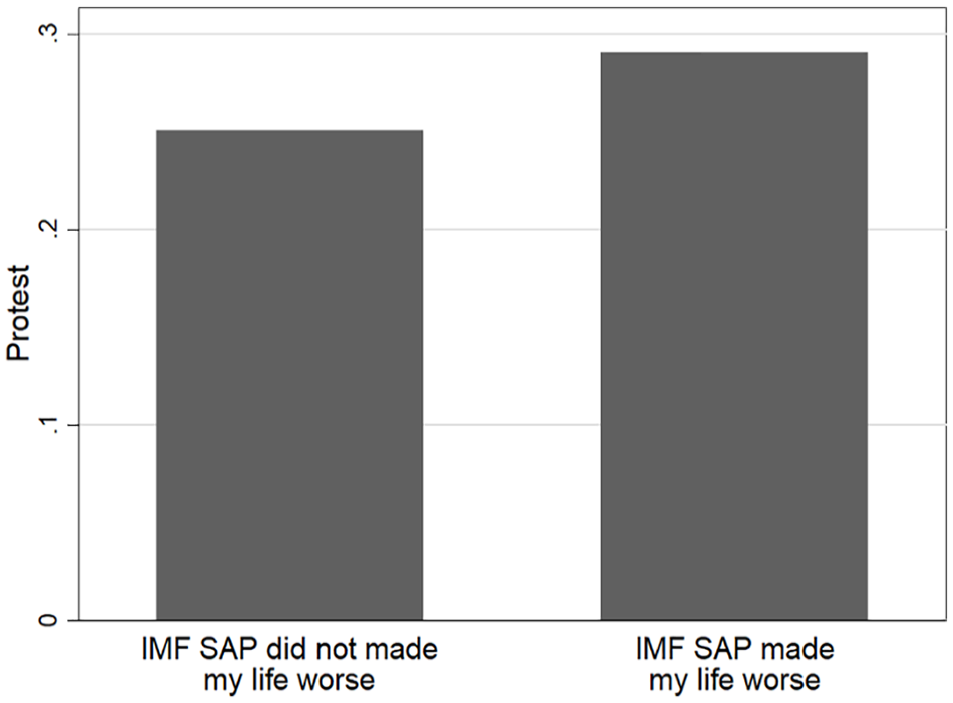
IMF SAP evaluations and protest.
Our primary empirical strategy, however, exploits country-level variation in IMF participation and SAP design and different individual-level partisan allegiances to mitigate concerns about perceptive biases. Our outcome of interest, protest, indicates whether the respondent has engaged in protest or considered doing so in the past five years. The corresponding survey question reads: ‘Here are a number of different actions people might take if [the] government were to do something they thought was wrong or harmful. For each of these, please tell me whether you have engaged in this activity or not: Attend a demonstration or protest march?’ Answer categories included: ‘Yes, often’, ‘yes, a few times’, ‘yes, once or twice’, ‘no, but would do if I had the chance’, ‘no, would never do this’, and ‘don’t know’. 3 We consider whether an individual actually protested or expressed an inclination to protest, as encoded in the first four response options. For robustness tests, we consider only actual protest behavior, as encoded in the first three response options, which produces similar findings.
Our predictors are measured at two levels of analysis and taken from different data sources. At the country level, we measure whether a country is under an IMF program up to four years before the survey date. This operationalization allows for a one-year lead in program implementation, which is appropriate considering that programs regularly include prior actions that governments must implement before being able to access IMF credit. In addition, we capture whether IMF SAPs include public-sector conditionality in the year before the survey. This closely follows our theoretical argument about public-sector reforms being a particularly contested area of IMF SAPs involving well-organized groups that can mobilize protest. 4 We draw both pieces of information from the IMF Monitor Database (Kentikelenis et al., 2016).
At the individual level, partisan identification captures the alignment between the governing party and the vote choice of a respondent in the previous election. This variable helps us distinguish between government supporters, opposition supporters, and non-partisans who did not participate in the election. We verify that most countries in the sample had their past elections four years before the survey took place. Hence, our measure of partisan alignment is unlikely to respond to choices that governments made during IMF program implementation but rather precedes them (Table A1 in the Online appendix). For our main analyses, we include all respondents. In robustness checks, we focus on the difference between opposition supporters and government supporters, dropping non-partisan individuals.
Given the potential for unobserved country heterogeneity, we estimate linear-probability models with country-fixed effects and cluster standard errors by country. We probe the robustness of our findings to three sets of controls. The first is a stripped-down model with only country-fixed effects. The second model includes standard demographic control variables that are known to affect protest (Gurr, 1970; Regan and Norton, 2005; Saxton, 2005). These variables include the logged age of the respondent and dummies for whether the respondent is male, employed, educated, urban-based, and supports democracy. Third, we include indicators for whether the respondent believes the government performs poorly, and whether respondents think the economy does worse than 12 months ago. We also gauge respondent preferences for not retrenching the public sector even if this was costly to the country. Finally, we capture political grievances against the government by measuring whether the respondent believes the government is run to benefit the few, if the right to free assembly has become more restrictive, and if society has become more unequal compared to the previous regime. The Online appendix includes definitions and descriptive statistics for all variables (Table A2).
Results
IMF programs, partisan politics, and protest
We expected that submission to IMF SAPs increases the partisan gap in protest. Figure 2 shows that without IMF SAPs, the average proclivity for protest is similar for government supporters and opposition supporters. For countries under IMF SAPs, there is a significant difference across partisans. A bivariate t-test confirms that the likelihood of protest is about 36.7% (33.6%–39.8%) 5 for opposition supporters, but only 21.7% (19.7%–23.6%) for government supporters. This is consistent with the interpretation that governments lump IMF adjustment burdens onto opposition supporters, while shielding their own partisans.
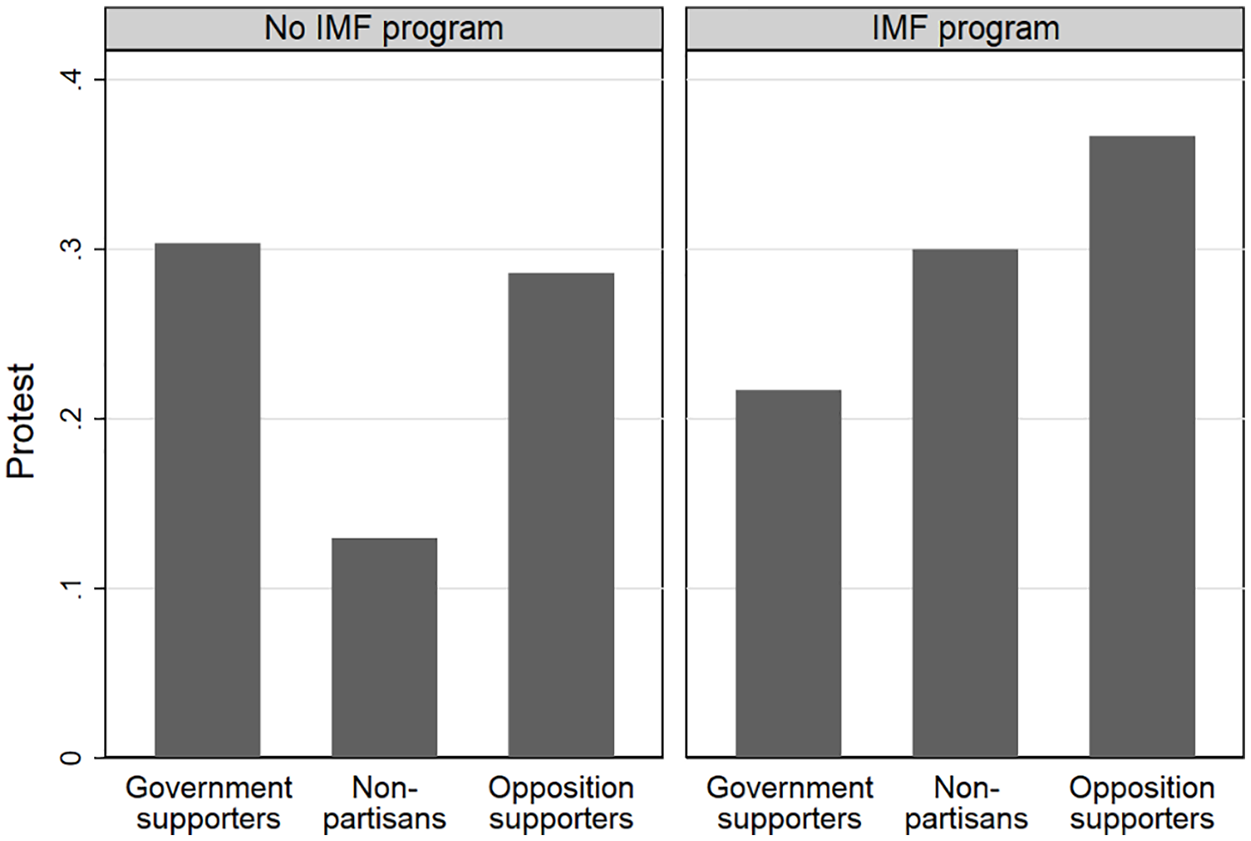
IMF programs, partisan identification, and protest.
Table I examines the relationship between IMF SAPs, partisan identification, and protest. Partisans are more likely to protest than non-partisans, reflecting their political mobilization. The partisan difference between government and opposition supporters in the likelihood of protest is not statistically significant in countries without IMF SAPs. 6 In contrast, the partisan difference is strongly significant in countries under IMF SAPs (p < 0.01). Substantively, the estimated probability of protest is 29.3% (26.2%–32.4%) for opposition supporters and 23.7% (21.2%–26.3%) for government supporters. A one-sided F-test confirms that this difference is highly significant (F > 37). These patterns are robust against different control variables, persisting even for our most taxing specification controlling for perceptions of government performance, corruption, and freedom of association.
IMF programs, partisanship, and protest.
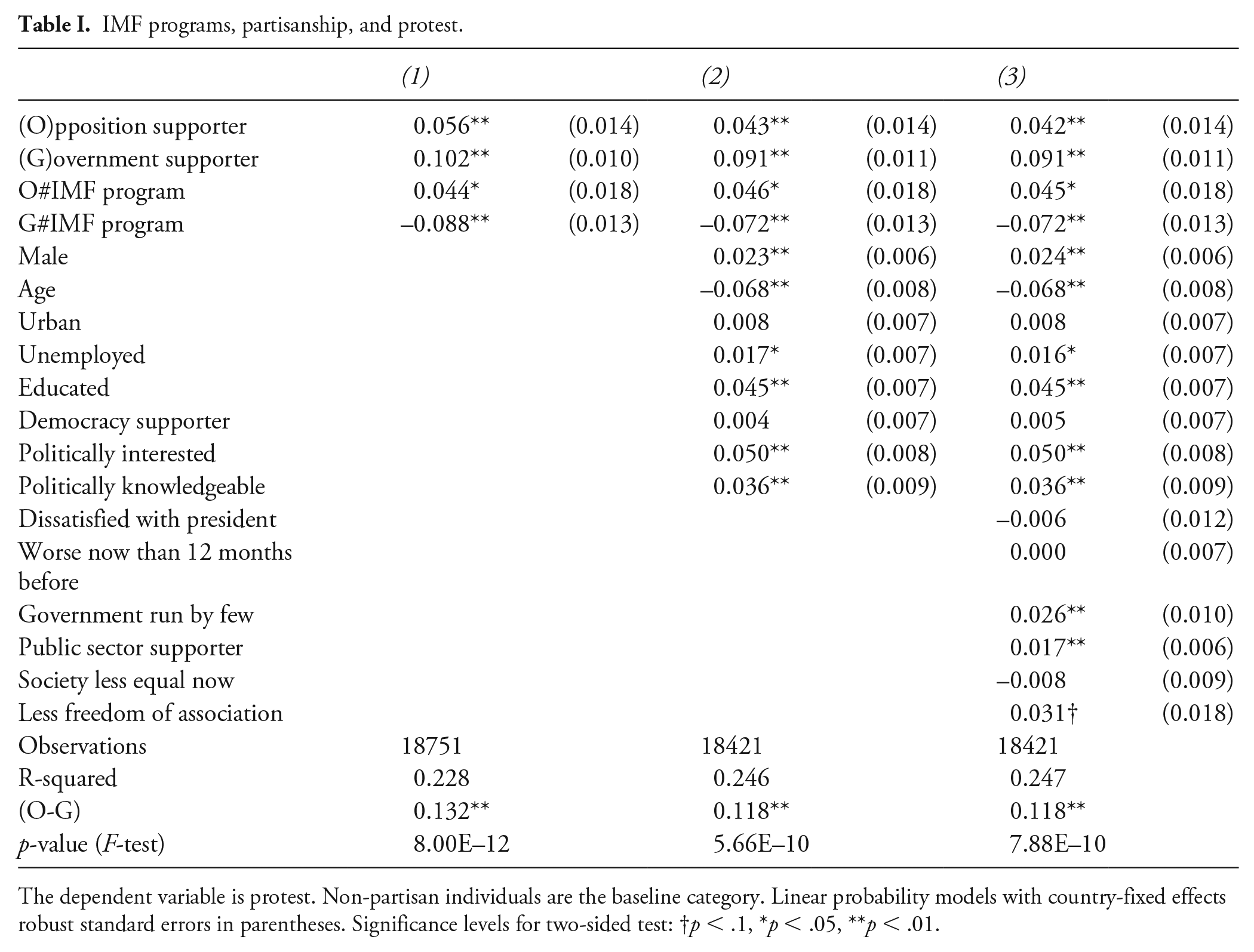
The dependent variable is protest. Non-partisan individuals are the baseline category. Linear probability models with country-fixed effects robust standard errors in parentheses. Significance levels for two-sided test: †p < .1, *p < .05, **p < .01.
Coefficient estimates of control variables are consistent with theoretical expectations. Males, younger individuals, unemployed people, and educated respondents are more likely to protest. Moreover, political interest and political knowledge are positively related to protest. Finally, individuals protest more if they believe the government is run for the few, if they expect the state to play a large role in society, and if they believe that freedom of association has worsened.
Public-sector conditionality, partisan politics, and protest
For countries under IMF SAPs, we expected that when programs entail public-sector conditionality, the partisan gap concerning protest increases. Figure 3 shows that for IMF borrowers without public-sector conditionality, protest is relatively less frequent than for borrowers with public-sector conditionality. 7 In contrast, for IMF borrowers facing public-sector conditionality, the likelihood of protest increases, specifically among opposition supporters. In substantive terms, the likelihood of protest is 35.4% (31.0%–39.8%) for government supporters and 65.8% (58.0%–73.5%) for opposition supporters. This suggests that partisan politics is a particularly strong driver of protest where IMF-mandated reforms target the public sector.
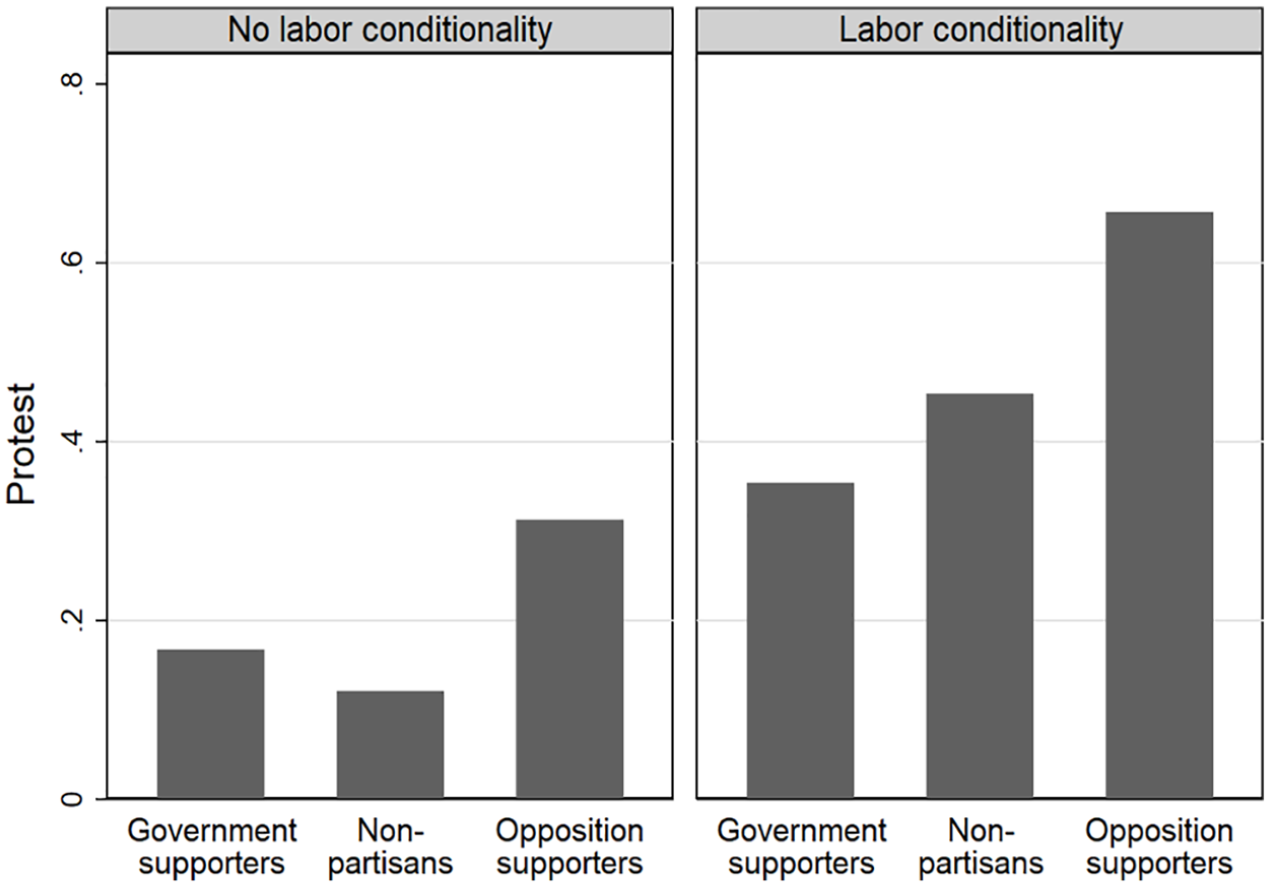
Program design, partisan identification, and protest.
Table II examines the relationship between public-sector conditionality, partisan identification, and protest in the context of IMF SAPs. In line with our earlier finding, protest is significantly more likely among opposition supporters than government supporters in a scenario without public-sector conditionality. 8 This partisan difference increases further when the IMF SAP includes public-sector conditionality. Substantively, the likelihood of protest, in this case, is 50.0% (42.3%–57.7%) for opposition supporters and 32.5% (27.4%–37.6%) for government supporters, implying a statistically significant difference of 17.5 percentage points.
IMF program design, partisanship, and protest.
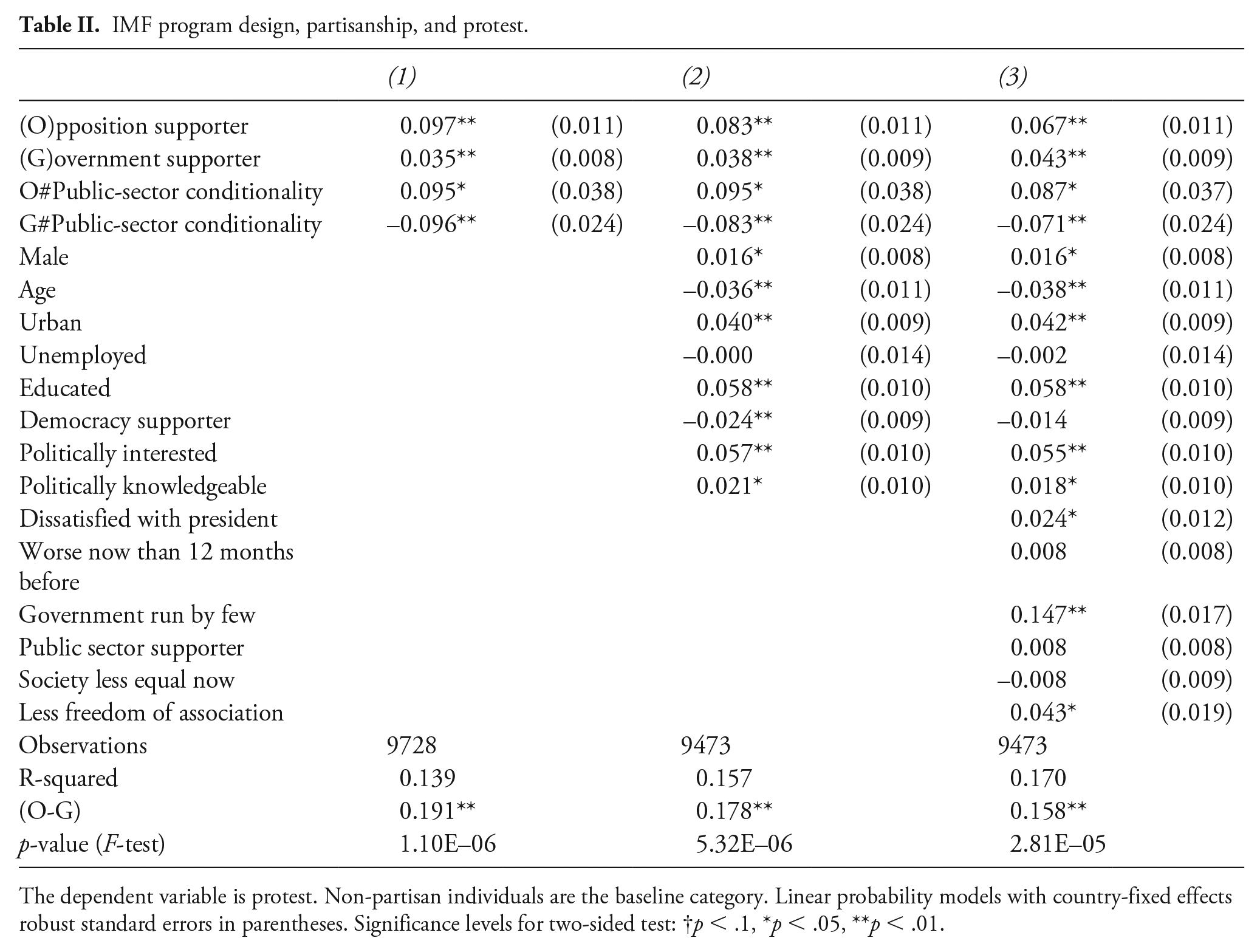
The dependent variable is protest. Non-partisan individuals are the baseline category. Linear probability models with country-fixed effects robust standard errors in parentheses. Significance levels for two-sided test: †p < .1, *p < .05, **p < .01.
In sum, our findings show diverging protest proclivity between different partisans when countries undergo IMF SAPs, especially with public-sector conditions. While results are not causal, they are consistent with the interpretation that governments lump adjustment burdens on opposition supporters, shielding their own supporters; this biased implementation of IMF adjustment measures induces protest among those who lose out because of such policies.
Robustness tests and further analyses
We conduct robustness tests and further analyses in the Online appendix and report on their results here. None of our robustness tests affects our main results. Considering alternative measurements, we define the dependent variable more narrowly, considering only actual protest behavior (Table A3). Furthermore, we dichotomize partisanship by dropping non-partisans from the sample. Opposition supporters are more likely to protest under IMF SAPs than government supporters, especially when IMF SAPs entail public-sector conditions (Table A4). We also probe alternative IMF measures, including an indicator of whether the country had an IMF program in the five years before the survey date, which allows for protest to erupt immediately at program announcement (Table A5), and a continuous measure of IMF exposure – the time share that a country has been under IMF programs between 1986 and the survey year (Table A6). Partisan gaps in protest are also larger for a higher (logged) number of public-sector conditions increases (Table A7), and when discounting conditions are waived by IMF staff (Table A8).
Varying methodological choices, we probe robustness against country-clustered standard errors, which are appropriate if the primary concern is about the non-independence of individuals within the same country. Coefficient estimates using country-clustered standard errors are less precise but there remains a marginally significant partisan difference under public-sector conditionality concerning protest (Table A9). Next, we pool observations by dropping country-fixed effects. The partisan difference in protest is insignificant for countries under IMF programs but becomes significant when programs entail public-sector conditions (Table A10).
Considering alternative explanations, we consider that respondent awareness of the IMF SAP may moderate their proclivity to protest. To that end, we include a binary indicator for whether people have heard about the IMF SAP of their country, along with its multiplicative interaction with partisan identification. We find that IMF SAP awareness amplifies partisan differences but operates independently of IMF conditionality (Table A11). Furthermore, we examine if opposition supporters protest not because they are treated badly by the incumbent government but because they resent the corruption of the political elite that may be exposed by an IMF program (Reinsberg et al., 2021). To address this issue, we add a measure of perceived corruption and its interaction with partisan identification. While corruption perceptions are positively related to protest, their inclusion leaves our main results unaffected (Table A12). We also assess the possibility that protest in the context of IMF SAPs is driven by negative sociotropic evaluations of these programs, again finding no changes in our core results (Table A13). Finally, we are concerned that other reforms confound the relationship of interest. To that end, we count the number of conditions not requiring public-sector reform. They do not affect protest for different partisans. Our results on public-sector reforms are unaffected (Table A14).
Protest may also be affected by local-level factors (Wegenast and Schneider, 2017). We integrate these factors in further robustness checks. First, we identify the administrative region of respondents, and measure its infant mortality rate, the female employment rate, and access to pipewater. For further robustness checks, we also source regional measures of population, wealth, and inequality. The data are from the Global Development Lab (Smits, 2016). Second, below the regional level, we identify the grid cell that encloses a respondent using spatial information from the Afrobarometer and the PRIO-GRID (Tollefsen et al., 2012). At the cell level, we measure the share of mountainous terrain (Blyth et al., 2002), travel time to the nearest major city (Uchida and Nelson 2009), the prevalence of urban areas in the cell (Bontemps et al., 2009), and whether the cell harbors any excluded ethnic groups (Vogt et al., 2015). In more extensive checks, we add measures of drug plantations, gemstones, and primary diamonds (Lujala, 2009).
Including controls at district level and grid-cell level leaves our results on IMF SAPs unaffected. This holds for using the baseline set of controls (Table A15) as well as an extended control set (Table A16). While we are cautious not to interpret those controls causally (Keele et al., 2020), we note that only higher female employment at the district level is consistently related to lower protest. At the grid cell, we find robust associations between protest and excluded groups, natural resources except primary diamonds, and urbanization. When comparing only across IMF program countries, we corroborate that the partisan gap in protest widens when programs include public-sector conditionality, for both the baseline controls (Table A17) and additional controls (Table A18). In further analyses, we estimate multilevel models with random intercepts for each level to better understand the variation across policymaking levels. Our core results hold. This is not surprising given that there is limited variation at higher levels of analysis – evidenced by low interclass correlation coefficients – suggesting that pooling observations within countries is highly appropriate (Table A19).
A final potential objection to our findings is that protest is driven merely by the perceptive biases of different partisans rather than biased implementation of IMF SAPs by the government. We confront this issue by replicating our findings using an index of deprivation capturing material hardships across four dimensions: food, income, healthcare, and freshwater. For each item, respondents are asked how often they went without it in the past 12 months. We find that opposition supporters are significantly more likely than government supporters to respond that they endured hardships, but only when the government is under an IMF program (Table A20). These findings suggest a greater divergence in protest across different partisans due to governments allocating adjustment pressures strategically. 9
Conclusion
We found that individuals during IMF SAPs are significantly more likely to protest when they supported opposition parties in the past election and when IMF programs included public-sector conditionality. Our qualitative evidence and statistical tests support the notion that governments trigger protest by allocating the burdens of adjustment disproportionally to opposition supporters, while containing protest among their own supporters whom they shield from adjustment burdens. We demonstrated these patterns using underexplored survey questions from Afrobarometer for 12 countries in 1999–2001 – a peak point of IMF SAPs in the region. Our analyses controlled for varying predispositions of different individuals and societal groups to evaluate the incumbent administration differently and withstood robustness tests and different modelling choices.
Before discussing some broader implications of our work, we note three limitations. First, we cannot fully address the problem of perceptive bias due to pre-existing partisan allegiances. In other words, people may hold more critical opinions about IMF SAPs because they sympathize with the opposition rather than facing additional adjustment burdens because of distributional politics (Evans and Andersen, 2006; Tilley and Hobolt, 2011). To allay this concern, we exploited exogenous variation in IMF program design, finding that partisan protest increases when programs include public-sector conditionality. We also controlled for whether respondents are informed about IMF SAPs, thereby eliminating perceptive biases due to systematic differences in the information environment. We further probed the robustness of our findings to experiences of hardship, finding that opposition supporters are more likely to report experiencing hardships than government supporters, but only when the government underwent an IMF program. Although each of these remedies is imperfect, they jointly support the conclusion that our results are unlikely to reflect only perceptive biases. In an ideal scenario, we would have a respondent panel to remove individual idiosyncratic effects (Schutte et al., 2022), but such data are unavailable. We leave it to future research to address this issue through more tailored survey designs. Second, while differential partisan treatment provides the basis for opposition protest, we are mindful that grievances need to be channeled and organized to result in protest. We did not further model the factors explaining when protests occur (Gurr, 1970; Regan and Norton, 2005; Tilly, 1978), although our results for public-sector conditionality suggest that protest is most likely where IMF SAPs target individuals with the capacity for collective mobilization such as public-sector workers. Future research should probe the generalizability of our findings beyond sub-Saharan Africa. Third, while individual-level data are inappropriate for untangling whether intensified partisan politics is the result of the IMF program or the economic trouble preceding it, existing country-level literature suggests that IMF programs can induce protest beyond these economic woes (Reinsberg et al., 2023). Even among IMF borrowers, we found a larger partisan protest gap in countries with more binding public-sector conditions, which suggests that IMF program design is important for protest prevalence.
Our study resonates with a burgeoning literature on the local distributive politics of foreign aid (Dreher et al., 2019; Jablonski, 2014; Knutsen and Kotsadam, 2020). Ours is the first individual-level study to unpack protest in the context of IMF SAPs, providing evidence to suggest that strong IMF policy pressure fuels partisan politics. While extending the empirical scope of foreign aid studies into the domain of IMF SAPs, we also note some important differences. Specifically, unlike foreign aid projects, IMF loans are not targeted to specific geo-spatial locations, thereby making geo-spatial identification strategies challenging. Our analytical framework remedies this problem by exploiting differences in program design that imply a varying scope for governments to engage in distributional politics. We found effects on partisan protest to be stronger for IMF SAPs with public-sector conditions than those without. We encourage further research on the spatial effects of IMF SAPs.
For policymakers, our results illustrate how global policy pressures by international financial institutions are moderated by local distributional politics to affect individual attitudes and socio-political outcomes. Hence, we conduct systematic large-N individual-level tests of long-held arguments by political economists (Haggard and Kaufman, 1992). Our results underscore that borrowing governments are not innocent bystanders in adjustment processes but can amplify pre-existing grievances by how they put external policy demands into practice. Our results therefore qualify the scope of policy space reduction that is often associated with external adjustment programs (Kentikelenis et al., 2016). To be sure, the IMF has sought to reform its lending practices, including through a greater emphasis on poverty and inequality (Oberdabernig, 2013), alongside embracing new economic thinking on some macroeconomic policies (Ban, 2015; Broome, 2015; Gallagher and Tian, 2017). However, these shifts are unlikely to affect the politically biased implementation of its programs, which it has no legal means to prevent. Yet, the IMF could require borrowing governments to consult opposition parties and civil society organizations in the crafting of adjustment programs. This would likely improve buy-in and reduce the likelihood of protest. For future research, we therefore advocate analyses of the linkages between the macro-policy level and the individual level to better understand the link between political attitudes and behaviors in structural adjustment processes.
Footnotes
Acknowledgements
We would like to thank Despina Alexiadou, Patrick Bayer, Margit Bussmann, Stefanie Reher, and participants of the UCL Comparative Political Economy and Behavior research seminar (6 October 2020), the workshop ‘The political economy of the security−development nexus’ at the University of Glasgow (21 January 2021), and the Political Economy group at Strathclyde University (8 May 2021) for excellent comments. The authors declare no conflict of interest.
Replication data
Replication data for this article are freely available on  and Harvard Dataverse (https://doi.org/10.7910/DVN/JT1HY9). The Online appendix, which includes additional data documentation and further robustness checks, is available at https://www.prio.org/jpr/datasets/.
Funding
Financial support by the Gerda Henkel Foundation (‘The human security implications of IMF programs’) is gratefully acknowledged.
Notes
BERNHARD REINSBERG, PhD in Comparative and International Studies (University of Zurich, 2016); Reader, University of Glasgow (2018– ) and Research Associate in Political Economy at the University of Cambridge (2016– ); current research interests: international organizations, foreign aid, political economy.
M RODWAN ABOUHARB, PhD in Political Science (Binghamton University, 2005); Associate Professor, University College London (2009– ); current research interests: human rights, human security, international financial institutions, structural adjustment lending.