




Abstract
Armed conflicts are expected to be harmful to education but micro-level studies find at times contradicting results. Therefore, this article identifies under which conditions and to what extent armed conflicts harm the long-term educational attainment of children in rural Sub-Saharan Africa. By combining 66 rounds of DHS surveys with geo-coded conflict information, our study contextualizes the findings of a series of country-specific case studies on the effects of conflict on education, and provides evidence on the mechanisms through which these effects occur. Our main identification strategy compares educational losses of youth living within the same household, while also controlling for local weather shocks and countrywide dynamics in education. The effects of conflict on education are strongly context-dependent. High-intensity conflicts reduce local educational attainment on average, although this effect becomes insignificant in strong autocracies. By contrast, education is generally unaffected by localized low-intensity conflict. Human capital loss due to conflict is most severely felt in weak states, and in response to non-state based conflicts, highlighting the importance of state capacity in mediating the educational costs of local conflicts.
Introduction
Education is a basic human right and a crucial determinant of economic and social development. Yet, violent conflicts often disrupt children’s education. This is especially true in West and Central Africa, where Islamic rebel groups target schools to oppose Western-values-based education, representing one quarter of all school attacks in the world (UNICEF, 2019). The threat of localized violence spreads fear in the affected communities, leaving school children at home and thousands of schools closed, or children traumatized and too anxious to learn (UNICEF, 2019). When students become displaced, refugee camps often cannot provide them with adequate education. This raises the question about the long-term consequences of conflict on educational attainment in conflict-affected communities.
The literature on the effects of conflict on education is substantial, yet the available case studies yield partly contradictory results (e.g. Akbulut-Yuksel, 2014; Foltz & Opoku-Agyemang, 2011; León, 2012). They present a wide range of estimates, spanning from positive effects of 0.2 years more of education per conflict year to negative effects of 0.9 years of education lost (e.g. Akbulut-Yuksel, 2014; Foltz & Opoku-Agyemang, 2011; Bertoni et al., 2019; León, 2012; Lee, 2014; La Mattina, 2018; Shemyakina, 2011). These country-specific studies focus on various types of conflict with distinct intensities and actors within specific country contexts, and fail to generalize their results to a wider range of violent conflicts and their determinants. From a macroeconomic perspective, Lai & Thyne (2007) and Gates et al. (2012) provide first cross-country evidence, analyzing the short-term effects of conflict on education. Lai & Thyne (2007) conclude that conflicts hamper the supply of education by the state.
This study contributes to reducing the gap between the micro and macro studies by identifying under which conditions and to what extent localized conflict exposure during childhood influences the educational attainment of youth in rural areas of Sub-Saharan Africa. We focus on long-term effects and consider conflict characteristics (their severity and actors), individual characteristics (age of conflict exposure and gender), country and location characteristics (political regime type, economic development, ethnic fractionalization and natural resources deposits) as important determinants of conflict effects. These conditions either follow the previous literature (e.g. León, 2012) or are closely linked to the concepts of state capacity and public goods provision – the channel that we investigate in more detail in this article. By extending the geographical scope of the analysis to a rural sample from 31 countries in Sub-Saharan Africa, our empirical study helps to generalize the findings of country-specific case studies on the costs of conflict in terms of lost education. Sub-Saharan Africa provides the optimal setting for such a study, being one of the most conflict-ridden regions in the world. At the same time, education is still far from universal in many countries of this region.
Our empirical analysis combines data from 66 demographic and health surveys (DHS) with geo-coded information on conflict events, provided by the Uppsala Conflict Data Program (UCDP). We determine potential conflict exposure through an exact measure of the distance between the current survey location of 10–26-year-olds and the geo-coded location of past conflict events, calculating potential exposure to violent events that have occurred within a 50 km radius of the survey location during different age periods. We focus on rural areas of Sub-Saharan Africa, as they have substantially fewer migrants than the quickly developing cities and the majority of displaced people either return to their homes after conflict or move to urban areas (Awumbila, 2017). We further assess the scope of a potential bias because of wrongly imputed conflict history of migrants by repeating our analysis for a sub-sample of data with migration information.
Our identification strategy relies on a set of fixed effects along two main dimensions. First, household (or location) fixed effects absorb the geographic and socio-economic variation in the average propensity to experience conflict. Second, country-specific birth cohort fixed effects capture yearly changes in the national economic, conflict, and political environment. In our preferred specifications, we combine these two sets of non-nested fixed effects.
Our results show that exposure to low-intensity conflict cannot be robustly linked to educational attainment in rural Sub-Saharan Africa. But, conflicts of substantial severity cause average losses in local education. One additional year of high-intensity conflict (1,000 and more casualties) reduces average education by 1.4 months. The effects of conflict concentrate among the most exposed children: Among the upper 5% of children living in the most violence-prone locations, the average losses from high-intensity conflicts reach up to 7 months. Conflicts are especially harmful to education when state capacity is impaired. Strongly autocratic systems are more successful at sustaining public goods provision during periods of intense violence compared to weak states and strong democracies. When we compare exposure at different age periods, we find no differences on average, confirming both the early childhood and fetal origin theories. With respect to gender, high-intensity conflict seems to affect boys’ education somewhat more negatively than girls’ education.
Theoretical considerations
The microeconomic framework of the educational process by Glewwe & Kremer (2006) offers a way of understanding through which channels violent conflicts affect educational outcomes. Within this framework, parents decide on the optimal amount of schooling for their children by maximizing household utility depending on their budget constraint and the production function for education:

The optimal decision depends on the costs of schooling K, the quality of schooling Q, household and child characteristics, H and C, and environmental factors E such as the local labor market, safety or culture. Conflicts can affect all of these factors and thereby shape schooling outcomes.
Conflicts increase the individual costs of schooling (K) by raising the need for safety precautions on the side of the parents or the schools. They also increase the opportunity costs of education as hiding, fleeing, working or fighting may become more important than attending school. Large-scale conflicts may additionally destroy schools and road infrastructure, increasing the costs of accessing education. Diminished tax revenues and the redirection of public funds towards military expenditures may also endanger the public provision of education (Besley & Persson, 2014). If conflicts provoke humanitarian crises, the ensuing displacement will disrupt education further (Justino, 2016). Conflicts may hurt or scare away qualified teachers, reducing the quality of schooling (Q) or even compromising the functioning of school systems altogether (Lai & Thyne, 2007; Monteiro & Rocha, 2017).
Conflicts may also alter household (H) and child (C) characteristics as well as environmental factors (E). A whole range of economic shocks can be triggered by conflicts that may inhibit educational investment and increase the need for child labor (Shemyakina, 2011; Akresh & De Walque, 2008). For instance, violent conflicts shape the local labor market, reducing the returns to education. They also can reduce the learning capacity of children due to undernourishment and psychological distress (Cunha & Heckman, 2007; Justino, 2016). Conflict exposure in utero and early childhood can have long-term consequences on neurological development and basic mental faculties that determine future abilities (Cunha & Heckman, 2007; Almond & Currie, 2011). Other environmental factors, such as landmines or physical dangers on the way to school, may cause school drop-outs (Justino, 2016). Taken these arguments together, we expect that:
Hypothesis 1: Violent conflicts increase the costs of education and decrease its benefits, resulting in lower schooling attainment on average in cohorts that were exposed to conflict during their childhood.
Such effects are likely to be heterogeneous, depending on the intensity of conflict, age of exposure, gender, conflict type, and state capacity. Violent conflict refers to a wide range of events from a violent demonstration to more protracted fighting during a civil war. A single violent event may affect the security environment, changing the risk assessment of parents in the decision of schooling, but it is less likely to have long-term consequences on the local educational attainment. By contrast, protracted or high-intensity conflict can destabilize communities, destroy the supply of education and affect virtually all elements in the education production function. Hence, we expect that:
Hypothesis 2: Low-intensity conflicts have no effect on the long-term educational attainment of the cohorts exposed to them in childhood, whereas high-intensity conflicts harm education more substantially.
We do not have clear-cut expectations on how the age at exposure or gender moderates the educational effects of conflict in general. In utero and early childhood conflict experiences may affect later educational decisions by inhibiting cognitive and non-cognitive development (Cunha & Heckman, 2007), whereas conflicts experienced at school age may reduce education more directly. Returns to education and exposure to conflict can differ by gender. Girls are more threatened by sexual violence and households may react more strongly to security concerns due to lower-intensity conflicts by keeping girls at home (Shemyakina, 2011). Young boys are recruitment targets for armies and rebel groups (Justino, 2016) and may suffer from high-intensity conflict more than girls.
The effects of conflict on education depend on whether actors involved in conflicts target the education system explicitly. Rebel groups attack schools to recruit children and destabilize the community. Fighting between rebel groups hampers the education of children who are involved in combat but also of all others by dispersing fear and insecurity in the region. By contrast, governmental actors may try to reduce the civilian burden of local fighting and protect the provision of education more strongly. Thus, we expect that:
Hypothesis 3: Conflicts between rebel groups or direct violence towards civilians affect educational attainment of the exposed cohorts by more than conflicts with direct state involvement.
Education is commonly a state-provided public good (Daviet, 2016). The supply of education depends on state capacity, which includes financial resources, administrative knowledge, and military and political power to establish and maintain well-functioning institutions that provide public goods and services. Countries with lower state capacity provide fewer public goods on average, resulting in lower levels of human capital development (Besley & Persson, 2014). The likelihood of unrest is reduced if a state is capable to repress insurgencies and accommodate grievances (Hendrix, 2010; Fearon & Laitin, 2003). Likewise, the under-provision of basic social security decreases the opportunity costs of fighting for the local population (Collier & Hoeffler, 2004). Hence, countries with lower state capacity are more likely to face revolts and at the same time have fewer resources to counteract them.
Hypothesis 4: State capacity is an important moderator in the relationship between conflict and education.
Conflicts may reduce the financial resources for public goods provision. First, conflict-induced economic crises are likely to reduce tax revenues. Education in wealthier regions may be less affected due to lower budget constraints (Hypothesis 4a). Second, local natural resource endowments are targets for rebel groups during conflicts, fueling localized conflicts and further increasing educational losses as rebels recruit significantly more child soldiers (Hypothesis 4b) (Haer, Faulkner & Whitaker, 2020). Third, governments may redirect educational funds towards military spending in crisis. This is less likely to happen in strong autocracies where the military is generally substantially better funded (Brauner, 2015). Moreover, a robustly functioning administrative system can also help in protecting the provision of education in strong states. Hence, we would expect that violent conflicts cause larger educational losses in relatively weaker political systems (Hypothesis 4c). Finally, the costs of governance and the need for cooperation increase with the populations’ heterogeneity (Habyarimana et al., 2007). During conflicts, group identification is often used to mobilize fighters, exacerbating existing social divides and worsening the provision of education (Hypothesis 4d).
Data and empirical strategy
Data sources
Our analysis relies on two main data sources: DHS household data and the UCDP dataset. The DHS program offers standardized, nationally representative household surveys for many countries including all kinds of socio-demographic characteristics. We use the most recent rounds of the standard surveys (2001–2016), which include geo-located survey locations (ICF, 2016). 1 Since we measure conflict exposure by direct geodesic distance to the survey location and since distance translates to substantially different travel times in urban as compared to rural areas, we restrict our sample to rural areas of Sub-Saharan Africa only. 2 More importantly, past migration experiences that could potentially bias our estimates downwards by making us assign past conflict history to unaffected youth are less prevalent in rural areas, as the overall migration patterns in Sub-Saharan Africa show a clear rural to urban trend (Awumbila, 2017). 3
The UCDP geo-referenced event dataset (GED, Version 5.0) provides conflict event data for the years 1989 to 2015 (Sundberg & Melander, 2013). It contains information on the date and location of conflict events as well as the estimated no. of fatalities. When restricted to Sub-Saharan African countries, the dataset reports 26,970 conflict events.
Additionally, we use precipitation anomalies (at a resolution of 0.5
For the heterogeneity analysis, national income per capita is taken from the Word Development Indicators provided by the World Bank (WorldBank, 2016) and national ethnic diversity is measured by the ethnic fractionalization index proposed by Montalvo & Reynal-Querol (2005). To quantify differences between political regimes, we use the polity2 variable from the Polity IV Project, which ranks a political regime’s form of government on a scale ranging from –10 (strong autocracy) to +10 (strong democracy) (Marshall, Gurr & Jaggers, 2019). We proxy for local GDP and economic development using satellite data on the intensity of nighttime lighting, gathered from the National Oceanic and Atmospheric Administration’s (NOAA) Earth Observatory Group (NOAA, 2019). We use version 4 of the DMSP-OLS Nighttime Lights Time Series, which provides yearly average visible stable lights at cloud-free coverage for the years 1992 to 2013 and aggregate it to the resolution of 0.5
Measurement
Our outcome variable of interest is educational attainment, which we measure by the reported no. of completed school years in DHS. We determine potential conflict exposure during childhood by combining an individual’s birth year with their residence as reported in the survey. We restrict our dataset to individuals born between 1990 and 2003 and thus aged 10–26 years at the time of the survey for whom we can observe a full conflict history starting from their pre-birth year. 4
For our main explanatory variable, we utilize the UCDP dataset. We consider a conflict year to be one in which at least one conflict event took place within a 50 km radius of the survey location. 5 According to this definition, about 12% of all childhood years in the sample were conflict years.
In order to distinguish between the effects of conflicts of varying intensities, we estimate a variety of models by gradually adjusting our definition of a conflict year according to the no. of casualties in a given year (based on the best estimate category in the UCDP dataset). We re-define a conflict year as one in which at least one conflict event has taken place within 50 km of the survey location and in which the conflict events resulted in at least N deaths, with N ranging from 0 to 5,000.
6
We measure potential conflict exposure,
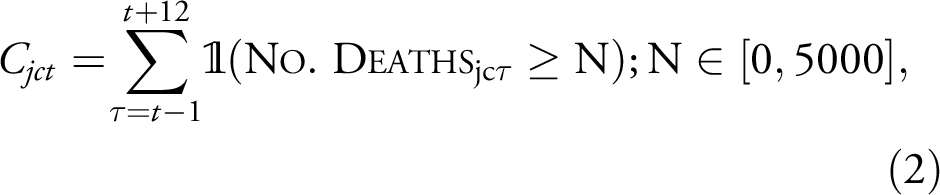
where
For the heterogeneity analyses, we use an alternative measure of conflict intensity by summing up the total no. of battle-related deaths and taking the logarithmic transformation, using the inverse hyperbolic sine function. For further analyses, we categorize conflict exposure years by the type of violence, as classified in the UCDP dataset, and the critical age periods of conflict exposure. The UCDP dataset categorizes conflicts into: (1) state-based conflicts, directly involving a state government; (2) non-state based conflicts, involving violence between two nongovernmental actors; (3) one-sided violence against civilians, which can be perpetrated by any organized actor (Sundberg & Melander, 2013). Regarding “critical age periods”, we follow the literature and distinguish between in utero (year preceding the birth year), early childhood (at age 0–3), pre-school age (age 4–6) and primary school age (age 7–12). 8
We control for location-specific economic shocks by measuring extreme weather events, which are based on the SPEI index measured on a 12-month scale. Months with SPEI values below –
To analyze the various channels through which conflict may affect education, we first classify countries based on their system of government; countries with polity2 scores below –5 for at least 10 of the included years are classified as strong autocracies, while those with polity2 scores above 5 for at least 10 years are classified as strong democracies. Next, we classify a location as being rich in natural resources if it is located within 50 km of a natural resource deposit. Geographic localities are further categorized based on whether they are above or below median values for ethnic fractionalization, income per capita, and local nighttime light intensity, on average, over time.
Summary statistics
Full sample:
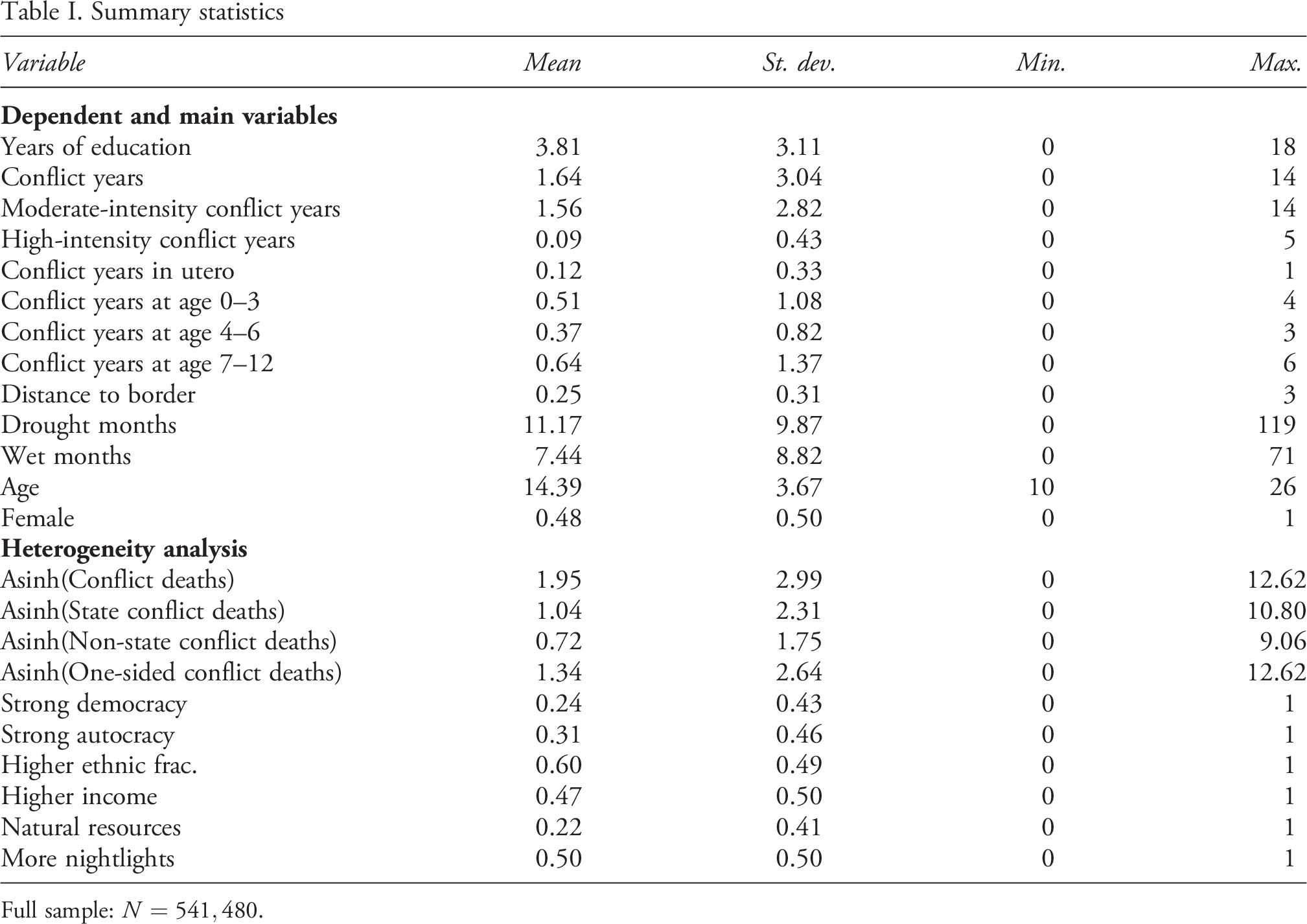
Restricting the sample to rural areas results in 541,480 observations located in 19,652 survey locations from 428 regions in 31 countries. All included surveys are listed in Table AI in the Online appendix. Table I reports summary statistics.
Youth in the sample have on average 3.8 years of schooling and about 1.6 years of exposure to any conflict during their childhood. Figure 1 maps the average no. of conflict years during childhood and completed school years per survey location. Detailed variable definitions are displayed in Table AXIII in the Online appendix.
Econometric model
We exploit the spatial and temporal variation in potential conflict exposure to infer the average effect of violent conflicts on educational attainment. Our econometric model regresses the no. of school years completed

where
Since conflicts do not occur randomly across space and over time, but rather are driven by political and economic causes, these driving factors could themselves be related to educational outcomes. For instance, a weak local labor market reduces the potential outside income of the local population, thereby reducing the opportunity costs of fighting, yet it may also reduce households’ ability and willingness to invest in education and the quality of local public service delivery. If we do not control for the underlying causes of conflict (weak institutions, ethnic tensions, economic shocks, etc.), we may overestimate the disruptive effects of conflict on education.
We address factors driving general conflict dynamics by controlling for an extensive set of fixed effects and Average years of conflict exposure and schooling per survey location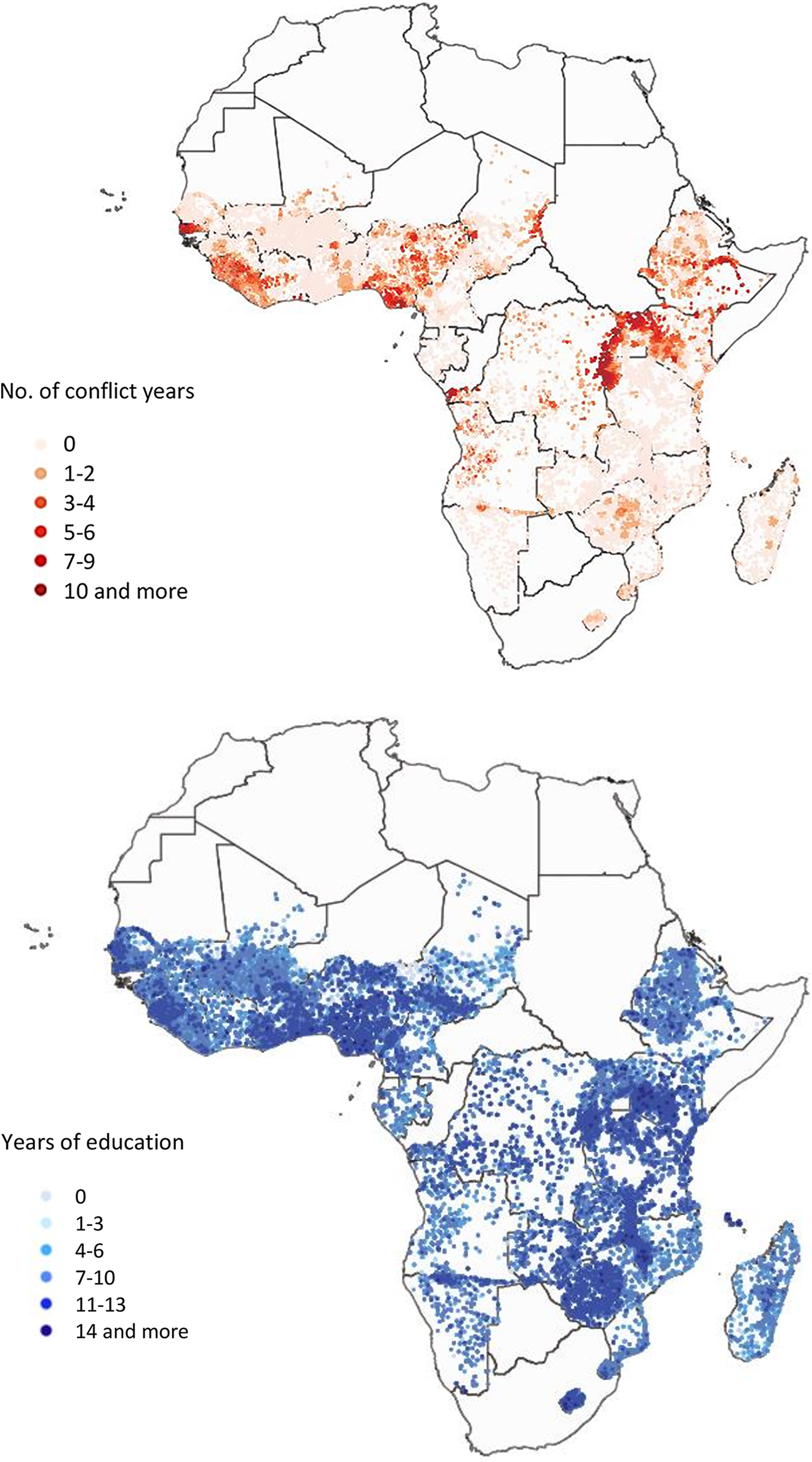
Our preferred specifications rely on a combination of these two types of non-nested fixed effects. They identify the effects of conflict based on within-household variation, comparing the educational attainment of different cohorts living within the same household who were differentially exposed to conflict, while at the same time factoring out all common time-varying dynamics that would affect the same cohort across all locations within a country. A remaining source of bias in our estimates comes from time-variant location-specific economic shocks, such as major weather shocks, which could potentially affect different parts of a country to varying degrees and which may affect both conflict and educational outcomes. Therefore, in our preferred specifications, we also control for a series of weather shocks, denoted by the vector
We rely on robust standard errors clustered at the first sub-national administrative level. Alternative specifications (see below) test the robustness of our results to other cluster specifications.
Issues of interpretation
We measure conflict exposure by linking past conflict incidence near a certain locality to the educational attainment of children and youth currently living in that locality. This measure does not capture direct individual exposure to conflict, but rather a location’s exposure to conflict. Since particularly high-intensity conflicts are likely to induce massive (although potentially transitory) migration (e.g. Czaika & Kis-Katos, 2009), conflict-exposed youth may not still reside in the same place they lived during the specified age periods. Many may have moved to different locations, at least temporarily, and some of them may not have returned. If migrant youth coming from conflict-affected locations still lag behind in education in their new location, this will lead us to underestimate the effects of conflict on average. On the contrary, if children with the best chances to complete their education (e.g. because of showing higher ability or coming from the wealthiest families) are more likely to leave in the face of conflict and/or are less likely to return after the conflict has subsided, our results may overestimate the individual costs of conflict. 9 Since DHS surveys do not collect information on migration systematically, we are left with a sub-sample that distinguishes migrant and non-migrant households. In the robustness section, the role of migration in the conflict-education link is analyzed in these two sub-samples.
The potential presence of migration-induced measurement errors cautions us to not interpret our estimates as precise measures of the individual costs of conflict on education. These limitations notwithstanding, our results have an unambiguous interpretation on the local level. Taking a regional economic approach, our results show how the cohort-wise distribution of human capital in a locality changes with its past conflict history. Local development is most likely to suffer, even in the long run, due to a resulting gap in human capital in conflict-affected cohorts.
Results
Exposure to conflicts of different severity
Conflict exposure and education
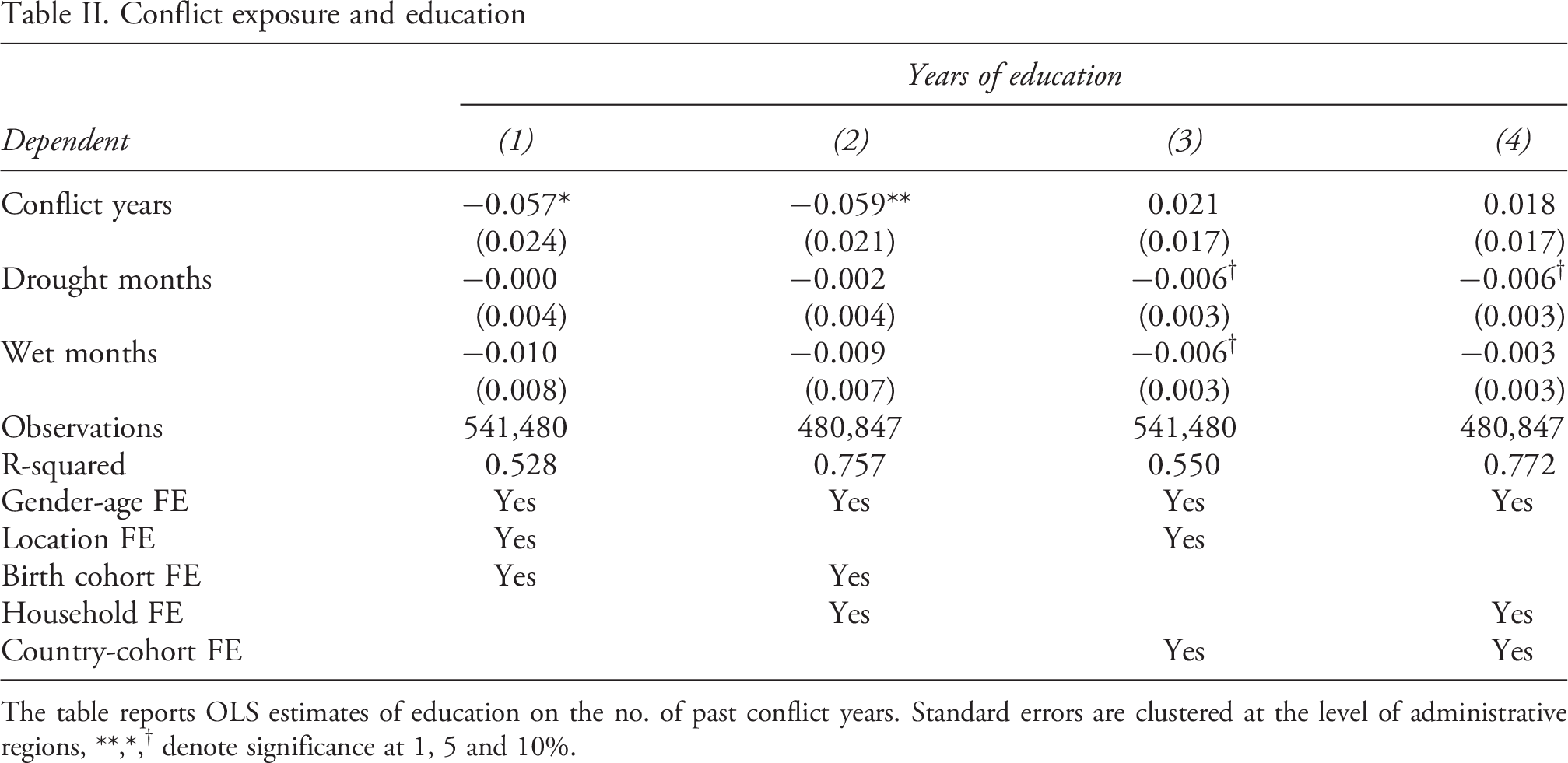
The table reports OLS estimates of education on the no. of past conflict years. Standard errors are clustered at the level of administrative regions, **,*,
In order to assess the effects of conflict intensity on education, we distinguish between moderate- and high-intensity conflict years based on the threshold of 1,000 casualties. The results in Table III confirm our expectations. In the first two columns, coefficients on moderate- and high-intensity conflict are both negative and significant, but the point estimates on high-intensity conflicts are about three times larger than those of moderate-intensity conflicts. Once we focus on within-country variation (columns 3 and 4), the significance of moderate-intensity conflicts vanishes, but high-intensity conflicts still stay significantly negative. Our most restrictive model in column 4 shows that while conflict of relatively lower intensity has no effect on the within-country variation in education, a further high-intensity conflict year reduces the no. of school years by 0.116 years or 1.4 months.
Intensity of conflict and education
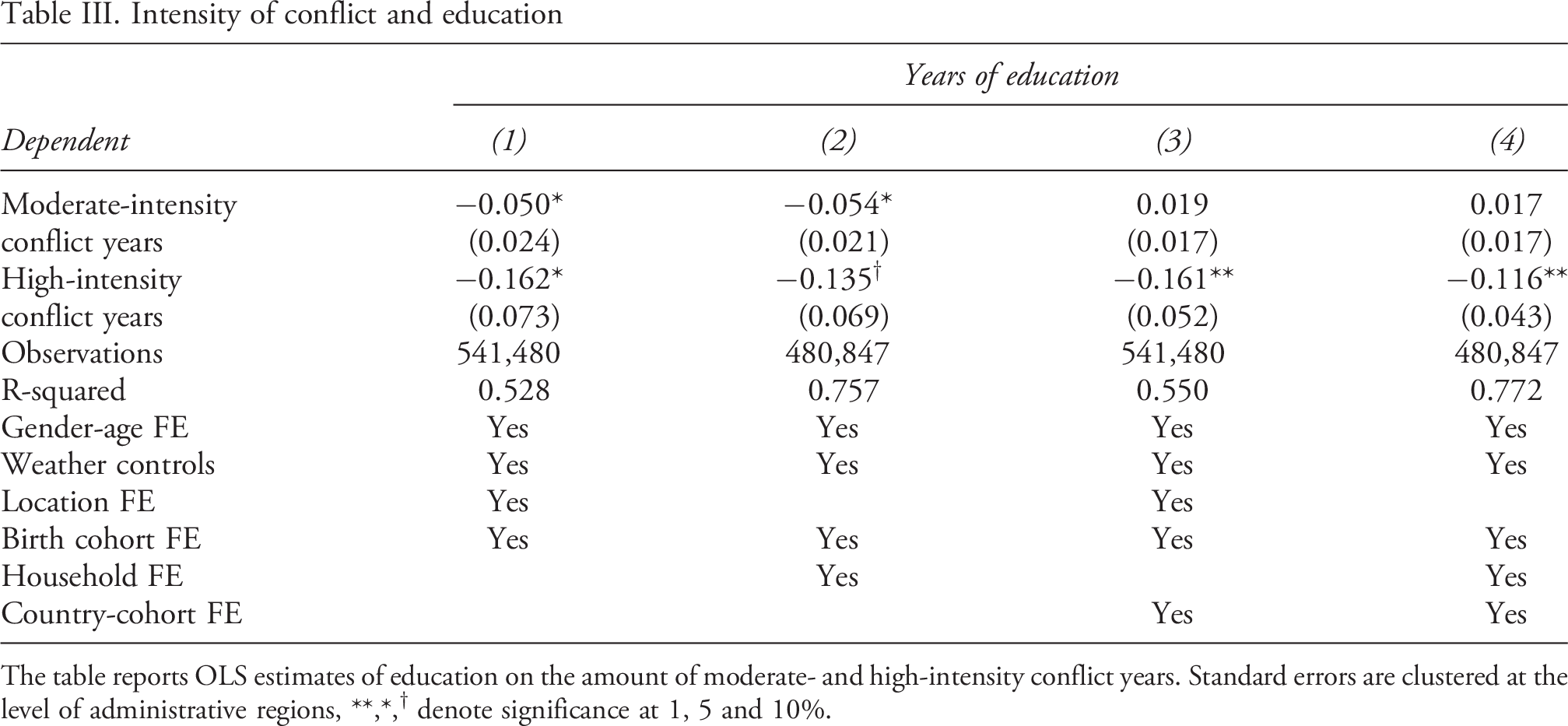
The table reports OLS estimates of education on the amount of moderate- and high-intensity conflict years. Standard errors are clustered at the level of administrative regions, **,*,
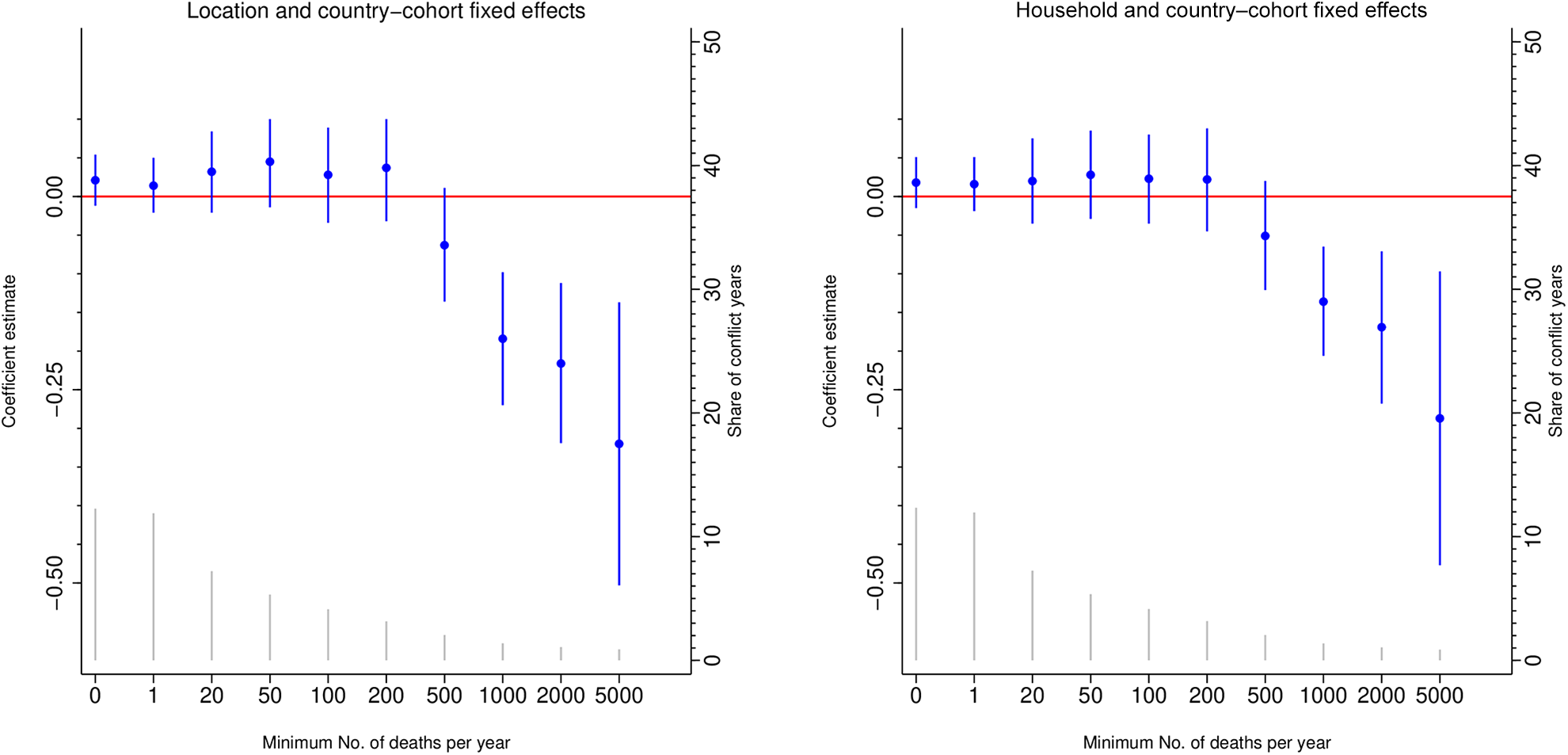
The effects of past conflict exposure on education by conflict severity
We differentiate the effects of conflict by age at exposure. We distinguish between conflict exposure in utero, during early childhood, pre-school age, and primary school age. Figure 3 presents the estimation results. Table AII in the Online appendix shows related results The effects of conflict on education by severity and age at exposure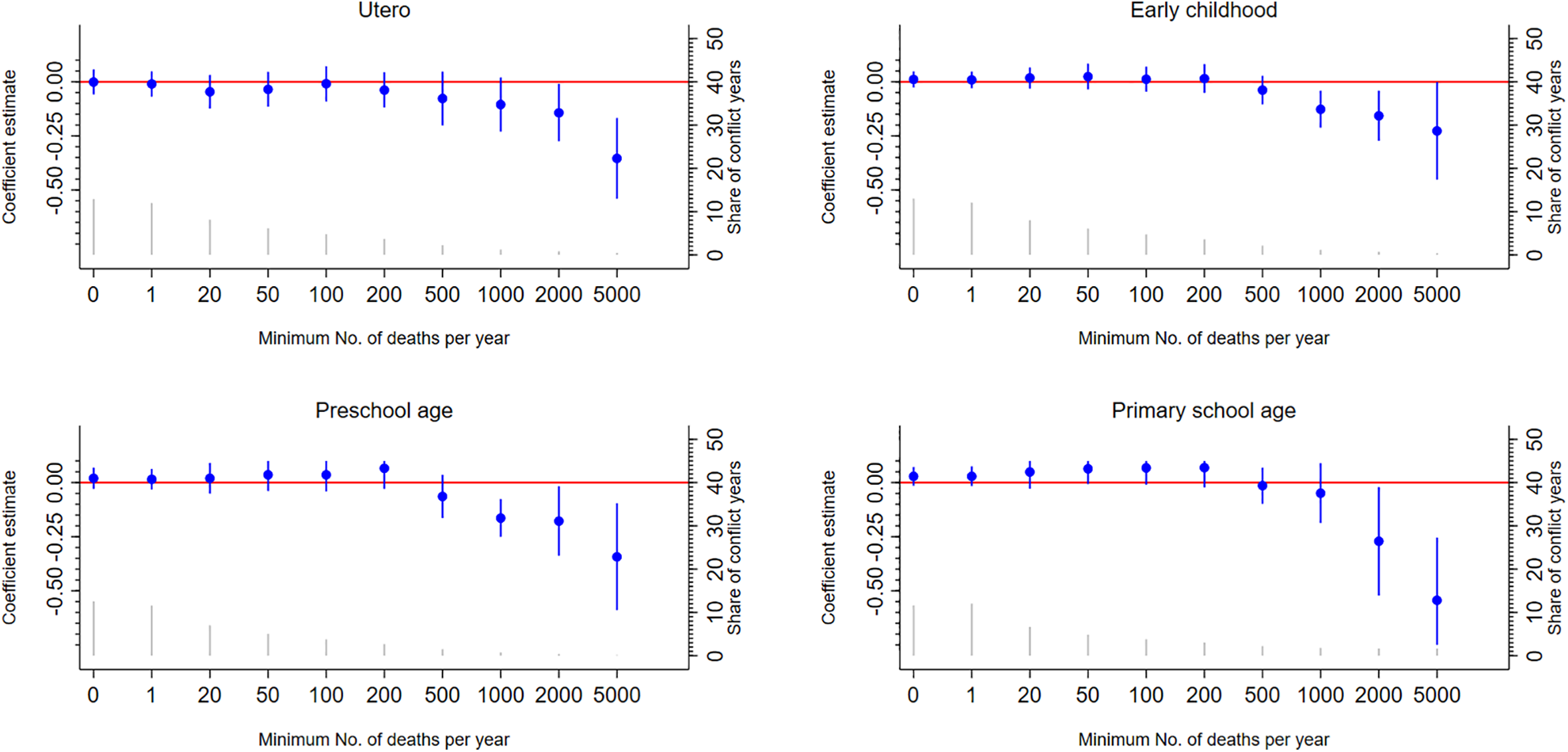
To compare the results by gender, Figure 4 shows a common baseline effect that turns more negative with conflict severity, and illustrates a differential effect for females. High-intensity conflicts reduce the educational attainment of boys more strongly than that of girls. However, there is no marked difference with respect to the effects of moderate-intensity conflict years. Table AIII in the Online appendix shows regression results differentiating between moderate- and high-intensity conflict by gender. The results show a weakly positive relationship between moderate-intensity conflicts and boys’ education, whereas the effect vanishes for girls. One additional year of Differential effects of conflict exposure by gender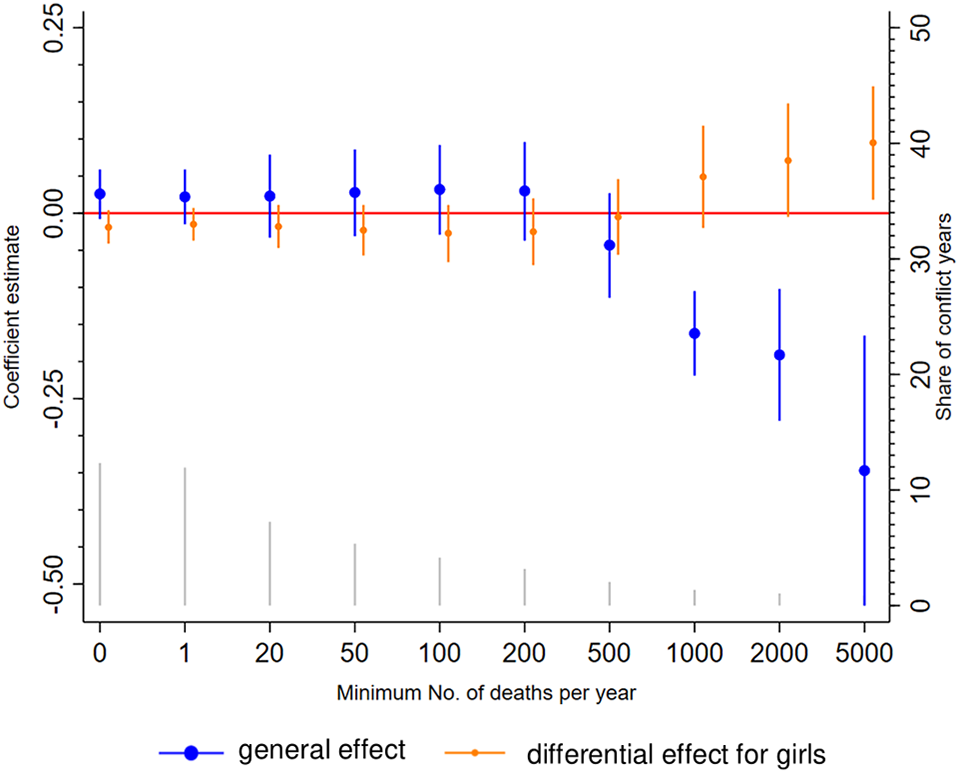
State capacity and further mechanisms
Heterogeneous effects by conflict type
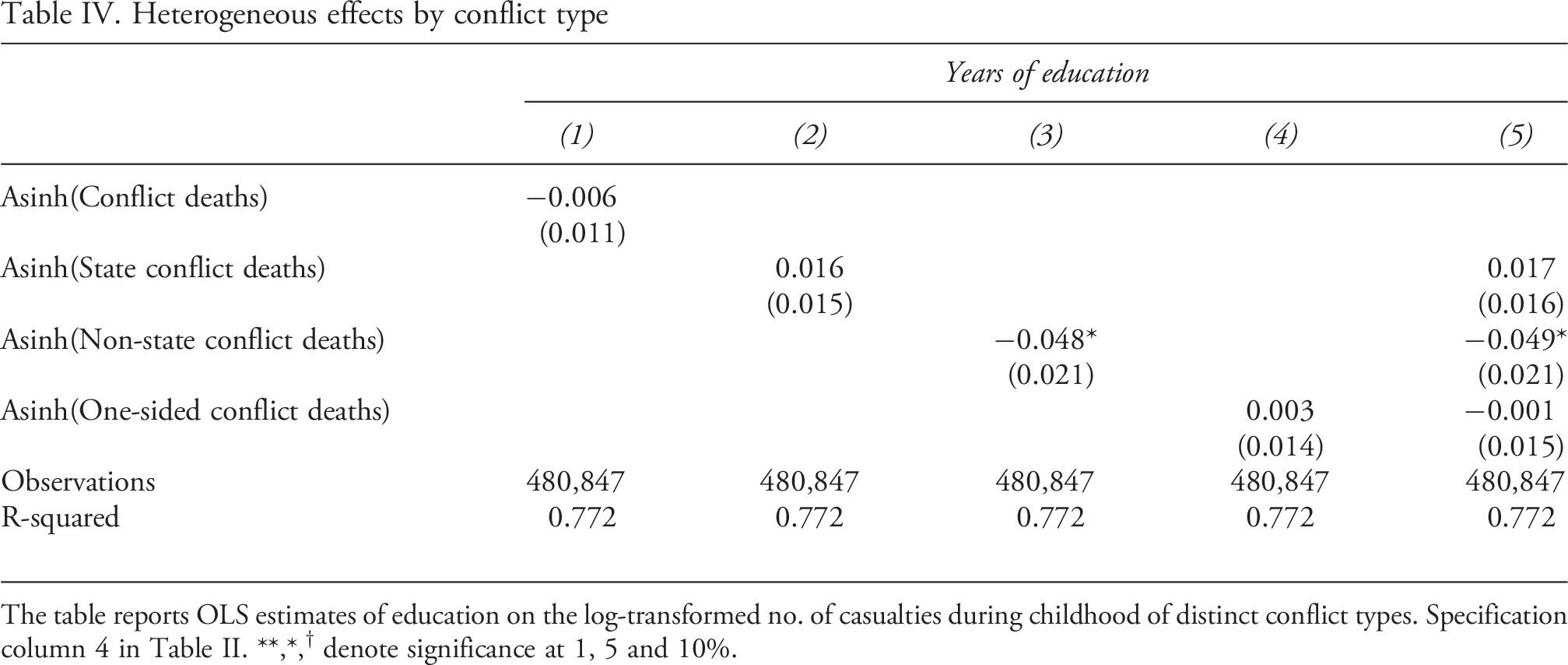
The table reports OLS estimates of education on the log-transformed no. of casualties during childhood of distinct conflict types. Specification column 4 in Table II. **,*,
We analyze a series of factors which influence the investment into state capacity, potentially moderating the effects of conflict on education, as outlined in the following section. Results are presented in Table V. All characteristics are interacted with past conflict intensity (the inverse hyperbolic sine of the no. of casualties) one-by-one first, whereas column 6 specifies the model to include all factors together.
States with a poorer population (measured by lower average income) may face larger financial restrictions and be more susceptible to economic shocks due to their tighter budget constraint. Similarly, wealthier regions with higher initial levels of educational attainment may face larger potential decreases if education is disrupted by conflict. Hence, the direction of the effect is a priori unclear. Our estimate in column 1 shows an insignificant effect of higher income per capita but a significant negative effect of conflict intensity in regions with higher economic prosperity (column 2). This indicates that better-developed regions lose more education due to conflict. Hence, we find no clear evidence in support of Hypothesis 4a.
Natural resources are often targeted by rebel groups because of their easy extraction and their high monetary value. Those groups also engage significantly more in abduction (Haer, Faulkner & Whitaker, 2020). Consequently, the educational attainment of children from resource-rich regions is likely to suffer more due to conflict. The result in column 3 supports Hypothesis 4b. Educational losses significantly increase with conflict intensity in locations with natural resource deposits.
We expect that educational losses from conflict vary with the form of government. Classifying countries into strong autocracies, strong democracies, and others, column 4 shows that the no. of fatalities in a conflict decreases local school attainment both in weak states and strong democracies. As only few strong democracies exist in our sample, and these countries have not participated in large-scale conflicts, it is likely that these estimates are under-powered. 12 Strong autocracies do not suffer education losses due to conflict, confirming Hypothesis 4c.
Heterogeneous effects by country and location characteristics
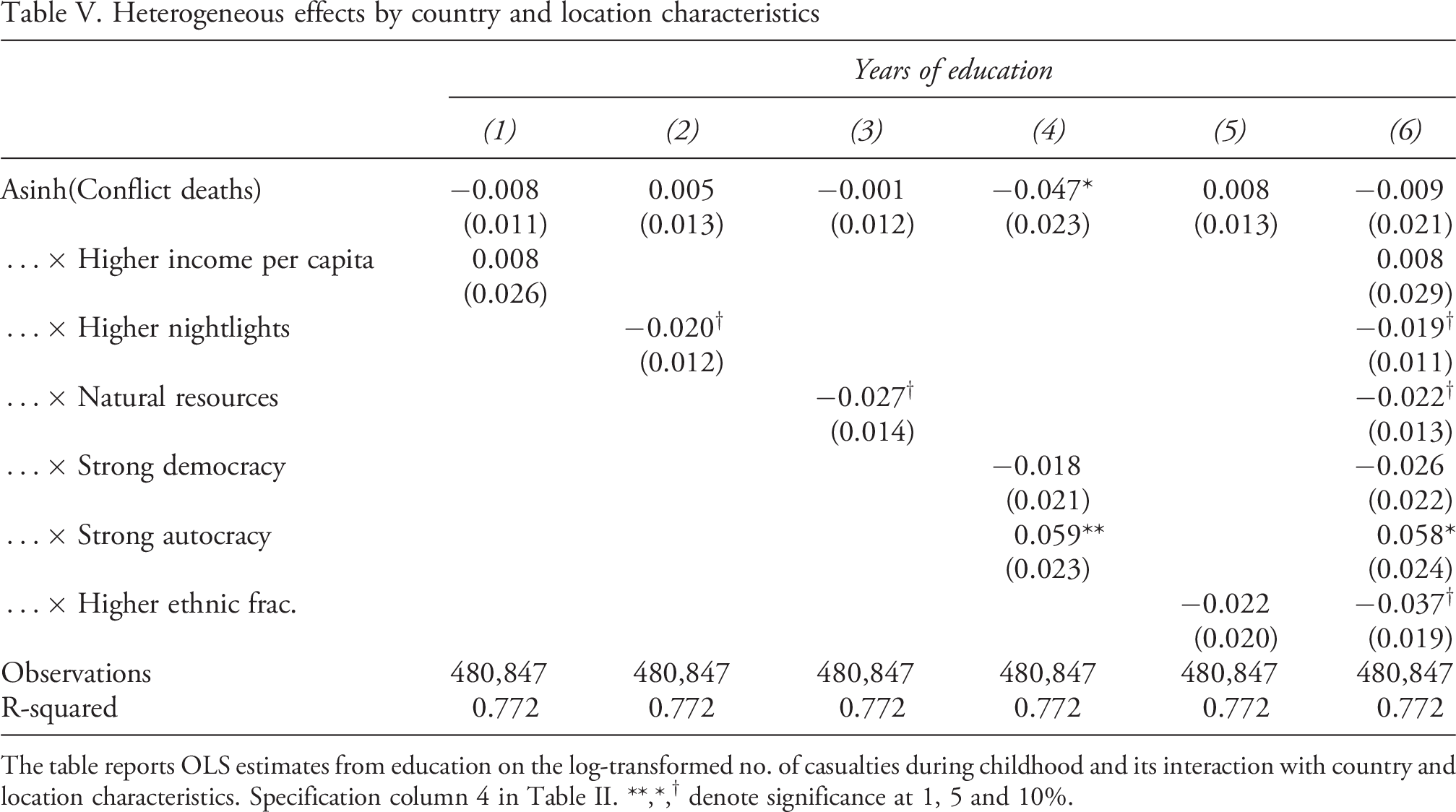
The table reports OLS estimates from education on the log-transformed no. of casualties during childhood and its interaction with country and location characteristics. Specification column 4 in Table II. **,*,
The provision of public goods may be more negatively impacted by conflict in ethnically heterogeneous states than homogeneous ones, as cooperation costs generally increase with heterogeneity. The result in column 5 provides no evidence for Hypothesis 4d.
Column 6 includes all interactions, jointly testing heterogeneities at the country and local level against each other. In this specification, our proxy for the state capacity channel turns out to be the most relevant differentiating factor. Education suffers substantially less from higher intensity conflicts in strong autocracies than under any other conditions. Regions with higher ethnic diversity are more strongly affected by conflict in terms of lost education, indicating that public service provision during times of conflict may be more limited in ethnically heterogeneous countries. All else equal, localities in proximity of natural resource deposits suffer substantially larger educational losses. Such a local resource curse not only triggers conflicts, but also interacts with conflict intensity in affecting educational losses. Finally, the coefficient for local nighttime light intensity becomes insignificant in this joint test.
Further robustness issues
Our measurement strategy relies on the assumption that we can assess the past conflict exposure of an individual by measuring past conflict occurrences near the individual’s current geographic location. Thereby, we neglect the potential measurement errors from migration described in the previous section. Although we cannot analyze the role of migration in the whole sample, we observe migration patterns within a sub-sample. 13 This allows us to compare the conflict coefficients by migration status. Table AIV in the Online appendix replicates our baseline results for this sub-sample of only 68,110 observations, showing the same link between exposure to conflicts of high intensity and losses in education in column 1. In the model with household fixed effects, we run into power issues as the sample is further reduced by half (column 2). The substantially smaller sample size renders the coefficient estimates insignificant. However, the magnitude and direction of the effect are both comparable to the first specification. In columns 3 and 4, we estimate the general effect of past conflict exposure together with a differential effect for non-migrants. Migrants indeed show worse education outcomes than non-migrants in locations exposed to moderate-intensity conflicts, so migration may contribute to the low estimate of the local costs of moderate-intensity conflict. However, in locations that have experienced a high-intensity conflict, non-migrants have decidedly fewer years of education on average, indicating that migration is not the only factor driving our results. Overall, migrants seem to be better off than locals (see above). This could be because families who care more about education are more likely to relocate before the outbreak of a conflict, thereby reducing the human capital of the local population. Alternatively, post-conflict locations might attract relatively better-educated households. In either case, migration tends to lead to an underestimation of the individual costs of high-intensity conflict.
To mitigate the possibility of unobservables driving the negative correlation between conflict and education, we extend our fixed effects specifications and substitute country-cohort fixed effects with region-cohort fixed effects. They absorb a wide range of time varying regional characteristics. They factor out common variation in the propensity to experience a conflict and in educational outcomes across administrative regions within the same year. The remaining identifying variation comes from a comparison of locations within the same administrative region of tier one (GADM, 2011) that are within or outside of the direct range of a given conflict. One downside of these specifications is that they will not be able to capture sufficient across-village variation in outcomes if the administrative units are small or the conflicts relatively far-reaching. Figure AI in the Online appendix presents a full set of results. They show patterns similar to Figure 2 but with slightly smaller education losses than our main results.
We also validate our fixed effects results and deal with the potential endogeneity stemming from local time-varying factors with an instrumental variable approach. Our instrument combines spatial variation in ethnic heterogeneity with the presence of location-specific weather shocks by interacting the distance to the nearest ethnic border with the no. of extremely dry and wet months experienced in any location. A detailed description of the procedure and the results are shown in the Online appendix.
Placebo checks can help us to assess the potential role of pre-trends or other confounding factors driving local conflict and education. For this, we repeat our baseline regressions, but focus on conflicts that should not have affected children and youth in our sample, due to the nature of their timing. We regress individual years of education on conflict occurring in the third and second year before the birth-year of a child and on conflicts occurring at a time when their secondary education should already have been finished. In the latter, we focus on a sample of adults aged 26–47 (born between 1969 and 1986), and test for correlation between their potential conflict exposure between the ages of 20 and 25 and their completed years of education. The results in Table AV in the Online appendix show no residual correlation between late-life educational attainment and pre-utero and adult exposure to conflict. Hence, the correlation between educational attainment and conflict exposure is unlikely to be driven by pre- or underlying trends.
Throughout our analyses, we reported estimates with standard errors clustered at the administrative level 1, allowing for unspecified correlation between the residuals of individuals living in the same region. However, in our context, the correct level of clustering is debatable. In Table AIX in the Online appendix we illustrate the robustness of our results to other cluster specifications: by location, two-way clustering with location and country-cohort, and using spatial correction. A detailed description is in the Online appendix.
The average influence area of a conflict could be farther or nearer than the chosen 50 km radius. Therefore, we re-estimate our coefficients using different conflict influence zones, namely 25, 100 and 200 km. The results are shown in Figure A2 in the Online appendix. Consistent with the literature (see e.g. Hallberg, 2012), the 25 km distance measure does not seem to sufficiently capture the full area of a conflict, and results yield substantially larger standard errors. Effect sizes diminish when using wider distance measures. As expected, the impact on educational attainment declines as the distance to the original conflict event increases.
Lastly, we provide standard errors that are adjusted for multiple hypothesis testing. We use the Benjamini and Hochberg procedure to decrease the false discovery rate. The results, shown in the Online appendix, reveal that high-intensity conflict remains statistically significant but the correction turns the estimates in the heterogeneity analysis insignificant. Our high-dimensional fixed effects strategy does not leave enough power for comparing competing hypotheses conclusively.
Conclusion
We study the link between localized conflict occurrence and educational attainment of youth living in the rural parts of 31 Sub-Saharan African countries from 1989 to 2015. In doing so, we are able to generalize the results of existing case studies on this link, and investigate heterogeneous effects of different conflict types and context-specific conflict characteristics. For this purpose, we combine DHS surveys with the UCDP conflict dataset and link individual school attainment to local conflict events. We address the endogeneity of conflict by including two-way fixed effects for households and country-specific birth cohorts, capturing time-variant shocks to conflict and education at the country level and time-invariant differences in the propensity of conflict across households.
Our results show no robust effect of our generic conflict exposure, which includes every type of conflict event. But, the most severe and prolonged conflicts do result in substantial average losses of educational attainment.
Our study focuses on rural areas as they experience substantially less in-migration. Although conflict-induced education losses may also be present in urban areas, our research design does not allow for a reliable identification of past conflicts experienced by urban youth. In the full sample, we do not see a significant relationship between past conflicts and current education of possibly affected cohorts. This could be due to more substantial measurement errors but also to a more dynamic urban education environment, and may help to explain contradicting findings in the literature, such as La Mattina (2018), who shows that there are no long-term losses in education in Rwanda.
We document shifts in the human capital composition of localities previously affected by severe conflict, leading to economic and social costs in the long run. Contextualizing the findings of previous case studies, the article highlights the diverse effects of conflict on education. We confirm heterogeneous effects by conflict severity, age at conflict exposure and conflict type found by previous literature (León, 2012). With respect to gender, our results show a stronger negative effect for girls of moderate-intensity conflicts and a smaller effect of high-intensity conflicts compared to boys, potentially consolidating the differential effects found in previous literature (Bertoni et al., 2019; Shemyakina, 2011). We add new dimensions of heterogeneity by investigating location and country characteristics, especially highlighting the role of state capacity. Our results suggest that conflicts affect education in various ways. On the one hand, the crucial role of state capacity suggests that part of the effect is driven by disruptions in the supply of education, confirming Lai & Thyne (2007). On the other hand, conflicts reduce the demand for education for instance by limiting skill development in early childhood.
In order to achieve universal education for all, remedial policy interventions should target previously conflict-affected regions, especially areas with high-intensity conflicts fought by non-state actors. Moreover, policies directed to increase state capacity can help to reduce the negative effects of conflict on human capital. Overall, we show that location, country and conflict characteristics matter. Hence, they should be taken into account when designing effective remedial policies.
Footnotes
Replication data

Acknowledgements
We would like to thank Toke Aidt, Richard Bluhm, Johannes Croisier, Christopher Ellis, Andreas Fuchs, Robert Genthner, Andreas Kammerländer, Andreas Landmann, Jo Thori Lind, Matthew Rudh, Günther G Schulze, Philip Verwimp, and all seminar and workshop participants for their useful comments and discussions. All remaining errors are ours.