




Abstract
Does power-sharing reduce or increase ethnic salience? Drawing on social psychology, I identify two countervailing mechanisms that help reconcile previously opposed findings. First, prolonged power-sharing practices attenuate between-group inequalities. Thereby, they gradually reduce the usefulness of ethnic identities as ‘rules of thumb’ and decrease their salience. Second, extended periods during which individuals live under ethnically differentiated power-sharing institutions render ethnic identities more accessible and thereby increase their salience. To test these expectations, I rely on the most extensive collection of mass surveys used in the empirical literature on ethnic salience so far, encompassing more than 900,000 respondents from a total of 132 countries. I show that power-sharing affects individuals’ self-identification and vote intentions in accordance with my arguments. As my findings are based on specifications that incorporate fixed effects at the group- and group-year levels, they are unlikely to be endogenous to the provision of power-sharing to groups whose identities are most salient in the first place. My findings have important implications for efforts to institutionalize peace in divided societies and for the literature on ethnic conflict.
Introduction
Salient ethnic divisions form a central concern in peace research. Some scholars have linked them to political violence directly (Montalvo and Reynal-Querol, 2005; Rothchild and Roeder, 2005) or indirectly via democratic (Dahl, 1971; Lijphart, 1977) and economic challenges (Easterly and Levine, 1997; Habyarimana et al., 2009). Moreover, though by no means sufficient (Hale, 2008), salient ethnic divisions are necessary for the formation of ethnic grievances (Cederman et al., 2013; Stewart, 2008). Hence, they make it more likely that violent conflict erupts along specifically ethnic lines.
It is hence no surprise that ethnic salience forms a cornerstone in the debate on institutionalizing peace. Some scholars argue that reducing ethnic salience is either ‘unrealistic in any reasonable time horizon’ or ‘only likely [. . .] in the context of accommodationist institutions’ (McGarry and O’Leary, 2008: 74). Based on this reasoning, they recommend accommodating diverse ethnic groups, most notably through power-sharing. In contrast, critics warn that accommodation may harden ethnic divisions. Instead, they recommend integrative institutions that foster a ‘single public identity coterminous with the state’s territory’ (McGarry and O’Leary, 2008: 41–42; Lieberman and Singh, 2012; Rothchild and Roeder, 2005).
Given the centrality of ethnic salience to this debate, it is surprising how little systematic empirical attention it has received in studies on the most widely advocated accommodative strategy, power-sharing. Theoretically, some scholars refer to early research on consociational democracy in Western Europe and expect power-sharing to reduce ethnic salience. Thereby, power-sharing might eventually render itself ‘superfluous’ (Lijphart, 1977: 228). In contrast, other scholars warn that power-sharing may ‘freeze’ ethnic identities and increase their salience. Hence, power-sharing may even carry the seed of its own, potentially violent, demise (Rothchild and Roeder, 2005). Empirically, there is only limited evidence to adjudicate between these opposed viewpoints. Existing research mostly abstains from studying how power-sharing affects ordinary citizens’ attitudes (Farag et al., 2023: 15), including the salience of their ethnic identities. Conversely, a growing literature investigates the determinants of ethnic salience but has so far abstained from considering the role of power-sharing.
In this article, I address these gaps. Drawing on social psychology, I introduce the concepts of ethnic identities’ cognitive fit and accessibility into the power-sharing literature (Abrams and Hogg, 1990; Hale, 2008; Turner, 1987). I expect ethnic identities to be salient if they account for meaningful similarities and differences between ethnic groups (offering high cognitive fit) and if they are readily available in individuals’ memory (have high cognitive accessibility). Building on this conception, I theorize on two countervailing mechanisms whereby prolonged power-sharing affects ethnic salience. First, power-sharing gradually attenuates inequalities in terms of political representation and economic wealth. Thereby, it reduces the cognitive fit of ethnic identities and decreases their salience. Second, some types of power-sharing politicize individuals as group members, render ethnic identities more cognitively accessible, and increase their salience. This second mechanism is closely tied to power-sharing institutions that tie political representation to predetermined ethnic identities. Based on these mechanisms, I expect prolonged power-sharing practices to reduce ethnic salience over time. However, I expect this effect to be attenuated, and potentially reversed, if power-sharing rests on ethnically differentiated constitutional provisions.
Using globally representative survey data, I examine how respondents’ exposure to different types of power-sharing over their lifetime affects their ethnic self-identification and party choice. In line with my hypotheses, I find that longer exposure to power-sharing practices, proxied by joint representation in the executive, is associated with reduced ethnic salience. Moreover, this association is most pronounced for informal power-sharing. In contrast, ethnically differentiated power-sharing institutions are associated with increased ethnic salience. All my specifications incorporate fixed effects at the ethnic group-year level. Hence, my findings are unlikely to be endogenous to a pattern whereby power-sharing is provided to groups with the most salient identities in the first place. As my sample encompasses more than 900,000 respondents from 132 countries, my analyses also contribute to a growing cross-national literature on ethnic salience more broadly.
Concepts
I start by defining three key concepts. First, following much of the ethnic conflict literature, I adopt a Weberian conception of ethnicity. This sees an ethnic group as a set of individuals that ‘entertain a subjective belief in their common descent’, based on ‘similarities of physical type or of customs or both’ (Weber, 1978: 389). I hence conceive of ethnic boundaries as durable, with individuals possessing limited freedom to shift these boundaries on their own (cf. Hale, 2008; Wimmer, 2008). However, I expect individuals to identify with the ethnic identities circumscribed by these boundaries to variable degrees.
This brings me to my second concept, ethnic salience. This captures two aspects of ethnic identification: first, the degree to which individuals prioritize their ethnic identity over alternative social identities, most importantly the nation (its cognitive aspect). Second, the degree to which individuals’ political behavior, such as their vote choice, is influenced by their ethnic identity (its behavioral aspect). Both aspects are linked to ethnic conflict, most notably via the formation of ethnic grievances (Cederman et al., 2013; Juon, 2023; Stewart, 2008). Ethnic self-identification is required for relative status comparisons, which underlie perceptions of injustice in the first place. Moreover, support for political elites that make ethnic claims is required to link grievances to ethnic conflict via mass mobilization.
Finally, building on Lijphart’s (1977) concept of consociationalism, I conceive of power-sharing as encompassing three inclusive principles: the government inclusion of minorities through grand coalitions, their proportional representation across state organs, and veto rights whereby they can block legislation that violates their core interests. 1 These principles can rest on formal, institutional rules, but can also be informally practiced (cf. Bormann et al., 2019). For instance, they may arise from long-standing inclusive norms (e.g. Switzerland’s ‘magic formula’) or temporary post-electoral coalitions (e.g. Slovakia’s 2002 coalition government that included a Hungarian minority party). Contrary to more demanding concepts of consociational power-sharing (Bogaards et al., 2019), I conceive of these principles as mutually reinforcing, but not jointly necessary. Moreover, following Lijphart (2004), I conceive of grand coalitions, evidenced by the joint representation of diverse ethnic groups in government, as the most central of these principles.
Literature review
There remains fundamental disagreement on the long-term consequences of power-sharing, so defined for ethnic salience. In the first place, one might doubt whether power-sharing meaningfully affects ethnic salience at all. This conception underlies arguments that see power-sharing as a ‘fixed destination’ for conflict management (Maphai, 1996: 78, cited in McCulloch, 2017; cf. McGarry and O’Leary, 2008). It also informs analytical decisions to treat ethnic groups as stable units of analysis, taken in much of the cross-national literature on ethnic conflict. For example, while acknowledging potential shifts over long time periods, Cederman et al. (2013: 234), argue that ‘where time spans are more limited [. . .] the assumption of stable group identification makes a lot of sense’. While these arguments may well apply, they remain untested and theoretically contested.
An alternative view is that power-sharing reduces ethnic salience. Adherents of this second view often refer to Arend Lijphart’s early work on consociational democracy in Western Europe. According to Lijphart (1968), consociational practices stabilized the Netherlands despite its deep divisions in religion- and class-based pillars, characterized by separate parties, schools, and media landscapes. An extended period of coalition government not only created cross-community stakeholders, but it also fostered a ‘spirit of tolerance’ among the wider citizenry, and gradually eroded the segmental pillars.
Building on this influential study, Lijphart theorized that consociationalism might similarly ‘depillarize’ other formerly divided societies. According to Lijphart, consociationalism will, in the long run, ‘depoliticize segmental divergences’ and eventually ‘render itself superfluous’ (Lijphart, 1968: 228). There is indeed evidence that consociationalism ‘depillarized’ other Western European countries that were formerly divided along religious and ideological lines: Belgium, Austria and Switzerland (Lijphart, 1977, 2002; cf. Deschouwer, 2006). Together with the extension of consociational theory to non-European contexts (Bogaards, 2000), such arguments have been advanced as regards power-sharing more generally, even where it stops short of encompassing all consociational principles and is practiced in difficult post-conflict contexts (e.g. Cammett and Malesky, 2012: 986; Hartzell and Hoddie, 2003: 320).
Despite these pervasive arguments, it remains unclear whether power-sharing reduces ethnic salience. First, while intuitively appealing, the process whereby elite-level moderation ‘trickles’ down to the masses and erodes segmental ‘pillars’ remains unclear (cf. McCulloch, 2017). Second, it remains to be seen whether limited forms of power-sharing similarly reduce ethnically based divisions, which characterize many post-conflict societies, as the full consociational ‘package’ did in Western European democracies that were not divided along ethnic lines (Andeweg, 2000; Lijphart, 2002: 20).
Finally, it is possible that power-sharing, especially if it is formally institutionalized, increases ethnic salience. Summarizing this view, Pildes (2008: 173–174) argues that power-sharing institutions ‘undermine the dynamic possibilities for how [ethnic] identities might shift and become more muted over time’. McCulloch (2014: 508) maintains that post-conflict power-sharing freezes ‘a particular moment in time – indeed, the very moment at which groups are most polarized’. Wolff (2011: 1783) warns that power-sharing may ‘entrench and institutionalize pre-existing, and often conflict-hardened, ethnic identities’. Some scholars even assert that, by boosting ethnic salience, power-sharing institutions may increase the risk that violent conflict will resume ‘at an even more intense level’ (Rothchild and Roeder, 2005: 2)
Studies in this literature highlight two mechanisms. First, power-sharing institutions politicize individuals as ethnic group members (Lieberman and Singh, 2012; McCulloch, 2014). Second, they empower hardliners who will keep ethnicity salient through polarizing appeals (Rosiny, 2015; Rothchild and Roeder, 2005). Thereby, they can ‘ethnicize’ even issues formerly unrelated to ethnicity (Murtagh and McCulloch, 2021; Nagle, 2016). These arguments are backed by evidence from numerous prominent cases, such as Lebanon and Bosnia.
However, many aforementioned studies again do not provide an individual-level basis for their hypothesized effects of power-sharing on ethnic salience (cf. Hale, 2008). This makes it difficult to understand how power-sharing increases ethnic salience. Moreover, the evidence for this view predominantly stems from post-conflict cases. As ethnic identities often harden in response to conflict (cf. Besley and Reynal-Querol, 2014; Horowitz, 2001; Petersen, 2002), this makes it difficult to assess whether high ethnic salience in these cases is a consequence of power-sharing or the conflicts that necessitated it in the first place. Finally, the relationship between power-sharing and ethnic salience may well go the ‘other way around’. High ethnic salience may force policymakers to practice power-sharing in the first place (Cederman et al., 2015; McGarry and O’Leary, 2008).
Cross-national research offers only limited evidence to adjudicate between these diverging views. There is a growing consensus that power-sharing contributes to peace, as given by the absence of large-scale violence (Cederman et al., 2013; Gurr, 2002; Hartzell and Hoddie, 2003; Østby, 2008). However, the finding that power-sharing prevents civil war is not proof that it reduces ethnic salience, nor does it rule out the possibility that it maintains ethnic salience at high levels, especially where it is formally institutionalized.
A growing number of empirical studies are investigating the determinants of ethnic salience. Focusing on individuals’ self-identification and vote intentions, these have investigated how ethnic salience is shaped by violence (Besley and Reynal-Querol, 2014; Gibler et al., 2012), ethnic cleavages (Dunning and Harrison, 2010), economic inequality (Higashijima and Houle, 2018; Ray, 2018a), electoral competition (Eifert et al., 2010; Flesken, 2018; Higashijima and Nakai, 2016; Huber, 2012), colonial legacies (Ali et al., 2019; McNamee, 2019), group size (Elkins and Sides, 2007) and modernization processes (Robinson, 2014). While this literature features increasing calls to investigate the impact of power-sharing (e.g. McNamee, 2019: 154; Ray, 2018b: 278), these have remained largely unanswered. Wimmer (2017) and Ray (2018a) provide evidence that government representation increases national pride, but do not investigate its long-term effects on more proximate measures of ethnic salience. Most recently, Horne et al. (2023) have shown that histories of co-governance foster positive evaluations of other parties, citing mechanisms that resemble Lijphart’s ‘depillarization’ logic. However, it is unclear how these findings travel to ethnic power-sharing outside stable Western democracies.
In sum, there remains profound disagreement on how power-sharing affects ethnic salience. Moreover, there is little cross-national evidence to adjudicate between these opposed perspectives, as few studies investigate the consequences of power-sharing on ethnic salience directly.
Theory
I address these gaps, and partly reconcile these diverging views, by introducing the social psychological concepts of cognitive fit and accessibility into the power-sharing literature. Following the social identity approach, which has long been dominant in social psychology (cf. Brubaker et al., 2004; Hale, 2008; Hornsey, 2008), I conceive of ethnic identities as cognitive ‘shortcuts’. These enable individuals to decrease uncertainty, both about how they should perceive social reality and which actions are appropriate (cf. Abrams and Hogg, 1990; Turner, 1987). Following this approach, I expect ethnic salience to be driven by two main factors.
The first factor is the cognitive fit of an ethnic identity. This captures how well ethnicity accounts for subjectively meaningful similarities and differences between sets of people (cf. Hogg and Williams, 2000: 89). Ethnic identities will be more salient if they have a higher fit, most importantly if they are associated with important status differences, such as access to political office and wealth. This makes it more likely that individuals will assess their situation in ethnic terms, form diverging policy preferences, and sort themselves into ethnically distinct social networks (Stewart, 2008), as has been documented for economic inequalities (Higashijima and Houle, 2018; Houle et al., 2019; Huber and Suryanarayan, 2016; Ray, 2018a). Ethnic identities will also be more salient if a group has been subject to identity threats, such as targeted violence (cf. Fearon and Laitin, 2000; Stewart, 2008), following which individuals can perceive themselves part of an ethnic ‘community of fate’ (cf. Hale, 2008: 50).
The second factor is an ethnic identity’s cognitive accessibility. This refers to how easily it can be activated by individuals, as compared to other, potentially ‘more fitting’ identities (cf. Oakes, 1987: 127–128; Turner, 1987: 54). An ethnic identity is accessible if it is available in an individual’s memory, due to prior activation or contextual cues (cf. Hogg and Williams, 2000: 89). Hence, ethnic identities will be more salient if they are linked to perceptible attributes that shape individuals’ life chances, such as region of origin, religion and language (Bormann et al., 2017; Hale, 2008). Moreover, they will be more salient where political parties make frequent ethnic appeals (Hale, 2008: 39; Liebermann and Singh, 2017).
Given the durability of ethnic inequalities and cultural markers, these considerations offer a social psychological basis for the view that ethnic identities will be reasonably durable (Hale, 2008; Stewart, 2008). However, they do not rule out that their salience can shift under long-term power-sharing. To the contrary, they suggest two countervailing mechanisms whereby power-sharing might affect ethnic salience: one whereby power-sharing reduces ethnic salience by decreasing the cognitive fit of ethnic identities; and one whereby it increases ethnic salience by enhancing their cognitive accessibility (see Figure 1). As I argue in the next two sections, the first mechanism is activated by power-sharing of any type, whereas the second is closely tied to ethnically based (corporate) power-sharing institutions.
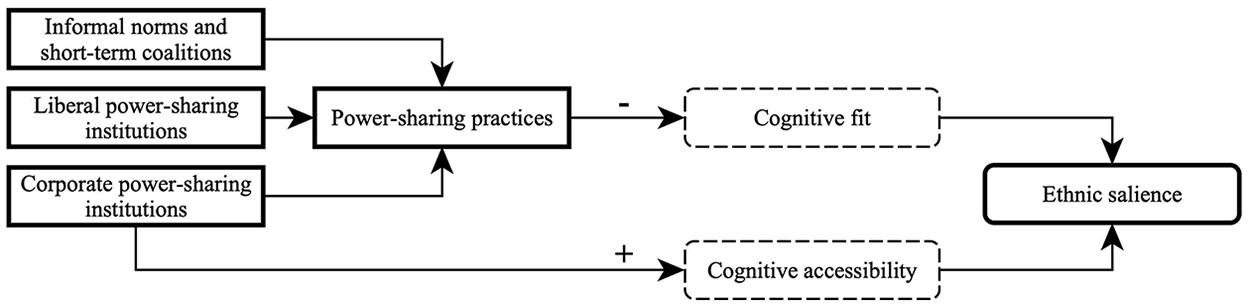
Theoretical framework.
Power-sharing and the cognitive fit of ethnic identities
First, I expect prolonged power-sharing, irrespective of its specific form, to gradually reduce ethnic salience. It does so by eroding between-group inequalities, which reduces the cognitive fit of ethnic identities. Almost by definition, power-sharing attenuates political inequalities between diverse ethnic groups by jointly including their representatives in government (Cederman et al., 2013). Thereby, it ‘softens’ one of the most consequential dividing lines that otherwise separates different groups from one another.
Over time, power-sharing may encourage members of diverse included ethnic groups to develop a sense of a common, shared identity. Representatives of included groups have fewer incentives to engage in ethnically divisive appeals, as lower inequalities reduce the resonance of such appeals (cf. Cederman et al., 2013). Moreover, like interparty coalitions (Horne et al., 2023), members of multi-ethnic coalitions will, at least occasionally, defend common policy proposals. Experiencing repeated demonstrations of cooperation, members of included groups may gradually perceive their interests as more aligned, and ethnic boundaries as less politically consequential.
Finally, power-sharing gradually attenuates additional between-group inequalities. By providing diverse groups with substantive representation, it enables them to address various disadvantages facing them. For instance, it may improve their access to economic opportunities (Bormann et al., 2021). As a result, power-sharing slowly erodes the association of ethnic identities with social, economic and cultural status (cf. Stewart, 2008). In turn, this makes it more likely that included groups’ political preferences will converge (Higashijima and Houle, 2018; Huber and Suryanarayan, 2016).
Through these processes, prolonged power-sharing gradually reduces the cognitive fit of ethnic identities and decreases their salience. Recent studies of Burundi illustrate these arguments. There, ‘the political salience of ethnicity has strongly diminished’ following the introduction of largely informal power-sharing practices in 2000, which were constitutionally entrenched in 2004 (Vandeginste, 2017: 8). Power-sharing ‘reassured members of all ethnic categories that institutions [. . .] would not be used as instruments of ethnic domination’ (Raffoul, 2020: 12). This addressed Tutsi identity threats and reduced their perception of forming a separate ethnic ‘community of fate’. Moreover, it encouraged the formation of multi-ethnic parties, which reconfigured ‘political alliances at the levels of party leaders, candidates and citizens’ (Raffoul, 2020: 12). Through common policies and appeals, these highlighted the shared interests of Hutu and Tutsi and reduced their perception of having diverging political interests. In turn, Burundian voters had incentives to seek patronage from multi-ethnic governing parties, ‘at the expense of [their] ethnic preferences’ (Raffoul, 2020: 12: 13). Thereby, power-sharing gradually reduced the ethnicization of individuals’ social networks.
These mechanisms lend a social psychological basis to the view that power-sharing reduces ethnic salience. Importantly, through these mechanisms, power-sharing reduces ethnic salience regardless of its precise institutional form. What is important is that power-sharing is effectively practiced over prolonged time periods. I summarize these arguments in the first hypothesis:
Hypothesis 1: Prolonged power-sharing reduces the salience of ethnic identities.
Power-sharing and the cognitive accessibility of ethnic identities
However, my framework also suggests a second, countervailing mechanism, whereby power-sharing can increase the salience of ethnic identities by enhancing their accessibility. This second mechanism is closely tied to ethnically based (corporate) power-sharing institutions. Corporate power-sharing explicitly predetermines the groups that share power (Lijphart, 2008 [1995]) and entails ‘the constitutional entrenchment of group representation’ (McCulloch, 2014: 503). It mandates power-sharing through formal, explicitly ethnic provisions, such as government quotas for specific groups. Prominent contemporary cases of corporate power-sharing include Belgium, Bosnia and Herzegovina, and Lebanon.
As corporate power-sharing institutions often rely on ethnic quotas or separate electoral rolls, they repeatedly categorize individuals as ethnic group members (cf. Hale, 2008; Lieberman and Singh, 2012, 2017; McGarry and O’Leary, 2008). Thereby, they reinforce the belief that ethnic identities form ‘natural’ political dividing lines (cf. Brewer, 1997). Moreover, they often connect additional resources to ethnic identities, reminding citizens of their ethnicity in everyday life. As a rule, they require the explicit ‘assignment of individuals to specific groups’ (Lijphart, 2008 [1995]: 72). For example, corporate power-sharing institutions may require individuals to publicly declare their ethnic identity (McGarry and O’Leary, 2008: 78). Alternatively, they may make access to resources, such as state employment, conditional on ethnic identities.
Finally, corporate power-sharing institutions indirectly increase the salience of ethnic identities by reinforcing political elites’ incentives to engage in within-group competition. Predominantly faced with challengers from within their own group, for example when competing over reserved seats, elites have incentives to press ethnically based demands (Horowitz, 1985; Rothchild and Roeder, 2005; Zuber and Szöcsik, 2015). In turn, these repeated appeals enhance the accessibility of ethnic identities among their group members.
These processes can be illustrated with recent studies of Lebanon. There, corporate power-sharing was enshrined as a transitional measure ‘to eliminate political sectarianism’ (Rosiny, 2015). Yet, ethnic salience remains high, as bemoaned by representatives of all major groups (Nagle, 2016: 1150). Political positions are allocated on a strictly sectarian basis, which consistently categorizes citizens as group members during all acts of political participation. Lebanon’s quota system is also connected to important social and economic rights and provides citizens with repeated, everyday reminders of their identity. For instance, legal authority over personal matters is devolved to sectarian authorities, including over ‘marriage, divorce and child custody rights’ (Nagle, 2016: 1149). Finally, Lebanon’s corporate power-sharing system creates incentives for ‘sectarian entrepreneurs’ to make ethnocentric appeals (Rosiny, 2015: 495). Thereby ‘antagonistic expressions of ethnic identity remain the key resource for political parties to mobilize support’ (Nagle, 2016: 1157).
Other types of power-sharing are less likely to increase ethnic salience through this second mechanism. Informal power-sharing practices, such as the norm of balanced linguistic representation in Switzerland’s cabinet or alternating coalitions with Albanian minority parties in North Macedonia, do not have a formal constitutional basis altogether. The main institutional alternative to corporate power-sharing, liberal power-sharing, relies on provisions that do not predetermine the groups that are to share power (McGarry and O’Leary, 2008). Instead, it relies on low electoral hurdles for executive inclusion, proportional electoral systems, and supermajority requirements, as in Northern Ireland, post-apartheid South Africa (1993–1995), and post-Hussein Iraq (2004–2009). Liberal power-sharing can encourage ethnic claim-making in electoral contests (cf. Murtagh and McCulloch, 2021) and thereby increase the accessibility of ethnic identities. However, this effect should be much less more pronounced than for corporate power-sharing institutions, whereby the state consistently categorizes citizens as members of their ethnic groups, connects substantial resources to ethnic identities, and encourages elites to engage in within-group competition.
An example that illustrates the consequences of both liberal and informal power-sharing for ethnic salience is South Africa. To facilitate the transition from apartheid, South Africa adopted a temporary, liberal power-sharing constitution in 1993. This gave all parties with at least a 5% vote share the right to proportionate cabinet representation and required consensual decision-making between them. These provisions generated a unity government between the African National Congress, the National Party (the former white ruling party) and the Zulu nationalist Inkatha Freedom Party. This increased cross-ethnic ties and trust between the diverse coalition partners; moreover, it enabled the smaller, minority-led parties to introduce limits on pure majority rule in the new permanent constitution (Sisk and Stefes, 2005). Following the end of formal power-sharing in 1996, informal inclusive practices have intermittently continued between the coalition partners at various levels (Sisk and Stefes, 2005). Together with the still highly proportional electoral system, this has discouraged mobilization along ethnic lines and contributed to an overall trend of decreasing ethnic salience (McLaughlin, 2007). Apartheid era legacies mean that racial consciousness remains high. Nevertheless, the political and economic salience of the racial cleavage has started to decline, owing to expansive affirmative action policies adopted in 1994 (Seekings, 2008).
These considerations lend a social psychological basis to the view that power-sharing can increase ethnic salience over time. However, this countervailing mechanism should predominantly accrue under corporate power-sharing institutions, which tie political representation to predetermined ethnic identities. In contrast, liberal power-sharing institutions are less likely to activate this mechanism, while informal power-sharing practices should not do so at all. The main observable implication of these arguments is that corporate power-sharing will reduce ethnic salience less substantially than its informal and liberal alternatives. Moreover, if it increases the accessibility of ethnic identities more than it decreases their fit, corporate power-sharing might even increase ethnic salience. I summarize these arguments in two further hypotheses:
Hypothesis 2: Prolonged corporate power-sharing institutions reduce the salience of ethnic identities less substantially, as compared to informal and liberal power-sharing.
Hypothesis 3: Prolonged corporate power-sharing institutions increase the salience of ethnic identities.
Data
Ethnic salience
A systematic test of these expectations entails stringent data requirements. To avoid selection bias, attitudinal information on ethnic salience is required for both ethnically divided, post-conflict cases as well as more stable contexts. Hence, it would not suffice to rely on individual global surveys or multiple waves of one regional survey. Going beyond existing research as regards spatial and temporal coverage, I therefore rely on a broad combination of mass surveys.
To collect this information, I consider all conventionally used, freely available cross-national mass surveys and screen them for measures pertaining to ethnic salience. I include two types of survey that contain such measures. First, global surveys, including the World Values Survey (Inglehart et al., 2014), the International Social Survey Programme (ISSP) National Identity modules (ISSP Research Group, 2010–2015), augmented by its spin-off, the China Survey, 2 and the Comparative National Elections Project. 3 Second, a series of barometer surveys covering specific world regions, including Africa (Afrobarometer Data, 1999–2016), the Middle East and North Africa region (the Arab Barometer), 4 Asia (the Asian Barometer, and the South Asia Barometer), 5 Europe (the European Social Survey (Norwegian Centre for Research Data, Norway, 2002) and the New Europe, New Russia and New Baltics Barometer series (Rose, 2010)), and Latin America (the Latinobarómetro). 6
Using these surveys, I standardize question items that tap into the cognitive and behavioral aspects of ethnic salience. My first dependent variable, Ethnic identification (EID), takes the value of 1 if respondents indicate that they more strongly identify with their ethnic identity than with their national identity. It takes the value 0 otherwise. To obtain sufficient coverage across countries and years, for respondents belonging to regionally concentrated groups, in my main specification I also consider question items that asked individuals to choose between their regional and national identity.
My second dependent variable, Ethnic party vote (EPV), takes the value 1, if respondents indicate they feel close to, will vote for, or have recently voted for an ethnically based party, and 0 otherwise. 7 To code this variable, I connect its underlying survey items to the V-Parties Dataset (Lindberg et al., 2022; Pemstein et al., 2020). Predominantly relying on this dataset, I then identified any party that either has an ethnic support base or that promotes its group’s cultural superiority. This also serves to include ethnic majority parties that may refrain from making explicit ethnic claims.
To analyze the relationship between power-sharing and ethnic salience, I assign survey respondents to their respective ethnic groups. I rely on the list of ethnic groups used by the Constitutional Power-Sharing Dataset (CPSD, Juon, 2020), itself based on the widely used Ethnic Power Relations Dataset (EPR, Vogt et al., 2015). To identify individual respondents’ ethnic identities, I combine explicit self-identification questions asked in some of the surveys with information on respondents’ settlement area, religion, language and phenotype provided in others. In my main models, I only include individuals that can be attributed to an ethnic group with reasonably high demographic probability (⩾80%) (see Online appendix 1.1 for details). Figure 2 shows the grand averages of respondents primarily identifying with their ethnic identity (Figure 2(a)) and intending to vote for an ethnic party (Figure 2(b)), according to these measures, in all countries included in my analyses.
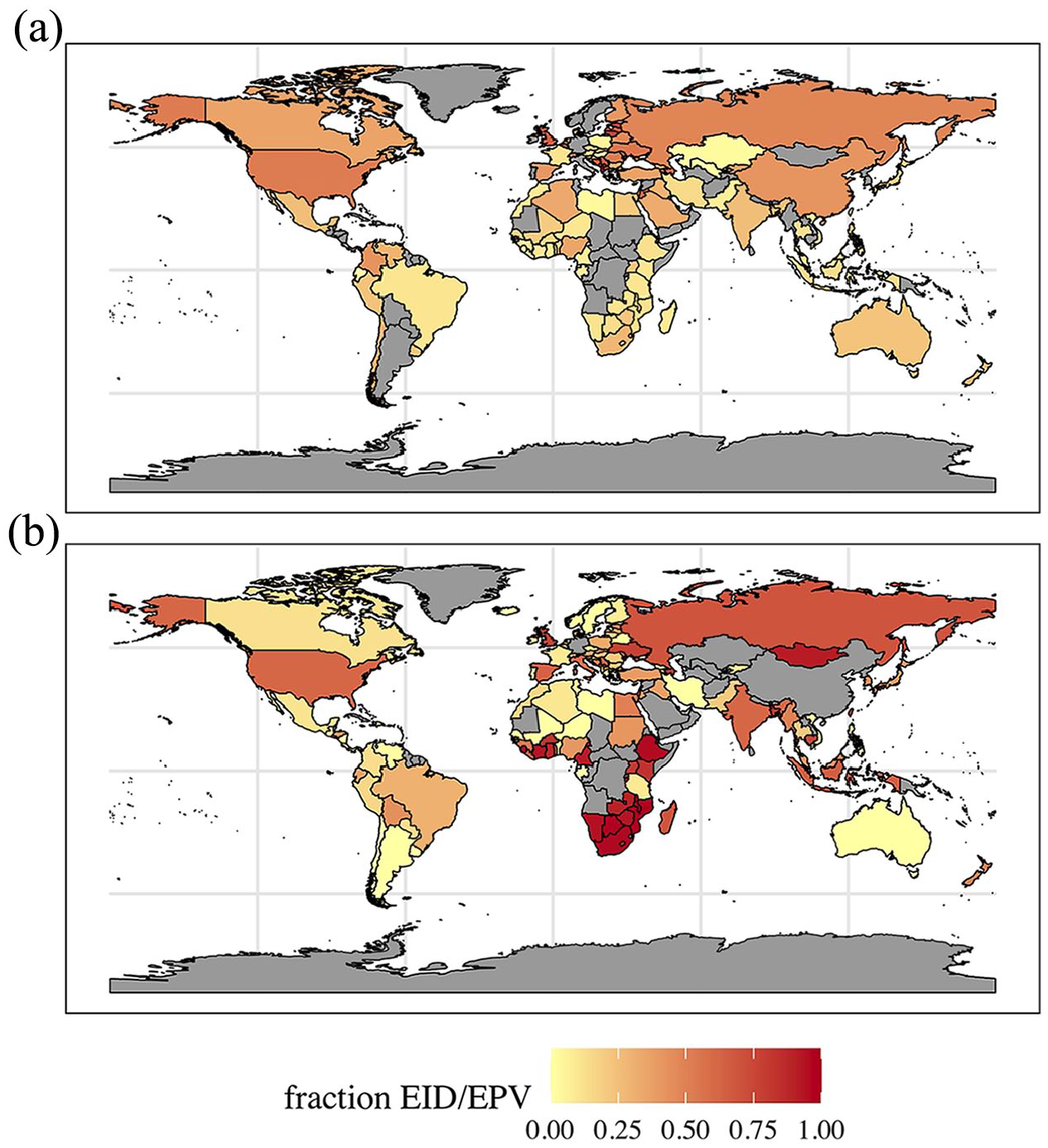
Included countries and grand mean of dependent variables: (a) Ethnic identification (EID) and
Power-sharing practices and institutions
Another major challenge is the measurement of different types of power-sharing, which I highlight in my argument. To proxy for overall power-sharing practices, I use information on group-wise governmental representation from EPR (Vogt et al., 2015). I identify all years in which a group enjoys joint representation, evidenced by de facto government inclusion together with any other group. This fits well with Hypothesis 1, which focuses on power-sharing practices irrespective of their specific form, and my conceptualization, which conceives of grand coalitions as their key principle (cf. Lijphart, 2004). A limitation is that this measure excludes proportional representation across other state organs and veto practices (cf. Bogaards, 2019; Bogaards et al., 2019). Moreover, the underlying EPR data only captures the government representation of ‘politically relevant’ groups. In my robustness checks, I show that my results remained similar when using a more expansive measure for power-sharing practices and limiting the sample to politically relevant groups.
To measure corporate and liberal power-sharing institutions, I rely on information provided by CPSD (Juon, 2020). This provides separate, group-level indices for corporate- and liberal power-sharing institutions. Mirroring my conceptualization, these build on Lijphart’s (1977) consociational principles and measure the degree to which each group benefits from constitutionally enshrined grand coalitions, proportional representation and veto rights. Whereas the corporate power-sharing index captures all provisions that rely on ethnic criteria (such as quotas and veto rights), the liberal index predominantly captures electoral measures (such as low electoral thresholds for executive inclusion, proportional electoral systems and supermajority requirements; see Juon, 2020 for details).
Finally, using both datasets, I operationalize informal power-sharing practices. To do so, I identify all ethnic groups that enjoy joint representation, as operationalized above, but are not targeted by substantial power-sharing institutions of either the corporate or liberal type according to CPSD. 8
Analytical strategy
Using these data, I quantitatively test my expectations. My sample includes a total of 973,080 respondents nested in 784 ethnic groups and 132 countries, although this number is lower in each specification due to the limited overlap between both dependent variables. This extensive, globally representative sample enables me to address challenges of selection bias by providing systematic information on ethnic salience across diverse contexts in all world regions.
However, my extensive, observational sample exacerbates another inferential challenge: the non-random assignment of power-sharing to different groups. Power-sharing, especially of the corporate type, is disproportionately provided to groups whose identities are already salient in the first place. Moreover, this often occurs at points in time when their identities are most salient, for example following conflict (cf. Wucherpfennig et al., 2016). Without accounting for these patterns, my analyses would be biased towards finding a positive association between power-sharing, especially the corporate type, and ethnic salience. Hence, I would risk falsely rejecting Hypothesis 1, which posits a negative effect of prolonged power-sharing on ethnic salience. Conversely, I would risk falsely attaining support for Hypotheses 2 and 3, which posit that corporate power-sharing reduces ethnic salience less substantially, compared to its informal and liberal alternatives, and may even increase ethnic salience.
Ideally, these concerns would be addressed by identifying (quasi-)random variation in power-sharing, which is not influenced by ethnic salience. For example, Dunning and Nilekani (2013) identify such variation for local caste quotas in India, while Samii (2013) does so for military integration processes in Burundi. However, such quasi-random variation is generally not available for large-scale policy choices, such as national-level power-sharing, especially of the corporate type (cf. Lieberman and Singh, 2012). 9
While I cannot overcome endogeneity concerns in my observational approach, I combine different empirical strategies to alleviate them. Most importantly, instead of comparing different countries and ethnic groups with one another, I more narrowly compare individuals belonging to the same group, in the same year, depending on their exposure to different types of power-sharing over their lifetime.
Variables for individual-level lifetime power-sharing
To do so, I first construct variables for each respondent’s lifetime power-sharing of the respective type (joint representation, corporate/liberal power-sharing institutions, informal joint representation) by summing up the annual power-sharing measures of each respondent’s group (see above) for each year of their life and dividing by the total number of such years. 10 I exclude pre-adolescent years during which respondents are less likely to be socialized politically, and only considered years from the age of 12. Hence, these measures vary at the individual level, depending on respondents’ year of birth, the year of observation and their groups’ degree of power-sharing in between. Formally, for an individual i of age a belonging to group g in a year t, they are calculated as follows:

where PS refers to power-sharing of the respective type.
This captures the individual-level mechanisms underlying my argument well. Thereby, I expect individuals’ prolonged experience with effective power-sharing to decrease the perceived cognitive fit of ethnic identities and reduce ethnic salience (Hypothesis 1). Conversely, I expect their prolonged exposure to ethnically differentiated (corporate) power-sharing institutions to partly (Hypothesis 2) or fully (Hypothesis 3) offset this effect, as this gradually increases the accessibility of ethnic identities and boosts their salience. Table 1 lists the groups in my sample with the highest lifetime power-sharing values. Reassuringly, despite conceptual differences, these encompass the most important cases discussed in the qualitative literature on consociational power-sharing (cf. Bogaards et al., 2019; Farag et al., 2023; McCulloch, 2014).
Groups with highest scores of lifetime power-sharing indices in sample.
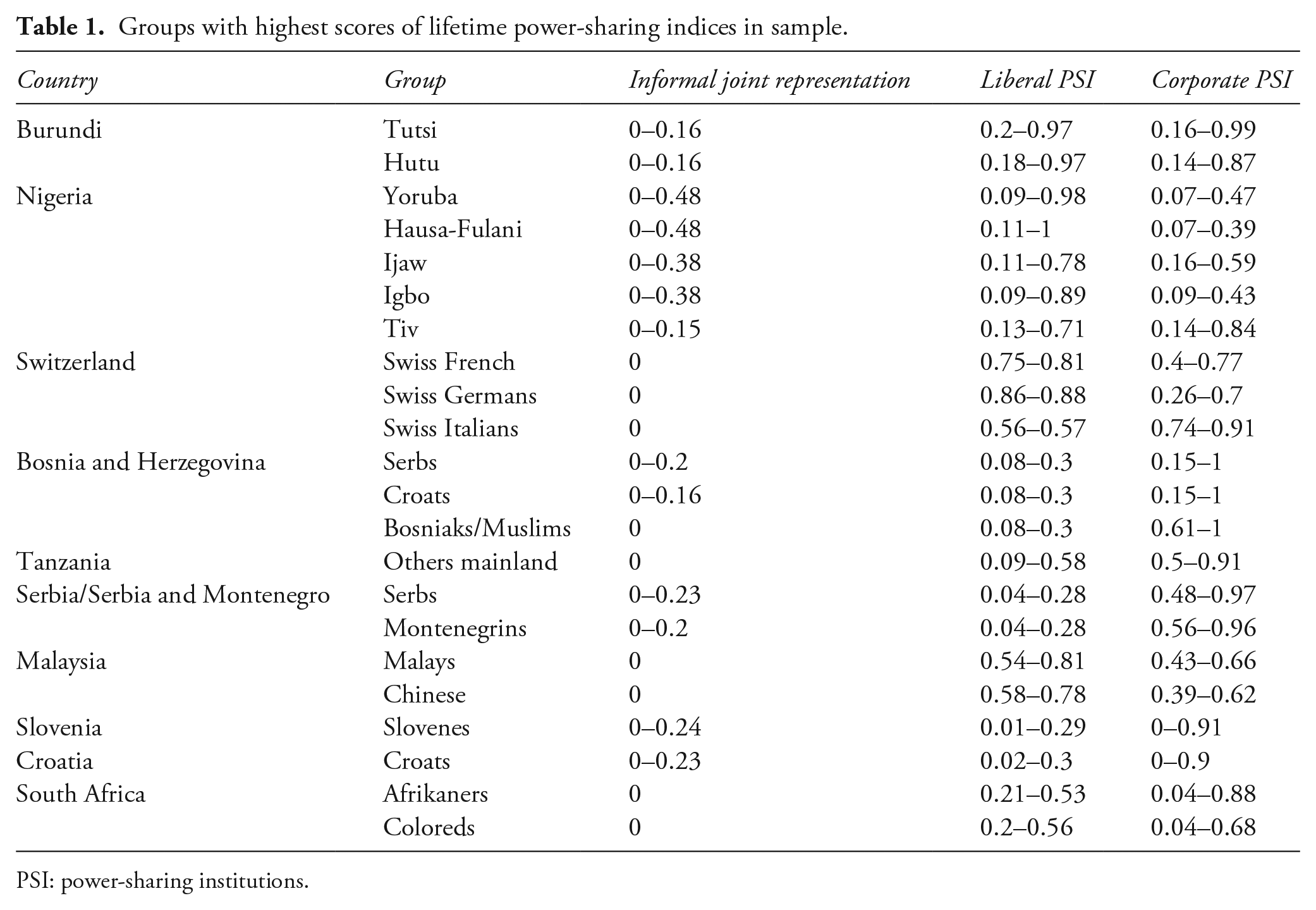
PSI: power-sharing institutions.
Specification and controls
Second, throughout my specifications, I incorporate fixed effects at the ethnic group-year level. For individual i in country c, group g, and year y, my specifications take the following form:

This is a logistic regression that examines the effects of respondents’ lifetime power-sharing, of different types.
The Ethnic group year fixed effect (
At the individual level,
Analysis
Main analyses
Table 2 shows my results. Models 1 and 2 test Hypothesis 1 by examining the effect of overall power-sharing practices, proxied by the joint representation of individuals’ group during their lifetime. Models 3 and 4 test Hypotheses 2 and 3 by distinguishing between informal power-sharing practices and corporate/liberal power-sharing institutions. As the substantive relationships indicated by the logistic coefficients are difficult to interpret, I visualize them using average marginal effects for observed values (see Figure 3).
Prolonged power-sharing and ethnic salience: main analyses.
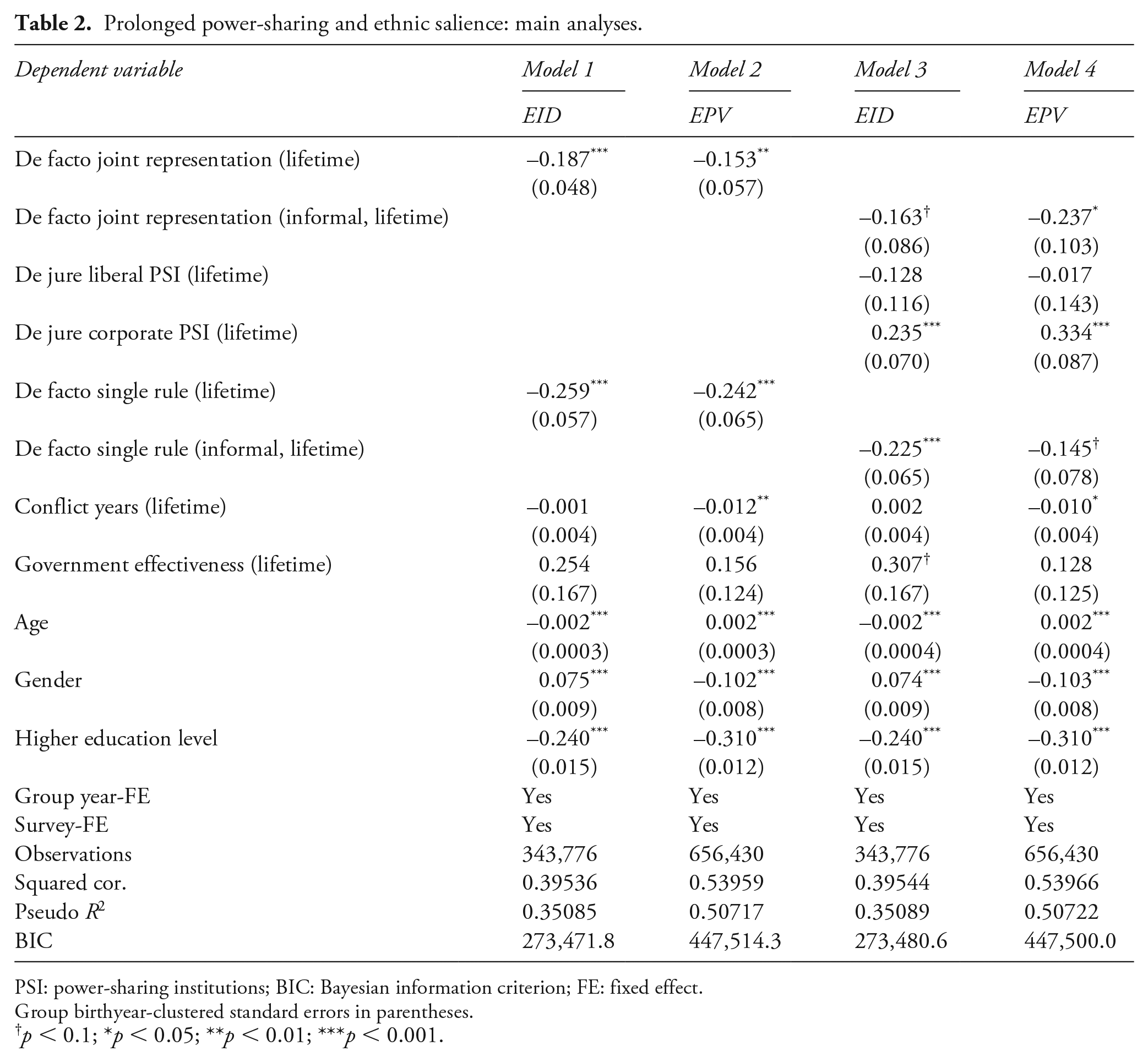
PSI: power-sharing institutions; BIC: Bayesian information criterion; FE: fixed effect.
Group birthyear-clustered standard errors in parentheses.
p < 0.1; *p < 0.05; **p < 0.01; ***p < 0.001.
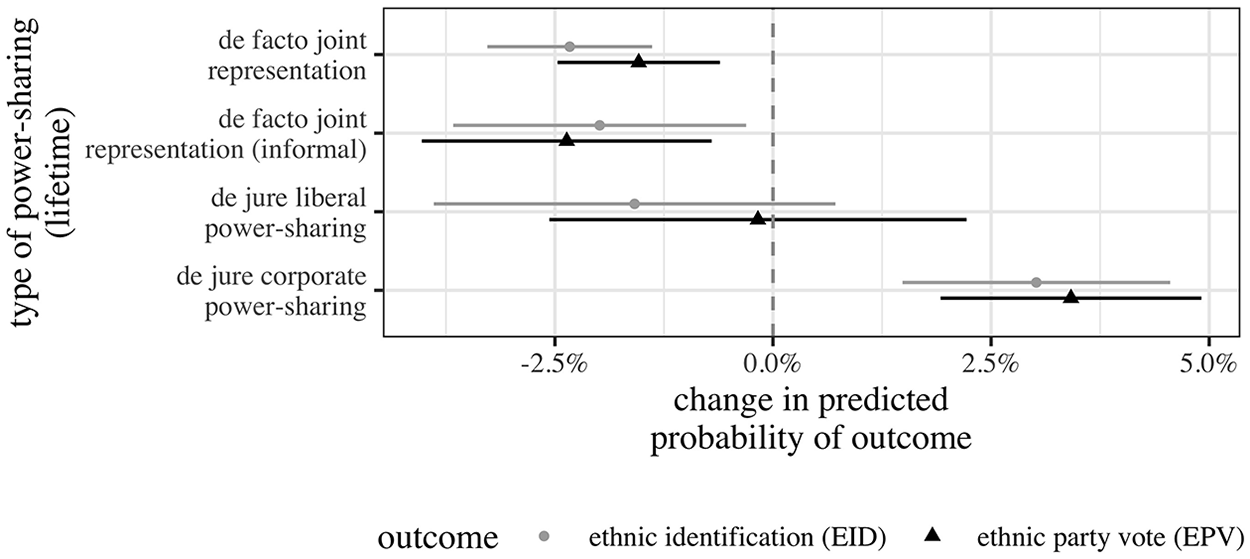
Marginal effects of different types of lifetime power-sharing on the probability of Ethnic identification (EID) and Ethnic party vote (EPV), based on Models 1–4 in Table 2.
In line with Hypothesis 1, I find that respondents are less likely to privilege their ethnic over their national identity (Model 1) and to vote for ethnically based parties (Model 2), the longer they have experienced de facto joint representation during their lifetime. Importantly, my attained coefficient and effect estimates (Figure 3, lines 1–2) are likely to be conservative, as they exclusively capture individual differences around the group mean in a given year, while omitting variance between different groups and countries. Moreover, as stated above, power-sharing is often provided to ethnic groups precisely at points in time when their ethnic identities are most salient in the first place. Considering this, the attained associations are substantial and offer evidence that prolonged power-sharing does indeed reduce ethnic salience over time.
In line with Hypothesis 2, Models 3 and 4 highlight important differences between different types of power-sharing (Figure 3, lines 3–8). I find that informal joint representation most substantially reduces ethnic salience. While my liberal power-sharing measures also have a negative coefficient, this remains statistically non-significant (p = 0.26 and p = 0.91, respectively). Finally, in line with Hypothesis 3, I find a positive and statistically significant association between prolonged corporate power-sharing and ethnic salience. In line with Hypothesis 3, this indicates that, at least in my sample, the effect of corporate power-sharing on the cognitive accessibility of ethnic identities outweighs its effect on their cognitive fit.
Robustness checks
I conduct several checks to probe the robustness of my results. First, a central motivation for my analysis was to ascertain whether power-sharing reduces ethnic salience in ethnically divided and post-conflict contexts. In additional analyses, I show that my findings are robust to limiting my sample to multi-ethnic countries with at least a 5% minority population (Vogt et al., 2015) and countries with ethnic contestations in the last 25 years (Germann and Sambanis, 2021; Vogt et al., 2015) (Online appendix 3.1).
Second, I probe the susceptibility of my findings to endogeneity (Online appendix 3.2). As discussed, my results are likely to have underestimated the support for Hypothesis 1, although they are at risk of falsely supporting Hypotheses 2 and 3. I addressed these concerns by incorporating additional controls for developments during the individuals’ lifetime that might make the introduction of power-sharing more likely, including past involvement in self-determination movements and targeted discrimination. Moreover, I estimate the effects of power-sharing ‘at the margin’ by limiting my sample to groups that were politically relevant in each year according to EPR (Vogt et al., 2015) and to those that were ever targeted by corporate power-sharing. Finally, instead of employing group year fixed effects, I instrument for de facto government representation (lifetime), broadly following the approach taken by Wucherpfennig et al. (2016). Reassuringly, none of these procedures substantially alters my results.
Third, an important limitation of my operationalization of power-sharing practices is that this only captures joint representation in the executive. This omits potential synergies between grand coalitions and other inclusive practices, such as proportional representation and mutual veto rights. To address this limitation, I show that my findings are robust to a more extensive measure of power-sharing practices that also considers ethnic representativeness in the legislature, unity governments, and oversized party coalitions (Online appendix 3.3).
In Online appendices 3.4–3.6, I present additional robustness checks, including different variable operationalizations, alternative specifications, separate models for my power-sharing variables, different criteria whereby I include respondents, an alternative hierarchical logistic specification and a group-level measure for gradually accumulating power-sharing stocks. Altogether, my results remain remarkably robust. One important limitation that emerge, however, is that the statistical significance of my Corporate power-sharing (lifetime) variable on EID depends on using the full variance provided by combining its diverse, and heterogeneous, underlying survey items. This suggests the need to investigate the impact of power-sharing on ethnic self-identification further with other well-suited measures that are available across a representative set of cases.
Conclusion
This article set out to shed new light on one of the most enduring and controversial debates in the literature on institutionalizing lasting peace in ethnically divided societies: the question of whether prolonged power-sharing reduces or increases ethnic salience. Previous research offers support for both views but has remained implicit in the mechanisms involved and only offered limited cross-national evidence for or against these claims.
My theoretical framework partly reconciles both views, by distinguishing between two countervailing mechanisms. First, prolonged power-sharing attenuates between-group inequalities, for instance in terms of political status and economic wealth. Thereby, it gradually decreases the value of ethnic identities as ‘rules of thumb’ and reduces their salience. Second, where inclusion is mandated through ethnically based, corporate power-sharing institutions, these institutions repeatedly categorize individuals as ethnic group members. This increases the accessibility of ethnic identities in individuals’ memory and bolsters their salience. As a result, I expected informal power-sharing to reduce ethnic salience most substantially, and that this effect should be attenuated, or even reversed, for corporate power-sharing institutions.
To test these arguments, I presented evidence from one of the most extensive datasets containing cross-national, attitudinal information on ethnic salience. In line with my argument, prolonged informal power-sharing, proxied by joint governmental representation of ethnic representatives over an individual’s lifetime, was associated with lower ethnic salience. Conversely, I attained only an inconsistent association for electorally based, liberal power-sharing institutions, while prolonged individual exposure to corporate power-sharing institutions was associated with higher ethnic salience.
Following up on these findings, future research should consider in more detail different types of informal power-sharing practices, beyond the descriptive representation of ethnic groups in government (cf. Bogaards et al., 2019). Moreover, it might consider how other accommodative strategies, such as regional autonomy, multiculturalism and economic redistribution affect ethnic salience. My hypothesized mechanisms suggest that these should similarly affect ethnic salience, for example by attenuating horizontal inequalities (cf. Stewart, 2008). In addition, future research should investigate the conditions under which different types of power-sharing might be substituted for one another. This question is relevant especially for post-conflict contexts in which minorities demand rigid and ethnically explicit corporate power-sharing institutions. However, in the long-term, the very same institutions reinforce ethnic salience, which is required for the eruption of violent conflict along specifically ethnic lines (cf. Cederman et al., 2013; Hale, 2008; Stewart, 2008). Relatedly, future research should explore in more detail than has been possible in this article the connections between ethnic salience and different types of ethnic conflict.
All in all, this study suggests that prolonged power-sharing leaves a lasting imprint on ethnic salience in heterogeneous societies. What do these findings mean for the wider debate on institutionalizing peace in ethnically divided places? First and foremost, they refute more extreme arguments against accommodation, such as the assertion that power-sharing inevitably accentuates ethnic divisions. I found no evidence for this. To the contrary, I found that prolonged power-sharing, especially where it rests on inclusive norms or informal coalitions, reduced ethnic salience. Second, my findings underline the importance of the specific institutional form whereby power-sharing practices are brought about. Most importantly, they indicate that if power-sharing rests on constitutionally enshrined, explicitly ethnic criteria, it may enhance ethnic salience by increasing the cognitive accessibility of ethnic identities. In sum, the results attenuate warnings against the long-term consequences of power-sharing for ethnic division, but counsel caution when this is attempted through the institutionalization of rigid, explicitly ethnic criteria.
Footnotes
Acknowledgements
I am grateful for the immensely valuable advice and support throughout this project’s lifetime by Kristin Bakke and Nils Metternich. I also wish to thank members of the Conflict & Change group at University College London, International Conflict Research group at ETH, and the Communication, Networks and Contention group at University Konstanz for their helpful feedback.
Replication data

Funding
The author disclosed receipt of the following financial support for the research, authorship, and/or publication of this article: This work was generously supported by the University College London Graduate Research Scholarship (X3W1RGWT9) and the ETH Zurich Postdoctoral Fellowship (20-1 FEL-27).
Notes
ANDREAS JUON, b. 1989, PhD in political science (University College London, 2020); postdoctoral researcher at ETH Zurich (2020– ), studying power-sharing, regional autonomy and ethnonationalism.