




Abstract
Lijphart’s claim that power-sharing spurs democratization in divided societies has strongly influenced ‘institutional engineering’ and is widely accepted among scholars despite the fact that empirical tests of its merits remain rare. This article revisits the democratic effect of power-sharing, arguing that it has two antagonist faces. On the positive side, it provides guarantees of inclusion to political elites, allowing them to commit to democratic rules. On the negative side, it also has an illiberal face, entailing limits on competition and individual rights. In this article, these contrary characteristics are traced back to two institutional types of power-sharing: a more flexible and open, liberal, type and a more rigid, corporate one. Using a novel dataset on power-sharing rules for 138 multi-ethnic countries and the period from 1945 to 2016, their respective democratic merits are tested. Conforming to theoretical expectations, the findings indicate that only liberal forms of power-sharing exhibit strong positive effects on democracy while corporate forms exert mixed or even negative ones. These findings are robust to a series of alternate model specifications and operationalizations as well as to instrumental variable approaches. In conclusion, the article indicates only a partial democratic effect of power-sharing, limited to its liberal subtype.
Introduction
Power-sharing is a popular institutional prescription for divided societies, with the prospect of establishing both political stability and democracy (Lijphart, 1977). Guided by this hypothesis, an important body of literature indicates that power-sharing indeed helps prevent violent conflict in divided societies (Cederman, Wimmer & Min, 2010; Pospieszna & Schneider, 2013; Roeder, 2005; Schneider & Wiesehomeier, 2008; Walter, 2002). However, most empirical research focuses on its effect on the (absence of) conflict, rather than on the establishment of positive peace, which also entails a democratic society. This gap is striking as numerous studies reveal that there are important trade-offs between political stability and democracy (Cederman, Hug & Krebs, 2010; Mousseau, 2001). Power-sharing regimes are a cornerstone in this debate, as they are praised for providing for democracy (Linder & Bächtiger, 2005), but also criticized for their antiliberal and undemocratic features (Dixon, 2012; Van Schendelen, 1984).
This article scrutinizes this critique of power-sharing and assesses its empirical validity. In particular, we argue that power-sharing has two faces (Bochsler & Juon, 2021): On the one hand, it fosters political plurality and guarantees political inclusiveness along communal lines (Bormann, 2014; Lijphart, 1977). This increased openness of the political system represents an important advance for democracy. On the other hand, power-sharing is often based on rigid ethnically based institutions, which not only limit free competition, but also confine political power to a narrow set of often undemocratic elites and risk perpetuating ethnic polarization (Dixon, 2012; Reilly, 2001; Van Schendelen, 1984). These restrictions clearly limit democratic ideals of free competition and openness.
We argue that the relative importance of these antagonist faces diverges between two institutional types of power-sharing (McCulloch, 2014; McGarry & O’Leary, 2007): In ‘corporate’ power-sharing systems, which are based on rigid, ethnically based institutions, the illiberal face of power-sharing will often be dominant and eclipse the democratic gains of increased inclusiveness. In contrast, in ‘liberal’ power-sharing systems, which rely on more flexible, electorally based institutions and on indirect incentives, the trade-off is less severe and gains accruing from higher inclusiveness will prevail. 1
An example for the former, corporate, type is Lebanon’s corporate power-sharing system, based on quotas for its various religious groups. While achieving long periods of stability, it has failed to turn the absence of violence into positive peace, instead establishing a nominally democratic system characterized by neopatrimonialism and severe democratic shortcomings and polarization (Ghosn & Khoury, 2011; Zahar, 2007). An example for the latter, more liberal type, are Nigeria’s power-sharing rules, gradually enhanced across several consecutive constitutions. Rather than relying on group-specific rules, they tie political representation to territorial units and constrain presidential elections through vote spread requirements. While also plagued by shortcomings, this more flexible institutional setup has enabled gradual progress towards the regularized, peaceful alternation of power (Sklar, Onwudiwe & Kew, 2006; Suberu, 2007).
Are these two types of power-sharing systematically associated with different effects on democracy? Are liberal power-sharing institutions better suited than corporate ones to overcome the trade-off between increased inclusiveness and limitations to democratic practice? Do they, then, represent a better safeguard for democracy?
This study is the first to trace these questions empirically in a systematic (large-N) fashion. Innovating over previous research, we measure power-sharing as a political-institutional model, as defined by Lijphart (1977), and test for diverging effects between its types. For this purpose, we use a newly updated global dataset that codes power-sharing in 138 ethnically diverse countries for the period of 1945–2016. Inclusive constitutional rules form the basis of our independent variables. In order to avoid overlaps with power-sharing, we rely on a minimalistic concept of democracy, using both our own novel measure thereof, based on electoral freedom (Hyde & Marinov, 2012), and conventional measures (Marshall & Gurr, 2014). Both are continuous in order to capture the rise of hybrid and competitive-authoritarian regimes since the end of the Cold War. These new measures allow us to go beyond existing studies and investigate the diverging impacts of the two types of power-sharing in detail. To our knowledge, there is no empirical work that captures both types simultaneously or that investigates their consequences for democracy. Most systematic earlier studies have not distinguished different types of power-sharing (Vogt et al., 2015), whereas others investigate some dimensions thereof, or focus on only one of our two types (Graham, Miller & Strøm, 2017).
The results conform to our theoretical expectations, showing that the liberal-pluralist type of power-sharing increases democracy levels, whereas the effects of the rigid, corporate type are mixed. Our findings are robust across multiple model specifications and operationalizations. They also hold if we use instrumental variables and matching procedures, to account for the origins of power-sharing. We complement these quantitative findings with a qualitative analysis of two power-sharing countries, Lebanon and Nigeria, which in our sample are typical of our attained relationship. While we identify antidemocratic practices in both, we find a less severe trade-off between consociational restrictions and democracy in the more liberal setup of the latter.
The remainder of this article proceeds as follows: The next section discusses previous research and formulates our theoretical expectations. Building on this, we present our conceptualization and operationalization of power-sharing and democracy, before conducting our empirical analysis. Finally, we situate our findings and identify avenues for future research.
Literature review and theory
While consociational theory is popular with scholars and practitioners alike, it nevertheless remains controversially debated. On the one hand, the literature on ethnic conflict mainly follows Lijphart’s reasoning that power-sharing allows for the inclusion of a plurality of interests. Thereby, it is often considered as the only suitable model of democracy to stabilize heterogeneous or post-conflict societies (Hartzell & Hoddie, 2015; Lijphart, 1977). On the other, the proposition that power-sharing also inevitably supports democracy has increasingly faced criticism: objections have outlined its inherent illiberal and anti-democratic features (Dixon, 2012; Rothchild & Roeder, 2005).
In the rest of this section, we first offer a conceptualization of these key terms, aiming to keep the concepts of power-sharing and democracy apart analytically. Based on this and on a literature review, we then move on to formulate hypotheses about the effects of power-sharing on democracy.
Concepts: Democracy and power-sharing
In this article, we address as democracies political regimes where the exercise of political power depends on the citizenry’s expression of its demands in regular open and competitive elections (Dahl, 1989: 221). This narrow term, corresponding to an ‘electoral democracy’, excludes further facets of democratic regimes which overlap with some aspects of power-sharing institutions. We conceive of its level as a continuous variable.
We conceptualize power-sharing regimes as an institutional arrangement in heterogeneous societies that stipulates political inclusion at the central state level, based on elite compromises, rather than majoritarian decisionmaking. This is underpinned by three constitutional pillars: proportional representation of all relevant groups in Parliament, provisions for grand coalitions or executive power-sharing, and minority veto rights (Lijphart, 1977). In this article, we focus exclusively on these horizontal power-sharing rules and exclude the fourth consociational pillar: group autonomy. Previous work consistently finds that its effects differ from power-sharing in government (Cederman et al., 2015; Graham, Miller & Strøm, 2017; Linder & Bächtiger, 2005). While it might be crucial to prevent conflict, its link to democracy levels of the state is less immanent: both power-sharing’s positive impacts on democracy by reducing electoral uncertainty and its negative side-effects due to institutional rigidity primarily derive from its horizontal dimension (see later in the article). We use the term ‘power-sharing’ as a synonym to ‘consociational regimes’.
The inclusive face of power-sharing
We argue that power-sharing helps sustain democracy for two reasons. First, power-sharing creates political stability, which is necessary to maintain democratic rule. Second, it makes transitions towards democratic rule acceptable for all parts of society. Both aspects are particularly central in heterogeneous societies with enduring divisions between communal groups. There, unconstrained majoritarian democracy risks excluding minorities permanently from power and creates destabilizing incentives for them to fight for inclusion (Mansfield & Snyder, 1995; Schneider & Wiesehomeier, 2008). Hence, democracy in divided societies is only sustainable if constitutional rules provide inclusive guarantees for minorities. By doing so, power-sharing might eventually even ‘resolve some of the major disagreements among the segments’ and ‘render [itself] superfluous’ (Lijphart, 1977: 228). This is reflected in the higher popular legitimacy of consociational democracies than its majoritarian alternative (Hänni, 2017).
The importance of these stabilizing impacts may be particularly high when competitive elections are initially established, most prominently after civil conflict or during democratic transitions. In both cases, elections are the pièce de résistance to establishing democratic rule. While offering belligerent groups the opportunity to transform their military capacities into political power, they can also serve as culmination points of political radicalization in divided societies (Brancati & Snyder, 2013; Horowitz, 1985). Similarly, transitions to democracy can threaten the balance of power and escalate into political violence (Cederman, Hug & Krebs, 2010; Jung & Shapiro, 1995; Mousseau, 2001). Majoritarian institutions of democracy inevitably produce both electoral winners and losers, and therefore fail to offer credible guarantees of political inclusion, especially after demobilization (Walter, 2002: 29).
The high stakes involved in initial competitive elections, particularly after a civil conflict, enhance incentives for election rigging and destabilizing violence (Cederman, Gleditsch & Hug, 2013; Hartzell & Hoddie, 2015: 45–49; Walter, 2002: 29). Political concessions aimed at lowering these stakes are only effective in the short-run and might be ignored by succeeding governments. However, their credibility can be enhanced through constitutional enshrinement, in the form of institutionalized power-sharing (McGarry & O’Leary, 2007; Walter, 2002). For instance, minority representatives can be provided with veto rights (Gates et al., 2016). Once stability is achieved, these guarantees might gradually lose their importance (Jung & Shapiro, 1995).
While arguments highlighting positive democratic effects of power-sharing figure prominently in the consociational democracy literature, empirical research on the matter has been scarce, with different approaches yielding diverging results. The most positive conclusions result from operationalizations that subsume checks and balances (e.g. judicial review) or liberal rights (e.g. press freedom) under a broad concept of power-sharing (Graham, Miller & Strøm, 2017). Focusing on its stabilizing role, power-sharing after civil conflict is assessed more positively (Hartzell & Hoddie, 2015; Jung & Shapiro, 1995). However, following more ‘classical’ operationalizations of power-sharing in central state institutions, Bormann (2014) reports a positive relationship, while Graham, Miller & Strøm (2017) attain mixed results, and whereas Jung & Shapiro (1995) even warn that it might be counterproductive to democratization (Jarstad, 2008: 130; Mehler, 2009: 462; Sriram & Zahar, 2009).
Our first hypotheses summarize these theoretical arguments highlighting the inclusive face of power-sharing and pointing to its particular importance in post-conflict contexts:
H1a:
Power-sharing allows multi-ethnic democracies to adopt higher levels of democracy than majoritarian regimes.
H1b:
The (positive) effects of power-sharing on the levels of democracy will be more pronounced in the aftermath of civil conflict.
The illiberal face of power-sharing
While the consociational model might enable democratization and democratic stability in difficult contexts, it is not short of alleged democratic deficits. These are especially pronounced in one particular implementation of power-sharing – namely, its ‘corporate’ type (McCulloch, 2014). Corporate power-sharing ‘accommodate[s] groups according to ascriptive criteria, such as ethnicity or religion’ (McGarry & O’Leary, 2007: 675). It is based on fixed group quotas for Parliament and government and on explicit veto rights allocated to a set of privileged groups.
These features make corporate power-sharing prone to antidemocratic backlashes. First, it is confined to specific segments. If other groups seek access to the regime, they need to aim for radical institutional changes or even for overthrowing the constitutional order altogether (Sriram & Zahar, 2009: 23). Second, a reliance on recognized groups politicizes individuals exclusively as group members and is in conflict with universal citizenship rights and liberal democratic values (McCrudden & O’Leary, 2013). Third, corporate power-sharing strongly emphasizes compromises between elites representing their respective communal groups. This risks de-emphasizing mass participation (Dixon, 2012; Lijphart, 1977: 50; Van Schendelen, 1984), open and programmatic competition (McCulloch, 2014: 502; Rothchild & Roeder, 2005), and might prevent the formation of a viable and strong opposition (Jung & Shapiro, 1995), all of which are core democratic elements. In sum, its explicit reliance on groups associates corporate power-sharing with the illiberal and antidemocratic features highlighted by the critics of power-sharing.
In contrast, the liberal type of power-sharing is more flexible. Avoiding explicitly specifying the groups between whom power is to be shared, it is based on encompassing constitutional rules, for instance low inclusion thresholds, proportional electoral systems, and super-majority requirements in the legislative process. Liberal power-sharing ‘rewards whatever salient political identities emerge in democratic elections, whether these are based on ethnic or religious groups, or on subgroup or transgroup identities’ (McGarry & O’Leary, 2007: 675). Some criticisms of power-sharing also apply to the liberal type, in particular its potential for segmenting the electoral market and its emphasis on elite compromises (Reilly, 2001). However, in contrast to its corporate alternative, liberal power-sharing avoids locking in citizens permanently into their respective group identities. Hence, it is more compatible with democracy and can more flexibly incorporate newly emerging groups into the political system.
We summarize this broad critique of power-sharing, and our specification thereof that differentiates between its two institutional types, in two further hypotheses:
H2:
Power-sharing regimes adopt lower levels of democracy than majoritarian regimes in multi-ethnic countries.
H3:
Corporate power-sharing regimes adopt lower levels of democracy than liberal power-sharing regimes.
Empirical analysis
We now proceed to test these hypotheses in a comparative, large-N fashion. We first present our new approach to operationalizing power-sharing and democracy, before estimating a series of statistical models that investigate their interrelationships. We complement these with a series of robustness checks to test their sensitivity to endogeneity and self-selection. Finally, we discuss the applicability of our quantitative findings to Lebanon and Nigeria.
Operationalizing institutional power-sharing and democracy
To test our hypotheses, we need to operationalize both power-sharing and democracy. For the former, we rely on the Constitutional Power-Sharing Dataset (v.1.2), which we updated for the present article (Juon, 2020). 2 The dataset codes, on the ethnic group-level, power-sharing in 138 countries covering the timespan between 1945 and 2016 and a total of 6,527 country-years. 3 Mirroring our conceptualization, it comprises institutional indicators belonging to the three horizontal pillars of power-sharing (Lijphart, 1977: 36): Grand coalitions (executive power-sharing), proportional representation in parliament, and veto rights over constitutional amendments and legislation. Most importantly for our purpose, it distinguishes between corporate and liberal types of power-sharing, providing separate, aggregate indices for each group’s degree of accommodation under both. 4
Power-sharing institutions are divided between corporate and liberal types as follows: Constitutional rules targeting specific ethnic minorities or organizations representing them are attributed to the corporate type. These include ethnic quotas and group-based veto rights. In contrast, provisions targeting political parties based on their electoral support belong to the liberal type; they include proportional electoral systems, low inclusion thresholds into executive office, and supermajorities in the legislative process. A more complicated case concerns territorially based institutions. If their alignment with ethnic settlement patterns is high, these institutions resemble ethnic quotas and are consequently predominantly attributed to the corporate type. Vice-versa, if territorial arrangements split ethnic groups between different mixed units (for example, in Nigeria’s vote spread requirements), they can flexibly accommodate different types of minorities and belong more closely to the liberal type (see Juon, 2020 for details).
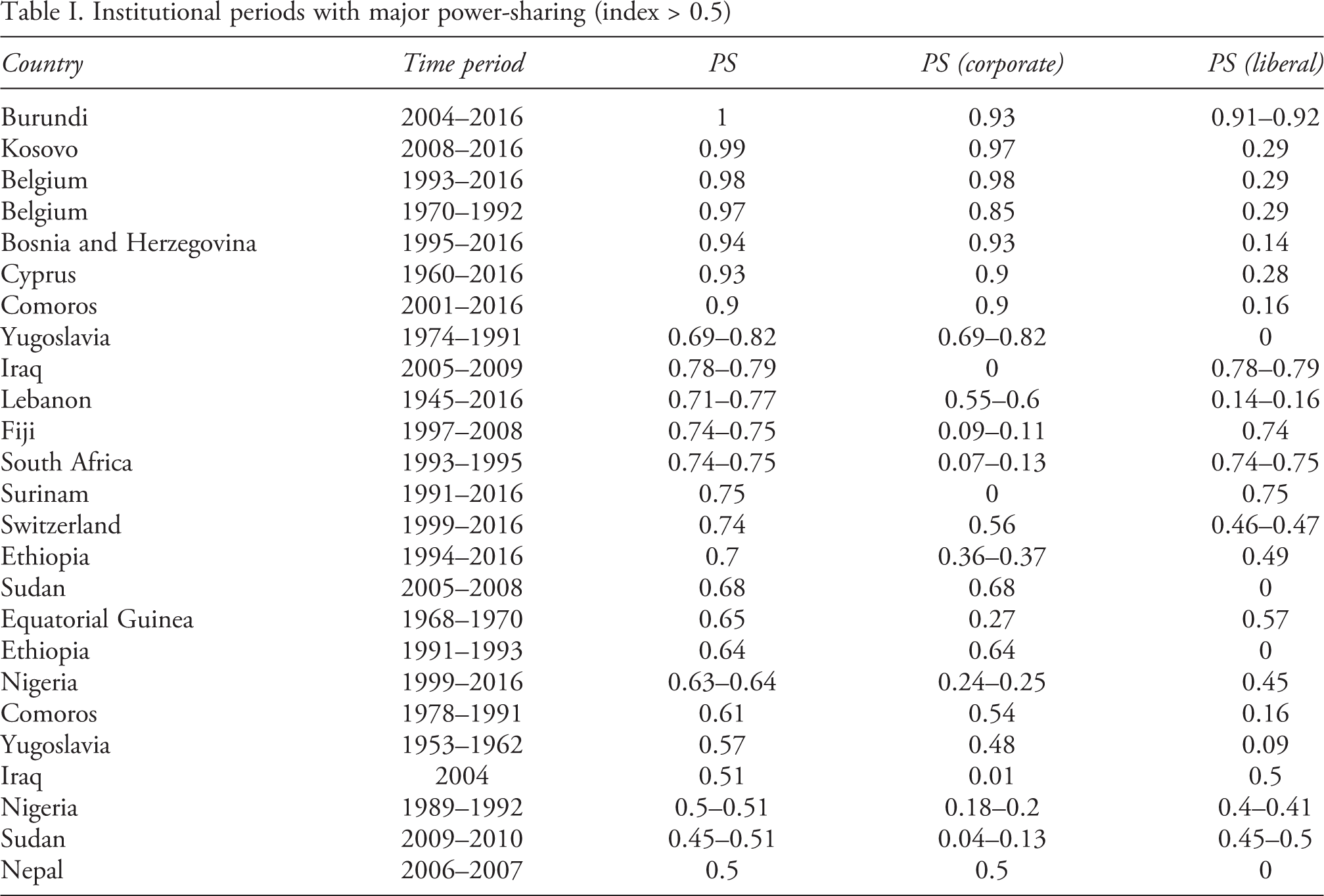
In order to set up our analysis, we aggregated these group-based measures onto the country-level by calculating their yearly average across ethnic minorities, weighted by population shares. 5 The resulting country-year indices (for overall, corporate, and liberal power-sharing) range from 0 to 1, reflecting both the inclusiveness (which fraction of a country’s minorities is covered?) and strength of power-sharing institutions (which degree of influence are they awarded?). For example, the inclusive system of ethnic quotas and veto rights in Belgium (after 1970) or the ethnic quotas in Lebanon are classified as strong corporate cases. In contrast, some of the highest values of liberal power-sharing are recorded in post-Apartheid South Africa (1993–1995), where constitutional rules provided for the inclusion of all parties above a 5% electoral threshold into the executive and for strict parliamentary supermajorities. Nigeria is also classified as predominantly following the liberal mode, as it institutionalizes government access based on territorial units whose boundaries cross-cut major segmental settlement patterns (Table I). 6
Importantly for our setup, corporate and liberal forms of power-sharing can be found in the constitutions of both democratic and authoritarian states (Table I). Furthermore, a series of systematic tests indicate that our measures indeed reflect not only constitutional wording, but correspond to political practice, both in democracies and non-democratic regimes. 7
Institutional periods with major power-sharing (index > 0.5)
In order to avoid such conceptual overlaps, we employ two different measures of democracy. First, we create a narrowly defined index of electoral democracy. We build on the expert-coded National Elections Across Democracy and Autocracy (Nelda) dataset (Hyde & Marinov, 2012), only covering those aspects that relate to the conduct of free and fair elections. 10 This gives us a rough normalized measure of whether elections were free and fair (index = 1). The minimal value (0) is assigned for non-free elections or the absence of elections for six years or longer. The measure excludes aspects of checks and balances or power-sharing. 11 Second, we employ a modified Polity IV index, addressing the problems identified by Vreeland (2008). 12
Main models
In our hypotheses, we are interested in the effects of power-sharing institutions on a country’s democracy levels. In order to investigate these expectations empirically, we rely on a series of models based on the following country-fixed effects specification:

The dependent variable, y(i, t), is the democracy level of country i during year t. α(i) is a country-fixed effect which limits the analysis to within-country variation, thus eliminating all omitted time-invariant confounders (such as stable ethnic demography and salience). X1(i, t-1) is a vector containing the main variables of interest, all lagged by one year to partly account for potential reverse causation. These include our power-sharing indices, a measure for regional democracy, 13 as well as a number of structural variables argued to be critical in the democratization literature: a country’s (logarithmized) gross domestic product per capita, its (logarithmized) population size, 14 its degree of fuel export dependency, 15 its ethnic fractionalization index, and the combined population shares of all minorities. 16 X2(i, t) controls for past conflict characteristics that may simultaneously influence the institutionalization of power-sharing and of democracy. These include binary variables identifying conflicts in the last ten years, major UN peacekeeping missions, 17 negotiated civil war settlements, and the number of battle-related deaths per capita (logarithmized) in the same timeframe. 18
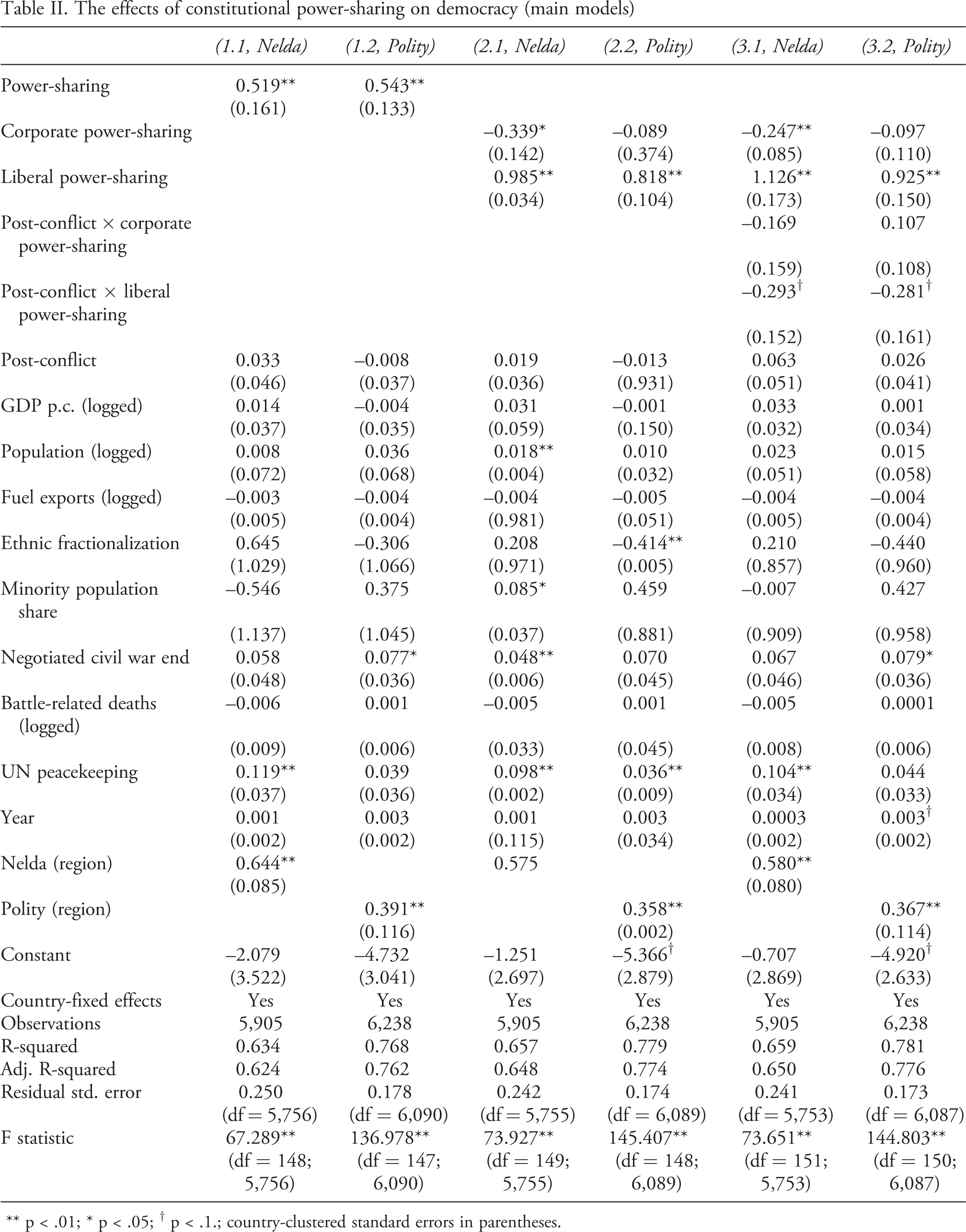
This setup enables us to systematically test our hypotheses. In a first step, we re-examine previous findings by assessing the overall impact of power-sharing on democracy (Models 1.1 and 1.2 in Table II): The attained coefficients indicate a very substantial effect: over-time increases of our normalized power-sharing index are associated with changes in our similarly normalized dependent variables of around half that magnitude – although one must keep in mind that, in the vast majority of countries, the former only varies across small parts of the theoretically possible range of values. This first specification thus offers preliminary support for Lijphart’s ‘consociational democracy hypothesis’ (our Hypothesis 1a), and against the (alternative) Hypothesis 2.
Building on this initial finding, we proceed to distinguish between the two types of power-sharing. We do this by keeping the same model, but using separate indices for the liberal and corporate types (Models 2.1 and 2.2). The results offer more nuance: The liberal type exhibits strongly increased effects on democracy levels; in contrast, the corporate type appears to have a negative relationship with democracy. As expected, the latter is much weaker and insignificant for the Polity-based measure where group-based inclusion implicitly forms part of the underlying democracy concept (see last section). This is in line with our Hypothesis 3.
In order to test whether power-sharing might be a more essential factor for democracy in post-conflict periods (Hypothesis 1b), Models 3.1 and 3.2 add interaction terms to our power-sharing indices with the dichotomous post-conflict variable. If either type was especially crucial in such contexts, we would expect their respective interaction terms to bear a positive sign. However, this is clearly not the case: While the effect of corporate power-sharing does not differ systematically, liberal rules of power-sharing even seem slightly less effective in post-conflict periods than in periods of enduring peace.
While most controls are insignificant, potentially due to the presence of country-fixed effects, the attained coefficients conform to previous findings: Most notably, democratic neighbourhoods, UN peacekeeping and negotiated settlements are positively associated with a country’s democracy levels.
Endogeneity concerns and alternative explanations
The effects of constitutional power-sharing on democracy (main models)
** p < .01; * p < .05; † p < .1.; country-clustered standard errors in parentheses.
In order to alleviate the potential for endogenous findings of the former type, we conduct several robustness checks. In one such test, we rerun our models, but lag all independent variables by two, five, and ten years, with the results remaining essentially unchanged. This boosts our confidence that they are not endogenous to temporal dynamics. In another test, we use an alternative specification with a first-differenced dependent variable which only picks up on subsequent changes in democracy rather than variation in its levels. While the negative effect of corporate power-sharing indicated in some of our models becomes insignificant, the positive impact of liberal provisions remains and the difference between the two continues to be remarkable (Online appendix 3).
In order to deal with the strategic use of power-sharing to avoid democratization, we conduct a brief descriptive investigation: If this were a widespread phenomenon, we would expect governing actors to adopt power-sharing institutions at comparably low levels of democracy. A cross-tabulation shows that, if present in our data at all, this issue appears minor and more widespread for liberal power-sharing (Online appendix 4). This would lead us to underestimate the already-attained positive effect of liberal power-sharing.
Another source of bias might be remaining conceptual overlaps between our measures for democracy and power-sharing. This concern applies to our liberal index, which comprises proportional electoral systems, which are unlikely to occur in authoritarian (e.g. single-party) regimes. However, our results remain almost unchanged in alternative specifications which exclude proportional representation from our indices. Further, while splitting our indices into separate components offers more nuance, the difference between the types, and hence our main finding, remains intact (Online appendices 3.3 and 3.4).
Instrumental variable and matching approaches
Our third and fourth set of robustness checks explicitly account for the origins of power-sharing institutions. In particular we subject our main findings to two sets of instrumental variable approaches (IV), one introduced by us that allows us to instrument for both types of power-sharing, and an established one that enables us to account for the corporate type. Additionally, we conduct a panel-matching procedure.
In a nutshell, in our first IV approach, we limit the analysed variation of power-sharing to the part that is induced by external actors, in particular by regional neighbours, conflict mediators, and military interveners. All these actors constitute external influences on a ‘host’ country’s propensity to institutionalize power-sharing. Regional neighbours exert an indirect influence by making available institutional templates. In regions where power-sharing is an established norm, elites are more likely to consider its adoption and minority citizens are more likely to demand its introduction (Cammett & Malesky, 2012; Cederman, Gleditsch & Wucherpfennig, 2018). In contrast, conflict mediators and military interveners affect the type of power-sharing directly, by pushing for the adoption of particular institutions. Importantly for our approach, they frequently do so by relying on existing, formalized institutional templates, based on their own historical experience (McCulloch & McEvoy, 2018; Mehler, 2013). For example, South Africa’s prior experience with power-sharing clearly influenced its mediation efforts in Burundi, culminating in the adoption of its consociational system there in 2005. In combination with threats of military intervention, South African mediation also shaped the successful push for power-sharing in the Comoros, leading to a consociational constitution there in 2001 (Mehler, 2013; Samii, 2013).
Based on these considerations, we base our first IV approach on two sets of three instruments, each for the corporate and liberal types of power-sharing. First, to capture regional diffusion, we calculate the annual averages of the two power-sharing indices within each given region. 20 Second, we identify major military interventions and mediation efforts as well as the individual states partaking in them. To do this, we rely on existing data which we extend up to 2011. 21 For all states actively involved in these efforts, we calculate their prior experience of power-sharing institutions to proxy for the institutional templates available to them. We then aggregate these into overall measures reflecting the degree to which each country was recently influenced by external actors with previous power-sharing experiences of the respective type. Both intervention and mediation measures are 0 if no external influence was recorded in the last 20 years or if external actors active in that period never used power-sharing themselves. They approach 1 as more of the active external actors had prior experiences with the respective type of power-sharing (Online appendix 5).
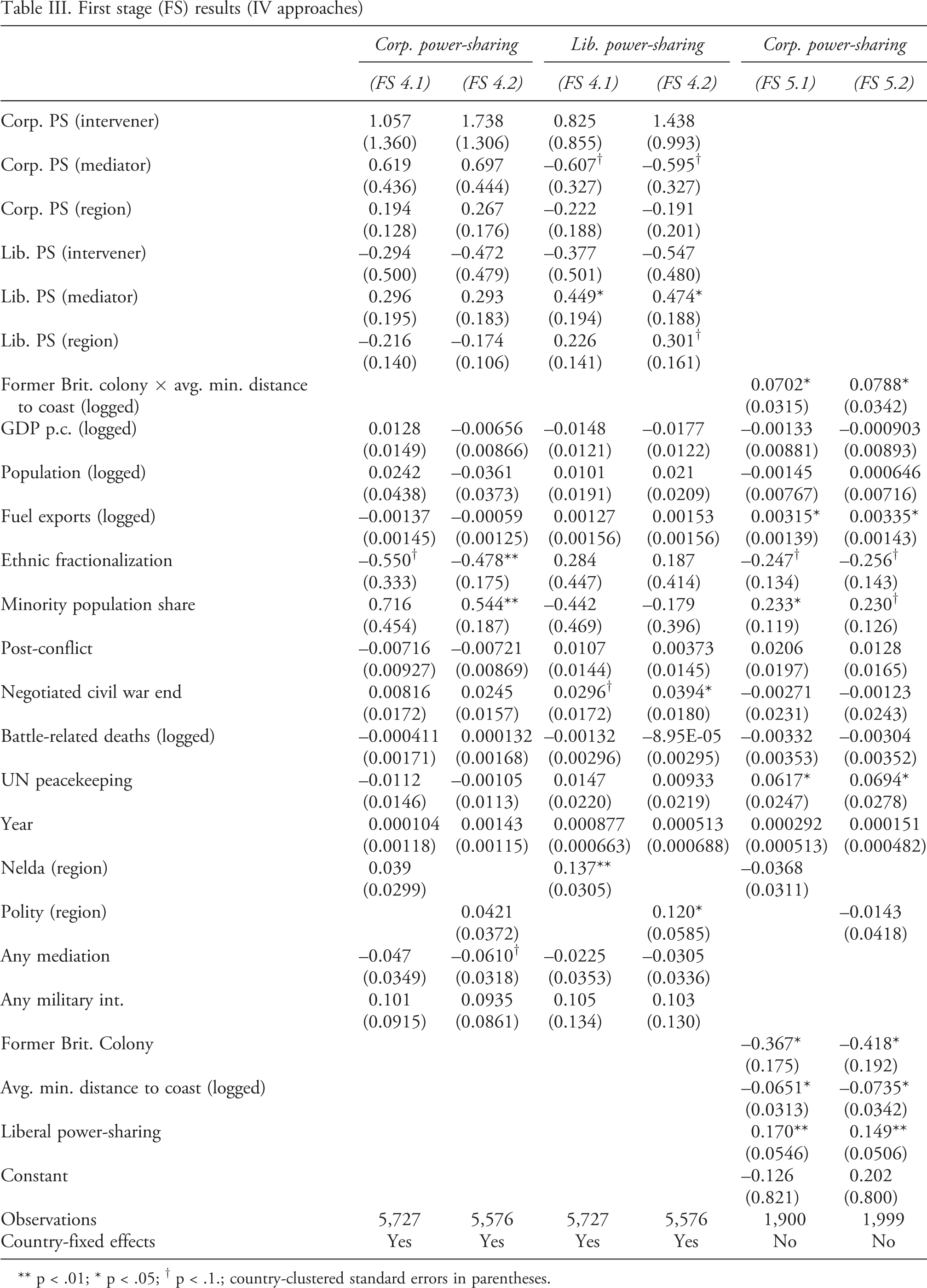
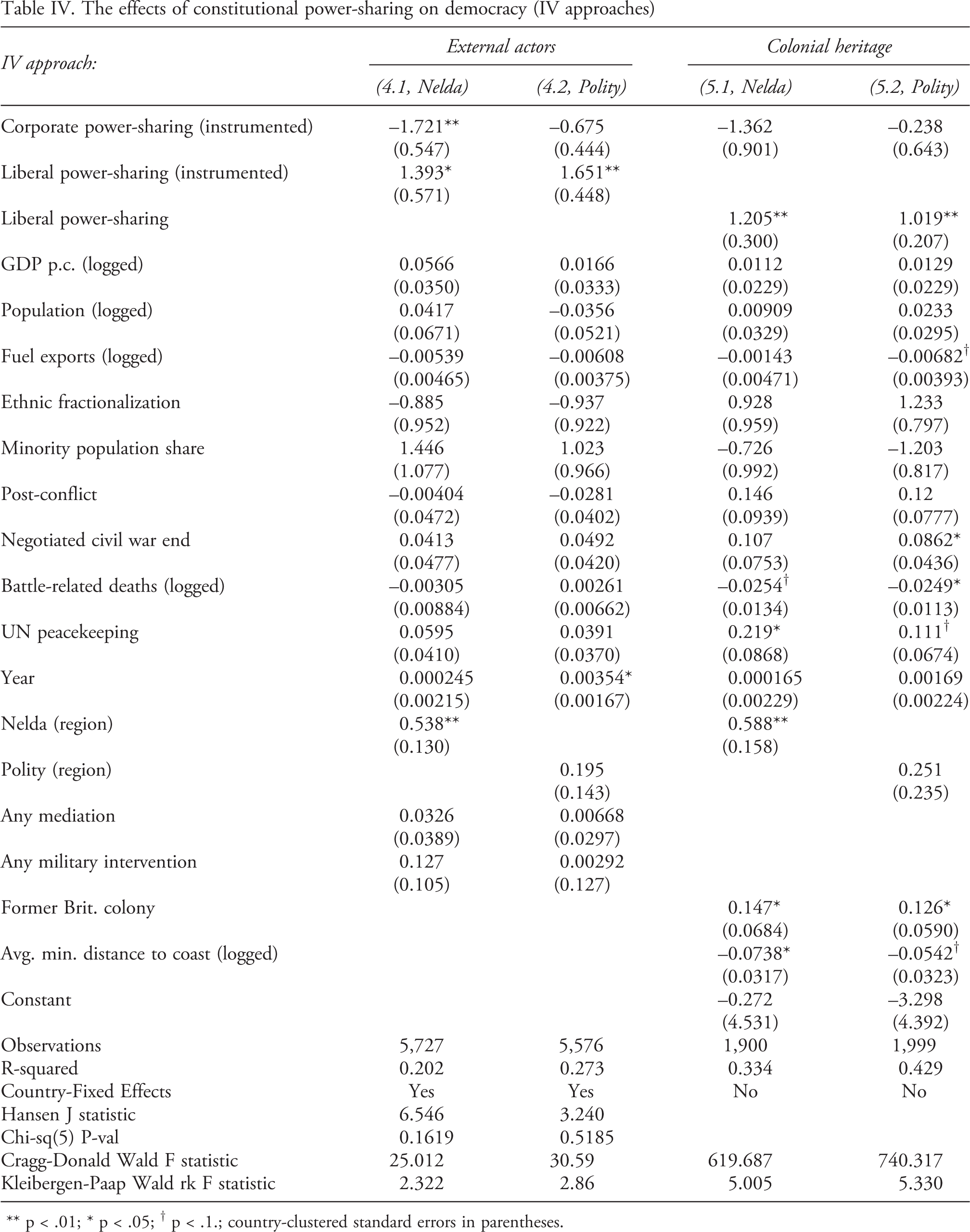
Following these arguments, we conduct a two-stage regression, instrumenting for corporate and liberal power-sharing. 22 The results from the first stage largely conform to our expectations, although in the presence of country-fixed effects, their significance often does not attain conventional levels (Table III). The second-stage results, regressing our democracy measures on the instrumented power-sharing indices, conform to our original findings (Table IV, Models 4.1–4.2). The more pronounced negative coefficient of corporate power-sharing does not bolster concerns whereby it might more often be adopted in periods with lower democratic baselines and strengthens our main finding on the diverging effects of the two types of power-sharing. 23
Furthermore, we test our results by relying on the most state-of-the-art IV specification of power-sharing, based on an interaction of colonial heritage with ethnic demographics (Wucherpfennig, Hunziker & Cederman, 2016). This approach not only provides us with a much stronger first-stage instrument for corporate power-sharing, but also enables us to exploit variation inside the more homogeneous set of cases of former British and French colonies in Sub-Saharan Africa and Asia (Table III and Online appendix 6). 24 Reassuringly, our results again remain unchanged even under this completely different approach and within this much more circumscribed set of cases (Table IV, Models 5.1–5.2).
Fourth, we conduct a panel matching procedure (Imai, Kim & Wang, 2019), enabling us to address self-selection and non-linearity concerns by matching sets of treated and untreated cases (for our dichotomized power-sharing measures) that are comparable on observable covariates (for example, by ethnic demography or recent conflict characteristics). While the estimated treatment effect for corporate power-sharing turns positive for our Polity measure, the clear difference between corporate and liberal types is unchanged for both dependent variables, thus again bolstering our main finding (Online appendix 7).
In sum, our investigations leave us reasonably confident of our main finding – the difference between corporate and liberal types of power-sharing. This remains robust to a large set of approaches, including country-fixed effects, first differences, two types of instrumental variable specifications, different dependent variables, and a panel-matching procedure (see Figure 1 for substantive effects of our main specifications).
Qualitative analysis
We complement our quantitative findings with a brief discussion of Lebanon and Nigeria. These are typical cases for our two types of power-sharing and representative of our wider attained quantitative relationship. Further, they offer temporal variance and are broadly comparable in their overall power-sharing levels and case history. 25 Our following discussion uses these two cases to situate the impacts of the two types of power-sharing in a specific context. It also offers nuance by highlighting the interplay of formal rules with informal arrangements not captured in our quantitative assessment.
First stage (FS) results (IV approaches)
** p < .01; * p < .05; † p < .1.; country-clustered standard errors in parentheses.
The effects of constitutional power-sharing on democracy (IV approaches)
** p < .01; * p < .05; † p < .1.; country-clustered standard errors in parentheses.
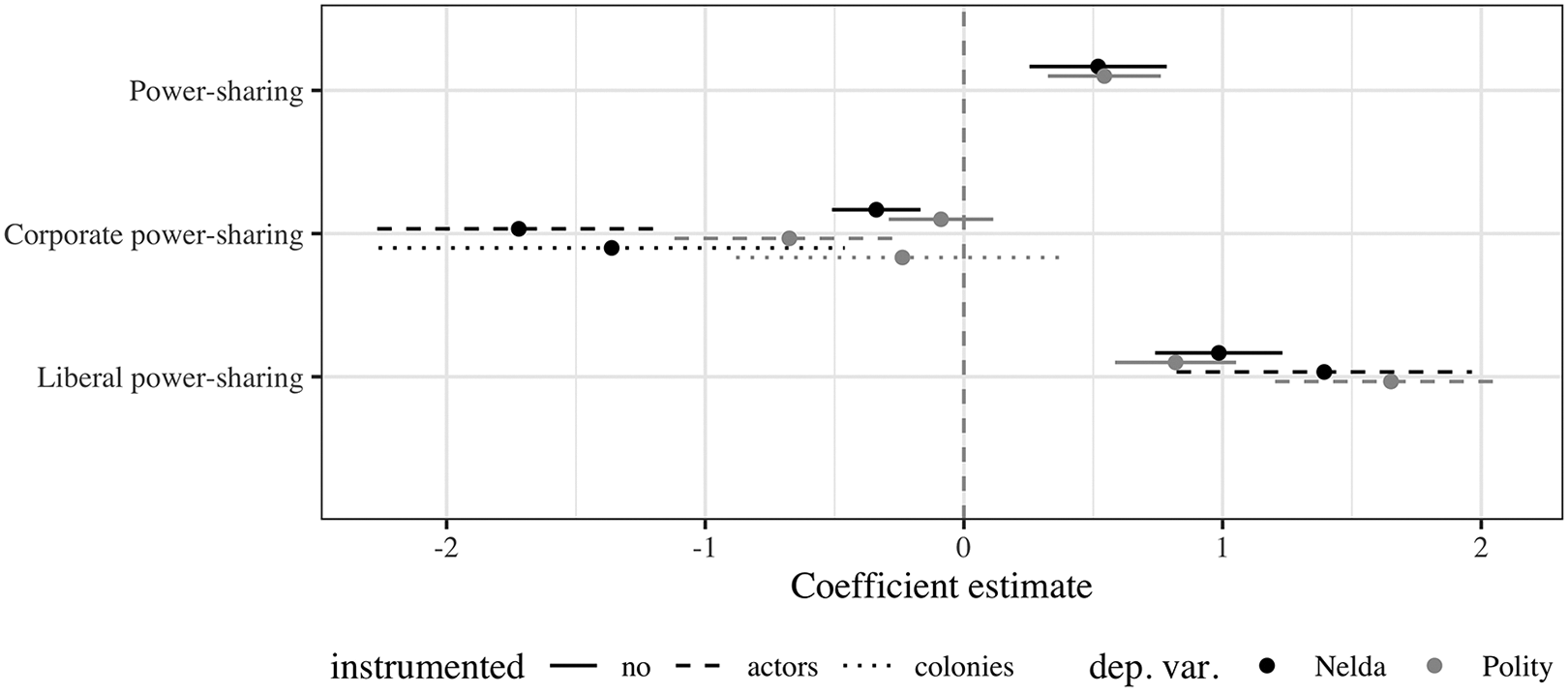
Substantive effects of power-sharing on democracy levels, main specifications.
The case of Lebanon reflects our expectations for democratic developments under the corporate type of power-sharing. It first adopted quotas for the religious communities in its pre-independence constitution of 1926 (art. 95). This was the basis for several modifications in response to repeated instability, leading to a more rigid system of power-sharing. An informal agreement between the sectarian leaders, the National Pact of 1943 assigned the most important state offices according to a sectarian key, following the now infamous 6:5 ratio between (Maronite) Christians and Muslims. In reaction to the Lebanese civil war, the constitutionally embedded Taif agreement of 1989 subsequently altered this into a 1:1 ratio (Zahar, 2007). Between 1989 and 2008, these formal rules came under renewed pressure due to instability and constitutional crises. While they were subject to repeated adjustments, specifically as regards electoral districts, they nevertheless served to uphold the common state (Salamey, 2014: 74–76).
While power-sharing served to uphold a nominal democracy, the Lebanese regime has effectively been locked in a segmental patronage system. Its system of quotas not only maintained a stable power distribution between confessional groups, but also induced severe political immobilism within them (Joseph, 2011: 156–158). To many observers, Lebanese democracy resembles a procedural facade (Ghosn & Khoury, 2011: 383), with substantial and persistent shortcomings in electoral freedom (Zahar, 2007) and competition. For instance, electoral districts are drawn to guarantee the representation of locally dominant groups (Salamey, 2014: 74). Yet, gerrymandering is used not only to prevent voting across confessional boundaries, but also to prevent opposition candidates from being elected (Makdisi, Kiwan & Martanner, 2010: 133–134; Zahar, 2002: 579–580). For 30 years (1975–2005), domestic institutions functioned in the shadow of the Syrian military, which acted as a foreign protector. The emphasis on elite agreements and low reform capacities are further reflected in Lebanon’s weak state apparatus, extraordinary powers given to the security forces (Ghosn & Khoury, 2011: 387–392), and limits on the freedom of assembly (Zahar, 2002).
Conversely, Nigeria illustrates the comparably flexible and responsive democratic trajectory enabled by a more liberal arrangement. Its constitutional rules are built around its main territorial units, the states, whose equivalence with major ethnic segments has been gradually loosened over the course of several constitutional iterations (Kendhammer, 2015). Its institutional evolution culminated in its most recent constitution, adopted during the transition from military rule in 1999. It awards at least one cabinet post to ‘indigenes’ of each state and grants veto rights to state governments over constitutional amendments. The election rule for presidential office also builds on the non-ethnically defined states: candidates are required to capture one quarter of votes in at least two-thirds of states.
Similar to Lebanon, Nigeria has combined constitutional rules with incisive informal arrangements. For one, Nigeria long followed an informal elite agreement that distributed power between six extra-constitutional, ethno-territorial ‘zones’. This found its expression, most prominently, in the internal composition of the long-dominant People’s Democratic Party (PDP), which ‘formally incorporated proportionality and zoning into its party charter and bylaws’ (Kendhammer, 2015: 159). The enforcement of these informal rules was accompanied by neopatrimonial practices and by the party’s capacity to control voting processes through local elites (Kendhammer, 2010: 67). In the context of strong political divides between North and South, the cornerstone of the presidential election rules – territorial vote spread requirements – was difficult to implement (Bogaards, 2010). The political parties did so by forming informal consociational pacts, requiring the presidency to rotate between the (primarily Muslim) North and the (primarily Christian) South. This served to reduce intercommunal tensions during the first rotation of the presidency from South to North in 2007, although the election was orchestrated by the PDP in a flawed electoral process (Suberu, 2007: 98).
In spite of these drawbacks, power-sharing helped contain tensions along the main ethnopolitical conflict lines. Further, the absence of explicitly ethnic rules offered greater flexibility to adapt to changing circumstances. The first series of elections (1999–2007) relied on rigid principles of rotation of offices and zoning. However, over the long-run, political competition improved, enabling these rules to be loosened. On the one hand, this offered parties the flexibility to abandon Presidential rotation rules in response to the unforeseen circumstances posed by the death of elected president Umaru Yar’Adua, a Northerner. On the other hand, competition gradually evolved between several multi-ethnic parties, whose internal organizational structure incorporated the principle of geographic distribution of power. This applied not only to the PDP (Kendhammer, 2010: 63–64), but also to the long-term opposition party APC, which was incentivized to reach out across communal lines to ensure competitiveness (Carbone & Cassiani, 2016: 42). Together, these developments have turned some of the most rigid, informal aspects of power-sharing redundant, and allowed for more effective democratization. This process culminated in the first partisan turnover in the presidential elections of 2015 (Carbone & Cassiani, 2016: 40–43).
In sum, the cases illustrate both faces of power-sharing – providing stability and reducing inter-ethnic tensions, but doing so through practices that undermine democratic competition. In Lebanon, power-sharing proved crucial to reinstall nominally democratic institutions. Yet, for long periods, the political regime stagnated without sustainable improvements in democracy levels. In Nigeria it provided the stability necessary to maintain fragile civil order at the end of military rule, although with dominant party control over the electoral process and vote-buying. However, while constitutional restrictions to competition prevail in Lebanon’s corporate power-sharing system, Nigeria’s more flexible, territorial rules have allowed it to experience a slow reduction of antidemocratic practices, and less than two decades after the introduction of power-sharing, elections have allowed for a peaceful alternation of the party in power.
Conclusions
The consociational model, also addressed as power-sharing, makes two central promises for divided societies: providing for democracy and for peace (Lijphart, 1977). In the empirical literature, the former has remained in the shadow of the latter (e.g. Cederman, Wimmer & Min, 2010).
This study presents new, systematic evidence on the diverging effects of two types of power-sharing on democracy levels. The first, ‘liberal’, type of power-sharing relies on flexible, indirect ways of including ethnic minorities (McGarry & O’Leary, 2007), such as proportional electoral systems, low inclusion thresholds into executive office, supermajority requirements, and inclusive rules using non-ethnic territorial subunits. By including diverse groups in government, it makes democracy more acceptable for minorities and rival factions, thus boosting democracy levels. The second type, ‘corporate’ power-sharing, relies on ethnic quotas, explicit veto rights given to minority representatives, and territorial provisions closely following ethnic settlement patterns. These institutions are rigid, leave little space for interethnic competition, and confine power to a narrow set of ruling elites, thus adversely affecting democratic norms of competitiveness and openness. Our analyses indicate that liberal power-sharing indeed exerts positive effects on democracy levels. Conversely, the overall impacts of corporate power-sharing are mixed and, potentially, even negative.
Our quantitative results are robust to a wide variety of modelling strategies and dependent variables. Results also hold once we use instrumental variable approaches (based on external norm-based influences and colonial legacies) and panel matching, thus accounting for the fact that power-sharing constitutions might be partly endogenous to democracy.
While our findings indicate broad democratic differences between the two types, they also point to the need for future research to consider in more detail several aspects that we have been unable to account for in this study. For one, the effects of power-sharing institutions might vary not only between the two types, but also between their underlying components, as indicated by the potentially negative effects of executive power-sharing across both. Furthermore, the cases of Lebanon and Nigeria show that more attention is required to the specific way by which institutionalized power-sharing is implemented informally.
Insights from our analysis echo earlier calls to more profoundly assess the merits of liberal and corporate power-sharing in divided societies (McCulloch, 2014). We read our findings as a cautionary tale for ‘constitutional engineers’: to engineer a positive peace going beyond the absence of violence, they should exercise caution when using rigid corporate forms of power-sharing. Whenever possible, a stronger reliance on more flexible liberal rules seems to offer the better prospects to develop democratic rule over time.
Footnotes
Acknowledgements
We are very grateful for helpful comments by Enzo Nussio, Lars-Erik Cederman, Jonathan Wheatley, Adis Merdžanović, Kristin Bakke, Nils Metternich, Neil Mitchell, and Hannah Smidt.
Replication data

Funding
This project was generously supported by the Swiss National Science Foundation (grant number 166228).
Notes
References
Supplementary Material
Please find the following supplemental material available below.
For Open Access articles published under a Creative Commons License, all supplemental material carries the same license as the article it is associated with.
For non-Open Access articles published, all supplemental material carries a non-exclusive license, and permission requests for re-use of supplemental material or any part of supplemental material shall be sent directly to the copyright owner as specified in the copyright notice associated with the article.
