




Abstract
Incumbents who resort to violence in efforts to secure their hold on power have been a major challenge for sub-Saharan Africa. At the same time, opening up domestic markets to international capital in the form of Foreign Direct Investment (FDI) has provided governments with more resources to garner the support of their citizens. How are these developments related? We argue that FDI reduces the likelihood that incumbents use violence in competitive regions. FDI has direct economic benefits for the population. Especially in competitive regions, where violence might reduce turnout even among their potential supporters, incumbents thus adapt their re-election strategies and use fewer violent means. We draw on geo-referenced data on election violence, FDI, and previous election results and match these within subnational regions. Investigating subnational variation in 15 sub-Saharan African countries, we find empirical support for our argument. FDI lowers pre-election violence in competitive regions, but has no effect in both incumbent and opposition strongholds. These findings are robust to using 10×10 km and 25×25 km grid cells and have important implications for democratic countries’ foreign policies: allowing multinational companies to invest in developing countries reduces violence, but might simultaneously bolster incumbent regimes.
Introduction
The third wave of democratization not only saw a spread of liberal democracies across the globe, but also a spread of elections as a means to attain or hold on to power in otherwise still very much autocratic countries (Levitsky & Way, 2010). Especially in sub-Saharan African countries, elections are oftentimes held in an environment that does not resemble a level playing field (Lynch & Crawford, 2011). Incumbents – deliberately and consciously – draw from a menu of options to sway the results in their favor (Schedler, 2002). Apart from outright interference in the electoral process, such as the deliberate misreporting of results or manipulation of electoral administrations, other manipulative strategies aimed at potential voters are also quite powerful. Among these strategies, incumbents regularly resort to repressive means such as violence to intimidate and demobilize voters in the run-up to elections (Rauschenbach & Paula, 2019).
The scale of pre-election violence is significant: 78% of countries are at risk of experiencing violence during elections, more than half of all elections held in the
Importance of FDI, aid, and remittances in African countries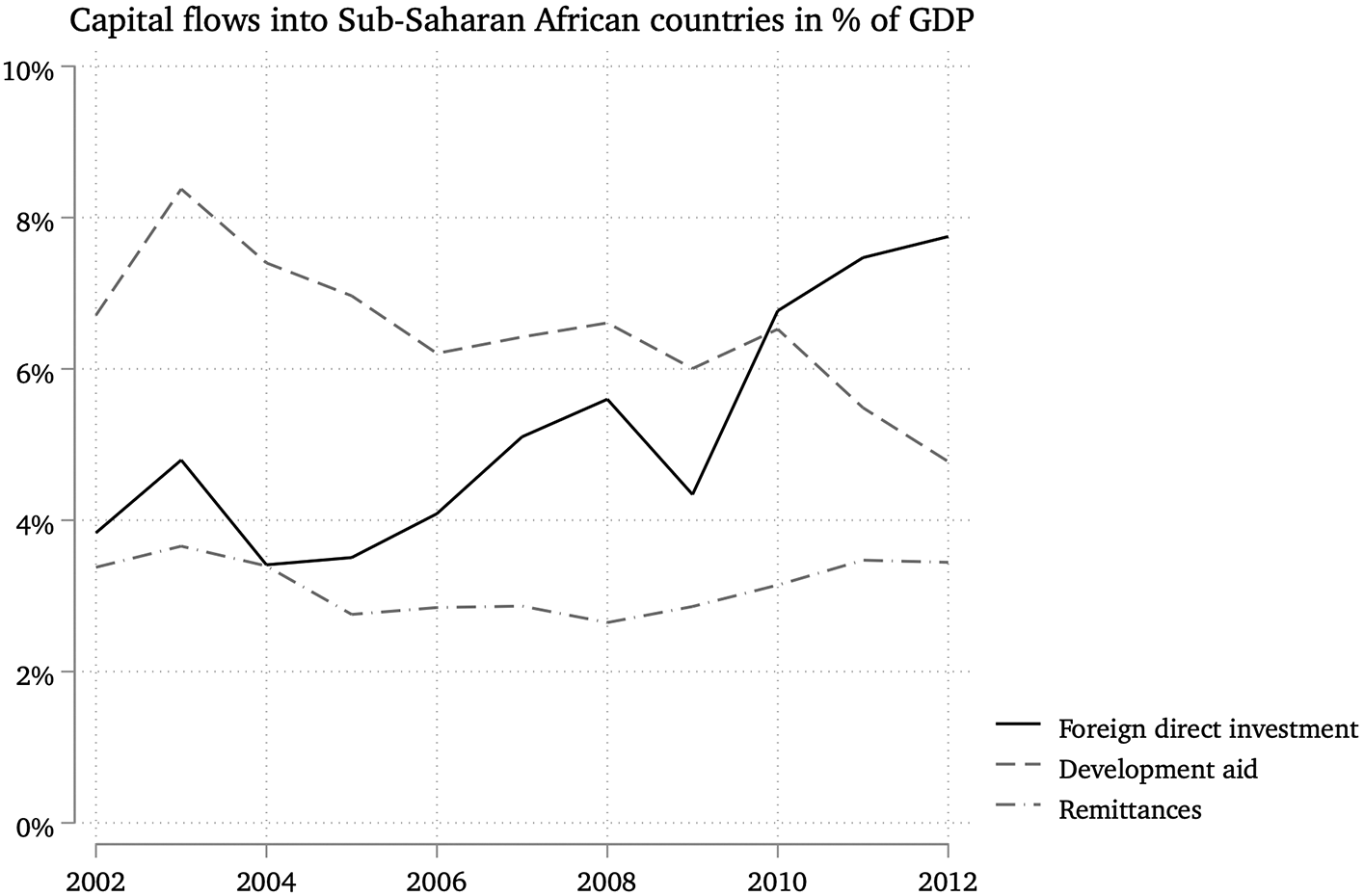
In recent years, many developing countries have embarked on a process of economic liberalization and globalization. Opening up the economy led to skyrocketing inflows of foreign direct investments (FDI) into most developing countries. FDI has doubled from about 4% of GDP in 2002 to about 8% in 2012. This type of cross-border financial flow has gained importance also in comparison to more traditional external sources of finance (see Figure 1). While foreign aid was the most important capital flow into sub-Saharan African countries, it decreased to about 5% of GDP in 2012. Moreover, FDI has also been more important in terms of size than remittances. As many developing countries became heavily reliant on FDI to bolster their economies (Pandya, 2016; OECD, 2023), it has had significant implications for the economic and political autonomy of governments. While governments might suddenly have more fungible resources, their room to maneuver in shaping policies could shrink (Mosley, 2000; Rudra, 2008). Whereas sizeable portions of the population might benefit economically, discontent can also run high (Palmtag, Rommel & Walter, 2020; Robertson & Teitelbaum, 2011).
Given the potential of international economic integration to shape both policy and politics, it is not unreasonable to assume that it changes politicians’ strategic considerations in the run-up to elections as well. In the following, we focus on how FDI affects the incentive of incumbents to use violence as a strategy to sway elections. Apart from having become an important international capital flow, focusing on the globalization of production offers two more advantages: first, FDI is investment in physical capital and, thus, by its very nature a form of foreign capital that incumbents can actually use to showcase economic success and campaign on (Owen, 2019). And second, FDI can have significant economic benefits on the local level, which can influence electoral races on the ground (Rommel, Palmtag & Messerschmidt, 2022). Hence, FDI allows us to provide a very focused test for whether there is an economic dimension to explain variation in incumbents’ use of pre-election violence.
We argue that incumbents have various strategies to influence electoral campaigns and that more FDI in specific regions changes the calculus of incumbents against using political violence. FDI directly and indirectly benefits the population by generating additional income. The availability of unearned foreign income that leaders can claim credit for makes violence as a strategy of vote manipulation less attractive. Yet, this change in strategy should predominately occur in areas where violence is frequently used and where more undecided voters live (Rauschenbach & Paula, 2019). Especially in more competitive regions incumbents can thus scale down on violent measures that are usually aimed at demobilization and simultaneously lower the risk that even their own supporters might not turn out because they fear violence. We test this argument using data on pre-election violence, FDI and previous election results in subnational regions of 15 sub-Saharan African countries from 2003 to 2012. We substantiate the analysis on the regional level with an analysis of 10×10 km and 25×25 km grid cells and find empirical support for our hypothesis. International capital inflows through FDI are associated with lower levels of pre-election violence in regions that are more competitive. As predicted by our argument, FDI does not make a difference for the strategic use of violence in both incumbent and opposition strongholds.
This article contributes to a better understanding of the international determinants of domestic contentious politics. Our study is the first to explicitly put the international economy front and center when explaining pre-election violence. Our findings using data from sub-Saharan Africa offer support for the idea that investments from abroad can lead to more peaceful politics and beneficial outcomes. Observing this effect in a multicountry study on the subnational level allows us to account for two aspects at the same time: the heterogeneous effects of international openness within developing countries and the geo-spatial distribution of the strategic use of violence. We therefore contribute to a growing literature that focuses at the impact of the international environment in explaining electoral violence (von Borzyskowski, 2019; Daxecker, 2014; Fjelde & Smidt, 2021; Smidt, 2020). We also heed calls for a more disaggregated perspective on the dynamics of violence (Birch, Daxecker & Höglund, 2020) by complementing recent research that goes beyond the country level (Müller-Crepon, 2022; Rauschenbach & Paula, 2019).
Theoretical argument
How does foreign direct investment affect electoral violence? In what follows, we argue that FDI reduces incumbents’ use of election violence in regions where elections are competitive. First and foremost, we assume that leaders in democracies and autocracies want to stay in power and actively work to increase their chances for re-election by using a variety of different manipulative strategies (Mares & Young, 2016; Rauschenbach & Paula, 2019). 1
Especially in young democracies and hybrid regimes in sub-Saharan Africa, violent measures are part of this toolkit of manipulation. We conceptualize pre-election violence as a strategy used by incumbents to interfere in the run-up of the electoral process, aiming to increase the chances of success at the ballot box (for an excellent discussion see Birch, Daxecker & Höglund, 2020). Even though violence can also be levied by the opposition, our focus is primarily on violence perpetrated by the incumbent in the run-up to elections. 2 Besides other forms of electoral manipulation, such as electoral misconduct, including fraud, the manipulation of electoral administrations, or vote-buying, incumbents consciously seek to demobilize voters (Straus & Taylor, 2012; Taylor, Pevehouse & Straus, 2017) and sway elections in their favor.
Costs and benefits of using violence before elections
Violence can be an effective strategy for incumbents to ensure their electoral success. Violence, or the fear of it, can foster demobilization by deterring at least some voters from going to the polls (Collier & Vicente, 2014; Bratton, 2008) or participating in activities in relation to elections. Similarly, (fear of) violence can be a negative incentive to support the regime or it can be used to facilitate other means of manipulating the election, such as electoral fraud through coercion of officials and silencing witnesses (Birch, 2020). Because violence is visible, it is also easier for incumbents to monitor whether agents on the ground actually implement this strategy of electoral manipulation, thus reducing the level of shrinkage (Brancati & Penn, 2022). Finally, the use of violence only consumes limited financial resources, as incumbents need only a small network of loyal agents to implement the strategy, while the psychological impact can spill beyond the immediate target audience to the wider population and generate widespread fear that potentially also persists in the long-run (Birch, 2020).
Yet, the use of this electoral strategy is not without risk and may also be associated with costs for the incumbent. First, deterring the opposition could demobilize the incumbent’s supporters by increasing the general level of fear among voters (Gonzalez-Ocantos et al., 2020). Furthermore, undecided voters might be less likely to support candidates that are prone to using violence (Gutiérrez-Romero & LeBas, 2020). Especially the excessive use of force can backfire for incumbents: opposition voters may not react with fear at all, but might be even more determined to turn out to vote (Young, 2020), or incumbents can lose their legitimacy within society at large, leading to large-scale protests (Birch, 2020). As electoral violence is more visible and recognizable than other strategies, it can also more easily lead to a loss of external legitimacy by the international community (Birch, Daxecker & Höglund, 2020; Birch, 2020). Finally, the use of violence can also endanger a leader’s personal life and survival, as there is both a short-term and long-term risk of retaliation and punishment (Birch, 2020).
Relying on violence as a stand-alone power-maintenance strategy therefore carries the risk of losing an election, which means that incumbents are well advised to use a mix of manipulative strategies such as fraud, vote-buying, and violence (Collier & Vicente, 2012; Birch, 2020). Incumbents have to decide whether to use violence in light of two factors: the perceived risk and legitimacy costs involved on the one hand, and the material resources they possess on the other hand (Birch, 2011, 2020; van Ham & Lindberg, 2015). While violence is relatively cheap in financial terms compared to other strategies such as vote-buying, it carries higher legitimacy costs and risks when used as a strategy of electoral manipulation (Birch, 2020; Collier & Vicente, 2012; Gonzalez-Ocantos et al., 2020; van Ham & Lindberg, 2015). 3
Incumbents not only determine the level of pre-election violence, given their risk perceptions and available financial resources, but also take subnational conditions into account when deciding whom to target. The use of election violence is generally attributed to the competitiveness of elections (Asunka et al., 2019; Collier & Vicente, 2014; Hafner-Burton, Hyde & Jablonski, 2014; Salehyan & Linebarger, 2015; Taylor, Pevehouse & Straus, 2017). At the same time and among competitive elections, pre-election violence is likely used in more competitive regions that host a lot of undecided voters (Collier & Vicente, 2012; Evéquoz, 2019; Robinson & Torvik, 2009). 4 In principal, financially costly strategies like vote-buying could also be effective here (Jensen & Justesen, 2014). Yet, given budget constraints, incumbents mostly target their own strongholds with clientelistic policies (Rauschenbach & Paula, 2019). This makes the use of violence highly likely outside of incumbent strongholds, in more competitive regions and opposition strongholds. 5
FDI as a substitute for violence on the subnational level
How do international financial flows affect electoral violence? We argue that FDI opens up additional financial flows that induce incumbents to use less electoral violence in competitive regions. The level of electoral violence that an incumbent chooses is not only subject to domestic politics, but increasingly involves an international dimension. For example, development aid is oftentimes characterized as unearned foreign income that incumbents use for re-election purposes (Ahmed, 2012; Morrison, 2009). Given that developing countries have also opened up their economies, we should expect similar effects of international capital flows which nowadays exceed international aid flows (Pandya, 2016). FDI is a form of cross-border investment by multinational enterprises in physical capital in other countries.
FDI exhibits strong, but locally concentrated, income-effects on both the aggregate and individual level (Rommel, Palmtag & Messerschmidt, 2022). Investments made by multinational enterprises increase the local capital stock, directly benefit the population by generating additional employment opportunities, and indirectly benefit the entire region by generating spillovers via consumption effects (Aitken & Harrison, 1999; Krugman, 1991). Leaders, in turn, campaign on publicly visible investment projects and thus claim credit for the benefits of unearned foreign income as a signal of their competency (Cruz & Schneider, 2017), which makes voters much more likely to attribute their additional personal income to the incumbent (Owen, 2019). In this sense, FDI functions similarly to other strategies like vote-buying in mobilizing voters for the incumbent; yet, with the additional advantage that the incumbent does not have to spend any resources on it. Incumbents – expecting that public opinion shifts in their favor – adapt to these changes by applying less violence in the respective regions.
This rationale should decidedly affect the level of violence in competitive regions. Given that incumbents use electoral violence predominantly in competitive regions and opposition strongholds to demobilize voters, these are then the regions where electoral violence could decrease significantly if the incumbent adopts this strategy. However, we argue that undecided voters in competitive regions are more likely to be influenced by additional personal income resulting from the current government’s policies than opposition supporters in opposition strongholds, who are already strongly opposed to the incumbent and whose preferences are therefore less susceptible to the influence of additional income. Leaders can thus expect additional individual income because of the presence of multinational investors to be attributed to their policies and shifting voting behavior in their favor in more competitive or undecided regions, rather than in opposition strongholds where voter preferences are less volatile. We would therefore argue that incumbents adjust their demobilization strategy specifically in competitive regions that receive a lot of FDI and expect a decline in pre-election violence in these regions.
In addition to the direct effect on individual income, FDI may to some extent also have an indirect effect by providing rents and freeing up resources in a country’s budget. For example, receiving foreign investment in firms and infrastructure could allow incumbents to devote more material resources to manipulating elections and allow the use of more materially expensive strategies such as vote-buying. Since incumbents already spend an optimal amount of material resources in their strongholds, the elasticity to buy additional votes given the budget is highest in more competitive regions. Thus, when receiving foreign income, incumbents have the opportunity to increase the use of resource-intensive manipulation strategies such as vote-buying and thus reduce more risky strategies such as pre-election violence. Again, this change in strategy should predominantly take place in competitive regions, where the likelihood of winning people over is higher than in opposition strongholds.
Hence, we hypothesize: Hypothesis 1: FDI reduces pre-election violence in competitive regions.
One example of an incumbent who used investment projects to gain support from undecided voters in competitive regions is Zambia’s former incumbent president Edgar Lungu (see Online appendix A-1 for a more in-depth illustration of this example). Due to an overall poor economic performance, he faced his toughest electoral contest yet and violence generally ran high in the run-up to the 2021 election. To portray foreign-funded infrastructure projects, which are concentrated in three regions, as his economic success and to garner electoral support, Lungu frequently shared images of infrastructure projects on Twitter and other media outlets. Government-initiated pre-electoral violence, on the other hand, was specifically not targeted towards these regions but was more prevalent in provinces that went decisively for the opposition in the previous election. Even though Lungu ultimately lost the election to his long-time opponent Hakainde Hichilema, this example showcases the main ingredients of our argument: incumbents employ a mix of strategies to influence voters in their bid for re-election. They strategically use pre-election violence in regions, where they believe intimidation will hinder the opposition’s campaign. In more competitive regions, they are more likely to refrain from using violence if they have the chance to campaign on their economic success using highly visible projects financed by multinational investors to sway undecided voters on material grounds.
Data and methods
We test this expectation thoroughly in a multicountry setting using subnational variation in 15 sub-Saharan African countries between 2003 and 2012. We rely on geo-located information on instances of pre-election violence, FDI projects, and previous election results and embed this information within 227 first-level administrative units. Sub-Saharan Africa offers several advantages to test our argument: the majority of these countries have relatively competitive elections, yet electoral violence occurs regularly (Daxecker, Amicarelli & Jung, 2019; Rauschenbach & Paula, 2019). At the same time, these countries are located within a region where FDI is on the rise, but still a relatively new phenomenon (see Figure 1). Additionally, we can generalize our findings across a set of countries that are different with regard to regime type, party competition, or history of violence.
Operationalization
Pre-election violence
To measure pre-election violence, we rely on data from the Electoral Contention and Violence (ECAV) dataset (Daxecker, Amicarelli & Jung, 2019). This dataset contains information on nonviolent and violent events around national elections in 136 countries from 1990 to 2012. The database includes events such as demonstrations, riots, or killings that are all related to national-level elections. Events are identified from news reports from either the Associated Press, Agence France Press, or the BBC. To come up with a list of events that matches our argument closely, we restrict the original data in the following ways: first, we exclude post-election events and rely exclusively on those that happened in the run-up to national elections or on election day; second, as our argument stresses the strategic calculus to use violence to sway election results we restrict all events to those where the government is the main perpetrator; third, we use the categorization provided by Daxecker, Amicarelli & Jung (2019) to only include types of events that have the potential for being or turning violent. 6
Our dependent variable thus captures acts of physical interference on the part of the incumbent government in the run-up to elections that have the potential to turn into violent events. Because exclusively violent events may be more reliably captured in international news outlets (von Borzyskowski & Wahman, 2021), we also restrict the number of events to those that were characterized by the actual use of violence and use this dependent variable in robustness checks. In order to embed all events in subnational regions, we rely on the reported location in terms of longitude and latitude. In the empirical analysis we use a binary indicator, which identifies whether any electoral violence occurred or whether elections were peaceful. We prefer this indicator, as the exact number of events is likely a function of how well media sources had covered a specific election or region. 7
Foreign direct investment
Our main independent variable is capital inflows by multinational corporations into sub-Saharan African countries. Official cross-country statistics are only available on the aggregate country level, which would not allow us to match FDI and pre-election violence at the level of subnational regions. Hence, we draw on a dataset by The Financial Times Ltd. (2018), which records foreign investment on the project level and includes precise information on the location of each investment, which makes it particularly valuable to measure the effect of investment on political outcomes at the subnational level (see, for example, Owen, 2019; Palmtag, forthcoming). Starting in 2003, this database records greenfield investments as well as expansions of existing projects on an ongoing basis, processing information from a variety of sources, such as news wires, media, and information from industry organizations. The dataset records, for instance, that De Beers, a US investor, opened a processing plant for the production of nitrogen in Francistown located in the north-east region of Botswana in 2003, investing roughly 300 million US dollars and creating roughly 53 new jobs. This detailed project-related data allows us to assess the exposure of subnational regions to FDI.
To measure exposure to FDI on the regional level, we match each FDI project with the first-order administrative unit it is located in. Following this geographic matching we create two different indicators: for one, we use the estimated capital expenditure per investment project and create a cumulative sum of capital expenditures by foreign investors in each year for the specific first-order administrative unit (and take the natural logarithm). 8 This is a fine-grained measure, which allows us to differentiate how much subnational regions are actually exposed to investment projects by foreign multinationals and differentiate between regions with large or minor capital inflows. Yet, our FDI data may suffer from some inaccuracy regarding the precise expenditure of projects as they are based on media reports and estimations of the investors. For a robustness check, we thus also create a more aggregate measure; a binary indicator indicating whether a subnational region is host to an investment project or not. This indicator takes on the value 1 in the first year any investment is recorded and remains 1 in following years.
Incumbent vs. opposition strongholds
Our argument suggests that FDI should have different effects in regions depending on whether they are incumbent strongholds, competitive regions, or opposition strongholds. We therefore include election results from previous elections in subnational regions. To do so, we focus only on countries where the Constituency-Level Elections Archive (CLEA) dataset (Kollman et al., 2020) records results from at least two elections between 2003 (the earliest year for which data on FDI is available) and 2012 (the latest year for which data on election violence is available). This leaves us with a total of 15 sub-Saharan African countries, for which data on election violence, FDI, and previous election results is jointly available. 9
To create our measure, we follow several steps. First, we identify the incumbent party for each election (e.g. the Botswana Democratic Party in the 2004 Botswanan election or the Democratic Progressive Party in the 2009 Malawian election). Our measure of incumbency advantage within regions thus relies on the vote share of the incumbent’s party. Second, we harmonize the election data provided by CLEA within first-order administrative units. For some countries (e.g. Mozambique or Zimbabwe), data are already on the regional level. For other countries (e.g. Kenya or Nigeria) data are available on a more fine-grained level, such as electoral districts. Here, we sum up the total number of votes cast for each incumbent party within a subnational region and then calculate the regional vote share.
Simple vote shares give us an indication of where incumbent parties within sub-Saharan African countries have their electoral strongholds. Yet, party systems and the strength of the incumbent parties vary widely across African countries. Some countries have a very strong two-party competition (e.g. Zambia), whereas in other countries party competition revolves around more than two parties getting a substantial share of the vote (e.g. Guinea-Bissau). In a third step, we thus group regional vote shares for the incumbent in quartiles to facilitate cross-country comparability: The 25% of regions within a country where the vote share for the ruling party is largest are categorized as incumbent strongholds. Similarly, the 25% of regions within a country where the vote share for the incumbent is lowest – and, consequently, opposition parties are much more favored by voters – are categorized as opposition strongholds. The remaining 50% of regions are grouped into two middle categories that resemble more competitiveness where either the opposition or the incumbent party have a slight electoral advantage. 10 To check that our results are not sensitive to percentile choice, we also create a 6-category, 8-category, and 10-category stronghold variable. For these more continuous measures, we again assume that categories at either end represent incumbent and oppositions strongholds, while the middle categories resemble competitive regions.
Estimation strategy
Our final dataset consists of 227 subnational regions located within 15 sub-Saharan African countries between 2003 and 2012. We run linear probability OLS models including country and time fixed effects and control for a number of alternative explanations on the regional level. First, we include average light intensity at nighttime as a measure for regional economic development (Li et al., 2020). Second, we include the size of each region in terms of population to account for how important each region is in national elections (Klein Goldewijk et al., 2017). Third, we control for past violence by including an indicator based on geo-coded UCDP conflict data (Sundberg & Melander, 2013). All control variables are lagged by one year. Fourth, we include a dummy for each country-year where a national election took place. Fifth, we include the logged area of each region to control for the fact that some regions differ widely in terms of size. We also include a binary indicator whether a subnational region is host to the country’s capital or whether the incumbent was born in that region (Dreher et al., 2020) to control for a country’s most likely power centers which might affect the distribution of FDI, incumbency advantage, and electoral violence. 11
This design is subject to two potential endogeneity concerns: on the one hand, political violence might determine the amount of FDI inflows. On the other hand, previous election results might change the behavior of multinational investors. Even though we cannot fully rule out both endogeneity concerns, we are nevertheless confident that our empirical strategy is suitable to identify the effect of FDI on pre-election violence. First, our analysis includes only variation on the subnational level (due to the inclusion of country fixed effects). While there is indeed evidence that conflict and violence deter FDI if you look at variation across countries, this effect should be small within countries. Once investors have decided that they will invest in a specific country, they face logistical restrictions with regard to the location of their investment. FDI in copper mines, for instance, requires that there are in fact copper deposits in a specific region; other types of investment might require access to maritime trade routes. Hence, our focus on variation within subnational regions already alleviates some endogeneity concerns. Second, the notion that violence deters FDI flows into countries, but not into specific subnational regions (given that investors have already decided to invest in that country) also chimes well with research that argues and finds that political violence might even increase FDI flows in market structures that constitute prospective monopolies (Maher, 2015). Hence, depending on market structure our empirical strategy might even underestimate the effect of FDI on pre-election violence.
To alleviate endogeneity concerns further, we run some reversed causality tests. For one, we do not detect any statistically significant effect of pre-election violence on FDI inflows on the regional level. Regional FDI inflows are largely driven by higher economic activity, a larger population size, and whether the region hosts a country’s capital (see Online appendix A-9). Second, FDI inflows are roughly equal in all regions, irrespective of whether a region is an incumbent or opposition stronghold or a more competitive region. Additionally, FDI inflows in regions also do not differ between election years and years without elections (see Online appendix A-10).
Our theoretical argument implies that the effect of FDI on pre-election violence depends on the politics of the subnational unit, that is, whether the region is an incumbent or opposition stronghold. Because we argue that FDI reduces violence in the run-up to elections especially in more competitive regions, we need a triple interaction, including all constitutive terms (Brambor, Clark & Golder, 2006). Our argument makes clear predictions about the nature of the respective terms. The effect of FDI on election violence should turn negative for electorally competitive regions, implying a negative interaction term between capital inflows and our measure of electoral strongholds. Because we predict that FDI does not affect the use of violent election interference in incumbent strongholds – similarly to opposition strongholds – we expect a positive triple interaction term between FDI and the squared stronghold categorizations.
Empirical findings
Analysis of subnational regions in sub-Saharan Africa
How does FDI affect pre-election violence in sub-Saharan Africa? Our main findings are reported in Table I. Model 1 shows that the unconditional effect of FDI capital expenditures on pre-election violence is statistically insignificant. FDI thus does not seem to affect the propensity of incumbents to use acts of violence across the board.
Effect of FDI on pre-election violence – subnational regions
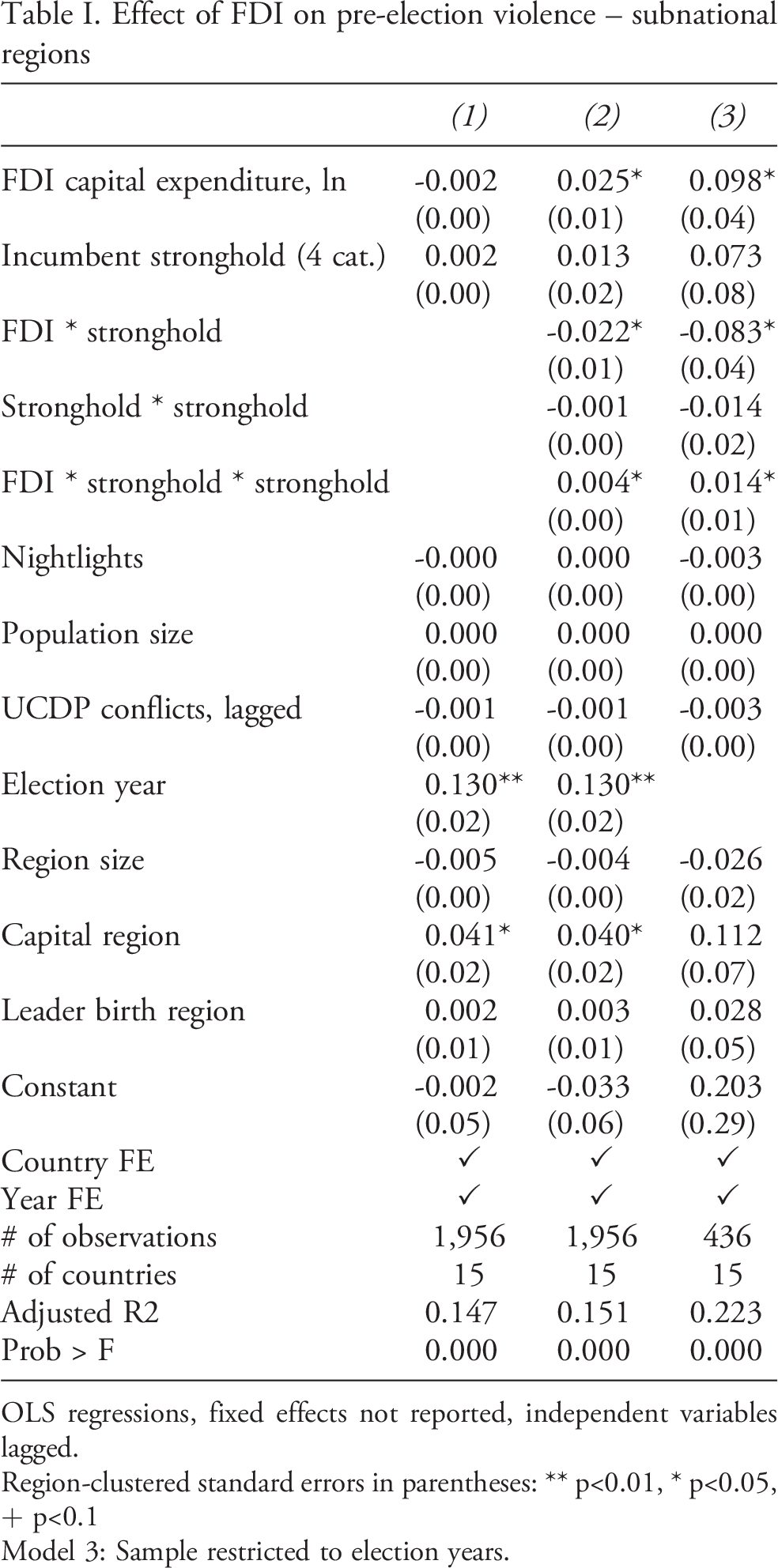
OLS regressions, fixed effects not reported, independent variables lagged.
Region-clustered standard errors in parentheses: ** p<0.01, * p<0.05, + p<0.1
Model 3: Sample restricted to election years.
To facilitate the interpretation of this triple interaction term, we plot the effect of FDI across our incumbent stronghold measure in Figure 2. The upper left panel in Figure 2 shows the interaction effect from our preferred model specification. As expected, FDI does not decrease violence in regions where either the main opposition party or the incumbent party has gotten a large share of votes in prior elections. In line with our argument, FDI reduces the use of violent measures in more competitive regions. Here, incumbents aim not at deterring voters from going to the ballot box, but count on the fact that economic gains from the presence of multinational investors are sizeable enough to sway votes in their favor. This effect is also substantial in size. Competitive regions that receive average FDI inflows exhibit a roughly 2.8% chance of experiencing election violence. When FDI increases by one standard deviation, this probability drops to about 1.2%; a statistically significant and sizeable 1.6 percentage point reduction.
Our results remain the same under several robustness checks. First, Figure 2 shows that the violence-reducing effect of FDI in competitive districts is robust to more fine-grained categorizations of the incumbency stronghold variable (detailed results in Online appendix A-3). Second, we come to the same conclusion when focusing solely on events that are characterized by the actual use of violence. Here too, foreign capital reduces the use of violence in regions that the incumbent cannot take for granted (see Online appendix A-5). Third, the results are robust to a coarser measure of FDI that distinguishes between regions that are exposed to investments by foreign multinationals on a binary level only (see Online appendix A-4). Fourth, we relax the assumption of a quadratic functional form of previous election results. To do so, we split our incumbency strong variable into mutually exclusive binary indicators and interact each with our FDI variable, that to say we put no restrictions on the functional form of the interaction term. The results presented in Online appendix A-7 underscore once more that FDI reduces the propensity of using violence in the run-up to national elections only in more competitive regions.
To get a better sense of the scope of the effect of FDI, we include the type of the electoral system in further robustness tests. In Online appendix A-8, we control for
Effect of FDI on pre-election violence – subnational regions Effect of FDI on pre-election violence – 10×10 km grid cells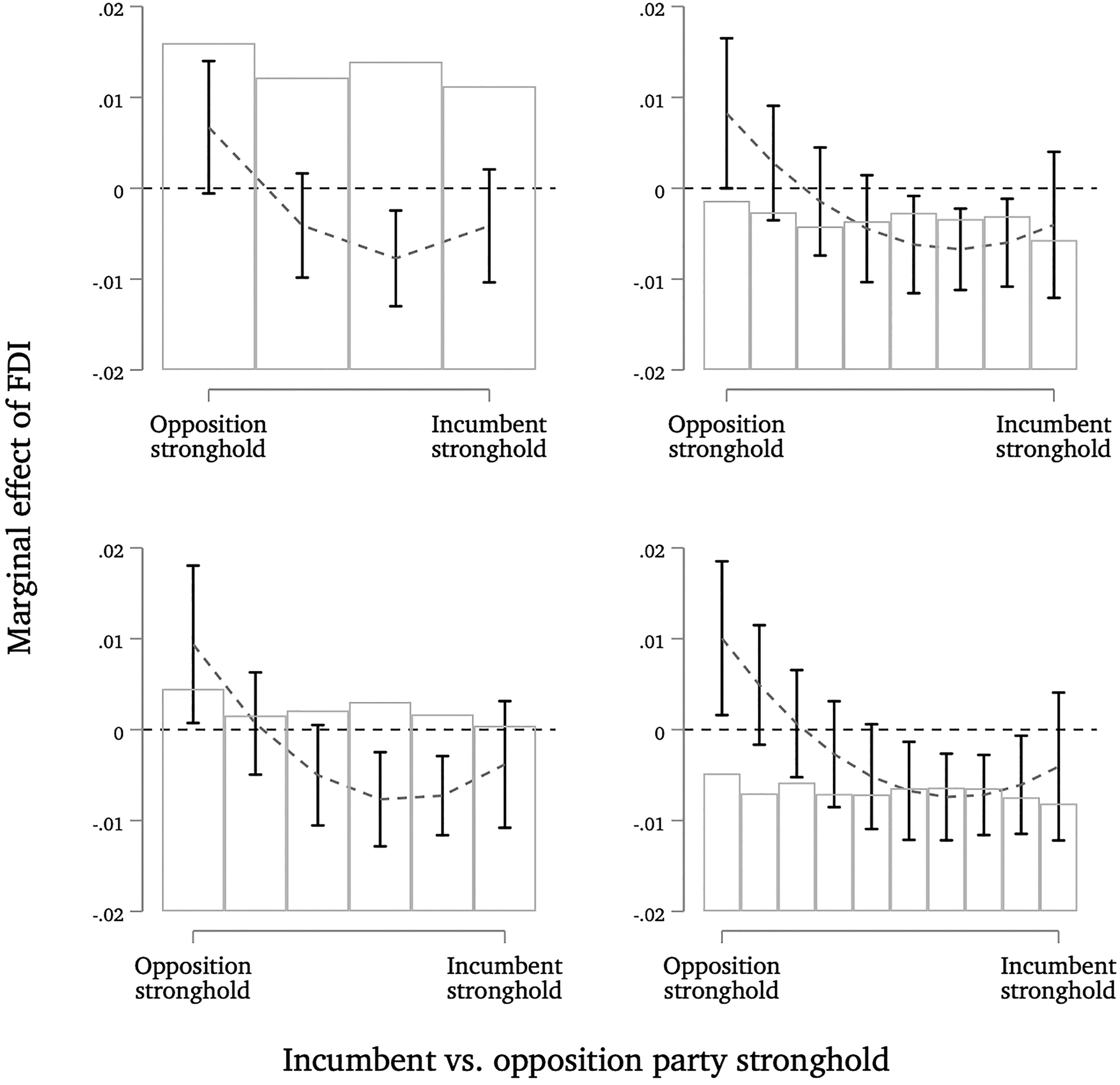
Analysis of grid cells in sub-Saharan Africa
The analysis relying on subnational regions provides strong evidence for a violence-reducing effect of FDI in competitive regions. Our argument suggests that this effect can be attributed to FDI’s direct economic benefits swaying undecided voters in competitive regions and allowing the incumbent to refrain from using violence to influence election results. Such economic benefits of FDI are arguably most pronounced close to project sites, which is why we complement our regional-level results with an analysis that takes fine-grained grid cells as an alternative unit of analysis. This approach has the potential to provide an even closer match between the location of FDI projects and instances of pre-election violence.
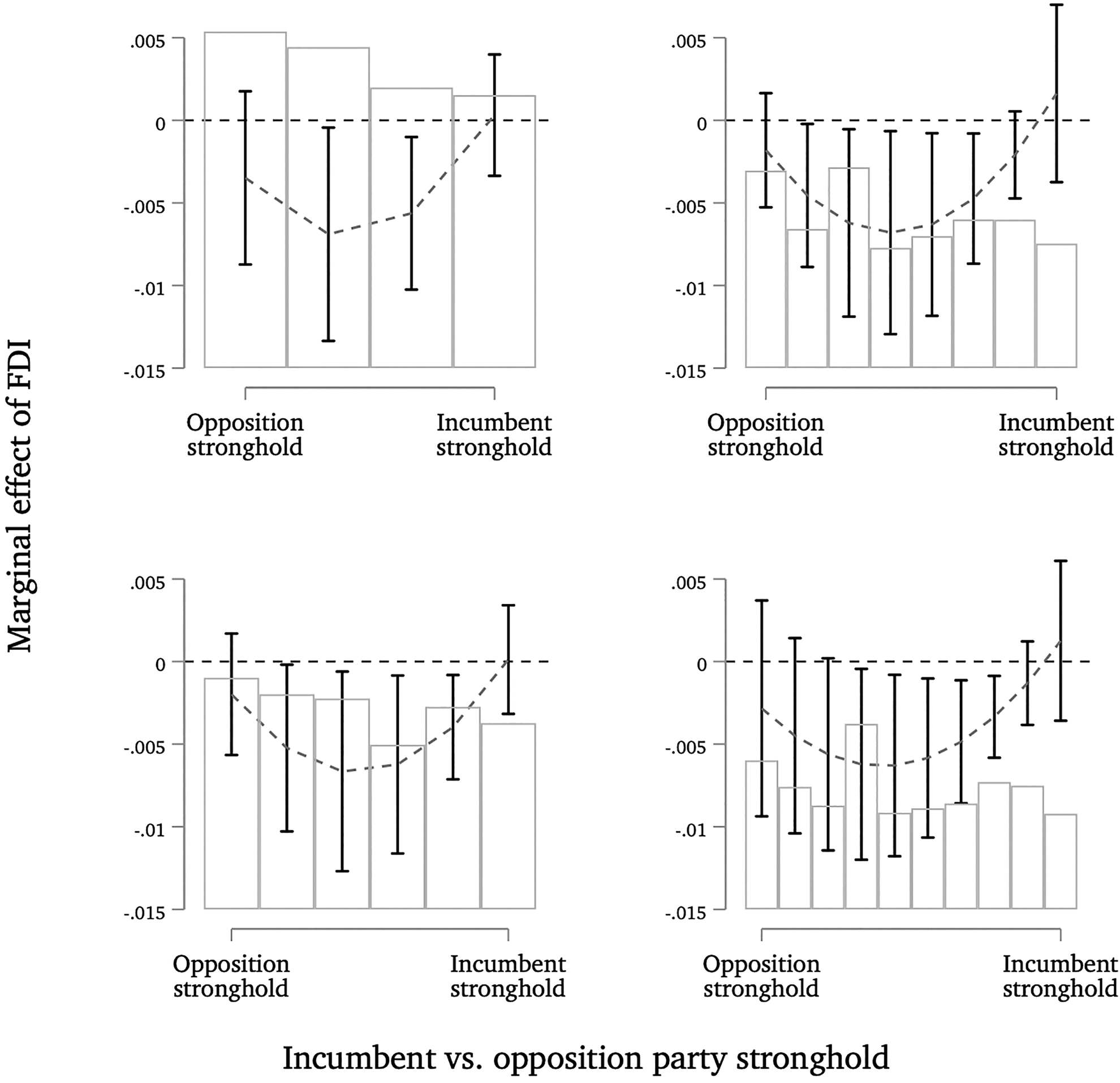
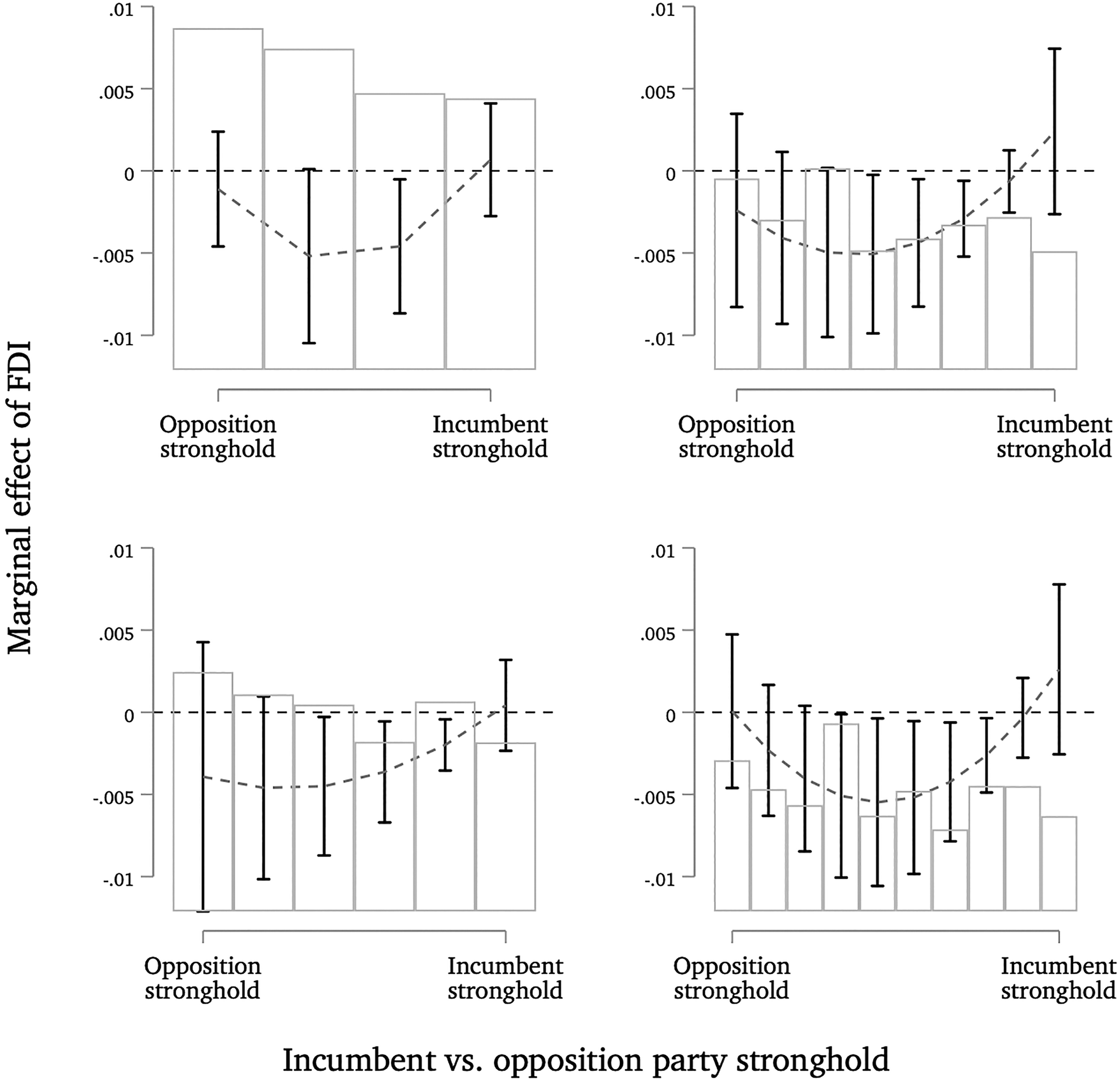
Effect of FDI on pre-election violence – 25×25 km grid cells
To do so, we create 10×10 km grids within the 15 sub-Saharan African countries resulting in a total of 66,004 cells observed between 2003 and 2012. 17 Even though the grid approach provides the advantage of a closer geographical match of projects and electoral violence, we proceed with caution, because of two shortcomings: first, data on previous election results does not come on the fine-grained level of grid cells; second, the geographical information in both the ECAV and FDI data is coded from reports in international news outlets. Research has shown that the reporting of event locations in such datasets can be prone to error overestimating the accuracy of the location, and thus puts a cautionary note on using very fine-grained units when analyzing media-based event data (Weidmann, 2015). Acknowledging these limitations of the grid-level design, we also increase the size of our grid cells in the analysis to 25×25 km.
We follow the operationalization of pre-election violence as outlined earlier in this article. Yet, this time we match the events within 10×10 km (or 25×25 km) grid cells instead of the larger, first-order subnational administrative units. Given that FDI projects are also available on a geo-located basis in terms of longitude and latitude, we now also measure exposure of grid cells to both the cumulative sum of capital expenditure within each geographical entity as well as a binary treatment variable. As mentioned earlier, previous election results are not available on such a fine-grained basis, but mainly on the level of subnational regions. To gauge whether a specific grid cell is an incumbent stronghold, represents a competitive district, or is an opposition stronghold, we identify the subnational unit that is host to each 10×10 km grid cell. 18
We estimate linear probability OLS regression models that include grid cell and year fixed effects. Standard errors are clustered on the level of grid cells. This approach allows us to leverage a difference-in-differences estimator that compares grid cells that are exposed to FDI at a specific point in time with grid cells that have not yet been exposed (Christensen, 2019; Rommel, Palmtag & Messerschmidt, 2022). 19
We again find that the effect of FDI on pre-election violence depends on whether the grid cell lies within a more competitive subnational region (see Online appendix A-15). In Figure 3, we visualize the marginal effect of FDI on election violence, conditional on whether a grid cell is either a stronghold for the incumbent or for the opposition, or whether it is a competitive region. The upper left panel of Figure 3 shows that FDI does not affect the use of election violence in incumbent and opposition strongholds, but that it reduces the government’s use of violence in grid cells that are located in more competitive regions. This finding is robust to using alternative categorizations of strongholds into six, eight, or ten categories as is shown in the upper right and the lower panels of Figure 3.
As can be seen in Figure 4, we also find the same pattern when focusing on 25×25 km, instead of 10×10 km grid cells. Even if we use larger geographical entities, FDI reduces acts of violence before elections perpetrated by the government only in competitive regions, but has no effect in both incumbent and opposition strongholds. These results are also robust to restricting pre-election events to those that were actually violent (see Online appendix A-16). The findings from the grid cell analysis thus strongly support the findings using subnational administrative regions as the unit of analysis. Taken together, our findings consistently suggest that FDI contributes to a more peaceful electoral process in competitive regions by substantially lowering the level of pre-election violence.
Conclusion
Violent interference in elections has plagued many new democracies in the past decades. Pre-election violence is especially detrimental to the democratic process as it has the potential to exclude citizens from casting their vote at the ballot box in the first place. Nonetheless, leaders of many officially democratic states are drawing on a number of strategies, including violence, to ensure that they stay in power. Research has thus focused on explaining how and when incumbents interfere with the electoral process and this has provided a compelling and encompassing list of factors that explain pre-election violence. This study adds an international perspective to this domestic threat to the democratic process and shows where and how FDI, a growing source of capital inflows in many of these countries, can reduce electoral violence. Our findings highlight that international financial flows contribute to the appeasement of new democracies and favorably impact the domestic democratic process.
Importantly, we find that the violence-reducing effect of FDI is only visible in regions which are neither dominated by the incumbent party, nor are opposition strongholds. Only in so-called competitive regions does FDI change the incentives and strategy of the incumbent. Here, additional income from FDI can spur support for the economically successful incumbent, which reduces the necessity to demobilize voters with violence. In addition, incumbents are most likely to direct fungible resources from investment to these competitive regions where the likelihood that they can sway voters is highest. In contrast, resources going to regions where the incumbent is already dominant will not lead to significant increases in voter support, and trying to change voters’ minds in opposition strongholds is far more costly (if at all possible through the channeling of resources). This conditional effect of FDI on pre-election violence shows that only by acknowledging the interplay of international forces and domestic politics, in our case the geographic distribution of incumbent support, we gain a more thorough understanding of domestic political events.
With increasing influence of international capital inflows, it is not only important to assess where these financial flows go to and how they impact the distribution of resources within host countries, but also how domestic political actors, such as incumbents and voters, as well as the relationship between these actors, can be impacted by changing economic conditions. We provide regional-level evidence that FDI, a vital component of globalization, does not necessarily threaten democratic politics but that it can have a positive, democracy-enhancing effect on a particularly worrying development – electoral violence. By combining project-level FDI data and election results on the regional level in 15 sub-Saharan African countries we demonstrate how FDI can contribute to the reduction of violence in regions where incumbents are normally inclined to deter voters from exercising their democratic rights.
Our argument suggests that FDI has an appeasing function in competitive regions. For one, it creates additional income for the constituency surrounding the FDI project and voters subsequently reward the incumbent for their improved economic situation. In addition, the incumbent might even be able to draw on additional resources, freed up because of the presence of multinational enterprises, and direct them to the most competitive regions, instead of relying of riskier strategies that involve the use of violence. Further research on the effect of international economic integration on democratization and the integrity of democratic processes could assess in more detail which groups of voters in these competitive regions reward the incumbent for the inflow of capital and which ones are bought off. While the former could be interpreted as a sign in favor of the existence of democratic accountability, the latter is certainly less intrusive than violent strategies to demobilize voters, but is still not ideal from a normative point of view. In addition, it would be important to extend the analysis of the impact of international capital beyond its effect on violent distortions of the electoral process and assess whether citizens are more likely to turn out in regions that attract multinational investors. Such analyses could underline our finding that economic openness can be conducive to democratic processes and participation. Overall, our results show that international capital can have an appeasing effect on political processes in emerging and developing countries.
Footnotes
Acknowledgments
We have profited from helpful advice provided by two anonymous referees and the editor of JPR. We are grateful to the members of the Chair for International Relations at the Hochschule für Politik München, led by Tim Büthe, and participants at the Joint IPE Conference of the Austrian, German, and Swiss Political Science Associations for valuable comments.
Replication data
The analysis datasets and code for the empirical analysis, along with the Online appendix, are available at  . The original fdimarkets data that were used to generate the analysis datasets are available from The Financial Times, Ltd., but restrictions apply to the availability of these data, which were used under license for the current study, and so are not publicly available.
Funding
The author disclosed receipt of the following financial support for the research, authorship, and/or publication of this article: We gratefully acknowledge support from the Department of Political Science at the University of Zurich.