




Abstract
Does increasing Internet access and use challenge authoritarian elections? I argue that Internet access provides both opposition supporters and government authorities with new means to shape electoral conduct. Opposition supporters can use the Internet to report on electoral malpractice and mobilize for support. At the same time government authorities can use the Internet to monitor antiregime sentiment prior to the elections and disrupt Internet access to selectively repress regime opponents during the elections. Studying Uganda’s 2016 presidential elections, evidence from election monitoring and survey data suggests that electoral violence is significantly higher in opposition strongholds with greater Internet access prior to the Internet disruption and is targeted specifically at voters. Insights from qualitative interviews with politicians, journalists and activists underline that the disruption of Internet access indeed hindered opposition supporters to effectively challenge electoral malpractice. Overall, the results stress the important role that Internet access can play for opposition actors in authoritarian elections. At the same time, they highlight their susceptibility to manipulation by government authorities.
Introduction
Does Internet use challenge authoritarian elections? The number of African elections during which governments ordered the disruption or manipulation of Internet access suggests indeed that many African rulers perceive Internet use as a threat. Between 2015 and 2020 alone, one-third of all national elections in sub-Saharan Africa (SSA) were accompanied by an Internet disruption, with governments either blocking specific websites or curtailing access to entire networks (Freyburg & Garbe, 2018; Rydzak, Karanja & Opiyo, 2020). At the same time, as shown in Figure 1, levels of electoral violence were significantly higher during those African elections that were accompanied by an Internet shutdown, defined as any ‘intentional, significant disruption of electronic communication within a given area and/or affecting a predetermined group of citizens’ (Rydzak, 2018: 6), even when controlling for relevant factors, including local conflict, gross domestic product (GDP) per capita, and regime type. 1 This raises the question in what way Internet use – and its disruption – affects electoral conduct.
The role of new information and communication technologies (ICT) in the conduct of authoritarian-developing elections remains poorly understood (Gagliardone, 2019). Anecdotal evidence, such as from the Ushahidi platform, which has been used to crowdsource data on incidents of violence during multiple African elections, including in Kenya 2007, Burundi 2010 and Sudan 2010, suggests that citizens and opposition actors routinely use ICT to report on electoral violence (Bunz, 2014; Okolloh, 2009; Zein, 2010). Simultaneously, governments increasingly monitor online discourse to identify Election violence during African elections 2015–20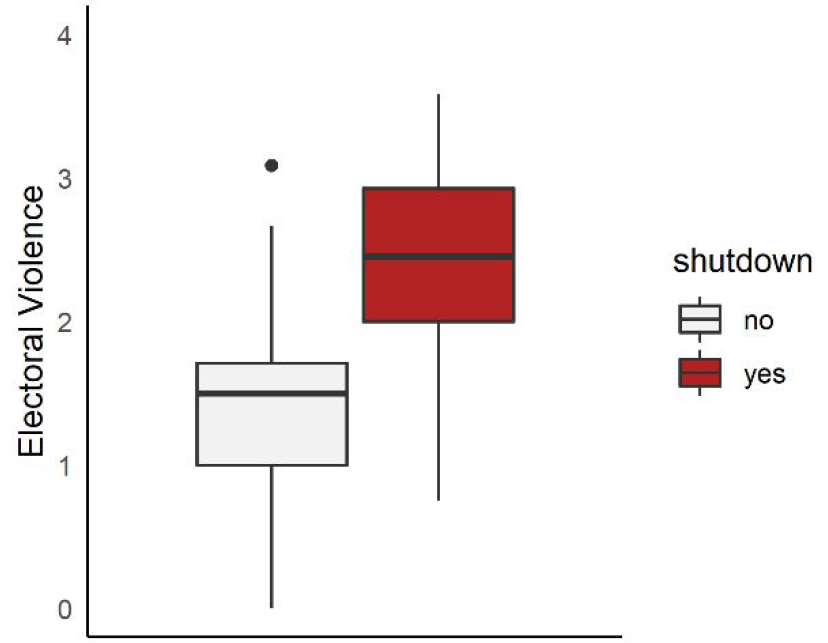
I borrow from insights in political communication studies (Bennett & Segerberg, 2013; Bimber, 2017; Karekwaivanane, 2019; Mare, 2016) to argue that the use of ICT helps opposition supporters address traditional challenges in mobilizing support, such as preference falsification (Kuran, 1989) or resources constraints (McCarthy & Zald, 1977). Facing these challenges, mobile smartphones can be used to undermine electoral malpractice by enabling the opposition to expose violence or fraud and to monitor election results in real time (Baguma & Eilu, 2015). In turn, and for the same reasons, authoritarian governments are likely to manipulate or suppress online communication during contested elections. As indicated by the literature on digital repression, ICT likely help governments localize opposition actors and selectively repress regime opponents during periods of Internet disruptions (Gohdes, 2020; Xu, 2020). Given that a growing number of people rely on ICT to access information, communicate and mobilize during authoritarian elections (Karekwaivanane, 2019), it is plausible to expect a disruption of ICT access to have profound consequences for the conduct of elections, resulting in increased electoral violence.
In the next section, I briefly review the literature on electoral violence and develop a theoretical argument on how access to and the disruption of Internet services can affect the occurrence of electoral violence. Subsequently, I discuss Uganda’s 2016 presidential elections as a case study and present statistics drawn from original survey data (N = 2,042) and election monitoring data from polling stations (N = 238) across Ugandan constituencies. I contextualize the statistical findings by 25 semi-structured face-to-face interviews with journalists, citizen activists and politicians from three opposition-leaning Ugandan districts, as well as evidence from major Ugandan newspaper outlets. The last section summarizes the findings and discusses the differential impact of an Internet disruption on opposition and government actors.
Results from the statistical analyses indicate that electoral violence is higher in those constituencies with more opposition support and higher Internet access prior to the disruption. Evidence from the qualitative interviews posits that Internet disruptions can indeed affect the occurrence of electoral violence: While a disruption prevents opposition supporters from effectively using ICT to challenge electoral malpractice, at the same time, it may obscure the use of violent state repression. My study thus highlights the importance of disentangling the ways in which ICT are used by citizens and state actors at election times to better understand the effects of Internet access and its disruption on core democratic processes.
Electoral violence in authoritarian regimes
Today, most countries in the world, whether democratic or not, hold regular elections. Authoritarian rulers may have different motivations for holding elections, including the co-optation of elites (Boix & Svolik, 2013), party members (Magaloni, 2008) and broader groups in society (Gandhi & Przeworski, 2006); or to strengthen the regime’s legitimacy (Waterbury, 1999), to identify bases of support and opposition (Gandhi & Lust-Okar, 2009) and to foster long-term regime stabilization (Knutsen, Nygård & Wig, 2017). In any case, the incumbent ruler needs to ensure that the election result does not threaten their rule. Cheeseman & Klaas (2018: 5) thus argue that ‘the art of retaining power has become the art of electoral manipulation’.
Electoral violence, defined as ‘events in which incumbent leaders and ruling party agents employ or threaten violence against the political opposition or potential voters before, during or after elections’ (Hafner-Burton, Hyde & Jablonski, 2014: 150), can be seen as the most coercive form of electoral malpractice (van Ham & Lindberg, 2015). In some cases, state security forces coerce citizens, such as during Kenya’s 2017 presidential elections, where the police used high levels of repression against opposition protesters ‘sometimes firing live ammunition at unarmed protesters’ (Mutahi & Ruteere, 2019: 254). In other cases, unofficial organizations such as youth gangs are put in place to harass or intimidate voters. In Uganda, so-called crime preventers were installed to support the government ‘by intimidating and brutalizing opposition supporters and reducing their turnout’ (Dow, 2022: 1606).
Höglund (2009) argues that electoral violence differs from political violence due to its different motives and hence needs to be studied as a phenomenon in itself. Between 2012 and 2016, a quarter of all elections worldwide and more than one-third of SSA elections involved severe violence (Cheeseman & Klaas, 2018: 95f). One of the main aims of electoral violence and intimidation is to demobilize potential non-supporters and prevent them from casting their vote (Bratton, 2008; Höglund, 2009). As such, electoral violence is usually targeted at areas with a strong opposition and well-informed voters (Bhasin & Gandhi, 2013; Rauschenbach & Paula, 2019; von Borzyskowski & Kuhn, 2020). In consequence, electoral violence can have far-reaching consequences not only for the electoral process but also for election results.
In response to electoral violence, citizens may engage in collective action (Tucker, 2007), especially when they know that others do so too (Bratton, 2008). However, such efforts are scarce in electoral autocracies, where collective action involves high costs and low chances of success (Tucker, 2007). Digital forms of communicating and sharing information may help ‘solve collective action problems that have long bedeviled those traditionally shut out of mainstream politics’ (Tucker et al., 2017: 47). 2 In particular, the Internet provides access to new sources of information about the electoral process and potential fraud (Reuter & Szakonyi, 2013), which may influence citizens’ decision to engage in counter-mobilization. In turn, authoritarian governments are incentivized to block or manipulate Internet access during elections. Yet, we still know little about the effects of Internet access, and its disruption, on electoral violence. This study therefore addresses the following question: How does access to Internet services, and its disruption, affect the occurrence of electoral violence?
Theoretical expectations
Since the early days of the Internet, scholars are interested in the conditions under which Internet access may bolster or challenge authoritarian rule and study the effect of Internet penetration on authoritarian survival, protest behaviour, or state repression (Deibert et al., 2008; Gohdes, 2015b; Rød & Weidmann, 2015; Ruijgrok, 2017; Ruijgrok, 2020; Xu, 2020). I borrow from insights in political communication to define the ways in which Internet access, and its disruption, can affect electoral violence. First, I systematically discuss how Internet access can help opposition supporters to challenge electoral violence. Second, I argue that a disruption of previous Internet access limits opposition supporters’ ability to address electoral violence while, at the same time, it allows state actors to obscure their use of electoral violence.
Challenging authoritarian elections: The role of Internet access
Internet access may help citizens to address electoral violence. On the one hand, access to Internet services encourages individuals under authoritarian rule to reveal their true preferences and, by providing information about the opposition’s strength, to encourage protest against electoral violence. On the other hand, once people have decided to engage in mobilization, ICT use substantially facilitates the organization of their efforts.
According to social movement theory, to become active in antiregime mobilization, citizens need to have a sense of the extent to which their grievances are shared with others (Gurr, 2015; Turner & Killian, 1957). Applied to the context of elections, voters are more likely to challenge electoral malpractice if they perceive the elections as fraudulent (Daxecker, Di Salvatore & Ruggeri, 2019) and if they know that others are also willing to stand up against it (Bratton, 2008). However, opposition elites and their supporters in authoritarian regimes are often confronted with the problem of ‘preference falsification’ (Kuran, 1989). Even if they secretly favour the opposition, citizens may deny their preferences in public due to the threat of punishment and uncertainty about broader public opinion. So-called ‘islands of separateness’ (Friedrich & Brzezinski, 1963: 279ff) – places in which people express and mobilize for their antiregime opinions – tend to be scarce in the authoritarian offline world. In the context of elections, citizens may lack information about the extent to which others share their disapproval of the regime and, hence, be reluctant to engage in mobilization challenging election malpractice. The alleged anonymity on the Internet can encourage individuals to share their ‘true’ preferences (Farrell, 2012), especially in places where the public sphere is heavily restricted (Chen et al., 2016). For instance, in Zimbabwe, the Facebook site run by anonymous blogger Baba Jukwa provided a crucial space for critical voices ahead of the elections in 2013 and is said to have had a significant impact on the mobilization of voters (Karekwaivanane, 2019: 54; Mare, 2016).
Moreover, Internet access makes it easier for protesters to communicate and organize without the existence of formal organizations (Bennett & Segerberg, 2013; cf. Bimber, 2017). Citizens typically face a constraint of resources needed to successfully organize mobilization, including money, time and knowledge (McCarthy & Zald, 1977). Internet access reduces the costs of sharing information and can make formal organizational structures obsolete (Bennett & Segerberg, 2013; Castells, 2015). In particular social networking sites provide a platform ‘for debate and knowledge-sharing while also enabling a message to reach its targeted audience in unprecedented fashion, within seconds’ (Mutsvairo, 2016: 6). They can be used nationwide, such as Twitter for mobilization during Nigeria’s elections (Bartlett et al., 2015), or in specific local contexts, such as Whats App groups ahead of county elections in Kenya (Omanga, 2019). Original evidence from Uganda indicates that opposition supporters are more likely to use ICT to mobilize voters and report on electoral malpractice. The survey data collected for the purpose of this study (see methods section) suggests that opposition supporters are more likely to use ICT to challenge electoral malpractice and mobilize voters than citizens who do not support any of the opposition parties during Uganda’s 2016 presidential elections. Respondents supporting opposition parties declared a higher propensity to use social media to report election malpractice and to communicate their participation in the elections, even when accounting for the influence of several individual characteristics and including constituency fixed effects (see Online appendix 1 for regression tables).
Importantly, mobilization taking place online can also spill over to offline engagement (Chibita, 2016). Baguma & Eilu (2015) argue that, in developing countries, particularly mobile (smart) phones provide individuals with an efficient tool for monitoring electoral malpractice. Pictures and other pieces of information can instantly be shared with broader networks, documenting incidences of violence and enabling opposition actors to send assistance to affected polling stations. During several African elections, citizens used online platforms to report on violence during elections and thereby ‘enable stakeholders at the local level to prevent or evade conflict’ (cf. Bartlett et al., 2015; Mutahi & Kimari, 2017: 20).
Deterring mobilization during elections: Authoritarian use of Internet access and disruptions
Internet access may help state authorities to identify areas in which counter-mobilization is likely to challenge the elections and directly target electoral violence at voters in those areas. Authoritarian rulers are affected by the problem of preference falsification, too, facing uncertainty as to which parts of the population may threaten regime survival (Boix & Svolik, 2013). Many authoritarian governments use formal and informal institutions to co-opt members of society and thereby alleviate monitoring problems (Gandhi, 2008; Gerschewski, 2013). However, co-optation becomes expensive with the increasing size of the so-called ‘winning coalition’, which is the part of society on whose support the government relies (Bueno De Mesquita et al., 2003). Instead, it can be more efficient to use targeted repression as ‘the cost to buy support from radicals can be significantly higher than that to imprison them’ (Xu, 2020: 4).
Internet access has equipped governments with new means to monitor regime dissent and forestall mobilization efforts by opposition actors. For instance, King, Pan & Roberts (2013) argue that governments use information from online communication to learn about and localize antiregime efforts (cf. Qin, Strömberg & Wu, 2017). While originally applied to government behaviour in China, studying online discourse may prove particularly useful to any government in electoral autocracies, as elections present a key moment of political uncertainty in which mobilization may threaten a regime’s survival.
However, as described above, when government authorities commit electoral violence, they face the risk of countermeasures precisely in those areas in which opposition supporters have access to Internet services and hence the ability to document and mobilize against violent behaviour. Governments, in turn, have better chances to commit violence without risking denunciation of their actions if Internet access is disrupted during elections. In particular, they can commit targeted acts of state violence without risking unfavourable consequences of ICT use by the opposition (Gohdes, 2015a; Kasm, 2018). Assuming that governments frequently monitor online behaviour to forestall where antiregime mobilization is likely to occur, they may implement short-time disruptions of Internet access to prevent people from monitoring their actions and hence obscure the use of state violence. By banning access to widely used online platforms, governments hinder the opposition from documenting state violence and effectively challenging their use of coercive force. I therefore expect that: Levels of electoral violence are higher in areas, in which opposition supporters had access to Internet services prior to a disruption.
The case of Uganda’s 2016 presidential elections
Uganda’s presidential elections in 2016 were the third multiparty elections since the National Resistance Movement (NRM) and Yoweri Museveni took power in 1986. With a reform in 2005, the government established a multiparty system and thus allowed for (minimal) party competition. Even though previous elections were not held under free and fair conditions (Levitsky & Way, 2010; Schedler, 2006), the opposition was a credible challenger to incumbent ruler Museveni. According to opinion polls before the 2016 elections, the opposition party Forum for Democratic Change’s (FDC) popularity peaked (Beardsworth, 2016). Consequently, the re-election of the incumbent president was more contested than during any of the previous elections.
In the years before the election, the Internet had become an important ‘tool for social, economic, and human rights development in Uganda’ (CIPESA, 2016). Due to increased connectivity, especially through mobile phones, it also provided individuals with new means to participate in politics (Grönlund & Wakabi, 2015; Grossman, Humphreys & Sacramone-Lutz, 2014). Especially for opposition campaigners, social media appeared a relevant tool ahead of the 2016 elections as following the Public Order Management Act in 2013, anyone holding a public meeting or rally needed to inform the police, which ‘ha[d] always restricted members of the opposition from making public consultations with citizens’ (Enenu, 2016). This act was said ‘to intimidate opponents of President Yoweri Museveni’ (Biryabarema, 2016). Furthermore, the use of social media for real-time reporting became pressing due to violence during election campaigns, ‘especially against opposition candidates’ (Ssekika, 2016). For opposition parties, social media thus represented a ‘crucial’ channel to communicate and share information (Presidential, parliamentary elections in embarrassing mess, 2016).
A few days ahead of the 2016 elections, the Electoral Commission (EC) announced the ban of smartphones at polling stations (Karugaba, 2016; Musisi, 2016). This ban was regarded as a strategic move to ‘limit information flows’ (Musisi, 2016). In response to the smartphone ban, opposition candidate Amama Mbabazi publicly encouraged all voters to ignore the ban and ‘go with their phones and cameras, and feel free to record anything they think is going wrong’ (as cited in Kaaya, 2016). There was already a restriction of communication during the previous presidential elections in 2011, at a time when access to the Internet was still relatively low. Back then, the government had ordered telecom operators to ban specific keywords on SMS, including ‘Egypt’, ‘bullet’ and ‘people power’ (Biryaberema, 2011). The disruption of social media on polling day was indeed the first time that Internet access was restricted nationwide at a large scale (Kembabazi, 2016). This is supported by media coverage in major Ugandan news outlets, none of which mentioned a possible Internet disruption in the months ahead of the election. 3
Uganda’s 2016 presidential elections provide an ‘easy’ case (Seawright & Gerring, 2008) to better understand ICT use and digital repression at election times for three main reasons. First, most Internet disruptions on election day take place in electoral autocracies, such as Uganda (Letsa, 2019) – that is, regimes that allow for minimum multiparty competition without granting free and fair de facto multiparty elections (Lührmann, Lindberg & Tannenberg, 2017). Second, Uganda ranks among the third of countries with the highest levels of electoral violence 4 and irregularities (see Online appendix 2); therefore, it represents a group of SSA countries notoriously affected by electoral malpractice. Third, regarding digitalization, Uganda is representative of many SSA countries, where mobile Internet connectivity substantially increased since 2014, with more than one-third of the country’s population online (Bahia & Suardi, 2019). Therefore, evidence from the Ugandan case generates useful knowledge about how Internet disruptions may affect electoral processes in other electoral autocracies in the region.
Descriptive statistics
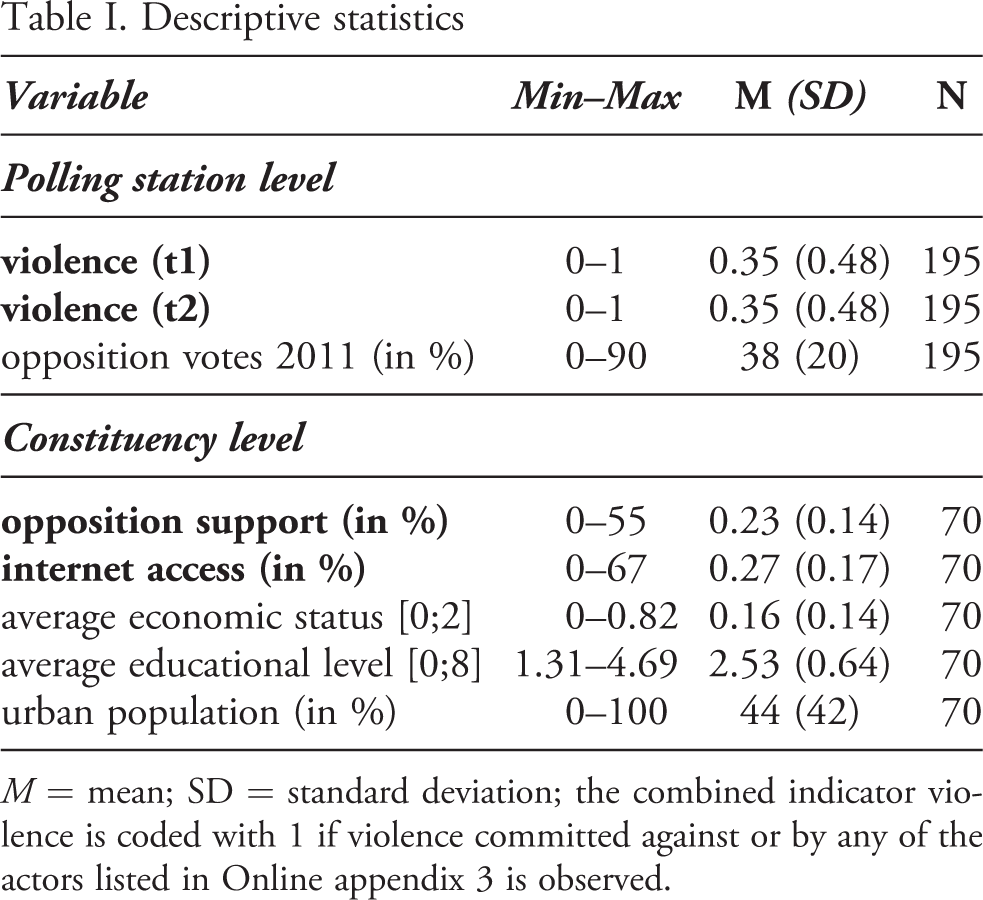
M = mean; SD = standard deviation; the combined indicator violence is coded with 1 if violence committed against or by any of the actors listed in Online appendix 3 is observed.
Research design
Empirical strategy
I apply a cross-sectional research design to examine the occurrence of electoral violence across constituencies during Uganda’s 2016 elections combining survey and election monitoring data. As there is no geographic variation in the disruption of Internet access, I use Internet access prior to the disruption as a proxy of how severely people were affected by the sudden loss of Internet access (limitations of this approach are discussed following the results). I estimate the effect of the interaction between the proportion of opposition supporters and Internet access on electoral violence. Specifically, I estimate the extent to which local Internet access and the proportion of opposition supporters influence the probability of electoral violence in a sample of 195 polling stations across 70 constituencies. 5 Descriptive statistics for the main indicators included in the analyses are provided in Table I.
To contextualize the findings, I interviewed 25 opposition and government politicians, activists and journalists in three electoral districts – Kampala, Gulu and Kitgum – in October and November 2018 (see Online appendix 5). Those districts tend to be opposition-leaning but vary with regard to their Internet coverage from high (Kampala) to intermediate (Gulu) and low (Kitgum) connectivity (GSMA Intelligence, 2019). In addition, I use insights from media reports of major news outlets in Uganda, including the Daily Monitor, New Vision and the Observer, two weeks before and after the elections. 6
Dependent variables
‘Electoral violence’ is operationalized with six indicators based on items from election monitoring data collected by the Citizens’ Election Observers Network–Uganda (CEON-U). Election observers recorded different forms of electoral violence during the polling process and during vote counting on a checklist (see Online appendix 6). For each point of measurement, I combine these indicators into one variable for violence (with the presence of any form of violence or intimidation at a polling station = 1). I further use each individual indicator as separate outcome (e.g. the presence of violence directed at voters = 1).
Independent variables: Opposition strength and access to Internet
For Internet connectivity and opposition strength, I aggregate original data from a regionally representative survey conducted in April 2019 by the research institute Research World International Ltd covering 2,042 respondents across 82 constituencies in Uganda using a multistage stratified random sampling design. The survey was conducted face-to-face with Ugandan nationals aged at least 18 years and is representative at the level of regions. I included three questions in the survey covering Internet access, use and political preferences (see Online appendix 7). The survey, conducted three years after the elections, relies on retrospective self-reporting that might be subject to memory bias, among other possible bias (Stone et al., 2007: 12). Reliability assessments using data from the Afrobarometer and the World Bank suggest minimal bias (see Online appendix 8). 7
The first key independent variable ‘opposition support’ is based on party preferences ahead of the 2016 elections. Data was coded binomially, with support for the ruling party NRM or support for no specific party (coded with 0) and support for any opposition parties (coded with 1). 8 The second key independent variable ‘internet access’ assesses whether people had Internet access before the 2016 elections (access coded with 1 versus no access coded with 0). I calculate the proportion of individuals with Internet access and opposition support, respectively, per constituency.
Controls
I account for four additional factors that might be systematically related to the level of violence, namely ‘average economic status’, ‘average educational level’, the share of ‘urban population’ per constituency and the share of opposition votes per polling station in 2011. I provide more details about the control variables in Online appendix 9. In addition, I rerun all models using population size as alternative control variable (Online appendix 10.1).
Methods
I use generalized linear models (GLM) to estimate the effect of the interaction term of opposition support and Internet access on the likelihood of electoral violence. For the combined indicator of violence, an intraclass correlation (ICC) suggests that around 12% of the total variance in election violence is accounted for by the constituency clustering (ICC = 0.12). Therefore, I include constituency as random intercept to account for within-constituency effects that might occur due to varying ethnic and political legacies, among others (Stegmueller, 2011). 9 For the models using the individual violence indicators as outcome, I do not include random intercepts as the ICC suggests little variance at the level of constituencies (all ICCs except for two indicators < 0.05). Electoral violence was recorded twice on polling day, in the morning and in the afternoon. I include time fixed effects to account for temporal correlation in all models. For the multilevel models, the assumption of linearity between the logit of the outcome and predictors in the model is fulfilled, and there is no indication of multicollinearity in any of the models (all VIFs < 5). As survey data is only representative at the level of regions, but not at the level of constituencies, I additionally run all models reweighting the independent variables based on census data (see Online appendix 10.2).
Empirical analysis
Statistical results
Evidence from the election monitoring data underlines the variation in electoral violence across constituencies. Figure 2 indicates that violence during polling (t1) and during vote counting (t2) were not equally present across the country. Several places with a high number of polling stations affected by violent incidences during polling, such as Chua or Chekwii, remained free from observed violence during vote counting. Overall, the mean share of polling stations affected by violence during polling per constituency (M = 0.33, SD = 0.34) was similarly high as the mean share of polling stations affected by violence during vote counting (M = 0.34, SD = 0.35).
Results from the GLMMs indicate that electoral violence is higher in areas with increasing Internet access and increasing opposition support (see Figure 3). The model comparisons reveal a positive significant effect of the interaction between the proportion of opposition supporters and Internet access on the likelihood of electoral violence (χ2(1) = 6.18, p = 0.01) (see Appendix 2 for regression table). That is, the occurrence of violence at a polling station depends on the interplay of strength of opposition support and Internet access in a constituency. The results further indicate that violence more likely occurs in areas with a lower socio-economic status (B = -3.81, SE = 1.52). To assess whether these findings are driven by dynamics in Uganda’s most populated district, I exclude observations from constituencies located in the capital district Kampala (N = 32). In this model, the interaction effect is even more pronounced (χ2(1) = 6.7, p < 0.01; see Appendix 3).
Figure 4 provides an overview of the marginal effects for the individual indicators of violence. The results indicate that the interaction term has a significant positive effect on violence against voters (OR = 1.8, 95% CI[1.05, 3.24], p = 0.04), but not on violence against polling agents or election officials (both p > 0.05). I computed the model-implied probabilities for violence against voters assuming opposition support 1 SD above the mean both for areas with high Internet access (1 SD above the mean) and for areas with low Internet access (1 SD below the mean) while holding all other predictors at their mean level. This yielded an expected probability of violence against voters of 10% for areas with high and 2% for areas with low Internet access. Overall, the results Levels of electoral violence in Uganda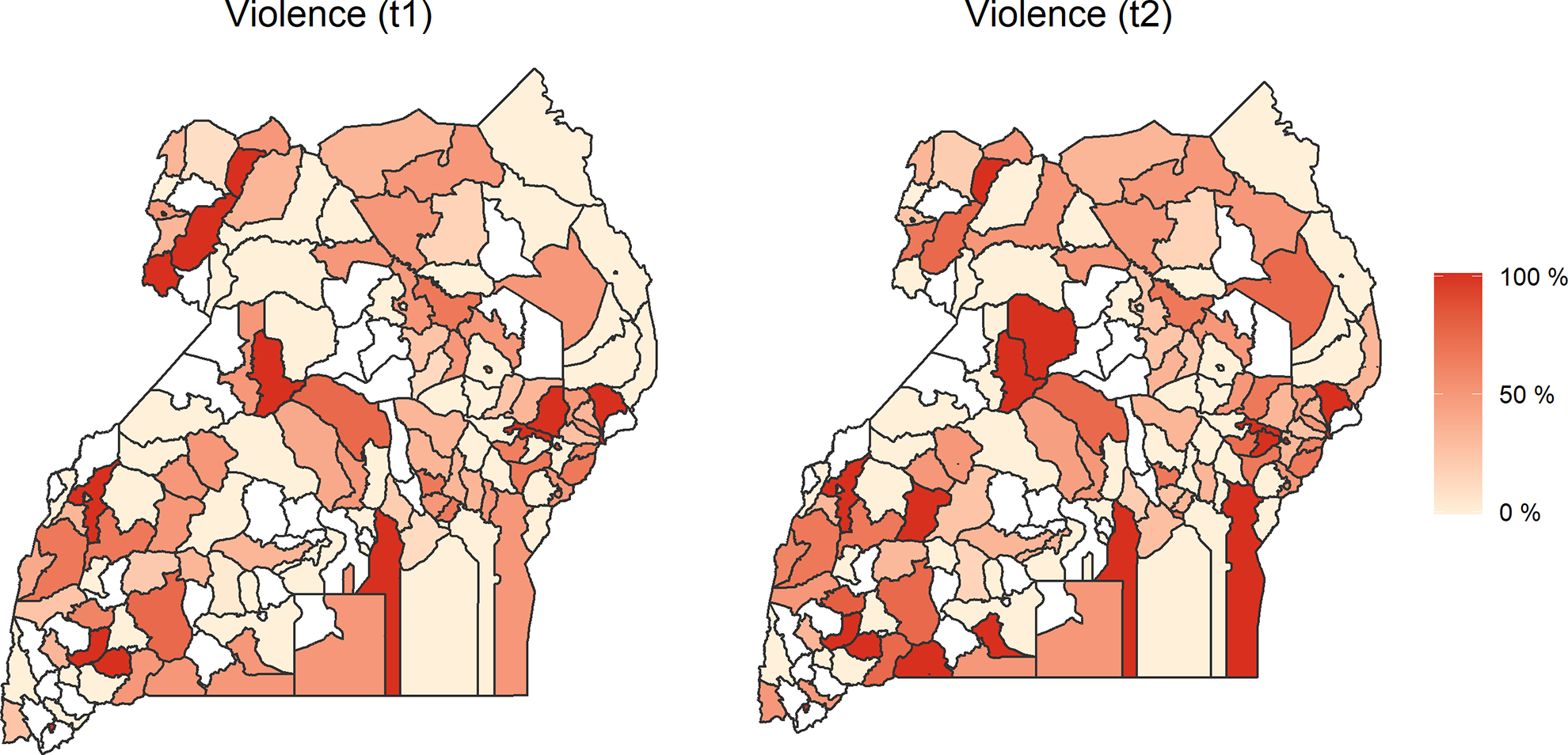
Understanding the role of the Internet disruption
Evidence from 25 qualitative interviews with Ugandan politicians, activists and journalists conducted in 2018 emphasizes the potential of ICT use to address electoral malpractice, yet also highlights how an Internet disruption hinders the opposition to realize this potential. In particular, insights from the interviews outline: (1) the ways in which the opposition prepared for the Effects of interaction term on violence (combined indicator) Effects of interaction term on violence (individual indicators)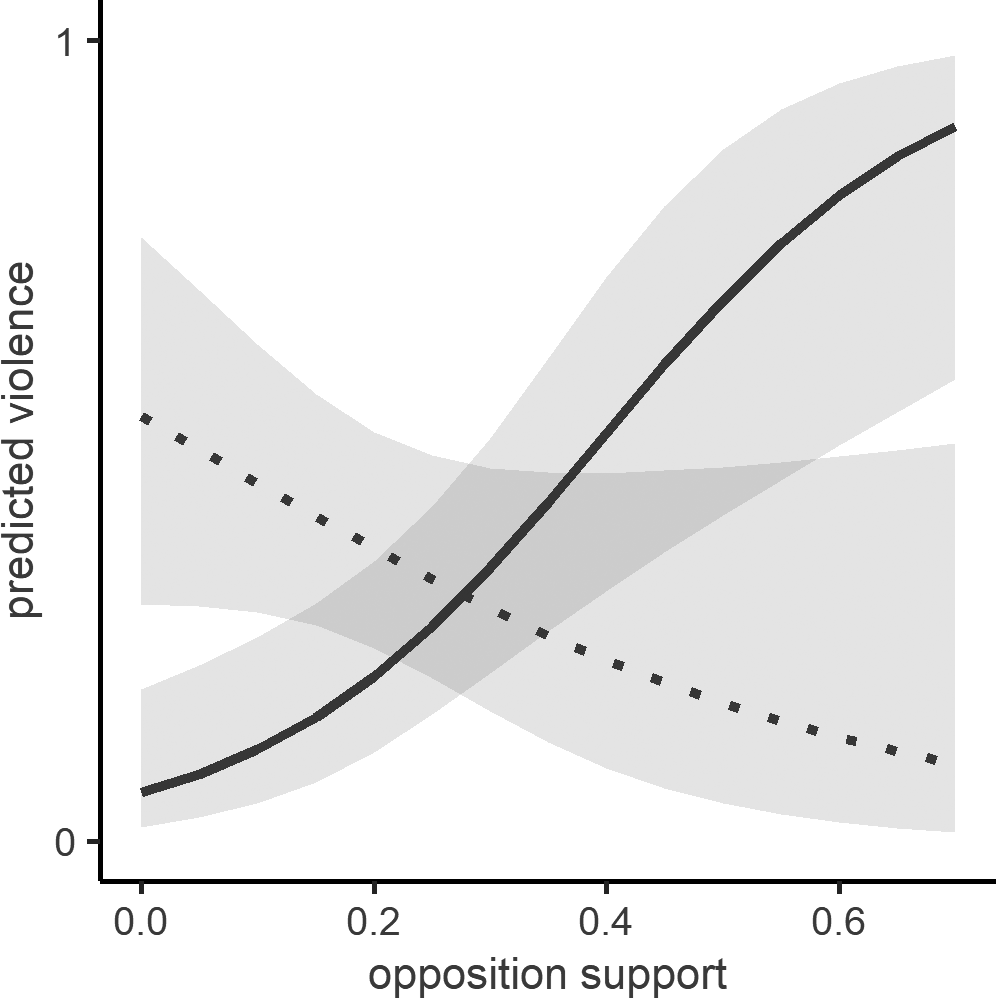
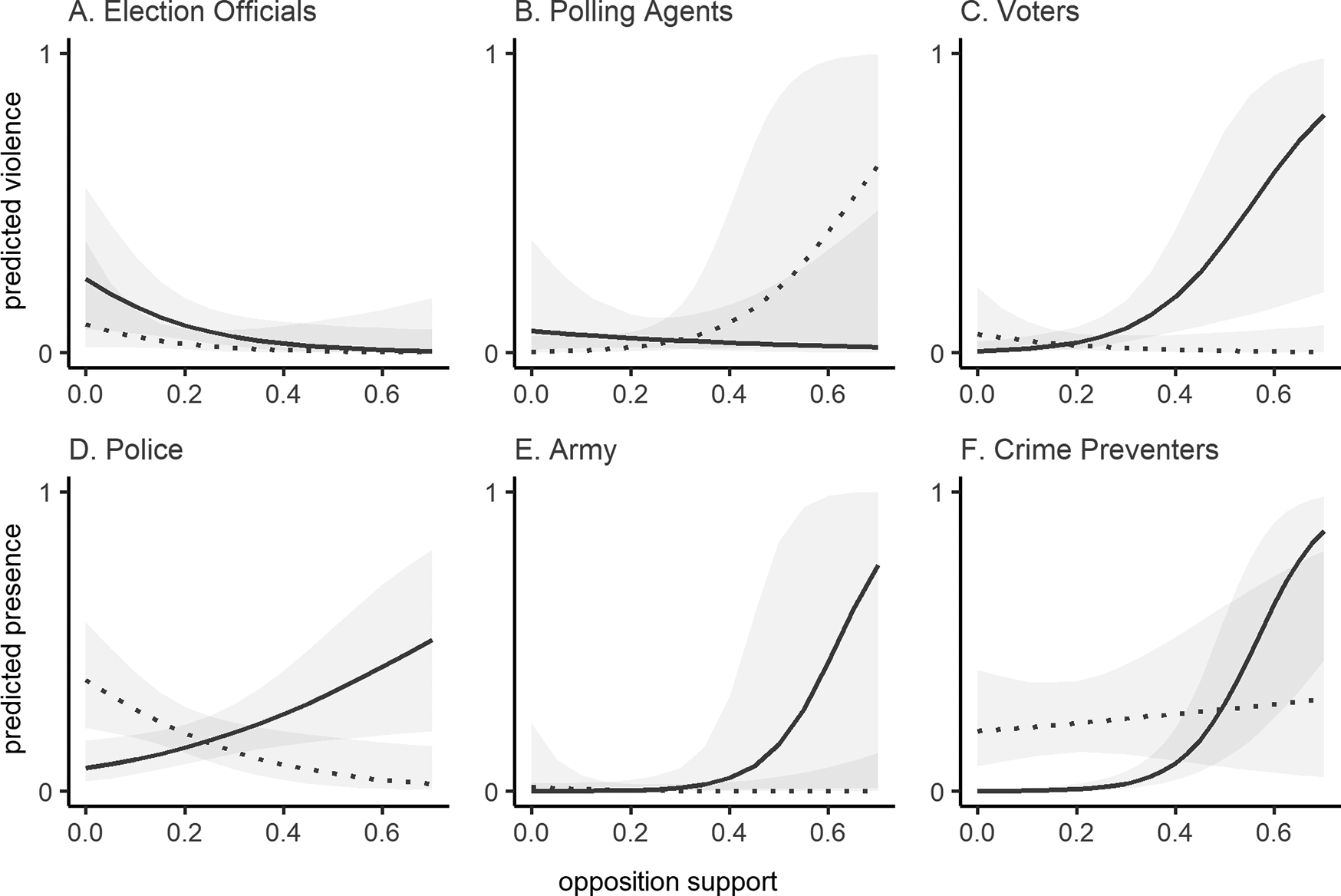
First, social media played a crucial role in mobilizing voters and addressing electoral violence for both citizens and opposition parties. An election observer in Kampala stressed that many citizens, due to heavy manipulation of the distribution of ballot papers ahead of the elections, had decided to keep track of what was going on. 11 As expressed by one civil society member in Kampala, the advantage of social media is their ability to report things ‘the exact way you see them […] which gets the observation of an electoral process to a whole new level’. 12 Furthermore, social media played a crucial role in the opposition’s strategy to address electoral malpractice. As indicated by several of my interviewees, the opposition party FDC had trained volunteers intending to install 10 people – the Power 10 (P10) – at each polling station in the country (FDC disregards EC on anti-vote-rigging team, 2016). Their main aims were to ‘mobilise people to go and vote, monitor the electoral process and observe the ballot counting process to foil vote-rigging’ (Oluka, 2016). A high-level FDC member in Kampala explained that the P10 teams were instructed to use WhatsApp to send pictures of the declaration of results (DR) forms to the FDC’s headquarter in Kampala to monitor the tallying process. 13 The aim was to get an independent overview of vote counts from each polling station in the country. The government denounced the P10 teams as ‘orchestrated by the opposition to rig’ (Kakaire, 2016).
Second, several respondents indicated that targeted forms of online repression played a role both ahead of the elections and on polling day. A journalist in Kampala outlined that the lines of opposition candidates were routinely intercepted. 14 A local politician in Gulu claimed that opposition candidates were often intimidated via text messages directly sent to their mobile phones and a local politician from Gulu said that his mobile money account was blocked ahead of the elections. 15 Intimidation was also used to prevent mobilization efforts offline: a local FDC politician in Kitgum stressed that, ahead of the elections, any gatherings or rallies were closely monitored and forbidden by the police. 16 According to an FDC politician in Gulu, the police chased people who were opposition-leaning to keep them from voting on polling day. 17
Third, as outlined by several respondents, the Internet disruption on polling day prevented opposition forces from challenging electoral malpractice. According to an independent politician in Gulu, 18 opposition parties could not receive information about critical incidents at polling stations nor provide appropriate support in time. A high-level politician from Kampala underlined the importance of the shutdown to prevent people from mobilizing. 19 He noted that in contrast to Egypt, where people rely on established organizational structures offline, ‘there is no Tahrir Square’ in Uganda, making it extremely difficult to mobilize larger groups in the absence of social media. Another opposition politician from Kampala also stressed that especially in opposition strongholds, such as Kampala, Wakiso or Mukono, polling materials were delivered late, leaving many voters angry and without the opportunity to vote. 20 In those areas, he added, it would have been likely that people had gathered spontaneously if there had been the opportunity to mobilize via social media. On the other hand, in less-connected areas in Kitgum, opposition agents used an analogue network of opposition actors moving from one polling station to another calling for remedy if they observed suspicious activities. 21 This account highlights that opposition actors in less-connected areas may still prepare themselves to use analogue forms of communication when responding to violence and intimidation at polling stations. Several interviewees further highlighted the shutdown’s impact on the opposition party’s ability to tally the results independently. Due to the shutdown of the messaging service WhatsApp, the FDC did not manage to tally the results on polling day. Instead, the individual P10 teams deployed at polling stations had to provide hard copies of the DR forms. It ultimately took more than two weeks to gather part of the DR forms for the FDC’s own tallying. The delay contributed to preventing the FDC from filing a petition to challenge the results, which needs to be submitted 10 days after the election results are declared (FDC to crack regime arrogance & impunity – Mugisha Muntu, 2016)
Limitations
The quantitative analyses in this study cannot explain the causal mechanisms at play. Eventually, higher levels of electoral violence might occur in areas with more opposition support and more Internet connectivity for different reasons. For instance, due to its information and mobilization potential, access to ICT may change citizens’ ‘commitment to democratic governance’ (Nisbet, Stoycheff & Pearce, 2012: 245) and increase their subjective perception of self-efficacy (Young, 2020). They might hence be qualitatively different from opposition supporters without Internet access, posing a higher threat to regime survival. In consequence, the interaction between the proportion of opposition supporters and people with Internet connectivity needs to be interpreted with caution.
Besides, only around 2% of the variance in the likelihood for electoral violence can be explained with Internet access and opposition support (Nagelkerke R Squared). This low rate of explained variance is not surprising given that I use data aggregated to the constituency level to predict outcomes at the level of polling stations. Future studies may draw on more observations to predict electoral malpractice in aggregated locations, such as districts or constituencies, rather than at the level of polling stations. Empirical studies further demonstrate that observers can reduce the occurrence of violence or fraud at polling stations (Asunka et al., 2017). While any bias in electoral violence could be considered systematic due to an observers-only sample, patterns might differ in a sample of polling stations without election observers. Therefore, to estimate levels of electoral violence across different locations, future studies could complement observer data with citizen or media reports.
Despite supportive evidence from the qualitative interviews, future analyses may allow for a more systematic assessment of an Internet disruption’s effect on electoral conduct, e.g. through a quasi-experimental design comparing electoral malpractice across districts with and without Internet disruptions. While Internet disruptions, in particular during elections, are usually nationwide, governments sometimes target specific regions only, such as in Ethiopia in 2020 (Human Rights Watch, 2020).
Conclusion
Evidence from Uganda is useful to better understand how Internet access and its disruptions can shape elections in electoral autocracies in the region. First, ICT can be strategically used by opposition supporters to report on election malpractice in real time, share information about critical incidents at polling stations, and mobilize for support in cases of emergency. Second, governments may use ICT access to identify opposition strongholds and commit targeted state violence. Finally, a disruption of ICT access on polling day may hinder opposition supporters from effectively responding to electoral malpractice. While these insights cannot automatically be applied to other cases, they provide a fruitful starting point to understand the role of ICT in the context of authoritarian elections in SSA and complement prior research on state repression during elections by acknowledging the role of ICT.
While the statistical analysis indicates that electoral violence is more prevalent in areas in which opposition supporters had benefitted from (greater) Internet access prior to the elections, insights from the qualitative interviews illustrate potential mechanisms. The disruption of social media access appeared to prevent people from mobilizing and hindered more strategic monitoring of electoral malpractice, especially in locations in well-connected opposition strongholds. This finding suggests that, due to their reliance on Internet access, opposition supporters in well-connected areas may be less capable of effectively countering electoral violence than opposition supporters in less-connected areas, and calls for a more thorough understanding of the extent to which mobilization online substitutes rather than complements mobilization offline. At the same time, the prevalence of electoral violence in well-connected opposition strongholds suggests that government authorities may strategically use Internet access to identify opposition strongholds. The Ugandan government has heavily invested in surveillance gear since 2011, including high-level spyware such as UK product FinFisher ‘to conduct targeted communications surveillance of political opponents’ (Privacy International, 2015: 40). Similar trends can be observed in other sub-Saharan African countries (Sutherland, 2019) and call for a more thorough investigation of digital state repression in the region.
Overall, the findings contribute to the growing discussion about mobile technology and its potential for political participation in the Global South (Bosch, 2013; Kamau, 2017; Martin, 2014). Given the diverse opposition landscape in Uganda (Beardsworth, 2016), the findings may not be directly applicable to other cases. Yet, similar events in SSA underline the importance of the findings for trends in the region: Burundi’s 2020 presidential elections, where access to social media was blocked in the early morning of polling day, were also accompanied by intimidation of voters and polling agents as well as allegations of vote-rigging (Finnan, 2020). During Mali’s 2018 election, where major social media outlets were blocked, state violence ‘undoubtedly contributed to the low turnout’ (Global Voices, 2018). These trends are particularly worrisome, as Internet disruptions are often used under the pretence of countering violence (Gohdes, 2016) but may be used as a strategic tool to commit human rights violations (Gohdes, 2015b).
Nevertheless, findings from this study highlight the potential of Internet access to challenge electoral violence, yet also caution that ‘it is too soon to celebrate the “opportunities” created by new media technologies’ (Mutsvairo, 2016: 8). Given the increasing trend among African authoritarian governments to disrupt Internet access at election times (CIPESA, 2019), the presented study is a crucial first step in carefully evaluating Internet use by opposition and government actors and its consequences for electoral conduct. Overall, there remains much to be learned about the role of social media during politically contested times (Zeitzoff, 2017). A growing number of studies examines the effects of Internet penetration on democratization (Rød & Weidmann, 2015), political violence (Pierskalla & Hollenbach, 2013) and protest behaviour (Weidmann & Rød, 2019). Yet, only if we understand how ordinary citizens and political opponents use social media and other forms of ICT in times of political contention can we interpret the effects of Internet coverage, or a lack thereof, in meaningful ways.
Footnotes

Acknowledgements
I thank Tina Freyburg, Carl Henrik Knutsen and Ursula Daxecker as well as two anonymous reviewers for excellent comments on earlier drafts of this article. I thank the National Democratic Institute and Research World International Ltd. for data provision and CIPESA who facilitated my work on the ground. I further thank Elena Kromark for research assistance and Daniel Mwesigwa and Theo Toppe for helping me implement this study. Finally, I thank all those who shared their insights and stories with me.
Funding
The author(s) disclosed receipt of the following financial support for the research, authorship, and/or publication of this article: The German ZEIT-Stiftung, the Basic Research Fund of the University of St. Gallen and the Swiss Network for International Studies supported this study financially.
Notes
Appendices
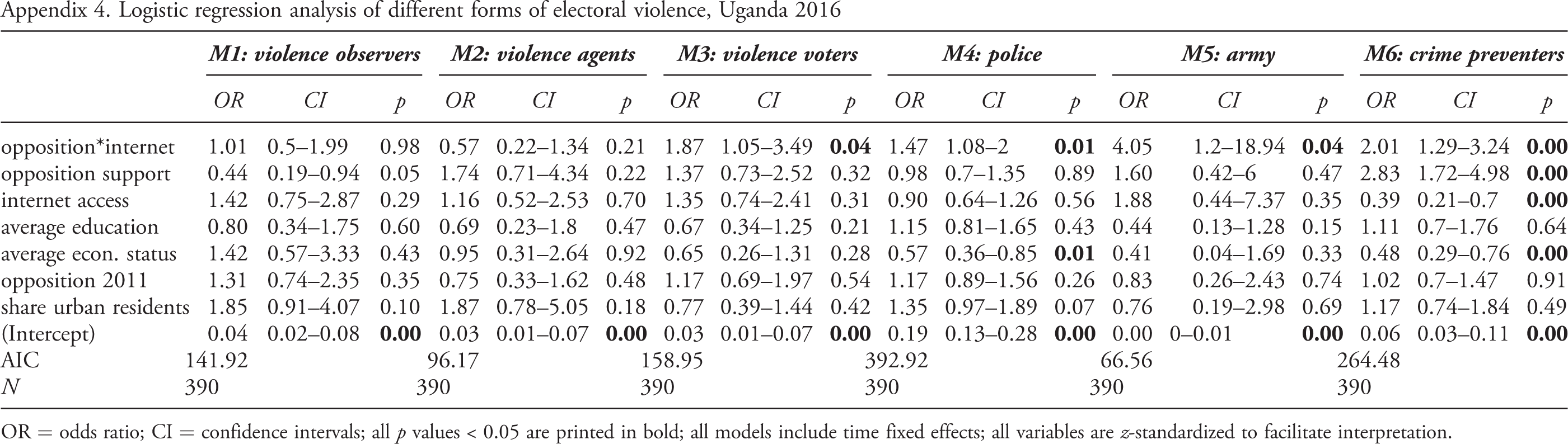
Logistic regression analysis of different forms of electoral violence, Uganda 2016
|
|
|
|
|
|
|
|||||||||||||
|---|---|---|---|---|---|---|---|---|---|---|---|---|---|---|---|---|---|---|
| OR | CI | p | OR | CI | p | OR | CI | p | OR | CI | p | OR | CI | p | OR | CI | p | |
| opposition*internet | 1.01 | 0.5–1.99 | 0.98 | 0.57 | 0.22–1.34 | 0.21 | 1.87 | 1.05–3.49 |
|
1.47 | 1.08–2 |
|
4.05 | 1.2–18.94 |
|
2.01 | 1.29–3.24 |
|
| opposition support | 0.44 | 0.19–0.94 | 0.05 | 1.74 | 0.71–4.34 | 0.22 | 1.37 | 0.73–2.52 | 0.32 | 0.98 | 0.7–1.35 | 0.89 | 1.60 | 0.42–6 | 0.47 | 2.83 | 1.72–4.98 |
|
| internet access | 1.42 | 0.75–2.87 | 0.29 | 1.16 | 0.52–2.53 | 0.70 | 1.35 | 0.74–2.41 | 0.31 | 0.90 | 0.64–1.26 | 0.56 | 1.88 | 0.44–7.37 | 0.35 | 0.39 | 0.21–0.7 |
|
| average education | 0.80 | 0.34–1.75 | 0.60 | 0.69 | 0.23–1.8 | 0.47 | 0.67 | 0.34–1.25 | 0.21 | 1.15 | 0.81–1.65 | 0.43 | 0.44 | 0.13–1.28 | 0.15 | 1.11 | 0.7–1.76 | 0.64 |
| average econ. status | 1.42 | 0.57–3.33 | 0.43 | 0.95 | 0.31–2.64 | 0.92 | 0.65 | 0.26–1.31 | 0.28 | 0.57 | 0.36–0.85 |
|
0.41 | 0.04–1.69 | 0.33 | 0.48 | 0.29–0.76 |
|
| opposition 2011 | 1.31 | 0.74–2.35 | 0.35 | 0.75 | 0.33–1.62 | 0.48 | 1.17 | 0.69–1.97 | 0.54 | 1.17 | 0.89–1.56 | 0.26 | 0.83 | 0.26–2.43 | 0.74 | 1.02 | 0.7–1.47 | 0.91 |
| share urban residents | 1.85 | 0.91–4.07 | 0.10 | 1.87 | 0.78–5.05 | 0.18 | 0.77 | 0.39–1.44 | 0.42 | 1.35 | 0.97–1.89 | 0.07 | 0.76 | 0.19–2.98 | 0.69 | 1.17 | 0.74–1.84 | 0.49 |
| (Intercept) | 0.04 | 0.02–0.08 |
|
0.03 | 0.01–0.07 |
|
0.03 | 0.01–0.07 |
|
0.19 | 0.13–0.28 |
|
0.00 | 0–0.01 |
|
0.06 | 0.03–0.11 |
|
| AIC | 141.92 | 96.17 | 158.95 | 392.92 | 66.56 | 264.48 | ||||||||||||
| N | 390 | 390 | 390 | 390 | 390 | 390 | ||||||||||||
OR = odds ratio; CI = confidence intervals; all p values < 0.05 are printed in bold; all models include time fixed effects; all variables are z-standardized to facilitate interpretation.