




Abstract
Civil conflicts typically end with negotiated settlements, but many settlements fail, often during the implementation stage when average citizens have increasing influence. Citizens sometimes evaluate peace agreements by voting on referendums or the negotiating leaders, and, almost always, they decide whether to cooperate. Yet, despite their role, we do not know much about how citizens form attitudes toward peace agreements. In this article, we assess how citizens form attitudes toward settlements, specifically the policy provisions that emerge from them, which are central in shaping the post-conflict context. These are complex policy changes, involving deeply factionalized actors, and the citizens evaluating them are often focused on rebuilding their lives. We therefore theorize that citizens use stark cues from political elites with whom they have affinity to form their attitudes. We test our theory using survey experiments in Colombia. We find that citizens rely on political elites’ cues to decide their stance on the settlement’s provisions. These cues appear to supply easily-accessible information that respondents use over other information. In contrast to work positing that peace agreements are exceptional and weary citizens are stabilizing forces, our results suggest that even these decisions are politics as usual, where divisions among political elites drive the outcome.
Introduction
Intrastate wars have produced many more deaths than interstate conflicts over the past half-century (Fearon & Laitin, 2003; Pettersson, Högbladh & Öberg, 2019). Most civil conflicts now end with negotiated settlements, but many settlements fail, often during their implementation (Collier et al., 2003; Jarland et al., 2020). The settlement’s terms matter to successfully stabilizing peace (Hartzell & Hoddie, 2007) – but the implementation process also has a profound effect on conflict recurrence (e.g. Nilsson, 2012).
What factors shape the terms and the implementation of a settlement? Increasingly, citizens’ attitudes matter because they are involved in peace processes, particularly in implementation (see Footnote 5). Yet, we still do not know much about how citizens form attitudes toward peace processes and agreements. A widespread theory about support for settlements focuses on exposure to violence, but the evidence is inconclusive. 1 Other factors, such as rural vs. urban residence, have some purchase but merit more exploration (Tellez, 2019).
We shift the focus from some existing structural arguments and posit that citizen support depends crucially on elite cues. Our theory’s basic premise is that acquiring information on provisions emerging from settlements is costly because these are part of complex policy changes, involving multiple, often deeply factionalized, actors. 2 Under these conditions, we argue that citizens use heuristics such as political elites’ cues that are clear because political factions are starkly articulated around peace processes (Sniderman, Brody & Tetlock, 1993; Kahneman, 2011).
However, our theory, and the general idea that citizens follow elite cues on settlements, is not a foregone conclusion. Other work hypothesizes that peace processes are unique settings with different dynamics from other political processes (e.g. Kalyvas, 2006; Wood, 2003). Consider two prevalent models: first, citizens are seen as war-weary and therefore supportive of any valid peace process (e.g. Zartman, 1995), collectively observing and rewarding compliance with implementation by combatant parties (Przeworski, 2005; Fearon, 2011; Wantchekon, 2004). In this view, citizens support settlements and provide the mechanism for ‘self-enforcing’ agreements. Second, and in contrast, citizens are seen as having heightened negative emotions that lead them to oppose any compromise in factionalized contexts. 3 In this view, citizens are unlikely to support settlements and, instead, provide a mechanism for undermining them. While we find some evidence that citizens are generally supportive of agreements – perhaps due to war weariness – our theory differs from these views by arguing that citizens follow different factions that support and oppose the process. Our framework also contrasts more broadly with ideas that citizens think differently during peace processes, that these are somehow extraordinary circumstances that change how they operate, either fixing their views or encouraging them to sort through information fully. Thus, our theory can also explain significant variation in support for different terms as implementation occurs, something the broader literature often cannot do (see Online appendix B).
We test our theory using survey experiments during the implementation of Colombia’s peace agreement between the government and the Revolutionary Armed Forces of Colombia (FARC). We examine views of citizens most affected by the fighting, who would perhaps be most likely to see the peace agreement as different from another political process, making it a potentially hard test of our elite cues’ theory. We assess the effect of elite cues on voters’ preferences toward provisions of the settlement, dependent on their political affinity with elites. 4
Our empirical work, including the case selected, builds on and contributes to a growing body of literature on public opinion about peace processes (Assouline & Trager, 2017, 2015; Fabbe, Hazlett & Snmazdemir, 2019; Kao & Redlich Revkin, 2018; Matanock & Garbiras-Daz, 2018; Tellez, 2019; Haas & Khadka, 2020; Masullo & Morisi, 2019; Carlin, McCoy & Subotic, 2019). Matanock & Garca-Sánchez (2017) provide observational evidence that public opinion towards the settlement between the FARC and the Colombian government aligned with elites’ positions. We further develop the theory and then experimentally test how attitudes on these complex policies develop in this factionalized environment. Moreover, in conflict contexts, the literature so far typically focuses on the negotiation, not the implementation period. Nevertheless, both are crucial to the success of agreements and subsequent peace, as citizens play a role in implementation regardless of whether they are incorporated into peace processes. We, therefore, focus on implementation.
The data show that citizens’ attitudes toward implementing provisions that emerged from the 2016 peace agreement are shaped by cues from political elites representing stark political factions, and the direction of this effect is contingent on individual affinity with those political elites. Beyond these results, a preliminary exploration of the mechanisms suggests that cues sometimes can convey a type of information (e.g. expected beneficiaries of a policy); however, such other information is unlikely to substitute for citizens’ reliance on cues from political elites.
Understanding citizen attitude formation during peace processes has important implications. As settlements are more likely to end civil conflict, they increasingly feature citizens involved through a direct vote on settlement referendums or on leaders negotiating them. 5 Even without voting, citizens still decide whether to cooperate with settlement terms (e.g. Office of the United Nations High Commissioner for Human Rights, 2009). Shedding light on what influences citizens’ attitudes toward settlements thus speaks to a growing literature on inclusion in peace processes (e.g. Nilsson, 2012). Specifically, we show that citizens seem to split along partisan lines and reinforce elite deals or divisions, so an elite deal remains the crucial component of a stable agreement.
Our results also suggest that political elite stances and their messaging to signal their stance on these provisions can substantially influence not only citizen support but also other crucial outcomes. While malleable, and specifically reflecting elite deals or divisions according to our findings, public opinion matters due to the different forms of citizen involvement in the process (ratifying, voting and cooperating). As political elites shape attitudes on provisions, they can alter the prospects of a settlement and its implementation, which, in turn, can change policy and politics in the country going forward (e.g. Dyrstad, Bakke & Binningsbø, 2021).
How do citizens form their attitudes about settlement provisions?
Peace processes are composed of compromises between various actors, and citizens influence their provisions by voting on them directly at times, voting on the leaders who negotiated them at times, and, in all cases, deciding whether to cooperate with policy changes. 6 But how do citizens form attitudes about the provisions?
Our theory builds on the idea that peace processes match the dynamics of attitude formation identified in other political processes where elite messaging is important, 7 and contrasts with ideas in existing literature on post-conflict contexts that instead imply that different dynamics are at work. First, some models suggest that citizens’ attitudes may simply be more fixed after fighting. Negative emotions can be heightened, which may make reconciliation difficult and citizens less receptive to even elite cues (Bar-Tal, 2009). Any party allegiances or other normal political dynamics may be ignored if, for instance, some see a status quo stalemate as better than a failure-prone agreement (e.g. Walter, 1997), or, alternatively, if citizens are war-weary and desperate to support any agreement (Zartman, 1995). Second, given the exceptional changes in peace processes, as well as the mixed messages that accompany them, other models suggest that citizens have strong incentives to sort through information on advantages and disadvantages to make fully informed decisions on whether to support each policy. Exiting models thus suggest that forming attitudes about provisions in settlements therefore may be unique decisions as voters assess policies but also reshape their state. However, these arguments provide reason to question whether post-conflict dynamics are different from normal politics. initial work on trends in Colombian public opinion suggests that citizens’ attitudes reflect prominent political leaders’ factions (Matanock & Garca-Sánchez, 2017; Liendo & Braithwaite, 2018). In addition to these conflicting ideas, both the theory and empirical tests are underdeveloped in these contexts. This paper seeks to further develop both. 8
Elite cues
We first draw on existing studies in political behaviour showing that acquiring information is costly and most citizens are uninformed even on important issues, and that they often rely on heuristics to form their opinions and make decisions (Tversky & Kahneman, 1974; Kuklinski & Quirk, 2000). Underpinning these ideas are theories about when people will use cognitive shortcuts vs. when they will invest more effort in acquiring and processing information (Sniderman, Brody & Tetlock, 1993; Kahneman, 2011). Citizens are likely to use cognitive shortcuts when they are distracted, when they must put cognitive effort elsewhere, and when the decisions are complex (Lupia, 1994).
We contend that the conditions during peace processes warrant the use of cognitive shortcuts, due to the complexity of the issues, as well as the post-conflict context that draws their focus elsewhere. Even as fighting winds down, citizens facing an adverse economic environment centrally focus on survival (Voors et al., 2012). Moreover, the advantages and disadvantages of the policies emerging from peace agreements are often complicated and based on compromise over time between opposing parties. Thus, citizens will likely rely on cognitive shortcuts to simplify decisions throughout these contexts.
An important cognitive shortcut is cues from political elites. These cues can lead citizens to update their information about the policy (Bullock, 2011; Cohen, 2003). 9 Elites specifically representing political camps (henceforth, ‘political elites’), supply clear cues because their starkly split positions provide salience on the issue and increase information in an existing cognitive context (Levendusky, 2010: 114). In our theory, political factionalization provides for the information environment in which political elites’ cleavages manifest and become starker, and, thus, where we expect their cues to be informative for citizens to form their attitudes. 10
Post-conflict contexts tend to be characterized by factionalization and ideological debate around the issue of war settlement and peace. Political elites in these settings are usually deeply divided as they often emerge from fighting factions (e.g. ethnic polarization; see López-Pintor, 2005), and, as transitions change the balance of power, new divisions also materialize in the post-conflict context on issues such as whether to take dovish or hawkish approaches to negotiations (e.g. Feldmann, 2019). Furthermore, in contexts where settlements are ratified via referendum, this factionalization can become especially acute because these processes tend to generate clear political camps that seek to mobilize citizens for or against the settlement. Political elites who have staked out strong positions during or after the conflict send clear signals through campaigns, public statements, or official endorsements. Therefore, cues from these political elites, defined in this context as politicians who lead opposing camps on an agreement, will be particularly legible for citizens who will then be prone to rely on them to form their attitudes toward peace issues.
11
Hypothesis 1: (Political elite cues): Citizens will rely on political elites’ cues to form their opinion about provisions emerging from settlements.
Affinity
We argue that the influence of elite cues depends on feelings about specific political elites, and that in the factionalized context of civil conflict, many citizens will hold strong positions. Carlin, McCoy & Subotic (2019) show that trust in the negotiating parties of the peace agreement in Colombia is highly correlated with support for the settlement and for certain provisions. We expect individual affinity with an elite, stemming from shared beliefs and values, ideological proximity, perceived common interests, or less ‘rational’ reasons such as the elite’s charisma or style, to activate and direct the effect of cues on attitudes (Ortiz-Ayala & Garca-Sánchez, 2014; Beck & Jennings, 1991). Elite cues on the costs and benefits of peace agreement provisions in economic, legal, and even emotional terms are viewed as either positive or negative, perhaps especially acutely when individual predispositions are deeply held (Levendusky, 2010; Druckman, Peterson & Slothuus, 2013).
Hypothesis 2. (Affinity): An endorsement on a provision from a political figure will increase support for that provision when a citizen has affinity for that elite. Conversely, an endorsement will decrease the citizen’s support when a citizen has an aversion to the endorser.
Information
We can also test some aspects of how cuing works. We posit that political elite cues could work as information shortcuts for citizens. Under this logic, cuing could, for instance, change expectations about the provisions’ likely beneficiaries. Citizens could use this heuristic to glean information and make efficient decisions without collecting and sorting all the details. 12
In our context, this explanation could be at work, as respondents did not know the detail about provisions emerging from the peace process. For instance, in our survey, only 14.4% of citizens could correctly identify the cap on prison sentences for those judged by the Colombian Special Tribunal for Transitional Justice (JEP), a key aspect of these provisions that was a contentious issue among political elites.
13
Hypothesis 3. (Perceived Beneficiaries): Receiving a political elite cue will shape which groups citizens perceive as potential beneficiaries from the provision.
Related, we argue that if cueing provides knowledge, more factual information potentially offers an alternative mechanism to understand and then evaluate provisions. However, we anticipate that citizens prefer the clearer signals from political elites more than additional information of any kind in these contexts because these cues more easily convey either affect or the policy’s advantages and disadvantages, producing a less effort-intensive path (Cohen, 2003; Druckman, Peterson & Slothuus, 2013). 14 We, therefore, do not state a standalone hypothesis about additional information, but we do evaluate its effect.
The context of the Colombian peace agreement
Colombia offers a unique opportunity to test our theory during the implementation of a hotly debated settlement to end a civil conflict. The role of voters is clear in this case. In 2016, citizens voted on and narrowly rejected the final agreement negotiated to end a war of over 50 years between the FARC and the government. A revised settlement was ratified in Congress later that year, after incorporating a set of the changes suggested by the opposition, and it has been slowly implemented since. Each provision requires approval by Congress. Citizens continue to factor into the process by, for example, voting on the legislators and the government that will be making decisions about implementation.
Despite their role, citizens still have little information about the settlement’s provisions due to its complex nature. The initial accord was nearly 300 pages long and filled with technical language about the provisions. Parts of the peace agreement have been enacted into law while others were effectively opposed and altered or abandoned. Understanding the advantages and disadvantages of specific policies emerging from the process demands considerable cognitive effort.
Colombian political elites on the government side divided into political camps during the negotiating phase (2012–2016) and remain divided around the provisions included in the settlement during implementation. The coalition led by the president who negotiated the agreement, Juan Manuel Santos, has expressed consistent support for the final settlement, while the coalition led by his predecessor, Álvaro Uribe, questions its legitimacy and has systematically sought to hinder implementation. Santos and Uribe have thus been clear representatives of those who support and oppose the settlement, respectively. Observational evidence suggests that when Uribe increased his criticisms against the peace process in 2013, his followers took more radical stances on issues such as a negotiated peace and reconciliation with former combatants (Gaviria, Ávila García & García-Sánchez, 2019).
Citizens still weigh in and ultimately have a say in the stability of the settlement through this extended implementation process. The 2018 elections, for example, reconfigured this process. The political camp opposing the agreement gained the upper hand, and, as the provisions from the peace deal were set to be approved piecemeal, the implementation slowed. For instance, to date, many of the provisions that had to be approved in Congress have been either voted against or not even been included in the agenda (Kroc Institute, 2019).
Variation in support for provisions emerging from the settlement
Before detailing the research design, we review the existing variation in public support for the provisions derived from the agreement between the Colombian government and the FARC. Attitudes vary considerably across these provisions. According to our original survey, representative of the conflict zones, 53% of Colombians expressed support for the overall peace agreement. Meanwhile, support for provisions regarding transitional justice and the political representation of FARC was lower than that of the overall agreement. The only provisions for which support was higher than the overall agreement is on rural development and the special seats for conflict regions (see Figure 1).
Overall, these data highlight that support for the provisions is not uniform and thus reinforce questions of how citizens form their opinions about the often-complex Percentage of individuals who support the peace agreement and its specific provisions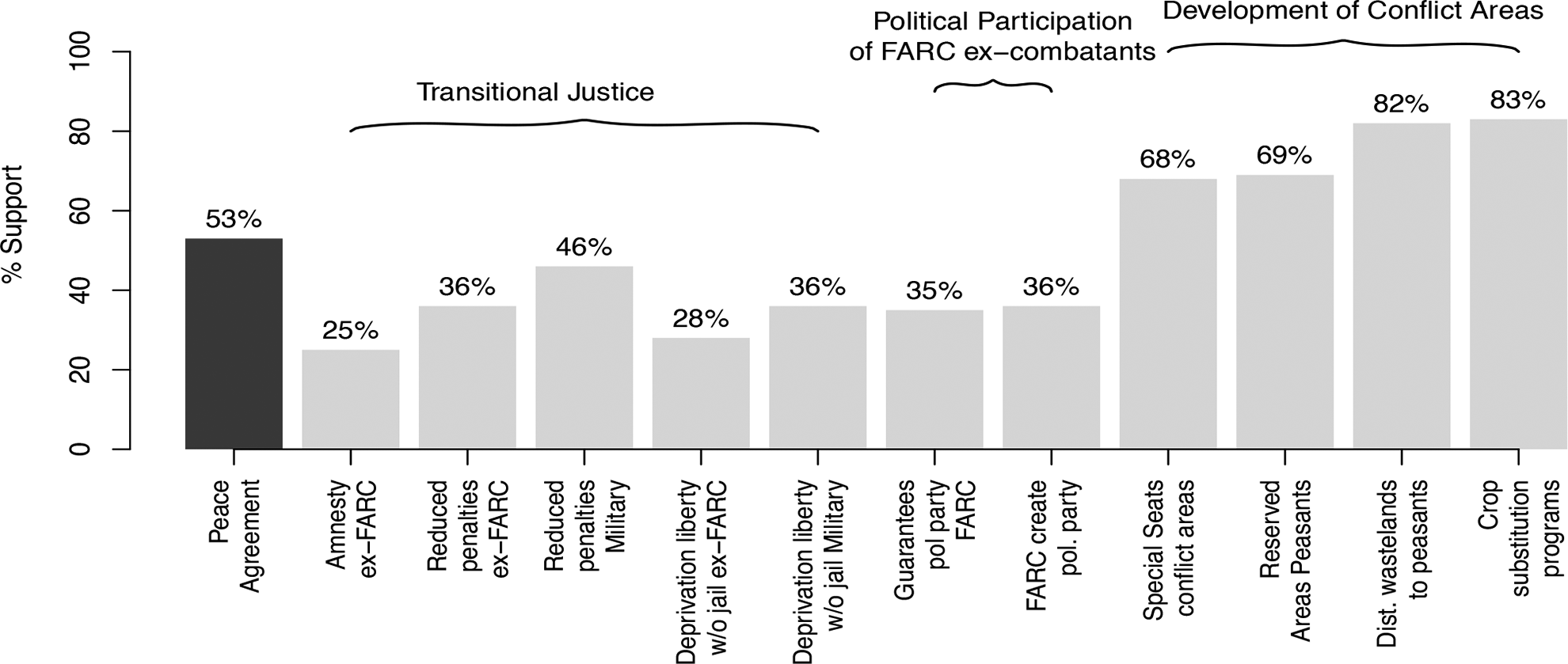
Research design
We test our hypotheses with a survey experiment during the ongoing implementation of the Colombian peace process. We randomize political elite cues on two provisions that emerged from the settlement and were not yet finalized during our study of this post-conflict context. The cue randomization provides us with exogenous variation on whether subjects receive an endorsement from an elite with whom they have affinity or not, even though we cannot directly manipulate individual affinity with the endorser. Hence, as we discuss later, we block on this variable for the treatment assignment.
The sample
We embedded the experimental questions in a 2017 survey representative of areas of civil conflict in Colombia. The sample selected adults living in the territories where the government, at the time we gathered the data, was running development plans, known as Development Plans with a Territorial Focus, as part of the implementation of the peace agreement with the FARC. 15 The implementation of the settlement is especially high stakes in these territories.
Fieldwork took place between October and December of 2017, about a year after the peace agreement was signed and while its implementation was being discussed in Congress. By the time of data collection, the race for the presidency was beginning and parties were defining their lists for the congressional 2018 national elections. Our survey suggests that the main concerns of residents in the sampled municipalities were issues related to peace and security and the economy. The sample consisted of 1,391 respondents. 16
As discussed in the theory section, the incentives to become informed about the settlement, including its specific provisions, should increase as citizens perceive direct effects on their lives. These citizens are more likely to be eligible for programmes introduced by peace agreements, potentially increasing their support for new rural development, increased political representation, etc., but they may also have been affected by conflict, potentially shaping their views about programmes such as reconciliation. Due to these interests, citizens in our survey may be the most willing to obtain and sort through different information on the settlement to form their attitudes, although our theory still hypothesizes that even they will continue to use political elite cues instead, given the cue’s legibility and the competing circumstances. Our survey sample, therefore, provides a hard test for our theory. 17
Experimental design
To test our theory, we used a vignette survey experiment that tests the effect of this type of cuing by randomizing elites’ cues that endorse provisions coming out of the peace agreement. In our ideal design, we would have randomized assignment of endorsements of the same provision by different political elites eliciting polarized affections (i.e., Santos and Uribe in the case we study). However, we did not use this design as it would have required deception, since it would have involved saying that one of the elites supported a proposal that it did not support. Instead, we examined the effect of cues using two separate vignettes, a design that allowed us to study these effects without deceiving participants about the actual elites’ positions. This design potentially limits the interpretation of eventual differences identified in the results of these two vignettes, and we probe these differences through additional tests below, but this was the ethical choice given the circumstances. 18
The provisions included in the vignettes
We presented each respondent with two provisions from the settlement that were in the works during our survey, either in the legalization process or just becoming law, and that were on topics with generally mixed support, as just discussed. Former president Santos, who negotiated the original peace agreement, supported one provision; his predecessor, Uribe, supported the other (which revised what had been in the original settlement). Although these two provisions provide within-subject variation in terms of the affinity with the political elites, which we discuss later, we analyse them separately.
19
Jurisdicción Especial para la Paz (JEP): This provision was set to establish the Special Tribunal for Transitional Justice to investigate, prosecute and punish crimes committed in the civil conflict. JEP’s judges would determine whether crime perpetrators can receive amnesty or a reduced sentence, in part depending on their confessions. The JEP’s creation was a central provision in the settlement, with support among negotiators, including Santos, but it was also contentious. The tribunal started operating in March 2018, after our survey, but has faced a series of political hurdles, many of them initiated by Centro Democrático, Uribe’s party.
Circunscripciones Especiales de Paz: This provision was set to create a special district in Congress, composed of 16 seats, reserved for the areas of the country most affected by civil conflict. The peace agreement stated that only indigenous communities, social movements and groups of citizens would be able to compete for these special seats, but Uribe, along with other politicians, proposed instead that any party could compete for these seats. We asked respondents about Uribe’s proposed modification. The revised proposal failed to receive the needed majority in a congressional vote in November 2017, just at the end of our survey. In 2021, the 16 seats became law due to a ruling from the Constitutional Court.
Randomization of treatments
We showed each participant the following vignettes for the two different provisions, and for each, we randomized whether a political elite endorsed the proposal (Santos in the JEP proposal and Uribe in the change to the special seats proposal) or not (in which case, the proposal uses a generic endorsement in the form of ‘some people’). This design thus allows us to avoid deception given the polarized context, as described above:
20
[Some people/President Santos] have/has supported the creation of the Special Jurisdiction for Peace (JEP). [Some people/former president Álvaro Uribe Vélez] have/has supported that the political parties that are already in Congress can also compete for the seats that are reserved for the regions of the country that are most affected by the conflict.
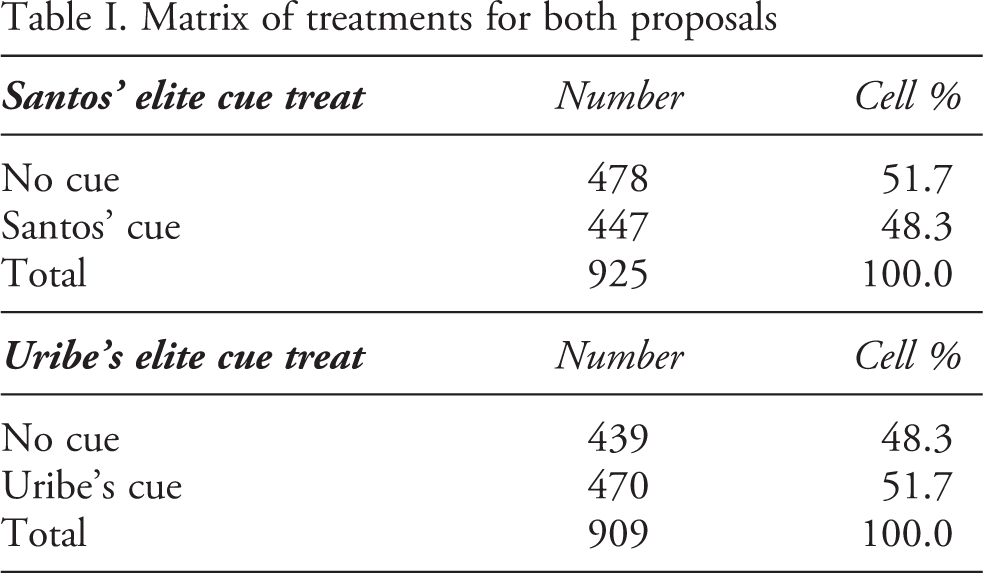
Matrix of treatments for both proposals
Measuring individuals’ affinity with elites
We operationalize individuals’ affinity with the elites representing the political camps in dispute using the following question: On this card there is a staircase with steps numbered from one to seven, in which 1 is the lowest step and means VERY UNFAVORABLE and 7 is the highest step and means VERY FAVORABLE. If your opinion is between very unfavorable and very favorable choose an intermediate score. I am going to mention the name of various public figures and I would like you to tell me on that scale what is your concept of each one of them.
Operationalizing the outcome of interest
Our main hypotheses are related to public support for the specific provisions that emerged from the Colombian settlement. We measure support for each one of the proposals using a 1 to 7 scale (where 1 means ‘No support at all’ and 7 ‘A lot of support’). Our hypothesis about the mechanism is related to the expected beneficiaries of these provisions. So we also ask about the extent to which they think the provision would benefit each of the following actors: (i) the government; (ii) the FARC; and (iii) citizens like them. 23
Analysis
Testing the effects of political elite cues
We can test our main hypotheses by simply comparing individuals’ level of support for each provision across type of endorsers and interacting these treatment indicators with the degree of affinity between the individual and the elite who endorses the proposal. Affinity with the political elites is measured with a dichotomous variable, as described. We therefore estimate the effect of interest with ordinary least squares regression, with robust standard errors, as follows:

where yi
corresponds to support for the provision under consideration;
Results
Elite cues and affinity (H1 and H2)
Testing first for the role of political elite cues alone,
25
we find an effect of elite endorsements on citizens’ opinions The effect of political elite cues conditioned on affinity with the endorser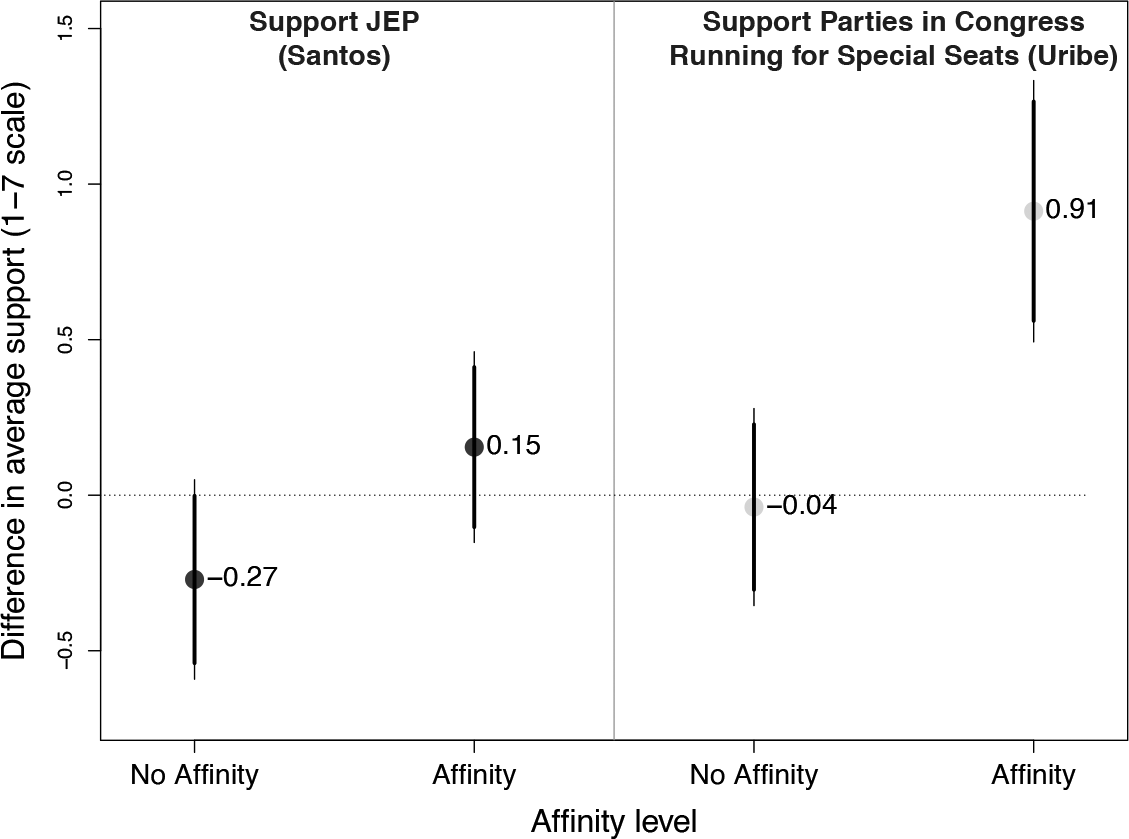
However, we expected the effect of elite cues to depend on individual affinity with political leaders, 26 and our results support this expectation. The second column of Tables IIa and IIb and Figure 2 show that the direction and magnitude of the effect of both Santos’ and Uribe’s cues are contingent on individual affinity with these elites.
The second column of Table IIa indicates the effect of Santos’ cue conditional on individual affinity: Among those with an affinity for Santos, receiving his cue increases support for the provision by 0.15 points (although this effect is not statistically significant), but, among those without an affinity for Santos, it decreases support by 0.27 points (and this effect is statistically significant at p<0.1). This difference in effect size is statistically significant (p<0.1).
The second column of Table IIb indicates the effect of Uribe’s cue: a positive, statistically significant effect for those with affinity (0.951, p-value <0.001) – in fact, its magnitude is substantial, increasing support for the policy by almost one point on a 1–7 scale – and a negative but, as expected, not statistically significant effect for those without affinity. In other words, we find even stronger, and more nuanced, evidence for the role of political elite cues once we factor in individual affinity with elites.
Information (H3)
To explore the possibility that elite cues work as information shortcuts for citizens – and the mechanism more broadly – we test whether elite cues shape citizens’ perceptions of the provisions’ beneficiaries. When asked to what extent they believed each provision would benefit different actors, we find mixed support for this hypothesis (Figure 3).
The effect of elite cues on average support for specific policies from the peace agreement
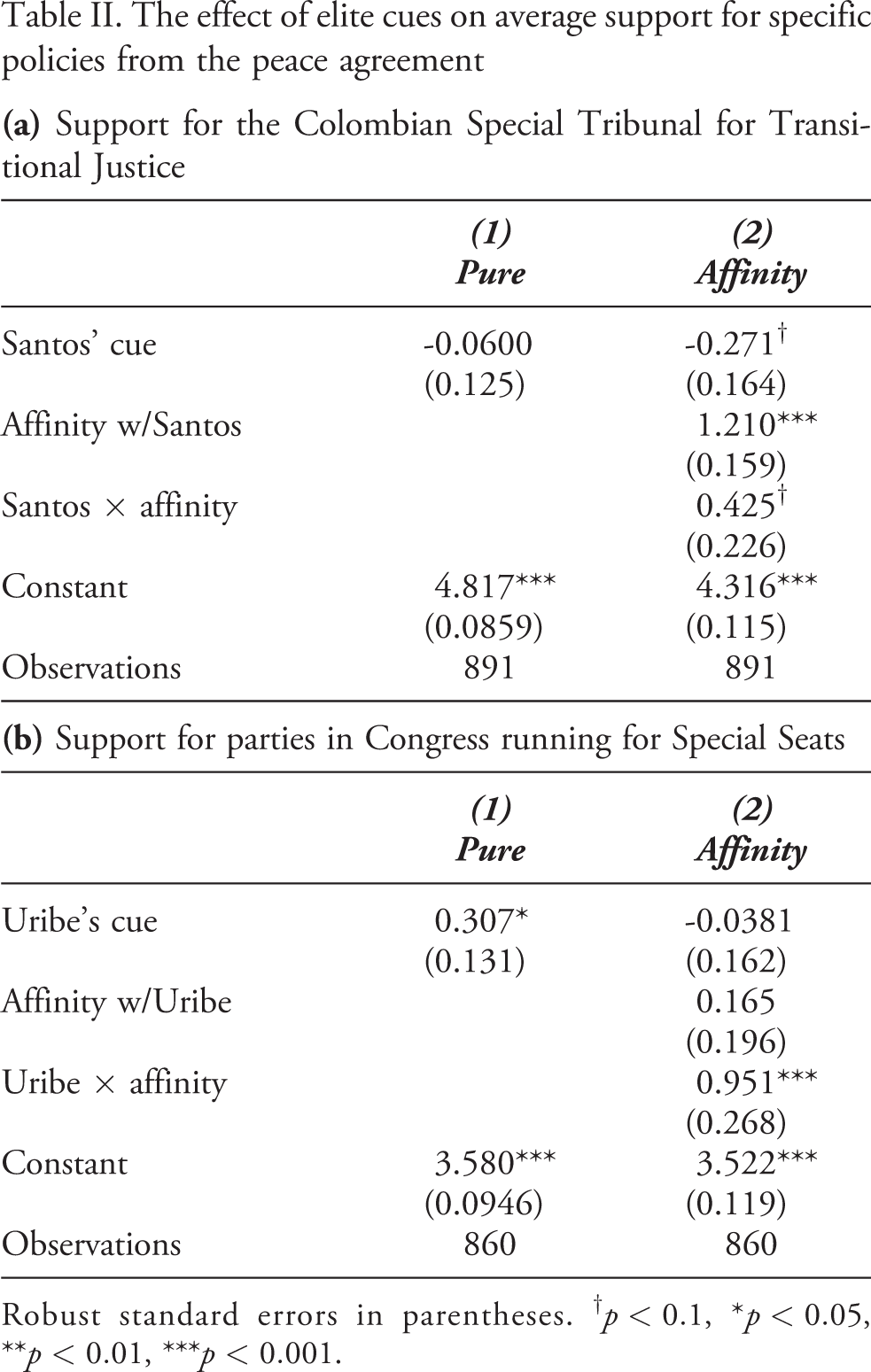
Robust standard errors in parentheses. †
The evidence from Uribe’s cue lends support to the explanation that individuals learn information from his endorsement, changing their perceptions about beneficiaries. Moreover, that Uribe’s cue is only informative among those who like him is consistent with models of cheap talk where communication is only informative if the sender’s (elite) and receiver’s (citizens) ideal points are not too distant (Crawford & Sobel, 1982). 27
However, the differences in the results between Santos’ cue and Uribe’s cue make it less likely that the mechanism is that their endorsements are conveying information to citizens (especially since the data in Figure A3 in the Online appendix show that both Santos and Uribe are political elites who could each theoretically drive a similar effect). 28 These elites, and the cues, though, may not be providing the same amount of information as we discuss in the next section.
To further explore the extent to which additional information shapes the process of attitude formation, we cross-randomized the endorsement experiment with the receipt of additional information about the provisions, resulting, for each vignette, in a
Extensions and robustness checks
An important set of extended tests emerged from the differences we found between the effects of the cues from the two political elites. While Santos’ cue reduces support among those who dislike him, his out-group, Uribe’s cue increases support among those who like him, his in-group (which is in line with Haas & Khadka, 2020). The effect of elite cues on the perceived beneficiary of the provision The joint effects of elite cues and information about the provisions under consideration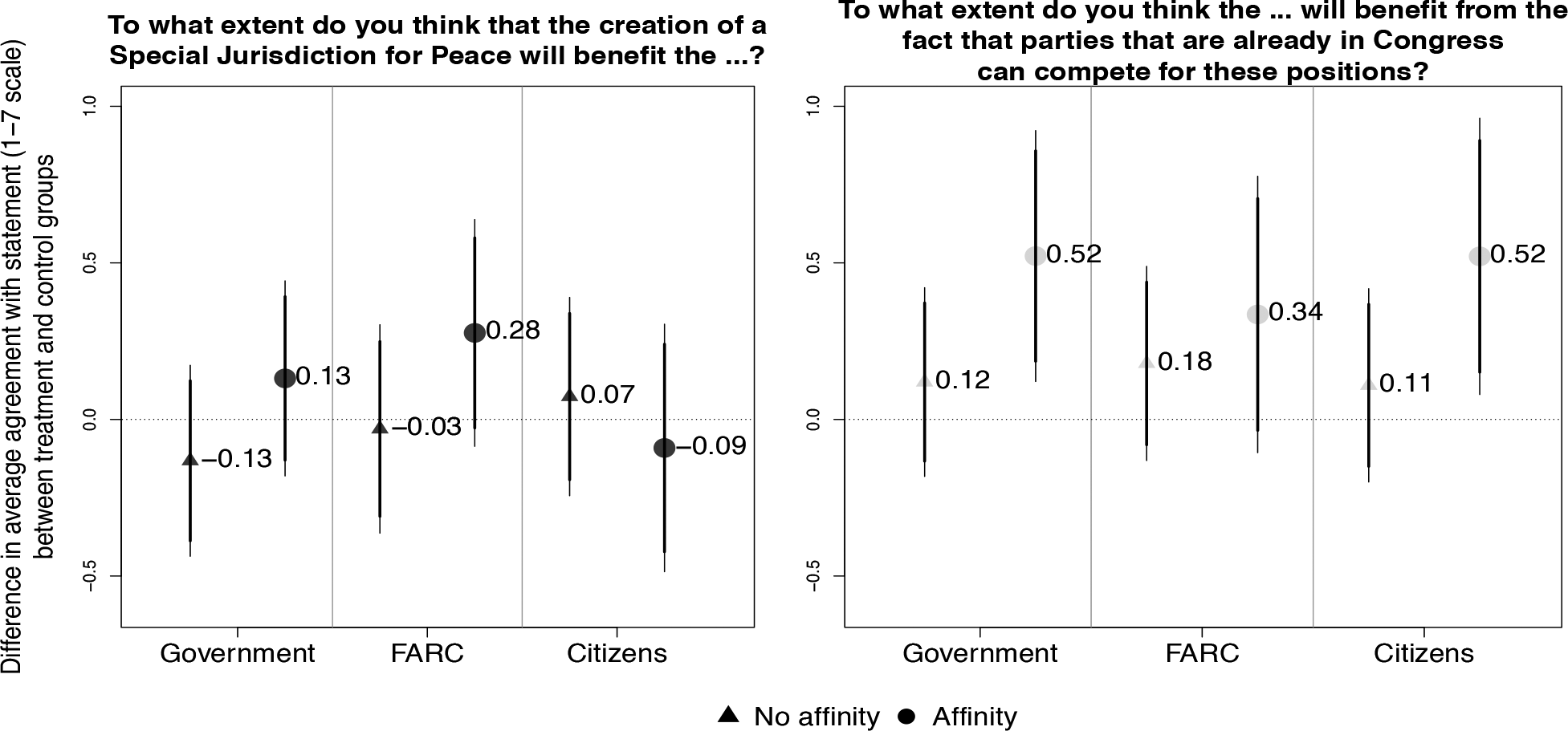
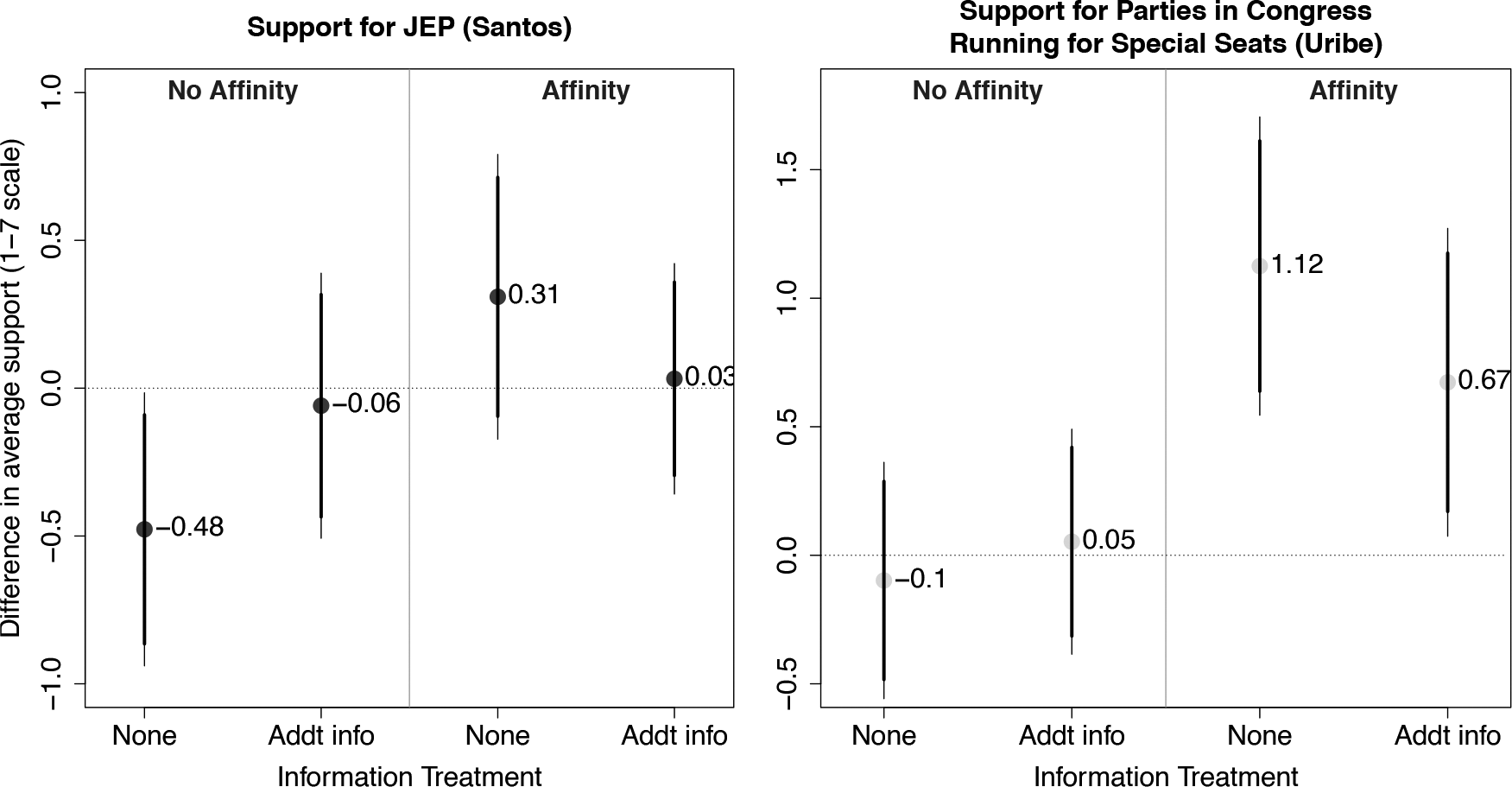
One strong explanation is that Santos has a more diverse ‘camp’ that therefore does not take his cues as readily. During the years of negotiations with the FARC, public opinion and electoral support gravitated around two factions representing divergent stances on the issue of peace (Botero, García-Sánchez & Wills-Otero, 2018). Supporters of the peace process conformed a coalition from the left to the centre of the ideological spectrum that claimed affinity with Santos because they match on this particular issue even though it was otherwise diverse on other issues; the other camp was a more clustered group on the right that claimed affinity with Uribe Distribution of support for different provisions by level of elites’ favourability rating and treatment status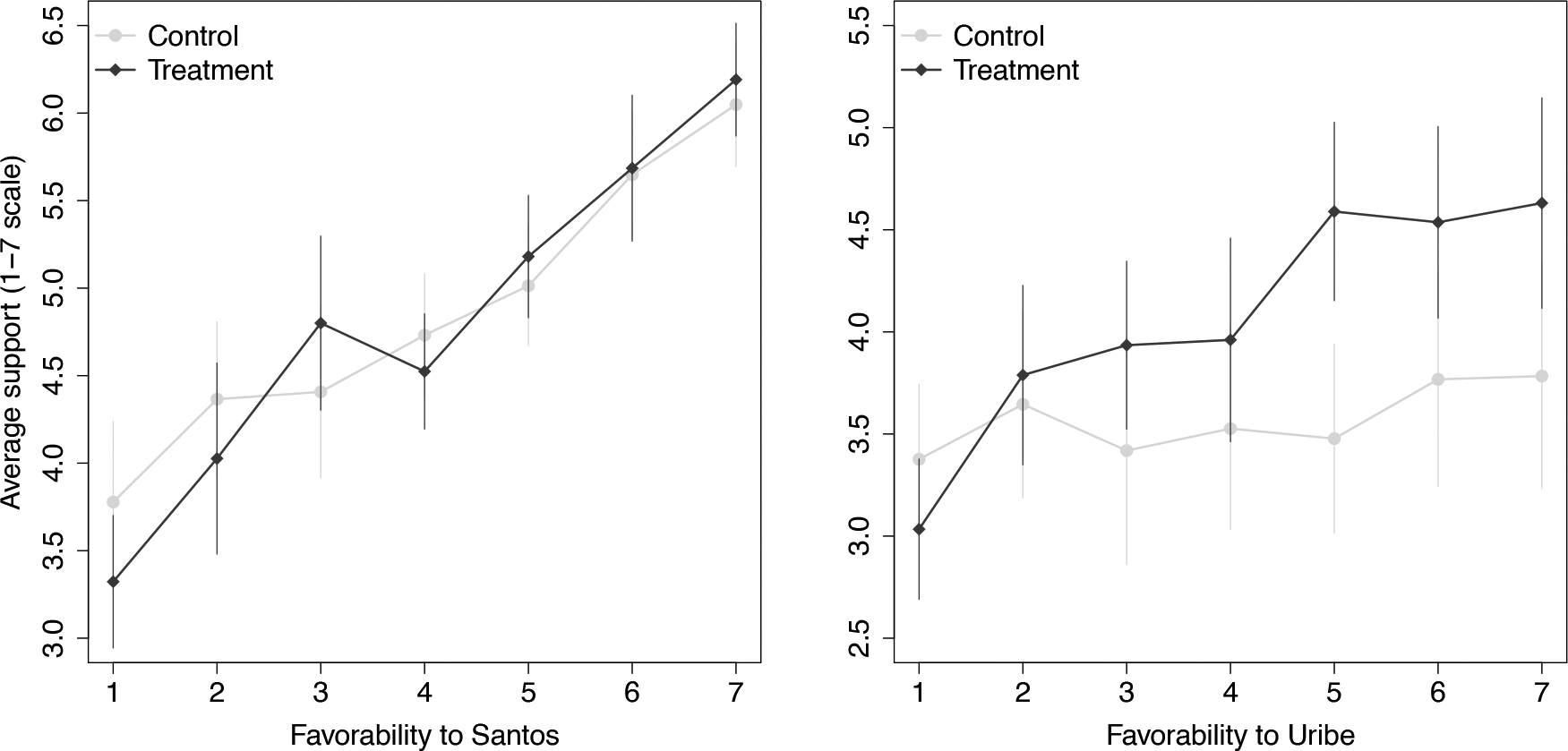
Two different pieces of evidence corroborate this interpretation. First, focusing on the control group, average support for the JEP increases along with Santos’ favourability rating, while support for the revision of the special seats is independent of Uribe’s favourability (see Figure 5). Support for the JEP is highly correlated with support for the peace agreement overall, so this suggests the expected correlation between the peace process and affinity with Santos. Second, we re-ran the analyses from Table II including a battery of covariates that may be correlated with elite affinity (see Table A16 in the Online appendix). 31 While the effects of Uribe’s cue conditional on affinity hold, Santos’ cue’s negative effect among those who dislike him is no longer statistically significant. Thus, Santos seems to be bringing together a diverse group of citizens in favour of the agreement, which, may make his cues less potent for his camp.
Another explanation of the results is that Santos’ endorsement was less surprising than Uribe’s (Nicholson, 2011). As the main promoter of the peace negotiations, Santos was likely to support the provisions. In contrast, Uribe’s endorsement of a peace agreement policy – albeit conditioned on modification of what was originally signed in Havana – was more unexpected and therefore persuasive. While we cannot directly test this explanation, and, given the context it likely has some merit, some evidence does counter it.
To assess different levels of prior knowledge about the provisions in the two vignettes, we compared the overall support for the proposal and the percentage of respondents answering ‘Don’t know’ or not answering in the control group without information and the control group with additional information. We do not find statistically significant differences in either case, thus differences in underlying knowledge are unlikely to be behind the divergent results (see Tables A17 and A18 in Online appendix K). However, this test does not get at the specific question of whether the Uribe endorsement is more surprising, so that is a question for future work.
We also ran several robustness checks on our results, including some already noted in the endnotes. For example, to further explore when citizens rely on cues, we provided endorsements from professors, elites considered more technical – defined as those whose perceived source of authority does not derive from the exercise of power or public office – but not polarized in the Colombian context. Yet, we found that they have little effect on support for the provisions (see Online appendix H). Moreover, we ruled out the possibility that respondents react to any ‘expert cue’ effect by using the technical elites’ experimental condition as a control group for political elites (see Online appendix I). 32 Again, the results for Uribe’s cue are robust to this specification, while the effect of Santos’ cue loses statistical significance. We also examined the robustness of our results with respect to different definitions of our affinity measure to ensure that the results are not driven by a particular way of operationalizing this variable, 33 and we find that they hold across different specifications (see Online appendix J). Finally, data from our sample show that 16.4% have an affinity for both leaders (see Table A2 in the Online appendix), and so we checked that our results are not driven by this special group; our results hold even excluding this group (see Table A13 in the Online appendix that replicates the estimations of Table II).
Conclusions
We analyse attitude formation toward the complex policies that compose peace agreements to end civil war, examining the case of Colombia. We find that cues from political elites have strong effects on individuals’ support for specific provisions that emerge from the Colombian settlement, and that these effects are conditioned on individual affinity with elites. These findings support our expectations that peace processes are politics as usual. We also find some evidence that these cues may be providing information about the beneficiaries of these policies to the respondents, but additional information about the provisions does not similarly shape public opinion.
Our work contributes to a growing body of experimental literature on public opinion about peace processes – although it focuses on the implementation rather than the negotiation period – and, on the whole, it suggests that attitude formation even in post-conflict contexts does not work differently from other political processes, unlike most of the existing post-conflict models, perhaps because of the high stakes of conflict (see Walter, 1997). Our findings imply that citizens use cognitive shortcuts even when evaluating these important policies. Specifically, they take cues from political elites who represent polarized factions, depending on their affinity for that elites’ camp.
By showing that citizens split along partisan lines or political camps as implementation takes place, we suggest that a broad elite deal remains the crucial component of a stable agreement even when citizens weigh in. Citizens strongly react to cues from political elites, so their input is not likely to counterweight elite divisions, and, instead, stems from it. Even when these policies are likely to benefit citizens, they may still reject the provisions.
A growing number of countries with civil conflict hold either direct referendums on peace agreements or elections of officials negotiating them. Thus, our results likely travel to other countries that, like Colombia, try to resolve a civil conflict via settlement, and, at the same time, have a competitive political system. In these cases, the possibility of a division of political elites along partisan lines, even if they represent the political establishment, may prove detrimental to peace.
Our work points to some additional research needed on the role of information. In one of our robustness checks, we also examine elites viewed as more technical, and we do not find that they shape attitudes. The theory also suggests that these political elites are most legible. Another recent study shows that religious leaders can shape citizen attitudes towards reintegration (Blair et al., 2021). Together our research suggests that factionalization may matter a good deal for cue uptake in these contexts, but future work could further explore this by using cues from more leaders. In addition, given the mixed findings presented on the mechanism, we are cautious with the interpretation of how elite cues influence attitude formation. Nevertheless, both these results and the null results of providing information examined in the extensions help point the path forward on this topic. They indicate the importance of more exploration on the mechanism of attitude formation, especially the role of information in cue-taking, and they suggest that citizens may rely on types of information that they can easily absorb to the exclusion of other information.
In addition, considering that the implementation of a settlement takes several years, a key question that emerges from this analysis and merits further study is the extent to which the effect of elite cues changes over time. We think that elite cues remain a strong influence on public opinions on peace as long as the peace agreement remains a salient issue and key public figures continue debating around it. The Colombian experience suggests that such conditions hold for a relatively short period of time. In 2016 conflict/peace issues were the main concern of Colombians, but, by 2020 such issues dropped fourth place. Additionally, recent evidence indicates that the opinion gap regarding peace issues, between political camps, has been closing, most likely because political elites are debating less about these topics (Ávila García et al., 2023). Future work that uses similar experiments later in the process, and in other contexts, will therefore be useful to understanding these politics that can prove divisive at least in this moment in Colombia.
Footnotes
Acknowledgements
This project was approved by University of California, Berkeley’s Institutional Review Board protocol #2017-02-9601 and by Universidad de los Andes’ Committee on Research Ethics protocol #791-2017. A pre-analysis plan for the survey experiment was registered in Evidence in Governance and Politics #20171104AB. We thank Dan Corstange, Alexander de Juan, Caroline Hartzell, Chad Hazlett, Gabe Lenz, Katerina Linos, Enzo Nussio, Francesca Parente, Alison Post, Julia Raven, Jake Shapiro, Laura Stoker, Carlos Ávila, and participants at American Political Science Association 2018, EGAP 22, a 2018 Folke Bernadotte Academy workshop, Peace Science Society workshop, Paris School of Economics Conflict Workshop, Brown, Columbia, and New York University’s speakers’ series, and Berkeley’s MIRTH and VIO Lab for excellent comments and suggestions. All errors or omissions are our own. We are grateful to USAID (Colombia) for their generous financial support to conduct the survey in which we embedded our experiment.
