




Abstract
To what extent are legislators, responsible for the implementation of many peace agreements, responsive to citizens’ preferences? Examining the 2016 Colombian peace agreement, we embed an experiment in the 2019 wave of a survey of all the members of Congress. We inform legislators about the attitudes of the general population and residents of conflict-affected regions on a provision included in the peace agreement: the creation of 16 special seats in the House of Representatives reserved for conflict areas. We find that legislators underestimate citizen support for this policy, and the magnitude of their misconception is correlated with the positions of their parties on the issue. Moreover, we find that providing information about citizens’ support for the policy does not affect legislator support for the provision.
In 2016, Colombia signed and began to implement a peace agreement with the Revolutionary Armed Forces of Colombia (FARC), seeking to end a conflict that lasted for more than 50 years. Beginning with the negotiation and approval process, citizens have been centrally involved, even voting in a plebiscite that narrowly rejected an initial agreement and produced revisions. While that revised agreement was passed directly through a congressional vote, citizens remained a central part of the process as the 2018 presidential election continued to revolve around the agreement.
The implementation of the peace agreement hinges on legislative action, however, and the role of citizens in that process is less clear. While citizens play a key role voting for these broader platforms and parties, generally rebuilding after conflict, and even accepting ex-combatants into their communities, 1 many of the policy changes from peace agreements occur through legislation. In these important but often less publicized piecemeal decisions by policy elites, we examine the extent to which they are responsive to citizens’ preferences. Is this another way in which citizens shape implementation, or, alternatively, does this process limit citizen influence? This question is particularly relevant because incentives that drive legislative responsiveness may be different during a peace process or post-conflict period compared to a regular situation. We argue that, in this specific context, the link between public opinion and legislators preferences may be especially weak due to the coincidence of various factors: these situations represent transitions or disruptions of the existing political order, often with volatile alliances, and, in addition, peace agreements are complex and include multiple provisions that are not always obviously key priorities to the general public.
In this paper, we develop a research design to examine two questions: (i) to what extent do policy elites, specifically legislators, know the level of support among different constituencies for policies related to provisions included in peace accords? And (ii) are they responsive to that support in their stance on these policies during crucial implementation stages?
To answer these questions, we study how legislators in Colombia form their attitudes towards some of the core policies that implement the peace agreement signed between the FARC and the government. Specifically, we designed a survey experiment to evaluate legislators’ understanding of citizen attitudes toward and their subsequent stance on the creation of a special district, composed of 16 seats in the House of Representatives, reserved for areas historically affected by conflict. 2 We partnered with the Misión de Observación Electoral (MOE), a well-known NGO that specializes in the monitoring of electoral processes in Colombia, to embed experimental questions on the 2019 wave of a survey they regularly conduct on the universe of all members of Congress in Colombia (elected for the 2018-2022 legislative period).
We find that legislators underestimate constituent support for the policy emerging from the peace agreement that we evaluated, especially the position of those citizens not living in conflict-affected areas. The magnitude of their misperceptions is correlated with the platform of their party on the issue. Specifically, legislators from parties that have opposed the peace agreement, and its implementation, systematically underestimate support for the creation of 16 special seats in Congress. Legislators from parties that have unambiguously supported the peace accord have higher and more accurate priors about citizen support for this policy. We also find that providing legislators with information about the actual citizen support for the creation of the 16 special seats in Congress largely does not affect legislators opinion. This result holds even when presenting legislators with information about support for the provision in districts that would potentially benefit from this policy.
Being able to survey the universe of the members of Congress in Colombia allows us to directly explore the real-world process by which a crucial set of policy elites shapes a peace accords’ implementation. Many settlements hinge on the legislature enacting its provisions into law. Yet, it also constrains the size of our study group and, therefore, the statistical power of our experiment. We used the best available procedures to address this by, for instance, increasing precision at the design stage, which included block randomizing on potentially prognostic covariates, but we note that this limits the conclusions that we can draw from our null findings. In the final section of the paper, we discuss this limitation in more detail, and we are careful in what implications we can draw throughout the paper.
Answering these questions sheds light on the extent to which legislators pay attention and respond to citizen attitudes about policy emerging from peace agreements, which, consequently, can affect implementation and potentially even the stability of peace agreements.
First, while citizen attitudes likely matter for implementation (e.g. they provide the context in which most programs operate) and the resilience of a peace agreement (e.g. their attitudes and behavior related to reconciliation and reincorporation of ex-combatants shapes the success of those programs), 3 this paper suggests that they are less influential when it comes to shaping legislators’ support for the policies that need to be passed into legislation. The conclusions from this paper tentatively point to limitations to the influence of citizens. Citizens in these contexts are often operating at capacity and then being asked to influence complex policy decisions as they wind through complex legislative processes. Existing work shows that citizens rely on elite cues when forming their opinions about peace agreements but especially their provisions and resulting policies (e.g. Matanock and García-Sánchez, 2017; Garbiras-Díaz et al., 2019). In turn, our null findings push this research agenda in new directions, seeking to understand aspects of peace processes in which policy elites, i.e. legislators, are key players in the implementation and stability of peace agreements. Those results, together with these showing that legislators estimate incorrectly but then also do not adjust their estimates based on citizen attitudes toward these policies, suggest significant power for policy elites at least in this stage of peace agreement implementation.
These conclusions therefore point to an aspect of this particular policy in which elites retain more power than the work on inclusion — or work on policy responsiveness in general — might anticipate. The policy that we study is somewhat threatening to elites, in that it was not designed to allow existing parties to compete for the new seats, so willful resistance may also be a component of this type of response. Understanding these potential limitations on the role of citizens is important to this research agenda, defined in the Introduction to this special feature. Our results suggest that, in contrast to the work showing the many ways in which citizens’ views and actions matter in peace processes, this is an area where they have less influence. For instance, our findings indicate that the impact of citizens’ input may be contingent on the extent that political elites perceive them as aligned to their partisan interests, ultimately affecting the prospects of policies included in settlements (especially when their implementation depends on their legislative approval).
Colombia’s 2016 peace accord: its implementation through legislation and its provisions for special seats
Many peace agreements are set to be implemented, at least in part, through piecemeal legislation. This perhaps especially applies to peace agreements seeking to end some of the most protracted civil wars in the modern era that also happen to be held in at least somewhat democratic states: Colombia, India, Israel/Palestinian Territories, and the United Kingdom. But it happens in many instances. In fact, even outside elections, as ministerial positions are formally established, their portfolios might be changed or shared among different offices, as occurred during the implementation a of a peace process in Chad (Atlas and Licklider, 1999, p. 43–46). And, of course, these policy processes can have substantial consequences for implementation and subsequent stability of peace agreements. In the case in Chad above, for example, the rebels returned to fighting when the policies implemented deviated from what they expected.
In Colombia, the legislative dimension of the implementation process is especially prominent. In 2016, then President Juan Manuel Santos and the FARC rebels signed a peace agreement. The agreement included provisions for institutional changes that would allow new political forces to emerge and participate in politics in the country — including the FARC’s newly-created party as it demobilized — and further open democratic space. The initial agreement was narrowly rejected in a 2016 plebiscite. When the “NO” won the plebiscite, after a campaign against the settlement that was led by elites, former president Uribe — the leader of the party that opposed the peace agreement in 2016 and that is currently in government, the Centro Democrático — and other leaders suggested changes. Some were incorporated into the text of the agreement that was later passed in Congress that same year. However, each of its provisions was then to be approved piecemeal, meaning that legislators were key actors in its implementation. The 2018 elections brought opponents of the peace agreement to office in the midst of this implementation process.
A particular policy provision that emerged from the peace process was to create a special “peace district” in the House of Representatives, consisting of 16 special seats, which would add representation for the areas of the country most affected by civil conflict and an absent state. Political parties already represented in Congress in 2018 were not eligible to compete for these seats. As a result, the provision also sought to increase political representation specifically for indigenous communities and social movements not yet organized as parties.
The special seats had a rather tumultuous legislative process. After the initial “NO” to the plebiscite, this provision was one of those that the 2018-2022 “government coalition” (composed of the parties that had opposed the approval of the peace agreement) sought to change, proposing that any party could compete for these 16 seats. This modification was rejected by the negotiators of the peace process, so the peace agreement that was approved kept this provision intact. Subsequently, the provision was discussed and advanced as a 2017 bill, but it failed to pass by one vote. However, this outcome generated controversy around the deliberative quorum defined by the Colombian Constitution to pass this type of legislation, as the country was in the midst of a crisis that ousted several legislators. In 2018, the bill was reintroduced, but was not voted on by the Senate as many opponents of the peace agreement left the chambers to avoid a quorum. At the time of our study, the creation of the special seats was yet to be debated again in Congress, while the controversy over whether or not to approve the provision continued. After our study, rulings by the Constitutional Court and the Council of State revived the original 2017 Legislative Act, finding that the qualified quorum had been met during that voting session; therefore, the bill passed in Congress as originally stipulated in the agreement, meaning that parties with existing representation are not eligible to compete for these seats, in effect for 8 years (from 2022 to 2030). Finally, in October 2021, President Duque signed the decree regulating the special district.
Therefore, at the time of our study, this policy emerging from a provision of the peace process had not become law, despite its popularity among citizens, especially those living in conflict-affected areas who would benefit from these special seats. Citizen attitudes towards this provision have been increasingly positive since 2016. Survey data from Observatorio de la Democracia at the Universidad de los Andes, shows that there has been a gradual increase of the acceptance in the public opinion towards the creation of these seats in Congress. According to the 2016 national sample, 54.2% of Colombians support the creation of the special district. Among those citizens living in conflict affected regions support for the 16 seats is significantly higher than in the country as a whole, and it has increased over the past years as it went from 68% in 2017 to 73% in 2019.
Figure 1 depicts the distribution of members of Congress’ and citizen support for the creation of the 16 special seats by their stances with respect to the peace agreement. In the case of citizens, they are classified on whether they support the peace agreement, and in the case of the legislators, whether they belong to parties that unambiguously campaigned in favor of the approval of the agreement back in 2016.
4
A comparison between attitudes toward this policy among the general public and among legislators shows that the latter are indeed more polarized than average citizens and split along the partisan divide that emerged around the 2016 plebiscite. In particular, legislators’ distributions are more skewed toward one of the extremes than those of citizens. Distribution of support for creation of special seats among civilians and legislators by stance with respect to the peace agreement. Sources: Data on support for this provision among civilians come from the 2016 LAPOP survey, and on support among legislators come from the authors’ original survey conducted with the universe of members of Congress in 2019, which we describe in detail in Section 3.2. Note: The solid lighter and darker lines correspond to support for the creation of the special seats among pro-peace citizens and legislators, respectively, whereas the dashed lighter and darker lines represent support among anti-peace citizens and legislators, respectively.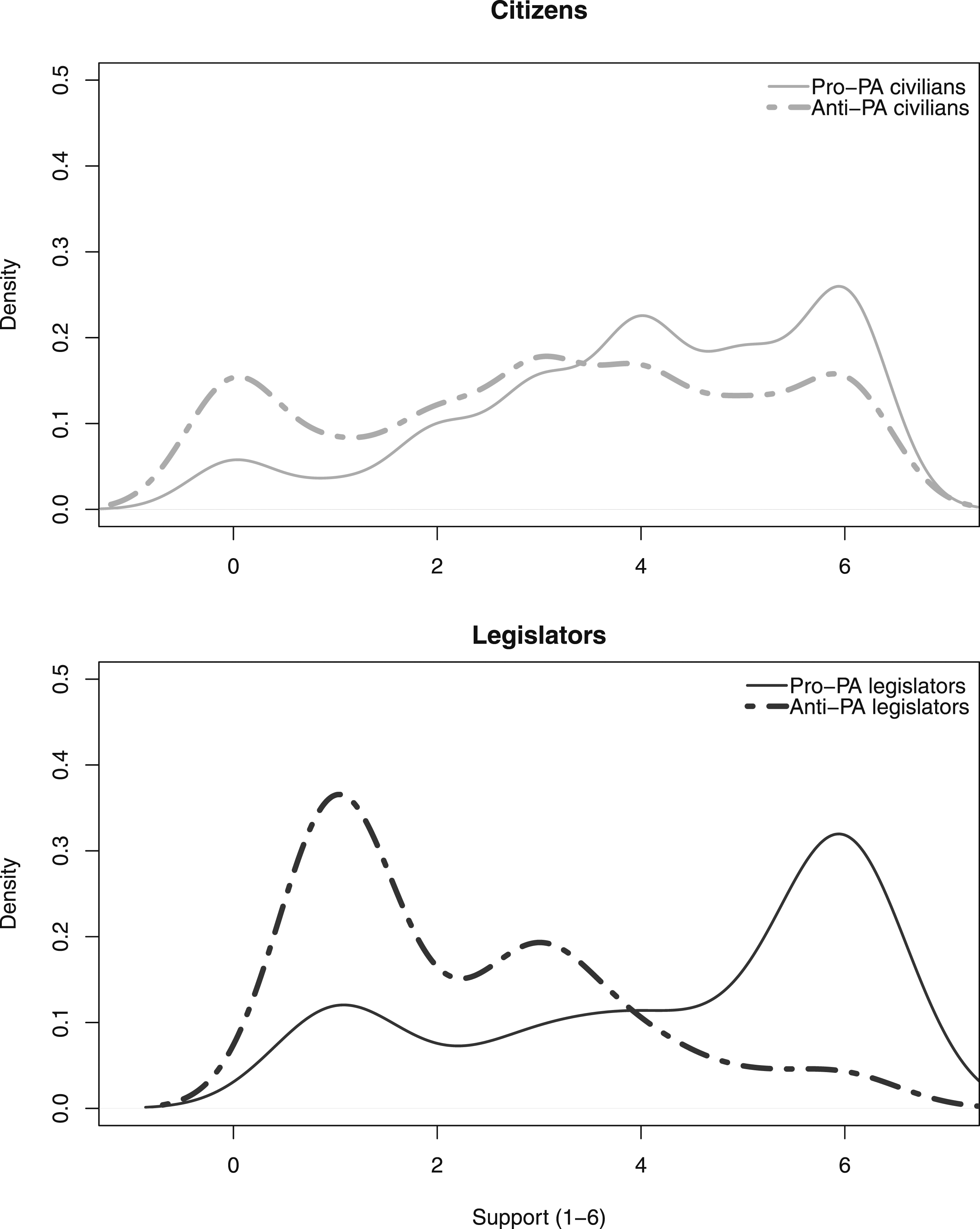
Theory and hypotheses
As described, when it comes to implementing peace agreements, it is often the case that its policy changes are set to be discussed and approved by the legislative branch, rendering Congress members key actors during this phase. Legislators in these common cases can determine the ultimate fate of the accord and the extent to which the final text is translated into tangible laws. Then, an essential question to answer is what types of considerations factor into the legislators’ decision to support a policy, and, specifically, whether citizen support shapes their decisions.
In this section, we start by hypothesizing about how certain variables can shape legislators’ priors about what they perceive to be the descriptive social norm 5 regarding citizen support for policies that emerge from a peace agreement but that have not yet been made law. We then hypothesize about how information about descriptive social norms shapes legislators’ support for the policies on which they are set to vote. We are particularly interested in legislators’ responses when encountering information about the preferences of two types of constituents: (i) average citizens and (ii) citizens residing in the areas of the country most affected by civil conflict and an absent state (who are the intended beneficiaries of these policies).
Elite attitudes and citizen representation
What role do citizen preferences play in shaping the attitudes and decisions of policy elites? More specifically, are legislators responsive to citizen preferences regarding policy emerging from provisions in peace agreements? To answer these questions, we draw on the literature on democratic accountability and partisan motivated reasoning, which we develop specifically as applied to post-conflict settings.
Underpinning the principles of representative democracies is the implied link between citizens and their representatives in deliberative bodies, such as Congress (Pitkin, 1967). One strand of research in this literature builds on the notion of dyadic representation and argues that citizen preferences should be reflected in the activity of representative bodies such as the legislative (Grant and Rudolph, 2004). Along this line, a group of scholars studying the U.S. has shown a strong relationship between constituents’ preferences and legislators, voting behavior (Ansolabehere et al., 2001; Stimson et al., 1995). This correspondence between the citizen attitudes and their representatives’ behavior is stronger when it comes to salient issues (Gilens, 2005). However, as another strand of research shows, citizen preferences are at times less well-represented. This includes when considering preferences of particular groups of citizens, such as those who are poor (Rosset, 2013; Lupu and Warner, 2021).
Beyond established democracies, however, there is less evidence of legislators, responsiveness to their citizens’ policy preferences. It is assumed that citizens in these contexts are less likely to constrain representatives. For instance, Latin American democracies were characterized as delegative (O’Donnell, 1994) because people elect legislators who then act with little regard toward their preferences (Stokes, 2001). However, within non-established democracies, levels of representation vary significantly across countries (Luna and Zechmeister, 2005; Joignant et al., 2016), and there is evidence that beyond the trajectory of a democracy there are certain contexts and issues that stimulate a weaker connection between public opinion and legislators’ preferences. That is the case of instances of political disruption or transition, and topics such as security, law and order, and civil liberties (Luna and Zechmeister, 2005; Lupu and Warner, 2017).
Peace agreements and post-conflict settings are somewhat unique scenarios in terms of the representation of public preferences, and additional factors work against creating a strong link between citizen preferences and legislators’ decisions. First, like in other instances of political transition or disruptions to the existing political status quo, politicians in post-conflict scenarios are likely to pay little attention to the public’s preferences as they may think citizens are ill-informed about a peace agreement, especially because these settlements are often complex, technical, and have numerous but often indirect policy implications. Citizens are consistently uninformed about aspects of these settlements; for instance, in a survey conducted by Observatorio de la Democracia, only 14.4% of citizens could correctly identify the cap on prison sentences for those judged on conflict-related crimes in a special court, despite this being a contentious issue subject to public debate.
Second, although peace is a salient and emotional issue in countries affected by civil war, once a settlement is signed, its specific policy provisions are likely to continue to generate strong debates among political elites but are far from being the main issues that concern most citizens (except perhaps ex-combatants and those otherwise most affected by conflict and therefore more benefited by the peace agreement). For instance, in ranking Colombia’s most important problems, citizens listed conflict/peace issues first in 2016, the year the agreement was signed, but, by 2018 and 2020, respectively, such issues dropped to third and fourth. 6 Once the peace agreement ceases to be a central topic of public debate, legislators may not pay attention to popular attitudes because they are confident citizens are not going to punish them electorally for their stances on an agreement as this is not a central concern for voters. In addition, some of these provisions deal with topics for which prior research indicates there is already a weak link between the public and legislators such as security, justice, or civil liberties (Luna and Zechmeister, 2005).
Third, in peace agreements, the presence of multiple elites and armed actors who must approve the settlement also leads to fewer acceptable deals, less stable political alliances, more acute information asymmetries, as well as other incentives to hold out or change terms with the hope of achieving a better deal (Cunningham, 2006, p. 875–876). In these contexts, elites are likely to take more polarized positions and push for change, jockeying among themselves, with less regard to how citizens may feel about the final settlement (especially given their lack of attention and knowledge as just described).
Fourth, even if legislators wanted to follow the public’s opinion on each and every one of the many provisions included in a peace agreement, the information about citizens’ attitudes on so many issues may not be available to them. The piece of information most commonly at hand to legislator is the opinion about the general agreement. For instance, if we assume that the Gallup Poll is the most accessible source of information politicians may use to follow public opinion, in the 2019 Colombia version of that survey there are no questions on support for the different components of the agreement. Most questions included in the 2019 Gallup Poll focused on the perceived effects of the agreement not on the actual agreement.
All these unique conditions of peace agreements make legislators more apt to lean into party platforms established in political echo chambers when forming their beliefs and taking their stance (Schirmer, 2019). For example, recent experiments in Colombia show that there is a common pattern of social isolation across different groups such as political elites, business leaders, intellectuals, journalists, and academics. The lack of social ties between elites and different groups, and especially across political camps, leads to less political debate, analysis, and reflection (Schirmer, 2019).
Given that similar contexts may also see a disconnect between citizens and their legislators, and, in particular, given the unique aspects of post-conflict settings, we argue that legislators’ (1) priors about citizen support for policies provisions related to the peace agreement, and (2) their support for those provisions should cleave along partisan divides rather than be directly driven by citizen preferences. The context in which elites form their attitudes about policies emerging from peace processes in post-conflict settings can impede a close linkage between citizens’ opinions on the agreement and those of their representatives, with the probable exception of those legislators representing conflict affected regions. In addition, biases in humans’ information processing can widen that disconnect. Not only might they lack the incentives to pay attention to citizens, but the process of motivated reasoning of partisan elites tends to be more oriented towards directional goals (i.e. reaching preferred conclusions), rather than accuracy goals (i.e. reaching correct conclusions), when forming their attitudes and making decisions (Taber and Lodge, 2006; Bolsen et al., 2014; Leeper and Slothuus, 2014). In other words, discussions mainly among co-partisans, underpinned by the lack of attention to citizens, make legislators more likely to process information in ways that provide evidence in line with their priors, rather than “to seek out and carefully consider relevant evidence so as to reach a correct or otherwise best conclusion” (Taber and Lodge, 2006, p. 756). Following this discussion, and building on recent experimental evidence (Baekgaard et al., 2019), even when provided with objective information, when it comes to the provisions included in peace agreements, legislators typically seek to corroborate their priors (i.e. with a directional goal). We therefore also argue that correcting legislators’ priors on citizen support for provisions included in peace accords is likely to yield little movements in their preferences.
Hypotheses in the Colombian case
Following the theory developed in the previous section, we now derive expectations in the Colombian case. First, we posit the following hypotheses about legislators’ priors and the variables that may affect their accuracy: • • •
Next, we focus on the extent to which information about citizens’ preferences shapes congressional members’ support for the policies. As described, we theorize that the propensity of policy elites to use the information about citizens’ preferences depends on their incentives to do so. We therefore posit the following hypotheses about which congressional members are likely to use data on support from the overall population, and on citizens living in conflict areas, when taking a position on the policy: • •
A note about the interpretation of belief updating
Our expectations about the effect of information rely on the extent to which legislators update their priors about citizens’ preferences regarding the special seats. Thus, we expect the direction of the effect of information to be conditional on the extent to which legislators in general are updating downwards (i.e. we are providing numbers that are smaller to their priors) or upwards (i.e. we provided a figure that is larger than their priors). Given the experimental design that we describe in the following sections, we take the information provided by the control group as an estimate of legislators’ priors, and then we estimate these expected relationships. 7
Research design
In this section, we describe the experiment that we designed to test the effect of providing information to legislators about citizens’ preferences regarding the creation of a special district that emerged as a central provision from the 2016 peace agreement.
Study universe: congressional members 2018–2022
The study examines the universe of congressional members elected in the most recent Colombian legislative elections on 11 March 2018. The enumerators for the survey ensured that the congressional members, not their aides, responded to the survey. 8 The relevant legislators serve from 20 July 2018 until 20 July 2022. Colombia’s Congress has two houses: the Lower House (Cámara de Representantes) and the Senate (Senado). The Lower House is composed by 166 legislators elected using a proportional representation (PR) system, where each of the country’s 32 departments and Bogotá (the capital) is an electoral district with a number of seats proportional to its population (161 representatives). In addition to these seats, two seats are reserved to Afro-Colombian communities, one for indigenous communities, one for Colombians who reside abroad. The Senate is composed by 108 senators: 100 are elected using a PR system in national district, and two seats are reserved for indigenous and Afro-Colombian groups. As a consequence of the peace agreement former FARC rebels were granted, for two legislative periods, 10 congressional seats, 5 in the House of Representatives and 5 in the Senate. Former rebels who are part of Congress have voice and vote. Finally, after a law passed in 2017, the presidential runner up and her running mate are granted a seat in the Senate and the Lower House, respectively. To date, 18 different parties have representation in Congress (see Table A1 in the Appendix). Table A2 in the Appendix provides the descriptive statistics of the legislators elected in March 2018 who answered the survey. 9
Survey
The survey of these congressional members was conducted by the Misión de Observación Electoral (MOE). MOE is a well-known NGO in Colombia that focuses on electoral observation. It ensures the safety and protection of the legislators surveyed, safeguarding their own confidentiality and personal data. Fieldwork took place between mid-October and early November in 2019. The survey lasted approximately 10–15 min, and it was conducted face-to-face, using paper-based questionnaires. All questions were asked in Spanish.
Like in any survey, there is the risk that respondents are not sincere about their true preferences. We believe social desirability was not a major concern because the topic of our survey is not a sensitive issue. First, politicians have been very vocal about their position with respect to this provision, making their position clear via public statements and roll call votes on the matter. If there were any social desirability, we believe it should go in the opposite direction from what we anticipate and find: i.e. perhaps, if legislators expect that citizens support the creation of the seats, then they should be more likely to support it. Second, results from priors and from the control group of our experiment indicate that legislators are very willing to show low support, and that they actually may underestimate (Aila?) support for this provision, so it is not clear whether saying they support the creation of the 16 seats is socially desired. Finally, the survey was confidential and MOE told legislators that their individual responses would not be made public. For these reasons, we asked directly about the policy rather than use indirect questions, so our survey captures legislators’ “declared preferences.”
Experimental questions
To answer our research question, we designed experimental questions for this legislator survey conducted by MOE. We asked about legislators’ attitudes on the creation of 16 special seats in the House of Representatives, reserved for the areas of the country that were most affected by civil conflict. As described above, this policy continued to be a subject of political debate in Colombia due to the lawsuits filed before the Constitutional Court and the Council of State by politicians belonging to the coalition that supported the peace agreement, so informing legislators about it is useful. Legislators were randomly assigned to three experimental conditions (i.e. questionnaires) as described below:
10
This “tell/ask” experimental design has been employed in previous work in political science, in the context of testing whether information can correct misperceptions (see, for instance, Ahler 2014, Gilens 2001, and Kuklinski & Quirk, 2000). To be clear, there is no deception, and all of the information comes from these public opinion surveys. After asking or telling congressional members about citizens’ preferences on this policy, as just described, we asked legislators how strongly they agree or disagree with the creation of the 16 special seats.
For the assignment, we conducted a blocked randomization to ensure balance on blocks created by combining the legislator’s party and the chamber to which he or she belongs (i.e. Senate or House of Representatives). 13 We block on party since legislators’ behavior is highly correlated with partisan behavior. 14
Operationalization
We describe how we operationalize legislators’ priors and the magnitude of their misperceptions; we then describe what heterogeneity we examine; and, finally, we describe our main outcome of interest in terms of legislators’ support for the 16 special seats.
Priors and misperceptions
First, we explore legislators’ priors and the magnitude of their misperceptions. Figure 2 illustrates how we conceptualize and operationalize both variables in the Colombian case.
15
First, we use the average percentages estimated by the legislators randomly assigned to the control group (i.e. the “ask” experimental condition) as an estimate of legislators’ priors about citizen support for the creation of the 16 special seats. Then, we leverage the estimates of the proportion of Colombians who support the creation of the 16 special seats from samples that are representative of the national level (which provides an estimator of support among the overall population) and of conflict-affected areas (which provides an estimator of support among citizens living in the territories that would benefit from this provision). Specifically, we compare the average percentages estimated by the legislators and the estimates of citizen support using the two survey samples as a measure of misperceptions. Distribution of perceptions of support for Special Seats from “Ask” condition, compared to information provided to “Tell Condition”. Note: In the figure, 
Heterogeneity
In order to test our hypotheses, we operationalize the following variables discussed in section 2 with other data: Electoral Incentives: This variable measures the extent to which the cluster of municipalities that would be able to select representatives for the special seats is a core constituency for the legislator. Drawing on past studies showing that members of congress concentrate their votes in certain regions, we compute a Partisan/ideological incentives: This variable measures parties’ support for the peace accord and its implementation during the Duque administration. We operationalize the legislator’s party/movement position with respect to the peace agreement using a measure that reflects the current Colombian political context after the 2018 elections. For instance, parties who were part of the Coalition of Government during the Santos’ administration, and thus supported the peace agreement, then took a different stance with respect to the peace agreement (e.g. some legislators from Cambio Radical, Partido Liberal, and Partido de la U). In addition, there was the enactment of the Opposition Statute, which provided guarantees for the opposition parties, forcing parties to declare their position with respect to the government: pro-government, opposition or independent. Considering the fact that Centro Democrático, President Duque’s official party, has a clear negative stance with respect to the peace agreement, we use this latter declaration as an operationalization of support for the peace agreement under the Duque administration.
This classification maps to support for the peace-agreement, until 2016, as follows: the current government coalition is composed of parties that led the “No” campaign, which we therefore label as the anti-peace agreement (anti-PA) coalition; 17 whereas the opposition coalition is composed of parties that undoubtedly supported the peace accord signed in 2016, which we, therefore, label as the pro-peace agreement (pro-PA) coalition; finally, while parties declared as independent supported the peace accord in 2016, the legislators elected in 2018 with these parties do not hold a clear pro-PA stance, and so we leave this category apart.
Outcome of interest: support for the creation of 16 special seats
We are interested in studying the effect of information on legislators’ views on the creation of the special seats. This variable is measured in the survey right after the treatment vignette, using the following question: Using the same scale from 1 to 6, where 1 represents ‘‘Strongly disagree’’ and 6 ‘‘Strongly agree,’‘ please tell me to what extent you agree to the creation of 16 special transitional circumscriptions of peace in the House of Representatives?
Analysis of the effect of information
To then test the extent to which the information provided about citizens’ preferences shapes legislators’ support for the policy, we compare the average support between groups. That is, we estimate difference in means across all three conditions using an OLS regression with heteroskedasticity-robust standard errors. Given our randomization protocol — i.e. equal probability of treatment assignment across all blocks — we estimate the following model:

where Y
ij
corresponds to the legislator’s declared support for the creation of the special seats; T
iColombia
and T
iConflict
Areas
are indicators for the Tell-Colombia and Tell-Conflict Areas treatment conditions; finally, I [J = j] corresponds to indicators for each one of our J blocks (fixed effects). The estimated quantities of interest are
Results
We begin by providing descriptive evidence on the correlates of legislators’ priors about citizens’ stances with respect to the policy under study, and then we explore the effects of the information experiment.
Misperceptions and priors
To assess the correlates of legislators’ priors about citizens’ stances with respect to the policy under study, we rely on the control group’s responses to the questions on legislators perception on popular support for the creation of the special seats and their own opinions about this provision of the peace agreement.
As described in section 2.2, we expect legislators to estimate greater support among potential beneficiaries of this policy than among the overall population. Figure 3 shows that, while this is the case, their estimates are still below the true averages — defined as those estimated in samples representative of each population. Moreover, the magnitude of these misperceptions lies outside both samples’ sampling error, estimated at 2.5% and 2% for LAPOP’s 2016 Colombia’s national sample and the Observatorio’s 2017 special sample, respectively.
18
Solid lines represent citizens’ support for the special seats, while dotted lines capture legislators’ perceptions about popular support for these seats. As expected, we see that the underestimation of legislators is larger for the general population (0.382 vs 0.542, gray lines) than for Colombians living in conflict-affected areas (0.60 vs 0.68, black lines). Specifically, while the distance between the true proportion of Colombians living in conflict-affected areas who support the proposal and the one estimated by legislators is 0.08 points, the distance with the proportion of all Colombians is 0.16 points. Distribution of priors (from control group). Note: Solid lines correspond to the percentage of support from the representative samples. Dashed lines correspond to legislators' estimated proportions. Legislators’ estimated proportion of Colombians who support the peace agreement is 0.38 and this figure for citizens living in conflict-affected areas is 0.6.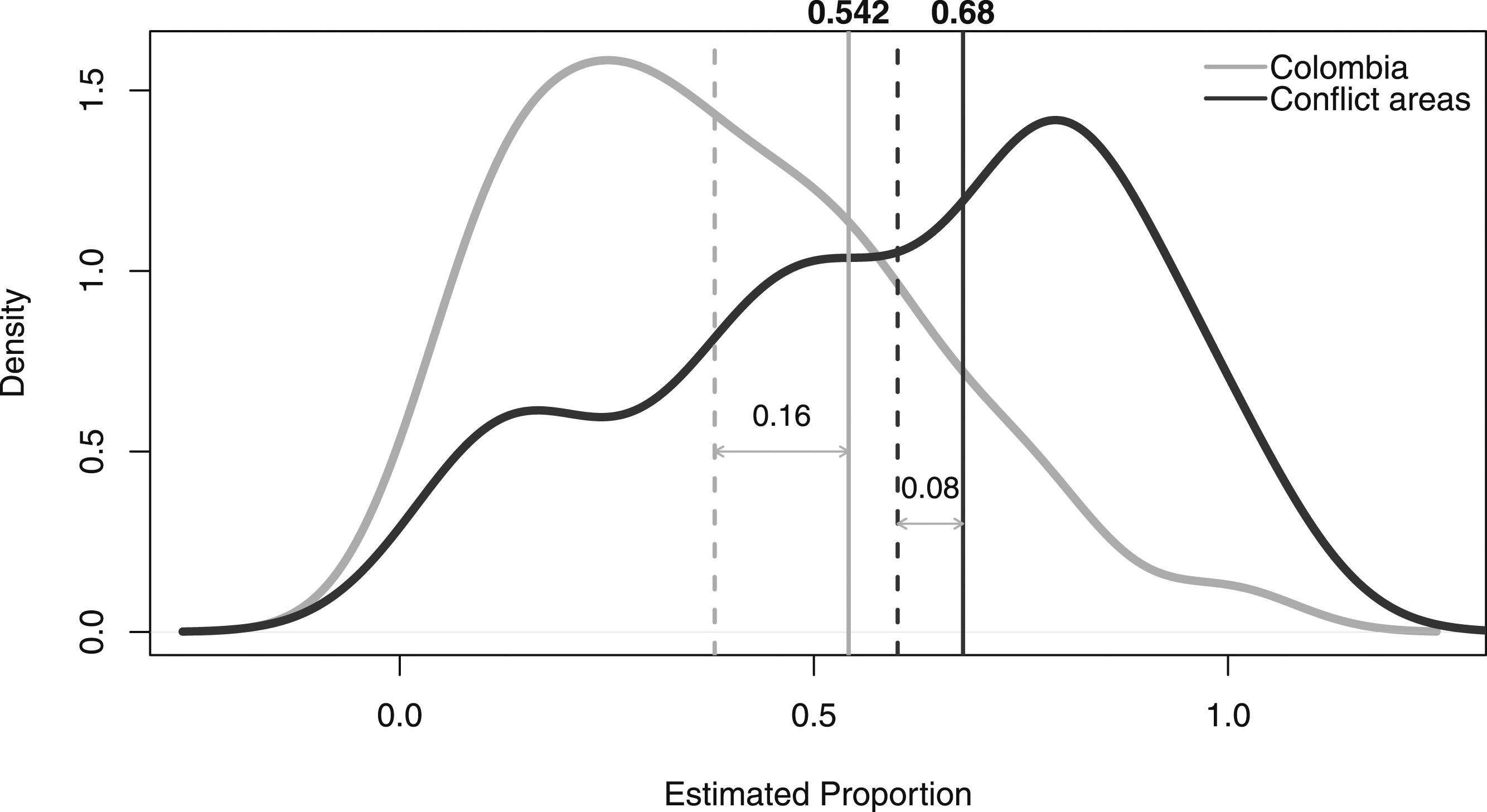
We now ask whether priors are correlated with legislators’ characteristics as described in the theory section. We start by examining if legislators’ priors are correlated with their stances on the peace agreement. Specifically, we test whether legislators who belong to parties that were in favor of the peace agreement are more likely to misrepresent citizens’ preferences as a way to further validate their stance on this issue. We code parties’ positions following the operationalization described in section 4, where a legislator can be part of either the opposition or government coalition in Congress, or be independent (meaning her party may adhere, in some issues to the government coalition, while in some others may join the opposition).
Figure 4 shows support by type of coalition. It indicates that legislators from the opposition coalition have systematically higher priors about citizen support than their peers from other coalitions. Moreover, they also have a more accurate representation of the actual support among both the general public and the residents of conflict-affected areas. In contrast, legislators from the government coalition tend to misrepresent citizen buy-in of this provision. In some cases, the differences in priors across these coalitions are systematic. When estimating support among Colombians here, we refer to the estimated proportion of citizens who support this provision using data from the national sample in general, the average prior from legislators belonging to the government coalition is statistically lower than the one from legislators classified as independent. When estimating support among citizens living in former conflict areas, members of Congress from the opposition coalition have a statistically significant higher prior than independent legislators. On average, then, pro-PA legislators’ priors about citizen support for the provision are higher and more accurate than those of anti-PA legislators. Average priors (from control group). Note: p-values correspond to t-tests. Dotted lines correspond to true proportions. 95% confidence intervals are also depicted.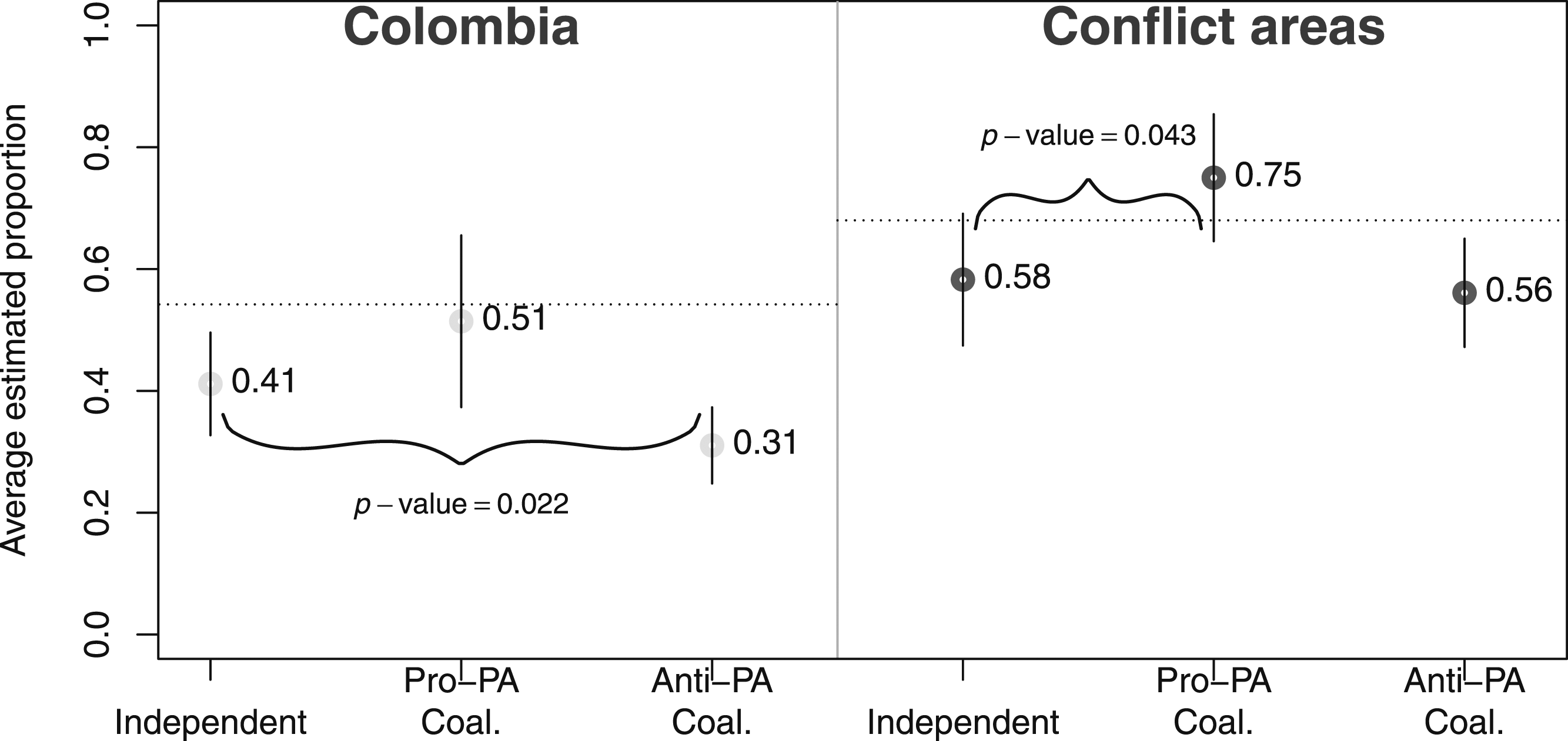
While the data from Figure 4 suggest that belonging to a party that supported the peace agreement — i.e. today part of the opposition coalition in Congress — is statistically correlated with both higher and more accurate priors about public support, we are careful in assigning any causal interpretation to this result as this association might be driven by other confounding variables. To rule out some evident suspects next we re-estimate this correlation accounting legislators’ socio-demographic characteristics (legislator’s house, sex and age).
The association between belonging to a pro-PA party and priors and misperceptions about citizen support for the creation of 16 special seats.
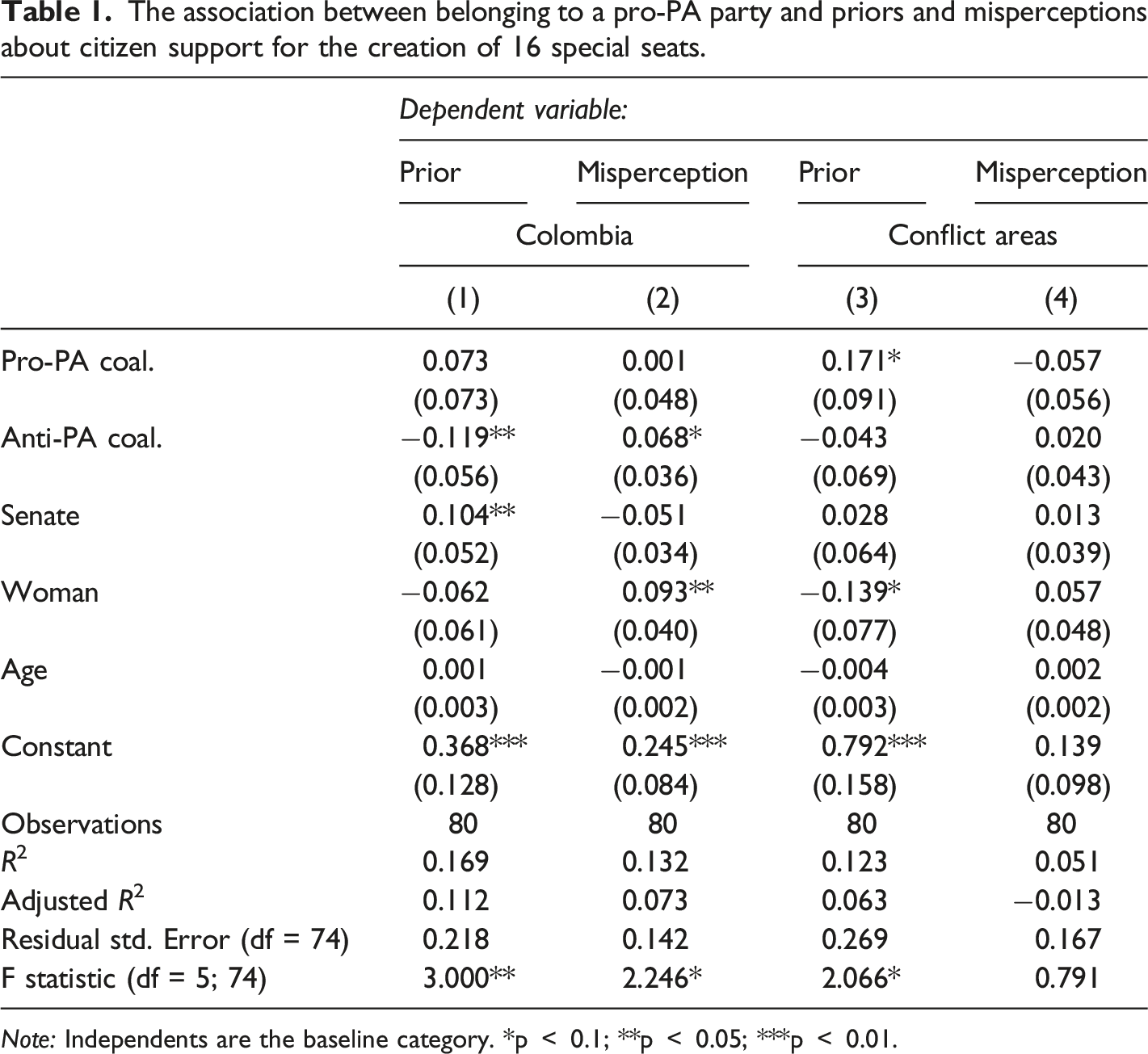
Note: Independents are the baseline category. *p
Following this discussion, next, we ask whether priors and misperceptions vary by the type of constituents that legislators represent. To do so, we regress both outcome variables on whether a legislator represents conflict areas, measured by the weight in votes those areas represented in their overall vote share. Given the nature of this variable, we separate the analysis by chamber of Congress, as senators are elected in a national district whereas representatives are so in departmental ones and thus the latter can only receive votes from municipalities that would obtain extra seats (henceforth "PDET" municipalities as these are called in Colombia) if the department they represent has at least one of such municipalities. As such, this outcome variable is missing for House Representatives who ran in circumscriptions with no PDET municipalities. As a final methodological note, in Colombia, lists can be open — in which case, voters can vote for a specific candidate in a list — or closed — in which case, voters can only vote for the party or movement’s list. In order to keep data comparable, we use the vote share obtained by the party instead of the candidate.
The effect of Senators representing conflict areas on priors and mispercpetions about citizen support for the creation of 16 special seats.
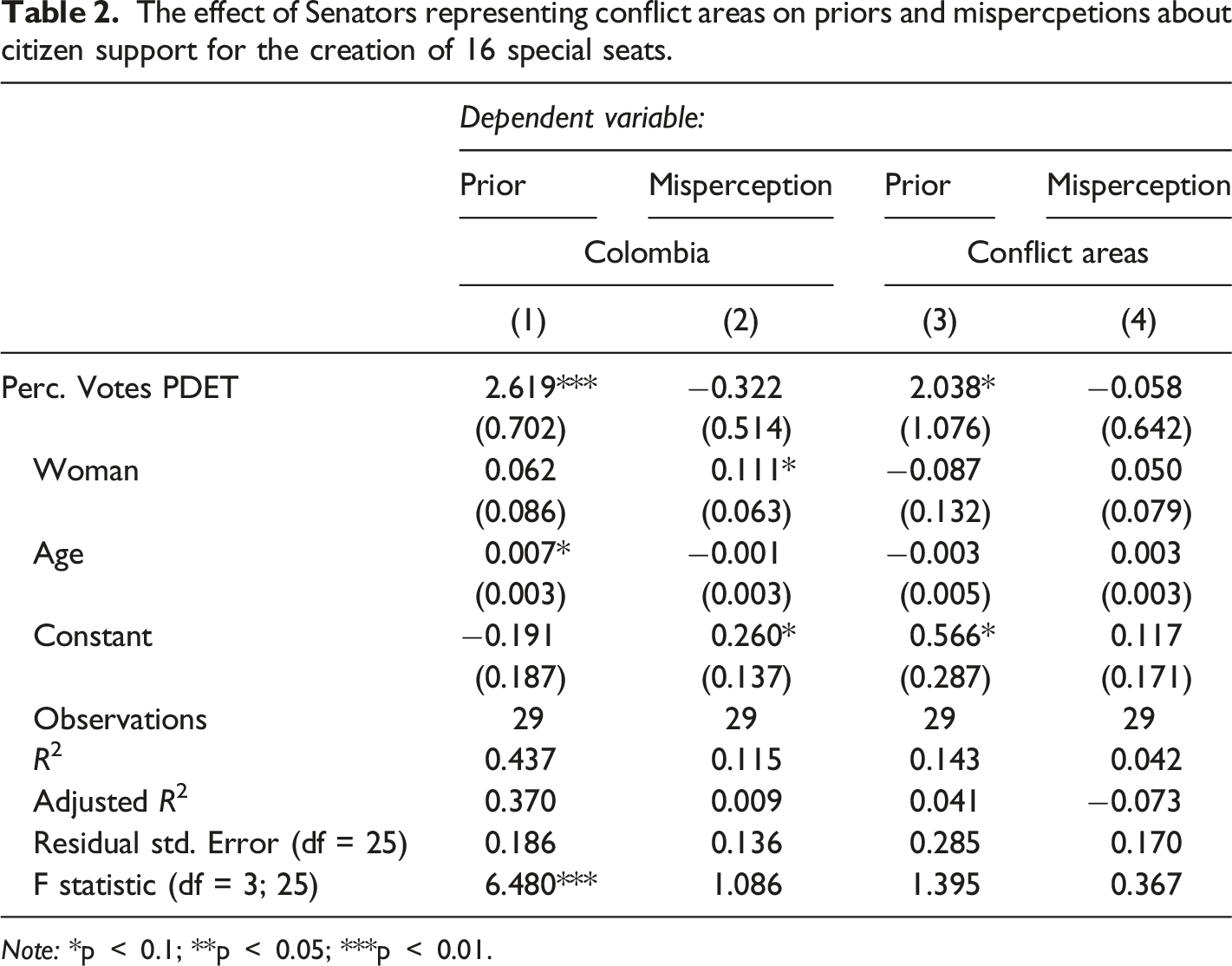
Note: *p
The effect of House Representatives representing conflict areas on priors and mispercpetions about citizen support for the creation of 16 special seats.
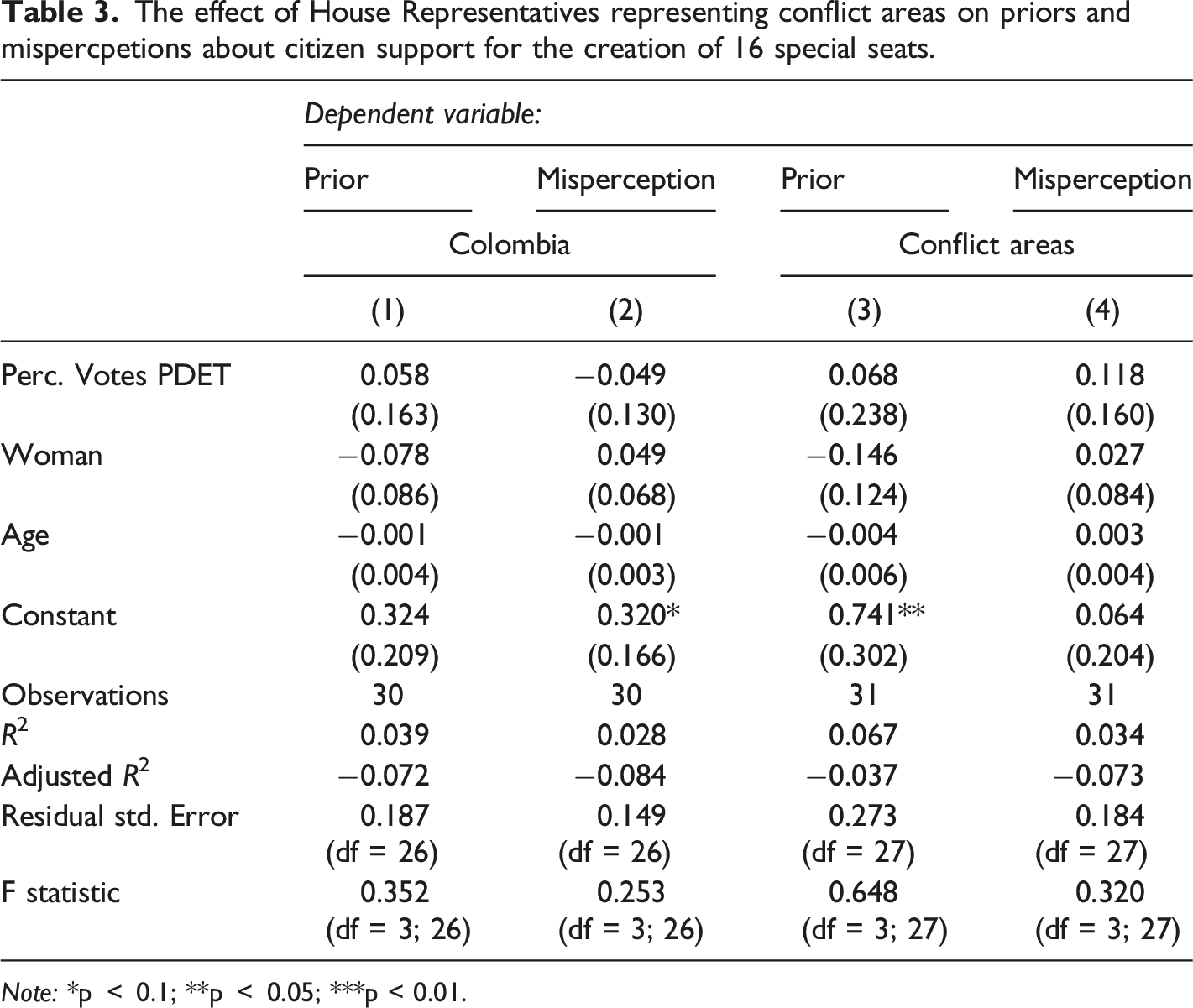
Note: *p
Finally, drawing on Baekgaard et al. (2019), who show that priors bias the way politicians interpret information, as discussed in the theory section, we present evidence on the correlation between congressional members’ priors about citizen support for the creation of the special seats and their support for this provision.
Figure 5 shows that priors are indeed correlated with legislators’ level of support for the provision under consideration, and this is true across types of parties. Legislators who reject the peace district (1, 2 and 3 on the support scale) estimate than less than 30% of Colombians approve such provision, whereas those supporting the special seats estimate popular support for this provision above 50%. Distribution of legislators’ priors and their support for the creation of a peace district (from the control group). Note: This figure plots average priors for each one of the six values allowed in the question that asked legislators about their level of support for the creation of the 16 special seats by party’s classification. The empty bars correspond to levels of support for which there are no data, i.e. no legislators from such party category reported that value.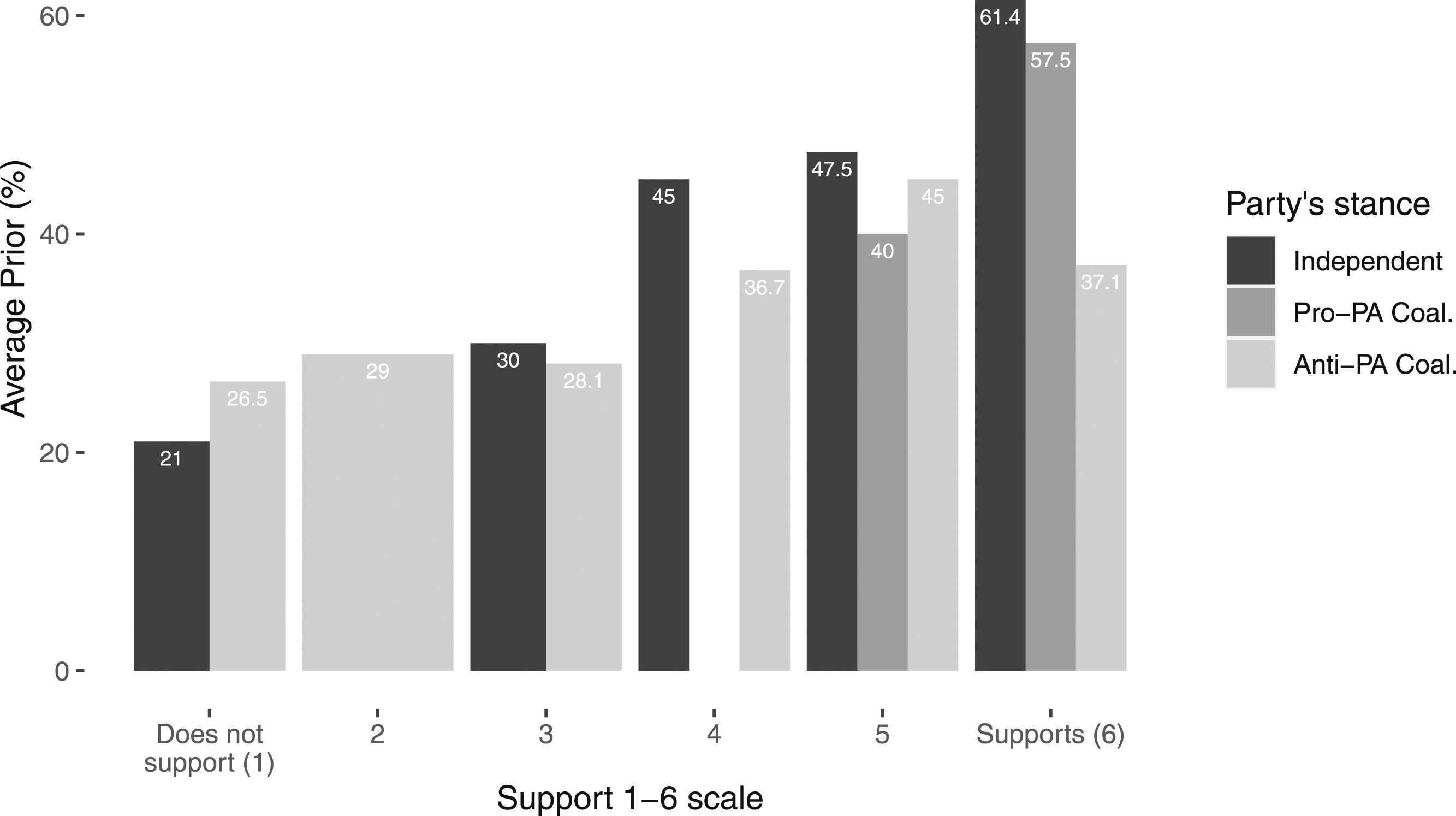
Information experiment
The findings presented in the last section provide suggestive evidence that elites’ beliefs about citizen preferences towards distinct dimensions of peace agreements are presumably shaped by the characteristics of the provision (e.g. the potential beneficiaries) as well as by their partisan preferences. In this section, we turn to the questions about whether, and, if so, how citizens’ preferences shape legislators’ attitudes towards provisions upon which they have a final saying. To do so, we rely on an original survey experiment where we exogenously informed a randomly selected sample of legislators about citizens’ preferences towards the creation of the special seats, as described above.
The effect of informing legislators about citizens’ preferences on their support for the creation of 16 special peace seats.
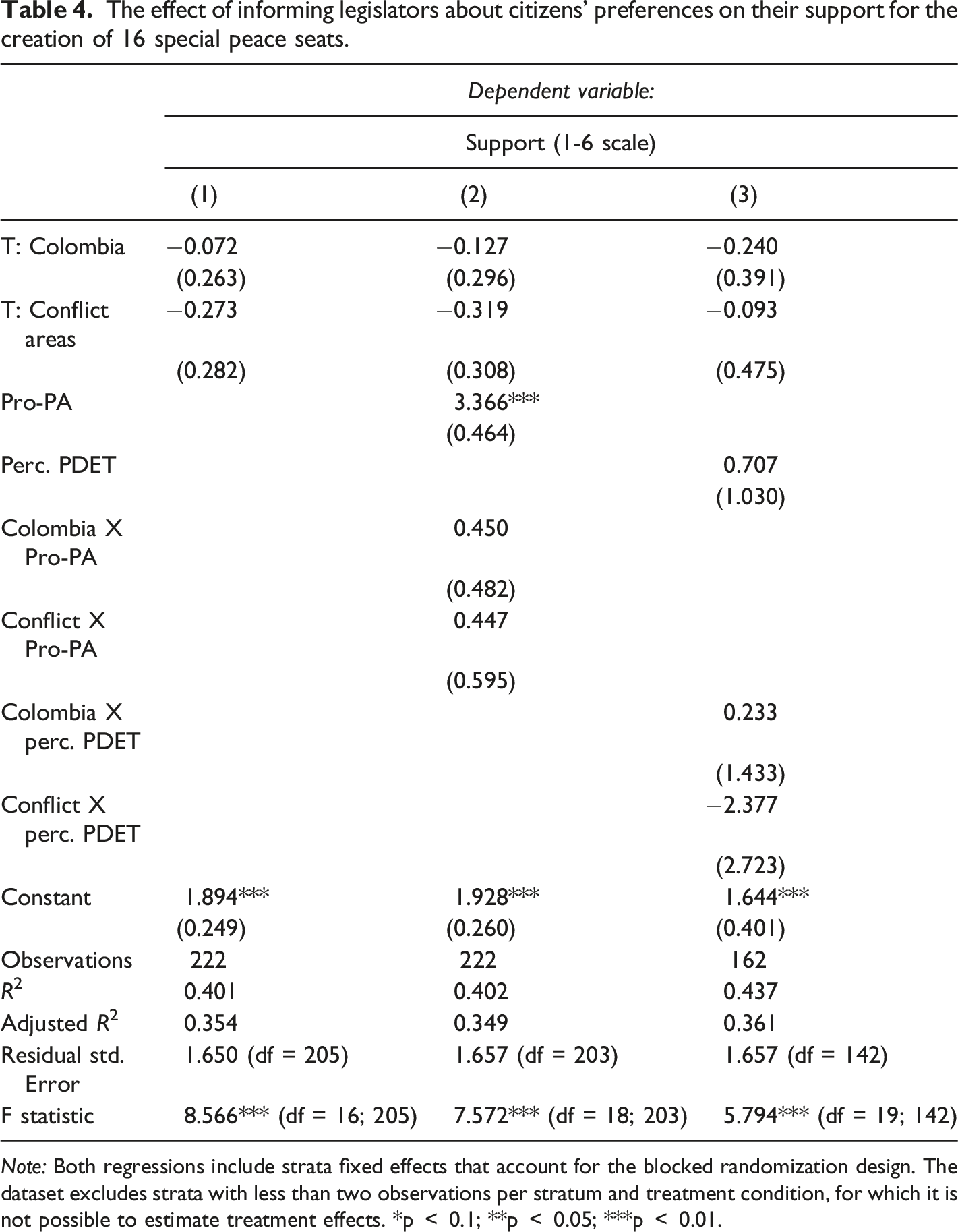
Note: Both regressions include strata fixed effects that account for the blocked randomization design. The dataset excludes strata with less than two observations per stratum and treatment condition, for which it is not possible to estimate treatment effects. *p
We also test whether the effect of our treatments is conditioned by the extent to which legislators represent constituents from conflict areas. Nevertheless, the results depicted in column 3 indicate that the effect of informing legislators about citizens’ preferences is not moderated by the weight PDET municipalities represent in the overall vote share obtained by legislators in the 2018 elections.
In general, we find that informing legislators about the preferences of either the average Colombian or the potential beneficiaries of the provision that creates 16 special seats does not shape their support for it. We posit that the null results among legislators from parties in favor of the peace agreement could be explained by the fact that average support for this provision among this group is already high (and less dispersed) and that they already have priors that are closer to the information provided in the vignettes, leaving less room for belief updating (see Table A4 in the Appendix).
While one concern could be the small size of our experiment, we have some reasons to believe the null findings are not driven by this. First, we conduct a non-parametric test, which does not rely on distributional assumptions, especially those that require large samples, and summarize its results in Table A5 in the Appendix. As shown, the randomization inference p-values indicate that with this test, the null results hold.
Second, although we cannot definitively prove that the null findings are not explained by lack of statistical power, we argue that the evidence indicates otherwise. First, the confidence intervals of our estimates are not particularly wide. Next, the MDE analyses indicate that our experiment was powered to detect policy-relevant effects that we believe our intervention was credibly able to achieve — especially, considering other interventions that use information treatments, which report similar effect sizes in a context and on issues very similar to ours (e.g. Matanock and García-Sánchez 2018). Furthermore, while we are underpowered to detect really small effect sizes, such as the ones we estimated, which range from 0.314 (our best-case scenario) to less than 0.1, those no longer represent substantively relevant magnitudes. 22 Finally, we took all the steps available at the design stage to increase the statistical power in our experiment, conditional on the constraints discussed above. Thus, together with the theoretical interpretations we offer above, we have reason to believe that our null findings point at an absent (or weak) effect of information about citizen attitudes towards settlement policies on policy elites’ stances.
Finally, we reestimate the variance of the difference in means following Aronow et al. (2014), whereby we calculate p-values using their suggested lower and upper bounds for the variance estimator in randomized experiments. We show the results in Table A6 in the Appendix. Even when we narrow down the variance estimator, we cannot reject the null of no treatment effects.
Conclusion
In this paper, we examine how policy elites form attitudes and take stances on polices that emerge from the central provisions of peace agreements. Specifically, we study legislators’ priors about citizen preferences toward such a policy that they are set to vote on — as well as the effect those preferences have on legislators’ positions on the same provision. We are particularly interested in two types of constituents: (i) Colombians, broadly speaking, and (ii) Colombians living in areas affected by the civil conflict and an absent state (which would benefit for the provision under consideration).
We designed an experiment on one of the policies emerging from the 2016 peace agreement in Colombia, which we embedded in a unique survey on the universe of legislators in the country. We randomly assigned legislators to three versions of the questionnaire. In the control group, which we called the “Ask” experimental condition, we asked congressional members to provide their priors about citizen support for the creation of 16 special seats to better represent conflict-affected areas with new political movements. We asked separately for Colombians in general and also for citizens living in conflict areas. For the second group, which we call the “Tell Colombia” condition, we provided them information about the actual share of Colombians. In the third group, which we call the “Tell conflict areas” condition, we also provided legislators with information about citizen support, but this time specifically Colombians living in the areas most affected by conflict in the country. Leveraging existing public opinion surveys that are representative of the two populations of interest — i.e. at the national level and of conflict areas — we were able to compute an estimate of citizen support for the creation of a special peace district in the Lower House, which aims to grant 16 areas of the country most affect by violence with more political representation in Congress. By comparing those estimates with those provided by legislators assigned to “Ask” condition (control group), we assessed the extent to which they misrepresent the actual priors among the general public.
Our results suggest legislators view citizen support through partisan lenses and do not significantly update when provided with information on citizens’ preferences. First, descriptively, we showed that legislators, on average, estimate that citizens living in the areas that would potentially benefit from the creation of a peace district in Congress are more supportive of this provision than Colombians in general. Yet, in both cases, they underestimate popular support for the special district, and their expectations are statistically correlated with the legislator’s party’s stance on the issue of peace, with those members belonging to parties that have opposed the accord being systematically more likely to underestimate citizen support and those in favor being more accurate. Second, we found that providing legislators with information about citizens’ support for the provision had null effects on their support.
These findings have both theoretical and policy implications for the stability and successful implementation of peace agreements. The evidence indicates that legislators’ priors about citizen support for these policies are shaped by partisan preferences but that citizen attitudes do not move their stance on those policies. Beyond post-conflict settings, this paper provides novel evidence in light with recent studies in the U.S. showing that politicians often times misrepresent constituency public opinion, hindering the principle behind dyadic representation (Broockman and Skovron, 2017). As such, this paper contributes to this literature by showing not only that those misperceptions are also present in other contexts, but, more importantly, that corrections to those underestimations may not influence support for policies that are widely supported by constituents. Returning to post-conflict settings, previous work in the literature has found that citizens play a key role in stabilizing peace accords and that they shape implementation (e.g. OHCHR 2009). From a policy perspective, therefore, this paper speaks to a limitation on citizens’ influence over the implementation process. Such limitation may transform into a poor implementation of some components of peace agreements, if the dominant legislative coalition decides to block them regardless of being strongly supported by the public. On the flip side, however, this limitation also means the implementation of unpopular but crucial provision of peace agreements, such as political integration and transitional justice, will not be blocked by popular pressure, as long as there is a majoritarian pro-agreement coalition in Congress. One aspect that we leave for future work is the type of provision. The provision that we study happens to be a threat to elites but popular among citizens. Other provisions that do not similarly threaten elites could be assessed differently, including by taking more into account citizen preferences, should they hold strong preferences.
The Colombian peace agreement that we study, signed between the government and the FARC, illustrates a broader set of peace agreements in which many of its components need to be passed piecemeal into law (e.g. peace accords in Chad, India, and the United Kingdom). The evidence presented in this paper sheds light on the role citizens play in shaping legislators’ attitudes, when the latter are key stakeholders for the ultimate translation of the provisions included in peace accords into law. Thus, the findings of this paper speak to the question of the feasibility and stability of a larger category of peace agreements during the implementation phase.
Supplemental Material
sj-pdf-1-jcr-10.1177_00220027221099245 – Supplemental Material - Do Citizens’ Preferences Matter? Shaping Legislator Attitudes Towards Peace Agreements
Supplemental Material, sj-pdf-1-jcr-10.1177_00220027221099245 for Do Citizens’ Preferences Matter? Shaping Legislator Attitudes Towards Peace Agreements by Miguel García-Sánchez, Aila M. Matanock and Natalia Garbiras-Díaz in Journal of Conflict Resolution.
Footnotes
Acknowledgements
This paper has benefited greatly from feedback from the editors of this special issue and those involved in the review process at the journal as well as from comments received at the 2021 Latin America Peace Science Society meeting, a Evidence in Governance and Politics (EGAP) Feedback Session, and the Speaker Series from the Department of Political Science at the University of Mississippi. We are also deeply appreciative that the Misión de Observación Electoral (MOE) allowed us to add our instrument to their survey of Colombian legislators.
Declaration of Conflicting Interests
The author(s) declared no potential conflicts of interest with respect to the research, authorship, and/or publication of this article.
Funding
The author(s) disclosed receipt of the following financial support for the research, authorship, and/or publication of this article: The experiment was pre-registered in EGAP's registry (#20190116AB) and was approved by UC Berkeley's Institutional Review Board protocol (#2018-10-11526). All authors contributed equally to the paper and the author order has been randomly defined.

Supplemental Material
Supplemental material for this article is available online.
Notes
References
Supplementary Material
Please find the following supplemental material available below.
For Open Access articles published under a Creative Commons License, all supplemental material carries the same license as the article it is associated with.
For non-Open Access articles published, all supplemental material carries a non-exclusive license, and permission requests for re-use of supplemental material or any part of supplemental material shall be sent directly to the copyright owner as specified in the copyright notice associated with the article.
