




Abstract
Communal violence is a major source of insecurity within and across borders, sparking significant displacement flows and disturbing livelihoods. While conflict literature has shed light onto its causes, the existing research has paid little systematic attention to the spatial dynamics of communal violence. We distinguish between spillover of violence and spillover of predictors. Spillover of violence is defined as conflict incidences occurring as a direct response to communal violence in a nearby location. Spillover of predictors describes instances of communal violence that occur due to nearby conflict-inducing factors. We clarify theoretical pathways for both spillover processes, focusing on drought exposure affecting not locally but in nearby areas. Applying spatial models, we test the expectations regarding nearby violence breeding violence and nearby drought increasing violence with data on incidences of communal violence for sub-Saharan Africa (1990–2014). Our results demonstrate that communal violence explains nearby communal violence through different spillover processes. We also find evidence for an increase in violence due to exposure from neighborhood droughts as well as other conflict-inducing factors.
Introduction
In sub-Saharan Africa and other regions, communal violence undermines livelihoods and can cause heavy death tolls. Previous research on armed conflict shows the causes of disputes are not always found at locations where violence ensues. To understand drivers of conflict, we ought to look beyond where we observe violent disputes (e.g. Bara, 2017; Forsberg, 2014; Gleditsch & Salehyan, 2011). Yet, existing conflict-spillover research almost exclusively examined state-based disputes and we know relatively little about spatial dynamics of communal violence. 1
Communal conflict is conceptually and empirically different from state-based violence, and thus it ‘makes theoretical and analytical sense to study communal conflicts separately’ (Brosché & Elfversson, 2012: 36). In comparison to state-based conflicts and other forms of non-state violence, fighting between communal groups is more confined in space and time. Communal violence erupts between mostly localized actors over intergroup incompatibilities and varies in casualty numbers. This distinction is also visible in a rich literature focusing on communal disputes (Benjaminsen & Ba, 2009; Boone, 2014; Detges, 2017; Krause, 2018). Yet, little explicit theoretical attention has been given to spatial processes of communal violence and only few studies empirically test spillover processes.
The article presents (to the best of the authors’ knowledge) the first study giving explicit theoretical attention to the spatial dynamics of communal violence while also testing these theories empirically. We distinguish between spillover of violence and spillover of predictors. Spillover of violence is defined as violence occurring as a direct response to violence in a nearby location (or spatial unit). This refers to instances where violence breeds violence in other locations. For instance, several recent intercommunal clashes in Nigeria originate from very localized disputes before catalyzing violence nearby – at times causing higher total fatalities than the Boko Haram insurgency (e.g. AFP, 2019; Reuters, 2018b). This is different from spillover of predictors which describes violence occurring due to nearby conflict-inducing factors. Anecdotal evidence suggests that resource competition occurs in areas outside prevalent resource shortages, thus not necessarily where scarcities are observed. For example in Kenya, droughts lead pastoralists to move their cattle into other areas, at times resulting in violent disputes with local groups (AP, 2017; Gettleman, 2017). In such cases, conflicts occur not where droughts directly affected herders, but in a nearby area. The objectives of this study are twofold. First, we explore whether incidences of communal violence occur through spatial spillover processes. Second, we scrutinize whether spillover is explained through spillover of violence and/or through spillover of predictors with special attention given to drought exposure.
Using grid cells for sub-Saharan Africa, we show that communal violence increases the probability of communal violence in nearby areas. We find incidences of communal violence to be explained both by spillover of nearby communal violence as well as spillover of predictors. Specifically, we find evidence for an increase in violence due to the effects of neighborhood droughts. We also find civil war fighting to affect communal conflict locally rather than through spillover. These findings bear concrete implications for policy makers and practitioners tasked with identifying priority risk areas and preventing the escalation of communal violence.
We proceed by briefly reviewing existing research and then introducing theoretic pathways for different spillover processes relevant to communal violence. We test our arguments using spatial models to distinguish the spillover of violence itself and the spillover effects of violence-inducing predictors. The article concludes with a summary of the findings and comments on policy implications.
Previous literature
Recent years saw a growing research interest on communal conflict. Such violence often relates to competition over land or natural resources, livelihoods and cultural habits, and local authority and political power (Boone, 2014; Brottem, 2020; Turner et al., 2012; von Uexkull & Pettersson, 2018). Communal violence differs from other forms of non-state violence in that fighting takes place between informally organized groups that are mobilized along collective identity lines. This is different from more formally organized rebel-to-rebel fighting as well as violence between affiliates of political candidates, organized crimes or supporters of football clubs, among others. We categorize existing research on communal violence along three areas.
First, considerable attention has been given to exogenous shocks such as water scarcity. This research builds on arguments over disputes between communal groups concerning access to renewable resources and subsequent violence resulting from intergroup competition (Balestri & Maggioni, 2017; Benjaminsen et al., 2012; Detges, 2014; Fjelde & von Uexkull, 2012; Nordkvelle et al., 2017; van Weezel, 2017; Vestby, 2019). Scholars expect degradation of environmental conditions to worsen intergroup relations at the local level as access to land and water resources is often conditional on rural power relations rather than the government. Rather than direct effects, climate-conflict links seem conditional on socio-economic factors.
Second, communal violence affects marginalized subnational groups. Socio-economic exclusion makes groups more vulnerable to shocks like drought (Detges, 2017; Döring, 2020; Fjelde & Østby, 2014; Hillesund, 2019). This also includes people negatively affected by legal reforms that challenge traditional land ownership and property rights (Benjaminsen & Ba, 2009; Turner & Moumouni, 2018). Political exclusion furthermore affects conflict dynamics, i.e. government biases condition interventions (Elfversson, 2015) or further amplify incompatibilities (Brosché, 2014; Krause, 2018).
Third, local-level institutions shape the underlying factors that give rise to disputes and alter conflict dynamics. Strong local governance has been found to decrease conflict risk (Wig & Tollefsen, 2016). On the other hand, intermediate levels of state capacity correlate with higher rates of violence (De Juan & Pierskalla, 2015). Eck (2014) argues that the presence of parallel judicial institutions induces violent escalation of communal conflicts due to unclear resolution systems. The role of customary governance and resolution instruments is key when mitigating conflict escalation (Brosché & Elfversson, 2012; Greiner, 2016; Higazi, 2016; Mohamed, 2002; Wig & Kromrey, 2018). Beyond traditional institutions, community leaders and religious institutions can shape local capacities to resolve communal conflicts nonviolently (De Juan et al., 2015; Krause, 2018; Mustasilta, 2019, 2021; Petrova, 2022).
Overall, research has contributed to a growing understanding of political, environmental and institutional features of communal disputes. Yet, researchers have paid less attention to wider spatial dynamics. There is little theoretical discussion on why communal disputes would cluster and there are very few explicit empirical analyses of conflict spillover (notably Cappelli et al., 2020; Harari & Ferrara, 2018; van Weezel, 2017). Studying spatial dynamics of communal violence requires a theoretical and analytical approach specific to the type of conflict. Here we contribute to the literature by providing theoretical pathways on spatial dynamics of communal violence.
Theory
‘The violent conflict in December 1986 was started by a quarrel related to “crop damage” between a young Karaboro farmer (the son of a field-owner) and a young Fulbe herder in a small village outside Sidéradougou. The argument between the two men concerned whether the cattle had caused the damage or not. In the heat of the discussion the Fulbe Herder was shot dead by the Karaboro farmer. […] [T]he field-owner was soon caught and killed by the Fulbe crowd. These and subsequent events led to outbreaks of violence in the entire area. Karaboro rebels went out and killed any Fulbe encountered.’ (Hagberg, 2004: 52).
Case evidence as above exemplifies how communal violence spreads across several villages following (apparent) spatial processes. Insights from state-based conflict studies provide clues on mechanisms in spatial interdependence of political violence more generally, but communal fighting follows several dynamics that distinguish such fighting from other forms of conflict. Unlike civil war and interstate conflicts, communal fighting does not involve troop movement through or beyond entire countries, or through non-cohesive geographic areas. This is also due to stark differences in use of military technology. Communal violence more often occurs in a confined area that can be defined within a Euclidean space. While administrative borders are crucial to most state-based conflicts, such boundaries can be misleading analytical units for disputes between informally organized groups. Furthermore, communal violence may involve (initially) relatively small groups of violent actors motivated by localized incompatibilities. Communal violence thus might occur in different locations as distinct incidences, even if fighting befalls the same ethnic groups. For instance, communal clashes over access to natural resources between Turkana and Pokot groups in one location in northwest Kenya do not necessarily lead to violent confrontations between communities adhering to these two groups elsewhere. How incidences of communal violence in one geographical area systematically increase the prospects of nearby communal violence needs theorizing and adequate spatial modeling. We clarify two key spatial processes in the following.
Spillover of violence
Spillover of violence is defined as violence occurring as a direct response to nearby violence. Here incidences of communal violence in location i between groups a and b increase the probability of communal violence in a neighboring location j. The resulted violence can take place between new actors (c and d), between a group affiliated with the original clashes and a new actor (a and c), or between representatives of the same groups (a and b). We argue that there are three interrelated mechanisms for such spillover. Violence can diffuse through a tangible mechanism involving displaced persons. Communal violence can also spread through more intangible mechanisms, i.e. groups in neighboring areas learning from or emulating tactics. Finally, communal fighting can spill over via escalation through affiliated groups adopting violent means to support their allies or preempt an attack against themselves. Several of these spillover mechanisms can occur simultaneously.
The nature of communal violence means that merely belonging to a community can make individuals fear victimization by violence related to communal tensions. Even relatively low levels of violence can drive families to leave their homes and seek shelter in nearby areas, as demonstrated by communal violence in Kenya (Elfversson, 2019). In fact, communal fighting can lead to the displacement of a significant number of people within or across borders (Duncan, 2005; Krause, 2018). Likewise, conflict management efforts of communal violence themselves may stipulate the relocation of conflict actors (Mwamfupe, 2015).
Temporary or long-term migration can increase the risk of communal violence in the host area. Displacement may influence host location intergroup dynamics and increase uncertainty over resource distributions. State-based conflict literature suggests changing ethnic power relations in the host area may induce violence diffusion (Fisk, 2014; Salehyan & Gleditsch, 2006). Yet, rather than directing violence primarily at the state, communal power changes and increased resource competition more likely explain escalating intergroup relations (Duncan, 2005; Fjelde & von Uexkull, 2012). These dynamics compound as communal conflicts often take place in peripheral and marginalized areas with weak state embeddedness. For example, violent disputes between Uduk refugees and the Maban communities (South Sudan) repeatedly occurred, with observers claiming conflicts to stem from questions over altered resource allocation (UNEP, 2018). More generally, host communities may perceive newcomers as threats to their own resource access. This is important for communities with similar livelihoods or natural resource dependencies.
Migration also relates to cross-border gun trade, which has become widespread between pastoralist groups across the Sahel region (Mkutu, 2008; UNECA, 2017). Increased use of firearms creates additional fear among host communities towards the displaced communities and serves as justification to organize attacks on local rivals. For instance in the border region of Uganda and Kenya, Pokot groups escape disarmament policies by crossing borders (with their arms), subsequently increasing tensions with other ethnic groups (Mkutu, 2016).
Communal violence can also spread through learning and emulation by other groups. Although communal conflicts are mostly localized, they do not occur in isolation. Other groups likely observe regional events, even if such interventions are outside their immediate context. Thus, groups update their perceptions on the efficacy and acceptance of specific strategies based on other groups’ experiences (Gilardi, 2013). Learning occurs when a nearby group actively observes and endorses strategies used by others on the basis of perceiving these strategies as efficient. For example, marginalized groups might become more inclined to violent tactics if this has been successful for others in a similar situation. Pastoralist groups are well informed about political developments, using cellular phones to access information and to communicate with relatives or other groups (AU, 2010). Moreover, communal violence may serve as a strategy to seek government attention and intervention in local affairs. Elfversson (2015) finds that nearly 60% of communal conflicts in sub-Saharan Africa see some type of intervention by the government. Groups observing other actors receiving resources can thus become more inclined towards also adopting violent strategies.
What is more, communities can emulate each other. Rather than adopting violence through perceived effectiveness, emulation refers to imitating behavior rendered acceptable by others. Hence, even if violence might appear ineffective in the short term, a group could resort to fighting because nearby groups have taken up arms to resolve disputes. Violence can become more generally accepted among groups within a certain region, as indicated for instance by van Weezel (2017) in the case of Nigeria. While both learning and emulation can occur between groups who are geographically distant, it is more likely that communities learn from examples closer to them. Geographical proximity facilitates concrete interaction, information flow and spreading fears and rumors, thus making groups more exposed to near examples rather than more distant ones.
In addition to tangible and intangible mechanisms, communal violence can spill over by escalation. This may include an enlargement of the fighting area or drawing in additional actors. Escalation often involves retaliatory attacks, including attacking members of a rival’s network. Here, existing alliances and ties, particularly ethnic or tribal, can facilitate the escalation of originally localized communal violence (Krause, 2018). Rumors and anger among broader collective identity groups play a salient role in this mechanisms, potentially leading to spillover through creating salient communal identities in an enlarged area.
Lastly, identifying with conflict actors can make nearby communities join fighting by supplying resources. This still assumes communal violence primarily between two groups identifying themselves along ethnic, tribal or religious lines, even when disputes originally dealt with explicitly local issues such as land access. Again, this may involve escalation with increasing numbers of villages and subgroups, resulting in an expanded fighting area among affected groups. During 2013, for instance, fighting over cattle between Berom and Fulani groups led to clashes between originally uninvolved Fulani pastoralists and Ron-Kulere people in neighboring Bokkos (Plateau state, Nigeria) (Higazi, 2016). In such cases, original disputes trigger involvement of other groups and ensuing spillover of violence to other locations.
These spillover mechanisms refer to analytically separable processes observable at the micro-level. Empirically distinguishing these mechanisms is, however, more challenging for approaches covering larger geographic areas. As we are interested in more general inferences, we hypothesize spatial interdependence of communal violence more broadly:
H
1: The probability of communal violence increases through nearby communal fighting.
Spillover of drought
In this section we describe predictor-spillover as a second key spillover process. We define predictor-spillover as violence occurring due to conflict-inducing neighborhood factors. Analytically distinguishing spillover of violence and predictor-spillover is not trivial; moreover, the differentiation should not only relate to methodological choices. Rather, the underlying logic of this distinction is rooted in theoretical arguments. We focus on drought as a key example of predictor-spillover for communal violence, whilst recognizing the potential of other conflict-inducing factors’ spillover effects. The prevailing theories on drought and conflict already, at least implicitly, include predictor-spillover mechanisms, and thus it is crucial to test these empirically. In brief, we expect drought in area i to increase the risk of communal violence in a neighboring area j because of (a) food insecurity and supply chain disruptions and (b) local migration patterns.
Drought has long been argued to be a key driver for violence, with migration often referred to as part of the story. Fluctuations in weather can affect food production as severe water scarcity explains crop failure, decline in livestock and generally worsened living conditions. This is true for different types of farming and subsistence, and especially for communities living in remote areas (Schmidhuber & Tubiello, 2007). Pastoralist income from livestock is inversely related to earnings from crops because livestock is sold mainly during times of crop failure (Speranza, 2010). Intensified resource competition can lead to disputes among pastoralist or other communities relying on grazing and farming. This is true for subsistence environments and generally in areas with existing cleavages (Fjelde & Østby, 2014; UNECA, 2017; von Uexkull & Pettersson, 2018). The impact of drought should reach markets even outside pastoralist-farmer frameworks since scarcity more generally affects communities relying on selling goods to markets. This also relates to temporary resettlement as a coping strategy for drought-affected communities (Pas, 2018). Many arguments linking environmental scarcity and conflict explicitly involve relocation. This means drought should not predict violence necessarily where it occurs, but rather in the surrounding area.
Examples for predictor-spillover can be found across sub-Saharan Africa. Many Sahel pastoralists move livestock far away from home regions depending on seasonal changes. Yet this ecology has become increasingly vulnerable due to combinations of recurring droughts, changing rainfall patterns, population pressures and land use changes. The shrinking space for pastoral land pushes livestock herders to protected areas and farmland, which provokes intergroup tensions (Brottem, 2020; UNECA, 2017). Recent land invasions in Kenya’s Baringo, Samburu and Isiolo continue patterns from previous years. More recently, heavily armed herders moved their livestock to temporary resettle in search of pasture and water (Matara & Njuguna, 2021; Reuters, 2018a). The ensuing conflicts therefore do not take place in the most scarce areas, but where nearby land is less affected by drought. Similar reports on pastures or well sites are also well described in Chad, Central African Republic or DRC, among others (Crisis Group, 2014).
We argue for two main pathways of violence-inducing spillover effects via droughts. First, the socio-economic effects of drought are not necessarily confined to the same areas where weather extremes occur. For instance, lower agricultural output affects local markets, but also markets nearby (which in turn feeds back to local markets). One prevailing theory around climate-driven violence considers hardship mechanisms through lower agricultural production (Seter, 2016). This supposes losses of income from farming or herding to alter existing cost-benefit considerations about the use of violence. Acknowledging how markets are linked through regional trade (UNECA, 2017), drought-induced hardship could spill over across space. This propagates local drought exposure onto neighboring areas.
Second, spillover of drought functions through local migratory patterns. A particular case for such a spillover involves clashes between herder communities, or between farmers and herders, which form a major share of communal violence incidences in sub-Saharan Africa (von Uexkull & Pettersson, 2018). Although almost all agro-pastoralists are mobile to some extent, high water shortages result in different migration patterns. For herders in West or East Africa, this can include dividing herds into sedentary and nomadic groups (Pas, 2018; Speranza, 2010) or to move beyond known grazing land (Bassett & Turner, 2006; Berhe et al., 2017). Some dairy cattle might stay within reach of a community along with other weaker animals while more mobile livestock is moved to better pasture or water points (Pas, 2018). The geographic range of such actions depends on seasonal rains, which means long-distance herding can last weeks or even several months. In times of sustained drought herders do not return to their home areas for extended periods.
The effect of drought is amplified by soil degradation, desertification or aquifer salination. Such development necessitates finding alternative routes. Yet, livestock herders almost never utilize areas not in use by others and they thus often compete with other pastoralists (and/or farmers). Such competition can lead to disputes through increased cattle theft or illegitimate use of land. Informal and formal institutions often peacefully settle disputes or regulate the use of land (Boone, 2014; Turner et al., 2012), but it is also not uncommon for actors to resort to violence. The resulting communal violence is then visible at a location away from the area influenced by drought.
Cattle raiding or illegitimately using water points not only happens in places occupied by herders, but also in other (privately or communally held) areas with better water conservation schemes. Indeed, safeguarding access to land or livestock with weapons has become more widespread among farmer and herder communities throughout Africa (UNECA, 2017). Using arms is more than theft prevention, as organized cattle herders may use firearms to appropriate natural resources by violent means. As a consequence, violent disputes should arise not only – or not even necessarily – where droughts occur, but more naturally in neighboring areas which might have not been affected by drought as severely as the surrounding locations.
While forms of temporal migration are an integral part of our proposed drought mechanism, we acknowledge that systematic disaggregated observations of such movements are difficult to obtain, especially for a large area. It seems therefore more appropriate to think of drivers for migration as key observable variables. Thus, we hypothesize:
H
2: The probability of communal violence increases through spillover from neighborhood drought.
Research design
This study analyzes spatial interdependence of communal violence by examining spillover through spread of violence (
Our choice for the unit of analysis builds on our theoretical arguments, but also by the availability of data, i.e. some covariates are only available on a yearly basis. We consider how the data-generating process reflects the empirical and theoretical nature of violence. When modeling spillover mechanisms, we make assumptions about both time and space. It is, for instance, very likely that we would observe different instances of ‘spillover’ if we analyzed villages per five-year spells as compared with weekdays. However, the spatio-temporal processes outlined in our theoretical argument suppose mechanisms that unfold through larger communities, and often over longer intra-annual periods. For example, the movement of weapons can take place over the course of hours or months. Using annual observations ensures events can unfold while also allowing us to pick up interactions with factors that change more slowly. For our
Communal violence and drought
The dependent variable communal violence incidence takes the value 1 if there was at least one communal violence fatality in a given cell-year or 0 if otherwise. Because communal violence can be observed as outbursts after years of non-fatalities, it is more appropriate to measure communal violence as incidences instead of onsets. Spatial panel models for binary outcomes are computationally demanding, especially with thousands of grid cells. We therefore follow Harari & Ferrara (2018), treating incidences of communal violence as continuous outcomes. 2 Conflict data comes from UCDP GED (Croicu & Sundberg, 2016; Sundberg & Melander, 2013) merged with UCDP Non-State data to gauge differences of non-state actor organization level (Pettersson, 2014). We define communal violence as the ‘use of arms between two informally organized armed groups, neither of which is the government, which results in at least 25 battle-related deaths in a year’ (Sundberg et al., 2012, 351). Communal armed groups are not permanently organized, though they share a common identification along ‘ethnic, clan, religious, national or tribal identities’ (Sundberg et al., 2012, 353). This excludes rebel group and electoral violence as well as violence attributed to sports club or criminal gangs. In the sample, the average annual likelihood of violence is about 0.45. Figure 1 shows the proportion of grid-cell-years with incidences of communal conflict. This figure also shows the countries excluded from the analysis because of incomplete panel data.
To examine the second hypothesis, the variable drought gives the annual proportion of months of the longest ongoing streak of drought. For example, a value of 0.5 means the longest period of drought in a given year was six months long. This builds on the Standardized Precipitation and Evapotranspiration Index SPEI-3 (Beguera et al., 2010) to determine drought conditions for every grid cell with values below –1.5 representing drought. 3 Based on the coding, we expect higher values drought to correlate with communal violence. In the robustness checks, we replicated our results with other measures for drought.
Models and controls
Following our theory, we examine two spillover types: spillover of the dependent variable communal violence (



Here Communal violence in sub-Saharan Africa, 1990–2014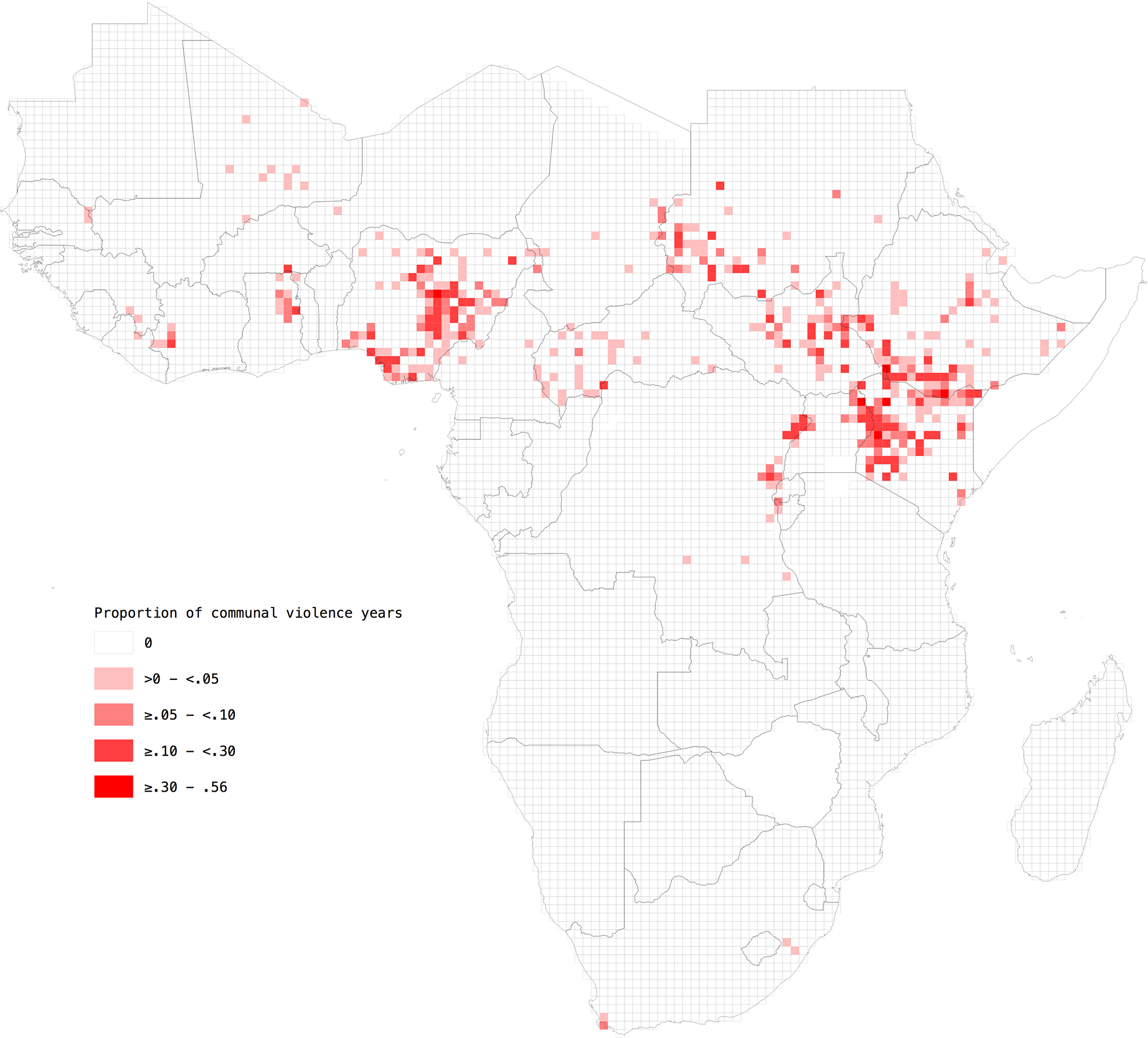

Here
Previous research argues economic development, state capacity, excluded political groups and population density impact communal violence and can confound the relationship between exogenous shocks, such as droughts, and communal violence. To account for the level of economic development, we use disaggregated GDP values based on the G-Econ data (Nordhaus, 2006). This variable also partially accounts for state capacity. Higher state involvement can mitigate causes of communal disputes, but state actors could potentially dampen spillover. In our robustness tests we follow other research in using calibrated night-time light emissions to account for state capacity and economic development (compare Koren & Sarbahi, 2018; Min, 2015; Weidmann & Schutte, 2017). A caveat is that we might miss local variation in informal governance institutions or implementations of property rights.
As other forms of violence, the likelihood of communal conflict increases in comparatively more populated areas, and this, in turn, affects responses to extreme weather. In addition, denser areas often have more infrastructures or institutions in place to distribute scarce resources such as water and food. As a consequence, population inevitably impacts violence and drought in relation to its neighborhood. Accounting for population density, we use estimates for the number of persons living within each grid (Goldewijk et al., 2011). 6 We control for the presence of marginalized groups which might be more likely to suffer from both conflict and drought. We rely on GeoEPR data (Vogt et al., 2015) for our dummy variable Excluded group taking the value 1 if there has been one or more excluded groups in a given grid cell-year.
Civil war events may also affect communal violence and land use. Previous research shows proximity to civil war fighting impacts intercommunal relations (Brosché, 2014; Higazi, 2016; Krause, 2018). Each model includes a dummy variable taking the value 1 if there had been at least one civil conflict event in a grid cell during the previous year, also based on UCDP (Croicu & Sundberg, 2016; Sundberg & Melander, 2013). 7
Accounting for temporal order, all controls are lagged by one year. In addition, there are strong arguments for why some of control variables also exhibit spatial clustering or could potentially have spillover effects affecting communal violence (see also Online appendix visualization). We compute models with aforementioned variables as auto-regressive terms to account for the potential spillover from these covariates.
Results
This article argues that communal conflict is explained through spillover of violence as well as spillover mechanisms via conflict predictors like drought. In this section we demonstrate that our arguments hold when tested separately and also when combined into one model framework.
Conflict through nearby violence
Assessing our first hypothesis, we find strong evidence for conflict spillover. For Model 2 and 3 in Table I, we observe positive and highly significant spatial lags for the dependent variable (
For comparison we also include results from the spatial error model (SEM, see Model 1, Table I) and a fixed-effects model with a simple dummy variable (Model 4) that takes the value 1 if a neighboring grid cell experienced communal violence, or 0 if otherwise. The latter is a relatively widespread practice to control for spatial dependence in the literature, although this does not account for spatial auto-correlation. Having in mind aforementioned caveats, we interpret the naive dummy variable in Model 4, which suggests communal violence from a neighboring area increases the local likelihood of violence by 9.6, almost 10 percentage points. This would mean a stark increase from the baseline likelihood of 0.45.
The Online appendix provides results for Moran tests among residuals for panel OLS models. These tests strongly suggest that modeling should account for spatial correlation. Furthermore, in Figure 2, we plotted incidences of communal violence across the sample. This graph shows that increases of communal violence are driven much more by spillover incidences than by fighting that is restricted to one area alone. In sum, our analysis provides strong evidence for spillover of communal violence. This finding on communal violence spillover is in line with spillover found in other types of conflict, e.g. state-based fighting (e.g. Gleditsch & Salehyan, 2011; Schutte & Weidmann, 2011).
Communal violence incidences in sub-Saharan Africa, panel fixed-effects, 1990–2014
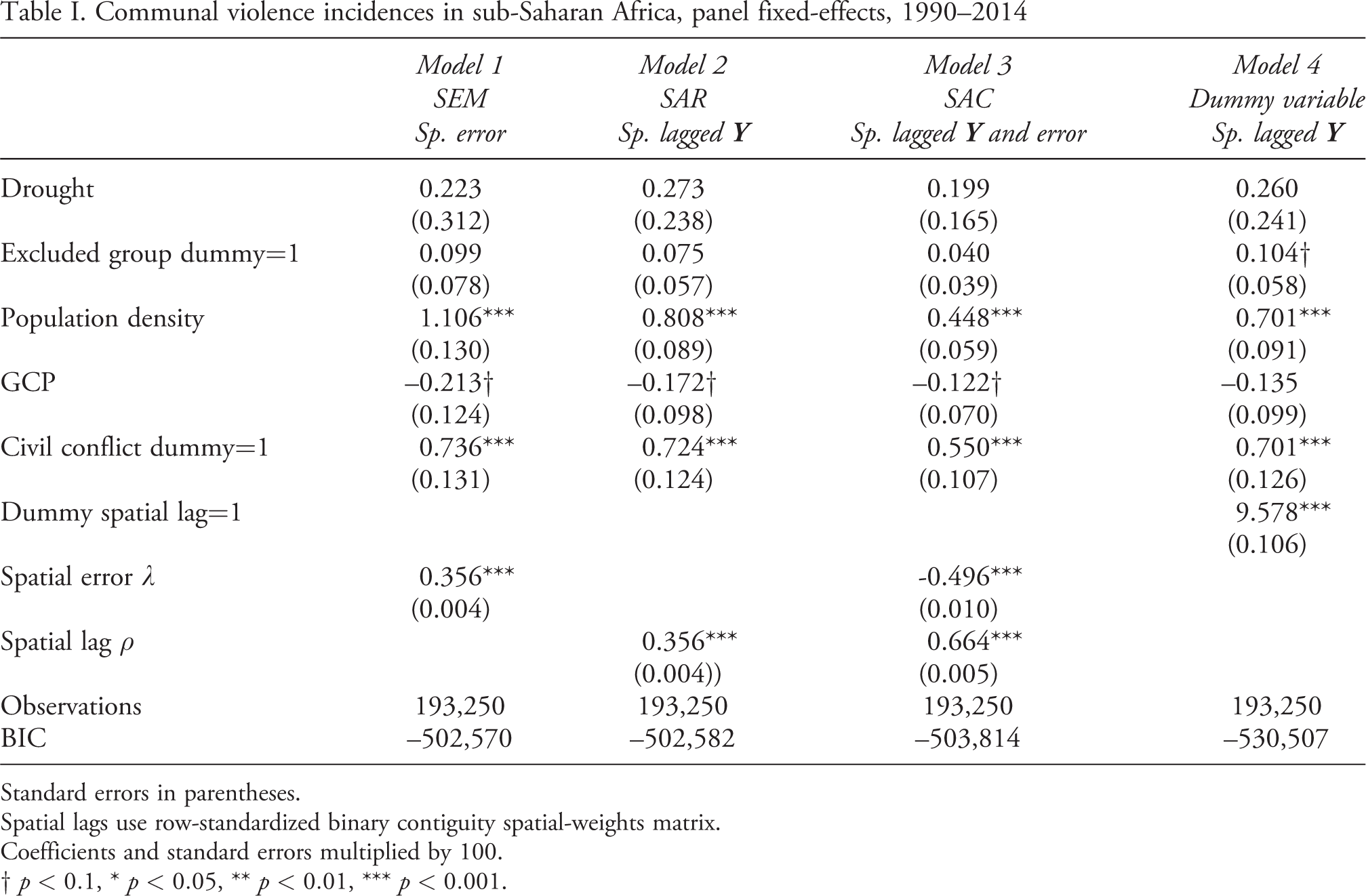
Standard errors in parentheses.
Spatial lags use row-standardized binary contiguity spatial-weights matrix.
Coefficients and standard errors multiplied by 100.
†
Conflict through nearby drought
Tables II and III report the results for predictor-spillover models. Because point estimates for coefficients in spatial models usually cannot be interpreted directly, Table III reports marginal impacts through indirect, direct and total effects. 8 This eases the interpretation and we therefore refer to Table III. Overall, we find evidence of communal violence occurring through neighborhood drought. In the following paragraphs we compare the different results across models. Note, in Model 5 (SLX) spillover processes are modeled only through predictors, whereas Model 6 (SDEM) also includes a spatial error term. Model 7 represents our theoretically preferred model as it includes both predictor-spillover as well as spillover from our dependent variable.
For our second hypothesis, our main interest lies with spillover effects from drought. Thus, we start by interpreting the indirect effects on communal violence (starting with the first row in Table III). These can be thought of as the average of all local drought spillovers. An example for such a spillover would be the effect of drought in one unit affecting violence in a neighboring unit. In all predictor-spillover models (5–7) we observe a positive spillover effect from drought. This suggests neighboring drought on average increases local violence. For the SLX model (Model 5), this is statistically significant at the 0.95 confidence level, while just falling short of that threshold for the other two. This would mean half a year of consecutive drought on average increases the conflict likelihood across neighboring cells by about 0.6 percentage points (as unit-increase would be about 1.2 percentage points for the SDM model). This is a substantial increase given the baseline likelihood of communal violence (0.45). This is an interesting finding as recent studies have argued that drought affects violence only conditionally on other variables. Our results suggest that there is potentially another pathway via spillover effects. The results also speak to qualitative studies showing that land changes and changing property rights could increase spillover tension (Brottem, 2020).
We now move to the middle block in Table III, which provides local effects of our predictors. This direct effect represents the effect of the change within grid cells while ignoring any spatial spillover, therefore representing the within-cell effects. The average direct effect of drought is Communal violence in sub-Saharan Africa, 1990–2014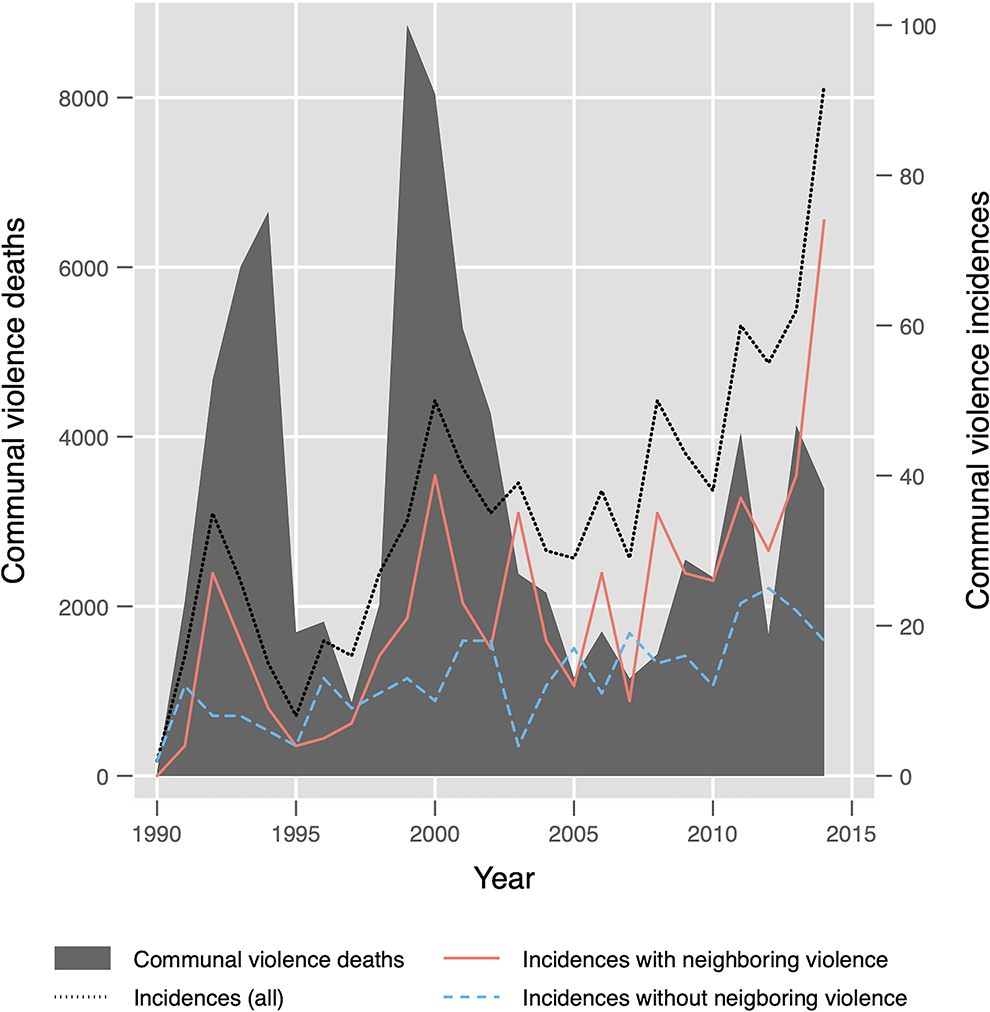
Lastly, we consider total effects, the sum of the respective direct and indirect impacts total effects (lower block, Table III). Following LeSage & Pace (2014), this can be interpreted in two ways. First, the average total effect provides the impact on communal violence for a typical cell if drought increased in all grid cells. Second, this statistic can also be interpreted as the average total impact from drought in one grid cell on the incidence of communal violence of all other grid cells. In all models estimates for drought are positive which means the probability of communal violence increases as drought exposure increases. This relationship is statistically significant, although for the models with combined spatial error (Model 6, SDEM) it is just below the 0.95 confidence threshold.
Complementing previous studies, our study also find no effect of drought on conflict locally. Yet, we find drought exposure affects communal violence primarily through spillover from neighboring cells and this relation holds even when modeling in the spillover of violence itself.
Other findings and robustness tests
We briefly consider other key variables. An interesting finding can be seen for the civil war exposure. For the total effect (lower block, Table III) we find civil war incidence to increase the likelihood of communal violence. We expected civil conflict to have an effect on communal violence both locally and through spillover. However, when included in the SDEM and SDM models, the total effect of civil war fighting on communal violence seems to be driven mainly by local effects of civil wars. Thus, we fail to find robust evidence that civil conflict incidences increase communal violence in nearby areas. While this could be an artifact from time-lagging the civil war variable, it might indicate spatial spillover of violence is conflict-type specific, i.e. communal violence leads to more nearby communal violence, rather than civil conflict igniting communal violence nearby.
Communal violence incidences in sub-Saharan Africa, 1990–2014
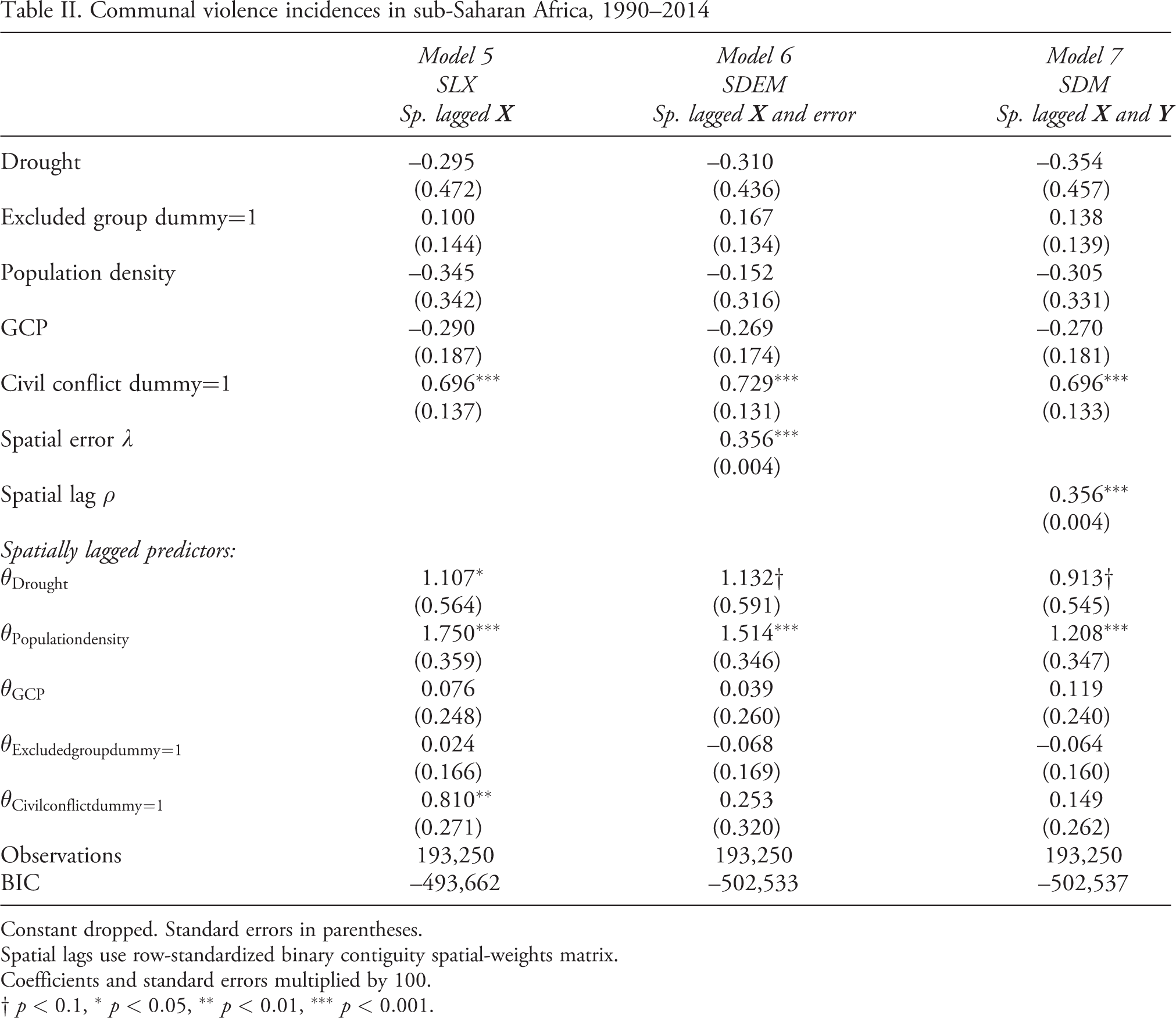
Constant dropped. Standard errors in parentheses.
Spatial lags use row-standardized binary contiguity spatial-weights matrix.
Coefficients and standard errors multiplied by 100.
In our robustness tests (Online appendix) we considered several other specifications. We apply different grid sizes and also use spectral-normalized spatial weights matrix. Neither change the results of our findings. Furthermore, our findings hold with cross-sectional models both with Spatial Probit and LPM models. Our results are also confirmed by using exposure to drought during the growing season of a cell’s main crop. In sum, our robustness tests further support our inferences.
Conclusion
This article addresses spatial dynamics of communal violence, a dimension that has received little explicit attention. The analysis shows that communal violence (much like state-based conflicts) can lead to fighting in neighboring areas. The results also show the importance of neighborhoods droughts as conflict-inducing factor. Specifically, we show increased violence due to exposure from nearby drought, even when controlling for spillover of violence. This finding has implications for how future research on climate security ought to consider spatial dynamics when addressing how climate extremes threaten local resilience.
Average indirect, direct and total effects on communal violence
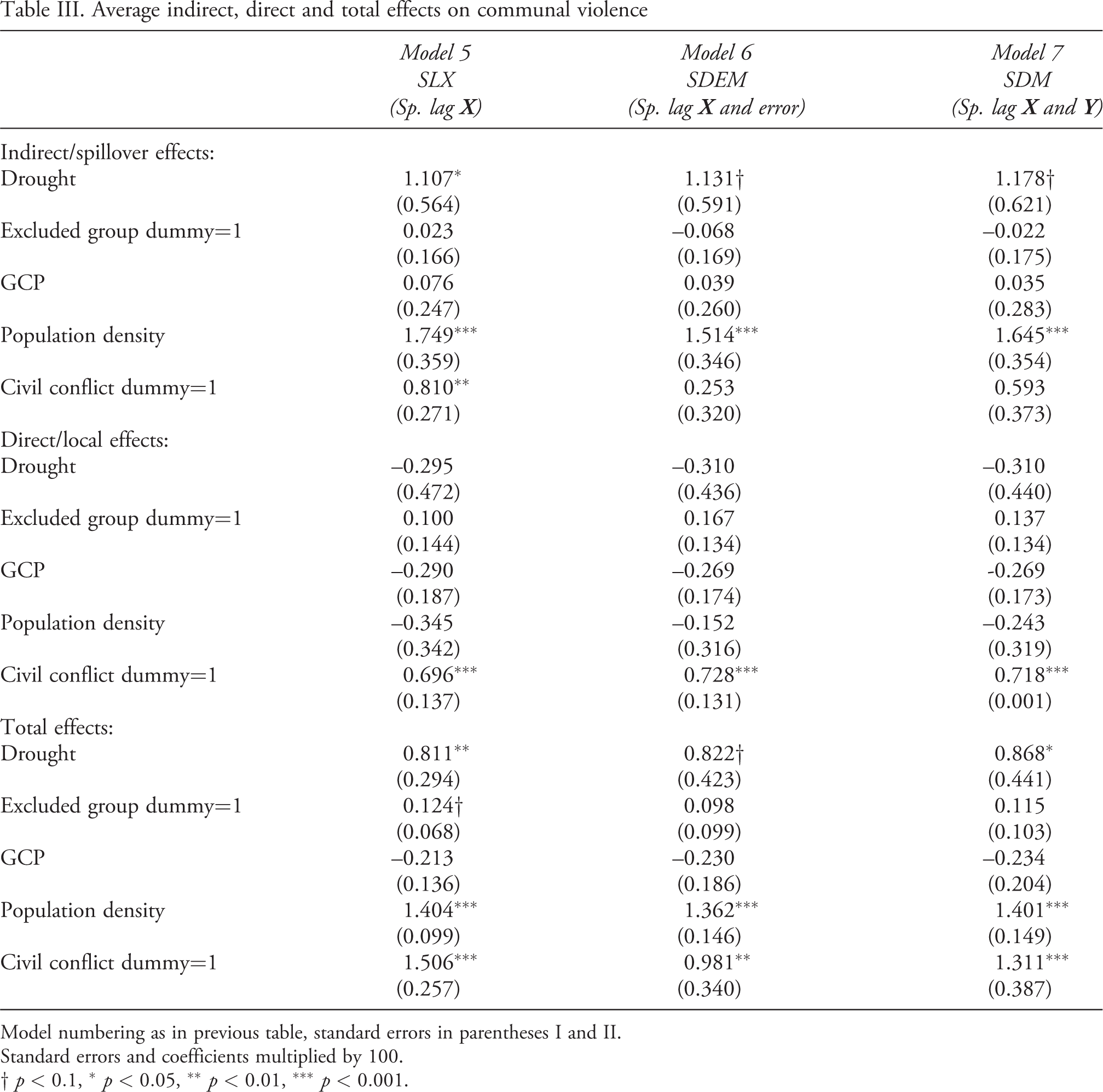
Model numbering as in previous table, standard errors in parentheses I and II.
Standard errors and coefficients multiplied by 100.
Finally, our study provides policy insights for conflict prevention, resolution and peacebuilding efforts. Although many communal conflicts remain relatively local, our findings suggest the impact of violence and conflict-inducing factors can extend to larger areas, affecting communities not directly linked to initial onsets. This necessitates multistage integrated approaches that combine conflict resolution and peacebuilding efforts with preventive and rapid response measures in areas adjacent to initial crisis settings.
Footnotes
Replication Data
The dataset and do-files for the empirical analysis in this article, along with the Online appendix can be found at http://www.prio.org/jpr/datasets and  .
.
Acknowledgments
For excellent feedback on previous versions, the authors would like to thank Johan Brosché, Mihai Croicu, Emma Elfversson, Kristine Eck, Hanne Fjelde, Håvard Hegre, Karin Johansson, Ore Koren, Päivi Lujala, David Randahl, Eric Skoog, Ashok Swain & Nina von Uexkull. We also acknowledge key suggestions made by the reviewers and editors.
Funding
The author(s) received financial support for the research, authorship, and/or publication of this article: Stefan Döring acknowledges support by the Swedish Research Council (VR, Grant No. 2022-00183), Riksbankens Jubileumsfond (M21-0002), and the UNESCO Category II International Centre for Water Cooperation, SIWI, Stockholm.