




Abstract
Anecdotal evidence suggests that sexual violence varies significantly across cases of election violence and communal conflicts but systematic research is scarce. Post-election violence is particularly likely if electoral mobilization further polarizes longstanding communal conflicts and political elites do not instruct security forces to intervene decisively. I comparatively analyse two prominent cases of post-election violence in Kenya (2007/8) and Nigeria (2008) that exhibit stark variation in sexual violence. Patrimonial networks and norms of violent masculinity that increase the probability of (gang) rape were present in both cases and do not explain variation. Civil war research has identified three explanations for the variation in sexual violence: situational constraints; ordered sexual violence or restraint; and bottom-up dynamics of sexual violence or restraint. I examine these for the context of post-election violence. I argue that the type of communal conflict triggered by electoral mobilization explains variation in sexual violence. In Kenya, pogroms of a majority group against a minority allowed for the time and space to perpetrate widespread sexual violence while in Nigeria, dyadic clashes between similarly strong groups offered less opportunity but produced a significantly higher death toll. These findings have important implications for preventing election violence. They demonstrate that civilian vulnerability is gendered and that high levels of sexual violence do not necessarily correspond to high levels of lethal violence. Ignoring sexual violence means underestimating the real intensity of conflict and its impact on the political process.
Introduction
Election violence is an unfortunately common feature of many national and local government elections in unconsolidated democracies. Most election violence occurs in the pre-election period to influence the outcome of an election (Daxecker & Jung, 2018). When post-election violence does occur, it is more likely to escalate (Straus & Taylor, 2012). This is particularly the case if electoral mobilization further polarizes longstanding communal conflicts (Höglund, 2009). Kenya’s 2007 presidential elections pitched a Kikuyu incumbent against a Kalenjin opposition candidate, which reignited local communal conflicts between the Kikuyu, Kalenjin and Luo ethnic groups. Disputed election results and subsequent violence brought the country to the brink of civil war. Similarly, in Nigeria, electoral mobilizations on both the national and local levels regularly trigger communal conflicts, resulting in deadly post-election violence, for example in cities such as Kaduna and Jos in the centre of the country.
However, the forms of post-election violence may vary dramatically. In Kenya, the 2007/8 clashes affected several towns and rural areas in the Rift Valley province and the capital Nairobi. Within two months, an estimated 1,133 people were killed and at least 900 cases of rape and other forms of sexual violence occurred (HRW, 2015). Reported forms of sexual violence also showed distinct local variation and included rape and gang rape of women and rape and sexual mutilation of men. In stark contrast, in Nigeria, only two days of post-election violence in the city of Jos in 2008 killed at least 800 people but very few cases of sexual violence were reported.
Does perpetrator restraint or situational constraint explain variation in sexual violence when elections (re)ignite communal conflicts? By using the term ‘sexual violence’, I mean physical forms of sexual violence and follow the Rome Statute of the International Criminal Court, which includes ‘rape, sexual slavery, enforced prostitution, forced pregnancy, enforced sterilization, or any other forms of sexual violence of comparable gravity’ (ICC, 1998), and I include forms of sexual mutilation, such as of the reproductive organs of both women and men. By election violence, I mean political violence that is ‘directly tied to an impending electoral contest or an announced electoral result’ (Straus & Taylor, 2012). Election violence research has examined the role of incumbents who resort to violence (Taylor, Pevehouse & Straus, 2017), international observers (Daxecker, 2012), and the electoral system (Fjelde & Höglund, 2016; Birch & Muchlinski, 2017). Research on gender and election violence examined violence against politically active women (Krook, 2018), forms and frequency of violence against women and men in the period leading up to an election (Bjarnegård, 2017), and practices of intimidation, verbal harassment, and physical harm against women (Bardall, 2011).
However, the field lacks a systematic and global comparative analysis of sexual violence and its variation. Neither does communal conflict research offer a systematic analysis of variation in sexual violence, although some well-known examples include the widespread rape of women during Hindu–Muslim riots in India (Narula, 2002), the (gang) rapes of Chinese women during the 1998 riots in Indonesia (Kusno, 2003), and anecdotally the sexual mutilation of men (Horowitz, 2001). Neither election violence nor communal conflict research explain when and why sexual violence is frequent.
Civil war research has established that civilian agency is causal for explaining variation in violence against civilians (Kalyvas, 2006), that lethal and non-lethal forms of violence against civilians may diverge (Gutiérrez-Sanín & Wood, 2017), and that rape and other forms of sexual violence can vary dramatically (Wood, 2006, 2018; Cohen, 2016). Although elites do order the use of sexual violence in some armed conflicts, in many others bottom-up dynamics among combatants rather than top-down orders likely explain widespread sexual violence (Cohen, 2016; Wood, 2018). Bottom-up dynamics are often absent in electoral violence research and its inherent instrumentalist perspective, which remains ‘interpretively loaded’ (Staniland, 2014) as the term assigns a motive derived from elite politics but may ignore divergent civilian motives for partaking in violence (Berenschot, 2020; Fearon & Laitin, 2000; Kalyvas, 2006), which is problematic for explaining variation in sexual violence and restraint.
Given the paucity of data on elections and the variation of sexual violence, I comparatively analyse two prominent cases of election violence in Kenya and Nigeria that exhibit significant variation in this regard. In 2012, following the 2007/8 post-election violence in Kenya, the ICC opened proceedings against the two leading politicians Uhuru Kenyatta (Kikuyu) and William Ruto (Kalenjin) under the Rome Statute for crimes against humanity of murder, forcible transfer of population, and persecution (ICC, 2012a,b). In addition, Kenyatta’s charges also included rape based on the allegation that widespread rape and other forms of sexual violence were carried out by a hierarchically organized Kikuyu gang that followed command, suggesting that widespread rape may have been ‘organizational policy’ (ICC, 2012a). The charges against Kenyatta and Ruto did not extend to all episodes of post-election violence, which Kenya’s Commission of Inquiry had described as ‘an extraordinary amount of violence between ordinary citizens’ (CIPEV, 2008: 343). The ICC also investigated the 2008 post-election violence in Jos as one episode of large-scale intercommunal violence in central Nigeria. Although attacks were ‘widespread’ and ‘systematic’, the investigation did not establish that the killings constituted crimes against humanity due to a lack of evidence that specific leaders or organizations instigated the violence (ICC, 2013: 6). In 2015 and 2016, charges against Kenyan politicians were dropped due to a lack of evidence.
This article links election violence to communal conflict research. I draw on the civil war and sexual violence literature and include a focus on civilian agency. I argue that the type of communal conflict triggered by electoral mobilization explains variation in sexual violence. Type and context of local communal conflict shape how armed civilians can victimize members of ethnic groups associated with certain political parties. Drawing on fieldwork in Nigeria and Kenya, human rights reporting and secondary literature, I show that whether elections ignite pogroms or dyadic clashes explains (lack of) opportunity for widespread sexual violence. Post-election violence in Kenya was predominantly one-sided, perpetrated by a majority that dominated the local conflict location against a minority, in contrast to more dyadic clashes in Nigeria. When major post-election violence takes place, security forces do not necessarily have instructions to intervene decisively and may even have been ordered to facilitate the violence. Consequently, pogroms are more likely to see widespread sexual violence because perpetrators do not need to fear immediate retaliation from a minority group and have time to (gang) rape and sexually torture (see Cohen, 2016). By contrast, in dyadic clashes, fear of imminent attack by opposing armed groups constrains sexual violence but renders the clashes much deadlier. The analysis shows that high levels of sexual violence do not correspond to high levels of lethal violence. This is important because ignoring sexual violence in post-election clashes means underestimating the real intensity of conflict and its impact on the political process. Given the grave injuries of sexual violence, these findings should inform election violence research and prevention.
I establish my argument as follows. First, I review the civil war literature and identify three rival explanations for variation: top-down orders to use sexual violence or restraint, bottom-up group dynamics of sexual violence or restraint, and situational constraint. Next, I discuss post-election violence and types of communal conflict that electoral mobilization can trigger to examine whether situational constraint or top-down/bottom-up dynamics explain variation in sexual violence. Third, I explain my plausibility probe into the argument that type of communal conflict triggered by electoral mobilization explains variation in sexual violence. I summarize empirical findings before delving into the details of post-election violence in Kenya and Nigeria, on which my argument is built. In the conclusions, I discuss implications for the study and prevention of post-election violence.
Variation of conflict-related sexual violence
There is near consensus that sexual violence in conflict is a complex phenomenon and unlikely to be explained by any mono-causal approach. Research has predominantly focused on civil and interstate war and found significant variation in forms and frequency. ‘Rape as a weapon of war’ has been understood as a means to produce, communicate and maintain ‘dominance’, to undermine both women and men of the enemy group, and destroy group identity and social bonds (Card, 1996). Top-down explanatory approaches have focused on armed group leadership. Whether or not the leadership adopts sexual violence as a strategy or actively prohibits and punishes such violence may explain its variation. Mass rape and other forms of sexual violence may be adopted by armed groups as a strategy, a weapon, or a tool. Military objectives for rape as a strategy may include ethnic cleansing, while organizational motives may focus on the regulation of sexual lives of combatants, for example through the use of forced prostitution. Furthermore, the leadership may authorize sexual violence through the use of specific rhetoric encouraging such acts, for example by referring to ‘all-out war’ (Wood, 2018).
By contrast, research into perpetrator motives and armed group structures focused on bottom-up dynamics to explain variation. Wood argued that rape can emerge as a practice, ‘a form of violence that is driven from “below” and tolerated from “above”’ (Wood, 2018). Although combatants enter armed groups with norms and values developed during peacetime, these preferences may change endogenously as a result of combatant recruitment and training, formal and informal socialization within the armed group, and during combat. Widespread sexual violence may result from bottom-up processes of socialization within armed groups and opportunistic motives and is likely when some combatants hold preferences for rape related to norms concerning aggression, sexuality and gender, and when small group dynamics generate coercion for participation (Wood, 2018). A credible analysis needs to pay attention to such bottom-up social dynamics. For example, sexual violence may displace a targeted population, which may be in the interest of elites in the context of election violence. However, the effect of displacement is not necessarily evidence that sexual violence was ordered to achieve this particular outcome (Cohen, 2016: 20). Instead, within-group dynamics, such as abductions and pressganging of armed group members who then use rape and particularly gang rape to build cohesion may explain the high prevalence of rape (Cohen, 2016: 20). However, cohesion building is only one mechanism that explains sexual violence; Cohen’s data also show that 51% of insurgent groups that did not abduct nevertheless raped, and 25% that did abduct did not gang rape, suggesting that other causal mechanisms are also at play (Kalyvas, 2017).
The context of post-election violence differs from that of civil wars. Perpetrators are generally not rebel group members abducted and forced to fight but members of communal militias, gangs, vigilantes, thugs and armed youth. Some gangs and militias also forcibly recruit some of their members (e.g. the Mungiki gang in Kenya; ICC, 2012b) but generally members of armed groups (other than rebel groups) join without force and remain embedded within their families and neighbourhoods. Ordinary men may be mobilized to fight through social pressure and shaming, particularly around the notion of being ‘a real man’, but the costs of non-compliance may be less severe than in the context of abduction by a rebel group.
However, Cohen’s work does offer one explanation applicable to the context of communal conflict: the lack of opportunity for rape and other forms of sexual violence, that is, situational constraints. Cohen found that combatants saw rape – and in particular gang rape – as an inefficient form of fighting, taking a significant amount of time to complete and exposing perpetrators to risks. Therefore, rape would often be perpetrated in the aftermath of fighting when risks were evidently lower (Cohen, 2016: 35). The situational context may also explain the absence of sexual violence in post-election violence.
To varying extent, sexual violence during armed conflict relates to pre-conflict norms and practices around gender relations. Gender inequality and the devaluation of femininity are constitutive for sexual violence as these norms and ideas provide the act with its specific meaning. The gang rape literature emphasized the importance of everyday gender norms. Gang membership is associated with rape prevalence, a large number of sexual partners, a sense of male entitlement and gang members’ quests for gendered power (Bourgois, 2003; Franklin, 2004). One medical study showed that men who have raped are more likely to hold gender inequitable views and are more likely to engage in gender inequitable practices, such as transactional sex and domestic violence (Jewkes et al., 2010). The most common motivation for all types of rape, including gang rape, stemmed from notions of sexual entitlement (Jewkes et al., 2010). Gang rape increases mutual esteem for the group; motives include ‘boredom’ and ‘fun’, peer group pressure, anger and punishing the victim (Franklin, 2004: 31).
Rape and gang-rape in conflict contexts also concern male victims and can be as widespread and multidimensional as sexual violence against women (Christian et al., 2011). Explanations for sexual violence against men have re-emphasized feminist arguments of emasculation through feminization or homosexualization (Schulz, 2018). Forms of sexual mutilation against men reflect the core of humiliation, dehumanization and literal emasculation (Sivakumaran, 2007).
In sum, drawing on Cohen (2016), the situational context of fighting may constrain armed groups and discourage widespread sexual violence due to perpetrators’ fears of imminent counter-attack. Second, if the situational context allows for widespread sexual violence but the leadership finds it in their interest to forbid rape and enforce such regulations through timely and effective punishment, ordered restraint may explain low levels of sexual violence. Third, if the situational context allows for widespread sexual violence but the norms and values of armed group members do not support such atrocities, bottom-up restraint may explain low levels of sexual violence (Wood, 2018).
Post-election violence and type of communal conflict
Electoral violence is generally understood as a form of political violence, in which the dynamics of electoral competition shape the motives of perpetrators (Bjarnegård, 2017), the identification of targets (Höglund, 2009; Bekoe, 2012) and the timing of violence (Klaus & Mitchell, 2015; Taylor, Pevehouse & Straus, 2017). Although electoral violence can include a wide range of phenomena, the ‘defining characteristic is that electoral contests become the focal points that shape the targets and the timing of the violence’ (Fjelde & Höglund, 2016). There is now near consensus that election violence is a broad research field with multiple logics and actors (Staniland, 2014; Söderberg Kovacs & Bjarnesen, 2018), and that violence before and after elections may follow different logics (Angerbrandt, 2018; Straus & Taylor, 2012). Post-election violence is tied to an announced electoral result (Straus & Taylor, 2012) and may be incited by elites to punish opposition voters (Birch & Muchlinski, 2017). Government and opposition elites may have different motives for inciting or tolerating post-election violence (Smidt, 2016). Consequently, the period after an election can be a time of high vulnerability, particularly when elections further polarize deeply rooted communal conflicts. However, the structural and temporal conditions of post-election violence do not directly explain why violence takes the form of rape in some cases and killings in others. Because political elites bear the brunt of responsibility for inciting/not effectively preventing post-election violence, less attention has been paid to civilian agency and bottom-up dynamics that may explain sexual violence.
The dominant institutional form of African politics is clientelism, which affects the electoral stakes (Höglund, 2009; Taylor, Pevehouse & Straus, 2017). The politics of patronage have long been recognized as drivers of election violence, whether from above or from below (Kagwanja, 2003; Berenschot, 2011; Brass, 2003; Wilkinson, 2004). Mobilization from below can be causal for the outcome of election violence (Bekoe, 2012; Staniland, 2014) and its prevention (Smidt, 2020). Elites may encourage, tolerate, or actively discourage post-election violence, which may also emerge ‘from below’ driven by local conflicts and patronage networks that may ignite violence also independently of elections (Angerbrandt, 2018). Post-election violence can offer a ‘window of opportunity’ for changing the distribution of resources and generally for settling longstanding local scores (Christian et al., 2011; Klaus & Mitchell, 2015).
I argue that local conflict conditions – the type of communal conflict that electoral mobilization triggers – matter for how elites can incite violence as much as for civilians seeking to victimize others to settle their scores. Research often lacks specification as to whether violence is directed against a minority or takes place between similarly strong groups; in what geographical context such violence takes place; whether the perpetrators are neighbours, armed youths, or well-organized gangs and militias; and what forms or repertoires of violence are used against civilians (see Krause, 2018). The classic ‘deadly ethnic riot’ is understood as one-sided because ‘there is rarely significant retaliation’ and therefore no reason for perpetrators to inhibit atrocities (Horowitz, 2001: 112). However, many communal conflicts are better understood as dyadic because they involve similarly strong groups. Examples include communal conflicts in Nigeria or Indonesia. Such conflicts may see armed groups facing off in battles and planning attacks while also protecting against counter-attacks. The geography of violence can vary significantly between urban clashes and rural fighting and enable armed groups to carry out varying forms of violence. The literature primarily associates urban violence with election-related riots and the mobilization of thugs by politicians (Brass, 2003; Berenschot, 2011). Rural communal violence is distinct because it tends to involve well-organized militias and logistical preparation for attacking settlements in more remote locations. While security forces may be able to intervene swiftly and decisively in towns and halt killings, they are generally less able to bring fighting in rural areas under control. Armed actors may range from neighbours with kitchen knives to thugs, armed youth, gangs and militias. Lastly, the repertoires of violence may vary, including high and low levels of sexual violence. Taken together, the type of communal conflict triggered by electoral mobilization, the local context of urban or rural environments and the level of organization among perpetrator groups all shape repertoires of violence and may allow for or constrain widespread sexual violence.
Explaining variation of sexual violence in post-election violence
I conduct a plausibility probe to build the argument that type of communal conflict triggered by electoral mobilization explains variation in sexual violence. I investigate the three explanations derived from the civil war literature for the context of post-election violence. A plausibility probe is ‘an intermediary step between hypothesis generation and hypothesis testing’ (Levy, 2008), using illustrative case studies for reflection about a broader theoretical argument. A probability probe establishes whether an argument is plausible and deserves further testing within the context of a broader study.
I focus on post-election clashes in Kenya 2007/8 due to the well-documented high levels and varied patterns of sexual violence. Identifying a case with reportedly low levels of sexual violence is challenging and requires field-based knowledge. Moreover, conducting interviews on this sensitive topic is only feasible with well-established research networks. I chose the case of post-election violence in central Nigeria (Jos) because I knew from previous fieldwork that sexual violence had not been reported. 1 Theoretically, other cases could have been chosen for the analysis but I judged ethics-related concerns as of primary importance. The plausibility probe allows for relaxed expectations regarding case selection and selection bias in the assumption that findings require further testing and verification in future research (Levy, 2008).
Although post-election violence in Kenya took place after national elections and in Nigeria after local elections, many contextual factors render the comparison fruitful. There are important similarities in the dynamics of violence and state relations in Nigeria and Kenya (Bekoe, 2012; Straus & Taylor, 2012; Mueller, 2008; Staniland, 2014; Wahman & Goldring, 2020). Both countries exhibit presidential systems with strong clientelism, patronage networks and ‘big man’ politics. Both have been characterized by a proliferation of vigilantes and gangs, which have entrenched violence and violent masculinity in people’s everyday lives.
Fieldwork in Kenya took place during two weeks in 2018 and served to contextualize and verify conclusions drawn from document analysis. Fieldwork in Jos took place over four one-months trips between 2010 and 2015, during which I conducted more than 100 interviews on conflict dynamics and only verified low levels of sexual violence during my last interviews, based on well-established research networks.
Post-election violence in Kenya, 2007/8
Kenya
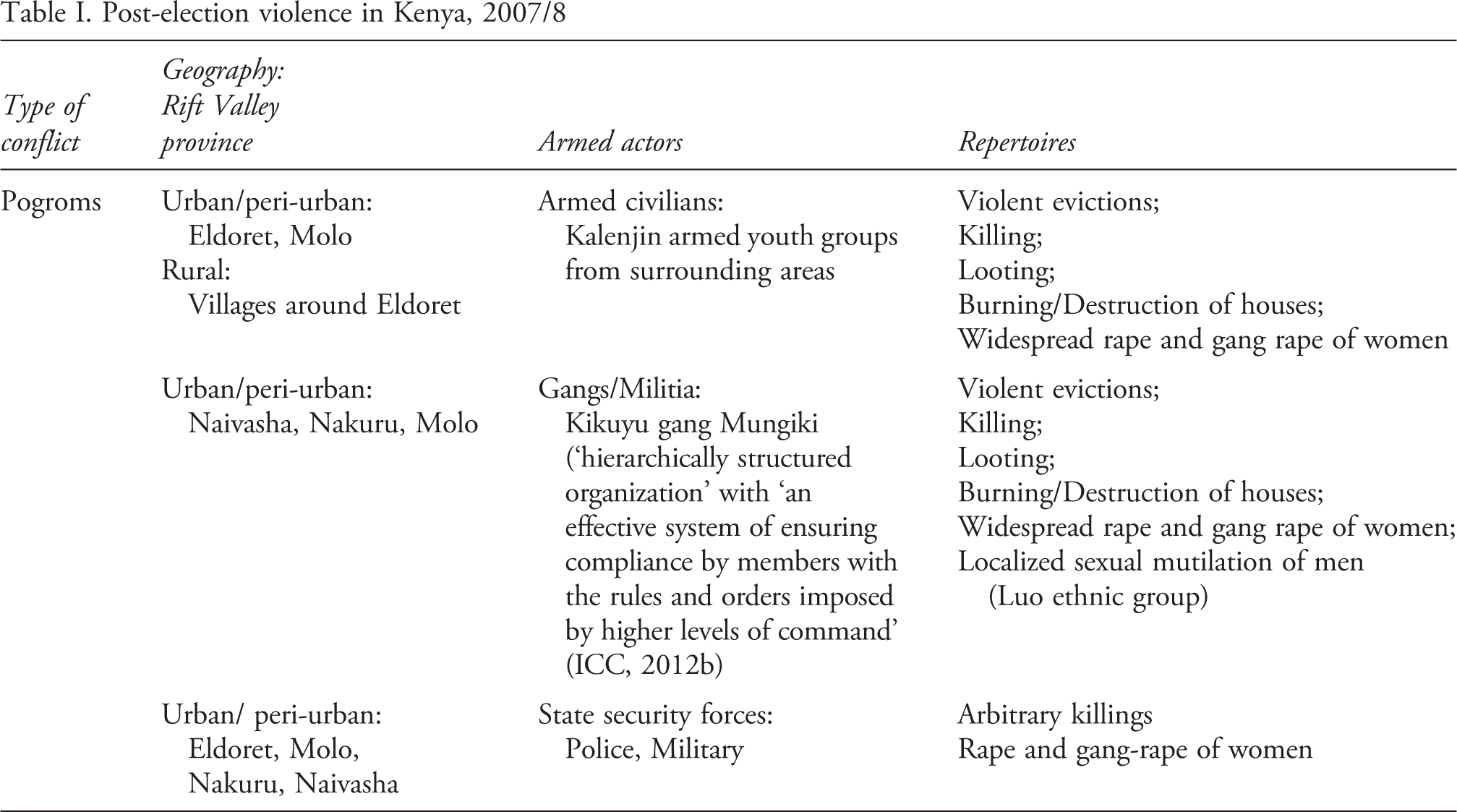
During Kenya’s 2007/8 post-election violence, pogroms with widespread sexual violence against both women and men took place in a number of towns and rural areas of the Rift Valley and in Nairobi, perpetrated primarily by Kalenjin armed youth associated with the opposition and Kikuyu gangs associated with the government side (see Table I). Post-election violence may have been incited by elites as a way of ‘bargaining for a preferred political outcome’ while perpetrators sought to punish opposition supporters for ‘voting against the “host” community’ (Klaus, 2020).
Kenya’s national elections have repeatedly sparked violence over the past three decades. In 1992, fighting took place between Kalenjin and Kikuyu in the Rift Valley province before and after the elections. In 1997, violence again took place in the Rift Valley and in the Coast province, mainly between Kikuyu and Luo (Klopp & Zuern, 2007). In 1992 and 1997, at least 3,000 lives were lost (Cheeseman, 2008: 170). Due to the persistent threat of election violence, many people leave the area they live and work in temporarily during election season to move to where their ethnic group constitutes a majority. Such voluntary displacement often takes place over several weeks or months in anticipation of election violence and puts great strains on people’s finances, families and businesses.
The most consistent electoral violence in Kenya is against the Kikuyu, who constitute about 30% of the country’s population and are seen as having benefited considerably from favouritism under Kenya’s first president, Jomo Kenyatta, himself a Kikuyu, particularly with regard to land acquisition in the Rift Valley (Straus & Taylor, 2012; Boone, 2012). Rift Valley province, the area worst affected, had a history of contested land claims and communal conflict (Boone, 2012). It was historically considered the homeland of mainly the Kalenjin, but since the colonial period many Kikuyu and other ethnic groups settled there. In this area politicians held power to redistribute land to their followers and incited people to violence around land grievances (Onoma, 2010). Furthermore, each side associated elections with the possibility of eviction and loss of land, ‘either through violent displacement during elections or through the exclusion of their party from power’ (Klaus & Mitchell, 2015: 628). Land-insecure civilians were more likely to be victimized during post-election violence than their land-secure counterparts (Klaus, 2017).
Prior to the 2007/8 clashes, Kenya had long been characterized by a gradual decline in the state’s monopoly of violence (Mueller, 2008; Kagwanja, 2003; De Smedt, 2009). Since the late 1980s, urban crime had become a serious problem and gangs consolidated, most prominently the Mungiki, a Kikuyu gang which came to control businesses and collect ‘protection fees’. The gang was hierarchically organized and had become a virtual shadow state in some areas of Kenya (Mueller, 2008: 193). Many other gangs and vigilante groups co-existed, not only for the purpose of crime but also to defend people from violence by state security forces and to provide income and the means for survival.
The 2007/8 post-election violence
The 2007/8 violence was multifaceted and cannot be reduced to elite instigation (Cheeseman, 2008; Klaus & Mitchell, 2015; Taylor, Pevehouse & Straus, 2017). On 30 December 2007 the incumbent president, Mwai Kibaki, a Kikuyu, was suddenly declared winner of the presidential vote. Violence escalated when followers of his opponent, Raila Odinga, a Luo candidate, alleged vote rigging. Odinga had chosen William Ruto, a Kalenjin, as his running mate to win the Kalenjin vote, and had previously been seen to be in the lead. Within minutes of the announcement, violence spread, with the bulk of killings taking place in Nairobi and the Rift Valley. First, opposition supporters, mostly Kalenjin, attacked Kikuyus in the North Rift Valley. A second wave followed when Kikuyu gangs organized revenge attacks against Orange Democratic Movement (ODM) supporters, mostly Luo and Kalenjin, within Kikuyu strongholds (KNCHR, 2008). Violence continued until a power-sharing agreement was signed on 28 February 2008. In Rift Valley province, 744 people were reportedly killed (CIPEV, 2008: 308). Post-election violence predominantly affected the towns of Eldoret, Molo, Nakuru and Naivasha.
In Eldoret and the surrounding area, Kalenjin attacks against Kikuyu were locally organized and meticulously planned; Kalenjin youth had reportedly been called on to ‘wage war’ against Kikuyu residents in the event of a Kibaki victory (HRW, 2008: 37; ICC, 2012a). Many people remembered the killings of Kikuyu in 1992 and 1997 and fled without a fight from the mobs that came to target them into forests or into larger towns and hid while their homesteads were destroyed and looted (HRW, 2008: 40). Armed youth attacked in organized groups; where they encountered resistance, people were massacred, including the burning of people who had sought refuge in a church (HRW, 2008: 35).
Kikuyu who fled the attacks and arrived in the towns of Molo, Nakuru and Naivasha, the traditional territory of the Kikuyu, brought with them stories of atrocities. These accounts stoked tensions among the Kikuyu and local leaders began organizing, collecting money to support self-defence forces (HRW, 2008: 43). In late January 2008, Kikuyu militias in the towns of Molo, Naivasha and Nakuru targeted the local communities of Luo, Luhya, Kalenjin and other minority groups seen as associated with the ODM in Kikuyu-majority parts (HRW, 2008: 43; KNCHR, 2008). Only in some areas, such as Nakuru and sporadically in Eldoret, did these attacks meet with counter-attacks.
Kikuyu reprisal attacks were primarily attributed to the Mungiki. They were ‘organized, paid, and directed by local leaders, businessmen, and […] politicians’ (HWR, 2008: 44). The Mungiki’s emergence and popular support tied in with previous electoral violence in the Rift Valley in 1992 and 1997 because the Kikuyu population affected formed ‘the core of Mungiki’s rural and urban following within the Rift Valley’ (Kagwanja, 2003: 35). One of the primary tactics of violence was arson and attackers sought to displace local residents of ethnic groups associated with their political opponents. Reports found that attacks were clearly coordinated and local elites – councillors and members of parliament – were alleged to have funded and coordinated the violence (HRW, 2008: 45, 54; CIPEV, 2008: 69, 71).
High levels of sexual violence
According to the 1989 census, in Rift Valley province, the Kalenjin constituted around 46.8% of the population and the Kikuyu almost 20% (Hassan & O’Mealia, 2018). In Nakuru, however, the Kikuyu are the predominant group (Boone, 2012). Thus, killings mostly took place in the form of pogroms against local minority populations and were organized with overwhelming force. The number of reported acts of sexual violence was almost on a par with the death toll. An estimated 1,133 people were killed and at least 900 cases of sexual violence occurred (HRW, 2015: 4). Other sources, such as the Coalition on Violence against Women in Kenya, assumed over 3,000 women were raped (COVAW, 2018). Female victims ranged from young children to old women, while in some areas in the Rift Valley men were also targeted. Hospital data confirm these estimates (Oosterveld, 2011). Data collected on sexual assault during and after the period of post-election violence confirmed a spike in both reported rape by unknown perpetrators and gang rape (Anastario et al., 2014).
Kalenjin attacks against Kikuyu in the Rift Valley, for example in the town of Eldoret, were characterized by widespread rape of women and gang rape. In Eldoret and the surrounding areas, the Kalenjin constitute about 60% of the population and the Kikuyu 30% (Author fieldnotes, 2018). According to male and female respondents, families in Eldoret believed that men were primarily at risk of being killed while women were deemed safer. Many families could not afford to temporarily leave the area together, so men predominantly fled while women stayed behind with their children. Both male and female respondents agreed that the high numbers of women who were raped in Eldoret stemmed in part from the fact that the men had left them behind. Respondents further explained that Kikuyu men who did not flee were often killed and that resistance would often lead to massacres of entire families (Author fieldnotes, 2018). Kalenjin youth came predominantly from rural areas in a coordinated manner to attack Kikuyu residents in Eldoret town (CIPEV, 2008: 43). The report of the Commission detailed that Kalenjin men killed Kikuyu men and gang raped Kikuyu women without necessarily killing them.
Women grassroots leaders in Eldoret explained that they understood the rapes by Kalenjin youth as a form of punishment. NGO workers linked the prevalence of rape, and particularly gang rape by Kalenjin armed youth against Kikuyu women, to Kalenjin youth initiation rituals that mark a young man’s position among his peers and socialized the Kalenjin into narratives of protecting their group and land. Initiation rituals included a period of seclusion after circumcision, which meant that boys of 12–17 years of age would spend one to two months together and bond over their shared experience. Initiation rituals reaffirmed masculinity and warrior narratives. Given high unemployment, however, few young men who had just become adults found jobs and could marry, settling down as respected members of their community. Instead, significant numbers of poor and frustrated men remained at the margins of the community and (gang) rape remained a social problem. In August 2007 and December 2007, prior to the killings, Kalenjin youth had held massive ‘oathing ceremonies’ after circumcision. These ceremonies were used for mobilizing the youth, instigating them ‘to conduct a cleanup operation’ and ‘to evict foreign communities within their areas’ (CIPEV, 2008: 69; Kamau-Rutenberg, 2009).
When armed Kikuyu attacked Luo and members of other minority ethnic groups, sexual violence was also widespread but both men and women were targeted. Luo men in particular suffered forced circumcision. Some women were allowed to leave unharmed while men’s penises were mutilated or cut off entirely. Hospital staff interviews and testimonials provide ample evidence of the widespread practice of forced male circumcision and penis mutilation by Kikuyu militias (Kihato, 2016; Ahlberg & Njoroge, 2013). Male circumcision is an important cultural act for Kikuyu and Kalenjin but Luo men are not circumcised. The idea that Luo cannot rule Kenya because they are uncircumcised had long been part of the political discourse. In Nairobi, the attacks on men, and their circumcision, prompted rape reprisal attacks by Luo men who gang raped Kikuyu women as a means to demonstrate their masculinity and to send a message to Kikuyu groups; ‘tell them who the real men are’ (Kihato, 2016).
The widespread practice of forced circumcision of Luo men in Rift Valley and Nairobi corresponds to the Mungiki as a well-organized and hierarchical gang able to execute common patterns of violence across diverse locations. The practice of forced circumcision of both women and men drew on cultural ideas and had long been embedded within Mungiki practice. The Mungiki also committed gang rapes (HRW, 2015: 18), a practice that has been attributed in part to forced recruitment (Cohen, 2016). Victim testimonies allege that the Mungiki did forcibly recruit some of its members (ICC, 2012b) and also forced Kikuyu men in Nakuru and Naivaisha to participate in the violence (HRW, 2008: 47).
Post-election violence in Jos, Nigeria, 2008
Nigeria
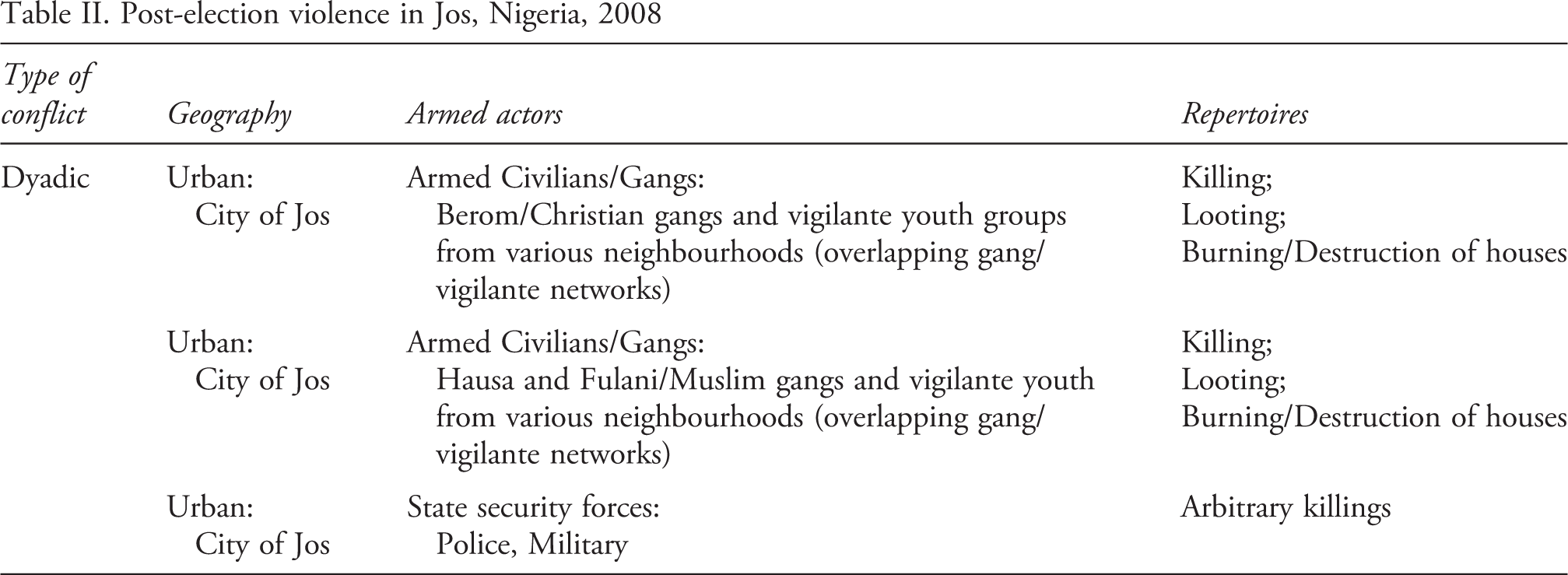
During post-election violence in the city of Jos in central Nigeria in 2008, at least 800 people were killed during two days of clashes between similarly strong groups and few instances of sexual violence were reported (see Table II). Local government elections re-ignited a longstanding communal conflict that pitched predominantly Christian ethnic groups who regard themselves as indigenous to the land against mostly Muslim groups referred to as ‘settlers’. Previous clashes around this cleavage had killed more than 1,000 people in 2001 after a contested political appointment, and clashes reignited in 2010, apparently without direct political instigation. The Jos conflict is relatively well covered in the media and literature (Tertsakian & Smart, 2001; Danfulani & Fwatshak, 2002; Best, 2007; Ostien, 2009; Higazi, 2011; Krause, 2011; Kwaja, 2011; Milligan, 2013). In urban Jos, mobile gangs and vigilantes have carried out killings. Cases of sexual violence and sexual slavery have only been reported for some militia attacks in rural areas, which were organized with overwhelming military force (HRW, 2013), but were not directly related to the 2008 post-election violence.
Between its return to democratic rule in 1999 and the year 2014, communal clashes in Nigeria killed at least 11,533 people. 2 This estimate excludes political killings, which may have been part of electoral campaigns, and rural ‘farmer–herder’ violence. Some of the deadliest clashes took place after the announcement of electoral results, such as the 2008 clashes in Jos after local government elections and the 2011 clashes in Kaduna after presidential elections. Communal violence takes place in the context of regional insurgencies, chronic state weakness, and persistent abuse by security forces. The daily lack of safety, particularly in poor communities, resulted in a proliferation of vigilantes, widespread civilian armament, and gang and militia formation.
The conflict in Jos is rooted in local elite competition over who qualifies as ‘indigenous’ and is entitled to political appointments, positions in government offices, access to higher education, and land rights. Jos was founded in 1915 during a tin mining boom. At that time, the Berom, the Anaguta and the Afizere ethnic groups farmed the region, which are predominantly Christian today. During the mining boom, large numbers of Hausa and Fulani, who are mostly Muslim, migrated to work in nascent Jos. Contemporary estimates of the population of Jos see the Hausa and Fulani as more numerous in Jos city centre but the extended city of Jos has roughly equal numbers (Author fieldnotes, 2010).
With the end of military rule, longstanding tensions turned violent after the 1999 local government elections in Jos North, which is the city centre. Even though the Hausa and Fulani won six out of 14 wards, which was the highest number won by any one ethnic group, a coalition of predominantly Christian ethnic groups elected a Christian chairman to the local government and the Hausa and Fulani were denied indigene rights (Danfulani & Fwatshak, 2002). They strongly protested against the loss of their privileges. Due to the staggering death toll of the 2008 local government elections in Jos, local government elections have remained suspended to date.
The 2008 post-election violence in Jos
After a week of clashes that killed more than 1,000 people in Jos in 2001, local government elections only took place again in 2008. The then Plateau State governor, Jonah Jang, was widely seen as a Berom hardliner fundamentally opposed to any political inclusion of the Hausa and Fulani. Even though Jang campaigned with the People’s Democratic Party (PDP), the then predominant party in Nigeria with a strong Hausa and Fulani presence, the PDP’s nominee for chairman of Jos North was a Berom, while the Hausa and Fulani campaigned through the All Nigeria People’s Party (ANPP). Thus, the electoral campaign again polarized the Berom allied to the Anaguta, representing a mostly Christian population group, against the Hausa and Fulani, who collaborated with the Afizere elite. Given the numerical strength of the Hausa and Fulani in Jos North Local Government Area (LGA), many observers were convinced that a Berom-led coalition could never win Jos North (Ostien, 2009). Voters were mobilized through overlapping ethnic and religious networks.
An exceptionally long period of electoral mobilization preceded the very deadly post-election violence. Elections were first scheduled for January 2008, then March 2008, but each time cancelled due to poor preparations before finally taking place on 27 November 2008 (Ostien, 2009). Clashes broke out when youth groups from both sides awaited the delayed election results. Neither side had been properly informed about a last-minute relocation of the collation centre and feared a stolen vote. It took security forces two days to bring the fighting under control. The clashes on the first day killed the vast majority of victims, an estimated 700 people (HRW, 2009). After shoot-on-sight orders were given, extrajudicial killings by the military and mobile police killed an additional 133 people, possibly many more (HRW, 2009).
Low levels of sexual violence
Although the Jos conflict attracted widespread media coverage, rape and other forms of sexual violence have not been reported. In interviews with residents, community leaders and NGO workers in Jos, I did not hear of incidents of sexual violence during the fighting in the city and did not come across NGO programmes that addressed the survivors of sexual violence or children born from rape. My interviews focused on how attacks were organized and how men were mobilized to fight. While rape always constitutes a highly sensitive topic, it is unlikely that community leaders would not mention rape if it had been prevalent during clashes.
When investigating the topic more directly in interviews with women leaders, NGO staff and some former perpetrators, I received mixed responses. Some respondents stated that sexual violence was always part of the clashes, referring to the discourse of ‘rape as a weapon of war’. Others acknowledged that such forms of violence rarely took place during communal fighting. Given the influx of international aid money and NGO peacebuilding programmes in the aftermath of the fighting in 2010, the most plausible explanation for me is that some respondents felt they needed to demonstrate knowledge of the international discourse of ‘rape as a weapon of war’ and therefore stated that this was always a problem. 3
Respondents who stated that sexual violence rarely took place during fighting in Jos referred to the situational context and characteristics of the battles and attacks to explain the absence of rape. Fighting took place within short but very intense periods. With two similarly strong groups fighting against each other, perpetrators faced serious risks of being killed by the opposing side, or being shot or arrested when the military eventually deployed. In 2008, a heavy military presence contained the fighting after less than two days, yet at least 700 people were killed. Thus, fighting in Jos was extremely deadly and the context likely did not allow for widespread sexual violence.
I further draw on proxy interviews by a female researcher from Jos who had previously worked in community peace programmes and was well respected in conflict-affected communities. Her interviews with women leaders from violence-prone neighbourhoods show that female leaders had, on average, not heard of more than three cases of rape of women or men in their neighbourhood during the period of the clashes. Many of the accounts of rape known within the neighbourhood concerned soldiers as perpetrators, and most were perpetrated in the aftermath of clashes. Some accounts of rape in the context of the clashes concerned girls or women who became lost when trying to flee fighting and found themselves in the ‘wrong’ neighbourhood. These rapes did not take place in the areas of fighting but within calm areas nearby, and the accounts were few. Furthermore, in a minority of cases, men were reported as victims of rape by soldiers who remained deployed to Jos after the clashes. The proxy interviews further demonstrate that many people saw sexual violence as a serious problem that affected everyday life in their community, and that women primarily feared soldiers, gangs and vigilantes. In sum, women as well as male leaders and elders recognized rape as a serious problem in the community but they were not aware of widespread sexual violence during the clashes in Jos.
The most plausible explanation for this absence of sexual violence is the lack of opportunity due to the characteristics of the fighting. Rape and gang rape take time but armed youth fought for less than two days. The dangers of being overpowered and killed by armed youth from the opposing side, or being arrested or shot by security forces, may have contributed to fighters only seeking to kill. NGO staff who had extensively worked with former perpetrators found the fighters’ lack of opportunity, time constraints, and the general uncertainty and high risk of being killed the most plausible explanations for low levels of sexual violence. 4 There is no evidence that restraint, either ordered by elites or emerging from fighters’ socialization, would explain the absence of sexual violence. On the contrary, rape was a serious problem in many communities, and violent masculinity has been shown to constitute a key factor in the fighting (Krause, 2019). Consequently, gender norms are unlikely to explain its absence during fighting. I conclude that constraint due to the dyadic clashes most likely explains the absence of sexual violence during post-election clashes in Jos.
Conclusions
This article set out to explain variation in sexual violence when elections (re)ignite communal conflicts. Drawing on the civil war literature, I identified three potential explanations: situational constraint; top-down ordered sexual violence or restraint; and bottom-up socialization and widespread sexual violence or restraint. Drawing on the cases of Kenya and Nigeria, I analysed the type and context of local communal conflicts that electoral mobilization triggered to assess opportunity for widespread sexual violence and evidence for ordered sexual violence or restraint. I find that whether electoral mobilization (re)ignites a communal conflict that pits a majority against a minority or two similarly strong groups against each other has implications for the likelihood and the extent of sexual and lethal violence. Dyadic clashes in Nigeria were extremely deadly but few cases of sexual violence were reported, even though rape was a serious threat primarily to women and girls in many communities outside the clashes. By contrast, pogroms in Kenya were associated with very high levels of sexual violence against both women and men but were overall less deadly. In Kenya, armed groups attacked with overwhelming force and did not have to fear immediate retaliation. I also find evidence of norms of violent or ‘warrior masculinity’ in both countries. Networks of thugs, vigilantes and gangs, and norms of gender inequality and violent masculinity, were prevalent. The gang rape literature links such attitudes to the prevalence of rape and gang rape outside of war dynamics. Hence, the analysis demonstrates that constraint rather than restraint explains a low level of sexual violence in Nigeria. In Kenya, these bottom-up social dynamics among armed youth and gangs likely contributed to widespread sexual violence due to the lack of constraints. Perpetrating sexual violence requires time. If government and opposition politicians had properly instructed security forces, their timely intervention could have effectively prevented such atrocities in Kenya.
Furthermore, the legacies of previous killings and people’s self-protection strategies contributed to high levels of sexual violence against women in Kenya because men were more likely to flee impending clashes. The memory of anti-Kikuyu violence in 1992 and 1997 led many Kikuyu men to temporarily leave Kalenjin strongholds in the belief that violence would not be directed against women and children. If more men had stayed with their families, the death toll would likely have been even higher. These findings imply gendered vulnerabilities; women may generally be more likely to suffer rape but survive while men are more likely to get killed. Consequently, non-lethal forms of violence deserve as much attention as lethal violence to inform prevention and civilian protection.
This article’s plausibility probe suggests the following theoretical argument. If electoral mobilization triggers communal conflicts that polarize a majority group against a minority on the local level, post-election violence likely consists of pogroms with widespread sexual violence. By contrast, if electoral mobilization triggers communal conflicts that polarize similarly strong groups on the local level, post-election violence is likely to take the form of dyadic clashes with a low level of sexual but a high level of lethal violence.
This argument has important policy implications. National and local government elections should be scheduled well in advance, allowing for comprehensive prevention efforts. Such efforts should be informed by a thorough analysis of the type of communal conflict that electoral mobilization may trigger and the risks of various forms of election violence, both sexual violence and killings. Pre-election education campaigns (Smidt, 2020) that promise prosecution of all forms of election-related violence – including sexual violence – could further add to prevention by undermining expectations of impunity. Lastly, the findings reaffirm that prevention needs to address ‘peacetime’ gendered forms of everyday violence and patronage networks that enable election violence.
Footnotes

Acknowledgements
The author is deeply grateful to her interview respondents and to Lantana Bako Abdullahi for her proxy interviews in Jos. The author benefited greatly from comments by the editors of this special issue, participants of the 1325 Folke Bernadotte Academy Working Group meeting in 2017 at PRIO and Dara Cohen. Any errors or omissions are the responsibility of the author.
Funding
Research support from the Swiss Program for Research on Global Issues for Development (Grant Number 146777), the Swiss National Science Foundation (PBGEP1_145599) and the Geneva Declaration Secretariat is gratefully acknowledged.
Notes
References
Supplementary Material
Please find the following supplemental material available below.
For Open Access articles published under a Creative Commons License, all supplemental material carries the same license as the article it is associated with.
For non-Open Access articles published, all supplemental material carries a non-exclusive license, and permission requests for re-use of supplemental material or any part of supplemental material shall be sent directly to the copyright owner as specified in the copyright notice associated with the article.
