




Abstract
Why do some jihadist organizations engage in beheadings while others do not? Although beheadings have become a signature tactic of the contemporary global jihadist movement, I show that most jihadist groups perpetrate few or no beheadings and only a minority have adopted beheading as a consistent part of their repertoire of violence. Such variation exists even among ideologically similar ‘Salafi-jihadist’ groups, suggesting that ideology alone cannot explain why such violence occurs. Instead, I argue that the use of beheadings is shaped by a combination of local strategic context and transnational ties. Beheadings are strategically useful to jihadist groups engaged in insurgency as a means of deterring civilian collaboration with the enemy, demoralizing enemy combatants and attracting foreign recruits. But the use of beheading is also costly for such groups, notably because of its tendency to alienate potential civilian supporters. Whether or not particular jihadist groups use beheadings depends largely on whether they can afford to ignore these costs. Jihadist insurgents who control significant territory are less sensitive to civilian attitudes because of their ability to obtain support through coercion and are therefore more likely to perpetrate beheadings. The use of beheadings is also shaped by transnational ties: organizations that seek formal affiliation with transnational jihadist networks are more likely to calculate that the benefits of using extreme violence to attract transnational support outweigh its costs. I test this theory using an original dataset of over 1,500 beheading events perpetrated by jihadist organizations between 1998 and 2019.
Introduction
Executions by beheading have become a signature tactic of many jihadist groups. While beheadings are also used by other types of armed groups, sometimes on a large scale (United Nations Human Rights Council, 2018), the tactic remains closely associated in public discourse with global jihadism (Taylor, 2014). As this article shows, however, jihadist groups vary in their use of such violence: most perpetrate few or no beheadings and only a minority adopt beheading as a consistent part of their repertoire of violence. This article seeks to explain this variation.
Jihadist beheadings are arguably among the most horrifying and puzzling forms of contemporary political violence, combining overt brutality and deliberate public display in a manner that appears anomalous (Fujii, 2013). Most direct conflict deaths today are caused by small arms or explosive weapons; such killings can be characterized by callous indifference to the suffering of victims, but do not usually involve deliberate, calculated cruelty. More overtly cruel forms of violence, such as torture, are usually hidden from public view. Jihadist beheadings, in contrast, are an overtly transgressive form of violence that is often deliberately publicized by the perpetrator. Some beheadings have been filmed and disseminated to a global audience of millions (Redmond et al., 2019). As discussed below, the frequency of jihadist beheadings has grown significantly in recent years. There is also evidence that the use of beheadings has spread beyond the jihadist movement (Grillo, 2008; Koch, 2018).
Existing research provides few explanations for why the prevalence of beheading varies across jihadist groups. While scholars have studied why non-state armed groups use particular forms of violence such as suicide bombing (Pape, 2003; Horowitz, 2010), sexual violence (Cohen, 2016; Revkin & Wood, 2021), or attacks on children and schools (Ahmad, 2019; Biberman & Zahid, 2019), few have systematically analysed the practice of beheading. Much recent work has focused on beheadings perpetrated by the Islamic State (IS) group, and especially on its use of videos and the Internet to disseminate its violence internationally (Friis, 2015, 2018; Zech & Kelly, 2015; Tinnes, 2016; Cottee, 2019). A number of observers have emphasized the religious and ideological dimensions of beheading, including its roots in Islamic theology and history (Furnish, 2005; Campbell, 2007; Nanninga, 2017). Yet variation in the use of beheading among ideologically similar ‘Salafi-jihadist’ groups suggests that ideology alone cannot explain why such violence occurs. Others have argued that beheadings can serve multiple strategic goals, including deterrence or provocation (Zech & Kelly, 2015), extortion (Lentini & Bakashmar, 2007), group bonding (Quiggle, 2015) and recruitment (Katz, 2014). Given its multiple uses, however, it remains unclear why most jihadist organizations avoid the practice of beheading.
This article argues that variation in the use of beheadings among jihadist groups is explained by a combination of local strategic context and transnational ties. While ideology plays an important role in legitimating the practice of beheading, whether specific jihadist groups adopt the tactic depends mainly on how they perceive the balance between its strategic usefulness and the costs of employing it. Jihadist groups that engage primarily in clandestine terrorism have relatively few incentives to use beheadings and generally avoid them. For jihadists involved in insurgency, on the other hand, beheadings are strategically useful as a means of deterring civilian collaboration with the enemy, demoralizing enemy fighters and attracting foreign recruits. But the use of beheadings is also costly for such groups, notably because of its tendency to alienate potential civilian supporters. Whether specific jihadist groups use beheadings depends largely on whether they can afford to ignore these costs. Jihadist insurgents that control significant territory are less sensitive to civilian attitudes because of their ability to obtain support through coercion and are therefore more likely to perpetrate beheadings. And organizations that prioritize transnational ties, seeking formal affiliation with transnational jihadist networks, are more likely to calculate that the benefits of using extreme violence to attract transnational support outweigh its costs.
I test these arguments using an original dataset of over 1,500 beheading events perpetrated by jihadist groups between 1998 and 2019. The findings provide strong evidence that strategy, territorial control and transnational ties are major determinants of jihadists’ use of beheading. I conclude by discussing the implications of my findings for how we understand jihadist violence and the growing role of jihadist insurgents in contemporary civil wars.
Variation in the use of beheadings
The modern practice of jihadist beheading emerged in the 1980s during the Afghan–Soviet war. Afghan insurgents sometimes beheaded captured Soviet soldiers and other prisoners (Helsinki Watch, 1985: 93, 1988: 68; Amnesty International, 1987: 216). Foreign fighters, thousands of whom travelled to Afghanistan to participate in the war, also engaged in such violence (Hafez, 2009: 79). After the war, use of this tactic spread along with veterans of the Afghan jihad to other theatres of conflict, including Bosnia (Kohlmann, 2004: 130, 136), Chechnya (Tishkov, 2003: 117), Algeria (Amnesty International, 1996a: 23) and Kashmir (Amnesty International, 1996b: 13). In 2002, the first filmed beheading of a United States citizen, the journalist Daniel Pearl, was broadcast on the Internet by Al-Qaida-linked militants in Pakistan. In 2004, following the United States-led invasion of Iraq, filmed beheadings of foreign hostages became a recurrent practice of Iraqi insurgents, especially the future Al-Qaida affiliate in the country (Jones, 2005). From Iraq, the practice of beheading spread to new conflict zones, including Afghanistan (Bergen, 2008: 112) and southern Thailand (Andre, 2015).
Using newly collected data, Figure 1 charts the diffusion of beheading among jihadist groups since the late 1990s. Figure 1a depicts the number of jihadist groups that perpetrated at least one beheading in every year from 1998–2019. The graph shows that the number of groups using the tactic has grown considerably over time and has been particularly high since 2013. The graph also shows, however, that this increase largely reflects growth in the total number of active jihadist groups. In recent years the proliferation of new jihadist groups has considerably outpaced the increase in groups using beheadings. A growing proportion of jihadist groups, in other words, has avoided beheadings.
Figure 1b depicts the annual number of beheading events reported during the same period. The graph also disaggregates beheading events by actor for the leading perpetrators of such violence. The graph shows that Al-Qaida in Iraq (AQI) and IS, along with IS’s various regional affiliates, have been by far the leading Diffusion of beheading across jihadist groups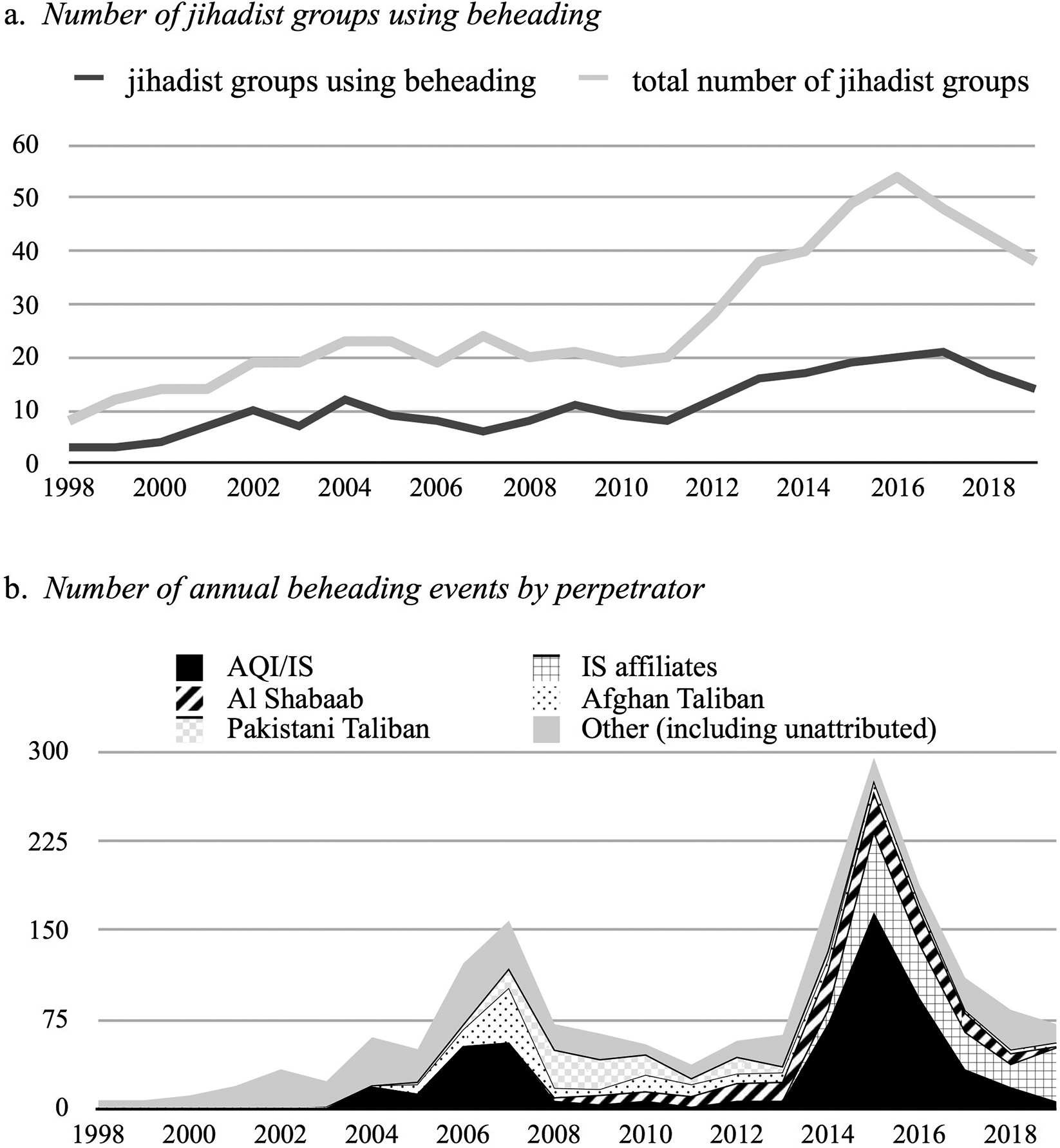
In contrast, as shown in Figure 2, most jihadist groups perpetrate few or no beheadings. The graph depicts the number of organizations that have either made consistent use of beheadings, used them only in individual or isolated cases, or avoided them entirely.
1
Overall, nearly two-thirds of jihadist groups (58 of 93) have perpetrated at least one beheading. Among these, however, nearly half (28 of 58) used beheading only in isolated instances. In other words, over two-thirds of groups (63 of 93) perpetrated few or no beheadings and only a minority have used beheadings as a consistent part of their repertoire of violence. The graph also reports the ideological orientation groups in each category, distinguishing between Salafi-jihadist, Deobandi and Salafist-nationalist groups. Groups in the latter category, which seek to implement Salafi Islamic governance within the limits of the nation-state (Gade et al., 2019: 2083), appear not to make systematic use of beheadings, suggesting that ideology plays a role in shaping jihadist repertoires. At the same time, the graph shows that most Variation in use of beheadings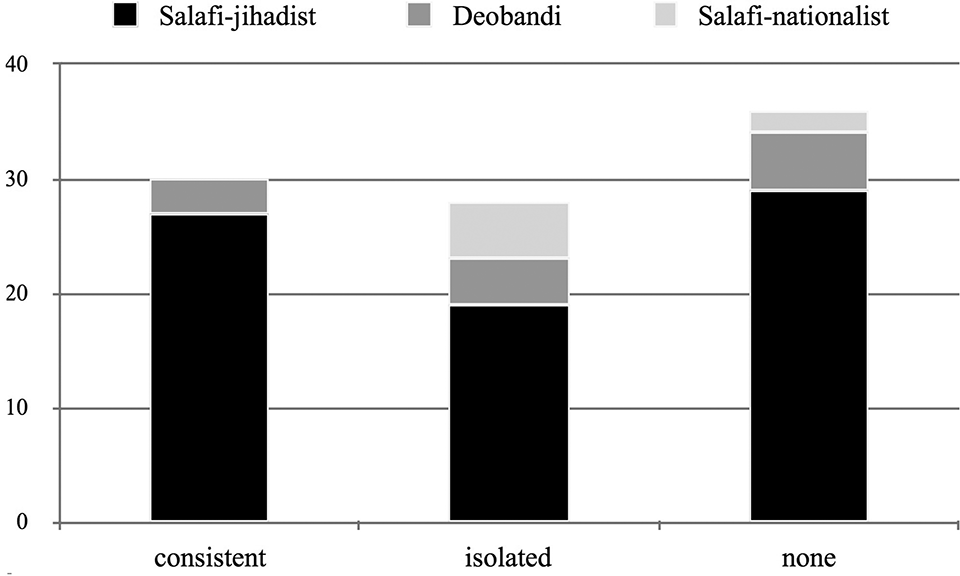
Explaining jihadist beheadings
The variation revealed in Figure 2 confirms the pertinence of the question posed at the outset of this article: why do some jihadist groups make consistent use of beheadings while most do not? In this section I argue that this variation is explained by a combination of local strategic context and transnational ties. While ideology plays an important role in legitimating the practice of beheading, whether specific jihadist groups adopt beheading depends mainly on how they perceive the balance between its strategic usefulness and the costs of employing it.
The role of ideology
Jihadist organizations, perhaps uniquely among contemporary armed groups, frequently provide formal, religious–legal justifications for their use of violence (Ahmad, 2019: 81). ‘For every act of violence’, Maher (2016: 17) notes, jihadist groups ‘will offer some form of reference to scriptural sources – however tenuous, esoteric or contested – to explain their actions’. Regarding beheading, the key scriptural references are two Qur’anic verses (47:4 and 8:12) that instruct the faithful to ‘strike at the neck’ of enemies in war. While these passages are subject to various interpretations, even within the milieu of radical Islamic scholars (Wagemakers, 2014), they are read literally by some jihadist ideologues as a warrant for beheading. Thus, the radical Egyptian cleric Abu Abdullah al-Muhajir, in his influential text on the Jurisprudence of Jihad, uses these passages to provide an explicit defence of beheadings. ‘God’, Muhajir argues, ‘did not only say “kill the infidels”, because the phrase “strike the necks” implies cruelty and severity that the word kill does not denote by itself. The killing was portrayed to be performed in the most dreadful way, namely beheading’. Consequently, according to Muhajir, ‘[b]eheading was intended and even favoured by God and his Prophet, whether objectors like this or not’ (quoted in Al-Zaatari, 2012). Another defence of beheading can be found in The Management of Savagery, an Al-Qaida strategy document published in 2004 under the pseudonym of Abu Bakr Naji. Emphasizing the need for ‘rough violence’ as a means of terrifying and deterring enemies, Naji invoked the example of Islam’s first caliph, Abu Bakr Al-Siddiq, whose orders, according to Naji, emphasized ‘severing the neck without clemency or slowness’ (Naji, 2006: 75).
Such interpretations of Islamic scripture and tradition are wholly rejected by mainstream Islamic scholars (Townsend, 2018). Yet they appear to have been quite influential (Winter & Al-Saud, 2016), effectively making the practice of beheading ‘available’ as a legitimate tactic within the ‘general repertoire’ of the jihadist movement (Tilly, 1986: 4). An analogy can be drawn here to suicide bombing, another key tactic in the jihadist repertoire. Though scholars have argued that the use of suicide attacks is explained in large part by strategic and organizational factors (Pape, 2003; Horowitz, 2010), Moghadam (2011) shows that ideological arguments justifying ‘martyrdom’ in religious terms have played a crucial role in the tactic’s diffusion across jihadist groups. Given jihadists’ concern for religious legitimation noted above, it is difficult to imagine controversial practices such as suicide bombing or beheading spreading among jihadist groups to the degree that they have without the availability of such justifications.
Incentives and constraints on the use of beheading

Strategy and territorial control
Jihadist groups vary in terms of the strategies they adopt. Some engage primarily in clandestine terrorism, operating through networks of small, secretive cells in areas of strong state control (Hansen, 2019: 18–19). Such groups are too weak to seek control over territory, and rely instead on spectacular acts of violence to try to coerce or provoke a desired government response (Duyvesteyn & Fumerton, 2009: 28; de la Calle & Sánchez-Cuenca, 2011: 453). Other jihadist groups opt for a strategy of insurgency, operating primarily in rural areas and seeking to acquire the military power required to actively contest state control over territory and civilian populations (Duyvesteyn & Fumerton, 2009: 28). 2 Most such groups achieve only a semi-territorial presence (Hansen, 2019: 25), temporarily dominating relatively small areas neglected by state security forces, without being able to entirely exclude enemy ground forces from them. Some jihadist insurgents, however, succeed in amassing sufficient military power to establish fully territorial proto-states (Lia, 2015), seizing and ruling over substantial territories and civilian populations.
Groups that embody these three ideal-types face different sets of incentives and constraints on the use of beheading. As summarized in Table I, the key difference, in terms of incentives, is between groups that engage in insurgency and those that rely exclusively on clandestine terrorism. Jihadist insurgents, I argue, have a greater range of incentives to use beheadings than do purely-clandestine groups. Specifically, insurgent groups can use beheadings to achieve three key strategic objectives:
Deterring civilian collaboration with the enemy: unlike purely clandestine groups, which effectively hide from both state security forces and most civilians, insurgent groups often rely on civilian collaboration to ensure their survival against militarily superior counterinsurgent forces. Such collaboration can be obtained through positive incentives (the provision of services or protection) or through coercion, including the selective killing of civilians suspected of collaborating with the enemy. Such killings are often deliberately publicized in order to deter others from ‘defecting’ (Kalyvas, 2006). Many jihadist beheadings can be understood as precisely this kind of exemplary punishment, with their exceedingly gruesome nature helping to amplify their message of deterrence (Kalyvas, 1999: 270). Often, the bodies or heads of victims in such cases are left in public places accompanied by notes accusing victims of being informers for the enemy.
Demoralizing enemy combatants: jihadists can also use beheadings as a form of psychological warfare targeting the enemy’s rank-and-file. Jihadist insurgents from Syria to Nigeria to Libya have sought to ‘deter military confrontations by releasing videos of captured troops being decapitated’ (McGroarty, 2014). One such video, produced in Libya in 2014, featured the victim urging his comrades to ‘go back to their houses or they will face the same destiny: beheading’ (Trew, 2014). At a tactical level, such beheadings are a form of coercion targeting individual enemy soldiers in order to persuade them to flee rather than fight; at an operational level, such coercion forms part of a broader military strategy aimed at undermining enemy cohesion and securing territory (Schelling, 1966: 8). Research on desertion shows that soldiers’ commitment to fight depends in large part on trust in their comrades’ willingness to do the same (McLauchlin, 2020). Beheadings of captured soldiers can undermine such trust, sparking chain-reactions of desertion (Lehmann & Zhukov, 2017).
Attracting ideologically committed recruits: highly publicized beheadings can be used by jihadist organizations to appeal to an international audience of militants and thereby attract new, ideologically committed recruits from abroad. Though there is no direct evidence that beheadings alone attract jihadist foreign fighters, the tactic does form part of a larger repertoire of extreme violence that many foreign recruits find attractive (Katz, 2014). Close observers of IS suggest that its displays of extreme violence played a role in attracting at least some of its many foreign recruits; according to Lister (2015: 298), ‘[t]he publication of gruesome beheadings, mass executions and suicide bombings […] aroused particularly intense levels of excitement – almost a frenzy – within IS’s online support community, some of whom were known to have later travelled to join the group’s fight in Syria and Iraq’.
Importantly, jihadist groups that operate exclusively as clandestine networks generally do not have these same incentives to use beheadings. Because of their overriding need to maintain secrecy, such groups generally function in relative isolation from the surrounding civilian population and are therefore less vulnerable than insurgent groups to civilian defection. Because they primarily employ attacks on ‘soft’ targets and avoid military engagements, fully clandestine groups also have less use for beheading as a means of demoralizing enemy soldiers. Finally, while some clandestine groups may seek to attract foreign fighters, such groups usually have a limited capacity to absorb new members – perhaps especially foreigners – without compromising secrecy. To be sure, clandestine groups may have other reasons to use beheadings, for example, to extort ransom payments for hostages (Lentini & Bakashmar, 2007) or to signal resolve to their opponents (Kydd & Walter, 2006). But these reasons alone are unlikely to lead them to use beheadings in a systematic manner: simple threats of murder against hostages will generally be sufficient to obtain ransom payments; and while beheadings may signal resolve to opponents, they are less effective as a signal of capability given their simplicity and low lethality (Lentini & Bakashmar, 2007: 302).
Jihadist groups vary not only in terms of their incentives to use beheadings, but also in terms of incentives to refrain from such use. An important incentive for restraint has to do with the attitudes of civilians, most of whom are likely to view beheadings as an unacceptably transgressive form of violence, even when used against enemies or alleged collaborators. There is significant evidence that jihadists who use beheadings face a public backlash. In Iraq in 2004–2008, the frequent use of beheadings by AQI undermined support for the group even among Iraqis otherwise supportive of the insurgency (Amnesty International, 2005: 17) and contributed directly to tribal uprisings against the group (Hashim, 2018: 105; Hein, 2018: 114). This backlash was severe enough that Al-Qaida’s leadership eventually called on the group to curtail its use of beheadings in order to avoid losing the ‘hearts and minds’ of ordinary Muslims (Zawahiri’s Letter to Zarqawi, 2005). Since then, some jihadist groups have adopted rules prohibiting beheadings (Clark, 2011: 9), while others have expelled commanders known to use them (Associated Press, 2014). Beheadings have been repeatedly condemned by mainstream Islamic scholars (Stammer, 2004; Open Letter to Dr. Ibrahim Awwad al-Badri, alias ‘Abu Bakr al-Baghdadi,’ and the Fighters and Followers of the Self-Declared ‘Islamic State’, 2014). Public opinion polling shows that IS, the most prolific perpetrator of beheadings, is extremely unpopular among ordinary people across the Arab world and that the proportion of respondents expressing disagreement with IS’s ‘methods’ of violence is consistently larger than that disagreeing with its objectives (Tessler, Robbins & Jamal, 2020), suggesting that even a proportion of individuals that might otherwise be swayed by IS’s ultimate goals are alienated by the extremity of its violence, including beheadings.
Yet not all jihadist organizations are equally constrained by civilian attitudes. Fully clandestine groups, which actively hide from state security forces and from most civilians, should be relatively impervious to civilian discontent. Semi-territorial insurgent groups, on the other hand, are more vulnerable to the loss of civilian support. Such groups seek to avoid detection by government forces primarily by basing themselves in remote rural areas in which they engage in activities (recruitment, training and stockpiling of arms and supplies) that are at least partially visible to local civilians (Lewis, 2020: 38). They therefore rely on civilians to withhold information about their activities from counterinsurgent forces (Berman, Felter & Shapiro, 2018). Given their weak territorial control, the ability of semi-territorial insurgents to obtain civilian collaboration through coercion is limited. Continued government access to the regions in which these groups operate creates opportunities for civilians unhappy about insurgent excesses to act against them, whether by supplying information to counterinsurgents or enlisting in counterinsurgent-organized militias. Knowing this, semi-territorial insurgents should generally refrain from overtly transgressive behaviours, such as beheadings, to maintain civilian support.
Crucially, however, this constraint on beheadings should weaken as jihadists’ control over territory becomes stronger. Organizations that exercise more extensive territorial control should be generally less concerned about civilians’ ‘attitudinal’ support given their ability to generate ‘behavioural’ support by means of coercion (Kalyvas, 2006). Civilians living under jihadist control may still be outraged by beheadings, but will have fewer opportunities to act on this outrage. At the limit, complete jihadist control would eliminate the prospect of civilian defection entirely, making beheadings of civilian defectors unnecessary (though use of beheadings to demoralize enemy combatants and attract foreign supporters might continue). In practice, however, jihadist territorial control is rarely if ever complete. Jihadist ‘proto-states’ typically attract external intervention (Lia, 2015), including intervention involving the use of drones and other capabilities that rely on networks of local informers for targeting information (Ackerman, 2010). Thus, even jihadists with significant territorial control will have incentives to use beheadings to deter civilian collaboration with their enemies, while being simultaneously less restrained in doing so than insurgents with a more tenuous territorial presence.
Hypothesis 1: Jihadist groups that operate as clandestine networks will be least likely to make consistent use of beheadings, while jihadist insurgent groups that exercise substantial territorial control will be most likely to do so.
Transnational ties
Jihadists’ responsiveness to civilian attitudes may also be influenced by the extent to which they prioritize transnational ties. While jihadist groups are often thought of as part of a larger ‘global jihadist movement,’ not all jihadist groups are equally oriented towards a global agenda. Many, in fact, prioritize local ties (Thurston, 2020). All else being equal, jihadists with a more local focus are likely to be more responsive to civilian attitudes, and therefore more constrained by civilian disapproval of beheadings. More ‘transnationalized’ groups, in contrast, should be less concerned with civilian attitudes given their ability to mobilize support from abroad.
Jihadist ‘transnationalization’ can take various forms, from reliance on foreign funding and the recruitment of foreign fighters to the adoption of transnational ideological frames (Harpviken, 2012). One indicator of a given jihadist group’s prioritization of transnational ties is its decision to seek formal affiliation with a transnational ‘parent’ organization, whether Al-Qaida Central (AQC) or IS. Groups that formally pledge allegiance (bay’ah) to a transnational patron can, if their pledge is accepted by the latter, obtain a variety of benefits, including access to resources, personnel, expertise and publicity (Moghadam, 2017: 20–25). If these benefits are substantial enough, the decision to seek transnational affiliation can orient an organization increasingly towards behaviour calculated to win and maintain the favour of its patron, even at the cost of alienating locals.
When a transnational patron group itself uses or endorses beheadings, groups seeking affiliation with that patron will have an incentive to adopt beheading as a means of signalling their commitment to the new alliance. The clearest examples of such behaviour come from groups that have joined IS’s global ‘caliphate’ since 2014. Many such groups, in Algeria, Egypt, Mozambique and elsewhere, began perpetrating highly publicized beheadings at the same time as they began to seek affiliation with IS (BBC News, 2014; Georgy, 2014). Some would-be IS affiliates have reportedly filmed and sent recordings of their atrocities directly to IS in order to demonstrate ‘accountability’ (Jadoon, Jahanbani & Willis, 2020: 37). Yet IS is not the only transnational jihadist group that has promoted beheadings. In the years following the 9/11 attacks, beheadings were identified with Al-Qaida’s global ‘brand’. High-level AQC officials personally participated in filmed beheadings (MacAskill, 2007) and the organization readily accepted pledges of allegiance from jihadist organizations known to use such violence. Though, as noted above, AQC leaders eventually criticized the highly publicized beheadings of foreign hostages in Iraq, AQC itself produced at least one beheading video in Pakistan as late as 2008 (Jackson, 2015: 55). It was only in 2009 that AQC officially adopted a policy against filmed beheadings (Kendall, 2016: 106), and only in 2013, following the group’s split with IS, that it finally condemned beheadings as a whole (Callimachi, 2014). For organizations seeking affiliation with AQC prior to 2013, as for groups seeking to join IS’s ‘caliphate’ since 2014, the use of beheadings could serve as a means of signalling their commitment to the global jihadist cause.
Hypothesis 2a: Jihadist groups pledging allegiance to IS will be more likely than other jihadist groups to perpetrate beheadings.
Hypothesis 2b: Jihadist groups pledging allegiance to AQC before its split from IS in 2013 will be more likely than other jihadist groups to perpetrate beheadings.
Empirical analysis
Data
In order test my hypotheses, I collected original data on jihadist beheadings perpetrated between 1998 and 2019. My dataset includes all jihadist groups in the Global Terrorism Database (LaFree & Dugan, 2007) that reached a minimal threshold of armed activity. 3 Data on beheadings were collected using a variety of sources, including: existing cross-national and conflict-specific event datasets; governmental, inter-governmental and non-governmental human rights reports; press reports; secondary literature; and other sources.
The resulting database contains information on 93 jihadist organizations active in 566 group-years, and records 1,758 distinct beheading events resulting in at least 4,423 individual victims. Just over 200 of the events reported in the dataset cannot be reliably attributed to a specific group, though there are good reasons to believe that they were perpetrated by jihadist groups. 4 Excluding these leaves over 1,500 beheading events that can be reliably attributed to specific perpetrators. Below, I use these to explore patterns in victimization and to systematically test my theoretical expectations about the relationship between beheading, strategy, territorial control and transnational ties.
Patterns of victimization
Patterns of victimization
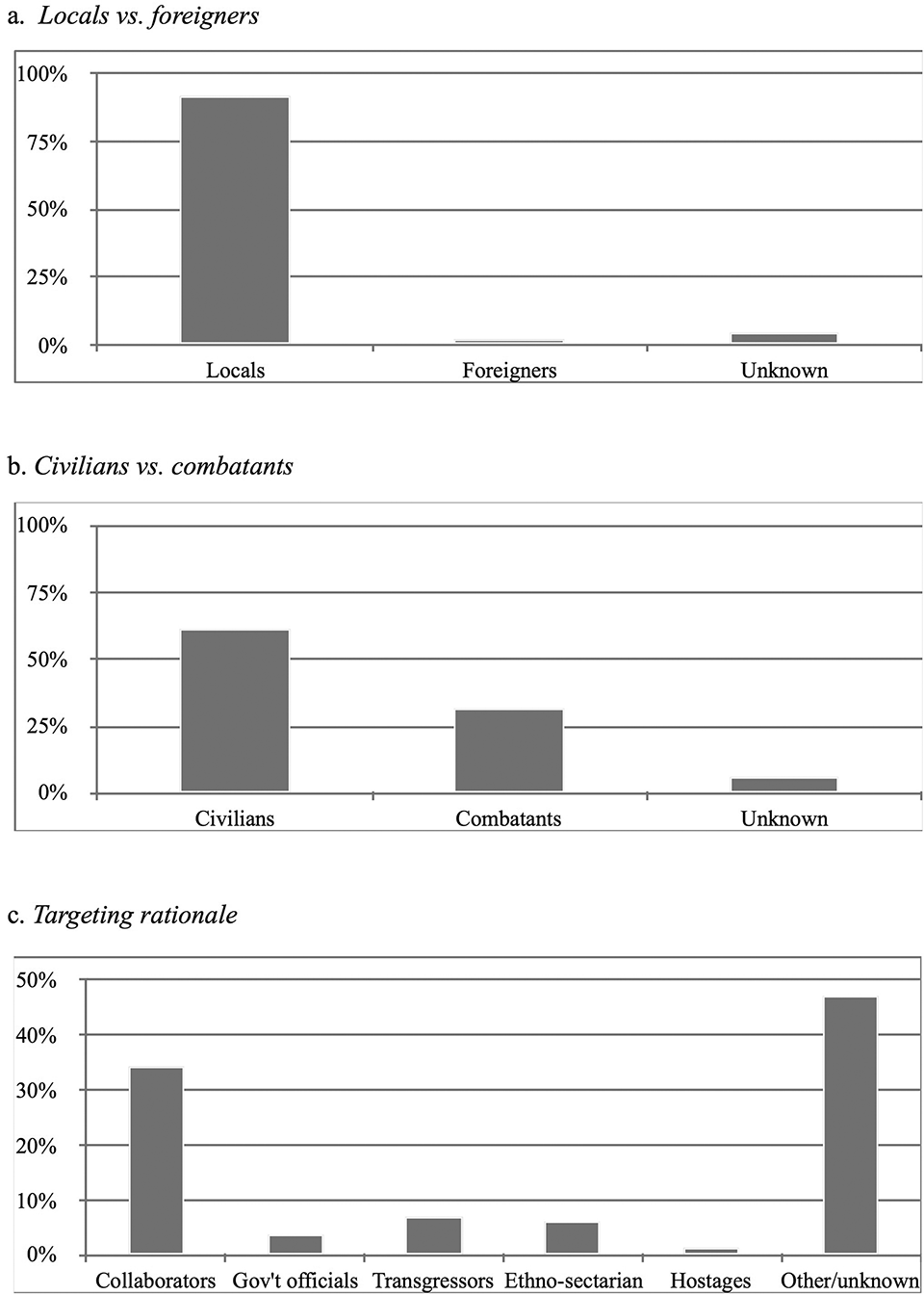
As a first step in assessing my theory, I use my data to examine patterns in targeting at the level of individual victims. I first categorize all beheading victims as either ‘locals’ (nationals or long-term residents of the countries in which their killers were based) or ‘foreigners’ (individuals killed after travelling to another country). As shown in Figure 3a, I find that an overwhelming majority (over 90%) of beheading victims since 1998 have been ‘locals’. While this finding confirms a broader pattern, whereby the majority of victims of jihadist violence are fellow Muslims, it contrasts sharply with the overwhelming focus in Western news media coverage on the beheadings of foreign hostages.
Second, I further disaggregate the category of local victims according to their status as combatants or civilians. As Figure 3b shows, I find that civilians have been the primary targets of jihadist beheadings, accounting for over 60% of all local victims. Yet I also find that nearly a third of local victims are combatants. This relatively frequent targeting of combatants is consistent with the argument that beheadings are used in part as a means of demoralizing enemy fighters.
Filmed or photographed beheadings
Finally, I categorize local civilian victims according to the rationale for their murder, distinguishing between those accused of espionage or other forms of collaboration with the enemy, those working as government officials or employees, those accused of ‘moral’ transgressions (e.g., blasphemy or sorcery), those targeted for their ethno-sectarian identity and those beheaded in the context of hostage-taking. As Figure 3c shows, the largest category of victims by far among those for whom a targeting rationale is known consists of civilians accused of collaborating with the enemy. This is consistent with the argument that jihadists use beheadings in large part to deter civilian defection in the context of insurgency.
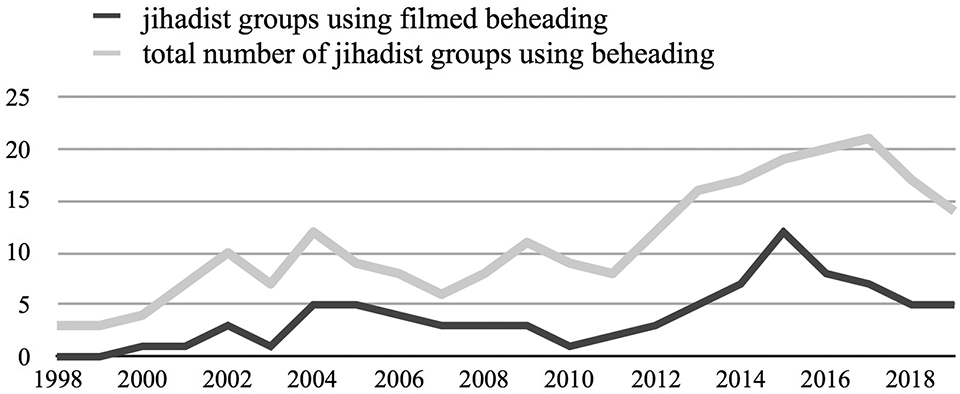
Taken together, the patterns in Figure 3 suggest that jihadist beheadings should be understood primarily as a tactic of intimidation targeting local enemies and their perceived collaborators. At the same time, even ‘local’ beheadings can have a transnational dimension. Figure 4 charts the number of jihadist groups that have filmed or photographed beheadings and disseminated them on the Internet. This number has grown substantially since 2010, indicating that a growing number of jihadist groups aim to make their violence visible beyond a strictly local audience. This is consistent with the argument that jihadist beheadings serve in part to advertise the perpetrator group to potential transnational supporters.
Statistical analysis: Variables and measurement
In order to directly test my hypotheses, I now examine patterns in the use of beheading at the level of the group-year. My main dependent variable measures whether a given jihadist group adopted beheading as a consistent part of its repertoire of violence in each year. I consider beheadings to be a consistent part of a group’s repertoire when two conditions are met: (a) the organization perpetrates multiple beheadings in each year; and (b) it publicly acknowledges using beheadings through an official statement or media release. I assume that recurrent and acknowledged use of beheading indicates that a group has adopted the practice of beheading as a matter of organizational policy. In contrast, isolated or unclaimed beheadings may occur even in the absence of such a policy, either because leaders exercise weak control over rank-and-file combatants, or because they authorize a single case of beheading before reconsidering. In total, 18.6% of group-years in my dataset feature recurrent and claimed beheadings.
For my first set of independent variables, I adopt Hansen’s (2019) typology of territorial presence, distinguishing between four types of jihadist groups. I code as clandestine networks groups that function entirely ‘underground’, organized in small cells that operate primarily in urban areas and engage in classic ‘terrorist’ tactics (bombings, assassinations and hostage-taking) requiring only small numbers of attackers (de la Calle & Sánchez-Cuenca, 2011: 455). I code as semi-territorial insurgents groups that establish a presence in rural areas and engage in attacks on state security forces using classic ‘guerrilla’ tactics (ambushes, raids, etc.) but exercise only limited territorial control (Hansen, 2019: 25). I code as jihadist proto-states insurgent groups that control substantial amounts of territory and actively rule over significant numbers of civilians. Finally, I code some groups as having what Hansen (2019: 23) calls an accepted presence: such groups operate openly on territory controlled by another entity that tolerates or promotes their activities. Because individual jihadist groups sometimes combine several forms of territorial presence simultaneously, I code each group’s dominant form of territorial presence in each year.
In order to test for the effects of transnational ties, I code which jihadist groups pledged allegiance to AQC or IS and when. I code a group as having pledged allegiance to AQC or IS beginning in the first year in which its leaders are known to have made bay’ah to either organization, regardless of whether the pledge was officially recognized or not by the ‘parent’ organization. I hypothesize that even unrecognized pledges reflect a more transnational orientation and are likely to impact a group’s repertoire of violence. For pledges of allegiance of AQC, I distinguish between groups that had a pledge of allegiance prior to Al-Qaida’s split from IS (AQC pre-2013) and those with a pledge after this split (AQC post-2013). Once a group has pledged allegiance to either AQC or IS, I code it as continuously ‘pledged’ unless it formally disaffiliates itself from its transnational patron (e.g., ISIS in 2013 and Hayat Tahrir al-Sham in 2016).
I also code variables to control for potential confounders. First, I measure the number of jihadist groups operating in a given conflict-zone in each year. 5 Rivalry among jihadists may lead to recurrent beheadings through a dynamic of ‘outbidding’ as organizations adopt more radical tactics to differentiate themselves from competing groups (Conrad & Greene, 2015). Rivalry may also push groups to attempt to seize territory in order ‘to increase [their] influence and weight vis-à-vis competitors’ (Lia, 2015: 36). Second, I code whether a jihadist organization fought against predominantly non-Muslim military forces in each year. Groups perceived as resisting occupation by non-Muslims may be more attractive as affiliates to both Al-Qaida and IS and may also be more likely to use beheadings if they take literally the Qur’anic injunction to ‘strike at the neck’ when meeting ‘unbelievers’ in battle. Third, I code whether a jihadist group was active in a country that experienced regime change in the previous five years. Changes of regime, whether provoked by foreign intervention, coups d’états, or popular uprisings, can weaken state control over territory, thus facilitating jihadist insurgency and state-building. Regime change can also incentivize the use of beheadings to disrupt the stabilization of a new government (Lentini & Bakashmar, 2007: 316). Fourth, I code organizational age, which may be positively correlated with the ability to seize territory, but may inhibit the adoption of innovative tactics, such as beheading (Horowitz, 2010). Finally, I code an ordinal variable indicating approximate group size. Larger groups may be more likely to perpetrate recurrent beheadings (if the sheer number of fighters in an organization undermines its ability to control them), more likely to seize control of territory and more likely to attract transnational allies.
Summary statistics for all variables are provided in the Online appendix.
Statistical results
Table II presents the results of a series of logistic regression models estimating the effect of my predictors on beheading. Because Salafist-nationalist groups appear not to make consistent use of beheading, these groups are excluded from all analyses. Models 1–6 pool observations from all remaining group-years in the dataset, while Models 7–9 use information from only those groups that made consistent use of beheading in at least one year and include group fixed effects to control for unobserved confounders. All models are estimated with group-clustered standard errors to account for intra-group dependence among observations. Pooled models account for time dependence using cubic polynomial time terms (Carter & Signorino, 2010).
Model 1 in Table II estimates the effect of territorial presence on beheading, without controlling for confounders. Because accepted presence perfectly predicts non-use of beheadings, group-years with this form of territorial presence are automatically dropped from this and all subsequent models. Coefficients associated with clandestine network and proto-state represent the estimated effect of these forms of territorial presence relative to semi-territorial presence, which is the reference category. The results are consistent with Hypothesis 1: the coefficient for clandestine network is negative and statistically significant at conventional levels, while that for proto-state is statistically significant and positive, suggesting that fully clandestine groups are less likely to use beheading than semi-territorial groups, while fully territorial groups are more likely to do so.
Model 2 adds to the basic specification all control variables with exception of group size, which is not available for all groups. The direction and statistical significance of the coefficients for clandestine network and proto-state remain largely unchanged. Model 3 adds the variable for group size. While the results for clandestine network remain largely unchanged in this model, the coefficient for proto-state is no longer statistically significant. 6 This is not entirely surprising given that group size and territorial control are highly correlated (small groups almost never control substantial territories). In order to separate out the effects of these two variables, Model 4 drops all small groups (under a thousand members) from the analysis and again estimates the effects of territorial presence on beheading. Here the coefficient for proto-state is positive and statistically significant, while that for group size is no longer statistically significant. This suggests that the effect of territorial control on beheading is not simply a function of groups size: among jihadist groups large enough to control substantial amounts of territory, exercising territorial control increases the probability of beheadings. Given that group size is likely to be partly endogenous to territorial control (groups controlling territory have a greater ability to recruit fighters), I omit this variable from the remaining pooled models to avoid post-treatment bias.
Correlates of beheading
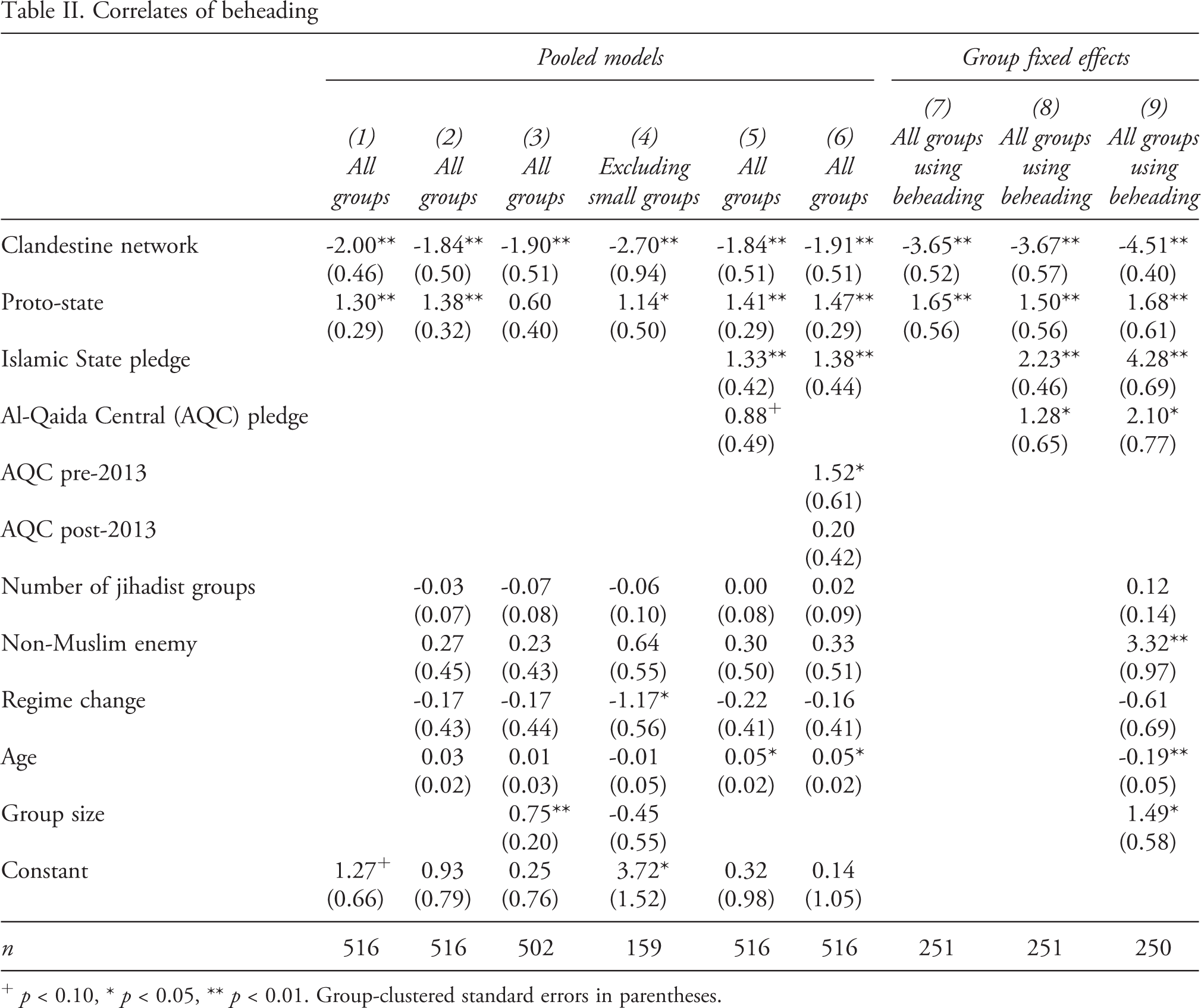
+ p < 0.10, * p < 0.05, ** p < 0.01. Group-clustered standard errors in parentheses.
Figure 5 uses the results of Model 6 to estimate changes in predicted probability of beheading given different values of my main predictors. Figure 5a compares the predicted probability of beheading for different types of territorial presence, holding all other covariates at their mean values. It shows that the probability of beheading increases from 4% among clandestine networks, to 19% among semi-territorial insurgent group, and to 43% among proto-states. Figures 5b and 5c depict changes in the predicted probability of beheading when comparing groups that pledged and did not pledge allegiance to Al-Qaida in the pre-2013 period or to IS. In both cases, I find that a pledge of allegiance to a transnational ‘patron’ more than doubles the probability of a jihadist group making recurrent use of beheadings. Overall, these estimates suggest that my predictors have a substantively significant effect on the use of beheading.
The models examined so far do not control for unobserved group-level characteristics that might simultaneously affect jihadist groups’ use of beheadings and their territorial presence or transnational ties. Models 7–9 therefore use group-level fixed effects to control for time-invariant, group-specific confounders while estimating the effects of Changes in predicted probability of beheading (predictive margins with 95% confidence intervals)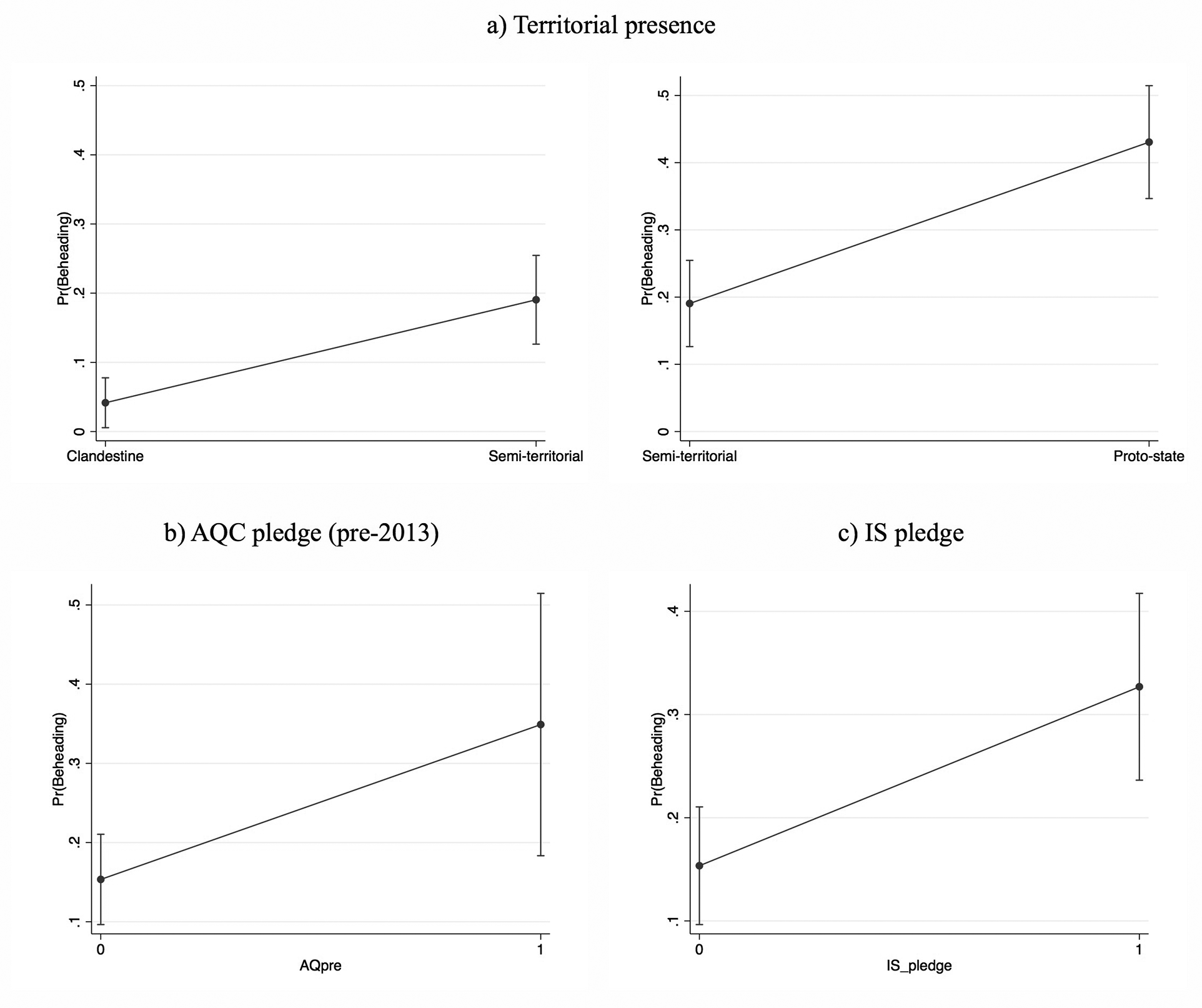
Robustness checks and additional analyses
The Online appendix includes several robustness checks and additional analyses. First, I re-estimate the models presented in Table II while excluding all observations for IS, arguably an extreme case (high on territorial control and beheadings). Second, to address the possibility that beheadings are a cause of territorial control, rather than its consequence, I re-estimate the models while omitting observations corresponding to the first year in which jihadist groups exercised full territorial control. 7 Third, to ensure that my findings are not biased by missing information, I replicate the analyses while dropping observations from groups active in countries and years in which my data report a large number of ‘unattributed’ jihadist beheading events (India between 2001 and 2007, Iraq between 2004 and 2008 and Pakistan between 2006 and 2011). Fourth, I re-estimate the models with Salafist-nationalist groups included in the analysis. Fifth, I re-estimate the models with groups coded as having an accepted presence included in the reference category for the variable measuring territorial presence.
Finally, I examine out-of-sample predictive power, using the results of Model 6 to conduct four-fold cross-validation (Ward, Greenhill & Bakke, 2010). The findings indicate that inclusion of information on territorial presence and transnational ties significantly improves the ability of the model to predict jihadist beheadings.
Conclusion
Though beheadings have become a signature tactic of the global jihadist movement, most jihadist groups perpetrate few or no beheadings. Only a minority of jihadists adopt beheading as a consistent part of their repertoire of violence. Their decision to do so, I argue, is shaped by local strategic context and transnational ties. For jihadists involved in insurgency, beheadings are strategically useful as a means of intimidating enemies and suspected collaborators. In the words of a 2011 manual issued by the Haqqani network in Afghanistan: ‘The easy way to kill infidels and their spies is beheading. The human breath is quickly discharged from the body, and [beheading] has a psychologically terrifying effect on our enemies’ (Roggio, 2011). Beheadings, particularly those filmed and distributed over the Internet, can also be used to attract foreign recruits. Yet jihadist groups must weigh the potential strategic benefits of beheading against the tendency of extreme violence to alienate potential civilian supporters. How they balance these costs and benefits is shaped by the extent to which they control territory and seek support from transnational allies.
These findings have several implications for how we understand jihadist groups. First, they significantly qualify interpretations of jihadist violence that foreground its ideological or religious character (Wood, 2015). Religious ideology may provide a template or ‘legitimizing script’ (Cottee, 2017) for certain forms of violence, but the repertoires of specific jihadist groups appear to be shaped primarily by strategic calculations. Second, my findings suggest that, for many jihadist groups, the relevant strategic context is that of insurgency, rather than terrorism (Kalyvas, 2018). Theories developed to explain jihadists’ behaviour in one context may not apply automatically in the other. Thus, for example, transnational terrorism is sometimes theorized as a form of costly signalling by relatively weak groups vis-à-vis far more powerful states (Kydd & Walter, 2006). Yet states do not appear to be the main audience for jihadist beheadings. Instead, these are used primarily to influence the behaviour of individuals (local civilians, enemy soldiers and potential foreign recruits) whose decisions are crucial to insurgent success. Finally, my article highlights how jihadist violence addresses both local and transnational audiences and suggests that this dual orientation creates contradictory pressures on jihadist groups: violent techniques such as beheading that appeal to potential transnational supporters can severely alienate locals. How jihadist groups navigate this trade-off, and why some seek to build local legitimacy while others prioritize transnational connections, is a promising topic for future research.
Footnotes
Replication data

Acknowledgments
I thank Lee JM Seymour, Theodore McLauchlin, Marie-Joëlle Zahar, Arthur Stein, Simon Pierre Boulanger Martel, Marc-Olivier Cantin, Daniel Solomon and three anonymous reviewers for helpful comments.
Funding
The author received financial support for the research, authorship, and/or publication of this article: This research was supported by the Social Sciences and Humanities Research Council of Canada and the Canada Research Chair in the Politics of Violence.