




Abstract
Much of the literature on victimization looks at the effect of organized violence (OV) on civilian perceptions and behaviour. Yet citizens in countries experience quotidian crime (QC) on a daily basis. QC differs from OV, the former being more isolated, while the latter is more of a collective experience. As such we develop a theoretical framework that explores the effects of both types of violence on preferences for public goods. Victims of OV may prefer welfare public goods for the entire community, whereas victims of QC may prefer security for themselves. We also test the effects of compound victimization on public goods’ preferences. We use original survey data from rural Liberia to test our hypotheses and find support for our argument. Our results show the importance of a disaggregated approach to understanding the effects of violence on preferences.
Introduction
In a village in Liberia, a woman complains to the village elders about her husband beating her. In the same village, the village elders hear complaints about a thief who has been stealing goats from different farms, and they hear about a fight that broke out between neighbours who were quarrelling over property lines. 1 These ‘petty’ or everyday crimes – what we call quotidian crime (QC) (Lake, 2022) – are typical of any society and they stand in contrast to organized criminal violence (Barnes, 2017; Nussio, 2019) and wartime victimization (Carpenter, 2005; Valentino, 2014).
The literature largely focuses on the effects of victimization from organized violence (OV) – violence exerted by a group, be that a drug cartel or a rebel group. While support for democracy and interpersonal trust decrease after the experience of violence (Fernandez & Kuenzi, 2010; Carreras & Bowler, 2019), apart from a few exceptions (Ley, 2018), the consensus of this literature is that victimization leads to increased political participation (Bellows & Miguel, 2009; Bateson, 2012; Dorff, 2017; Berens & Dallendörfer, 2019), increased pro-sociality and collective action (Bellows & Miguel, 2009; Balcells, 2012; Voors et al., 2012; Gilligan, Pasquale & Samii, 2013; Beber, Roessler & Scacco, 2014; Bauer et al., 2016). Only one study distinguishes quotidian, or what the author calls `common delinquency,' from wartime violence quotidian, or what the author calls ‘common delinquency,’ from wartime violence in Colombia and finds that conflict and crime victims show elevated levels of participation in social organizations (Nussio, 2019).
We argue that quotidian violence and OV differ when it comes to the perpetrator, target, motive and severity of the violence. These differences in victimization lead to variation in preferences for public goods for the individual or for the community. Different types of victimization may thus shift priorities over the type of public good the state provides.
Quotidian crime is often smaller in scale and less lethal than OV. In many contexts, it usually involves individual attacks, making the crime less political, more personal and isolating. Thus, because of the personal nature of QC, victims exhibit a desire for individualistic restorative justice (Johnson, 2009), including for punitive measures and enhanced security. In contrast, OV is usually more political and lethal, and is inflicted by groups on other groups. Violence occurs because an individual is associated with a group (rightly or wrongly) – those who experience the violence share that experience. As such, this type of victimization is more likely to create preferences for welfare public goods that improve social well-being for the community due to the collective nature of the violence.
Moreover, because there is less literature on compound victimization – that is, experiences of both OV and QC – we also provide several theory building hypotheses and test them here. We explore the conditional effects of QC victimization on war victimization to better understand how multiple and different types of victimization affect public goods preferences. Our insights demonstrate the importance of including those who have experienced compound victimization as a part of theories related to the effects of victimization.
We analyse public goods preferences with original survey data from one of the most rural counties in Liberia, collected in 2015. Comparing the types of victimization and distinguishing if the victim prefers the good for him/herself or the community, we find support for our argument that QC victims value investment in security measures whereas victims of OV are more supportive of social protection and basic public goods such as water, food or electricity. We find that these preferences for public goods largely remained individualistic – respondents wanted the good for themselves – despite the type of victimization. We also find some support that compound victimization leads to neither a preference for security nor welfare public goods.
Understanding the effect of different forms of violence on preferences for goods and services is important for a number of reasons. First, while distributive politics are always conflictual, creating beneficiaries and losers, voters need to be able to form majorities and agree on public policies. However, if different forms of violence shape preferences in different ways, then political discourse can become more polarized. This is particularly worrisome for post-conflict societies that are still coping with cleavages from the past and where quarrels over the provision of public goods and investment in public policies can be detrimental for the healing process. While the literature on war and organized crime victimization scrutinizes their effects on political engagement and cooperative behaviour, we still know little about how victimization influences the choice of public goods. In other words, victimization might increase political participation, but it increases activism for some goods not others.
Moreover, the civil war literature has placed less emphasis on QC and compound victimization even though crime accompanies civil conflict (with the exception of Nussio (2019)). However, some scholars have begun to theorize about the intersections of crime and conflict. Similar to and building on the work of Neumayer (2003), Kalyvas (2015), Rivera (2016), and Barnes (2017), we theorize a divide between QC and OV, rather than between ‘crime’ and ‘conflict.’ This re-orientation helps to conceptualize the differential effects of violence on various outcomes.
Variation in preferences for public goods
Distributive conflicts are at the heart of politics, but only recently has the literature started to address trade-offs (Häusermann, Kurer & Traber, 2019). We expect individuals to hold different views about public goods depending on the type of violence experienced. We propose that public goods preferences vary by the degree to which the good is socially welfare maximizing. Moreover, we analyse whether individuals prefer the public good for themselves or for the community.
Governments provide a range of goods and services, but some of these goods are considered more welfare-oriented and re-distributive than others. Following the classical typology of Lowi (1972), public policies can be classified into distributive, constituent, regulatory and redistributive policies. Social protection goods or policies related to healthcare, cash transfers, public housing (all considered as social consumption, see Häusermann, Kurer & Traber (2019)) and education (classified as social investment) are traditionally considered to maximize social protection and fall into the category of redistributive policies. In contrast, basic public goods, security and infrastructure are not considered a part of the welfare state, but fall into the categories of distributive (basic goods and infrastructure) and regulatory policies (security). Although all of these goods can be welfare maximizing in an economic sense (apart from possible distortionary effects of taxation), redistributive policies are more welfare maximizing in terms of social protection. Social investment policies are conceptualized as the most social welfare maximizing (Häusermann, Kurer & Traber, 2019). From a theoretical perspective, regulatory policies such as security fall on the other side of this spectrum. What criminologists have identified as the ‘penal–welfare nexus,’ describes a trade-off between prisons and welfare. Security policy serves as an alternative strategy to the welfare state to improve social control and to govern the ‘socially marginal’ (Beckett & Western, 2001: 44). Greater emphasis on penal policies can be found in ‘typically more individualistic’ liberal market economies (Lacey, Soskice & Hope, 2018: 206). Social and penal policies, thus, represent two opposite approaches to manage poverty – either through the provision of welfare or by locking people up (Wacquant, 2009). 2
Because government budgets are resource constrained, policymakers must decide how to allocate resources, which naturally entails conflicting interests about the investment of public resources in these different policy fields. Infrastructure, security and basic public goods are usually indispensable among voters in most countries. They allow a state to function. Investments in redistributive policies, however, such as public schools, hospitals and housing raise distributive conflicts. They are often less universally accepted, because they do not benefit everyone equally and can be privatized. Given fixed budgets and these tradeoffs, we expect preferences over which type of public goods to be provided to vary by individuals and one factor that determines these preferences are people’s particular experience with violence.
The impact of different types of victimization on politics
Violence influences not only the individual, but the decisions he or she makes, and can have long-lasting, inter-generational effects (Balcells, 2012). Even after decades, individuals still show characteristics associated with violent experiences, as the trauma is transmitted through family ties.
Despite legacies of victimization, the political science literature is somewhat split on how violence affects individual behaviour and attitudes: it finds both negative and positive effects on political engagement and policy preferences with the bulk of research centring on the consequences of OV. Some research shows that organized criminal violence can suppress political activism (Carreras & Trelles, 2012; Ley, 2018), reduce vertical and horizontal trust (Brehm & Rahn, 1997; Rozenas, Schutte & Zhukov, 2017; Carreras & Bowler, 2019) and affect preferences for public policies (Altamirano, Berens & Ley, 2020). Individuals exposed to violence in a democratic regime often develop (or re-develop) authoritarian values (Cruz & Kloppe-Santamaría, 2019). Notably, crime victimization and perception increase support for stricter penal policies (Bateson, 2012; Visconti, 2020) or even support for extra-judicial activities (Johnson, 2009; Cruz & Kloppe-Santamaría, 2019; García-Ponce, Young & Zeitzoff, 2022). Additional research shows that the effect of victimization on political participation is conditioned by social networks (Dorff, 2017).
Insights from psychology suggest that the negative behaviour and attitudes occur because victimization can increase apathy and loss of self-esteem (Peterson & Seligman, 1983; Macmillan, 2001). Victims might experience various physical and psychological symptoms such as fearfulness, anxiety, or depression (Miller & Rasmussen, 2010). Thus, victimization leads to a sense of alienation and individualism that may map onto political behaviour and public policy preferences.
While there is some literature that shows how victimization leads to negative coping mechanisms, the literature on the effects of war victimization largely finds that it enhances political participation, cooperative behaviour, collective action, and pro-social attitudes and behaviour (Blattman, 2009; Bellows & Miguel, 2009; Blattman & Miguel, 2010; Voors et al., 2012; Gilligan, Pasquale & Samii, 2013; Mironova & Whitt, 2016). Gneezy & Fessler (2011) explore how exposure to violence affects individual engagement in enforcing norms to induce cooperative behaviour within the group. Similarly, experiencing (organized) criminal violence increases non-electoral political engagement, such as taking part in community meetings and protests, and correlates with greater interest in politics (Bateson, 2012). Because victimization through organized crime can be a ‘relational process,’ in which victims and perpetrators interact repeatedly, victims find ways of resistance even in such ongoing relationships (Kaplan, 2017; Moncada, 2020: 2).
Thus, on the one hand, victimization might lead to isolation and individualistic preferences. On the other hand, victimization may lead to collective healing strategies, action and preferences. We build on both of these insights and suggest that the difference in the findings might be due to the type of violence that individuals experience. Moreover, we suggest that victimization not only affects the level of political activism, but also the preferences for different types of goods and services for which individuals may be politically active in the first place.
The impact of different types of victimization on public good preferences
Following in the footsteps of Kalyvas (2015, 2019), Barnes (2017), and Nussio (2019), we argue that differences in types of violence are likely to affect political outcomes in different ways. Specifically, we argue that organized crime and QC differ with respect to the perpetrator and target, motive and the severity of the violence.
First, OV involves violence against a group of people, or against an individual because he or she is associated with a group – rightly or wrongly. The organized group perpetrates violence to achieve some stated goal. These groups can be insurgent, rebel, terrorist, or criminal groups. Importantly, the group that commits violence is usually an outsider. External organized groups inflict violence on areas outside of where they originate in order to gain more turf or territory. The ‘outside’ nature of attacks often solidifies community in-group cohesion among those being attacked (Beber, Roessler & Scacco, 2014; Kaplan, 2017). It makes members of the community band together against the external perpetrator and more unified in either resistance or cooperation (Kaplan, 2017; Krakowski, 2020). When victimization by OV is a repeated act, such as through racketeering, victims develop strategies of every-day resistance within their community (Moncada, 2020). The violence reifies a collective struggle, which continues into the post-conflict period. The ‘in-group’ community engages in collective healing. This collective healing can even extend to non-victims as well (Balcells, Palanza & Voytas, 2022). They commiserate with one another as they overcome the trauma.
In contrast, QC involves petty crimes by individuals or groups who lack cohesive identity. The perpetrator is often from within the community. He or she is usually an insider or in-group member. This is because the perpetrator must have some familiarity with the community in order to perpetrate the crime. 3
Second, motives may differ. While the stated goal for organized criminal groups is usually economic, and the stated objective for insurgent/rebel/terrorist groups is usually political, there is overlap in goals (Kalyvas, 2015). Some organized criminal groups pursue political ends such as control over territory or fully co-opt the government (i.e., drug cartels in Mexico, see Trejo & Ley (2019) or electoral violence in Italy (Alesina, Piccolo & Pinotti, 2019)), and some insurgent/rebel/terrorist groups pursue economic objectives such as production of illicit drugs (i.e., the Taliban in Afghanistan and opium production). Thus, at times a false dichotomy exists between organized crime and conflict, but both pursue larger goals. QC, on the other hand, is committed based on individual motivation and not to achieve a collective economic or political outcome. QC includes everything from murder, theft, arson, assault and/or abuse (Blair, Blattman & Hartman, 2017). It is usually against another individual, not because he or she is a member of a group, but because he or she has something of value that the perpetrator wants.
Third, OV is perpetrated at a much larger scale and involves the direct targeting of civilians and/or government. The goal of the violence is to inflict cost on the government and this means that the violence is often lethal (Valentino, 2014). As such, collective violence is more impersonal, but more violent. Compared to OV, the scale and lethality of QC is much lower than OV. Incidents usually happen to one person, not an entire community, so that fewer people are affected. QC is also unlikely to involve mass killings, genocide and large-scale rape, which are much more common when violence is organized (Pettersson & Öberg, 2020).
These differences in the types of violence are likely to lead to variation in individual experiences with victimization. Victims often experience QC as an isolating, personal event (LeJeune & Alex, 1973). Specifically, the personalized nature of QC, the small-scale motives of the perpetrator and the lower intensity of violence might have two consequences on preference formation about public goods. First, individuals may prefer harsher penalties against someone who has personally attacked them. This is because the crime is directed at the individual and not the collective. As such, they value policies that take on a more punitive characteristic (Garca-Ponce, Young & Zeitzoff, 2022) and ones that strengthen the state against crime (Holland, 2013; Cruz & Kloppe-Santamaría, 2019; Visconti, 2020).
4
García-Ponce, Young & Zeitzoff (2022) find that experience of violence raises anger and therefore, the desire for tougher penal policies. Empirical evidence shows that victims are more supportive of right-wing incumbents and those who promote iron fist policies to fight spiralling crime rates (Holland, 2013; Visconti, 2020). It is also petty, rather than organized crime, that raises the victim’s willingness to voice individual political demands (Berens & Dallendörfer, 2019). Second, when individuals experience QC, they may be more concerned with their own needs rather than about social welfare and the community. Because the crime happened to only them, victims turn individualistic in their preference formation process. We, thus hypothesize that QC victims will be more likely to value public goods that improve security and they are more likely to value such measures for themselves rather than for the community.
In contrast, the collective nature of OV and the collective nature of the coping of victimization have two consequences on preference formation. Collective victimization is likely to lead to preferences for public goods that are more favourable to groups. This means that individuals who experience OV may prefer welfare maximizing policies. In particular, war victims may prefer social protection. They may be more likely to want public goods that focus on healing the entire community. The victimized ‘in-group’ develops a shared political consciousness but collective healing also ensures that their political activism around a set of preferences for goods and services is one that benefits the affected group (e.g. see Moncada (2020) on victims’ demand for citizenship rights). That is, the collective nature of healing means ensuring that the goods and services that the community receives benefits everyone that was wronged. The idea is consistent with the victimization literature mentioned above on post-traumatic growth theory that suggests that collective healing leads to preferences that benefit the collective (Tedeschi & Calhoun, 2004; Gilligan, Pasquale & Samii, 2013). We, thus, hypothesize that victims of OV should exhibit a preference for social protection, especially when asked what the community needs from the government.
Finally, it is important to note that OV and QC often go hand in hand. Quotidian violence or common delinquency is ubiquitous throughout the world. While the literature finds a link between poverty, economic uncertainty and the origins of the increase in QC (Skogan, 1992; Blair, Blattman & Hartman, 2017), the opportunity for quotidian violence increases with state weakness (Paris & Sisk, 2009). Civil wars further weaken state institutions and create factions and conditions for every-day violence to occur (Kalyvas, 2006). Thus, those who have experienced armed conflict are also likely to experience QC.
Given that many individuals are likely to experience this compound victimization, we propose four exploratory expectations for how experiences with both types of violence might shape the individuals’ preferences for public goods and services. We treat the development of these hypotheses as a theory building exercise as compound victimization is less theorized about in the literature.
First, the experience of OV could be a defining experience for people in their lives (Balcells, 2012). As such, we expect that victimization from OV will dominate how victimization shapes preferences for several reasons. Because OV, including war, is a collective experience, it touches on many more aspects than an individual’s safety for a longer period of time. It affects the security of families, communities and the country as a whole. In contrast, QC might not have the same reach. QC also usually occurs in a single instance, whereas victimization from OV could happen over a period of time. Moreover, the collective nature of OV means that people will talk about the violence for years to come. The experiences are recounted as a part of history. Second, falling victim to QC could evoke memories of trauma that happened during the period of OV. The reliving of trauma increases the salience of earlier victimization and thereby, reinforces the effect on public goods preferences so that QC victimization acts, in this instance, as moderator of an increased demand for public goods that increase social protection and maximize overall social welfare.
One could, thus, expect victimization from OV to dominate even if the violence occurred prior to the experience of QC.
5
Taken together, if OV dominates, we expect the public goods preferences associated with collective victimization to dominate as well.
Another possibility is that the personal nature of QC is more salient of an experience for people because the event happened to the individual. The memory of the victimization endures within the individual precisely because of the individual nature of the targeting. QC victimization may even override the victimization from OV because the individual may be able to heal from the latter through collective healing processes, but is unable to heal from the former because of the isolating nature of the violence. The individual may also continue to hold a grudge because of the personal nature of the crime.
Moreover, in many countries QC is more common and frequent than OV. As such, these events may be more recent than the OV the person experienced. Traumatic events that are more recent have an effect on the brain activation (Ganzel et al., 2007). This means that if QC victimization is the more recent event (which it was for everyone in this study),
6
it is possible that those experiences are more salient and will affect preferences. As such, we would expect QC victimization to dominate how individuals perceive their preferences so that people’s preferences shift to security.
A third possibility is that QC and experiences with OV will enhance preferences for both social protection and security. Violence by organized groups may trigger feelings for the community which creates demand for social protection. At the same time, QC victimization might spur people’s preferences for a secure state. These two preferences are not mutually exclusive, which means that a preference for both public goods types could increase.
There is of course, a fourth possibility, which is that people do not want either type of good.
This may occur because individuals who have experienced multiple forms of trauma may not want to associate themselves with the community thereby moving away from preferences that are oriented towards helping the community – welfare maximizing public goods. Moreover, they may not want the state to address personal insecurity because such policies might remind them of the crime, or it leads to preferences for extra-judicial punishment which occurs outside of the realm of the rule of law. If the state fails to protect individuals multiple times, they may be loath to believe it can protect them in the future. As such, individuals develop an apathy to public goods that are welfare enhancing or geared toward punishment.
Case selection: Rural Liberia
We chose to test our theory in a weak, post-conflict state because these are the contexts in which we expected both OV and QC to occur. We chose a country where the OV took the form of a severe civil war because for a first test of the theory, we wanted to ensure that OV victimization could easily be differentiated from QC.
Liberia experienced two waves of brutal conflict from 1989–2003, which enables us to test the legacy of that violence. In total, the conflicts killed over 250,000 people and created over 800,000 refugees (Lidow, 2011). As a result of the war nearly half the population still believe that combatants make the villages unsafe (Vinck, Pham & Kreutzer, 2011).
Within Liberia, we specifically chose Grand Kru County, because it is one of the most rural counties in Liberia, and thereby an example of a typical rural sub-national geographical unit in low-income economies. Our study is limited to such areas, where people are likely to know each other and thus, there is a clear distinction between in-group (internal) and out-group (external) members of a community. Sub-national variation when it comes to the level and severity of OV that occurred (see Section A in the Online Supplement). Grand Kru County experienced moderate violence from both sides, which is typical of most parts of conflict-ridden countries (Kalyvas, 2006). Moreover, in Grand Kru County QC occurs regularly. Most people in rural areas have a fairly unified understanding about what QC constitutes (Blair, Karim & Morse, 2019). In Grand Kru County, at least 20% of the population reported experiencing some form of crime, whether witchcraft, burglaries, beatings, assault, or domestic violence (Vinck, Pham & Kreutzer, 2011). 7 Like many rural counties, those who live in Grand Kru County also have low levels of access to government goods and services and it is relatively homogeneous when it comes to ethnicity (Vinck, Pham & Kreutzer, 2011).
Research design
We conducted a survey of 724 individuals, aged 18 and over in 10 villages in Grand Kru County during September–November of 2015 (see Section A in the Online Supplement). 8 We randomly selected 10 villages with 80 households or more from a group of 43 villages. 9 The Center for Action, Research, and Training, a local Liberian survey firm, travelled to Grand Kru County to implement the surveys. When they arrived at each randomly selected household in each village, they randomly selected a respondent for the survey. If the person was not home, they returned when he or she was home. The survey included a variety of questions related to public health and security and took several precautions. 10
We took into consideration several ethical concerns with implementing our survey. 11 First, the survey may have raised expectations about the government being able to increase public goods provision. To lower expectations, the enumerators made clear that participation in the survey would not necessarily increase public goods provisions to the county. At the same time, information about citizens’ preferences was shared with government agencies and donors. Second, asking questions about traumatic experiences could lead to re-traumatization. We made sure to have an on-call social worker onsite at all times. Furthermore, surveys in Liberia often include questions about experiences with violence (Vinck, Pham & Kreutzer, 2011). Nevertheless, in order to gain accurate responses and not overwhelm our respondents, we asked a limited number of questions about victimization.
Dependent variable
We measured the dependent variable by asking the question in an open-ended way. This approach differs from other surveys. We opted for this format because there is minimal understanding about the types of public goods that rural Liberians prefer in the first place. We did not know if their preferences would align with the closed answer responses in other surveys. By asking citizens an open-ended question about their preferences, we were able to yield a wide range of responses as well as non-traditional responses such as ‘cash’ or ‘roof material.’
We also asked questions to reflect individual needs versus community needs. As mentioned earlier, we believe that people have different preferences for what the community needs versus what they individually need based on their exposure to different forms of violence.
The individualistic preference question inquired: ‘What is the most important thing the government should do for you?’ The community-oriented question asked: ‘What is the most important thing the government should do for the community?’ Responses were post-coded into 19 response categories. These categories were verified by local enumerators. We then further categorize these responses into five types of public policies/goods – social investment, social consumption, basic public goods, infrastructure and security – and categorize the options in order of most social welfare oriented (social protection) to least (security) (see Table S2 in the Online Supplement). We pre-specified these categories in advance of the analysis. The Online appendix highlights the categorization.
We consider support for hospitals/health care, housing, education, elder care and provision of cash transfers or loans as support for social protection policies. Social protection policies can be categorized into two areas. Demand for schools, teachers, jobs and scholarships are categorized as social investment policies (see Bonoli, 2013). Healthcare, housing, cash transfers and government loans are classified as social consumption. 12
Electricity, water, food and toilet/latrine are considered to reflect demand for basic public goods. This is followed by the options roads, market/community/town building/magistrate and phone service which are coded as infrastructure preference. Finally, demand for police/security and courts are coded as preference for security. We exclude the answer ‘do nothing’ which refers to a Preferences for public goods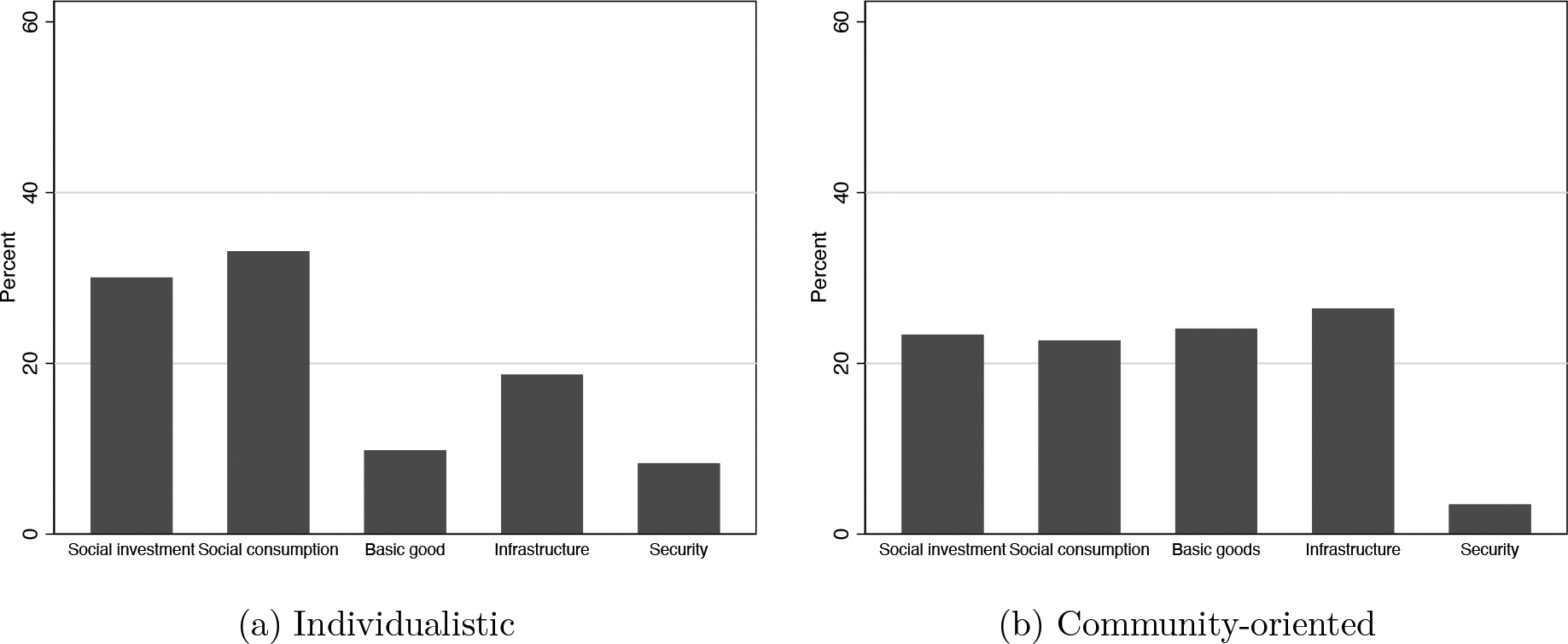
Figure 1 shows that respondents did choose different public goods depending on if the question asked about individual or community-oriented preferences, demonstrating the variation. Respondents were twice as likely to name security policies as individual preference than when thinking about community needs. They were also more likely to choose social consumption and social investment out of individual need as well. In the Online appendix (Figure S1), we show that a two-sided t-test of responses to what the community needs versus what the individual needs reveals significant differences for some public goods.
Independent variables: OV and QC experience
We rely on self-reporting because reliable data on crime and wartime incidents are not available, and because the theory requires that the individuals actually experienced the violence. 13 The QC victimization question asks: ‘In the past year, has anyone in the family been a victim of some problem (theft, beating, physically attacked, rape etc.)?’ In our sample, 18.09% of the respondents gave a positive response. By referring to the family instead of asking about personal victimization we circumvent/attenuate a possible social desirability bias. We expect victims who have personally experienced violence to respond with ‘yes’ to the survey item. We do not disaggregate QC victimization because there is a fairly unified understanding about what constitutes QC (Blair, Karim & Morse, 2019). Crime includes assault, domestic violence, rape, theft and burglary. Moreover, we did not want to retraumatize our respondents by asking multiple modules about victimization. While it could be possible for this QC to be perpetrated by organized groups, we specifically chose an area where there is minimal OV in order to limit this possibility.
We acknowledge that QC victimization is not necessarily random. Crime victims are usually perceived as weak by the perpetrator (Daigle, 2017). However, our balance table (S5 in the Online Supplement) shows that QC victims do not significantly differ from non-victims when considering most standard covariates. There are two exceptions. Victims of QC are more educated and are more likely to be traditional leaders.
For wartime victimization we create a composite score (war victim) using a set of questions on different types of violence experience. 14 We based these questions on other studies that ask about victimization, but amended them to fit the context following consultation with our enumeration team. The composite score is an additive indicator based on the experience of killings of family or friends, property damage, rape, beatings, or witnessing of violence (see Table S3 in the Online Supplement for specific wording) and therefore measures degrees of any type of conflict victimization. The war victimization indicator ranges from 0 to 5 with a mean of 1.92 and a standard deviation of 1.60. About 33% of the sample indicated that they lost a family member or friend during the war. Property damage was even more widespread at 54%. Only 5.9% witnessed violence and 45% report to have been beaten or hurt during the conflict. 15 Because war victimization takes on a collective form and encompasses more than one incident, the index allows us to capture the collective nature of the violence by determining not only whether war victimization occurred, but also the degree to which individuals were affected.
A number of studies have suggested that war victimization is often indiscriminate and thus may be random (Bellows & Miguel, 2009; Lyall, 2009). Kalyvas (2006) suggests that indiscriminate violence is more common in areas controlled by either the government or rebels. At different periods of time, the government and rebels controlled different parts of Grand Kru County, suggesting that at least some of the violence civilians experienced may have been indiscriminate. The balance table for war victims (all those who report to have experienced at least on type of violence, see Table S6 in the Online Supplement) shows, however that, older respondents, males, married, from the ethnic majority, living in traditional leaderships, community locals and land owners are more likely to have experienced war violence. We include these co-variates in our model.
In order to ensure that our ‘treatments’ were strong, both experiences of victimization had to be salient. Due to the severity of the civil war and the inter-generational dimensions of its legacy, it is likely that wartime violence still has an effect on the population despite having occurred over 15 years ago. For QC, salience might differ. We therefore opted to ask questions about QC within the past year. This control over the ordering (OV prior to QC) attempts to equalize the salience of the two types of victimization. Moreover, the ‘past-year period’ accounts for recall bias. We did not trust the recall of QC from before the war, nor for a longer period than a year before the survey.
Given the large share of victims during the war, we can expect that many crime victims are also former war victims. About 69% of the respondents in our sample were victimized during wartime, but the intensity varies, with only 2.58% who experienced all of the above enumerated types. Most respondents experienced three types of violent encounters during the war (22.5%). Among these, 15.3% indicate crime victimization within the past 12 months (for a cross-table see Table S4 and Figure S2 in the Online Supplement). Given the number of respondents who were war victims, characteristics of compound victimization mimic victims of OV, although differences from non-victims are smaller in size (see balance Table S7 in the Online Supplement). In order to take compound victimization into account, we estimate our models with the inclusion of the interaction term between war and crime victimization.
We add a set of control variables, which have become standard in the study of public goods preferences (see Table S1 in the Online Supplement for descriptive statistics). We control for sex (female), age and age squared (to factor in nonlinearities of the age effect), level of education (‘primary/secondary,’ ‘higher’ education; ‘no education/basic ABC knowledge’ serves as reference category) and the marital status (married/cohabitation; single/divorced serves as reference category). We also control for owning land as a measure for wealth, whether they were born locally, insecurity perception (if the respondent fears the armed groups or criminals; no one/local authority serves as reference category) and being a member of the village leadership. The estimated average variance-inflation value is 5.0, which indicates low collinearity between the predictors. Next, we also consider baseline trust in institutions. We hold constant the respondent’s trust in the community as shown in the Online Table S10 – our main results remain robust. Finally, we add a control for bystanders during the survey (a dummy variable recording 1 for any kind of by-stander and 0 for none; for a detailed discussion see Section A in the Online Supplement).
Estimation
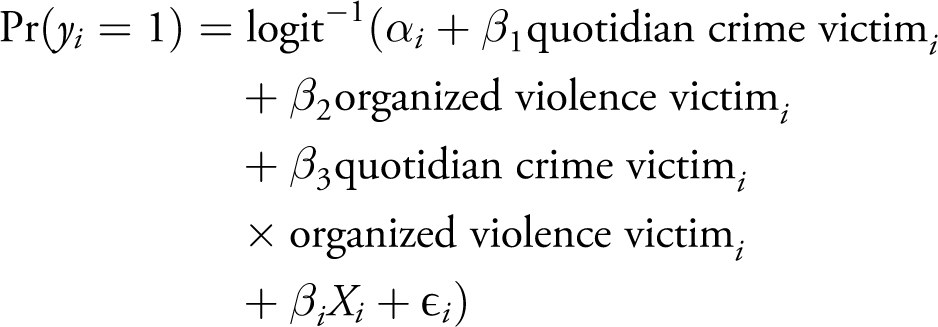
Our dependent variables, personal and community-oriented public goods preference, are based on a nominal scale of J categories (social investment, social consumption, basic public goods, infrastructure and security) measured for i individuals, but in order to provide a more nuanced comparison we look at each public good category (=1) in comparison to the rest (=0). We therefore employ a logistic regression with clustered standard errors at the village level (k). The reference category for each model is always the other public goods. Aside from our analytical interest in compound victimization effects, likelihood-ratio tests also indicate that the models without the interaction are nested in the more specified models (for the models that ask about individualistic preferences) so that we report the fully specified models below. X refers to a vector of socio-demographic control variables and
To assess the robustness of our findings, we estimate a series of models in the Online appendix that vary controls (S8–S11). We also analyse public goods preferences with a multinomial specification (see Section E Table S13 in the Online Supplement for results and extensive discussion). Our main findings remain robust to this specification.
Results
Estimation results from the logistic regression on individualistic and community-oriented public goods preferences (our five main public goods categories with the respective other public goods as reference category) are displayed in Table I. 17 Our main interest rests on the distinction between social investment/social consumption and security as public goods preferences, but we also show how victimization influences support for basic public goods and infrastructure.
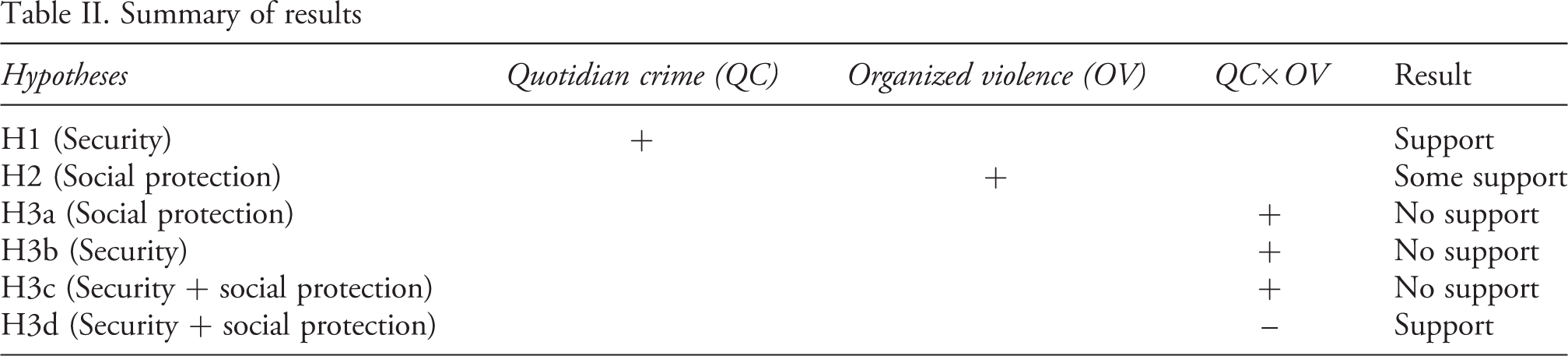
Consistent with H1, we find that QC victims (who were not victimized during conflict) are significantly more likely to demand security for themselves (M9). The average marginal effect for QC victimization, holding wartime at zero and all other variables at modes, is 0.16. The incidence rate for preferences for security related public goods increase from 9% to 25% when the individual experienced QC.
The logistic regression shows that when respondents are victimized by QC without being former war victims as well, they are significantly less likely to demand infrastructure (M7) from the government. This might be because infrastructure allows for more violence to occur (Pierskalla & Hollenbach, 2013). Those who have experienced QC do not want to enable criminals to enter into communities.
Next, we find partial support for H2. Individuals, who were victimized during the war, and who have not been victims of QC in the past 12 months, are more supportive of social investment for themselves (an increase in the predicted probabilities of 3.2%, M1, though only significant at the 10% level). In contrast, war victims are less supportive of social investment for the community (a decrease in 2.4%, M2). This means that war victims personally prefer educational opportunities, but find its provision less urgent for the community. There is no support for war victimization affecting social consumption policies (M3–M4). That is, we find that war victims are more likely to prefer social investment policies, but against our expectation, the increased demand for social investment is preferred to serve individual interests (M1). War victims may not be as pro-social or altruistic as the literature suggests. Rather, many war victims missed out on educational opportunities and might want the opportunities that they missed out on now. We visualize the findings in Figure 2. 18
We now turn to the results for H3a–d on compound victimization. Experience with war and QC victimization appear to increase individualistic preferences for basic public goods (M5) and infrastructure (M7). The interaction term is negative and significant for social investment (M1) and security (M9). War and crime victims are less likely to prefer educational opportunities or security for themselves. Rather, they prefer basic public goods and infrastructure – electricity, water, sewage, roads and cell phone towers. This finding suggests that there is support for H3d. Victims appear to eschew welfare goods and individual security in favour of other types of public goods.
Our results are summarized in Table II. The first column provides the hypothesis for each public good, the second–fourth columns provide the direction of the hypotheses based on the type of violence experienced, and the last column states the level of support for each hypothesis.
Logistic regression on personal and community-oriented public goods preferences for quotidian crime (QC) and war victimization (OV)
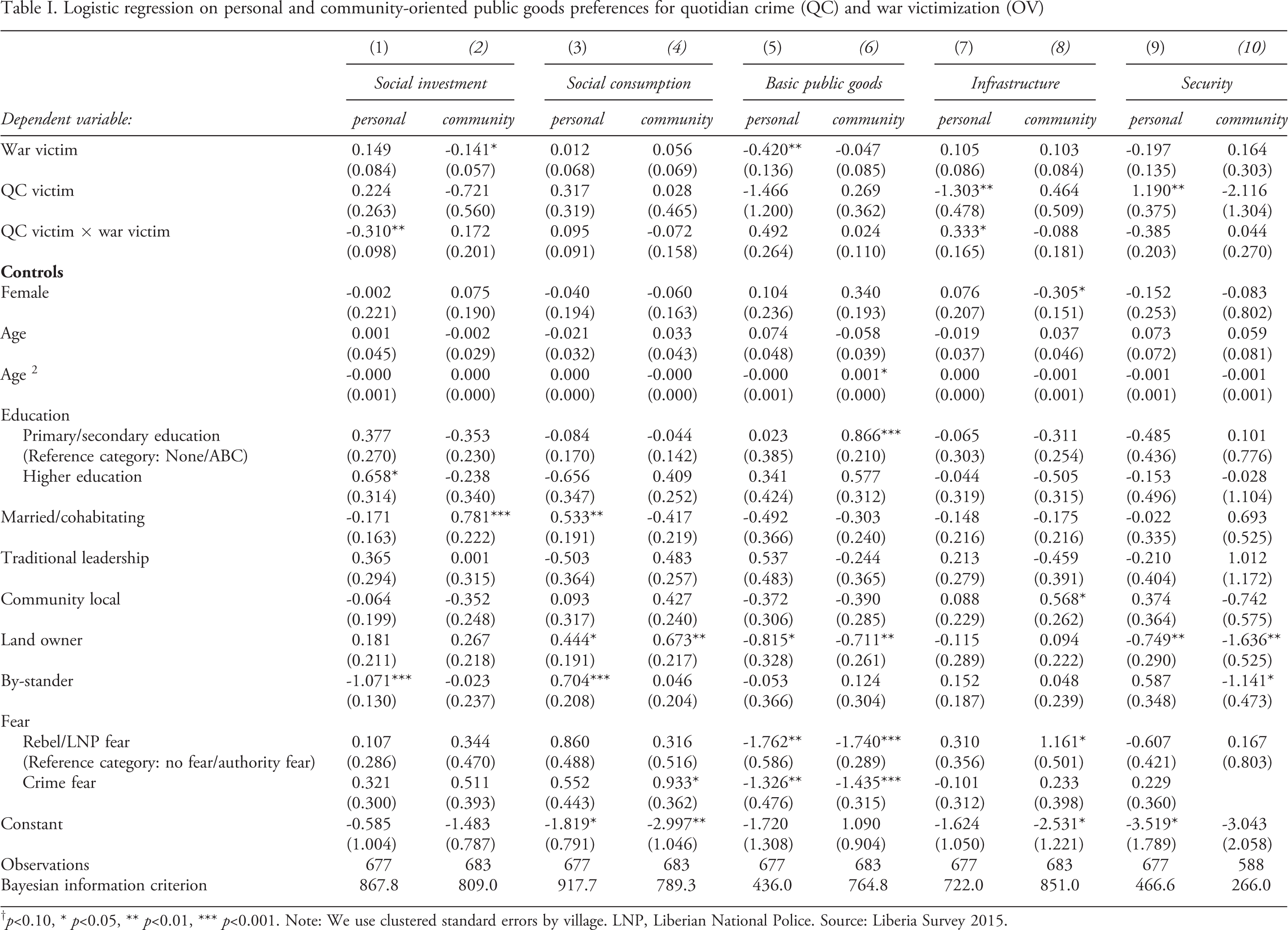
† p<0.10, * p<0.05, ** p<0.01, *** p<0.001. Note: We use clustered standard errors by village. LNP, Liberian National Police. Source: Liberia Survey 2015.
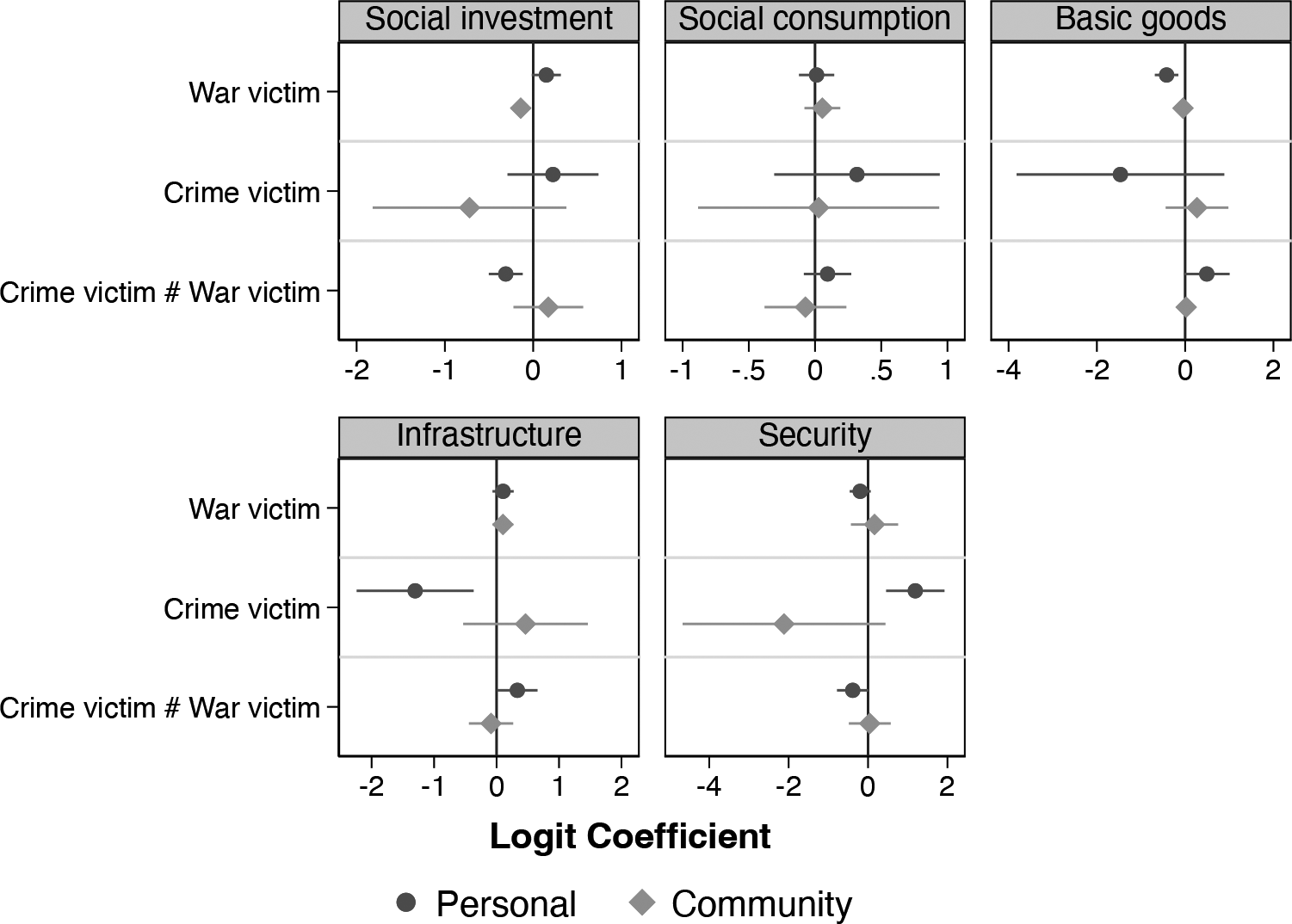
Coefficients plot: Public goods preferences (Table I)
Summary of results
Discussion and conclusion
Our study demonstrates that different types of violent experiences lead to differences in preferences for public goods in the context of a post-conflict, rural, and low-income country. We show that QC victims are more likely to prefer security, whereas victims of organized (wartime) violence prefer social investment. When both types of victimization occurred, individuals are more likely to prefer basic public goods (e.g. water, food or electricity) and infrastructure. The results demonstrate that compound victimization constitutes a different set of preferences than those who have experienced either OV or QC. Thus, more work should be done to understand the interactive nature of compound victimization.
We do not find that victimization (OV or QC) affects public goods preferences for the community. Victimization only appears to affect individualistic policy preferences. However, our study indicates that there are differences with respect to what individuals want from the government for personal reasons and what they want for the community. What individuals believe the government can do for them does not always translate to believing that the government can do the equivalent for the community. This contradicts some of the war victimization literature that shows that war victims are more pro-social or altruistic. Indeed, at some level, victimization could make individuals more political, but more political to serve individualistic needs.
Our survey is limited in that it only surveys rural Liberians – what we believe is a typical case of a weak, post-conflict, rural sub-national unit. However, in such areas, there is a clearer distinction between in-groups and out-groups. This distinction is important for our theory. We, thus, suspect that other individuals in different contexts shape preferences in a different way. Furthermore, we believe that our findings specifically apply to weak states because the need for all public goods is high. In states where some public goods are provided but not others, there may simply be a preference for the goods and services that are lacking. Yet, while we have suggested that the post-conflict context creates the conditions for increased QC, we believe that our finding about QC applies to rural areas in non-conflict countries as well. Indeed, our results on QC victimization are consistent with other studies that find that crime victims are more likely to prefer security.
Finally, we have argued here that OV victimization differs from QC experiences. Specifically, they differ based on the perpetrator and target, motive, and severity of the violence. These differences are most likely in poor and rural, post-conflict societies. However, because of data limitations we cannot identify which of these aspects most strongly drives preference formation. Further research is needed to unpack the nuances of attitudinal change after different violence events including how family victimization and a victim’s embeddedness in kinship networks affects preference formation (Dorff, 2017). Moreover, in contexts where multiple perpetrators of OV exist, future work should study the implications of differences in the motives of each actor.
Footnotes
Replication data

Acknowledgements
The paper has been presented at the European Political Science Association 2019 meeting, the Online Peace Science Colloquium Seminar, Vanderbilt University, in April 2020 and the Comparative Politics Workshop at Cornell University May 2020, the Politics of Crime Control and Social Protection Workshop at University of Cologne 2020 and University of Innsbruck. We thank Nicolas Barnes, Sarah Brooks, Cassy Dorff, Ana Isabel López García, Gustavo Flores-Macías, Sandra Ley, Raluca Pahontu, Pauliina Patana and Omar García Ponce for helpful comments and suggestions.
Funding
The authors received the following financial support for the research, authorship, and/or publication of this article: This project was generously funded by grants from Emory University, the Folke Bernadotte Academy 1325 Working Group and a National Science Foundation Dissertation Improvement Grant.