




Abstract
Conflict-related sexual violence (CRSV) is an increasingly consequential crime to perpetrate – at least if we limit our view to reactions within multilateral institutions such as the United Nations (UN) Security Council. Turning to the state-led forum for human rights: the UN Universal Periodic Review (UPR), this study instead uncovers sparse and highly selective condemnation of CRSV. By extracting data on all bilateral shaming relating to sexual violence in the UPR since its inception in 2008, this article demonstrates that only 5% of all governments take the opportunity to condemn major sexual aggressors. The findings should adjust our expectations on the progress rate within the policy field of CRSV and advance our understanding of the challenges tainting international negotiations on the topic.
Keywords
Introduction
‘[S]exual violence […] can significantly exacerbate situations of armed conflict and may impede the restoration of international peace and security’ (United Nations Security Council Resolution 1820 (United Nations Security Council, 2008, §1).
To understand when states do decide to shame CRSV, I ask: under what conditions do states shame other states for conflict-related sexual violence? Through statistical analyses of state-with-state interactions within the UPR in the 2008–2019 period, I find that one of the most recurrent patterns in CRSV-shaming is that Western donors shame states that receive their aid. I also find evidence that CRSV-shaming is particularly attractive to those governments with an interest in profiling themselves in connection with the Women, Peace and Security (WPS) agenda. Unlike human-rights shaming in general, the shaming of CRSV does not seem to be either more or less likely among military allies. Nor do I find evidence that CRSV-shaming is constrained by trade interests specifically. A plausible interpretation of the empirical evidence is that states primarily shame CRSV when so doing serves their own political purposes – that is, when they can use it to justify aid packages or to showcase their international commitment to the WPS agenda.
The findings presented in this article have implications for the larger literature on international responses to CRSV. While previous research on multilateral efforts often evinces an increasing interest in CRSV, this study shows that very few governments consider it worthwhile to take initiatives in this area on their own. This finding is particularly remarkable considering that the focus of this project is on shaming in the wake of Resolution 1820 (2008) – a period when the interest in CRSV-shaming should be at its highest.
Previous research
Quantitative research on the international commitment to end CRSV tends to focus on the UNSC. 3 The number of country-specific resolutions (Benson & Gizelis, 2019), as well as the probability of both peacekeeping deployment (Hultman & Johansson, 2017) and gender-mainstreamed mandates (Kreft, 2017), indicate that the Security Council is to some degree responsive to ongoing CRSV. However, both qualitative and quantitative research highlight the inconsistency of the UNSC in terms of its inclusion of WPS language in the operational paragraphs of resolutions in general (Kirby & Shepherd, 2016: 378), and of peacekeeping mandates in particular (Kreft, 2017). There is also a negative association between areas suffering from CRSV and the deployment of female peacekeepers, despite an underlying aspiration on the part of the UN to increase female peacekeepers for the sake (partly) of reducing such violence (Karim & Beardsley, 2013). These discrepancies cast doubt on the extent to which the efforts of individual member-states match commitments made at a multilateral level (Karim & Beardsley, 2013). Another indication of less than complete commitment can be seen in the fact that many states adopt national action plans (NAPs) in this area only slowly and/or instrumentally (i.e., because doing so suits their other purposes) (Basu, 2016; Kirby & Shepherd, 2016). Two of the UNSC’s permanent members, Russia and China, have yet to develop such plans – despite the fact that NAPs date back more than 15 years (Kirby & Shepherd, 2016). Other states, among them Canada and the United Kingdom, engage in the WPS agenda in ways that serve their foreign-policy objectives more generally (Basu, 2016). However, notwithstanding the variation in commitment to WPS at country level, no study has investigated how this plays out in relation to states’ attitudes and actions in response to CRSV. In this study, I focus on interstate shaming, because it offers an excellent opportunity to observe when and to what extent individual governments speak up against CRSV.
Most research on shaming focuses on whether or not it works (e.g. Hafner-Burton, 2008; DeMeritt, 2012; Krain, 2012; Murdie & Davis, 2012). The focus is on how conformity to international norms can be promoted through public shaming, and on what the consequences may be for the targeted state. These studies tend to stress international organizations as the shaming agent. Such research is doubtlessly important, but restricting our reading to it can obscure the role that individual states and their bilateral ties play in the process of calling out other states’ (mis)behaviour. To this end, a number of studies have emerged that focus on state-led peer reviews, that is, interstate shaming (e.g. McMahon, Busia & Ascherio, 2013; Koliev & Lebovic, 2018; Carraro, Conzelmann & Jongen, 2019; Kahn-Nisser, 2019). The literature most relevant for CRSV is that which examines the UN’s peer-review mechanism on human rights: the UPR.
On the one hand, studies of the UPR find support for the general intuition that a correlation should obtain between the human-rights performance of states and the criticism they receive from other states (Asgari & Sanaei, 2017; Bae, 2018). A recurrent finding here, however, is that a wider range of factors actually determines how often and how strongly such criticism is voiced (Abebe, 2009; Sweeney & Saito, 2009; Freedman, 2011; Carraro, 2017; Terman & Voeten, 2018). More specifically, states are less likely to shame political and military allies as well as major aid-receiving states (Bae, 2018; Terman & Voeten, 2018). In general, furthermore, states that voice such criticism have greater material capacities and higher human-rights standards than do states which do not (Abebe, 2009; Cowan & Billaud, 2015; Bae, 2018). Another finding concerns universalism vs. cultural relativism with regard to human rights: states animated by universalist notions voice criticism both more often and more harshly. This translates into an overrepresentation of shaming by Western governments (McMahon & Ascherio, 2012).
Filling the remaining gap: What a study of CRSV-shaming has to offer
When scrutinizing whether shaming actually reflects realities on the ground, the above-mentioned studies focus on a state’s overall human-rights performance (Lebovic & Voeten, 2006; Asgari & Sanaei, 2017; Bae, 2018), rather than on specific violations. This is indispensable in a general assessment of a peer-reviewing institution, but it also has limitations. A topic-oriented approach is needed in order to ascertain whether states are equally inclined to engage in shaming irrespective of what kinds of violation are in question, or whether instead certain kinds are more easily discussed than others. This approach may also have clearer relevance for human-rights advocates, since it is often more relevant to know how one specific violation is dealt with across different forums than to establish the overall performance of one institution. This is true in the case of the WPS agenda, including its norm against sexual violence. On the one hand, CRSV appears to be widely condemned: consider, for example, the number and variety of stakeholders present at the Global Summit to End Sexual Violence in Conflict in London 2014 (Kirby, 2015). On the other hand, the viewpoints and level of engagement of different states often differ dramatically in negotiations on topics within this area (Hamid & Werner, 2019). Studying the initiatives taken by individual governments on their own to shame CRSV offers an opportunity to advance our understanding of how states respond to it outside of multilateral institutions of decisionmaking, and of the conditions under which they choose to speak up against the worst sexual aggressors on their own initiative. Examining such unilateral behaviour may help us better understand the challenges that arise in diplomatic negotiations in this area.
Promoting the understanding of CRSV as a threat to international peace and security: An ongoing process
If we are to understand the politics around the shaming of CRSV, we must first understand the ongoing development of an international norm against CRSV. Throughout the 1990s, scholars within the Copenhagen School (see Buzan, Wæver & Wilde, 1998 and related works), together with civil-society organizations around the globe, rallied support for a broadened perception of security – one applying not just to nation-states but to social groups and individuals as well. This worldwide civil-society mobilization actually dates back several more decades than that, but it was during the 1990s that work on it intensified around the UN headquarters (Naraghi Anderlini, 2019; Hunt & Wairimu Nderitu, 2019). A number of thematic resolutions was passed in the UNSC, one of them being Resolution 1325 (2000) on WPS (Basu, 2016). Member states thereby agreed to protect women from sexual and gender-based violence. The resolution also focuses on other aspects relating to equality and women, but CRSV has been the least controversial of these (Tryggestad, 2015; Kirby & Shepherd, 2016). Indeed, a majority of the follow-up resolutions have concerned CRSV, most prominently Resolution 1820 (2008). While governments were initially sceptical of focusing on CRSV as an international security concern rather than a more general human-rights issue, advocates eventually succeeded in building up support to such an extent that the resolution was adopted unanimously, with 42 official co-sponsors (Cook, 2008; Crawford, 2017, chapter 3).
The high-level attention paid to CRSV over the last two decades suggests that the norm against it has become institutionalized. However, the negotiations on Resolution 2467 (United Nations Security Council, 2019) illustrate that the attitudes of different governments still diverge considerably on the matter. When Germany was vying for a seat on the UNSC, it made CRSV one of its priorities and prepared an ambitious resolution draft on the question. However, China, Russia and the United States threatened to use their veto if the resolution was taken to imply any extended accountability mechanism, and if sexual and reproductive health measures were mentioned in its operational paragraphs (Hamid & Werner, 2019). This reflects a process, often referred to as ‘international socialization’ (Finnemore & Sikkink, 1998: 898–902), whereby norm-promoting states (Germany in this case) strive by diplomatic means to persuade other states to follow.
While negotiations on the UN Security Council represent one of the most high-level platforms for influencing other states, it is not the only one available. States can frame and communicate their foreign policy in ways that punish or reward certain types of behaviour on the part of other countries. A few states have explicitly adopted such an aspiration with regards to the WPS agenda, among them Canada and Sweden (Aggestam & Rosamond, 2019). Margot Wallström, the former Swedish Minister for Foreign Affairs (2014–2019), took a confrontational approach in 2015 when she openly denounced Saudi Arabia’s discrimination against women, and criticized its use of flogging as ‘medieval’ (Dickson et al., 2015; Taylor, 2015). Her statement led to a diplomatic crisis and resulted in the termination of a trade deal worth 1.3 billion USD for Sweden (Dickson et al., 2015), but it was technically in line with the country’s feminist foreign policy (Aggestam & Rosamond, 2019: 43).
A less direct way for states to foster norm compliance is to team up with like-minded states and to call for the implementation of CRSV resolutions by various organs throughout the UN system. The largest group of this type – the Group of Friends of Women, Peace and Security – is an informal group of states led by Canada. Its efforts are devoted to publicizing WPS issues and calling for concrete measures to address them (Tryggestad, 2009). Coordinated lobbying of this kind can issue in draft resolutions presented to the UN HRC.
As an independent mechanism of the HRC, the UPR can be situated in-between foreign-policy decisions of a unilateral type and negotiations within multilateral organizations such as the UNSC. The UPR provides a purely state-led platform, where every state can comment on the human-rights practices of other states without having to compromise on form or substance. All states are reviewed equally often (every four to five years), regardless of their human-rights record. This has granted the UPR a generally high degree of legitimacy. The body is supposed to ‘fully integrate a gender perspective’ (Human Rights Council, 2007: annex, 3 k). This suggests that it offers a suitable and legitimate forum for states to showcase their commitment to ending CRSV globally, irrespective of their motives for such showcasing. Indeed, some states may use the UPR to gain political credibility with regards to CRSV by publicly condemning CRSV perpetrated by others. However, given the moral seriousness of such an accusation, and the consequences of making it, states are wont to tread carefully in the area, so as not to expose the target or any bilateral interests to unwanted hazards. I outline the incentive structure in question in greater detail below.
Shaming CRSV: Attractive to some, dissuasive to most
Traditionally, the principle of sovereignty makes states wary of intervening in the internal affairs of other states. This wariness applies generally; it is not specific to CRSV issues. A specific feature of sexual violence, however, is its gendered nature (e.g. Crawford, 2017: 97–98), which I argue has implications for the shaming practices among states.
A core tenet of feminist theory concerns the way that civilians and combatants/state representatives are distinguished and defined on the basis of gendered attributes. Symbolized by the male majority within the police and military, the state assumes the masculine roles of protector and defender – at times even that of emancipator. For this role to be meaningful, the civilian population is ascribed feminine traits: that is, they must be seen as innocent and largely powerless individuals in need of state protection. This role is customarily ascribed to women, children and the elderly (Young, 2003; Sjoberg, 2013 chapter 7; Carpenter, 2016; Nagel, 2019). Along similar lines as Nagel (2019), I argue that the public shaming of CRSV carries a particular sting for the targets of such criticism, because it calls attention to a state’s ultimate failure to protect the most vulnerable portions of its population. Even worse, it can reveal state complicity in such abuses. Any targeting of civilians demonstrates a failure in this regard, but CRSV makes the failure even clearer, because of the default understanding of women (‘the innocent’) as primary targets: ‘A failure to protect its women emasculates the state […and although] governments (read elites) might not care about their people being victimized, they do care about control, reputation and projected strength’ (Nagel, 2019: 1837–1838). In 2012, for example, the British government established a deployable Team of Experts to support the efforts of other states to combat CRSV impunity. While the initiative was well-received overall, British officials did note ‘some sensitivity towards being labelled a country that suffers from this’ (Crawford, 2017: 136). A failure to abstain from CRSV acquires particularly sharp contours against the backdrop of Resolution 1820 (2008). There are strong reasons for states to be reluctant to shame; however, an adherence to liberal principles helps explain why some states choose nonetheless to criticize other states on these grounds.
From an institutionalist viewpoint, human rights are to be regarded as universal, with an independent value in and of themselves. Moreover, since governments do not all respect human rights to the same degree, said rights become a watershed in international relations: states treat other states differently depending on whether they perceive them as rights-defending or rights-defying (Lebovic & Voeten, 2006). More specifically, it has been argued, governments use the performance of other governments with regard to gender equality and the status of women to navigate and to rank their international relations (Bjarnegård & Zetterberg, 2022; Jacqui True in Parashar, Tickner & True, 2018: 37). Given the attention paid in recent decades to CRSV, moreover, a state’s reputation in that area becomes an important aspect of how other states see it. Generally speaking, rights-respecting states attract more trade and foreign investment (Robert G Blanton & Blanton, 2007; Shannon Lindsey Blanton & Blanton, 2007); whereas states that violate their population risk condemnation, and they may ultimately put their own sovereignty at risk by offering a reason/pretence for other states to intervene. Recent American history offers several examples of the use of CRSV to justify overseas military involvement (Crawford, 2017, chapter 2). In 2001, for example, the administration of George W. Bush cited CRSV to justify its military intervention in Afghanistan (Young, 2003). Similarly, the Australian government justified its military involvement in Syria by pointing to the mistreatment – often sexual in nature – of women and girls by the Islamic State of Iraq and Syria (Meger, 2016: 154).
The frequency with which states cite CRSV to justify their political actions highlights the salience of CRSV as a concern in international relations. Because of its high salience, CRSV offers (fungible) political capital to states that explicitly condemn it (Meger, 2016; Crawford, 2017, chapter 2). A state that shames another state for CRSV gains political capital; the state so shamed loses political capital. The ‘gains’ can in turn serve other political goals, opening doors within international politics that would otherwise remain shut.
4
In this way, CRSV-shaming becomes an act whereby states with a better record in the area acquire means to assert or to improve their international standing, while at the same time enforcing/reinforcing the subordination of those that perform worse (Jacqui True in Parashar, Tickner & True, 2018: 38). More and more governments are explicitly integrating pro-feminist values into their foreign policies, so ‘the competitive space on [the WPS] agenda is thickening’ (Skjelsbæk & Tryggestad, 2019: 524). This makes any move that might generate this type of political capital all the more attractive. The attraction should be most powerful for states seeking to show a strong profile in relation to the WPS agenda in general, and to CRSV in particular. Thus, I hypothesize:
H1. Governments that care about their reputation in relation to the WPS agenda are more likely to shame CRSV, all else being equal.
While this argument helps us understand the variation between governments in their readiness to resort to shaming, it cannot explain their selection of particular targets. To understand why a state decides to shame one state but not another, we need to pay attention to the relational aspect of interstate shaming. A key element here is to examine the audience costs which shaming entails for the targeted state, and to consider when and to what degree these costs also matter to the shaming state itself.
The CRSV-shaming results – especially if voiced many times and through numerous channels – in an increasingly tangible expectation that the government in question will re-evaluate its practices and policies (Carraro, 2019; Haglund & Hillebrecht, 2020). This expectation is sustained by pressure from domestic civil-society organizations and civil rights-aware citizens, and by pressure from the foreign governments carrying out the shaming. Such pressure is powerful in itself, because it brings the threat of audience costs, should the government not proceed to make improvements. Audience costs entail a loss of credibility as a reliable trading or investment partner (Lebovic & Voeten, 2009; Barry, Clay & Flynn, 2013; Vadlamannati, Janz & Berntsen, 2018), as well as domestic disapproval and a loss of popular support (Tomz, 2007). Before subjecting another state to the risk of such consequences, therefore, a state considering the use of CRSV-shaming should consider how the targeted state will respond to the criticism and be affected by it; as well as what impact this will have on the shaming state itself and on relations between the two states (Terman & Voeten, 2018).
Two types of relationships are commonly mentioned as obstacles to shaming: military alliances; and trade partnerships (Terman & Voeten, 2018). Governments avoid shaming military allies, because: (a) the latter’s reactions may have negative consequences for their own national security;
5
and (b) it may be difficult to deny an awareness of atrocities such as CRSV if the allies have carried out joint military operations. Governments also avoid shaming due to economic concerns: for example, if the effect of so doing is to endanger significant economic interests, such as favourable trade agreements. To summarize, governments are more likely to shame CRSV when no military or economic interests are at stake. This is captured in the following hypotheses:
H2. Governments are more likely to shame CRSV if the aggressor is not a military ally, all else being equal.
H3. Governments are more likely to shame CRSV if the aggressor is not a trading partner, all else being equal.
Interstate partnerships are not all the same, however. While trade deals and military alliances are of mutual interest to the parties, other partnerships are explicitly hierarchical. For the dominant party in such a constellation, shaming may not entail much risk. Indeed, shaming the subordinate may further its overarching political objectives. Aid relationships are an example hereof. Research has shown that, while bilateral aid is often framed in terms of humanitarian action, it neither serves purely humanitarian ends nor is guided solely by humanitarian needs. Instead, donors tend to settle on aid agreements which benefit themselves in one way or another (Schraeder, Hook & Taylor, 1998; de Mesquita & Smith, 2007, 2009; Whang et al., 2019). To sell aid programmes to domestic audiences, governments need to select and to package their aid priorities according to what they believe will gain most traction. During the last decade, CRSV has often come under the spotlight and functioned as a factor justifying a given aid allocation (Crawford, 2017: 77). In this context, the UPR offers a convenient, low-cost opportunity for donor governments to highlight an acute problem (CRSV) in an aid-receiving state, and at the same time to demonstrate political commitment. To test the proposition that CRSV-shaming is used to justify foreign policies such as aid, I hypothesize:
H4. Donor governments are more likely to shame CRSV, all else being equal.
To conclude, CRSV-shaming can be both attractive and costly. This yields the underlying expectation that governments will shame CRSV when it serves their political interests and abstain from so doing when it risks endangering bilateral relations. In the following section, I explain how I will test the hypotheses.
Research design
Dataset and unit of analysis
I have theorized about conditions that either incentivize governments to shame states guilty of CRSV, or which deter them from so doing. To examine this matter empirically, I have compiled a dataset based on all country reviews of conflict-affected states 6 within the UPR between 2008 and 2019. During those years, 53 conflict-affected states were under review. 7 States are reviewed approximately every fifth year, meaning they were subject to review between one and three times during the period I have chosen, depending on the longevity of the armed conflict in question. 8 At each country review, all other UN member and observer states have an opportunity to give recommendations. This sets the UPR apart from many other shaming fora, and makes it particularly suitable for a systematic study of states’ diplomatic behaviour.
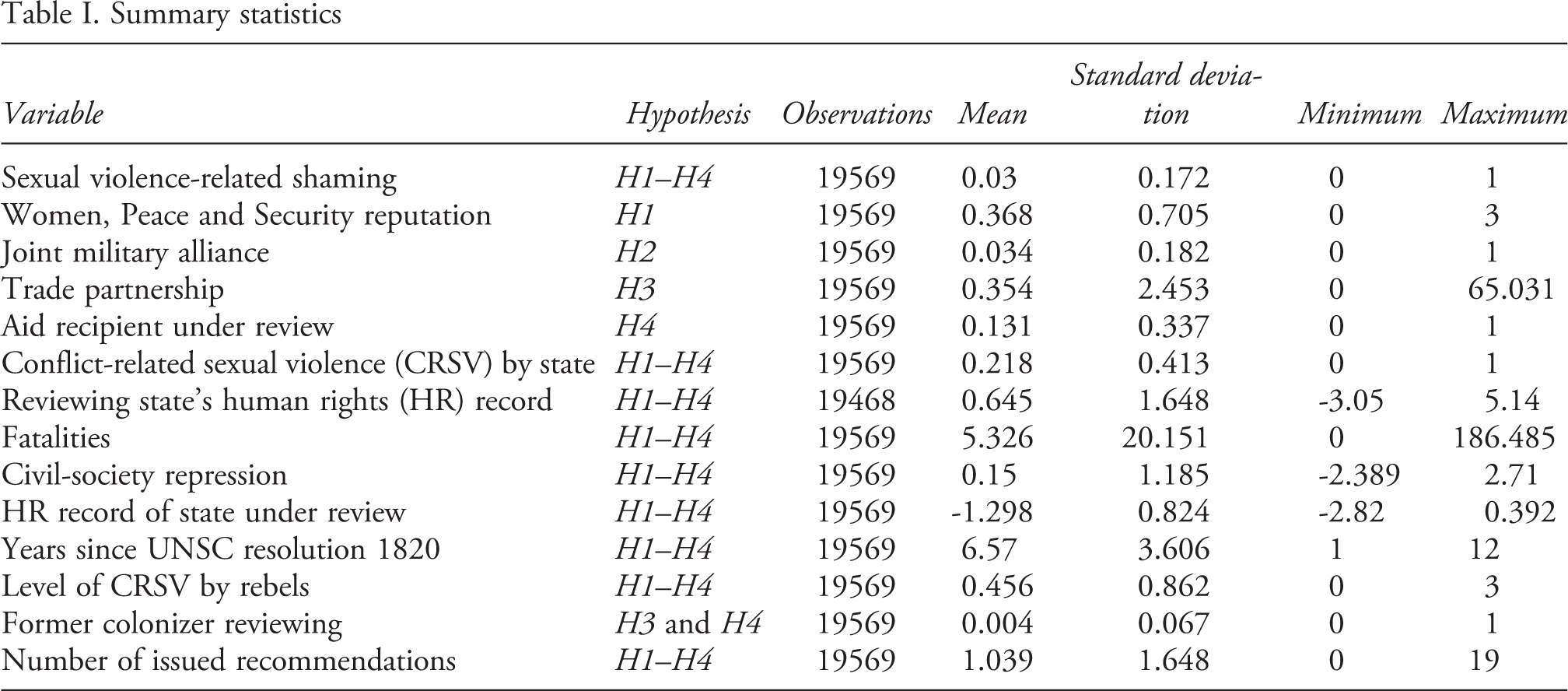
My unit of analysis is each bilateral review opportunity: that is, each state’s opportunity to shame a state under review. This allows me to analyse how connections to the state under review potentially impacts fellow states’ decisions on whether or not to shame. This comes to 19,468 observations (for an overview of the data, please see Table I). At each bilateral review opportunity, a state (also referred to as a ‘reviewing state’ or a ‘shaming state’) chooses to give zero or more recommendations to the state under review. Given the short speaking time (often 1–2 minutes) and the voluntary nature of participation in the reviews of other states, it indicates strong condemnation when a government takes the floor and uses this time to mention sexual violence. In the sample used in this study, the average number of recommendations of any kind is one per review opportunity.
Dependent variable: Sexual violence-related shaming
By sexual violence-related shaming, I mean criticism (known as a ‘recommendation’ in UPR lingo) of sexual violence raised within the UPR. To count as sexual violence-related shaming, the recommendation needs to meet two criteria: (a) it contains any of the following terms – sexual violence, sexual torture, sexual slavery, forced sterilization, sexual mutilation, sexual abuse, sexual exploitation, rape, or forced marriage; 9 and (b) it is critical or specific – that is, it does not involve praise for good work done, or vague suggestions that the state ‘consider’ or ‘reflect upon’ a given course of action. 10 Recommendations related to sexual violence are generally formulated in more severe terms than recommendations focused on other issues (Figure A1 in Online appendix).
Between 2008 and 2019, sexual violence-related shaming was carried out at 594 dyadic review opportunities, targeting 49 governments altogether. Such criticism is often packaged as a single recommendation, rather than several separate ones. For this reason, I dichotomize sexual violence-related shaming – with 1 indicating that recommendations were made concerning sexual violence, and 0 indicating the converse.
Summary statistics
States’ shaming responses to conflict-related sexual violence
Independent variables
To test H1, which concerns whether governments care about their reputation in relation to WPS, I construct a variable reflecting the number of adopted NAPs relating to WPS. WPS reputation indicates 0 if the country has no NAP, 1 if the country has adopted one NAP, 2 if the country has adopted two NAPs and 3 if the country has adopted three or four action plans 11 . To examine H2, which concerns military alliances, I use a dummy variable indicating whether or not (1/0) the two states in question are in a joint military alliance. For this information, I use data on defence alliances collected by the The Alliance Treaty Obligations and Provisions project (Leeds et al., 2002). To test the third hypothesis, which relates to the effect of trade partnerships, I use data from the World Trade Organization (2021) to calculate the extent (in %) to which the reviewing state is dependent on imports from the state under review. For each reviewing state, I divide the value of imports from the state under review by the reviewing state’s total value of imports per year. To test H4, which concerns donors’ readiness to shame, I use information from the Organisation for Economic Co-operation and Development (2021). Aid recipient under review has a value of 1 if the state under review receives aid from the reviewing state, and of 0 otherwise. 12
While we can reasonably expect sexual violence to occur in every armed conflict, there is a vast variation in how much it occurs (Wood, 2006; Cohen & Nordås, 2014). For this reason, I interact each of the hypothesized conditions with a variable indicating how the war conduct of the state under review was described in terms of CRSV prior to the UPR review. There are great asymmetries in how and to what extent CRSV is documented (Davies & True, 2017), which in turn has consequences for how other states respond (Crawford, 2017). To be less sensitive to slight and/or arbitrary variations in how CRSV is described, I use a crude measure to capture its prevalence. CRSV by state ranges from 0 (no reports of CRSV or reports of isolated events of CRSV) to 1 (reports of ‘widespread’, ‘massive’ and/or ‘systematic’ CRSV). For this information, I rely on reports by Human Rights Watch (HRW) and Amnesty International (AI), compiled by the Sexual Violence in Armed Conflict data project (Cohen & Nordås, 2014; Nordås & Nagel, 2018). 13 I create a variable indicating the maximum value across HRW and AI estimates during the current year and the previous two. Reports of widespread, massive and/or systematic CRSV preceded 22% of all country reviews.
Confounding variables are justified in the Online appendix.
Empirical strategy and model
To learn more about the conditions under which states shame other states for CRSV, I draw on both descriptive statistics and multivariate analyses. To measure substantive impacts, I calculate the marginal effect of shaming under different conditions. This procedure has many advantages over rough interpretations of coefficients, especially for analysing interactions (Mustillo, Lizardo & McVeigh, 2018; Mize, 2019) My calculations derive from logistic regressions in which I cluster the error terms on each dyad.
Findings
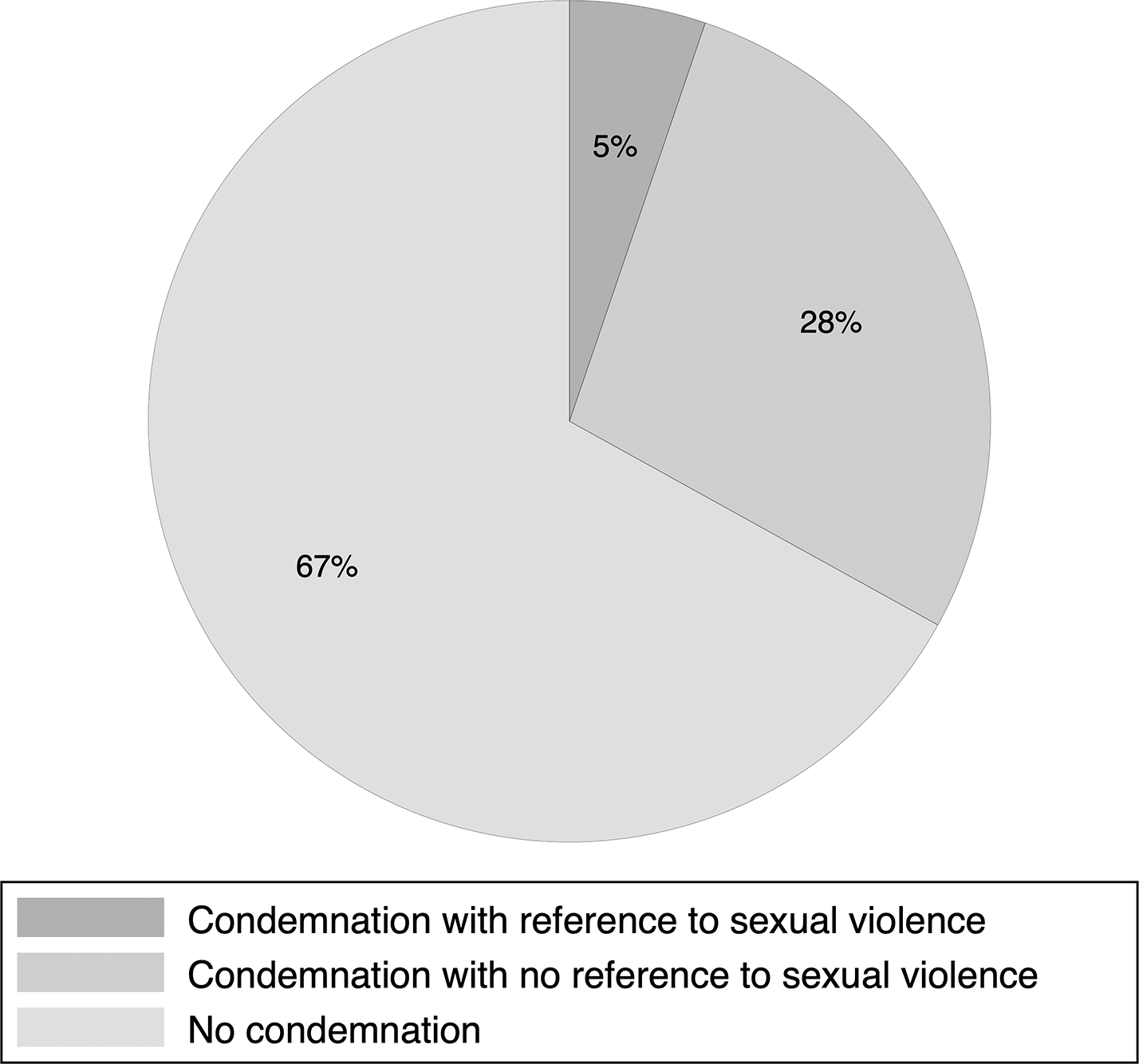
All governments with a documented record of widespread, massive and/or systematic CRSV (hereafter referred to as ‘major sexual aggressors’) have been shamed for this by at least one foreign government during their review in the UPR. However, the magnitude of this criticism – that is, how many governments shame sexual violence – varies greatly. Most governments stay silent. One-third of all states offer any kind of criticism, and the majority of these make no explicit reference to sexual violence (see Figure 1).
One such example was the review of Iraq in 2014, prior to which HRW had reported widespread sexual torture in detention centres. In the course of the review, 21 states made criticisms relating to ‘detention’, but none mentioned sexual torture (UPR Info, 2021). Overall, the number of governments that do shame major sexual aggressors by explicitly criticizing sexual violence varies between one and 29, with an average around 10. Of all governments making any type of criticism of a major sexual aggressor, 16% mention sexual violence explicitly. This means that sexual violence is mentioned on 5% of the total number of possible occasions.
If we look more closely at the variation between states that do decide to shame, we find there is no fixed group of states that always shame CRSV. In total, 78 different states forward CRSV-shaming to a major sexual aggressor at some point in time. Of these Norway and Italy contribute most frequently, taking the opportunity to shame sexual violence in 40% of all cases where a major sexual aggressor is under review. This is followed by a number of states – including Austria, Canada, France, Netherlands, Sierra Leone, Sweden and Slovenia – which shame sexual aggressors between 32% and 36% of the time.
Figure 2 shows the states that shame sexual violence most frequently (upper chart) and those that shame conditions in general most frequently (lower chart). While there is an overlap between the two groups (e.g. Canada, France and Slovenia), the comparison suggests that disaggregated States that shame most frequently in the United Nations Universal Periodic Review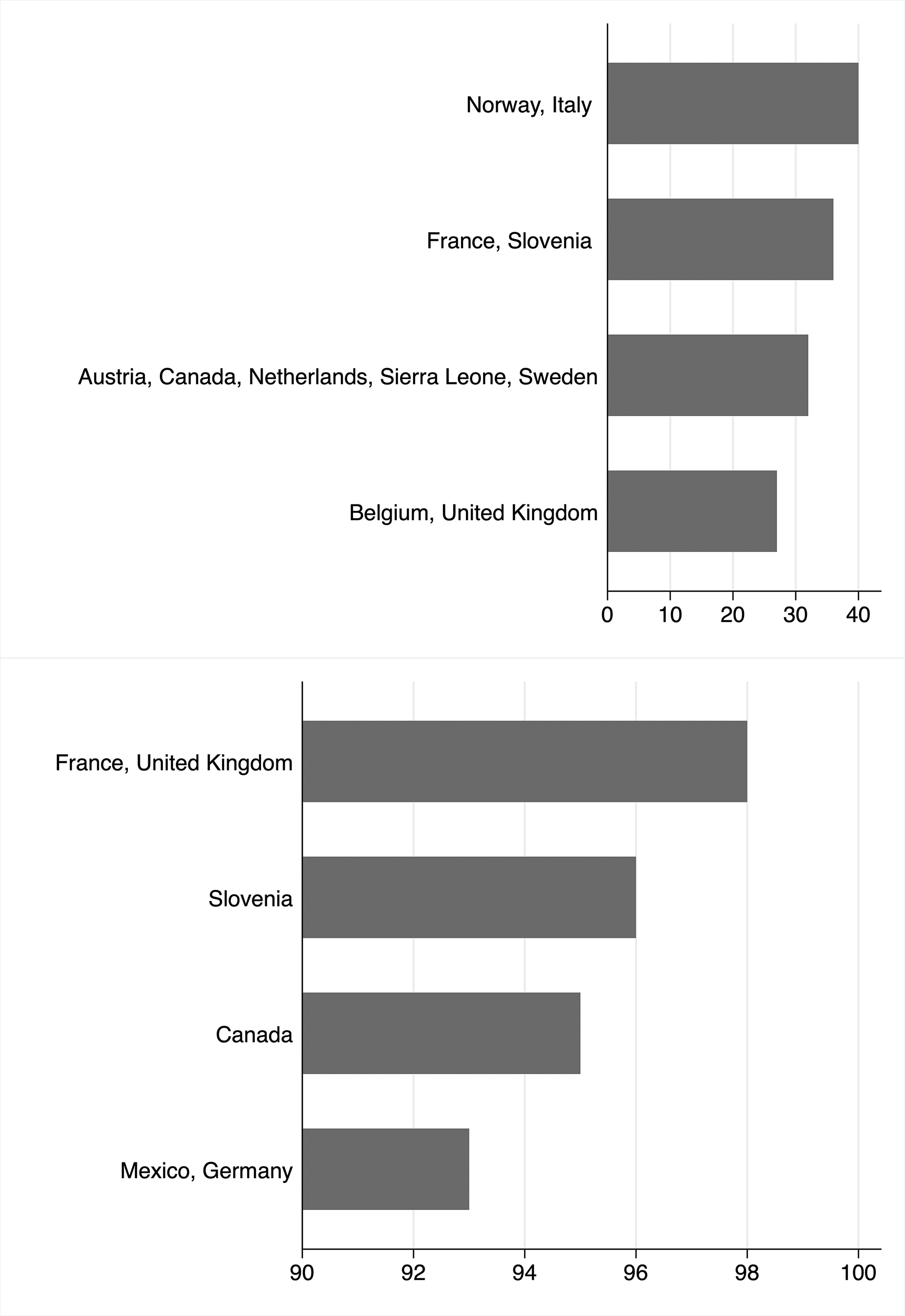
The overarching patterns in the data illustrate that shaming of sexual violence is sparse. The shaming that does happen is not random but selective, in accordance with my theoretical argument. I have stipulated four conditions under which governments are more likely to shame major sexual aggressors: (a) when they are interested in a respectable WPS reputation; (b) when they are not allied militarily with the aggressor; (c) when they have no trade interests at stake; and (d) when they are aid donors. I continue by testing these propositions one by one on the basis of descriptive statistics and multivariate analyses.
My H1 stipulates that governments that care about their reputation in relation to the WPS agenda are more likely to shame CRSV. Whether a government cares about its WPS reputation is measured by the number of times it has adopted a (revised) NAP on WPS. I argue that the development and continued engagement of such a plan reflects a political interest in the WPS agenda. This interest can either be ideologically anchored (which a de facto pursuit of feminist policy would suggest) or instrumental (i.e., undertaken for the sake of other goals) (True, 2016). Australia, for example, only developed one during the years under study – when running for a seat on the UNSC, suggesting its motives for adopting it were instrumental (Kirby & Shepherd, 2016: 378). The effects of having and continuously developing a NAP should become more tangible over time as coordination improves domestically, both among state institutions and in relation to civil society (Jacevic, 2019).
Since 2005, when NAPs were encouraged for the first time, 51% of all UN member-states have adopted at least one. 17 states have adopted three or four action plans. This group consists of early adopters, such as the Scandinavian countries and the United Kingdom but also later-but-frequent adopters such as the Democratic Republic of the Congo and Georgia that have adopted three NAPs within less than nine years (Women’s International League for Peace and Freedom, 2021). States that shame major sexual aggressors have on average adopted one NAP while those that remain silent generally do not have any NAP (average of 0.3). This provides indicative support for H1. It may be, however, that this bivariate relationship is due to confounding factors, such as the overall human-rights record of states. To assess whether we indeed see an isolated impact of states’ NAP engagements here, I proceed to multivariate analysis.
The predicted probabilities of CRSV-shaming, stratified by WPS engagement, are displayed in Figure 3. 15 The predictions lend support to H1. Governments grow more likely to shame CRSV the more engaged they are in developing NAPs for WPS. States that have adopted three or more action plans are more than double as likely to shame CRSV than states with no NAP (0.1 compared to 0.04). Put differently, among states that have adopted three or four action plans, one in 10 states shame major sexual aggressors. Only one in 25 states without any NAP does the same. The overall pattern regarding varying degrees of WPS engagement follows the expectation. While the difference is a slim one, there is in fact a statistically significant difference in effect size relative to non-adopters down to the adoption of one NAP. Taken together, this signals that states with an interest and engagement in the WPS agenda are keener to criticize CRSV, all else being equal. We can assume that states that shame less or not at all are either uninterested in any WPS-related issue, or that they lack the administrative resources needed both for shaming and for continuous development with action plans (Abebe, 2009; Barrow, 2016). In sum, the first hypothesis finds support in the evidence.
According to the second hypothesis, we can expect states to be more prone to shame CRSV when it is perpetrated by a non-ally. Descriptive statistics confirm this expectation: while states on average speak up in 5% of all CRSV cases, the figure falls to 3.4% when Probability of shaming conflict-related sexual violence, per degree of national action plan engagement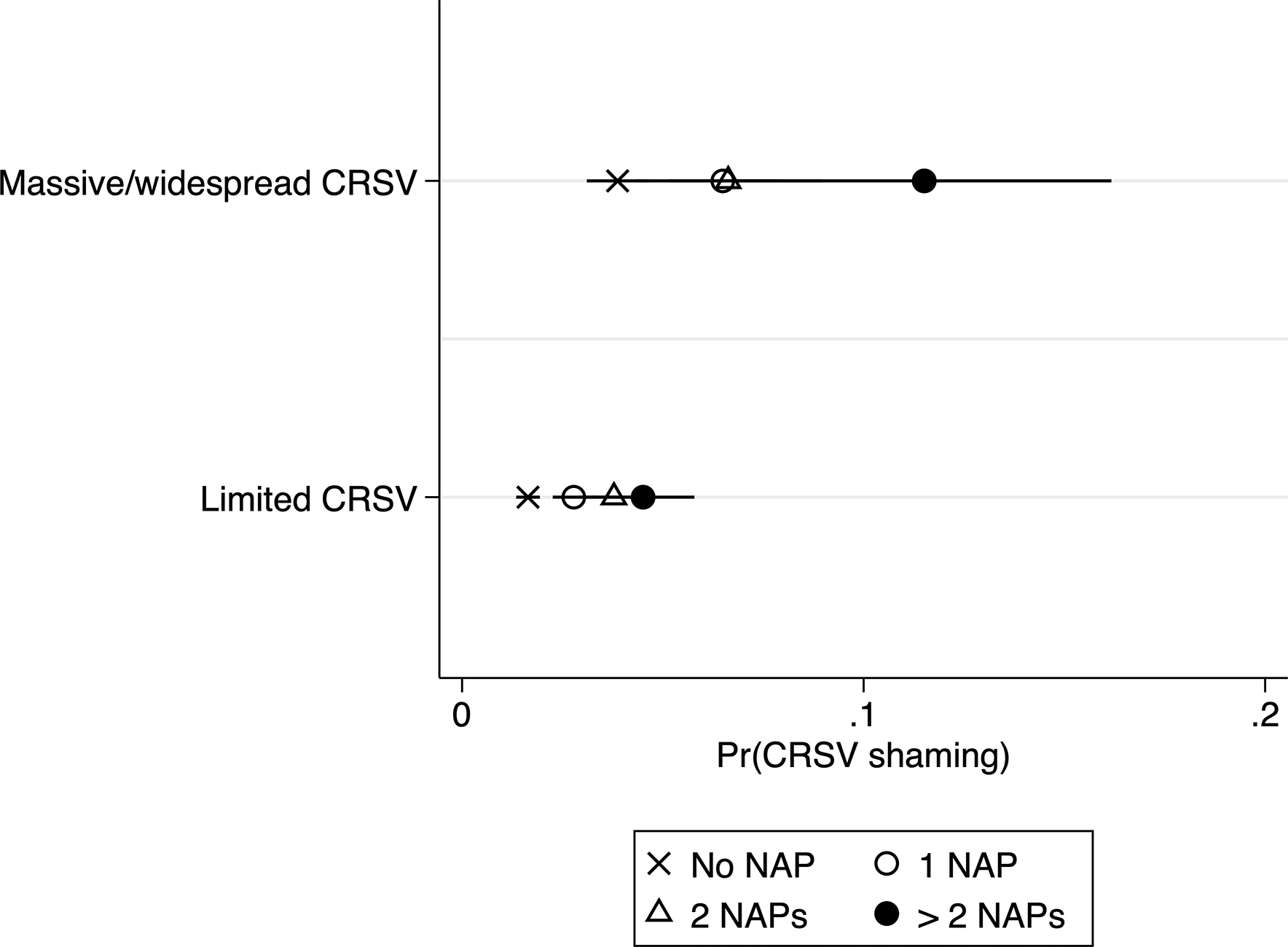
In line with expectation, the multivariate analysis (illustrated in Figure 4) indicates that the probability of shaming CRSV is consistently higher when no military ties are present. Notably, however, the effect size of massive/widespread CRSV is statistically indistinguishable across the different groups. If we take other variables into account, we find no discernible difference between allies and non-allies in terms of the effect of CRSV on shaming. This result is interesting, because it contradicts the finding of previous research that states are generally more reluctant to criticize allies harshly (Terman & Voeten, 2018). This evidence suggests that CRSV-shaming follows a different logic, at least in part.
My H3 captures the expectation that states will be more wary of shaming economically important partners, and more prone to shame sexual aggressors in whom they have no economic interest. Economic interest is operationalized as the share of a country’s imports that comes from each particular state under review. Descriptive statistics support this hypothesis. In the 24 dyads where the sexual aggressor under review accounts for more than 5% of the other state’s imports, sexual violence is only criticized by the importer twice. In the eight cases where the sexual aggressor accounts for more than 10% of the other country’s imports, the importer never conducts any CRSV-shaming. In fact, very few importers voice any type of criticism of their trading partner. To this extent, the evidence supports H3. What remains to be analysed, however, is whether we can indeed establish an isolated effect of trade on shaming behaviour.
A multivariate analysis clarifies that this type of relationship has no independent measurable impact on states’ shaming patterns. The overlapping confidence intervals in Figure 5 illustrate that states are similarly prone to shame sexual violence regardless of their dependency (or lack thereof) on imports from the aggressor in question. A plausible supposition here is that this follows from the generally limited export capacity of states involved in armed conflict. That said, the sample does include economies with demonstrated export capacity such as India, Russia and the United States. This finding also corroborates that of previous Probability of shaming conflict-related sexual violence, by military alignment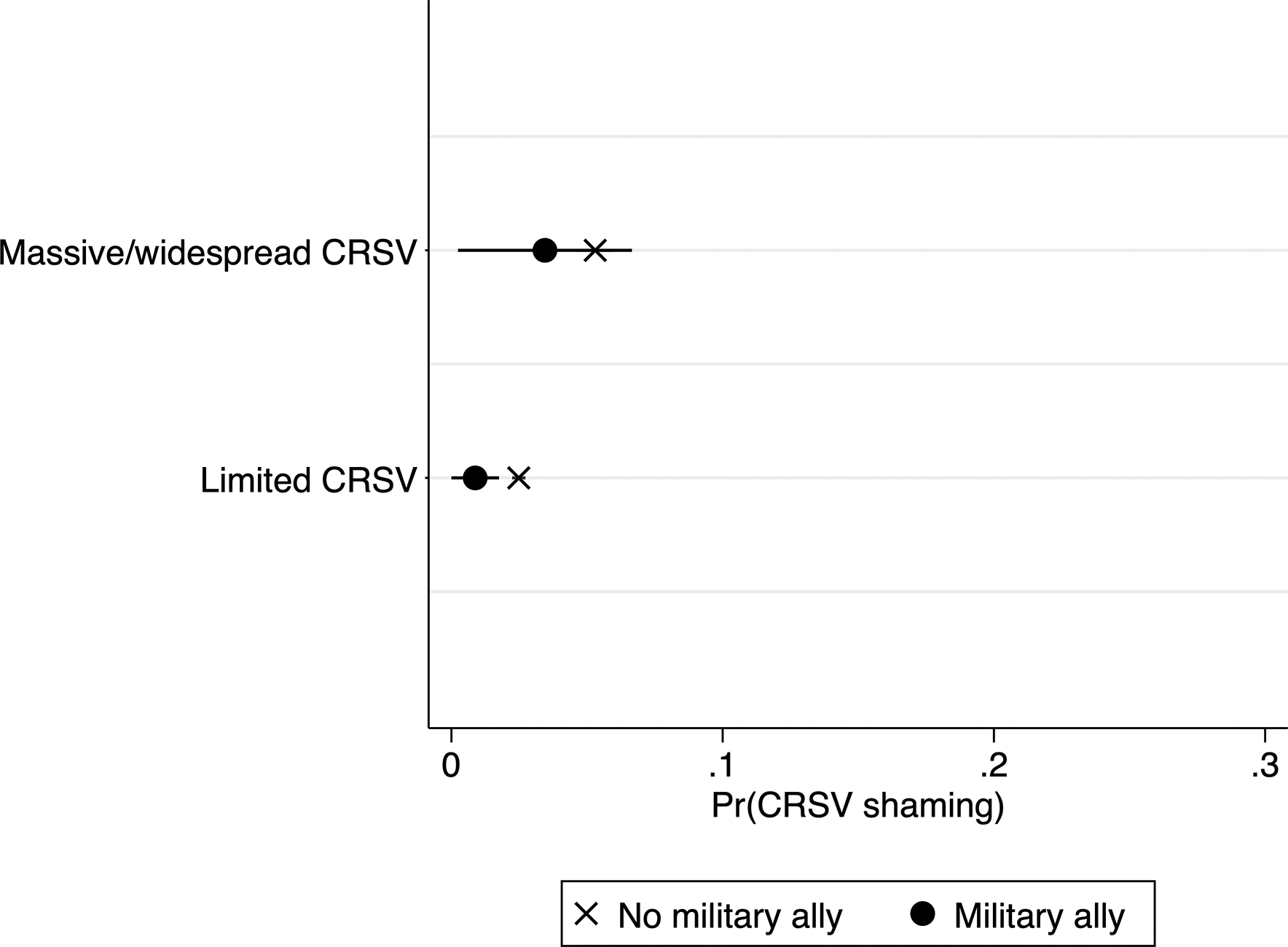
To underpin H4, I have argued that shaming CRSV which is perpetrated by an aid recipient offers donor states a low-risk opportunity both to show international commitment to end CRSV and to justify continued aid programmes. My sample contains 655 review opportunities for donors (44 individual donors) to shame CRSV perpetrated by an aid-receiving government. Donors with the most such opportunities include Japan, the Nordic countries and South Korea. 17 The group of donors which seizes this opportunity, on the other hand, is less diverse. Four states account for nearly one-third of all seized opportunities to shame CRSV in aid-receiving states. These are Norway and Italy (which respectively take the opportunity 43% and 38% of the time), followed by Austria and Canada (which take the opportunity 32–33% of the time). These frequencies stand in sharp contrast to the overall participation rate of 5%. Indeed, half of all CRSV-shaming within the UPR is directed by a donor at an aid recipient. Put differently, there is a clear over-representation of donors among those that shame CRSV. This speaks in favour of H4.
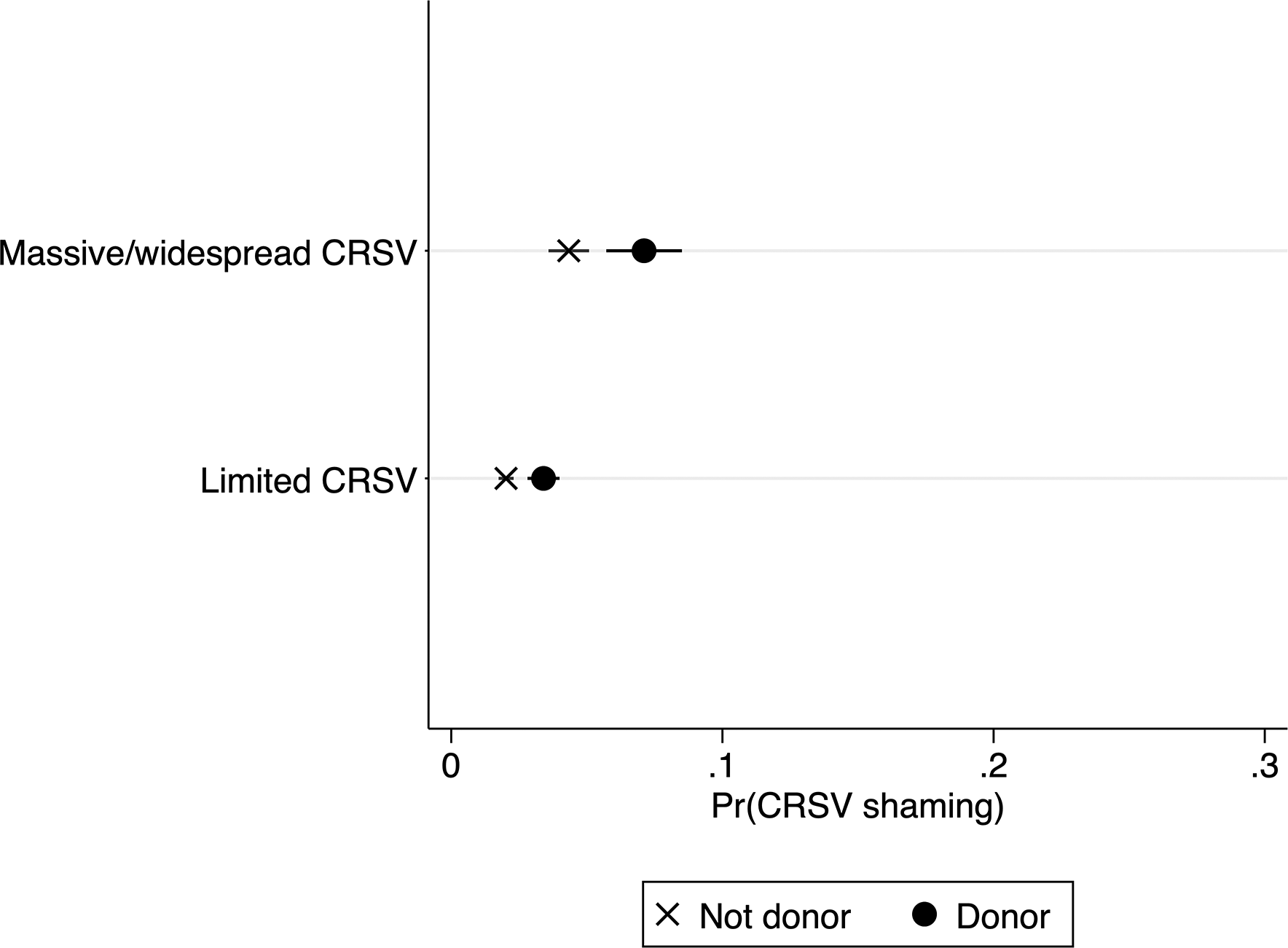
Multivariate analyses furnish support for H4. As Figure 6 illustrates, donors are consistently more likely to shame a major sexual aggressor than a state which does not give aid to the state under review. On average, donors are almost twice as likely to shame outbreaks of widespread/massive CRSV as non-donors. The estimated probabilities are 0.071 and 0.043 (p-value of 2nd differences in effect size=0.1); therefore, one in 14 donors and only one in 25 non-donors shame sexual violence in these instances. By way of illustration, the Norwegian government regards donor relationships as a natural and efficient channel for promoting feminist norms (Skjelsbæk & Tryggestad, 2019).
This study has sought to answer the following question: under what conditions do states shame other states for conflict-related sexual violence? Having stipulated four hypotheses beforehand, I find support for two of them: (a) states with an interest in the WPS agenda and being associated therewith are more likely to shame CRSV; and (b) donor states are more likely to shame CRSV (see Table II). By contrast, I find no evidence of differential treatment vis-à-vis military allies or trading partners. While no shaming is the most common response to CRSV, it appears that Probability of shaming conflict-related sexual violence, by import dependency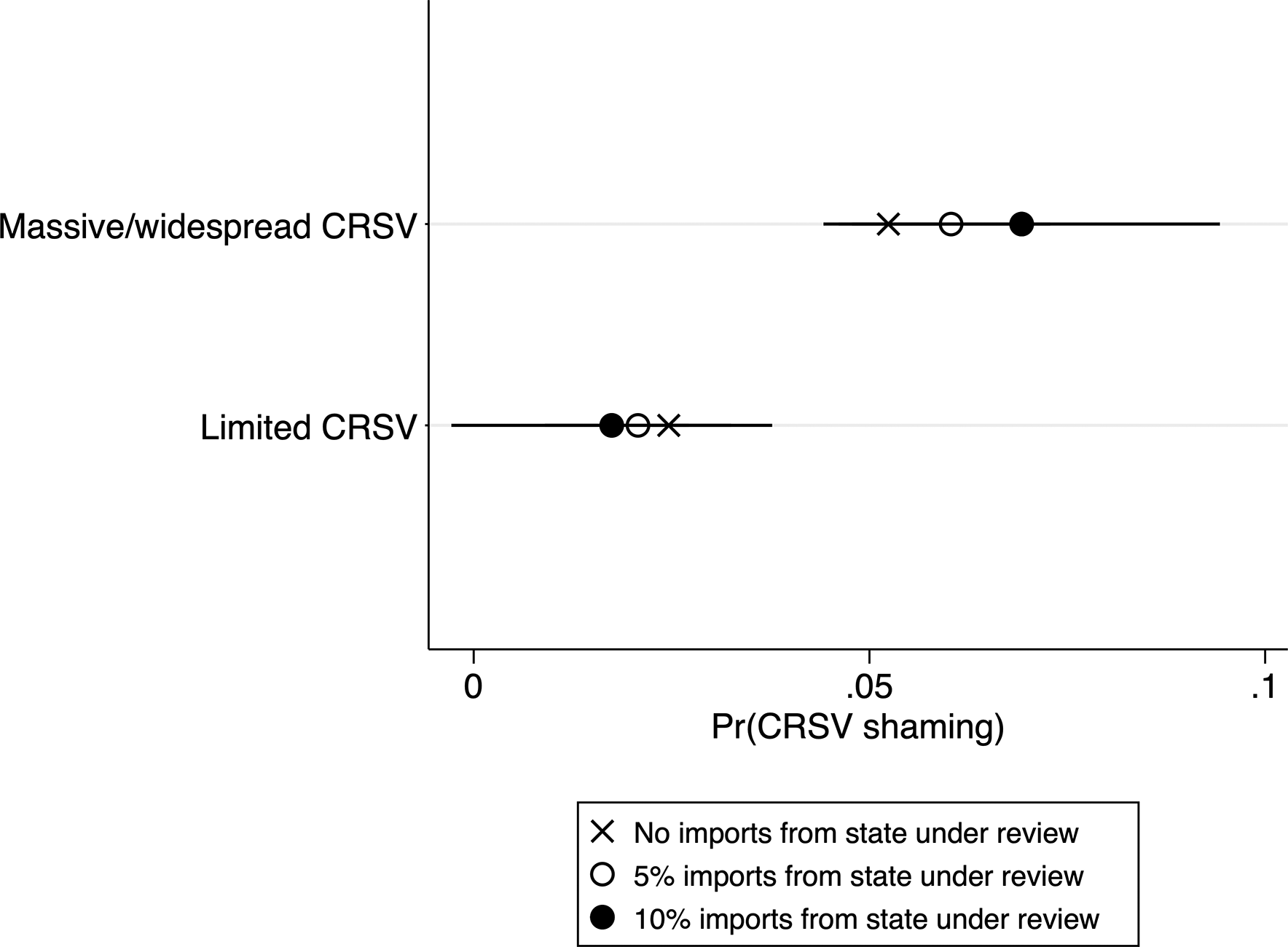
One side-finding is worth mentioning: the number of years since the United Nations Security Council Resolutions 1820. In 2008, the average probability of shaming another state for widespread/massive outbreaks of CRSV was 0.031 (based on Online Table A1, Model 4). In 2019, this probability was between two and three times higher: 0.078 (p-value of 2nd differences <0.01). In other words, nearly one in 12 states shamed a major sexual aggressor in 2019; 11 years earlier, by contrast, approximately one in 30 took the opportunity to criticize CRSV when given the chance. As a reference point, we can take the predicted probability that a state will shame another state on any grounds. 18 While the probability of any type of shaming is naturally higher than that of CRSV-specific shaming, it does not show the same trend over time. In 2008, the average probability of shaming another state was 0.31. Eleven years later, the same number was 0.33 (p-value of 2nd differences <0.01). Rather than showing that states have shamed each other more as UPR has gotten up to speed, this comparison indicates that they have become increasingly inclined to shame CRSV specifically, as the norm against CRSV has advanced.
Western bias? Regional patterns of donorship and shaming
Summary of findings

Probability of shaming conflict-related sexual violence, by aid partnership
Conclusion
Bilateral shaming of CRSV is rare. When is it done, and by whom? This study has explored the determinants thereof. Rather than responding by default to sexual crimes as such, states appear to engage in such shaming selectively – in particular, when they find that so doing helps further other political objectives. This should prompt us to adjust our expectations on the rate of progress in this policy field, and help us better understand the dynamics of international negotiations in this area. Numerous aspects of the matter remain to be studied. A deeper analysis is needed, for example, of the foreign policies of individual states, and of their commitments on the Committee on the Elimination of Discrimination against Women.
Footnotes
Replication data

Acknowledgements
The study has benefitted from generous input from Konstantin Ash, Christopher Butler, Emma Elfversson, Christopher Fariss, Erika Forsberg, Charlotte Grech-Madin, Lisa Hultman, David Randahl, Chiara Ruffa and Susanne Schaftenaar. Additionally, I thank anonymous reviewers as well as the editor of Journal of Peace Research for valuable comments.
Funding
The author received the following financial support for the research, authorship, and/or publication of this article: The project has received support from the Swedish Research Council (grant 2018-00835) and the Knut and Alice Wallenberg Foundation (grant 2018.0455).