




Abstract
Whereas previous research shows that peace agreements which include a broad segment of society are more likely to lead to sustainable peace, little effort has gone into explaining inclusion itself. We address this gap in the literature by providing the first large-N study to examine the causes of inclusive peace negotiations across civil wars. We argue that civil society actors can gain leverage through mobilization of civilian protest, or build trust through dialogue efforts, thereby enhancing the chances of inclusion of non-warring actors at the negotiation table. The argument is examined by analysing unique and new monthly data on peacemaking efforts in all intrastate armed conflicts in Africa and the Americas, 1989–2018, including measures beyond mere nominal participation, such as whether civil society actors or political parties had substantive roles as either mediators or full participants at the peace talks. Our findings show that protests by civil society actors increase the likelihood that non-warring actors will have a seat at the negotiation table, whereas we find no such effect concerning dialogue efforts. The article contributes by providing new insights into how nonviolent action can shape peace processes by opening the doors to negotiations and is thus part of an emerging research agenda that seeks to bring together the fields of civil resistance and inclusive peace processes.
Introduction
A comprehensive peace agreement was signed in Sudan in 2020 with the aim to bring a peaceful end to the civil war that has raged within the country. The agreement was negotiated not only by the armed actors but also the Sudan Revolutionary Front – an alliance of civil society organizations that, through a massive popular-based nonviolent campaign of various forms of protests, had challenged and toppled the autocratic regime of President Omar al-Bashir in 2018–2019 (Zunes, 2021). The Sudanese case exemplifies the key role of civil society in shaping the dynamics of armed conflicts and the conditions under which peace talks are held. In particular, it illustrates two different roles of the Sudanese civil society – protest and negotiation – and how one paved the way for the other. The Sudanese civil society organizations thus got their place at the negotiation table after being able to successfully mobilize against the regime through protests.
Inclusion of civil society actors in peace accords has been identified as a key factor behind sustainable peace (Bell & O’Rourke, 2007; Nilsson, 2012; Wanis-St. John & Kew, 2008). 1 To let different stakeholders have a say when the transition from war to peace is negotiated is important in itself, but it can also lead to greater chances for a more robust post-conflict peace. Moreover, the type of institutions, constitutional arrangements, and state structures that are put in place during the transition phase of the peace process will come to shape the space and opportunity for civil society actors, political parties, and the people they represent for many years to come. We also know that actors, such as the UN and the World Bank, are advocating for more inclusive policies (United Nations & World Bank, 2018). However, little effort has gone into explaining inclusion itself. Can civil society actors, through protests and dialogue efforts, shape the conditions for inclusive peace talks in civil war? We do not yet understand the conditions under which the negotiation table is opened up to include not only the warring parties but also representatives from other spectra of society, such as women’s organizations, religious groups, human rights actors, or political parties. To get a seat at the table alongside the primary parties – commonly the government and the rebel group(s) – can be of critical importance to gaining influence over the transition process from war to peace.
We address this research gap by providing the first large-N study to examine the causes of inclusive peace negotiations across civil wars. The study contributes by providing new insights into how nonviolent action can shape peace processes and is thus part of an emerging research agenda that brings together the fields of civil resistance and inclusive peace processes. In particular, we contribute by studying whether armed conflicts that see civil-society-led initiatives – protests as well as dialogue efforts – are more likely to be followed by civil-society or political-party involvement at the formal peace talks. Empirically, we draw on new and unique data from the NoWA (Non-Warring Actors in peacemaking) dataset to explore the involvement of non-warring actors in peacemaking efforts in all intrastate armed conflicts in Africa and the Americas, 1989–2018. In this study, we examine inclusion with a degree of empirical precision not used in previous research: conflict–dyad–month. With more refined and calibrated measures, we are able to study the dynamics and processes with more nuance than when using higher levels of aggregation. We are thus able to trace civil society involvement during conflicts over time and across cases in a way that has not been done before.
We theorize that even when armed actors may have reasons to constrain the possibilities for civil society participation and the formal paths to participation are closed, civil society actors may tailor their engagement through more informal ways, including dialogue efforts with the warring parties and protests in the streets. Civil society organizations thus have a different repertoire of actions that they can implement to gain influence. Not all forms of inclusion translate to real influence over negotiations. Sometimes inclusion is superficially approached and actors are included, albeit only left to observe, but not engage in, the process. We therefore explore not only the inclusion of non-warring actors in terms of presence at the table, but also explore if they have a substantive role as either mediators or full participants. Our findings demonstrate that protests by civil society actors increase the chance that non-warring actors such as civil society actors or political parties will have a seat at the negotiation table, including in a more substantive sense (as mediators or full participants), whereas dialogue efforts do not have the same influence on inclusivity.
Identifying the factors that drive inclusion is important for a number of reasons. First, if one of the key factors in achieving sustainable peace is inclusion in peace accords, then we need to know how inclusive processes are created. This is important from a policy perspective: if inclusion is the goal, we need to understand how to achieve it. Second, studying civil society engagement is a way of broadening the scholarly scope of attention beyond armed actors: whereas lots of research has gone into studying the dynamics of armed actors in war-making and peace processes, we know remarkably little about non-armed actors in these contexts. While this is now gradually starting to change (e.g. Idler, Belén Garrido & Mouly, 2015; Kaplan, 2017; Masullo, 2021; Vüllers & Krtsch, 2020), our research can shed light on how non-armed actors interact with each other and with armed actors (governments and rebel groups). This also speaks to the broader question of the effect and dynamics of civil resistance more generally (e.g. Chenoweth & Cunningham, 2013; Chenoweth & Stephan, 2011; Schock, 2005). Finally, it is important to study how different forms of engagement – in particular, protests and elite-based formal negotiations – are related to each other.
Theory
There is a large field of research focusing on the inclusion of civil society and the different functions and roles such actors may play in contributing to peacebuilding (e.g. Bell & O’Rourke, 2007; Belloni, 2008; Hellmüller, 2020; Krause, Krause & Bränfors, 2018; Orjuela, 2003; Paffenholz, 2010; Paffenholz, 2014; Paffenholz & Zartman, 2019; Zahar & McCandless, 2019), as well as the impact of high-quality civil society inclusion on longer-term democratization following nonviolent transitions (Dudouet & Pinckney, 2021). Research on the determinants of inclusion, however, is still in its infancy and only a few studies focus on this topic (e.g. Elfversson & Nilsson, 2022; Hirblinger & Landau, 2020; Martínez Lorenzo & Nilsson, forthcoming; Souza, 2019). Some works explore structural factors; for instance, Nilsson (2012) does not find any evidence that the type of political system or economic growth in a society affects the likelihood of civil society inclusion in peace accords. Other works examine the process of inclusion. For example, Dudouet (2021) suggests that the nature and attributes of social movements, their different types of relations to conflict parties, and their relationships with external mediators help to account for the different strategic choices of movements, including seeking formal representation at the table. Furthermore, Elfversson & Nilsson (2022) examine how the type of third-party actor may shape conditions for inclusion in the context of communal conflicts. Hence, while more work is being done on this issue, we still know relatively little about the causes of inclusion, in particular regarding how peace efforts by civil society actors contribute to shaping the conditions for inclusion. Generating knowledge about the selection process behind inclusive agreements is thus of key importance in order to better understand their role in shaping sustainable peace.
Civil society actors are organizations, groups, and networks that organize and mobilize citizens through non-state structures, but which are not family or market based: ‘Civil society is understood to comprise organizations that take voluntary collective action around shared interests, purposes, and values and that are distinct from those of the state, family, and the market’ (Paffenholz, 2014: 70). Civil society is a concept that captures a plethora of very different types of actors. Civil society consists of women’s organizations, labour movements, youth groups, religious societies, and other actors that are located in the space beyond the state, family, and market, although commonly existing with various ties to these other sectors of the society.
Civil society is ‘civil’ in the sense that it consists of actors that are predominately unarmed and represent civilians – yet it is not necessarily ‘civil’ in the sense of only representing actors with a respectful, tolerant, and honest agenda. Actors who are part of civil society may have war-mongering, authoritarian, or sectarian agendas, just as they may include actors with an agenda for the exact opposite (Belloni, 2008; Sombatpoonsiri, 2020). Thus, we should not assume that civil society actors engaging in protest and dialogue are necessarily actors with benign, peaceful aspirations, and they may also try to create obstacles to peace negotiations and agreements.
A growing field of research has examined the role of protests and civilian agency during civil wars (Arjona, 2015; Barter, 2014; Chenoweth, Hendrix & Hunter, 2019; Dorff, 2019; Vüllers & Krtsch, 2020). Kaplan (2017) shows how communities can take various sorts of actions in the midst of violent conflicts in order to advance their interests. Some work has also been done on the connection between protests and peace processes (Abbs, 2021; Dudouet, 2017; Leventoğlu & Metternich, 2018; Nilsson et al., 2020; Petrova & Abbs, 2021). In particular, Leventoğlu & Metternich (2018) argue that protests can be seen as signals of strong rebels that can create broader coalitions, including the urban middle-classes, and they demonstrate empirically that negotiation onset is predicted by antigovernment protests.
In this article, we examine the extent to which action by civil society outside the formal peace process influences the chance that non-warring actors will get a seat at the negotiation table. Warring actors may have reasons to invite or to constrain civil society actors’ or political parties’ participation at the negotiation table. Inclusion may be preferable if armed actors wish to send a signal of reform-interest, increase the legitimacy of the process, or share some of the burden of making costly concessions. On the other hand, including wider segments of the society will imply giving up some power assets otherwise in the hands of the warring actors, including procedural control and power over the process (e.g. Cunningham, 2013). It increases the warring parties’ audience costs as it risks exposing actors negotiating in bad faith. Civil society organizations and representatives at the table will also have the opportunity to raise concerns and grievances that it may not be in the narrowly defined self-interest of the primary parties to address. For governments, inclusion may be costly as it sends a signal of a lack of representativeness within said governments, which tend to seek to portray themselves as representing the wider society. For rebel groups, allowing civil society or political parties to speak may challenge the way they have framed the grievances and their aspirations of being the valid spokesperson of segments of the society.
Yet, civil society can counter and overcome such obstacles. While we acknowledge that inclusion may come about through different pathways, one way is through nonviolent action. Previous research has demonstrated that civil society organizations have a wide repertoire of nonviolent actions (Cunningham, Dahl & Frugé, 2017) that they can also employ in the midst of armed conflicts (Chenoweth, Hendrix & Hunter, 2019). Here we focus on two categories of such actions: protests and dialogue efforts.
When civil societies mobilize through protests, they create public pressure against the primary parties by influencing public opinion. Through their engagement in nonviolent, disrupting acts of civil action, such as strikes, demonstrations, and occupations, they can also create costs for the political leadership, creating incentives for the leadership to amend their policies and open up for inclusion. Liberia can serve as an illustration of this dynamic. The women’s organization WIPNET brought together large demonstrations against the civil war and successfully put pressure on President Taylor and the warring parties to engage in talks. When peace negotiations were later initiated, Mediator Abubakar extended invitations to several civil society actors to participate. While representatives of WIPNET continued to advocate for peace from outside of the negotiation room, many other civil society actors did partake in the talks, including the Mano River Women Peace Network (MARWOPNET), the Inter-Religious Council of Liberia (IRCL), and the Liberian Bar Association, and many political parties were also present (Hayner, 2007; Nilsson, 2009). Such actors can then air concerns of a constituency that may have been silenced by the incumbent power-holders, raising concerns that need to be addressed at the negotiation table. Dudouet (2017: 2) makes a case for the ‘crucial importance of civil resistance […] as a pre-negotiation strategy for oppressed groups, enabling them to wage necessary conflicts through nonviolent means, thereby putting pressure on incumbent elites to redistribute power equitably’. Dudouet (2017) argues that it is useful to think about a sequenced process where protests help to empower groups and give them leverage over the present elites. Thus, the main effect of civil resistance and protests in the context of a peace process is to create leverage over the primary parties as well as to give a voice to underrepresented actors and their grievances that have not sufficiently been articulated. This has been described as the ‘fundamental bargain of nonviolent resistance’, namely that ‘direct action creates the leverage that negotiation translates into tangible gains’ (Wanis-St. John & Rosen, 2017: 19).
Civil society mobilization can influence the two dimensions that Lantz (2011) suggests are critical in determining who gets a seat at the table, namely which actors have practical leverage to influence the possibility of reaching a peace deal, and the normative question of who should be included. For example, how women can get access to the negotiation table is central here, and something which international actors, as well as states and local power-holders, can help ensure (Möller-Loswick, Riesenfeld & Olsson, 2019). Through demonstrations and protests, civil society organizations can both influence the costs of conflicts and the status-quo, creating incentives for settling a conflict through an inclusive approach, while also making an argument for the ethics of inclusion, through influencing the public debate. Peace negotiations do not occur in vacuums. When civil society mobilizes, organizes, and expresses their grievances and concerns, we therefore expect the primary parties to be more likely to provide space for non-armed actors at the table.
Peace processes restricted for the elites only come with certain costs in terms of lack of legitimacy, public ownership, and preparedness among constituencies for possible concession-making at the negotiation table. Peacemaking under such conditions may risk pacifying citizens, rather than empowering them (Francis, 2010). With nonviolent action, civil society actors can take steps to prevent such disempowerment and instead make the warring parties, as well as the international community, aware of their presence, importance, and voices.
Protests and negotiations represent two distinctly different approaches to social conflicts; however, they do share a number of similarities (Finnegan & Hackley, 2008). Interestingly for our approach, an important role in both negotiations and nonviolent struggles lies in the importance of coalition-building (Finnegan & Hackley, 2008: 16–17) or brokerage (McAdam, Tarrow & Tilly, 2001: 157). By building coalitions, negotiators or activists seek to draw more stakeholders into the dynamics of the transition process, shape new bonds between different types of actors, and create larger constituencies that have an interest and a common stake in the outcome. This type of coalition-building will increase the leverage of civil society movements and thereby increase the chance for inclusive negotiations. Based on the above discussion, we deduce the following hypothesis:
Hypothesis 1: If civil society is engaged in protests during conflicts, it is more likely that non-warring actors will be included in peace talks.
Civil society can also invent new channels for negotiations beyond the official ones (e.g. Kelman, 1998; Lederach, 1997), paving the way to inclusion also at the negotiation table. In this way, civil society can create a space for dialogue across different segments of a society, including across the fault line between the constituencies of the armed actors (Jones, 2020). Organizations and actors in civil society may be in a position to reach out to one side of a conflict and talk to them as a way to make progress. By opening channels of dialogue, civil society can create networks of individual brokers, active on the rebel or the government side, identify issues that need to be taken up at the official level, or build a climate of safe space in which negative stereotypes between the antagonists can be overcome. Civil society actors make themselves useful in the peace process not necessarily because they openly demand inclusion, but because they show themselves able to establish communication channels with the antagonists (Saunders, 2005; Wehr & Lederach, 1991). By creating and shaping different channels of dialogue, processes of joint inquiry, or bilateral caucuses, civil society actors can influence who will be invited to the negotiations. Engaging in dialogue efforts, civil society actors can develop proposals based on different perspectives, including insights from the civil society, and these proposals can grow to become influential for the development of the negotiation process.
A key question for civil society dialogue efforts is that of transfer, that is, the way in which citizen-based processes of dialogue, negotiation, and problem-solving are associated with formal procedures of change (Cuhadar & Paffenholz, 2020; Fisher, 2020). It is essential that those who engage in dialogue have a sufficient distance to be fruitful avenues for change: too distant from power and civil society workshops risk becoming a talking circus without any possibility to achieve change, while too close will mean that the actors will not have the room to manoeuvre in relation to parties’ established positions (e.g. Fisher, 2006). Based on this discussion, we propose the following hypothesis:
Hypothesis 2: If civil society is engaged in dialogue efforts during conflicts, it is more likely that non-warring actors become included at peace talks.
Research and policy have increasingly come to recognize the need for meaningful inclusion (Dudouet & Pinckney, 2021; Hirblinger & Landau, 2020; Paffenholz et al., 2016). For example, while inclusion in general has no effect on the chance of democratization following a nonviolent transition, high-quality inclusion of civil society does (Dudouet & Pinckney, 2021). Given the changing international discourse and emphasis on inclusion, many actors have taken steps to include civil society at least nominally. There is a recognition that inclusion is sometimes a facade in order to appease the international community, rather than being a measure that actually opens space for civil society or other non-warring actors. Yet there are reasons to expect that when civil society engages in nonviolent action, it increases the chances that the inclusion will be more substantive. When civil society is mobilizing protest, or when they engage in dialogue efforts, they can wield the leverage or build the trust needed to make substantive inclusion possible. Following this line of reasoning, we formulate the following expectations:
Hypothesis 3: If civil society is engaged in protests during conflicts, it is more likely that non-warring actors will be included at peace talks as full participants or mediators.
Hypothesis 4: If civil society is engaged in dialogue efforts during conflicts, it is more likely that non-warring actors will be included at peace talks as full participants or mediators.
Research design
We focus on the involvement of non-warring actors in peacemaking efforts across all intrastate armed conflicts in Africa and the Americas during the period from 1989 to 2018. We study all government–rebel conflicts which have resulted in at least 25 battle-related deaths in a year, using the UCDP dyadic dataset v.19.1 (Harbom, Melander & Wallensteen, 2008; Pettersson, Högbladh & Öberg, 2019). While the UCDP dyadic dataset is coded on a yearly basis, we rely on the government–rebel dyad month as the unit of analysis, thereby allowing us to trace peacemaking efforts over time and capture important variations in inclusion across dyads. 2 In addition, since many peace efforts start after the violence has stopped, and we want to capture such activity, we also study peacemaking efforts for an additional 24 months after the dyad has been active (unless the rebel group dissolves or becomes active as part of another dyad). Only including active conflict years would have risked excluding much of the peacemaking efforts that occur.
We rely on a new and unique dataset on the involvement of non-warring actors in peacemaking efforts – the NoWA dataset, v.1.2, which currently covers such efforts from 1989 to 2018 across all armed conflicts in Africa and the Americas. This dataset offers fine-grained information on the types of non-warring actors that are involved, their different roles in peacemaking efforts, and information on the timing of such involvement on a monthly basis. In terms of types of actors, the dataset captures a wide range of civil society organizations, for example, women’s organizations, human rights groups, religious actors, and trade unions, as well as political parties. Regarding the different roles in peacemaking, we draw on and modify Paffenholz’s (2014) categorization and capture the following types of roles: formal negotiations (either as full participants or observers), mediation, mass action, problem-solving, consultation meetings, public participation, and public decisionmaking, as well as official and unofficial parallel forums. 3 In terms of timing, we study these processes at the monthly level, thereby opening up for questions relating to sequencing and when, if at all, non-warring actors become involved in peacemaking. NoWA also contains monthly information on negotiations between the warring actors. Our definition of negotiations is in line with the UCDP definition: the talks must include at least two of the warring actors, of which at least one is the government, and the talks need to deal with one or more issues relating to the armed conflict. 4 Similar to the UCDP, the NoWA dataset is mainly based on coding of news articles from the global news database Factiva, which includes reports from larger news agencies such as BCC monitoring, Reuters, and AFP, as well as local news sources. In addition, in specific cases this information is complemented with other sources, such as journal articles and reports.
Our first dependent variable, Inclusion, is coded 1 if any type of civil society actor or political party is participating at the formal peace talks, either as full participants, observers, or mediators, and is otherwise coded 0. For example, in cases such as Colombia and Guatemala, civil society has been included at the negotiation table in various capacities, whereas the peace negotiations in Angola and Rwanda have largely been exclusive in character. Notably, the peace negotiations may still be exclusive in some sense, leaving out some of the key stakeholders, but through this measure we can ascertain that the peace talks were open to one or more non-warring actor. Applying an organizational perspective, non-warring actor in this context means a representative of an organization, network, or community. Moreover, while informal or formal parallel forums may take place alongside negotiations, we here focus on presence at the negotiation table. Our second dependent variable, Substantive inclusion, is coded 1 if a non-warring actor is included at the peace talks as a full participant or as a mediator, and is otherwise coded 0. This operationalization is based on the assumption that there is a qualitative difference between being observers of talks (commonly with restrictions in terms of access, possibility to express positions, engagement in direct bargaining, coming forward with concrete suggestions, etc.) compared to being involved in a more substantive sense as full participants or as mediators (by which follows a certain degree of procedural power).
Our main independent variables focus on previous peacemaking efforts by various types of civil society actors. First, we study protests capturing events where civil society actors are involved in nonviolent campaigns or demonstrations that are related to peace efforts (thereby excluding general protests not connected to peacemaking or negotiations). In contrast to previous literature on nonviolent campaigns, which commonly only study large demonstrations with more than 1,000 participants, we do not require a certain number of participants to count these protests, but very small protests are not likely to be reported in the media sources that we use. Moreover, since the effects of protests may not be instantaneous, we seek to account for a slight delay in impact. The measure Protests is coded 1 if there have been any protests taking place in the last six months. 5 In the robustness tests, we use an alternative measure capturing such involvement in the last three months. Our second key independent variable is dialogue efforts, where one or more civil society actor is involved in meetings or workshops with one or more of the warring actors, or is in other ways promoting dialogue efforts. These may occur before negotiations have started or may take place parallel to negotiations. We consider whether any Dialogue efforts have occurred in the last six months and also use an alternative measure focusing on three months.
We account for a couple of key control variables that we believe may influence the opportunities for civil society actors to become involved in protests or dialogue efforts, as well as the likelihood of inclusion at the negotiation table. The vibrancy of the civil society is an underlying structural condition that will influence the possibilities for inclusion: in conflicts where there is a strong, ordered, and lively civil society, we would expect it to be more likely that it may be included, compared to situations where civil society is weaker, less well-organized, and less energetic. We therefore account for the vibrancy of civil society using a measure which captures whether civil society ‘enjoys autonomy from the state and in which citizens freely and actively pursue their political and civic goals, however conceived’. The variable Civil society robustness is an index (v2xcs_ccsi) from V-dem, v.10 capturing whether civil society is seen as robust (Coppedge et al., 2020: 50). To ensure time order, we use the value for the preceding year for this measure. Next, we include a set of variables capturing a few central characteristics of the conflicts, using data from the UCDP dyadic dataset, v19.1 (Harbom, Melander & Wallensteen, 2008; Pettersson, Högbladh & Öberg, 2019). We control for the incompatibility as the different forms of participation could be influenced by the issue at stake, which in turn may also impact the likelihood of inviting local stakeholders. The variable Territory takes on the value 1 if the incompatibility is fought over territory and is coded 0 if the conflict is fought over government power. We also account for the Duration of the conflict, capturing the number of years since the government–rebel dyad first became active in terms of reaching 25 battle-related deaths. To account for temporal dependence, we also include the number of months since the last civil society inclusion in the negotiations, along with its squared and cubed terms (Carter & Signorino, 2010). 6
In alternative specifications, we use some other measures capturing the vibrancy of civil society, women’s participation, and the level of democracy. These measures are from V-dem, v.10 (Coppedge et al., 2020). Since all these measures are highly correlated, we use them in separate models. We include the variable Civil society participation (v2x_cspart), which captures aspects such as whether CSOs are ‘regularly consulted by policymakers’ and the extent of involvement in CSOs. We also account for Women’s participation (v2x_gencs) using a measure capturing women’s ‘ability to express themselves and to form and participate in groups’ (Coppedge et al., 2020: 281). Next, we control for the degree of Liberal democracy, using the liberal democracy index from V-dem, which emphasizes the checks and balances on executive power and protection of minority rights. Finally, we also introduce a control for economic development measured as the Log of GDP per capita, since this could influence the general conditions for civil society actors in conflict-ridden societies. We here rely on data from the United Nations (2020). 7
Empirical findings
Before presenting our key findings, we discuss some descriptive patterns in our data. Summary statistics are available in the Online appendix, Table A1. We find that although negotiations are a rare event, more than 50% of the cases – 97 of the 191 active dyads across 71 armed conflicts – engage in negotiations at some point in time. Examples of countries that have experienced negotiations include Burundi, Colombia, Guatemala, DRC, Mali, Mexico, and Sudan. There are in total 880 months where one or several rounds of negotiations are ongoing. While some negotiation periods may stretch several months, as in 1996 in Guatemala, in other cases negotiations occur in a single month, as in Mali in December 2012. Out of these 880 monthly negotiations between the armed actors, 230 also include one or more civil society or political party actors at the negotiation table. Hence, about 26% of all negotiation months that occur are inclusive in the sense that at least one civil society or political party organization is present at the talks, as either a full participant, observer, or mediator. While we focus here on the inclusion of non-warring actors in general, it is also interesting to reflect on the type of actors that are involved (given involvement). Figure 1 breaks down the involvement by actor. 8 The most common types of actors are religious actors, representing 30% of the cases, and political parties are included in 27% of the cases, whereas women’s organizations are present at the peace talks in only 9% of the cases. Other civil society actors make up 15% of the cases. This category includes actors such as human rights associations and peasant associations which are not represented in any of the other categories. General civil society organizations, representing 13% of the cases, refers to those instances when no specific organization is mentioned, and a more generic term such as ‘civil society group’ is used. Thus, there is great diversity in the types of actors present at the peace talks.
We now turn to our main findings. For all models, we rely on logit analysis and use clustered standard errors at the conflict level.
9
We first stipulated, in Hypothesis 1,
Distribution of different types of non-warring actors in peace negotiations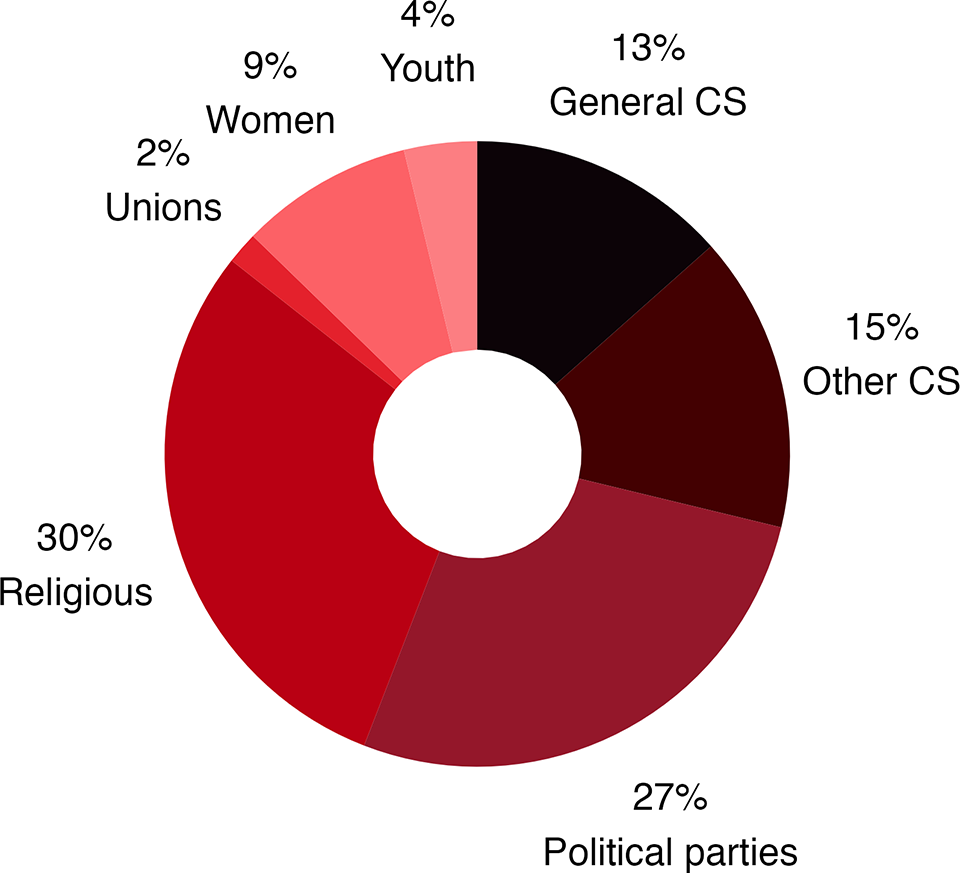
Since peace talks are very dynamic processes that may be ongoing for some time, we want to ascertain that our results are not simply reflecting an ongoing peace process. Consequently, we explore whether nonviolent actions drive negotiations more generally, or inclusive negotiations (which is the focus in this study). We thus create the measure Exclusive negotiations, which captures peace talks where civil society or political parties do not have a presence at the table. When accounting for this possibility, we find that protests are not driving negotiations more generally as we find no significant effect on exclusive negotiations (see Model 3, Figure 2; see also Table A2, Online appendix). Whereas civil society protests are associated with inclusive peace negotiations (see Models 1 and 2), protests do not seem to have the same effect in pushing exclusive negotiations where non-warring actors are left out of the formal talks. In contrast, whereas dialogue efforts do not seem to help provide a space for civil society actors or political parties at the table (see Models 1 and 2), this particular form of nonviolent action has a positive and significant effect at the 90% level on the likelihood of exclusive peace negotiations (see Model 3, Figure 2).
In terms of substantive effects, using Clarify, we find that the likelihood of inclusion increases from 0.8% to 1.7% when moving from no protests in the previous six months to having at least one month with protests in the last six months (Tomz, Wittenberg & King, 2001). While the percentages are small, it should be noted that this is at the monthly level, and the overall chance of negotiations is low to begin with. When civil society has been engaged in protests in the preceding six-month period, the chance of seeing civil society or political parties represented at the peace talks more than doubles. When considering substantive inclusion, the likelihood increases from 0.4% when there are no protests in the preceding six months to 1.0% when such activities have taken place. Again, while the percentages are small, the chance of substantive inclusion (i.e. representation as either full participants or mediators) more than doubles
Protests, dialogue efforts, and inclusive and exclusive negotiations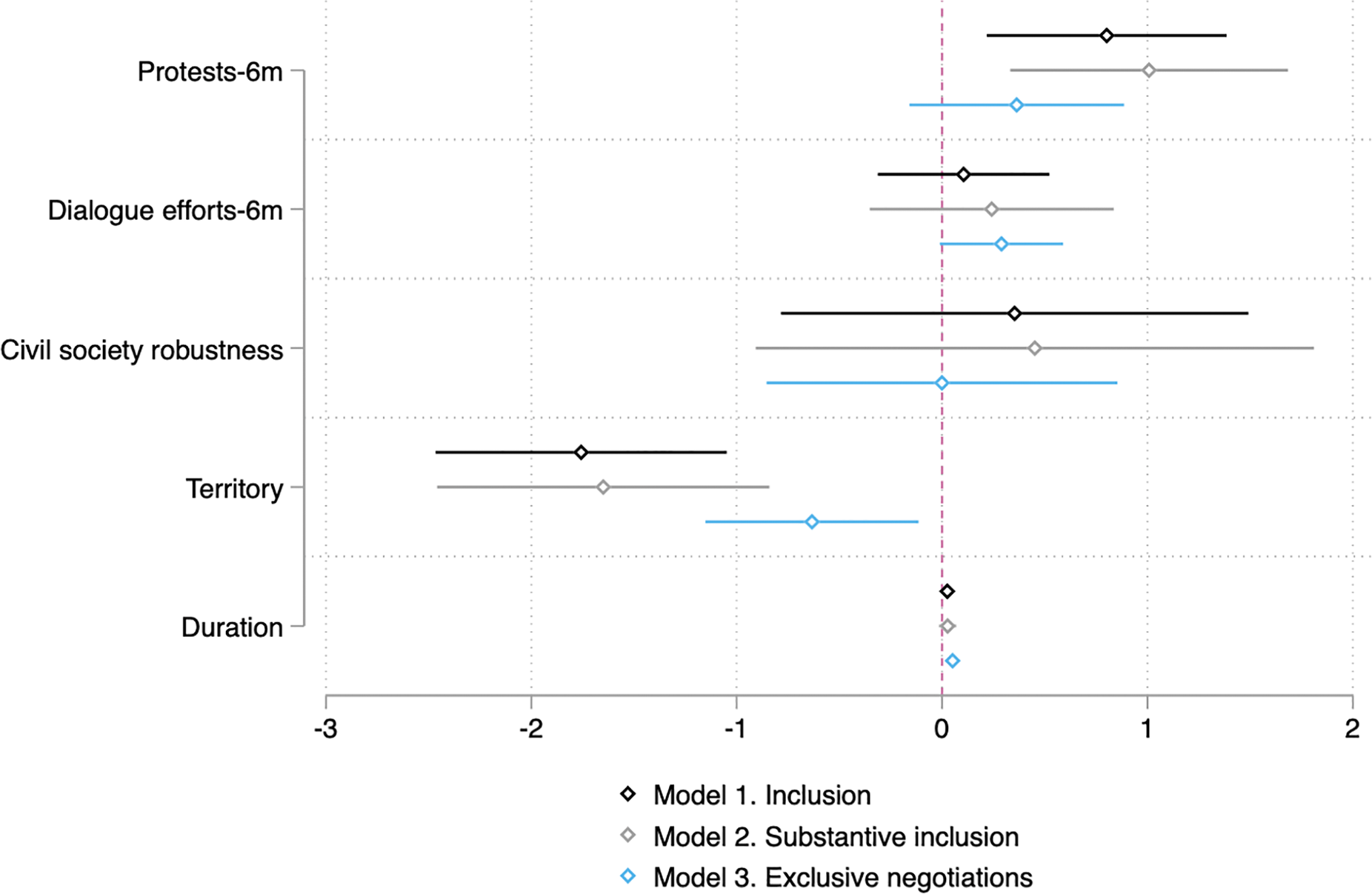
We also carry out a number of robustness tests. Notably, our main result on protests holds when accounting for several alternative measures, such as Civil society participation, Women’s participation, Liberal democracy, and Log of GDP per capita (see Models 4–11, Figure 3; see also Online appendix, Tables A3–A4). 11 As discussed, the variable dialogue efforts do not have a significant effect on either of our two measures for inclusion. We also used alternative measures of protests and dialogue efforts, which focus on activities in the preceding three months (instead of six months) (see Table A5, Online appendix). When doing so, our results concerning protests remain the same for both outcomes, whereas the effect of dialogue efforts is positive and significant at the 90% level for substantive inclusion. Moreover, when we consider protests in the preceding three months, we find a positive and significant effect on exclusive negotiations. There is thus some indication that it could take time for protests to help sustain more inclusive forms of participation. The results concerning dialogue efforts and exclusive negotiations remain significant at the 90% level when using the measure that focuses on the preceding three months. In addition, we also take some first steps towards exploring our findings in terms of predictive performance (see Online appendix, Table A9).
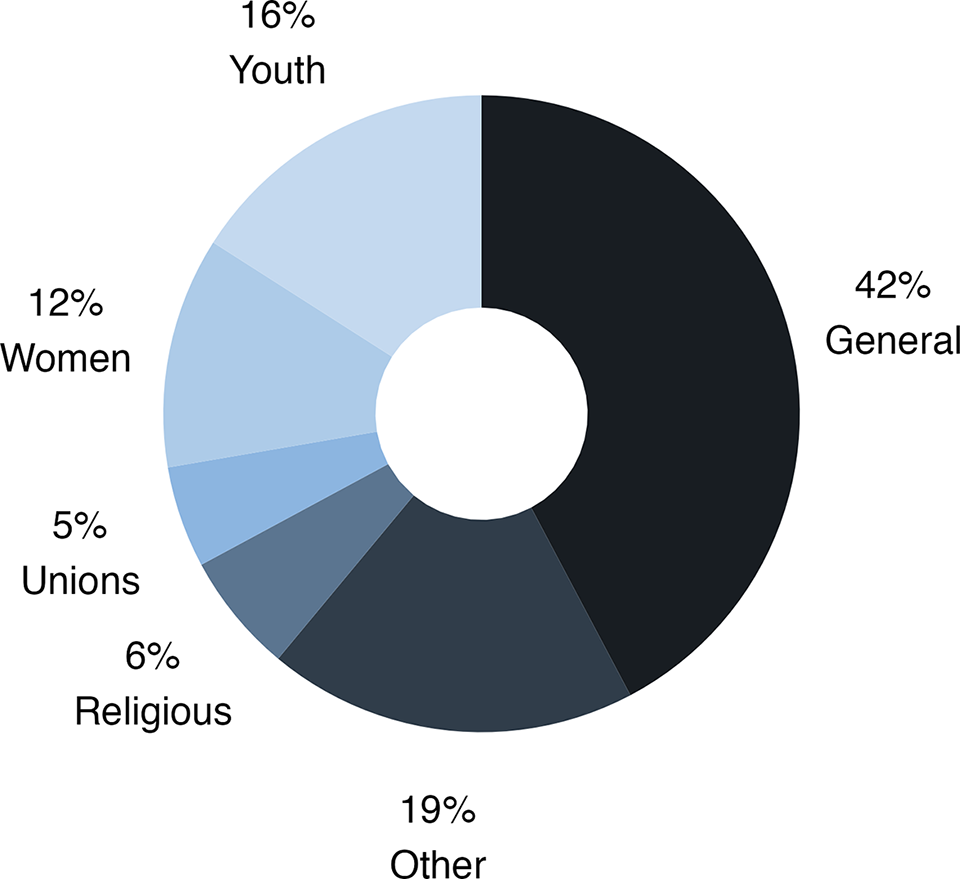
One pertinent question is which actors participate in these protests and to what extent; for example, women’s organizations are driving the inclusion of women’s organizations at the peace talks. In a first step, we take a look at some descriptive statistics regarding the different actors involved in protests (see Figure 4).
12
We can, for example, note that the share of women’s organizations in protests is around 12% out of the total number of protest
Protests, dialogue efforts, and inclusion – robustness tests Distribution of different types of civil society actors in protests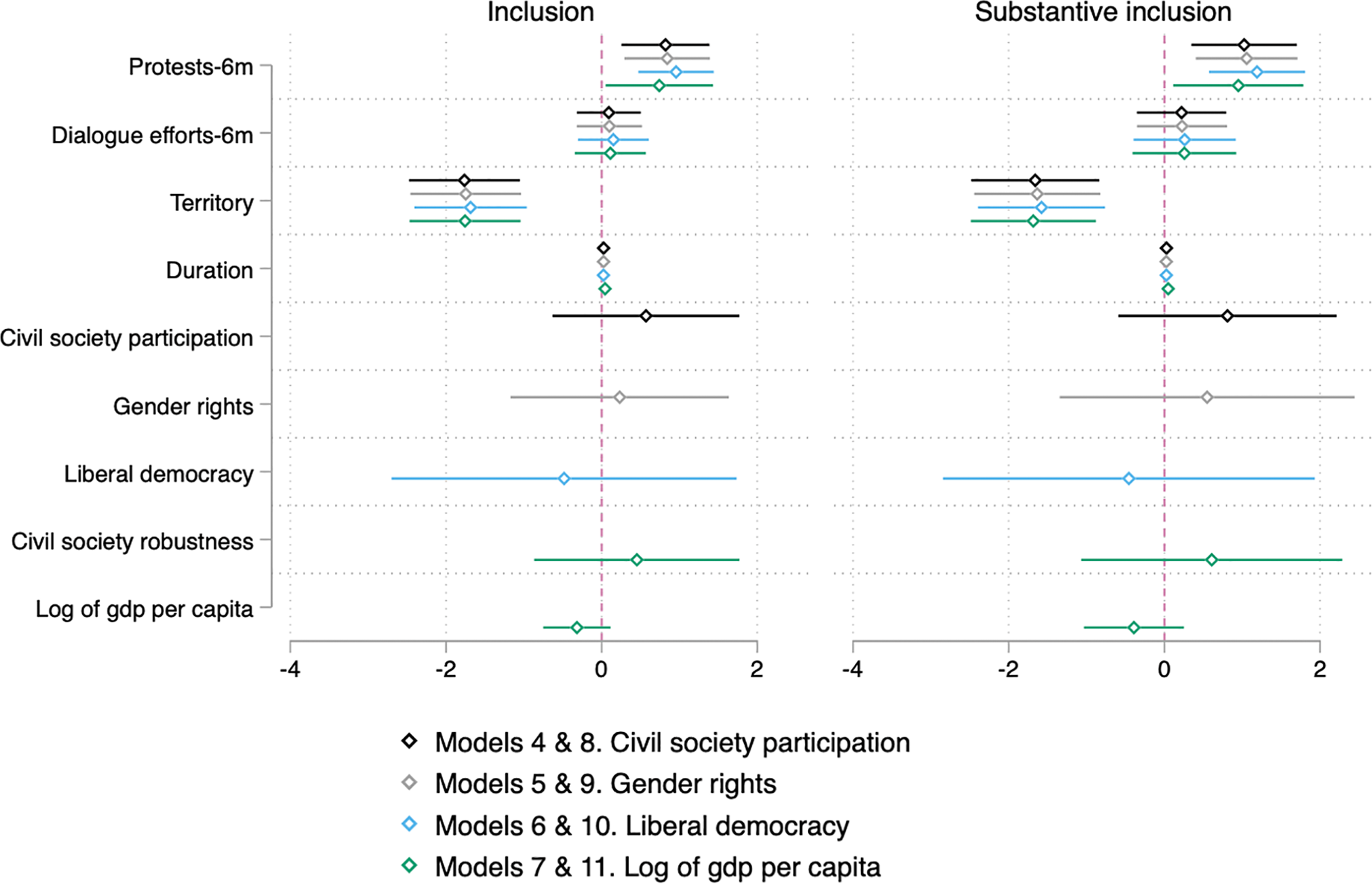
To probe this relationship a little further, we explore if the finding on protests can be attributed to particular civil society actors (see Figure 5, Models 12–23; see also Online appendix, Tables A6–A7). Overall, the findings do not seem to suggest that this is the case. For our first dependent variable – inclusion – we find a significant effect of protests involving youth actors, as well as for general civil society organizations (i.e. when the actors involved are referred to a generic term such as ‘civil society group’). The results concerning religious actors and unions show effects in the opposite direction (not significant), but it should be acknowledged that the number of cases for these categories are quite few. Turning to substantive inclusion, the result concerning youth actors is also significant in this context. In addition, we find that when women’s organizations are involved in protests, the chance of a substantive presence at the negotiation table increases. Thus, youth and women’s organizations seem to be able to bring about
Types of civil society actors in protests and inclusion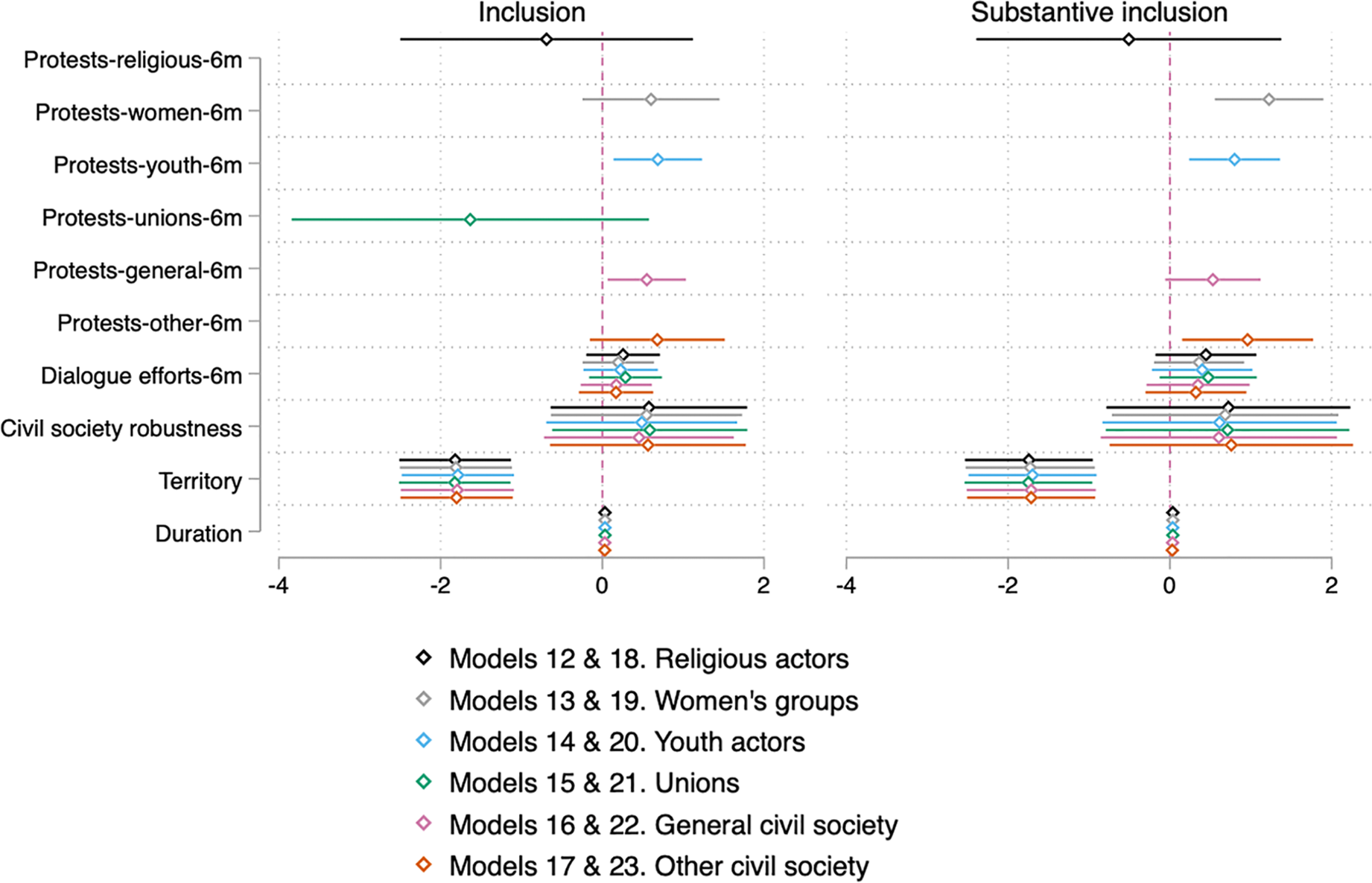
Protests and inclusion, recursive bivariate probit
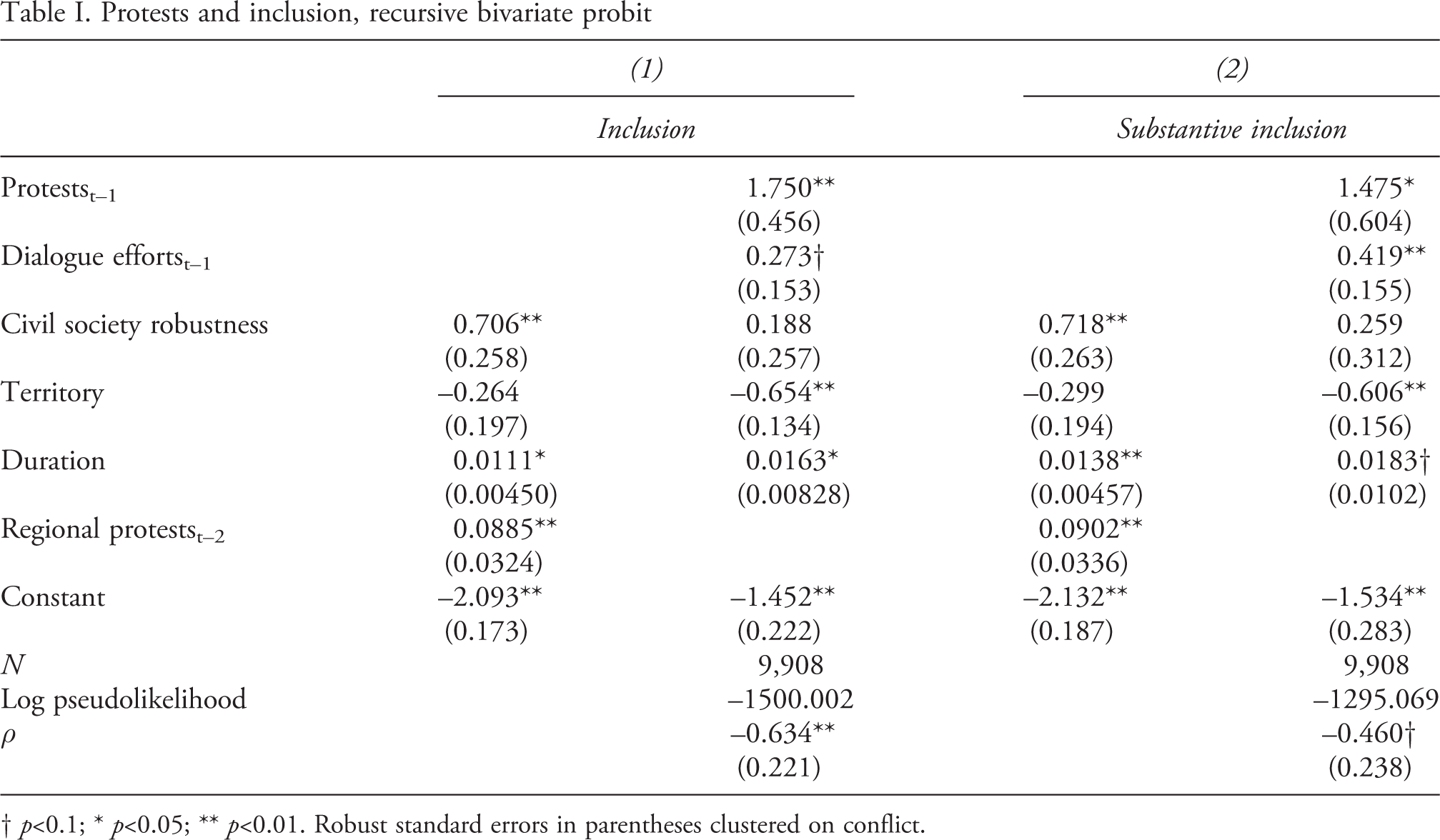
† p<0.1; * p<0.05; ** p<0.01. Robust standard errors in parentheses clustered on conflict.
Conclusions
This article investigates the effect of nonviolent action on the prospects for different types of inclusion at peace negotiations. Our study speaks to the wider discussion about inclusive peace by moving attention to an earlier stage in the process and seeking to explain inclusive negotiations. Moreover, while a lot of scholarly interest has been paid to the approaches and policies of external countries or intergovernmental organizations in relation to inclusive peace processes, this study approaches inclusion from another angle. As has been demonstrated above, there are also civil society organizations active that can mount pressure and build trust to incentivize warring actors to open up participation at the negotiation table more broadly. Following this line of inquiry, research may continue to look deeper into civil society capacities and explore further the strategies they employ in order to empower themselves.
Moreover, this study points to the importance of studying the complementarity of different civil society actors. It is important to unpack the categories of nonviolent actions as well as actors. In this way, we can get a more disaggregated analysis of how different types of social movements and organizations may create openings for inclusion. The analysis shows that it is not necessarily the same type of actors and organizations that are involved in the nonviolent action as are in the formal negotiations. For example, whereas religious organizations are frequently among the included non-warring actors at the table, religious actors’ involvement in protests is rather rare. Thus, it is not necessarily the same (type of) actor that takes actions in the streets or sets up new forms for dialogue that then gets into the negotiation room. This speaks to the question of complementarity between different types of organizations, and taps into the scholarly development of the organizational setup of nonviolent campaigns (Butcher et al., 2022). The different roles taken may also be an indication of coalition-building efforts by civil society, although we do not know the extent to which the different types of actors coordinated their efforts.
The inclusion debate has moved away from the inclusion–exclusion dichotomy in order to examine more multidimensional ways of inclusion (Paffenholz, 2014). The NoWA dataset builds on this multidimensional approach to inclusion, and this study has taken this research one step further by examining the relationships between different types of civil society actions. In particular, our study demonstrates the relationship between nonviolent protests on the one hand, and the elite-driven processes of inclusion at the negotiation table on the other.
Furthermore, there is a broader scholarly discussion concerning what factors help to explain the vibrancy of a civil society, and the inclusion of civil society actors in different arenas (e.g. Bailer, Bodenstein & Heinrich, 2013; Lowry, 2005), but this scholarly debate has, so far, not examined what drives inclusion in peace talks. The line of research in this study can contribute to the question of how vibrancy of civil society is created, particularly because armed conflicts and the ways they are terminated represent formative phases in the development of a society. By bringing in civil society, this study can hopefully generate new research into this important topic.
Footnotes
Replication data

Acknowledgements
We thank Kajsa Tidblad-Lundholm, Barbara Magalhães Teixeira, Luís Martínez Lorenzo, Anton Ruus, Lou van Rozendaal, Eva Karamichael, Alanna Smart, and Tim Zackarias Gåsste for excellent research assistance. We are grateful for feedback received at the JPR special issue workshop 2021, the ISA Annual Convention 2021, the NEPS annual meeting 2021, and the University of Tennessee 2020. We also thank Paola Vesco, the editors, and the three anonymous reviewers for their excellent comments. In addition, we extend our thanks to the UCDP team for their generous advice on the coding process.
Funding
The authors received financial support for the research, authorship, and/or publication of this article: We gratefully acknowledge financial support from the Folke Bernadotte Academy (no. 17-00297), the Swedish Research Council (nr. 03847 and nr. 03247), and the Marianne and Marcus Wallenberg Foundation (no. MMW 2013.0025).