




Abstract
Protests against coronavirus policies have occurred in all European countries. The intensity of protest varies strongly, however. We explain this variation by strategic choices that protest organizers make to maintain the protest movement. Specifically, we argue that protest organizers pay heed to the dynamics of the pandemic in their country: the number of protest events is higher when and where mortality rates are lower and containment policies are more stringent. At the same time, the number of protest events is influenced by political factors. Despite the fact that civil liberties facilitate trust in government, these two variables exert opposite effects: while higher trust in government and public administration reduces the number of protest events, stronger civil liberties increase the number of protest events. We find evidence for these hypotheses in an analysis of the number of monthly protest events based on information from ACLED, the Armed Conflict Location & Event Data Project, in 28 European countries between March 2020 and August 2021.
Introduction
Protests against coronavirus policies have become almost as epidemic as the virus itself. In most European countries, protesters have opposed lockdowns and mask wearing requirements, school closures and vaccination programs but sometimes also demanded economic support from their governments for those hit hardest by the policies. These protests united a wide range of people that have otherwise little in common – stretching from those who fundamentally reject the democratic system of their home country to those who have voted for mainstream parties all their lives but feel economically and socially threatened by strict lockdown policies. While protesters share their opposition against coronavirus policies such as closures or curfews, the number of coronavirus-related protest events varies immensely across countries and over time (Fluegel & Holcomb, 2021).
Drawing on theories of protest mobilization (Opp & Roehl, 1990; Davenport, 2005), we argue in this article that protest events against containment policies 1 are more likely to occur where and when coronavirus policies are relatively comprehensive and strict and where and when Covid-19 mortality rates are low. Protest particularly thrives from a perceived lack of synchronicity between the problem, the pandemic, and the solution, the policies enacted to fight the pandemic. As a consequence, protest is more likely to occur in European countries at the end of a wave of the pandemic, when governments are reluctant to relax measures as quickly as the number of people dying from Covid-19 falls, and at the beginning of the new wave, when epidemiologists already foresee the storm to come and governments discuss the necessity to raise the stringency of containment measures while the protesters still question the necessity or proportionality of the discussed measures.
In addition to this perceived lack of synchronicity, we argue that protests against coronavirus policies are also facilitated or impeded by the political culture of each country. Mobilization for protest is less successful when protest activities face higher governmental restrictions (Lohmann, 1994; Hollyer, Rosendorff & Vreeland, 2015). Protest events are therefore more likely to occur where protest is protected by strong civil liberties even though protest events may accelerate the pandemic by transmitting the virus (Lange & Monscheuer, 2021). Protests against containment policies flourish on a first seeming contradiction: protesters lament the demise of civil liberties whose very existence and protection facilitates their protest in the first place.
At the same time, protests are less likely where citizens have more trust in their government and in the country’s public administration. Countries with good governance are better at preventing social discontent and conflict (Hegre & Nygård, 2014). In countries in which the population has general faith in and trusts the governance exerted by their political officials, citizens are more likely to believe that coronavirus measures are pursued by a government and public administration that serve the best interests of the people and that the government is simply forced by the pandemic situation to implement temporary but necessary measures that heavily intervene in the private and economic lives of citizens.
The different effects civil liberties and political trust have on protest against coronavirus measures constitute the second seeming contradiction of such protests. Political trust and civil liberties tend to strongly correlate with each other. Citizens are much more likely to trust their government where the government guarantees and protects civil liberties through political institutions and policies (Mishler & Rose, 2001). In countries that lack civil liberties the government cannot be trusted because the political system lacks checks and balances. Political trust, thus, is an asset that allows governments to implement unpopular political measures in a severe crisis. Political trust fades when governments exploit this asset. In contrast, civil liberties constrain governments. Where civil liberties are absent, governments are more likely to misuse and abuse their authority. This is why political trust is positively associated with civil liberties. Weak civil liberties trigger the frequent misuse and abuse of political authority which in turn reduces political trust. During a crisis, governments will implement unpopular measures and they can do so more easily where citizens trust their government and the public administration. We therefore expect a positive statistical association between civil liberties and protest against coronavirus measures and a negative statistical association between political trust and protest despite the strong positive correlation between civil liberties and political trust.
We test these theoretical expectations on data from 28 European countries over the period March 2020 to August 2021. We find robust evidence in support of these hypotheses. Our research speaks to two equally important literatures. First, our article contributes to the small but rapidly growing literature on the nature of political protest against coronavirus policies. While this literature focuses on the characteristics of participants in protest events that criticize Covid-19 containment policies (Nachtwey, Schäfer & Frei, 2020; Pantenburg, Reichardt & Sepp, 2021; Grande et al., 2021; Teune, 2021), our research directs the attention toward the strategic nature of protest events. Naturally, our contribution complements rather than rivals the emerging literature on the characteristics of protest participants. The same holds for our second contribution. The social science literature on protest movements has predominantly analyzed how opposition to political regimes, governments, or policies is jointly determined by mobilization spirals and repression of the opposition and of protesters by the government (Davenport, 2005; Opp & Roehl, 1990). We draw on this literature but argue that for protest against Covid-19 containment measures a more dynamic perspective is needed in which mobilization also depends on the strategy of protest chosen by protest event organizers and the credibility of the position of the protesters, which is influenced by mortality rates and the stringency of governments’ Covid-19 containment policies – two factors that vary strongly over time and change much more quickly than traditional motives for protest. The plausibility of protest, and thus the potential for mobilization, thus depends on a highly dynamic and volatile situation. As we will show, these factors together with more stable determinants of protest, namely political trust and civil liberties, drive the number and timing of protest events against containment measures.
A theory of protest against Covid-19 containment policies
This section develops a theory of protest against policies aimed at containing the pandemic. Our theory draws on traditional models of protest – models that explain the level of protest by three factors: an incentive to protest, the level of repression, and mobilization (Jenkins, 1983; Opp & Roehl, 1990). This incentive, repression, mobilization model of protest provides a reasonable starting point for studying the emergence of protest against coronavirus policies. In the standard model the individual incentive to openly participate in protest events is relatively static and is only endogenous to the expected number of protesters and the expected level of repression. We argue that in the context of the Covid-19 pandemic the individual incentive to protest against coronavirus policies is volatile and depends on the stringency of containment policies on the one hand and the Covid-19 mortality rate on the other, which both vary tremendously over time.
The political economy of protest
Opposition to coronavirus policies can take different forms. Many people have simply expressed their opposition by non-compliance with guidelines and regulations (Nivette et al., 2021). Others have participated in spontaneous or organized forms of political protest events. We wish to explain the number of these protest events in a particular country in a given period of time, say a month. The relevant actors for these events to occur are the protest organizers and the governmental administration approving the request for legal protests to take place and, in case of conflict, the courts that ultimately decide whether a protest event is allowed to go ahead. Of course, a small number of protest events can take place spontaneously or unlawfully.
We assume that protest organizers generate individual utility from keeping a movement alive and from growing it into a sustainable political force. The strategic goals of protest organizers are best reached when the protest events they organize attract sufficiently large numbers of participants so that the event generates media attention, which ultimately may widen and deepen the social movement. The supporters of protest need to be mobilized to participate in protest events. They operate under constraints – protest participation costs time and money and may lead to repressive action by the government. Protesters gain utility from expressing their discontent with political parties, politicians, and the policies these actors implement. A notable share of these supporters may also participate because they want to be part of a movement of like-minded people – in which case they are easier to mobilize for a longer period of time than supporters that only represent their own personal interests and may leave the movement if their interests are continuously frustrated by governments failing to give in to the protesters’ demands. Another group may also support the movement because they perceive the protest against containment policies as an instrument to find support for other political goals or gain acceptance and support for other political movements. For example, extremist right-wing groups may try to utilize protest against coronavirus policies to attract new members and followers (Cohen, 2020).
The government but also, to the extent they do, mainstream opposition parties that support its coronavirus policies aim at preventing the level of protest from growing and have an electoral interest in keeping the number of protesters low since successful large-scale protest mobilization is likely to galvanize those opposition parties that oppose the containment policies. In the first wave of the pandemic, mainstream opposition parties almost without exception rallied around the flag and supported their government’s policies independently of political couleur but this effect waned after the first wave was brought to an end and often resulted in political conflict over the right set and the right level of stringency of containment measures (Plümper & Neumayer, 2020). Governments in European countries operate under a constitutional constraint – at least in countries with a strong traditional institutionalization of civil liberties protest can only be discouraged by the government, but not entirely prevented. At most, governments can respond to violations of social distancing rules, which are likely to occur in protest events, and dissolve protest events.
Incentives to protest, the level of repression, and mobilization are not independent of each other. For example, when the government increases the level of repression, the incentives to protest usually increase as existing grievances become exacerbated (Curtice & Behlendorf, 2021), but the collective action problem of mobilization becomes harder to overcome because fewer people will actually accept the risk of protesting. Mobilization serves as a trigger that turns potential protest – the existence of a sufficiently large number of individuals that have an incentive to protest – into actual protest. Protest events and movements often start with a small nucleus of political entrepreneurs who openly oppose the political status quo regardless of the level of repression. When this nucleus of protesters becomes visible, others will join the protest and the protest movement grows (Lohmann, 1993; Hollyer, Rosendorff & Vreeland, 2015). From the perspective of the political entrepreneur, successful mobilization is the main goal in the early stages of protest. If mobilization fails, the emerging movement will implode (Brunnbauer & Haslinger, 2017). Social scientists rarely analyze when and why mobilization fails for reasons other than suppression. 2 According to Jenkins (1983), the organization of interests fails if the mobilizable group of protesters has diverse preferences and heterogeneous motives for protesting.
The logic of protest organization: Lack of synchronicity and the incentive to protest
Protesters against containment policies claim that they ‘want their lives back and their country re-opened’ (Reuters, 2020). Beyond these common slogans, protest events combine groups with different backgrounds, ranging from well-organized anti-vaccination groups or people that oppose all forms of social distancing to radical political groups that do not necessarily have a firm stance against coronavirus measures per se but rather try to gain support among protesters for their ulterior political objectives.
Mobilization for organized protests has been helped by the fact that coronavirus policies polarize. 3 Many people have developed either strong positive or strong negative attitudes toward containment measures in general and lockdowns, mask wearing requirements, and border closures in particular (Howard, 2021). This polarization is exacerbated by the heterogeneous and rather stark distributional consequences of the pandemic. Whenever strict containment measures were implemented by European governments, they were rather successful and brought incidence rates down to low levels within a couple of months (Plümper & Neumayer, 2020). Yet, these containment measures have adverse economic, social, and psychological consequences. The virus impacts on different people differently and the political measures implemented to bring and keep the virus under control have strong economic consequences and systematic redistributive effects. On the one hand, the probability of dying from Covid-19 is relatively low on average but is much higher the older a patient is and also increases with pre-existing health conditions. The vast majority of people dying from Covid-19 have been of age 70 or older (Sudharsanan et al., 2020). 4 At the same time, the economic consequences of the crisis and of the containment measures are felt mostly by the younger generations, especially by those working in the non-essential service industry or parents with children of school age (Bonaccorsi et al., 2020). The economic sectors that have been mostly affected by the crisis include the tourism and travel sector, the hospitality sector and retail businesses (Chetty et al., 2020). The young have been mostly affected by school and university closures and restrictions on social contact. Thus, the pandemic redistributes utility from the younger generations, particularly those below 50 or even 40 years of age, to the older generation, particularly those aged over 70.
The diverse nature of this protest movement, together with some heterogeneity in the costs of protesting, will affect the individual probability of participating in protest events against containment policies. For our argument it is not of great importance who exactly is most likely to protest. It does not really matter whether those who believe in conspiracy theories are most likely to protest or those who have a personal economic interest in laxer coronavirus policies either because they work in one of the most affected economic sectors or because they have children whose school has gone into remote teaching. Research into the determinants of protest participation is interesting and important, 5 but for our argument we only need variation in the individual propensity to participate in such protests. We assume that the probability density function is approximately Poisson distributed with many protest supporters unlikely to actually participate and few supporters likely to participate frequently.
Organizers of protest cannot influence the utility function of the protest supporters. They can, however, to a certain extent influence the probability that the protest event they organize becomes successful – that is, attracts a sufficiently large number of protesters. The vast majority of the literature on protest has, often implicitly, assumed that individual participation depends on the expected number of participants and the expected level of repression (Lohman, 1994; Bernhagen & Marsh, 2007) and has kept the individual motivation to protest otherwise constant. However, this assumption, while plausible for democratization processes, is not plausible for protest against coronavirus policies.
The timing of protest particularly matters for incentivizing individuals to participate in protest in a highly dynamic situation such as presented by the SARS-CoV-2 pandemic. Protest organizers can expect to draw more participants to an event in periods in which the stringency of containment policies is higher and the Covid-19 mortality rate is lower. Given the protest is against restrictive measures, the more restrictive the measures the greater the incentive to protest. Low mortality rates meanwhile reduce the credibility of coronavirus measures and increase the incentive to protest. When mortality rates are low, a potentially large number of people can be mobilized by the organizers to participate in protest events that dispute whether restrictive measures are justified. Conversely, when mortality rates are high protest supporters are less likely to be mobilized because governmental claims that the coronavirus policies are necessary become more credible. This mechanism is consistent with different functional forms. One possibility is that the effects of stringency and mortality are additive. Another possibility is that a disproportionally large number of events occur if stringency is high while at the same time mortality is low such that the effect of one factor is systematically conditioned by the level of the other factor.
Either way, the most conducive constellation for protest arises in periods in which containment policies are relatively strict and mortality rates are relatively low and the least conducive constellation when policies are relatively lax and mortality rates are relatively high. Much protest activity is thus likely to occur at the end and the beginning of a wave. At the end of a wave, stringent measures are still in place but mortality rates have already declined. At the beginning of a wave, experts can already predict a rise in mortality rates, which are largely determined by lagged infections rates. Accordingly, the government may start to implement stringent policies even though the mortality rates are still low. Both situations create a situation of asynchronicity: at the end of a wave, policymakers keep measures in place to bring incidence and mortality rates even closer to zero. At the beginning of a wave, governments, if they follow scientific advice, act well before mortality rates rise steeply. Periods of asynchronicity make it easier for protest organizers to mobilize their supporters to participate in protest events. Therefore, we expect more protest events to take place at the end or the beginning of a wave than when a wave peaks.
The politics of containing protest: The role of trust and civil liberties
Government containment or repression of protest against Covid-19 containment policies can take many forms. Much of the literature modelling political protest conceptualizes repression as borderline or outright violations of human rights. Governments repress by imprisoning or perhaps even liquidating potential leaders of the protest movement, by criminalizing and discriminating against participants of protest events, and by prohibiting or attacking protest events with brute force. There is ample evidence for this, particularly in more autocratic countries and where governments depend on small ethnic coalitions (Hendrix & Salehyan, 2019). The ‘repression’ of the protest movement against Covid-19 containment policies is less drastic in European countries. Though protest events are occasionally disallowed or terminated because of expected or actual violations of social distancing rules and regulations, most European governments fight the protest movement with more subtle political instruments. In turn, the existence of political competition in European countries renders it less likely that the protest movement turns to violent mobilization (Edwards, 2021), though there have of course been violent protest events, for example in the Netherlands in January and November 2021 but also in Belgium and Austria in November 2021 as governments impose restrictions on the unvaccinated and re-impose lockdown measures. 6
In Germany, the first major protest event took place on 28 March in Germany’s capital Berlin. The organizers had chosen the encompassing motto ‘defend basic right – say no to dictatorship’ though strangely no speeches were given. The protest campaign spread to other German cities but quickly waned in June when containment policies were relaxed by the German government. Over the summer, protest events became rare, though some events attracted considerable media attention, with a strong uplift again in the number of events in October and November (see Plümper, Neumayer & Pfaff (2021) for further descriptive evidence on the German case). In France, protest initially emerged from yellow vest groups, who criticized the dire consequences of the strict lockdown for families with low income that live in crowded public housing buildings. In the summer of 2021 protest became more heated after the Macron government introduced a Covid-19 vaccination obligation for health care workers and a ‘sanitary pass’ that all people older than 12 had to present upon entering public venues including cafés, restaurants, cinemas, hospitals, care homes, trains, shopping malls, and the like.
In Germany, government officials often used two major strategies to ‘repress’ the movement: first, local authorities banned rallies because they expected violations of social distancing regulations and they found the hygiene plans of the organizers to be wanting. Courts repeatedly overturned such bans because the ex ante expectation of violations of regulations was generally considered insufficient reason to restrict civil liberties in general and the constitutional right of freedom of assembly in particular. Second, government officials increasingly claimed that the protest movement was infiltrated and instrumentalized by extremist right-wing groups (Morris & Beck, 2020). Several states put the Querdenken organization under surveillance by the intelligence services followed later on at the federal level (Plümper, Neumayer & Pfaff, 2021). Strategies that ridicule and stigmatize protesters are usually referred to as ‘soft repression’ (Ferree, 2005; Linden & Klandermans, 2006). In France, repression was less soft if Amnesty International (2020) is to be believed: ‘Thousands have been arbitrarily fined, arrested, detained and prosecuted for peaceful activities which should not be considered offences. Peaceful protests have been banned under draconian COVID-19 powers and hundreds of protesters fined.’
Whether or not the administrative hurdles and bans against protest events coupled with allegations of infiltration and instrumentalization by right-wing extremist groups had the goal or only the welcome side-effect of reducing support for the protest movement is unclear. What is clear, however, is that soft repressive measures make it more difficult for the organizers to overcome the collective action problem. Most ordinary citizens will not attend protest events if they have to be fearful that the police will disperse people from an event declared unlawful by the local public administration. Likewise, some will dislike being associated with extremist groups. When the potential number of participants declines, the incentive for each undecided supporter of the protest movement to participate in protest events also declines. Thus, declaring protest events as unlawful and placing protest organizers in ideological proximity to radical right-wing extremists reduces participation in protest. Lower participation in turn reduces the attention protest events receive, and this makes more repressive political measures unnecessary.
Countries with strong civil liberties can expect to see more protest events against Covid-19 containment policies because strong civil liberties constrain governments’ ability to repress the protest movement, provide protest organizers with more freedom to organize such events successfully, and allow supporters to participate in protest events without having to fear retaliatory acts. When protest events are prohibited, the chances are fair that courts will overrule political attempts to prohibit rallies and other protest forms in countries with strong civil liberties.
It is thus the existence of civil liberties that allow protesters to rally against the alleged abolition of civil liberties by governments battling SARS-CoV-2 with stringent containment policies. In European countries in which civil liberties were already weak before the outbreak of the pandemic, protest against coronavirus policies is less likely to occur – partly because courts do not protect the right of the activists to organize protest events and partly because protest supporters find it riskier to participate since the government may use more repressive measures, being less constrained by civil liberties.
While governments in countries with strong civil liberties can thus expect to see more protests, they have a more effective strategy than repression at their disposal in their attempt to contain protest against their policies. Political scientists have demonstrated that governments in countries in which the population has a high level of trust in government and public administration find it easier to implement difficult and costly policies (Lundin, 2007; Marien & Hooghe, 2011). This argument also holds for coronavirus policies and has consequences for the ability of protest organizers to overcome the collective action problem. Accordingly, political trust reduces the number of people that oppose government measures, and this in turn makes it more difficult for protest organizers to mobilize people to join protest events against Covid containment policies. In other words, with lower demand potential for protest, the supply of protest events declines. Conversely, in countries with low levels of political trust, it is easier to overcome the collective action problem of protest.
Trust operates on two levels: first, political trust may prevent a trusting individual from participating in protest even though the individual partly agrees with the arguments and claims of the protest organizers; and second, a high level of political trust in a country reduces the ability of protest organizers to mobilize against governmental policies and this may prevent individuals from participating in protest – Lohman’s (1993, 1994) mobilization spiral reversed.
In addition, where political trust is high individuals are more likely to adhere to measures even if they are unpopular and difficult to enforce in case people do not follow them voluntarily (Bargain & Aminjonov, 2020). Greater buy-in among the population allows governments to keep periods with high mortality rates that make stringent measures inevitable relatively short. This in turn reduces the opposition to coronavirus policies.
Since the number of people that trust their government and the public administration is always significantly smaller than the population, a high level of political trust will reduce but can never entirely eliminate the potential for protest against the government and its policies. Political trust makes it more difficult for protest organizers to overcome the collective action problem of protest and protest organizers in countries with high levels of political trust will find it more difficult to successfully organize protest events. But it is not impossible, of course.
Summary of expectations
The above discussion identifies four major factors that influence the organization, timing and location of protest events against Covid-19 containment measures: the stringency of these containment measures, which influences the number of protest events positively because the more stringent the measures the more aggrieved those opposed to containment will feel, which facilitates their mobilization; the severity of the pandemic situation, which reduces the number of protest events because it increases the risks for protesters and lets containment measures appear justified; the level of civil liberties since strong civil liberties facilitate protest organization despite the pandemic situation and reduce the ability of governments to repress the protest movement; and, finally, trust in the government and public administrations, which shapes behavior both at the individual and the social level. Protest organizers, however, focus more on how many protesters they can mobilize and not so much on whom they can mobilize – a logic that helped governments to stigmatize the protest movement – and it is therefore predominantly the absence of political trust at a social rather than individual level that helps protest organizers build and strengthen their protest movement.
Research design
We analyze the number of protest events at the country level. In related research, we have studied the regional distribution of protest events at the US state level (Pfaff, Plümper & Neumayer, 2022) and the German district level (Plümper, Neumayer & Pfaff, 2021). There are clear advantages to a subnational study. Protest activity partly depends on and addresses subnational containment policies, which raises the question whether it is justified to base our analysis at the country level. We submit that it is. Contrary to the United States, in the vast majority of European countries the stringency of containment policies did not radically differ at the subnational level. Moreover, even in federal countries protest events rarely address regional or local variation in containment policies but rather the policy decisions of the central government. Mortality rates do of course vary subnationally and more so than containment policies, but again much less so than in the United States, which stretches across a continent. We believe that any bias from aggregating to the country level is likely to be small and outweighed by the benefits of being able to conduct a comparative cross-country analysis, which is our interest here.
Thus, our dependent variable is the number of protest events in a country month where our sample covers 28 countries over the period March 2020 to August 2021. We coded organized protest events against governmental policy measures responding to the Covid-19 pandemic based on data from ACLED, the Armed Conflict Location & Event Data Project (Raleigh et al., 2010). 7
Our coding process captures events in which protesters criticize the handling of the pandemic by a regional or national government or express their opposition towards Covid-19 containment policies. We specifically exclude protest events that call for more economic support for groups of individuals or specific economic sectors as our theory fits best with protest against government containment measures. Events can take place as peaceful protests or car rallies, violent demonstrations, or protests in which the police intervened. We exclude protests opposing working conditions and hygiene measures in private companies to ensure that our sample only covers events directed against governmental actors. Appendix 1 provides a list of countries in the sample, together with the total number of protest events against Covid-19 containment policies in these countries over our sample period. The highest number of protest events in total took place in Italy with 3,222 events, the lowest in Hungary with only 13 events. Appendix 1 also provides a timeline of the total number of protest events in our sample. March 2021 (1,270) and May 2020 (1,094) saw the largest number of protest events across all of Europe. March 2020 saw the smallest number of protest events (45).
A country’s epidemiological situation is captured by the monthly average of the notified two-week Covid-19 mortality rate (confirmed deaths from Covid-19 per 100,000 people), with data taken from the website of the European Centre for Disease Prevention and Control (ECDC). There are two main reasons why we prefer mortality rates over incidence rates (confirmed positively tested cases) though the results on our variables of substantive interest are robust to using incidence rates instead of mortality rates (see below). First, we contend that what matters more to individuals’ willingness to participate in protest is mortality rather than incidence. Even those sympathetic to government containment measures, and therefore unlikely to join a protest, understand the criticism of skeptics against focusing on incidence rates when the vast majority of infected people either have no symptoms or only experience a mild disease. By contrast, while skeptics dispute the definition and thus the death toll caused by Covid-19, it is much more difficult to maintain that there is no problem highly disruptive containment policies are supposed to address when hundreds of people die either from or with the disease every single day and there is proven excess mortality. Second, while far from unproblematic since reporting also varies to some extent over time, as do the definitions across countries of which deaths count as Covid-19 mortality, the mortality rate is much less prone to measurement error in the first wave of the pandemic when limited testing capacity meant that a large number of infections, indeed the majority of infections, remained unconfirmed by polymerase chain reaction (PCR) tests. Mortality rates varied tremendously across time and, less so, across European countries in our sample period. They reached a staggering maximum of approximately 310 fatalities per 100,000 people in March 2021 in Hungary. By contrast, there were no reported Covid-19 fatalities in Latvia and Slovakia in March 2020, in Estonia in June and July 2020, and in Slovakia in June 2020.
From the same ECDC source as the mortality data come our data on Covid-19 containment policies. We create eight subcomponents, namely for mask wearing requirements (giving double weight for measures that require masks to be worn in all places as opposed to only indoors); restrictions on private gatherings and socializing; closure of schools; closure of sports and hospitality venues; closure of retail shops; restrictions on mass public gatherings; regional stay-at-home orders; and, finally, national stay-at-home orders. The subcomponents are additively aggregated and normalized such that fully restrictive policies would score 100 and the absence of all restrictions would generate a score of 0. ECDC distinguishes between full measures and partially relaxed measures. We create separate measures for both and combine full and partial measures by a weighted average of the two with full measures given double weight. 8 Not Sweden but Estonia in June 2020 and Hungary in July and August 2020 have the least restrictive containment policies with values below 5, whereas the most restrictive policies were adopted by France in November 2020, followed by Lithuania and Austria in January 2021 and Portugal in February 2021, all scoring above 60 on our stringency measure. Averaged over the entire sample period, Finland and Sweden had the least restrictive policies in place, while the Czech Republic and Belgium had the most restrictive ones. In a robustness test, we employ the ‘containment index’ from the widely used Oxford University’s Covid-19 government response tracker as an alternative measure to test whether our results are robust. 9
Data on civil liberties are taken from Freedom House’s Freedom in the World 2020 publication (freedomhouse.org). It measures the extent to which the civil liberties of citizens are protected in a country, based on assessments by a team of 125 analysts and 40 advisers from the academic, think tank, and human rights communities. Civil liberties refer to freedom of expression and belief, associational and organizational rights, rule of law, and personal autonomy and individual rights. They are measured on a scale from 0 to 60. In our sample, Hungary had the lowest score at 43, while Finland, Norway, and Sweden all scored at the maximum of 60. As our final central explanatory variable, we measure trust in government and public administration by the percentage of survey respondents in the Eurobarometer surveys undertaken in July and August 2020 who state that they ‘tend to trust’ their national government as well as the public administration in their country. 10 At 25.5%, Bulgarians tend to trust their government and public administration least, while the Danes exhibit the highest trust at 80%.
Baseline estimation results
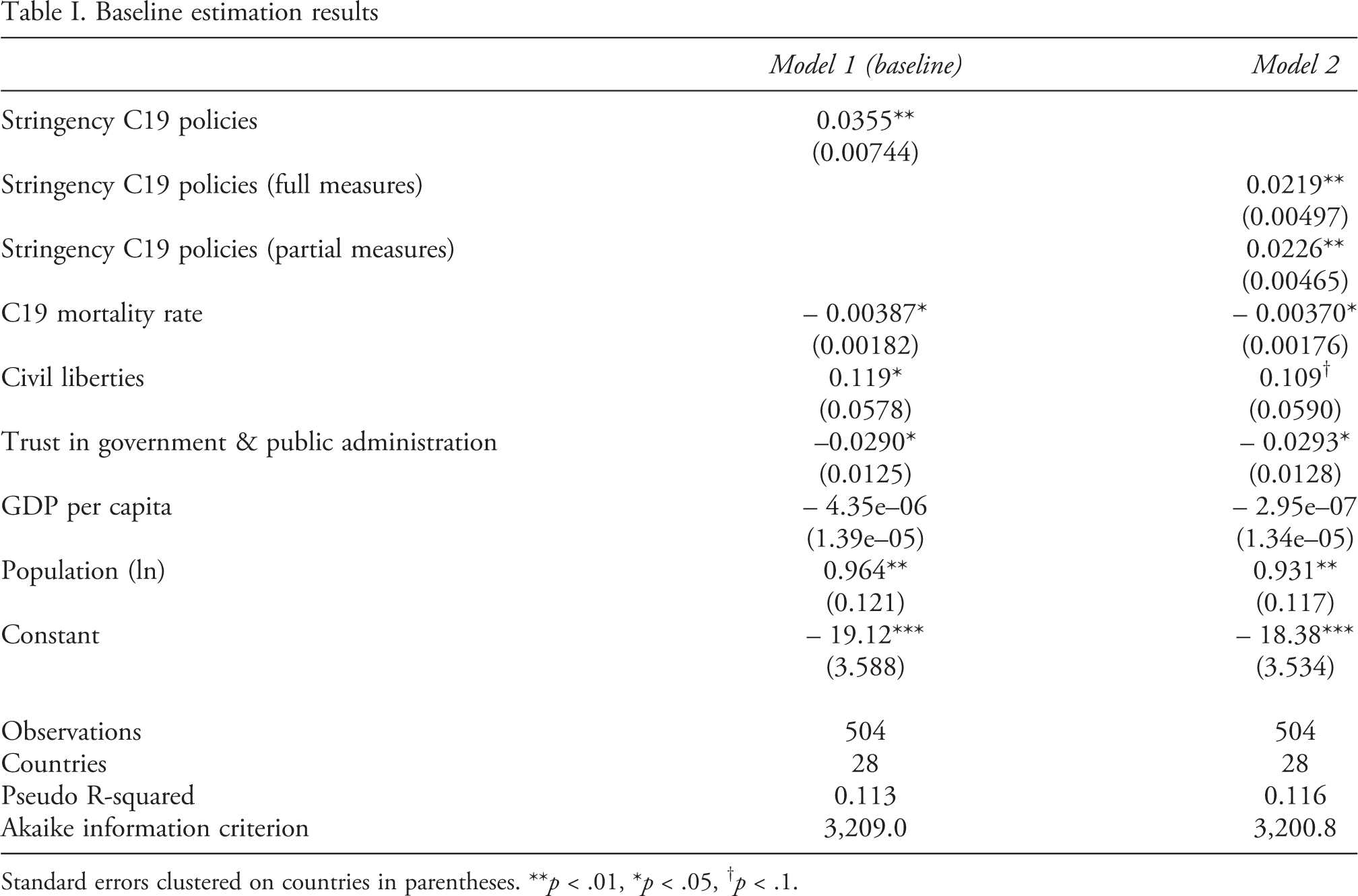
Standard errors clustered on countries in parentheses. **p < .01, *p < .05, † p < .1.
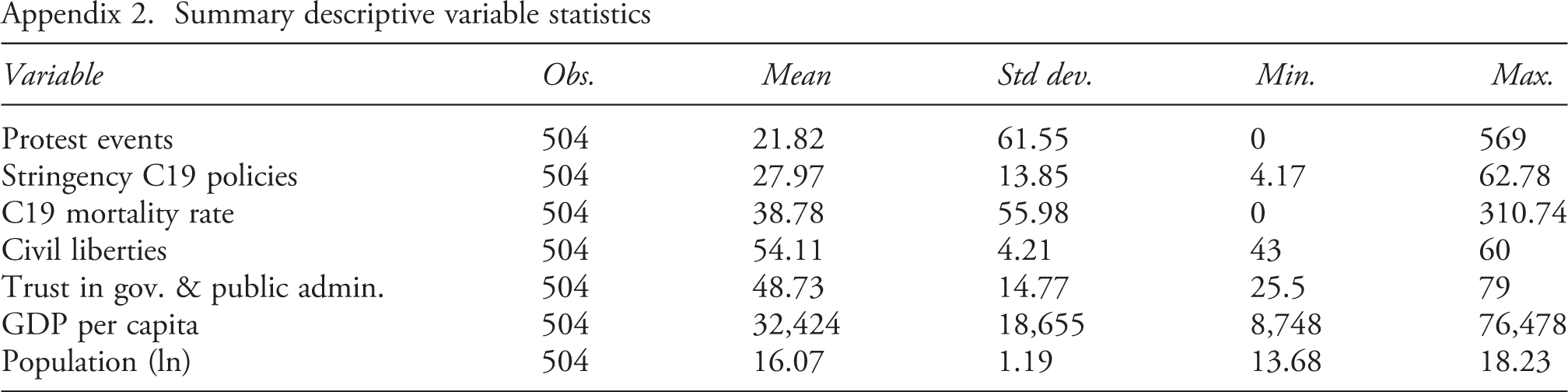
Naturally, more protest events can be expected in countries of larger population size. Hence, we control for the log of the size of population. We also control for per capita income, though we have no strong a priori expectation how this might correlate with protest events. Population and gross domestic product (GDP) data are taken from Eurostat. 11 Appendix 2 provides summary descriptive variable statistics.
Since our dependent variable is a count variable, namely the number of protest events in a country month, we estimate our models with negative binomial regression – there is large over-dispersion in the data which renders negative binomial more suitable than Poisson regression. Only a small share of observations had no protest events at all, which means we do not need to consider hurdle or zero-inflated count data estimators. We cluster standard errors on countries.
Results
Table I presents estimation results. Model 1, which will function as our baseline model for robustness testing, contains the aggregate Covid-19 containment policy measure in which we combine full and partial measures into one weighted average. In Model 2 we estimate separate coefficients for full and partial measures. As expected, we find more protest events are predicted by our model the more stringent policies are and the stronger are civil liberties in a country. Conversely, fewer protest events are predicted the higher is the Covid-19 mortality rate and the higher the level of trust in the government and public administration. We also find that more events tend to take place in more populous countries whereas GDP per capita has no statistically significant effect. Model 2 shows that if we disaggregate the containment policy measures into its two aggregate subcomponents, both full and partial policies are positively associated with the number of protest events.
The coefficients cannot be directly interpreted as effect sizes since with non-linear estimators like negative binomial the effect size of a variable depends on the aggregated effect of the other explanatory variables (King, Tomz & Wittenberg, 2000; Hanmer & Kalkan, 2013). To facilitate an interpretation of the substantive results of our analyses, we display the predicted effect sizes for our four central explanatory variables in two Predicted joint effects of stringency and mortality on the number of protest events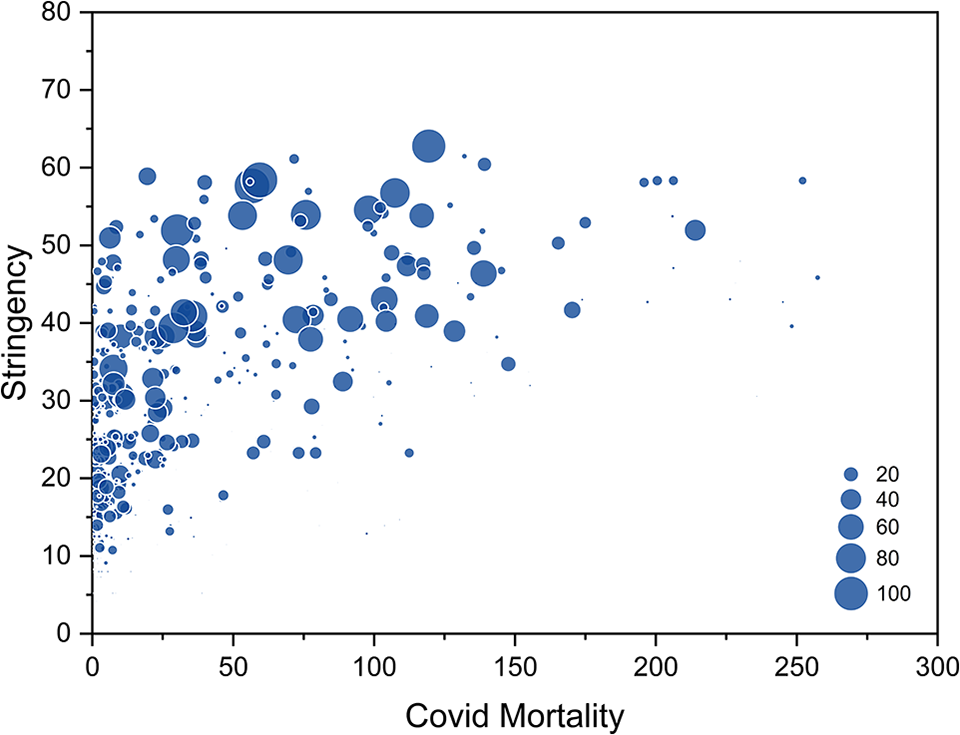
Figure 1 plots the number of predicted protest events, represented by the area of each data point, as a function of the mortality rate on the x-axis and the policy stringency index on the y-axis. It shows that countries experience more protest events against containment measures when the containment measures are relatively stringent and when mortality rates are relatively low. There is, of course, no deterministic relationship between these two explanatory variables and protest, but Figure 1 amply demonstrates that if a country experiences a large number of protest events then this is usually in a situation that combines relatively stringent containment policies with low mortality rates. We noted above that our theory is compatible with different functional forms relating to stringency and mortality. In particular, the effects of stringency and mortality could range from additive to systematically conditional on each other. Figure 1 suggests that the effects of stringency and mortality are only weakly conditional. One should keep in mind that some conditionality is implicitly assumed and imposed by maximum likelihood models like ours. In a non-reported robustness test, we modelled conditionality more explicitly by adding a multiplicative interaction term between stringency and mortality to the estimation Predicted joint effects of political trust and civil liberties on the number of protest events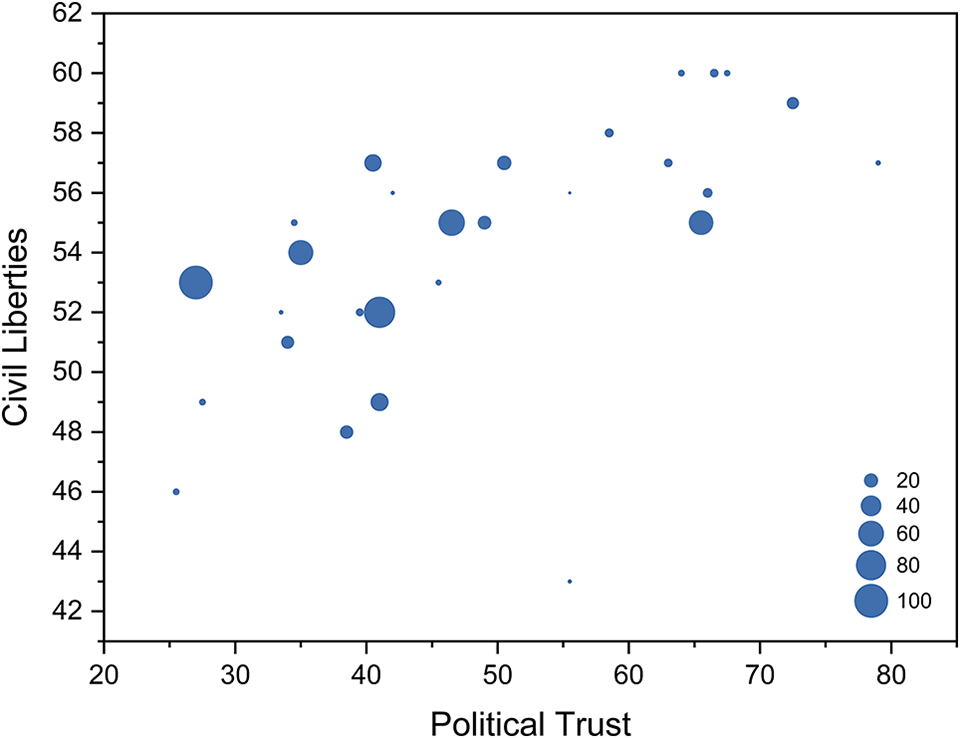
Figure 2 displays the predicted average monthly number of protest events, again represented by the area of each data point, as a function of political trust on the x-axis and civil liberties on the y-axis. Since both explanatory variables are time-invariant in our sample, we have calculated cumulative predicted protest events and then divided by the number of months to allow direct comparability of the bubble sizes of both figures.
A high number of predicted protest events is associated with both low levels of political trust and at least medium to high levels of civil liberties. In fact, we find that the predicted number of protest events is generally highest in countries with low political trust, but we also find that the predicted number of protest events is highest in countries with a level of civil liberties that is a little bit below the highest level.
Robustness
Robustness tests
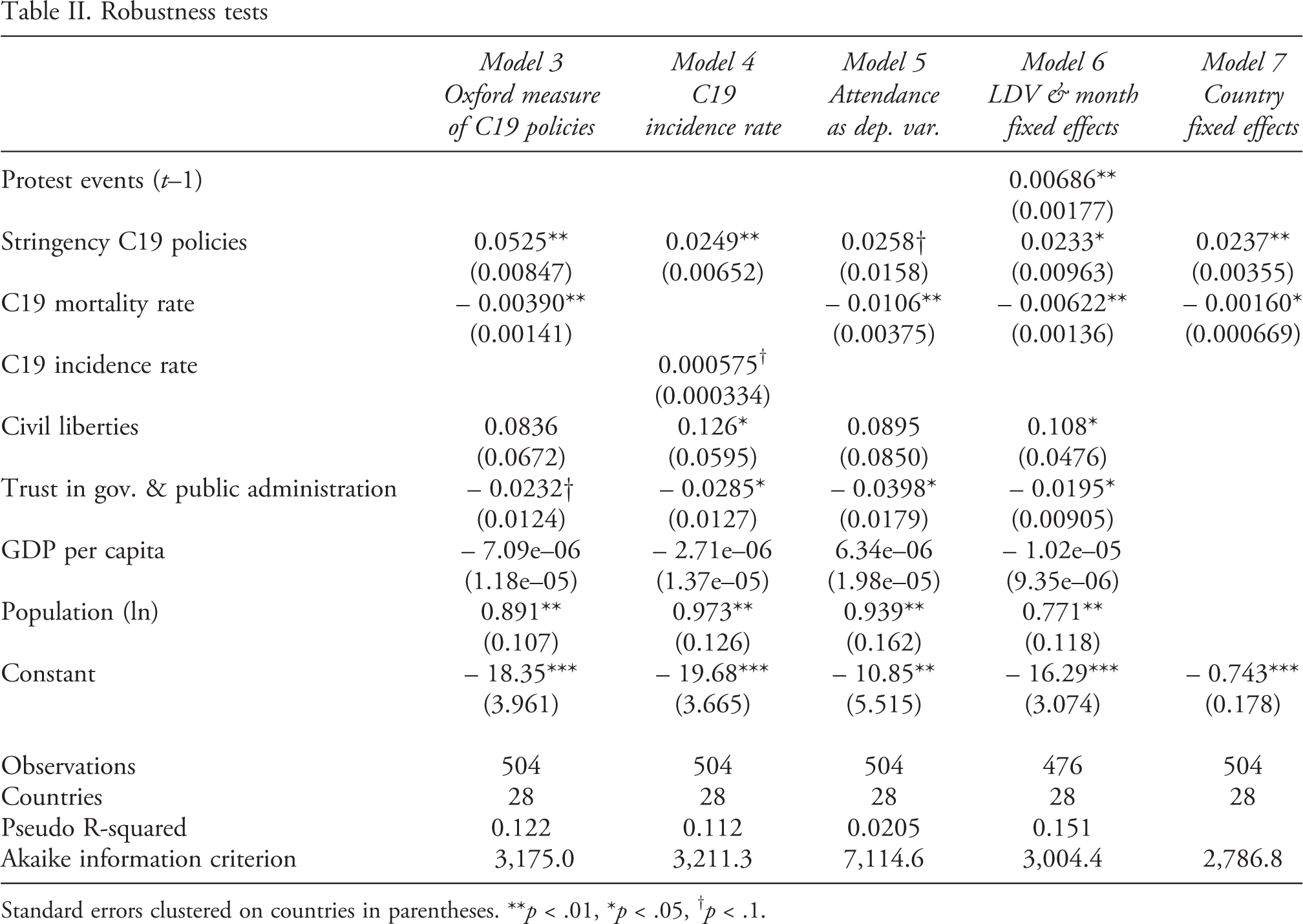
Standard errors clustered on countries in parentheses. **p < .01, *p < .05, † p < .1.
In Model 4, we replace the mortality rate with the case or incidence rate. The coefficient of this variable is only marginally statistically significant but results are robust. In Model 5, we replace the total number of protest events in a country month with the sum total of estimated attendees at these events. This alternative dependent variable has to be treated with a good deal of caution. On a conceptual level, it is important to note that protest organizers can only indirectly influence the size of an event via the choice of timing and location, which are directly in their control. More importantly, ACLED does not collect the size of participants systematically for all events. Often, the size of the protest is either not reported at all or is only described in approximate terms. For those events where no attendance figures were reported, we replaced them with the minimum number of attendees that events attracted in a country for which attendance is reported. With these caveats in mind, results for Model 5 suggest robustness for this alternative if problematic dependent variable, except that the coefficient of the civil liberties variable is no longer statistically significant.
Model 6 adds the lagged dependent variable as well as month fixed effects to the estimation model. The lagged dependent variable can capture some path dependency in protest with a rising movement’s success in organizing events in month t rendering it more likely that successful protest events can be organized in month t+1. The month fixed effects capture the cyclicality of protest events over time that is common to all countries. It is not an unproblematic specification since some of this cyclicality is not driven by influences such as the weather, with good weather – all other things equal – being conducive to protest events, or holiday periods like Christmas exerting a dampening effect. Instead, the policy stringency and mortality variables also change somewhat cyclically such that the month fixed effects might absorb some of the true substantive effects of these two variables. Nevertheless, the results from this model show that our baseline model results are robust to this specification.
Lastly, in Model 7, we employ a conditional country fixed effects negative binomial estimator. This specification necessarily drops most of our variables for which we have no time-varying information, but it allows us to check whether our results on the time-varying policy stringency and mortality variables are robust to eliminating any correlation they may have with time-invariant unobserved heterogeneity across countries. As with Model 6, the coefficients (let alone estimated effects) are no longer directly comparable to the baseline model, but we continue to find a substantively important positive effect of policy stringency and negative effect of mortality rates on the predicted count of protest events.
Conclusion
The organization of protest events is a long-term investment. To be successful, a protest movement needs organizers that understand how to mobilize their supporters. We have analyzed the logic of protest against coronavirus policies making two contributions to the literature: first, we have shown how the organizers of protest events respond to the epidemiological crisis as approximated by Covid-19 mortality rates and the stringency of the coronavirus measures. Arguably, the arguments and slogans of the protest movement become most compelling where and when mortality rates are low and policies in response to the coronavirus are stringent. And second, we have argued and empirically shown that political trust and civil liberties – while not independent of each other – have opposite effects on the number of protest events. Trust in government and public administration dampens protest, while civil liberties increase the number of protest events. Our empirical estimations based on 28 European countries over the period March 2020 to August 2021 support these explanations. As we finish revising this article in late February 2022, the properties of the now dominant Omicron variant and vaccinations have kept mortality rates much lower this winter than during previous waves. At the same time, opposition to vaccination policies has added a powerful incentive for protest. Consistent with our analysis, this resulted in many more protest events in many European countries. However, we do not necessarily expect our theoretical predictions to fully hold for this latest wave of protest since many people have become increasingly tired of containment measures. Therefore, it may well be that over the course of a pandemic the intensity of protest becomes less dependent on the actual stringency of containment policies.
In addition, our results shed some light on the so-called prevention paradox (Rose 1981). In Rose’s original formulation, this paradox addresses the distribution of cases of a disease in a population in which high-risk individuals are relatively rare and therefore the share of high-risk patients remains small. During the SARS-CoV-2 pandemic, the term prevention paradox has been used to state that the number of people questioning the effectiveness of policies increases in the success these policies have had on the pandemic situation. Our research adds a dynamic perspective. We find that the number of protests against containment policies is potentially higher where these policies have been more successful. Of course, many protesters doubt that measures had an effect at all, claiming that those who have died from Covid-19 would have died anyway. Others accept that measures were effective, but still claim that the purported cure is much worse than the disease, that is, the economic and social side-effects of measures against the coronavirus are worse than the detrimental health effects of the pandemic itself. Our findings give rise to a slightly modified, dynamic variant of the prevention paradox, which suggests that protest against containment measures peaks after the measures have been successful.
Our article also has implications for the social science literature on political protest. Existing theories of political protest undoubtedly offer a great starting point for the analysis of the movement against Covid-19 containment policies. However, we believe that more work is needed in two respects: first, existing theories do not sufficiently distinguish between the political goals of a protest movement and the strategic goals of the leaders of the protest movement. In fact, the protest literature often ignores the existence of protest organizers and the strategic role they play. This may be a plausible assumption for short-lived grassroot movements. However, successful movements will at some point have to institutionalize themselves. The protest movement literature focuses on who participates in protest and neglects that mobilization is an important strategic element for protest organizers. Second, the protest movement against coronavirus policies also reveals the dominant theories’ deficits in explaining the dynamics of protest. These theories usually explain the dynamics of protest movements via the interplay between mobilization and repression. While these factors play a relevant role in the protest against coronavirus policies in Europe, they overlook the important role that the credibility of protest plays. This credibility is not constant but varies strongly with the pandemic situation and the level of containment policies. Both factors are highly dynamic and can change quickly and when they change, the strategic logic of the organization of protest also changes quickly.
Footnotes
Replication data

Notes
Appendix
Summary descriptive variable statistics
| Variable | Obs. | Mean | Std dev. | Min. | Max. |
|---|---|---|---|---|---|
| Protest events | 504 | 21.82 | 61.55 | 0 | 569 |
| Stringency C19 policies | 504 | 27.97 | 13.85 | 4.17 | 62.78 |
| C19 mortality rate | 504 | 38.78 | 55.98 | 0 | 310.74 |
| Civil liberties | 504 | 54.11 | 4.21 | 43 | 60 |
| Trust in gov. & public admin. | 504 | 48.73 | 14.77 | 25.5 | 79 |
| GDP per capita | 504 | 32,424 | 18,655 | 8,748 | 76,478 |
| Population (ln) | 504 | 16.07 | 1.19 | 13.68 | 18.23 |