




Abstract
This article presents the Uppsala Conflict Data Program (UCDP) “Violent Political Protest” (VPP) data set: a new –standalone- category of organized violence, which complements, and is compatible with, UCDP’s three categories of organized violence: one-sided violence, non-state, and state-based conflict. It consists of violent political protests, with at least 25 casualties during a year, in which informally organized civilians challenge states over governmental or territorial issues. We describe the data collection process, and demonstrate the data’s use with empirical analyses. Violent political protest is present globally, but most prevalent in the Middle East and Africa, and increasingly common over time. Violent political protest frequently co-occurs with state-based conflicts, but rarely due to conflict escalation. We explore if this is due to shared contexts, and find that gender inequality increases the likelihood of VPP onset, similar to state-based conflicts. Finally, we identify avenues for future research, including using VPP to assist in a more precise and complete analysis of organized violence.
Introduction
Syria, 2011
In early 2011, popular uprisings, soon referred to as the “Arab Spring”, spread to several countries, including Syria. Initially, the protests against the Government of Syria were relatively minor. Following events in Daara, where three boys were killed by the police and where protesters subsequently were met with heavy-handed repression through lethal force, the protests escalated into nation-wide, large-scale demonstrations. The demands of the civilians included political change incorporating demands for a new government. Many of the protesters were unarmed, but there were also clashes between protesters and security forces. The ensuing civil war started when army officers disserted from the Syrian army and joined the opposition during the summer of 2011. By that time, however, political violence had already been ongoing for several months through asymmetrical clashes between protesters and Syrian armed forces.
Palestinian Intifada, 1989
Throughout 1989, Palestinians took to the streets, many of them young, demonstrating against the Israeli occupation of Palestinian territory. As part of a large-scale campaign, driven primarily by Palestinians in the occupied territories who were disappointed with the inefficiencies of resistance strategies employed by the exiled Palestinian leadership, a wide range of civil resistance tactics were employed, including demonstrations. The demonstrations were commonly small-scale, but recurrent, and often consisted of a group of youths throwing stones at Israeli soldiers. The soldiers responded by shooting back, which resulted in more than 25 deaths. These types of events have been a recurring phenomenon and have claimed many lives, especially during the 1990s.
Egypt, 2013
In the beginning of 2013, following growing discontent with President Morsi and the developments in the country since the Arab Spring uprising 2 years earlier, anti-government demonstrations occurred in several cities. Several of the demonstrations became violent with clashes between protesters and security forces. A few months later, in July, President Morsi was ousted by the military, sparking a new wave of demonstrations. Pro-Morsi protesters challenged the coup and demanded that Morsi should be re-instated. The military responded with highly repressive measures, resulting in hundreds of people being killed in violent clashes.
All these three empirical examples of social conflicts, political protest and organized violence share three characteristics. First, they involve an incompatibility between a social group and a regime, either over control of territory or the power of the state. Second, although protestors used predominately unarmed means, they included violent clashes. These protests were not strictly non-violent or non-armed according to the Uppsala Conflict Data Program’s (UCDP) definition of ‘arms,’ which includes any material means, e.g. manufactured weapons but also sticks, stones, fire, and water (Pettersson 2020b). They were lethal and resulted in more than 25 deaths, in all of these three cases predominately due to regime-based repression. Third, the uprisings were popular-based and had no formal organization structure that assigned a name to itself. Currently, these types of conflicts are not included in UCDP data. They represent a phenomenon of civil protests that is not entirely nonviolent and could be described as ‘political riots’, ‘violent protests’, or ‘armed demonstrations’. The Violent Political Protest (VPP) data set, which we introduce in this article, includes these informally organized violent protests over government or territory resulting in a minimum of 25 deaths.
We argue that this category of violent conflict is essential to include in our analysis of political violence for the following three reasons. First, existing UCDP data on organized violence does not capture violent political protests. They are not included as state-based armed conflicts, since these require a certain centrality of command on the non-state side. Violent political protest groups are instead network-based, i.e. groups without a formally organized structure that make demands related to government or territory. 1 They are excluded from the UCDP one-sided violence data, since the civilians are armed, and do not fit the non-state category since one of the parties is the state. After the Arab Spring, this omission has become more acute and accentuated. We show, in the analysis below, that this non-centralized type of organized violence is not restricted to Arab Spring events and that it has become more common over time. Second, several theories of social conflicts and political violence are not built on a theoretical assumption about centrality of command on the non-state side – they instead theorize about broader insurgencies or uprisings rather than rebel groups. By omitting cases of violent political protests their tests are empirically incomplete. Ignoring these cases, research risks misrepresenting empirical reality and testing theories on an incomplete set of insurgencies. Finally, cases such as the anti-Assad campaign in Syria, the Palestinian Intifada, and the anti- and pro-Morsi campaigns in Egypt, are important historical cases in and by themselves. Some of these social conflicts are key turning events in their countries’ histories and trajectories. Identifying these cases is thus essential for both quantitative and case study research.
With this article, we present the VPP data set, which is a new dyad-year data set on a subcategory of political violence: violent political protests, in which informally organized civilians challenge states over governmental or territorial issues that result in at least 25 casualties during a year. VPP is a new, stand-alone, category of violence, which complements, and is compatible with, UCDP’s three main categories of violence (state-based, non-state, and one-sided). The VPP data set helps to address the shortcomings in previous research on social conflicts and organized violence identified above. This new data set enables a fuller picture of violent dynamics between non-state groups and states, allowing further conceptual development and more precise analyses of organized violence. The data on this new category of organized violence currently covers 1989-2019 and is global in scope. UCDP will continue to update the VPP data set on a yearly basis.
This article first presents the VPP data set, its coding rules, data sources and coverage. We situate VPP in relation to existing data sources, and discuss how the data can be useful for scholars interested in political violence, unarmed insurrections and (largely) nonviolent protest-movements, as well as repression of dissent. We describe spatial and temporal patterns, show how the VPP category is empirically related to other forms of UCDP organized violence, and identify that state-based conflict and violent political protests often co-occur. Illustrating how the data set can be used, we explore gender inequality as an explanatory variable for the occurrence of violent political protest, as this has been found an important predictor in previous research on state-based conflicts. In this empirical application, we show that gender inequality increases the risk for violent political protests, in a similar way as state-based conflict. Finally, we discuss further avenues for future research made possible by this novel data set.
Why do we need a new data set on violent political protest?
Data on violent protests can currently be found in several different data sets. We first specify how the VPP data set relates to UCDP’s main categories of organized violence. We then explore how it relates to existing data sets on protests. Whereas the VPP data are conceptually more limited than other data sets on protest violence, given that it only documents cases where the threshold of 25 people killed in one year is passed, we argue that it fills an important niche in the empirical study of violent protest.
Uppsala Conflict Data Program
The UCDP is the most comprehensive data source on organized violence (Melander, Pettersson, and Themnér 2016, Wallensteen 2011). 2 Organized violence, in which the government of a state is at least one of the actors, is a phenomenon currently occurring in two categories, state-based armed conflicts and one-sided violence. 3 Of the two, state-based conflicts are the most prevalent and destructive in terms of deadliness. The two are often related: a substantial proportion of one-sided violence occurs in the context of ongoing state-based armed conflicts.
The advantages of developing a new, standalone, category within the UCDP framework are clear. First, it allows for analyses of multiple categories of organized violence that do not risk any conceptual overlap or empirical double-counting between events. Second, since the data is based on the same empirical strategies, in terms of information-collection, etc., comparative analysis between the different categories and how they relate to each other sequentially are enhanced, and the risk for distortions due to simple differences in data collection precision is minimized. Third, UCDP is able to continuously update and maintain their data sets on political violence, providing concurrent data sources for the research community to conduct up-to-date research on political violence. VPP joins these categories and will be updated yearly.
VPP is fully compatible with UCDP, but there are other data sets on protests available from other sources. Below, we give an overview of other data sets, and discuss how the VPP data set contributes to the scholarly community in relation to these existing data sources.
NAVCO
One of the most important scholarly developments during the last decade has certainly been the systematic examination of nonviolent conflicts. Erica Chenoweth’s seminal work in this field stands out as particularly important, building on NAVCO 1.0, not the least by providing an empirical basis for evaluating claims about this form of social conflict (Chenoweth and Cunningham 2013, Chenoweth and Lewis 2013, Chenoweth and Stephan 2011, Stephan and Chenoweth 2008). A growing research field has focused on the phenomenon of mass-based social rebellions and protest-movements fought (largely with the use of civilian rather than military power) over maximalist demands such as regime-change, end of occupation and territorial secession (Bartkowski 2013, Chenoweth and Stephan 2011, Cunningham 2013, Nepstad 2011, Schock 2003, 2005, Sharp 1973, Zunes 1994). NAVCO 1.2 contains data on nonviolent conflicts, and specifically focuses on campaigns while NAVCO 2.1 (1945-2013) includes campaign-year level data. Yet, as they are defined in terms of whether they are “predominately” nonviolent, it allows for some type of violent or coercive behavior on the non-state, opposition, side. This implies that there is a certain overlap with the VPP-data. During 1989-2013, 27 VPP dyad-years overlap with NAVCO 2.1 campaign-years. The VPP data set contains 44 unique dyad-years (1989-2013).
Whereas VPP is restricted to situations with more than 25 deaths and does not include uprisings that were completely nonviolent, VPP data is more inclusive than NAVCO 2.1 in terms of not requiring any campaign-structure, such as a discernable leadership, for the non-state opposition in order to be included. This is important, as previous research shows that the variation in terms of campaign structure can help to explain how nonviolent conflicts unfold, in particular whether they are able to bounce back after being met by regime repression (Sutton, Butcher, and Svensson 2014). 4 Moreover, VPP, unlike NAVCO, does not employ a participant threshold nor requires multiple connected events to occur within the same calendar year for a dyad to be included. Importantly, VPP specifically focuses on violent political protests. These can take place within existing nonviolent campaigns (as signified by the overlap), but also exist as phenomena on their own. This type of protest violence has been understudied, and should be taken seriously when studying contentious politics (Bell and Murdie 2016, Sullivan 2019). VPP contributes by making violent political protests visible and provides an opportunity for scholars to further disentangle different types of dissent, such as nonviolent action, violent political protests, and armed conflicts.
Other Data sets
Whereas NAVCO is the most well-known and comprehensive data set on nonviolent uprisings, there are several other data sets that can be used to study civilian protests. Another attempt to empirically capture contentious tactics by non-state actors beyond state-based armed conflicts is the Social Conflicts in Africa Data (SCAD) (Salehyan et al. 2012). The SCAD-data, covering the time period 1990-2017, represents an inclusive approach as it utilizes data on social conflicts in Africa and Latin America, including protests, strikes, riots and inter-ethnic violence (Salehyan et al. 2012). It is a georeferenced, event-based data set, and therefore a particularly important source for those who seek to explain intra-country variations. Its geographical limitation is an obvious limitation for those interested to examine this phenomenon globally. The Armed Conflict Location and Event Data Project (ACLED) includes data covering the time-period 1997-2019 and is event-based (Raleigh et al. 2010). The data also include nonviolent protests, riots, and violent protests. Its geographical coverage is restricted, and although it has expanded recently, only Africa is covered in its entirety for the entire time-period. The Minorities at Risk (MAR) data set, including the subsidiary The Minorities at Risk Organizational Behavior (MAROB) data set, includes information on organizations that use nonviolent means as a strategy. The MAROB data set covers the time-period 1980-2004, uses the actor-year as the unit of analysis, but is geographically restricted to 16 countries in the MENA region (Asal, Pate, and Wilkenfeld 2008). The MAR data focuses on identity-conflicts formed around group-identities, including along ethnic, religious and linguistic lines (Minorities at Risk Project 2009). The Strategies of Resistance Data Project (SRDP) is a global data set on organizational behavior in self-determination disputes. It includes organization-year data on self-determination movements covering the time-period 1960-2005, and includes a broad scope of resistance strategies, including boycotts, sit-ins, and low-risk type of protest behavior (Cunningham 2011, 2013, Cunningham, Dahl, and Frugé 2020). 5 The Mass Mobilization in Autocracies Database (MMAD 2.0) covers the time-period 2003-2015. MMAD is an event-based automatic data-coded data set, limited to autocracies, employs a low threshold (25 people gathered) for political protests, and includes oppositions to both government (at various levels) and non-governmental institutions. This data includes peaceful and violent protests, including political riots and cases where activists have violently clashed with security forces (Weidmann and Rød 2019). The mass-mobilization (MM) data covers the time-period 1990-2020 and includes 162 countries, covering all protests against governments with more than 50 participants, including both peaceful protests and protests with violence (Clark and Regan 2016). The “Historical Regime Data” (HRD) includes also data on popular nonviolent uprisings. This regime-year data set has the longest time coverage (1789-2016) and includes 197 polities (Djuve, Knutsen, and Wig 2020). However, HRD includes only cases that experienced regime change, thus, only the ‘successful’ cases seen from the perspective of nonviolent oppositions.
The VPP data set examines informally organized violent protests that result in a minimum of 25 deaths. It is therefore restricted to relatively violent cases compared to many of the data sets discussed above, yet it is comprehensive in its spatial scope. It is global in its reach, thereby complementing regional data, such as collected by SCAD, ACLED, and MAROB. It is collected across all political systems, complementing data on authoritarian systems, such as MMAD 2.0. VPP, unlike MM, specifies and classifies incompatibilities in conflicts specifically. It includes both governmental and territorial incompatibilities, thereby complementing data on self-determination movements such as SRDP or on ethnic conflicts such as MAROB. VPP therefore lends itself to potentially enabling analysis that compares different types of social conflicts. VPP data will also be updated alongside other categories of social conflict in the UCDP, implying that it will be possible to track development over time.
Introducing the VPP data set 6
This section outlines the research design of the VPP category, by detailing the definition and operationalization, data sources and coding procedures. This new, standalone, UCDP category has several similarities to the UCDP’s existing three categories of organized violence, but also some crucial differences that will be described below. The VPP data set is dyad-year and is coded based on events. 7 As with UCDP’s current three categories of violence, the events included in the VPP category are mutually exclusive and no event is therefore represented in more than one category.
Definition of the VPP category
A violent political protest is defined as “a contested incompatibility that concerns government and/or territory where the use of armed force in civil protest between two parties, of which one is the government of a state and the other an informally organized protest group, results in at least 25 deaths in one calendar year.”
This definition shares some commonalities with the definition of UCDP’s state-based category: the use of arms, an incompatibility over government/territory with the state, and a threshold of a minimum of 25 deaths per calendar year and dyad. Arms include manufactured weapons, but also sticks, stones, fire, water etc. An incompatibility over government concerns the type of political system, the replacement of the central government, or the change of its composition. An incompatibility over territory concerns the status of a territory, e.g. secession or autonomy.
The definition of the VPP category distinguishes itself from the state-based category in two important ways; its focus is on civil protest and informally organized groups. Civil protest is operationalized as a manifestation of active opposition that is non-militarily organized, including demonstrations, riots, boycotts, sit-ins, strikes, looting etc. that occur within the context of the political conflict. There is no threshold of inclusion regarding the number of protesters.
An informally organized group corresponds to groups at organizational level two in the UCDP Non-State Conflict Data set (Pettersson 2020c). They are operationalized as any group without an announced name, which uses force, and is organized around a common goal. These are groups that are composed of opponents of political parties and candidates/representatives. Groups can also consist of supporters of independence or autonomy for a certain territory. These are not groups that are permanently organized for confrontation, but who at times use their organizational structures for such purposes.
Focus on dyads
A dyad is made up of two primary parties that have a stated incompatibility (Pettersson 2020a). In the VPP category, the primary parties are made up of a government on the one hand and opponents of the government, or supporters of a territory, on the other. 8
Different time periods of protests
The VPP category focuses on protest violence during one calendar year and within one dyad. For example, deaths occurred as part of a wave of protests against the government in February are counted together with deaths that occurred as part of protest violence in November the same year, as long as they are part of the same dyad.
Different geographical locations
Protests may take place in several geographical areas of a country and still be included in the same dyad. They do, however, need to be clearly linked to the same incompatibility. For example, protests can be held in two different parts of the country, both against the government. In these cases, events will be included in the same dyad. If, however, protests in one place fulfill the incompatibility criterion but not in the other (for example, the protests simply focus on food prices, but do not demand the government’s resignation), events in the latter location will not be included.
An example of this is the case of Egypt and the Port Said football violence in 2013. In early 2013, violent demonstrations against President Morsi took place in Cairo. Many protesters were dissatisfied with the progress in the country so far and claimed that the president had let the revolution of 2011 down. Around the same time, violent clashes erupted in Port Said when the verdicts in the football trials, following the deadly football violence the previous year, were announced. In some instances, protesters voiced demands both for the president’s resignation and concerning the trials. Deaths that occurred during such events were included in this VPP dyad. Events where no demands relating to the governmental incompatibility were reported to have been raised, were not included in dyad.
Naming informally organized groups
The non-state actor in this category is a group without an announced name, in contrast to a formally organized group with a stated name. Group names are assigned according to a set of rules. Protesters demonstrating against a government are assigned the name “Opponents of [name of president/prime minister/monarch]”. Group names thus depend on towards whom the protesters direct their demands. 9 An example of this can be found in Egypt 2013. During the first half of 2013, demonstrations against the government were coded as “Opponents of Morsi” and then as “Opponents of Mansour” following the military’s ouster of President Morsi. If the incompatibility concerns territory, the group is assigned the name “Supporters of [name of territory]”. If the two opposing sides use different names for the disputed territory, we list the name used by the opposition, which is in line with UCDP practice (Pettersson 2020a).
Incompatibilities in Civil Protest
In the VPP category, an opposition group is an informally organized group without a clear hierarchical structure. Since such groups have no clear leadership who can announce the incompatibility, the focus is on the existence of a stated goal of incompatibility. For instance, some demonstrators might call for the resignation of a president, while others in the same demonstration might call for more jobs. There is no threshold regarding the amount of protesters calling for e.g. the resignation of a president, rather if such a demand is raised, the requirement of a stated goal of incompatibility is seen as fulfilled.
The use of violence
Events between government forces and an informally organized group in violent political protests separate themselves from events included in the UCDP state-based and one-sided violence categories. The events included –aggregated up to dyad-year in the data set- in the VPP category are not included in the state-based category, since they do not fulfill the organizational criterion for the UCDP state-based category (i.e. formally organized opposition groups that announce a name for themselves). Furthermore, the events are not included in the UCDP one-sided violence category since the non-state actor (civilians) is armed.
Not all of the protesters need to be armed in order for an event to be included in the VPP category. For instance, if a group of protesters at a certain time and location contains both unarmed civilians and stone-throwers, the group is seen as armed. There is no threshold on the number of armed protesters, rather as soon as armed violence is used by a protester the protest is included in the VPP category. In other words, at its extreme, one instance of, for example, stone-throwing from a protester is enough for inclusion. If none of the protesters are armed, the event is instead included in the UCDP’s one-sided category, provided that all other criteria for inclusion for that category are fulfilled. 10
Furthermore, the accounts of the character of the protests sometimes differ. There might, for example, be conflicting accounts as to whether the demonstrations were violent or not. In those cases, efforts are made to find independent reports detailing the events. If no independent reporting stating that the protesters were unarmed was found, the event is generally included in the VPP data set, provided that all other criteria are fulfilled.
The VPP data set contains information on the intensity of the violence. A distinction is made between low intensity (25-999 deaths in a year) and high intensity (at least 1000 deaths in a year). The inclusion threshold is 25 deaths in a calendar year. Violent political protests are generally asymmetric dyads, with governments usually much more powerful. Although the use of violence by the opposition group is a criterion for the dyad to be included in the data set, most lethal violence within the dyad is frequently attributed to government repression of the violent political protest.
Outcome
Finally, the VPP data includes information on the outcome of the protests. If the demands of the protesters were met within 12 months after the protests started, the demands were coded as fulfilled. If some demands were fulfilled (for instance substantial constitutional changes were made, but the president does not resign), then the demands were coded as partially fulfilled. Otherwise, the demands were coded as not fulfilled or not applicable (e.g. outcomes of cases that started in 2019 will only be codeable in 2020).
Data sources and coding procedures
The data in the VPP data set mainly build upon previously unpublished UCDP data. Events that are used to identify VPP dyads in this data set have previously been coded as unclear or lacking sufficient organization, and have therefore not been included in other UCDP data sets, UCDP’s data has global coverage and goes back to 1989. Throughout the years, events relating to violent protests have been coded for reference, and after having gone through this vast amount of data, we feel confident that the coverage of such events has been very high. This approach does open up for bias against inclusion of dyads in earlier years and in the less-developed world. Events relating to violent protests in recent years are more likely to have been reported and recorded than events in a less-developed country in the early 1990s. However, we deem it likely that demonstration violence with 25 or more deaths would have been reported, and the inclusion of several cases during the early part of the 1990s strengthens this assumption. Finally, in addition to existing UCDP data, additional searches have been made when there were indications of violent protests with more than 25 deaths. The above procedure was used for backdating VPP. Current and future data collection is according to the UCDP’s general coding procedures, which have been thoroughly described in earlier publications (for details, please see: Sundberg, Eck, and Kreutz (2012), Eck and Hultman (2007))
Mapping violent political protests
When?
The VPP category currently covers the period 1989-2019 and contains 67 dyad-years in 48 unique dyads. Popular uprisings received increased attention after the Arab Spring. Yet, as can be seen in Figure 1A, VPP cases can be found throughout the time period. For instance, in the 1990s, we observe cases over government in Africa, Europe, the Middle East, and Asia, as well as violent protests over territory in Europe and the Middle East. The highest number of observed dyads (8) is in 2019 and occurred in all regions but Europe. These dyads included violent protests over government (Iran 2019) and over territory (West Papua 2019). The second peak year was 2011 with six dyads, all related to the Arab Spring. Trends over time: the number of dyads per year in violent political protest, state-based conflict, and one-sided violence, 1989-2019.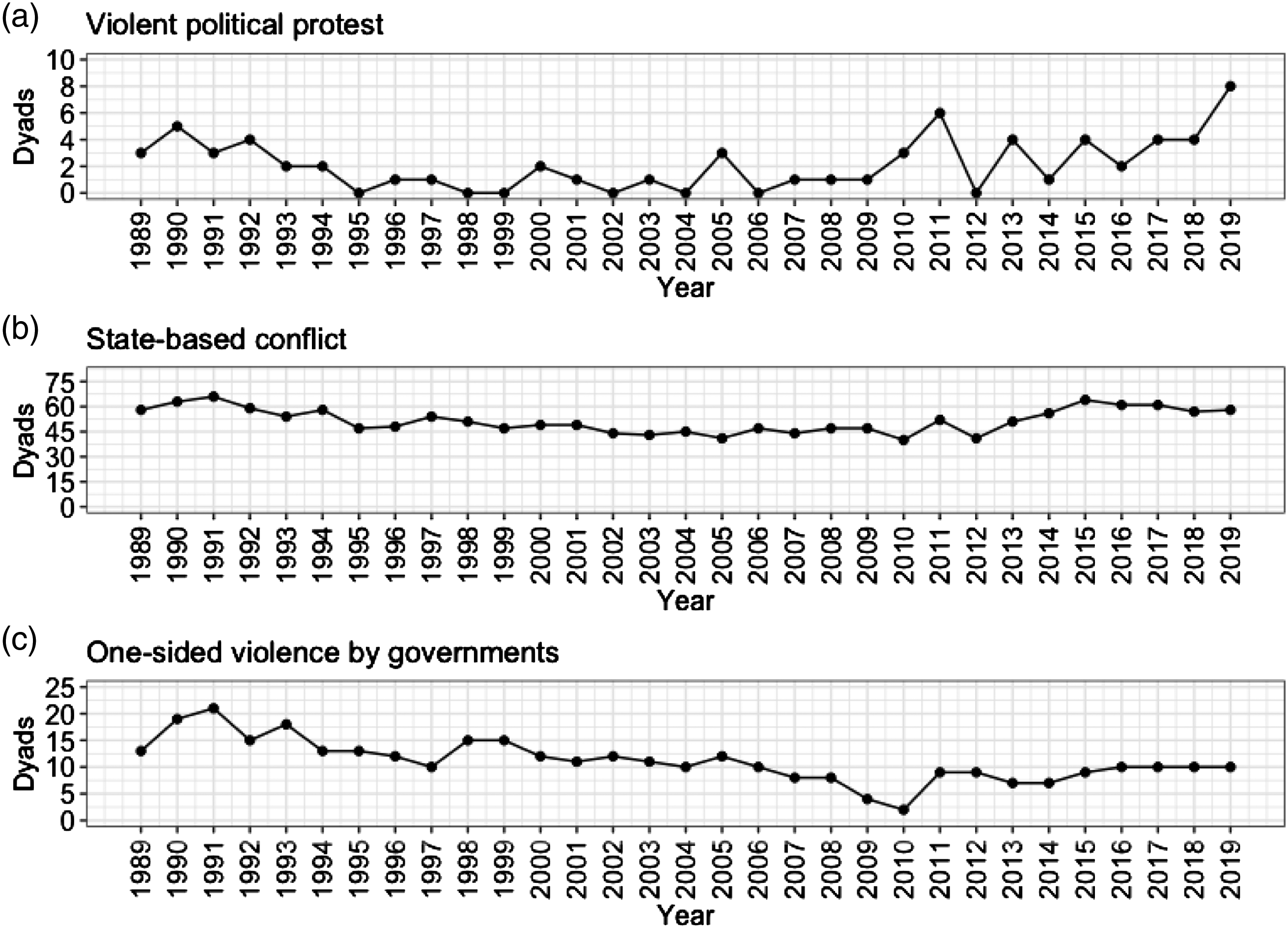
In total, seven out of 31 observed years did not see any active VPP dyads. Violent political protest dyads were generally lower in frequency between 1994 and 2006 (see Figure 1A). Six of the inactive years were observed in this 13-year time period. We can also observe an upward trend in VPP dyads in the latter half of the 2010s, culminating in the highest number of VPP dyads observed in 2019.
The increase in VPP cases in recent time is also notable in comparison to two other UCDP categories of violence where the state is one of the main actors: state-based conflict and one-sided violence (see Figure 1). One-sided violence (Figure 1C) is relatively stable since 2016, state-based conflict (Figure 1B) sustains a relatively mildly downward trend after 2016, whilst VPP (Figure 1A) shows a steady upward trend (please note the different y-axes for the figures, see Figure 2 for normalized trends). Normalized trends over time: violent political protest (red solid), state-based conflict (black dash), and one-sided violence (blue dot-dash), 1989-2019.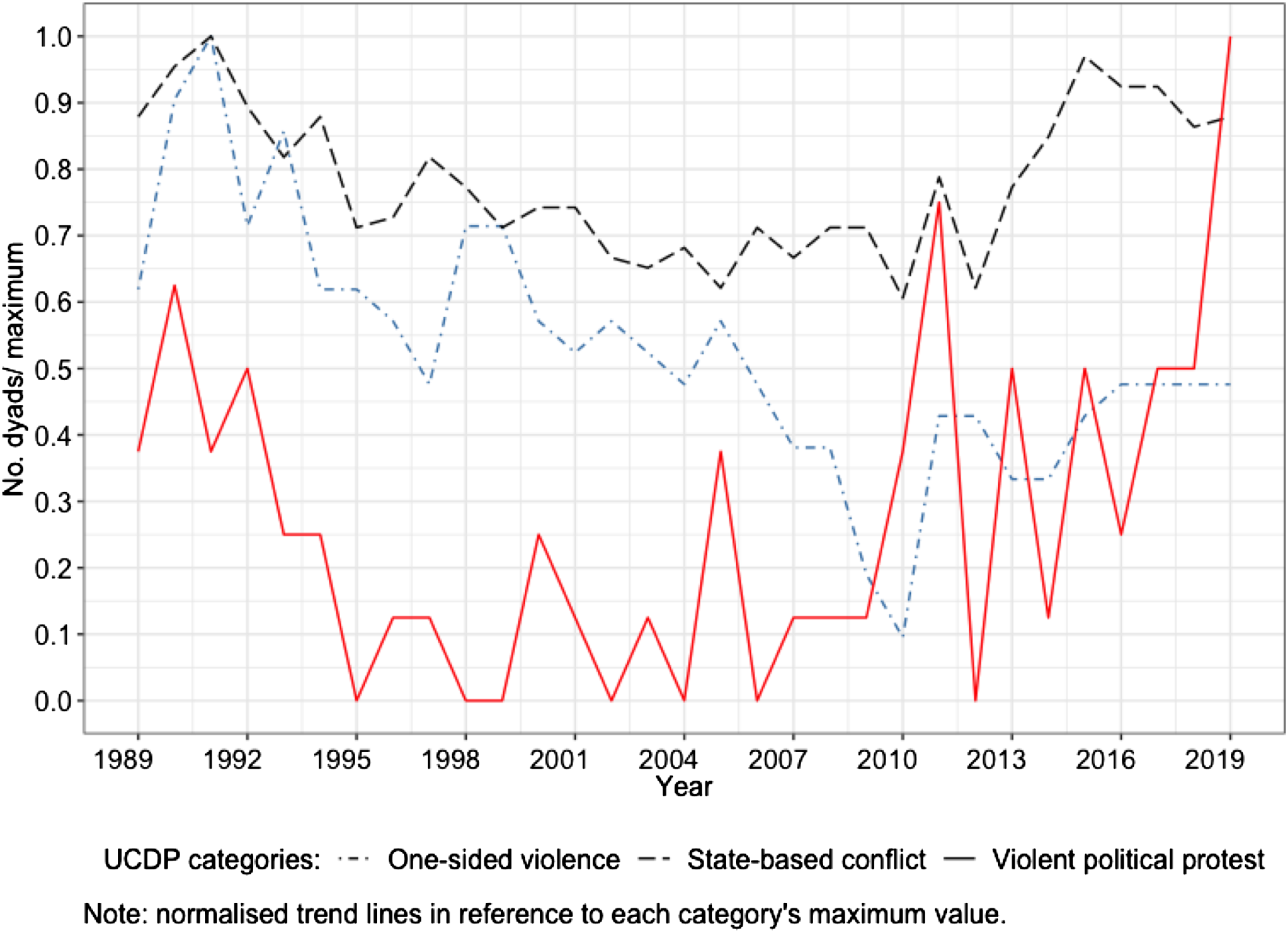
Where?
The VPP data set is global in scope and cases are identified in all world regions.
11
Figure 3 shows the geographical distribution of the VPP cases. With a slight margin, the majority of VPP can be found in the Middle East (24 recorded dyad-years in a total of seven countries). The distribution is concentrated. Egypt and Israel (Palestine) experienced most violent protests with six and ten recorded dyad-years, respectively. Thus, over half of the VPP dyad-years in the Middle East occurred in only two countries. The region with the second largest portion of observed VPP cases was Africa (23 recorded dyad-years in a total of 16 countries). Overall, the distribution of VPP dyads was more geographically dispersed than in the Middle East. Violent political protest: geographical distribution, 1989-2019.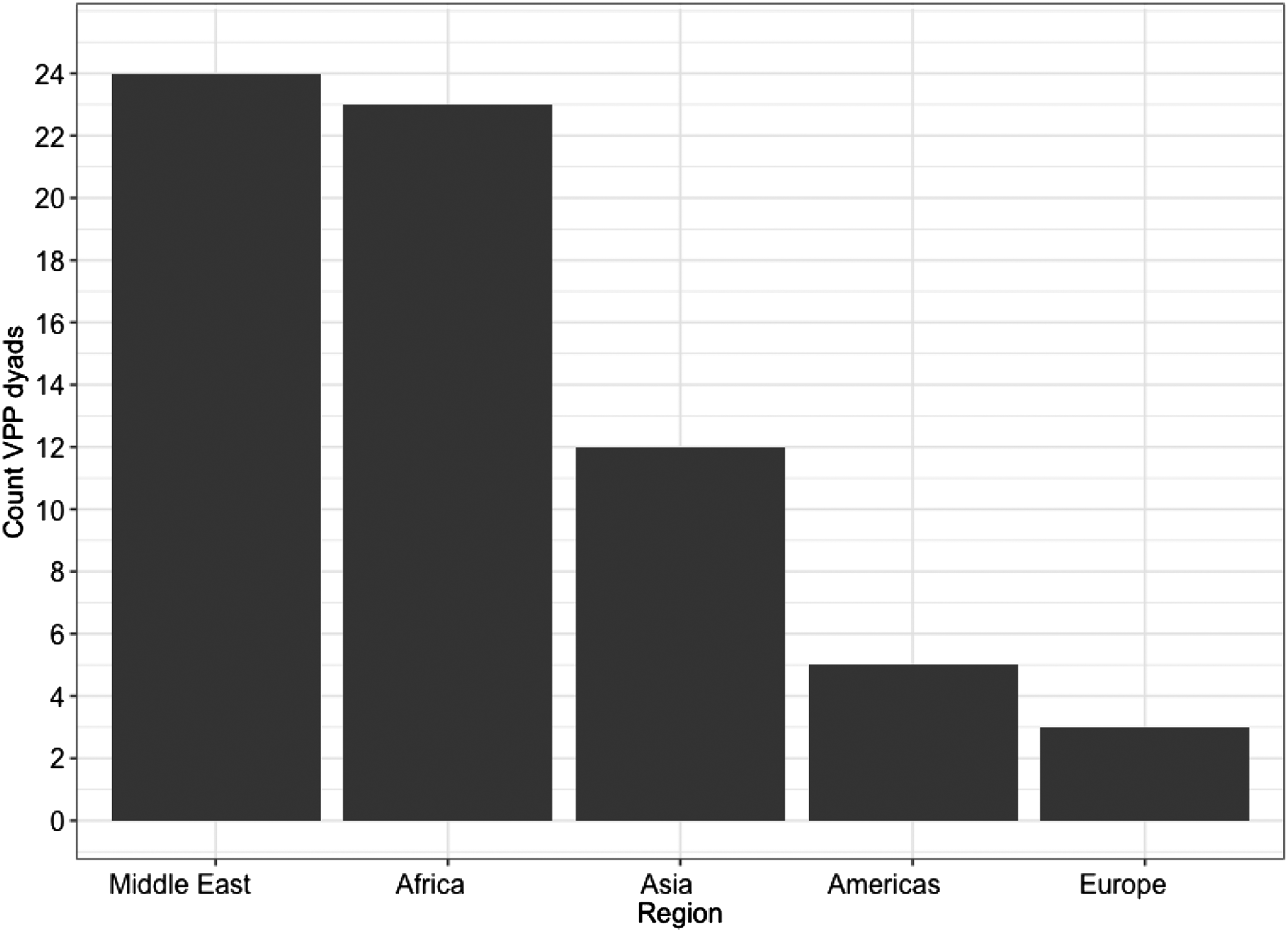
Violent political protest cases are less common in the other three world regions. Asia has the third largest frequency of dyad-years (12). In the Americas, VPP is low (5), yet is becoming increasingly common. The Americas had no recorded dyads until Bolivia 2003, after which the next dyad was not observed until 2017. Overall, demonstrations have been common in the Americas, yet many of them often focused on, for example, food and fuel prices rather than maximalist aims (government or territory). There were indeed violent demonstrations against governments, but these did not pass the threshold of 25 deaths in a calendar year. However, since 2017, four VPP dyads were observed (in Venezuela, Haiti, and Nicaragua), a clear trend break for the Americas. Finally, Europe has experienced the least number of VPP (3), all taking place in Eastern-Europe, in Kosovo 1989-1990 (2) and Albania 1997 (1).
Outcomes
The outcomes of the VPP dyads are particularly interesting to study: is this a useful protest strategy to achieve change? There are a number of different ways to look at the outcome. In this study, we explore the outcome by assessing whether protestor demands were attained within 12 months after the protests ended. This means that we have excluded those cases that occurred in 2019, of which the outcome remains to be coded. This leaves 59 dyad-years during 1989-2018. The outcomes of those cases are coded into three categories: demands fulfilled, demands partially fulfilled, and demands not fulfilled. Partially fulfilled cases denote those where some of the demands were fulfilled within 12 months, but not all. One example is the case of Zambia. Following demonstrations, President Kaunda amended the constitution to allow for multiparty elections. The elections were then held the following year. The president only resigned after being defeated in those elections. The resignation took place about 16 months after the demonstrations.
Figure 4 shows that the overwhelming majority of VPP dyads (67.8%) were not successful as their demands were not fulfilled within 12 months after the protests. Fifteen cases had their demands fulfilled (25.4%), and only four cases (6.8%) had their demands partially fulfilled. However, when we assess the outcome per type of incompatibility a different picture emerges. The success rate of VPP dyads differs depending on the type of incompatibility (government/territory) (see Tables 1 and 2). Outcomes of violent political protests within 12 months of dyad start, 1989-2019. Outcome, incompatibility over government, 1989-2019. Outcome, incompatibility over territory, 1989-2019.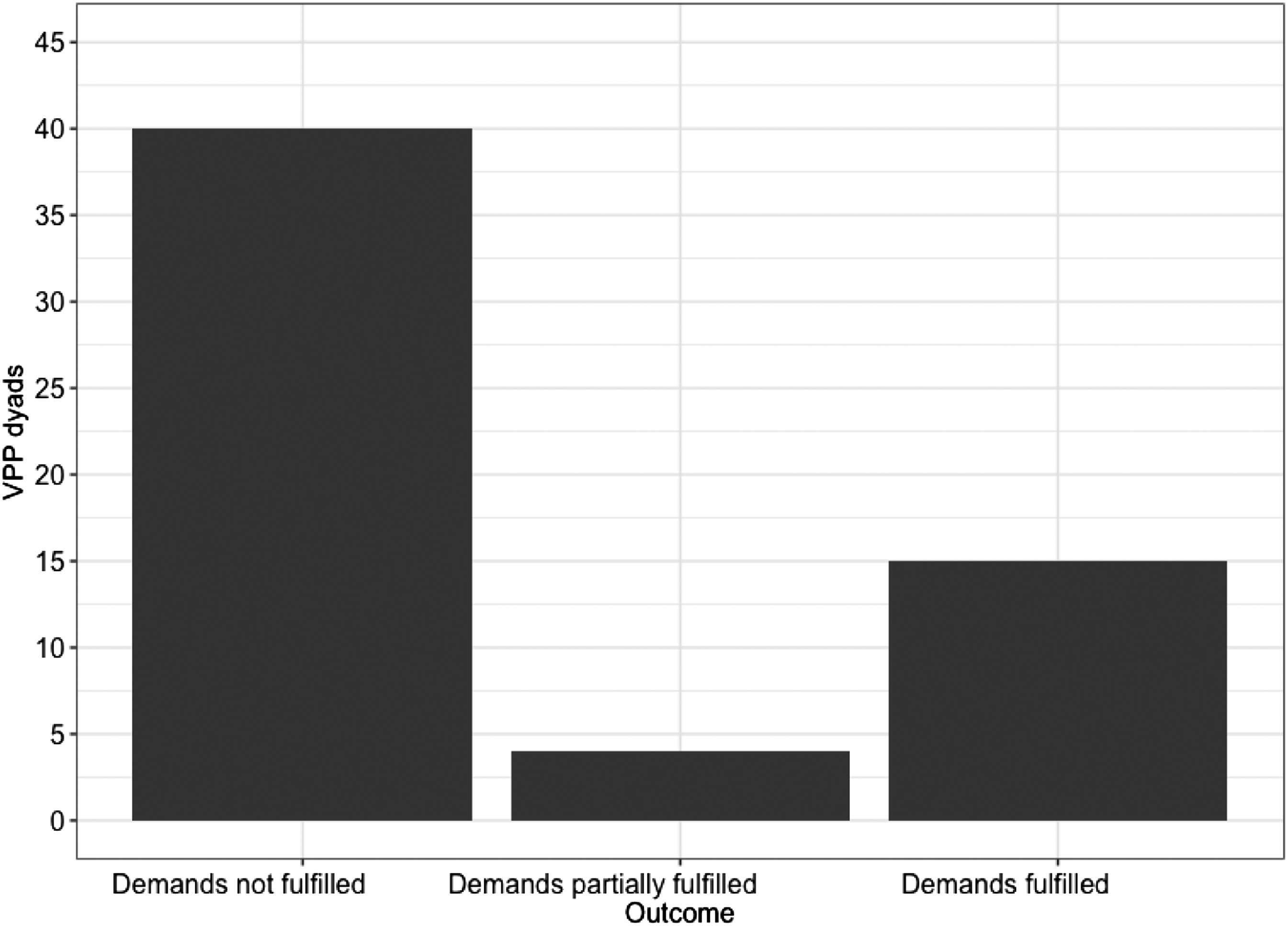
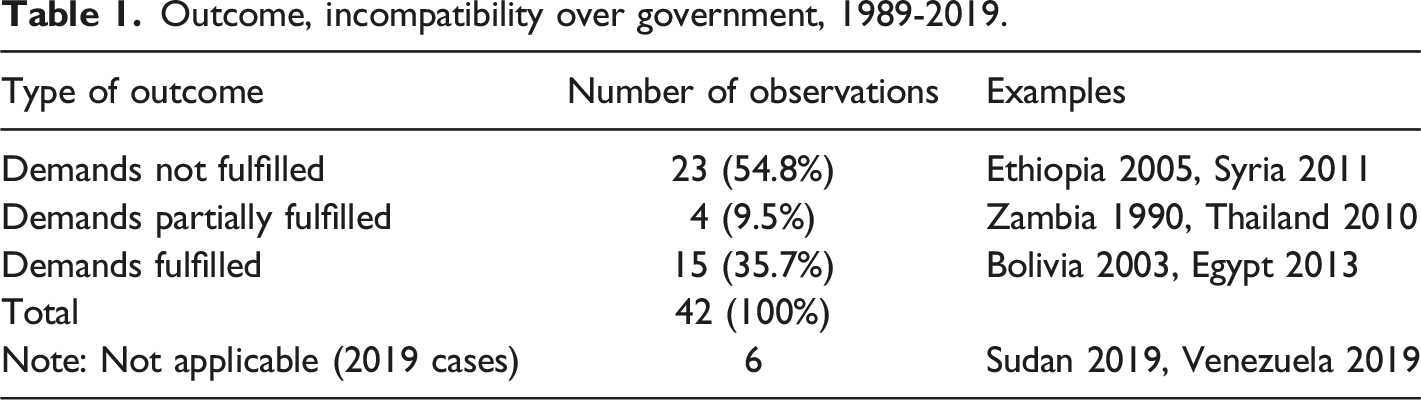
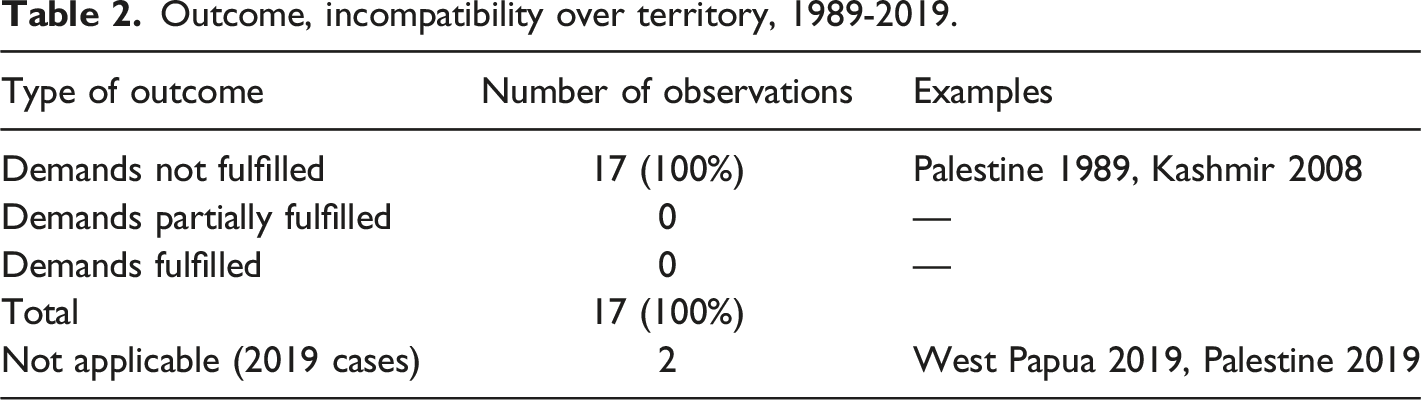
The clear majority, 42 of the 59 VPP cases (71.2%), fell within the government incompatibility category (see Table 1). Out of these 42 VPP cases, 15 (35.7%) had their demands fulfilled, 4 (9.5%) partially fulfilled, and 23 not fulfilled (54.8%). In contrast, VPP over territory are less common: seventeen out of the 59 VPP cases (28.8%) fell in this category. Notably, none of the VPP cases over territory saw their demands fulfilled. The success rate of VPP cases over government is thus much higher than VPP cases over territory; almost half of VPP cases over government had their demands fully or partially met, compared to none for territorial cases. This is in line with previous research on nonviolent conflicts: it appears more difficult to achieve results in territorially defined nonviolent campaigns (Chenoweth and Stephan 2011, Svensson and Lindgren 2011).
In sum, we show that this type of violent protest has been a recurring phenomenon throughout 1989-2019. Although VPP has featured over the entire time period, it is becoming increasingly more common with its two peak years observed in the 2010s (2011 and 2019). VPP is observed in all world regions, but is most common in Africa and the Middle East.
VPP and other categories of UCDP organized violence
Violent political protest is a phenomenon of its own, but may also relate to other manifestations of social conflict. For instance, they can transform into, or be transformed from, other forms of organized violence (on escalation see e.g. Gustafson (2020), Vogt, Gleditsch, and Cederman (2021), Beardsley, Cunningham, and White (2017); on substitution see e.g. Svensson and Lindgren (2011), Dudouet (2013)). This opens up for a set of interesting possible causal pathways. Future research could, for example, explore escalation, de-escalation, cases that never transform and organized violence occurring in parallel to violent political protests. The VPP data set can be a useful resource in such an endeavor. Below, we explore how different forms of social conflict, of which data is collected by the UCDP, connect to one another. First, we give a short overview of how VPP relates to the one-sided violence category. Second, we identify several interesting empirical patterns on the relationship between VPP and state-based conflicts.
Figure 5 shows whether a VPP dyad took place in a country where there was one-sided violence, by the government, the year before (5A), in the same year (5B), or the year thereafter (5C). There is a clear pattern: one-sided violence is more common in the same year as a VPP dyad than the years before and after. This indicates that one-sided violence and VPP may be related in some cases. One possible scenario is that protesters might escalate from nonviolent to violent when governments use lethal violence against them, such as in Syria during the Arab Spring. However, as Figure 5 shows, the clear majority of VPP dyads did not bear a clear relationship to one-sided violence committed by the government and occurred as a phenomenon of its own. Frequency of VPP dyads experiencing one-sided violence (by governments) at t-1, t, t+1.1989-2019.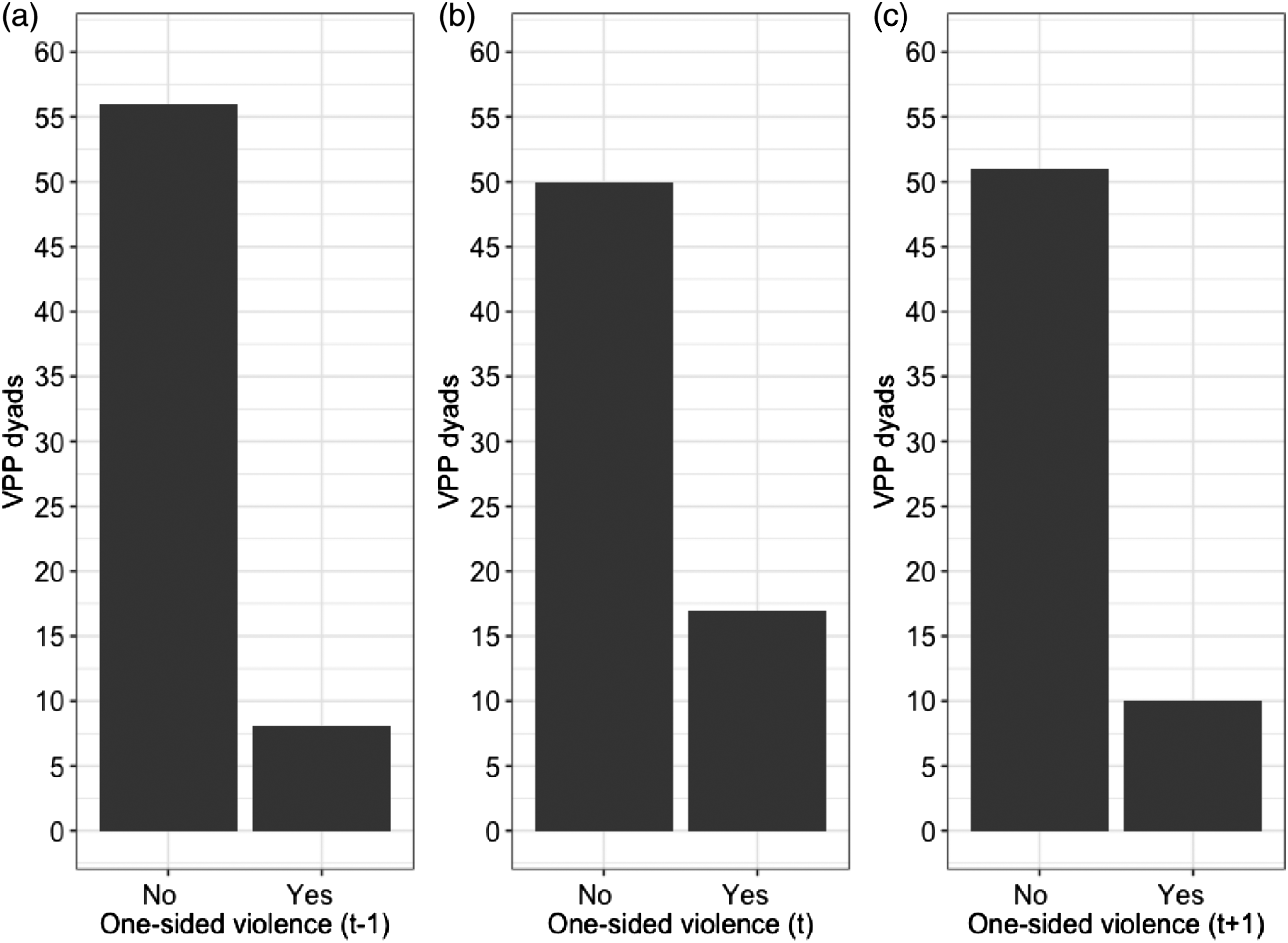
Violent political protest may also be expected to be related to state-based conflicts. We identify a few possible alternatives here. Figure 6 shows whether a VPP dyad took place in a country where there was a state-based conflict the year before (6A), in the same year (6B), or the year thereafter (6C). In Figure 6A, the distribution is almost equal. Almost half of VPP dyads occurred in countries where there were also state-based conflicts ongoing in the year before. Figure 6B suggests that it becomes more likely that a country experiences VPP and state-based at the same time (compared to t-1). The pattern becomes stronger at t+1.
12
First, we conclude that VPP often occurs in a context where violence is present, since many VPP dyads occur when there are already state-based conflicts ongoing. However, we also identify a potential escalation pattern in which VPP increases the risk for civil war, since the proportion of VPP dyads that co-occur with state-based conflicts within the same country increases from t-1 to t and t+1. Frequency of VPP dyads experiencing state-based conflict at t-1, t, t+1, 1989-2019.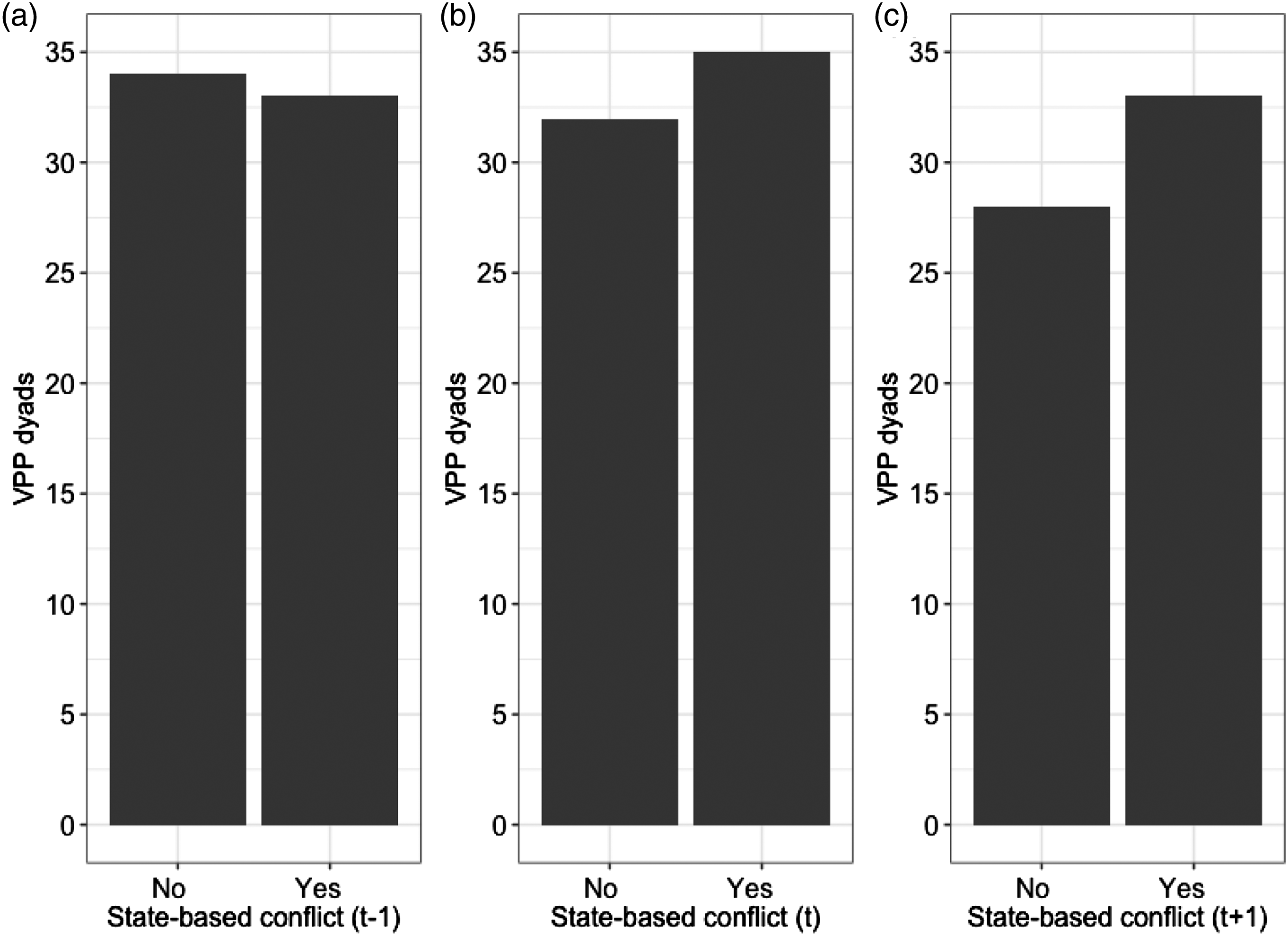
We identify three possibilities to why VPP and armed conflicts co-occur in time: a complement to armed group tactics, an escalation process, or a shared context that gives rise to violent social conflicts. First, violent political protests can complement a reliance on armed group tactics. The Israel-Palestine conflict was fought primarily through armed rebel tactics, but was partly complemented with a tactical shift to civil protest, predominately peaceful but also containing the use of violence (Pearlman 2011). The most intensive phase of the Intifada ended through the Oslo accords, but the Palestinian civilian protests continued, later in parallel with military actions by the Hamas movement. Thus, the Palestinian case is an example of how civilian protest violence occurred in a context of other forms of organized violence, without necessarily directly increasing the risk of escalation into a civil war.
Second, violent political protest can be a first step in an escalatory process towards full-blown civil war. Syria in 2011 is a case in point. Opponents of Bashar al-Assad protested against the regime. Through the brutality of the regime response, the opposition radicalized, and the Syrian army split through defections amongst primarily Sunnis in the lower ranks of the Syrian army. This led to intra-state armed conflicts during the summer of 2011. Nonetheless, there are few such examples and this escalation pattern is not confirmed beyond a handful of cases. This becomes visible when we compare VPP’s co-existence with state-based dyads to the total number of state-based dyads, which also leads us to our third identified possibility for co-occurrence: a shared context. 72 out of 1602 (4.5%) state-based dyads between 1989 and 2019 experienced VPP in the same year. Only 44 (2.7%) of all state-based dyads had the same incompatibility (either over government or over the same territory). Of these, only 31 state-based dyads (1.9%) commenced the same year as VPP. A similar pattern can be observed for state-based dyads that experienced VPP the year prior to the state-based conflict. 73 out of 1602 (4.6%) state-based dyads experienced VPP in the year before. Only 43 (2.7%) had the same incompatibility (either over government or over the same territory). Of these, 32 state-based dyads (2%) erupted after VPP (i.e. did not experience their onset prior to VPP). We can illustrate these patterns with India. In 2008, a VPP dyad emerges between the Government of India and the Supporters of Kashmir. In that year, India experienced eight different state-based dyads. Three of the eight Indian dyads in 2008 were conflict onsets. However, none of these onsets are, in reality, related to the VPP dyad. All three had a different territorial incompatibility and are therefore not cases of escalation. Of the remaining five dyads, only one has a related incompatibility: the Government of India and the Kashmir Insurgents. This is, however, no example of an escalation: the state-based conflict erupted in 1990 and had been active ever since. This illustrates that VPP co-exists with state-based conflicts within the same country, but that VPP is seldomly directly connected to an escalation to state-based conflict. 13
To conclude, we illustrate that VPP dyads frequently co-occur with other forms of social conflicts, especially armed conflicts (Figure 6), but that state-based conflicts rarely escalate from VPP dyads. This finding resonates with some previous research that indicates that escalation from protests into armed conflicts and civil war is rare (Chenoweth 2021, 151, Chenoweth and Shay 2019). We thus find that this pattern is not indicative of a broader escalation pattern where VPPs often develop into state-based conflicts. Rather VPP dyads often take place in countries where there are state-based conflicts present, which is instead suggestive of that there may be a conducive context in which these two forms of violent social conflicts occur. We investigate one such context in the empirical application below.
Illustrating with an empirical application: gender equality and VPP onset
In this section, we will exemplify how the VPP data can be used, by exploring the role of gender inequality as a driver of violent political protests. In recent years, research has increasingly focused on how gender equality or women’s empowerment affects armed and nonviolent conflict respectively. Previous research finds that countries with lower levels of gender equality are less likely to experience nonviolent campaigns, but more likely to experience armed conflict. The general argument suggests that lower levels of gender equality are correlated with more violent attitudes within society, leading to an increased use of violence (e.g. Bjarnegård, Brounéus, and Melander 2017, 2019, Caprioli 2005, Dahlum and Wig 2020, Cook and Wilcox 1991, Melander 2005, Schaftenaar 2017, Tessler and Warriner 1997, 273-280, Brooks and Valentino 2011). Violent political protest shares some characteristics with both nonviolent campaigns, as defined by NAVCO, and armed conflicts as defined by UCDP. As discussed above, all three assess movements with maximalist aims over territory and government, but have varying definitions of movements’ organizational structure. In particular, VPP is characterized by protestors not being strictly non-violent. This is a characteristic shared by rebels in armed conflict, but not necessarily by protestors in full-fledged nonviolent campaigns. We therefore here explore whether, in similar way as previous research suggest, lower levels of gender equality are related to a higher tolerance and support for violence, with the expectation that countries with lower levels of gender equality are more likely to experience VPP onset.
To assess this, we design the following model. The variable VPP onset takes the value 1 if a VPP onset occurs in a given country-year, otherwise it receives the value 0. An onset is coded when there was a new VPP-dyad or if there is more than 1 year since the last observation of the VPP-dyad. We use the Varieties of Democracies (V-Dem) Women’s political empowerment index as a proxy for gender equality (Coppedge et al. 2018). We include several control variables: Ln GDP per capita, Ln population (World Bank Development Indicators 2020), and cubic polynomials to account for temporal dependency. All independent variables are lagged t-1 and standard errors clustered by country. 14
The effect of women political empowerment on VPP onset.
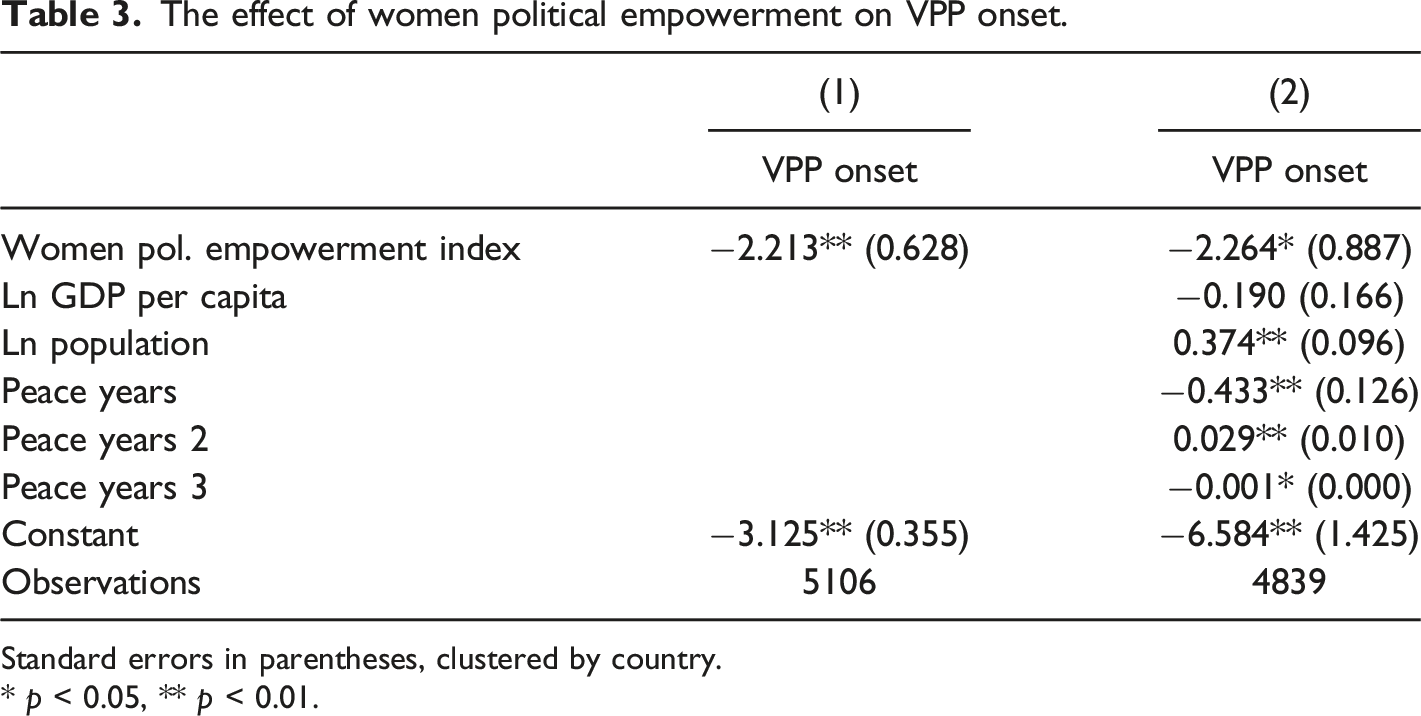
Standard errors in parentheses, clustered by country.
* p < 0.05, ** p < 0.01.
We include a limited set of control variables. We find that VPP is more likely to occur in more populous countries. This is a predictor in common with both armed conflict and nonviolent campaign onsets (Chenoweth and Lewis 2013). Finally, there is there is no significant effect of GDP per capita on VPP onset. Further research on violent political protest should include other factors, such as the level of democracy, urbanization, and etho-political factors, both to further probe the relationship between gender equality and violent political protest, and to uncover new relationships.
Concluding discussion
Informally organized violence is a type of armed conflict that currently falls outside the conceptual framework and empirical analysis of quantitatively oriented peace- and conflict research that relies on UCDP data. Even if the challenged regimes respond with repression, these types of popular uprisings are not considered cases of ‘one-sided violence’, as they include armed civilians. At the same time, these types of uprisings are too informally organized – no formal name, no unified leadership structure – to be included in the category of ‘state-based armed conflicts’. They cannot be considered for the third category of organized violence – non-state conflicts –- as the government is one of the sides in the conflicts. This article therefore launches VPP, a new –standalone- category of organized violence, that complements the established three UCDP categories, and that empirically captures a set of crucial cases that are currently omitted from the analysis of most of the work of conflict scholars.
Using this novel data, we show that VPP is present globally, but most prevalent in the Middle East and Africa. Violent political protest is increasingly common over time with its peaks recorded in the 2010s (2011 and 2019). Violent political protest outcomes vary by incompatibility: governmental dyads are much more likely to reach their aims than territorial dyads. No territorial VPP has reached its aims until now. Violent political protest also frequently co-occurs with state-based conflicts. There is evidence that groups use VPP as complementary armed group tactics, but also that VPP rarely escalates towards a state-based conflict. We explore if co-occurence is due to shared contexts. In the empirical application, we find that one such contextual factor, societal-level gender inequality, increases the likelihood of VPP onset, in a similar way as state-based conflicts.
The VPP data is a small, niched, data set that can be added to existing data sets, depending on the research interests of the scholars, or that can serve as a basis for selecting cases for more qualitatively oriented scholars. The VPP data lends itself to a set of different possible studies. For example, scholars interested in political violence, and who evaluate theories with no assumption of formal organization on the non-state side, can (and should) include the VPP data to the state-based armed conflicts. Thereby it complements pre-existing data sets on political violence.
The VPP data captures a type of asymmetric conflicts within states. It represents one set of ‘unarmed insurrections’ (a term that usually does not require full nonviolent discipline on the side of the opposition), and can therefore be a particularly valuable resource for scholars interested in examining the onset, dynamics and outcomes of these types of uprisings. In particular, VPP data can also be used by scholars interested in nonviolent discipline, if combined with other data sources. A growing field is examining how nonviolent discipline is an important explanation for the outcomes of mass-mobilized uprisings (Ackerman and DuVall 2000, Ackerman and Kruegler 1994, Dudouet 2008). As VPP captures cases where the demonstrators have not been fully nonviolent, systematic comparisons with nonviolent protests are called for.
In addition, VPP documents a category of organized violence that is important to study also in its own right. Violent political protests sometimes take place within existing nonviolent campaigns, but also exist in isolation. This type of protest violence has been understudied, and should be taken seriously when studying contentious politics (Sullivan 2019). VPP contributes by making these violent political protests visible and provides an opportunity for scholars to further disentangle different types of dissent, such as nonviolent action, violent political protests, and armed conflicts. The data will thus help to further the field by highlighting a category that falls between violent and nonviolent campaigns. A growing field has examined the difference between these types of campaigns (Ackerman and Karatnycky 2005, Celestino and Gleditsch 2013, Chenoweth and Stephan 2011, Scarritt 1994). Empirically, however, this is not a black and white-question, rather there is a grey-area where protests use some, but oftentimes relatively little, coercive tactics (Case 2021). There is a growing scholarly interest in the dynamics and effect of riots, including political riots (e.g. Abbs and Gleditsch 2021, Aidt and Leon 2016, Kadivar and Ketchley 2018). To help the field to think more carefully about cases that are in-between the categories of violent and nonviolent tactics, VPP can represent an interesting way to further analyze and deepen the understanding of the actual empirical trajectories in many contemporary social conflicts.
Another field of research that should be interested in accessing these new empirical cases as basis for analysis is research on government repression. Why do governments repress civil protests, and what is the outcome of this type of repression (Davenport 2007, 2005, Lichbach 1987, Moore 1998)? When are non-state opposition actors able to ‘bounce back’ after being confronted with repressive measures, as described in the theories of “political juijutsu” (Martin, Varney, and Vickers 2001, Sharp 1973, Sutton, Butcher, and Svensson 2014)?
We saw that the Arab Spring and 2011 represented a peak in the application of political protests, including those that were violent. These have been described as networked revolutions, twitter-revolutions or Facebook-revolutions, where the application of new information technologies enabled leaderless and informally organized protest movements to emerge as challengers of the status quo. Given the technological developments, perhaps in the future we will see more informally organized coercive protest movements. All the more reason, then, to develop our analytical tools for understanding this particular form of social violence.
Supplemental Material
sj-pdf-1-jcr-10.1177_00220027221109791 – Supplemental Material for Violent Political Protest: Introducing a New Uppsala Conflict Data Program Data Set on Organized Violence, 1989-2019
Supplemental Material, sj-pdf-1-10.1177_00220027221109791 for Violent Political Protest: Introducing a New Uppsala Conflict Data Program Data Set on Organized Violence, 1989-2019 by Isak Svensson, Susanne Schaftenaar, and Marie Allansson in Journal of Conflict Resolution
Footnotes
Acknowledgements
We would like to thank the editor and the anonymous reviewers for excellent suggestions to improve this article. In addition, we would like to express our thanks to our colleagues at the Department of Peace and Conflict Research, Uppsala University, and Tom Renvall in particular, for their valuable feedback.
Declaration of Conflicting Interests
The author(s) declared no potential conflicts of interest with respect to the research, authorship, and/or publication of this article.
Funding
The author(s) disclosed receipt of the following financial support for the research, authorship, and/or publication of this article: This work was supported by the Marianne and Marcus Wallenberg Foundation (MMW 2013.0025: Battles without Bullets).

Supplemental Material
Supplemental material for this article is available online.
Notes
References
Supplementary Material
Please find the following supplemental material available below.
For Open Access articles published under a Creative Commons License, all supplemental material carries the same license as the article it is associated with.
For non-Open Access articles published, all supplemental material carries a non-exclusive license, and permission requests for re-use of supplemental material or any part of supplemental material shall be sent directly to the copyright owner as specified in the copyright notice associated with the article.
