




Abstract
Broad political participation is widely accepted as a crucial element of transitions from armed conflict to peace. As such, reforms to increase access to participatory democracy are often written into peace accords. Yet despite this connection between peace and participation in policy, we know relatively little about how the two interact in practice. Who uses participatory institutions? Does civilians’ experience during armed conflict affect how they participate after war ends? This article examines an unlikely case of post-conflict participation in Colombia to answer these questions: the activation and organization of local referenda from below – that is, by conflict-affected communities themselves – to contest the national government’s mining and oil policy. Using an original dataset of 95 municipality-level attempts to organize these referenda (consultas populares), I find that both conflict intensity and insurgent group presence have significant and positive effects on consulta activation. The impact of insurgent group presence, however, is mediated by the timing of armed groups’ consolidation of territorial control. I further explore this relationship through a qualitative case study. The results highlight the importance of considering the lingering impact that armed conflict may have on democratic participation beyond electoral politics. Even when communities explicitly avoid references to conflict or victim status in their discourse, experiences during armed conflict can still shape local dynamics of political participation during post-conflict transitions.
Introduction
On 26 March 2017, over 6,000 residents of a small, agricultural municipality in the central Andean department of Tolima, Colombia took to the polls to cast their votes in a local referendum about a proposed gold mining project in their territory. With their vote – a near-unanimous ‘no’ against the development of the project – the people of Cajamarca blocked the activities of AngloGold Ashanti, one of the largest gold mining companies in the world (Muñoz & Peña Niño, 2019). The vote in Cajamarca was part of a wave of movements across the country that sought to activate a mechanism in the Colombian constitution known as a consulta popular 1 (hereafter referred to as a consulta) to protect their lands from the perceived threat of extractive (mining, oil, or hydroelectric) projects. Between 2013 and 2018, nearly 10% of Colombia’s 1,123 municipalities registered mobilizations calling for the organization of consultas related to extractive projects, challenging the national government’s pro-extractive post-conflict development plan.
Within Colombia, these communities’ turn to institutional channels for participatory democracy constituted a notable shift in the repertoires of contention employed during conflicts over territory. Historically, community opposition and state response to disputes over land use has mirrored the contention of the country’s armed conflict; communities have blocked roads, staged demonstrations, and organized land invasions to hinder project development. The government, meanwhile, has responded with military and police force (CINEP/Programa por la Paz, 2013). By activating the consulta, opponents of extractive projects in communities like Cajamarca turned toward the state and its mechanisms of participatory democracy to make their voices heard.
Beyond Colombia, the case of Cajamarca and municipalities offers lessons for post-conflict participation outside of the oft-studied realm of electoral politics. Political participation is widely accepted as a crucial element of conflict prevention and post-conflict transition (Bell & O’Rourke, 2007; Brinkerhoff, 2005; Jackson, 2005). This was understood as early as 1991 in Colombia, when delegates to the country’s constitutional convention envisioned that consultas and other participatory reforms would serve to counterbalance Colombia’s historically closed political system – one of the roots of the country’s armed conflict. Yet participatory institutions on paper do not necessarily translate to their use in practice. The consulta remained dormant as a tool for participation until 2013, which coincided with the beginnings of the Colombian government’s peace negotiations with the Revolutionary Armed Forces of Colombia (FARC). 2 This change in the use of consultas during Colombia’s transition from armed conflict with the FARC offers an opportunity to examine how experience during conflict may impact participatory democracy once violence abates. 3 Does experience during conflict condition communities’ post-conflict activation of participatory democracy?
This article answers this question through a mixed-methods study of 95 municipal-level attempts to organize consultas in Colombia during and after the 2012–2016 peace negotiations with the FARC. In doing so, it makes two main contributions to the fields of peacebuilding, democratization, and dynamics of conflict. First, this article answers Balcells & Justino’s (2014) call to bridge micro- and macro-level approaches to the study of political violence. I do this by putting into conversation two divergent literatures that that focus either on individuals’ exposure to violence or communities’ interactions with rebel groups. Within the former category, studies of individuals’ attitudes toward participation and politics (see Davenport et al., 2019) suggest that exposure to violence is positively correlated with individual-level participation in community groups and politics, the effects of which can last for generations (Balcells, 2012; Lupu & Peisakhin, 2017).
Recent studies on the micro-dynamics of conflict, meanwhile, suggest that the legacy of armed conflict may be decoupled from rates of conflict-related violence. Violence is only one way that armed groups interact with civilians, and the way they exert control and interact with local populations can vary (e.g. Arjona, 2016; Breslawski, 2020; Mampilly & Stewart, 2020). These variations, in turn, can have implications for post-conflict politics. Where interactions with armed groups catalyze the mobilization and organization of ordinary citizens, post-conflict politics tend to look more democratic (Huang, 2016). Similarly, different forms of interaction can either strengthen or weaken pre-existing political institutions and their ability to address citizens’ needs (Vargas Castillo, 2019). The emphasis here is on the mode of engagement between armed groups and civilians rather than violence or control in and of itself. This article’s finding that both violence and the timing of violence might help explain post-conflict participatory democracy represents a contribution to the study of rebel governance and its legacies after war.
Second, this study expands our understanding of post-conflict participation to include engagement with participatory democracy as well as formal electoral politics. Existing studies of post-conflict participation have focused on reforms promoted by either national governments or external peacekeepers, such as combatant participation in post-conflict elections (Matanock, 2017) or representation in legislature or cabinet (Call, 2012). Instead, I focus on non-electoral, participatory mechanisms activated and implemented from below – that is, by conflict-affected communities themselves. As more communities turned to the consulta after 2013, Colombia’s national government actively discouraged and tried to block communities from using it (McNeish, 2017a). Movements to employ the consulta had to be initiated from the grassroots level, making them an unlikely, but powerful, case of participation. Turning toward the consulta signaled those citizens believed in, or at least hoped for, the legitimacy and efficacy of participatory reforms. Understanding patterns of activation, therefore, can help us understand how democratization may be built from the ground up in areas affected by conflict.
The rest of the article proceeds as follows. First, I clarify this article’s understanding of post-conflict participation and justify its employment of the consulta as its subject of focus. Next, I evaluate the existing literature on the effects of armed conflict and post-conflict participation and formulate the hypotheses that I test in my statistical analysis. The following section presents my data and results from statistical models. I then explore possible causal mechanisms through a case study of the effort to organize a consulta in Cajamarca. I conclude by discussing how my findings may hold lessons beyond Colombia and offering suggestions for future directions of research.
Defining political participation
This study is interested first in the general question of whether experience during armed conflict affects post-conflict participatory mechanisms. While scholars agree that participation is important for peacebuilding, participation can take many forms, with different levels of accessibility for the average citizen. Some clarification around what I mean by ‘participation’, therefore, is useful. I employ a broad definition of political participation outlined by Conge et al. (1988: 247) as ‘individual or collective action at the national or local level that supports or opposes state structures, authorities, and/or decisions regarding allocation of public goods’. This definition includes actions through institutional channels, such as voting, or extra-institutional channels, such as demonstrations or strikes. It excludes ‘community behavior’ that is not oriented toward the state, such as belonging to neighborhood associations.
I focus on a particularly unlikely form of political participation: what Mayka (2019) and Rodríguez-Franco (2017) have termed ‘civil society activation’ or ‘citizen activated institutions’. In this form of participation, citizens act through formal, state institutions, but institutional activation is initiated and shaped by the mobilization and coordination of civil society groups which pressure the government to recognize their actions. In the context of post-conflict transitions, civil society activation can complement top-down programs to promote participation. These actions, however, can be especially ‘high-risk’ (Loveman, 1998; Zulver, 2022), especially in contexts where social leaders and actives continue to be targeted for violence, like Colombia (International Crisis Group, 2020).
The consultas considered in this study fall into this category of participation. While the consulta as an instrument is a participatory institution sanctioned by the state, its use by civil society to contest extractive projects runs counter to national government policies and priorities. Beginning in the 1990s and continuing today, successive presidential administrations have promoted investment in mining and oil projects as a crucial driver of Colombia’s economic growth. The government has introduced tax breaks, auctions of extractive titles, and changes in legal codes to reduce barriers to investment (McNeish, 2017b; Vasquez, 2014). Community opposition to extractive projects represents a thorn in the side of national government officials courting multinational companies. In this scenario, the impetus to implement the consulta in the cases considered here almost always comes from civil society.
Communities in all municipalities have the legal right to organize consultas per Colombia’s constitution, but not all chose to when confronted with imminent threats to their territory from extractive projects, even as others demonstrated their utility in disputes over land use. Colombia’s interrelated history of armed conflict and political exclusion offers one possible explanation for this variation. The following section explores how armed conflict may affect political access and participation after conflict recedes.
Theoretical framework
There are two strands of literature to which we can turn to understand how armed conflict can make citizens more or less likely to activate participatory mechanisms after conflict ends. One examines the effect of violence on individual actions and disposition toward participation. The other investigates the differential effects of armed groups’ presence on local-level institutions and organizations. I evaluate each of these explanations in turn.
Violence and the individual
Few would argue that civil war and its attendant violence are positive experiences for those affected. Recent scholarship, however, has pointed toward a silver lining of civil war: increased participation and altruism among individuals who experience violence first-hand. Studies ranging from surveys of child soldiers in Uganda (Blattman, 2009), households affected by civil war in Sierra Leone (Bellows & Miguel 2009), and field experiments in rural Burundi (Voors et al., 2012) tend to converge in their findings. Wartime experience positively affects social and/or political behavior on an individual level after conflict.
Despite the apparent agreement 4 around the positive correlation between exposure to violence and participation, the actual mechanism driving victims’ engagement in post-conflict politics is less clear. Most scholars borrow from the discipline of psychology to hypothesize that conflict exposure leads to generalized preference change due to ‘post-traumatic growth’. As Bauer et al. (2016: 23) summarize in their meta-analysis, ‘psychologists have noted that some people respond to trauma by reflecting on and reevaluating their lives, especially in terms of what they regard as important and valuable such as family and relationships’. Trauma in the form of conflict-related violence, the argument follows, leads to pro-social behavior, of which political participation is one facet. Aggregated to the community level, increased pro-social behavior may change social norms and fortify institutions that promote social and political participation (Bellows & Miguel, 2009: 1147).
Applying these arguments to the case of consulta activation in Colombia, we would expect individuals living in areas that experienced greater conflict intensity to exhibit more pro-social tendencies. This increased pro-sociality could facilitate efforts to organize movements to activate consultas, as community members may be more willing to participate in organizing and/or take on leadership roles. Bauer et al. (2016) suggest that pro-social effects are stronger within culturally defined in-groups than among out-groups. This assumption should only strengthen our expectations regarding mobilization within a community (within an in-group) against mining or oil firms (outsiders).
Importantly, much of the existing literature suggests that the pro-social effect on consulta participation should hold regardless of the type of violence and/or identity of the perpetrators (Bauer et al., 2016). This allows me to employ a fairly blunt instrument to measure conflict intensity in my analysis. Some scholars may disagree with this framing. Balcells (2012: 313), for example, contends that victimization leads individuals to reject the political identities of perpetrators. Balcells’ study, however, examines participation in formal voting and party preferences. In the context of non-electoral politics, party preferences likely play a smaller role. First, national party ideology tends to be significantly diluted at the local level. Second, when voting on issues that immediate threaten their land and livelihood, even individuals with strong political preferences in formal elections may see consultas as far removed from the preferences of party elites in Bogotá.
Hypothesis 1 (conflict exposure and pro-sociality): Municipalities that experienced greater conflict intensity will be more likely to register a movement to activate a consulta.
Armed groups and engagement
Theories of violence and pro-sociality capture only one element of life during armed conflict. Low rates of violence can belie the influence of non-state armed groups over a community (Kalyvas, 2006). Where armed groups compete against the state or each other for territory, violence may spike. When one group is able to consolidate power, violence tends to diminish. Instead, armed groups often turn to less-violent forms of governance or social control to keep populations in order. Scholarship on the formation and legacy of rebel governance indicates the character of insurgent-civilian interactions under rebel governance has important impacts on the political and social life of communities, both during (Gáfaro et al., 2014; Kaplan, 2017) and after (Huang, 2016; Martin, Piccolino & Speight, forthcoming; Vargas Castillo, 2019) conflict. Styles of wartime insurgent-civilian relationships varies across groups and territories (Arjona, 2016; Mampilly & Stewart, 2020). Fortunately, much of the existing theory on rebel governance is derived from case study work conducted in Colombia. This allows me to make some generalizations that are relevant to post-conflict consultas.
Previous work has found that guerrilla groups (namely the FARC) were more likely to ‘prop up’ existing local government institutions (in contrast with right-wing paramilitary groups, which were more likely to dismantle them) and incorporate community members into local rule (Kaplan, 2017; Vargas Castillo, 2019: 47). The FARC was also less likely to harass local organizations, so long as those organizations aligned with the rebel group’s ideology (Arjona, 2016: 145). This has important implications for the types of civil society groups that led movements against mining in rural areas. From its origins, the FARC cultivated an ideology that espoused rural empowerment and its roots as a rural self-defense movement (Karl, 2017). The FARC’s leadership also explicitly opposed the development of corporate mining projects, both in line with its leftist ideology and likely in response to the state security presence that projects would bring. This alignment in interests and ideology suggests that civil society groups – such as community associations or environmental defense groups – may have been more likely to survive the conflict with their organizational capacity and leadership intact in areas controlled by the FARC. In fact, activists may have increased their leadership skills during this period, as they were forced to negotiate and plan their activities under the FARC’s armed presence (Jha & Wilkinson, 2012). Community members interested in organizing a consulta between 2013 and 2018 could then tap into these pre-existing activist networks. It is important to note that the networks I refer to here are comprised of civilians and are distinct from the rebel group commanders and former combatants.
5
Hypothesis 2 (armed group presence): Municipalities where the FARC had sustained/hegemonic control will be more likely to register a movement to organize a consulta.
Timing is everything
Building leadership skills and institutionalizing civil society organizations can take time that communities living in a dynamic security environment may not have. Vargas Castillo notes (2019: 134) that communities often experienced rule by multiple armed groups over the course of Colombia’s decades-long armed conflict. As a result, the sequence and length of exposure to different types of rebel government may matter. Indeed, one study of armed group presence and participation during war finds that longer periods of insurgent presence are associated with larger increases in participation and collective action (Gáfaro et al., 2014: 22). We may expect similar impacts for post-conflict participation; the longer the FARC has a sustained presence in a territory, the more time (select) civil society groups have to consolidate and build skills in a (relatively) favorable environment.
Hypothesis 3 (temporality): Municipalities where the FARC consolidated control earlier in the conflict will be more likely to register a movement to organize a consulta.
Data
This article uses consulta activation as its primary measure of post-conflict participation. Proponents of civil society-activated participatory institutions recognize civil society mobilization as a necessary step for both demanding implementation and securing participation in these institutions. Following their arguments, this study operationalizes ‘activation’ by identifying municipalities where mobilizations specifically called for their local governments to hold a consulta related to an extractive project. The focus on extractive-related consultas ensures the mobilizations represent ‘unlikely’ cases of participation – that is, where participants’ (stated) goals challenge national government policies. 6
To identify cases where these movements have taken place, I systematically searched both regional and national media reports for mentions of consultas populares. If a municipality was mentioned in the media as having any organized action demanding a consulta (e.g. community members have demanded a town hall to discuss organizing a vote), that municipality is counted as a positive case, even if I could not find evidence that the mayor or local council had taken institutional action. The logic behind including these municipalities as positive cases stems from multiple conversations with Colombian academics and activists. All agreed that, given the Colombian media’s tendency to under-report activities in rural territories, coverage in media reports can be interpreted as an indication that the movement is real and significant on the ground.
For my statistical analysis, I construct a dichotomous variable (mobilized) that codes whether or not a municipality has a movement for a consulta. Some municipalities registered two separate initiatives 7 to demand a consulta, but these municipalities are only counted once for the purposes of this analysis. The independent variables tested in this paper do not vary sufficiently over time between the two attempts. Therefore, including these attempts as separate cases would constitute double counting.
The mobilized variable includes cases of consulta activation where neither activists nor local authorities have taken the step to register with the local office of the National Registry – the first step toward triggering the deployment of government funds and electoral infrastructure for a vote. 8 I include these cases because some municipalities have experienced numerous mobilizations and formal town hall meetings that facilitate informal participation around the consulta without yet triggering the formal mechanism. That said, filing a movement with the National Registry may constitute an important step toward increasing the quality and legitimacy of participation connected to the consulta. I also test my hypotheses using a second, more restricted, dichotomous dependent variable (registered) that captures whether a movement has formally filed with the local branch of the National Registry (1; or activated) or not (0; or dormant) based on documents published on the National Registry’s online archive. The number of positive cases under these criteria decreases from n = 95 mobilized to n = 37 registered. 9 Cases are mapped in Figure 1.
The full universe of cases in the dataset follows Mahoney & Goertz’s (2004) ‘possibility principle’, including all municipalities that are ‘at risk’ of holding a consulta related to extractives. I define ‘at risk’ as those municipalities where the national government has either already granted concessions for extractive projects or where the National Mining Agency and/or National Hydrocarbon Ministry has advertised territory as eligible for titling. I exclude municipalities where the area of land reserved for ethnic (indigenous or Afro-Colombian) communities exceeds 10% of the municipality. In accordance with international conventions, the Colombian legal code requires both private companies and the state to consult ethnic minority communities (often referred to as free, prior, and informed consultation) before developing projects that will affect their designated lands (see Rodríguez-Garavito, 2011). As these communities have access to a designated tool for consultation, I assume that civil society groups will turn to this guaranteed pathway of participating rather than undertaking the more demanding process of mobilizing local government officials and eligible voters to hold a consulta. This assumption is supported by Figure 1. Areas with high concentrations of ethnic communities, such as the Pacific coast and Amazon, do not register any attempts to organize a consulta.
I measure both my dependent and independent variables on the municipality level. This level of analysis distinguishes my study from previous work on post-conflict participation, which has approached participation from the individual level (i.e. Blattman, 2009) or village level (i.e. Kaplan, 2017; Vargas Castillo, 2019) of analysis. The reason I focus on the municipality is threefold. The first reason is administrative. The municipality level is the smallest organizational level for which authorities can call for a consulta.
10
Thus, the ‘community’ that a consulta aims to poll is comprised of all towns, villages, and rural settlements within the municipal boundaries. The second reason is theoretical. Smaller communities within the municipality may have experienced slightly different levels of conflict (Arjona, 2016; Kalyvas, 2006) and feature their own internal politics that are not captured with municipality-level data. Nonetheless, to mobilize for a consulta, activists must coordinate across this spectrum of experiences. How residents of these smaller administrative units interact and coordinate between themselves determines the feasibility of consulta mobilization. The sum of this interaction and coordination is captured by my municipality-level measure. Finally, the municipality
Map of attempts to organize consultas related to extractive projects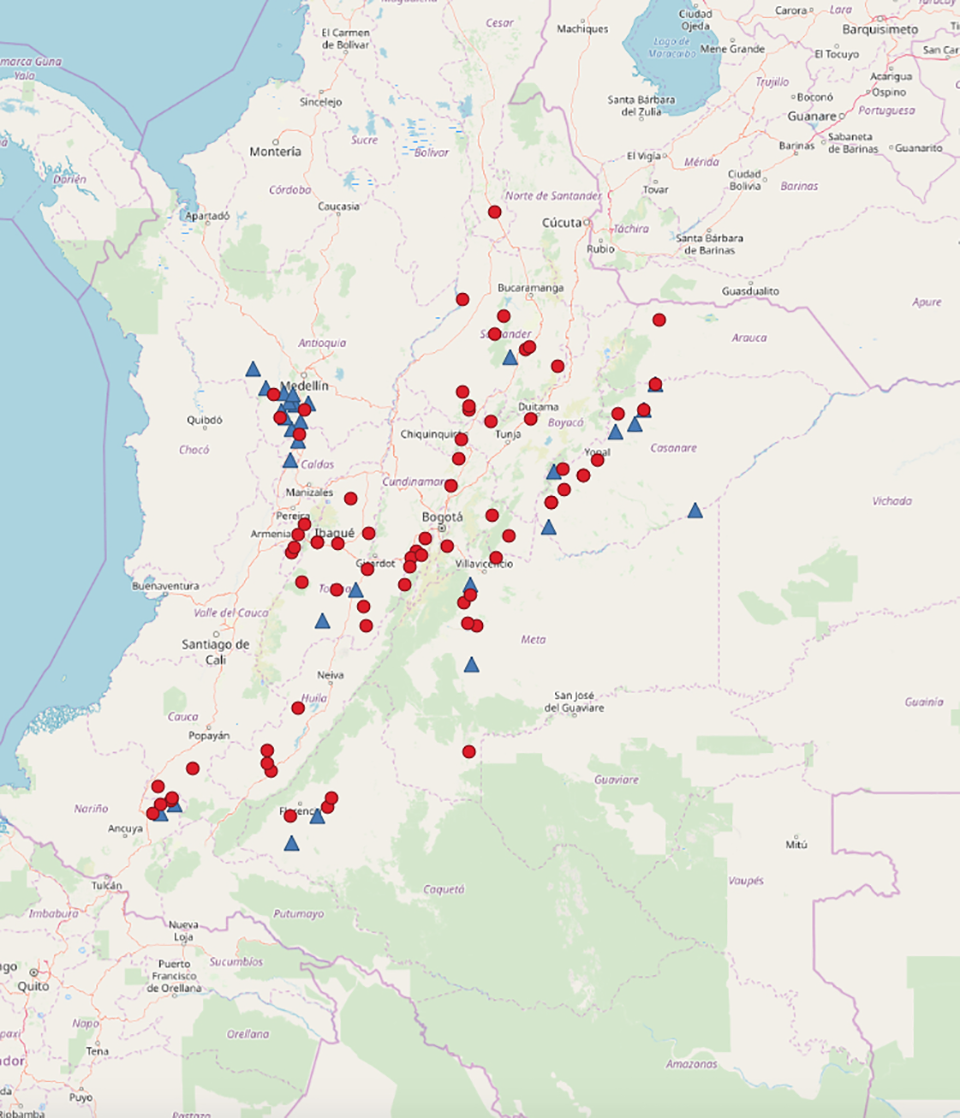
Independent variables
To test my first hypothesis – municipalities that experienced greater conflict intensity will be more likely to register a movement for a consulta – I use an indicator for conflict intensity created by the Conflict Analysis Resource Center (CERAC), a Colombian think-tank. 11 Between 2000 and 2012 – generally the most violent years of Colombia’s armed conflict – CERAC collected data on both armed group presence and conflict-related events for all municipalities across Colombia. Municipalities are typologized on a 0–7 scale based on both the number of violent events and the persistence of conflict (permanent, interrupted, pacified, no conflict). Municipalities that scored a 7 on this scale represent those that were the most affected by armed conflict, while those that scored a 0 did not experience conflict from 2000 to 2012.
My second hypothesis predicts that municipalities that experienced sustained territorial control by the FARC will be more likely to register movements for a consulta. To measure territorial control, I build on Matanock and García-Sánchez’s (2018) work identifying armed group territorial control in selected Colombian municipalities for their survey experiment on counterinsurgent support. They draw on Kalyvas’s (2006) observation that ‘control produces different patterns of violence [we can observe]’ to identify armed group control through longitudinal information on violence in a particular time period. Spikes in violence by multiple actors indicate contestation over control, but declines in violence indicate consolidation by one group. Using semiparametric group-based modeling, they identify different trajectories of violence by different armed actors to identify the status of control in each municipality by the end of the period in question. I expand their dataset by replicating their analysis using violence data for the years 1993 to 2013 for all the municipalities in my sample. 12 Data on violence comes from the Universidad de los Andes’ CEDE municipal dataset, which includes panel data collected from primarily from state agencies. This variable indicates which armed group (or the state) had near total or sustained control of the municipality in the period that directly preceded the wave of consulta activations.
To capture the temporality of armed group control that is central to my third hypothesis, I created variables that disaggregate rates of violence by armed actors and time period as an indication of when armed groups attempted to consolidate control. The contemporary period of the Colombian armed conflict can be broken down into three periods (Prieto et al., 2014). The first period (1990–2002) marked a time of territorial expansion and consolidation by the FARC, which ended with the failure of the El Caguán peace process in 2002. This period was followed by eight years of Álvaro Uribe’s presidency (2002–2010), which saw rapid improvements in the Colombian military force under his policy of Democratic Security. This period also featured the highest levels of paramilitary activity across the country. The second period ended in 2010 with the election of Juan Manuel Santos, who signed a final peace agreement with the FARC in 2016. I created variables that capture violence committed by the FARC and rightwing paramilitary groups by municipality during the first two time periods outlined above.
Control variables
In addition to controlling for various socio-economic conditions, 13 I include a number of other variables in my models to address possible selection effects on the independent and dependent variables. Some municipalities may have been targeted for violence during armed conflict for the same reason that they may also be more likely to mobilize for a consulta after conflict abates – the presence of natural resources. Many scholars have emphasized the connection between natural resource wealth and conflict (Collier & Hoeffler, 2000; Gutiérrez Rodríguez, 2018; Rettberg & Prieto, 2018). Guerrilla groups, paramilitaries and organized criminals all may seek control of areas where extractive exploitation is already underway to gain access to financial benefits from royalties or to engage in illegal extraction. State forces, meanwhile, have incentives to regain and maintain control of these areas to protect legal extractive operations. I construct a measure of municipality extractive royalties pre-consulta movement as a control for existing extractive projects with data from the Colombian government’s Planning Unit for Mining and Energy. I also include a dummy variable for whether a municipality is covered by a convenio de fuerza. These convenios are agreements signed between private companies and state agencies (army, air force, police) that provide enhanced security services for extractive sites in exchange for funding. 14 Ostensibly, these agreements are intended to protect extractive installations from attacks by insurgents, but human rights groups contend that they are often used as a pretense to quell anti-extractive protests and target social leaders. This variable, therefore, helps to account for possible spuriousness where municipalities attract FARC presence and independently are more vocal opponents to extractive projects.
I include distance from Bogotá, Colombia’s capital, as an additional control. State capacity across Colombia is uneven and has been for much of the country’s history. The lack of state presence can contribute to armed groups’ abilities to pursue and maintain territorial control. Importantly for this study, variations in state presence may also have implications data reliability. The further away municipalities are from Bogotá, the more likely that media coverage did not report on the presence of consulta movements.
Finally, I include a control variable to account for the continued threat of violence after the formal end of Colombia’s armed conflict with the FARC in 2016. In many areas of the country, Colombia’s ‘post-conflict’ has not been peaceful. Individuals mobilizing around environmental issues, in particular, have been explicitly targeted for violence by various actors; in 2019, the NGO Global Witness named Colombia the deadliest country in the world for land rights activists (Griffin, 2020). Leaders of pro-consulta movements across Colombia have reported receiving death threats aimed at stopping existing mobilizations and discouraging future ones (McNeish, 2017a). This study, however, is concerned with violence during conflict, rather than violence committed after. To control for post-conflict violence, I construct a dummy variable to capture whether the municipality registered at least one assassination of a social leader between 2016 and December 2018.
Empirical strategy and discussion
Average conflict intensity (2000–2012) and consulta activation
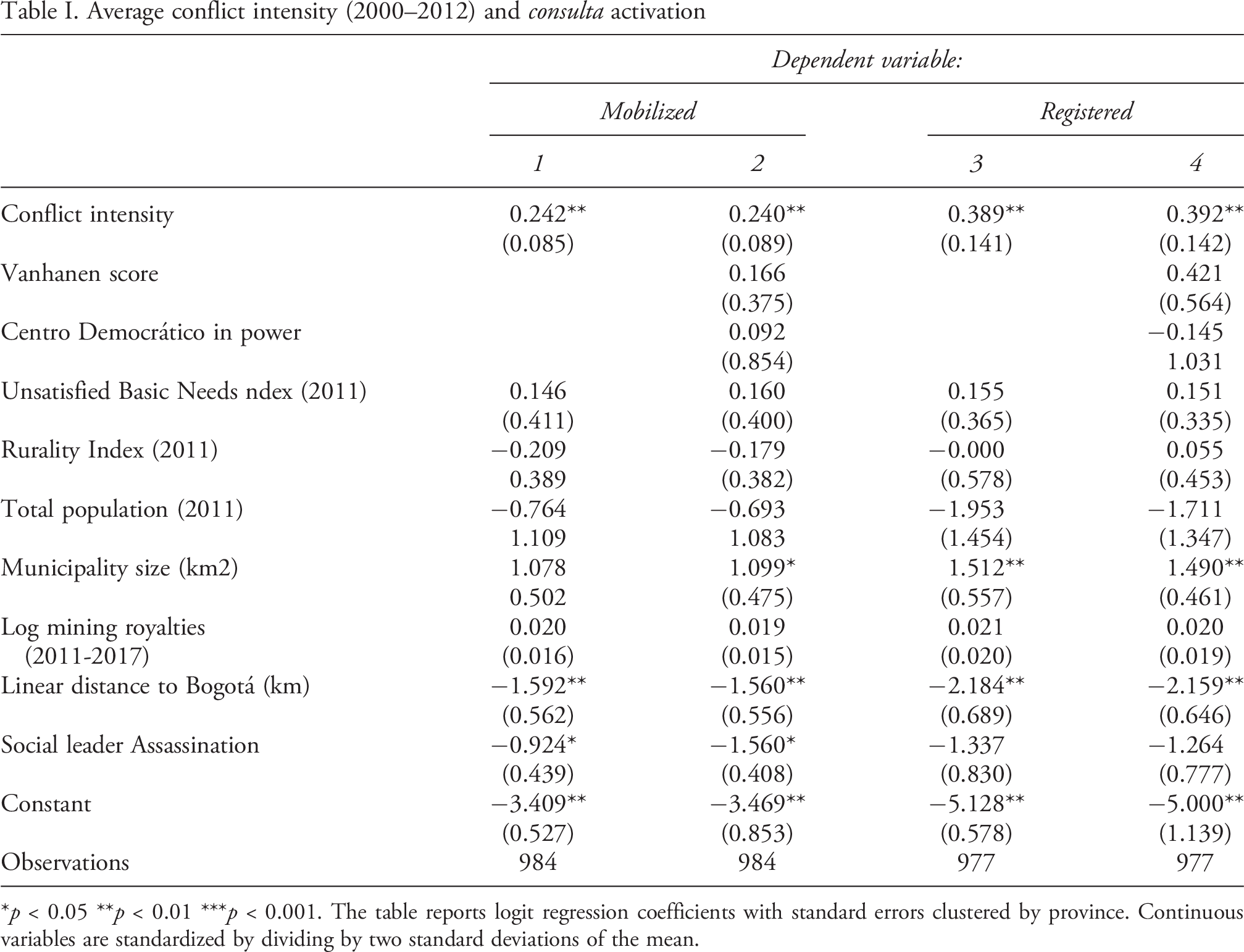
*p < 0.05 **p < 0.01 ***p < 0.001. The table reports logit regression coefficients with standard errors clustered by province. Continuous variables are standardized by dividing by two standard deviations of the mean.
Focusing first on general exposure to armed conflict, the results reported in Table I provide evidence supporting my first hypothesis; municipalities that experienced greater conflict intensity were more likely to both mobilize and register their movements calling for a consulta. Holding all other values at their means, municipalities that were most affected by conflict were 3.6 times more likely to mobilize and nearly 10 times more likely to register with the National Registry than those that experienced no conflict-related violence. 15
The results remain significant when I add possible alternative explanations into models 2 and 4. As both the early stages and eventual completion of a consulta require movement leaders to gain approval from either the local mayor, municipal council, or both, it is possible that local political dynamics (Tarrow, 2011) may explain why some communities are able to activate the consulta while others are not. The inclusion of measures for political openness 16 and a dummy variable for the mayor’s political party 17 do not affect either the coefficient size or the significance level of the coefficients for conflict exposure.
Armed group control (ending in 2013) and consulta activation
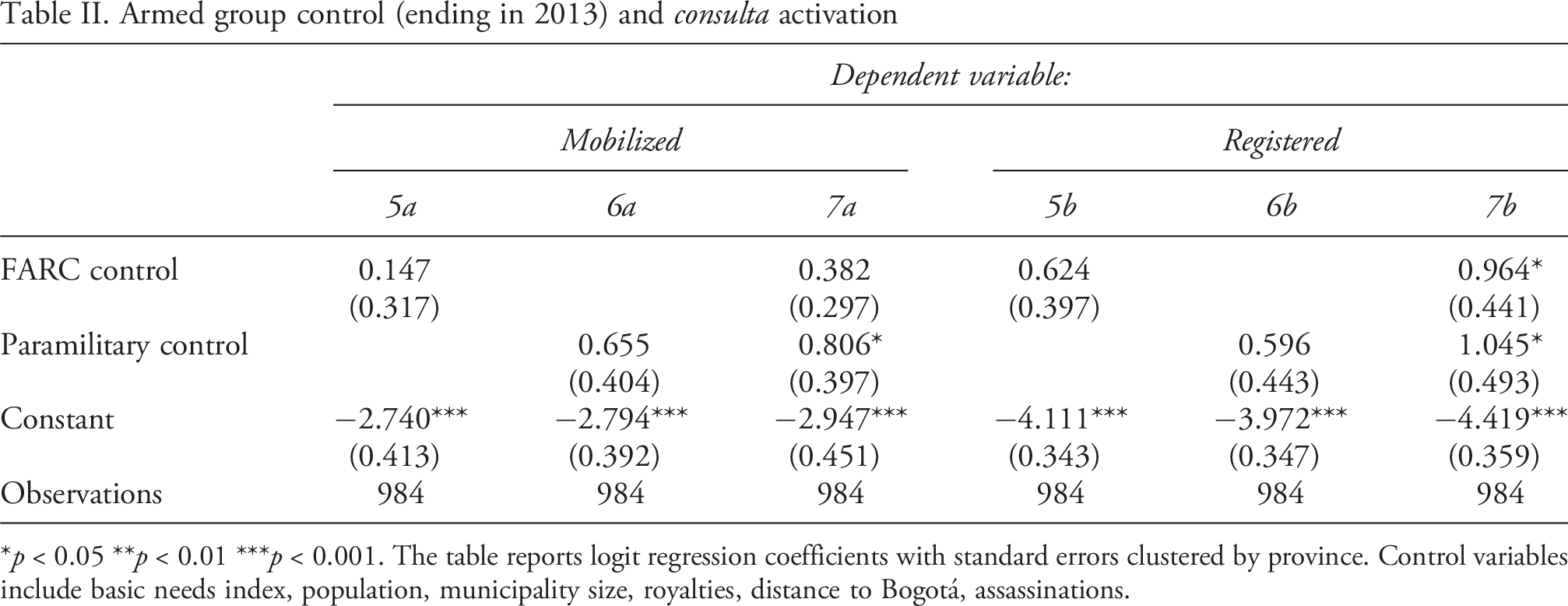
*p < 0.05 **p < 0.01 ***p < 0.001. The table reports logit regression coefficients with standard errors clustered by province. Control variables include basic needs index, population, municipality size, royalties, distance to Bogotá, assassinations.
The correlation between movement registration and conflict exposure provides especially robust evidence that there is some connection between the two. While Colombia’s history of armed conflict and state repression has made all forms of collective action high-risk, informal demonstrations, meetings and town hall events related to consulta activation constitute relatively lower-risk forms of participation. While they may be recognized by other participants, movement leaders and individual attendees do not have to formally document their attendance. In contrast, registering with the National Registry requires either movement leaders to provide their names and identification numbers to government officials, or for mayors and municipal council members to formally support the motion for a vote. In a context where activists are targeted for violence and local politicians may be sanctioned by the national government for activating the consulta, registration represents a high level of commitment to participation.
As mentioned, data on conflict intensity measured in violence do not capture the full picture of civilians’ experience during armed conflict. Therefore, I turn to assessing the impact of armed group presence through 2013 on participation through consultas. The results of logistic regressions using both the mobilized (models 5a–7a) and registered (models 5b–7b) dependent variables suggest we should reject the hypothesis that FARC presence increases the odds of a community activating the consulta. As reported in Table II, the presence of the FARC in a municipality has no statistically significant effect on either dependent variable. Instead, when we consider the presence of both groups together in models 7a and 7b, paramilitary group control has a slightly positive effect on mobilization and registration.
This result is surprising. In contrast to the FARC, paramilitary groups in Colombia tended to dismantle local leadership structures and target activists, preferring to replace local leaders with their own or external personnel (Arjona, 2016; Vargas Castillo, 2019). The theoretical framework I laid out earlier would suggest that these actions would hurt communities’ ability to activate participatory democracy after war. Vargas (2019: 134–138) posits that caution should be taken when interpreting the legacy of paramilitary control over a municipality. He argues that sequence and length of exposure to groups matters: ‘in most regions, guerrillas arrived first and exercised uncontested control during years, sometimes decades, before the insertion of paramilitary groups in these areas.’ Therefore, areas under control of paramilitaries in 2013 may have also experienced long periods of guerrilla influence. This may also explain why FARC control in 2013 has no effect on a municipality’s likelihood of organizing a consulta. If guerrilla consolidation happened recently, civil society groups may not have had enough time to develop.
To account for overlaps in armed group presence, I turn to my third hypothesis: municipalities where the FARC consolidated control earlier in the conflict will be more likely to register a movement to organize a consulta. I analyze a sub-sample of my data by keeping only municipalities under guerrilla control in 2013. Following the same logic related to patterns of violence and consolidation of control, I use my time period variables to evaluate when violence by armed groups in municipalities peaked. My analysis assumes that if violence peaked in the earlier period (1993–2002), then the FARC’s presence in a municipality was consolidated early. High rates of violence in the second period
Plot of coefficients logit models 8a–12a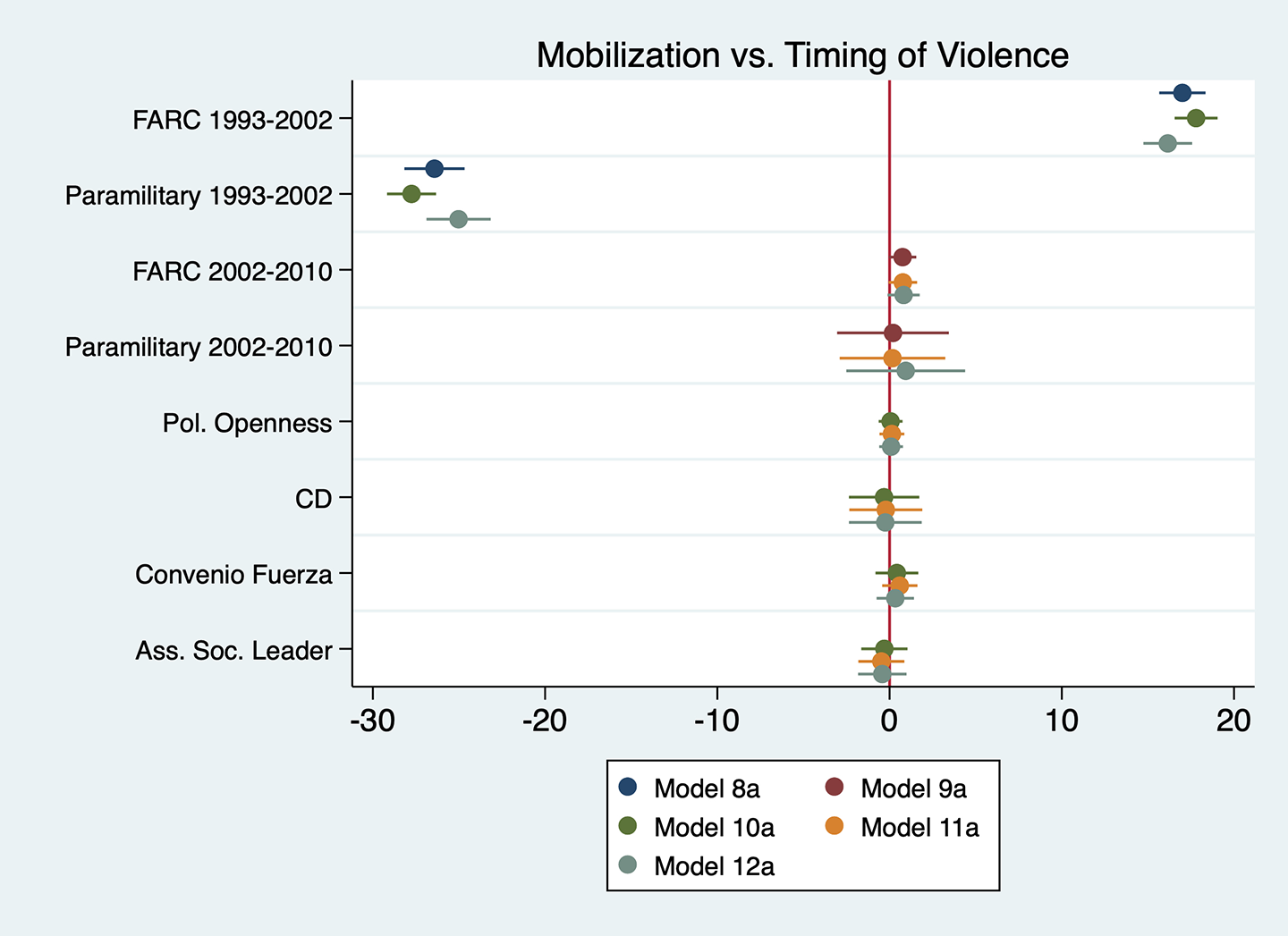
Among the municipalities under guerrilla control in 2013, those that experienced guerrilla violence and consolidation of control between 1993 and 2002 were significantly more likely to both mobilize and register pro-consulta movements. Where municipalities experienced higher levels of violence by paramilitary groups in this period, communities were less likely to activate the consulta. Violence by either group between 2002 and 2010 has no effect on the likelihood of mobilization or registration. The introduction of control variables and robustness checks using various alternative measures of violence or more conservative estimates of guerrilla control (see Online appendix) do not affect either the direction of effect or statistical significance.
The results indicate that temporality matters for the stickiness of guerrilla influence. Early contestation or violence by paramilitary groups could force civil society groups underground or fray the social fabric of affected communities (Idler, 2019). Even when guerrillas consolidate power later and introduce an environment relatively more favorable to groups that would support a consulta, they may struggle to overcome earlier targeting of their leaders or dismantlement of local institutions. Temporal effects are limited to municipalities under guerrilla control. When I repeat my analysis in municipalities under paramilitary and state control, respectively, in 2013, the timing of violence has no effect on participation through consultas (see Online appendix).
This article’s municipality-level approach has identified a positive relationship between conflict intensity, sustained guerrilla presence, and post-conflict participation through consultas. It is possible that conflict exposure increased the average pro-sociality of residents of the municipality, increasing the likelihood that movement leaders would be able to convince community members to participate in their mobilization. It is also possible that the relative space afforded to local leaders under guerrilla rule increased social learning and leadership potential of a select number of community members (Justino & Stojetz, 2018: 26), who were then more effective at leading pro-consulta movements. Both mechanisms may be at work at the same time or in different locations.
This article returns to the town of Cajamarca, Tolima as a case study to test these possible causal mechanisms. The following section draws from various secondary
Plot of coefficients logit models 8b–12b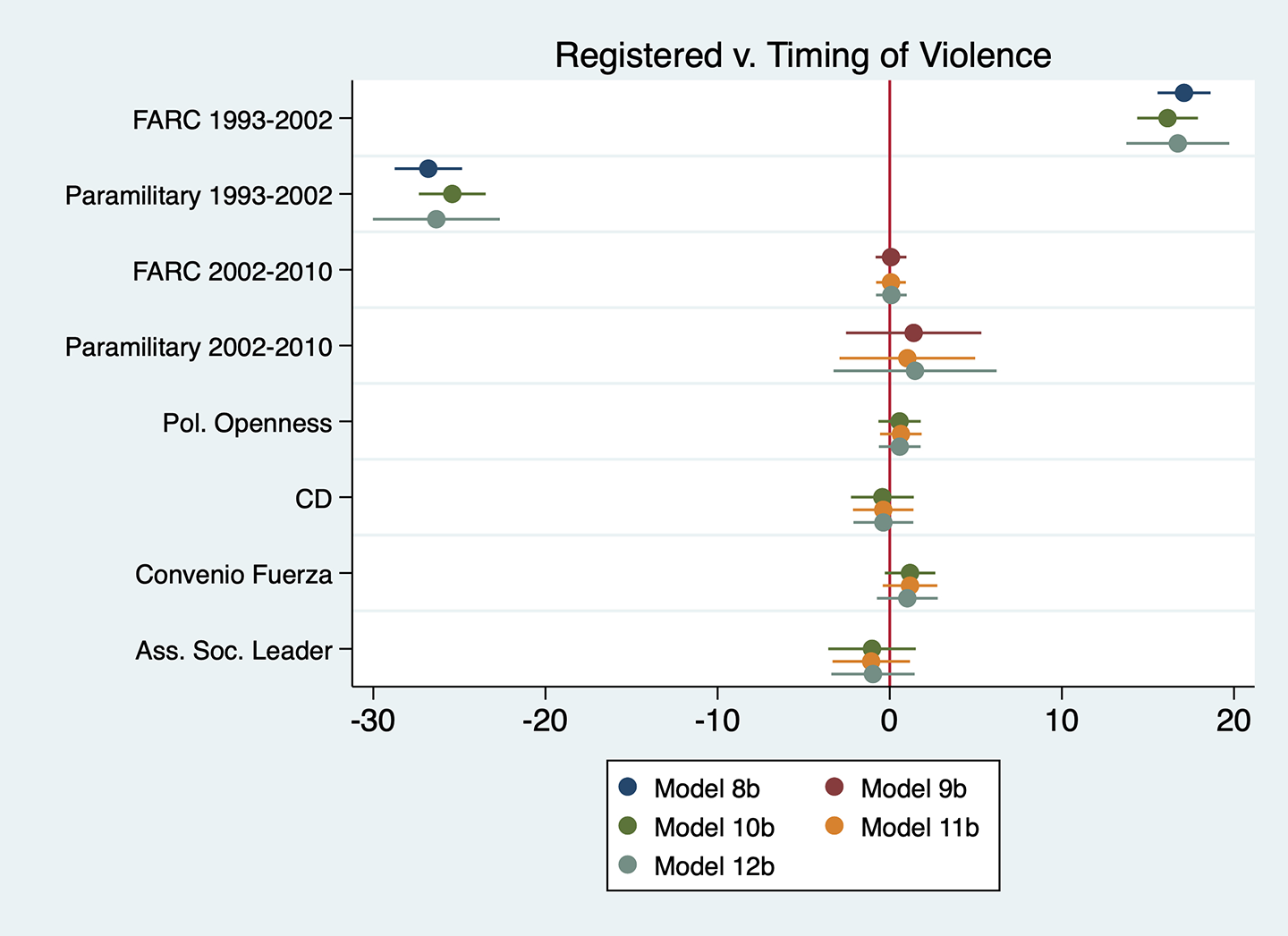
The case of Cajamarca
Cajamarca lies on the Western edge of the municipality of Tolima, in the center of the department’s ‘coffee belt’ (see Figure 4). The municipality is bisected by the Pan-American highway, making it a strategic point of connection between the country’s center and capital of Bogotá, the port of Buenaventura on the Pacific coast, and the south. While the areas to Cajamarca’s south experienced high rates of violence during Colombia’s armed conflict with the FARC, CERAC scores Cajamarca as a ‘4’ – the country average – on its scale of conflict intensity. From the 1990s onwards, government documents indicate the presence of the FARC’s 21st front in the municipality (Vicepresidencia de la República, 2002). Between 1998 and 2007, the FARC committed a series of selective assassinations and assembled roadblocks on the Pan-American highway (CINEP, 2004a, 2008). Paramilitary groups also committed violence in the municipality, including a 2004 massacre of four campesinos and union members for ‘supposed collaboration with the FARC’ (CINEP, 2004b: 487). Statements by local residents indicate that the FARC established the rules for residents, for example dictating under what circumstances civilians could travel after dark (CINEP, 2004b: 152).
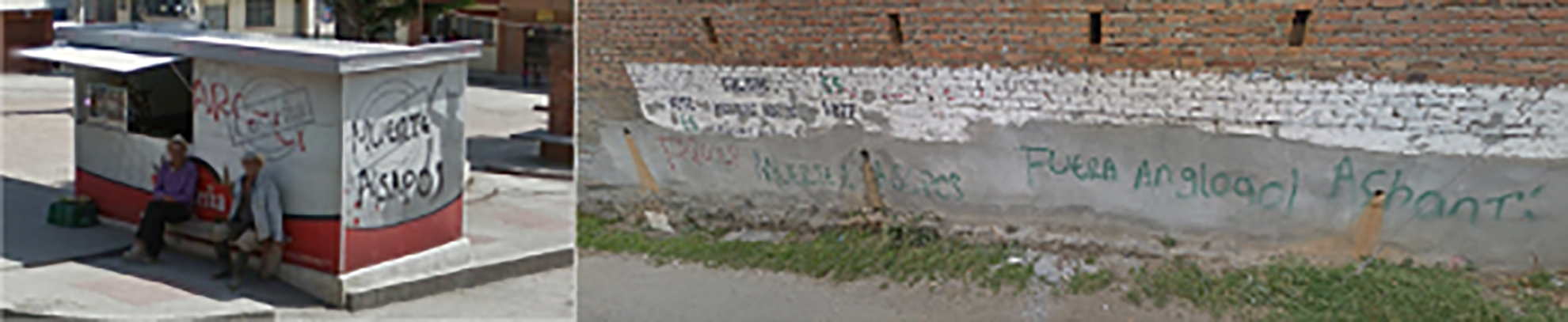
As suggested by studies of micro-dynamics of conflict, experience of violence across the municipality was uneven. Nearly all the lethal events documented by observers and government officials occurred in the locality (corregimiento) of Anaime – a 90-min walk or 15-min drive from the municipality’s main town (cabecera municipal). Photos from Anaime in January 2013 indicate that guerrilla influence was lasting, as walls of the town’s central square and principal streets are covered with pro-FARC graffiti (see Figure 5).
Anaime played an outsized role in Cajamarca’s pro-consulta movement. This locality, rather than the cabecera municipal, was the home base for many of the local organizations involved in coordinating the consulta.
AngloGold Ashanti (AGA), a major South African mining company, obtained the rights to develop a new large-scale gold mine in Cajamarca in 2003. Residents of the municipality only learned of the project in 2007 when then-president Álvaro Uribe publicly unveiled the project plans, much to the dismay of many local campesinos who worried that the project would affect their land and water sources (Ruiz Ruiz et al., 2018: 371–387).
Map of Cajamarca municipality Pro-FARC graffiti in Anaime (2013)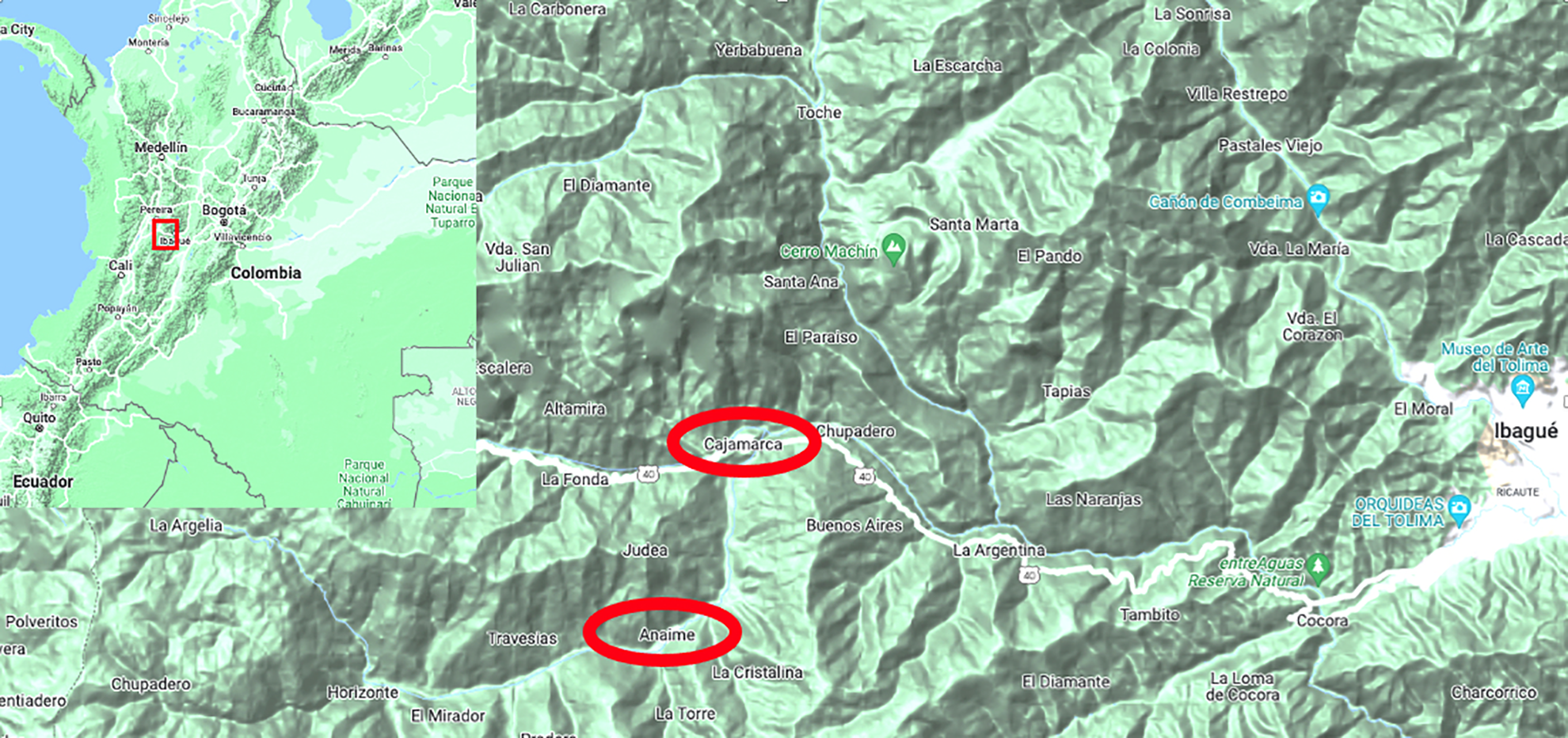
Accounts of Cajamarca’s consulta often focus on the roles of external NGOs, activists and university students from the department capital in organizing the movement (García & Dietz, 2020; McNeish, 2017a; Shenk, 2021), but local groups, including AgroTu Anaime, the Alianza de Mujeres Campesinas de Anaime and COSAJUCA, played a central role as well. These groups coordinated with local politicians, organized demonstrations, and went door-to-door educating residents on the potential effects of the mining project (Muñoz & Peña Niño, 2019; interview by author, 2019). Despite the considerable difference in size between the cabecera municipal and Anaime, representation in the pro-consulta movement featured an almost even split between the two localities. The name of the pro-consulta committee – the Comité Ambiental y Campesino de Cajamarca y Anaime – reflects this.
It is important to emphasize that the pro-consulta movement was neither formed nor driven by the FARC front present in the municipality. Local activists were careful to make this distinction clear in their communications with community members. In fact, organizers reported that perceptions of their association with the guerilla group represented one of the biggest hurdles they had to overcome to secure community participation (interview by author, 2021). The agrarian associations in Anaime that provided a foundation for the pro-consulta movement, however, likely had to count on tacit approval from the FARC leaders in charge of the territory when they formed. The same month of the 2007 Agrarian Strike, presumed FARC combatants assassinated two residents of Anaime, including the president of the local communal authority group (junta de acción communal) (CINEP, 2008: 102). Other scholars have also found that armed group presence in the Colombian conflict encouraged local residents to increase participation, leadership and decisionmaking in local productive organizations, such as agrarian associations (Gafaro et al., 2014). These organizations, in turn, may provide a training ground for leaders of later social movements, as the case of Anaime and Cajamarca’s consulta shows.
Conclusion
The activation of the consulta in Colombia provides an opportunity to revisit and further develop existing theories on the connection between armed conflict and participation. Previous studies have pointed to links between exposure to violence and increased participation on the individual level, while others have probed the relationship between rebels’ territorial control and post-conflict institutions. The aim of this study is to examine whether and how these two theories may interactor or coexist to explain variation in non-electoral, post-conflict participation through consultas.
Statistical analysis of 95 attempts to hold extractive-related consultas provide some evidence in support of theories of conflict exposure and pro-sociality. Greater conflict intensive is correlated with consulta activation, but effected sizes are small, indicating, as one might expect, that exposure to conflict is one of many motivating and mitigating factors for participation. Who controls a municipality toward the end of conflict seems to have little effect on consulta activation. When we consider identity and timing together, however, a significant, positive relationship emerges between early FARC territorial consolidation and both mobilization for a consulta and movement registration with government institutions. A deeper dive into the case of Cajamarca’s pro-consulta movement indicates that leadership skills developed by members of productive associations in areas with a sustained presence of the FARC might provide an important foundation for later pro-consulta movements.
The results of this study have important implications for scholars of conflict and democratization. Themes of war and peace often take center stage in national-level electoral politics in the post-conflict period. The 2018 presidential election in Colombia, for example, centered in large part around how the winner would continue to implement the 2016 peace accord. Meanwhile, citizens’ concerns on the local level may be more forward-looking rather than reference experiences during previous periods of violence. Of the 95 pro-consulta movements analyzed in this article, none made explicit references to members’ status as victims in the reports I gathered, despite many being in areas hit hardest by conflict-related violence. Expanded participation in post-conflict electoral politics, therefore, is not equivalent to greater inclusion of citizens’ interests. Participatory mechanisms can offer unique channels for communities to elevate their local concerns to national-level dialogues. Understanding where and how communities can access participatory institutions represents a crucial and understudied element of post-conflict democratization.
At the same time, this study highlights the importance of considering the legacy of armed conflict on community members, even when they do not explicitly invoke conflict experience in their demands. Future studies might expand this article’s analysis beyond Colombia to include extractive-related consultas carried out in Peru and El Salvador or areas affected by criminal violence in Mexico. Outside of Latin America, scholars might consider local history of armed conflict and violence on citizen engagement in participatory planning projects in Indonesia or water management in Bangladesh. How long does the impact of armed conflict and violence on participation persist? This article indicates that the legacy of armed conflict is far-reaching. Just how far it reaches is unclear.
Footnotes
Replication data

Acknowledgements
I thank Abbey Steele, Aila Matanock, Andrea Ruggeri, Bård Drange, Gonzalo Sánchez, Jessica Anania, Philip Luke Johnson, workshop participants at the University of Oxford, the editor, and the anonymous reviewers for their generous and constructive comments on earlier iterations of this article. I am also grateful to the individuals who contributed to my research during my time in Colombia.
Funding
The author(s) disclosed receipt of the following financial support for the research, authorship, and/or publication of this article: I gratefully acknowledge the financial support of the Clarendon Fund and Malcolm Deas Fund.