




Abstract
While some militant groups consistently target civilians, others only resort to violence in specific locations and points in time. Existing research typically treats civilian targeting as a static feature of conflict systems at either the country or group level. This offers little explanation for variation in the patterns of violence across time and space. I develop an explanation for why militant groups target civilians at specific places and times based on how groups are likely to respond to local political and security conditions. I argue that violence against civilians serves as a function of response for militant groups – violence depends on both the control of territory and subnational competition from other non-state actors. The likelihood of civilian targeting is higher in locations where groups control territory and face competition, as groups seek to display dominance and punish defectors. The likelihood of civilian targeting is high in locations where groups face competition. However, this violence is unlikely to be as high as where groups also control territory, accounting for the need to reach out to civilians for support. The analysis of georeferenced event data on civilian targeting by militant groups across sub-Saharan Africa (1997–2013) and an illustrative case study on Boko Haram in Nigeria and Cameroon find robust support for my argument.
Keywords
Introduction
Where and when do militants target civilians? Popular accounts of militarism often portray groups’ violence as both brutal and indiscriminate. In reality, however, there remains large variation in civilian targeting across and within militant groups. 1 Figure 1 displays the spatiotemporal distribution of attacks on civilians for al-Shabaab in Somalia. It is clear violence is concentrated in particular spaces and points in time. Between 2019 and 2021, al-Shabaab launched extensive attacks against civilians in Ceelbuur, with civilian targeting amounting to 85% of their violent strategy in the town. 2 Conversely, al-Shabaab committed few attacks on civilians in Jamaame, with such violence accounting for only 10% of violent events for the organization in the town. Aside from its spatial profile, civilian targeting is temporally concentrated. Between 2018 and 2020, al-Shabaab’s violence against civilians accounted for approximately 17% of the total attacks attributed to the organization. By 2021, this share decreased to 7%. This raises an important empirical question: what explains spatiotemporal variation in militant groups’ violence against civilians at the subnational level? Put differently, why does militant violence occur in some locations, at certain points in time, and not others?
Scholarly attention to this question is limited. A related literature on the frequency and intensity of
Distribution of al-Shabaab violence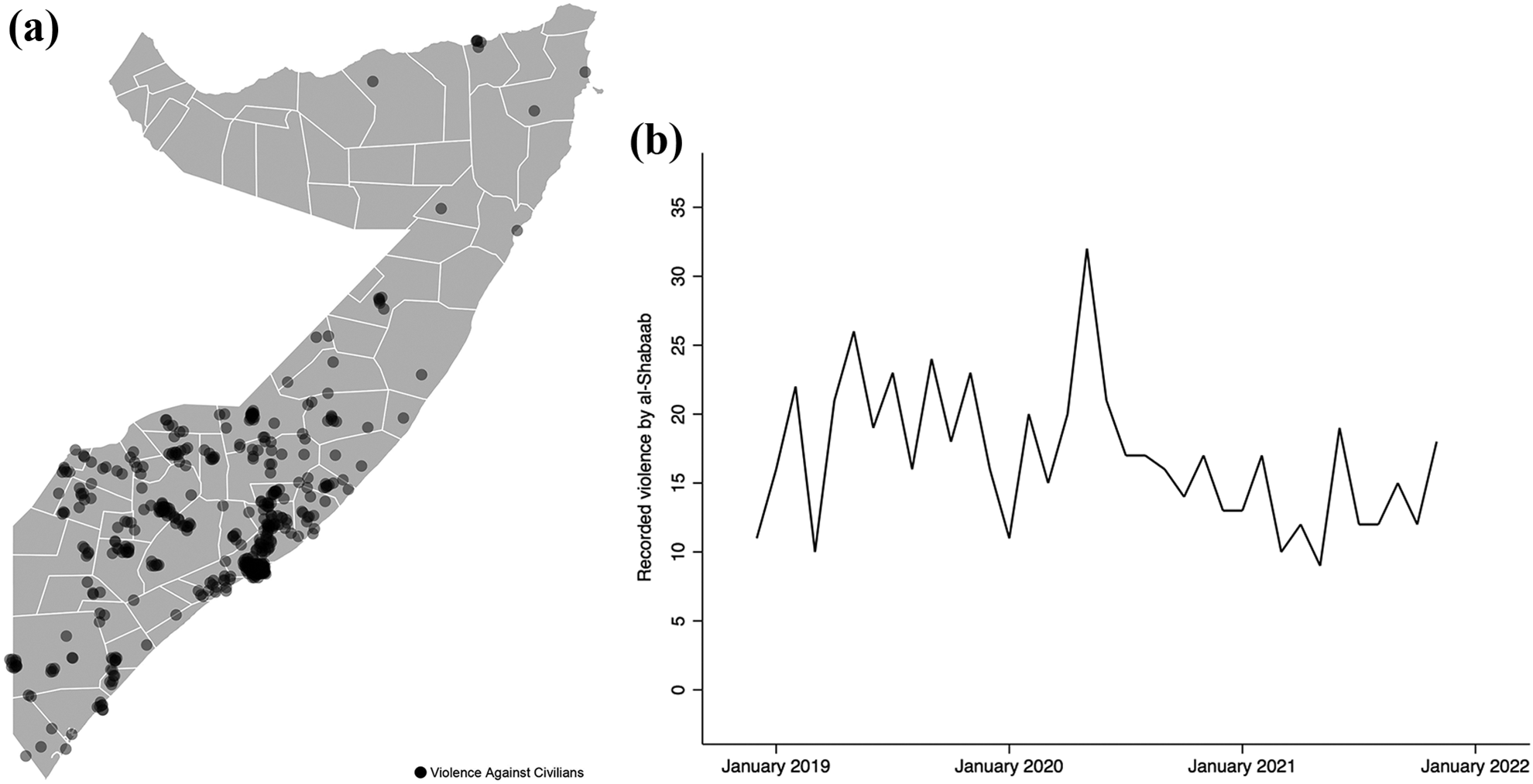
This article develops a framework to explain spatiotemporal variation in militants’ targeting of civilians and tests its predictions empirically with data on militant violence at the subnational level. In what follows, I first review existing studies on civilian targeting. Next, I build on existing theories about the dynamics of civilian targeting to develop a framework that can explain its variation. I look to the behavioural contours of the locations within which militants operate to explain this variation. 3 I argue civilian targeting serves as a function of response for militant groups in the conflict marketplace – violence depends on both the control of territory and competition from other non-state actors. The likelihood of violence is high where groups face competition. The likelihood of violence is higher where groups control territory and face competition. Higher levels of civilian targeting are therefore reliant on an interaction between territorial control and competition at the subnational level.
After developing these arguments in more detail, I test them using georeferenced event data across sub-Saharan Africa (1997–2013). Sub-Saharan Africa offers a rigorous test of the theory given the availability of fine-grained data on militant violence and diversity in the activity of organizations across the region. I utilize data from ACLED to provide subnational measures of territorial control and competition. In compiling them, I assessed the acquisition of territory by militant groups and the number of non-state actors in specific locations. I complement the quantitative analysis with a case study on civilian targeting by Boko Haram in Nigeria and Cameroon (2015–16). This allows for an illustration of the mechanisms at play. The analysis provides robust support for the theory. I conclude with a discussion on the implications of my findings and directions for future research.
This research contributes to existing research on civilian targeting in several ways. First, I illustrate the existence and deployment of violence against civilians within the spatial decision-making processes of militant groups across sub-Saharan Africa. Second, I introduce an important component to models on militant violence by examining an interaction between territorial control and intergroup competition. Finally, my empirical approach allows for an examination on the dynamics of civilian targeting in ways not previously possible.
Militant violence against civilians
Violence against civilians refers to the deliberate and intentional infliction of violence on non-combatants by armed groups (cf. Wood, 2010; Asal et al., 2019; Dowd, 2019; Balcells & Stanton, 2021). Following Asal, Brown & Schulzke (2015) and Dowd (2019), I take organizations’ recorded attacks on civilians as evidence of intention, excluding events in which civilians are killed in crossfire. 4 I focus specifically on militant groups’ violence against civilians. ‘Militant groups’ refer to violent and armed non-state actors.
Scholarly work on civilian targeting is extensive. The literature has investigated several forms of violence by militant groups (e.g. Fjelde & Hultman, 2014; Haer, Faulkner & Whitaker, 2020; Doctor, 2021). Among explanations for these forms of violence, scholars consider regime characteristics (e.g. Balcells, 2010), resource mobilization (e.g. Hoffman, 2004; Weinstein, 2006), and state repression (e.g. Polo, 2020) as well as organizational capacity (e.g. Hultman, 2007) and goals (e.g. Akcinaroglu & Tokdemir, 2018). Many also view civilian targeting as a weapon of the weak (e.g. Hultman, 2007; Polo & Gleditsch, 2016). As Asal et al. (2019: 4) explain, ‘weak organisations’ coercive measures seek to deter civilians from collaborating with the government, and the relationship is found to be stronger as the government uses more violence’.
Others prioritize the role of territorial control in explaining the occurrence of civilian targeting (e.g. Kalyvas, 2006; Arjona, 2016). Territorial control is defined as an actor’s ‘ability to move freely, access information and resources, and prevent its enemies’ movement and access in a particular place and time’ (Rubin, 2019: 6). It is presented as zero-sum: in any given area, the capturing of territory by one actor equals a lack of control for competing actors (Anders, 2020; Kalyvas 2006). As Anders (2020: 702) writes, ‘generally speaking, actors commanding less territorial control inflict more indiscriminate violence, and vice versa’. Oswald et al. (2020) find this is also the case in the initial period after the takeover of territory, examining civilian targeting by the Revolutionary United Front, in Sierra Leone. More selective violence occurs under secured territories as a method of punishing non-compliance and deterring defections to the opposing side (Kalyvas, 2006; Gutiérrez-Sanín & Wood, 2014). Berman, Shapiro & Felter (2011) also consider the relationship between territory, violence, and cooperation, demonstrating violence may depend on the willingness of civilians to cooperate with armed groups.
Aside from territorial control, existing research also emphasizes the role and presence of other non-state actors in the conflict environment as an explanation for civilian targeting. Bloom (2005) argues violence is used as a strategy to outbid other actors. Here, organizations increase attacks on civilians within specific conflict environments to differentiate themselves from others and, ultimately, gain a market share of support. To this view, Wood & Kathman (2015: 169) suggest groups ‘increase attacks on civilians to preserve their bargaining position in the wake of new entrants in the conflict environment that threaten to diminish the concessions they expect to receive from the state’. Dowd (2019), on the other hand, argues militants’ targeting of civilians depends on whether the organization is the most violent actor in the location concerned.
While previous studies provide substantial insights into the occurrence and intensity of violence, the literature typically treats civilian targeting as a static feature of conflict systems at either the country or group level. This offers little explanation for spatiotemporal patterns of violence. It also does not account for variation within and across militant groups and the local spatial decision-making processes influencing actors in various subnational systems. 5 As a result, the spatial footprint of civilian targeting is ignored and local influences on this form of violence remain unclear.
Moreover, existing research prioritizes a dual framework between state and non-state actors. In this view, the conflict environment is dominated by interactions between the state and non-state actors and between non-state actors themselves. This often excludes interactions between militant groups and civilian populations. Notable exceptions include Wood & Kathman’s (2015) study on interrebel competition and Fjelde & Nilsson’s (2012) research on intergroup violence. Nonetheless, these studies prioritize group-level explanations over subnational explanations for violence. This approach does not account for local motivations for violence nor its spatial profile. It cannot explain why, for example, the use of civilian targeting differs for al-Shabaab across various locations in Somalia. It also cannot explain the occurrence of large-scale civilian targeting by certain militant groups at specific places and at certain points in time in Western Sahel. To assess this form of violence, I examine the specific locations in which militant groups operate.
Finally, studies often employ national- or group-level measures of subnational phenomena – such as territorial control and competition – to explain the occurrence and intensity of civilian targeting. These studies do not account for the ‘fragmented spatial patterns’ of competition and control (Anders, 2020: 702). In this article, I utilize data on subnational violence, which permits a closer inspection of the spatial profile of violence as well as strategies of violence and restraint at the local level. The following sections build on existing theories and present predictions on the variation of civilian targeting across the subnational conflict environment.
Intergroup competition, territorial control, and the logic of militant violence
To build a framework for understanding civilian targeting, I draw upon seminal work on the logic of violence in civil war (e.g. Bloom, 2005; Kalyvas, 2006; Arjona, 2016). This work suggests that violence is best understood as a strategic function in subnational environments. In particular, ‘violence is used to solidify local-level control over territory and the inhabitant population, as well as to settle old scores and rearrange micro-level power relationships’ (Hammond, 2018: 35). In this section, I outline the logic of militant violence and detail how its occurrence is shaped by the specific incentives of militant groups, relative to levels of territorial control and intergroup competition. Afterwards, I detail specific environments within the conflict marketplace where militant groups choose to target civilians.
Following Fjelde & Nilsson (2012), I start by assuming that militants seek to maximize opportunities for obtaining political power and material spoils in the conflict environment. These goals are interrelated. As Fjelde & Nilsson (2012: 607) write: ‘Government concessions regarding decision-making power or territorial autonomy generally entail selective rewards to those who partake in the rebellion.’ Moreover, ‘the distribution of spoils is often critical to sustain’ as a militant group (Fjelde & Nilsson, 2012: 607; see also Lichbach, 1995; Moore, 1995). Organizations are likely to alter their engagement with these goals over time and space (Wood, 2003; Weinstein, 2006; Fjelde & Nilsson, 2012). Militants may deploy violence against civilians to secure these objectives and improve their position in local conflict environments. Patterns of violence might vary depending on where, and the conditions under which, the group operates (Wood, 2010; Polo, 2020). The expectation of variation represents a puzzle: when, where, and why do militant groups choose to limit or use violence against civilians in pursuit of their goals?
I suggest an explanation lies in the specific locations in which groups operate. I argue civilian targeting serves as a response signal for militant groups – violence depends on both the control of territory and competition from other non-state actors. This is a result of territorial control and competition affecting the spatial decision-making processes within local conflict environments.
The presence of territorial control and subnational competition exhibit separate but interactive contexts in which a group may strategically decide to target civilians. In the conflict environment, militant groups must ‘maximize the support they receive from the civilian population and minimize the support that rival groups receive from the same population’ (Kalyvas, 2012: 660). To this end, groups deploy a variety of tools ranging from ‘political persuasion and the provision of public and private goods, all the way to coercion’ (Kalyvas, 2012: 660; see also Mampilly, 2011; Arjona, Kasfir & Mampilly, 2015; Breslawski, 2021). In their areas of operation, therefore, territorial control encourages a cooperative relationship with non-combatants (Kalyvas, 2012: 664). Groups can strike cooperative bargains with civilians to reap social, political, and economic benefits such as intelligence, food, and housing (e.g. Arjona, 2016; Rubin, 2019). Take, for example, al-Shabaab’s collaborative relationship with civilians throughout Somalia for intelligence purposes. In Weel Maro, al-Shabaab limit violence to promote the development of the Amniyat [their intelligence network] (Harper, 2019). Members of the local community are offered small payments for imparting information (BBC, 2019). Their exchange of information is key to the strength of the group in Somalia. It increases the group’s operational latitude and corporate infrastructure. According to one resident, this relationship means al-Shabaab ‘are like djinns [spirits]. They are everywhere’ (BBC, 2019). In turn, I view the influence of territorial control on violence, and the behaviour of militant groups more broadly, as a micro-bargaining process between armed groups (in their competition for influence and control) and civilians (in their ability to interfere). Violence occurs in locations where control is limited, contested, or insecure, so as to restore order across the local population at certain points in time or deter civilians from defecting to other groups in the location concerned (Kalyvas, 2006, 2012; Metelits, 2010).
The presence of competition – or additional militant groups in the same location – creates an environment where groups must communicate their ability and determination to observers. In this context, violence is communicative in as much as it is coercive. As Wood & Kathman (2015: 168) outline: ‘when rival extremist groups compete for a population’s loyalty, they may engage in a process of out-bidding by which they attempt to “one up” one another by using increasingly spectacular, casualty intensive attacks’. Violence, here, is used as a ‘strategic tool in the process of political bargaining’ within a competitive political marketplace (Dowd, 2016: 50; see also Bloom, 2005; Nygård & Weintraub, 2015; Phillips, 2019). It is carefully choreographed to attract attention and communicate strength, so that incoming groups yield to the perpetrating group’s demands (Kydd & Walter, 2006). These demands include refraining groups from operating in specific locations, interacting with civilians, and utilizing resources. The relationship between Boko Haram and its rival jihadi faction previously led by Abubakar Shekau is telling. In March 2020, Boko Haram ‘upgraded its military capabilities to outbid the Shekau faction, only to see Shekau’s fighters respond by carrying out the deadliest attack in Chad’s history’ (Zenn & Clarke, 2020). Wood & Kathman (2015: 169) explain that civilian targeting occurs during ‘periods of intense competition and volatility within the [subnational] system and [subsides] during periods in which competition becomes less acute’. However, organizations may also exhibit restraint during periods of intense competition, in the construction of a standout strategy to attract support from civilians (e.g. Dowd, 2019). Overall, violence is used variably within competitive environments.
While a large literature exists on competition and outbidding, it does not stand without criticism. Much of the literature that seeks to contest or question outbidding draws on three concerns. First, its inability to account for alternative explanations, such as state repression (Brym & Araj, 2008). Second, its failure to account for specific intergroup attributes which may affect competition, such as ethnicity or ideology (Nemeth, 2013). Third, the lack of empirical testing at a finer unit of analysis (Findley & Young, 2012a). In spite of these limitations, I argue outbidding occurs at a local level and drives an increase in civilian targeting when organizations are active in the same location. My focus on the precise location of militant activity moves beyond traditional outbidding tests (e.g. Bloom, 2004) and considers aggregation problems in studies of political violence (see Findley & Young, 2012b). 6
What remains clear, therefore, is that militant groups behave in response to local conditions in their areas of operation. This discussion provides a framework for making detailed predictions about the likelihood of civilian targeting in certain spaces and points in time in the subnational conflict environment. In particular, it suggests violence occurs not only as a consequence of overall market competition; rather, violence is likely to vary over time and space based on the contextual intensity of competition vis-à-vis the presence of territorial control. In this sense, civilian targeting is a function of response in the conflict marketplace. The next section will locate and explore the variation of civilian targeting in more detail to outline specific environments within the conflict marketplace where militant groups choose to target civilians.
The spatial profile of violence
Building on the previous discussion, I formulate specific environments where militant groups are likely to target civilians as a response to local conflict dynamics. My expectations are outlined in Figure 2.
First, the likelihood of civilian targeting is high in locations where militant groups face competition and do not control territory. The use of violence stands as a response to the competitive political marketplace in these locations (Bloom, 2005; Boyle, 2009). Militant groups pursue a dominant initiation strategy to communicate strength to the civilian population and other non-state actors. The targeting of civilians stands as a coercive measure to promote coordination and collaboration. This form of targeting also signals a presence and relative strength to other non-state actors active in the same location. Violence in these locations, however, is unlikely to exhibit the highest level of civilian targeting. Among a bigger pool of contenders to political relevance, militant groups must balance the desire to display strength with the need to reach out to civilians for support. In Borno, Nigeria, for example, Boko Haram face competition from local vigilante groups. Between 2015 and 2018,
The spatial profile of militant groups’ violence against civilians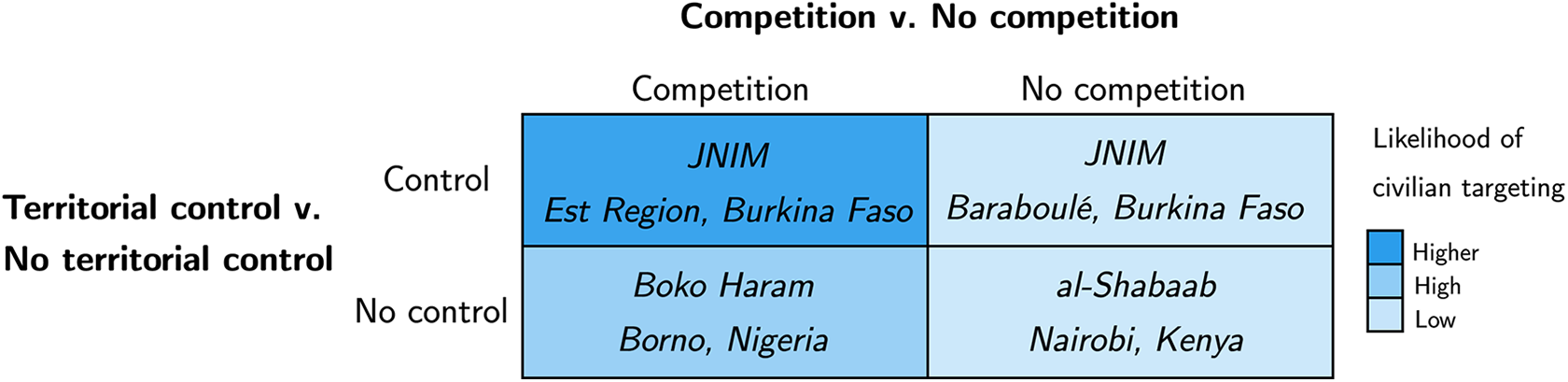
Second, the emergence or existence of challengers in contexts where militant groups control territory drives an increase in civilian targeting. This increase is likely for two reasons. One, it is a function of maintaining dominance – the same dominant initiation strategy discussed previously – in which groups seek to dissuade contenders by signalling strength and determination. Two, it stands as a repressive measure to both punish and deter civilians from defecting to other groups. The likelihood of civilian targeting is higher where groups face competition and control territory, as the environment calls not only for a display of strength, but also the policing of civilian interactions with competitors. 7 The behaviour of Jama’at Nasr al-Islam wal Muslimin (JNIM) in the Est region of Burkina Faso illustrates this strategy. JNIM has maintained territorial control throughout the region since January 2020. Under these territories, JNIM focus on developing links with former Ansarul Islam fighters and exploit local- and community-based grievances, such as land disputes, to develop a fighting force (Crisis Group, 2020). Despite this, JNIM face competition from other non-state actors, such as the Islamic State in Greater Sahara (ISGS). In turn, the group has increased civilian targeting to communicate strength and outbid ISGS. JNIM has also intensified civilian targeting to punish civilians who speak out against them. For example, the group has carried out high-profile abductions of local government officials and schoolteachers. Moreover, JNIM has targeted former Ansarul Islam fighters who pledged allegiance to ISGS in their territories. As of August 2020, 37% of all violence attributed to JNIM since January targeted civilians. This level of violence is higher in comparison to civilian targeting by JNIM in other locations across Burkina Faso, such as Baraboulé, where the group control territory but do not face competition.
Overall, locations where a militant group faces competition exhibit high risk to the group’s political and security objectives which, in turn, calls for a display of strength and determination through the use of violence. The likelihood of violence increases where groups also secure territory, as a method of punishing civilian non-compliance and deterring defection to other groups. Groups are unlikely to employ violence where there is no demand to display this form of strength or punish defection. Figure 2 indicates two possible locations. First, where a group controls territory and does not face competition. For example, JNIM limited violence (to less than 1% of attributed events) in Baraboulé, Burkina Faso, between January and August 2020, to increase recruitment efforts. Second, where a group does not control territory and does not face competition. Al-Shabaab’s behaviour in Nairobi, Kenya, is illustrative of this lack of a need to display strength, as the group focuses on military, as opposed to civilian, targets to build a regional profile. What remains clear is that the likelihood of violence is high in locations where militant groups face competition; the effect of competition on the likelihood of civilian targeting will be exacerbated where groups secure territory. I therefore delineate the following hypotheses:
H1: The likelihood of civilian targeting is high in locations where a militant group faces competition from other non-state actors.
H2: The likelihood of civilian targeting is higher in locations where a militant group secures territory and faces competition from other non-state actors.
Data and research design
I test my expectations using a dataset of spatiotemporal grid-cells covering sub-Saharan Africa between 1997 and 2013. 8 The unit of analysis is the cell-year. The grid structure comes from PRIO-GRID, a standardized vector grid network introduced ‘to aid the compilation, management, and analysis of spatial data’ (Tollefsen, Strand & Buhaug, 2012: 363). The grid cells have a resolution of 0.5 decimal degrees latitude/longitude which corresponds to roughly 50 × 50 kilometres at the equator.
The grid-cell unit of analysis is selected for several reasons. First, the grid cells link well with the aggregation of the ACLED data, which capture events in specific locations. Second, as Tollefsen, Strand & Buhaug (2012: 365) indicate: ‘Gridded data are inherently apolitical entities; they are fixed in time as well as space and are insensitive to political boundaries and developments.’ In turn, the units of observation are ‘identical in shape and completely exogenous’ to the main variables of interest (Tollefsen, Strand & Buhaug, 2012: 365). Moreover, administrative units are too large for observing spatiotemporal interactions in the main variables of interest (cf. Fjelde & Hultman, 2014: 1239; Mancini, 2005: 15).
Administrative units are also too large to ensure unit-wide territorial control or competition. The known disadvantages of country-level aggregates (see Cederman & Gleditsch, 2009) would therefore apply to models at this level of analysis. In addition, ‘the composition and outline of [administrative units] are prone to change over time and their extent and function may vary substantially between countries’ (Tollefsen, Strand & Buhaug, 2012: 365; see also Costalli & Ruggeri, 2015). The magnitude of the problem is much greater across sub-Saharan Africa. In fact, in the period under examination, at least half of countries in my sample increased their number of administrative units by 20% (see Grossman & Lewis, 2014). As Grossman & Lewis (2014: 196) explain: ‘The creation of several new units typically makes each one, on average, smaller and more homogeneous.’ This would impact militants’ ability to secure territory and could distort boundaries of intergroup competition in the theoretical model. Finally, the availability of data to control for confounding variables over time is greater at the grid-cell level than at any other subnational unit.
Since my theory considers violence as an extension of the subnational environment – and not merely within the context of a civil conflict – I choose to retain all grid-cells across sub-Saharan Africa with a population greater than or equal to 10. The main variables of interest are taken, or operationalized, from ACLED. 9 ACLED provides data with a grid-cell code for each event in Africa from 1997 until 2013. 10 Sub-Saharan Africa consists of 7,013 cells across 45 countries, resulting in 119,213 cell observations within the 17 years of analysis.
The dependent variable is civilian targeting. I construct a dichotomous variable using ACLED, which takes the value of ‘1’ where a militant group is recorded as the perpetrator of civilian targeting within the grid-cell each year, and ‘0’ otherwise. ACLED defines actors as a military, rebel force, political militia, or ethnic militia. I code a rebel force, political militia, and ethnic militia as a militant group.
The first independent variable is territorial control. I measure territorial control using a combination of events in the ACLED data. ACLED contains information about politically motivated violent events with geographically exact information. In turn, it is possible to place the violent events, and territorial control therefrom, within a specific grid-cell in a given year. This form of manipulation is not uncommon (see Sauter, 2017; Wimmer & Miner, 2020). To determine whether or not a militant group has territorial control, I use the following ACLED events: battle (no change of territory or non-state actor overtakes territory); headquarters or base established; strategic development; and non-violent transfer of territory. 11 With this, I develop a binary measure for control in which a value of ‘1’ is given if a militant group is assigned to any of the listed events in a specific cell, and ‘0’ otherwise. Each selected event, I argue, tells us that a militant group has, in some way, shape or form, control over territory within a specific grid-cell. 12 A value of ‘1’ is assigned in the subsequent cell year units until the government overtakes territory. To account for contestation, I assign a value of ‘0’ where there is more than one change in territorial control between the state and militant groups within a year in the same cell. Based on these criteria, I have 64,925 cell year units in militant group control and 54,288 in government control.
The second independent variable is competition. I measure competition as additional non-state actors active in the same cell in a given year. This approach is similar to the method employed by others to account for country-level competition and rivalries between non-state actors (e.g. Findley & Young, 2012a; Phillips, 2015; Farrell, 2019). 13 I use the following ACLED events to account for competition: battle (no change of territory or non-state actor overtakes territory); headquarters or base established; non-violent activity by a conflict actor; violence against civilians; non-violent transfer of territory; strategic development; and remote violence. An ‘additional’ actor is present for every event assigned to an actor other than the actor that perpetrated the first recorded violent event in a specific cell in a given year. A value of ‘1’ is assigned if there are additional non-state actors in the same cell in a given year, and ‘0’ otherwise. I select a dichotomous measure over a count of the number of non-state actors because my theory predicts an interaction between whether or not a militant group has territorial control and whether or not a militant group is faced with competition from other non-state actors. 14 With these criteria, I have a total of 3,340 cell year units with additional non-state actors, and 115,873 without any additional non-state actors.
As control variables, I first include the presence of an active conflict and conflict intensity since incidents of heavy fighting and large-scale battles increase the likelihood that those who do not belong in the battle will become victims of the fighting. 15 I also control for economic development and population density since both may influence the level of political violence in a grid-cell each year (Buhaug et al., 2011). Finally, I control for yearly drought proportion, yearly mean temperature, government repression in the previous year (i.e. state attacks on civilians), temporal dependence (i.e. lagged dependent variable), and spatial autocorrelation (i.e. violence against civilians in the first-order neighbouring cell in the previous year).
Given the categorical nature of my two main independent variables, along with the binary dependent variable, I use a linear probability model in my analysis with country-level fixed-effects. While some may assume that a logit model would be more appropriate for a binary dependent variable, the linear probability model is better suited to handling fixed effects and comparing coefficient estimates (Angrist & Pischke, 2008; Mood, 2010). 16
Empirical analysis and discussion
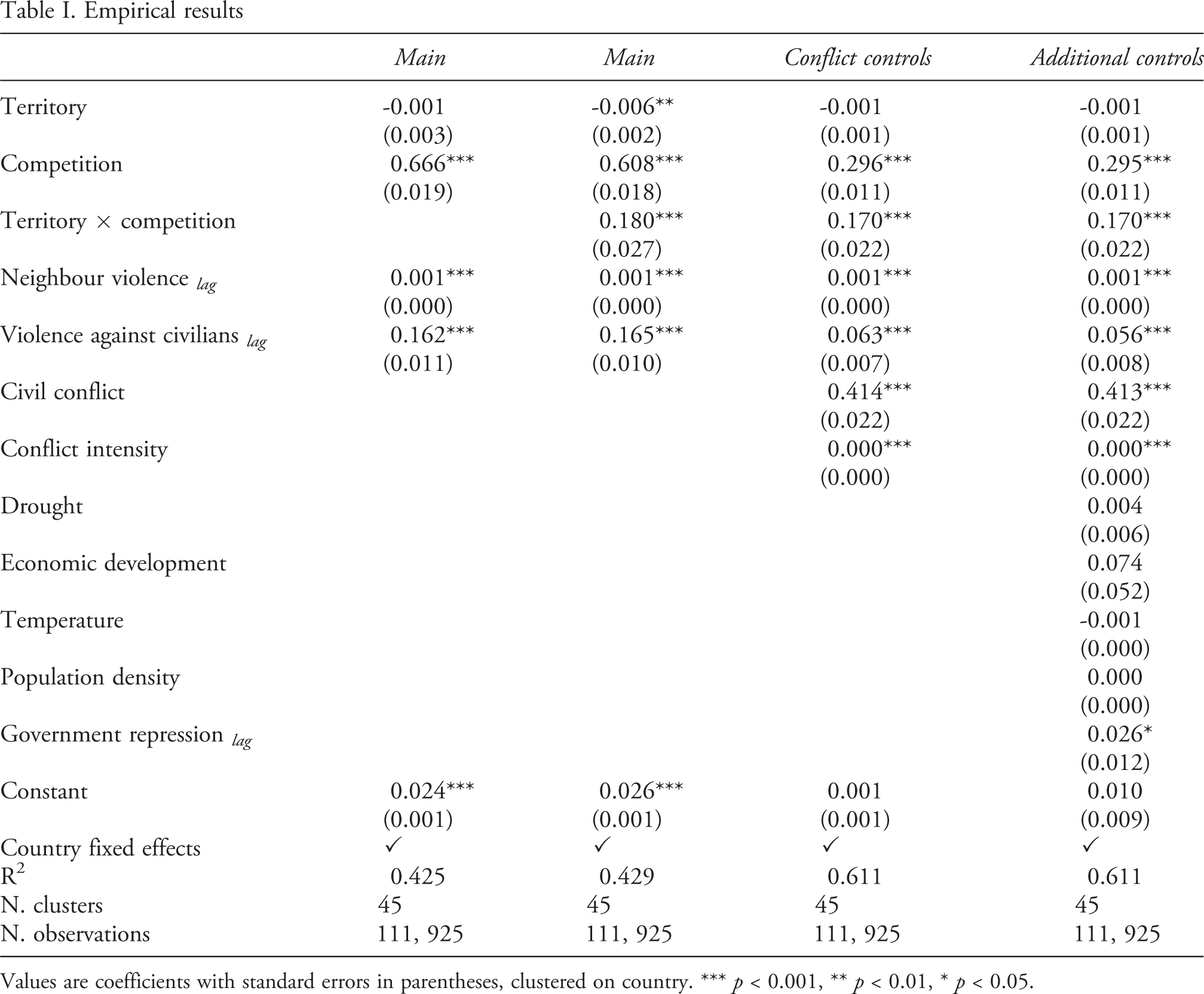
The results from a linear prediction of militant groups’ violence against civilians are shown in Table I. Models 1 and 2 present the main specification, with Model 1 excluding the interaction. Models 3 and 4 include additional conflict-level and cell-level control variables.
The coefficient for the interaction term is positive and statistically significant across all model specifications. On average, militant groups are more likely to target civilians in locations where they control territory and face competition. However, interaction terms are not substantively interpretable on their own. To evaluate the hypotheses and the substantive implications of the models, I turn to the substantive effects based on estimates from Model 4.
Empirical results
Values are coefficients with standard errors in parentheses, clustered on country. *** p < 0.001, ** p < 0.01, * p < 0.05.
When considered independently, the control of territory and intergroup competition influence the likelihood of civilian targeting in different ways. In Model 1, an additional unit of territorial control leads to a decrease of 0.001 in violence against civilians, all else being equal. Substantive effect of Territory × Competition on violence against civilians. Figure based on Model 4 in Table I. Bars indicate 95% confidence intervals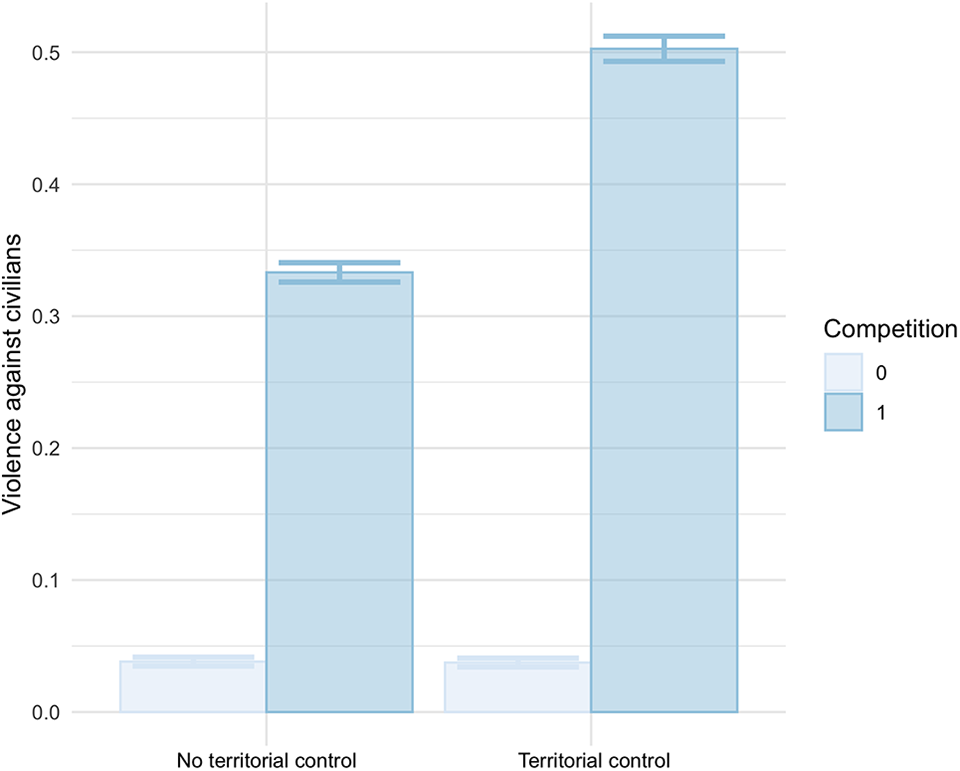
Taken as a whole, therefore, the results support the theory constructed: violence against civilians serves as a function of response for militant groups in the conflict marketplace. The results hold also when controlling for possible alternative explanations of civilian targeting such as the presence of an active conflict, conflict intensity, population density, and government repression. Moreover, these results speak to existing theories on population control (e.g. Arjona, 2016) and the role of outbidding in conflict systems (e.g. Kydd & Walter, 2006) in structuring militant violence against civilians.
Where this analysis differs is in an attempt to locate violence at the subnational level and explain spatiotemporal variation in militants’ targeting of civilians. The likelihood of civilian targeting is higher in locations where groups control territory and face competition from other non-state actors. In these locations, the targeting of civilians is a function of response to local political and security conditions which require groups to maintain dominance and renounce defectors through the use of violence. For example, in 2018, the Islamic State in Somalia secured control of the Dasaan area of Puntland. The group increased its targeting of civilians by 20% as a signal of strength, in December 2018, when faced with competition from al-Shabaab. By contrast, militant groups are likely to engage in high (but not the highest) levels of civilian targeting where they merely face competition. In this context, comparatively lower levels of violence indicate a possible balance between two strategies – reaching out to civilians for support and outbidding. ISGS’ behaviour in Gao, Mali, supports this proposition. Since 2019, ISGS have failed to secure territory in the region and face competition from other non-state actors such as JNIM and Imghad Tuareg. As a result, ISGS target civilians at a high level (approximately 28% of attributed violence); but this violence is comparatively lower than in locations where the group control territory and face competition.
Robustness
The Online appendix reports a series of robustness checks for alternative empirical specifications and estimations. To summarize, I have checked the results’ robustness to an ordered dependent variable, alternative measures of territorial control, logit estimations, cell and year fixed effects, additional control variables, a finer temporal unit of analysis, inclusion of full population sample, and coarsened exact matching. Pre-processing matching is applied to test the results’ robustness in a more homogenous sub-sample to improve causal inference, estimation, and efficiency by reducing possible bias, model dependence, and imbalance (see Iacus, King & Porro, 2012). All substantive conclusions remain unchanged.
Finally, some may question the extent of selection bias in the data. While the geocoding of events is cross-checked in the ACLED dataset, and event information is triangulated from a variety of sources, it is not excused of potential biases. Media sources are subject to both selection and description bias in the type of events they choose to report (Weidmann, 2016: 207). It impossible to rule out the fact that certain countries, regions, or events may have better media coverage than others, which risks measurement bias in the dependent variable (Weidmann, 2016; Berman et al., 2017). However, as Wigmore-Shepherd (2017: 1) indicates: ‘domestic restrictions on press freedoms within states under consideration [in the ACLED data] do not negatively impact the number of events coded for that particular country’. 17 Moreover, my empirical strategy makes it unlikely that any structural differences in media coverage will affect the results since fixed effects focus on changes within units and thus are more robust to selection biases across units and other types of unobserved variables.
The case of Boko Haram in Nigeria and Cameroon (2015–16)
To better illustrate the hypothesized dynamics and demonstrate the plausibility of a causal connection between territorial control, competition, and civilian targeting, I present a brief case study on Boko Haram in Nigeria and Cameroon between 2015 and 2016. 18 This case illustrates within-group variation in civilian targeting and demonstrates spatial decision-making processes in local environments. In particular, it illustrates how Boko Haram responds to local political and security conditions and how this response changes throughout different locations at the same point in time. While the dynamics of civilian targeting by Boko Haram are not unique to the time period selected, I select January 2015 to December 2016 to complement event data with primary sources released by the group, which affirm purported levels of territorial control, competition, and civilian targeting. 19
Since its launching of jihad under the leadership of Abubakar Shekau, in 2010, Boko Haram has remained among the most notable militant groups in Africa. The group garnered initial attention following a series of attacks in major cities across Nigeria, including the attack on a prison in Bauchi, which saw the militants release more than 700 intimates, including former fighters (Smith, 2010). When Nigerian forces launched military campaigns to reduce the group’s influence in urban areas, Boko Haram expanded in rural areas and began to control large amounts of territory (Matfess, forthcoming: 7). The group garnered attention on a global scale through the continued perpetration of particularly egregious attacks, such as the suicide bombing attack on the United Nations building in Abuja, in 2011, and the kidnappings of 276 schoolgirls in Chibok, in 2014, and 344 schoolboys in Katsina in 2020. Boko Haram pledged bay`ah [allegiance] to Abu Bakr al-Baghdadi and the Islamic State in March, 2015, following the loss of large amounts of territory to military offensives (Matfess, forthcoming: 7). Despite the government’s insistence that Boko Haram is ‘technically defeated’ (BBC, 2015), Matfess (forthcoming: 7) notes the group maintains ‘a persistent and destabilizing presence in the Lake Chad Basin’.
Between January 2015 and December 2016, Boko Haram controlled large swaths of territory in the Far North region of Cameroon. For example, militants controlled territory in the town of Mora yet faced competition from other non-state actors, such as the Mora Communal Militia. Across the Far North, civilian targeting accounted for 31% of events attributed to Boko Haram, which is comparatively higher than in Borno. Figure 4 details the location of events in the Far North and Borno. In Mora, approximately 40% of events involved the direct targeting of civilians. High levels of violence in Mora exhibit both a dominant initiation and stomp out strategy, in which the group sought to pageant its strength and punish defectors. Boko Haram’s video releases on online platforms support this strategy. The footage details high-intensity attacks on civilians, including the suicide bombing attack on 21 August 2016 which injured more than 25 civilians. Here, Amnesty International revealed the modus operandi of Boko Haram was to ‘shoot, slaughter, and kill’ (Amnesty International, 2019). This is corroborated by Afu’s (2019) interviews with civilians in Mora, which provide accounts of public assassinations of men, women, and children who defect or refuse to comply with Boko Haram’s standards.
From January to April 2015, Boko Haram’s control of territory in Borno deteriorated rapidly amid a series of counter-offensive operations by the Nigerian and Chadian militaries. Despite this, the group remained active, with a reported 174 violent events in Borno between January 2015 and December 2016. At this time, Boko Haram faced competition from other non-state actors, such as the Civilian Joint Task Force and Vigilante Group of Nigeria. Across Borno, civilian targeting accounted for 23% of events attributed to Boko Haram. In the town of Gwoza – the location of the group’s previous khilāfah [caliphate], which it lost to Nigerian forces in March 2015 – only 7% of violence attributed to Boko Haram directly targeted civilians. Here, Boko Haram balanced the desire to outbid other actors in the region with an outreach strategy. The existence of such strategy is supported by videos released by Boko Haram. On 2 June 2015, the group released a video on its online platforms which detailed a change in group behaviour in consequence of territorial losses across Borno. Specifically, Ochonu (2018) argues Boko Haram limited civilian targeting to embark on community reassurance gestures in order to win the ‘hearts and minds’ of
Events attributed to Boko Haram in Nigeria and Cameroon, 2015–16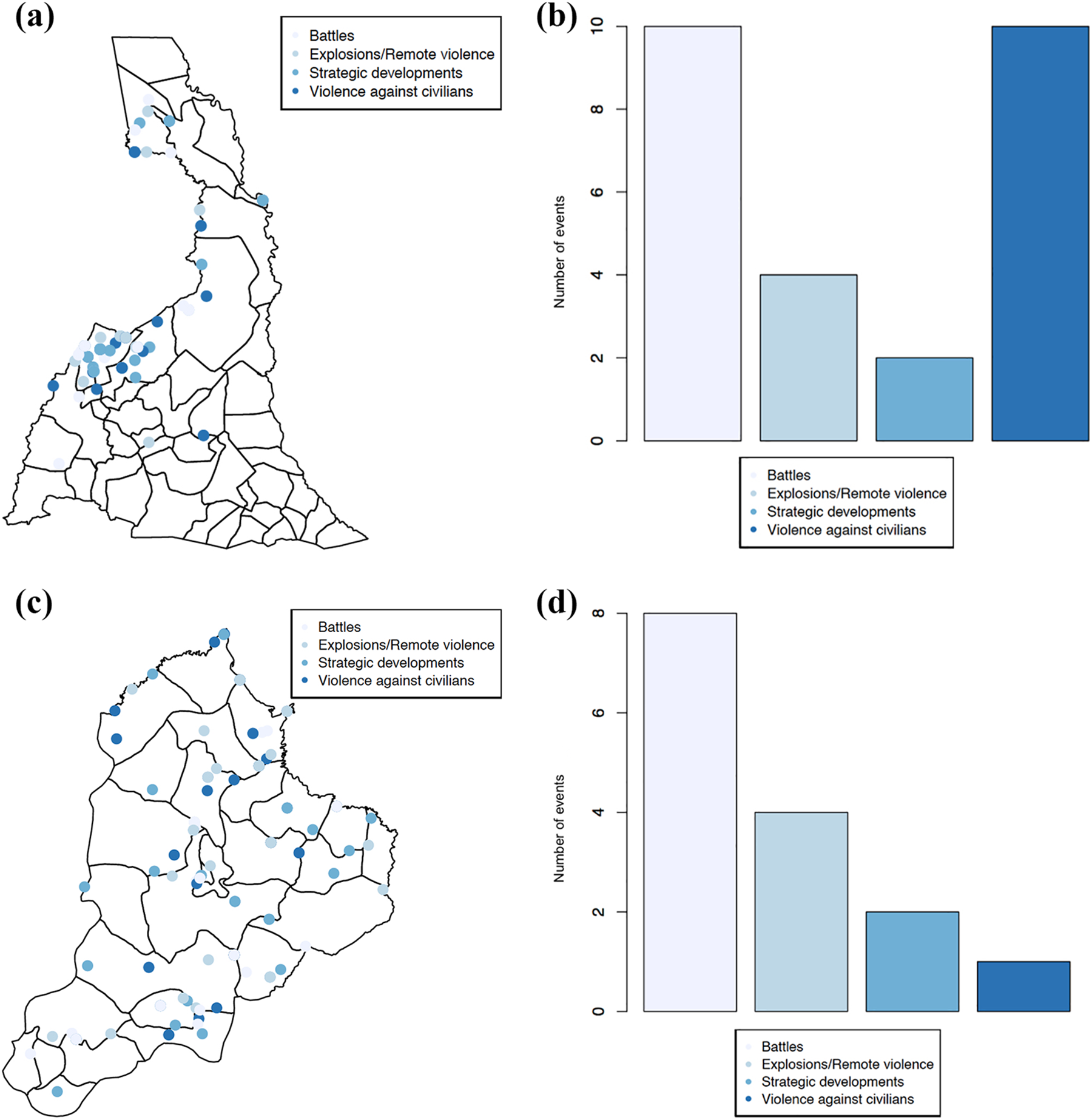
Overall, the case of Boko Haram in Nigeria and Cameroon nicely illustrates the need for militant groups to alter their behaviour relative to local political and security conditions. In the Far North, Boko Haram’s behaviour is influenced by their control of territory and the presence of other non-state actors, which encourages higher levels of civilian targeting to eliminate competition and reinforce dominance. In Borno, Boko Haram’s reach out to civilians for support, in consequence of a lack of territorial control among a selection of competitors for political relevance, prompts high (yet lower by comparison) levels of violence against civilians. In turn, militant groups’ violence against civilians is a function of response at the subnational level: higher levels of violence depend on the control of territory and intergroup competition.
Conclusion
This article has investigated spatiotemporal variation in militants’ civilian targeting. It has presented an innovative approach to understanding civilian targeting, allowing for a direct comparison of violence across and within the specific locations in which groups operate. Unlike previous studies which consider country- or group-level predictors of violence, I move the field forward by focusing on the subnational context. I have argued that violence serves as a function of response for militants. Specifically, violence depends on both the control of territory and intergroup competition. I leveraged georeferenced event data on civilian targeting across sub-Saharan Africa to test this expectation.
The results support the propositions and suggest violence has a spatial profile. Where groups control territory and face competition, the likelihood of violence is higher, as they seek to punish defection and display strength. The need to display strength is present where groups merely face competition; but, without territorial control, they must balance the desire to outbid competitors with the need to reach out to civilians for support. Therefore, the likelihood of violence is high in these locations, yet comparatively lower than where groups face competition and control territory. The case study on Boko Haram in Nigeria and Cameroon provides evidence that the proposed mechanisms are driving the statistical relationships.
The results hold significant implications. For further research, the study introduces an important component to models of militant violence by explicitly examining an interaction between territorial control and competition. I present subnational measures for this interaction. The measure of competition is relatively novel in the level of its aggregation, as other work favours measures at the country- or group-level (e.g. Farrell, 2019). The measure for territorial control accompanies other measures of control (e.g. Kalyvas, 2006; Sauter, 2017; Anders, 2020), accounting for variation within and between militant groups at the subnational level. More practically, the study provides comprehensive evidence on the spatial decision-making processes of militants across sub-Saharan Africa, shedding new light on strategies of violence and restraint. Certain locations throughout sub-Saharan Africa have witnessed the rapid and expansive seizure of territory by militant groups in recent years. I illustrate how these groups behave in their areas of operation, both inside and outside of territorial control. Governments can therefore better assess the risk of militant violence in specific locations to avoid counterproductive responses.
While the analysis helps uncover spatiotemporal variation in civilian targeting at the subnational level, I acknowledge that it does not exist without limitation. The data only cover sub-Saharan Africa and observations are limited to the grid-cell level. The study does not include controls for potential state-level influencers of violence. These caveats notwithstanding, the data are among the most comprehensive available at the subnational level. Future data-collection efforts extending beyond sub-Saharan Africa will allow for a more comprehensive empirical test of the theory proposed. Further effort could also be made to refine the measures of competition and territorial control to better capture fluid and variant levels of control and competition at the local level. Future research could use this study as a means to explore differences in tactic selection across specific locations and points in time. Moreover, we still know little about the selection of civilian targets as opposed to hard or official targets in specific locations, and the conditions under which groups are likely to prefer one over the other. Future research should examine this, too.
Footnotes
Replication

Acknowledgements
I thank the Associate Editor Alex Braithwaite, three anonymous reviewers, Jessica Maves Braithwaite, Joseph Brown, Han Dorussen, Mirna El Masri, Lawrence Ezrow, Kristian Skrede Gleditsch, Maiyoraa Jeyabraba, Kyosuke Kikuta, Carmela Lutmar, Brian Phillips, Sara Polo, Subhasish Ray, Anouk Rigterink, Jacob Zenn, and participants at the University of Essex IR Workshop, UCL Conflict and Change Annual Workshop, GSISE 2020, APSA 2021, and ISA 2021 for excellent comments and suggestions on earlier versions of this article.
Funding
The author disclosed receipt of the following financial support for the research, authorship, and/or publication of this article: I am grateful for support from the Economic and Social Research Council (ES/P00072X/1).