




Abstract
Do International Criminal Court (ICC) indictments reduce atrocities? The ICC convicting only ten perpetrators since its founding in 2002 has generated skepticism of the court’s ability to prevent attacks against civilians. Drawing on the criminal violence literature, this article applies the concept of assurance to explain how the ICC reduces atrocities despite its limited capacity. As with criminal organizations facing domestic indictments, armed groups affiliated with ICC indictees often (mis)perceive that the indictments come with assurance: that is, inductee-affiliated groups believe that they can alleviate the costs imposed by indictments if they refrain from further attacks. I test the effect of ICC indictments on violence using the weighted regression method generalized synthetic control to mitigate empirical challenges posed by endogeneity and data unreliability. The results indicate that indictments lead to a substantial initial decline in attacks against civilians by armed groups affiliated with indictees, but the attacks return to pre-indictment levels when indictees face sustained punishment from the court. Descriptive cases of ICC indictments against alleged perpetrators in Uganda and Kenya are used to illustrate the role of assurance. These findings imply that the ICC might reduce violence by engaging in plea bargains and other negotiated settlements – tools commonly employed by domestic prosecutors fighting criminal organizations.
Keywords
The International Criminal Court’s (ICC) mandate to prevent ‘grave crimes’ far exceeds its capacity to do so through the arrest and conviction of perpetrators alone (e.g. Ainley, 2011). The ICC’s struggle to convict perpetrators has generated skepticism of the court’s effectiveness since its inception (Zvobgo, 2019). A European diplomat is said to have exclaimed sarcastically, ‘Where is your army?’ when ICC prosecutors expressed their intent to arrest the court’s first indictees, the leadership of the Ugandan-based Lord’s Resistance Army (Moreno-Ocampo, 2014).
At first glance, skepticism of the court’s ability to reduce atrocities appears warranted. Since its 2002 founding, the ICC has convicted just ten individuals – a small fraction of the perpetrators under the court’s jurisdiction. The ICC’s struggle to apprehend and convict indictees undercuts the basic deterrence model that the court’s architects envisioned: preventing atrocities by convicting those involved in the crimes. ‘My mission,’ the ICC’s first lead prosecutor Luis Moreno-Ocampo explained, ‘is to end impunity for these crimes in order to contribute to the prevention of future crimes’ (Krcmaric, 2018).
Despite the ICC’s struggles implementing a deterrence-through-convictions model, it has reduced atrocities by armed groups affiliated with the court’s indictees. The ICC has succeeded in dissuading perpetrators from continued abuses – a dynamic international relations scholars term ‘specific deterrence’ (or recidivism, in criminal justice parlance). Drawing on the experience of domestic law enforcement with criminal organizations, this study helps explain this puzzle by introducing the concept of ‘assurance’ – a variable that has yet to be considered in studies on the effectiveness of ICC indictments.
Assurance involves an individual or group facing a punishment anticipating that they will gain reprieve from the punishment if they improve their behavior. Criminal organizations often refrain from violence if they perceive that doing so will reduce costs on the organizations imposed by law enforcement. In a similar vein, armed groups facing ICC indictments refrain from violence if they perceive – rightly or wrongly – that doing so will reduce the costs imposed by indictments.
In the context of ICC indictments, this study posits that indictees have perceived assurance through a negotiations mechanism and a judicial process mechanism. In the court’s early years, indictees misperceived that the ICC would negotiate settlements. As indictees attempted to engage in bargaining, they would refrain from abuses, believing that doing so would make prosecutors more inclined to reach a settlement. Soon after the court’s founding, however, it became evident to indictees that the ICC eschewed such settlements. With the ICC’s refusal to negotiate, indictees increasingly have sought to use the court process to escape their indictments. Through this mechanism, indictees try to beat their charges in court, which incentivizes them to refrain from atrocities given that doing so increases the likelihood of having their charges dropped.
The article proceeds in four sections. The first section lays out the logic of how assurance incentivizes indictees to reduce violence. The second section details the empirical strategy centering around generalized synthetic control, which mitigates endogeneity and data unreliability that challenge analyses of the ICC’s effectiveness (Xu, 2017). The third section presents the results, showing that groups affiliated with an ICC indictee engage in fewer attacks against civilians, but groups that do not have their indictees’ cases dropped in court return to pre-indictment levels of violence. The results section also illustrates the theory’s mechanisms with descriptive analysis of ICC indictments in Uganda and Kenya. Finally, the conclusion discusses the study’s implications, namely wrestling with the trade-offs of the ICC providing explicit assurance to indictees through plea bargaining.
Theory
This study fits within longstanding debates on ‘peace versus justice’ trade-offs surrounding the ICC and international tribunals. In the ICC’s early years, scholars theorized, even before the court’s founding, that increasing the probability of punishment for perpetrators would reduce the bargaining space to end conflict and thus the court’s interventions would have a limited effect or exacerbate violence (e.g. Snyder & Vinjamuri, 2003; Goldsmith & Krasner, 2003; Drumbl, 2007). A second wave of scholarship, largely relying on systematic analyses of the ICC’s early investigations rather than theory alone, showed mixed evidence of the court’s effect. Some studies indicated that the court appeared to deter abuses (e.g. Mitchell & Powell, 2011; Sikkink, 2011; Simmons & Danner, 2010; Hillebrecht, 2016) whereas other studies found it had little or no effect (Hashimoto, 2010; Meernik, Nichols & King, 2010).
The most recent third wave of scholarship on the ICC takes a middle-ground. The questions scholars have come to ask is no longer whether or not the ICC influences levels of violence but rather what types of violence ICC intervention affect and how the court has the effect that it does. Krcmaric (2018) finds that ICC involvement deters atrocities but at the same time prolongs the duration of conflicts. In a similar vein, Duursma (2020) argues that ICC arrest warrants do not prevent the start of negotiations to end conflicts but they do undermine the parties’ ability to reach settlements.
These third-wave studies point to a variety of mediating factors to explain ‘the how’ of the ICC’s influence. The studies suggest that the court’s effectiveness at addressing violence increases with a higher probability of domestic punishment against perpetrators (Prorok, 2017), threats of prosecution from the ICC (Mendeloff, 2018), perpetrators’ dependence on financial capital from democracies (Hashimoto, 2020), and the ICC’s ability to shape the narrative surrounding the conflict (Kersten, 2016). This scholarship is consistent with related work on international tribunals that shows the tribunals to be more effective at deterring atrocities if they meet certain conditions such as strong support for prosecutors (McAllister, 2020).
In line with this third wave, this article introduces and evaluates the concept of assurance as an additional mediating variable that influences whether or not an ICC indictment reduces atrocities.
Assurance and the ICC
In general terms, a target of a punishment perceives assurance when the target anticipates that it can have the punishment reduced in exchange for complying with a demand. This dynamic plays out often in international politics as scholars have demonstrated with respect to nuclear non-proliferation efforts and other policy issues. Assurance process and armed group violence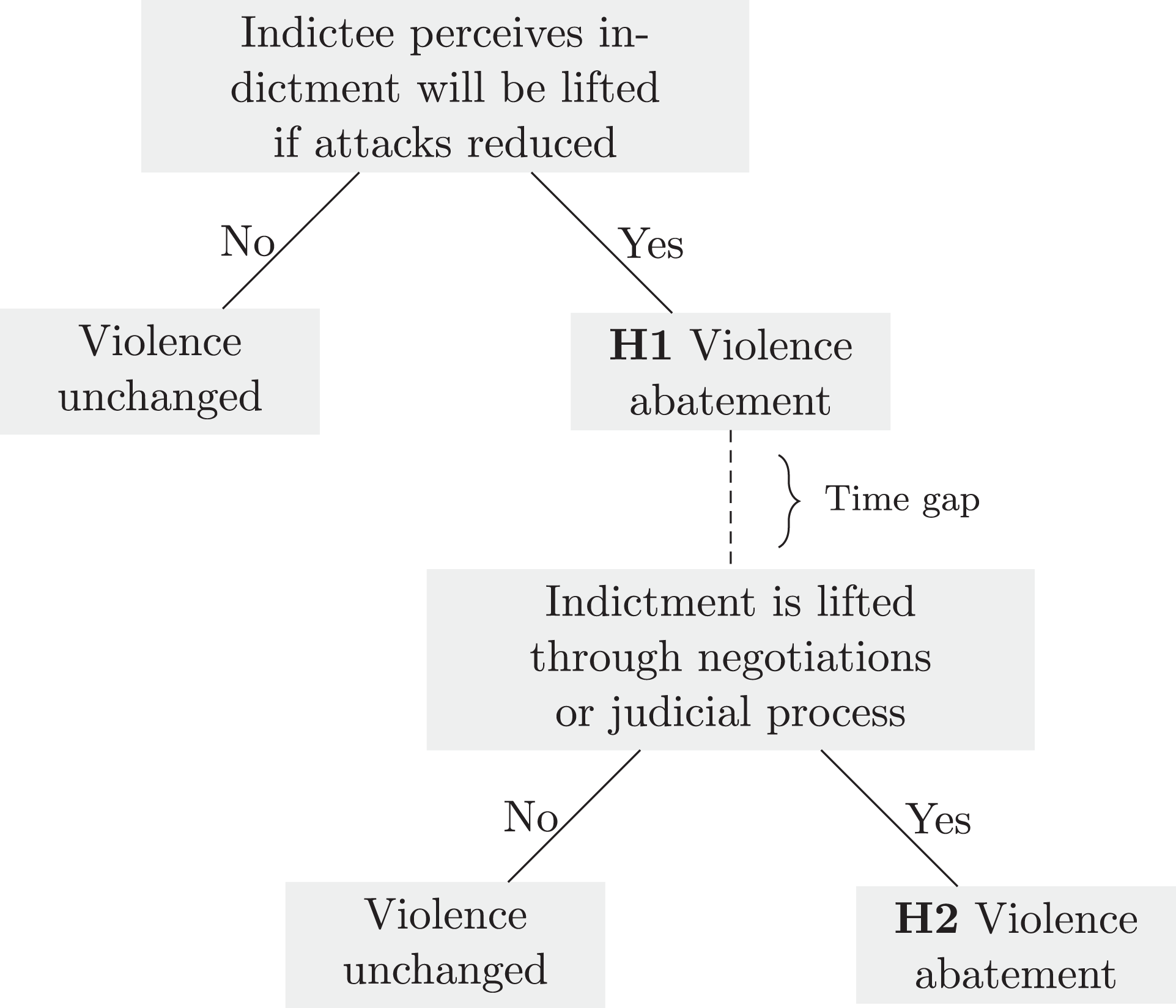
Domestic cases involving criminal organizations help elucidate the theorized assurance mechanisms that ICC indictees face. When criminal organizations become aware of indictments, they often look for opportunities to have the costs minimized in some way. They might gain a reprieve from state punishment through one of two mechanisms: either a negotiated settlement with prosecutors or beating the charges through the judicial process. Importantly, criminal organizations often perceive assurance in that their chance of gaining a reprieve through either of these mechanisms increases if they abate from violent criminal activity.
With respect to assurance through negotiated settlements, the logic from criminal organizations’ perspective is to ‘lie low’ in hopes that, by refraining from continued violence, their punishment might be alleviated. Sometimes a quid pro quo is implicit between criminal organizations and the state. State authorities might refrain from targeting criminal organizations that purposively limit their violent activity (Lessing, 2017). Sometimes explicit arrangements are employed (Hughes, 1992). These arrangements might come in the form of plea bargains in which prosecutors lighten indictee punishments in exchange for their admission of guilt. Or, they might be grand bargains such as state authorities committing to not target or even to support criminal organizations as long as those organizations do not engage in visible violence (Durán-Martnez, 2018). In an example of one such arrangement between the El Salvadorian government and the country’s gangs, the government conceded to providing better conditions for imprisoned gang leaders for reduced violence that cut the country’s 2012 homicide rate in half (Avalos, 2019).
With respect to assurance through the judicial process, when state authorities are not interested in negotiated settlements, organizations may still refrain from violence in order to maximize their chances of an acquittal in court. Criminal organizations often recognize that continued violence makes acquittal less likely and risks new charges being leveled against them. The Italian-American mafia appeared to consider but refrain from carrying out some targeted killings, albeit not all, during their intermittent confrontations with state actors such as during the 1980s Commission Trial that prosecuted leading figures in the New York-based mafia families (e.g. Raab, 2005).
At first glance, it would appear that an assurance mechanism involving negotiations is not applicable in the context of the ICC. The court’s prosecutors have steadfastly refused to negotiate with indictees. However, for assurance to be operative prosecutors do not need to be willing to negotiate – rather, indictees only need to perceive that they are willing to do so. Soon after the ICC was founded, indictees believed – wrongly, as it would later become clear – that ICC prosecutors were willing to negotiate. Indictee Bosco Ntaganda, a former rebel commander operating in eastern Democratic Republic of the Congo, according to the court’s first chief prosecutor Moreno-Ocampo (2015), ‘knew about the ICC’ and was ‘trying to get support to escape’ his indictment. This perception incentivized the groups to abate their attacks against civilians, recognizing that continued violence would reduce the likelihood of the ICC agreeing to alleviate their punishments.
That said, the ICC’s prosecutors had little intention of negotiating with indictees. Moreno-Ocampo remarked, ‘I’m like a train moving down the track and I just follow the evidence’ (Bosco, 2014). The view of Moreno-Ocampo (2015) was that negotiations were in effect a political matter and characterized his approach as, ‘we do justice, and let the [UN] Security Council do political agreements’ – a policy that subsequent prosecutors maintained. The repeated failure of attempts by indictees to negotiate the withdrawal of their indictments meant that this misperception on the possibility of reaching a negotiated settlement only lasted for so long.
As it has become evident that ICC prosecutors were not going to ‘play ball’ at the negotiating table, indictees have sought assurance through the criminal justice system to alleviate the costs of the indictments. Given that conviction is far from certain, indictees attempt to have their indictments lifted in court, usually through acquittal or prosecutors dropping their cases. And, like criminal organizations, they recognize that refraining from violence against civilians post-indictment increases their likelihood of achieving this outcome and avoids having new charges brought against them. 1
In sum, throughout the court’s tenure, indictees have been incentivized to refrain from abuses in order to reduce their punishments. Given that indictees have perceived assurance, Hypothesis 1 is that on average indictments are associated with an initial decline in attacks against civilians by groups affiliated with an indictee relative to similar groups not affiliated with an indictee.
Indictees will maintain the violence abatement as long as the indictment costs are alleviated. If the alleviation does not materialize, it signals that their assurance was unwarranted and thus no longer incentivizes them to refrain from abuses. Those indictees that initially engage in attempts to negotiate ultimately turn back to violence considering they see the abatement will not lead to a punishment reduction. Similarly, if indictees come to see that the case against them is so strong that they will be convicted regardless of their present behavior, it similarly reduces the incentive for abatement.
Many ICC indictees, however, have been able to beat the charges in court or have their charges dropped, which validates their perception of assurance and incentives continued abatement. Thus, Hypothesis 2 is that indictee-affiliated groups that have had their punishment alleviated will continue to reduce attacks against civilians.
As illustrated in Figure 1, once indictee-affiliated groups reduce attacks, there is a time gap between the initial post-indictment period and the expected alleviation period. This gap is, in essence, the amount of time before the assurance effect wears off and the groups return to violence if the indictment is maintained. The length of this time gap is difficult to predict a priori. There is no theoretical justification for generalizing the amount of time before an indictee perceives that the punishment will or will not be alleviated, because it is largely a function of indictee-specific and conflict-specific characteristics.
Theoretical assumptions
This theory rests on two core theoretical assumptions. The first assumption is that indictments impose a sufficiently costly punishment to influence the behavior of indictee-affiliated groups. Without sufficient costs, these groups would be inclined to ignore the indictment and continue civilian attacks. However, even though the ICC lacks a robust enforcement capacity, indictments often impose substantial costs on indictees that outweigh the benefits of committing continued abuses. Third-party states impose economic and travel sanctions (Appel, 2016), and the indictees incur the social cost of stigmatization (Jo & Simmons, 2016; Dancy, 2017). 2 For instance, Sudan’s ex-president Omar Bashir, arguably the court’s most high-profile fugitive, was forced to cancel numerous trips abroad to France, the United States, Turkey, Kenya, Uganda, Central Africa Republic, Nigeria, Zambia, South Africa, Malaysia, Malawi, Botswana, and Nigeria, among other countries (BW, 2015).
There is debate about how much indictees perceive the indictments as costly. Extending the Bashir example, despite his travel being restricted, nevertheless he was able to travel to other African countries. But, even these trips did not come without risks; he barely escaped arrest during a 2015 trip to South Africa (Reuters, 2015). Perhaps the clearest indicator that indictments impose costs is that Bashir and other indictees actively lobbied to have the indictments against them lifted. Bashir’s effort included stepping up intimidation and harassment of humanitarian workers in Darfur, plausibly to put pressure on the international community to drop the investigation (Duursma & Müller, 2019). Moreover, other African states engaged in, according to one scholar, ‘furious lobbying’ to have the investigation dropped out of fear that their leaders too could be indicted (Mills, 2012). If there were no costs, the indictees – and potential future indictees – would have little incentive to expend energy and resources on having them lifted.
That ICC indictments generally impose sufficient costs to induce improved behavior is not to say that the costs are uniform across indictee-affiliated groups. Some indictees are more exposed to external pressure brought on by the indictments than others. For instance, as Hashimoto (2020) points out, countries with leaders that rely on foreign capital from democracies are more likely to have ratified the Rome Statute. Groups affiliated with these leaders, consequently, are more vulnerable to facing heavy costs from indictments as democracies can cut off their capital flows.
The second assumption underpinning the theory is that indictees maintain the support of their affiliated groups. If groups no longer supported their leaders in the wake of an indictment, the groups would have little incentive to reduce attacks. That said, there is little evidence indicating that indictments undercut support for indictees within their affiliated groups. This dynamic is similar to criminal kingpins maintaining the support and control of their organizations even in prison (Skarbek, 2011).
A moderating factor affecting an indictee’s ability to restrain civilian attacks is the cohesiveness of indictee-affiliated groups (Weinstein, 2006). The more cohesive an indictee-affiliated group is, the more likely that it will refrain from civilian attacks in hopes of gaining a reprieve for its leader. International criminal tribunals, McAllister (2020) finds, more effectively deter civilian attacks among groups with centralized structures. That the ICC rarely arrests indictees might moderate the impact of a lack of cohesiveness. Without arrest, indictees can remain present within the group to monitor and constrain members that might be inclined to engage in atrocities.
Empirical strategy
I test the hypotheses drawing on armed group-level data of violence against civilians in Africa, where all ICC indictments have been issued to-date. The statistical analysis uses generalized synthetic control to mitigate endogeneity and data unreliability that presents challenges to studies of the ICC’s effectiveness.
Data
The outcome, attacks against civilians, is drawn from ACLED, Armed Conflict Location & Event Data (Raleigh et al., 2010). The dataset used in the analysis includes ACLED-identified government forces, rebels, and militias in Africa that have been involved in at least one battle or attack against civilians between 1997 and 2017. 3 The time series begins in 1997, which is the start of the ACLED dataset, to provide for as much pre-treatment trends as available. 4 A well-established – if not the most well-established – correlate to violence against civilians is broader conflict. 5 To proxy conflict intensity, the model includes the number of ACLED-recorded battles in which each group was involved in a given month. A challenge of working with micro-level violence data such as ACLED is that conflagrations of violence are often followed by long lulls in activity. Thus, the raw number of attacks and battles is transformed into a three-month moving average of the log number for each armed group. 6
The treatment is the month that an ICC indictment becomes public. Indictments are often issued under seal to aid in the indictee’s arrest, and given that the assurance mechanism requires indictees to be aware of the indictment, the treatment begins with the month that it becomes unsealed. All indictee-affiliated groups – meaning the indictee leads the group or coordinates attacks with the group – are considered to have received the indictment treatment. 7 Evidence in support of Hypothesis 1 would show indictee-affiliated groups on average reducing attacks during the initial post-indictment period regardless of whether or not their indictments were eventually lifted.
Armed group summary statistics
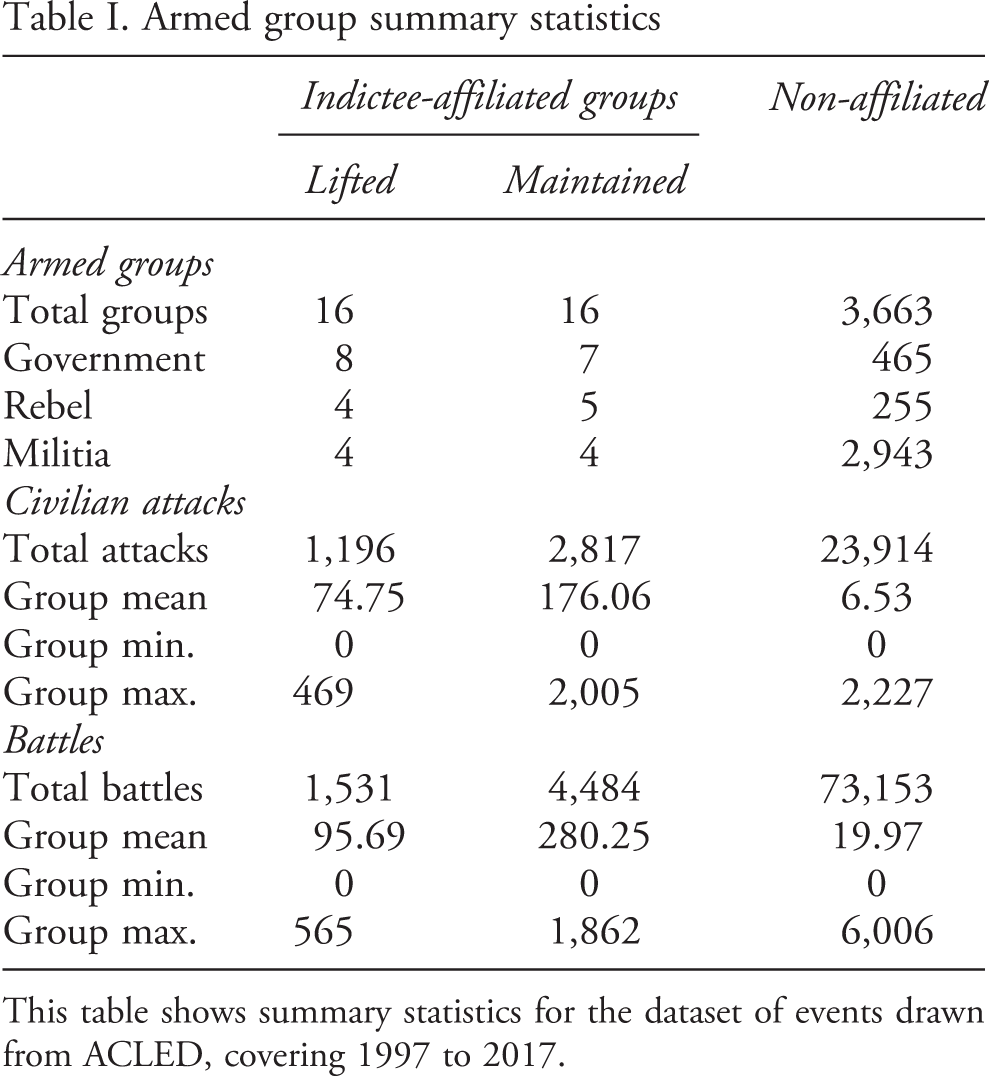
This table shows summary statistics for the dataset of events drawn from ACLED, covering 1997 to 2017.
As indicated in Table I, 16 armed groups are associated with an indictee that had their punishment lifted and 16 are associated with an indictee that had the punishment maintained. As of August 2019, the ICC has only released indictments against African leaders, so the dataset covers all relevant groups. 8 The remaining groups not affiliated with an indictee make up the pool of control units to draw on for the analysis. Indictment statuses are coded as of the dataset’s December 2017 end date. 9
Generalized synthetic control
Treatment effects are estimated using the generalized synthetic control (GSC) method (Xu, 2017). At its most basic level, GSC compares the outcome of control units to treated units as done with difference-in-difference (DiD) and other commonly employed estimators. What differentiates GSC is that it uses weights and pre-treatment trends to generate counterfactual estimates for the control units. In this context, it weights attacks against civilians by indictee-affiliated groups based on the battle covariate and pre-indictment frequency of attacks to look like armed groups that do not have an indictment against their leader. The aim is to create ‘synthetic’ armed groups for the control units that are similar to the indictee-affiliated groups except for not having received indictments. These synthetic groups estimate – to the extent that the data allow – counterfactual trends of violence against civilians by indictee-affiliated groups if their leaders had not been indicted. The final step in the estimation process is taking the difference between the average frequency of attacks by indictee-affiliated groups and the counterfactual synthetic groups.
The estimation equation is as follows:

where

where
The use of GSC has the disadvantage of being more complex than traditional estimators, but this complexity can mitigate the empirical challenges that arise in studies of ICC effectiveness. GSC partially alleviates endogeneity more than DiD, the most common alternative estimator. GSC relies only on pre-treatment observations – rather than pre-treatment and post-treatment observations as done in DiD – for the counterfactuals used to measure an effect. And, whereas DiD uses unweighted data for the comparison units, GSC weights the comparison units to create synthetic versions of the treated units.
Moreover, GSC mitigates measurement error arising from event data, which ACLED and other event-based datasets gather based on media reports. The reliance on reporting generates potential bias, especially over time, given that stricter accountability standards from international organizations (Fariss, 2014) and the proliferation of mobile technology (Weidmann, 2015) have facilitated increased reporting of violence. By incorporating interactive fixed effects into the GSC model (as opposed to non-interactive fixed effects used in DiD), the model partially absorbs differential effects of external, unobserved shocks like those from the increased media reporting. 10
Results
The results show support for the hypotheses that assurance helps reduce violence by indictee-affiliated groups. The groups on average reduce attacks against civilians in line with Hypothesis 1 that expects violence abatement post-indictment. These reductions, as specified in Hypothesis 2, are only sustained if the indictment costs are lifted by having the case against the indictees withdrawn. Combining the statistical findings with illustrative case studies from ICC interventions in Uganda and Kenya indicates that the mechanisms of assurance through negotiations and assurance through the judicial process are operative in the respective cases.
Indictments reduce violence
Figure 2 and Table II show the estimated effects of indictments on violence for indictee-affiliated groups that eventually had their indictments lifted as well as for those that had their indictments maintained. The vertical axis in Figure 2 indicates the SATT, that is, the difference in the percentage change of civilian attacks by indictee-affiliated groups relative to the counterfactual groups formed using the GSC method. The horizontal axis shows the number of months before the indictments were released publicly to the left of the vertical dashed line and the number of months after the indictment was released to the right of the line. The trend lines are the SATT for each month with 95% confidence intervals indicating the indictments’ average effect on the indictee-affiliated groups.
Per Hypothesis 1, both categories of indictee-affiliated groups – those that have their indictments eventually lifted and those that have them maintained – reduce attacks for on average roughly 36 months post-indictment. It is estimated that, at this point, groups that have their indictment eventually lifted engage in 34% fewer attacks on civilians and those that have their indictment maintained engage in 33% fewer attacks than they would have had their leaders never been indicted. The trend is consistent with the theory that indictee-affiliated groups perceived that they could increase their chances of having the indictment lifted by refraining from attacks.
As stated in Hypothesis 2, the reductions are hypothesized to continue only for the groups affiliated with indictees that eventually have their indictments lifted. By 48 months after the indictment release, those that had their indictment lifted on average commit 39% fewer attacks than they would have without the indictment, whereas those that had the indictment maintained revert back to expected pre-indictment levels of attacks. These results indicate that indictee-affiliated groups that do not receive an alleviation for their punishment lose the incentive to continue violence abatement.
The numbers of attacks continue to diverge 60 months post-indictment. Those that had their indictments lifted committed on average 56% fewer attacks while those that had them maintained committed 17% more attacks relative to what the models estimate if the groups had never been indicted. The magnitude of the increase is relatively small and the variance in the estimate indicates that it is not statistically significant.
11
In all, these results are
Indictment effect on attacks against civilians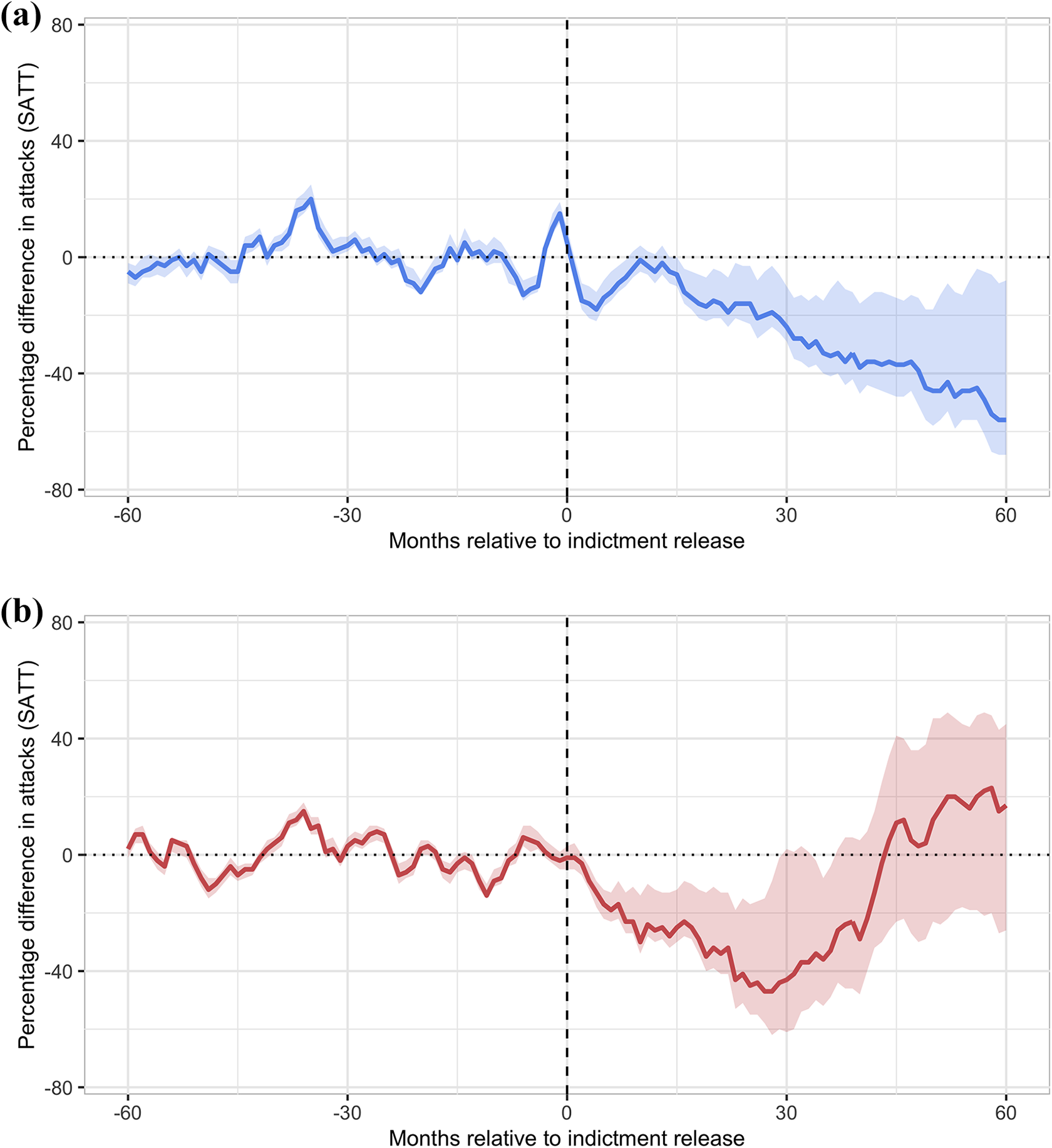
Importantly, the parallel trends assumption appears to hold, suggesting that the GSC models mitigate the persistent challenge of endogeneity found in studies of ICC effectiveness. This assumption can be assessed by evaluating the gap between the SATT lines and the horizontal dashed line in Figure 2 in the 60 months prior to the indictment. If the SATT lines hug the horizontal line closely in the pre-indictment period, the model estimated that counterfactual control groups have similar levels of attacks against civilians compared to the indictee-affiliated groups. As indicated, for 60 months prior to an indictments’ release, indictee-affiliated groups have similar levels of attacks against civilians with only modest gaps.
Indictment effect on attacks against civilians
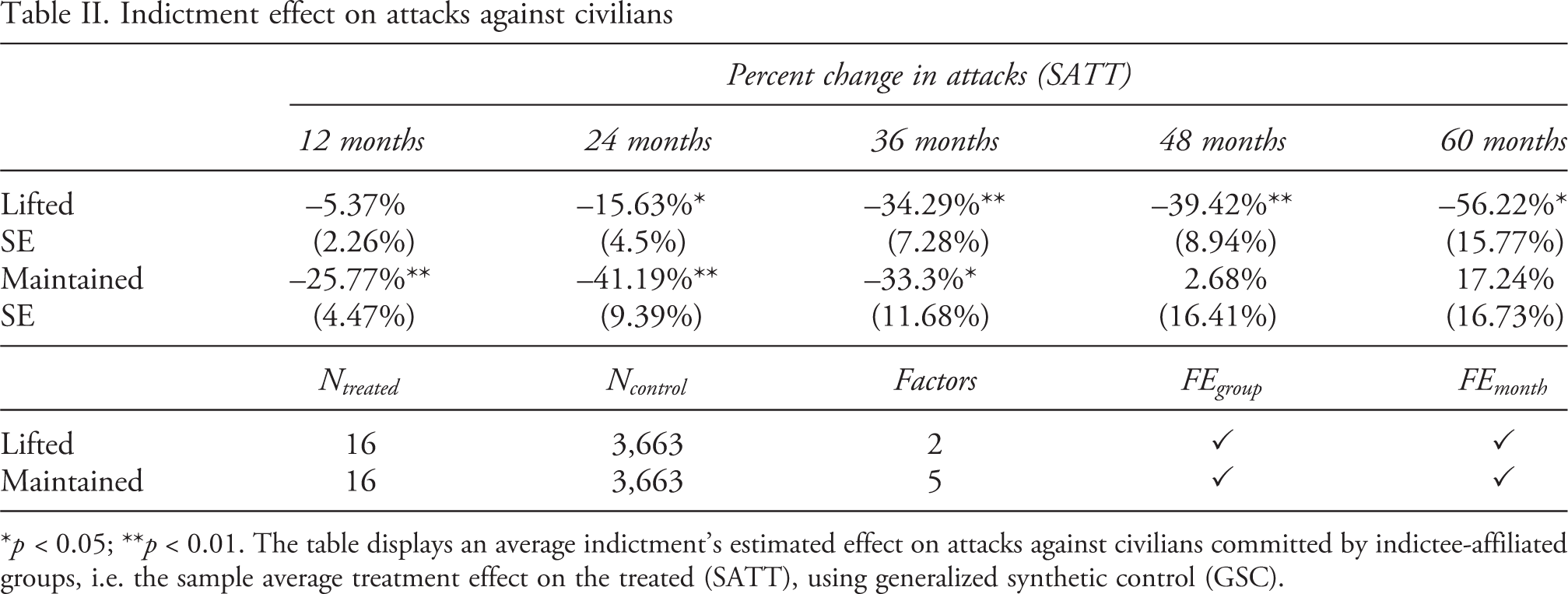
*p < 0.05; **p < 0.01. The table displays an average indictment’s estimated effect on attacks against civilians committed by indictee-affiliated groups, i.e. the sample average treatment effect on the treated (SATT), using generalized synthetic control (GSC).
Assurance mechanisms
To demonstrate that assurance plays a role in driving the aggregated findings, I turn to case studies along with parsing out the GSC results for individual armed groups targeted by the ICC interventions in Uganda and Kenya. The Uganda case study illustrates how assurance through negotiations reduced civilian attacks initially but not over the long run. The Kenya case study illustrates how assurance through the judicial process reduced attacks and the gains were sustained.
Uganda: assurance through negotiations
An analysis of the Lord’s Resistance Army’s (LRA) atrocities illustrates how ICC indictments in the court’s early years incentivized reduced attacks against civilians – at least initially – as indictee-affiliated groups sought to negotiate away their indictments. If the assurance through negotiations mechanism were operative in this case, LRA attacks against civilians would decline around the date that the court released the indictments in part because the LRA sought to have the indictments withdrawn. Moreover, the LRA would revert to attacks against civilians when it no longer assured that the ICC was willing to withdraw the indictment in exchange for improved behavior.
Initially based in Uganda’s north, the LRA launched an insurgency in 1987. The group’s strategy centered around widespread human rights abuses including child abduction, mutilation, and civilian killings (AJE, 2014). After ratifying the Rome Statute in June 2002, Uganda’s government moved quickly to refer the conflict for investigation, doing so in December 2003. The ICC released its first ever indictments, which named Kony along with four of his top deputies – Vincent Otti, Okot Odhiambo, Dominic Ongwen, and Raska Lukwiya – in October 2005.
Soon after the indictments’ release, peace talks in Juba began (ICG, 2007). The ICC warrants were a crucial factor – albeit, not the only factor – bringing the LRA to the negotiating table. Kony saw the Juba talks, according to Kersten (2016), as his ‘best chance at removing the ICC warrants’.
Kony made lifting the ICC warrant a key demand in the negotiation, which indicates that he saw the negotiations as a means to reduce the costs imposed by the ICC indictments. In a June 2006 interview, he declared that if the ICC ‘want[s] peace, they will take that case from us […] But if they do not want peace, then they will continue with’ (Schomerus, 2010). A few months later, Otti reinforced that, without withdrawing the charges, ‘not even a single LRA soldier will go home […] because it might be a trap’ (Macdonald, 2017).
Kony also made this demand to United Nations officials, demonstrating that the indictment weighed on him. In November 2006, Jan Egeland, then-UN head of humanitarian affairs, met Kony near the Sudanese border with the Democratic Republic of Congo. Although the encounter lasted only 30 minutes, Kony pressed Egeland on his concerns about the court. Egeland characterized the arrest warrants as ‘the stickiest issue’, recounting that ‘Kony said he will never surrender as long as he faces the risk of being arrested’ (Gettleman, 2006).
That the LRA declared a unilateral ceasefire at the outset of the talks suggested that the group was using violence abatement as a strategy to help them succeed with success from the LRA’s perspective including a lifting of the indictments (BBC, 2006). The ceasefire was not simply an empty promise either. Indeed, I parse out the individual GSC results to compare LRA attacks on civilians to the counterfactual of what those attacks would have been without the indictment. By the time that the ceasefire was declared in June 2006, LRA attacks were estimated to be 149% (
Uganda’s president Yoweri Museveni encouraged Kony’s belief that the indictment could be rescinded in exchange for improved behavior by the LRA. Prior to the Egeland encounter, a presidential spokesman made clear that Kony was offered ‘total amnesty […] despite the international criminal court indictment’ (Vasagar, 2006). 12
The ICC, however, was not willing to be flexible. Throughout the negotiations, Kony received only unwritten agreements on having the indictments lifted, which made him increasingly skeptical that the Ugandan government could follow through. In contrast to the clear statements from Museveni, ambiguous language on how the LRA would be held accountable was embedded into written agreements, namely the Agreement on Accountability and Reconciliation (AAR). As a result of the ambiguity, Kony was not confident that the agreement would allow him to avoid ICC prosecution (Wegner, 2012). 13 The LRA requested meetings with legal experts to provide a clear legal interpretation of the AAR, but at those meetings, according to Macdonald (2017), ‘[n]obody could actually explain how the AAR accords would work in practice’.
During a series of talks with a delegation from the government-recognized Madi Cultural Institution, Kony made a final push to clarify if the agreement provided amnesty from the ICC. A member of a delegation, Ronald Iya, recounts that, in September 2008, Kony ‘explained that he had not understood about the ICC and the warrants’. In response, he was told by another member of the delegation that ‘the ICC could not just be brushed off, and there could not be a proper discussion of the warrants while the LRA was refusing to sign the peace agreement’. The following month, according to Iya, Kony again ‘raised the issue of the ICC’. Iya recounts, ‘[a]t first [Kony] said that he did not fear it, because the ICC would do nothing to him. Then he said he would not sign until the indictment was lifted’ (Iya, 2010).
Without clarification on the agreement, Kony ultimately refused to abide by the AAR. The assurance Kony once perceived that he could negotiate his indictment wore off and by early 2008, the LRA returned to its pre-indictment levels of attacks on civilians according to the GSC results. In May 2008, their attacks were about the same – just 1% (
Given that ICC indictment coincided with the talks in Juba, it is impossible to separate them analytically to explain the LRA’s violence abatement strategy. At the same time, it is unnecessary to separate them given that the talks and the indictments were so intertwined. That Kony saw Juba talks as a means to have the indictment lifted suggests that they were central to initiating the talks. And, that the talks unraveled in large part because the ICC indictments remained in place indicates that they were a central barrier to a resolution. Thus, Kony and the LRA reducing attacks so the talks would succeed was largely equivalent to them reducing attacks in order to have the indictments lifted, as would be expected given their misperceived assurance.
Kenya: assurance through the judicial process
The ICC’s indictments against six Kenyans, most notably politicians Uhuru Kenyatta and William Ruto, illustrate how indictees reduce violence due to perceiving assurance through the court process. The indictees made strategic decisions to push their affiliated groups to reduce widespread atrocities with the aim of increasing the probability that they could beat their charges in court. Their bet ultimately paid off as the cases against them and other original indictees were ultimately not confirmed, withdrawn, or vacated.
The ICC investigation in Kenya centered around violence that took place after the country’s 2007 presidential election. The violence broke out when election officials delayed the releasing of the results and intensified when the incumbent President Mwai Kibaki of the Party of National Unity (PNU) was declared winner despite allegations of fraud by the main opposition candidate Raila Odinga of the Orange Democratic Movement (ODM). Over two months of bloodshed, more than 1,000 people were killed and an estimated 500,000 people became internally displaced (HRW, 2008). 14 The violence involved Kenyan Police attacking protesters, and it took on an ethnic dimension, especially in Kenya’s Rift Valley. ODM supporters targeted ethnic Kikuyu, who tended to support the PNU, and Kikuyus, including those in the Mungiki militia, targeted Luo and other groups supporting the ODM.
In March 2011, the ICC indicted six individuals for crimes against humanity that prosecutors alleged occurred during the post-election violence. Of the six indictees, the most prominent were two members of the Kenyan parliament: Uhuru Kenyatta, who allegedly directed the Mungiki militia – along with the Kenyan Police – to attack ODM supporters, and William Ruto, who allegedly used ethnic Kalenjin militia to attack PNU supporters. For assurance through the judicial process to be operative in this case, three developments would need to play out: the indictees would have to perceive that conviction was not a pre-determined outcome regardless of their behavior during the trial; they would have to perceive that refraining from violence would lower the probability of conviction; and, they would have to maintain sufficient influence over their armed supporters to restrict them from engaging in attacks.
As with the ICC indictments in Uganda, it is impossible to isolate the effect of the indictments from broader political dynamics occurring around the time the indictments were released. That said, qualitative evidence and the individual GSC results for Kenya suggest that these conditions were met and accordingly indicate that assurance played an important role in reducing atrocities.
Conviction was far from a foregone conclusion for the indictees. If they thought that they would be convicted regardless of their behavior, this would eliminate the incentive to refrain from further atrocities. That said, the accused recognized that the ICC would struggle to prove the allegations against them. Their confidence stemmed in part from their ability to prevent the ICC from gathering evidence against them. The blocking of evidence collection likely included tampering with and in some cases targeting individual witnesses, albeit the scale of these targeted attacks never approached that of the post-election violence. Indicative of their confidence at winning their case Kenyatta even appeared at the ICC as a ‘private citizen’ to discuss the evidence leveled against him. Kenyatta would not have attended the hearing, as one human rights observer noted, ‘if he thought the prosecution had a meaningful, robust case against him’ (Taylor, 2014).
Ruto and Kenyatta perceived that limiting atrocities against civilians would increase their probability of escaping punishment from the court. The ICC judge presiding over the trial warned them against committing ‘fresh crimes’. After the warning, Kenyatta and Ruto, who ran together in a political coalition for Kenya’s 2013 election, ramped up public calls for peace prior to the election period (Dutton & Alleblas, 2019). Their calls were echoed on radio and television as the election approached (Merino, 2015). They also, unlike in past elections, carefully avoided association with armed gangs that perpetrated much of the violence. One Kenyan observer noted the pair adopted this reconciliatory tone in part because the ‘ICC was watching’ (Dutton & Alleblas, 2019).
In line with the leaders’ calls, armed groups affiliated with Ruto and Kenyatta refrained from violence. In 2013, reportedly, 500 died and 120,000 were displaced in the lead-up to the polls (Merino, 2015). And, despite contested outcome to the elections as in 2007, there was no widespread outbreak of post-election violence. These killings and the deaths of witnesses in the case demonstrate that the groups did not completely refrain from violence (Bensouda, 2014). But, the violence in the 2013 polls never reached levels comparable to the 2007 polls with the figures indicating a more than 50% drop in deaths and displacement.
The individual GSC results for Kenya show reductions in violence relative to the counterfactual of no indictments. Despite attacks around the election period, the Kenyan Police significantly reduced violence against civilians for the year following the indictments’ release with an average 20% (
The improved behavior by Ruto, Kenyatta, and the other indictees ultimately paid off. The charges against all six of the indictees were lifted by the court. Such an outcome appears to have been less likely had Ruto and Kenyatta engaged in continued attacks after the indictment.
Conclusion
The ICC’s lack of a robust enforcement capacity for apprehending and convicting perpetrators is said to undermine the court’s ability to deter atrocities. This study, however, suggests that the court has deterred some indictee-affiliated groups through the unintentional provision of assurance. Indictees in the court’s early years misperceived that they could negotiate away their indictments and more recently indictees judge that they can beat their charges in court. In both scenarios, the indictees are incentivized to reduce attacks on civilians given that they increase the likelihood of alleviating the indictments’ costs.
The court’s lack of a robust enforcement capacity has led some observers to argue that the ICC should engage in negotiated settlements such as plea bargains in which indictees admit their guilt in exchange for a lighter sentence (e.g. Mavis, 2014). The ICC, according to this view, should use negotiated settlements to incentivize indictee-affiliated groups to refrain from further abuses by making alleviation of indictments’ costs conditional on improved behavior.
Engaging in negotiated settlements would put the ICC in line with domestic prosecutors who commonly rely on plea bargains to increase the number and likelihood of convictions, especially when they – like their ICC counterparts – have scarce resources (Combs, 2002). Indeed, plea bargaining is a central component of many domestic judicial systems such as in the United States where prosecutors use the practice to curtail criminal group activity. 16 The International Criminal Tribunal for Rwanda and the International Criminal Tribunal for the former Yugoslavia have also used plea bargaining to secure convictions against those involved in the type of grave crimes within the ICC’s mandate (Turner, 2017).
Perhaps anticipating the court’s limited enforcement capacity, legal scholars as far back as 2004 – just two years after the Rome Statute went into force – predicted that the court would adopt a policy of engaging in negotiating settlements (Omeri, 2016). ICC prosecutors, however, have agreed to just a single guilty plea in a case involving the desecration of protected cultural sites.
The most common concern raised with the ICC using plea bargains is that doing so would corrode the court’s general deterrence capacity. This study’s analysis evaluated whether or not ICC indictments generate specific deterrence, which involves preventing perpetrators who have engaged in atrocities from continuing to do so. Gains in specific deterrence could in theory accompany significant trade-offs. Indeed, plea bargains could weaken the court’s general deterrence effect, which involves preventing prospective perpetrators from offending in the first place. Perpetrators, the concern is, would see that indictees can readily negotiate a low-cost plea bargain with prosecutors and as a result they would not fear an indictment.
That said, although plea bargains would make punishments less severe, they would not make punishments any less likely or perhaps would make them more likely. And, the preponderance of criminology and psychology research points to the probability of punishment as a more important component in deterring crime than the severity of punishment (e.g. Mungan, 2017; Grogger, 1991; Antunes & Hunt, 1973). This finding suggests that gains in reducing atrocities by indictees who ultimately do not face harsh punishments could outweigh the potential loss in general deterrence against prospective perpetrators.
Whether or not plea bargains would undermine the ICC’s general deterrence capacity remains one of the many open questions that deserve consideration. There are important normative questions that similarly require consideration, namely how might plea bargains incorporate principles of distributive justice such as equality and compensation? Such principles have been shown to be essential for establishing durable peace in the wake of conflict (e.g. Wagner & Druckman, 2017; Albin & Druckman, 2012). Victims of ICC indictees might also feel left out by a court that actively negotiates with perpetrators. The court’s prosecutors will have to take such normative considerations into account if they choose to engage in plea bargaining.
Footnotes
Acknowledgments
I am grateful for input from Yiqing Xu, Richard Nielsen, Teppei Yamamoto, Mayumi Fukushima, Reid Pauly, Cullen Nutt, Philip Martin, Tim McDonald, Nina McMurry, and Weihuang Wong, as well as from participants at a Judith Reppy Institute for Peace and Conflict Studies workshop and the Harvard-MIT-Yale Political Violence Conference.
