




Abstract
In this article, we present the most up-to-date, fine-grained, global dataset on external support in armed conflicts: the UCDP External Support Dataset (ESD). The dataset encompasses data on states and non-state actors as both supporters and recipients and provides detailed information on the type of support provided to warring parties in armed conflicts between 1975 and 2017. We use it to highlight three broader trends in the provision of external support: (1) a dramatic increase in the number of external supporters, (2) a larger share of pro-government interventions, and (3) the rise of direct military intervention as the predominant mode of external support. In conclusion, we identify several avenues worthy of future inquiry that could significantly improve our understanding of external support in armed conflicts.
Introduction
In 2019, the Uppsala Conflict Data Program (UCDP) recorded the highest number of internal armed conflicts with foreign troop involvement since the end of World War II (Pettersson & Öberg, 2020: 599). This number increases considerably when we add the many indirect ways in which outside actors support warring parties short of direct intervention. Saudi airstrikes in Yemen, Russian ‘little green men’ in Ukraine, al-Qaida funding the Pakistani Taliban, Hezbollah fighting on behalf of Iran in Syria, a coalition of states combating jihadists in Mali, the United Arab Emirates and Turkey engaging in proxy warfare in Libya, and Turkish Kurds receiving training by Syrian Rojava fighters constitute just a small sample of recent third-party involvement in armed conflicts.
Research on the involvement of external actors in civil wars has grown exponentially in recent years. Novel theories have emphasized the importance of broadening our conceptualization of civil wars by incorporating actors other than the main warring parties (Gleditsch, 2007; Salehyan, 2010; Toukan, 2019; Moghadam & Wyss, 2020) that profoundly shape conflict processes. A range of subfields have discussed the nature and impact of different types of outside involvement under labels such as third-party intervention, external support, state sponsorship, delegation, proxy warfare, transnational alliances, and competitive interventions. However, data limitations have significantly hampered this burgeoning and wide-ranging research agenda. In particular, we lack current, comprehensive, time-varying, and global data that encompass both state and non-state actors as supporters and recipients with the types of support disaggregated. This has been a significant barrier to employing more ‘actor-centric’ (Findley & Teo, 2006: 828) or ‘network’ (Aydin & Regan, 2011: 574) approaches that stress the strategic interdependence of actors and actions. Furthermore, it has been difficult to identify and distinguish effects of specific forms of external support from various supporters.
In this article, we present the most up-to-date, fine-grained, global dataset on external support in armed conflicts: the UCDP External Support Dataset (ESD). This is a major update of the preceding dataset (Högbladh, Pettersson & Themnér, 2011) which has been widely used by conflict scholars. The dataset contains data on states and non-state actors as both supporters and recipients and provides detailed information on the type of support provided to all warring parties in state-based armed conflicts from 1975 to 2017.
Previous research has significantly advanced our knowledge of the political decision-making of external actors as well as how external support affects conflict processes. Scholars looking at the decision-making process have mainly focused on the question of why external support is provided (Byman, 2005; Ives, 2019; Salehyan, 2010; Salehyan, Gleditsch & Cunningham 2011; San-Akca, 2016). This work has pointed to a range of factors such as the presence of international rivalries, the salience of ethnic kinship or colonial ties, ideological proximity, domestic institutions, geography, characteristics of the recipient, strategic considerations, economic interests as well as fundamental changes on the systemic level.
External support has been found to impact all aspects of the civil war process from conflict onset (Cunningham, 2016; Regan & Meachum, 2014), to conflict duration (Anderson 2019; Aydin & Regan, 2011; Cunningham, 2010; Roberts, 2019; Testerman 2015), spill-over to interstate conflict (Schultz, 2010), civil war negotiations (Karlén, forthcoming), conflict outcome (Jones, 2017; Lyall & Wilson, 2009; Sawyer, Cunningham & Reed 2017; McKibben & Skoll, 2021; Keels, Benson & Widmeier, forthcoming), conflict recurrence (Karlén, 2017), and democratic transitions (Colaresi, 2014). It shapes the form of contestation (Jackson, San-Akca & Maoz, 2020; Petrova, 2019), its lethality (Heger & Salehyan 2007) as well as levels of civilian abuse (Salehyan, Siroky & Wood, 2014) and sexual violence (Johansson & Sarwari, 2019).
Both research on the motives behind support provision as well as its effects have been stymied by the fact that available datasets are either: (1) outdated, (2) lack variation over time, (3) restricted to a particular type of actor or (4) only offer an aggregated measure of the type of support provided. Moreover, it has been difficult to assess the dynamic and interdependent relationships between different supporters. The ESD addresses these challenges. In the following, we describe the dataset in more detail, offer a comparison to existing datasets, and highlight general patterns and recent trends in external support provision before concluding with a discussion of its utility for future research.
The ESD: A brief overview
We define external support as the provision of militarily relevant assistance by an outside party to a warring party with the intent to assist that party in an ongoing armed conflict. 1 As such, the notion of external support is intrinsically tied to armed conflict, distinguishing it from peacetime activities such as regular arms trade or security sector reform. Moreover, it excludes assistance provided unintentionally, for example, rebel sanctuary due to porous borders. 2 Foreign troops can be deployed as part of external support provisions, but it differs from some conceptualizations of military interventions in that at least the implicit consent of the recipient is required, and missions need to be actively supporting a recipient rather than solely opposing an opponent. Support is external if the outside party is not a warring party to the conflict in a given year, although it might be physically present in the same territory. While the range of potential outside parties is vast, the data are limited to support by foreign governments and armed opposition organizations, i.e. rebel groups.
The dataset was coded using open-source material. This material includes newspaper articles from news outlets in English, French, Spanish, and German, policy briefs from recognized institutions, government outputs such as reports, press releases, or websites, reports by non-governmental and intergovernmental organizations as well as peer-reviewed articles and books. To achieve maximum comparability over time, serial publications were given special consideration. The entire dataset is manually coded, and contentious cases underwent a two-stage review process to ensure intercoder reliability. Nevertheless, as all media-based, open-source data collection efforts, the data are prone to reporting biases and information effects (Weidmann, 2016). Yet, increased coverage of more recent conflicts and access granted retrospectively to previously classified documents mitigate some of these concerns. If anything, the dataset provides a conservative estimate of the true extent of external support.
In its most disaggregated form, the dataset consists of 10,363 observations across 2,234 unique conflict dyad-years for the period 1975-2017. The unit of analysis is the triad-year. The triad includes the external supporter, the recipient and the recipient’s opponent. The list of active conflict-dyads stems from the UCDP Dyadic Dataset 18.1 (Harbom, Melander & Wallensteen, 2008; Pettersson & Eck, 2018). The type of support is then coded along ten dimensions: troops, access to infrastructure and joint operations, weapons, materiel and logistics, training and expertise, funding, intelligence, access to territory, other, and unknown support. For example, in 2017, the Democratic Republic of the Congo (supporter) provided troops and intelligence support (support type) to Uganda (recipient) in their fight against the Allied Democratic Forces (opponent). Information on the state or non-state character of the supporter and the recipient, the alleged or confirmed nature of support, and the supporter’s potential membership in a coalition is also available. A detailed discussion of all variables and key definitions can be found in the codebook and summary statistics are available in the Online appendix.
Unique features of the ESD
The ESD constitutes an improvement over existing datasets along several dimensions. Currently, it contains the most up-to-date, global, and fine-grained data on external support to warring parties. As such, it includes information on state, non-state and coalition supporters providing direct and indirect types of support and relates them to state and non-state recipients. With its observation period from 1975 to 2017, the ESD covers substantial parts of the Cold War and post-Cold War period, but also the time before and after 9/11 and the rise of the Islamic State and its affiliates that have propelled a new wave of external support. Meanwhile, it maintains global coverage in terms of supporters and conflicts. Compared to existing data on external support, the ESD does not only extend the time period available for analysis, but it significantly increases the level of detail on the type of support and the range of supporters considered. Regarding state-to-state support, this represents a crucial extension of available data. To our knowledge, it is also the first dataset to systematically describe the role non-state actors play in providing external support.
The dataset also includes information about whether support is part of a coalition effort. A coalition is defined as three or more states that coordinate their provision of external support to achieve a common goal. This includes both ad hoc coalitions, for example, the Coalition of the Willing in Iraq, and formal coalitions, such as the United Nations Organization Stabilization Mission in the DR Congo (MONUSCO). State support by multilateral actors is recorded and disaggregated by contributing country. The dataset is further unique in its inclusion of alleged support and support provided by substate actors, such as provincial parliaments, rogue members of the military or intelligence agencies in separate categories for researchers to use according to their specific research interests. With these innovations in mind, this dataset provides unrivalled flexibility in accommodating different research needs while ensuring full compatibility with other UCDP datasets. As such, the ESD powers a variety of lines of inquiry and should suit both the needs of scholars probing the role of external support on conflicts in general as well as those exploring the behaviour of different types of actors and the effects of various types of support.
Comparison to existing datasets
Comparison of most-widely used datasets on external support
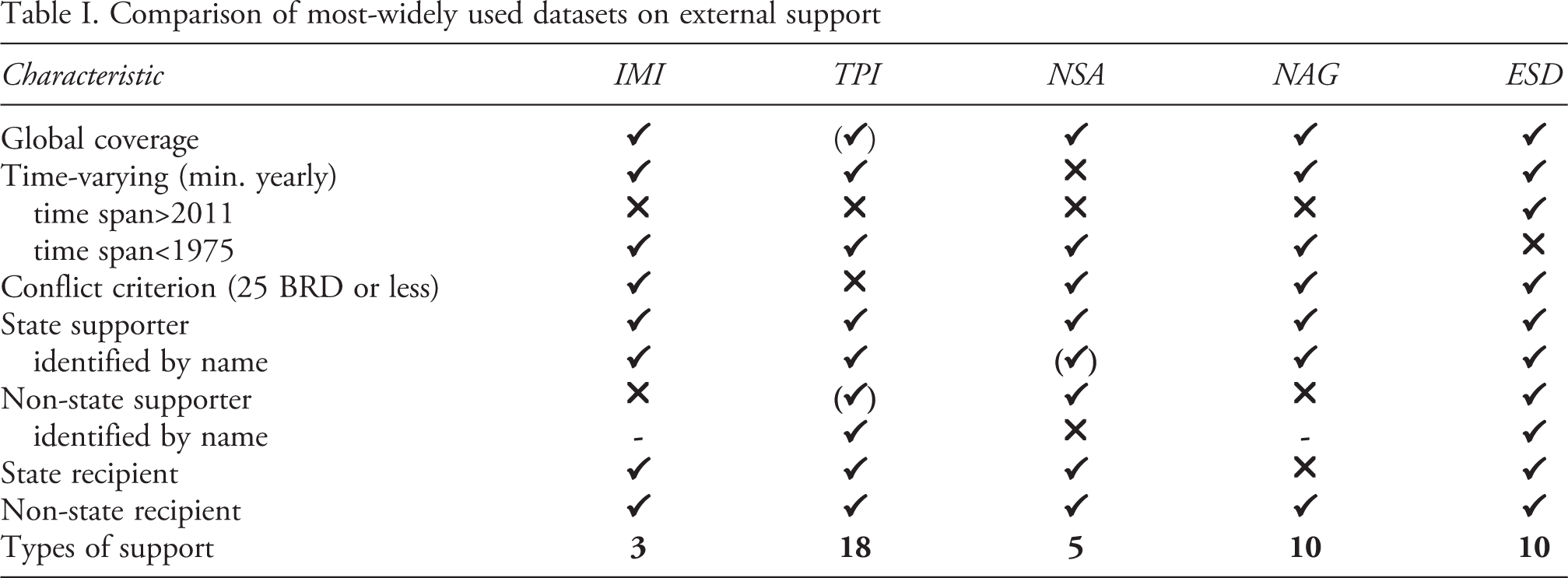
Another set of datasets have focused primarily on the availability of outside resources to non-state actors (Lyall & Wilson, 2009; Cunningham, Gleditsch & Salehyan, 2013; Jones, 2016; San-Akca, 2016). While these data collection efforts have been instrumental in the development of the study of delegation to rebel groups many of them offer little or no variation over time and limited information on the type, let alone specific identity, of the external supporter. 4 A notable exception is the Non-State Armed Groups dataset (NAG), which disaggregates external support into different support types while maintaining a long temporal span, currently from 1922 to 2010. While researchers with a historical focus will be hard-pressed to find a more detailed data source than the NAG, the ESD has several advantages when it comes to analysing cases of more recent external interference.
First, compared to the NAG, the ESD reports external support to non-state and state recipients in a civil war. Existing research emphasizes the strategic nature of external support provision: it is frequently provided in response to interventions on the opposing side (Findley & Teo, 2006; Gent, 2007; Aydin & Regan, 2011). Many research projects thus require the ability to at least control for the provision of external support to the opposing side. Here, use of the ESD ensures consistency across the different types of support for both non-state and state recipients across all conflicts listed in the UCDP Dyadic Dataset with the option to extend research to non-state conflicts (von Uexkull & Pettersson, 2018). Second, the ESD contains valuable information on the provision of external support by non-state actors that the NAG lacks. Since most of these non-state supporters back fellow rebel groups, this should be of particular interest to scholars studying the effects of external support on rebel groups. Third, although the ESD is more limited in time span than the NAG, it covers the most recent time period (until 2017).
Table I summarizes key characteristics of the datasets most widely used to examine external support and closely related concepts. Besides the already discussed TPI and NAG, the comparison includes the International Military Intervention Dataset (IMI) (Pickering & Kisangani, 2009) and the Non-State Actors in Armed Conflict Dataset (NSA) (Cunningham, Gleditsch & Salehyan, 2013). A more detailed comparison is available in the Online appendix. Overall, the ESD provides greater coverage and more detailed information on all relevant dimensions. Only its limited historical reach puts it at a disadvantage vis-à-vis some alternatives.
Patterns of external support
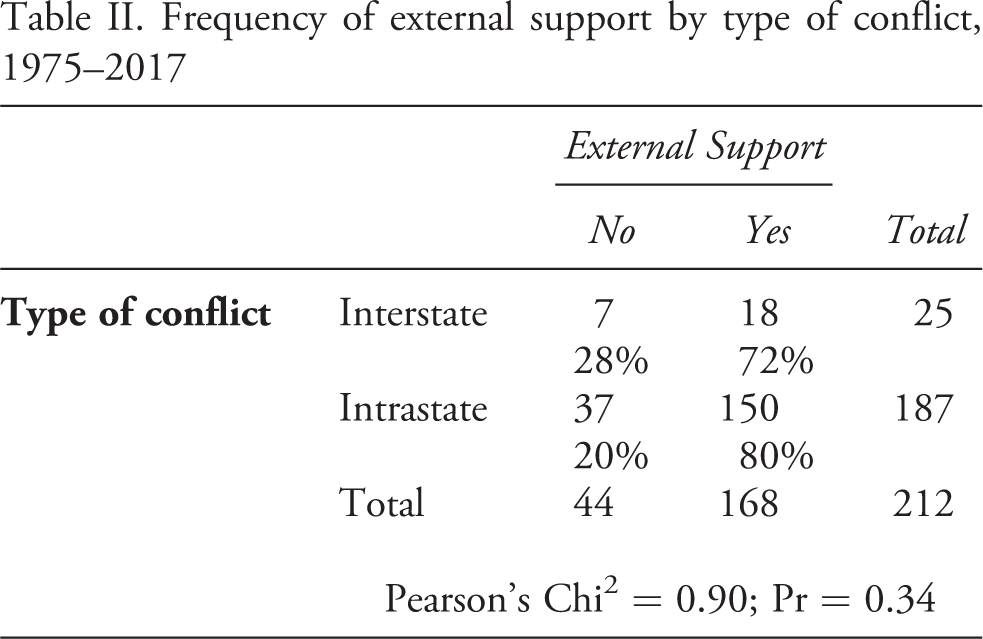
Frequency of external support by type of conflict, 1975–2017
As Table III shows, the main state supporter across all decades under observation has been the United States while al-Qaida has been the most active non-state supporter since the 1990s. Most US support has been distributed to foreign governments while the bulk of Al-Qaida’s support has been channelled to jihadist rebel groups. The permanent members of the UN Security Council have been the most frequent external supporters during the last decade, replacing regional powers such as India, Iran and Pakistan that took centre stage after the beginning of the 21st century. However, note that the frequency of support provision does not necessarily yield information on the extent and impact of support.
Training and expertise is the most common type of support provided in the international system. However, interesting variation exists in relation to recipients and supporters as Figure 1 demonstrates. Governments most often receive training and direct troop support while rebels frequently receive weapons and training. Rebel groups are more likely to offer support to other non-state actors rather than governments, and they are especially active when it comes to conducting joint operations, sharing expertise, and providing safe haven. 6 States often intervene more directly by sending troops. Moreover, they frequently offer support in the form of training, weapons, materiel and logistics support. Recent work has just begun to explore the diverging effects of different types of support and identities of supporters. The ESD offers a way to continue along this rewarding path and to assess the joint effect of various types of support and supporter combinations.
New trends in external support
More supporters
Not only has external support become more prevalent in armed conflicts over time, but the number of actors involved has increased exponentially since the beginning of this century. Figure 2 shows that while there were often less than 60 supporters involved in armed conflicts between 1975 and 1998, this number has since then doubled to more than 120 supporters. Although the number of states in the system increased with the end of the Cold War, the number of supporters did not rise drastically until over a decade later. All the while, the total number of armed conflicts providing opportunities to interfere has increased only slightly over the 40-year period. This increase in supporters is likely to complicate the bargaining environment in that it could signal the emergence of more ‘veto players’ capable of acting as barriers to conflict resolution (Cunningham, 2010).
Most active external state and non-state supporters by decade
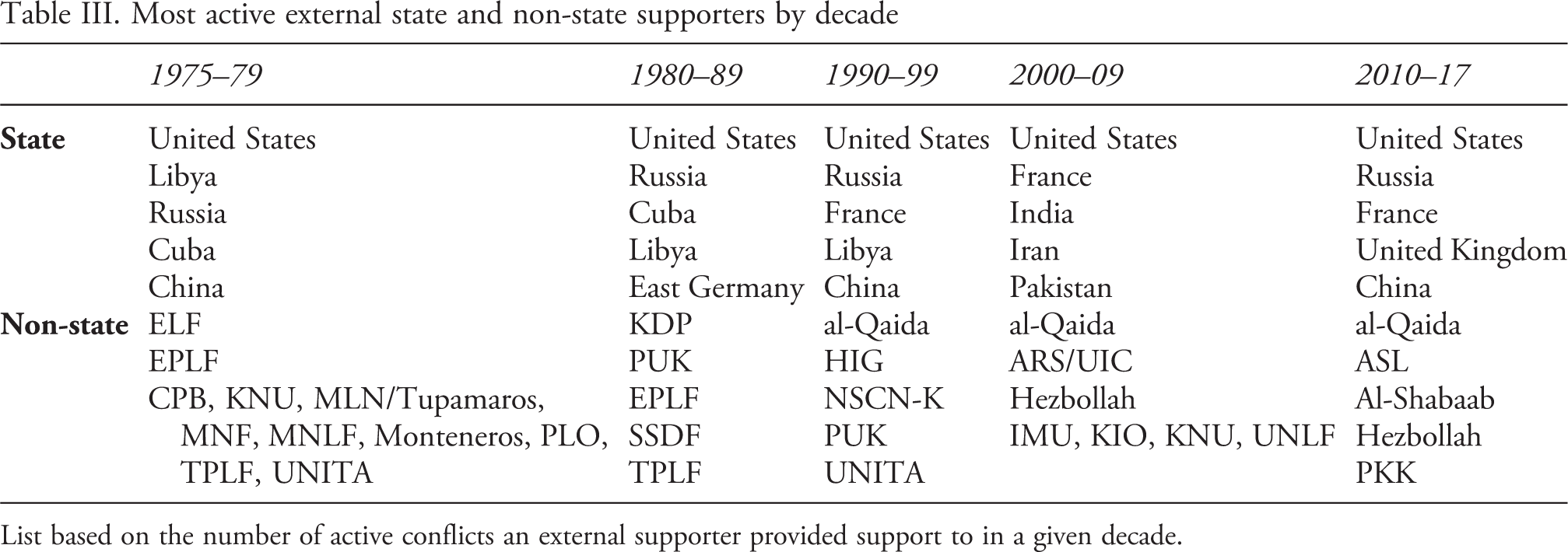
List based on the number of active conflicts an external supporter provided support to in a given decade.
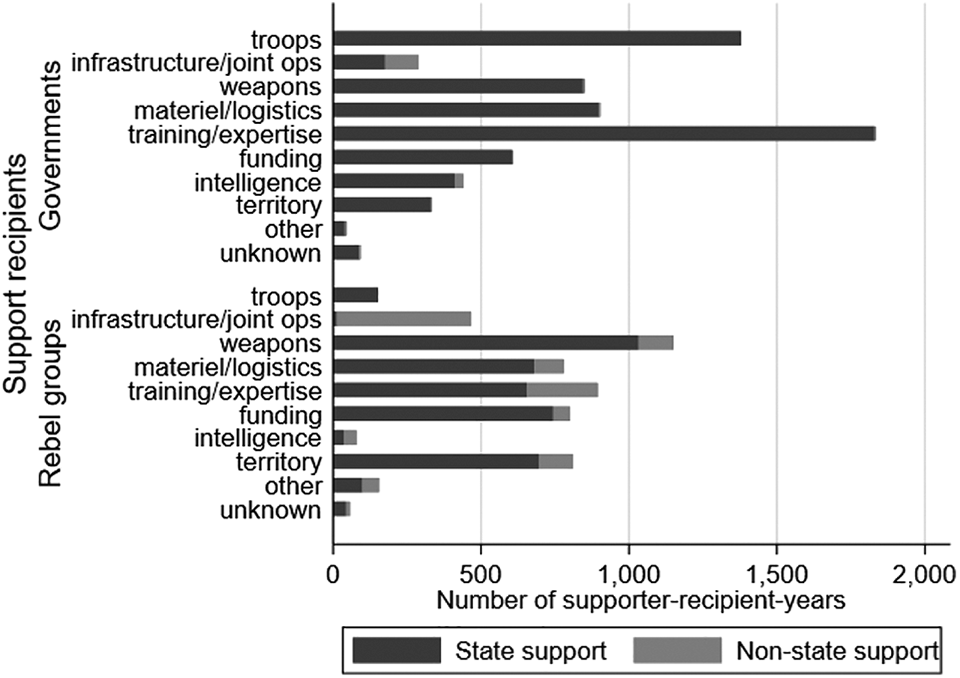
Frequency of support type by type of supporter and recipient, 1975-2017.
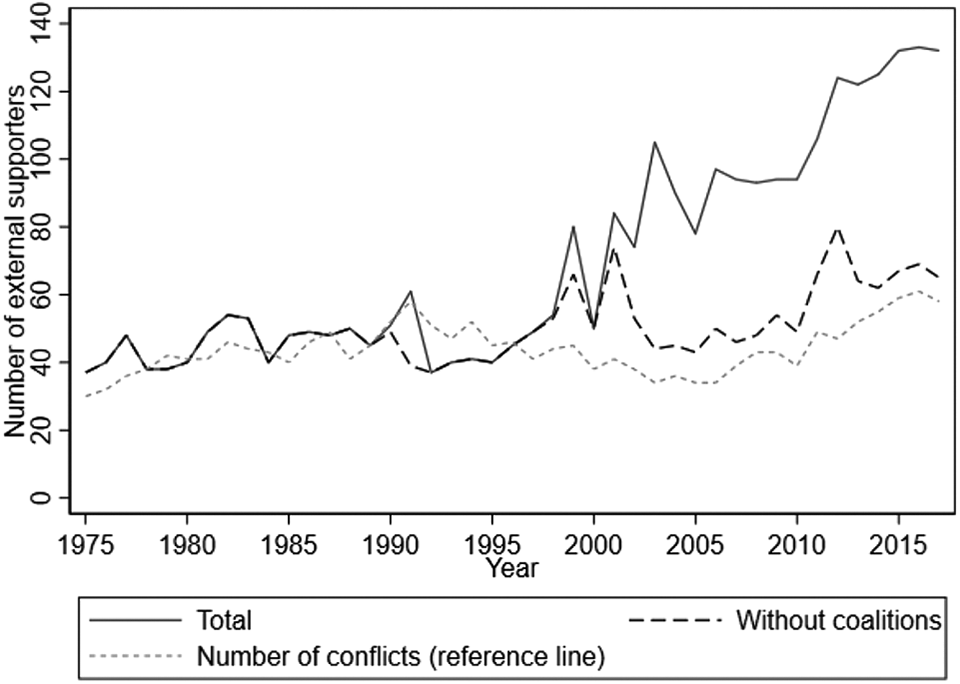
Number of external supporters by year, 1975–2017
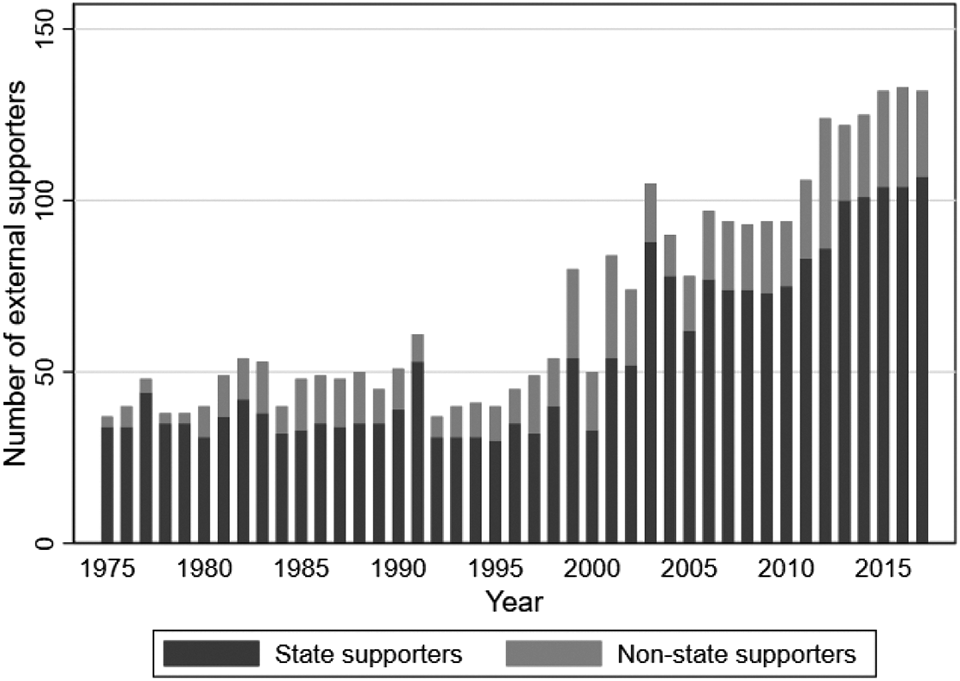
Number of external state and non-state supporters by year, 1975–2017
Second, differentiating between state and non-state supporters, Figure 3 demonstrates that the number of rebel groups that provide support has equally increased over time. While the dataset lists the PLO, UNITA, and ELF as the only non-state supporters active in 1975, this number peaks in 2012 with 38 rebel groups providing external support, such as Al-Shabaab training Boko Haram combatants, and it has stayed above a count of 20 ever since. This supports the observation that a diverse set of non-state actors have in recent years adopted sponsorship roles similar to those traditionally held by states (Moghadam & Wyss 2020: 120). Newly available data on external support by substate actors and rogue members of the security apparatus further suggest that focusing on state support sanctioned at the highest level may risk further underestimating the full extent of Type of interventions in intrastate conflicts by year, 1975–2017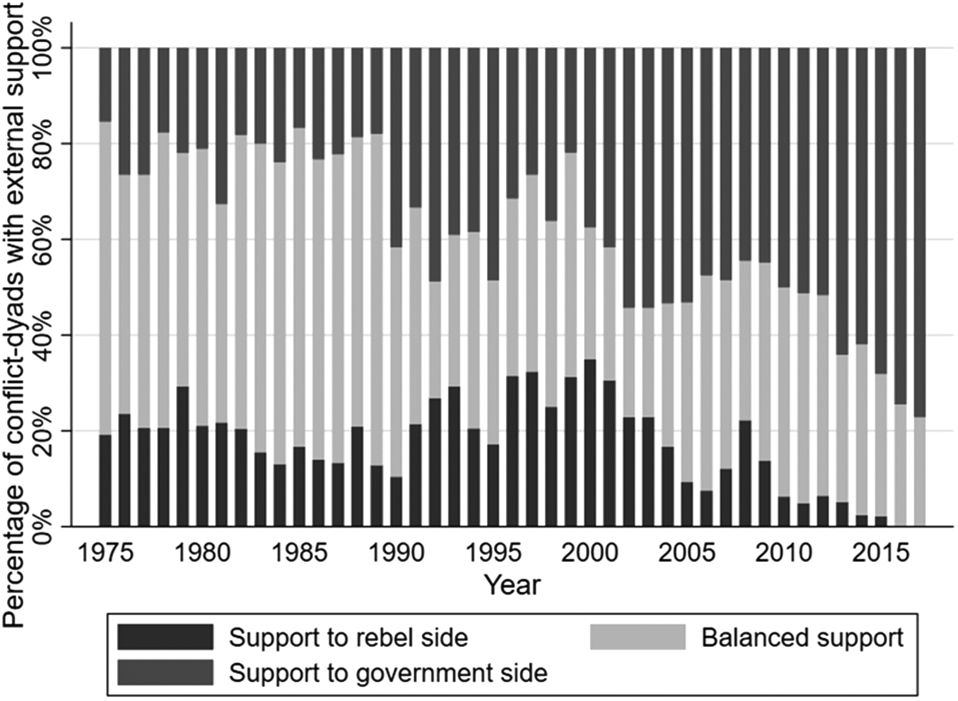
More pro-government interventions
During the Cold War, balanced interventions – where both sides in a conflict receive external state support – were a hallmark of superpower competition. However, Figure 4 suggests that important changes in support constellations have occurred over time. After the Cold War, government-sided, rebel-sided and balanced interventions in intrastate conflicts occurred in roughly equal numbers. Yet, in the aftermath of the 9/11 attacks, state support for rebels was significantly reduced, while efforts to support governments in their fight against non-state actors increased. While in 2000, as many as 14 conflict-dyads saw intervention in support of the rebel side only, this number had decreased to zero by 2016. Instead, by 2017, 77% of all active conflict-dyads saw state support in favour of government forces only, reflecting international – and frequently multilateral – efforts to curb insurgencies and to combat violent extremism.
One possible explanation for this trend is that the 9/11 attacks and the subsequent ‘Global War on Terror’ gave rise to an international environment prone to labelling and pursuing armed non-state actors as terrorist organizations. This likely increased the reputational costs associated with offering support to such groups at a time when many other states were increasing their counterterrorism efforts. At the same time, this development paved the way for greater cooperation between state actors including the provision of external support to ‘combat terrorism’ in recipient states. This development implies that future research should pay more attention to rising levels of interstate security cooperation rather than Direct and indirect support, 1975–2017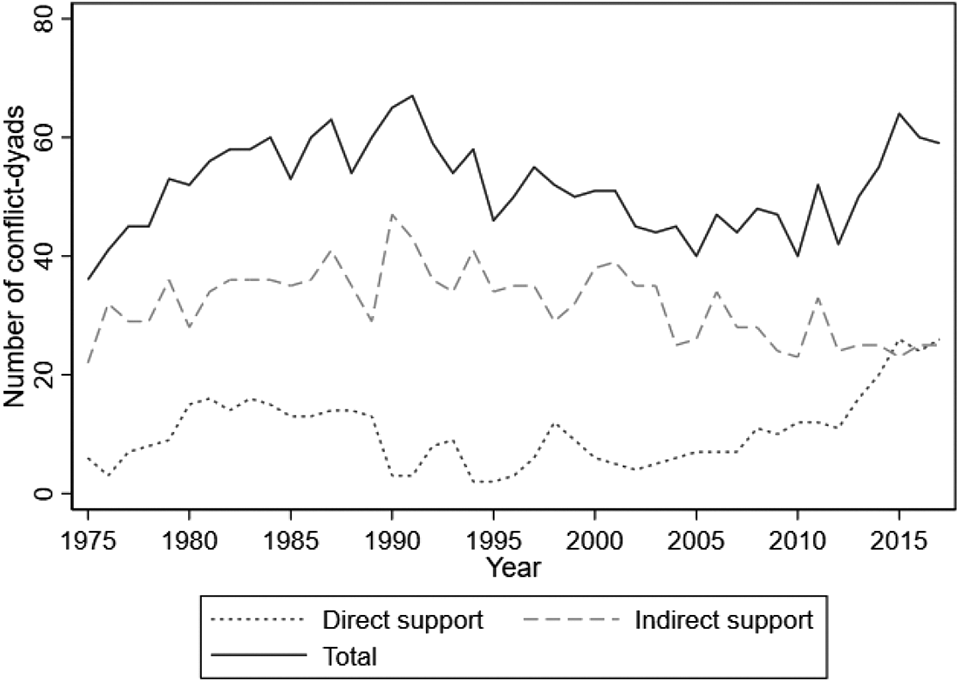
More direct interventions
Much existing work has examined direct support, that is, the deployment of troops for combat operations on behalf of a recipient. Due to data limitations, research on indirect support, such as the provision of weapons, materiel, training, and intelligence has largely been confined to non-state recipients or in the case of state recipients to military aid provided by the United States. Information from the ESD facilitates a direct comparison between the different modes of intervention for all recipients. The ability to distinguish between these different types of support is important, not least because existing research suggests that effects can vary drastically between support types (McKibben & Skoll 2021).
Our data show that for most of the observation period, the number of conflict-dyads that received indirect support by far outnumbered those with direct military involvement (see Figure 5). 8 In 2015 however, the number of conflict-dyads that saw direct support surpassed those with indirect support for the first time since the beginning of the observation period in 1975. While the decline in the number of conflict-dyads with indirect support reflects the overall reduction of armed conflict beginning in the 1990s, the provision of direct support is on a clear upward trajectory after 2001, coinciding with the rollout of the ‘Global War on Terror.’ This suggests that external supporters increasingly opt to intervene directly, dispatching their own troops to the conflict-country rather than propping up local warring parties with equipment and know-how.
A possible explanation for this trend is the rise of light-footprint warfare where air strikes, drone warfare, special forces dispatchments, and limited military operations replace conventional, large-scale troop deployments (Watts et al., 2017). This hybrid form of external interference combines the perceived benefits of direct support, such as greater control and monitoring capabilities, with the advantages of indirect support, such as lower human and financial cost and greater deniability of wrongdoing. Since this type of engagement includes the involvement of foreign troops in combat roles, it enters the dataset as troop support together with more conventional large-scale deployments of ground forces and could hence contribute to the observed rise in direct support. Future research is well-advised to inquire into the interplay between direct and indirect support and the hybrid forms, such as advise-and-assist missions, it produces.
Taken together, these empirical trends suggest that a growing number of external actors interfere in armed conflicts. These interventions increasingly occur as part of a multilateral framework, in support of recognized government forces, and including the deployment of foreign troops. These trends require urgent attention from conflict and civil war scholars whose focus remains on indirect, bilateral interventions mostly in support of rebels. While actions taken to target rebels’ financial networks and supply lines are undoubtedly of great importance to curb the violence committed by militant groups, our data suggest that most external support today comes in the form of direct interventions on behalf of governments.
Way(s) forward
The ESD opens several different avenues for further research allowing for both reassessments of established findings and detailed examinations of novel theories. The dataset is uniquely situated to address the strategic and dynamic nature of external support. Scholars specifically interested in the interdependent actions of different external supporters can make good use of the dataset with its inclusion of time-varying data on external support to both the government and the rebel side in armed conflicts by state and non-state actors alike.
In addition, scholars have only recently begun to disaggregate and theorize different types of support independently (Keels, Benson & Widmeier, forthcoming; Testerman, 2015; Sawyer, Cunningham & Reed, 2017; Roberts, 2019; Huang & Sullivan, 2021). The ESD makes it easier to assess these ideas and to explore interactions between different types of support. Moving the focus away from the high threshold of troop deployment, the dataset enables us to inquire into the effects of materiel, information and technology transfers while still maintaining the opportunity to control for direct intervention in our analyses.
Lastly, the data raise several questions worthy of further inquiry. When are states likely to intervene and by which means? Which types of interventions commonly occur together? Why do states increasingly channel support together rather than unilaterally? What can account for the growing share of support from non-state actors and how has it affected conflict processes? Does the increasing number of pro-government interventions lead to shorter conflicts? Do more indirect forms of external support provide supporters with less leverage over recipients’ behaviour? These are just some of the questions that demand attention in this rapidly expanding field. To this end, the ESD provides novel, up-to-date, fine-grained and global data to power the next generation of research on external support in armed conflicts.
Footnotes
Replication data
The dataset and codebook, along with the Online appendix, are available at https://ucdp.uu.se/downloads/ and  . All visualizations were created using Stata 16.1.
Funding
The authors disclosed receipt of the following financial support for the research, authorship, and/or publication of this article: We gratefully acknowledge support from the European Research Council (grant agreement no. 694640 – ViEWS), the Swedish Research Council (grant 2017/1959), the Swedish National Infrastructure for Computing, and the Oxford Project for Peace Studies Funds.