




Abstract
The internationalization of intrastate conflicts has become a defining trend in 21st-century organized violence, marked by external actors providing militarily relevant support—such as troops, arms, or intelligence—to domestic warring parties. While research examines various dimensions of this phenomenon, systematic analysis of macro-level trends and their drivers remains limited. This article addresses this gap through three contributions. First, it introduces a network-based framework to conceptualize forms of internationalization and identify potential explanations. Second, it demonstrates empirically that intrastate conflicts have indeed become more internationalized across multiple measures. Third, it synthesizes research to identify and evaluate likely drivers of this trend. The study provides the first systematic framework for understanding internationalization as a network phenomenon and establishes a foundation for future research on external involvement in civil wars. By unifying fragmented research through a coherent analytical lens, the article advances both theoretical and empirical understanding of contemporary conflict dynamics.
Keywords
Introduction
When it comes to academic debates about current changes and continuities in organized violence and armed conflict, one observation stands out: The first two decades of the 21st century seem to be characterized by a significant internationalization of armed conflict that comes primarily in the shape of a rising number and share of internationalized intrastate conflicts (Bellamy, 2023; Davies et al., 2024; Harbom and Wallensteen, 2005; Pettersson and Öberg, 2020), a heightened role of transnationally oriented, Islamist 1 rebels (Crenshaw, 2017; Hegghammer, 2010; Kalyvas, 2018; Salehyan, 2007), and an increase in the forms, actors, and intensity of external support in armed conflicts (Meier et al., 2023).This observation of a significant trend of internationalization is relevant because wars with external involvement tend to be longer, deadlier for civilians, and more resistant to international efforts at resolution (Balch-Lindsay and Enterline, 2000; Salehyan et al., 2014).
However, research that investigates what lies behind this recent trend and attempts to explain why intrastate conflict increasingly attracts external involvement remains limited. To be sure, there is a long tradition of research on various subtypes of internationalization, especially on military interventions into civil wars as well as various forms of external support that states, but also non-state actors, provide to parties in an intrastate conflict (Pfeifer et al., 2026). But this literature discusses causes and consequences of specific forms of external support and interventions without situating them within the broader phenomenon of internationalization. As a result, few studies examine macro trends in the internationalization of intrastate conflict—overall dynamics across different forms of external involvement—and review potential causes driving the increase in internationalized intrastate conflicts. 2
Against this background, this article takes stock of the rich evidence on the internationalization of intrastate conflict and, based on a review of the existing scholarship on external support and intervention, discusses potential explanations for this trend. We do so in three steps:
First, we clarify our understanding of internationalization and present an analytical framework that conceptualizes internationalized intrastate conflict from a network perspective. The basic idea is to understand intrastate conflicts as complex networks that comprise not only the belligerents but also a range of other actors. These other actors are located outside the state at hand, have varying relationships to the conflict parties and, possibly, also with each other. Thinking of internationalized intrastate conflict in terms of an abstract network helps us to conceptualize and systematize explanations of internationalization. Second, based on this conceptualization, we examine what recent data reveal about the evolving patterns of internationalized intrastate conflict. In that section, we demonstrate descriptively that the observation of a recent trend in internationalization holds across different forms and indicators, discuss which countries and conflicts account for it, and show that the trend is driven by new instances of external involvement and is not merely the cumulative result of longer-lasting internationalized conflicts. We can also show that for most data, the years 2011/2012 can be identified as the point where a systematic shift occurred.
In the third step, we use our network perspective to synthesize existing research on external involvement in intrastate conflicts, identify possible causes that might help explain the recent internationalization trend, and assess their plausibility in light of existing data. Our analysis here points to several changes in actor characteristics and relationships, as well as in international context conditions that plausibly have contributed to the recent trend in internationalization. In particular, we identify two likely drivers of this trend. First, the interaction between the war on terror and the designation of rebel groups as terrorist organizations has incentivized external state intervention, particularly in support of governments. Since 2015, the majority of internationalized conflicts have involved designated terrorist organizations as primary non-state actors. Second, rising interstate rivalries amid the transition to a multipolar order have fostered competing external involvement, primarily through indirect forms of support rather than direct military engagement.
This article makes three contributions to the academic debate in peace and conflict studies. It introduces a conceptual framework to facilitate a systematic analysis of internationalized intrastate conflict. It scrutinizes existing empirical data, giving credence to the proposition of a recent internationalization trend of contemporary intrastate conflict. Finally, we identify plausible factors that might help explain this macro trend and lend themselves for future research. While our presentation of the different aspects of the internationalization trend remains descriptive, we introduce an analytical instrument to analyze these changes systematically in future research. Whether and how precisely these factors shape dynamics of external involvement in intrastate conflict and, thereby, drive internationalization requires systematic, comparative research, for which our study hopefully lays the groundwork.
Internationalized intrastate conflict from a network perspective
Traditionally, internationalized civil wars have been defined by the involvement of military troops from another country (Small and Singer, 1982: 219). Similarly, the Uppsala Conflict Data Program (UCDP)/Peace Research Institute Oslo (PRIO) Armed Conflict Dataset conceptualizes internationalized intrastate conflicts as involving troop support from at least one foreign government (Davies et al., 2024: 676). These definitions, however, are limited in terms of means and actors of external involvement. In focusing on external state actors that intervene militarily in an intrastate conflict by providing troop support to either a government or a non-state actor, they tie internationalization to military interventions in intrastate conflict. This excludes other forms of intervention, such as by economic or diplomatic means (see, e.g., Regan, 1996: 342; Regan et al., 2009), as well as the external involvement by non-state actors like rebel groups, transnationally operating networks, or private military companies (see, e.g., Finnbogason and Svensson, 2018).
Military interventions by states, then, are just one phenomenon in a whole repertoire of external involvement in armed conflicts. Dunér (1983: 60) distinguishes between different instruments and levels of intervention, ranging from combat involvement to military advisors, arms supply, or financial support, to activities such as intelligence sharing. This recognizes that external involvement goes far beyond just the state’s provision of troops. In the literature, interventions and support are sometimes used interchangeably, although intervention implies a much larger and more fundamental form of involvement that can but does not have to rely on military means (Skoll, 2025).
The UCDP External Support Dataset (ESD) (Meier et al., 2023) is the latest effort to quantify the phenomenon comprehensively and to distinguish systematically between different forms of external support by a variety of actors. 3 The ESD focuses on external support that is “intentional, direct, and aimed at enhancing military capabilities” (Meier, 2022: 10). Apart from direct support (troop support and troop presence), it also covers indirect forms ranging from providing intelligence or training to supplying weapons to the warring parties. Unlike other datasets on state-rebel support (see, e.g., Byman et al., 2001; San-Akca, 2016), it also includes support provided by non-state actors. In this broader understanding, internationalization can be seen as involving any kind of militarily relevant support to the parties in an intrastate conflict, including contributions that remain below the threshold of active troop deployment. 4
To systematize and illustrate these different forms of internationalization, facilitate a differentiated descriptive analysis of the phenomenon, and analyze the drivers behind this internationalization trend, we propose a framework that conceptualizes internationalized intrastate conflicts as networks composed of actors (nodes) and their relationships (ties).
Such a network perspective (see, e.g., Hafner-Burton et al., 2009; Maoz, 2011) has been increasingly applied to conflict studies, explaining why third parties intervene in conflicts (Hannigan, 2019), why states actively engage in different types of conflict (Beardsley, 2024), how networks among them affect conflict duration (Aydin and Regan, 2012), how triadic networks of conflict parties and interveners influence whether third parties mediate between belligerents or take sides (Corbetta and Grant, 2012), how rebel organizations choose allies based on shared ideological or ethnic constituencies (Balcells et al., 2022; Gade et al., 2019), and how militant networks and relational patterns shape who fights whom during civil conflicts (Dorff et al., 2020).
This network perspective integrates well with earlier frameworks explaining external involvement in armed conflict. For example, Mitchell (1970) proposed two analytical lenses into the reasons for third-party interventions in civil wars: patterns in the characteristics of those who intervene and “linkages between the domestic group seeking assistance and the external parties perceived as potential allies” (Mitchell, 1970: 170). From this foundation, he identified four key factors explaining external military intervention: domestic factors within both (1) the conflict-affected state and (2) the intervening state; (3) transnational factors linking conflict parties to potential outside interveners; and (4) factors in the international system that increase the likelihood of civil war and/or interventionist behavior (Mitchell, 1970: 170; see also Findley and Teo, 2006).
We build on and expand these attempts to explore how different types of changes in actor characteristics and actor ties in the relevant conflict networks could explain the phenomenon of increasing internationalization. As depicted in Figure 1, at the core of internationalized intrastate conflicts is the conflict between a government and at least one rebel group that clash militarily within the boundaries of a state. These local parties to the intrastate conflict can receive militarily relevant support from different types of external actors—state and/or non-state—and the support can come in different forms—direct (deployment of troops or fighters) and/or indirect (provision of weapons, training, or intelligence). 5 While it is militarily relevant external involvement that defines internationalized intrastate conflict, the ties between actors (nodes) include all kinds of relationships from friendly to conflictual (alliances, rivalries, and the like). 6
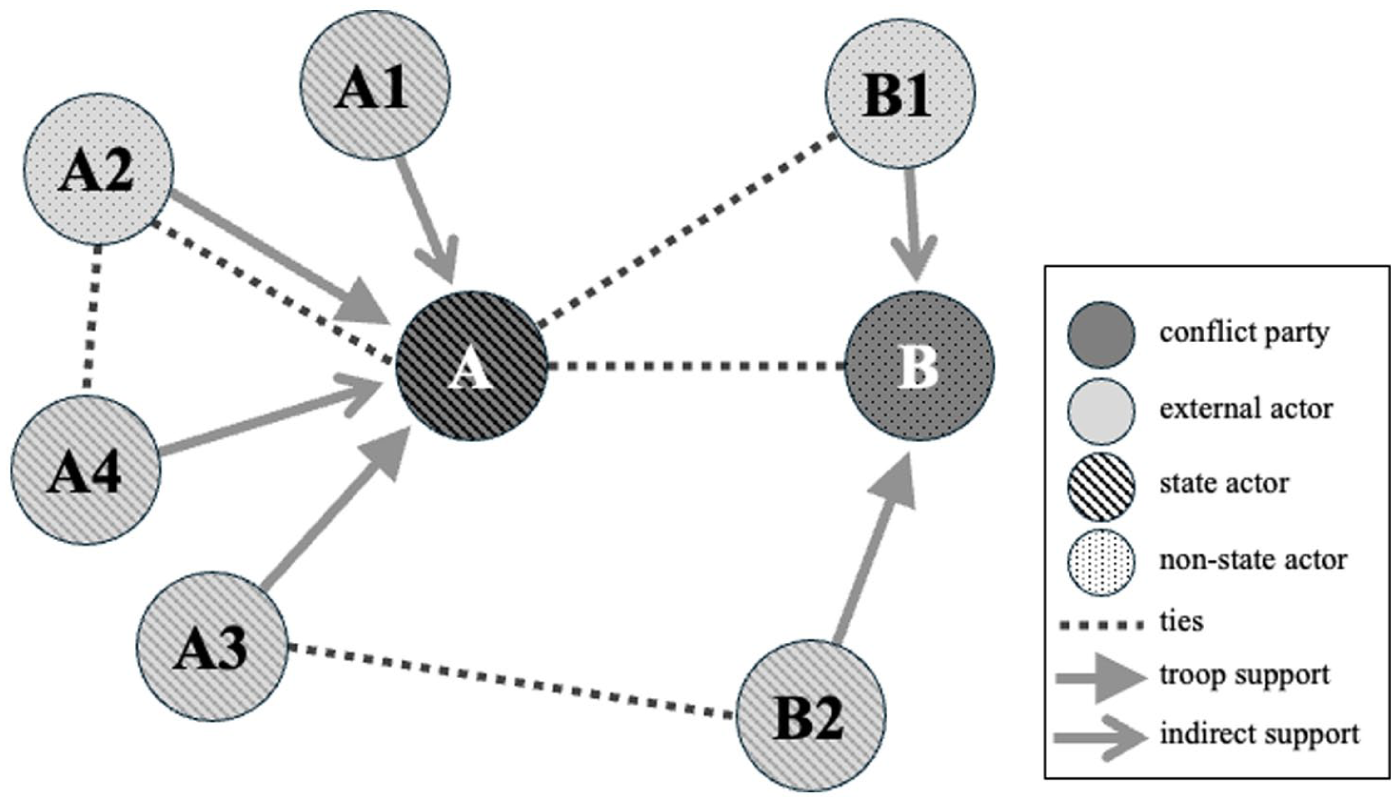
The network of internationalized intrastate conflict.
We outline conceptually how these ties have different functions for external support to conflicting parties: An alliance between external actor A2 and conflict party A means that A will likely receive external support from A2. In contrast, a rivalry between external actor B1 and A often translates into external support by B1 to conflict party B which fights against A. Rivalries between external actors A3 and B2 can fuel conflict between A and B, through external support (see Gartzke and Gleditsch, 2022). Hence, ties—also those between actors that are not related through militarily relevant support (such as between A2 and A4 in Figure 1)—can be expected to shape the dynamics of internationalization within the network.
As we will see in the third part of this article, this network perspective helps us think systematically about four general changes in the causes of internationalization that may explain the increase in internationalized intrastate conflict. First, conflicts may become increasingly likely to internationalize due to changes in actor characteristics, such as the rise in the number of conflict participants (as seen in the growing importance of multiparty civil wars). Second, the ties between actors that lead to foreign involvement in intrastate conflicts could change in quality or quantity. For example, rivalries between external actors and conflict parties might become more frequent, driven by rising international tensions or weakening international institutions. Third, shifts in contextual conditions may affect the relevance of actor characteristics that prompt external support. An illustration of this is the increased focus on human rights as a justification for military intervention in the latter half of the 20th century. Finally, actor ties that lead to foreign involvement could become more or less influential in how external actors decide to get involved in an intrastate conflict. For instance, a changed geopolitical climate might make existing rivalries more likely to trigger external support.
By examining how each of these causal pathways has evolved globally over time, we can systematically identify which mechanisms—whether changes in actor characteristics or ties, or altered weights of existing actors and ties—have driven increased internationalization. Before we do so, however, we have to assess whether we are indeed witnessing an internationalization trend.
Descriptive evidence on the internationalization of intrastate conflict
Is there a trend of increasing internationalization?
When we start with the narrow definition of internationalized intrastate conflict as used in the UCDP/PRIO Armed Conflict Dataset (Gleditsch et al., 2002), the picture seems clear: intrastate conflicts have become increasingly internationalized (Davies et al., 2024: 676). Figure 2(a) depicts how armed conflicts of this type have increased markedly since 2008. In 2013, UCDP recorded more than 10 internationalized intrastate conflicts for the first time, and the highest number so far was recorded in 2020 with 27 conflicts. This rise of internationalized intrastate conflicts is mirrored by a decline in intrastate conflicts without internationalization. Based on these data, authors have noted a strong internationalization trend and a considerable shift in the nature of intrastate conflicts (Human Security Report Project [HSRP] 2011; Szayna et al., 2017; Wenger and Mason, 2008). Figure 2(a) shows a slight reverse trend for the years 2020 to 2023. However, the overall number of internationalized intrastate conflicts, as measured by UCDP, remains historically unprecedented, with 20 conflicts in 2023.
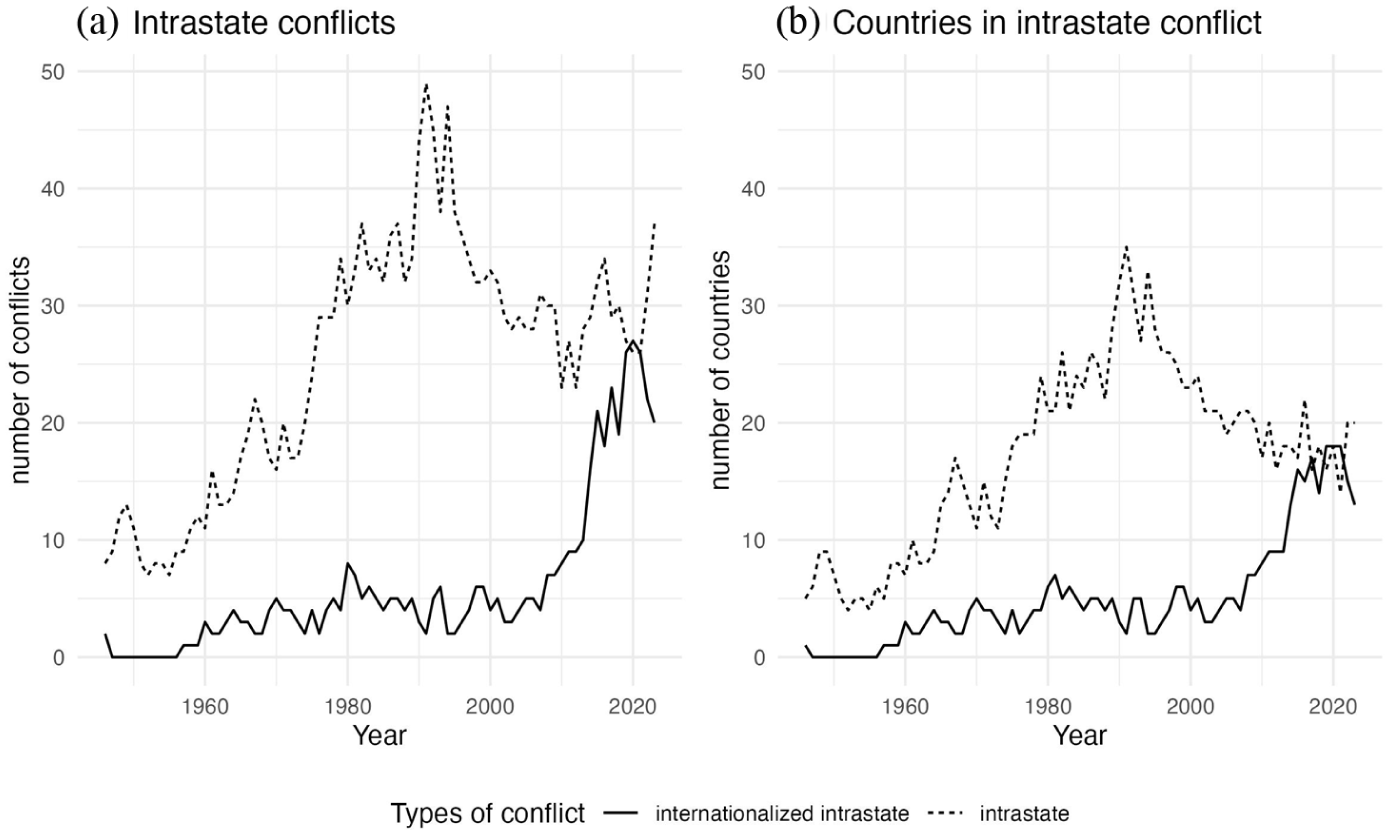
Intrastate conflicts from 1946 to 2023. (a) Intrastate conflicts. (b) Countries in intrastate conflict.
How robust is this trend, however, when comparing the evidence for different types and indicators of internationalization? Using the UCDP conflict data and the ESD, in this section, we explore whether similar trends are evident in alternative conceptualizations of internationalized intrastate conflict. While many more datasets could be considered, our focus on these data sources aims to maximize temporal coverage and comparability. For instance, the International Military Intervention (IMI) dataset covers an important dimension of the internationalization phenomenon but only spans the period until 2005 (Pickering and Kisangani, 2009). 7 This shorter temporal coverage makes it difficult to assess a phenomenon that unfolded predominantly during the first two decades of the 21st century. Moreover, the datasets we use rely on comparable samples, allowing us to evaluate various conceptualizations of internationalization while holding the universe of cases constant.
UCDP conflict data, as used in Figure 2(a), allows for more than one conflict per country, which might lead to an overestimation of the trend, as several related internationalized conflicts taking place in the same country are counted as separate entities. An example is the 2014 conflict between the Ukrainian government and the Russian-supported separatist groups in Eastern Ukraine. While UCDP records three separate internationalized intrastate conflicts, since each was fought by a different separatist group and over different territories (Donetsk, Lugansk, and Novorossiya), from our network perspective these bilateral conflicts should rather be considered as part of a single conflict network. In Figure 2(b), we therefore count the number of countries whose governments have been a primary warring party and that have witnessed at least one internationalized intrastate conflict. Indeed, the internationalization trend remains consistent for this alternative measure.
Nevertheless, both the number of conflicts and the number of countries may be less relevant if internationalized conflicts are comparatively minor in terms of conflict intensity. We, therefore, compare the number of fatalities in internationalized and non-internationalized intrastate conflicts in Figure 3(a). 8 The data show a rapid increase from about 14,000 battle-related deaths in internationalized intrastate conflicts in 2013 to nearly three times that number a year later. From 2004 to 2022, internationalized conflicts accounted for the majority of casualties in all intrastate conflicts. There are large variations over the years, which are due to a relatively small number of extremely violent conflicts, such as the one between the Ethiopian government and the Tigray People’s Liberation Front. But even when accounting for these outliers, as Davies et al. (2024: 676) emphasize, the “average number of battle-deaths per [internationalized intrastate] conflict year is over four times higher compared to intrastate conflicts that are not internationalized.” In addition, Figure 3(b) shows that, from 2005 to 2022, high-intensity intrastate conflicts that claimed more than 1000 lives in a year (i.e. civil wars) were predominantly internationalized. This contrasts with the 1980s and 1990s, when most civil wars did not see involvement by external troops.
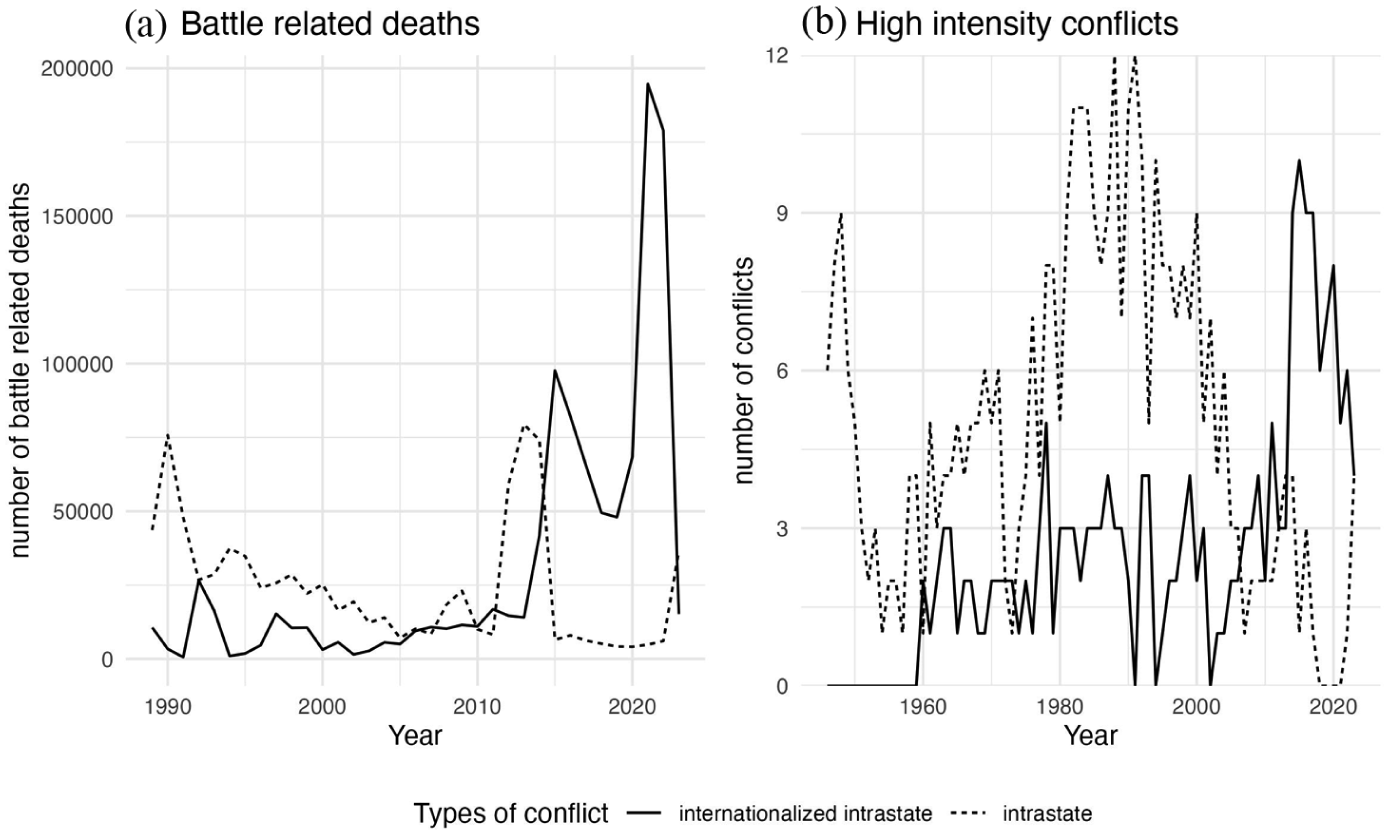
Conflict intensity of intrastate conflicts. (a) Battle-related deaths. (b) High-intensity conflicts.
While the UCDP conflict data suggests that the international dimension of intrastate conflicts has become more prevalent and lethal, it only grasps some of the forms of external involvement that can characterize internationalized intrastate conflicts from a broader network perspective. Based on the ESD, we can get the broader picture and, in line with our analytical framework, assess the various forms of internationalization by zooming in on the different actors and means of militarily relevant external involvement. As Figure 4(a) shows, doing so results in a different picture than the one based on the UCDP conflict data reported above. Throughout the period covered, an overwhelming majority of intrastate conflicts received some form of external support. This difference in Figure 2 is mainly driven by the indirect support provided by foreign states, which historically has been much more widespread than either direct support by states (with troops) or any form of non-state support (Meier et al., 2023: 549–550). Unlike the UCDP conflict data, the ESD only covers the period from 1975 to 2017. This excludes the 1960s as an important period in which the so-called Cold War turned hot in various places across the global South (Berger, 2008). However, our aim in this section is to examine whether the trend toward internationalization, which the UCDP conflict data show for the early 2010s, holds across different forms and indicators. These relevant years are covered in the ESD. Figure 4(a) confirms the recent trend in internationalization: In 2011, the total number of militarily supported intrastate conflicts rose to 46, surpassed its previous peak of 40 from 1994, and continued to rise to up to 55 conflicts in 2016.
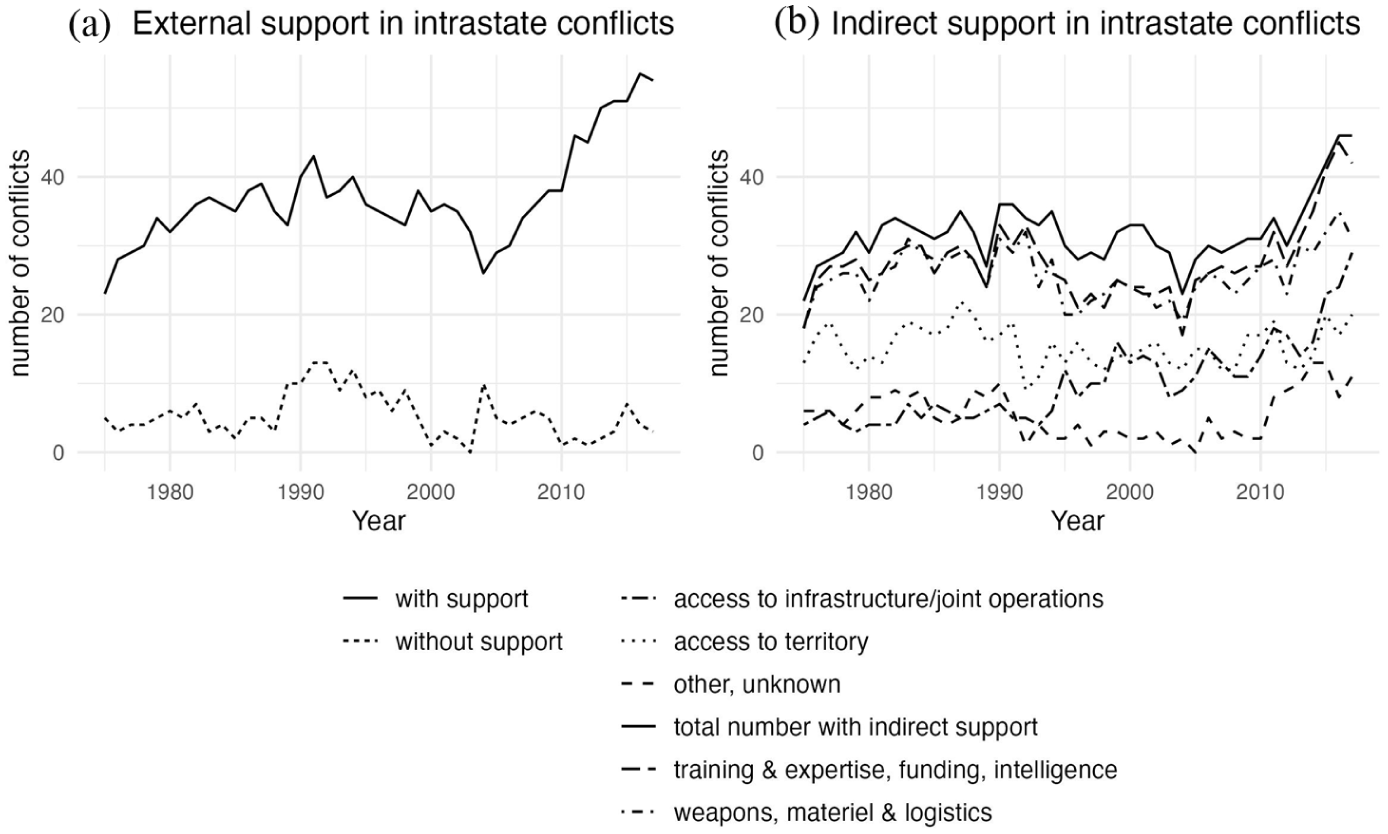
External support in intrastate conflicts (1975–2017). (a) External support in intrastate conflicts. (b) Indirect support in intrastate conflicts.
Figure 4(b) reveals that this trend is not only driven by increasing troop support. Support in the form of delivering weapons and other materials, as well as providing training, intelligence, or funding, makes up the largest share. The category of access to infrastructure and joint operations, which includes direct support by non-state actors, has also seen a steady increase, becoming more and more important as a form of indirect support. 9
As shown in this section, the recent trend of internationalization is most pronounced for direct foreign military interventions or the deployment of foreign troops. When looking at other forms of external involvement, such as weapons supplies, and non-material forms of support, such as providing intelligence or expertise, recent trends look less unprecedented. However, the observation of a marked increase in internationalization since 2011 still holds. Taken together, existing data seem to suggest a trend of increasing external involvement in intrastate conflicts during the first decades of the 21st century.
How global is this trend?
The prior section established a clear trend of internationalization, but how global is this phenomenon really? Are a few states getting involved in ever more conflicts? Or is it just a specific region or a subset of intrastate conflicts experiencing internationalization?
Figure 5(a) shows that the number of states providing troop support remained relatively stable throughout the 1980s and 1990s but has increased sharply since the beginning of the new millennium. The internationalization trend is thus not driven by a heightened activity of a few. Given that recently, up to 100 different countries have provided foreign troops in at least one conflict per year, it seems justified to talk about a global trend of states becoming more willing to intervene militarily in intrastate conflicts. The international networks to which intrastate conflicts are related also include an increasing number of foreign rebel groups providing support (Meier et al., 2023: 551), albeit on an altogether lower level. 10
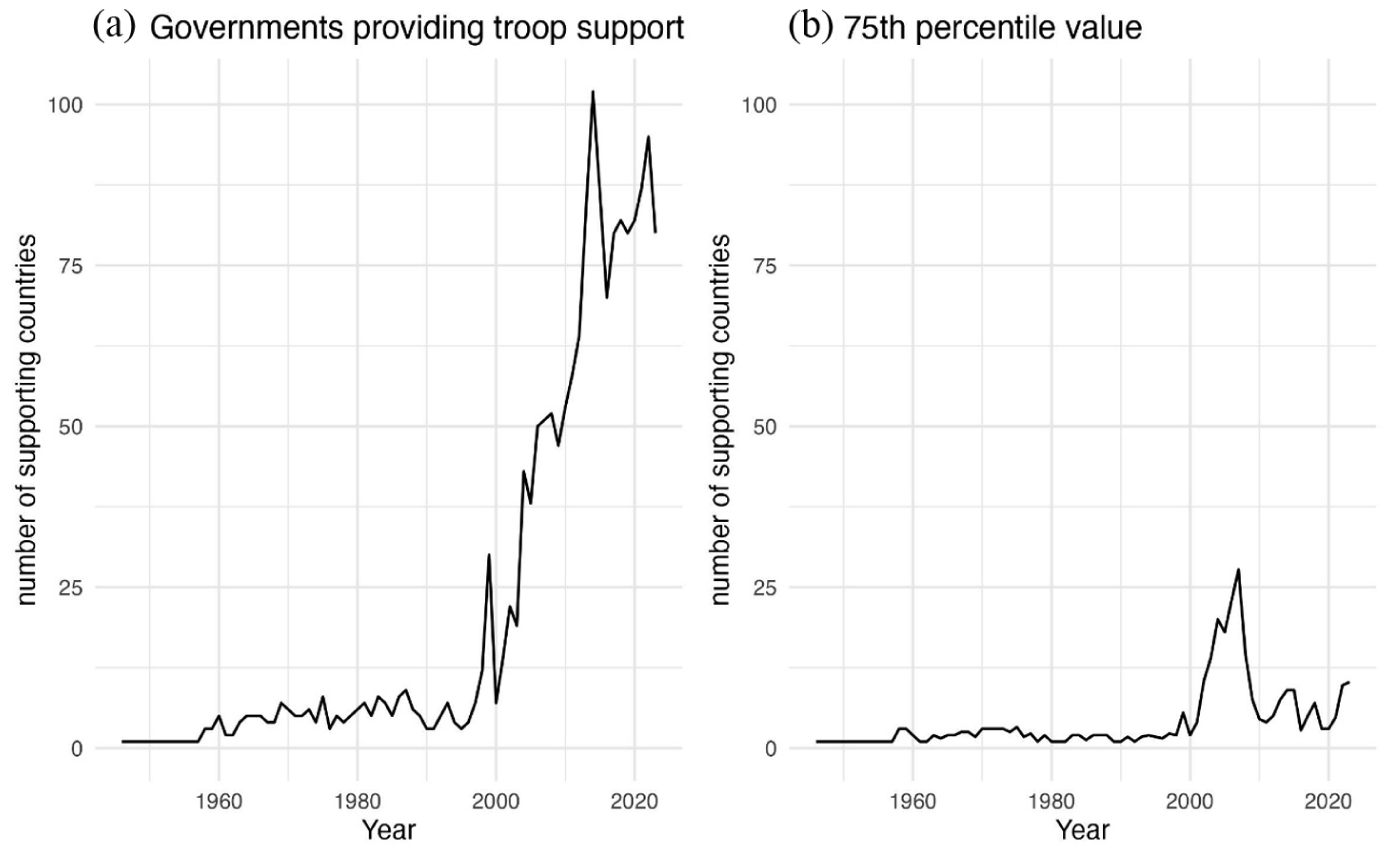
Providers of troop support in intrastate conflicts (1946–2023). (a) Governments providing troop support. (b) 75th percentile value.
We might consider whether the trend is due to a few conflicts attracting the involvement of an increasing number of external actors. In 2004, the number of states providing troop support rose to 43. However, in that year, there were only four internationalized intrastate conflicts in total. The conflicts in Iraq and Afghanistan, as well as the global conflict between the US government and al-Qaida, were all supported by more than 14 states, while the Algerian government was supported by three other governments in its fight against al-Qaida. However, the increase in supporters since 2010 cannot be attributed to a few support-intensive conflicts. There were 16 internationalized intrastate conflicts in 2014, the year with the highest number of supporters so far. Four of these counted more than 10 supporters, and in 10 conflicts, there were more than three supporters per conflict. This stands in contrast to 1980, the year with the highest number of internationalized intrastate conflicts before the 2000s. In seven of the eight conflicts, there was only one supporter per conflict this year. This shows that the international networks to which intrastate conflicts are related through direct military support have expanded significantly.
We thus observe two trends: First, looking at internationalized intrastate conflicts, we see that the network of supporters per conflict grows. Second, we see a diversification of the field of supporters, as both the number of external actors providing military support in internationalized conflicts has increased and more non-state actors have become involved (Meier et al., 2023: 549). This growth in the number of actors involved in the networks affects all actor types but particularly concerns states: In the 1980s, there were 10 governments that provided troop support in the 11 internationalized conflicts that were active during this time. With involvement in four different conflicts, Cuba was the most active intervener. In the 2010s, however, proportionally more states have supported fewer conflicts. Forty-seven different governments intervened in 34 intrastate conflicts, excluding the extreme cases of Afghanistan, Mali, and the Central African Republic, with more than 30 supporters per conflict. Data on indirect forms of support show a very similar picture (see Figure 15 in Appendix 1).
When turning to recipients, the first observation is that their absolute number is much lower. However, as Figure 6 shows, the number of conflict parties receiving troop support more than doubled between 2004 and 2011 and has since remained at a historically high level, with around 20 recipient actors. 11 This upward trend was preceded by other peaks, albeit on a lower level.
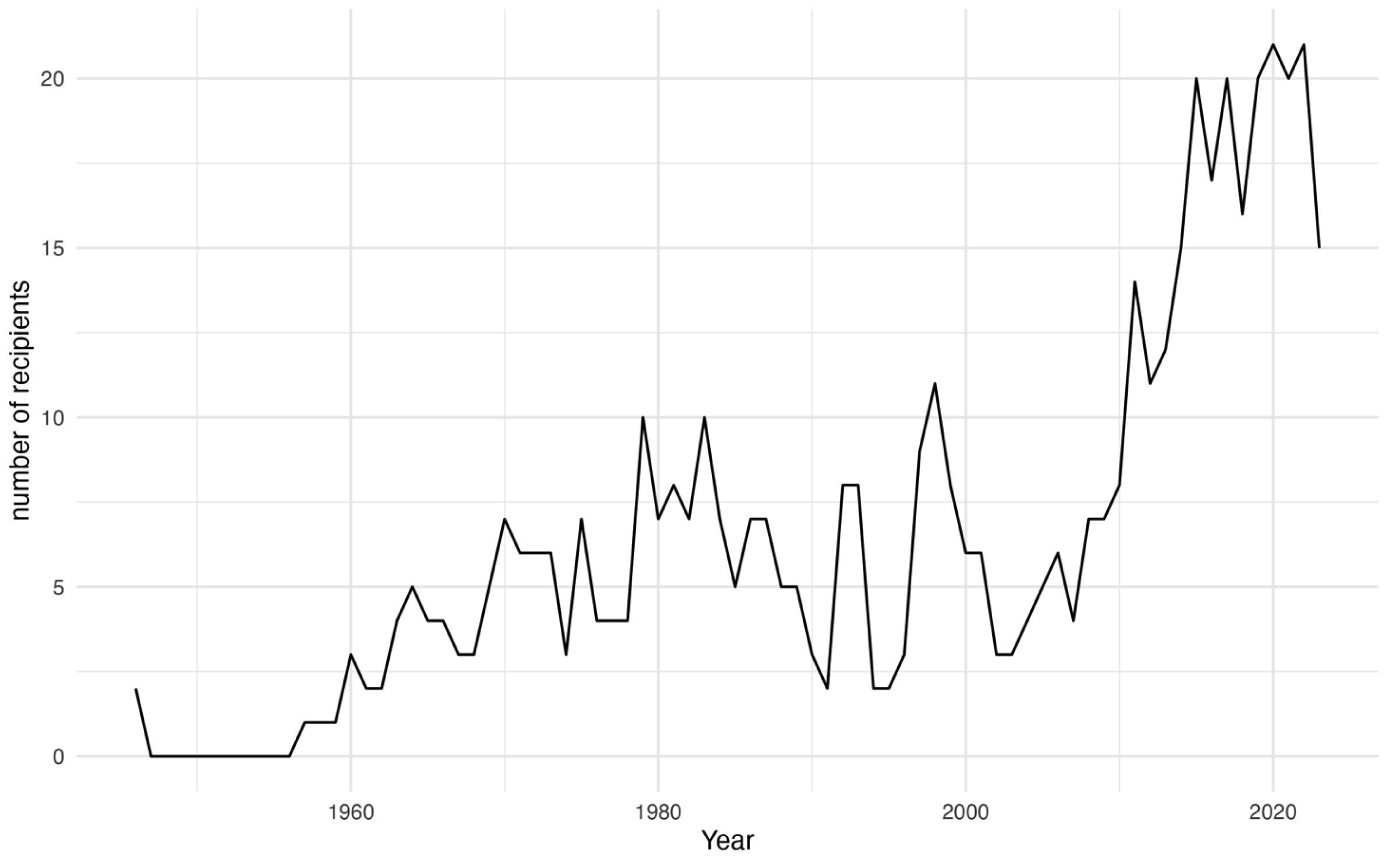
Recipients of external support.
While there has been a long-term increase in both the number of troop providers and the number of recipients, the former has grown faster. In 1990, there was an average of one supporter for every recipient. Today, there are five supporters per recipient. 12 In network terms, this means that the number of nodes and their respective ties has grown. This development goes hand in hand with the increase in coalitions, as depicted in the ESD. Until 1998, troop support was provided exclusively on a bilateral basis. With seven coalition-based 13 internationalized conflicts and six with bilateral support, the number of coalition-based conflicts exceeded the number of bilaterally supported conflicts in 2013 and continued to do so until 2017. In conflicts with indirect support, coalitions play a less prominent role, but the data still show a corresponding trend since the beginning of the 21st century (see Figure 16 in Appendix 1). 14 According to ESD, there are basically two types of coalitions behind this trend: Ad hoc coalitions such as the US-led coalition in Iraq (2003–2011), the “Global Coalition Against Daesh” to defeat the ISIS (“Islamic State in Syria and Iraq”) organization in Iraq (2014–2017), or the Saudi-led coalition in Yemen (2015–2017), and multilateral interventions such as the International Security Assistance Force in Afghanistan (2006–2014), the United Nations Force Intervention Brigade in the DR Congo (2013–2017), the African Union Mission in Somalia (2012–2017), or the European Union Training Mission in Mali (2009–2017) (Meier, 2022, Appendix 2, 22). 15 To an important extent, thus, the expanding network of external supporters in contemporary internationalized intrastate conflicts is characterized by states that coordinate their external involvement.
This set of coalitions also suggests that the internationalized intrastate conflicts currently observed tend to cluster in specific contexts and regions. Indeed, of the internationalized conflicts identified by UCDP since 2010, 64% occurred in Sub-Saharan Africa and 18% in the Western Asia and Northern Africa (WANA) region (see Figure 7). This regional concentration is roughly in line with the argument that transnationally oriented Islamist rebels and the international responses to them constitute a key driver of the current trend of internationalization. We will come back to this potential explanation in the next section.
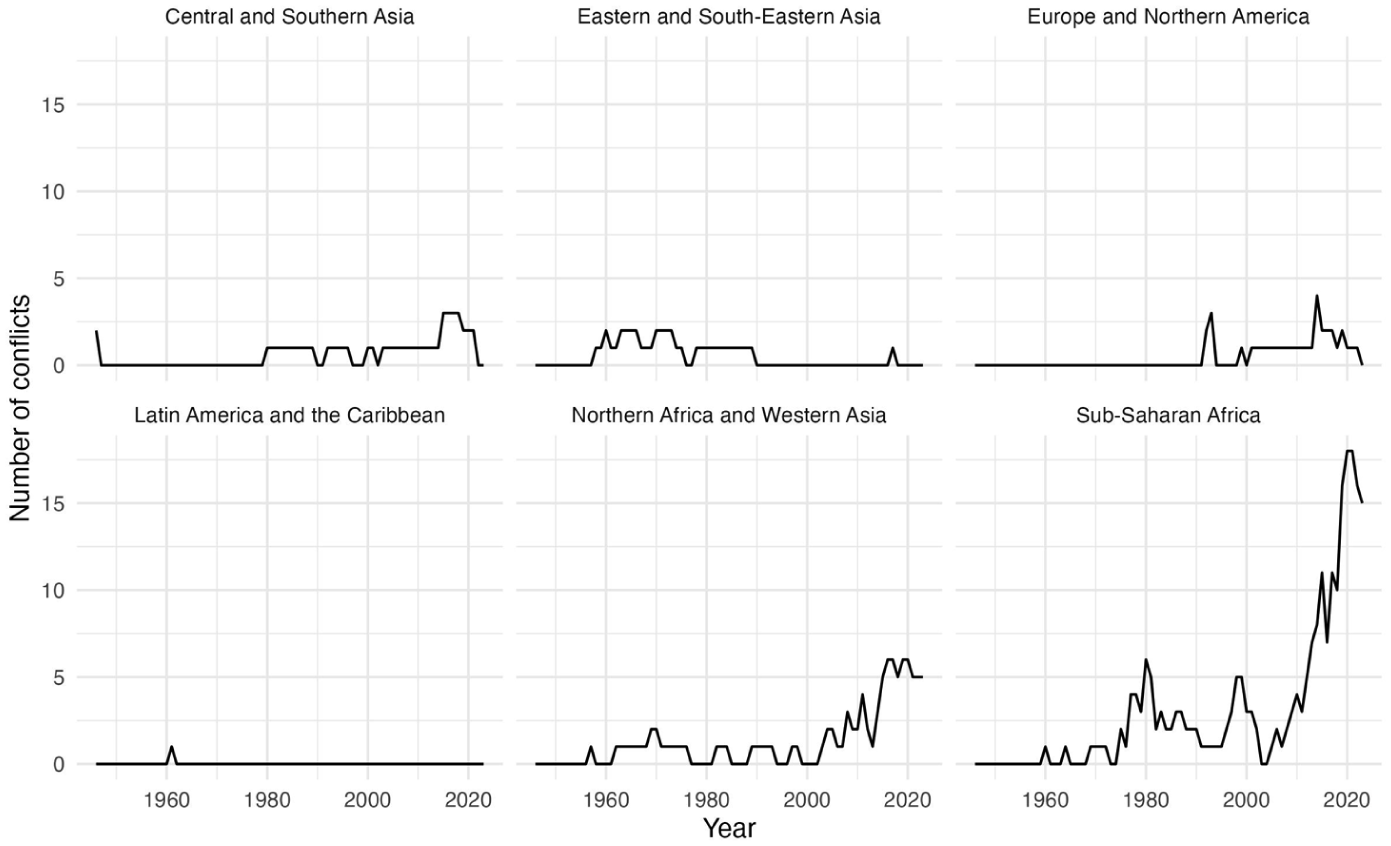
Internationalized intrastate conflicts by regions—based on the SDG regional classification.
In sum, internationalization emerges as a global phenomenon in terms of external actors’ involvement in intrastate conflicts. However, the primary settings for such internationalization appear to be concentrated in specific regions.
Do new instances of internationalization drive this trend?
The previous analyses suggest that intrastate conflicts are increasingly embedded in international networks of militarily relevant support. However, this upward trend in internationalization might also be the result of an accumulation effect: As internationalized intrastate conflicts last longer (Sawyer et al., 2017), the number of active internationalized intrastate conflicts can be expected to increase over time. We might, therefore, observe an increasing trend through accumulating numbers of conflicts with external involvement even if the rate at which internationalization occurs may actually remain constant.
To assess this objection, Figure 8 displays the number of annual events of internationalization, that is, the instances in which either an intrastate conflict became internationalized or in which an internationalized conflict (re)emerged (based on UCDP data). To disprove the accumulation thesis, the number of new or recurring internationalization would have to increase. The figure shows that the 2010s were indeed characterized by an unusually high number of onsets of internationalization. 16 This suggests that the recent trend toward internationalization is not the cumulative result of a constant process but rather indicates that internationalized intrastate conflicts seem to occur more frequently than in the past. 17
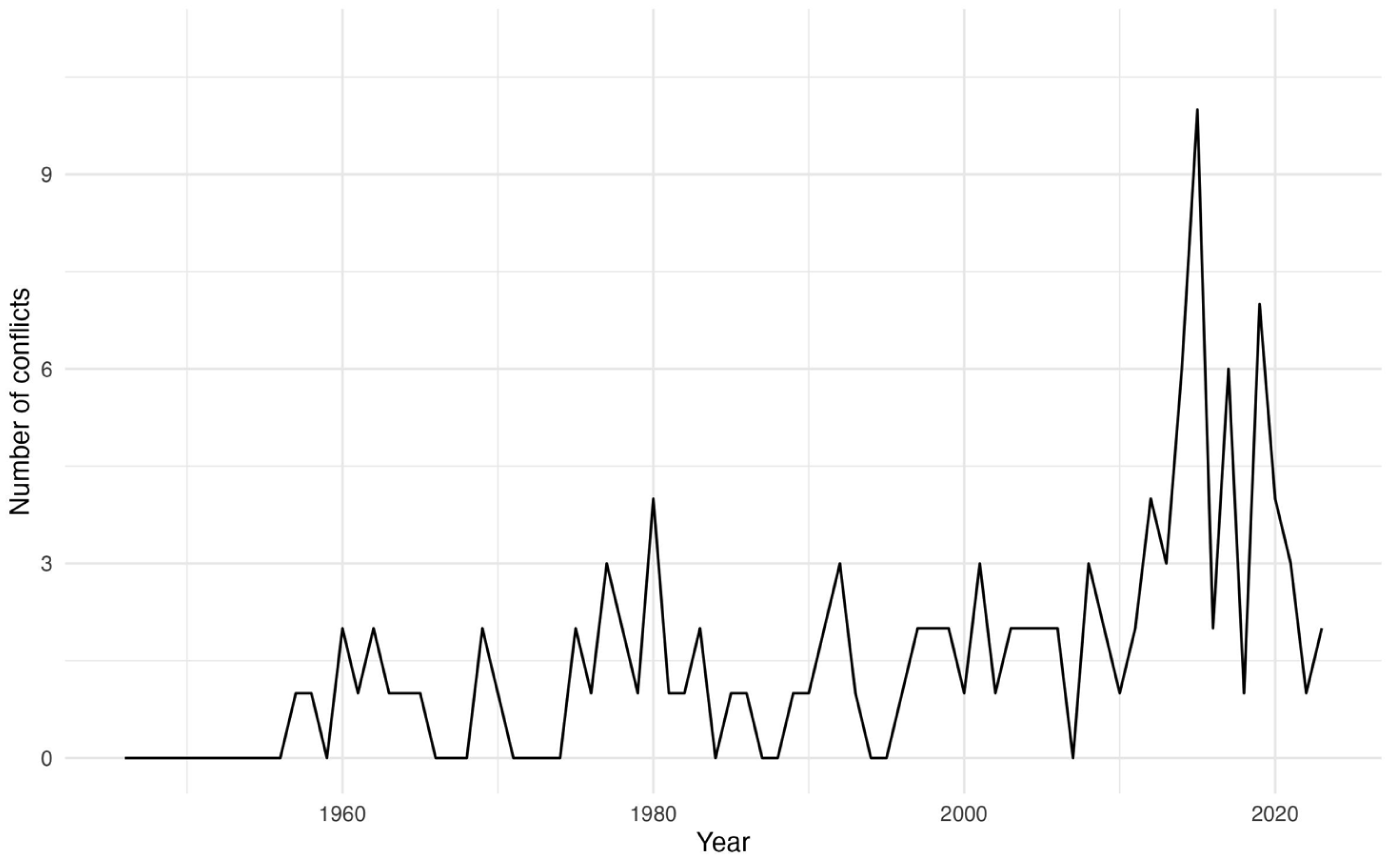
Annual events of internationalization of intrastate conflicts.
Are these changes systematic and when did internationalization become more frequent?
The visual inspection of the time series provides descriptive evidence of systematic shifts or changes, and we therefore submit the data presented in the graphs above to a more systematic test of whether and when a significant change occurred. Specifically, we assess if we can identify a year in which the average level of international involvement changed so much that the subsequent level cannot be explained by normal variation, a so-called structural break. 18
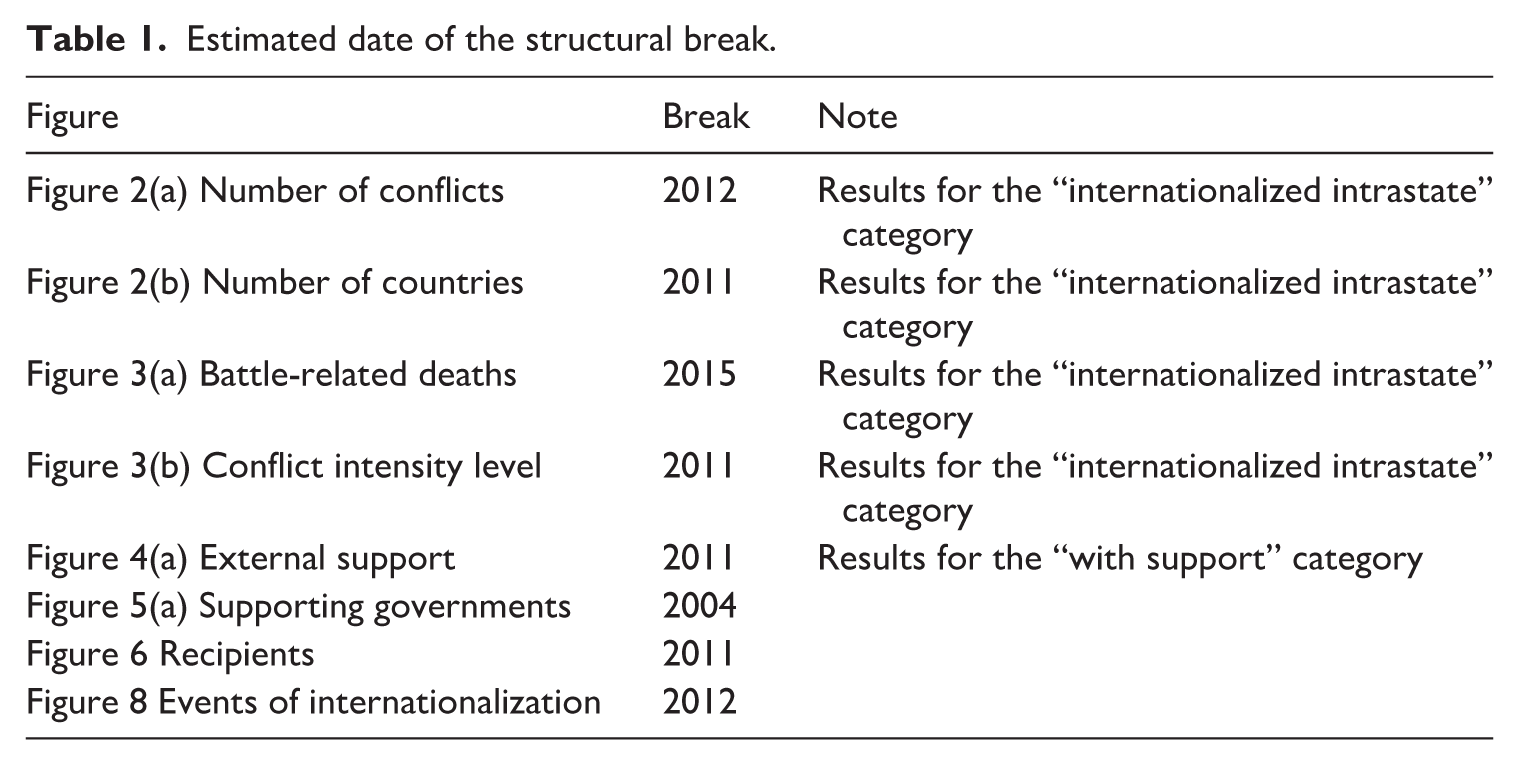
Table 1 lists the estimated year of the structural breaks and shows that virtually all types of external involvement experienced a structural break in 2011 or 2012, that is, a change in the average level of international involvement that cannot be explained with normal variation. All estimated years are highly statistically significant (p < 0.000001). Only battle-related deaths in internationalized intrastate conflicts and the number of governments providing troop support shifted in different years, respectively, in 2015 and 2004. Battle-related deaths are a highly variable indicator, as outlined above, whereas the number of governments providing troops most likely increased due to the conflicts in Afghanistan and Iraq, which escalated in the mid-2000s. These two deviant cases notwithstanding, this powerfully underscores that at the beginning of the 2010s, a substantive change occurred that cannot be explained by random fluctuations.
Estimated date of the structural break.
Having established this systematic shift, we can now proceed to examine possible explanations for why external actors are becoming increasingly involved in intrastate conflicts.
Assessing potential explanations for the recent trend in internationalization
At first sight, explaining macro trends in global conflict time series may seem a futile exercise. Empirical research designs for a relatively short, univariate time series have very low internal validity. Moreover, there is so far no encompassing (explanatory) theory that would allow us to understand the increase of both direct and indirect state as well as non-state external support. Based on the network perspective on internationalized intrastate conflict developed above, however, we can systematically derive potential explanations for the macro trend at hand.
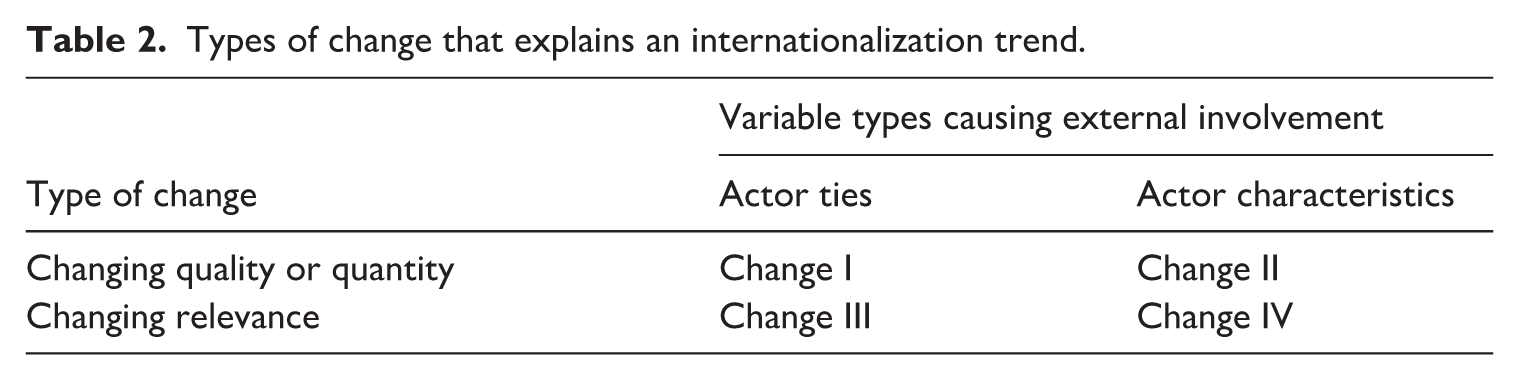
The explanations we propose integrate existing theory and evidence on the causes of external support and interventions. From our network perspective, the external involvement of outside actors in an intrastate conflict can be caused, first, by the characteristics of the actors involved—both local conflict parties and external supporters—and, second, by the ties between these actors. Actor characteristics and ties are the two defining variable types causing external support and intervention (dimension 1). Both types of variables can change in quality and quantity or become more or less relevant (dimension 2). In the latter case of changed relevance, existing actor characteristics and ties become more or less likely to trigger external involvement than in previous times. For example, a certain ideological leaning of rebels involved in intrastate conflicts may yield varying state responses depending on the respective “global time” in which an armed conflict takes place (Hensell and Schlichte, 2021: 31). Their causal effect size increases because—material or discursive—changes, for example, in the international system, cause actors in the network to reassess other actors in the network and their ties to them.
Combining these two dimensions (actors/ties and type of change), the globally rising number of internationalized intrastate conflicts can be attributed to four types of change (see Table 2): First, actor ties that cause foreign involvement in intrastate conflicts could change in quality or quantity (change I). Second, and similarly, actor characteristics, such as regime type or economic interests that shape decisions regarding external military support, may also change (change II). Third, actor ties that cause foreign involvement might not change in quality or quantity but become more (or less) relevant for external actors’ decisions to become involved in an intrastate conflict (change III). Fourth, actor characteristics that cause external support could become more (or less) relevant to other actors (change IV).
Types of change that explains an internationalization trend.
In line with the network perspective, we attribute each potential cause of external involvement to different features of the network—actors and their characteristics, ties between actors, and how these elements gain or lose significance as actors reassess each other within the broader network structure. By assessing the empirical plausibility of each of these pathways of change, we can identify which mechanisms have most likely driven the observed phases of increased internationalization. 19
Building on Figure 1, Figure 9 presents a hypothetical conflict network and describes how we may order various explanations of internationalization along the dimensions of actor characteristics (i.e. the nodes in the network) and ties between them (i.e. the links connecting the nodes). At its core, we again have a simple intrastate conflict between the incumbent government (actor A) and a rebel group challenging this government militarily (actor B). The gray arrows indicate that actors A1, A2, A3, and A4 provide external support to actor A, and that actors B1 and B2 are external supporters of actor B.
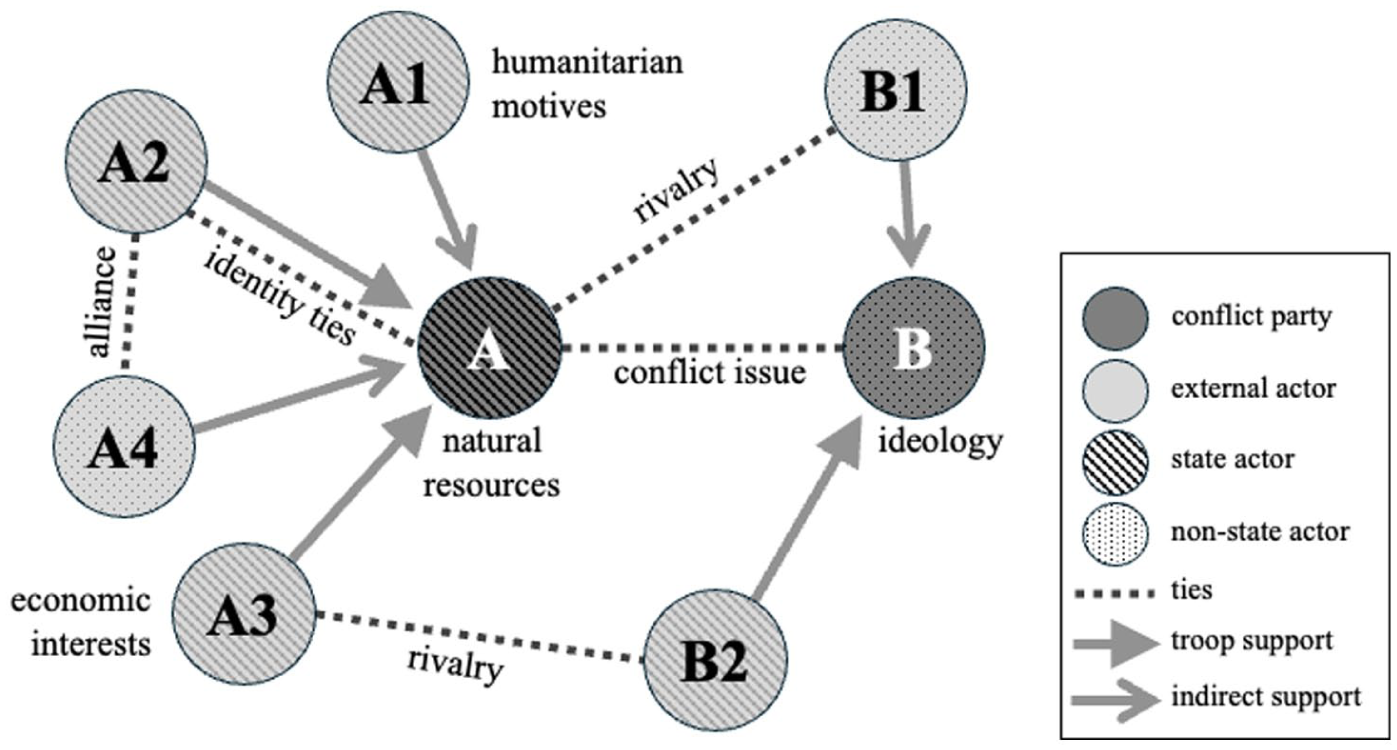
Possible causes of change in a network of an internationalized intrastate conflict.
The figure contains various explanations for why we observe support from specific actors for other actors. Each explanation is either rooted in a characteristic of an actor or in a specific tie that two actors share. The dotted lines indicate ties between actors that exist independently of the specific conflict and that may cause the intervention of an external actor (both state and non-state actors) in the conflict between A and B. This includes Mitchell’s (1970) transnational ties between external supporters and local recipients. Yet, the rivalry between A3 and B2 highlights that a tie can trigger external involvement even when this relationship does not involve the primary conflict parties A and B (see also Beardsley, 2024). Furthermore, it is worth recalling that ties can represent either friendly or conflictual relationships. This framework also helps us understand how Mitchell’s (1970) international factors can contribute to internationalization: As Kalyvas and Balcells (2010) have argued with a view to the impact of the end of the Cold War on civil wars, changes in the international context can alter actor characteristics and ties, as the demise of the Soviet Union meant a cut in its relations to allied regimes and rebel groups (change I + II). Yet, as in the case of the US backing of anti-communist regimes, structural changes in the international context—here, the end of system polarity—can also mean that existing ties to unchanged actors become less relevant and therefore less of a cause for external involvement (change III) (Kalyvas and Balcells, 2010: 421–22).
Building on Table 2, the following sections systematically examine prominent explanations of external involvement in armed conflicts, categorizing them by whether they focus on actor characteristics or inter-actor ties. For each category, we identify potential changes in quality, quantity, or relevance that could explain the observed increase in internationalized intrastate conflict and assess their empirical plausibility.
Changes in actor characteristics
At the actor level, as with the domestic factors in Mitchell’s (1970) model, internationalization can be caused by changes in the characteristics of either the primary conflict actors (state and non-state) or the interveners (state and non-state). First, characteristics of the state conflict party can cause foreign involvement. In Figure 9, state actor A controls natural resources, which is a prominent explanation of external interventions. Resources are a characteristic of the actor who controls them, most often the incumbent regime. Similarly, a country’s regime type is a characteristic of the state conflict party that might affect external support in a conflict (Saideman, 2002).
Several explanations of interventions also focus on non-state actors’ characteristics (Skoll, 2025). Insurgent groups that control territory are more likely to receive support (Salehyan et al., 2011). Similarly, rebel capacity may be a reason for international engagement, with strong rebel groups more likely to receive military support (Gent, 2008; Szentkiralyi and Burch, 2018). Furthermore, rebel fragmentation may be a cause for intervention (Berlin and Malone, 2023). The rebels’ ideology might also explain external involvement. In Figure 9, actor B may propagate a specific ideology, for example, Islamism, which may increase the probability that foreign actors intervene against it in a conflict or increase the probability of non-state actors with a similar ideology supporting it through weapons, training, or fighters.
Specific actor characteristics may change over time, thereby explaining the increasing internationalization. The rise in internationalized intrastate armed conflicts has most prominently been attributed to the recent wave of Islamist insurgent groups (Davies et al., 2022: 597). If the explanation for the internationalization trend were to be found in the growing quantity at the level of conflict actor characteristics (change II), we would expect that the share of Islamist conflicts that are internationalized remains relatively stable while Islamist conflicts become more frequent. If the explanation for the internationalization trend were to be found in the growing relevance of Islamist ideology (change IV), we would expect a rising share of Islamist conflicts that are internationalized while the share of Islamist conflicts among all intrastate conflicts remains stable. This would indicate an increasing readiness of external actors to internationalize an Islamist conflict by intervention.
Using the UCDP Conflict Issue dataset (Brosché and Sundberg, 2024), 20 we find that the number of internationalized intrastate conflicts in which the insurgents sought to transform the political system into an Islamic state has indeed increased since 2000 (see Figure 10). 21 However, internationalized conflicts without Islamist actors have increased at similar rates. Therefore, conflicts in which the insurgents sought an Islamic state have not become the dominant type among internationalized conflicts in general. 22 Moreover, the increase in conflicts with Islamists predates the large increase in internationalized conflicts around the year 2011/2012, which could be explained, among other things, by events such as the 2003 Iraq War that had a strong mobilizing impact on jihadist groups worldwide (Hegghammer, 2006). The data suggest that this change in the characteristics of primary conflict parties has plausibly contributed to the internationalization of intrastate conflict but does not drive the trend entirely.
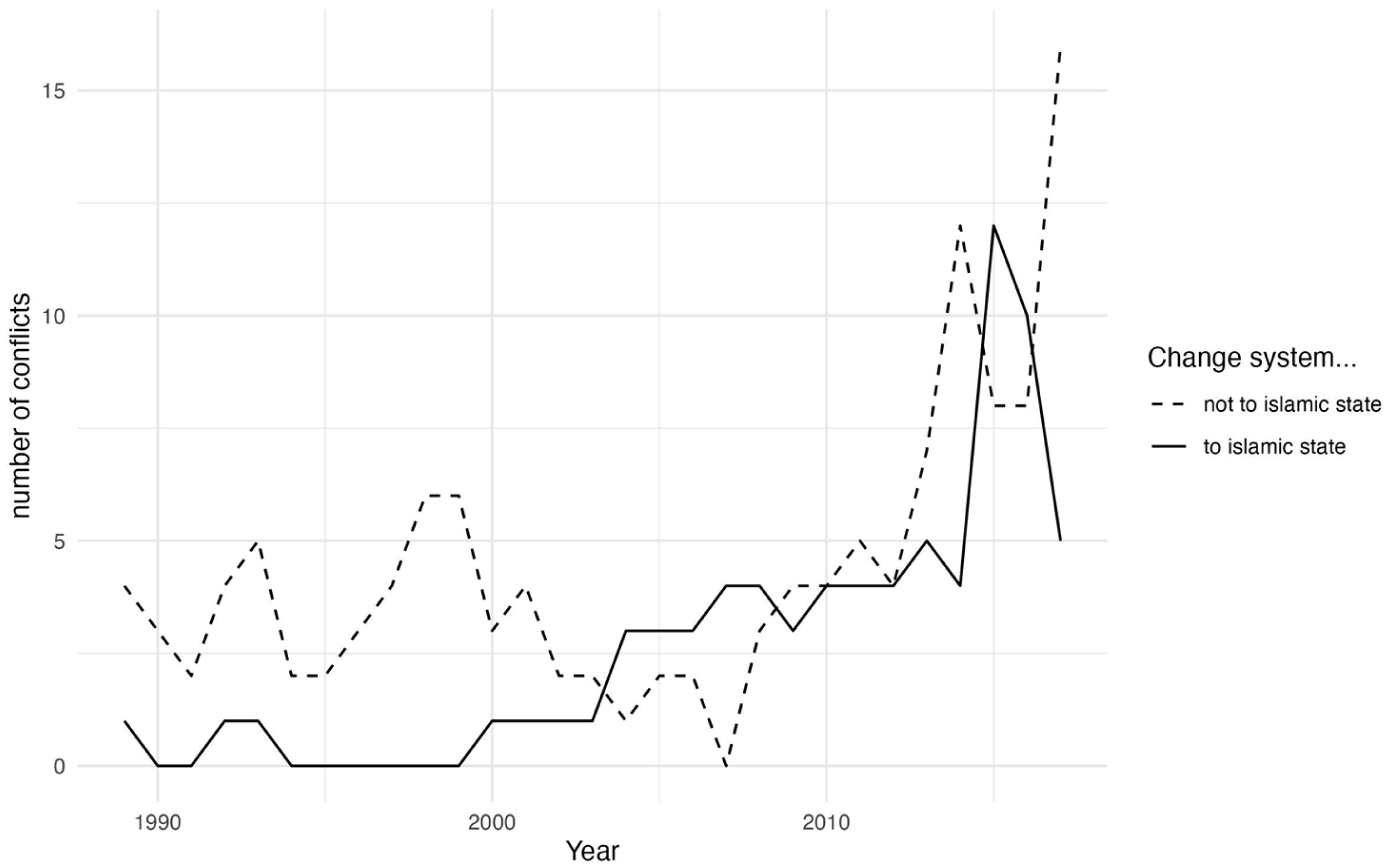
Internationalized conflicts with conflict parties attempting to change the political system (1989–2017).
While the global proliferation of Islamist insurgent groups (change II) contributes to the explanation, shifting external attitudes toward intervention in conflicts involving such actors (change IV), which we tackle further below, represent an equally important factor. Future research should examine both the rise of Islamist actors and the evolving international response to them. This analysis requires distinguishing between different types of Islamist groups, as evidence suggests meaningful variation in their (trans)national aspirations (Schwab, 2023; Stenersen, 2020).
Explanations based on the characteristics of supporters, or those third-state and non-state actors that intervene directly or indirectly into an intrastate conflict, build on the insight that (military) interventions may serve actors’ “political, economic, strategic, territorial, or humanitarian objectives” (Kisangani and Pickering, 2021: 8; Pickering and Kisangani, 2009: 593). For instance, fossil fuels (Bove et al., 2016: 1251; San-Akca et al., 2020), as well as other resources, make military support for parties to an intrastate conflict seem attractive to external supporters (Klosek, 2018: 344). 23 Supporters may seek to secure access to another state’s resources or to avoid contagion that threatens existing supply routes in the vicinity of a conflict (Chojnacki, 2006: 27, 30; Kathman, 2011).
Other goals range from “changing the domestic politics of a foreign country” (Recchia and Welsh, 2013: 5), changing regimes (Henriksen, 2022, 15–32), and promoting democracy (Hermann and Kegley, 1998), to “saving strangers” (Wheeler, 2000) and other humanitarian purposes, to fighting terrorism (Cottey, 2003)—and finally, to influencing the outcome of an ongoing civil war (Dunér, 1983). For example, in Figure 9, supporter A1 is concerned about humanitarian issues and, therefore, intervenes. These motivations usually arise from specific characteristics of the intervening actor, such as domestic politics, regime type, and normative goals like protecting human rights or the international order. 24 More general theories on the domestic dimension of the decision to use force build on the core assumption that the main goal of political elites’ behavior is to stay in power (Tamm, 2016). However, elites face constraints when deciding whether or not to get involved in a conflict (Sakstrup and Tolstrup, 2020; Weeks and Crunkilton, 2017). These constraints depend on regime types and the size of their selectorates (Bueno de Mesquita et al., 2004). For example, personalist regimes usually have small winning coalitions and, therefore, get engaged in war more often (Weeks, 2014: 7). Regimes may also differ with regard to the role they accord to normative goals when it comes to the decision to get involved in armed conflict. Humanitarian interventions are concerned with the normative goal of safeguarding civilians. This makes humanitarianism seem a typically democratic reason (or justification) for military intervention, as we would not expect the critical public to play an important role in more closed authoritarian regimes. Some even identified a specific “disposition of democracies to intervene militarily” (Chojnacki, 2006: 30; see also Geis et al., 2013) based on normative considerations.
The characteristics of potential external supporters, such as their regime type or normative motivations, can change over time and thereby alter the number of intrastate conflicts with external involvement. For example, although humanitarian intervention has been an issue since the 19th century, the concern for human rights as a reason to consider military intervention has grown over the second half of the 20th century (Finnemore, 2013). Moreover, the discourse on humanitarian interventions’ legitimacy changed after the end of the Cold War and in the early 2000s (Weiss, 2016; Wheeler, 2000). The report of the International Commission on Intervention and State Sovereignty (ICISS, 2001) sparked a lively debate on the Responsibility to Protect, culminating in the adoption by the 2005 World Summit of the Responsibility to Protect as an international norm. This could have either led to increased internationalization through an increase in actors willing to start humanitarian intervention because public attention to humanitarian crises increases in potentially intervening countries or through changes in their regime types (e.g. more countries become democratic, change II). Alternatively, even with unchanged domestic preferences, states may feel more obliged to respond to the international norm or find it easier to justify an external involvement in terms of a humanitarian agenda (change IV). In both cases, we would observe humanitarian interventions becoming more frequent among internationalized intrastate conflicts. If the explanation lies in changes in actor characteristics—such as more countries becoming democratic or publics becoming more attentive to humanitarian crises (change II)—we would expect the share of humanitarian interventions among internationalized conflicts to remain relatively stable while the overall number of internationalized conflicts increases. If instead humanitarian norms become more relevant to external actors’ decision-making (change IV), we would expect a rising share of internationalized conflicts to involve humanitarian interventions, even if the characteristics of potential interveners remain unchanged. Combining data from the ESD and the Humanitarian Military Intervention (HMI) dataset (Gromes and Dembinski, 2019), Figure 11 depicts an increase in humanitarian interventions in internationalized intrastate conflicts with a significant increase after 2010. However, the absolute numbers are relatively small and can, at best, explain a limited part of the rapid increase in internationalized conflicts since 2011. Moreover, the significant increase in non-humanitarian interventions since 2010 outnumbers those with humanitarian justifications by far (see also Bellamy, 2023: 395).
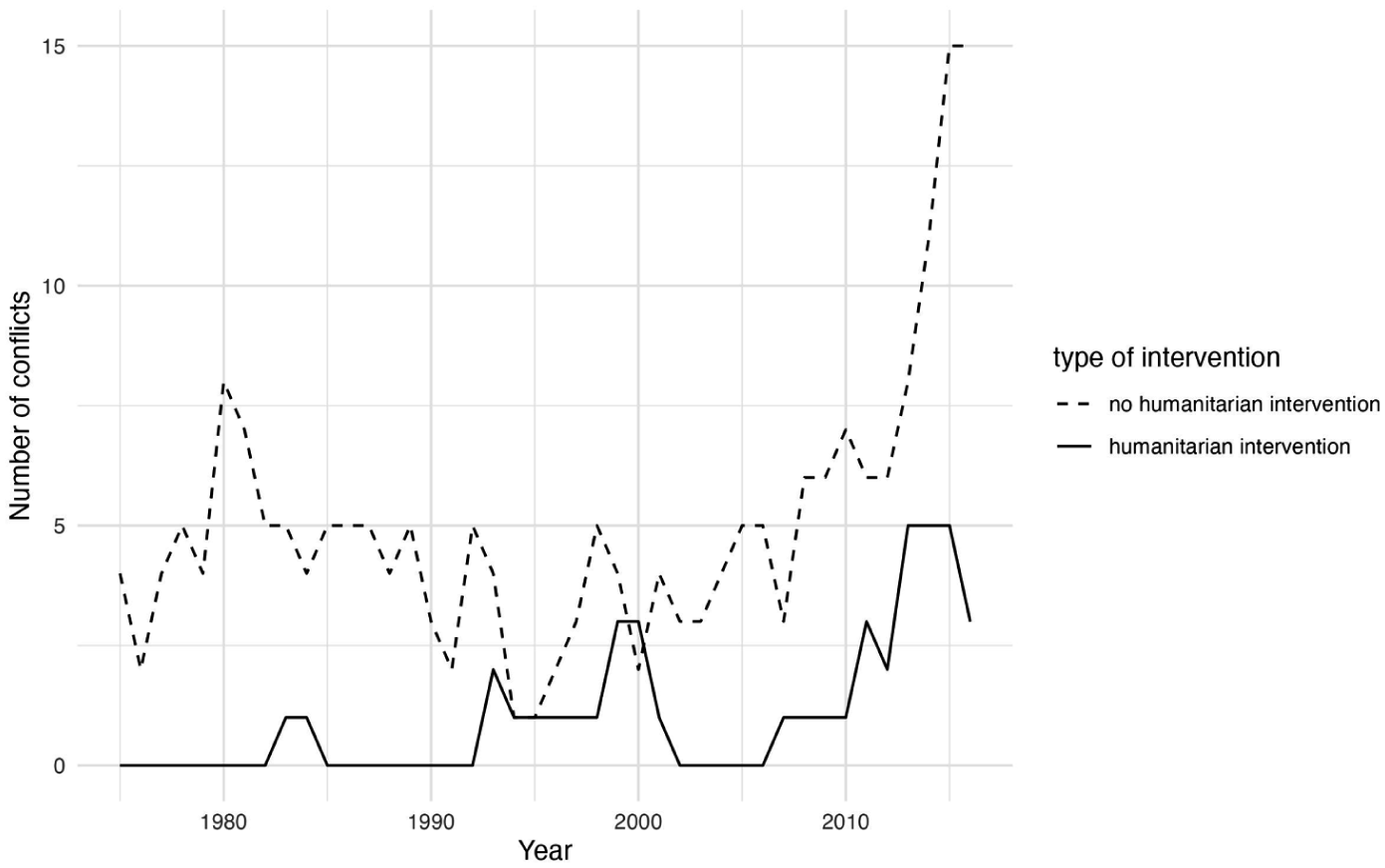
Types of intervention in internationalized intrastate conflicts (1975–2016).
Another possible explanation of the recent internationalization trend concerns the so-called global war on terror (Bellamy, 2023: 395; Meier et al., 2023: 551). 25 Very clearly, an important part of the military interventions and other forms of external involvement in intrastate conflict over the last two decades is related to the fight against organizations designated as terrorist, in particular transnational Islamist rebel groups. This includes the first phase of the global war on terror, which was directed against al-Qaida networks and employed massive military force and boots-on-the-ground missions, but also the US-led international coalition against ISIS in Iraq, Syria, and the fight against Islamist rebels in the Sahel region, which relied more on “light footprint” approaches, means of remote warfare such as drones, and the deployment of special forces (Boyle, 2020).
The war on terror has become a pervasive global security framework (Karlsrud, 2019; Moe and Geis, 2020), fundamentally altering intervention incentives in intrastate conflicts. Third states now demonstrate heightened willingness to support governments against transnational Islamist groups under the counterterrorism banner, driving the documented increase in pro-government interference (Meier et al., 2023: 551). This shift reflects both changed supporter motivations (change II) and evolving international discourse that legitimizes counterterrorism interventions across both Western and non-Western contexts (change IV) (Ahmad, 2016; Dexter, 2007; Holland, 2012; Khalid, 2017).
Figure 12 supports this interpretation and shows the number of internationalized intrastate conflicts in which at least one non-state primary conflict party was listed as a terror organization. 26 There are two points in time when the numbers increased considerably: in 2003 and a decade later in 2014/2015. The latter rise is remarkable, and since 2015, a clear majority of internationalized intrastate conflicts have involved designated terrorist organizations as non-state primary conflict parties. Note that, since 2011, all of the non-state conflict parties designated as terrorist and involved in internationalized intrastate conflict have been labeled Islamist terror organizations. This development is even more noteworthy when considering that the data on non-internationalized intrastate conflict shows a more balanced picture (see Figure 18 in Appendix 1). This concentration of terrorist-designated actors within internationalized conflicts suggests that designation status—rather than absolute numbers—drives external intervention. While this points to changed perceptions of Islamist groups as the primary mechanism (change IV), the possible role of an actual expansion of terrorist insurgent groups (change II) cannot be entirely dismissed either. 27
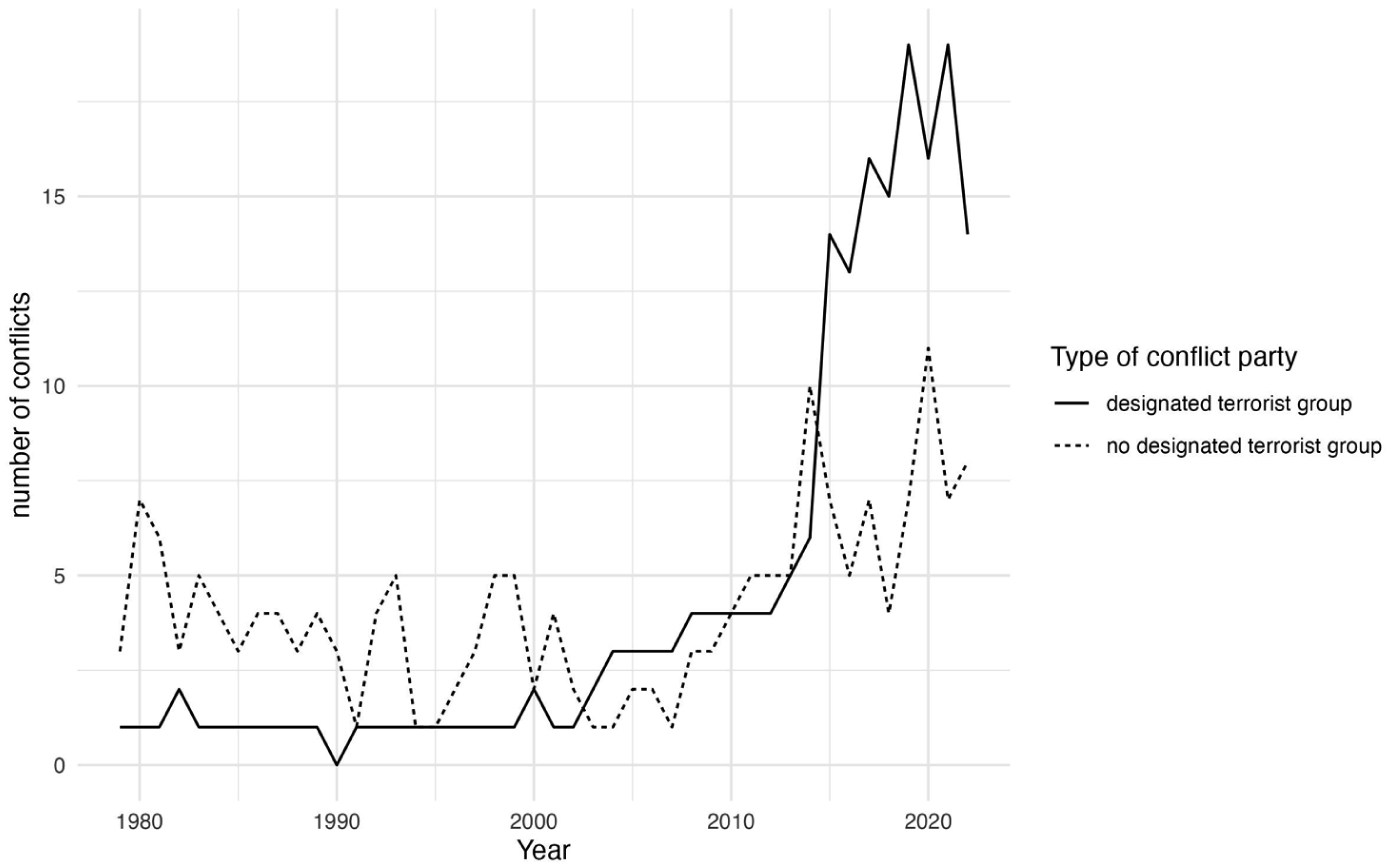
Types of non-state conflict parties in internationalized intrastate conflicts from 1979 to 2022.
Changes in ties between actors
Moving away from a focus on either the primary warring parties or the intervener, the reason for external involvement can also originate from the relationship between actors in the conflict network. According to the logic of the network, this means that while the nodes remain unchanged, the ties between them may change. There are three types of relationships between the relevant actors: The causes for external intervention can be related to the ties between, first, one of the primary conflict parties and its supporter(s), second, the conflict party and the supporter(s) of the other side, or, third, the supporter and another supporter.
A common explanation of intervention is the existence of identity ties between conflict parties and their supporters. In Figure 9, the friendly relationship between the conflict party A and its supporter A2 is based on their shared identity traits. Religious and ideological links and ethnic ties, whether between neighbors or across greater distances, affect outsiders’ motivation to lend support in a civil war (Bove and Böhmelt, 2017; Carment and James, 2000; Gleditsch, 2007; Ives, 2019; Saideman, 2002; San-Akca, 2016). Moreover, if an insurgent group has transnational constituencies, this increases the probability that they attract outside support (Salehyan et al., 2011), such as foreign fighters (Hegghammer, 2010). Insurgent groups themselves can also be organized transnationally (Salehyan, 2011). This may foster cooperation among states facing the same enemy and entail interventions by states in which the respective group is active. Other examples of ties facilitating support are geographic proximity (Regan, 2011, 465) or a historically grown connection (Berenskötter and Mitrani, 2022). Historical colonial relationships illustrate this pattern: studies demonstrate that former colonial powers are more likely to intervene in conflicts involving their former colonies (Chacha and Stojek, 2019; Findley and Teo, 2006; Lemke and Regan, 2004; Powell, 2021).
If general changes in ties between supporters and supported were to contribute to the internationalization trend (change I), we would expect to observe an increase or decrease in the number of internationalized intrastate conflicts in which there is a specific link between the intervener and the conflict party. To examine the ethnic relations between the supporters and the supported, we combined the ESD data with the Transborder Ethnic Kin dataset (Vogt et al., 2015). 28 Figure 13 shows that internationalized intrastate conflicts with and without ethnic relations have contributed equally to the increase in internationalized conflicts since the 2010s. Although there has been an increase in the share of internationalized conflicts characterized by an ethnic relation between the intervener and the conflict country, this trend, therefore, does not account for the rapid rise of internationalized conflicts in the last decade. Data on colonial ties reveal a similar picture (see Figure 19 in Appendix 1).
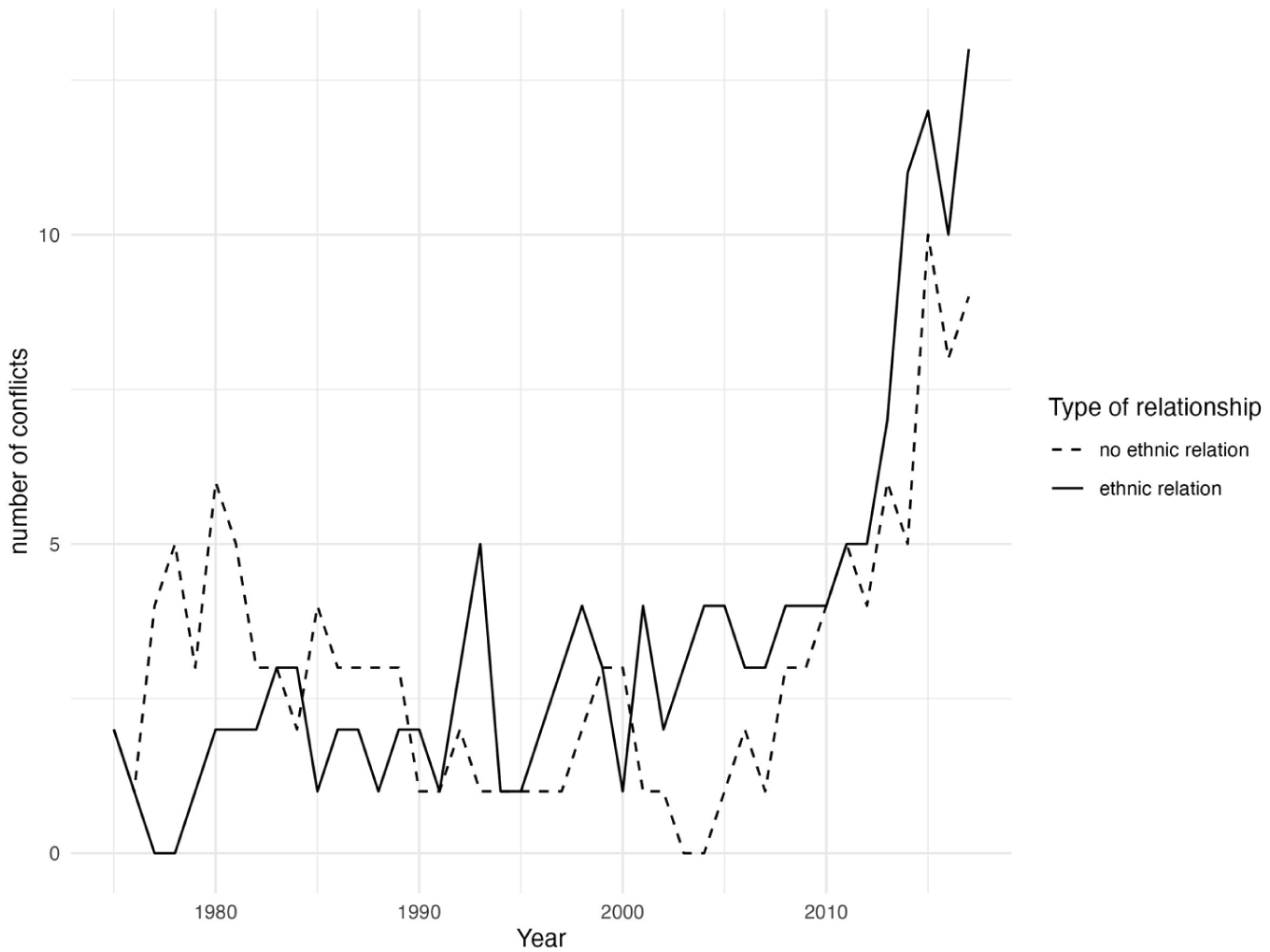
Ethnic relationship between intervening and conflict countries in internationalized intrastate conflicts.
External actors may also intervene in an intrastate conflict due to the ties between a supporter and the opposite conflict party. In Figure 9, the conflict party A and supporter B1 are rivals. Consequently, B1 supports actor B in its fight against A. In essence, the enemy of an enemy is a potential friend, and external actors often lend support to such potential friends to weaken a rival (Isoda, 2022; Maoz and San-Akca, 2012). If such rivalries have become more frequent, for example, through increasing international tensions or an erosion of international institutions which had previously fostered positive ties between states, this would correspond to change I.
A third explanation of international involvement is the relationship between two supporters. Here, external supporters may not even have a very high interest in the war per se but rather become involved because other outside actors are engaged (Elias, 2017; Schulhofer-Wohl, 2020). In Figure 9, actors A3 and B2 are rivals, and each one may intervene on opposing sides to undermine the other’s interests. In such rivalries, the enemy of an enemy’s friend may become a friend. Historically, the proxy wars between the United States and the Soviet Union during the Cold War are prominent examples of this pattern (Anderson, 2019; Findley and Teo, 2006). The end of the Cold War brought about a different pattern of external support structures due to changed power relations in the international system: superpower support was replaced by support, first, from lesser states, and then increasingly non-state actors such as other rebel groups, diasporas, religious communities, and/or wealthy individuals (Byman et al., 2001; Grauer and Tierney, 2018; Kalyvas and Balcells, 2010).
Some research suggests that interstate rivalries are at work in recent conflicts again and may drive up the number of internationalized intrastate conflicts (change I). A number of interstate rivalries played out as intrastate conflicts on the African continent (Duursma and Tamm, 2021), which dovetails with the finding in Figure 7 that Sub-Saharan Africa experienced the biggest increase in internationalized intrastate conflicts. More generally, this assessment resonates with earlier warnings that scholars of international war might have underestimated the level of armed conflict in the international system by ignoring indirect conflict strategies, like the provision of aid to rebel organizations (Salehyan, 2010). Moreover, structural changes in global power relations and world order during the first two decades of the 21st century have arguably accompanied intensifying interstate rivalries. Bellamy (2023: 389) suggests these changes reflect a new “geopolitical context,” characterized by “increasingly militarized competition.” In this sense, changing context condition may make existing rivalries more likely to trigger external support (change III).
In terms of our network framework, such a change in the structure of the international system can have three types of effects. First, it deteriorates ties between great powers and makes (competing) intervention into intrastate conflicts more likely (change I). Second, increasing great-power rivalries can increase the relevance of existing ties between these powers and local conflict parties as the latter may be seen as relevant allies in the struggle over competing spheres of influence (change III). Third, at the structural level, the transition to a multipolar order without a clear-cut hegemon can reduce international constraints on regional powers. Existing (negative) ties between intraregional rivals (e.g. Saudi Arabia and Iran), then, become more likely to escalate into (competing) interventions and proxy wars (change III). Indeed, arguably, such dynamics have been observed for some time in several contemporary internationalized intrastate conflicts in West Asia (e.g. Yemen and Syria) (Ahram, 2020; Stein, 2021).
If increasing interstate rivalries were a cause driving the recent trend in internationalization, we would expect the number of intrastate conflicts in which both sides receive military support to increase. Figure 14(a) shows that conflicts in which both conflict parties received indirect support clearly dominated until the 1990s. After a decline in the 1990s and early 2000s, the number of conflicts in which both sides are supported has been increasing again and, since 2011, reached an unprecedented level. This lends support to the idea that the ongoing change in the international system might be bringing about a fundamental change in civil war dynamics, similar to the end of the Cold War (Kalyvas and Balcells, 2010). The simultaneous provision of indirect external support could herald a new era of competitive interventions, which were associated with protracted conflicts during the Cold War (Anderson, 2019).
The picture looks different when focusing on troop support. As Figure 14(b) shows, internationalization of intrastate conflict so far hardly involves competing troop support to governments and rebels.
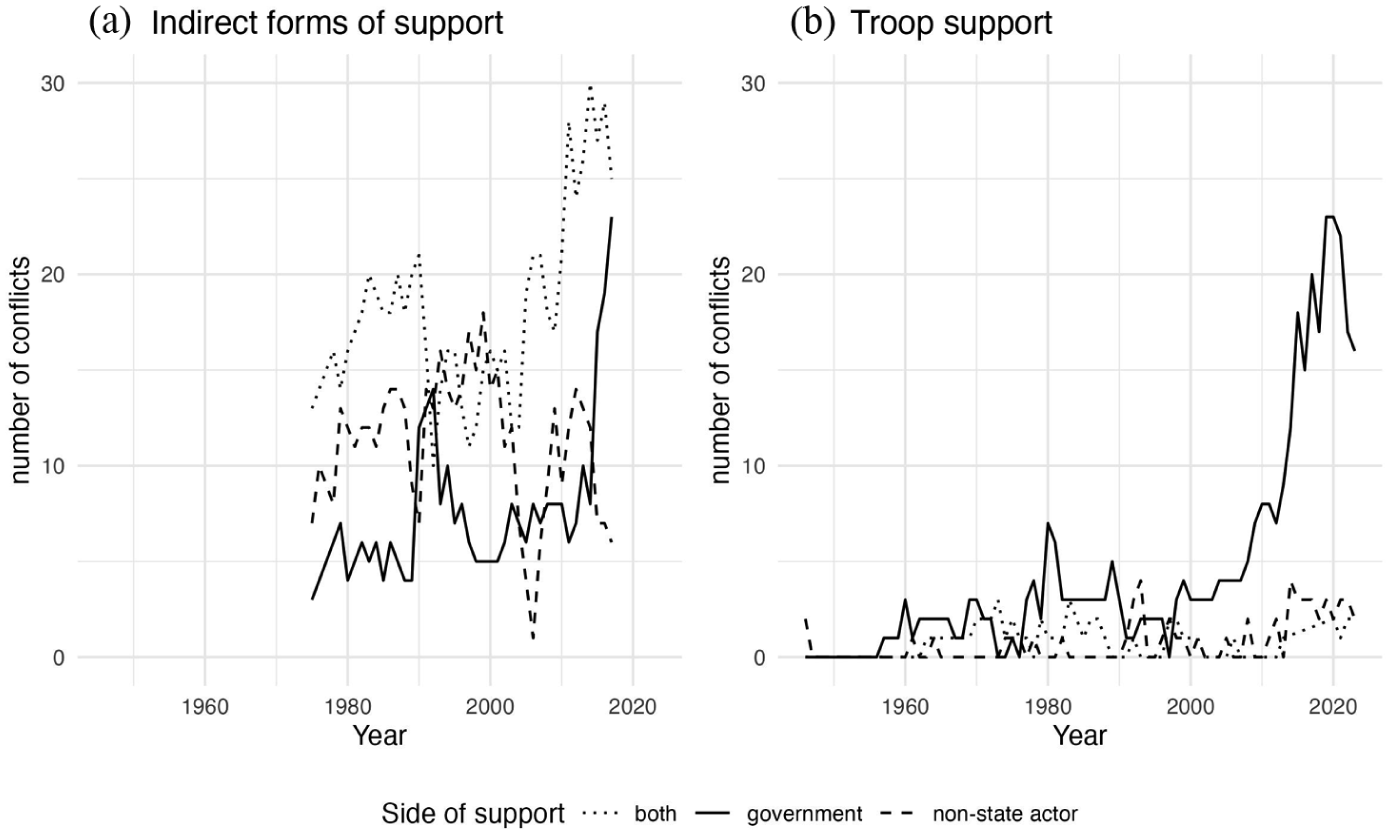
Conflict parties receiving external support in intrastate conflicts. (a) Indirect forms of support. (b) Troop support.
On the contrary, both indirect and direct support to governments has been on the rise. This matches with findings on changes in support patterns by Cunningham et al. (2016: 53): While historically “support to rebels has been more common,” with the end of the Cold War “the overall level of support for the rebel side in civil wars has dropped precipitously, despite prominent cases such as Libya, Syria, and Ukraine where external support is considered influential.” Cunningham et al. (2016: 53) rather note a “trend toward growing foreign support of governments,” including in the form of “larger multilateral coalitions supporting the government side.” While these authors focus on the first two decades after the end of the Cold War, Figure 14(b) shows that this trend has accelerated in particular during the 2010s (see also Meier et al., 2023). At the same time, Grauer and Tierney (2018) documented increased support for rebels in the post-Cold War period. The ESD reveals that this trend primarily stems from two sources: non-state support and indirect forms of (state) support (see Is there a trend of increasing internationalization?), which also aligns with Grauer and Tierney’s (2018) findings.
An intervention can also result from a friendly relationship between two supporters. In Figure 9, supporter A4 does not have direct ties with the conflict party A. Instead, A4 is an ally of supporter A2. By supporting conflict actor A, A4 helps a friend or complies with obligations in an international alliance. This pattern helps explain the rising number of conflicts in which troop support has been provided in the form of coalitions since 2000 (see Figure 14 and Figure 16 in Appendix 1). In fact, the dramatic increase in the number of states sending troops into intrastate conflicts (Figure 5(a)) can only be explained by considering the role of such coalitions, which are sustained by many states that participate to support another state or an international organization.
In this section, we have developed a systematic framework for explaining the observed trend in internationalization by applying our network perspective to existing theory and evidence on external intervention. The framework identified two key dimensions that can drive changes in internationalization: actor characteristics (of both local conflict parties and external supporters) and the ties between these actors, both of which can evolve in quality, quantity, or relevance over time. Assessing the empirical plausibility of these potential drivers, we found partial support for changes in actor characteristics (i.e. an increase in internationalized conflicts involving designated terrorist organizations as non-state primary conflict parties) and changes in actor ties (i.e. an increase in competing interventions where indirect support is provided to both conflict parties and an increase in troop support to governments).
Conclusions
This article has introduced a network perspective on internationalized intrastate conflict to systematically analyze the growing trend of external involvement in intrastate armed conflict. Despite the political significance and devastating human costs of recent internationalized conflicts, systematic research on this critical phenomenon remains surprisingly limited. Through analysis of recent datasets and examination of multiple conceptualizations of internationalization, our study empirically confirms that internationalized intrastate conflict has expanded notably during the 2010s. Our network framework provides a structured approach for evaluating potential explanations of this trend and assessing their empirical plausibility.
Empirically, we observe a clear trend: Intrastate conflicts appear to be increasingly embedded in international networks of militarily relevant support. Two developments seem to be shaping this trend: First, we see a rising number of pro-government interventions with troop support over the past two decades. This development started in the early 2000s, and most data suggest a systematic shift in 2011/2012. Around 2020, this foreign troop involvement affected more countries than at any time for which we have comparable data. This increase in external involvement is particularly characterized by a diversification in state supporters, who increasingly tend to provide troop support to the government side and do so in the form of coalitions. Second, since 2009, we have also seen a rising number of conflicts in which both sides receive indirect support in the form of weapons, intelligence, or other forms of assistance. Furthermore, although at a lower level, we also see increasing non-state support to rebels, mostly in the form of financial support and light weapons. However, the number of studies on this specific topic is still limited.
As a result, internationalized intrastate conflicts have become the dominant conflict type among high-intensity conflicts. Taking a network perspective to systematically examine the causes of this internationalization trend, our analysis reveals multiple interconnected drivers rather than a single explanation. Two key mechanisms emerge as particularly important: first, the interaction between the prominence of Islamist rebel groups (i.e. changes in actor characteristics) and the so-called global war on terror. This dynamic has created stronger incentives for external state intervention (increased relevance), particularly in support of governments and through coalition arrangements. The empirical evidence supports this explanation: since 2015, the majority of internationalized intrastate conflicts have involved designated terrorist organizations as primary non-state actors, while non-internationalized conflicts exhibit a more balanced distribution of actor types. While our operationalization of Islamist groups does not correspond to the most recent rise of internationalization, with similar shares of Islamist and non-Islamist actors across both internationalized and non-internationalized conflicts, their designation as terrorist organizations, rather than their absolute numbers, likely drives external intervention. This mechanism aligns with the logic of the war on terror framework and points to changing relevance as the underlying dynamic.
A second potential driver is the rise in interstate rivalries associated with the ongoing structural transformation of the international system into a politically fragmented, multipolar order, characterized by heightened geopolitical competition. According to the data, recent trends in internationalization are not (yet) characterized by direct troop support on both sides of a conflict, but we do (already) see high levels of competing involvement when looking at indirect forms of support.
Overall, our discussion of the possible causes of internationalization is meant as a hypothesis-generating exercise. While this article does not provide definitive answers, it opens up various promising avenues and questions for future research, most notably with a view to more systematically assessing the extent to which, and the precise ways in which, the various factors identified actually shape the internationalization of intrastate conflict. In terms of theory-building, it offers a conceptual framework to develop specific propositions on how different types of changes in actor characteristics and ties affect internationalization trends. Empirically, an obvious way forward is the use of methods of network analysis. Furthermore, our explanatory framework for macro-level trends in internationalization may inform and connect with research on macro-level trends in other phenomena. For instance, analyzing the interplay of changing actor characteristics and ties in conflict networks might also help explain the remarkable decline in efforts at international mediation in civil wars since the early 2000s (Howard and Stark, 2017; Lundgren and Svensson, 2020) or the long-term trends in the use of international sanctions (Mulder, 2022).
While the data show a more general trend of increasing external involvement in intrastate conflicts during the first two decades of the 21st century, the most recent numbers suggest that this increase has perhaps already reached its apex. In 2023, as seen, the number of internationalized conflicts declined significantly, and the number of battle-related deaths dropped even more drastically. However, it is too early to tell if these recent changes represent a reversal of a remarkable increase or are simply due to random fluctuations. The most recently released UCDP conflict data for 2024 suggest a level of internationalized intrastate conflict that stabilizes on a level that is still very high by historic standards, even if decidedly lower than during the 2020–2022 peak (Davies et al., 2025: 1226). As the ESD data do not cover this most recent period, it is not yet possible to make more detailed statements about this potential trend reversal. Future data collection may allow us to evaluate this recent development more systematically.
Footnotes
Appendix 1
Appendix 2
Acknowledgements
We thank the anonymous reviewers for their thoughtful and constructive feedback on this article. We are also very grateful to our collaborators within the TraCe project team—Felix Bethke, Jonas Driedger, and Iris Volg—who are not listed as authors of this article but whose work and feedback were critical to its production. A special thanks goes to Jonah Schulhofer-Wohl who, as a TraCe Fellow, commented on earlier versions of the paper on several occasions. Finally, we thank the participants in the TraCe workshop on “The Internationalisation of Intrastate Conflict,” which took place in Frankfurt in October 2023 with the great help of Franziska Kasten and Ann-Christin Nygenfind. For their valuable inputs and the intense debates, we are particularly grateful to Margit Bussmann, Sara Daub, Stathis Kalyvas, and Anastasia Shesterinina.

Funding
The authors disclosed receipt of the following financial support for the research, authorship, and/or publication of this article: This article was written as part of the research project “Regional Research Center Transformations of Political Vio-lence” [01UG2203A], funded by the Federal Ministry of Research, Technology, and Space (BMFTR).
Declaration of conflicting interests
The authors declared no potential conflicts of interest with respect to the research, authorship, and/or publication of this article.