



Abstract
Calculating the consequences of global public bads such as climate change or pandemics helps uncover the scale, distribution and structure of their economic burdens. As violent conflict affects billions of people worldwide, whether directly or indirectly, this article sets out to estimate its global macro-economic repercussions. Using a novel methodology that accounts for multiple dimensions of war, the article finds that, in the absence of violent conflict since 1970, the level of global GDP in 2014 would have been, on average, 12% higher. When disaggregating these results by conflict type, civil conflicts are estimated to have been the costliest by far. Income growth is found to be altered up to four years following the end of a conflict, although the direction of this relationship depends on the intensity and type of conflict. Countries also suffer significantly from fighting in neighbouring countries, thereby showing the importance of mitigating spillovers rapidly. The largest absolute losses associated with violence emanate from Asia, while many high-income economies are found to benefit economically from participating in conflicts on foreign soil. This analysis thus shows that, despite some evidence of a faster post-conflict growth and possible benefits for external participants, violent conflict leads to net global losses that linger long after peace is achieved, reducing the peace dividend. The article concludes by discussing public policy options to strengthen the benefits of peace as a global public good.
Keywords
Introduction
Public bads cost society: HIV/AIDS (Veenstra & Whiteside, 2005), malaria (Sachs & Malaney, 2002), alcoholism (Rehm et al., 2009) and diabetes (Yach, Stuckler & Brownell, 2006) reduce economic growth, as do air pollution (Larsen, 2014), climate change (Stern, 2007; Hsiang & Jina, 2014; Kalkuhl & Wenz, 2020), soil degradation (Pimentel et al., 1995), financial crises (Cerra & Saxena, 2008; Inklaar, de Guevara & Maudos, 2012) and, recently, COVID-19 (Fernandes, 2020; McKibbin & Fernando, 2020).
Likewise, violent conflict burdens society both economically and socially (Collier, 1999; Verwimp, Justino & Brück, 2009, 2019; Mueller, 2013; Serneels & Verpoorten, 2015; Bove, Elia & Smith, 2017; Costalli, Moretti & Pischedda, 2017), though the aggregate, global scale of this burden remains unclear (IEP, 2016; OCHA, 2017).
Past studies have shown that a country’s economic growth can be influenced by conflicts occurring both on its own territory (Polacheck & Sevastianova, 2012) and on its neighbours’ (Murdoch & Sandler, 2002a,b, 2004; de Groot, 2010; Dunne & Tian, 2014), and this influence can be prolonged long after the conflict is ended (Organski & Kugler, 1977; Collier, 1999; Kang & Meernik, 2005). The direction, period and factors determining these relationships are, however, still debated. Furthermore, little is known about the differential consequences for the various types of conflict participants.
We thus set out to fill this knowledge gap. Using a panel of 190 countries from 1970 to 2014, we estimate the average consequence of various dimensions of conflicts on yearly GDP growth. First, we categorize all the major conflicts 1 that took place during the observed period into three types: civil (between a state and a non-state actor), interstate (between two states) and non-territorial (participation in a civil or interstate conflict taking place entirely on foreign territory). Second, we analyse the number of years following the end of each type of conflict, during which a significant relationship continues to be observed with growth. Third, we introduce a spillover variable that measures the possible influence of each type of conflict taking place up to 1,000 km away from a country’s border. Finally, as we posit that the economic consequence of each of these conflict dimensions depends on the intensity of the episode, we use an index that quantifies conflict intensity on a scale from 0 to 10, based on a variety of factors.
Using a country-fixed effects estimation and cross-checking the robustness of the results with other specifications, we find that an additional unit of civil or international conflict intensity reduces the ‘host’ country’s yearly GDP growth by an average of 0.9% during the conflict years. On the other hand, we find a U-shaped relationship between conflict intensity and GDP growth for external participants. Secondly, civil conflicts are found to have a U-shaped influence on growth up to four years following the end of a conflict, while international conflicts seem to have a positive influence up to two years later. This thus provides some evidence for Organski & Kugler’s (1977) ‘phoenix’ effect, whereby post-conflict nations grow faster than their peaceful counterparts. Finally, spillovers from civil and international conflicts are found to be strongly detrimental to growth, while having a neighbour participating externally in a conflict is found to be economically beneficial.
As a second step, we provide a methodology to estimate what the yearly growth rate would have been in the absence of conflict. We then use this estimated rate to provide a year-by-year counterfactual GDP level for each country. We consequently find that, had there been no conflict throughout the world since 1970, global GDP would have been 12% larger in 2014.
Disaggregating our main results, we find that Asia has suffered the most from conflict; while many developed economies in North America, Europe and Oceania are found to have benefited from their participation. A potential explanation for this is that external state actors intervene in armed conflicts primarily out of their own economic and national security interests (Aydin, 2012; Bove, Gleditsch & Sekeris, 2016; Bove, Deiana & Nisticò, 2018).
Our inquiry into the global economic burden of violent conflict is structured as follows. First, we illustrate the conceptual framework used for the analysis. Next, we identify the datasets and methodology used for our empirical estimation. We then present our results, discuss their robustness and compare them with previous findings before concluding.
Conceptual framework
Although there is a clear consensus that ‘hosting’ a conflict is damaging to growth in the short term (see e.g. Bozzoli, Brück & Sottsas, 2010 for a comprehensive survey on the topic), the growth reactions to being near a conflict, participating externally and ending conflict remain unclear. We thus analyse the global dynamics surrounding conflicts to estimate their net global consequences over 45 years of observation. While this is an empirical exercise, we first consider what can be learned from the theoretical literature to help construct our empirical model.
As the literature is mostly conclusive regarding conflicts occurring within a country’s own territory, we focus on this case to graphically illustrate our theoretical framework. We discuss details of the concepts introduced here below and alternative scenarios in the following subsections.
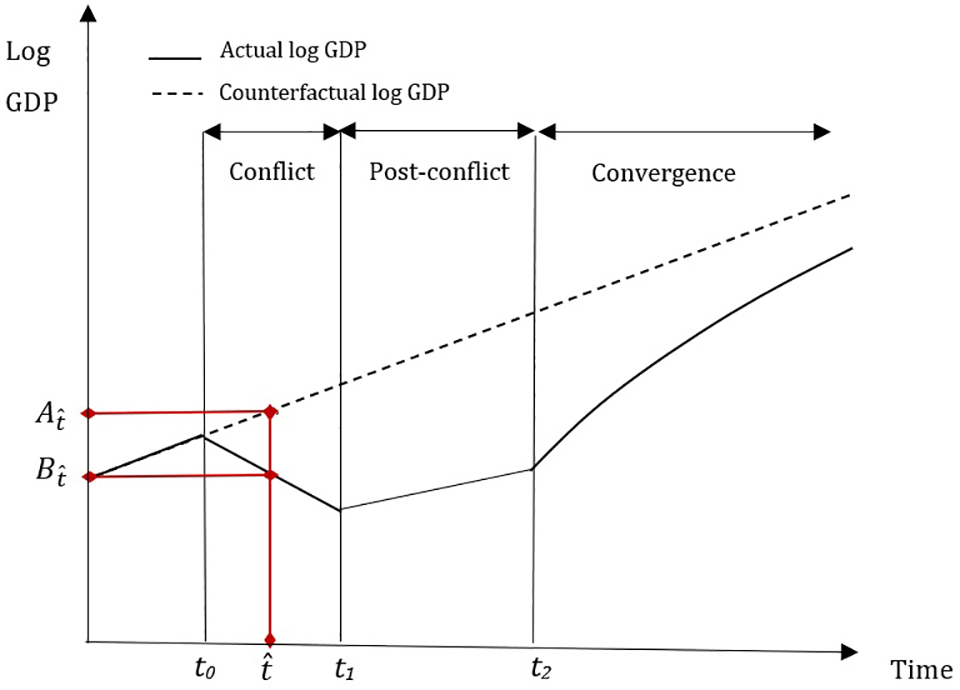
Theoretical burden of conflict
As shown in Figure 1, when a conflict breaks out in a country (at t 0), yearly GDP growth is expected to decline. Hence, the observed GDP level goes below the GDP that the country could have experienced had there been no conflict (the ‘counterfactual GDP’). Once peace is achieved (at t 1), the immediate post-conflict period starts. This is an adjustment period during which the past conflict continues to directly influence growth, although the direction of this influence and actual length of this period are still debated. For simplicity, the figure only shows the situation where a country’s growth rate is still reduced. From t 2, the previous conflict no longer has an effect, except through the theory of conditional convergence (Barro & Sala-i-Martin, 1992), according to which countries with a lower GDP, ceteris paribus, will grow faster than their richer counterparts. During the entire period, the difference between counterfactual and actual GDP is the total GDP loss resulting from conflict.
As question marks still prevail on the direction, intensity and timing that define the GDP path during each of the above-mentioned subperiods surrounding conflict, we estimate average predictions for each conflict type. We next introduce the model that is the backbone for this analysis.
Empirical model
Conflict can affect GDP not only through population changes, but also by influencing other fundamental growth predictors like investment (Abadie & Gardeazabal, 2003; Chen, Loayza & Reynal-Querol, 2008) and education (Lai & Thyne, 2007; Brück, Di Maio & Miaari, 2018). In an attempt to estimate the more direct growth alterations that can emanate from conflict, we control for the three above-mentioned variables which are included in Mankiw, Romer & Weil’s (MRW) (1992) interpretation of the Solow (1956) model. With some abuse of terminology, we hereinafter refer to them as the ‘Solow covariates’.
Our empirical model takes the following form:
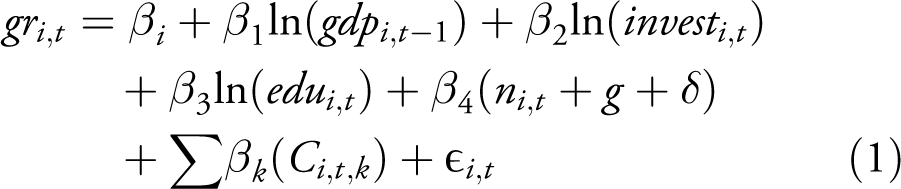
where gri,t
is the growth rate of country i at year t and
Possible influences of conflict on economic growth
While the use of aggregate data makes it hard to explore the mechanisms through which a conflict shapes economic performance, we build on the literature to discuss some of the processes through which conflicts influence the GDP growth of host nations, neighbours and external participants.
Current conflicts
Conflicts can have an immediate negative effect on output when they disrupt production (Blomberg, Hess & Orphanides, 2004). If public goods are destroyed, this reduces the efficiency of public expenditure. Moreover, the increased military expenditure occurring during conflict is likely to crowd out public expenditure in other areas (Knight, Loayza & Villanueva, 1996; Collier et al., 2003), including the police force. Reduced expenditure on the latter impedes the rule of law and thus the security of property rights. In response to this, private agents are likely to engage in portfolio substitutions (Weinstein & Imai, 2000) by shifting their assets out of the country (Collier, 1999), thereby potentially benefiting other nations. On top of this, if the military expenditure is financed by an increase in taxes, this could lower private consumption or create dissaving if this income reduction is seen as temporary (Collier, 1999). The longer and more intense the conflict, the larger these effects are expected to be (Costalli, Moretti & Pischedda, 2017).
Proposition 1: Civil and international conflicts negatively affect economic growth, and the effects grow with intensity.
While host countries mainly suffer from civil and international conflicts, third parties may benefit from them. External state actors tend to intervene in armed conflict primarily out of their own economic and national security interests (Aydin, 2012; World Bank, 2020). Potential benefits for third parties include enhanced access to natural resources and trade, improved national security, and geostrategic advantages (Chang, Potter & Sanders, 2007; Bove, Gleditsch & Sekeris, 2016; Bove, Deiana & Nisticò, 2018). However, intervening in a conflict on foreign soil can also exacerbate costs for the home nation if it leads to an increase in the world price of commodities produced by the host nation. One example is the price of oil in the USA, which jumped from $25 a barrel in 2007 to $140 a barrel in 2008, following their intervention in Iraq (House of Representatives Hearing, 2010: 7; Stiglitz & Bilmes, 2008).
Proposition 2: Getting militarily involved in conflicts taking place on foreign soil affects home country growth, although the sign of this correlation is a priori ambiguous.
Neighbouring conflicts
Conflicts can also affect neighbouring nations’ economic growth through their impact on labour and human capital notably. First, an increasing share of labour is likely to be assigned to unproductive activities like border protection (de Groot, 2010). Second, past findings have shown that refugees that stop at their nearest neighbours tend to be unskilled and poor (de Groot, 2010) and can carry contagious diseases (Montalvo & Reynal-Querol, 2007). Meanwhile, those who pass through their primary neighbouring countries on to secondary ones are likely to carry more human capital (Dunne & Tian, 2014), although a positive effect will hardly be observed within the short term. Finally, the presence of refugees and displaced populations can increase the risk of conflict diffusion through the transnational spread of arms, combatants and ideologies (Salehyan & Gleditsch, 2006; Choi & Salehyan, 2013).
Another burden of conflict can be found through the globalization channel. In a host country, road destruction and declining commodity production (Hendrix & Glaser, 2011) mean that domestic and international trade are hindered (Blomberg & Hess, 2006). Neighbouring states may also be negatively affected if trading routes pass through the conflicted areas or if foreign investors judge the whole region risky. On the other hand, a positive effect could be seen if neighbours become substitute trade partners (Cali et al., 2015). Furthermore, neighbours of conflict participants may increase their exports of military goods, potentially leading to a Keynesian stimulus (Keynes, 1920) for their economy.
Proposition 3: Civil, international and non-territorial conflicts influence neighbouring nations’ economic growth.
Past conflicts
Looking at post-conflict economies, reduced productivity can remain due to permanent injuries or disease spread, which require continued public health expenditure (Edwards, 2013; Dunne & Tian, 2017). Extra deaths and injuries can also take place if landmines remain (Unruh, Heynen & Hossler, 2003), and nations may suffer from continued environmental consequences including water, sanitation and biodiversity challenges (Hoeffler, 2012). Postwar agricultural production may also be dampened due to war legacies (Bozzoli & Brück, 2009). However, the direction of the post-conflict effect on economic growth is likely to depend on the gravity of the conflict. Collier (1999) found that following a one-year conflict, the five post-conflict years will have a growth rate of 2.1% below the growth path in absence of conflict. But after a 15-year conflict, this post-conflict growth is 5.9% higher than the counterfactual. Thus, countries that faced severe conflicts seem to experience a phoenix effect faster, by bouncing back to their long-term trend. This can be due to a higher amount of international support following a more intense, and possibly more mediatized, conflict, which could accelerate the reconstruction process (Miguel & Roland, 2011). Furthermore, when conflict leads to institutional reform (Slater, 2010), this facilitates the removal of exploitative governments, thereby reducing vested interests that inhibit innovation (Olson, 1982) and allowing the mobilization of resources, in turn leading to faster growth (Cramer, 2007).
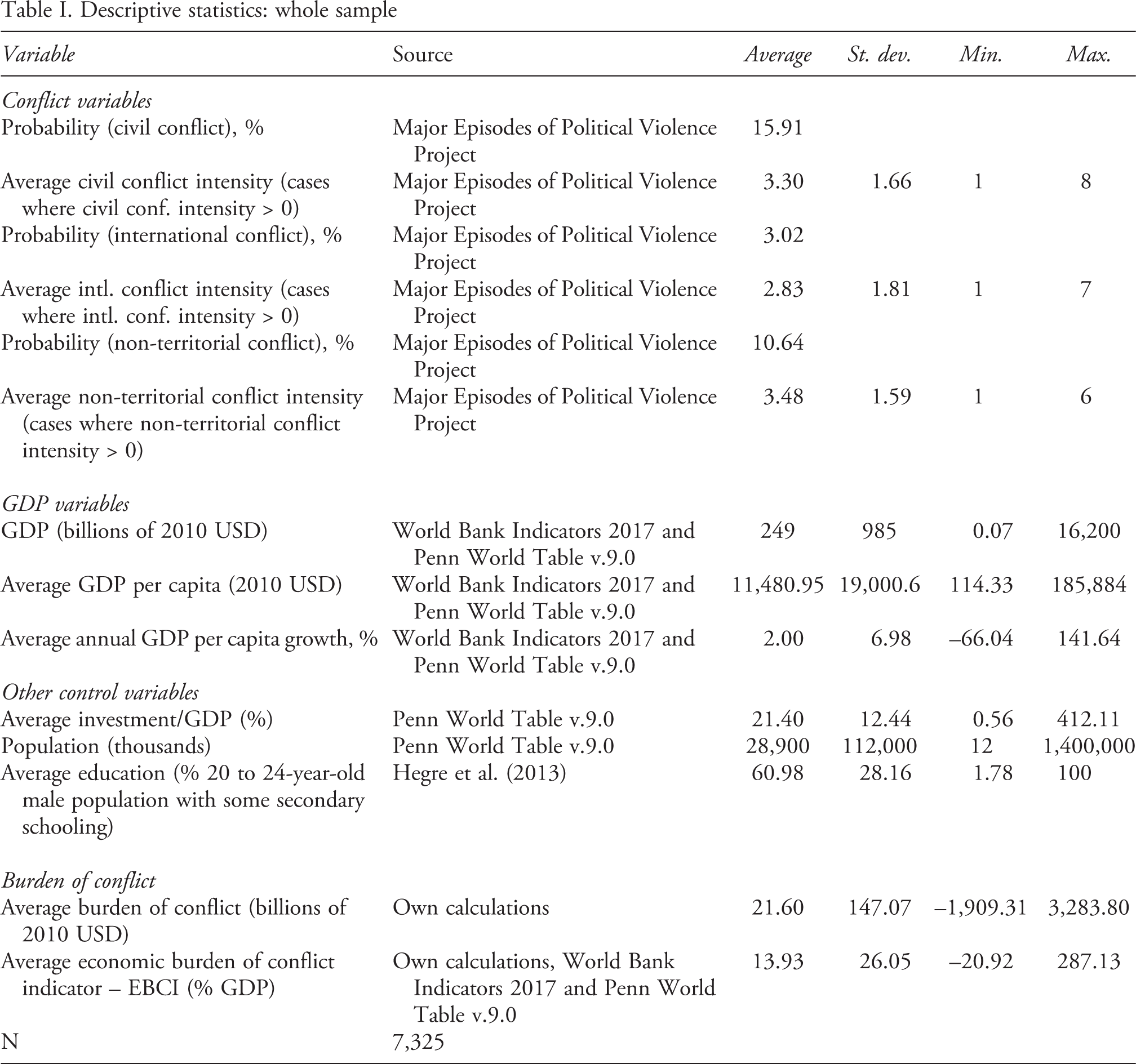
Descriptive statistics: whole sample
Proposition 4: Civil and international conflicts influence post-conflict economic growth, although the direction depends on the gravity of the conflict.
Data and methods
Data sources and variables
To shed light on the above-mentioned propositions, we construct an annual panel that comprises 190 countries from 1970 to 2014. We next describe our sources and variable selection process. Descriptive statistics for all variables are provided in Table I.
Dependent variable
Our main source for GDP data (in 2010 US dollars) is the World Development Indicators (World Bank, 2017). We add data from the Penn World Tables version 9.0 (PWT; Feenstra, Inklaar & Timmer, 2015) for 18 countries that are not included in the former.
3
We use aggregate GDP growth as the outcome variable to capture the possibility of a decrease in output due to a decrease in population. However, we show in Conflict years per region during 1970–2014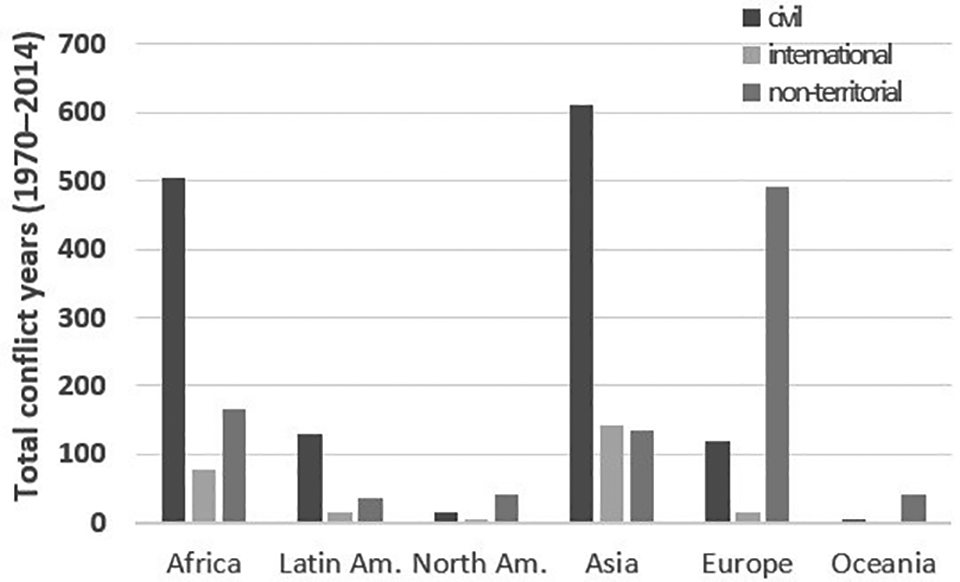
Current conflicts
We consider three types of conflicts: civil, interstate and non-territorial. For each type, we use Marshall & Cole’s (2014) intensity measure which uses a scale from 0 to 10. These magnitudes reflect multiple factors including state capabilities, number of deaths, capital destruction, population displacement and episode duration. Sporadic acts of terrorism are included within that scale, at magnitude 2. In order to create our non-territorial conflict variable, we also use Gleditsch et al. (2002), which provides information on external participants for each observed conflict. Figure 2 shows the number of conflict years per conflict type and per region over the 45 observed years.
Past conflicts
We include a set of post-conflict variables to estimate the growth consequences of previously having experienced conflict, provided that the country is now at peace. To measure how many years following a conflict a significant influence is still observed, we test the correlation between growth and the lagged intensity of each conflict type separately, controlling for the Solow covariates, for up to ten peaceful post-conflict years. We then select the post-conflict variable that is most significant and provides the highest R-squared for each conflict type. We find that civil conflicts continue to significantly influence growth up to four years after the conflict ends; non-territorial conflicts up to one year; and international conflicts up to two years. 4
Neighbouring conflicts
For each conflict type, we create a spillover variable that measures the average intensity of conflict in each country’s neighbouring countries, if the observed country itself is not currently in conflict. This empirical approach stems from the spatial econometrics literature, which finds its basis in Anselin (1988). The conflict spillover variable is created using a contiguity matrix whose elements are:

where the contiguity variable is the minimum distance between nations, capped at 1,000 km.
5
Thus, mindistij
is 0 when countries i and j share a border, and
A ‘reflection problem’ (Manski, 1993) might occur if a country’s conflict onset is correlated to its neighbours’ unrest. In such cases, identification problems could emerge from introducing a conflict spillover variable along with a set of domestic conflict variables. In addition, we wish to avoid ‘double-counting’ spillovers from the perspectives of both the ‘offending’ and the ‘affected’ countries (Bozzoli, Brück & Sottsas, 2010). To tackle both issues, we set the spillover variable to zero, if the observed country is currently in conflict itself. Thus, our spillover estimates represent the growth consequence for a peaceful country located less than 1,000 km away from a country afflicted by any of the three types of conflicts.
Controls
For investment and population data, we use the PWT. For education, we use Hegre et al.’s (2013) data on the proportion of males aged 20–24 that have attained secondary or higher education. This measure enables us to concentrate on an age range in which students should already have attained their secondary education, thereby reducing a possible collinearity bias from using both education and conflict intensity as explanatory variables for GDP growth. Finally, we use Marshall, Gurr & Jagger’s (2017) Polity2 index to control for regime type in the robustness section.
Variable selection
To avoid a manual selection process which could lead to overfitting or omitted variable issues, we use the double Lasso approach of Belloni, Chernozhukov & Hansen (2014), as implemented by Ahrens, Hansen & Schaffer (2018). Among the set of conflict variables, only past non-territorial conflict is found to be irrelevant in the full specification. On the other hand, all the Solow covariates are found to be relevant in predicting GDP growth, including when tested alongside the previously selected conflict variables.
We then use Lind & Mehlum’s (2010) ‘U-test’ on Stata to decipher any potential non-linear relationship to growth. Controlling for the Solow covariates, the test shows that current non-territorial and past civil conflicts follow a U-shape. We thus include their squared intensities in the final regression.
Methodology
Challenges
The estimation of the global burden of conflict faces several challenges. First, an omitted variable bias might emerge if unobserved factors exist which jointly determine growth and conflict. Second, there could be reverse causality since not only does conflict affect growth, but poor economic conditions can also increase the risk of conflict (Fearon & Laitin, 2003; Miguel, Satyanath & Sergenti, 2004).
Several methodologies have been adopted to address these challenges. Chen, Loayza & Reynal-Querol (2008) conduct an event-study to analyse the aftermath of war in a cross-section of 41 countries. This approach, however, requires a large number of peaceful years before and after the shock, which significantly restricts the sample of conflicts that can be analysed and is thus not suited for a global analysis like ours.
More recently, some conflict studies have applied the synthetic control method, which compares the post-conflict GDP trajectories of conflict-ridden countries with the trajectories of weighted combinations of otherwise similar but peaceful countries (e.g. Abadie, Diamond & Hainmueller, 2015; Abadie & Gardeazabal, 2003; Bove, Elia & Smith, 2017; Costalli, Moretti & Pischedda, 2017). This method is thought to reduce the omitted variable bias by accounting for the presence of time-varying unobservable confounders. However, it relies on pre- and post-treatment periods having complete observations in the outcome series. This requirement can significantly skew the observed sample towards low-intensity conflicts as economies hit by stronger conflicts are more likely not to be reporting macroeconomic data (de Groot, 2010; Blattman & Miguel, 2010), which would in turn systematically understate the estimates in our setting.
As the above-mentioned methodologies are hardly applicable for our comprehensive estimation of the global burden of violent conflict, we investigate panel techniques instead. Although it is challenging to claim causality with such methods, various approaches are used to draw us closer to causal statements.
Regression analysis
While this article mainly focuses on the short-term consequences of conflict, long-term results help understand the dynamic. We thus start the analysis with a cross-section ordinary least squares (OLS) regression. These results must, however, be interpreted with caution given the possibility for time-invariant country-specific features.
Our second approach thus uses the two-step difference generalized method of moments (GMM) estimator developed by Arellano & Bond (1991), which tackles country-fixed effects by first-differencing the regressors. One drawback, however, is that the number of moment conditions is of order T. Thus, given our 45 years of observation, we can encounter an instrument overproliferation issue (Roodman, 2009a). We limit this by capping the number of instruments using Stata’s ‘collapse’ option (Roodman, 2009b). However, given that in our large-T setting, the asymptotic bias of order 1/T, which results from the failure of strict exogeneity in dynamic panel models, is only 0.02 (Nickell, 1981; Alvarez & Arellano, 2003), we keep that methodology for robustness and opt for a within-country estimation as our main specification.
Thus, we use a standard fixed effects panel estimation (or least squares dummy variables, LSDV) with annual data to capture short-term effects. This methodology enables us to account for the possibility that countries exposed to more intense conflicts are those which have lower levels of growth to start with.
Counterfactual analysis
To help interpret our findings, we next recreate a counterfactual
6
GDP growth rate (

This rate is then used to calculate the counterfactual GDP level as follows:

Yearly losses/gains from conflict are then estimated by subtracting actual GDP from the counterfactual GDP level. Although this method does not consider the indirect consequences of conflict emerging from their effects on capital and labour, it provides an indicative estimate for the direct ramifications attributed to each observed conflict type.
The global scope of our study makes it difficult to claim causality. However, we finish our main analysis by limiting our sample to the years and countries observed in two recently published studies that used the previously described synthetic control method with a similar objective to ours (Bove, Elia & Smith, 2017; Costalli, Moretti & Pischedda, 2017). Reassuringly, the closeness of our results provides further evidence for the adequacy of our chosen methodology.
Results
Regression analysis
Regression results
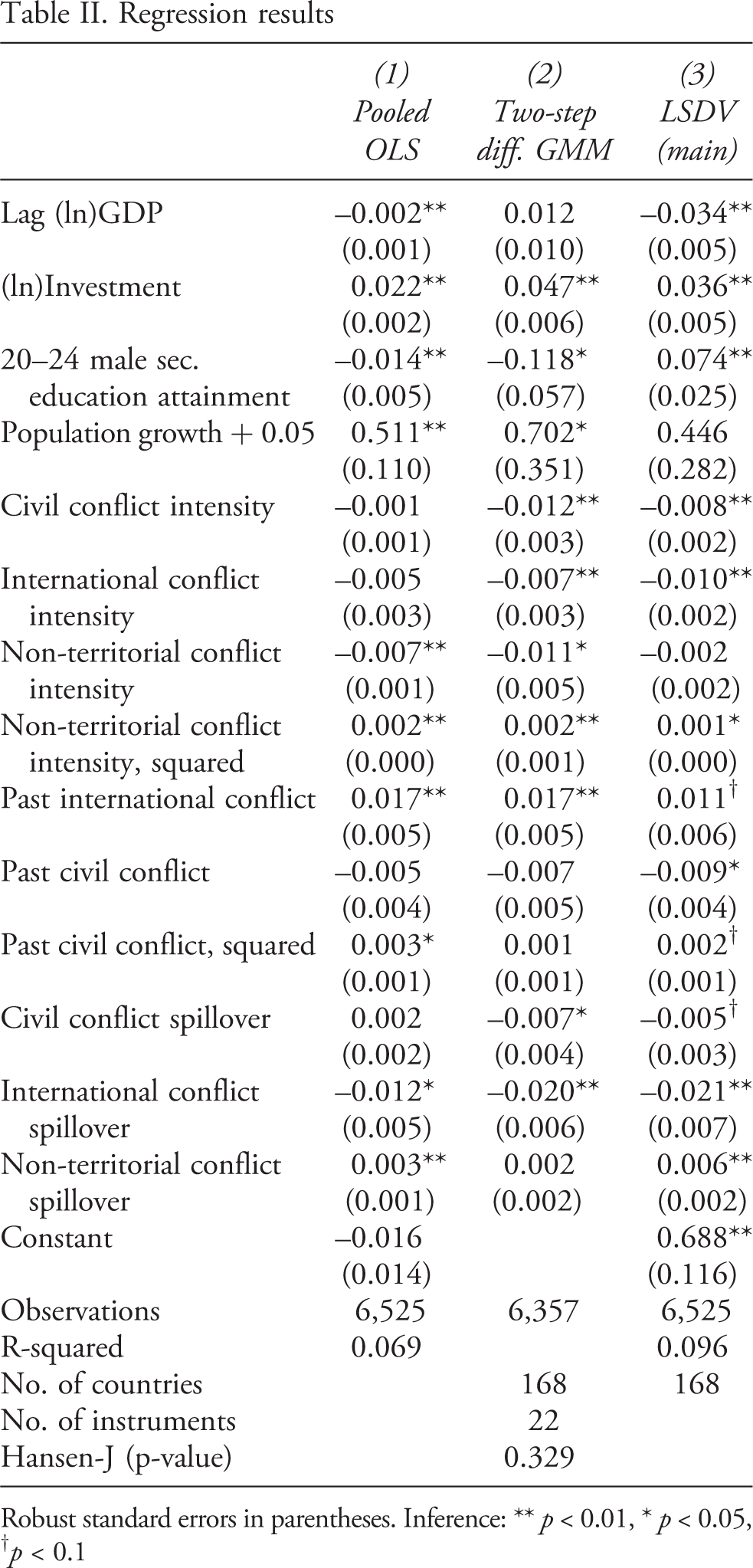
Robust standard errors in parentheses. Inference: ** p < 0.01, * p < 0.05, † p < 0.1
Interestingly, a highly significant quadratic relationship is found for countries participating in conflicts on foreign soil. Thus, high levels of non-territorial conflict intensity seem to provide a Keynesian stimulus to growth (Reitschuler & Loening, 2005), while lower Association between conflict and growth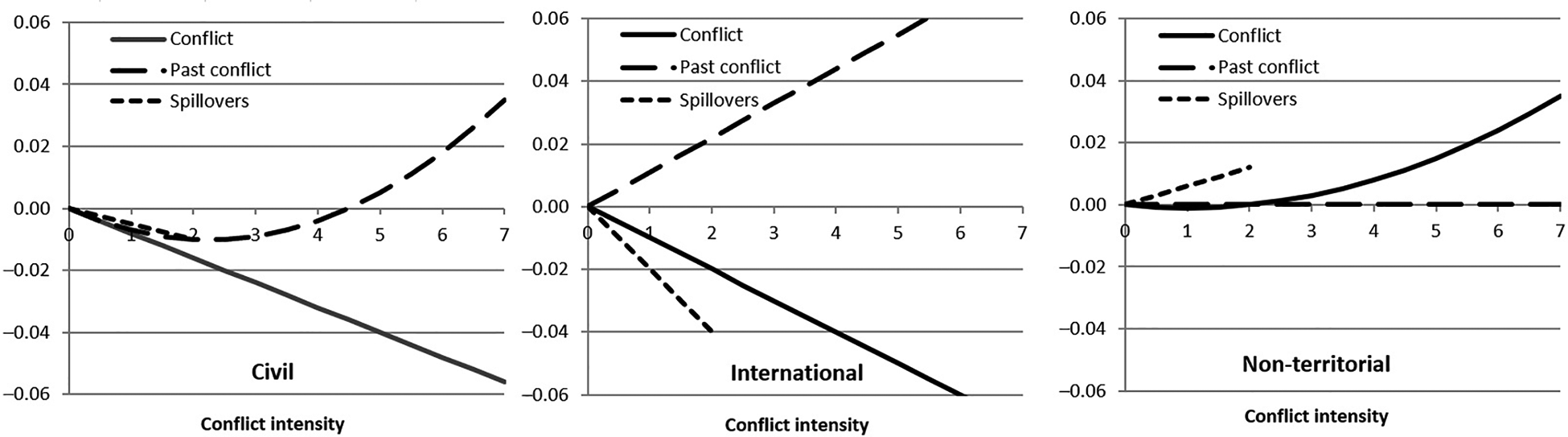
Consistent with our expectations that the within estimator has at most a small Nickell bias, the two-step difference GMM estimates (Column 2) are very similar to our preferred LSDV specification (Column 3). Although the Hansen-J test of over-identifying restrictions shows a p-value of 0.338, thereby not rejecting the hypothesis of instrument validity, the fact that it is above 0.25 hints at a potential instrument overproliferation issue (Roodman, 2009a), even after capping the number of instruments.
We thus concentrate on Column 3 for our short-run analysis. All the significant long-run results found in Column 1 are confirmed in this setting. On top of this, current civil and international conflicts are found to have a significant negative correlation with growth, which is consistent with Proposition 1. Our results show that, ceteris paribus, an additional intensity unit in a civil or international conflict leads to an average decrease of 0.8% or 1% of current GDP growth, respectively. Further supporting Proposition 3, the spillovers of both international and civil conflicts follow a negative linear trend while, again, a positive influence is observed on domestic growth when neighbouring states take part in non-territorial conflict.
We also find a significant quadratic relationship between past civil conflicts and growth. Hence, the latter is depressed following low-intensity conflicts and boosted after intense ones, thereby supporting Proposition 4. Thus, as suggested by Collier (1999) and corroborated by Gil-Alana & Singh (2015), the legacy of civil conflict seems to depend on the severity of conflict. We graphically summarize the conflict coefficient findings in Figure 3.
Robustness of regression results
In this section, we discuss the robustness of the relationships found in the regression analysis. All results are presented in the Online appendix A, Tables A.I–V.
Multicollinearity
In order to decide whether a strong multicollinearity bias emerges from including the Solow covariates with the conflict variables, we re-run the LSDV analysis, first excluding all conflict variables and then excluding all Solow covariates. Columns 2 and 3 in Table A.I in the Online appendix show that in both cases, the coefficients remain comparable to the main specification, both quantitatively and qualitatively. The same conclusion is found in Column 4, when using lagged Solow controls (which should not be impacted by current conflicts) instead of current ones in the main regression. Multicollinearity therefore does not seem to be a heavy threat.
Other specifications
First, to accommodate the possibility of global-wide shocks, we experiment using time-fixed effects. Second, as an omitted variable bias could emerge from not considering the quality of institutions, which can affect both growth and conflict intensity, we control for polity. This specification stays in the robustness section, however, as no data are available for ten of our observed countries. Third, we change our dependent variable to GDP level and to per capita GDP growth. Finally, we use different data sources for investment (World Bank, 2017) and education (Barro & Lee, 2013; Lutz et al., 2007; Samir et al., 2010). For the latter, we change the measure to the percentage of 15–64-year-olds with some secondary education (instead of focusing on the 20–24-year-old male population). Reassuringly, the previously found relationships are not affected by any of those alternatives (see Tables A.II–A.III).
Reverse causality
Our within-country methodology reduces the possibility that results may be driven by violent conflicts in traditionally low-growth countries. However, there might still be a concern that those countries are more likely to experience intense conflicts. Following Bircan, Brück & Vothknecht (2017), we thus replicate our results, this time splitting our sample into low- and high-growth groups. This is done by using the average quartile position of each country over the 45 years of observation, and then separating the countries between those whose average position was 1 or 2 (low growth), and those whose position was 3 or 4 (high growth).
Column 2 in Table A.IV shows the estimates when the sample is restricted to low-growth countries, while Column 3 shows the estimates for high-growth countries. Coefficients remain generally comparable in sign and significance across both subsamples, thereby assuaging concerns over reverse causality.
Geographical disparity
In order to decipher which countries seem to have the bigger weight on the regression results, we rerun the growth regressions, removing one region at a time. Results are presented in Table A.V in the Online appendix.
Current civil and international conflicts remain significant at the 1% level in all specifications. Europe, however, seems to drive the current non-territorial conflict results, which is unsurprising given its extensive participation in conflicts on foreign soil (see Figure 2). Meanwhile, Africa drives the post-civil conflict U-shaped correlation with growth, while Asia seems to have benefited the most strongly from a positive post-international conflict growth. However, the sign and magnitude of all these coefficients remain comparable across all specifications, which once again reassures us in our methodological choice.
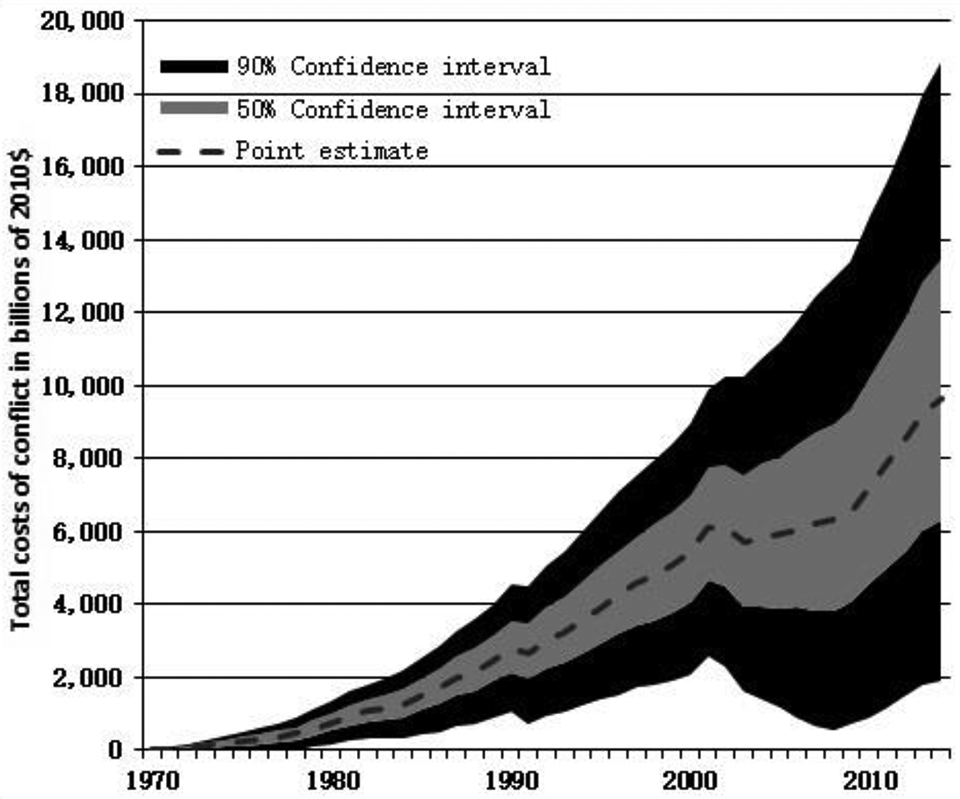
Confidence interval based on Monte Carlo methodology of parameter consistency
Counterfactual analysis
Our next step is to estimate a series of counterfactual annual GDP growth rates by subtracting the previously found conflict ‘effects’ from the actual yearly growth rates. These yearly counterfactual growth rates are then used to calculate counterfactual GDP levels, from which the true GDP outcomes are subtracted to estimate the yearly GDP gap due to conflict for each country.
By 2014, we find that global GDP would have been 9.7 trillion 2010 US$ (or Tr$) larger if violent conflict had been absent since 1970, equalling 12.2% of global GDP. This net global cost estimate consists of gross costs of 12 Tr$ and gross benefits of 2.3 Tr$. A Monte Carlo estimation shows that the 90% confidence interval of our results yields costs between 1.9 and 18.9 Tr$ by 2014 (Figure 4). 7
Results disaggregation
Differentiating our results across countries, we find that the influence of conflict varies significantly in relative terms (Figure 5A). For seven countries, total GDP would have more than doubled without violent conflict (Figure 5B). In absolute terms, China’s costs (3.3 Tr$) are the largest (Figure 5C), followed by India (1.6 Tr$) and Iraq (1.1 Tr$).
By region, Asia would have benefited the most from the absence of violent conflict between 1970 and 2014, whereas North America would have lost 0.9 Tr$ (Figure 5D). We generally find that developing countries Distribution and structure of the burden of violent conflict in 2014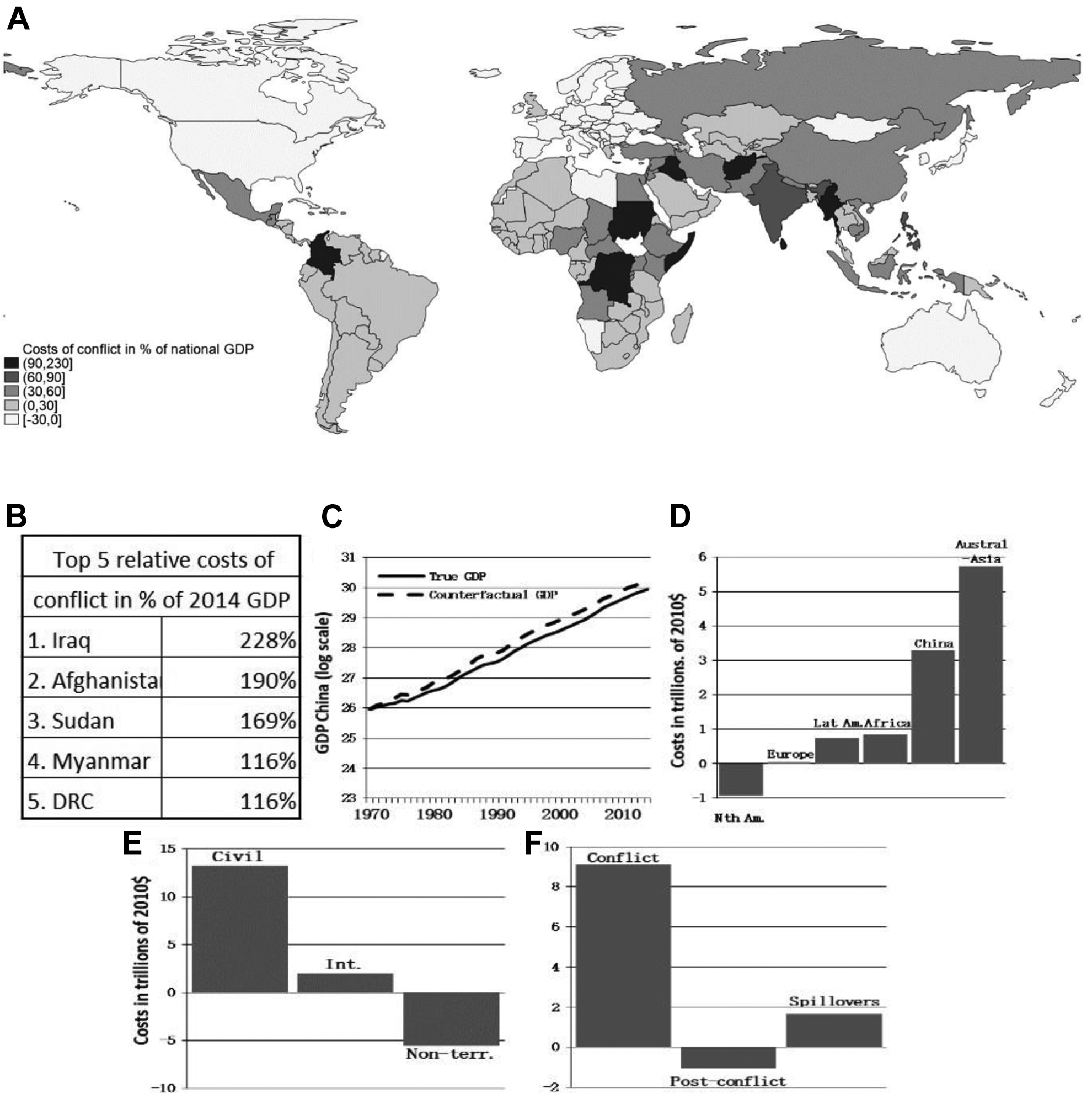
Relevance of the global burden of conflict in a larger perspective
Sensitivity analysis
To test the sensitivity of our main result, we rerun our counterfactual analysis using four different specifications. Each approach yields broadly similar findings in terms of total costs, thereby confirming the robustness of our approach.
First, we re-run the cost estimation, this time including past non-territorial conflicts, the only conflict variable that had failed the double Lasso variable selection test. This merely reduces the conflict burden to 11.9% of 2014 global GDP. Second, we rerun the analysis, this time including time-fixed effects. Results increase slightly, to 14.5% of 2014 global GDP. Third, we move our window of 45 years of observations from 1970–2014 to 1960–2004. 8 As a result, the global burden of conflict amounts to 13% of 2004 global GDP. This provides further support to the stability of our estimation. Fourth, our conflict intensity measure is based on a scale from 0 to 10 and includes criteria like state capabilities and capital destruction. As those can be found to be endogenous to GDP growth, we rerun our analysis using data from Gleditsch et al. (2002) instead, which measures conflict intensity based on a dichotomous index that solely relates to the number of directly related deaths. The global estimate is reduced very slightly, to 11.8% of 2014 global GDP.
Discussion
Comparison with other costs of conflict analyses
We first compare our results with recent articles that used the synthetic control method (Abadie & Gardeazabal, 2003) to estimate the cost of civil war (Bove, Elia & Smith, 2017; Costalli, Moretti & Pischedda, 2017). We, however, change some specifications to make our estimates comparable, by: (i) keeping current civil conflict as the sole conflict variable; (ii) changing our dependent variable to per capita GDP growth; and (iii) restricting the country-year sample selection to match each article. Restricting our sample to the 20 countries observed by Costalli, Moretti & Pischedda (2017), we find that a country loses, on average, 15.7% of its potential GDP per capita during the war-torn years. This is within the range between their original finding of 17.5%, and Bove, Elia & Smith’s (2017) replication of 12.8%. Next, when restricting our sample to the 27 countries observed by the latter article for their main result, our estimate is 9.9%, which is close to their 9.1% finding. These estimates are also in the same order of magnitude as Gates et al. (2012), who find that a median-size conflict decreases GDP per capita by 15%, and Mueller (2012), who finds a persistent loss of roughly 18% of GDP per capita caused by ongoing civil wars. These comparisons indicate that our approach produces plausible cost estimates.
Comparison with other global public bads
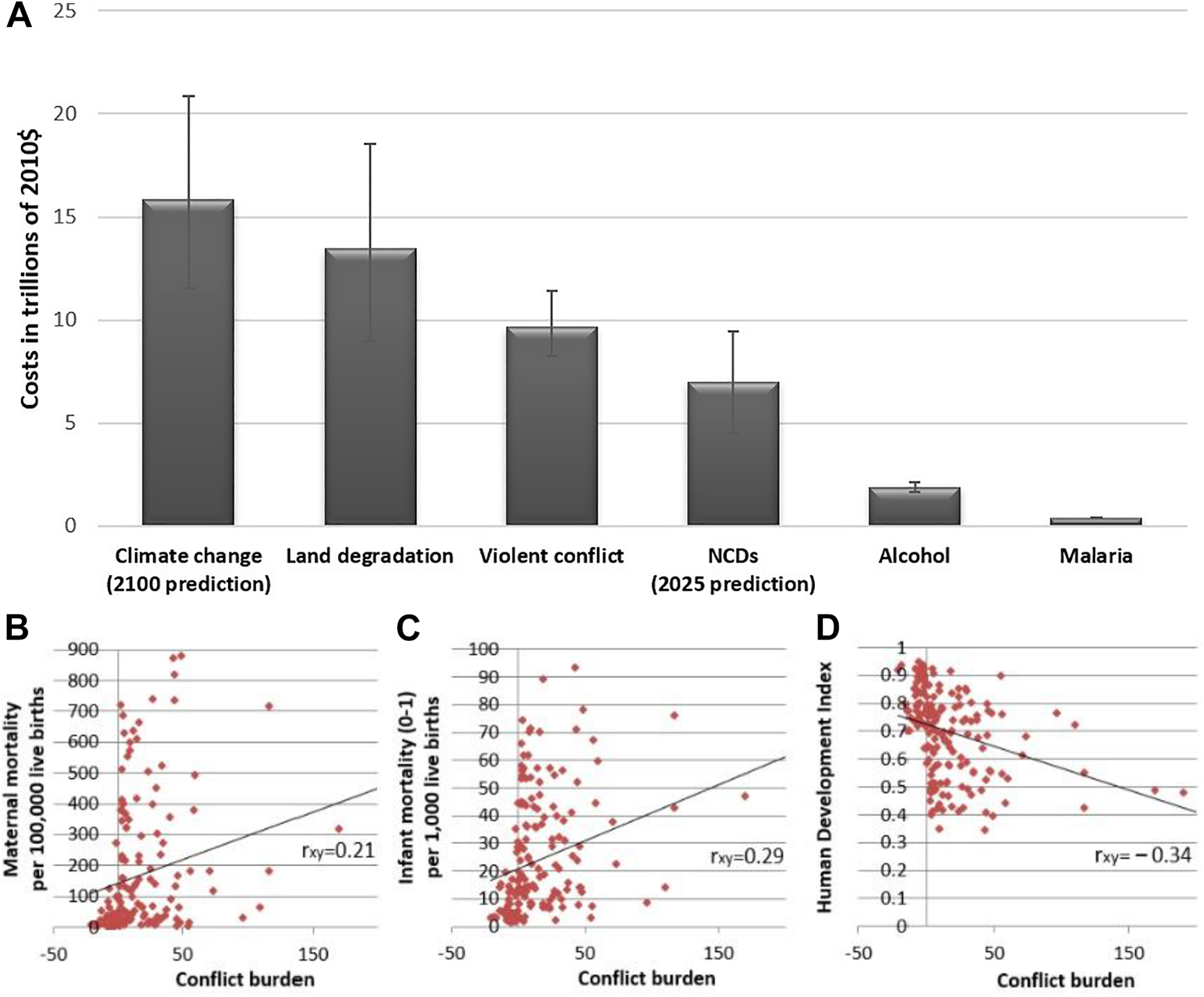
Figure 6A gives an indicative comparison of our result with the global burden of other public bads, based on various analyses. While methodologies, periods and country samples differ across studies, we adjusted each result to our setting as far as possible. A detailed explanation of this adjustment is provided in Online appendix B.
Our estimate of the global burden of violent conflict is found to be lower than that of climate change (Stern, 2007) and land degradation (ELD, 2015), but higher than non-communicable diseases (NCDs) 9 (Bloom et al., 2011), alcohol consumption (Rehm et al., 2009) and malaria (Sachs & Malaney, 2002).
Comparison with other development indicators
Our results can be interpreted as the economic burden of conflict indicator (EBCI), measuring the accumulated GDP loss due to violent conflict across countries each Effects of different policy simulations on the global burden of conflict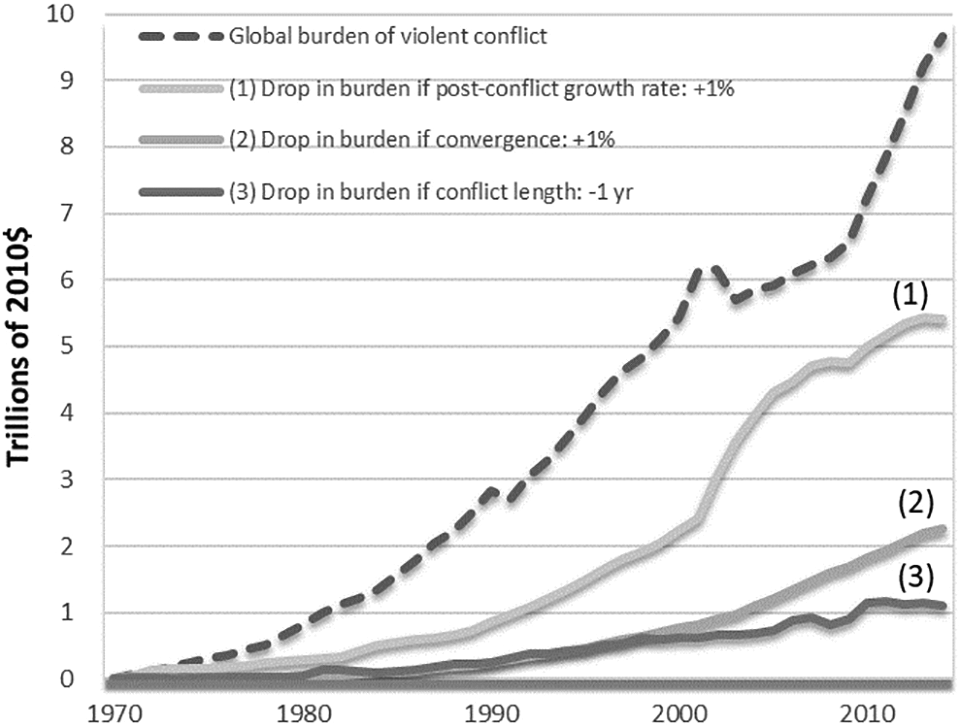
Policy simulations
So far, our counterfactual estimations assumed that violent conflict is abolished entirely, which is clearly not a realistic policy option. Thus, we simulate some more nuanced policies, namely a reduction in the length of violent conflict (investments in peacebuilding) and increases in post-conflict growth (investments in reconstruction). Scenario 3 in Figure 7 shows that a one-year reduction in the length of all violent conflicts strongly reduces the burden of conflict. Likewise, an increase of one percentage point (pp) in the post-conflict rate of convergence term would help mitigate the GDP loss (scenario 2). However, the highest drop in the global burden of conflict is found when growth is increased by 1 pp for two years (for international conflicts) and four years (for civil conflicts) once conflict ends (scenario 1). Thus, the results show that one prominent way to reduce the burden of violent conflict is to rapidly invest in reconstruction after peace is achieved.
Conclusion
We find that, in 2014, the world would have been approximately 12% wealthier in the absence of violent conflict since 1970. Estimating the conflict-induced global GDP loss over a 45-year period gives valuable insights into the structure of the economic burden of violent conflict. Geographically, Asia is found to have suffered the largest accumulated costs, which were mostly driven by civil conflicts. On the other hand, North American, European, and Oceanic countries mainly benefited from their participation in conflicts which mostly occurred on foreign soil. This result helps explain not only the persistence of conflict but also the increasing trend in internationalized internal conflict.
We identify evidence of a ‘peace dividend’ in terms of higher growth in the post-conflict period. However, the net accumulated GDP gap due to conflict remains negative for most affected countries, especially those that experienced intense civil conflicts. Significant losses are even found for the peaceful neighbours of conflict-affected countries. These results thus underscore the need for the international community to make additional efforts regarding conflict resolution and peacekeeping. Comparing various policy solutions, we find that speeding up growth in the two to four years following the end of the conflict is a promising way to reduce the burden of violent conflict.
One important caveat to our work is that we do not estimate the costs of preventing conflict. However, while these costs may be high in the short run or may not always bear fruit, governments and international organizations alike should recognize that such an investment is crucial with a long-run perspective. One must, after all, compare the one-off cost of preventing a conflict to the continuous stream of future losses resulting from its onset.
Finally, we demonstrate that the global burden of violent conflict is comparable to the global burden of other public bads, such as climate change and diseases. We posit that these non-economic barriers to economic growth have been underappreciated, if not literally underestimated, by economists and political scientists alike. Global GDP growth can be stimulated in many ways; making peace clearly is one of them.
Footnotes
Replication data

Acknowledgements
We thank Michael Brzoska, Joshua Catalano, Lisa Chauvet, Peter Croll, Valpy FitzGerald, Javier Gardeazabal, Paula Gobbi, Scott Gates, Gregory Hess, Debarati Guha-Sapir, Katharina Meidert, Matthew Minor, Håvard Nygård, Lutz Sager, Kati Krähnert, Gerald Schneider, Anja Shortland, Elisabeth Sköns, Christian Staacke, Felipe Valencia, Fedor van Rijn, Philip Verwimp, Sebastian Wolf and conference and seminar participants in Montreal, London, Berlin, Washington, DC, Stockholm, Amsterdam, Izmir, Brussels and Vancouver for their useful comments.
Funding
The authors acknowledge support from the German Foundation for Peace Research (DSF) through the Global Economic Costs of Conflict project.