




Abstract
How does local ethnic demography affect the conduct of majoritarian elections? Because legislative elections in majoritarian systems are contested locally, local ethno-political polarization increases the risk of pre-election violence. In districts that are polarized between politically competing ethnic groups, violence can be targeted with comparative ease at opposing voters, and can, if perpetrated collectively, mobilize the perpetrators’ co-ethnics. I do not expect such dynamics in PR systems where political competition plays out at higher geographical levels. To test this argument, I combine new data on the ethnic composition of local populations in 22 African countries with monthly data on riots and survey data on campaign violence. Ethno-politically polarized districts in majoritarian and mixed electoral systems see substantively larger increases in the number of riots prior to legislative elections and more fear of pre-election violence among citizens than non-polarized districts in the same country and at the same time. I do not find these patterns in PR systems. The results enhance our understanding of how electoral systems interact with local ethnic demography in shaping pre-election violence.
Introduction
Choices over the design of electoral systems in ethnically divided societies are most influential in determining the fate of democracy and peace in a polity. Addressing electoral violence as a vital threat to democracies around the globe, this article analyzes the impact of local ethnic demography on violence preceding legislative elections in Africa. In particular, I argue that local competition between politically mobilized ethnic groups increases the risk of violence before majoritarian but not proportional legislative elections.
The literature on the vices and virtues of majoritarian and PR systems in ethnically divided societies is extensive, beginning with the seminal contributions of Horowitz (1990, 1991, 1994), Lijphart (1985), and Lijphart & Aitkin (1994). It mostly focuses on the effects of electoral systems on political parties, post-conflict stability, and the risk of civil war in general. 1 Studying the effects of electoral systems on electoral violence, Birch (2007) and Fjelde & Höglund (2016) present country-level evidence that majoritarian elections come with more misconduct and campaign violence than PR systems, in particular where ethnic groups are excluded from political power. However, despite Birch’s (2007) theoretical insight that election violence in majoritarian systems is caused by local competition, prevailing country-level research does not shed empirical light on why campaigns turn violent in some constituencies but not in others (Birch, Daxecker & Höglund, 2020). Furthermore, not all types of electoral competition may lead to equal levels of violence. Focusing on competition along ethnic cleavages, this study addresses these issues with high-resolution spatio-temporal data that evidence the violent consequences of local competition between politically mobilized ethnic groups in majoritarian elections.
Drawing on the incentives set by the structure and geographic locus of competition in majoritarian legislative elections, I argue that local political competition between ethnic groups incentivizes violent campaigning. In ethno-politically polarized constituencies, violence can be effectively targeted and, especially when it comes in the form of a riot, serves the purpose of polarizing the electorate. In contrast, local ethno-political competition does not increase the risk of violence before PR elections, where legislative elections are contested at the regional or national level. This makes local ethnic polarization inconsequential for campaign strategies in PR systems.
With this focus on local ethno-political competition, the argument builds on and extends previous research that understands pre-election violence as intending to ‘influence the electoral process and in extension its outcome’ (Höglund, 2009: 417; Birch, Daxecker & Höglund, 2020). Pre-election violence can increase the odds of victory of its instigator through the polarization of the electorate (Dercon & Gutiérrez-Romero, 2012; Horowitz, 2001; Wilkinson, 2004) and the demobilization of his opponent’s voters by means of intimidation, displacement, and death (Bratton, 2008; Collier & Vicente, 2014; Klopp, 2001; Steele, 2011). 2 It not only affects nationwide official elections, but also intraparty contests (Goldring & Wahman, 2018; Bech Seeberg, Wahman & Skaaning, 2018; Reeder & Seeberg, 2018). In parallel to incentives to campaign peacefully, violence likely accompanies contested campaigns (Hafner-Burton, Hyde & Jablonski, 2013; Salehyan & Linebarger, 2015; Wilkinson, 2004), in particular those led by incumbents (Taylor, Pevehouse & Straus, 2017; Rauschenbach & Paula, 2019).
I test the argument that local ethno-political competition increases the risk of violence before majoritarian but not PR elections with new spatial data on the ethnic composition of local populations in 22 African countries between 1990 and 2013, mostly countries with unconsolidated democratic institutions and recurring electoral violence (Goldsmith, 2015). The main analysis studies the effect of local ethno-political competition on pre-election increases in rioting. Districts that are demographically polarized between politically mobilized ethnic groups experience steeper increases in rioting prior to majoritarian elections than non-polarized districts do. Consistent with the argument, this effect is absent in PR systems.
Rigid two-way fixed effects and controls for spatio-temporal autocorrelation restrict the potential of spurious results. The findings are robust to using different data on rioting and pre-election violence, and are not due to reverse causality affecting the timing of elections and local ethnic demography or endogenous district boundaries. In addition, I find that survey respondents’ fear and experience of pre-election violence increases with the level of local ethno-political polarization in majoritarian but not proportional electoral systems.
The consistent empirical evidence supports the theoretical argument and contributes to our understanding of the effects of ethnic geography on the conduct of majoritarian elections in Africa. It also supplies evidence on the local drivers of electoral violence to those who try to prevent it. Further discussed in the conclusion, the results add to the existing literature on drawbacks of majoritarian electoral systems in multi-ethnic and unconsolidated democracies. The findings also highlight the effect of the spatial design of electoral districts on the (violent) conduct of elections.
The geography of ethno-political competition and violence before legislative elections
It is often argued that campaign violence is ‘produced’ (Brass, 2011) by political elites and their henchmen trying to increase their chances at the ballot box (Collier & Vicente, 2011, 2014; Horowitz, 2001; Wilkinson, 2004). Particularly in ethnically divided constituencies, candidates might choose to deliberately incite ethno-nationalist discourses and plan interethnic violence. Such patterns have affected, for example, elections in India (Brass, 2011; Wilkinson, 2004) and the 1992 Kenyan legislative election (Throup & Hornsby, 1998). Here, incumbent MPs of the Kenya African National Union (KANU), traditionally associated with the Kalenjin, were involved in inciting riots against ethnic Kikuyu, Kisii, Luo, and Luhya, leading to the displacement of 300,000 and the death of 1,500 (Africa Watch, 1993; Klopp, 2001). However, violence did not break out everywhere in the country. Instead, closely contested precincts with non-Kalenjin swing-voters saw most rioting, which may have actually harmed the prospects of KANU candidates elsewhere (Klopp & Zuern, 2007; Throup & Hornsby, 1998).
In (cynical) parallel to monetary expenditures (Cox & Munger, 1989; Erikson & Palfrey, 2000; Pattie, Johnston & Fieldhouse, 1995), the likelihood of instrumental campaign violence increases with the probability that it turns an election to the benefit of its instigator. As the Kenyan experience illustrates, campaigns are therefore most likely to come with substantial bloodshed where races are expected to be close (Hafner-Burton, Hyde & Jablonski, 2013; Klopp & Zuern, 2007; Salehyan & Linebarger, 2015; Wilkinson, 2004). Only then do the expected benefits of violence outweigh its costs, which consist in material payments for those who perpetrate the violence, the risks of alienating voters (e.g. Gutiérrez-Romero & LeBas, 2020), and potential judicial persecution.
In addition to influencing pivotal voters’ turnout and choice, electoral violence can also aim at affecting election timing, either preventing a poll from happening or forcing one to be held. While this is an important dynamic, electoral violence of this type will be conducted differently, not targeting pivotal voters but aiming to pressure the executive, legislator, and/or electoral commission into changing the electoral timetable. Because of this difference in strategic goals, my theoretical argument here only concerns violence as a strategy used to maximize perpetrators’ chances of winning scheduled and undelayed elections. I will, however, return to the effect of violence on the timing of elections as an empirical challenge.
For pre-election violence to be effective in maximizing instigators’ chance of victory, it must be targeted at the voters of the perpetrator’s opponent(s). In contrast to ideologically motivated electoral preferences, perpetrators of campaign violence can discern prospective vote choices that follow ethnic identities (Horowitz, 2001). Since many voters in multi-ethnic societies base their vote to a significant – but not exclusive 3 – degree on ethnic attributes of candidates such as language, religion, or name (Adida, 2012; Basedau et al., 2011; Bratton, Bhavnani & Chen, 2012; Bratton & Kimenyi, 2008; Chandra, 2004), perpetrators can use the same characteristics to target their violence. 4 But not only does the politicization of ethnicity facilitate the violent demobilization of electoral opponents – it also increases the mobilizing effect of violence on perpetrators’ supporters, because it highlights ethnic differences and incites ethno-nationalist sentiments (Dercon & Gutiérrez-Romero, 2012; Horowitz, 2001; Wilkinson, 2004). The resulting ideological polarization of the electorate coincides with the increase in the salience of ethnic identities caused by contested elections (Eifert, Miguel & Posner, 2010).
However, not all forms of violence suit the goals of the perpetrators of electoral violence in ethnicized polities. To achieve the first aim of demobilizing opposing voters, violence has to be ethnically targeted to such an extent as to induce sufficient fear among them and their co-ethnics. To pursue the second goal, raising the salience of ethnic identities among the voters of the violence-inducing candidate himself, the demographic basis of those who perpetrate the violence has to be equally broad. Only if a sufficient number of people participate in the violence can a public arousal of sentiment be achieved (Brass, 2011). With these two goals of pre-election violence in ethnicized polities in mind, the ethnic riot fits the incentives of the instigators of pre-election violence better than other forms of collective violence. This is because an ethnic riot, defined here as ‘intense, sudden, though not necessarily wholly unplanned, lethal attack by civilian members of one ethnic group on civilian members of another ethnic group’ (Horowitz, 2001: 1), combines popular mobilization with selective targeting of ordinary members of the ethnic ‘other’ (Wilkinson, 2004). Violence perpetrated by state or non-state organizations typically lacks the widespread mobilization of ethnic groups against each other.
In addition, rioting is a form of medium-scale violence with a relatively low risk of punishment. Given its broad demographic basis, even independent prosecutors may find it difficult to expose the planners behind riotous masses after the fact. In contrast, violence executed by organized structures such as the police, political parties, and militias leaves more traces for prosecution and punishment. The argument that riots are particularly ‘effective’ instruments of ethnic campaign violence, however, does not entail that electoral violence takes no other form.
The previous reasoning motivates the claim that political competition between ethnic groups increases the risk of pre-election violence, in particular of riots. Since the degree to which the competition for political power is ethnicized is strongly related to the electoral design of a multi-ethnic society, 5 the electoral system likely also affects the extent to which one should expect violent legislative campaigns. The literature on electoral systems consists roughly of two camps. The first holds that PR leads to equal representation of all ethnic groups, facilitates power-sharing, prevents the political domination of single groups, and fosters peace (Lijphart & Aitkin, 1994; Schneider & Wiesehomeier, 2008). Critics of this view hold that PR encourages ethnic mobilization and perpetuates divisions along main cleavages (Horowitz, 1991: 167–172). Instead, they argue that ethnically divided societies should conduct elections following plurality rules, in particular using the ‘single transferable’ or ‘alternative’ vote that encourage cross-ethnic alliances and intra-ethnic divisions (Horowitz, 1991, 1985). Empirically however, PR systems exhibit lower degrees of ethnicization of political preferences than majoritarian systems (Huber, 2012). This coincides with Fjelde & Höglund’s (2016) finding that majoritarian countries in Africa exhibit more electoral violence than proportional ones, 6 especially where large ethnic groups are excluded from political power.
Notwithstanding its merits, many proponents of proportional vs. majoritarian voting do not sufficiently consider the importance of the geography of ethnic cleavages when assessing the (violent) consequences of both (cf. Barkan, Densham & Rushton, 2006; Wagner & Dreef, 2013). 7 Because majoritarian elections are contested locally, the geography of political preferences is a key determinant of the degree of competition in a country’s electoral districts (Sartori, 1997). 8 Consequently, the risk of pre-election riots under ethnicized voting in a majoritarian system is co-determined by the extent to which local constituencies are divided between ethnic groups. The risk of pre-election riots will be highest in an ethno-politically polarized constituency with two politically mobilized ethnic groups of equal size. The risk of campaign riots decreases as the number of groups in a constituency and/or their heterogeneity in size increases. Both factors reduce competition between them.
Hypothesis 1: Local polarization between politically mobilized ethnic groups increases pre-election rioting in majoritarian electoral systems.
The link between local political competition among ethnic groups and campaign riots is thus contingent on the nature of majoritarian systems and the locus of their electoral contests. Fundamentally different geographical patterns of pre-election violence should therefore be observed in pure PR systems, which I analyze as a control group only. Under PR voting, competition takes place at supra-local level, mostly at the region or country level. Thus, regional or national characteristics will shape incentives for violent campaigning before elections. In contrast, the degree of local ethno-political polarization will not influence considerations about where to best incite riots before an election, since it does not strongly determine the share of votes won by parties. In a proportional contest, it is less ‘effective’ to target ethnically mixed areas than those homogenously inhabited by one’s opponents – a strategy that South Africa’s ANC pursued in the first post-apartheid election in 1994 (Klopp & Zuern, 2007). In addition and as Birch (2007) points out, parties in PR systems pool the risks and benefits of electoral campaigning. They are thus less vulnerable to the collective action problems faced in majoritarian systems (Carey & Shugart, 1995) and have greater powers to maintain their credibility and avoid violence during electoral campaigns altogether. I thus expect the following contrast between violence before majoritarian and PR elections:
Hypothesis 2: Local polarization between politically mobilized ethnic groups increases pre-election rioting more in majoritarian than in proportional electoral systems.
Local ethno-political competition and pre-election riots
To test the arguments’ two main hypotheses, I combine data on the ethnic composition of African districts with monthly riot data to model local increases of the number of riots prior to legislative elections. The main empirical strategy models differences in the pre-election increase of the monthly number of riots as legislative elections approach in ethno-politically polarized and non-polarized districts (see also Harish & Little, 2017; Goldsmith, 2015). The focus on the pre-election increase in violence comes closer to the hypothesized causal mechanism than other models on the link between electoral competition and local-level violence. These either compare average levels of violence across units of analysis
9
or restrict the sample to election periods only
Ethno-political polarization in Kenya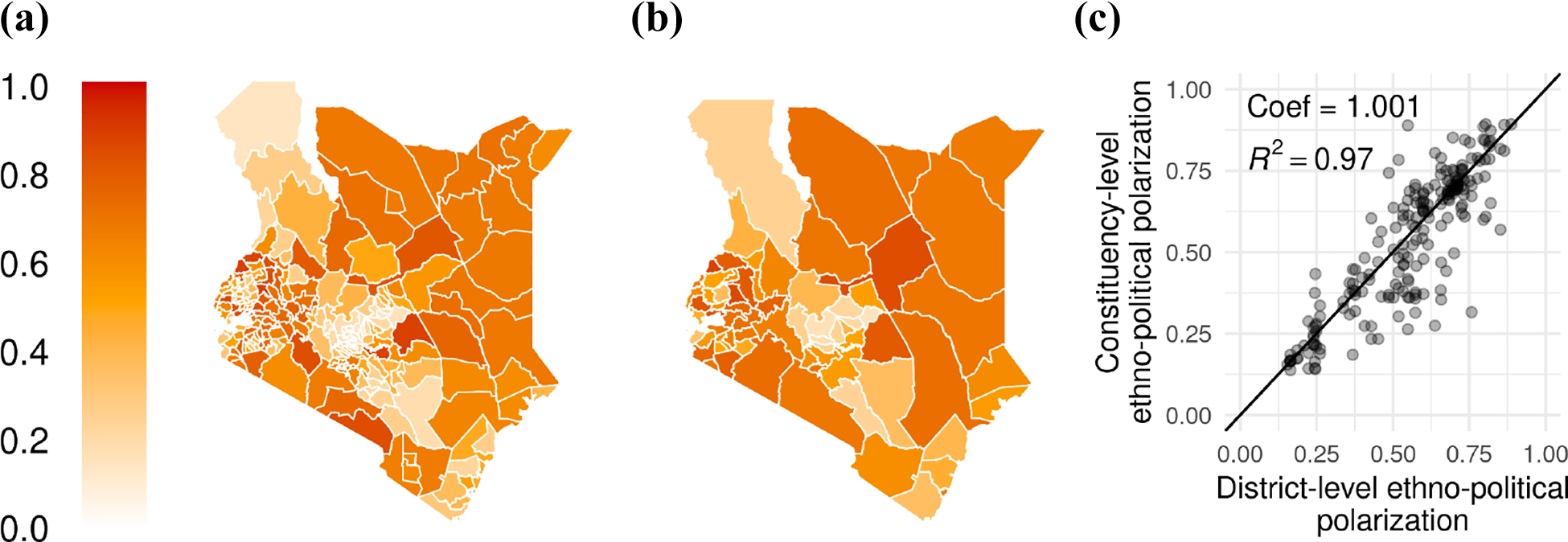
The empirical analysis finds that ethno-politically polarized districts see an escalation of rioting before majoritarian legislative elections that is much more severe than the escalation observed in non-polarized districts or before legislative elections under proportional voting. This result is robust to various permutations of the baseline model. In addition, similar effects of local ethno-political polarization affect citizens’ surveyed fear of pre-election violence in majoritarian systems. I do not extend the analysis to cover post-election violence, which does not have a direct effect on the outcome of the election itself and is therefore presumably motivated by a different logic than outlined above.
Data
The district-month in 22 African countries between 1990 and 2013 constitutes the fundamental unit of analysis. Yearly varying data on the spatial extent of districts, defined as the second administrative level in states, comes from FAO’s (2014) GAUL database. Administrative units as units of analysis might seem inferior to using electoral districts where electoral competition takes place. However, there is no comprehensive cross-national dataset on electoral districts available to date. More importantly, taking electoral districts as units of analysis would make a comparison between majoritarian and PR systems all but impossible, because electoral districts created for majoritarian elections do not exist in PR systems. Because electoral districts in majoritarian systems are typically nested within administrative units, measures for administrative districts are expected to be a reliable proxy for those on the level of majoritarian constituencies – real ones in majoritarian systems and ‘counterfactual’ constituencies in PR systems. Figure 1 illustrates this notion for Kenya in 2007. District-level ethno-political polarization explains 97% of the variation found at the constituency level. 10
The main dependent variable is the monthly count of riots. These data come from the geo-coded Social Conflict in Africa Data (SCAD, 1990–2013; Salehyan et al., 2012), where riots are defined as ‘[d]istinct, continuous and violent action directed toward members of a distinct “other” group or government authorities’ (Salehyan & Hendrix, 2017: 4). This definition roughly coincides, except for the ethnic modifier, with the definition of the ‘ethnic riot’ given above. Because of the difficulty of distinguishing ethnic from non-ethnic riots in newspaper sources without exacerbating reporting bias, I take the raw riot count as the best fitting measure of rioting. I furthermore discuss analyses of the subsets of spontaneous, ethnic, and election-related rioting.
Riot-events are spatio-temporally matched to district-polygons and aggregated to the monthly level. 11 To compare the robustness of the results with different conflict data (Hegre & Sambanis, 2006), I complement the analysis with counts of riots and riot-fatalities from the ACLED data (Raleigh et al., 2010) and the geocoded ECAV data on electoral violence (Daxecker, Amicarelli & Jung, 2019). 12 Throughout, I take the natural logarithm of the count of riots and riot fatalities with 1 added as the dependent variable to alleviate the variables’ right-skew and to follow the intuition that the increase from 0 to 1 riot is larger than moving from 3 to 4 riots.
To model the increase of rioting prior to legislative elections, each district-month is associated with its temporal distance to the next legislative election. Data on the date of elections come from the National Elections across Democracies and Autocracies data (NELDA v4, 1989–2012; Hyde & Marinov, 2011). 13 Because the ‘effectiveness’ of violence likely increases exponentially as elections come closer (Harish & Little, 2017), the variable time to election is calculated as the inverse of the distance to the next legislative election (after adding 1 so as not to divide by 0 in election months). The variable thus increases exponentially as an election comes closer. This is more realistic, more flexible, and does fit the data better than a simpler pre-election dummy (see Figure 3). A robustness check drops all elections that have not been held at their scheduled data, showing that the results are not driven by endogenous election timing.
To differentiate majoritarian elections from proportional voting, I rely on the World Bank Data on Political Institutions (Beck et al., 2001). The data encode whether legislators are elected using a first-past-the-post or winner-takes-all rule. This coding includes five mixed majoritarian and PR systems 14 for which, according to the argument presented above, incentives for pre-election violence should be higher in ethno-politically polarized single-member-districts as well. 15
I measure the degree of local ethno-political polarization by computing a polarization index with data on local ethnic demographics and the political relevance of ethnic groups. The first input consists of maps of the ethnic composition of local populations in Africa (Spatially Imputed Data on Ethnicity, SIDE; Müller-Crepon & Hunziker, 2018).
16
The data are constructed by spatially imputing the ethnic composition of geo-coded survey-clusters enumerated in USAID’s Demographic and Health Surveys (DHS, 2018). Using non-parametric modeling techniques, Müller-Crepon & Hunziker (2018) impute the survey data over a grid with a resolution of
Based on the SIDE data, I construct the measure for local ethno-political polarization in four steps visualized in Figure 2. To move from ethnic compositions of local populations to their composition in terms of politically mobilized ethnic groups, I first match the SIDE data with the Ethnic Power Relations dataset (EPR; Vogt et al., 2015). This dataset provides a time-varying list of ethnic groups that are politically mobilized by at least one actor at the national level or politically discriminated against by the state. The coding of political mobilization is most often based on the existence of ethnically mobilizing parties or politicians. Because MPs are often part of larger ethnic coalitions, 17 the data fit the proposed theoretical argument well. I match ethnic groups in SIDE with their EPR counterparts for every year between 1990 and 2013. 18 Groups in SIDE without an equivalent in EPR are coded as being politically irrelevant.
In a second step, I weigh each grid-cell with its population in a given year.
19
I then aggregate the resulting grid of head-counts of politically Flowchart of the construction of the measure of district-level ethno-political polarization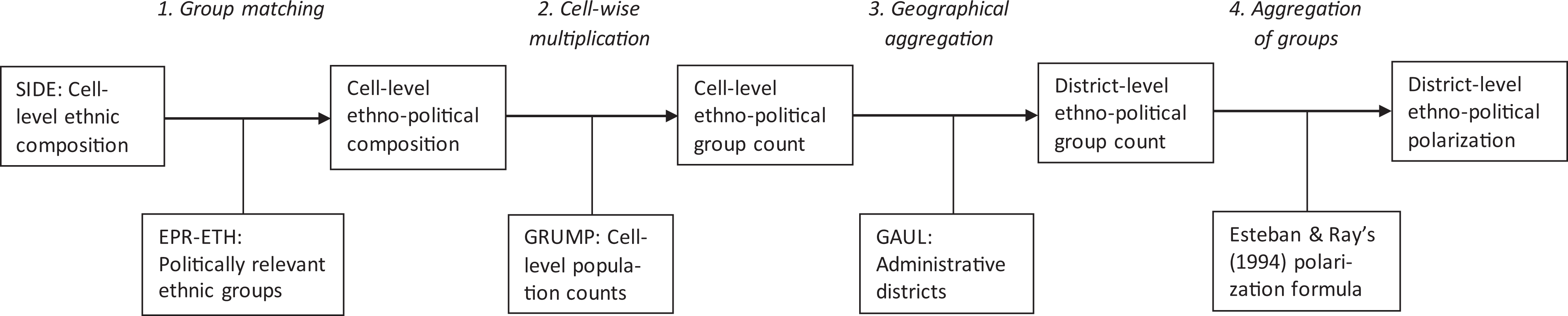
Empirical strategy
Using the resulting dataset, I model the effect of ethno-political polarization on the increase in rioting prior to elections as a linear count model:

where
In comparison to count models such as the negative binomial model, the linear model allows for adding a flexible set of spatio-temporally defined fixed effects
The narrow fixed effects serve four purposes. First, as the Arab Spring and common adjournments of electoral contests evidence, elections might be caused or inhibited by violence preceding them. The country-month fixed effects effectively block this link by netting the data of all variation that is constant at the country-month level. Second, they account for omitted variables that are constant at this level and influence both the timing of elections and the occurrence of riots. These covariates include all national-level socio-economic factors. Third, the use of time-varying data on the spatial extent of districts and the related danger of boundary changes that are endogenous to elections or riots presents the ‘modifiable areal unit problem’ in its time-varying form. By using district-year fixed effects, the problem is alleviated insofar as for each district-year only one stable areal unit is observed and local causes of past changes are controlled for. Fourth, the district-year fixed effects reduce the impact of locally varying spatial and temporal auto-correlation. They account for the intermediate past of district-years and their yearly environment and thereby limit the bias spatio-temporal auto-correlation introduces.
To account for remaining temporal auto-correlation, I follow Carter & Signorino (2010) and approximate the decay of riot-risk after a riot as a cubic polynomial of the time since the last event in a district. To model spatial auto-correlation, I add the number of riots in neighboring districts at times Mean number of riots in polarized and non-polarized districts over the 24 months prior to elections in majoritarian and mixed systems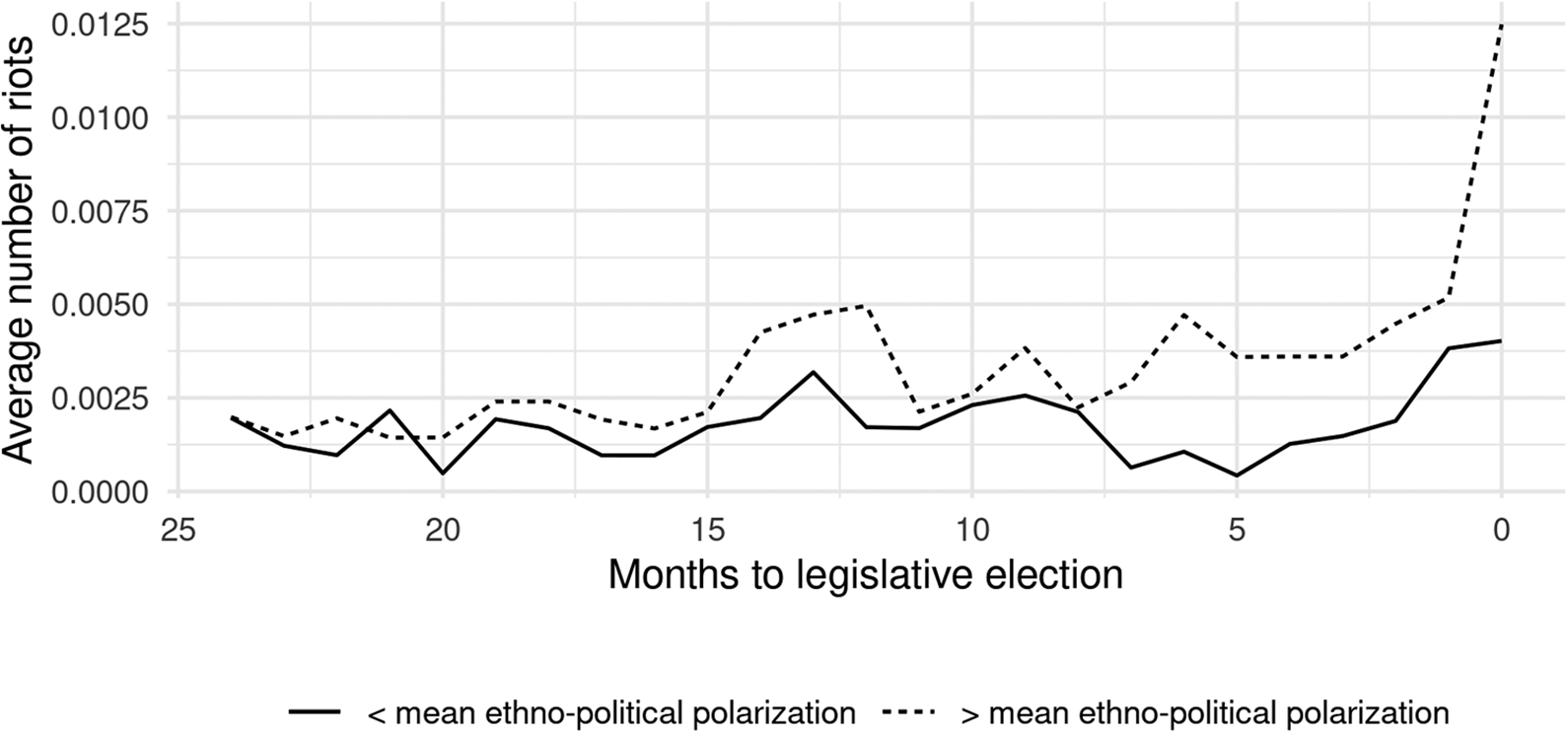
Results
Figure 3 provides a first descriptive test of Hypothesis 1 that ethno-politically polarized districts experience steeper increases in the number of riots prior to majoritarian elections than their non-polarized counterparts. The figure shows that relatively polarized districts see slightly higher numbers of riots during non-election times and, crucially, experience a starker escalation of riots during electoral campaigns than districts with a low level of polarization. Table I reports the results of the statistical analysis of this pattern of pre-election violence. The table summarizes the association of pre-election increases in the number of riots with the level of local ethno-political polarization in majoritarian and mixed electoral systems. Models 2 and 3 iteratively introduce fixed effects on the country and district levels. Model 4 finally combines country-month and district-year fixed effects for reasons outlined above. Note that with the full set of fixed effects, the constitutive terms of the main interaction term time to election
Local ethnic polarization and pre-election violence in majoritarian and mixed systems
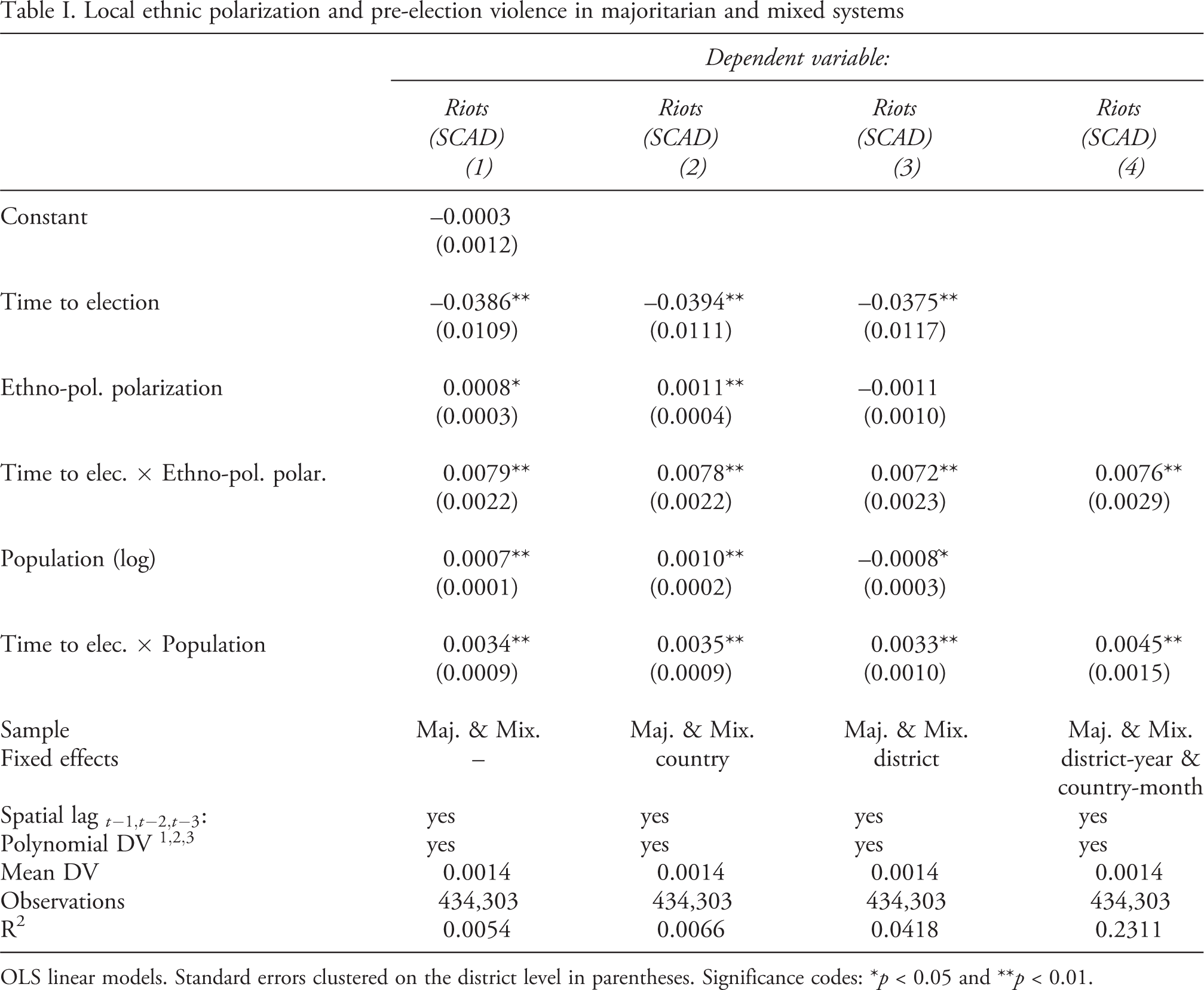
OLS linear models. Standard errors clustered on the district level in parentheses. Significance codes: *p < 0.05 and **p < 0.01.
As a first indication of the robustness of the result, the difference in the local escalation of the number of riots prior to elections seen between polarized and non-polarized districts remains very stable once the country-month and district-year fixed effects are added to the model (Model 4, Table I). They control for unobserved heterogeneity that might influence the timing of elections and spatio-temporal auto-correlation not captured by the respective controls.
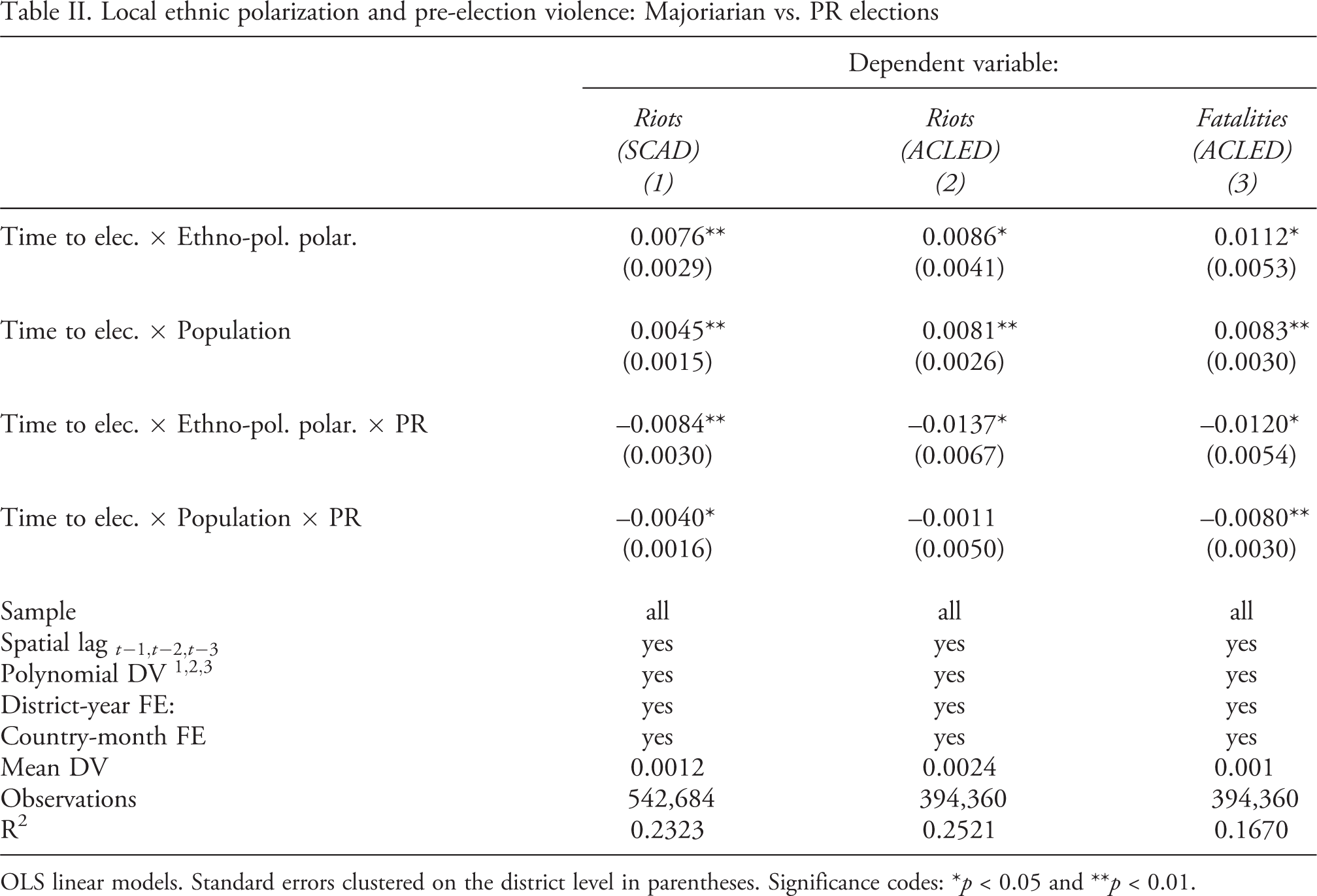
So far, the baseline results support the argument that, in majoritarian systems, local ethno-political polarization heightens the risk of pre-election increases in the number of riots. Following Hypothesis 2, this finding can only be attributed to the nature of majoritarian systems if no such effect is found in PR elections. To estimate the difference in the effect of local polarization on pre-election increases in the number of riots, I interact all predictors in the baseline model with a PR dummy and extend the sample to all countries in the sample. Furthermore, I extend the range of outcomes with data on riots and riot fatalities retrieved from ACLED which are likely less affected by media bias but only cover the time since 1997 (Raleigh et al., 2010).
In its first three rows, Figure 5 plots the marginal effect of the interaction of ethno-political polarization Prediction of the number of riots over the pre-election period in majoritarian polities, varying the degree of local ethno-political polarization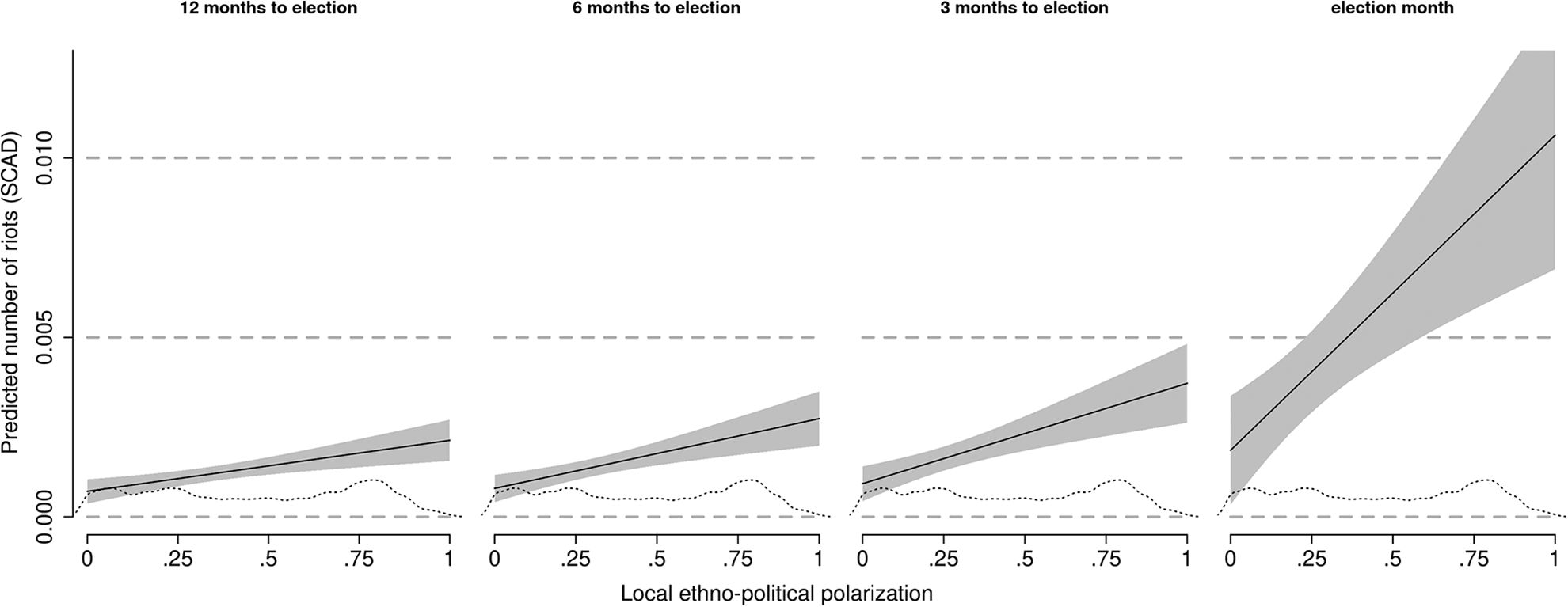
In sum, these results suggest that the effects of local ethno-political polarization found in majoritarian and mixed systems are due to the nature of majoritarian as compared to PR elections. Local ethno-political competition does not increase the risk of pre-election violence in PR systems.
Robustness checks
In the following, I summarize the results of a number of robustness checks. Figure 5 summarizes the main findings. Online appendix A2 presents all analyses in further detail.
Direct measure of electoral violence
I first address the question of whether the results above indeed capture electoral violence. An analysis of the Electoral Contestation and Violence (ECAV) data collected by Daxecker, Amicarelli & Jung (2019) reveals that the number of instances and fatalities of electoral violence during the six months preceding an election significantly increases in ethno-political polarization in majoritarian, but not proportional systems. Note that the coverage of the ECAV data is limited to pre-election periods and therefore only allows for a cross-sectional research design.
Disaggregating riots
Disaggregating the SCAD data on rioting, I test whether the results are mainly driven by riots with a clearly identifiable leadership or organization (e.g. political parties or unions) or without. Participants of riots with unidentified leadership or organization are oftentimes identified by ‘ethnic’ labels. 27 They likely have a broader popular participation and their anonymous perpetrators are harder to punish after the fact. In line with my theoretical argument, I therefore expect that riots coded by SCAD as ‘spontaneous’ drive the results. In addition, SCAD provides information on the conflict issues mentioned in news articles. Among the mutually non-exclusive issues, I expect ‘elections’ and ‘ethnic discrimination, ethnic issues’ to drive the results. The analysis shows that the effects mostly stem from ‘spontaneous’ riots, and riots reported to be related to electoral and ethnic, rather than all other issues. Lastly, I find no effects of ethno-political polarization of pre-election increases in the number of local demonstrations, strikes, and violent attacks by militias. Taken together, these results support the argument that ethnic riots are campaign weapons in ethno-politically polarized constituencies.
Reverse causality
Two types of reverse causality may explain the results. In the first, violence directly affects Robustness checks on Model 1 in Table II with 95% CIs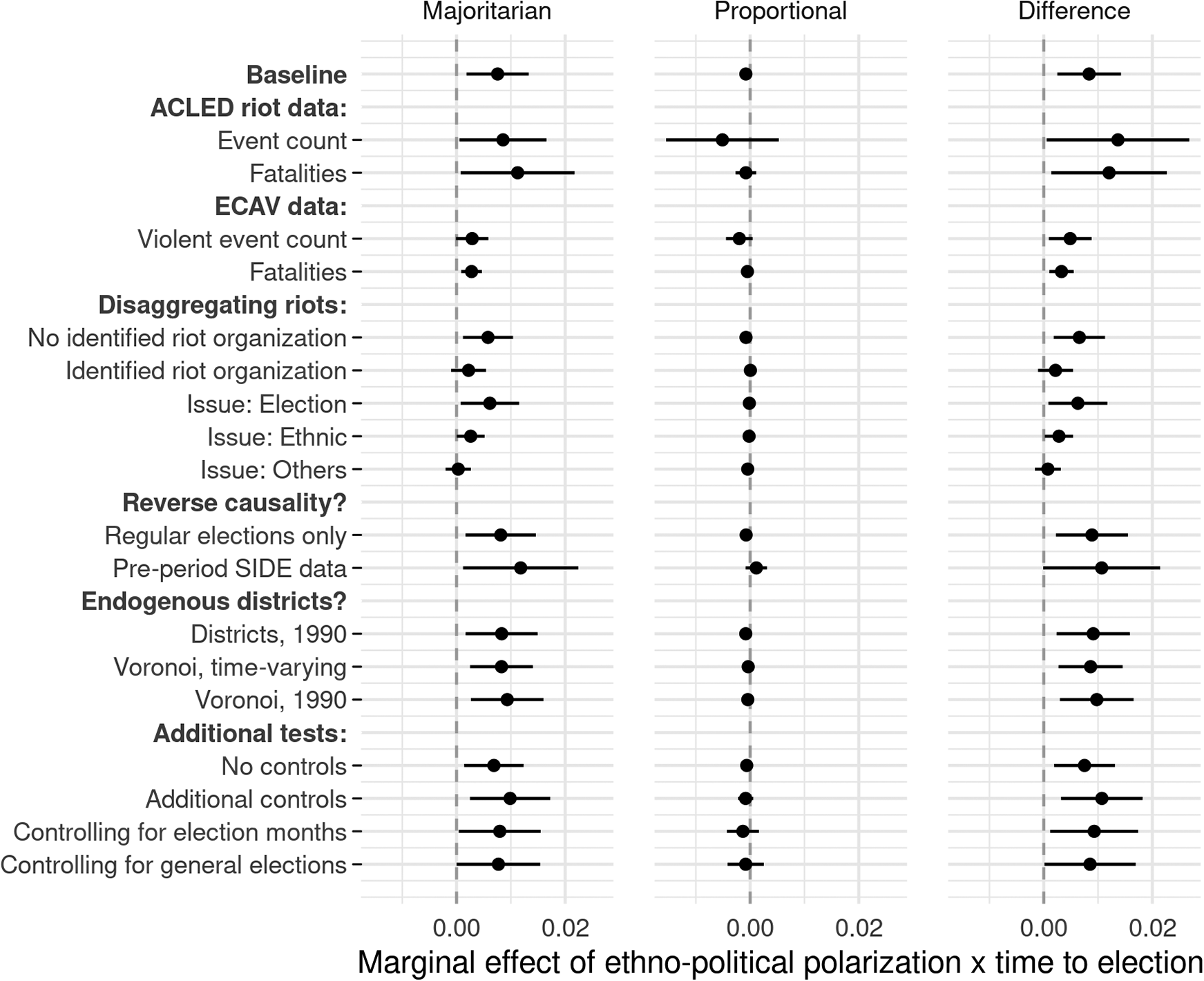
Endogenous districts
Responding to past or expected violence, politicians might have adjusted district borders to foster peace or incite conflict. To account for such endogenous borders, I use (1) stable districts as observed in 1990 and (2) artificial districts based on Voronoi tessellations around districts’ centroids as alternative units that are less biased by endogenous district designs. The respective results correspond to the baseline estimates.
Additional analyses
Local ethnic polarization and pre-election violence: Majoriarian vs. PR elections
OLS linear models. Standard errors clustered on the district level in parentheses. Significance codes: *p < 0.05 and **p < 0.01.
The fear of pre-election victimization and local ethno-political polarization
As shown above, local ethno-political competition is robustly associated with district-level increases in the number of riots prior to majoritarian and mixed but not PR elections. In the following, I assess the effect of local ethno-political competition on individuals’ fear and experience of pre-election violence. This analysis avoids media biases in the riot data (von Borzyskowski & Wahman, 2019; Weidmann, 2016) and provides evidence on the extent of individual-level pre-election vicitimization in polarized constituencies.
Building on Rauschenbach & Paula (2019), I draw on Afrobarometer (2018) surveys rounds 4–6 from 19 countries (Online appendix Figure A1), which asked individuals: ‘During election campaigns in this country, how much do you personally fear becoming a victim of political intimidation or violence?’ Additionally, I examine Afrobarometer pre-election surveys from Nigeria (2007) and Uganda (2010/11) that contain data on whether respondents or their community have been subject to recent campaign threats relating, inter alia, to their physical well-being. While available for only two elections, this is a more accurate measure of electoral violence than individuals’ fear of it. While other forms of campaign violence than riots can affect individuals’ reports and fear, I expect response patterns to coincide with the main results if pre-election rioting indeed intends to affect voters. Without knowing the immediate cause of individuals’ reports and fears, I cannot completely rule out that response patterns are driven by non-riot forms of political violence.
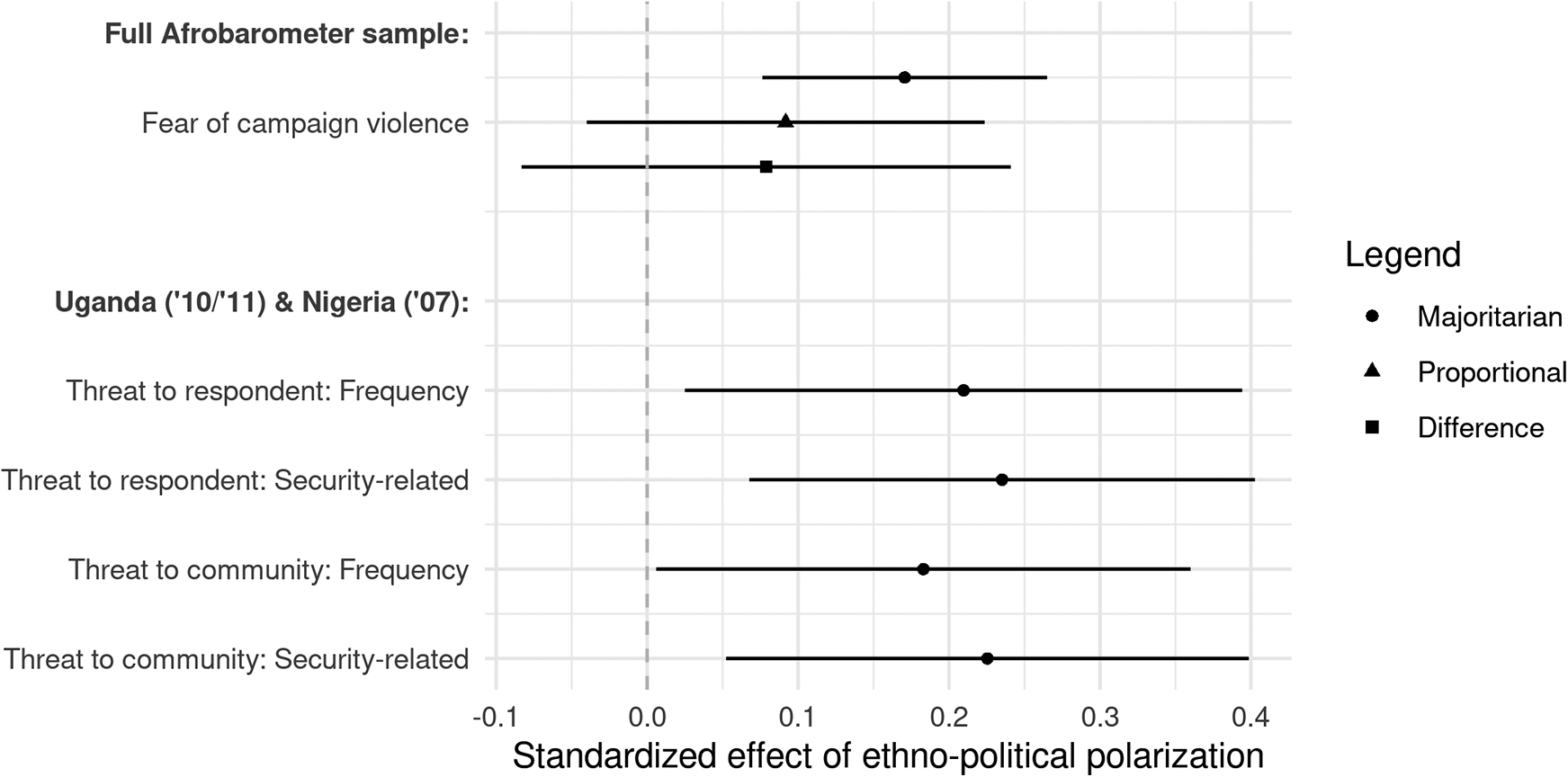
Estimated standardized effect of local ethno-political polarization on fear and experience of pre-election violence
I match the district-level measure of ethno-political polarization in the year prior to a survey 28 to Afrobarometer respondents via the geographic location of survey clusters (Ben Yishay et al., 2017). 29 The main analyses are conducted using the following OLS specification: 30

where outcomes y of an individual i in district d of country c interviewed in year t are regressed on the district’s level of ethno-political polarization. I only compare respondents interviewed in the same survey by adding survey fixed effects
Results
Figure 6 presents the estimates of the standardized effects of local ethno-political polarization on respondents’ fear and experience of campaign violence. In majoritarian systems, the fear of respondents is positively and significantly associated with the ethno-political polarization of their home district. The effect, plotted in the first row of the figure, amounts to a change in the reported level of fear by 0.17 standard deviations as one moves the polarization measure from 0 to 1. This effect of local ethno-political polarization is weaker in pure proportional systems, though not precisely estimated at zero. The difference between pure PR and majoritarian systems is not statistically significant (p
Moving beyond subjective perceptions of fear, Figure 6 reports the estimated effects of ethno-political polarization on reports of electoral threats in Uganda and Nigeria. Respondents in polarized districts in both countries report that they and members of their community have been targeted significantly more often by campaign threats than those living in non-polarized areas. The estimated effect on security-related threats is similarly strong. Respondents who live in polarized areas are on average 5.1 percentage points or .24 standard deviations more likely to have received such a threat. Unsurprisingly, the effect on reports about security-related threats being issued at community members is consistently estimated. In sum, these findings show that individuals in ethno-political polarized districts under majoritarian voting experience more electoral violence, thus bolstering the main theoretical argument.
Conclusion
Local political competition between ethnic groups can increase the odds of pre-election violence in majoritarian elections in Africa. By focusing on the nexus between local ethno-political cleavages, the electoral system, and campaign violence, the preceding analysis highlights the importance of sociopolitical geography for gauging the merits of majoritarian as compared to proportional electoral systems.
In particular, I argue that majoritarian elections turn violent where ethnic constituencies of similar size compete for legislative seats at the local level. Because competition in proportional systems occurs at higher geographical level, local ethno-political polarization has no effect on violence before PR elections. This argument is supported by results that show that the level of violence before majoritarian elections significantly increases with local ethno-political polarization. Similarly, citizens who live in polarized districts in majoritarian polities systematically report substantially higher levels of fear of pre-election violence than their co-nationals in non-polarized districts. These patterns of pre-election violence in ethno-politically polarized districts under majoritarian voting do not threaten electoral integrity in pure PR systems.
Echoing arguments made by Barkan, Densham & Rushton (2006) and Wagner & Dreef (2013), these results suggest that constitution writers are well advised to account for a state’s ethnic geography when drafting electoral institutions. This is particularly important in unconsolidated democracies – in countries with more established norms of peaceful campaigning, local ethnic competition is less likely to lead to widespread violence. The results show that majoritarian elections can turn violent in areas where politically mobilized ethnic groups make up roughly equal shares of the population, thus increasing electoral competition along ethnic lines. The contrasting finding of an absence of this pattern in PR elections adds more detail to our understanding of the propensity for electoral violence in majoritarian elections (Birch, 2007; Fjelde & Höglund, 2016).
In addition to the contrast between majoritarian and PR elections, the findings suggest that electoral districts in majoritarian systems can be designed to reduce district-level ethno-political polarization and electoral violence. However, the likely positive effects of such district designs must be discussed alongside their impact on the competitiveness of elections, the translation of votes to seats, and the representativeness of future electoral results. Furthermore, districts designed to achieve non-polarized ethnic compositions may well legitimize ‘ethnic gerrymandering’ more generally, further politicize ethnic identities, and ultimately foster ethnic conflict. While the immediate effect of district-level polarization on electoral violence shown in this article can inform such discussions, it should be only one of many concerns addressed by electoral designs. These must be ultimately geared towards serving citizens’ preferences.
Footnotes
Replication data

Acknowledgements
I thank two anonymous reviewers and the editor Cullen Hendrix, Robert Bates, Nils-Christian Bormann, Lars-Erik Cederman, Ursula Daxecker, Michael Gilligan, Philipp Hunziker, Yannick Pengl, Espen Geelmuyden Rød, and participants of the 2016 ISA Conference in Atlanta, as well as of workshops at Harvard University, University of Konstanz, and Witten-Herdecke for very constructive comments and suggestions.
Funding
This research was supported by the Swiss National Science Foundation through grant P0EZP1_165233.