




Abstract
The principal threat most autocratic leaders face stems from within the regime. To control militaries and mitigate the risk of coups d’état, many autocratic leaders repeatedly purge strong officers from the military. What are the causes and consequences of such purges? Despite its importance, scholars rarely have studied the question, as they have lacked a systematic and comprehensive dataset. The Military Purges in Dictatorships (MPD) dataset contains information on the dates and characteristics of 1,007 military purges, and covers 566 political leaders in 116 authoritarian countries over the period 1965 to 2005. In this article, I describe MPD, compare it with other datasets, present descriptive statistics on the data, and suggest its applications. By coding the timing and various characteristics of military purges, MPD facilitates empirical study of the relationships between autocratic leaders and their militaries, and thus is useful for researchers studying political violence, repression, civil-military relations, coup-proofing, leader survival, and regime transition.
Introduction
The principal threat most autocratic leaders face comes from within the regime rather than from outside. Approximately three-quarters of dictators who lose power do so as the result of a coup d’état (Svolik, 2009). To address such threats to their power, many dictators attempt to control their militaries by eliminating strong potential rivals from key positions and replacing them with those who are loyal. Prominent examples include Iraq’s Saddam Hussein, Syria’s Hafez al-Assad and Uganda’s Idi Amin. More recently, Turkey’s Recep Erdogan and China’s Xi Jinping have increased their political control by purging opponents in their militaries. An emerging literature on comparative authoritarianism points out that the repeated elimination of rival elites allows dictators to consolidate their personal power and diminishes the ability of those elites to hold the dictator accountable (Svolik, 2009; Sudduth, 2017). In fact, the number of authoritarian regimes where political power is highly concentrated in the hands of a single individual – typically called personalist dictatorships – has steadily increased since the end of the Cold War (e.g. Kendall-Taylor, Frantz & Wright, 2017; Frantz & Kendall-Taylor, 2017).
What are the causes and consequences of purging the military in autocracies? Despite its importance, a lack of comprehensive data has impeded systematic research on this topic. The Military Purges in Dictatorships (MPD) dataset contains systematic human-coded data on military purges, defined as events in which a political leader within a dictatorial regime eliminates individuals from their positions in the military or other elements of the security apparatus. The MPD dataset contains coded information on the dates and characteristics of military purges covering 566 political leaders in 116 countries under authoritarian regimes from 1965 to 2005. MPD codes, for example, whether a purge is primarily peaceful, or involves arresting, jailing or killing military officers, the positions of purged officers, the size of the purge, and the background reasons for it. Researchers can use MPD in an event data format as well as a leader-year panel data format. In coding the data, careful attention has been paid to which leaders conduct purges and, thus, unlike other datasets with country-year observations, MPD properly codes cases where multiple leaders ruled in the same year.
This article proceeds as follows. I first present an overview of other datasets that capture some aspects of political purges, and I highlight important aspects of the MPD dataset that are not captured elsewhere. Next, I describe how MPD was constructed, and set out the definitions, data sources, and coding criteria. I then provide descriptive statistics for MPD. I go on to illustrate how MPD can be used by examining the effects of military purges on the severity of repression of civilians. The concluding section includes discussion of an agenda for future research.
Comparison with existing datasets
How can a dictator’s efforts to purge the military be measured? The most comparable dataset has, perhaps, been provided by Geddes, Wright & Frantz (2018) (GWF). GWF has several indicators specifically coded to capture the levels of personalization – defined as concentration of power in the hands of a leader – within the security apparatus for 280 autocratic regimes from 1950 to 2010. Their Military purge variable captures whether regime leaders murder military or security service opponents, or jail or execute them, either without trial or after a trial regarded as unfair by country specialists or journalists. Their Military promotion variable captures whether there are widespread forced retirements of officers not from a regime leader’s ethnic or religious group (Geddes, Wright & Frantz, 2017: 30–31). 1
Though these variables certainly help us understand the personalization level of the security apparatus, they do not identify military purge ‘events’ and their timing in a precise manner. GWF codes each variable as of 1 January for each calendar year, and once a regime leader is coded as having engaged in personalization activities such as jailing military officers, the same codes are applied ‘until the current leader is ousted or the regime ends unless something you read leads you to believe that the leader’s way of dealing with the military has changed’ (Geddes, Wright & Frantz, 2017: 30–31). In other words, their data identify the first regime year when a specific personalization policy – including military purges – occurs, and all subsequent regime years retain the same coding, such that that leader is assumed to continue jailing and executing officers until he is ousted or the regime ends (Song, 2018: 13). For example, the Military purge variable is coded as positive during the entire tenure of Stalin, regardless of actual occurrences of military purges in a particular year. In contrast, MPD precisely codes the timing of each military purge, regardless of whether a dictator has engaged in purges in the past.
Several other datasets also capture military purges, but these are limited to particular types of purge. The dataset on ethnic exclusion created by Roessler (2011) identifies when a particular ethnic group is excluded from the central government. 2 Although the data capture an important aspect of elite purges, they are limited to those based on ‘ethnicity’. Yet, even in countries where ethnicity is politically relevant, ethnic identity is not the only cue for dictators’ decisions about which individuals are potential threats and should be eliminated. The Banks Cross-National Time-Series Data Archive also includes a variable on purges (Banks, 2020), but is limited to purges based on violence and coercion.The concept of elite purges, however, should not be limited in this way, as nonviolent elimination can be effective in concentrating power into dictators’ hands. For example, Cameroon’s Paul Biya repeatedly dismissed his rivals from key positions through nonviolent means and these efforts are considered to have increased Biya’s control over national defense (Keesing’s, 1986). More fundamentally, the Banks purge variable includes dictators’ acts against opposition groups outside the regime, without any differentiation of a dictator’s actions to purge regime insiders. More recently, Easton & Siverson (2018) coded whether a state leader eliminates and punishes the plotters following a failed coup attempt. The coverage of their data is therefore limited to the circumstances and periods following failed coup attempts.
MPD builds on the dataset originally used by Sudduth (2017), but has extended it in several ways. First, it expands the data coverage by coding all autocracies between 1965 and 2005, whereas the original data cover only the period 1969–2003. Second, MPD introduces several new indicators that are useful in explorations of the dynamics of military purges. For example, it codes the dates of military purges and lists all the positions targeted in each, which allows users to ascertain the relative importance of each purge. Another new feature of MPD is an indicator that identifies whether a purge is primarily violent or nonviolent. Third, MPD distinguishes multiple purges in the same leader-year, while the original dataset aggregated the information for each leader-year and did not capture the existence of multiple events for the same leader-year. Finally, as discussed below, my research team and I re-examined the original codings of Sudduth and updated them if we found those codings to be questionable, or if we found more relevant information that led us to make changes to the original codings. Thus, the MPD dataset improves on the quality and reliability of the codings for those cases covered by Sudduth (2017), while adding new ones for the extended period of coverage.
MPD data: Definitions, coding procedure, variables, and limitations
The MPD dataset contains information on the dates and characteristics of 1,007 military purges covering 566 political leaders in 116 authoritarian regimes from 1965 to 2005.
Definitions
Following Sudduth (2017), MPD defines military purges as incidents where a dictator eliminates individual members of the elite who have legitimate access to the use of armed forces. The targets of purges coded in MPD are thus officers in the military or other elements of the security apparatus and civilian members of the elite at the top of the security apparatus, such as the defense minister or interior minister. Regarding the manner of elimination, a dictator’s actions to dismiss, replace, demote, arrest, jail, or kill officers, as well as forced resignations, are treated as purges in MPD. Finally, we want to distinguish dictators’ actions to expand their power at the expense of elites from incidents where dictators dismiss officers purely because of their incompetence or for other non-political/technical reasons. The difficulty is, though, that dictators can justify their actions by emphasizing that purged officers were incompetent or had committed crimes, even when their intention to consolidate their personal power is clear (a case in point is China’s Xi Jinping). MPD therefore takes an inclusive approach, that is, it includes all cases where a dictator eliminates officers, but in addition it codes the background reasons for each case. Users thus can operationalize their purge variables by focusing only on cases with certain background reasons appropriate for their studies.
The basic unit of analysis for the MPD dataset is the military purge ‘event’, such that we code even those purge incidents that occur within a short period as distinct events when the background reasons for these purges are different. In addition to the event format dataset, we provide a panel dataset with a leader-year unit of observation, which, unlike the country-year format, identifies which leader conducted the purge. Therefore, even when multiple leaders rule in the same year, MPD precisely assigns each purge event to the appropriate leader. To identify autocratic countries, we rely on both GWF and Cheibub, Gandhi & Vreeland (2010) (hereafter CGV), such that we code for all the countries that are treated as a non-democracy by either GWF or CGV. The list of leaders is obtained from Archigos (version 4.1) (Goemans, Gleditsch & Chiozza, 2009).
Coding procedure
To make the dataset, my research team (research assistants drawn from graduate students at Emory University and the University of Strathclyde) and I gathered information using (i) Keesing’s Record of World Events and (ii) Lexis-Nexis news searches. Because of their global coverage and consistent reporting standards, we decided to use Associated Press, BBC, New York Times, and Washington Post news articles from the Lexis-Nexis database. To search for relevant articles from the news database, we used several key words that would capture purge events as defined above. Those words include purge, arrest, dismiss, expel, replace, remove, reshuffle, sack, and fire. My research team downloaded all hits from the search and read all the articles to see whether they qualified for coding. Each research assistant read all the articles for specific countries and coded all the events from these countries for the relevant period. This process allowed research assistants to develop country-specific expertise and improve their interpretation of specific cases. To ensure interrater reliability and minimize the possibility of miscoding, all the events originally coded were re-examined by different research assistants, and our research team as a whole made a final decision on any cases of disagreement. All the cases were then reviewed by me, as the project manager. For any cases I found to be questionable, research assistants searched for additional news articles using (iii) the Periodicals Archive Online (ProQuest) and (iv) the wider literature on individual countries. After reviewing the information from the additional search, I made a final decision on coding.
Variables
In MPD, we include information on the dates and various characteristics of military purges. The Date variable codes year, month, and day of a specific purge event. Though it is often difficult to obtain information on the exact day of a purge, for the majority of cases we were able to capture month-level information. 3 We also coded several variables to capture the nature and characteristics of purges. First, we identify whether a purge was primarily violent in nature or nonviolent. Violent purge indicates whether the purge involves the arrest, jailing, or killing of officers. Nonviolent purge takes the form of dismissing, demoting, or replacing officers. Second, we code the background reasons for the purge. Based on our reading of each case, we code whether a dictator purges the military, for example, (i) to diminish the influence of a dictator’s political rivals who are popular among other elites and thus are suspected to be potential threats to his political survival, (ii) to exclude those who have different policy preferences and criticize the dictator’s policy, (iii) to punish those officers who have planned to overthrow the leader or the regime, (iv) to punish officers for being incompetent, or (v) to punish officers who have committed crimes, or (vi) because of pressure from foreign countries. We also code whether a purge happens in the form of cabinet reshuffles or new government formations. These categories are not mutually exclusive, and a single purge event can have multiple background reasons. We code these variables so that users can properly operationalize their purge variables by excluding cases with certain background reasons.
MPD can also differentiate the relative importance of each purge, as it identifies the positions of purged officers. In the Position variable, we list all the positions targeted in each purge. 4 Based on the information on these purged positions, we then rank purge events in four categories. The Rank variable identifies whether the targets of a particular purge include (i) the top-ranking positions, such as the army chief of staff, chief of general staff, the commander of the army (or navy or air force), or ministerial positions such as the defense minister or interior minister; (ii) deputies for the top-rank positions, such as deputy chief of staff or deputy defense minister; (iii) mid-level officers and senior officers, such as the commander of the regional command, army general or colonel generals; or (iv) junior officers or soldiers. The Size variable is a four-category measure that indicates whether the number of purged officers is (i) only one individual, (ii) between two and ten, (iii) between 11 and 100, or (iv) more than 100. We also code whether the target of the purge is an organization: the Organization purge variable captures whether a leader eliminates an entire organization.
Detailed documentation on coding procedures and variables is available in a codebook. In addition, descriptions of each military purge coded in the dataset and brief discussions of how we coded it are provided in a case description document (see Online appendix).
Limitations
Like any data collection efforts that rely on news articles, MPD potentially has reporting bias. As the news media target a particular audience, their coverage might be biased in favor of particular countries. In particular, because MPD focuses on authoritarian countries, it might suffer from underreporting (Salehyan, 2015). Though it is certainly possible that it misses some military purge events, there are several reasons to believe that MPD is less subject to such bias.
First, we gather information from a variety of news sources, including Keesing’s Record of World Events, Lexis-Nexis news searches, and literature on individual countries. Consulting multiple sources allows us to make the data as comprehensive as possible and to address the potential biases found in particular sources. Second, as emphasized by Sudduth (2017), dictators have incentives to make purges public, to credibly signal the cost of disloyalty and scare off other potentially disloyal elites. Due to their public nature, purges are likely to be reported by news sources. Relatedly, changes within military organizations resulting from purges can have important consequences on countries’ military capabilities, strategies, and regional security environments. Because of their security implications for neighboring countries, military purges tend to draw the attention of foreign media and governments, which will counter any tendency to underreporting. Third, we dropped from MPD seven countries where we could not obtain sufficient information to accurately code purges. Finally, as I will discuss in the following section, the trends in military purges captured by MPD are consistent with a scholarly understanding of this phenomenon.
Descriptive statistics
This section presents descriptive statistics for MPD. I first examine variations in the incidence of military purges among different regions and years. For the sake of Number and probability of military purges by region and year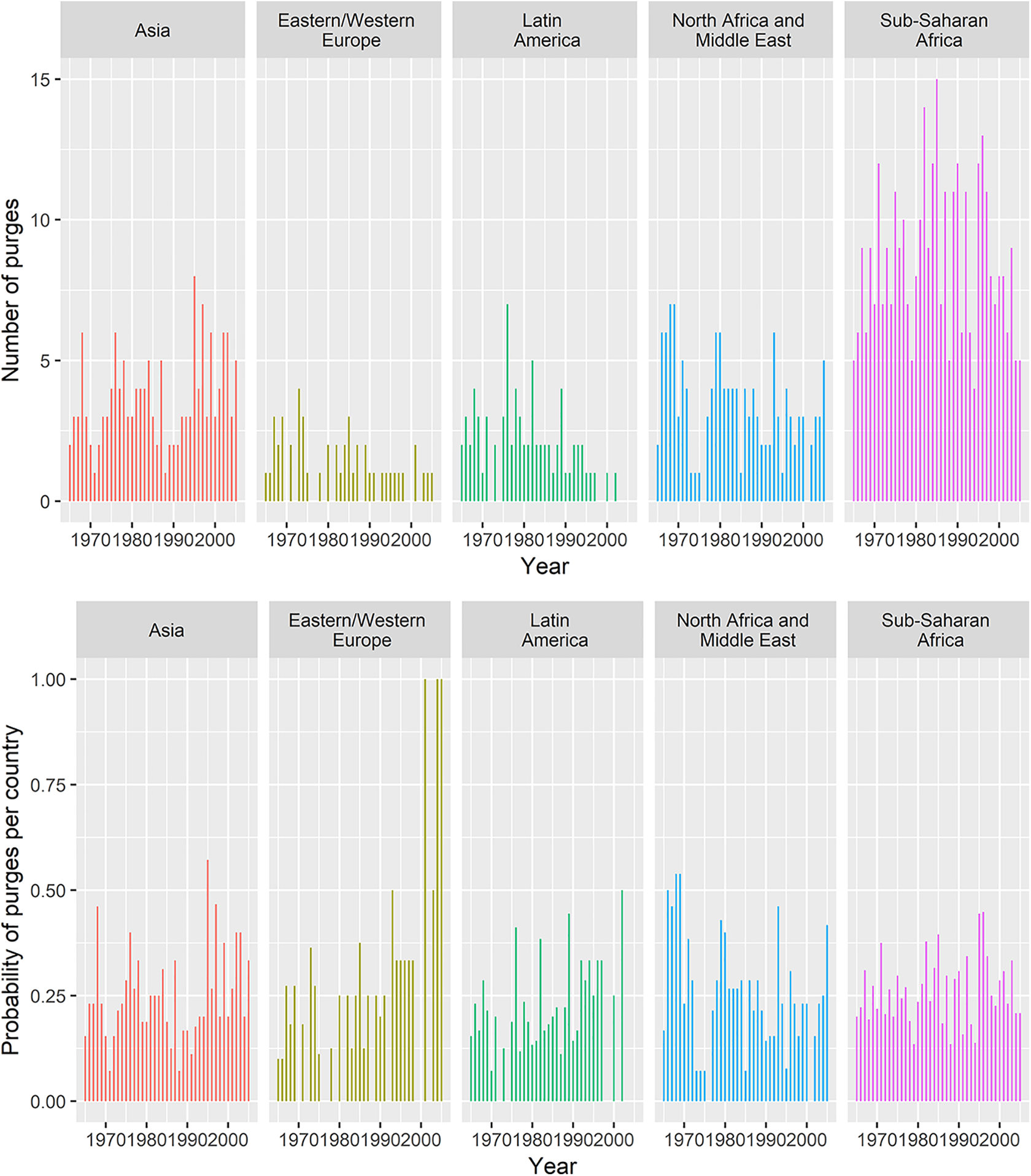
In the upper part of Figure 1, I plot the total number of military purge events per year in separate panels for different regions. It reveals that the largest number of military purges occurred in sub-Saharan Africa, while North Africa and the Middle East, and Asia also witnessed a fairly large number of purges. The lower part of Figure 1 reports the probability of purge events per country, calculated as the total number of military purges divided by the number of autocratic countries, for each region-year. It shows that, though sub-Saharan Africa witnessed the largest number of military purges, the probability that each autocratic regime experiences at least one purge event in any given year is similar across regions as well as across years.
5
The average probability of military purges per country-year How leader type is correlated with the probability of military purges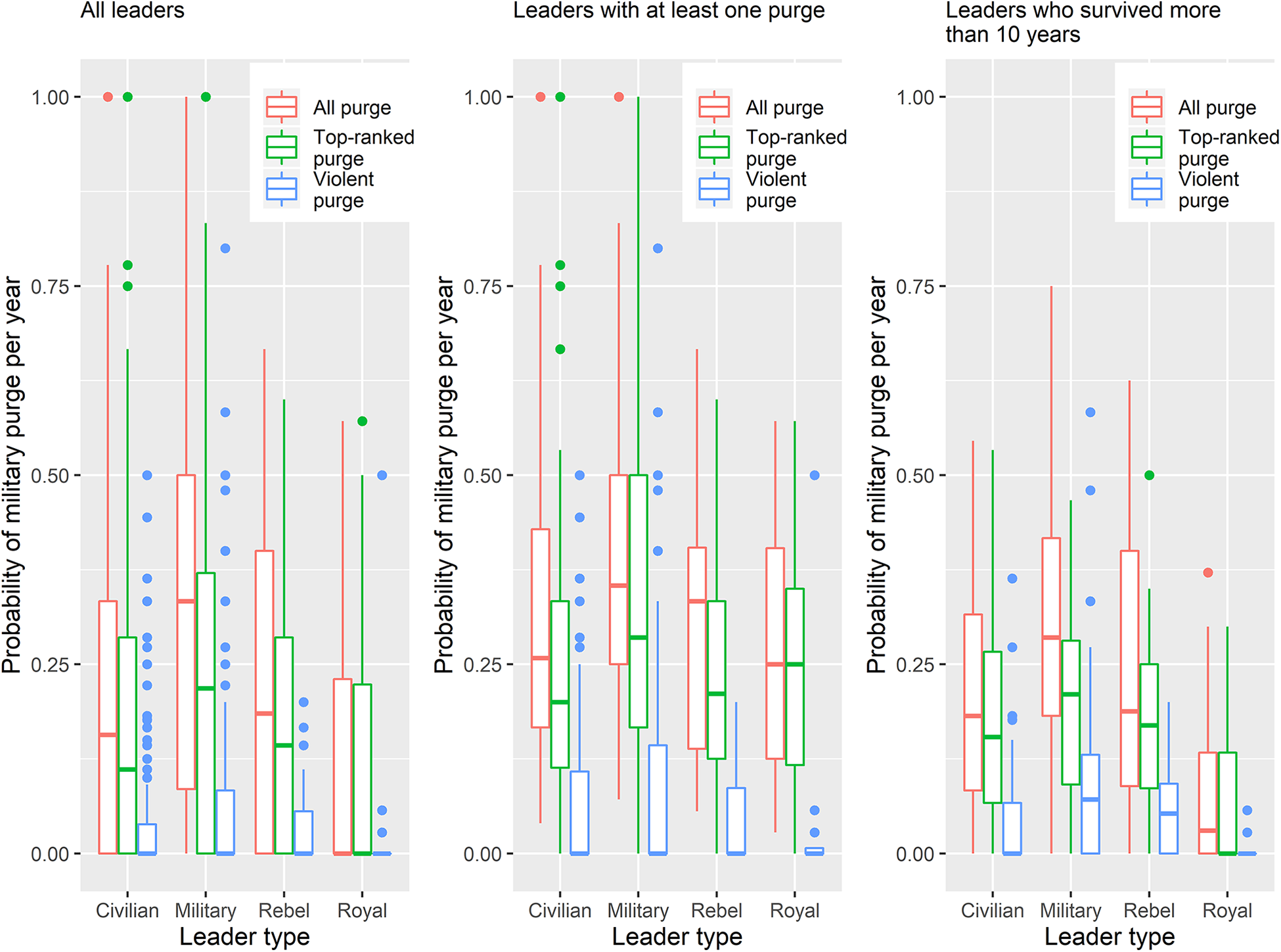
We now explore how the characteristics of individual leaders are correlated with their tendencies to purge the military. For this exercise, I use the leader-year format of MPD. Figure 2 presents boxplots of the distributions of the probability of a military purge per year, calculated for each leader as a unit. Using data from Geddes, Wright & Frantz (2017, 2018), I compare four different leader identities prior to their assuming office – that is, civilian, military, a rebel leader, or a member of the royal family. For each type of leader, the three boxplots display the distributions of (i) all types of military purges, (ii) military purges where the targets include top-ranking positions, and (iii) military purges that involved the arresting, jailing, or killing of officers. Each panel represents different samples of leaders. The left-hand panel plots the distribution for all authoritarian leaders, while the middle panel shows the distributions for those leaders who purged their militaries at least once during their tenure. The right-hand panel focuses on the sample of leaders who survived more than ten years.
The left-hand panel in Figure 2 shows that military leaders who were members of the security apparatus prior to coming to power are more likely to purge the military than other types of leader, though both civilian and rebel leaders also display a relatively high likelihood of military purges (around 14 % per year). This tendency also applies to purges that target top-ranking officers. Second, whereas the majority of leaders never violently purged the military, there are a few leaders who had frequently conducted violent purges (i.e. there are a good number of outliers for violent purges). Turning to the middle panel, where we focus on leaders who purged at least once during their tenure, the variations among different types of leader considerably diminish. Moreover, all types of leader have relatively high probabilities of purges (above 0.25 per year on average), implying that leaders who have purged at least once are more likely to purge again.
Finally, in the right-hand panel, military and rebel leaders who survived more than ten years show much higher levels of violent purges than the leaders in other panels. These findings might suggest that in order to implement violent purges, a leader needs to have already consolidated enough power. Alternatively, they might reveal a selection effect, such that those who have abilities to survive for a long time also have abilities to violently purge militaries from the beginning of tenure. Though descriptive statistics cannot demonstrate causal relationships, the findings underscore the importance of further work to see how time (tenure) as well as the type of leader matter in explaining variations in military purges.
Finally, I compare the MPD data with the data on personalist regimes created by Geddes, Wright & Frantz (2014). The GWF data code whether a specific authoritarian regime is a personalist, military, or single-party dictatorship. The category of personalist dictatorship indicates that a high level of concentration of power in the hands of the dictator is considered to have been achieved in the specific regime. Since a dictator accumulates his power at the expense of regime elites by repeatedly eliminating strong rivals from the regime over time (Svolik, 2009; Sudduth, 2017), we should expect that dictators who frequently purge their militaries in MPD should eventually consolidate enough power during their tenure and, thus, should be coded as personalist in GWF. Figure 3 confirms this point. Figure 3 displays the list of leaders who had purged their militaries more than seven times during their tenure. Approximately 50% of leaders who purged their militaries more than seven times are coded as personalist regimes in GWF. Approximately 55% of those leaders who implemented purges more than eight times during their tenure are coded as personalist regimes in GWF. This exercise of comparing MPD and GWF thus gives us confidence that MPD properly captures a dictator’s efforts to promote the process of personalization of power.
How to use MPD
In this section, I illustrate a use of MPD by analyzing the impacts of military purges on the severity of state repression. Dictators face threats not only from within the regime, but also from outside the regime. To suppress societal dissent and challenge, dictators often resort to repression, or coercive actions against civilians. To implement repression, however, dictators must rely on the compliance of members of the security apparatus (e.g. DeMeritt, 2015; Hendrix & Salehyan, 2017; Dragu & Lupu, 2017; Tyson, 2018). How do dictators’ efforts to consolidate power by repeatedly purging members of the security apparatus affect security officers’ willingness and ability to comply with the orders and carry out repression?
Theoretically we can think of two competing scenarios. First, military purges might lead to higher levels of repression because purges allow dictators to ‘place at the heads of security organizations loyalists who are more willing to use coercion to keep the regime in power’ (Frantz et al., 2019: 374). Because the fates of the loyalists are linked with that of the leader remaining in power, they are more willing to employ violence to protect the regime. They are also aware that the chances that they themselves will be purged should they disregard their orders to repress are high (Fruge, 2019). Second, military purges might decrease the levels of repression. Frequent purges prevent officers from developing the leadership skills and establishing the cohesive ties with their troops and personnel (Brooks, 1998; Powell, 2015; Sudduth, 2016; Narang & Talmadge, 2018) that are required to achieve successful coordinated actions in implementing repression. Moreover, purges would increase grievances among military officers, making them increasingly refuse to obey the leader’s orders to repress, or even making them more likely to defect from the regime (Brooks, 2013; Gaub, 2013).
Using MPD, I am able to evaluate these competing hypotheses. Our sample consists of the 108 authoritarian countries over the years 1965–2005, with the country-year unit of analysis. Using MPD, I create several binary variables that capture whether (a) all types of military purges, (b) violent purges, (c) purges where the targets include top-ranking positions, and (d) large-scale purges where the number of purged officers is more than 100, occurred at least once in the last five years for each country-year. Following Sudduth (2017), I focus on military purges that occur for political reasons, and exclude cases where a dictator eliminates officers because they were incompetent or committed crimes.
To measure the severity of repression, I use the number of civilians killed intentionally by government armed forces, taken from the UCDP One-Sided Violence (OSV) Dataset Version 19.1 (Eck & Hultman, 2007). Though there are a number of existing datasets on state repression, many of them count dictators’ acts against Leaders with the largest number of military purges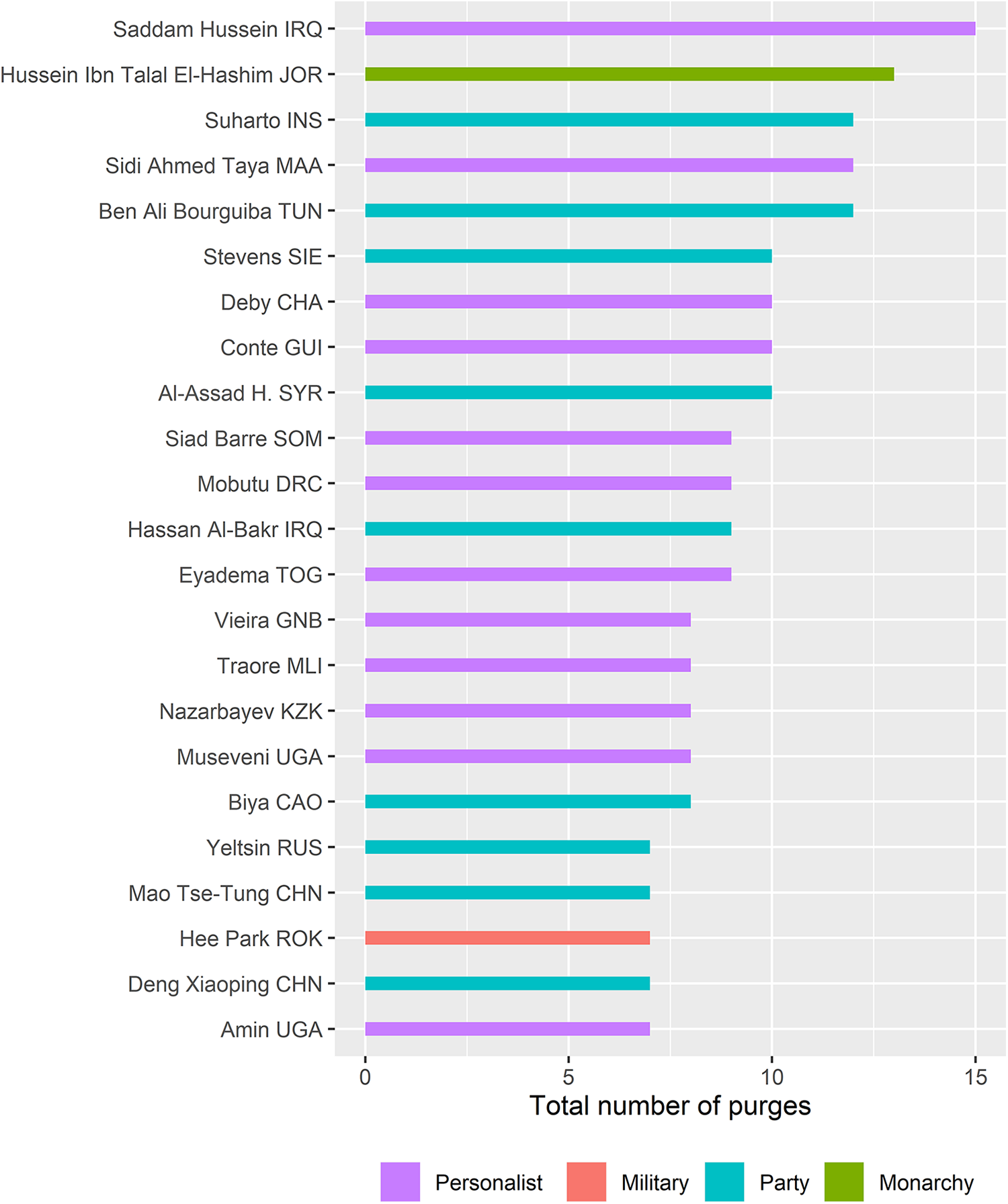
Since my dependent variable (the number of civilians killed by government forces per country-year) exhibits over-dispersion as well as an excess number of zeros, I use zero-inflated negative binomial models with country random effects, estimated via the glmmTMB package in R. In all the models reported below, I control for GDP per capita, population size, civil war, the lag of the dependent variables in both the count components and zero-inflated components, and civilian leader, military leader, support party, and leader tenure in the count components. Due to the space limitation, I discuss the data sources of these variables in the Online appendix.
The left-hand panel in Figure 4 plots the coefficient estimates of the count components, reporting the effects of different types of military purges on the number of civilian fatalities, with 95% confidence intervals. It demonstrates that a large-scale purge variable has a negative and statistically significant effect on the number of civilian fatalities (Model 4), while the effects of other Effects of military purges on the number of civilians killed by governments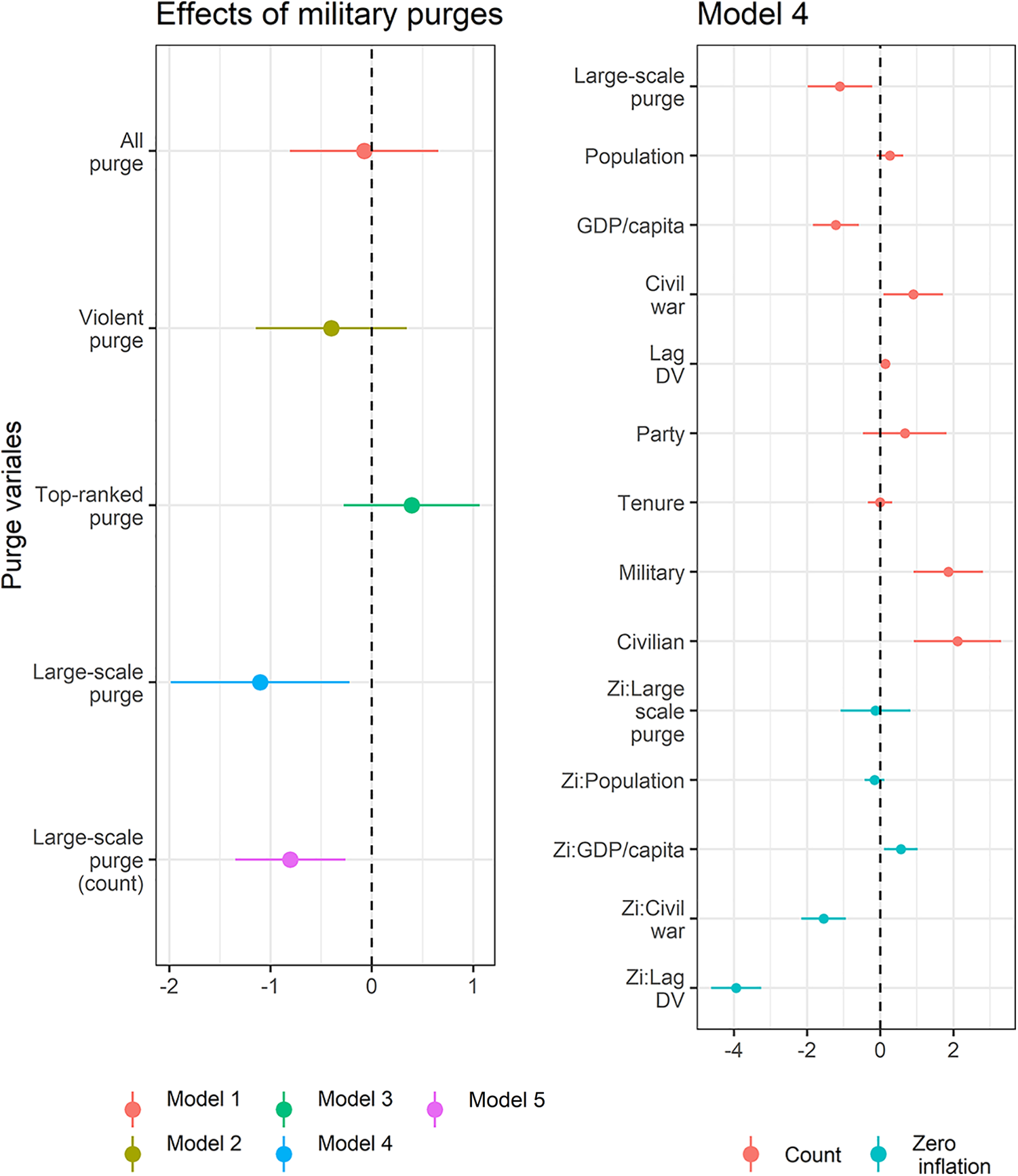
Using MPD, I examine the impact of military purges on the severity of state repression, assessing competing hypotheses suggested in the literature. The findings reveal that (i) dictators’ efforts to consolidate power by purging their security apparatus will reduce, not increase, the severity of repression, measured by the number of civilians killed by the government. Moreover, (ii) purges have significant impacts only when they target a large number of military officers. Though the finding that the size of purges matters might not sound surprising, it indicates that the key agents that channel dictators’ actions toward militaries to the level of state repression are middle- and lower-ranked officers, rather than top-ranking members of the security apparatus. In large-scale purges, defined as those with more than 100 individuals targeted, coded in MPD, the majority of victims are the middle- and low-ranked officers, simply because there are not so many top-ranked positions to be purged. A detailed assessment of the causal mechanisms is beyond the scope of this article, but these findings underscore the importance of further work to disaggregate types of military purges in analyzing their causes and consequences.
Conclusion
MPD contributes to the literature on political violence and comparative authoritarianism. Though many studies have examined how political authorities repress citizens’ capabilities to challenge them, we know very little about when leaders repress regime elites (especially the military) who are the key agents of the state repression of citizens. Using MPD, this article demonstrates that purges of members of the security apparatus reduce the regime’s ability and willingness to repress civilians. Further, MPD allows researchers to explore the dynamics of consolidation of power in dictatorships. Though a global rise of personalist dictatorships and its implications for global stability have been highlighted (e.g. Kendall-Taylor, Frantz & Wright, 2017; Geddes, Wright & Frantz, 2018), we hitherto lacked a systematic dataset that captures the timing of when dictators take steps to promote the concentration of power at the expense of the elite. By providing such information, MPD will illuminate the dynamics behind a global rise of personalism, a concerning trend in the post-Cold War era.
Footnotes
Replication data

Acknowledgments
The author thanks Alex Baturo, Jos Elkink, Richard Johnson, and participants in the 2019 European Consortium for Political Research workshop on personalism for helpful comments. She also thanks Constantin Brod, Laura Maxwell, Fraser Stewart, and Jian Xu for excellent research assistance. She is especially grateful to Mels de Zeeuw, who served multiyear terms as the lead research assistant for the data coding effort.
Funding
This project is supported by the British Academy/Leverhulme Small Research Grant.