




Abstract
This article presents an update to the ViEWS political Violence Early-Warning System. This update introduces (1) a new infrastructure for training, evaluating, and weighting models that allows us to more optimally combine constituent models into ensembles, and (2) a number of new forecasting models that contribute to improve overall performance, in particular with respect to effectively classifying high- and low-risk cases. Our improved evaluation procedures allow us to develop models that specialize in either the immediate or the more distant future. We also present a formal, ‘retrospective’ evaluation of how well ViEWS has done since we started publishing our forecasts from July 2018 up to December 2019. Our metrics show that ViEWS is performing well when compared to previous out-of-sample forecasts for the 2015–17 period. Finally, we present our new forecasts for the January 2020–December 2022 period. We continue to predict a near-constant situation of conflict in Nigeria, Somalia, and DRC, but see some signs of decreased risk in Cameroon and Mozambique.
Overview
This article presents an update to the ViEWS political violence early-warning system first presented in Hegre et al., 2019. We outline improvements to a number of components: we have enhanced ViEWS’ ability to forecast conflict onsets and to separate low- and high-risk cases; we have made adjustments to the dependent variables to increase the usefulness of the system, improved the methodology, and expanded the set of predictors. We first summarize and motivate these changes, and proceed to show how these revisions improve performance. The revisions primarily pertain to forecasts at the country level. Changes to the subnational level have been more incremental, and we therefore allocate less space to these developments.
In line with ViEWS’ goal of maximal transparency, we also revisit ViEWS forecasts published in Hegre et al. (2019) and the monthly updates on the website (https://pcr.uu.se/research/views/current-forecasts/). The evaluation shows that overall predictive performance is in line with our expectations in Hegre et al. (2019). Finally, we summarize the new forecasts for the January 2020–December 2022 period. 1
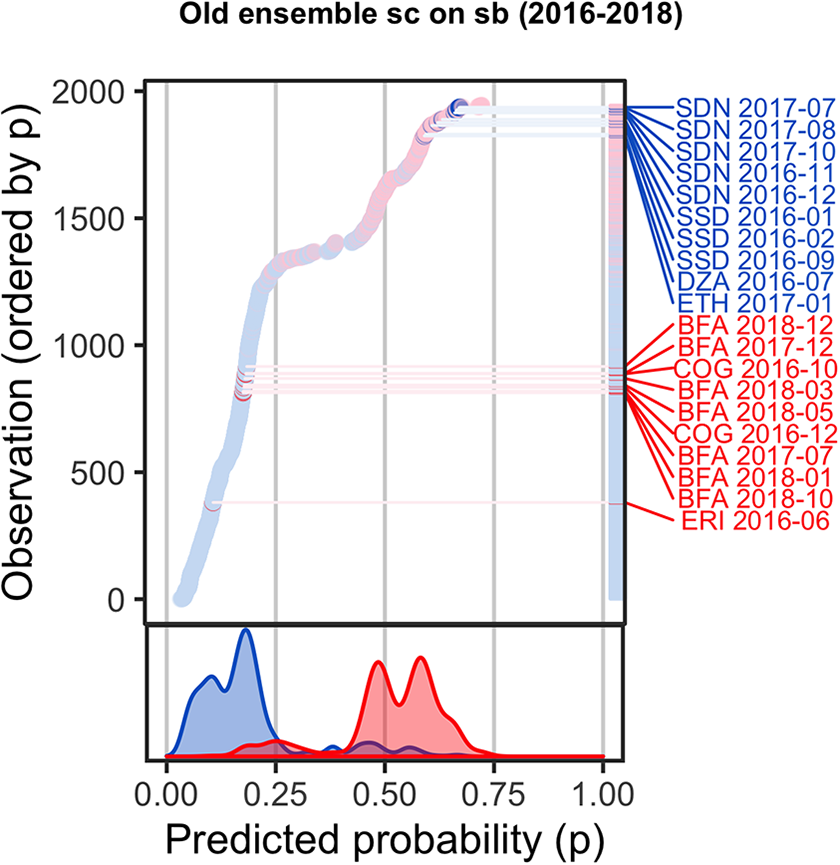
Model criticism of Hegre et al. (2019) cm ensemble, state-based conflict (2016–18)
Revising the ViEWS pilot
In Hegre et al. (2019) we indicated several potential avenues to strengthening the performance of the system, such as increasing the system’s ability to forecast political violence in countries with little pre-existing conflict and to separate between low- and high-risk cases. To highlight how the system presented in Hegre et al. (2019) fared with regard to these two dimensions, we make use of the model criticism plot in Figure 1 (Colaresi & Mahmood, 2017). 2
The figure indicates that the ViEWS ensemble overestimated the risk of conflict continuation and underestimated the probability in hitherto peaceful countries. Some cases reflect these general patterns: the ensemble consistently predicted a high risk of conflict in Sudan in 2017–18 (shown as blue dots and labeled ‘SDN [date]’). The red labeled dots are instances where we assigned low risk to cases that did experience conflict. A number of these were countries without significant recent conflict before 2016 (e.g. Eritrea). As we detail below, we have sought to improve the ability of the system to capture early signs of violence even in absence of recent conflicts, as well as identify a decrease in conflict probability in locations with recent conflict history.
Second, while in Hegre et al. (2019) the ViEWS ensemble was calibrated so that the average predicted probability of conflict was close to the actual relative frequency, it did not separate well between low- and high-risk cases. This is clear from the marginal plot in Figure 1: very few observations had a predicted probability higher than 0.75 or lower than 0.05, and the red (positive cases) and blue (negative cases) densities overlap. This lack of separation was the result of incorporating a handful of overall poorly performing models in the ViEWS ensemble, and the lack of weighting. Below, we elaborate on how we revised the set of constituent models and improved our ensemble procedures to produce sharper forecasts.
Changes to how we handle data for model evaluation and averaging
We have improved the ViEWS system for handling data and out-of-sample evaluation. In the following, we will refer to a specification as a ‘model’
Trains model
Generates predictions for all months i in the calibration period (
Calibrates model, obtains ensemble weights, and tunes hyper-parameters using the predictions from (2) along with the actuals for all months in the calibration period.
Retrains model using both the training and calibration periods (
Generates predictions for the testing/forecasting period (
Partitioning of data for estimating model weights, hyper-parameter tuning, evaluation, and forecasting
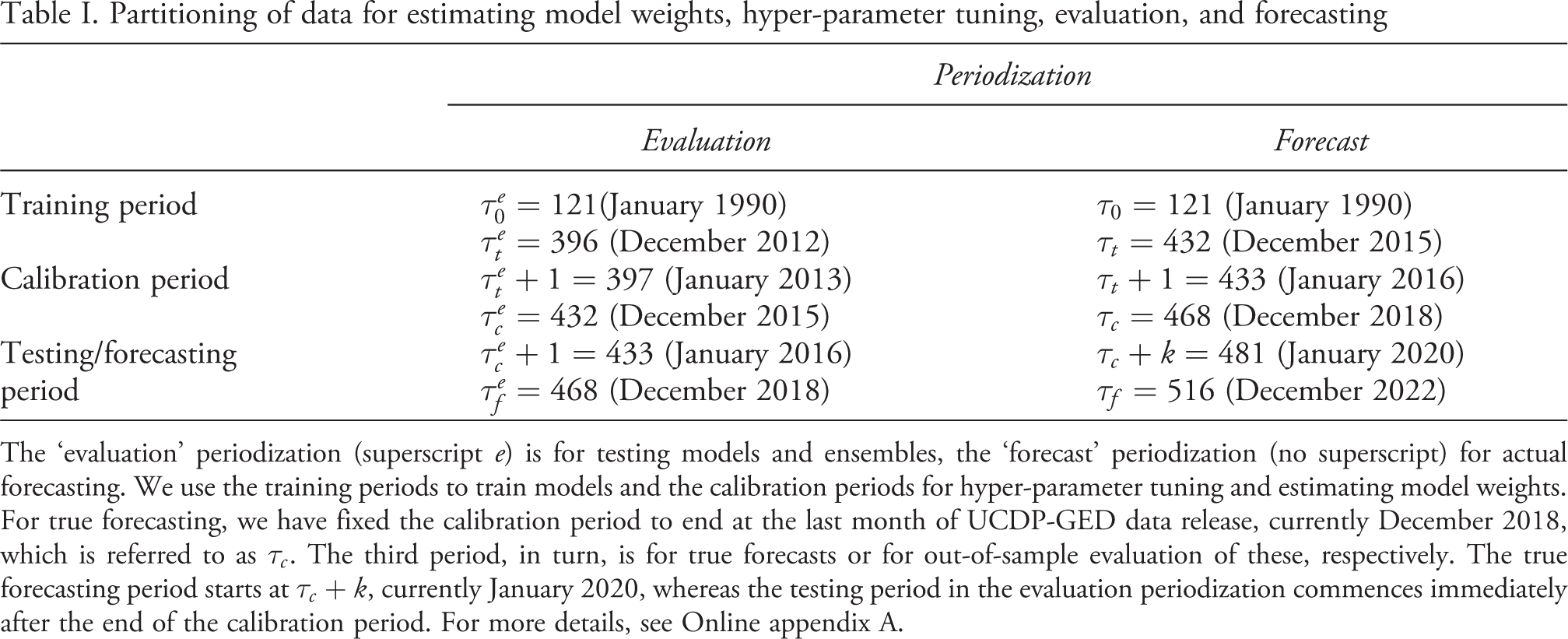
The ‘evaluation’ periodization (superscript e) is for testing models and ensembles, the ‘forecast’ periodization (no superscript) for actual forecasting. We use the training periods to train models and the calibration periods for hyper-parameter tuning and estimating model weights. For true forecasting, we have fixed the calibration period to end at the last month of UCDP-GED data release, currently December 2018, which is referred to as
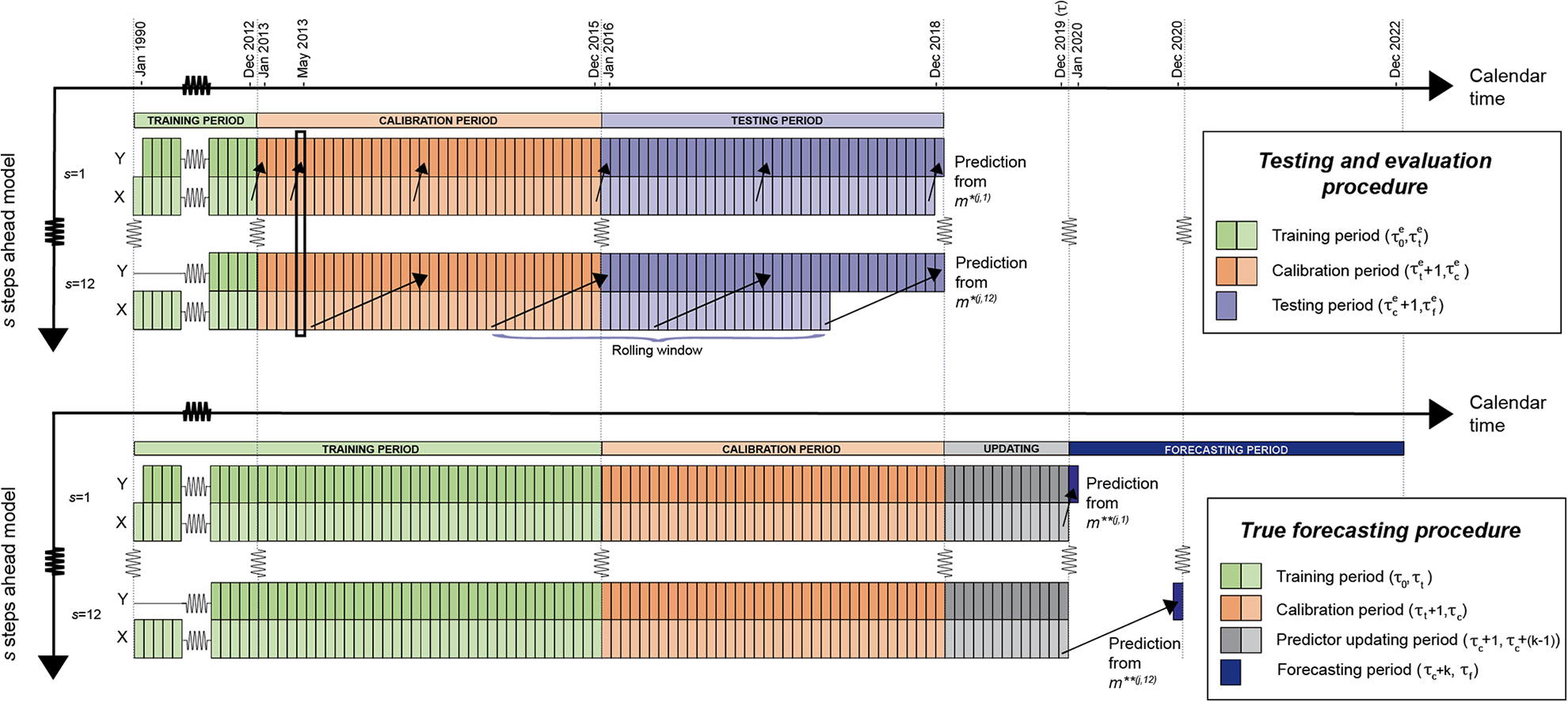
Management of temporal domain (timeshifting, periodization) in current pipeline, for evaluation (top) and forecasting (bottom)
In step 5, the procedure is different when we evaluate models than when we generate true forecasts. The two variants of the procedure are summarized in Figure 2 and described in more detail in Online appendix A. When evaluating the models, we generate predictions for each month in the testing period.We then match
When we generate true forecasts, however, we only make forecasts based on the most recent input data. For the forecasts presented below, we have data up to December 2019. We make one set of forecasts at
In Hegre et al. (2019), we used the current procedure for forecasts also when evaluating, calibrating, and estimating model weights. The new setup provides us with much more data for testing and calibration, enabling us to estimate ensemble weights more precisely and specifically for each s. We also have more data for hyper-parameter tuning, allowing us to introduce new algorithms. In addition, our evaluation of individual models in the ensemble yields more precise results, as we can allow similar model specifications to perform differently for different s. We now capture that some models are more important for forecasting the immediate future and others for the more distant ones.
Changes to dependent variables
We continue to generate predictions at the country-month (cm) and PRIO-GRID-month (pgm) levels for each of the UCDP forms of organized violence (state-based (
We continue to use the single-death threshold for the PRIO-GRID unit of analysis, as the threshold of 25 BRDs is rarely surpassed within a month in an area as small as the ∼ 55x55 km PRIO-GRID cell. Also, we include models at the country level trained on the lower BRD threshold in our model ensemble, as they may provide useful indications on early signs of violence and thus contribute to identify conflict outbreaks.
Ensembles
The final forecasts in ViEWS are generated by combining models in ensembles. 3 Ensembles can improve predictive performance and make predictions more robust to new data since a broader set of models are less sensitive to overfitting (Armstrong, 2001). In Hegre et al. (2019), our ensembles were unweighted model averages, as they did as well as the weighted ones. We have switched to ensemble Bayesian model averaging (EBMA; Montgomery, Hollenbach & Ward, 2012) at the cm level, since it now outperforms unweighted ensembles at the cm level.
EBMA performs better than unweighted averages since it allows including more models that specialize for subsets of the data in addition to broader ones. Such targeted models perform poorly in isolation. For example, the onset models we present below are poor at predicting conflict incidence, but incorporating them improves the anticipation of new or re-emerging conflicts. As we discussed above, these models can severely impact the ability of the unweighted ensemble to separate between low- and high-risk cases. Weighting each model’s impact on the ensemble by predictive performance solves this problem. EBMA now performs better since the new infrastructure provides us with more data for model weighting. Given this, we can relate observed outcomes Y for every month in the calibration period to predictions for every model
New set of constituent models
We have revised the set of constituent models in the cm and pgm ensembles considerably, in particular by weeding out poor models and improving the ability to anticipate conflict in more peaceful countries. We discuss the criteria for adding and retaining models below.
To simplify the organization, we use the same models for all steps and for all outcomes. Here, we illustrate the major changes compared to Hegre et al. (2019). More details are found in Online appendices B and C.
New models and data at cm level
The new cm level ensembles include 16 models (Figure 3). Most are trained by means of a random forest classifier algorithm (Breiman, 2001), implemented using the scikit-learn package (Pedregosa et al., 2011). For the random forest models, we set the number of trees to 1,000 and use package defaults otherwise. Details, feature importances, and prediction maps are found in Online appendix B.
We have sought to improve performance for new conflicts along two avenues. The first is to expand models that include ‘structural’, slow-changing factors that capture latent risks of conflict. Our theoretical expectation is that these should dominate forecasts a couple of years into the future, when the current immediate history is less important. The vdem_glob model includes variables describing countries’ political institutions from the Varieties of Democracy (V-Dem) dataset (Coppedge et al., 2017). The likelihood of conflict is highest for half-democracies and after recent regime change (Cederman, Hug & Krebs, 2010; Hegre et al., 2001). The wdi_all_glob model contains socio-economic indicators from the World Development Indicators (World Bank, 2019), ranging from poverty and health measures through indicators for inequality or the quality of Performance of constituent models (vertical axis), 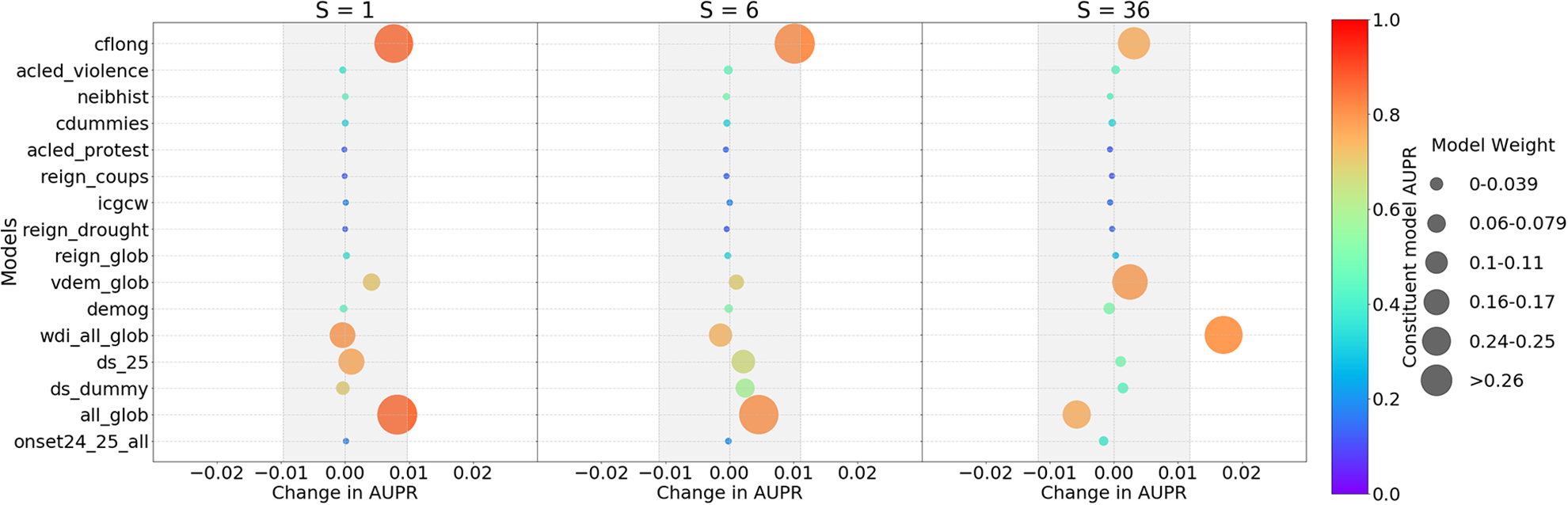
The second approach is to capture early signals of increasing tensions for short-term forecasts. Data for these models are updated monthly. The ACLED_protest and ACLED_violence models include recent history of protest and violence (Raleigh et al., 2010). The icgcw model uses monthly warnings from the International Crisis Group’s Crisis Watch (https://www.crisisgroup.org/crisiswatch). The reign_glob model incorporates information on recent elections, coups, and other leader changes and the reign_coups model contains the predicted risk of military coups, both sourced from the REIGN Dataset (Bell, 2016; www.oefresearch.org). These model escalation and dynamics of political violence related to transitions induced by coups (Belkin & Schofer, 2003) or elections (Birch, Daxecker & Höglund, 2020). The reign_drought model taps into early signals of tensions by including drought/precipitation data (von Uexkull et al., 2016).
We have amended our conflict history models in order to reduce the system’s tendency to overestimate risk in countries with recent conflict. The new, extensive cflong model contains detailed information of the severity of past violence in terms of the number of people killed and how much time has elapsed since earlier violence. We also have included a neibhist model that describes the conflict history of a country’s neighbors, building from the evidence that violence tends to spatially cluster (Gleditsch, 2002).
The ensembles also include a very broad random forest model all_glob, containing all the features described above, designed to capture interactive effects. Also using all features, onset_24_25_all is trained on onset of conflict rather than incidence, in an effort to improve the ensemble’s ability to predict the outbreak of violence. 4
As in Hegre et al. (2019), we include two broad ‘dynamic simulation’ models that have the logistic regression model at its core. One of these (ds_dummy) is trained on the incidence of conflict with at least one battle-related death (BRD) as the outcome variable, the other (ds_25) using the incidence of at least 25 BRDs (see Online appendix B for details).
New models at pgm level
The new pgm level ensembles include 12 models based on subnational data (Tollefsen, Strand & Buhaug, 2012). The high spatial resolution of conflict predictors enables the pgm level models to better capture differences across space than cm models, indicating where conflicts are likely. As the risk of conflict can be influenced by both local and national factors, in the cross_level model, we also make the two levels of analysis inform each other. Unless otherwise noted, models were trained using random forests. Details, prediction maps, and feature importance are found in Online appendix C.
We have retained the pgd_natural, pgd_social and two dynamic simulation models (ds_dummy, ds_25) from Hegre et al. (2019). Our changes to the pgm level models have also aimed to improve ViEWS’ ability to predict conflict onset. The spei_full model measures the occurrence of droughts (Vicente- Serrano, Beguera & López-Moreno, 2010), which can push deprived communities to mobilize upon pre-existing grievances (von Uexkull et al., 2016). A new conflict history model called sptime seeks to discriminate better between low and high risk of violence. It contains features representing various relative weightings of spatial and temporal distance to conflict.
In addition, four broad models make use of all the features listed above. The allthemes model is trained on the incidence of conflict, and the onset24_100_all and onset24_1_all models are trained on two definitions of local onset to help predicting the first cases of violence. 5 Finally, the xgb model applies the XGBoost gradient boosting decision tree algorithm (Chen & Guestrin, 2016) to all features. Five core hyper-parameters were tuned using a genetic algorithm (Russell & Norvig, 2016), where models were trained using an initial random sample of possible hyper-parameter combinations and scored based on the AUPR metric. In an iterative process resembling natural selection, the best-performing models pass on hyper-parameter values to further iterations while adding random ‘mutation’ to explore the parameter space. The final xgb model is an ensemble of the best five performing hyper-parameter sets in any iteration. More details on the procedure are given in Online appendix C.
Evaluation
Constituent models
There is no golden rule to establish which models to include in an ensemble. The most important criterion is that they improve predictive performance. Second, models should be interpretable on their own, as we discuss below (Figure 9). Finally, the more distinct the models in the ensemble, the larger the joint contribution, just as a crowd is wiser if there is diversity of opinion within it. Accordingly, our criterion for including or excluding the models in the ensemble is built in the spirit of Mill’s ‘harm principle’: we remove models if they harm the predictive performance of the ensemble in the test partition of the data. To avoid this decision being determined by random events in the test partition, we define ‘harm’ as reducing the AUPR of the ensemble by more than 0.5 standard errors, estimated by bootstrapping. We drew 100,000 samples of prediction–actual pairs from the full ensemble, computed the AUPR for each of these samples, and calculated the standard error as the standard deviation across the bootstrapped AUPR metrics. We then compared the difference in AUPR between the full ensemble and the reduced ensemble with the bootstrapped standard error of the AUPR for the full ensemble. All our models at the cm level passed this test.
Figure 3 summarizes the predictive performance of the constituent models and ensembles, for steps 1, 6, and 36 at the cm level. It reports the weight of the models in the ensemble, AUPR for the predictions from the individual models, and the extent to which they contribute to the predictive performance of the ensemble. 6
Individual predictive performance varies greatly between models. For
Models that perform poorly, however, may still contribute important information to the ensemble predictions. The onset_24_25_all model performs poorly overall since most conflict observations in our data are already ongoing conflicts. However, our evaluations against conflict onset indicate that it is superior at picking up the first month of conflict. With the exception of the conflict model (cflong), themed models in general perform worse than models containing many features, such as all_glob and ds_25, but are likely to add unique insights to the ensembles. Moreover, they provide useful information on how a group of explanations (e.g. protest, demography) performs at forecasting political violence.
Evaluation metrics for 2016–18 of the new cm EBMA ensemble (one-BRD threshold) compared to the 2019 ensemble
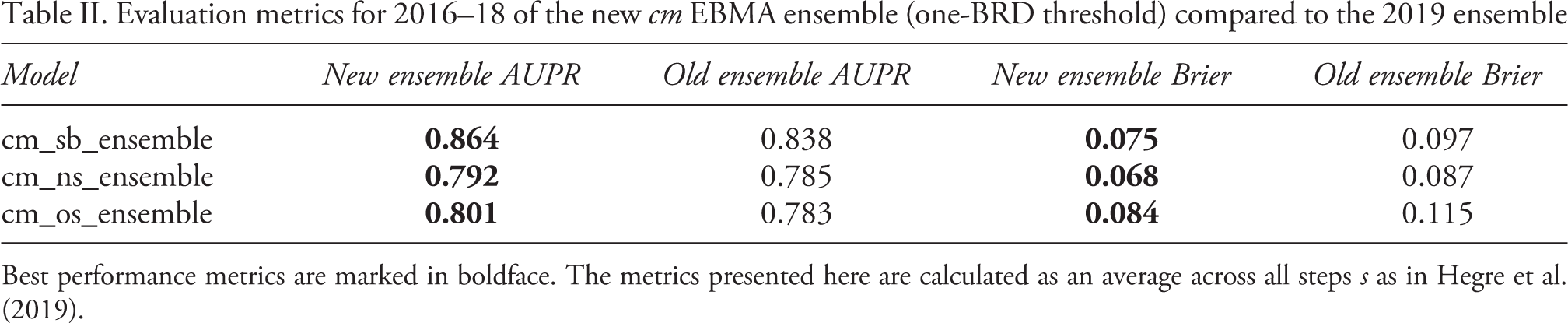
Best performance metrics are marked in boldface. The metrics presented here are calculated as an average across all steps s as in Hegre et al. (2019).
Online appendix D also shows the predictive performance of constituent models and ensembles for the pgm level. As expected given the difficulty of this prediction task, AUPR scores are markedly lower than for cm. As for cm, there are large differences in predictive performance between the constituent models, which largely mirror the divergence in relative performance that was seen in the cm analysis above.
Comparison with the 2019 model cm ensembles
We now turn our attention to the ensembles. In Online appendix D, we show that EBMA consistently outperforms unweighted ensembles for the
Figure 4 shows the model criticism plot for the new Model criticism plot of current 1 BRD cm ensemble (test data: 2016–18)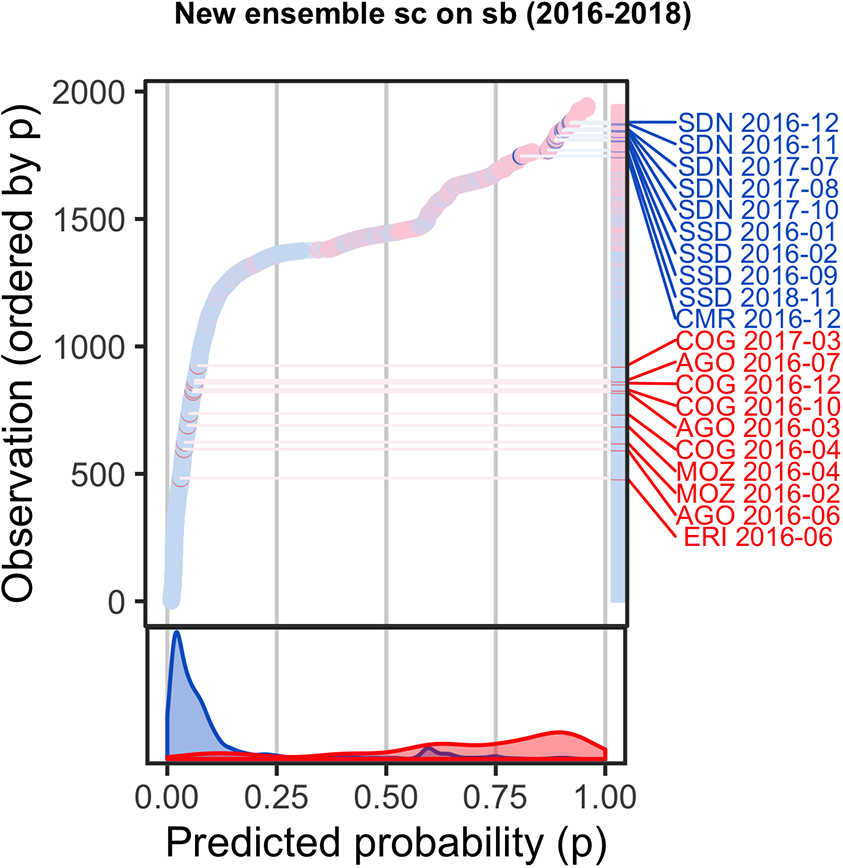
Comparing previous published forecasts with actual events
ViEWS has produced updated forecasts every month since July 2018 based on the setup documented in Hegre et al. (2019). We use actual conflict data from two sources to evaluate the forecasting results: (i) UCDP-GED (Pettersson, Högbladh & Öberg, 2019) up to December 2018, and (ii) UCDP-Candidate (Hegre et al., 2020) thereafter. 7
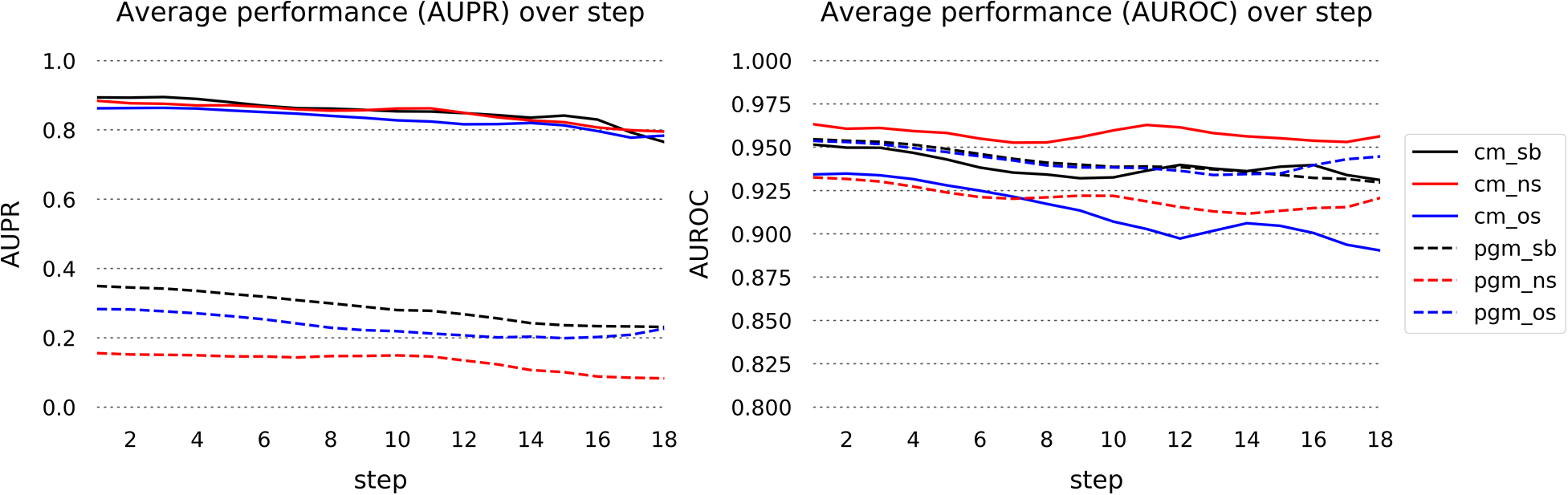
Areas under the Precision-Recall curve (AUPR, left), Area under the Receiver Operator Curve (AUROC, right), averaged across all runs with predictions, by s
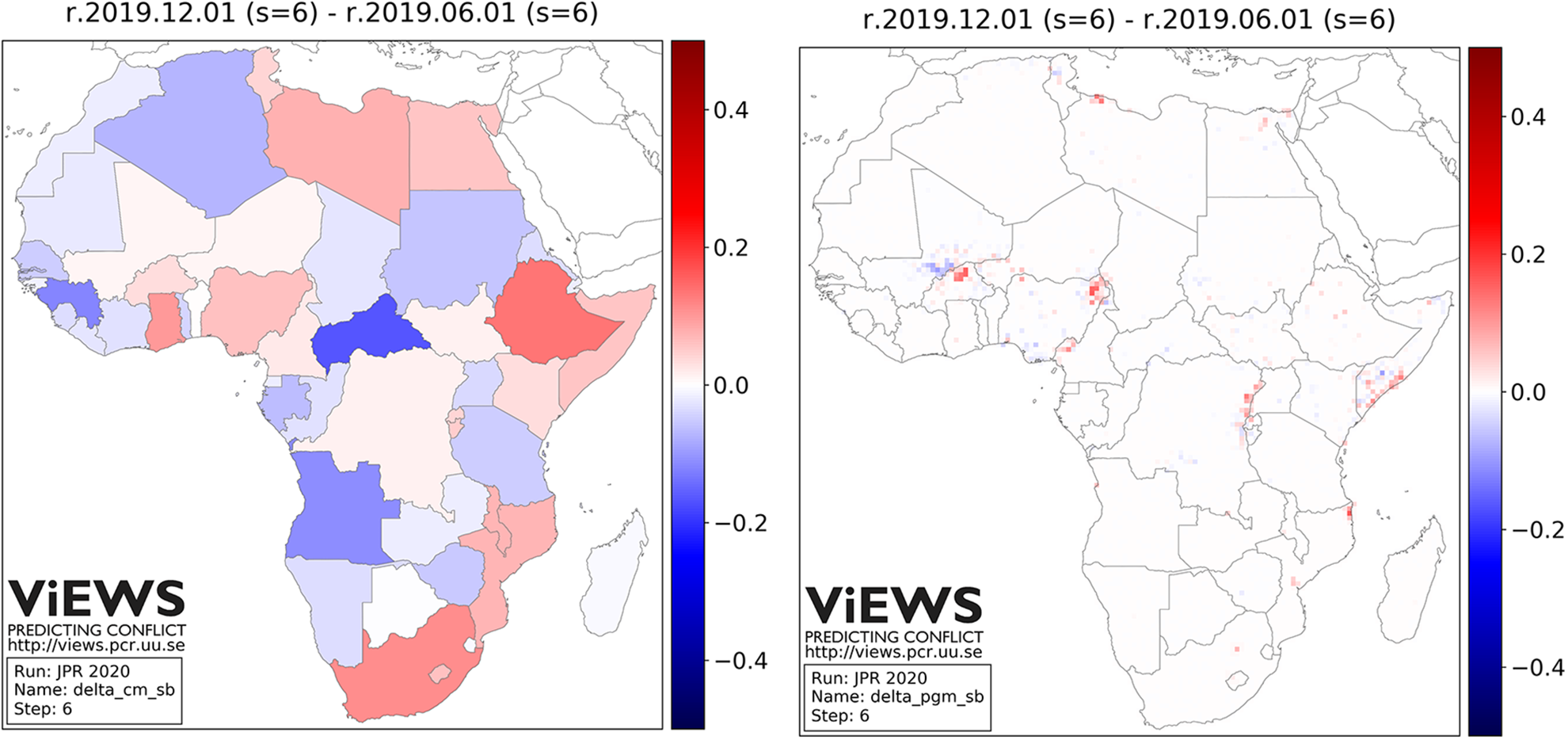
Changes in forecasted probability of
Figure 5 shows the areas under the precision-recall curves (left) and the area under the receiver-operator curve (right) by steps s, for each outcome
How have our forecasts changed over time?
Figure 6 shows how the ViEWS forecasts six months into the future changed from June 2019 to December 2019. The ensemble was unchanged over the period, so these changes are predominantly due to new observations of conflict events. Clusters of increased future probability of violence appear where fighting has recently escalated, such as in Tripoli, Cairo, Anglophone Cameroon, the Ituri province in DRC, and two provinces in ViEWS ensemble forecasts for 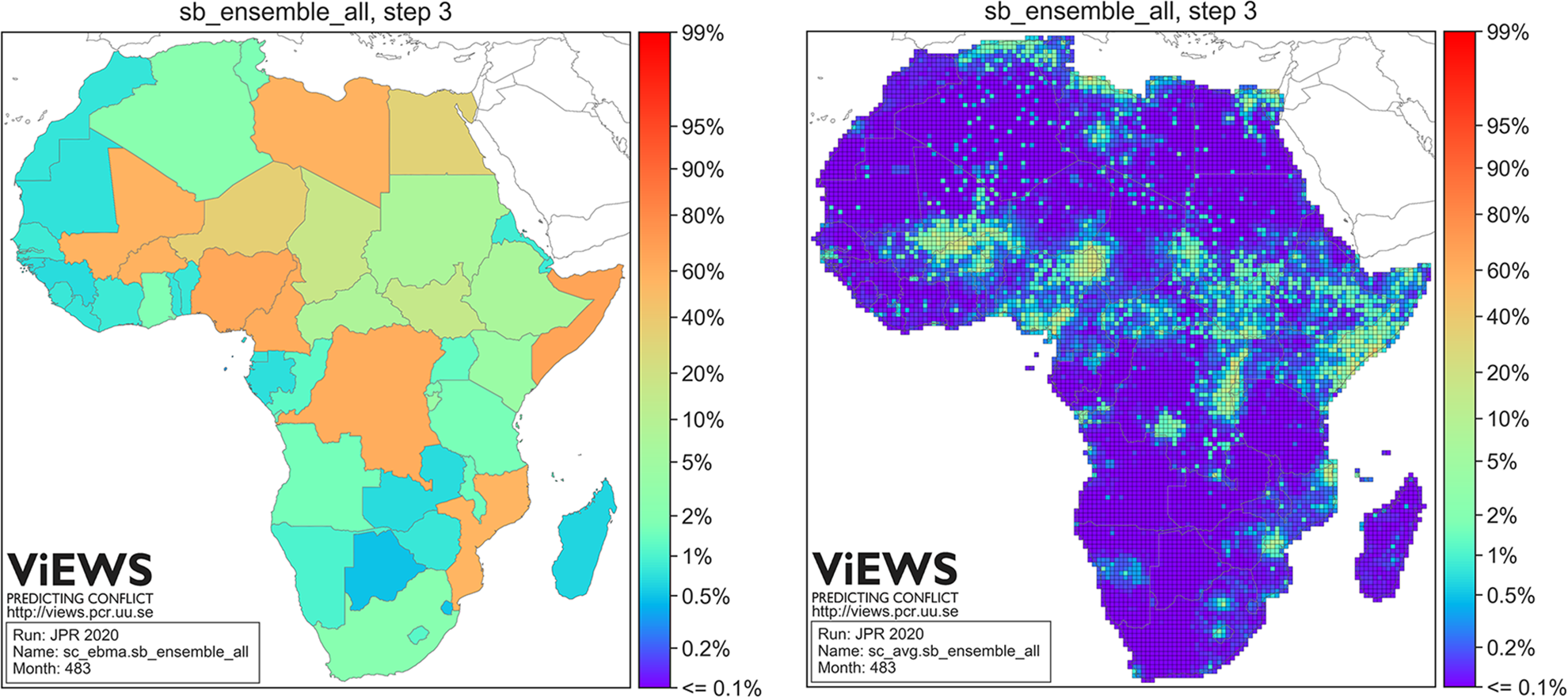
Forecasts January 2020–December 2022
Figure 7 shows the predicted risk of state-based conflict in March 2020, at the cm (left) and pgm (right) levels, based on data up to and including December 2019. Figure 8 shows the trends in predicted probabilities over the entire forecasting period.
As we noted in Hegre et al. (2019), the expected conflict pattern in Africa remains remarkably stable. Nigeria, DRC, and Somalia are expected to remain the most conflict-prone countries in Africa, as our model predicts at least 25 BRDs in eight to nine out of 12 months during each of the coming three years. The pgm model suggests
Cameroon, Burkina Faso, and Mozambique have a high predicted probability of conflict over most of 2020, but the model suggests the likelihood of violence is decreasing. Egypt and Sudan, on the other hand, are forecasted to increase conflict risk over the coming years.
To gain some intuition of what drives these forecasts, it is instructive to look at the predictions from individual models in the ensemble. Online appendix B shows the prediction maps for all cm models for various steps s. Given its recent conflict history, the thematic conflict history models cflong and acled_violence indicate a high probability of conflict in countries with recent violence, such as Nigeria, Burkina Faso, and Mozambique. However, also structural models such as vdem_glob, reign_glob, and wdi_all_glob contribute to the forecasts.
Figure 9 illustrates the contribution of each constituent model to the ensemble prediction for some example cases and various months.
11
Although the plots must be interpreted with caution, they can give a useful indication of what drives violence probability.
12
Important contributions to the ensemble come from conflict history Trends in predicted probabilities, cm level, ensemble, selected countries, January 2020–December 2022 Contributions from constituent models to ensemble predictions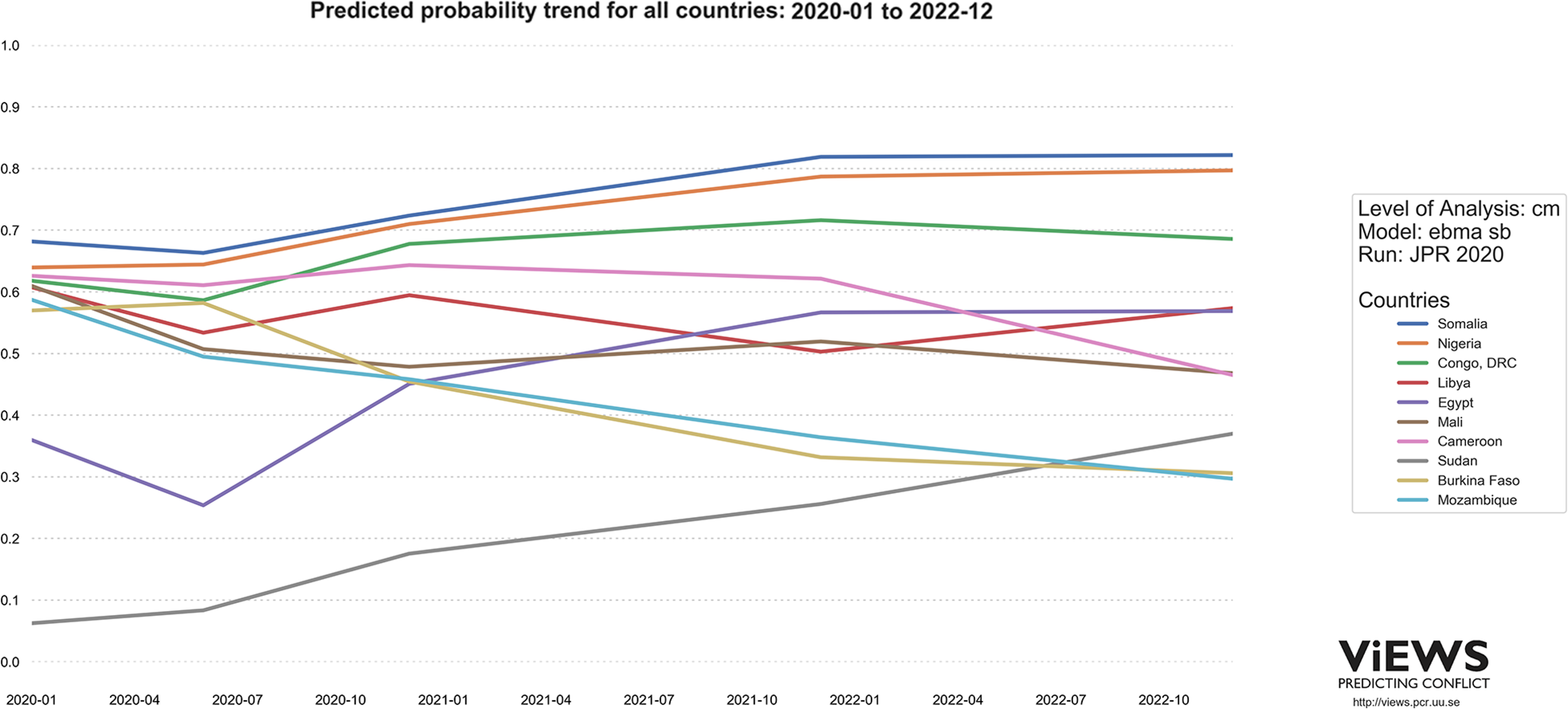
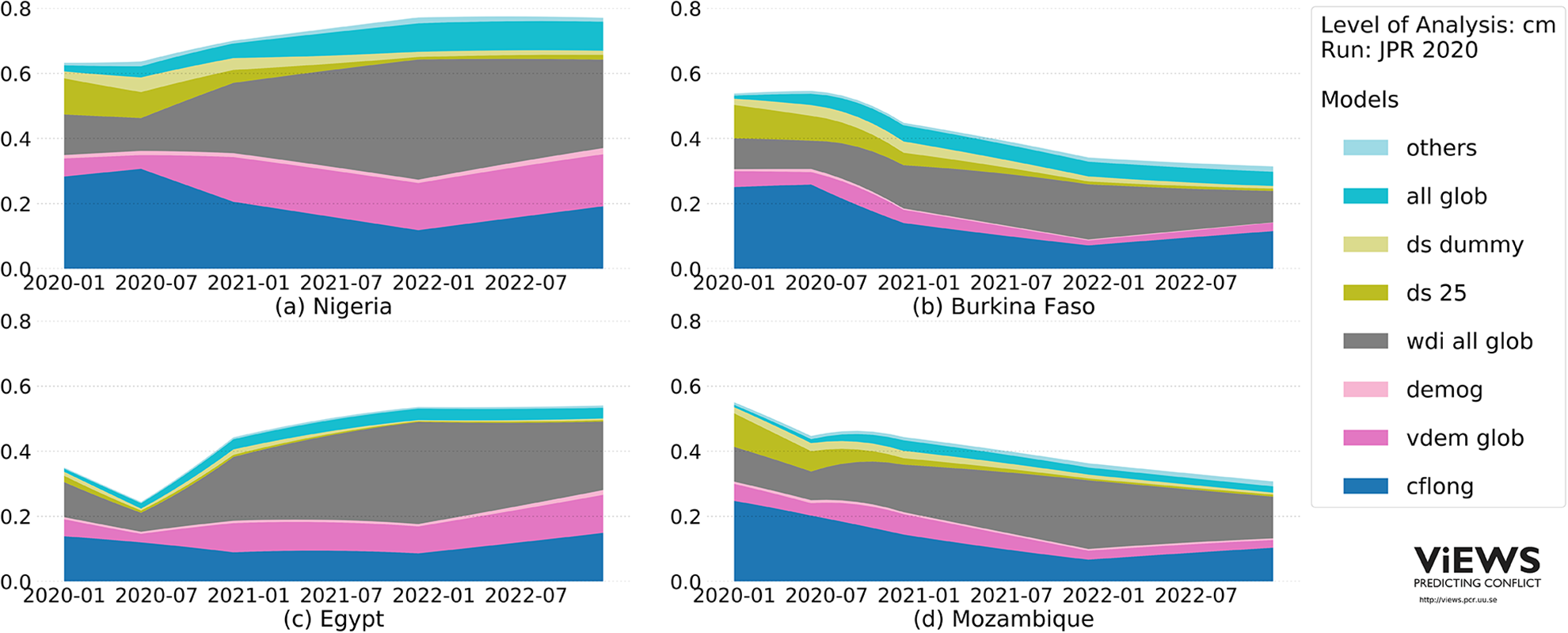
Figure 9a shows the risk profile for Nigeria. Much of the forecast is driven by conflict history, but as the forecasting horizon is extended, socio-economic and institutional factors become more important. The increasing probability in Egypt (9c) is mostly driven by socio-economic factors. The predicted decline in conflict probability in Burkina Faso (9b) relative to Nigeria is partly due to less high-risk political institutions, whereas the decline in Mozambique (9d) is attributed to a less intense conflict history.
Conclusion
The recent innovations in ViEWS summarized here improve the pilot and provide guidance for other conflict forecasting efforts. The new infrastructure for evaluating and weighting models makes better use of available data. This facilitates breaking the forecasting problem up into smaller pieces, which again helps us achieve some important objectives: it allows us to train and weight different models for the immediate and far-ahead future, and, for each time horizon, models representing different theoretical and methodological approaches to conflict forecasting. The current structure of constituent models that together form ensembles helps interpretability and allows for incremental improvement of the system.
We have shown that the new framework has improved overall performance, in particular with respect to effectively separating between high- and low-risk cases. New ‘structural’ models perform well with respect to new conflicts at the cm level, in particular for one to three years into the future. We have also documented the accuracy of the forecasts we have published every month based on Hegre et al. (2019), and demonstrated that the out-of-sample evaluation we conduct gives a precise indication of expected performance.
The new framework also opens up several avenues for future development. Ensembles of models are most effective and interpretable when constituent models are distinct from each other, while still performing well on their own. We will explore how to reduce correlation between models while retaining predictive performance. How to handle the distinctiveness/performance trade-off is an intriguing research question for which the conflict forecasting literature provides little guidance. For instance, broad models with large sets of features are important due to their ability to pick up interactive relationships between variables. However, they are obviously correlated with more distinct models that focus on a more narrow set of variables. Given the correlation, including both types of models means that the weight-based interpretation shown in Figure 9 becomes less useful. The optimal solution may be to identify breakdowns into smaller components of broad models (such as those based on WDI and V-Dem) that jointly maximize distinctiveness and overall performance.
Conversely, several constituent models such as protest and climate models are highly interesting from a substantial point of view. However, their poor performance tends to render them irrelevant or risk dragging down the performance of the ensemble. More work is required to specify such models carefully so that they better represent the underlying conflict dynamics associated with protest or climate change impacts, to tune them to maximize predictive performance for the relevant subset of conflict events.
Both of these model development approaches suggest we should strive to specify models that represent insights identified in the general conflict research literature published in this journal and elsewhere. We believe this is largely consistent with maximizing predictive performance, obviously a key criterion when developing a prediction ensemble. At the same time, this approach helps in understanding why armed conflict occurs, and how it can be prevented.
Footnotes
Replication data
Replication data and datasets with detailed predictions are available at https://views.pcr.uu.se/download/datasets/views_replication_jpr2020.zip, along with six Online appendices detailing our infrastructure (A), models at the cm (B) and pgm (C) levels, evaluation (D), our published forecasts (E), and the new predictions (F). Full source code is available at  . All analyses were conducted using scikit-learn and R.
Acknowledgements
Funding
ViEWS receives funding from the European Research Council (ERC) under the European Union’s Horizon 2020 research and innovation programme (grant agreement no. 694640) as well as from Uppsala University. Computations are performed on resources provided by the Swedish National Infrastructure for Computing (SNIC) at Uppsala Multidisciplinary Center for Advanced Computational Science (UPPMAX).