




Abstract
International organizations’ ability to respond promptly to crises is essential for their effectiveness and legitimacy. For the UN, which sends peacekeeping missions to some of the world’s most difficult conflicts, responsiveness can save lives and protect peace. Very often, however, the UN fails to deploy peacekeepers rapidly. Lacking a standing army, the UN relies on its member states to provide troops for peacekeeping operations. In the first systematic study of the determinants of deployment speed in UN peacekeeping, we theorize that this speed hinges on the incentives, capabilities, and constraints of the troop-contributing countries. Using duration modeling, we analyze novel data on the deployment speed in 28 peacekeeping operations between 1991 and 2015. Our data reveal three principal findings: All else equal, countries that depend on peacekeeping reimbursements by the UN, are exposed to negative externalities from a particular conflict, or lack parliamentary constraints on sending troops abroad deploy more swiftly than others. By underlining how member state characteristics affect aggregate outcomes, these findings have important implications for research on the effectiveness of UN peacekeeping, troop contribution dynamics, and rapid deployment initiatives.
The speed with which the UN deploys peacekeepers is critical for the effectiveness and legitimacy of its peacekeeping operations. Once the Security Council establishes a peacekeeping operation, every day that passes before troops are fully deployed weighs on the prospects of success. In cases like Cambodia, Sierra Leone, and Chad, the delayed arrival of UN peacekeepers undermined, and sometimes derailed, the peace process. The UN’s credibility and authority suffered, both locally and globally. In other instances, the UN managed to put a meaningful military presence on the ground within days, increasing its ability to shape the tactical and political environment. How can we account for this variation in the UN’s response time? In particular, since any UN peacekeeping force is a composite of troop contributions by member states, why do some countries deploy their troops faster than others?
Extant literature does not provide satisfying answers. While the importance of timely peacekeeping deployment is undisputed, its determinants remain poorly understood. To fill this gap, we engage in the first systematic, large-N analysis of the factors that affect deployment speed in UN peacekeeping. We develop a theoretical argument that accounts for variation across troop-contributing countries (TCCs) and test its observable implications against new data on the deployment speed of TCCs across 28 UN peacekeeping operations established between 1991 and 2015.
Theoretically, we focus on explanations at the contributor level. While a range of factors affects UN deployment speed, including geopolitics, mission country conditions, and the UN’s overall force pool, rapid deployment ultimately depends on how fast member states are willing and able to deploy the troops that make up a mission. We therefore contend that a better understanding of the UN’s capacity for rapid deployment hinges on shifting the focus from peacekeeping missions in the aggregate to their constituent components: individual TCCs. We theorize that the relative speed of deployments depends on the incentives, capabilities, and constraints of each TCC, conditional on other factors that affect all missions and all TCCs at a given time.
Empirically, we use a survival framework to model the time from mission establishment to observed deployment. Our data reveal three principal findings, all pointing to the importance of contributor-level explanations. We demonstrate, first, that countries that are more sensitive to the financial incentives that the UN offers deploy more rapidly than comparable countries less sensitive to such incentives. Second, countries that are exposed to conflict externalities, specifically refugee flows, deploy with greater urgency than comparable countries that are less exposed. Third, countries where foreign deployments require parliamentary approval deploy more slowly than others. The solidity of these findings varies across different cuts of the data. Beyond TCC-level factors, we find that deployment speed is sensitive to mission country characteristics, including its logistical conditions, severity of violence, and colonial links to the permanent members of the UN Security Council (the P5).
Our study has implications for both research and policy, further elaborated in the conclusion. First, it enhances our understanding of rapid deployment in UN peacekeeping. The nascent literature on institutional arrangements to facilitate rapid deployment (Langille, 2014; Koops & Novoseloff, 2017; Karlsrud & Reykers, 2019; Coleman, Lundgren & Oksamytna, 2020) has not analyzed alternative explanations in a multivariate framework, and no study of rapid deployment has given sufficient consideration to contributor-level explanations. When a peacekeeping operation fails to deploy quickly, the UN peacekeeping bureaucracy is often blamed. In reality, the UN can only be as fast as its troop contributors, which differ significantly in their deployment speed. Mission composition is thus a key factor in UN rapid deployment.
Second, our study nuances available knowledge on states’ motivations for participating in UN peacekeeping. We show how some motivations discussed in the literature on troop contributions (e.g. Gaibulloev, Sandler & Shimizu, 2009; Victor, 2010; Coleman & Nyblade, 2018) also affect how quickly contributions are delivered. At the same time, our study demonstrates that factors that shape the willingness to contribute troops are not identical to those determining how fast those troops are deployed. Even states that are highly motivated to participate and to deploy quickly may be slowed down by weak capabilities or parliamentary hurdles.
Third, as the first systematic study of UN peacekeeping deployment speed, the article provides a platform for further research which could, for example, clarify scope conditions, generate qualitative evidence on how incentives impact deployment speed, and systematically assess the assumed link between deployment speed and mission performance.
Finally, our findings have important policy implications. We recommend that the UN focuses its efforts to improve deployment speed on those TCCs that it can realistically influence. Since financial considerations seem to motivate rapid deployment, the UN should further explore possibilities for calibrating the existing system of incentives in order to increase its deployment speed.
Rapid deployment: Crucial for effectiveness and legitimacy, but poorly understood
While the ultimate success of a UN peacekeeping operation depends on many factors, including its mandate, resources, and local dynamics (Doyle & Sambanis, 2006; Fortna, 2008; Howard, 2008), the speed with which it deploys is a decisive element. Rapidly deployed forces allow the UN to ‘shape the tactical environment on the ground at the most important, most fluid moment – that when peace deals have just been struck, or missions just authorized’ (Jones et al., 2009: 24). The 2015 UN High-Level Independent Panel on UN Peace Operations identified slow deployment as a major problem: ‘When a mission trickles into a highly demanding environment, it is dangerously exposed on the ground and initial high expectations turn to disappointment, frustration and anger’ (UN, 2015: 63).
Beyond the success of individual missions, rapid deployment matters for UN legitimacy. Indifference to a crisis can be blamed on the Security Council, and a resumption of violence may reflect a myriad of factors over which the UN has little control. By contrast, deployment delays after the Security Council mandates a mission expose the UN as unable to deliver on its own objectives. Yet it is not purely the fault of the UN Secretariat. As long as they lack standing military capacities, international organizations engaged in peacekeeping, including the UN, are critically dependent on member states contributing troops.
Given its importance, the issue of rapid deployment has attracted surprisingly little academic attention. Beyond the nascent literature on institutional mechanisms cited above, Hardt’s (2014) study of how promptly regional organizations (but not the UN) react to crises investigates the speed of diplomatic decisionmaking on mission authorization and the promptness of mission start-up. The speed of deployment beyond the start-up phase has not been studied. The literature on states’ motivations for contributing troops to UN operations tells us little about why countries that are willing to contribute vary in the speed at which they deploy. Historical data show that the largest contributors, which evidently have both the interest and ability to provide troops, differ considerably in deployment speed. The factors that determine troop contributions diverge, at least in part, from the factors that determine how fast countries deploy their troops.
TCCs’ incentives, capabilities, and constraints
When the Security Council considers a new peacekeeping operation, the UN Department of Peace Operations (DPO) 1 initiates discussions with potential TCCs to gauge their willingness to contribute troops. Once the relevant national authorities in the TCC approve the decision to contribute, the UN and the member state typically sign a Memorandum of Understanding outlining the administrative, logistical, and financial conditions of the deployment. The TCC is then expected to assemble, prepare, and equip its contingent. The final step is the transport to the theatre of operations, which can be organized by the TCC or the UN.
TCCs vary in the speed with which they complete this process. To explain this variation, we develop an argument centered on three factors: incentives, capabilities, and constraints. Incentives refer to the motivations that TCCs have to pledge and deploy their troops quickly. Capabilities are military, logistical, and institutional resources of TCCs which may impact pre-deployment preparations and actual deployment speed. Constraints capture procedural barriers that must be overcome before a TCC can deploy. Within these categories, our analysis focuses on economic and security incentives, military deployment capabilities, and parliamentary constraints. We do not assert that these are the only factors determining deployment speed, but we highlight them as both important in their own right and indicative of the impact of TCC-level factors in their respective categories. Mission conditions, such as conflict severity and geography, affect all troops deploying to the same mission, and we adjust for them in our analysis.
Incentives
States weigh political, economic, security, institutional, and normative factors when deciding to contribute troops to UN peace operations (Bellamy & Williams, 2013). Some motivations arise from the relationship of the potential TCC with the mission country (Perkins & Neumayer, 2008; Gaibulloev, Sandler & Shimizu, 2009; Uzonyi, 2015) or other states contributing to the mission (Ward & Dorussen, 2016; Henke, 2016; Passmore, Shannon & Hart, 2018). Some of these motivations apply not only to the decision to contribute troops but also the speed with which those troops are deployed. Recognizing that states have different types of motivations, we focus our investigation on economic incentives, which vary with states’ susceptibility to UN reimbursements, and security incentives, which vary with their exposure to conflict-generated negative externalities.
Economic incentives arise from the reimbursements that the UN provides to TCCs for their participation. Since reimbursement rates are the same for all TCCs – currently $1,428 per soldier per month – regardless of their economic situation or military expenditure, they are more attractive to some states than others. UN reimbursements are profitable only under restrictive conditions (Coleman & Nyblade, 2018) but are frequently highlighted as a key consideration for low- and middle-income TCCs (Bobrow & Boyer, 1997; Khanna, Sandler & Shimizu, 1998; Bove & Elia, 2011; Gaibulloev, Sandler & Shimizu, 2009). Qualitative evidence suggests that reimbursements matter for some states. A former Fijian Army Chief of Staff acknowledged that sending peacekeepers abroad has become ‘[t]he whole purpose of the Fiji military’ (Reuters, 2014), while Lundgren (2018) cites similar motivations expressed by Indonesia, Malawi, Senegal, Bangladesh, and Ghana. Even TCCs that do not directly profit from UN reimbursements may appreciate them as a way of funding deployment bonuses for their troops or securing other benefits of peacekeeping participation (e.g. diplomatic visibility or military training) at little or no cost.
If states vary in the extent to which they value UN reimbursements, we would expect reimbursements to shape not only peacekeeping participation but also deployment speed. States whose governments or militaries view UN peacekeeping as attractive in part for economic reasons know that the sooner troops are deployed, the sooner UN monies will begin trickling in. 2 In the longer term, moreover, TCCs susceptible to the pull provided by UN reimbursements should be interested in creating an image of a reliable, responsive partner in order to secure future invitations to contribute.
Deployment decisions may also be affected by externalities emerging from the conflict. Uzonyi (2015) argues that the decision to contribute peacekeeping troops is influenced by dyadic refugee flows. Refugee flows have been linked to the spread of civil war (Salehyan & Gleditsch, 2006), so TCCs want to stem refugee inflows as quickly as possible, including by speedily deploying their contingents to a peacekeeping operation that could stabilize the refugee-sending state.
These logics lead to our first hypothesis: H1: The higher a TCC’s economic and security incentives, the faster it will deploy.
Capabilities
Deploying troops to a peacekeeping mission presents a number of organizational and logistical challenges. Contingents must be prepared for deployment. Equipment and materiel must be procured and readied according to UN guidelines. Troops must be transported to the theatre of operations. TCCs with advanced military capabilities are more likely to overcome these challenges quickly. They maintain higher levels of readiness, conduct swifter pre-deployment preparations, and are more able to provide transportation using national air- or sea-lift. For example, the 2006 reinforcements of the UN mission in Lebanon deployed swiftly in part because European TCCs ‘made use of their own means for putting boots on the ground rather than relying on UN logistics’ (Mattelaer, 2009: 13).
Conversely, TCCs with less advanced military capabilities typically have lower readiness levels, are more dependent on the UN or other states for transportation, and may need to wait until a third party provides equipment or self-sustainment services (Coleman & Williams, 2017). Another capability is institutional memory, or the TCC’s familiarity with UN procedures, systems, and standards. Deployment is likely to be easier (and possibly quicker) if all counterparts are experienced at working together. We expect both military resources and peacekeeping experience to impact deployment speed: H2: The greater a TCC’s military resources and UN peacekeeping experience, the faster it will deploy.
Constraints
States have different internal approval processes for international troop deployments. Some governments face few restrictions on their ability to commit peacekeeping troops, while others require formal consent from other domestic actors. One prominent example is the need to seek parliamentary approval, which can considerably lengthen the deployment process. For example, in the UN Mission in Liberia, ‘[o]ne of the reasons for delays in deployment was that a number of countries that had offered troops subsequently had to obtain legislative or executive approvals before confirming their offers’ (UN, 2004: 6). The parliamentary approval process can involve several stages. When the Netherlands considered contributing to the UN mission in Mali, the Special Representative of the Secretary-General, the Force Commander, and the head of DPKO’s Africa Division had to testify before the Dutch parliament before it gave its go-ahead (Karlsrud & Smith, 2015). Observers are aware that ‘lengthy parliamentary approval processes in developed countries […] can lead to long delays in deployment’ (Smith & Boutellis, 2013: 6), but we note that a TCC at any level of development can have parliamentary controls. However, in weakly democratized countries (or ‘hybrid’ regimes), formal parliamentary controls may have less of a delaying effect than in consolidated democracies. This leads to our third hypothesis: H3: The greater a TCC’s effective parliamentary controls over foreign deployments, the slower it will deploy.
Interdependencies
Our theoretical framework focuses on the incentives, capabilities, and constraints of individual TCCs. Yet since peacekeeping operations are multinational, the deployment speed of one TCC may be affected by that of other states. Interdependence may emerge for strategic reasons. A TCC may deliberately accelerate or delay its troop deployment in response to the observed deployments of other TCCs. For example, a state that is primarily motivated to deploy for other-regarding reasons, such as promoting peace or human rights, but which is sensitive to the costs and risks of deployment, might be inclined to free-ride and delay deployment if other TCCs are already on the ground. By contrast, TCCs motivated primarily by self-regarding reasons that cannot be satisfied via free-riding, such as financial gain, would be less likely to delay deployment (cf. Passmore, Shannon & Hart, 2018). Interdependence can also emerge from network effects: TCCs are more willing to contribute troops if countries with similar foreign policy preferences also contribute (Ward & Dorussen, 2016), and they may be more motivated to do so quickly.
Thus, interdependencies are most likely to be substantial if TCCs have good information about other TCCs’ deployment speed, strive to promote public goods, and prefer to deploy alongside likeminded countries. They would be lowest if TCCs lack information about other TCCs’ deployment speed, seek private gains, and are indifferent to other TCCs’ characteristics. To assess our privileged mechanisms while controlling for interdependencies, we adopt several strategies. We examine the role of the lead TCC, the largest contributor to each mission, based on the assumption that its deployments are the most visible to other TCCs, while it is unlikely that mission participants have information on the progress of pre-deployment preparations in all other TCCs. We also investigate the role of private and public goods in motivating TCCs, their preference network centrality, and the overall number of countries participating in a mission.
Data
We evaluate our hypotheses against data on 28 UN missions deployed between 1991 and 2015 (Table A1 in the Online appendix). These data cover all substantial peacekeeping operations fielded by the UN during this period. 3 To measure deployment speed, we combine data on authorized troop levels, sourced from Security Council resolutions, with UN troop deployment data from the IPI Peacekeeping Database (Perry & Smith, 2013). The UN reports the number of troops by mission, TCC, and month, leading us to employ the month as our temporal unit of analysis.
To allow for an analysis of the speed of deployment, we reformat these data in two ways. First, for each country and mission, we calculate the number of troops that have arrived anew in the mission each month, defined as the difference between deployment in the observed month and the previous month. Our unit of observation for this analysis is the Troop unit, a group of 100 troops from the same TCC and mission. This unit of observation balances granularity of measurement with substantive relevance. Selecting an individual soldier as the unit of observation would provide the highest granularity but would not correspond to a substantively meaningful deployment. Selecting the entire deployed force as the unit of analysis would place all emphasis on substance, sacrificing granularity of measurement. Our unit of observation provides reasonable granularity while still reflecting meaningful deployments, roughly corresponding to company-size military units. The 100-troops threshold also excludes small, ‘token’ contributions (Coleman, 2013), which could otherwise bias our results. We present results based on alternate units of observation (individual peacekeepers or TCC contingents) in the Online appendix.
Second, given our interest in measuring the time to deployment, we restructure the data as event history data (Cox & Oakes, 1984; Freedman, 2008). Troop units enter the risk set upon mission establishment and exit at the time of deployment. Based on monthly observations, we code the event history of troop units as 0 until they deploy, 1 in the month they deploy, and missing thereafter. The time troop units ‘survive’ in the non-deployed state is their deployment time. For example, when the Security Council established the UN Mission in Sudan (UNMIS) in 2005, it authorized 9,250 troops, corresponding to 9,250 / 100 = 92 troop units entering our data in the non-deployed state. For each of these troop units, we then record the date of deployment, allowing us to calculate its deployment time. For example, Egypt’s UNMIS deployment reached nine troops after three months, 98 after five months, and 173 in the sixth month. According to our criteria, Egypt’s deployment corresponds to zero troop units until the sixth month, when it is coded as having one 100-sized troop unit deployed and 73 troops counting towards the second troop unit. In the seventh month, Egypt deployed an additional 459 troops (or 532 including the 73 from before), which we code as five troop units deployed that month.
We impose four restrictions on our data. First, we exclude resolutions that modify troop ceilings of ongoing missions. Given that we cannot confidently attribute Count of deployed 100-person troop units by months since mission authorization; 28 peacekeeping missions, 1991–2015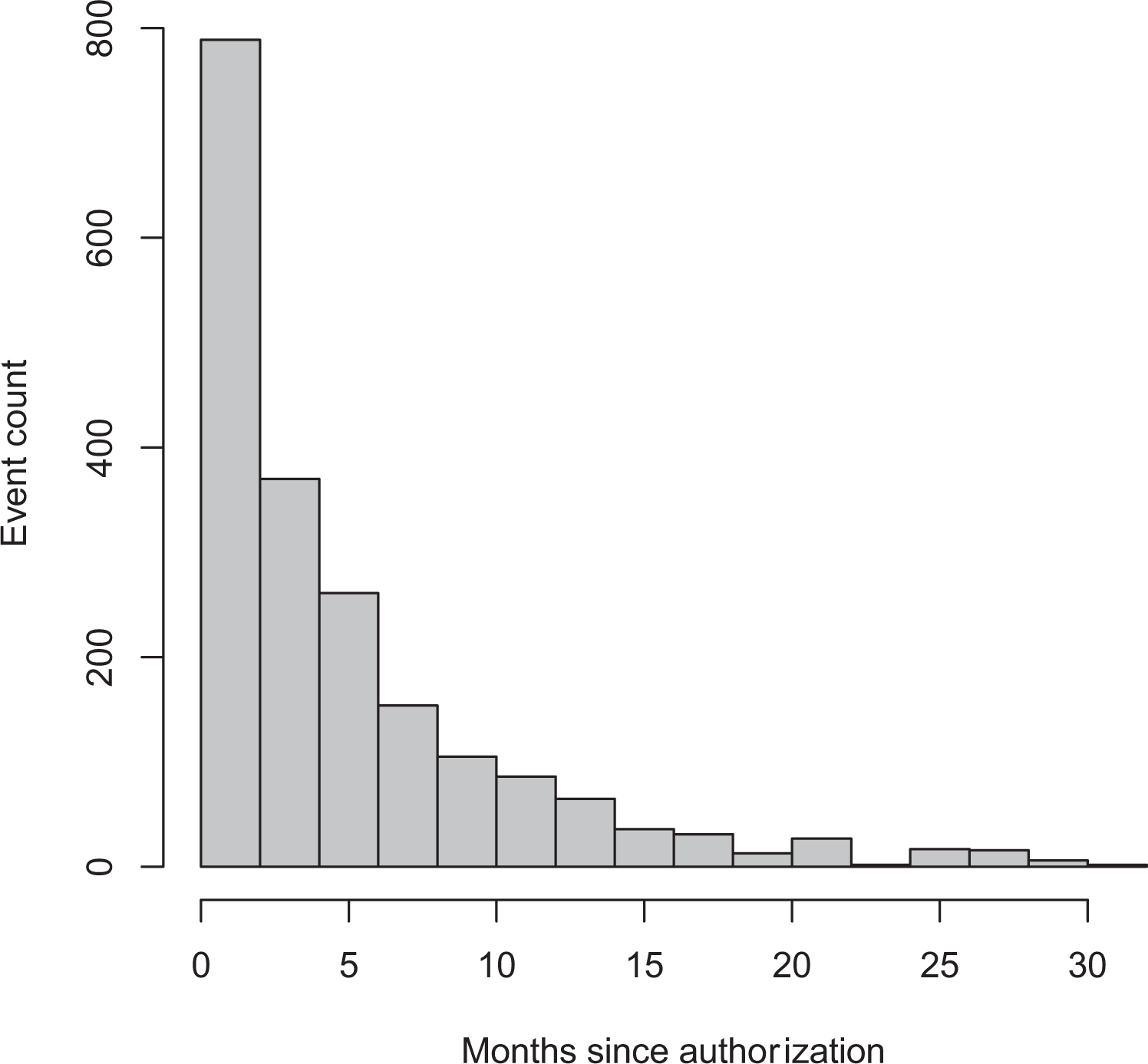
Figure 1 presents the total event count (deployed troop units) by months since authorization, across the missions in our sample. The distribution demonstrates that the UN is able to field a considerable number of troops within the first 3 months, and a majority within a year, but that a sizeable minority remain non-deployed for longer periods.
Figure 2 exhibits the median deployment time by mission. It varies from over a year (UN Organization Mission in Democratic Republic of Congo, MONUC) to one month (UN Operation in Somalia, UNOSOM). Some of this variance is due to mission composition, emerging from the TCC-level variation in deployment speed. Some of it reflects non-TCC factors, including the UN’s varying ability to respond to crises and different circumstances facing each mission. To isolate the TCC-level effects, we therefore need to adjust for mission-specific and international conditions in our multivariate analysis.
Covariates
We view the deployment process as a general function Sijt = f(Xij, Zj, Vt), where Sijt is the deployment time of troop unit i, deploying to mission j in year t. Heterogeneity across TCCs, missions, and international conditions is represented via Xij, Zj, and Vt, respectively. The model includes one vector of covariates varying across both TCCs and missions (Xij), one vector varying across missions but not over time (Zj), and one varying over time but not across missions (Vt). The variables of key theoretical interest are found in the first vector; control variables in all three.
To represent attributes that vary across TCCs (Xij), we include operationalizations of our privileged explanatory variables. We gauge a TCC’s sensitivity to economic incentives using the variable Expenditure per soldier (cf. Gaibulloev, Sandler & Shimizu, 2009) calculated from Correlates of War data (Singer, Bremer & Stuckey, 1972). Countries that spend less per soldier would be more likely to view UN reimbursements as attractive. Recognizing that economic incentives are difficult to measure and that military expenditure per soldier may correlate with capacity, we employ a series of alternative measures in additional tests. Net beneficiary is coded as 1 for states where the annual military expenditure per soldier exceeds the standard yearly UN reimbursements for one soldier. Peacekeeping dependency is operationalized as the value of UN reimbursements in relation to the military budget. GDP per capita measures the level of prosperity in a TCC.
To capture security incentives emerging from externalities, we include the variable Dyadic refugees, coded as 1 if there are any refugees from the mission country in the observed TCC.
5
Given that many TCCs are not exposed to any refugee flows, a binary threshold indicator is reasonable, but we also test the variable Dyadic refugees (proportion), operationalized as the proportion of all Median deployment time in months by mission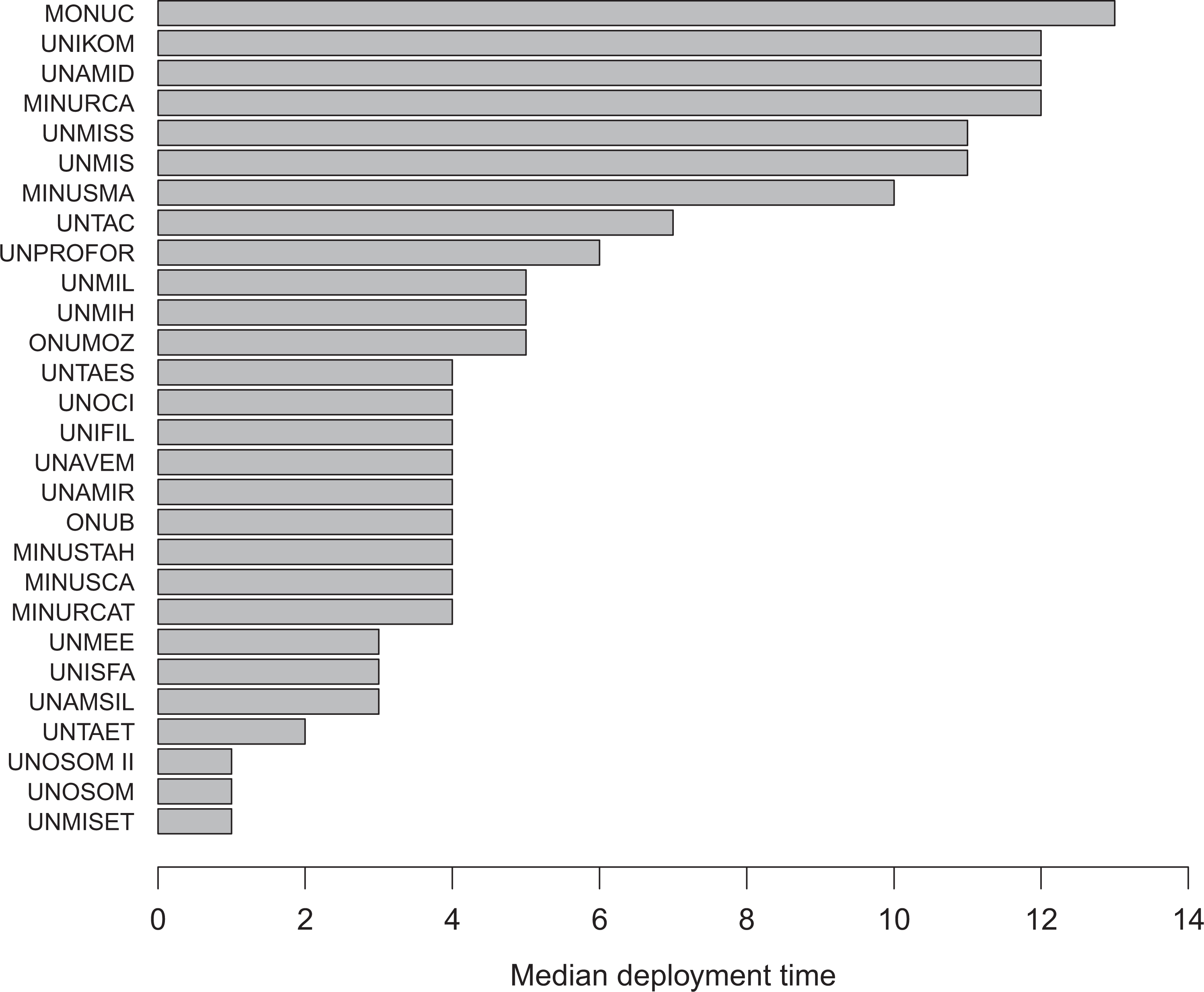
To evaluate the effect of capabilities (H2), we include two measures of military readiness and peacekeeping experience. Military capability is operationalized as the TCC defense budget in the year of observation (Singer, Bremer & Stuckey, 1972). We operationalize a TCC’s familiarity with UN peacekeeping based on its Mission experience, calculated as the cumulative mission years in which a TCC contributed more than 100 troops in the preceding five years. TCCs that have made longstanding and substantial contributions score high on this variable, whereas TCCs with smaller or short-lived contributions score lower.
To measure the impact of constraints, we include Parliamentary controls (H3), coded 1 for countries requiring the approval of the national legislature to declare war or engage in international military interventions and 0 otherwise (V-Dem data). To assess how parliamentary controls vary across regimes, we interact the variable with Democracy, coded as 1 for countries with a Polity score above 5 in the year of observation and 0 otherwise (Marshall, Gurr & Jaggers, 2016).
We include a vector of controls to account for additional TCC-level considerations, mission conditions, and temporal variation in UN-wide factors. Distance from a TCC capital to the mission country capital is calculated using the haversine formula and coordinates provided in Perry & Smith (2013). Shorter distance could motivate TCCs to respond swiftly and alleviates logistical challenges, although airlift may counteract the effect. Contingent size is the sum of troop units deploying from the same TCC to the same mission. Larger contingents may be difficult to assemble and transport, but they are more likely to be self-sustaining and enjoy other benefits of scale. Dyadic trade is operationalized as the observed TCC’s trade with the mission country as a proportion of all its trade in year t, calculated from information in Barbieri & Keshk (2016). A baseline expectation is that dyadic trade promotes faster deployment, but we recognize that many conflict countries (and TCCs) have low volumes of international trade.
We adjust for mission conditions (Zj) relating to logistics, conflict intensity, and political salience. To account for variation in how easily incoming troops can deploy to bases across the mission country, we adjust for the square kilometer Area of the mission country and its Level of development, operationalized as its GDP per capita. Countries that are large and underdeveloped, such as Mali, pose greater logistical difficulties than countries that are small and more economically developed, such as Lebanon. Recognizing that severe conflicts accompanied by deaths and displacement are likely to be treated as a priority by the international community, we include a measure of Battle deaths (Gleditsch et al., 2002). Economic importance is operationalized as the total value of the mission country’s imports and exports in the year prior to the mission’s establishment (Barbieri & Keshk, 2016). Humanitarian salience is measured as the count of worldwide refugees from the mission country, based on UNHCR data. 6 Finally, we include the variable P5 colony to capture former colonial ties between the mission country and any permanent member of the Security Council.
Models aiming to gauge interdependencies include three additional measures. First, we test the effect of Lead TCC, coded as 1 for the TCC set to become the largest (and most visible) contributor to a mission and 0 otherwise. Lead TCCs are known to be particularly committed to the success of the operation, for which they often supply the head of mission and the force commander (Oksamytna, Bove & Lundgren, 2020), which may affect the speed of their own deployment. Second, we include the Number of TCCs that contribute to a mission, based on the expectation that a higher number of contributors may induce free-riding with regard to speedy deployment (Gaibulloev, Sandler & Shimizu, 2009; Passmore, Shannon & Hart, 2018). Third, following Ward & Dorussen (2016), who argue that TCCs tend to deploy alongside TCCs with similar foreign policy preferences, we use their measure of Preference centrality based on complementarities of votes in the UN General Assembly, and like them, we also include the squared term of the variable.
Heterogeneity in international conditions (Vt) enter the model via one covariate, the variable Overstretch, coded as 1 for years in which the UN force pool experienced significant depletion (more than 10,000 new troops deployed in the previous year) and 0 otherwise. Our assumption is that deployment is slower in years when the UN is overstretched.
Results
We evaluate our hypotheses through Cox proportional hazard models. A method for investigating the effect of covariates on the time an event takes to happen, a Cox model is a function of an unspecified baseline hazard, modified by a vector of parameters, which describe how the hazard rate changes in response to covariates (Box-Steffensmeier & Jones, 2004; Freedman, 2008). In our case, the hazard rate corresponds to the probability that a troop unit will deploy at a given time, measured in months since the mission’s establishment, given that it has not yet done so. Since troop units are nested within missions, they are likely to exhibit correlated outcomes. To account for these dependencies, we employ a marginal model approach with robust errors clustered on missions (Therneau & Grambsch, 2013). 7
Table I exhibits the results. Model 1 is estimated on all the data. Since Cox proportional hazards models can be sensitive to outliers, we consider the more conservative Model 2, which excludes influential observations (having deviance residuals with an absolute value greater than 2.5), the main model. In Models 3 and 4 we examine interactions. Models 5 through 8 in Table II report our tests of interdependencies and historical shifts in UN peacekeeping. Tables A5–A11 in the Online appendix contain robustness checks. We report logged hazard ratios. Increases in variables with coefficients above 0 correspond to faster deployment; increases in variables with coefficients below 0 correspond to slower deployment. All continuous variables are log-transformed. We use the Efron method for ties and report alternative methods in the Online appendix.
Cox duration models of time to deployment
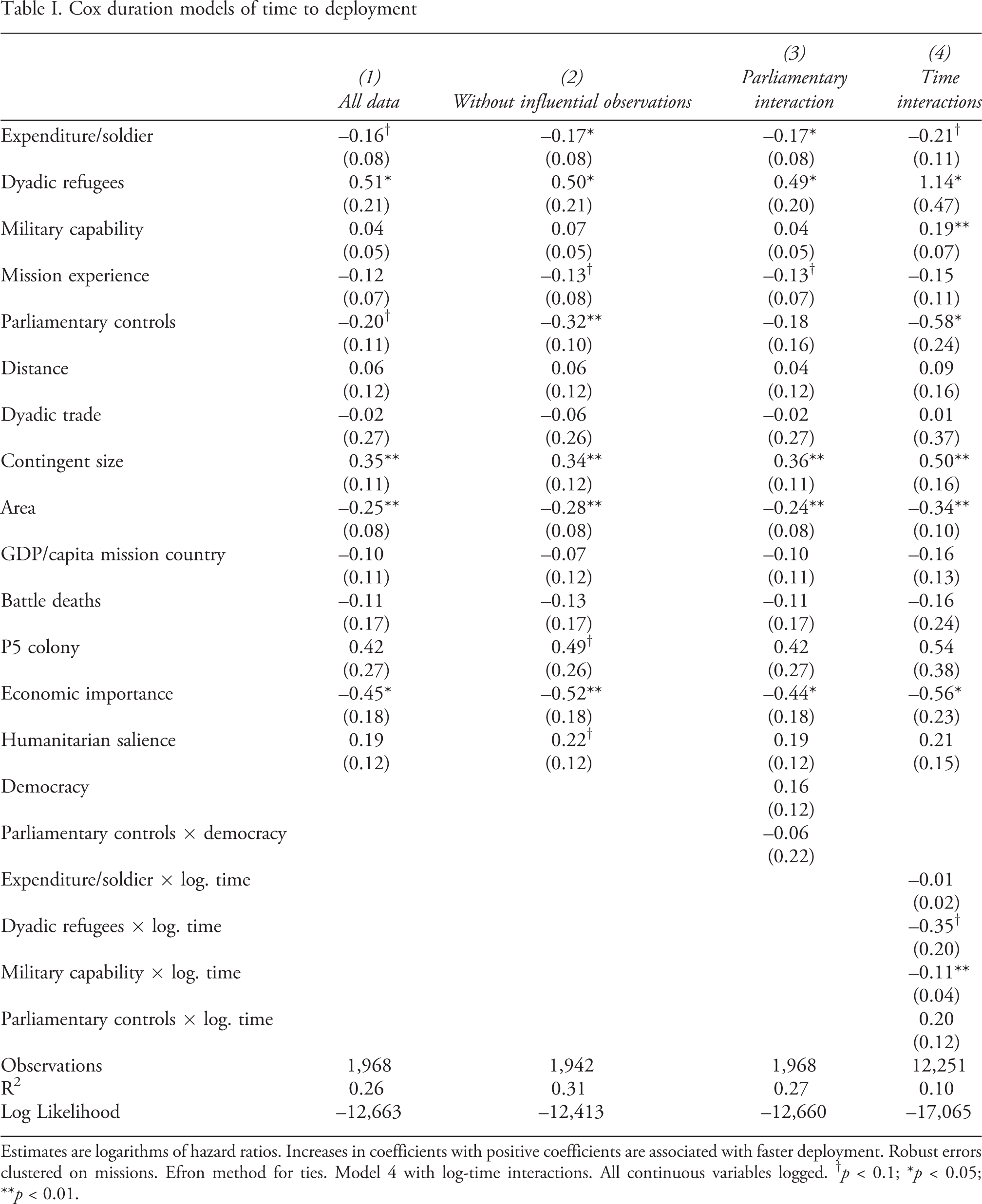
Estimates are logarithms of hazard ratios. Increases in coefficients with positive coefficients are associated with faster deployment. Robust errors clustered on missions. Efron method for ties. Model 4 with log-time interactions. All continuous variables logged. †p < 0.1; *p < 0.05; **p < 0.01.
Cox duration models of time to deployment
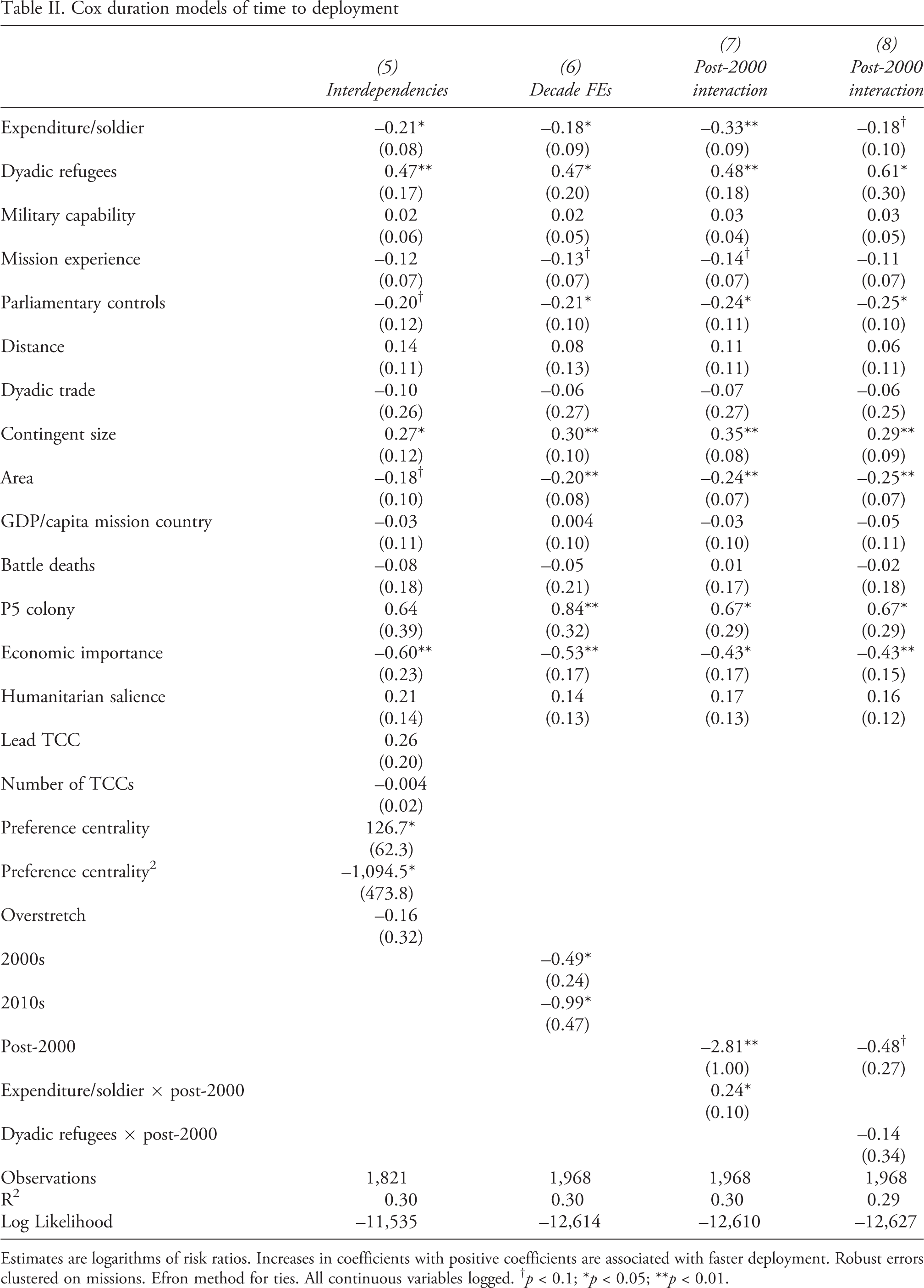
Estimates are logarithms of risk ratios. Increases in coefficients with positive coefficients are associated with faster deployment. Robust errors clustered on missions. Efron method for ties. All continuous variables logged. †p < 0.1; *p < 0.05; **p < 0.01.
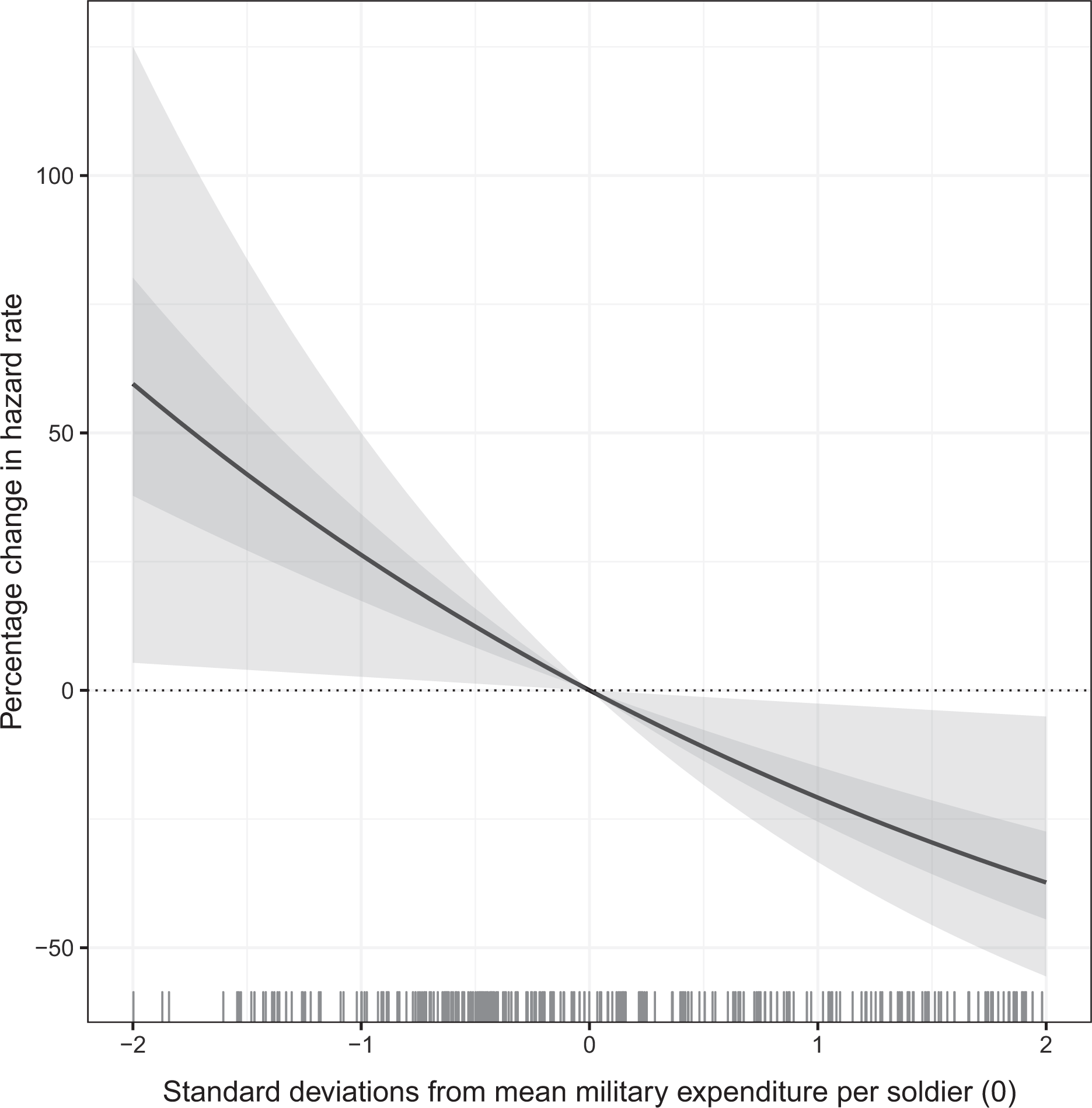
Relative hazards of military expenditure per soldier on deployment time
Tests with alternative measures, reported in Table A7 of the Online appendix, support the incentives interpretation. While the estimates exhibit high variance, our measures of net beneficiary, peacekeeping dependency, and lower prosperity all correlate with faster deployment. Qualitative evidence on TCCs from our sample supports the link between economic incentives and shorter deployment speed, 9 but limited availability of similar qualitative data precludes a systematic test. Overall, while the overall evidence favors the conclusion that economic incentives speed up deployments, the varying coefficients motivate a cautious interpretation. In the conclusion, we return to this question, outlining strategies for data collection and research that may elucidate how economic incentives operate and establish more precise scope conditions.
Consistent with the other component of H1, the presence of refugees from the mission country predicts faster deployments. The coefficient is positive and consistently significant at the 95% level or higher. The presence of refugees from the mission country increases deployment hazards by 65%. Importantly, as indicated in Model 3 in Table A6 in the Online appendix, the effect is insensitive to the size of refugee flows, suggesting that perceptions of externalities matter more than actual numbers. For several missions in our sample, there are clear links between refugee inflows and peacekeeping deployments: for example, four countries – Sweden, Turkey, France, and the UK – were major TCCs in the UN mission in former Yugoslavia (UNPROFOR) and hosted thousands – sometimes tens of thousands – of fleeing Bosnians. The Swedish parliament’s debates and decisions that authorized participation in UNPROFOR explicitly linked refugee inflows with the urgency of reacting speedily to the Yugoslav crisis. 10
We recognize that the effect of dyadic refugee flows may reflect alternative mechanisms. It is possible, first, that countries that are open to receiving refugees are also more likely to respond willingly to the UN’s requests for troops and deploy those troops speedily. Second, diaspora groups, pressuring TCC governments to respond more swiftly to a crisis in their home country, may account for some of the effect.
Contrary to theoretical expectations (H2), we do not find that troop units from TCCs with higher military capabilities deploy more swiftly. The estimated coefficient is positive but insignificant. However, when a time interaction is included, as we do in Model 4, the effect is statistically significant but subject to temporal attenuation over the mission’s lifespan. As time from mission authorization elapses, the variable’s effect diminishes, suggesting that a greater military capability provides a Relative hazards of parliamentary controls on deployment time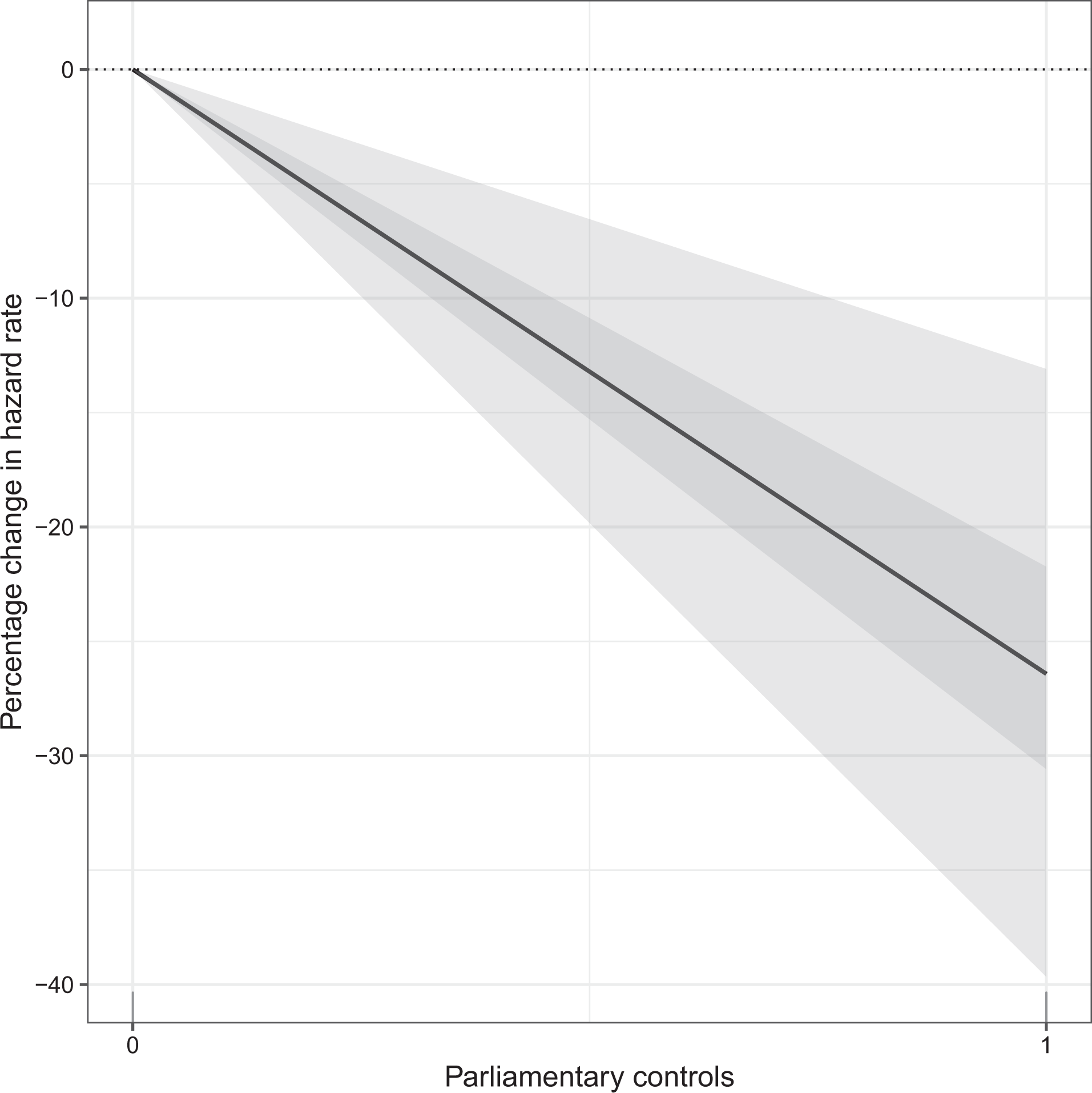
The coefficient on Mission experience is generally statistically insignificant, suggesting that long-time TCCs do not systematically differ from other TCCs in deployment speed. The measure might be biased against TCCs in the earliest missions in our sample. By construction, these TCCs would have little mission experience, given that there are no earlier operations in our sample. However, the coefficient does not change even if these missions are excluded, so the conclusion from our data must be that mission experience does not lend speed advantages, when other covariates are taken into consideration.
Regarding parliamentary controls (H3), the results are largely consistent with theory, but differ in precision across subsets of the data. It is most precisely estimated in the main Model 2, which excludes influential observations. The negative coefficient suggests that TCCs with more restrictive procedures for foreign military engagements deploy more slowly than comparable TCCs with greater executive discretion. Figure 4 illustrates the difference as relative hazards. All else equal, parliamentary checks reduce the hazard rate by about 26%, corresponding to an increase of the median deployment time from four to six months. Including an interaction between parliamentary controls and regime type (Model 3) indicates that procedural barriers are higher in democratic countries. While the estimate is uncertain, it is consistent with the interpretation that parliamentary controls have less of a delaying effect in weakly democratized countries than in robust democracies.
A comparison of Sweden and Norway illustrates the impact of parliamentary constraints. The two are similar in most respects but differ in the extent of parliamentary controls over foreign military engagements. In Sweden, participation in Chapter VII operations, which constitute the majority of contemporary UN peacekeeping missions, requires parliamentary approval (Heldt, 2012). In Norway, the right to deploy troops abroad is exercised by the government (Kjeksrud, 2016). This could be one reason why Norway’s mean deployment time is four months, whereas Sweden’s is over a year.
Several other factors systematically correlate with deployment speed. The coefficient on Contingent size is positive and highly statistically significant regardless of specification, indicating that troop units that form part of a larger contingent have shorter deployment times. This suggests that the unwieldiness of larger contingents is outweighed by the benefits of scale.
While GDP per capita of the mission country does not affect deployment speed, the coefficient on Area is consistently negative and statistically significant, supporting our expectation that larger countries pose greater logistical deployment difficulties. Several of the missions with the longest mean deployment times (Figure 2), such as MONUC or the UN-African Union Hybrid Operation in Darfur (UNAMID), involve deployment to remote regions of large countries. We also find that peacekeepers deploy faster to countries that generate higher numbers of refugees, globally, but slower to countries more integrated into world trade. This suggests that the UN responds more quickly to crises that produce humanitarian externalities than to those disrupting trade.
We do not find any evidence that distance or battle-deaths are significant predictors of deployment speed in the general sample. We note that this sample includes the mission in Ethiopia and Eritrea (UNMEE), which deployed to an interstate conflict that generated a significantly higher volume of battle-deaths (50,000) than any other mission (the median is 626). If UNMEE is excluded from the sample (Table A6 in the Online appendix), conflict intensity is negatively associated with deployment speed, suggesting that in a sample of more typical missions, a riskier mission environment is associated with longer deployment times.
Visual inspection of Schoenfeld residuals does not suggest any obvious violations of the proportional hazards assumption, but statistical tests (Therneau & Grambsch, 2013) indicate that some TCC-level variables have time-varying impacts. Following Box-Steffensmeier & Jones (2004), we model such temporal relationships by interacting these variables with logged time (Model 4). To enable this analysis, we expand the data into equally spaced intervals and reformulate the dependent variable as a discrete variable observed on a monthly basis, yielding a nominally higher N. The main effects remain robust to the inclusion of such interactions, but the interaction coefficients suggest that some effects attenuate with time from mission authorization. The effect of dyadic refugees weakens over time and becomes indistinguishable from zero from around eight months. For parliamentary controls, we observe a similar attenuation pattern. The effect of military capabilities, as discussed above, is subject to analogous weakening whereas that of military expenditure per soldier is largely time-insensitive.
Additional tests
We deepen our analysis by considering how our results hold up to three types of additional tests (Table II). First, we consider strategic interdependencies. Model 5 includes measures testing for the effect of being the lead TCC, free-riding, network dynamics, and overstretch. We find that Preference centrality is associated with higher speed, a finding that overlaps with Ward & Dorussen’s (2016) observation regarding troop contributions in general. The negative sign on Number of TCCs suggests that a higher number of contributors correlates with marginally slower deployments, but the estimate is not significant. We interpret this as an indication that free-riding may be a smaller problem during the deployment than during the preceding force generation. Likewise, the coefficient on Lead TCC is positive, consistent with the notion that these TCCs deploy more swiftly than comparable TCCs without this role, but we would need more data to ascertain whether the estimate reflects a systematic effect.
Second, we analyze historical shifts. Over time, the UN has sought to strengthen its rapid deployment arrangements (Coleman, Lundgren & Oksamytna, 2020). Since these policy changes have been gradual, it is impossible to identify clear discontinuities, so a better approach is to look at broader trends. We include decade dummies that gauge unobserved time-varying factors impacting all missions deploying within the same period. These dummies (Model 6) provide intriguing new information on how UN rapid deployment has evolved over time. We find that, despite all the efforts to improve rapid deployment, missions in the 2000s and 2010s deployed more slowly than missions in the 1990s. This finding is consistent with the notion that TCC-level incentives are a key force in rapid deployment, possibly overshadowing efforts to improve institutional arrangements.
Third, to gauge whether TCC incentives vary over time, we interact them with a binary indicator, Post-2000, coded as 1 for deployments after the year 2000. This is a broad cut of the data, separating the 1990s, characterized initially by enthusiasm for peacekeeping and broad participation of all types of TCCs and then by a peacekeeping crisis including the withdrawal of most Western TCCs, from the more recent period, characterized by a peacekeeping resurgence with troops overwhelmingly from the developing world. The interaction with military expenditure per soldier in Model 7 is positive, suggesting that economic incentives, to the extent they are accurately captured by this variable, had more of an impact in the 1990s than afterward. The exact reasons for this require further research, but a possible reason is that many of the largest TCCs experienced significant increases in prosperity in the last 30 years, attenuating the relative importance of reimbursements (cf. Coleman & Nyblade, 2018). 11 We do not find a statistically significant association for an identical interaction with dyadic refugees (Model 8).
Taken as a whole, the results are broadly consistent with our hypotheses. The evidence strengthens our belief that greater incentives and fewer procedural hurdles at the TCC level facilitate more expeditious deployment. We note that some results, specifically those relating to parliamentary controls, are dependent on specifications and modeling approaches, and that others depend on the choice of indicator. Next to the TCC-level factors, we find that deployment speed is sensitive to a range of mission circumstances, including general logistical conditions and conflict externalities. We also find clear indications of temporal effects, both within missions and across different eras of peacekeeping.
Beyond what is reported here, we took several steps to ensure that our results are not driven by particularities of model choice or specification. In the Online appendix, we present results based on alternative clustering strategies, different methods for resolving ties in survival modeling (Breslow), and other aggregation choices (data on individual troops or TCC contingents).
Conclusion
Based on new data on 28 UN peacekeeping missions established between 1991 and 2015, we carried out the first statistical analysis of TCC-level variation in deployment speed. Three key contributor-level findings emerge. First, TCCs where UN reimbursements are large relative to military expenditure per soldier deploy more rapidly. Second, countries exposed to refugee flows from the mission country deploy sooner than countries that do not experience such externalities. Third, parliamentary controls over foreign deployments reduce the speed of deployment, especially in full democracies. Contrary to expectations, while large armies may enjoy benefits of scale, TCC capabilities do not systematically predict deployment speed beyond the start-up stage. Beyond the TCC-level explanations, mission conditions also matter. Deployment is slower to countries that are large and experience ongoing violence. Conversely, mission countries that are small, fairly stable, and generate externalities for the entire international community can expect an overall faster deployment.
Our study suggests several implications for the academic literature. First, it extends our understanding of rapid deployment in UN peacekeeping. To date, discussions on rapid deployment have concentrated on various institutional mechanisms to facilitate quicker start-up. While such mechanisms are important tools, their impact can only be understood in the context of TCC incentives, capabilities, and constraints. The UN is a global organization whose members differ economically, militarily, and politically, and this diversity shapes how they participate in existing institutional mechanisms.
Second, our study adds nuance to the academic understanding of states’ motivations for participating in UN peacekeeping. Our findings demonstrate that some of the motivations discussed in the literature on troop contributions may impact the speed with which troops are delivered. We also show, however, that deployment speed is affected by factors that have little or nothing to do with motivations, such as constraints and mission conditions. Taken as a whole, this suggests that different stages of the deployment process – from the initial decision to contribute, over domestic pre-deployment preparations, to actual boots on the ground – are governed by mechanisms that are partly overlapping but also distinct.
Third, as the first systematic investigation of deployment speed in UN peacekeeping, this article sets the scene for further research into its dynamics and determinants. Several questions remain unanswered, presenting opportunities for future research. To begin with, reflecting the debate about the relative importance of financial incentives for peacekeeping participation, future studies should deepen our understanding of economic incentives and explore a wider range of factors that might motivate TCCs to deploy quickly. In addition, our data suggest that interdependencies and sequencing have some influence on the speed of deployment, which warrant a more systematic examination. Finally, although policy reports and case studies are unanimous in stressing the importance of rapid deployment, the effects of deployment speed on peacekeeping outcomes deserve more attention.
In terms of policy, we suggest that the UN should focus on those TCC characteristics that it can realistically influence. The UN can do little to change the extent of parliamentary control over international deployments, which is a matter of domestic jurisdiction. While the UN can engage with national parliaments to increase awareness of peacekeeping’s importance, its ability to help governments overcome this domestic constraint is limited. Likewise, it cannot do anything to affect most mission conditions. By contrast, the organization can enhance TCC incentives for rapid deployment, including financial ones. While further research would be needed to fully understand how TCC governments and militaries perceive – and react to – financial incentives, our results indicate that they are a policy lever available to the UN which may have a real impact. We recognize the ethical debates surrounding the current division of labor in UN peacekeeping, where developed countries provide most of the funding but developing states bear the risk of personnel deployments. Yet as long as this arrangement remains in place, the UN should pursue solutions to the problem of rapid deployment. When peacekeepers – from both developed and developing countries – deploy slowly, they are dangerously exposed during the start-up and may need to stay longer if they miss the initial window of opportunity to cement peace.
Footnotes
Replication data

Acknowledgments
We would like to thank the organizers and participants of the panel ‘Explaining the Performance of International Organizations’ at the 59th Annual Convention of the International Studies Association (San Francisco, 2018), especially discussants Lisa Martin and Tana Johnson, as well as three anonymous reviewers for valuable feedback. All errors are our own.