




Abstract
While a dominant position in research on compliance holds that enforcement is necessary for states to abide by their international commitments, many international organizations (IOs) do not have recourse to such coercive means. This article offers the first systematic analysis of one prominent alternative to material coercion: compliance reporting by IOs. It develops an argument for why reporting by IOs should lead states to correct non-compliant behavior, and when those effects should be particularly strong. It tests this argument in the context of the International Labour Organization (ILO), which offers a unique setting for evaluating the impact of reporting in the absence of coercion. The principal findings are threefold. First, reporting has significant and durable effects on state respect for labor rights. Second, reporting affects compliance both immediately and when repeated over longer periods of time. Third, reporting has stronger effects on improvements in labor rights when target states are democratic and resourceful, and have a stronger presence of labor NGOs. By contrast, it does not matter to reporting’s effect whether states are highly economically dependent on the outside world or whether reporting is coupled with active shaming of non-compliant states. Taken together, our results suggest that existing research has not fully appreciated the potential of monitoring systems based on reporting to generate compliance with international rules. While hard enforcement may still be important, especially in areas where incentives to renege are strong, the findings of this article suggest that it is not the exclusive path to compliance.
Keywords
A dominant argument in research on compliance holds that material coercion is necessary for states to abide by their international commitments (Simmons, 2012; Thompson, 2013). Unless states face a credible threat of interstate enforcement, they will violate international rules when it is in their interest to do so (Downs, Rocke & Barsoom, 1996; Goldsmith & Posner, 2005). When compliance results without material coercion, it is either because interests coincide or because required adjustments are shallow. This argument in many ways presents a baseline expectation for research on compliance. As Simmons (2012: 367) puts it: ‘[T]he coercion hypothesis dominates the international relations literature largely by default.’
In this article, we assess the effects of an alternative to material coercion: reporting on state compliance by international organizations (IOs). Reporting occurs when IOs engage in regular and public reviews of the compliance record of member states (Kelley & Simmons, 2019). Such reporting is often an integral part of IOs’ systems for monitoring compliance, sometimes referred to as information systems (Dai, 2002) or review institutions (Raustiala, 2001). By collecting and presenting information on compliance, IOs attempt to deter states from violations and nudge them into compliance if infringements nevertheless occur. Sometimes, reporting is linked to threats of material coercion, if states are found guilty of violating international rules. Such is the case in the World Trade Organization (WTO), where exposure as violator gives other states the legal right to retaliate. However, in many IOs, such as the International Atomic Energy Agency (IAEA), International Labour Organization (ILO), and Organisation for Economic Co-operation and Development (OECD), reporting operates on its own. Reporting is also a cornerstone of the Sustainable Development Goals of the United Nations (UN) and the Paris Agreement on climate change. This raises important questions about the effects of reporting on state behavior. Does reporting affect compliance with international rules or is it a toothless institutional practice? How do the effects of reporting compare to those of other factors shaping state compliance? What are the conditions under which reporting has stronger or weaker effects?
In this article, we offer a systematic analysis of reporting’s effects on state compliance. Theoretically, we suggest that reporting may mobilize pressures against non-complying states through pathways in elite, domestic, and transnational politics (Kelley & Simmons, 2015). We assume that state leaders may be responsive to such pressures because of both instrumental concerns with reputation (Keohane, 1984; Guzman, 2008) and social concerns with status and identity (Johnston, 2001; Goodman & Jinks, 2013). Against this backdrop, we develop hypotheses about conditions of target countries and the reporting process that may shape the effects of reporting on compliance. Empirically, we focus on the ILO, which presents an ideal organizational context for testing these hypotheses. The ILO has for many decades engaged in regular and public reporting on member state compliance with international labor standards (Weisband, 2000; Koliev & Lebovic, 2018). This reporting is not linked to a threat of enforcement, making it possible to isolate its effects on states’ correction of behavior once identified as violators of ILO conventions. In addition, the case of the ILO offers a rare opportunity to evaluate if the effects of compliance reporting vary depending on characteristics of the target countries and characteristics of the reporting process. Specifically, the article analyzes behavioral adjustments of states to compliance reporting in the ILO over the time period 1989 to 2011, based on a novel dataset.
Our central findings are threefold. First, reporting by the ILO has positive and durable effects on state respect for international labor standards, especially when targeting severe restrictions in labor rights. Second, reporting has fairly immediate effects on state behavior, but can also lead to improvements when repeated over longer periods of time. Third, reporting has stronger effects on improvements in labor rights when the target states are democratic, resourceful, and have a strong presence of labor NGOs. By contrast, it does not matter to reporting’s effect whether states are highly economically dependent on the outside world or whether reporting is coupled with active shaming of non-compliant states. Robustness tests demonstrate that these positive findings on the effects of reporting are not the result of ILO selection strategies or secular trends in targeted countries.
In establishing independent effects of reporting, we join other scholarship that questions the idea of material coercion as a panacea for compliance problems. Other scholars have pointed to the role of persuasion (Risse & Ropp, 2013), socialization (Johnston, 2001), acculturation (Goodman & Jinks, 2013), capacity building (Jacobson & Weiss, 1998), rule interpretation (Chayes & Chayes, 1998), domestic audience costs (Dai, 2007), and civil society mobilization (Simmons, 2009). Our findings suggest that IO reporting, too, is consequential for compliance. While hard enforcement may still be important, especially in areas where incentives to renege are strong, it is not the exclusive path to compliance.
The argument
Our argument consists of a general expectation that IO reporting may positively affect state compliance, as well as specific expectations about the conditions under which such effects are likely to be stronger or weaker. As a first step, we lay out the logic behind the general expectation. We start from the assumption that reporting may induce compliance by activating both instrumental and social concerns on behalf of states. These micro-mechanisms are analytically distinct, but empirically complementary, in guiding actor behavior (March & Olsen, 2008; Goodman & Jinks, 2013).
The first mechanism, grounded in rational choice, privileges the reputational consequences of being exposed as a violator. It suggests that states care about and adjust to public exposure of non-compliance, because they are concerned with their reputations as reliable partners in international cooperation (Keohane, 1984; Tomz, 2007; Guzman, 2008). If states are exposed as violators, other states and non-state actors are less likely to engage in cooperation with them in the future, resulting in a loss of gains. However, if states can acquire and preserve a reputation as trustworthy partners, then other states and non-state actors are more likely to seek their cooperation.
The second mechanism, grounded in social constructivism, privileges the consequences of public exposure for status and identity. It suggests that states care about and adjust to public exposure because it generates social rewards and punishments that they appreciate and fear as such (Johnston, 2001; Goodman & Jinks, 2013; Risse, Ropp & Sikkink, 2013). ‘Rewards might include psychological well-being, status, a sense of belonging, and a sense of well-being derived from conformity with role expectations. Punishments might include shaming, shunning, exclusion, and demeaning, or dissonance derived from actions inconsistent with role and identity’ (Johnston, 2001: 499).
We consider it possible that reporting generates such instrumental and social concerns through complementary pathways in elite, domestic, and transnational politics (Kelley & Simmons, 2015). At the elite level, reporting may influence state compliance by triggering government elites’ concerns with reputation and status (Johnston, 2001; Hafner-Burton, 2008). Elites include politicians and senior officials with responsibility for the policies of a state in a particular domain. Reporting involves public exposure of violations and creates pressure on elites to rectify non-compliant behavior. Elites are responsive to such pressure because of its implications for their own professional standing, the standing of the organization they direct, and the standing of the country they represent (Kelley & Simmons, 2015).
At the domestic level, reporting may influence state compliance by equipping political interests with the information and moral leverage to challenge government practices in violation of international rules (Dai, 2007; Simmons, 2009). Domestic interests are non-profit or for-profit actors with an ambition to influence government policy, such as labor unions and employers in the case of labor rights. IO reporting increases the information on state practices available to domestic interests, which opens up possibilities for these interests to mobilize public opinion and pressure policymakers. In addition, IO reporting on non-compliance boosts the moral leverage of domestic interests by coming from an authoritative source and exposing a government’s wrongdoings in relation to the performance of other states (Kelley & Simmons, 2015).
Transnationally, reporting may influence state compliance by triggering pressures from third parties (Keck & Sikkink, 1998). Those external actors may be other states that support the normative principles in question or generally value partners that stick to their commitments. IO reporting brings violations to the attention of other states, which may exert pressure through public criticism, threatening the reputation of target states (Koliev & Lebovic, 2018). Transnational pressure may also come from non-state actors in other countries. IOs publicly identifying a state as violator of international rules facilitates non-state mobilization and influence by offering a focal point for mobilization and lending legitimacy to these efforts. Elite, domestic, and transnational politics generate the combined expectation that public exposure of violations through reporting may have positive effects on state compliance.
H1: Reporting makes it more likely that states correct non-compliant behavior.
As a second step, we theorize the conditions under which reporting by IOs is likely to be particularly effective. We focus on two types of conditions whose importance may be tested in the context of a single issue-area, such as international labor rights: characteristics of the target countries and characteristics of the reporting process.
First, democracies may be more receptive than autocracies to international reporting of illegitimate behavior. Public exposure should be particularly effective with regard to stable democratic regimes, especially in the area of human rights where such regimes are normatively committed to the content of these rules (Risse & Ropp, 2013: 17). In democracies, gaps between commitments and actual behavior are more likely to create political and legal pressure from below (Dai, 2007; Simmons, 2009). In addition, democratic states are more likely to care about public exposure of their wrongdoings, because they usually aspire to belong to the civilized community of states that respect international law. This expectation ties in with a broader literature that shows how democracies behave systematically different from autocracies in world politics (Pevehouse & Russett, 2006).
Second, states that are more economically dependent on the outside world may be more sensitive to public reporting of non-compliant behavior. Exposure as a violator may lead to partners cutting back on economic cooperation or to international business refraining from investments. The more dependent a state is on external partners, the more likely it is that such transnational pressures influence responses to reporting (Keck & Sikkink, 1998). This expectation features prominently in existing research, which varyingly emphasizes dependence on bilateral aid, foreign direct investments, and international trade (Franklin, 2008; Lebovic & Voeten, 2009; Murdie & Davis, 2012).
Third, states with a more vibrant civil society may be more responsive to reporting by IOs. Public exposure can lead to pressure from below, from domestic interests advocating and defending the principles in question. The importance of NGO mobilization for state compliance with international rules and norms has been theorized in several influential works (Keck & Sikkink, 1998; Simmons, 2009; Risse, Ropp & Sikkink, 2013). Building on this logic, we expect reporting to have greater effects in states with stronger NGO communities.
Fourth, states with fewer capacity constraints may be better positioned to adjust their behavior in line with international rules. It is a longstanding insight in research on compliance that economic, technological, and political capacity constraints partly explain cross-national differences in compliance (Jacobson & Weiss, 1998; Simmons, 2009: ch. 8). Carrying the costs of adjustment to demanding environmental standards, compensating losers from free trade, investing in training of public bureaucracies, and other measures required to comply with international rules are often costly. Among states exposed as violators, those with greater capacity constraints should therefore have a tougher job correcting non-compliance. These factors generate four hypotheses about effects of target country characteristics:
H2a: Reporting is more effective in correcting non-compliance among more democratic states.
H2b: Reporting is more effective in correcting non-compliance among states more economically dependent on the outside world.
H2c: Reporting is more effective in correcting non-compliance among states with a higher domestic NGO presence.
H2d: Reporting and shaming are more effective in correcting non-compliance among states with fewer capacity constraints.
In addition, we expect characteristics of the reporting process to condition the effects of reporting. Specifically, we find it plausible that reporting may be more effective when combined with explicit shaming of non-compliant states. Shaming builds on reporting but adds a strong evaluative component of explicit condemnation (Johnston 2001; Koliev & Lebovic 2018: 437–438). In shaming, IOs do not limit themselves to identifying non-compliant states in a report, but subject them to social opprobrium through active and public blame. It sends a strong signal of disapproval to the violating state and the broader community. Assuming that state elites care about reputation and status, this mobilization of shame should increase the social costs of non-compliance and make reporting more likely to produce behavioral adjustment. In addition, IO reporting supplemented with shaming should give additional leverage to domestic interests and transnational actors that mobilize for change in a country.
H2e: Reporting is more effective in correcting non-compliant behavior when combined with shaming.
Demonstrating that reporting has an effect on state behavior that is independent of material coercion requires a research design that controls for this alternative. We follow a strategy with three components in the remainder of this article: showing that an institutional environment presents opportunities for reporting; showing that state behavior changes in conformance with expectations after public exposure; and showing that threats of enforcement were not part of the decision to conform (Johnston, 2001: 510).
Compliance reporting in the ILO
The ILO is the main organization to develop and monitor international labor standards. The ILO governs over 100 conventions, but focuses on eight so-called fundamental conventions, covering freedom of association, elimination of forced labor, abolition of child labor, and eradication of discrimination. It promotes these conventions through ratification campaigns and monitoring.
Labor rights, as enshrined in ILO conventions, are a distinct subset of human rights. Compared to civil and political rights, including personal integrity rights, labor rights are relatively more contested, normatively and politically (Mantouvalou, 2012; Koliev, 2019). While the ratification rates for ILO conventions are high, and governments and social partners express rhetorical support for these conventions, the political dynamics around labor rights are particular (Mosley & Uno, 2007; Peksen & Blanton, 2017). From the perspective of employers, labor rights are often seen as a restriction on their activities with potentially negative impacts on profitability. Likewise, from the perspective of governments, worker rights are tied up with the larger political question of the role of organized labor in a country. These dynamics not only present incentives for non-compliance with ILO conventions, but also suggest why normative commitments to labor rights overall might be weaker than to other forms of human rights.
What makes the ILO’s monitoring system uniquely well suited for an assessment of the effectiveness of compliance reporting is the absence of centralized coercive measures and the clearcut separation of reporting from shaming in its construction. The ILO does not have effective recourse to enforcement through legal or financial sanctions. 1 Instead, it seeks to ensure compliance through monitoring by two supervisory bodies: the Committee of Experts on the Application of Conventions and Recommendations (CEACR) and the Conference Committee on the Application of Convention and Recommendations (CAS). While reporting is the central activity of the CEACR and commonly used, shaming is the exclusive task of the CAS and only used in select cases to complement reporting.
The CEACR is composed of legal experts, serving in a personal capacity and appointed by the ILO’s governing body. Its principal task is to examine the extent to which law and practice in the member states conform to the ratified conventions. Its evaluations are published annually. When the CEACR establishes that a state is not in compliance, it issues an ‘observation’ in the annual report, which indicates a more serious or longstanding case of non-compliance. If a member state rectifies its behavior, the CEACR removes it from the observation list.
The CEACR makes its assessments based on information submitted by governments and social partners. Governments are obliged to send a copy to employers’ and workers’ organizations, which may comment on the report or communicate directly with the ILO, which guarantees their independence from governments. For the fundamental conventions, the normal reporting cycle is two years.
Because of its composition, some regard the CEACR as a quasi-judicial body (Thomann, 2011). However, its assessments are not those of a tribunal. Rather, the CEACR attempts to nudge states into compliance by way of exposure (Koliev & Lebovic, 2018). Through its reports, the CEACR makes clear that states’ labor practices are known to the international community. These reports exert pressure on states to conform to international labor norms through evidence of worker rights violations and anticipation of labor rights improvements.
Most member states of the ILO have been put on the observation list by the CEACR. Over the time period 1989 to 2011, only five of the 154 states in our dataset were not listed as non-compliant in a CEACR report. The CEACR is persistent: if non-compliance is discovered, it will continue listing a state until change has been achieved. There are instances where the CEACR has listed states for years with no or limited response (ILO, 1990–2011a). For instance, from 1996 to 2011, the CEACR listed Azerbaijan in all reports because of an ongoing violation of workers’ right to strike. In other cases, CEACR reporting has been more effective. For instance, in 1994, the CEACR noted that Greece had violated convention 98 by intervening in the free collective bargaining process. The CEACR regretted that the Greek government had taken legislative measures to set the maximum wage levels for employees in the public sector. A year later, the CEACR noted with satisfaction that Greece had suspended the problematic decree, thus creating conditions for free collective bargaining.
In contrast to the CEACR, the CAS is a political body comprising government, worker, and employer representatives. The composition reflects the ILO’s unique tripartite structure. Its main task is to examine CEACR reports and select cases for ‘discussion’ – a euphemism for public shaming. The cases selected typically involve violations of a more serious nature. In the ILO, then, reporting and shaming are sequential processes: reporting always comes first and only sometimes is it complemented by shaming.
The CAS meets once a year in association with the International Labour Conference (ILC) and is open to all delegates. Representatives of the governments targeted by the CAS are invited to respond before the committee. The discussions and conclusions are summarized in the annual report of the CAS. Given the discomfort of this procedure to non-compliant states, the shaming practices of the CAS have been a controversial issue for a long time (Koliev, 2019). Shaming of states by the CAS is much less common than countries being listed as non-compliant in CEACR reports. The CAS has shamed 70 of the 154 states in the dataset during time period 1989–2011.
Empirical analysis
We examine the effects of ILO reporting on states’ worker rights improvement through a multivariate regression analysis. We begin by briefly describing operationalizations and models, before presenting the results and reporting robustness checks.
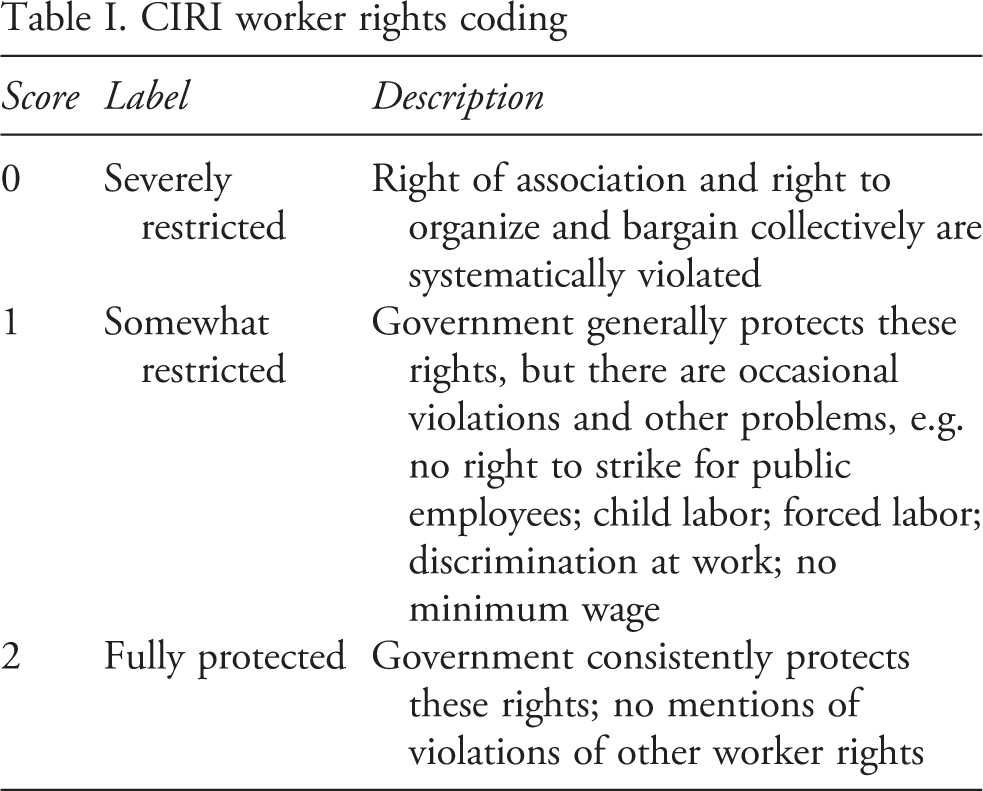
CIRI worker rights coding
Dependent variable
Our dependent variable is Improvements in worker rights, capturing whether states improve the protection of labor rights by passing and enforcing laws. This variable is based on data from the Cingranelli-Richards (CIRI) dataset on human rights. The CIRI worker rights variable has an ordinal scale and is coded for each country-year. The variable ranges from 0 to 2, where 0 indicates ‘severely restricted’ worker rights, 1 ‘somewhat restricted’ worker rights, and 2 ‘fully protected’ worker rights (see Table I). The level of labor protection in the CIRI dataset depends on workers’ right to free association and collective bargaining (Cingranelli & Richards, 2014: 65–70). These rights are regulated in two fundamental ILO conventions, numbers 87 (freedom of association) and 98 (collective bargaining). The dataset includes the years 1989–2011 and the 154 countries that have ratified either of the two conventions.
The CIRI coding of worker rights is based exclusively on the US State Department’s country reports on human rights practices. The initial drafts of the State Department’s reports are prepared by embassy staff in each country on the basis of information from government officials, opposition parties, human rights activists, academics, and others actors (Mosley, 2011: 2). These drafts are then reviewed by staff at the State Department’s Bureau of Democracy, Human Rights, and Labor, with further input from other staff at the State Department and outside experts. ILO reports are not a systematic source of information in this broad process of consultation. 2 We can therefore expect the CIRI worker rights score to provide an autonomous measure of state respect for worker rights. This distinguishes the CIRI data from alternative measures of labor rights protection, which use ILO reports as a principal or partial component (Mosley, 2011; Kuchera & Sari, 2016).
To test the effects of ILO reporting, we transform the CIRI score into a dichotomous variable that captures worker rights improvements by coding all positive annual changes for each state-year. For the full time period and all included countries, we count a total of 368 improvements in worker rights: 196 are improvements from ‘severely restricted’ to ‘somewhat restricted’, while 158 are improvements from ‘somewhat restricted’ to ‘fully protected’. The distinction between improvements from 0 to 1 and from 1 to 2 enables us to control for the effect of the initial level of workers’ rights. Although our theoretical expectations focus on improvements, the dataset also includes an almost equal number of decreases in the CIRI score of worker rights. We use these data to construct a measure of CIRI score decreases as a robustness check. Finally, the volatility of CIRI scores is quite high for many countries. To control for the possibility that an increase is followed by a decrease, we introduce an additional version of the dependent variable. We assess the durability of reporting’s effects through a binary improvement variable that gets a score of 1 only if no decrease in the CIRI score occurs within the following five years (44.6% of all improvements).
Explanatory variables
Since the CIRI worker rights score gives the greatest weight to government respect for the rights of association and collective bargaining, we focus on conventions 87 and 98, governing these rights (Cingranelli & Richards, 2014: 65). Our main explanatory variable is Reporting, which is coded 1 if the CEACR includes a country in its report in a given year with regard to conventions 87 and 98, and 0 otherwise. The data for this variable were gathered from the ILO’s NORMLEX database and annual documents from the CEACR (ILO, 2016a,b).
There is strong consensus in the naming and shaming literature that explanatory variables must be lagged to account for the time it takes for countries to comply (Murdie & Davis, 2012; Krain, 2012). While a one-year lag is a minimum to avoid problems of endogeneity, previous scholarship on social influence has shown that even longer time lags have to be considered (Bearce & Bondanella, 2007: 716). Because of the two-year reporting cycle for the ILO’s fundamental conventions, we choose a two-year time lag for the Reporting variable. A two-year lag also makes sense in view of the time it takes to adjust policies in response to international criticism.
On average, each of the 154 countries in our dataset is subject to about 12 CEACR observations (Reporting) between 1989 and 2011, and is shamed 1.8 times over the same time period. Single observations on non-compliance in just one year are the exception. More common is recurrent listing of a country in successive CEACR reports, with an empirical range of 1 to 20 years during our observation period. As part of our test of H1, we assess if an effect of Reporting on Improvements in worker rights is linked to the length of the listing period. For this purpose, we create three additional versions of the Reporting variable that represent different lengths of the listing period: one to four years, five to ten years, and a category for more than ten years of iterated observations.
A particularity of the ILO’s reporting process is the possibility of combining reporting with shaming (H2e). We build a Shaming variable that is coded 1 if the CAS has included a country on its shaming list, and 0 otherwise. The data for this variable were also gathered from the ILO’s NORMLEX database and annual documents from the CAS (ILO, 2016a,c). While it is logically impossible that a country is shamed without first having been reported, only some report listings lead to shaming. As a consequence, the statistical correlation between Reporting and Shaming is relatively low (r = 0.26). Whereas some countries, like Colombia (18 shaming events/22 reporting events), Myanmar (17/21), and Turkey (14/22), have almost as many shaming events as reporting events, other countries with similar numbers of reporting events have not been subject to a single shaming event, among them Trinidad (22 reporting events), Portugal (16), Libya (16), and Austria (13). To minimize the overlap between the Reporting and Shaming variables, we build an additional version of Reporting that is sensitive to parallel action by CAS and thus allows a test of whether shaming matters.
In the theory section, we identified a number of conditions under which reporting may be more or less effective (H2a–d). Studies have shown that democracies tend to have better labor protection (Mosley & Uno, 2007). To control for regime type, we include the variable Polity based on Polity IV data (Marshall, Gurr & Jaggers, 2014). The variable ranges from –10 to +10. Given the central role of domestic democracy in our framework, we add an alternative measure of democracy based on V-Dem’s Regimes of the World (RoW) index (Lührmann, Tannenberg & Lindberg, 2018). This variable ranges from 0 to 9, where 0 is a closed autocracy and 9 is a liberal democracy. Second, we use two variables to measure economic dependency: the Trade dependence variable represents trade as a share of GDP and the FDI dependency variable measures foreign direct investment inflows as a share of GDP (World Bank, 2016). To capture pressures from domestic and transnational civil society, we use a labor rights NGO variable from Peksen & Blanton (2017), which expresses the number of pro-labor rights organizations with international ties in a country in a given year. 3 Fourth, we use the level of economic development as a proxy for a country’s capacity constraints, measured as GDP per capita (World Bank, 2016). In addition, we add a number of control variables that are common in the study of labor rights, such as the number of ratified fundamental ILO conventions and GDP growth (Kim, 2012). We also use the initial value of the worker rights variable as a proxy for the history of the protection level (Past worker rights) (Peksen & Blanton, 2017: 83). Finally, we account for time-dependent effects by considering the number of years since the last improvement in the CIRI worker score (Time since last improvement) (Kim, 2012: 709).
Model specification
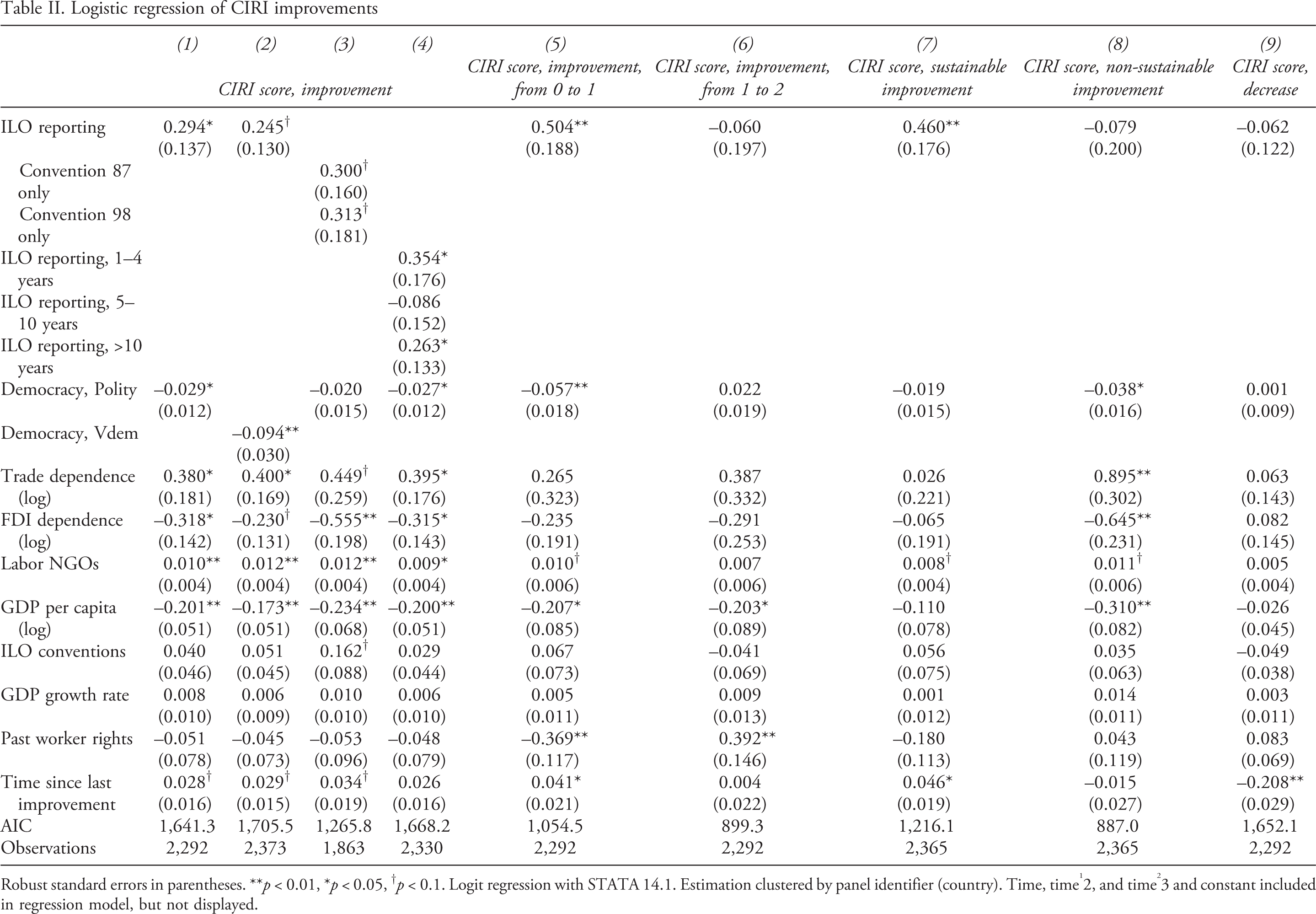
We use logistic regression models due to the nature of our dependent variable. We control for time dependence through the three variables time, time2, and time3. With the exception of Reporting, we enter all time-variant independent variables with a lag of one year. We cluster the data by countries and calculate robust standard errors. We begin the analysis with a logit estimation of the effects of reporting and assess the effects using different specifications of the dependent variable (Table II). In a second step, we test the potential impact of conditioning factors on the effects of Reporting (Table III) and Shaming (Table IV) on Improvements in worker rights.
Results
Logistic regression of CIRI improvements
Logistic regression of CIRI improvements, ILO reporting (CEARC), interaction effects
The analysis in Model 4 reveals that reporting both has immediate effects and can affect behavior when repeated over longer time periods. The coefficient for Reporting between one and four years is positive and significant. An illustrative case is Slovakia, which was listed in 1997 because of a proposal from the government to exclude employer and worker organizations from the wage negotiations, in violation of Convention 98. In 1999, the Slovak government decided to re-enter the tripartite negotiations (US State Department, 2000). We also find support for a positive effect of more than ten years of iterated reporting (Model 8). A case in point is Morocco, which was listed from the early 1990s onwards for lack of legislation protecting workers from anti-union discrimination (ILO, 1990–2011b). In 2002, the government of Morocco finally introduced legislation prohibiting discrimination against workers based on trade union membership or activities.
Models 5–9 present the results for alternative versions of the dependent variable. Model 5 demonstrates that H1 is confirmed for changes from severely restricted (0) to somewhat restricted worker rights (1), whereas ILO Marginal effects on CIRI improvement (Model 1)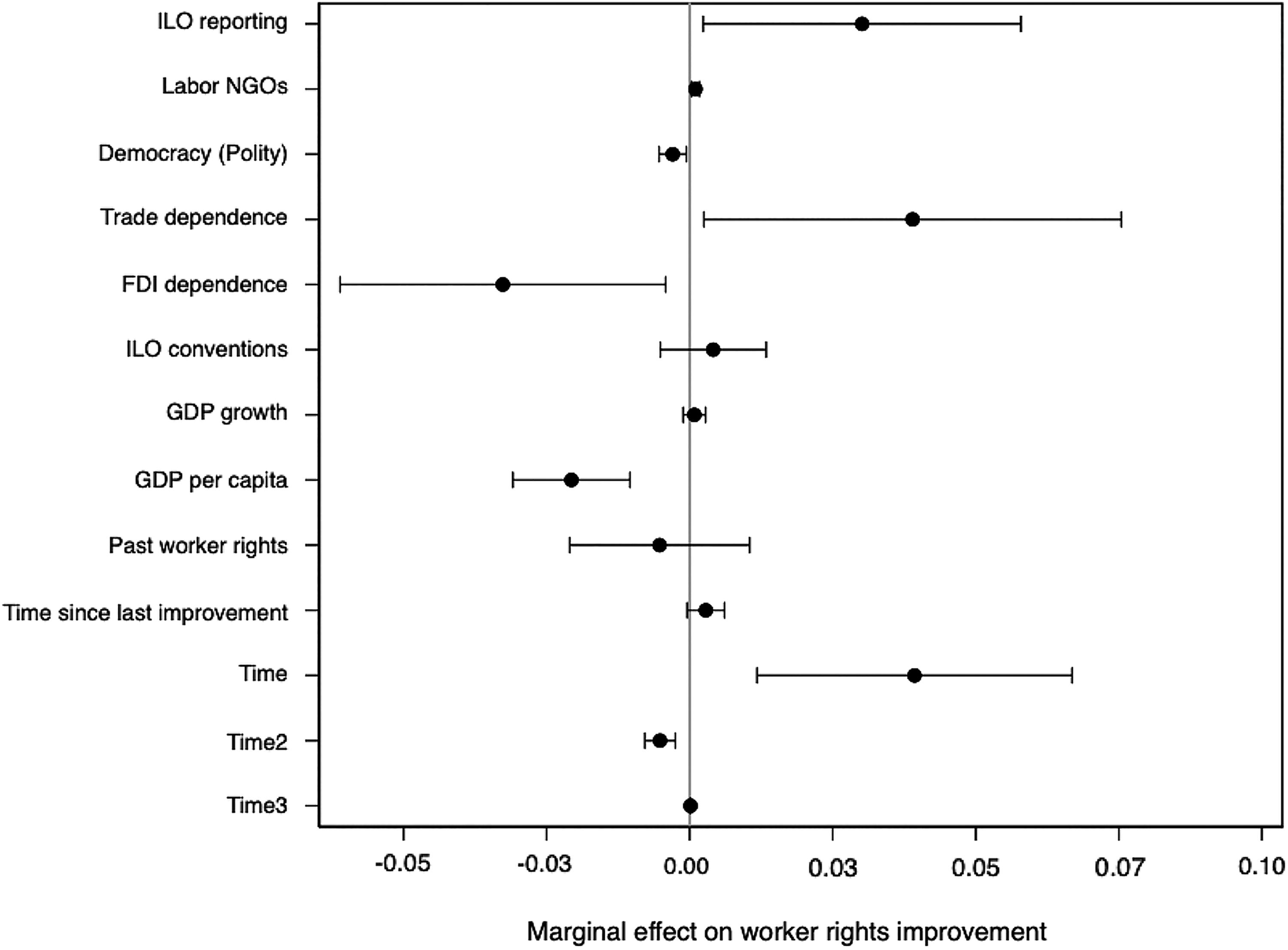
To test if Reporting has durable effects, we compare sustainable CIRI improvements that were not followed by decreases within the next five years (Model 7) with cases of less sustainable improvements (Model 8). Our analysis shows that Reporting indeed leads to sustainable improvements, whereas it does not have an effect on unsustainable improvements. The finding that reporting has durable effects on state behavior differs from results in some earlier research on naming and shaming (Hafner-Burton, 2008). Finally, additional support for H1 comes from a placebo test in Model 9, where we assess if Reporting also can explain decreases in the CIRI score. The results show it cannot, strengthening our confidence that the effects of ILO reporting on improvements in labor standards are robust.
Next to Reporting, Labor NGOs, Trade dependence, and Time since last improvement have positive effects on improvements in worker rights. The effect of labor NGOs is robust and significant except for Model 6 (shift to full protection) and Model 9 (decrease). The coefficient for trade is significant in Models 1–4 and Model 8, the latter suggesting that improvements driven by the vulnerability of the domestic economy do not lead to persistent improvements in workers’ rights. Conversely, the effects of Democracy, GDP per capita, and FDI dependence on labor rights improvements are strongly negative and significant. Many of the improvements at the lower end of the scale take place in poor countries with low democracy scores. Moreover, 80% of all countries categorized in the highest category of the CIRI score are democracies. 4 While the ratification of ILO conventions and the GDP growth rate do not reveal significant results, we find that the level of Past worker rights, as could be expected, has a negative effect on improvements from ‘severely restricted’ to ‘somewhat restricted’ (Model 5), and a positive effect on shifts to the highest level of ‘fully protected’ rights (Model 6).
If we compare the marginal effect of our main explanatory variable to the effects of other significant variables on all improvements (Model 1), ILO Reporting has a slightly weaker impact than trade, but a stronger effect than all other covariates, including political regime, presence of labor NGOs, and implementation capacity of a country (Figure 1).
Conditional marginal effect of reporting on CIRI improvements
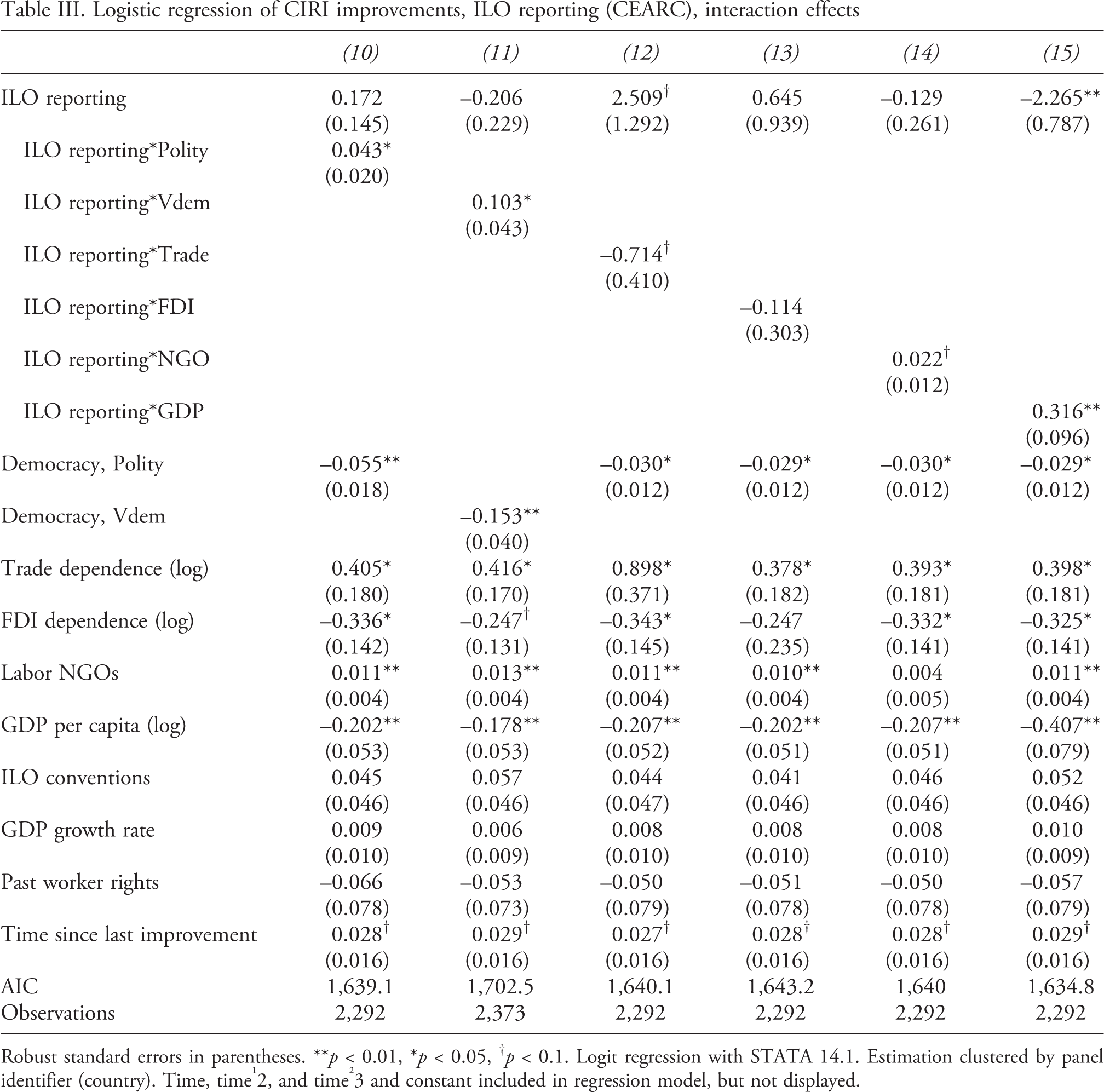
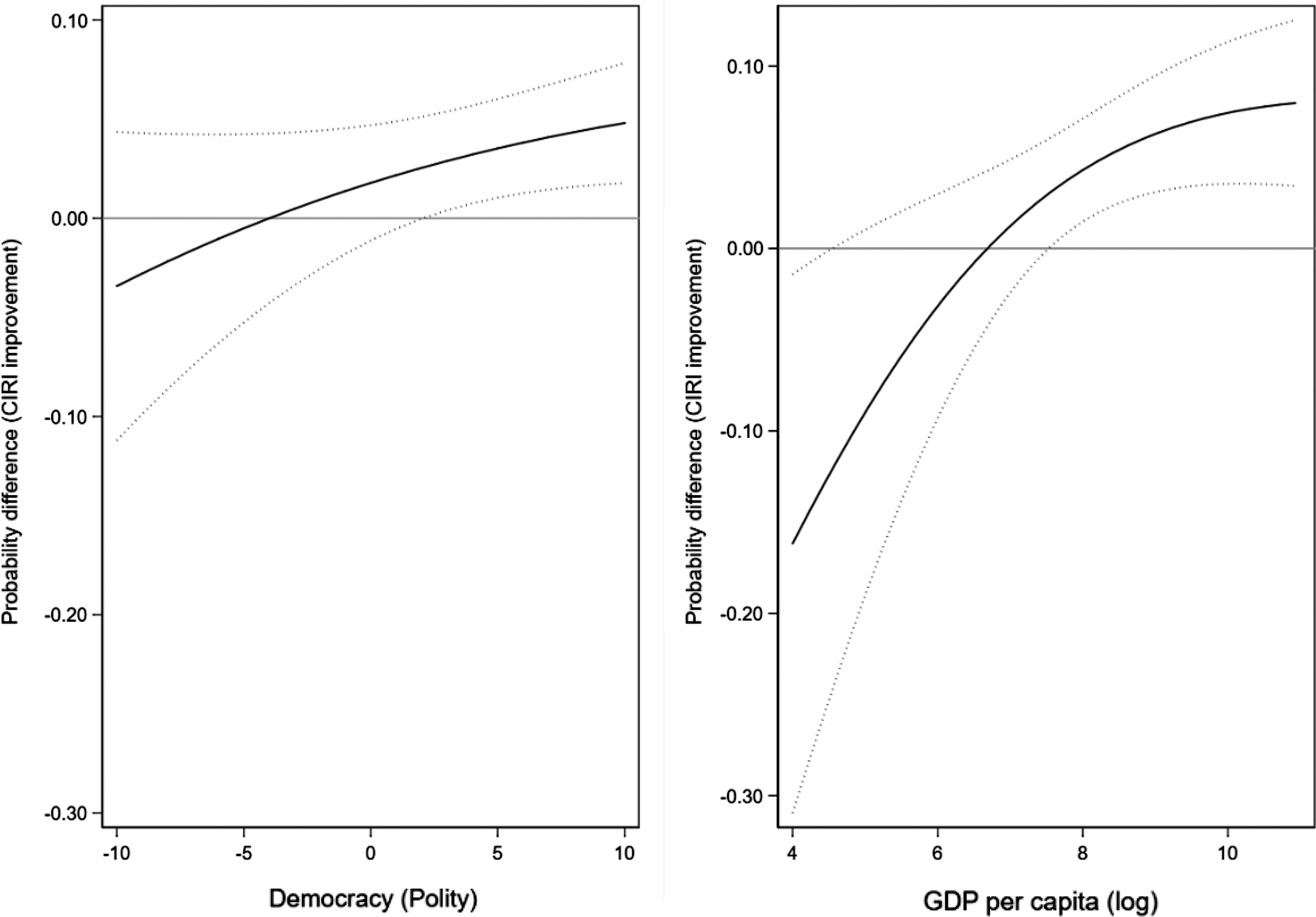
As a second step of our analysis, we test the conditions under which Reporting affects worker protection (H2a–e). We find that some of the conditions expected to shape the effects of reporting are relevant in the ILO. As Table III indicates, we find significant interaction effects that support H2a and H2d, and observe some evidence for H2c. The interaction of Reporting and Democracy (Polity and V-Dem) is significant, while the coefficient for Reporting becomes weaker and loses its significance (Models 10 and 11). The interaction effect for Reporting and Democracy (Polity) is visualized in Figure 2. It highlights the difference in the marginal effect of Democracy on positive changes in the CIRI score when we add Reporting. The same positive interaction is observed for GDP per capita, our proxy for a country’s capacity to implement improvements of worker rights (Model 15 and Figure 2). Here, Reporting even shows a negative coefficient when we add this interaction term. Finally, ILO Reporting is significant at the 90% threshold when interacted with Labor NGOs (H2c).
These positive interaction results for Democracy and GDP per capita contrast with their negative direct impact on labor rights improvements. Whereas poorer and more autocratic countries in general have a higher likelihood of improving the protection of labor rights, due to their lower initial levels of protection, we find that ILO reporting is more effective for richer and more democratic countries.
Considering that reporting mainly has effects in cases of poor labor protection, it is reasonable to wonder which richer democracies, if any, actually conform to this profile. The data reveal several interesting cases. The UK was classified as having ‘severely restricted’ labor rights from 1991 to 1998, when it was reclassified as having improved to ‘partly restricted’ rights. Similarly, Brazil, Chile, Greece, and Israel belonged to the category of countries with ‘severely restricted’ labor rights at some point in time.
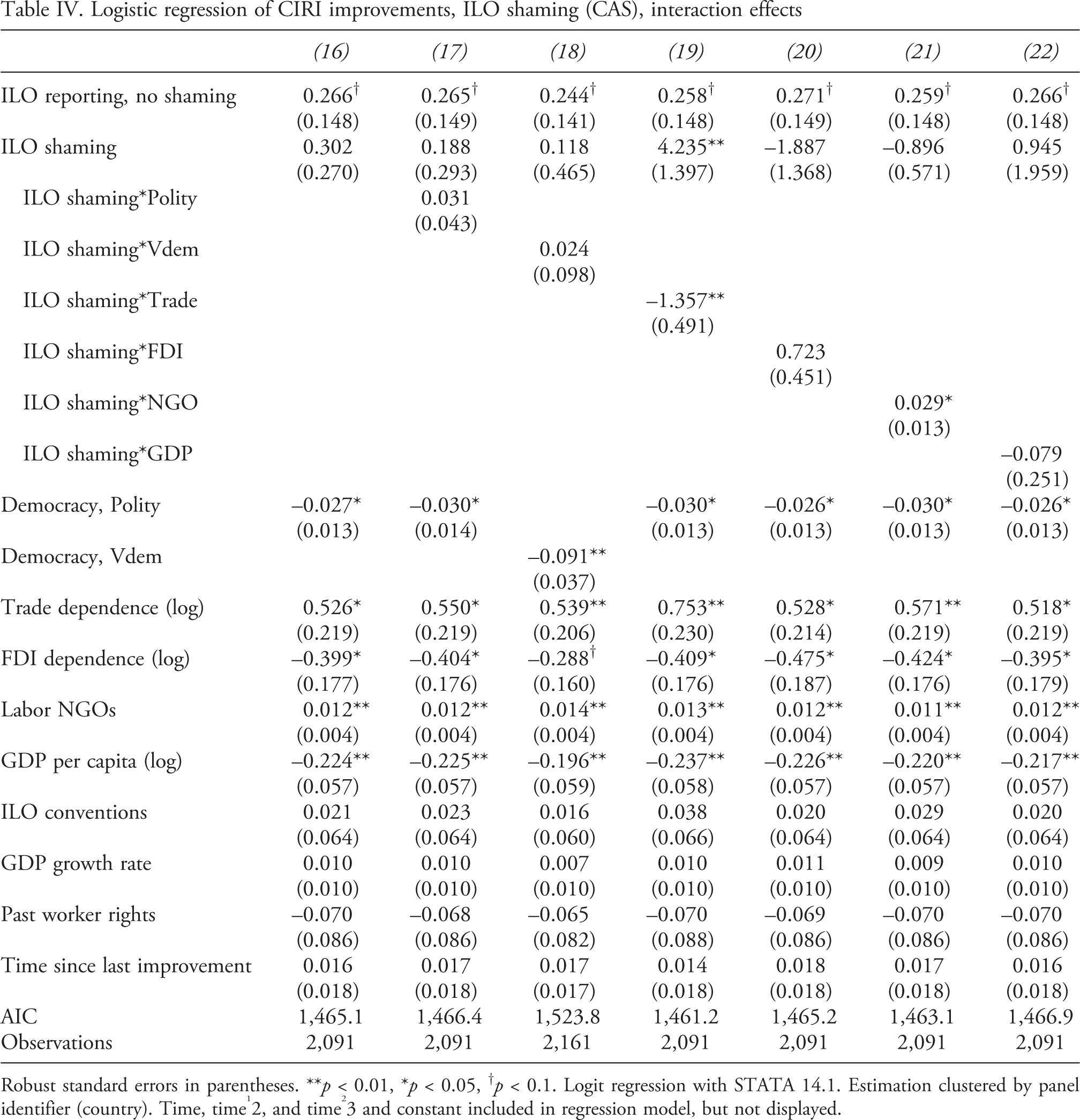
Models 12 and 13 in Table III show that there is no support for H2b: economic dependency in terms of trade and FDIs does not strengthen the effect of ILO reporting. This is surprising, given that existing literature typically assumes that more vulnerable states are more receptive to naming and shaming (Franklin, 2008; Keck & Sikkink, 1998; Risse & Ropp, 2013). We note, however, that our results are in line with those of some other studies (e.g. Murdie & Davis, 2012).
Logistic regression of CIRI improvements, ILO shaming (CAS), interaction effects
Robustness checks
We took a number of measures to check the robustness of the findings. First, we controlled for the possibility of floor and ceiling effects, re-estimating Models 1, 5, and 6 (Table II) by excluding all countries that are stuck at the top (2) or bottom (0) of the CIRI score. For these countries, it is logically impossible to expect an increase (decrease) of the CIRI score. Table A.1 (all tables and models named A are in the Online appendix) presents the results without ceiling and floor effects (Models A.1–A.3) and without ceiling effects only (Models A.4–A.6). We find that our main results are robust to the exclusion of these cases, while the control for a ceiling effect (Model A.4) leads to a somewhat weaker, yet still significant, effect of Reporting.
Second, we controlled for the possibility that our findings could result from a secular trend, such as societal modernization or regime transformation, occurring in parallel to ILO reporting. We control for domestic structural changes by assessing if the effects of reporting still hold when paralleled by strong increases in democracy scores, income levels, civil society strength, and trade openness. For this purpose, we created new versions of the Reporting variable that are sensitive to disproportional changes in these four control variables. The results from Models A.7–A.10 in Table A.2, show that the immediate effects (1–4 years) of reporting are stable or even stronger. The only visible difference is the slightly weaker effect of repeated reporting over longer time periods (more than ten years) when we control for the process of democratization (Model A.7).
Third, we controlled for the possibility of selection bias in the ILO’s choice of what states to target through reporting. Table A.3 shows the results of a logistic regression predicting targeting by the CEACR (Models A.11–A.13) and the CAS (Models A.14–A.16). Moreover, we test a Heckman selection model with two binary dependent variables, where CEACR reporting represents the selection stage and CAS decisions the outcome (Models A.17–A.18). The results suggest that the ILO does not target ‘easy cases’ – actual violations of worker rights matter when the CEACR decides what countries to list in its reports. The results for shaming (Models A.14–A.16) are similar.
Fourth, we also use 2sls-models to test the endogeneity of ILO reporting to workers’ rights (Models A.19–A.20; Table A.4). Sagan tests show that the null hypothesis of exogeneity cannot be rejected at the conventional level of significance. In addition, we run a robustness check, interacting ILO reporting with countries that ratified either convention 87 or 98, to test whether those who ratified only one of the conventions respond differently (Model A.21). Our analysis finds no such evidence.
Fifth, we provide robustness checks for two of our control variables. To begin with, we offer a third measure of democracy – Freedom House Civil Liberties Index (Freedom House, 2017) – which leads to the same robust results (see Models A.22 and A.23; Table A.5). In addition, we replace our NGO variable with V-Dem’s Civil Society Participation Index (Coppedge et al., 2019; Models A.25–A.27; Table A.5). The interaction with ILO reporting (significant at the 10% level and positive) in Model A.25 lends additional support to our hypothesis H2c.
Sixth, we perform a robustness test using an alternative dependent variable. The data on collective labor rights (CLR) by Mosley (2011) are widely used in similar studies. However, comparability with our data is constrained by endogeneity (ILO reporting is one of three sources for CLR data), different scales, and a design that covers only half of our observation period. To still enable a test, we develop three versions of the CLR data on collective labor rights in practice (LaborPracticePos; Models A.28–A.30; Table A.6). 5 As reference points, we include our basic model for the CLR sample only (Model A.31) and for country-years not covered by the CLR data (Model A.32). The coefficient for ILO reporting is positive and significant for one of these alternative dependent variables (Model A.28), but not the others. The results for several other variables also differ compared to the baseline model. These differences may partly be due to technical issues: residualization takes out variation even for cases where the two other sources of CLR data would be in line with ILO reports. But, in addition, the two reference models (A.31–A.32) indicate that the effect of Reporting is contingent on a longer observation period than that covered by the CLR data.
Seventh, we incorporate country fixed effects into our models from Tables II and III. This leads to a conservative estimation that takes out large parts of the cross-sectional variation. Still, the results show that ILO reporting is significant in producing sustainable improvements (Model A.36) and confirm the interaction effects between Reporting and Democracy, Labor NGOs, and GDP per capita (see Models A.37, A.40, A.41). The coefficient for our main independent variable is positive, but no longer significant in Models A.34 and A.35. However, this coincides with generally weaker results for alternative explanations, except for Time since last improvement.
Conclusion
This article has offered a systematic assessment of the effect of reporting on state compliance with international rules. We have focused empirically on reporting in the ILO, which has a long history of monitoring international labor standards, allows us to control for the potential impact of enforcement on compliance, and makes it possible to evaluate if reporting’s effects vary depending on characteristics of target countries and the reporting process. We summarize our principal findings in terms of three conclusions.
First, reporting works. In the ILO, regular and public reporting on state compliance has significant positive effects, particularly when dealing with severe violations of international labor standards. Reporting’s effects are quite immediate; after one or a few listings as non-compliant, states do take measures to improve labor rights. But reporting can also work through repeated listing over extended time periods, even if this effect becomes weaker when we control for structural changes. Reporting’s effects are durable and not just temporary adjustments to momentarily please international partners or domestic interests. Reporting need not involve shaming to be effective; in fact, combining reporting with shaming only contributes to further improvements under specific circumstances.
Second, reporting does not have the same effect on all countries. Reporting is a tool that primarily works for the liberal world of democratic states with active labor movements and sufficient capacity to do something about violations. For this group of states, public exposure as rights violators is highly uncomfortable, internationally and domestically, leading them to take immediate and sustainable action. By contrast, autocratic and poor states lack both the domestic political pressures and resources to respond to international criticism with measures that bring about real improvements in labor rights. Our robustness checks demonstrated that this result is not driven by strategic targeting of ‘easy cases’ by the ILO.
Third, the effects of ILO reporting are good news for international labor rights. Earlier literature has offered mixed evidence on the effects of ILO conventions on worker rights. While some find that ratification of these conventions has positive consequences for workers (Kim, 2010), others conclude that ratification paradoxically is negatively associated with respect for labor rights (Peksen & Blanton, 2017). We show that the ILO’s monitoring system is an independent source of compliance with international labor standards, distinct from the mixed effects of ratification. Characterizations of the ILO as a ‘toothless tiger’ (Elliott & Freeman, 2003: 102), because of its lack of coercive measures, appear to overlook the impact of its procedures for monitoring, assessing, and comparing state compliance.
Taken together, our results suggest that existing research has not fully appreciated the potential of monitoring systems based on reporting to generate compliance with international rules. As notable as these findings are, they likely also underestimate the full consequences of reporting, since they only capture the compellence effect of monitoring (being pushed to comply when revealed to be a violator), but not the deterrence effect (abstaining from violations because of the risk of exposure).
To what extent do these results carry implications beyond the context of the ILO and international labor rights? IO reporting as a non-coercive system for inducing compliance appears to become increasingly common in world politics, suggesting that our findings may be of broader importance. Other examples of IOs and regimes that rely on reporting rather than enforcement include the IAEA, OECD, Financial Action Task Force on Money Laundering (FATF), and Montreal Protocol on Substances that Deplete the Ozone Layer. In addition, the UN Agenda 2030 for sustainable development and the Paris Agreement on climate change suggest that the international community is putting growing faith in review arrangements built around reporting and comparison instead of coercion.
Yet it should not be assumed that IO reporting has similar effects on compliance across all issue areas. It appears likely that some policy domains present conditions more favorable to reporting than others. For instance, reporting may be more effective in issue areas where a reputation for compliance is more central to gains from cooperation, such as trade liberalization, and where international norms are associated with stronger normative commitments, such as human rights. Conversely, reporting may be less effective in issue areas where incentives to renege on agreements are particularly strong, such as arms control, and where domestic and transnational interest mobilization is rarer, such as finance. While this article focused exclusively on international labor rights, exploring the scope conditions for effective reporting is an important next step for this research agenda.
Footnotes
Replication data

Acknowledgements
We thank Judith Kelley, Ayla Matanock, Beth Simmons, Anton Strezhnev, and the two anonymous reviewers for JPR for valuable comments on earlier drafts of this article.