




Abstract
Are states willing to overlook human rights violations to reap the fruits of international cooperation? Existing research suggests that this is often the case: security, diplomatic, or commercial gains may trump human rights abuse by partners. We argue, however, that criminal-justice cooperation might be obstructed when it undermines core values of individual freedoms and human rights, since the breach of these values exposes the cooperating state to domestic political resistance and backlash. To test our argument, we examine extradition: a critical tool for enforcing criminal laws across borders, but one that potentially threatens the rights of surrendered persons, who could face physical abuse, unfair trial, or excessive punishment by the foreign legal system. We find support for our theoretical expectation through statistical analysis of the surrender of fugitives within the European Union as well as surrenders to the United States: greater respect for human rights correlates with the surrender of fewer persons. A case study of Britain confirms that human rights concerns may affect the willingness to extradite. Our findings have important implications for debates on the relationship between human rights and foreign policy as well as the fight against transnational crime.
Introduction
Are states willing to compromise their commitment to human rights for the sake of international cooperation? Scholars have often answered this question in the affirmative, suggesting that political and economic interests tend to take precedence over human rights. In order to reap diplomatic or commercial gain, governments might overlook the human rights violations of their partners. For example, several studies suggest that human rights exert a limited effect, if any, on arms transfers and the allocation of foreign aid (Neumayer, 2003; Carey, 2007; Lebovic & Voeten, 2009; Erickson, 2011; Schulze, Pamp & Thurner, 2017).
This article examines the impact of human rights on cooperation in an area that has received little attention from IR scholars: criminal justice. Cooperation among states in the investigation, prosecution, and punishment of crimes goes back centuries but has increased in importance in the current era: ‘Bad’ actors – from organized crime syndicates, through human and drug traffickers, to transnational terrorists – take advantage of globalization to commit crimes (Andreas & Nadelmann, 2006). To curb cross-border crime, states assist each other in implementing and enforcing their domestic criminal laws. Such cooperation ranges from the sharing of evidence (known as ‘mutual legal assistance’) and the extradition of criminal suspects to the transfer of criminal proceedings and the freezing or seizure of assets (UNODC, 2009; Efrat & Newman, 2017).
From a functionalist perspective, criminal-justice cooperation can easily appear efficient, as it helps to prevent or punish crime. In this article, we develop an alternative account that explains why states may refuse to cooperate against crime. We argue that an important cause for such reluctance rests in concerns that the cooperative endeavor might undermine core societal values. The core values that criminal-justice cooperation impinges on include individual freedoms and human rights, as well as legal fairness. States more committed to these values are less likely to cooperate for fear of breaching them. Such a breach might expose the cooperating state to domestic political resistance and backlash due to the undermining of fundamental normative principles.
To test this argument, we examine the extradition of wanted persons: a central feature of international criminal cooperation. Extradition is the surrender by a state (the requested state) of a person present in its territory to another state (the requesting state) that seeks that person either to prosecute them or to enforce a sentence already handed down by its courts (UNODC, 2009: 143). While the mechanism of extradition has a long history, its use has grown in this era of burgeoning transnational crime, with thousands of requests made annually worldwide covering a broad array of crimes: from terrorism and drug trafficking through homicide to robbery and fraud (Nadelmann, 1993; Pyle, 2001). Extradition stands on the principle ‘that it is in the interest of all civilized communities that offenders should not be allowed to escape justice by crossing national borders and that States should facilitate the punishment of criminal conduct’ (Home Office, 2011: 20).
While a crucial tool for fighting crime, extradition potentially threatens the rights of surrendered persons, who could face physical abuse, unfair trial, or excessive punishment by the foreign legal system. To assess whether such human rights concerns carry weight and, in fact, constrain the extradition process, we examine extradition patterns within the European Union under the European Arrest Warrant (EAW). To verify the generalizability of our findings, we analyze data on the extradition of suspected criminals to the United States. Narrative evidence of the recent British debate on extradition policy sheds additional light on the causal mechanism. Our findings across the different types of evidence point to a strong relationship between core values and international criminal cooperation: countries that exhibit greater respect for human rights tend to extradite fewer individuals.
Our findings advance the literature on the international effects of domestic legal systems and norms. Existing research tends to focus on how domestic norms influence treaty behavior or cooperation with international courts (Mitchell & Powell, 2011). We, however, turn attention to how differences in domestic norms shape actual patterns of cooperation against crime. Our argument and findings also offer tangible evidence of the impact of human rights on foreign policy and international cooperation. While in various areas governments appear willing to trade human rights respect for the benefits of cooperation, such compromise turns out to be harder in the area of criminal justice. In this context, at least, the commitment to human rights appears to be an actual constraint on cooperation rather than lip service (Hafner-Burton, 2005; Tomz & Weeks, 2020).
International criminal cooperation and extradition
States seeking to combat crimes are often hamstrung by their transnational nature. As criminals and crimes transcend traditional notions of territorial jurisdiction, police and prosecutors increasingly find evidence and suspects scattered or hidden across borders (UNODC, 2010). Without international cooperative action, the rule of law might be hollowed out. Responding to this challenge, governments employ mechanisms for international criminal cooperation. These mechanisms address the different elements of the criminal-justice process: from the gathering of evidence through the criminal prosecution and trial to the punishment (UNODC, 2012).
Extradition is perhaps the best-known of those mechanisms, and it plays a key role in the suppression of transnational crime (Nadelmann, 1993; Magnuson, 2011). Extradition is the formal legal process by which persons accused or convicted of crime are surrendered from one state to another for prosecution or punishment. While comprehensive global statistics concerning extradition are unavailable, a UN survey of 35 countries found some 3,000 extradition requests made in 2012 (UN, 2014: 27), excluding those processed through the EU extradition scheme: the European Arrest Warrant. During the period 2005–11, nearly 80,000 extradition requests were made among EU members through the EAW (Carrera, Guild & Hernanz, 2013).
Policymakers worldwide consider extradition a vital tool in confronting criminality, and it has played a particularly central role in the US fight against organized crime and drug trafficking. Since the 1970s, the United States has filed an increasing number of extradition requests (Nadelmann, 1993: 817–818). As a result, drug traffickers and kingpins from Colombia, Mexico, and other countries ended up in US courtrooms. Perhaps the most infamous of these is Joaquin ‘El Chapo’ Guzman, the leader of the Sinaloa Cartel. One of the richest men in Mexico and among the leading drug lords globally, El Chapo was first extradited from Guatemala to Mexico in 1993. After a series of prison escapes and manhunts, Mexico extradited him to the United States in January 2017, and a New York court convicted him in February 2019.
In addition to the wide use of extradition to counter narcotics trafficking, it has become essential for government efforts to prosecute international terrorists’ networks (Finnegan, 2017). Anti-terrorism treaties – such as the International Convention for the Suppression of Terrorist Bombings and the International Convention for the Suppression of Acts of Nuclear Terrorism – require states to prosecute or extradite those who engage in terrorism. 1
Extradition and the defense of core values
If extradition serves as a valuable tool of international cooperation for fighting crime and terrorism, will governments let human rights stand in the way? In this section, we develop an argument emphasizing the ways in which domestic norms, particularly those associated with human rights and physical integrity, may shape a state’s willingness to extradite individuals. Since extradition potentially puts the human rights of the extradited person at risk, states concerned for such rights will be more reluctant to extradite: extradition might legitimize conduct that runs contrary to their values and make them complicit in human rights violations. Furthermore, extradition might bring these states under criticism for failure to uphold fundamental norms.
Our argument builds on a growing literature which stresses the importance of domestic legal practices and norms for international cooperation. Work on legal traditions, for example, has found that differences between the common law, civil law, and Islamic law influence states’ attitude toward international courts. Such work emphasizes the fit between domestic legal practice and global legal practice – for example, in terms of the status of precedent or contract fulfillment (Mitchell & Powell, 2011). Similarly, Kelley (2007) argues that states with a high level of domestic rule of law are less likely to breach their commitments to the International Criminal Court: these states’ normative dislike for breaking commitments – and fear of the domestic consequences of breaking commitments – pushes them to honor their pledge to the ICC. In a similar vein, Putnam (2016) finds that US courts are more willing to exercise extraterritorial jurisdiction when core legal values, such as those embodied in the US constitution, are at stake. Finally, Efrat & Newman (2016) demonstrate that national rules and norms concerned with substantive and procedural fairness influence a state’s willingness to defer to a foreign legal system.
This body of work demonstrates that international cooperation in legal matters often runs up against domestic norms. States that engage in such cooperative efforts face the risk that foreign legal systems may be based on values that are distinct from or contradictory to one’s own. And these tensions are particularly acute in criminal-justice cooperation, where foreign systems may hold different conceptions of fundamental notions such as due process, fair trial, or excessive punishment. International criminal cooperation between legal systems with different values could therefore become challenging both personally and politically. At the personal level, law-enforcement agencies and judicial actors might find themselves involved in conduct that runs contrary to their values and beliefs and is an anathema to their mission, resulting in cognitive dissonance (Kelley, 2007: 577). Politically, governments open themselves up for attack when they engage in international criminal cooperation with states that do not respect core values. Political opponents, NGOs, the media, and other critics may charge that the government cooperates with an unfair or abusive legal system – harming the individuals involved in the legal process, and also tarnishing and diminishing domestic norms and standards (Chase & Fife, 2016; Lennox, 2017). At the same time, the violation of core values reinforces the sovereignty concerns surrounding international criminal cooperation. Opponents may blame the government for undermining national sovereignty by abdicating the authority of the national legal system in favor of a foreign one that fails to uphold fundamental norms. Indeed, survey experiments conducted by Tomz & Weeks (2020) demonstrate that citizens in democracies are much more willing to attack a country that violates human rights than a country that respects them.
Which core values does extradition threaten? As extradition subjects the requested person to criminal trial or punishment by a foreign legal system, we may broadly distinguish between three sets of concerns involving fundamental human rights (Dugard & Van den Wyngaert, 1998; Sadoff, 2016).
A common concern is that the extradited person might experience torture or another kind of abusive treatment, such as harsh interrogation techniques, corporal punishment, or poor detention conditions (Sharfstein, 2001). In its 1989 landmark decision in the case of Soering, 2 the European Court of Human Rights ruled that the extradition of a fugitive who would be put on death row in the United States, taking into account the conditions and length of detention prior to execution, constituted inhuman or degrading treatment, in violation of Article 3 of the European Convention on Human Rights.
Another concern is that the extradited person would not receive a fair trial. The UN Model Treaty on Extradition, for example, requires the extradition-requesting state to provide minimum guarantees in criminal proceedings, as stipulated by the International Covenant on Civil and Political Rights. These include, among others, ‘a fair and public hearing by a competent, independent and impartial tribunal established by law’; presumption of innocence; adequate time and facilities for the preparation of one’s defense; a trial without undue delay; not to be compelled to testify against oneself or to confess guilt; and a right to appeal the conviction and sentence. 3 Also in the category of unfair trials are cases in which the requesting state’s court might discriminate against the requested person or prejudge them on the basis of their race, nationality, or other factors.
The third set of concerns revolves around the excessive nature of the punishment. Most countries of the world have abolished the death penalty, and they tend to include provisions in their domestic legislation, as well as in international agreements they negotiate, to bar extradition to countries where the death penalty might be imposed – unless the requesting state provides assurances that such punishment will not be implemented. 4 Some countries also consider life sentence as an excessive punishment that would block extradition. 5
Obviously, concerns about physical abuse, unfair trial, or excessive punishment might arise when the extradition-requesting country is an autocracy with a poor human rights record. Extradition to China, unsurprisingly, could meet serious resistance (Efrat & Tomasina, 2018). But it is important to note that extradition raises concerns even when the requesting country is a democracy that is generally committed to human rights, and even when the crime in question is ordinary and not a particularly heinous one. Even in democracies, the legal system might be prone to bias and discrimination; it could suffer long delays that undermine the fairness of the trial; prison conditions might be poor; and defendants might come under pressure to confess their guilt (Stuntz, 2011; Fair Trials, 2017).
But to what extent do human rights concerns actually influence extradition practice? Such concerns had, in fact, been alien to the traditional paradigm of extradition, which focused on states’ shared interest in fighting crime and on the maintaining of friendly international relations based on respect for state sovereignty. Blocking extradition on human rights grounds would, of course, disrupt the good relations between states and their joint efforts against crime. Extradition arrangements have therefore given modest weight to the rights of the wanted person. Instead, they sought to secure the interests of states and their ability to cooperate. Yet the traditional model of extradition has been modified over the past three decades. It is the aforementioned decision of the European Court of Human Rights in the case of Soering (1989) that is heralded as the human rights turn for extradition (Dugard & Van den Wyngaert, 1998). Following Soering, human rights concerns have received growing emphasis in extradition agreements, legislation, and case law. The Charter of Fundamental Rights of the European Union, for example, prohibits extradition if there is a serious risk that the person ‘would be subjected to the death penalty, torture or other inhuman or degrading treatment or punishment’. 6 The UN Model Treaty on Extradition includes a similar prohibition. 7 Various countries have incorporated human rights safeguards in their extradition legislation. 8 Drawing on legislative provisions, constitutional safeguards, or general notions of fairness and justice, courts in various countries have considered human rights claims in extradition proceedings. 9
While states seem to be paying greater attention to human rights in extradition as a matter of official policy, this does not necessarily mean that human rights affect the practice of extradition. Indeed, one can dismiss this seeming attention as cheap talk (Pyle, 2001; Posner, 2014). States may establish mechanisms to refuse extradition on human rights grounds, but they may also set a high threshold for refusal, rendering these mechanisms ineffective. In other words, states’ actual conduct may still be prioritizing cooperation against crime and friendly international relations over human rights. By setting a high bar for human rights considerations, governments can avoid the diplomatic tensions that come with the refusal of extradition requests and the criticizing of other countries’ human rights practices. Domestically, a high bar can demonstrate to voters that the government is serious about tackling crime.
We argue, however, that human rights concerns in extradition serve as more than cheap talk. As suggested above, engaging in international criminal cooperation contrary to fundamental norms creates tension and cognitive dissonance for those officials who observe these norms as a duty and a responsibility; it might also expose the government to domestic criticism for failing to uphold core values. Indeed, governments may also face the opposite domestic criticism, that is, calls to disregard human rights concerns in extradition. Critics might argue that by failing to extradite offenders on human rights grounds the government is providing a safe haven to criminals (Efrat & Tomasina, 2018: 613). We expect, however, that the strength of the pro-rights criticism will increase with the country’s respect for human rights. In countries with a strong rights record, governments might face a domestic backlash for extradition that violates human rights, and such backlash could embarrass the government and tarnish its image as a protector of human rights. The Australian government, for example, met heavy criticism as it tried to ratify an extradition treaty with China in 2016–17. Lawyers accused the government of attempting ‘to appease China, to gift it with a right of extradition and to abandon any citizen to the fate of a criminal-justice system that lacks the most basic protections’ (Lennox, 2017). Ultimately, the government suffered a humiliating defeat when it failed to win ratification for the treaty (Murphy, 2017).
In summary, we argue that human rights concerns do constrain extradition in countries with greater respect for human rights. Such countries are less likely to extradite wanted persons due to the possibility of abusive treatment, unfair trial, or excessive punishment. These concerns, however, carry less weight for countries with a weaker human rights record. In those countries, officials are unlikely to experience domestic pressures to guarantee extradited persons’ rights, nor will they do so out of a deep-seated respect for human rights. Overall, then, we expect to observe fewer extraditions by countries with greater respect for human rights.
E1: States extradite fewer persons the stronger their respect for human rights.
Analyzing extradition within the European Union
We turn to examining the impact of human rights on the European Arrest Warrant: the arrangement for extradition – ‘surrender’ in EU parlance – among member-states of the European Union since 2004.
The European Arrest Warrant creates a fast-track procedure for extradition between EU members, based on the principle of mutual recognition of judicial decisions – a principle that requires that a decision made by a judicial authority in one member state receive full and direct effect throughout the EU (Plachta, 2003). This means that, under the EAW, national judicial authorities must accept a foreign warrant – a request for the arrest and surrender of a person, submitted through a standard form – without inquiring into the underlying facts and circumstances, and they should execute the warrant within strict time limits. The EAW also removes various barriers to extradition and limits the grounds for refusal. Traditionally, the executive possesses the authority to block extradition ordered by the courts. The EAW’s system of surrender, however, relies on courts alone, with minimal formality and no involvement of the executive. Furthermore, the EAW removes the nationality exception. Most civil-law countries of Europe restrict or prohibit the extradition of their own citizens (Efrat & Newman, 2020). The European Arrest Warrant, by contrast, requires EU members to surrender their citizens.
Do basic rights affect the operation of the European Arrest Warrant? One may not expect this to be the case. Since all EU members are democratic countries that generally respect human rights, extradition to a fellow EU member presumably should not raise human rights concerns. Furthermore, the European Arrest Warrant builds on mutual trust among the member-states. As the Framework Decision establishing the EAW notes, ‘[t]he mechanism of the European arrest warrant is based on a high level of confidence between member-states’. 10 A judicial authority in one state must trust that fellow criminal-justice systems adhere to the common rules and principles of the EU, including the rule of law and human rights (Willems, 2016; Efrat, 2019). The premise of mutual trust means that human rights concerns should not influence surrenders among EU members, since they are all assumed to respect human rights. This makes the EAW a hard test for our argument.
Our dependent variable is the Rate of surrenders through the European Arrest Warrant, that is, the ratio of actual surrenders a member-state makes to the number of surrender requests it receives. Data on surrender requests and surrenders made come from member-states’ responses to the annual EU Council questionnaire on quantitative information on the practical operation of the European Arrest Warrant. Based on the Council’s questionnaire and additional sources, researchers from the Center for European Policy Studies compiled data on the EAW operation that correct some of the deficiencies and inconsistencies in member-states’ reporting (Carrera, Guild & Hernanz, 2013). These data cover the period 2005–11. Note that the annual figures reported through the questionnaire and used here are totals for each member-state: the total number of surrender requests that a member-state received from all other EU members combined in a given year, and the total number of surrenders a member-state made to all other EU members combined in a given year. This means that the following analysis is monadic and not dyadic. Table I provides an overview of the data by summing up the number of requests (that is, the number of EAWs a country received) and the number of surrenders during the period considered here.
We measure the key independent variable – respect for human rights in the surrendering state – through the Physical Integrity Rights Index from the CIRI Human Rights Dataset. Ranging from 0 to 8, this index measures governments’ practice of torture, extrajudicial killing, political imprisonment, and disappearance (Cingranelli, Richards & Clay, 2014). Higher values indicate greater respect for human rights.
EAWs received and persons surrendered, 2005–11
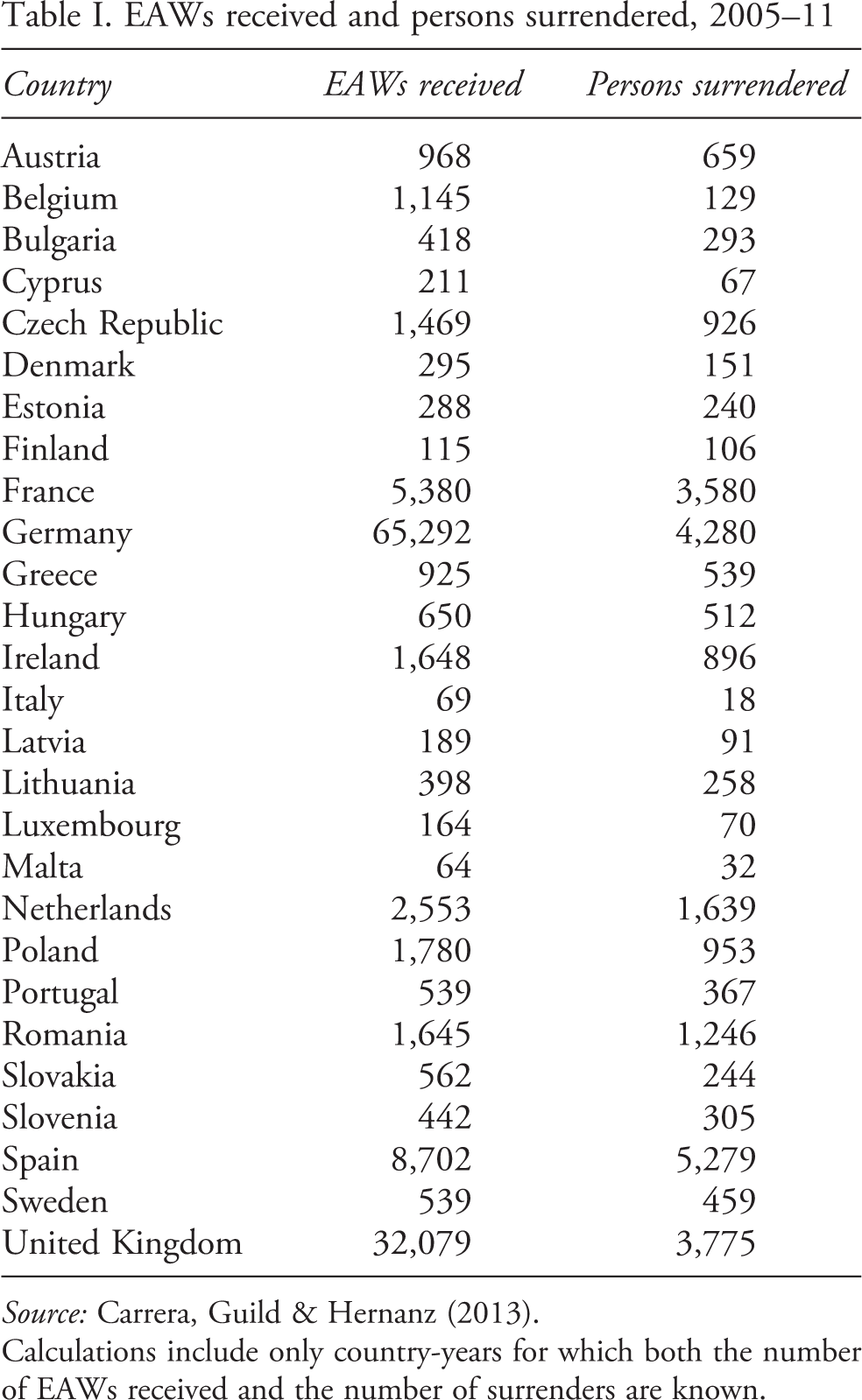
Source: Carrera, Guild & Hernanz (2013).
Calculations include only country-years for which both the number of EAWs received and the number of surrenders are known.
Since our dependent variable is a fraction – the ratio of surrenders made to surrender requests – we employ two types of models specifically designed for fractional outcomes, that is, dependent variables that range from 0 to 1, such as rates, proportions, and probabilities. The first is a fractional-response regression, which computes quasilikelihood estimators based on probit. As a robustness check, we employ a beta regression with a probit link. In all models, standards errors are clustered by country to account for potential dependence within units over time. Table II reports the results.
Model 1 is a fractional regression that includes the key independent variable – human rights – alongside the four standard controls described above and two additional controls that capture potential influences on the rate of surrender: the strength of the rule of law in the surrendering state
15
and the government’s political orientation expressed through the strength of right-wing parties in government.
16
In this model, the only variable that achieves statistical significance is human rights. Consistent with our expectation, greater respect for human rights is associated with a lower rate of surrenders. Figure 1 shows the substantive effect of this variable: a noticeable drop in the rate of surrenders with the increasing respect for human rights. By contrast, the strength of the rule of law – which captures the quality of Predicted surrender rates between EU members at different levels of human rights with 95% confidence intervals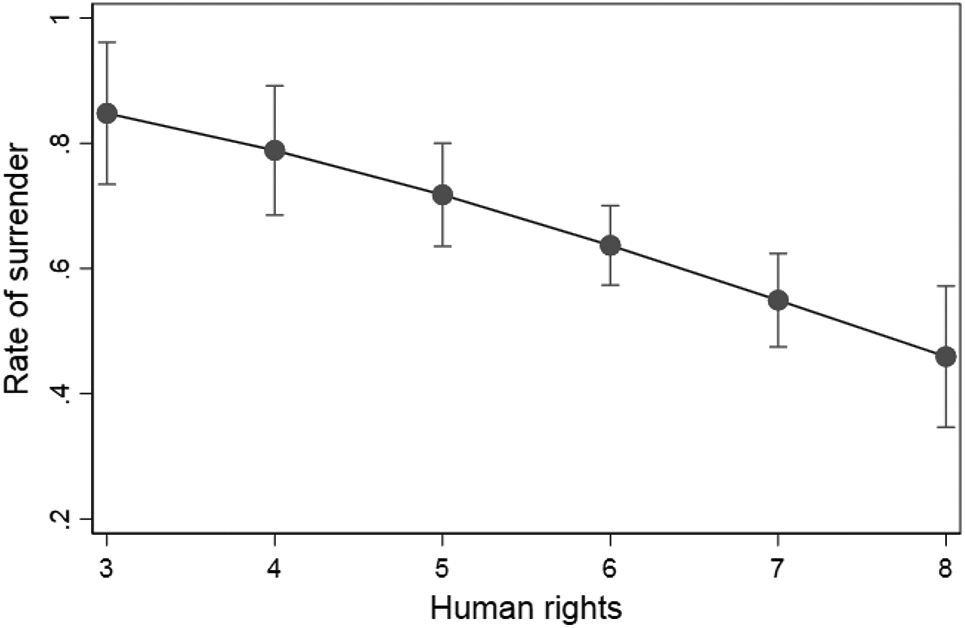
Models 2–4 conduct several robustness checks. Model 2 re-estimates Model 1 through a beta regression. 17 Some of the controls that were nonsignificant in Model 1 do gain significance in this model. Importantly, the key result holds: human rights are negatively and significantly associated with the rate of surrenders through the European Arrest Warrant. Models 3 and 4 – fractional regressions – confirm the negative effect of human rights on surrenders. Model 3 includes a control variable that specifically measures the quality of the criminal-justice system. This variable, from the World Justice Project, 18 captures the effectiveness, timeliness, and impartiality of criminal investigation and adjudication. Criminal-justice quality, however, appears unrelated to the rate of surrenders. So does the presence of veto players. 19 In Model 4, we control for a different criminal-justice indicator: a country’s rate of prisoners per 100,000 population; 20 we also control for the percentage of the population holding a positive image of the EU, 21 since a more favorable societal attitude may facilitate compliance with EU law. These two controls, however, lack statistical significance and the key result holds.
In summary, we have shown that respect for human rights negatively correlates with the rate of EAW surrenders. This may be one of the reasons for the surprisingly low surrender rate in a system where non-surrender should be the exception. By our calculations, the average surrender rate stands at 57% during the period considered here.
Analyzing extradition to the United States
Top 25 extraditing countries to the United States, 2003–15
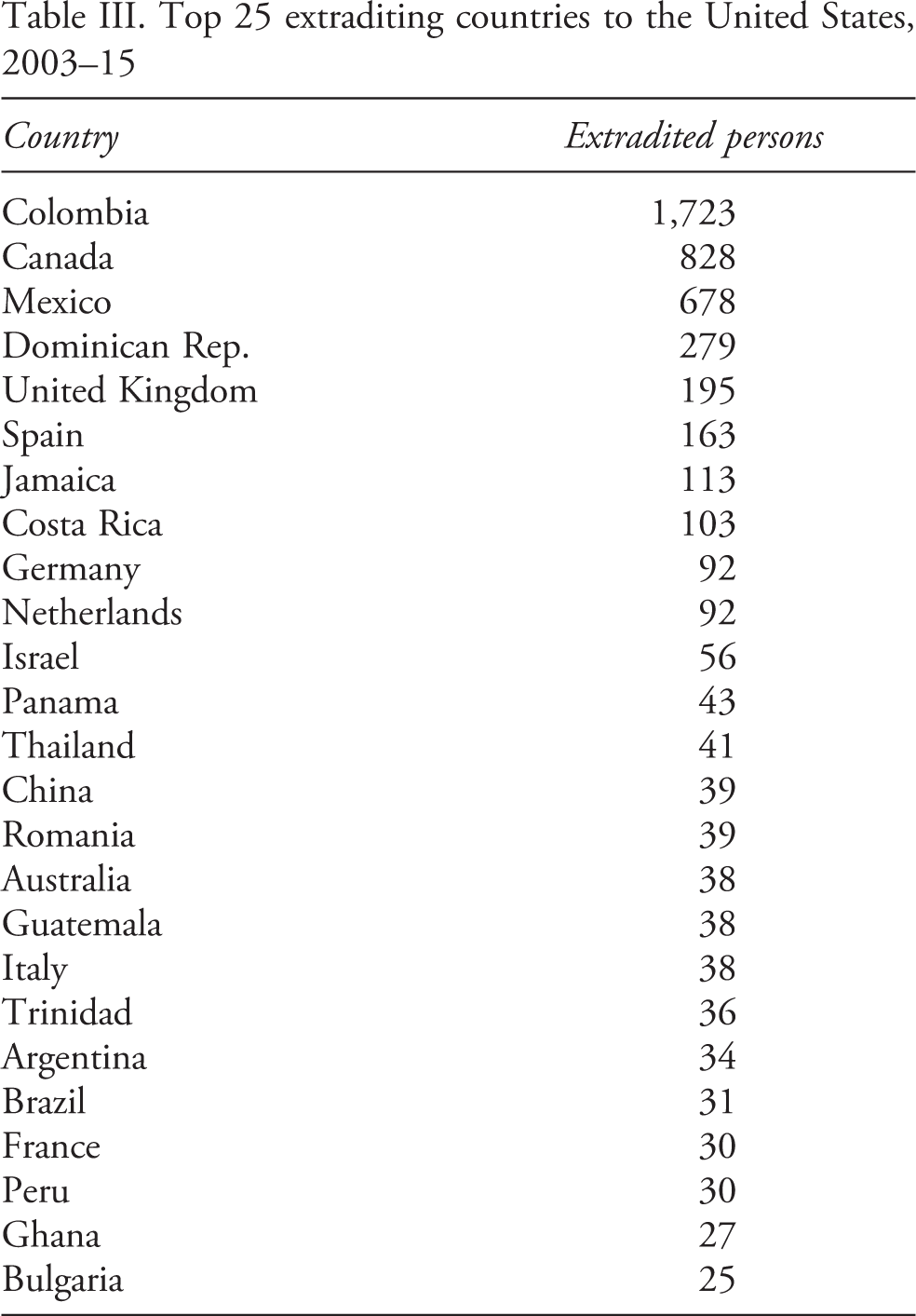
Influences on extradition to the United States
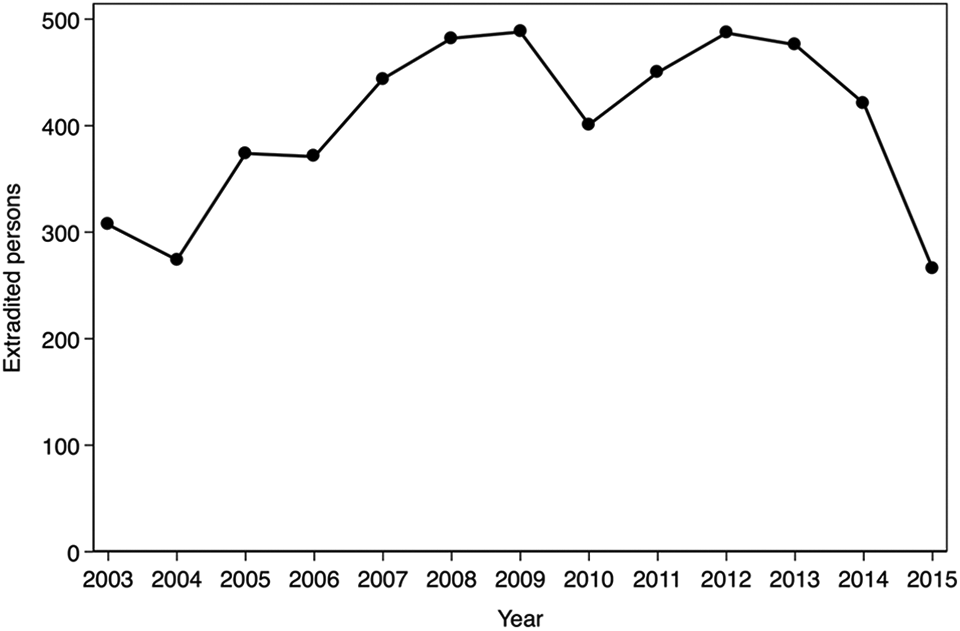
Our dependent variable is the annual number of persons extradited from each country to the United States. According to our expectation, this number should diminish with the country’s respect for human rights. Note that, unlike the EU analysis, we lack data on the number of persons whose extradition the United States requested. The dependent variable is thus a count variable, rather than a ratio of actual extraditions to extradition requests. Nonetheless, as detailed below, our analysis does control for influences on the number of extradition requests the United States may have
Flows of extradited persons to the United States, 2003–15 Annual count of all extraditions to the United States, 2003–15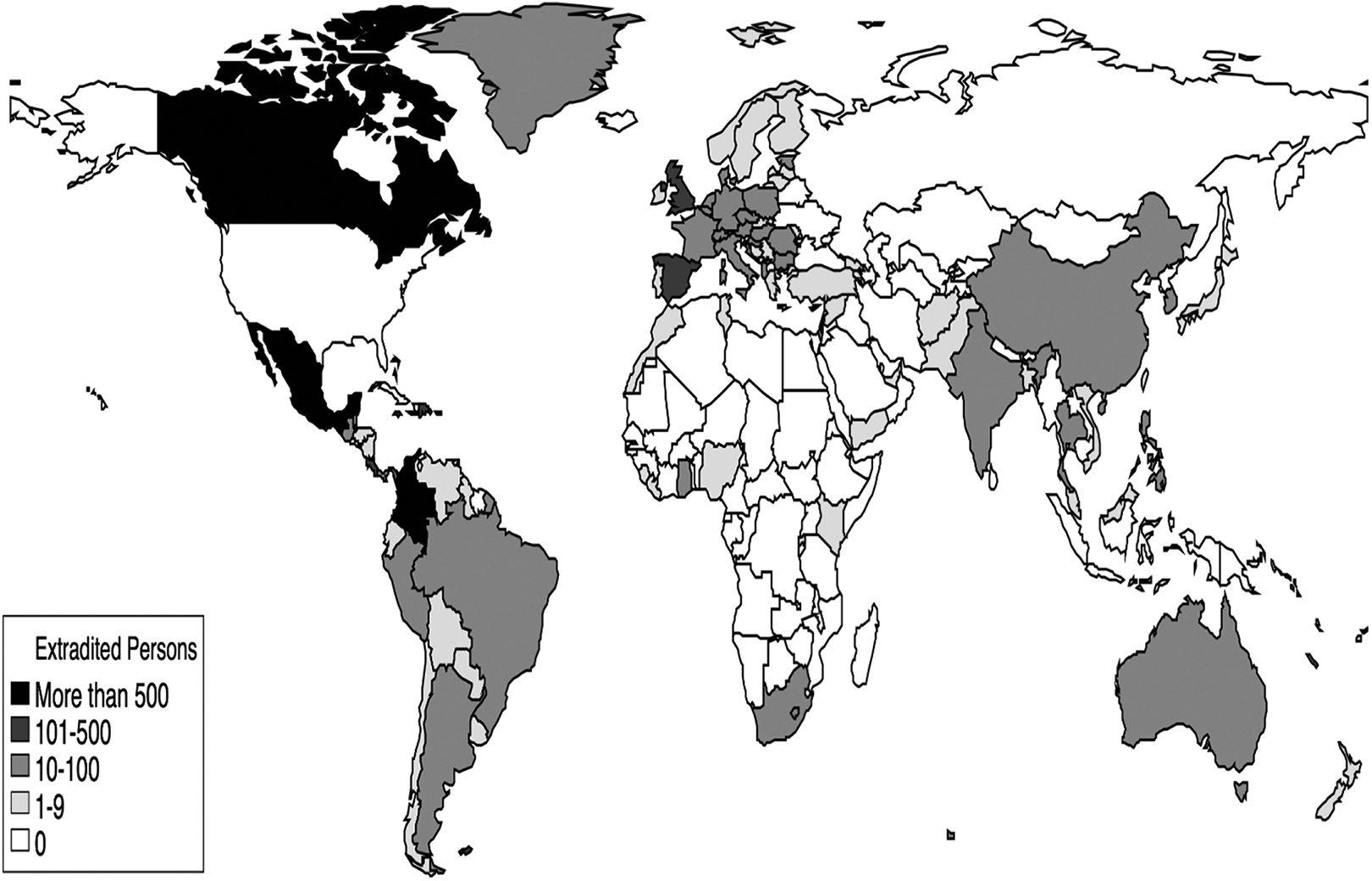
The primary independent variable is the extraditing country’s level of respect for human rights, measured through CIRI’s Physical Integrity Rights Index. As a robustness check, we employ the Political Terror Scale (PTS). Ranging from 1 to 5, this measure captures state-sanctioned or state-perpetrated violence. We use the data compiled from the US State Department reports (Gibney et al., 2016). The original scale is inverted, such that a higher score indicates greater respect for human rights – similar to the CIRI measure.
Our models include a battery of controls. We control for the size of the extraditing country’s population 23 – where there are more people there are more criminal offenders – as well as GDP per capita. 24 Distance from the United States serves as another control, since fleeing criminals often seek refuge in nearby territories; more broadly, countries close to each other experience significant cross-border exchange, which raises the potential for criminal activity (van Schendel & Abraham, 2005). 25
Beyond human rights, our key independent variable, we control for two additional domestic institutional features of the extraditing country: democracy and common law. Democracies have been shown to be more cooperative across issue areas (e.g. Bättig & Bernauer, 2009), and this tendency may extend to extradition. 26 Common-law countries may also be more prone to extradite to the United States – a fellow common-law country – since the shared legal origin fosters predictability and confidence, which facilitate cooperation (Mitchell & Powell, 2011: 75). Common-law countries are also willing to extradite their own citizens, whereas many civil-law countries prohibit the extradition of their citizens (Shearer, 1971).
Significant criminal activity within a country is likely to generate US demand for the extradition of offenders. Given the high priority that the United States accords to drugs and money laundering (US Department of State, 2017), we expect more extraditions from countries that are heavily involved in the drug trade or in the laundering of money. The US State Department’s annual ranking of money-laundering involvement serves as our proxy of criminal activity. 27 This measure also captures drug activity, since much of laundered money originates in the drug trade.
Countries that are friendly toward the United States – measured through ideal-point distance in UN General-Assembly voting 28 – may be more likely to assist US law-enforcement efforts through extradition. Greater voting distance should thus lower the number of extraditions.
Finally, we control for the existence of an extradition treaty between the country and the United States. 29 Countries often allow extradition in the absence of a treaty (Sadoff, 2016: chap. 7), yet a treaty facilitates extradition by establishing a legal obligation to extradite and by laying out the rules and requirements of the process (Shearer, 1971: 22).
Results
Influences on the rate of surrender through the European Arrest Warrant
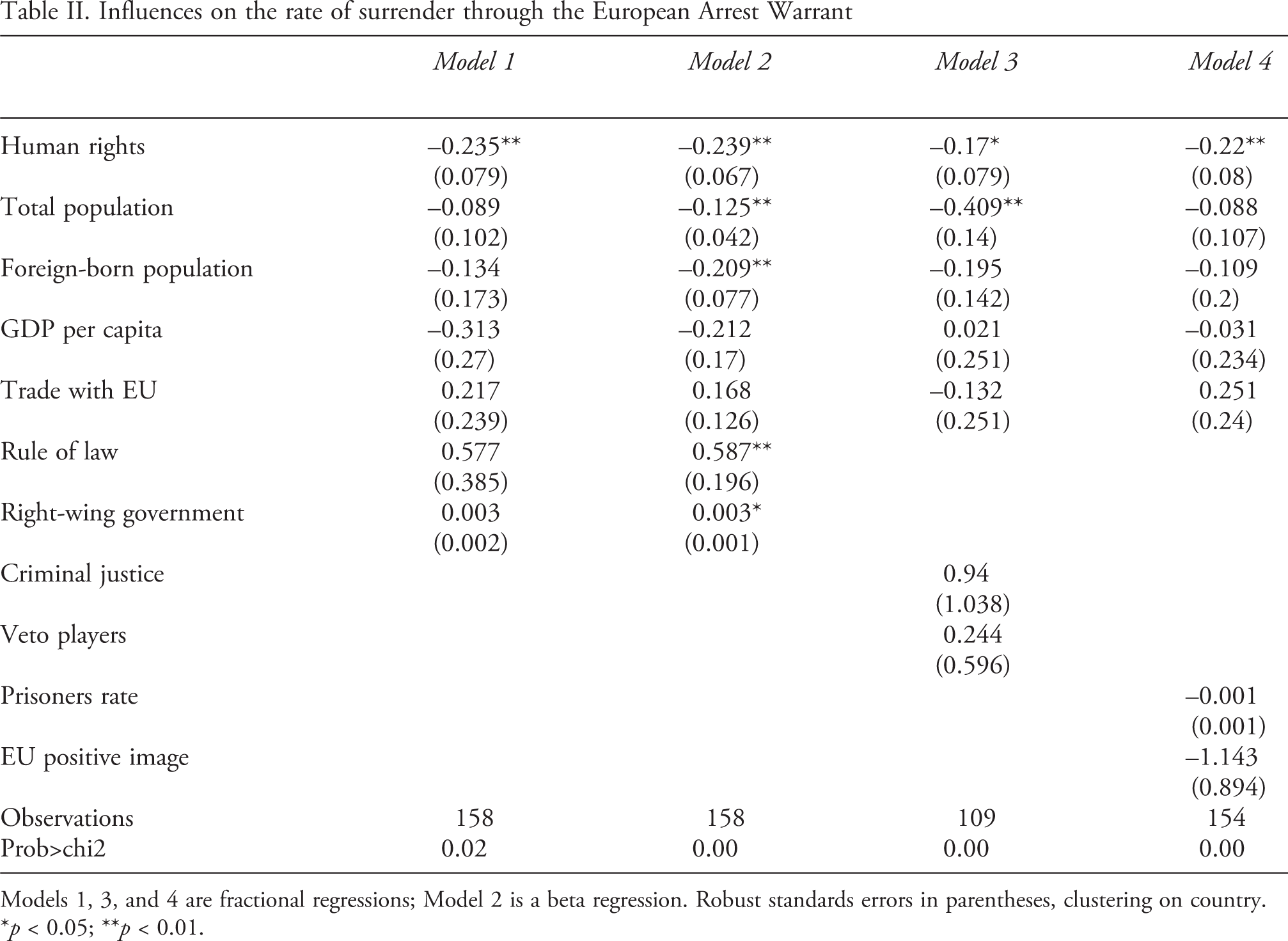
Models 1, 3, and 4 are fractional regressions; Model 2 is a beta regression. Robust standards errors in parentheses, clustering on country. *p < 0.05; **p < 0.01.
In Model 1, respect for human rights, measured through the CIRI index of physical integrity rights, is negatively associated with the number of extraditions: a one-point increase on this scale reduces the expected count of extraditions by 26%. Similarly, in Model 2, the Political Terror Scale is negatively correlated with the number of extraditions: a one-point increase on this variable lowers the expected count of extraditions by 30%. These findings support our expectation: countries with a stronger human rights record tend to extradite a considerably lower number of individuals. 30
The control variables in Models 1 and 2 conform with expectations for the most part. More populated countries extradite more individuals to the United States. So do countries with a higher GDP per capita, possibly indicating richer countries’ greater capacity to apprehend criminals. By contrast, countries that are distant from the United States extradite fewer individuals. Criminal activity considerably increases the expected count of extraditions: in both Models 1 and 2, a one-unit increase on the money-laundering scale almost doubles the number of extraditions. Countries that are politically removed from the United States, as measured by a larger distance in UN voting, extradite fewer persons – but this finding is not statistically significant. Common-law countries are more likely to extradite to the common-law-based US justice system, but this is only significant in Model 1. As expected, the presence of an extradition treaty makes a country much more likely to extradite: a treaty increases the frequency of extraditions more than fourfold (Model 1) or more than fivefold (Model 2). Interestingly, however, the expectation regarding democracy is not supported by these two models. Whereas many studies document the cooperation-enhancing impact of democracy, we find that democracy may increase the expected count of extraditions – but this effect is not statistically significant.
Influences on extradition to the United States
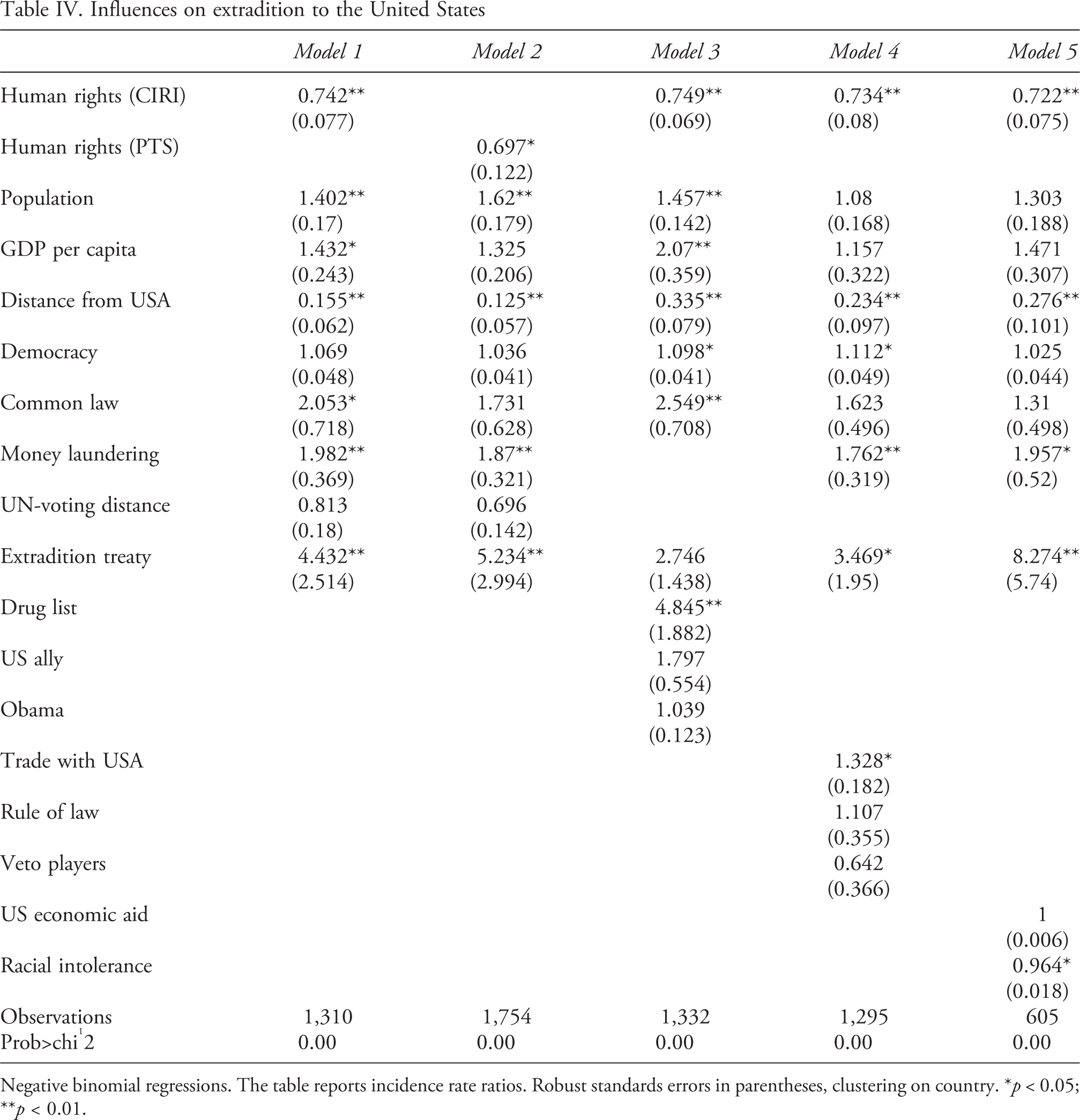
Negative binomial regressions. The table reports incidence rate ratios. Robust standards errors in parentheses, clustering on country. *p < 0.05; **p < 0.01.
In Model 4, bilateral trade serves as measure for a country’s relations with the United States. As one would expect, countries that are more dependent on their trade with the United States tend to extradite more individuals. 33 This model also controls for the strength of the extraditing country’s rule of law, since the ability to carry out the process of extradition might depend on the capacity of the local legal system. 34 This variable, however, seems unrelated to the number of extraditions. The presence of veto players also does not affect the count of extraditions. 35 Human rights, however, are still negatively associated with that count.
Model 5 uses the dependence on US economic aid as a measure for a country’s relations with the United States. 36 In addition, this model includes a measure of societal ethnocentrism. Ethnocentric sentiments intensify the view of globalization as harmful: they inspire concerns that global integration might bring with it foreign intervention and the erosion of local traditions or values. Ethnocentrism thus reduces the support for free trade (Mansfield & Mutz, 2009; Margalit, 2012). It is possible that ethnocentrism similarly fuels resistance to extradition as an abdication of sovereignty in the legal arena. Our measure of ethnocentrism comes from the World Values Survey (Inglehart et al., 2014): the percentage of respondents who indicated they would prefer not to have people of a different race as their neighbors. This measure is indeed negatively correlated with the number of extraditions: where intolerance is rife, there is less willingness for limiting local judicial authority by surrendering fugitives to stand trial abroad. Consistent with previous models, this model also shows a negative effect of human rights on extraditions to the United States – an effect that is statistically significant and substantively large.
Extradition vs. extraordinary rendition
Our analysis of the US case applies to legal, formal extradition practices and not the covert ‘extraordinary rendition program’, which expanded considerably between 2001 and 2005. As part of this program, the US government and the Central Intelligence Agency (CIA) worked with foreign governments to secretly detain and interrogate terrorist suspects in undisclosed locations worldwide (Cordell, 2017). Owing to its secret nature, it is difficult to identify all the individuals who were detained, but conservative estimates put the number at over 100 (Blakeley & Raphael, 2018). While the US government has not banned the practice of extraordinary rendition, it has severely curtailed it since 2005.
While extraordinary rendition is an important issue, its non-inclusion in our analysis does not affect the results concerning extradition. Extradition is the primary, longstanding channel for the transfer of criminal suspects among states for the purpose of prosecution and punishment. Extraordinary rendition served a different goal: detention and interrogation of suspects, rather than prosecution. Thus, it was not an alternative to extradition. The extraordinary rendition program is also much more limited than extradition in scope and size. The United States requests the extradition of persons for a variety of crimes: first and foremost drug offenses, but also homicide, assault, robbery, fraud, sex offenses, and others. In comparison, extraordinary rendition involved only terrorist suspects. And the overall number of roughly 100 persons secretly detained is much smaller than the number of extradited persons, whose annual count ranges roughly from 300 to 500. Furthermore, the extraordinary rendition program was short-lived, largely ending in 2005. The analysis here covers the years 2003–15 – mostly in the post-rendition period. Our results hold even when the analysis is limited to the post-rendition period, that is, 2006–15.
Moreover, the fundamental logic of our analysis – the key role of core domestic values of human rights – played an important role in the extraordinary rendition case. The United States likely turned to the secret channel of rendition since it feared a public backlash against the violations of the rights of terrorist suspects. And indeed, the revelation of the program and the associated scandal put considerable pressure on partner governments, particularly those committed to high standards of human rights (Huq, 2006; Blakeley & Raphael, 2017).
While extraordinary rendition was not a substitute for extradition, there are other channels that states may use – instead of extradition – to transfer criminal suspects across borders for prosecution: from deportation to unilateral lure-and-capture operations (Sadoff, 2016). We have focused on extradition as the primary channel for delivering suspects, but see important future work considering these alternatives.
Exploring the mechanisms: Britain’s extradition controversy
After statistically establishing the impact of human rights on extradition, we take a closer look at the causal mechanism through the British case. The issue of extradition has fueled an intense public debate in Britain since the reform of the Extradition Act in 2003 (Efrat, 2018). Facing globalization’s challenge to international law enforcement cooperation, the Labour government headed by Tony Blair sought to modernize and streamline the way in which extradition requests submitted to Britain are handled. In particular, the reform established a simplified procedure for dealing with extradition to EU countries through the European Arrest Warrant. Also in 2003, Britain signed a new extradition treaty with the United States. In the wake of the attacks of 11 September 2001, this was seen as a key pillar in the Blair government’s fight against terrorism.
Yet extradition policy quickly became a recurring political hot potato. Growing concerns about extradition to the United States and EU countries were expressed in parliamentary debates, in the media, before parliamentary committees, and before a government-appointed panel that reviewed Britain’s extradition arrangements. Consistent with our argument, critics highlighted what they perceived as human rights violations or other expressions of unfairness in the US and European justice systems – systems that, in their view, failed to meet the core standards of British law.
Both the government-appointed panel and the House of Lords Select Committee on Extradition Law observed that many of the witnesses before them focused on ‘aspects of the US justice system which they felt made extradition inappropriate or unjust’ (Home Office, 2011: 254; Select Committee on Extradition Law, 2015a: 99). MP Dominic Grieve (Conservative), for example, argued that ‘[t]here is a lack of public confidence in the US criminal justice system […] there are perceptions in this country that the US criminal justice system can be harsh and its penal policy can be harsh, and its sentencing policy can appear disproportionate by European and British standards’ (Home Affairs Committee, 2012: Ev. 60). Some expressed concerns over the very high frequency of prosecutions ending in plea bargains. While plea bargains occur in the British legal system as well, critics suggested that the US system obtains these deals excessively and under pressure – ‘forc[ing] possibly innocent people to make guilty pleas’, according to MP David Davies (Conservative) (Hansard, 16 October 2012, col. 171).
The harsh prison conditions in the United States also attracted criticism. MP Douglas Hogg (Conservative) argued that US prisons are ‘ghastly […] an affront to civilization’ (Hansard, 12 July 2006, col. 1439). British newspapers echoed this view. The Week magazine described Chris Tappin, a retired British businessman extradited to the United States in 2012, as ‘the victim of an FBI sting’, held in ‘a remote prison in the desert’, where detainees suffer abuse and humiliating treatment (Edwards, 2012).
Criticism of European justice standards similarly highlighted the poor prison conditions in certain EU countries: cells might be overcrowded or filthy, and prisoners might be subjected to mistreatment by prison personnel or other prisoners. Opponents also suggested that not all EU countries fully guarantee the right to a fair trial. For example, they might hold the extradited person in a long pre-trial detention or admit evidence that was inappropriately obtained (Joint Committee on Human Rights, 2011b: 188–193). Parliament’s Joint Committee on Human Rights (2011a: 7) summarized the dilemma: It is important, however, to balance the need to return alleged offenders to the country in which the crime took place with the need to respect the rights of those requested for extradition. In our Report we highlight a number of areas where we believe the protection of rights for these persons is significantly below the standard which a UK citizen should expect. This is in part due to the introduction of a streamlined extradition process in the Extradition Act 2003, including the European Arrest Warrant, and the varying human rights protections within the European Union.
Overall, Britain’s extradition debate demonstrates the prominence of human rights concerns in how rights-respecting countries think about extradition. It also shows how governments might face criticism and pressure for failing to protect the human rights of persons facing extradition. Such pressure, in turn, may inspire greater caution in the surrender of persons to foreign justice systems, at the expense of the joint efforts against crime.
Conclusion
In this article, we developed an argument as to how human rights alter patterns of cooperation on transnational crime. Our argument suggests that engaging in cooperation with a foreign legal system could expose a government to domestic criticism: political opponents, NGOs, and the media might leverage such cooperation to question the government’s commitment to society’s core values. Similarly, the contradictions between domestic and foreign values may be seen as imperiling the mission and beliefs of law enforcement officials that implement the cooperative measures. As a result, countries with stronger respect for human rights are more hesitant to cooperate on criminal justice. Specifically, they are likely to extradite fewer individuals, given the human rights risks that extradition poses.
To test our argument, we analyzed data on wanted-person surrenders within the European Union and to the United States. Across datasets, and in qualitative evidence concerning Britain’s extradition arrangements, we find robust support for our argument. In short, stronger commitment to human rights correlates with the extradition of fewer individuals. While our findings suggest the applicability of the argument in both the European and US contexts, future work should explore other instances of criminal-justice cooperation, such as mutual legal assistance; dive deeper into the mechanism at play; and examine alternative channels for transferring criminal suspects across borders.
Our findings offer important implications for scholars of international politics. We join a growing group of scholars that examine not only formal agreements and official rules, but also their actual effects on the ground (e.g. Jo & Simmons, 2016). To our knowledge, this article is among the first to do so in the area of criminal-justice cooperation. Moreover, this article highlights the role that human rights can play in shaping and constraining foreign policy. Despite the fact that policymakers often tout such a connection, empirical evidence of its existence is scarce (e.g. Lebovic & Voeten, 2009; Erickson, 2011; Nielsen & Simmons, 2015; Schulze, Pamp & Thurner, 2017). The evidence presented here, however, suggests that even in instances where there may be real benefits to cooperation – such as curbing crime – it may be constrained by human rights concerns. Perhaps this is because of the nature of the threat that criminal-justice cooperation poses. In other issue areas, cooperation might affect human rights in a broad and remote manner that is hard to specify in advance. By contrast, cooperation against crime directly and immediately threatens the rights of specific, known individuals. Such a threat is more difficult to ignore.
Footnotes

Acknowledgements
We thank the editor of JPR and three anonymous reviewers for helpful feedback. Guy Freedman provided excellent research assistance.
Funding
This research was supported by the European Union’s Horizon 2020 Research & Innovation programme under Grant Agreement no. 770142 (Reconciling Europe with its Citizens through Democracy and the Rule of Law – RECONNECT).
Notes
References
Supplementary Material
Please find the following supplemental material available below.
For Open Access articles published under a Creative Commons License, all supplemental material carries the same license as the article it is associated with.
For non-Open Access articles published, all supplemental material carries a non-exclusive license, and permission requests for re-use of supplemental material or any part of supplemental material shall be sent directly to the copyright owner as specified in the copyright notice associated with the article.
