




Abstract
Why are some peace processes in communal conflicts more inclusive of civil society actors than others? Inclusion of civil society actors, such as churches and religious leaders, women’s organizations, or youth groups, is seen as important for normative reasons, and studies also suggest that civil society inclusion can improve the prospects for durable peace. Yet, we have a very limited understanding of why we observe inclusion in some communal conflicts but not others. We address this gap by theorizing about various forms of civil society inclusion in local peace processes, and examining to what extent involvement by different types of third-party actors—governments, inter-governmental organizations (IGOs), and non-governmental organizations (NGOs)—may contribute to inclusion. Empirically, we draw on a combination of cross-case and in-depth data covering peace negotiations in communal conflicts in Kenya. The findings show that civil society was less frequently included as facilitators when the government was involved as a third party, while inclusion in the form of direct participation of civil society in negotiations, or via involvement in the implementation phase, was equally common across different types of third-party actors. Our study thus provides important new insights regarding how inclusion plays out in communal conflicts.
Introduction
Why are some peace processes in communal conflicts more inclusive of civil society actors than others? In the 1990s, a grassroots-driven peace process in northeast Kenya gained attention for its achievement in restoring peaceful relations among local communities following years of conflict causing hundreds of deaths (Ibrahim Abdi and Jenner, 1997; Ndegwa, 2001). The peace process in Wajir was notable not least because of its inclusivity: it was spearheaded by a group of women at the market, who initiated dialogue and gradually enlisted the support of professionals, elders, and other local stakeholders to create an inter-clan peace committee, which eventually produced the Al-Fatah peace agreement. Acknowledging that all segments of society were affected by, and in different ways were involved in the conflict, different civil society groups were assigned active roles in maintaining the peace; for instance, specific measures were taken to include the youth in implementing the agreement in light of the fact that young men tended to be the ones carrying out the violent attacks (Ibrahim Abdi and Jenner, 1997). Women, clan leaders (elders), religious leaders, and local businesspeople also played active roles in this broader peace process. In contrast, many peace processes after communal conflict take place without the inclusion of civil society actors. One such example is the armed conflict between the Dassanetch and Turkana communities in northwest Kenya, in the border area to Ethiopia, in 1997. This conflict was addressed through high-level negotiations between Kenyan and Ethiopian officials, with no inclusion of local civic actors in the talks (Reuters, 1997).
As these cases illustrate, in some instances, efforts to resolve communal conflict include local civic stakeholders, whereas other peace efforts entail negotiations only between political leaders or group representatives without active efforts to involve civil society. How can such variation in the inclusiveness of peace processes be understood? This article takes a first step toward systematically addressing this question, by theorizing about different forms of civil society inclusion—facilitation, direct participation in negotiations, and involvement in implementation—and exploring under what conditions inclusion becomes more likely. In particular, we examine to what extent involvement by different types of third-party actors may influence whether civil society is included in a peace process or not. We draw on novel data covering negotiations after communal conflicts in Kenya (1989–2018) in combination with qualitative evidence from field interviews and secondary sources.
The outcome of interest in this article is civil society inclusion in peace processes in communal conflicts. We recognize that civil society comprises a diverse set of actors, in some cases may be as polarized as society at large, and not necessarily always mobilize for peace (Belloni, 2008; Krznaric, 1999; Orjuela, 2003). We also acknowledge that there is to date limited evidence as to whether inclusive peace processes are more effective in ending the fighting or in preventing new episodes of communal conflict. However, we argue that understanding the conditions for civil society inclusion is imperative for several reasons. First, we think there is good reason to expect that it can increase the chances that the peace process results in durable peace. A large body of work—in particular within a civil war context—investigates the role that inclusion of civil society actors plays in negotiating high-quality peace agreements (Krause et al., 2018), anchoring the peace (Nilsson, 2012), and thereby producing more durable settlements to violent conflicts (Wanis-St. John & Kew, 2008). Overall, while some works problematize the role of civil society or point to how inclusion can make negotiation processes more complex (Orjuela, 2003; Wanis-St. John & Kew, 2008), substantial evidence exists that the inclusion of civil society actors often pays off in the sense that agreements to end conflict become more durable (Krause et al., 2018; Nilsson, 2012; Wanis-St. John & Kew, 2008). While most research on civil society inclusion has tended to focus on peace processes in civil wars, there are studies which reach similar conclusions in a communal conflict context. For instance, Van der Linde and Naylor (1999), in a study of communal conflict resolution in Northern Ghana, suggest that the high level of inclusivity in the peace process was a main explanation for the conclusion and sustainability of the Kumasi Peace Accord.
Second, in a broader sense, the inclusion of civil society is emphasized based on democratic and rights-based principles: it reflects the position that not only armed factions but also the wider society affected by an armed conflict should have a stake in negotiating the post-conflict order. Thus, inclusivity in peace processes has become an international norm emphasized by actors such as the UN and the World Bank (Hellmüller, 2019; Paffenholz and Zartman, 2019). However, despite its importance, only limited attention has been devoted to understanding under what conditions civil society actors are able to participate. Local peace processes addressing communal conflict are particularly understudied and undertheorized. This article contributes by theorizing about various forms of inclusion, and why and how involvement by different types of third-party actors—governments, inter-governmental organizations (IGOs), and non-governmental organizations (NGOs)—may influence inclusion. Drawing on novel data from the Kenyan context, our study provides new insights into the conditions for inclusion in communal conflicts.
Previous research
Communal conflict herein refers to localized violent conflict between groups that fight each other along the lines of communal identity. Communal identity in turn is understood as socially constructed and self-ascriptive, and may include ethnic, tribal, and religious identification, as well as identification based on livelihood or notions of indigeneity (Brosché and Elfversson, 2012). Local peace processes here refer to non-binding conflict resolution addressing communal conflicts, and which involve negotiations between the primary parties to the conflict. Civil society is defined as distinct from the state, the business sphere, and the family, consisting of “. . . the wide range of voluntary organizations in society such as religious associations, women’s organizations, human rights groups, and trade unions” (Nilsson, 2012: 246; Paffenholz, 2014) and including customary institutions. While customary institutions are clearly different from civil society associations such as women’s groups or trade unions, for instance, in terms of the degree of formalization and barriers to inclusion, they often tend to be distinct from the state and political parties, and thereby constitute civil society in the sense of engaging in between the public and private realm (Onwuzuruigbo, 2011; Osaghae, 2006). However, there is also variation in to what degree customary actors can be considered as civil society—in some cases, they are strongly integrated into and/or appointed by government institutions (Baldwin, 2016; Buur and Kyed, 2007). 1 Hence, we consider customary authorities and institutions to comprise civil society, as long as they are not formally incorporated into state structures.
There is a large literature focusing on how and to what extent civil society actors can contribute to improving the prospects for peace in civil wars (Belloni, 2008; Orjuela, 2003; Paffenholz, 2010, 2014). Even within that literature, however, there has to date been limited research focusing specifically on the conditions for civil society inclusion in peace processes but a few exceptions exist (e.g. McClintock and Nahimana, 2008; Martínez Lorenzo and Nilsson, 2020; Souza, 2019). 2 Martínez Lorenzo and Nilsson (2020) divide potential explanations for inclusion in civil war peace processes into four categories: structural factors, the third parties and their relationships, how civil society is organized, and characteristics of the warring parties and their behavior. Paffenholz (2014) highlights explanations pertaining to the warring parties and their willingness to allow for such participation, as well as the role played by third parties in a peace process. She proposes that within the literature, the “. . . main reasons for excluding civil society from peace negotiations relate to the difficulty in reaching a peace agreement between the primary parties to the conflict. In addition, practitioners find it difficult to choose which civil society groups should participate” (Paffenholz, 2014: 72). Souza (2019) similarly emphasizes the role of third-party mediators in influencing the inclusion of civil society in peace accords in civil wars. In sum, while a few studies have explored conditions for inclusion in a civil war context, our knowledge about this in communal conflicts is scarce.
When it comes to communal conflicts, there are numerous case studies that describe success stories of civil society involvement in peace building (e.g. Ibeanu, 2003; Ndegwa, 2001; Van der Linde and Naylor, 1999), but there is little clear theoretical distinction between different forms of civil society inclusion nor of the conditions that may promote it. In the case of Nigeria, Ikelegbe notes that the state has often preferred to deal with communal conflicts through suppression rather than dialogue, which has undermined the possibility for civil society involvement (Ikelegbe, 2003). Case studies from Ethiopia and from the border region between Uganda, Sudan, and Kenya have also suggested that government-led peace processes may leave little room for civil society engagement (Abbink, 2000; Leff, 2009). While this literature provides some foundations for deriving more general expectations, it is not clear what specific factors promote inclusion, and which conditions are most important. Also, this body of literature covers very different forms of civil society inclusion—ranging from situations where civil society was formally provided a role in negotiations and in peace agreements, to cases where civil society was essentially excluded but nevertheless worked in parallel to “formal” negotiations to reconcile divided communities. We contribute to this literature by focusing specifically on third-party actors and how they may help shape the conditions for inclusion in communal conflicts.
Theorizing civil society inclusion in communal conflicts
Like other forms of intergroup conflict, communal conflict may be addressed in different ways, and different actors may take measures to contain, suppress, or help resolve the conflict. Generally, when lethal intergroup violence breaks out, it represents a challenge to the state’s claim to have a monopoly over violence and its ability to ensure the safety of its citizens. Consequently, communal conflict often—but far from always—leads to intervention by the government to restore peace (Elfversson, 2015; Ikelegbe, 2003). Such interventions may entail the deployment of security forces to halt the violence, at times followed by campaigns to disarm local communities. Aside from peace enforcement strategies, governments and other actors may launch efforts to facilitate negotiated agreements. 3 Other than government representatives, a wide variety of actors may act as a third party in local peace processes, including international actors and different forms of NGOs (Eaton, 2008; Imoghibe, 2003; Pospisil et al., 2020). In some cases, the main parties negotiate without the presence of a third-party actor.
The focus in this article is on local peace processes where there is an attempt to resolve the communal conflict through negotiation, that is, cases of non-binding conflict resolution efforts, which involve negotiations between the primary parties to the conflict. This does not cover pure arbitration, such as judicial procedures often set up in Nigeria (Imoghibe, 2003), or cases where the conflict is dealt with only through enforcement, such as armed intervention and disarmament in Karamoja, Uganda (Bevan, 2008). It also excludes high-level reform processes seeking to address broader issues that cause communal violence (Amman and Duraiappah, 2004; Klopp and Lumumba, 2017), unless they involve elements of direct negotiations. Meanwhile, in contrast to high-profile civil war negotiations, local peace processes rarely take place in a conference room around a “negotiating table”—rather, they may play out in the form of more or less broad-based community meetings or state-led peace conferences (Chopra, 2009).
Civil society involvement in local peace processes may take very different forms. Below, we theorize three main forms of inclusion, which relate to the different stages of the conflict resolution process (Walter, 2002): Initiating talks, negotiating a settlement, and implementing the settlement. We recognize that also other forms of civil society involvement exist (Paffenholz, 2014), but focus here on three central modes of inclusion. Civil society may be included as facilitators, spearheading or mediating dialogue between the warring parties. In turn, civil society actors may be direct participants in negotiating a settlement to the conflict (i.e. have a “seat at the table” alongside the armed actors). Finally, civil society may be given a specific role in post-settlement implementation. Notably, these different forms of inclusion may not necessarily occur in sequence, and are not mutually exclusive but can overlap. We elaborate these three forms of civil society inclusion in communal conflict resolution below, and discuss whether and how involvement by different types of third-party actors—government representatives, IGOs, and NGOs—may influence whether civil society is included in these three different forms of inclusion, respectively.
We focus on the role of third-party involvement since previous research has suggested that this may affect the inclusivity of peace processes in communal conflicts (e.g. Imoghibe, 2003; Wise et al., 2019). By third-party actors, we mean actors that are external to the communal conflict, for example, national/domestic NGOs that are involved as third-party actors. When it comes to NGOs that can be seen as locally embedded community-based organizations, however, these are seen as part of civil society. Thus, we make a distinction between third-party actors (including NGOs) that are external to the communal conflict, and locally embedded civil society actors (which also can include NGOs).
Facilitation by civil society actors
A first type of civil society involvement sees local civil society actors spearheading a peace process to resolve violent communal conflict. In such cases, either because the state fails to address the conflict or as a complement to state-led strategies, local actors such as religious leaders or community-based organizations launch efforts to resolve the conflict and serve as facilitators, mediating between the warring sides. Cases where the peace process is entirely driven by local civil society actors, without involvement by the state, are often referred to as “grassroots peacemaking.” Facilitators in these types of cases usually correspond to what has been termed “insider-partial mediators” (Wehr and Lederach, 1991): a mediator role which implies a deep connectedness and insider status in the conflict context. Despite being biased or partial in this sense, this type of third party relies on trust rather than on manipulation to help the parties resolve their conflict. In cases of communal conflict, facilitators from civil society may be better placed than the government to help warring parties build trust and identify common ground (Onwuzuruigbo, 2011).
We thus contend that one important form of inclusion for civil society actors is through their potential role as facilitators. When civil society actors are involved as facilitators, they are in a position where they directly can influence how the process is set up, the issues on the agenda, as well as the communication between the warring actors. A civil society actor acting as mediator thus has the opportunity to influence the shape and form of the peace negotiations. In this sense, peace negotiations with a civil society actor acting as facilitator can be seen as more inclusive than peace negotiations lacking such involvement. As an example, the Kumasi Peace Agreement was negotiated through a civil society-led, highly inclusive process following a very intense communal conflict in Northern Ghana in the mid-1990s (Van der Linde and Naylor, 1999). Another example is mediation by women’s groups in communal violence in the Niger Delta, where the pursuit of peace has been interlinked with issues like environmental protection and social justice (Ikelegbe, 2005), or in inter-tribal conflict in Yemen (Tabbara and Rubin, 2018).
A distinct form of civil society-led peace processes revolves around customary institutions. A large literature documents how local conflicts are often handled by such institutions, variously referred to as “customary,” “traditional,” or “indigenous” (e.g. Abbink, 2000; Akinwale, 2010; Hagmann and Mulugeta, 2008; Murithi, 2008; Pospisil et al., 2020). While the specific model varies according to local custom and cultural context, there are a number of conflict resolution principles that tend to be emphasized across contexts, including trust-building, facilitation, community consensus, and broad participation (e.g. Imoghibe, 2003; van Tongeren et al., 2005). Wehr and Lederach (1991) explicitly associate “insider-partial” mediators with traditional or customary contexts (p. 87). The extent to which customary conflict resolution practices remain relevant, or are normatively desirable, remains a topic of much debate, due to the co-optation of customary authority by colonial and postcolonial rulers, and the fact that such institutions tend to be highly patriarchal (Ewelukwa, 2002; Mamdani, 1996). Extensive variation exists whereby in some cultural contexts, elders (or similar customary authorities) possess very strong authority and legitimacy, whereas in other cases not. This may also vary greatly among groups in the same state or region (Kioko, 2017).
We know from existing research that in cases where dominant political actors actively support one side in the conflict, they may seek to manipulate the peace process to ensure a favorable outcome, thereby undermining local civil society actors and institutions (Brosché, 2014). In cases where a conflict connects to issues of high strategic interest to the government, it may also be that pressure is exerted to reach agreement quickly and that broad inclusion is deprioritized. From research in civil war contexts, we know that heavily top-down peace processes can impede the active involvement of local civil society actors (e.g. Gizelis and Joseph, 2016). This suggests that when government representatives intervene, this can potentially serve to crowd out local civil society actors to act as facilitators, as the government has their own strategic interests of remaining in charge of the process. IGOs and NGOs, in contrast, may not come with the same strategic interests as government actors, and may be more willing to team up with civil society actors who can bring local knowledge and legitimacy in their capacity as facilitators. In sum, we expect that when the government is involved as a third party, this may inhibit inclusion by civil society in the form of facilitation, whereas third-party actors such as IGOs or NGOs are likely to act alongside or even in cooperation with local civil society actors.
Direct participation in negotiations
In the literature on inclusive peace negotiations, inclusion is commonly considered to consist of direct participation in the peace talks by civil society groups, alongside the warring parties to the conflict. Such participation may take the form of having a seat as a full participant with similar voting rights and opportunities for making their voices heard, or by having a more limited role acting as observers to the peace talks, but with possibilities for participating in the deliberations (Paffenholz, 2014). By having a seat at the negotiation table, civil society actors may be able to advocate for issues of importance for a particular group, or advocate for issues of more general importance to the wider population at large. For example, women’s groups in cases such as the Colombian peace process have been able to advocate for women’s rights, but also other key issues such as land rights and security guarantees (Bigio and Vogelstein, 2017).
One argument for why this form of direct civil society inclusion is important is that the participation of different segments of a conflict-affected society has the potential to generate a peace agreement that becomes more just and sustainable. By including more segments of society, the agreement is more likely to address underlying causes of conflict (cf. Barnes, 2005; Krause et al., 2018). When broad segments of society have been involved in negotiating an agreement, it is also more likely that the peace agreement will have broad public support and thereby make it more difficult for the armed groups to remobilize for violence. In the case of the Kumasi Peace Agreement mentioned above, analysts have argued that the inclusive and participatory nature of the peace process was key for its sustainability (Van der Linde and Naylor, 1999).
The degree to which civil society is directly involved in negotiating agreements in communal conflict varies extensively. For instance, negotiations in pastoralist conflicts in East Africa have often entirely excluded the youth, who are the ones carrying out raids and fighting but traditionally do not have a say in conflict resolution in this cultural context. NGO-led third-party initiatives have also oftentimes focused on elders from the community, bringing them to conference venues far from the area of conflict, resulting in agreements not anchored among the actual fighters (Eaton, 2008). However, there are some indications that the inclusion of women, youth, and other previously marginalized segments of society in local peace negotiations is becoming increasingly common (Pospisil et al., 2020: 13).
Third-party actors that intervene are in a direct position to influence which actors gets a seat at the table. We expect two forms of concerns by third-party interveners to affect the decision to grant civil society such a role: strategic and normative concerns. In terms of the former, including more groups in negotiations increases the complexity and makes it more difficult to reach agreement (Paffenholz, 2014: 78). Such concerns may be particularly important for the government, which has an interest in quickly reestablishing security and showing its constituents that it has achieved a peaceful settlement. On the other hand, global norms about the desirability of civil society inclusion also affect third parties. While such norms may affect the decisions by all third parties, IGOs and NGOs may be particularly attentive to them, given their mandates and funding structures. In sum then, we expect direct participation to be more frequent in cases where IGOs and NGOs are involved as third parties, whereas government-led initiatives can serve to reduce inclusion in the form of direct participation at the talks.
Civil society involvement in implementation
Whereas too many actors at the negotiating table may impede the efficiency of the peace talks, another way of achieving legitimacy for the peace talks through the inclusion of civil society actors may be to involve such stakeholders in the implementation (Belloni, 2008). Paffenholz (2014) identifies post-agreement mechanisms as one of the roles that civil society can play to strengthen democratization and make peace last. Through a clear role in implementation, civil society can help uphold the momentum for peace and put pressure on the state and local elites to stick to their agreed commitments (Ismail, 2009; Zanker, 2014).
Civil society involvement in implementation may take different forms, ranging from advocacy to being assigned a formal implementation role in the peace agreement. In terms of the latter, states have increasingly recognized and formalized local conflict resolution bodies in the form of local peace committees (LPCs), often connected to peace agreements to strengthen local capacity to manage cases of renewed tension (Odendaal, 2013; Pospisil et al., 2020). LPCs—an umbrella term for different hybrid structures at the local level, set up with the purpose to address local conflict—are often specifically set up to include civil society actors and to create an institutionalized link between civil society, former warring parties, and the government (Issifu, 2016; Odendaal, 2013: 137).
If civil society inclusion in implementation is seen as a measure that strengthens the durability of an agreement, we should expect all third parties to seek to promote it. However, in the case of Kenya, we particularly expect third-party involvement by the government to be associated with civil society involvement in implementation. This is because the Kenyan government has increasingly adopted the LPC model as a conflict management and prevention strategy, and stipulated that LPCs should involve civil society (Chuma and Ojielo, 2012; Nganje, 2021). Consequently, when the government is involved in negotiations following communal conflicts, it likely assigns a role in implementation to civil society actors. Similar state approaches of delegating responsibility for aspects of local conflict management to, for example, customary authorities have been adopted in other states in the region (Buur and Kyed, 2007).
Empirical analysis
Cases and data
To explore our theoretical expectations, we draw on two main sources of empirical information: a dataset covering communal conflicts in Kenya, and case studies which are based on primary interviews as well as secondary sources. Kenya provides a suitable context for exploring variation in civil society involvement in peace processes in communal conflicts. It has experienced a high number of violent communal conflicts displaying different dynamics and revolving around different issues. Importantly, there is variation both in how the central government and other actors have responded to these conflicts, and in the degree of civil society involvement, which allows us to explore our expectations. In relation to a broader population of contexts affected by communal violence, Kenya can be argued to represent a typical case: it has a colonial history which has left an impact on intergroup relations, it is a “semi-democracy” with large variations in institutional strength across the national territory (Chopra, 2009), and politics are influenced by high levels of clientelism (Boone, 2011). These types of dynamics are similar to other contexts affected by communal conflict (Brosché and Elfversson, 2012). Kenya also has a vibrant civil society actively involved in political transformation broadly (Murunga and Nasong’o, 2007) as well as conflict resolution specifically, which allows us to focus on the conditions that enable or constrain civil society inclusion.
For the dataset, we included all violent communal conflicts in Kenya, 1989–2018, covered by the Uppsala Conflict Data Program (Sundberg and Melander, 2013), and collected information about negotiations and the actors involved. 4 Out of a total 70 episodes of violent conflict, negotiations took place in 45 episodes. The coding of civil society inclusion in these negotiations was based on a systematic search in the news database Factiva, complemented by an extensive review of secondary sources such as reports and academic literature. Civil society inclusion here denotes the involvement of local civil society actors—that is, civil society actors from the region where the conflict takes place—and does not cover involvement of international or nationwide NGOs. Civil society inclusion covers cases with at least one of the three forms of inclusion theorized above. Out of the 45 cases with negotiations, 30 cases saw civil society inclusion. Third-party involvement, in turn, captures whether an external actor was involved in helping the warring parties resolve or manage the conflict. By external we are here referring to an actor that (1) was not a primary party to the conflict and (2) was not a local civil society actor. Out of 45 cases with negotiations, 39 saw involvement by at least one type of third-party actor. Third parties fall in three categories: government representatives, IGOs, and NGOs.
Case study evidence is drawn from secondary sources as well as from interviews conducted during a series of field trips 2013–2019, within the context of a broader study on conflict resolution in communal conflicts. Interviews were conducted with different stakeholders involved in local peacemaking including government representatives, academics, NGO and CSO representatives, and in some cases with civilian residents in the conflict-affected areas. 5 Interviewees were selected strategically based on their roles and insights in conflict and peace processes in different locations, or their knowledge of the broader political dynamics within which these processes are situated. All interviews were semi-structured, which enabled a systematic compilation of information on pre-set questions, while also allowing the participants to expand on topics they consider important and to add other relevant information.
Patterns of civil society involvement
Before studying the different forms of civil society inclusion, we explore the overall patterns of civil society inclusion in relation to third-party involvement. As a first cut, and since the cases are relatively few, we use descriptive statistics to shed light on the patterns. Figure 1 illustrates the overall pattern of civil society inclusion by each type of actor. 6 Conflicts with third-party involvement by the government saw civil society involvement in 17 of 25 cases (68%), conflicts with third-party involvement by an IGO saw civil society involvement in 4 of 5 cases (80%), and conflicts with third-party involvement by an NGO saw civil society involvement in 14 of 19 cases (74%). By comparison, cases without third-party involvement saw civil society involvement in three of six cases (50%). While the cases are few and the patterns should be interpreted with caution, these figures indicate that civil society inclusion was more likely when a third party was present.
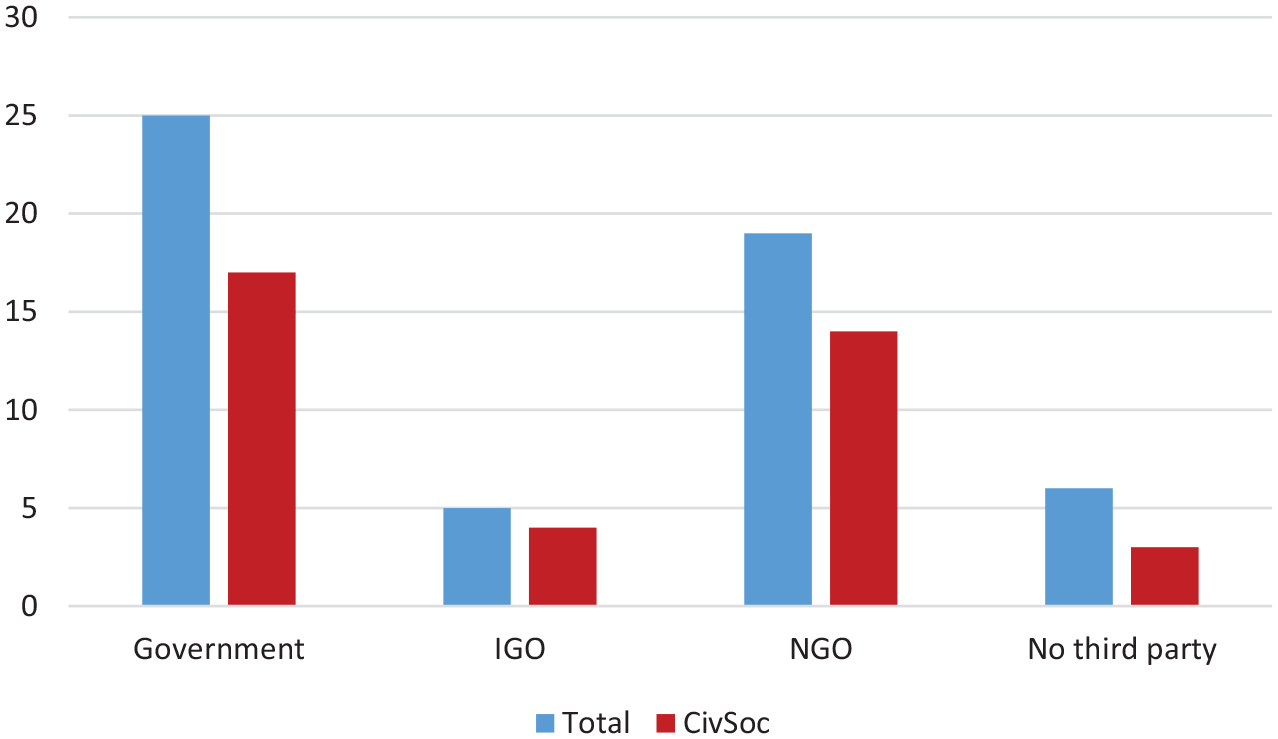
Third parties and civil society inclusion.
Looking more closely at the different forms of civil society inclusion, Figure 2 illustrates the number of cases with civil society inclusion in each of the three categories we outline above, grouped by involvement by government, IGO/NGO, and no third party. Because there are so few cases of IGO involvement, and since our expectations for IGOs and NGOs align, we group cases with IGO and NGO third parties together (the pattern across these two categories is very similar; full descriptive statistics are available in the Supplemental Appendix). In what follows, we discuss these results and also use qualitative case illustrations to further interrogate the conditions for civil society inclusion.
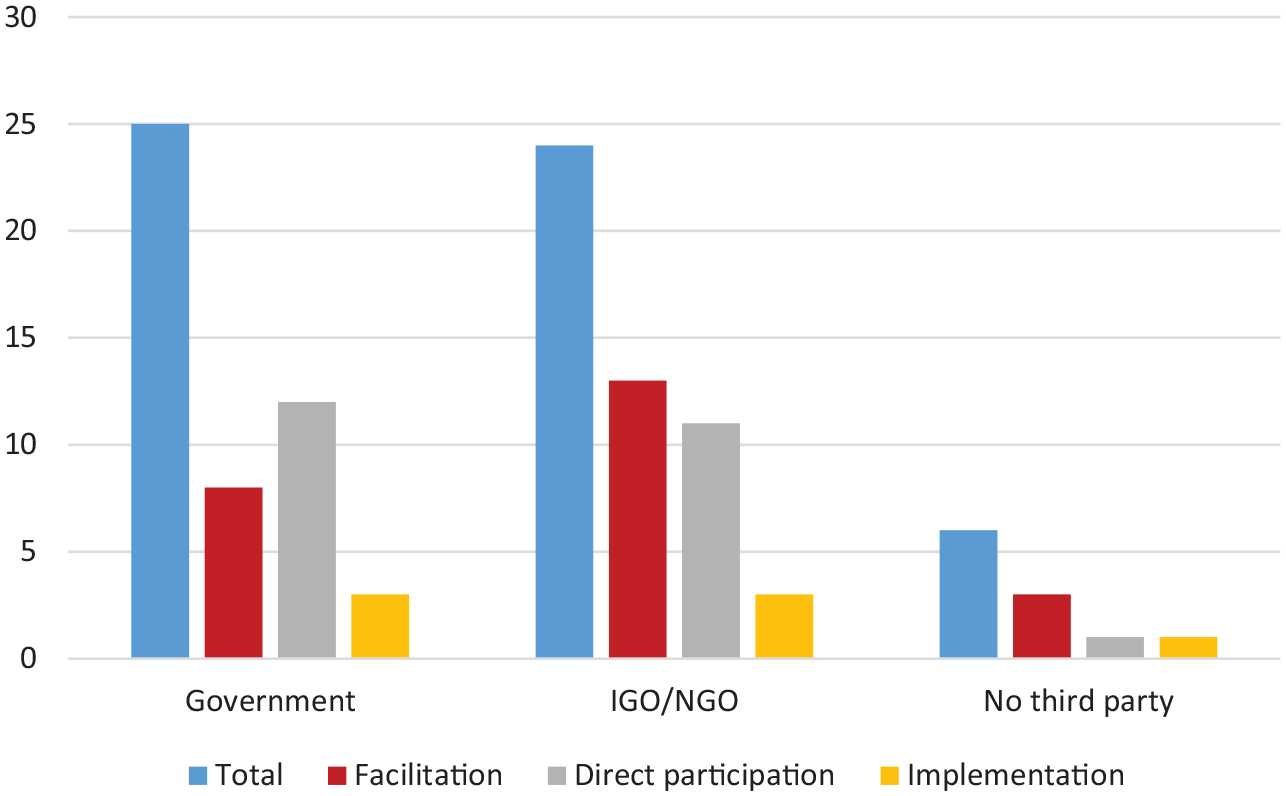
Third parties and forms of civil society inclusion.
Facilitation
According to our data, in 20 of 45 cases, civil society was included as facilitators. As Figure 2 shows, facilitation took place in only a third of the cases with government involvement (8 of 25), compared to more than half of the cases with third-party involvement by IGOs and NGOs (13 of 24). This is in line with our theoretical expectations and could indicate that when the government intervenes in a local conflict, it also wants to be in control of the negotiations and act as the mediating party. Such an interpretation resonates with previous research that shows that the government may have interests to manipulate communal conflict resolution processes and undermine civil society actors (Brosché, 2014). At the same time, we acknowledge that government involvement sometimes did coexist with facilitation by civil society. For instance, after an intense outbreak of fighting over boundaries and local power in Mandera in northeast Kenya in 2005, the central government intervened as a third party. After deploying the Kenyan military to provide a buffer between the communities and to secure international borders, the government supported the formation of an inter-clan arbitration committee comprising respected Muslim leaders from the Supreme Council of Kenyan Muslims. The team was led by the highly respected Sheikh Umal from the Ogaden clan, and also involved other prominent actors like local members of parliament (Ojielo, 2010; security analyst, interview, 8 June 2016).
The Mandera case helps illustrate the complexity of civil society involvement alongside government intervention. On one hand, facilitation was clearly led by civil society actors, and the process itself was characterized as inclusive, with high local legitimacy (security analyst, interview, 24 May 2016). At the same time, it has been observed that the negotiations took place under considerable pressure from above (Menkhaus, 2015). The mediation team was supported by the National Steering Committee on Peace Building and Conflict Management, NSC, which was established in 2001 to coordinate the work of local peace building institutions in Kenya and link these formally with government and development activities. The government was responsible for enforcement of any agreed outcome (NSC official, interview, 24 May 2016; peace worker, interview, 24 May 2016). According to Chome (2016), the news coverage of the conflict, and in particular the severity of the last attack where the victims included many children, created significant national pressure to resolve the conflict quickly (p. 20). Hence, even if the government included civil society in facilitation (and also in negotiations and implementation), the space they were given was constricted.
We should also note that when the central government does not intervene, civil society actors often fulfill this role. There were 20 cases with negotiations where the central government was not involved, and more than half of these saw facilitation by civil society actors, often religious actors or customary authorities. This pattern is consistent with existing literature (Nganje, 2021). Notably, in regions with a low degree of “state presence,” civil society actors often fulfill roles that may otherwise be expected of the government, including mediation in armed conflict. In Kenya, a case in point is the Wajir conflict. Here, state institutions and outside actors had largely withdrawn from the region in the face of escalating violence and insecurity. In this context, civil society actors (women, professionals and elders) took the initiative to begin a peace process, and retained a lot of influence throughout the process of negotiation and implementation of a peace agreement (Ibrahim Abdi and Jenner, 1997; Ndegwa, 2001). A similar example is the peace process in Kerio Valley in 2001–2002. Like in Wajir, the central government did little to address the conflict other than reactively deploy security forces following particularly severe clashes. Local leaders who believed the conflict should be resolved through dialogue approached local church officials, and the Catholic Justice and Peace Commission took on the role as facilitators, presiding over talks that culminated in a peace agreement (Elfversson, 2016; Korir, 2009; CJPC official, interview, 20 March 2013). Overall, our data indicate that in the majority of cases with civil society facilitation, churches or religious leaders mediated between the warring communities, underlining the important role of religious actors in local peacemaking in Kenya.
Direct participation
The general pattern suggests that direct participation in negotiations is not the norm: out of the total number of cases with negotiations (45), it occurred in less than half the cases (19). Furthermore, as Figure 2 shows, direct participation by civil society took place in roughly half the cases regardless of which type of third party was involved. This contradicts our expectation that the government may have strategic interests to reduce involvement from local stakeholders at the table, whereas NGOs and INGOs may operate according to the norm of inclusion. The patterns we observe here rather indicate that the type of third party does not make inclusion at the table any more or less likely. However, we can note that direct participation was more frequent in cases with third-party involvement compared to cases without such involvement.
Third parties sometimes directly involve civil society in communal conflict resolution. For example, in 2008, a large peace conference was organized in reaction to conflict between the Turkana, Toposa, and other pastoralist groups in the border region between Kenya, South Sudan, and Uganda. The peace conference was sponsored by a range of international NGOs under the coordination of the Kenyan NGO Seeds of Peace in Africa. In their role as third parties, they explicitly targeted youth (“warriors”) from the different communities who negotiated ways to promote peaceful coexistence, including a shared monitoring body and sports tournaments (Riungu, 2008). Similarly, another third party, the Kenyan NGO Adeso in partnership with United States Agency for International Development (USAID) and Finn Church Aid, launched a project to ensure women’s participation in negotiations to address communal conflict between the Pokot and Turkana in the North Rift (Adeso, 2015).
The case of Kerio Valley, mentioned above, illustrates potential obstacles to direct participation by civil society. Because the peace process built on customary conflict resolution mechanisms, women and youth were excluded. In local custom, peacemaking following violent raids is carried out by the (male) elders representing the warring sides. However, those directly involved in the negotiations took steps to anchor the process in the broader community: the elders and Chiefs would hold consultative meetings before talks, and then come back to the community and report about the proceedings (CJPC official, interview, 22 February 2014; Marakwet elder, interview, 3 March 2014; Pokot woman, interview, 28 February 2014). Similarly, in Nakuru County, a local agreement was reached in 2012 following negotiations involving community elders and mediated by government and NGO representatives. While not included in the formal talks, civil society actors were brought on board after initial consensus among the primary parties had been reached, and were co-signatories of the agreement (Kalenjin elder, interview, 18 March 2013; Kikuyu elder, interview, 19 March 2013). These examples resonate with Paffenholz’ (2014) point that civil society can play important roles also outside of direct participation.
In summary, the data gives no indication that a particular type of third party makes it more likely that civil society participates directly. Other contextual factors may be more important, such as the perceived urgency; when mediators are under pressure to reach agreement quickly, inclusion of civil society can be deprioritized (e.g. Hellmüller, 2019). There is, however, some indication that direct participation has become more common with time (see Figure 3 below). Such a trend would not be surprising, given increasing emphasis on the inclusion of women and youth in both global and national policies. This is in line with the empirical pattern in Kenya, where we can see that inclusion of women and youth (often through direct participation at the table) has become more common over time. An important normative shift has occurred following the 2007–2008 post-election violence, with attempts to establish a national infrastructure for peace where the role of civil society is recognized as key (Chuma and Ojielo, 2012; NSC official, interview, 15 March 2013).
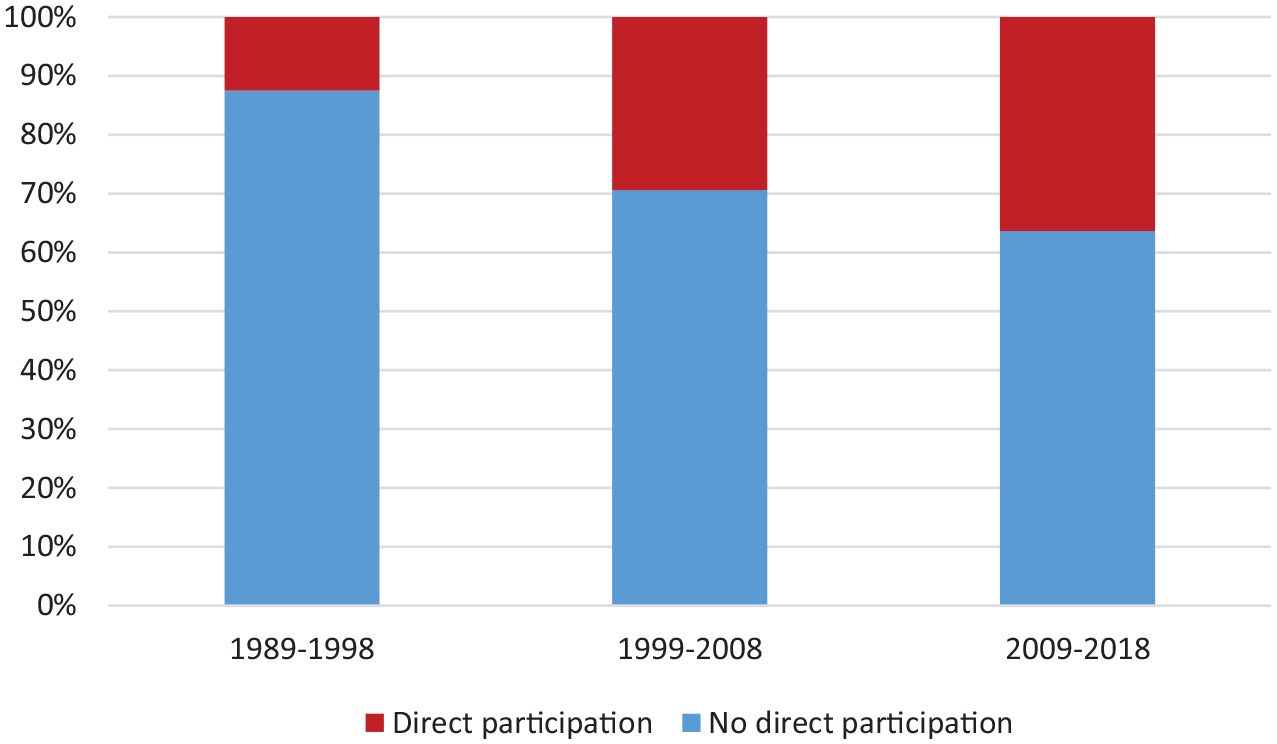
Direct participation of civil society over time.
Implementation
According to our data, only very few conflict resolution processes specified a role in implementation for civil society. It should be noted here that such involvement is only possible in cases where there is agreement (23 cases). In addition, implementation is rarely specified in detail in local peace agreements, compared to agreements in civil wars (Pospisil et al., 2020). In contrast to our expectations that government involvement would make civil society involvement in implementation more likely, such involvement was equally (un)common for different third parties. While the cases are few, we thus find no indication that the type of third party matters for involvement in the implementation phase. It is perhaps even more noteworthy that civil society inclusion through implementation is so rare overall. Even though third parties should have incentives to seek to anchor the peace through local stakeholders, only a few cases with agreement (6 of 23) saw involvement from civil society in the implementation phase. This also means that to the extent that civil society is included, they are more likely to be involved as facilitators or by having a seat at the table.
In the cases where civil society was involved in implementation, it mainly took the form of involvement in LPCs charged with overseeing implementation of local agreements. In Kerio Valley, for example, the LPC (mainly comprising elders from the two sides) was tasked with overseeing access to grazing and water in line with the agreement, and resolving any new minor disputes (NGO representative, interview, 18 March 2013; participant observation, Murkutwo, 2 February 2014). It should be noted that civil society inclusion in implementation here necessitates that a clear agreement is reached, but may be more fluid in practice. In numerous other cases, no formal peace agreement was reached, but instead LPCs were involved in promoting continued negotiation and preventing re-escalation in the face of smaller incidents. This was the case following violent conflict in Tana River in 2001, where the local communities and religious mediators were unable to reach a full agreement, but nevertheless set up village-level peace committees to continue dialogue and prevent new issues from escalating (Humanitarian worker, interview, 22 May 2016; Catholic church official, interview, 25 May 2016).
Conclusion
Our study contributes to the literature on communal conflicts by providing novel insights into how third-party actors can help shape different forms of inclusion in communal conflicts across Kenya. We make a theoretical contribution by discussing how different types of third-party actors may influence the extent to which local civil society actors become engaged as facilitator, participate in the negotiations, or have a role in the implementation. Empirically, our study presents several interesting findings. Notably, when the government is involved as a third-party actor, it can reduce the chances of civil society inclusion in the form of facilitation. We suggest this may be linked to the government’s interest to be in control of the negotiations. We also find that when civil society actors are involved as facilitators, religious actors such as churches or religious leaders play important roles. When it comes to the other forms of inclusion that we study, direct participation and implementation, the type of third-party actor does not seem to make a difference. We can note, however, that civil society involvement through direct participation at the peace talks has become more common over time, and women and youth are often involved in this way.
Despite the growing recognition of the use of LPCs in Kenya, we find that inclusion in implementation is not so common overall. There are only a few cases where civil society actors played a formal role in implementation. However, our case illustrations also show how civil society is often involved in different ways beyond formal inclusion. This is in line with Paffenholz’ (2014) argument that there are many ways to broaden the inclusivity of peace negotiations. Yet, cases where civil society inclusion is more direct and formalized serve an important role in anchoring peace among broader communities (Imoghibe, 2003: 307).
Our findings also speak to the literature on inclusion in civil war peace processes, which highlights the central role third-party actors can play as regards inclusion in peacemaking (Hirblinger and Landau, 2020; Souza, 2019), as well as the role of women in peacemaking (Krause et al., 2018; Nilsson and Svensson, 2020). Yet, whereas the United Nations and other regional and international actors are involved in pushing the inclusion agenda, the government is a central actor when it comes to communal conflicts. This suggests that it is important to further study the specific conditions for inclusion in communal conflicts, and its implications for inclusion of different types of civil society actors.
An important area for future research is to explore to what extent the findings from Kenya resonate with dynamics elsewhere. We believe civil society’s role in Kenya has many features in common with other countries heavily affected by communal conflict, such as Nigeria, India, and Ethiopia. At the same time, civil society inclusion in local peace processes has been found to vary greatly (Pospisil et al., 2020: 16). Future studies could fruitfully extend the data collection to more systematically test the conditions for inclusion across contexts, and also account for various contextual factors. Such analyses, as well as in-depth case studies, should prove useful to further enhance our understanding of the conditions for inclusion in communal conflicts, which represents an important new field of inquiry.
Supplemental Material
sj-docx-1-cac-10.1177_10.1177_00108367211047136 – Supplemental material for The pursuit of inclusion: Conditions for civil society inclusion in peace processes in communal conflicts in Kenya
Supplemental material, sj-docx-1-cac-10.1177_10.1177_00108367211047136 for The pursuit of inclusion: Conditions for civil society inclusion in peace processes in communal conflicts in Kenya by Emma Elfversson and Desirée Nilsson in Cooperation and Conflict
Footnotes
Acknowledgements
We thank Kathrin Maier for coding assistance, and the editor and two anonymous reviewers for constructive comments on the article.
Funding
The author(s) disclosed receipt of the following financial support for the research, authorship, and/or publication of this article: The research was funded by the Swedish Research Council (VR, 2014-03847).
Supplemental material
Supplemental material for this article is available online.
Notes
Author biographies
 .]
.]
.]
References
Supplementary Material
Please find the following supplemental material available below.
For Open Access articles published under a Creative Commons License, all supplemental material carries the same license as the article it is associated with.
For non-Open Access articles published, all supplemental material carries a non-exclusive license, and permission requests for re-use of supplemental material or any part of supplemental material shall be sent directly to the copyright owner as specified in the copyright notice associated with the article.
