




Abstract
When and why do groups participating in mass dissent choose to initiate terrorist campaigns? I argue that groups involved in civil wars and mass civil resistance might face similar organizational pressures, which encourage the initiation of terrorism due to higher tactical effectiveness. Internal organizational pressure might depend on leaders’ expectations of a decline in followers’ commitment with protracted use of mass tactics. This is likely to motivate leaders to initiate terrorist campaigns to secure organizational survival. External organizational pressures might depend on increasing dissident campaigns’ fragmentation. This intensifies competition making leaders more likely to initiate terrorism so as to establish themselves at the forefront of their movements. The findings provide empirical support consistent with my claims and indicate no significant difference between civil wars and mass civil resistance movements with regards to these effects. Contrary to the common idea that the use of conventional violence should entail a higher willingness to engage in illegal violence against non-combatants, this finding suggests that conflict dynamics affect the decision to initiate terrorism and that terrorist campaigns have a coherent strategic logic across different types of mass dissent.
Introduction
Existing research on terrorism and conflict has argued that a number of different structural factors and conflict dynamics strategically motivate non-state actors to use terrorist tactics (e.g. Bloom, 2004; Bueno de Mesquita & Dickson, 2007; Crenshaw, 1981; Kydd & Walter, 2006; Kalyvas, 2003; Eubank & Weinberg, 1994; Li, 2005; Piazza, 2012; Piazza & Walsh, 2010; Schmid, 1992). Also, social movement literature has investigated whether conflict dynamics motivate dissidents’ tactical choice (e.g. McAdam, 1982; Reinhart, 2013; Tarrow, 1989; Tilly, 1978; Jenkins & Eckert, 1986; Kriesi et al., 1995). However, these works consist largely of theoretical accounts with illustrative examples or unique case studies and/or consider empirically only dissident groups that use terrorism without an explicit comparison with dissident groups that do not use terrorism.
Therefore, on one hand, we know little about relative causal effects or the generalizability of the various explanations they invoke. On the other hand, we are left without ground to comprehend which factors affect dissident organizations’ choice of terrorism versus another dissident strategy. In other words, we cannot infer whether the strategic logic of terrorist attacks differs from the strategic logic of other types of collective dissent. A more consistent empirical test for a rationalist explanation of terrorism must do more than show why terrorism might appear as an attractive option to a rational non-state actor under some circumstances – it must take into account why non-state actors are unable to locate alternative dissident strategies or outcomes that they would prefer to terrorism (see Fearon, 1995). This is the first aim of this article.
An expanding body of work points to the existing variation in the use of terrorism by rebel groups – where ‘terrorism’ is defined as the use of indirect attacks by non-state actors against a government targeting non-combatants – in the context of civil wars (Asal et al., 2012; Findley & Young, 2012a; Sánchez-Cuenca & de la Calle, 2009). These works have led to a growing body of empirical studies that investigate the determinants of intensity and deadliness of terrorist attacks by explicitly comparing rebels that complement conventional violence with terrorism to rebels that only use conventional violence. These works have focused on the effect of state repression, the relative strength of the rebel groups, the type of regime, and the rebels’ ideology (Polo & Gleditsch, 2016; Stanton, 2013). Despite the important contributions made by these papers, these studies leave further questions unanswered. In particular, we lack an explanation for why certain rebel groups in civil wars initiate terrorism while others do not. This is the second aim of the article.
Social movement scholars have discussed numerous case studies that show that groups that use terrorism have often originated from, or operated within, mass civil resistance campaigns (e.g. Braungart & Braungart, 1992; Crenshaw, 1992; Della Porta, 1995, 2013; Neidhardt, 1992; Wieviorka, 1993). But what explains the emergence of terrorist tactics in some nonviolent campaigns but not in others? Do similar factors motivate the initiation of terrorist campaigns in civil wars and civil resistance alike? In this article, I attempt to explain why some dissident groups turn to terrorist tactics, as opposed to continuing their engagement in alternative mass tactics, while others do not.
To this end, I draw from literature on social movements, civil wars, and terrorism. I systematically investigate whether leaders of organizations that participate in campaigns of mass dissidence decide to initiate terrorist campaigns with the aim of preserving the commitment of their followers and as a strategy of outbidding. In this way, the article addresses the gaps in the literatures I discussed above and it provides an answer to the question of why some dissident groups, but not others, turn to terrorism, rather than continuing their engagement in mass dissent.
Mass tactics are defined as a series of observable, continuous, purposive tactics by non-state actors that coordinate with each other in pursuit of a common political objective and involve overt and direct contentious political activities with at least 1,000 participants (Chenoweth & Stephan, 2011; Chenoweth & Lewis, 2013b). These overt and direct contentious political activities are strikes, marches, public demonstrations, occupations, obstructions, sit-ins, guerrilla activities, bombardment of military units, and pitched battles. Mass dissident tactics require sustained levels of participation. The numbers of actual participants in these actions might vary greatly, ranging from a thousand to over a million (Chenoweth & Stephan, 2011). Participation in a mass campaign can therefore be ‘low’ relative to other mass campaigns, while still being high in absolute terms, since even ‘low’ participation involves at least 1,000 participants.
First, contrary to the common idea that the use of conventional violence should entail that dissidents are more willing to engage in illegal violence against non-combatants (Eck & Hultman, 2007), I argue that groups involved in mass civil wars and groups involved in mass civil resistance might face similar conflict dynamics, which produce organizational pressures that encourage the initiation of terrorism. This is explained by higher tactical advantages involved in terrorism when compared to mass dissent.
Second, social movement scholars have argued that terrorism is utilized by leaders of dissident organizations as a means to maintain commitment (Della Porta & Diani, 1999; Klandermans, 1997; Taylor & Van Dyke, 2004). I argue that leaders expect that their followers will experience increased frustration, and that their commitment will diminish, when the use of mass tactics is protracted over time. This expectation imposes internal organizational pressure to initiate terrorist tactics as a means to foster commitment and to secure organizational survival.
Third, although a wide range of literature has argued that domestic competition increases the likelihood that a political organization will use violence in an effort to distinguish itself, there has been contradictory evidence that increased domestic competition influences the use of terrorist tactics (Conrad & Greene, 2015; Findley & Young, 2012b; Nemeth, 2013). I maintain that fragmentation within mass dissident campaigns increases competition between organizations over limited recourses and encourages the formation of narrow militant groups that are more likely to initiate terrorism for gaining support.
Terrorism onset in mass dissident campaigns by primary methods
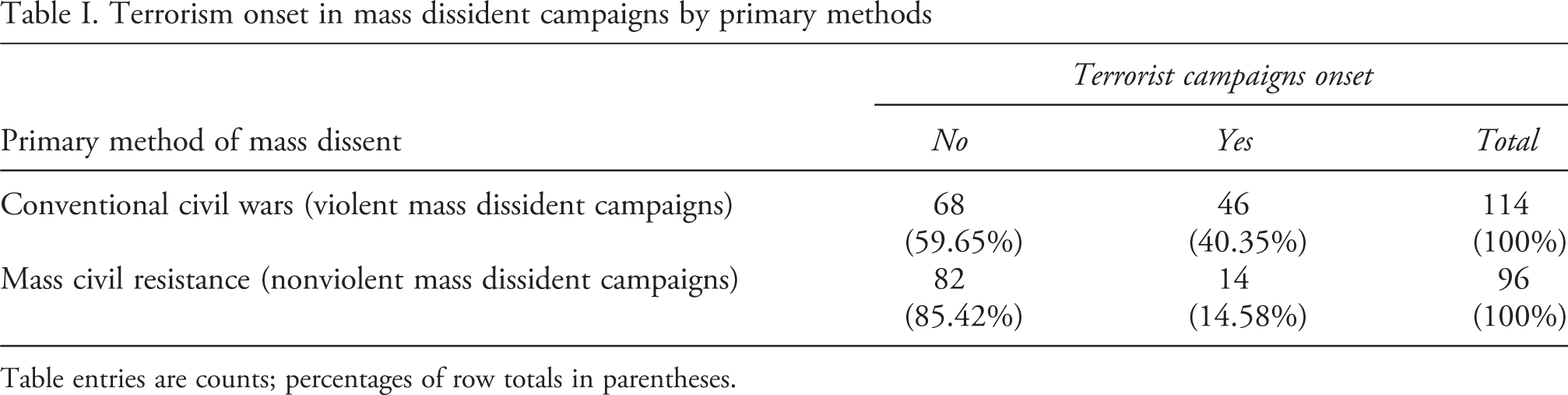
Table entries are counts; percentages of row totals in parentheses.
Terrorism as a strategy and the price of its alternatives
Table I summarizes how the onset of terrorism varies across primarily violent and primarily nonviolent mass dissident campaigns. The table uses new data (described in detail in the research design below) on any terrorism occurrence in 189 mass dissident campaigns between 1948 and 2006. Terrorism is defined as the threatened or actual use of illegal force and violence with the intention to intimidate or transmit a message to a larger audience (START, 2012: 6).
While previous literature finds that the percentage of rebel groups that use terrorism is high, 1 Table I demonstrates that terrorist tactics are by no means ubiquitous in civil war. In fact, 60% of civil wars do not see any terrorism. Moreover, terrorist tactics also emerged in 15% of mass civil resistance campaigns. I argue that groups involved in either civil war or mass civil resistance might face similar organizational pressures that motivate the initiation of terrorism. These organizational pressures for leaders might derive from (1) the expectation that followers will be increasingly frustrated with mass dissent over time and (2) the increasing fragmentation of mass dissident campaigns. The effects of these two dynamics apply irrespective of whether the mass dissident campaign initially relies primarily on conventional armed violent or nonviolent methods and stems from the potentially higher tactical effectiveness of terrorism. Additionally, the effects of these dynamics apply despite the potential costs of terrorism resulting from civilian victimization, which involve the alienation of the constituencies to which the groups belong (Polo & Gleditsch, 2016; Stanton, 2013). This assumption is based on the following claims.
Unlike mass dissent, terrorism does not aim at imposing direct costs on governments. One might expect that the use of conventional violence should entail a higher willingness to engage in violence against non-combatants (Eck & Hultman, 2007). However, terrorism differs fundamentally from conventional violence, which attacks the state’s coercive apparatuses (Bueno de Mesquita & Dickson, 2007; Sánchez-Cuenca & de la Calle, 2009; Tilly, 2004). Terrorism is a particularly demanding form of dissent entailing extreme sacrifices and investments from individual dissidents (Klandermans, 1997). Dissidents engaging in terrorism go underground and not only isolate themselves from their previous social lives but also restrict their contacts to a very small nucleus of dissidents (Della Porta & Diani, 1999). In fact, organizations that use terrorism are typically structured in semi-autonomous conglomerations of cells with a variety of specialties and a single command structure: columns (White, 2013). The secrecy necessary to carry out terrorist tactics demands that different dissidents in the columns are not in contact with each other. In the long term, the implication of illegally targeting civilians is, at best, the exclusion from society. Terrorist attacks constitute a severe violation of most states’ domestic laws and they also constitute a violation of international humanitarian law and international criminal law (ICRC, 2011, 2015).
The core strategic rationale of terrorist attacks is to signal commitment and resolve to the state and its population, rather than to win outright by brute force or to leverage the power of the people through civil resistance. Terrorist campaigns maximize dissidents’ relative power through their functions of propaganda and pressure (Kydd & Walter, 2006; Lake, 2003; Sánchez-Cuenca & de la Calle, 2009). Additionally, targeting non-combatants and soft targets makes fewer demands on organizational resources and coordination capabilities than mass dissident activities. On the one hand, conventional warfare requires armed forces and military control over large-scale operations, to integrate movement and indirect fire support, and to combine multiple arms and units in situations that require a high degree of flexibility (Biddle & Friedman, 2008; Guevara, 1960; Record, 2007; Tse-tung, 1978). On the other hand, mass civil resistance requires the ability to communicate effectively with the social base, media, and civil society, while the concentrated actions of a large number of volunteers have to be coordinated. This necessitates more material resources than terrorist activities may require (Popovic, Milivojevic & Djinovic, 2006). By contrast, small groups with few resources and poor capabilities can successfully carry out terrorism (Biddle & Friedman, 2008; Bueno de Mesquita, 2013; Record, 2007). A simple comparison of participation in terrorist organizations (Asal, Rethemeyer & Anderson, 2009) and violent dissident campaigns (Chenoweth & Lewis, 2013b) reveals that the average number of active participants in terrorist groups is only 550 while the average participation in mass violent campaigns is 5,499. Finally, initiating terrorism might seem cheaper than sustaining mass dissent, because terrorist tactics entail less risk of retaliation. While mass dissident activities expose groups to direct state repression, terrorism allows for concealment.
When and why do participants choose to initiate terrorist campaigns? Internal and external organizational pressures
For campaign elites, it is easier to elicit participation in nonviolent rather than violent mass dissident tactics (Chenoweth & Stephan, 2011; Cunningham, 2013; Dahl et al., 2014). Conventional armed violence requires more specialized training than civil resistance and more expensive equipment, and often involves extreme individual moral and physical commitment. By contrast, physical barriers are lower for nonviolent resistance and participation is easier to elicit in growing campaigns, although initial collective action can be difficult and often suffers from attrition. However, disciplining individual followers and coordinating conventional armed dissent after armed capabilities are developed may be easier than disciplining mass civil resistance. In civil wars, organizations tend to have consolidated command and control structures, making it easier for armed cadres to control contentious behaviors through mechanisms of reward and punishment. Additionally, individual participants become financially dependent on their organization. These factors professionalize dissidents and facilitate the sustainment of large-scale insurgencies (Connable & Libicki, 2010).
On the contrary, the leaders of mass nonviolent campaigns rarely have an incentive structure to reward and punish participants (Dahl et al., 2014). Civil resistance participants receive no material benefits but also do not depend financially on the campaign. The integration of dissidents into civilian life and their power of refusing to participate in it are the most important sources of power that groups in civil resistance can leverage against states.
However, the organizations in dissident movements that are capable of successfully mounting mass civil resistance campaigns exert effective direct influence on dissent activities and, at least initially, can discipline individuals and coordinate the contentious behavior of mass nonviolent dissidents. In mass civil resistance, an effective labor division transforms the diffuse commitments of nonviolent collective actors into clearly defined roles. This maximizes the capacity of the movements as a whole to regulate the contentious behavior of their members (Gamson & Fireman, 1979). Additionally, effective coordination through formalized lines of communication facilitates the ability to carry out a coherent strategy for organizations within nonviolent mass dissident movements (Jenkins, 1983). In summary, the more cohesive a nonviolent movement, the more efficiently nonviolent discipline is maintained (Pearlman, 2011). Cohesiveness and effective coordination are also essential for the ability of violent campaigns to carry out disciplined mass armed tactics against the coercive apparatuses of states (Tse-tung, 1978).
Organizations that participate in mass dissident campaigns might face internal and external pressures that encourage groups to resort to terrorism, due to perceived higher tactical effectiveness when compared to mass dissident tactics. On the one hand, pressure might emerge from within the organizations – internal organizational pressure – and endanger the ability of the organization to maintain commitment and coordination among its followers. On the other hand, pressure might emerge from within the mass dissident campaign – external organizational pressure – and it derives from dynamics of fragmentation and competition.
Leaders expect that followers will lose commitment over time due to frustration regarding the ineffectiveness of mass dissent. In fact, the protracted use of mass dissent tends to normalize this tactic and determine the loss of its initially threatening nature for opponent states (Taylor & Van Dyke, 2004). Mass dissent protracted over time also signals to participants that this tactic is ineffective in obtaining the desired political goals. Over time, the normalization of mass dissent and its disclosed incapacity to produce desired political outcomes motivate participants’ frustration and dissatisfaction (Della Porta & Tarrow, 1986; Nepstad, 2015; Pearlman, 2011). The expected frustration of followers exerts internal organizational pressure on leaders that aim at ensuring organizational survival. On the one hand, time is a very precious resource for leaders of nonviolent mass dissident movements. In their manual on how to successfully manage nonviolent mass dissent campaigns, Popovic, Milivojevic & Djinovic (2006), the leaders of the Optor! campaign against Milosevic, dedicated one entire chapter to stressing the importance of setting realistic goals and deadlines to maintain morale. On the other hand, protracted conventional violence also effectively undermines rebels’ preferences and sympathies (Kalyvas, 2006). To stimulate participants’ commitment and ensure organizational survival, leaders might decide to use more individually demanding tactics. Particularly demanding forms of dissent are not simply directed to the achievement of short-term political goals, but also aim to raise consciousness and to create solidarity (Taylor & Van Dyke, 2004; Della Porta & Diani, 1999). Carlos Fonseca Amador (Borge et al., 1982), the leader of the Sandinista National Liberation Front (SNLF) – an armed organization against the Nicaraguan Government – claims that the organization preceding SNLF failed to survive due to the choice of the wrong method to let followers participate in the struggle. According to Fonseca, followers had not yet developed a high revolutionary consciousness and they became demoralized due to an accumulation of fatigue in participating in the activities of the ‘regular columns’. Fonseca explains that once some of these followers deserted the guerrilla and arrived back in their own areas, they took part in armed assaults on local government, as well as execution of known informers. He concludes: ‘this indicates that to a large extent some of the [followers] that became demoralized went through that crisis because they were not organized in the right manner. It means that they probably should have been irregular rather than regular guerrilla’ (Borge et al., 1982: 45). Continuing commitment is effectively achieved when activists make extraordinary sacrifices for an organization because the failure of their organization would render their sacrifices worthless (Klandermans, 1997). As explained above, terrorist tactics require such extreme sacrifices and investments. Dissidents initiating terrorism isolate themselves from their lives and are in contact only with a small nucleus of dissidents. Additionally, the implication of illegally targeting civilians is, at best, a long-term exclusion from society. Individuals in organizations that use terrorism continue their involvement because surrendering implies ‘losing’ everything they had already paid as the costs for entering the underground and targeting civilians (Della Porta, 1992). Social psychological accounts for extremism also point to an indirect link connecting terrorism to a loss of collective significance through a heightened need for closure (e.g. Hogg et al., 2007; Webber et. al., 2018). An increased feeling of collective insignificance motivated by the frustration over protracted mass dissent might augment the appeal of terrorist tactics because groups engaging in terrorism embed their action in confidence-affording and clear-cut views, consensually supported. Therefore, leaders might find terrorist tactics useful as a means of maintaining commitment and secure the survival of their organization as the duration of mass dissent increases.
The progressive fragmentation of mass dissident campaigns spurs competition among organizations over scarce resources and imposes external organizational pressure to group leaders. Increasing fragmentation is likely to be affected by an increase of diversity of groups’ demands (Seymour, Bakke & Cunningham, 2016). In turn, groups in increasingly fragmented campaigns are more likely to tactically disagree and to compete for resources as it becomes gradually less likely that the objectives of individual organizations can be achieved as part of the broader mass dissident campaign. As additional new organizations emerge from the same mass dissident campaigns, increasing competition between the movements’ organizations increases the likelihood of the onset of terrorist campaigns. This is because increasing competition motivates group leaders to differentiate dissident actions from those of other organizations within the same mass dissident campaigns, which leads to a shift towards more radicalized activities. In fact, leaders expect to attract members and media attention with more militant actions (Bloom, 2004; Conrad & Greene, 2015; Taylor & Van Dyke, 2004). Competitive tactical radicalization has been observed both in cases of mass civil resistance and in civil wars as groups vie for prominence (Clauset et al., 2010; Crenshaw, 1981; Della Porta, 2013; Della Porta & Tarrow, 1986; Pearlman, 2011; Kydd & Walter, 2006). For example, Enrico Fenzi, one of the ideologues and leaders of the Red Brigades, an organization that emerged from the New Left mass dissident campaign in Italy, explains the choice of initiating terrorist tactics as follows: ‘For the Red Brigades to be protagonists meant to take a more active role in the upheaval and this, in turn, to be protagonist meant to initiate the use of terrorist violence. In other words, to be protagonists it was necessary to use an additional disruptive charge’. 2 Leaders that are faced with external organizational pressure deriving from increasing competition within the mass movement might decide to initiate terrorist campaigns to outbid rival organizations. Terrorism as outbidding aims to convince the public of the greater worthiness of the perpetrators relative to other dissident actors. This logic is explained by a statement of Ahmad-Zadeh (1971: 2), a founder of the Iranian People’s Fadaee organization, which emerged from a mass nonviolent campaign against the Shah regime in Iran: ‘[w]e certainly do not expect the direct support of the people immediately […]. Conscious of the correctness of the armed struggle, influenced by it and with the moral support of the people, these groups take up arms and extend the struggle, thereby increasing the possibilities of material support from the people’. Increasing fragmentation also divides mass dissident campaigns into progressively smaller subgroups that are well suited for terrorism, because they can pursue radical agendas that large organizations cannot maintain. In addition, small organizations have a comparative advantage in using terrorist tactics, since they lack sufficient capabilities to hurt the state directly using armed violence or exerting the power of the people. As explained above, terrorist tactics require fewer human and material organizational resources than either mass civil resistance or conventional armed violence. Hence, I claim that increasing fragmentation within mass dissident movements raises the competition among organizations and imposes external organizational pressure on leaders to differentiate dissident actions in a way to outbid others. Additionally, the optimal strategy, for these groups with militant character and limited capabilities, to gain support and put themselves in the forefront of their movements is to initiate terrorist campaigns.
Hypothesis 1: The onset of terrorism is more likely the longer a mass dissident campaign lasts.
Hypothesis 2: The onset of terrorism is more likely with increasing fragmentation within the mass dissident campaign.
Research design and data
Building on the Nonviolent and Violent Campaigns and Outcomes 2.0 (NAVCO) data (Chenoweth & Lewis, 2013a), I have compiled a new dataset on any terrorism occurrence in 189 mass dissident campaigns between 1948 and 2006 (see Chenoweth & Lewis, 2013a: 3 for NAVCO’s definition of mass dissident campaigns). I identified terrorist attacks by dissident actors or groups engaging in mass dissent and who share the same broad political goals of the mass dissident campaigns (see ‘Dependent variable’). The unit of analysis is the mass dissident-campaign-year. The campaign is a more appropriate unit of analysis than groups, because it makes it possible to take into account changes in participants’ strategic context. Additionally, focusing on mass dissident campaigns as collective actors makes it possible to aggregate groups’ characteristics and avoids artificially increasing the number of observations.
NAVCO 2.0 is limited to dissident campaigns where the underlying incompatibilities are regime change, institutional reform, major policy change, territorial secession, or greater autonomy and anti-occupation in independent states. The findings pertain only to ‘campaigns with maximalist goals and a high level of sustained mobilization over time’ (Chenoweth & Lewis, 2013b: 420). See the Online appendix for a discussion on the cases of the Madagascan active forces mass civil resistance and the Islamic Salvation Front mass civil resistance.
NAVCO 2.0 classifies mass dissident campaigns as nonviolent if this is the primary resistance method and participation is limited to unarmed civilians (Chenoweth & Lewis, 2013b: 418). In contrast, campaigns are classified as primarily violent when dissidents use armed force and the campaign has generated at least 1,000 battle-related deaths per year. These are ‘ideal categorizations’ and the primary mass tactic does not exclude participants’ simultaneous use of other tactics, so long as they do not become dominant (Chenoweth & Stephan, 2011: 12). Battle-related deaths accounted for in violent dissident campaigns do not include deaths due to attacks deliberately directed against civilians. Although battle-related deaths include collateral damage in the form of civilians killed in crossfire, my dataset on terrorist attacks considers only deliberate targeting of non-combatants.
Dependent variable
The dependent variable is a dichotomous variable indicating onsets of terrorist campaigns. Terrorist campaign onset refers to the first year of a dissident campaign in which participants begin to systematically use terrorist tactics: at least three terrorist attacks within a year form the first terrorist campaign. The intensity of terrorist attacks is likely to differ across mass dissident methods after the onset due to the existence of armed resources and know-how in the case of civil wars. However, actors’ rationale for initiating terrorism might be driven by a similar strategic calculus and three terrorist attacks within a year in the absence of civil wars can be considered a relevant threat to domestic stability.
I used the Global Terrorism Database’s (GTD) three basic coding rules and three additional criteria to identify terrorist attacks (START, 2012): attacks must be intentional, entail use of violence or the threat of violence, aimed at political, economic or social goals, have the intention to coerce, intimidate or transmit a message to a larger audience than the immediate victims, violate the prohibition of international humanitarian law to target civilians or non-combatants, and be perpetrated by non-state actors. Additionally, I included only terrorist attacks carried out by actors engaging in mass dissent and which share the broad political goals of the dissident campaigns. When perpetrators are known, I engaged in in-depth case research using scholarly literature and news media reports from Lexis Nexis to verify that organizations that choose terrorism participated in mass dissent. Participation in mass civil resistance is established when groups (1) contributed to coordinate the emergence of nonviolent mass movements and/or (2) took part in the broader coalition waging mass civil unrest.
Among the groups engaging in terrorism in nonviolent campaigns, there are cases of organizations that previously participated in large-scale civil war (such as the IRA, the Free Papua Movement, the CPN-M/UPF, and New People’s Army). I considered these organizations as responsible for the onset of new terrorist campaigns, because the existence of resources to target the state’s coercive apparatuses makes the initiation of violence against non-combatants and other soft targets a clear tactical choice. The Online appendix summarizes the patterns of participation in and coordination of mass civil resistance for all groups carrying out terrorist attacks.
Similarly, among the groups engaging in terrorism in violent campaigns, there are cases of organizations previously engaging in mass civil resistance (e.g. the LTTE). The rationale behind including these groups in the analysis and considering them as responsible for the onset of new terrorist campaigns rests on the assumption that the mobilization of conventional violence against the state constitutes a substantial change in the strategic context for organizations previously engaged in mass nonviolent dissent.
When the perpetrators of terrorist attacks are unknown, I engaged in in-depth case-by-case research using the GTD advanced online research tool and news media reports from Lexis Nexis to verify that attacks targeted the political opposition to civil resistance campaigns. In 2005, for example, nonviolent mass dissent was waged against Hezbollah’s Syrian-friendly government (Cedar Revolution). Terrorist attacks that targeted Hezbollah officials, pro-Syrian Lebanese politicians, and Syrian citizens in Lebanon provide evidence that actors who share the broad political goals of the civil resistance engaged in terrorism even if the name of the perpetrator’s group is unknown. The Online appendix presents evidence of the identity of broad political goals between perpetrators and civil resistance campaigns.
I obtained detailed information on the systematic use of terrorism in mass dissident campaigns from GTD as of the 1970s. Prior to 1970, I coded the data on terrorism in mass dissent from Lexis Nexis news reports, following the criteria outlined above. To obtain the data on terrorism in mass dissident campaigns with domestic political goals, I followed Endlers, Sandler & Gaibulloev’s (2011) protocol to extract domestic terrorist attacks from the GTD. Terrorist strategies must have direct consequences for the venue country, its institutions, citizens, property, and policies.
Some dissident campaigns target foreign states and attacks thus fall under Endlers, Sandler & Gaibulloev’s (2011) definition of transnational terrorism. I manually coded these as domestic attacks, given their location and targets. For example, a terrorist attack perpetrated by Palestinian nationals targeting Israeli or Palestinian nationals in Israel during the mass dissident campaign for the Palestinian liberation territories is thus counted as a domestic attack. However, a terrorist attack perpetrated by Palestinians against US nationals abroad is considered fully transnational and thus is dropped from the data, even if it furthered the cause of the mass dissident campaign for the liberation of the Palestinians.
The dataset covers 1,485 campaign-year observations, 3 in which 275 years had terrorist attacks. To restrict attention to terrorism onsets or first use only, I dropped subsequent ongoing years where terrorism is used again in a mass dissident campaign. Subsequent years of terrorism are dropped from the sample because the incentives for and constraints on continuing or ending terrorist campaigns may be different from the incentives for avoiding terrorism before it begins and dynamics which may lead to its onset. Including on-going terrorism would mean modeling terrorism onsets over and over again and could thus bias my findings (Bennett & Stam, 2000: 660–662).
Core explanatory variables
My core explanatory variables are taken from the NAVCO 2.0 dataset (Chenoweth & Lewis, 2013a). The first mass dissident campaign characteristic of interest for my purposes is Mass dissident campaign duration. I count the years elapsed since the start of the individual mass dissident campaign. Figure 1 shows the frequency distribution of the values of Mass dissident campaign duration. In the sample of dissident campaigns used here, civil resistance lasts on average 5.7 years, while the average length of violent campaigns is 11.6 years.
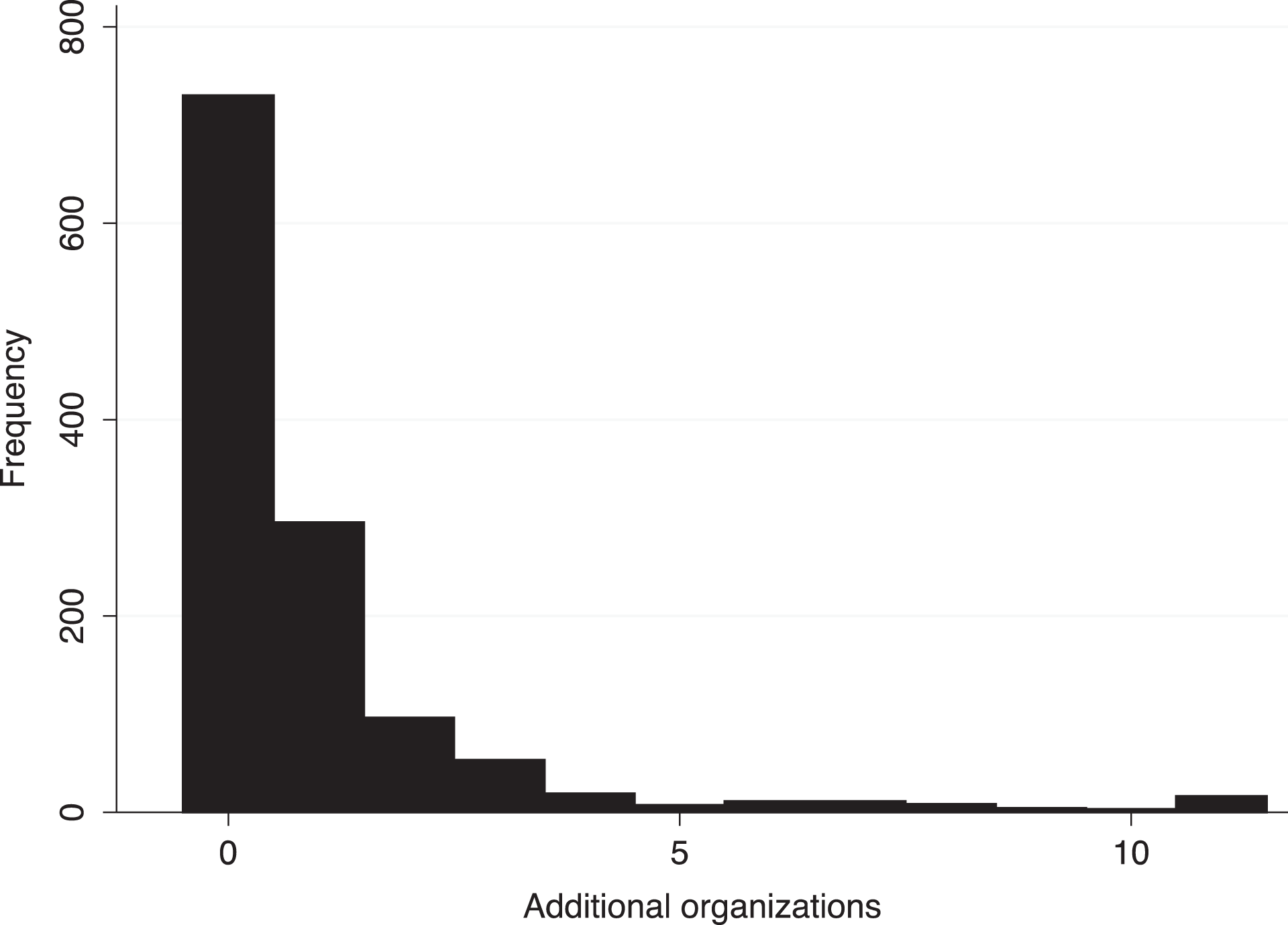
The second variable of interest proxies increasing levels of fragmentation within mass dissident campaigns by coding the number of Additional organizations emerging in a given year from within a given mass dissident campaign. It is extracted from NAVCO 2.0 and measures the ‘[n]umber of new named organizations involved in the campaign in that particular year’(Chenoweth & Lewis, 2013a: 6). Figure 2 shows the frequency distribution of the value of Additional organizations. The average number of new organizations in the sample of dissident campaigns used here is one. In very few campaigns do more than three new organizations emerge per year.
Potential confounders
To assess accurately the effect of protracted use of mass dissident tactics and increasing fragmentation on the likelihood of terrorist campaigns onset, and to ensure that their effects do not reflect just the primary tactic of mass dissent, I include a binary variable on the primary campaign method of mass resistance: Primary method of mass dissent. Disciplining and coordinating conventional armed dissent after armed capabilities are
Distribution of mass dissident campaign duration Distribution of additional organizations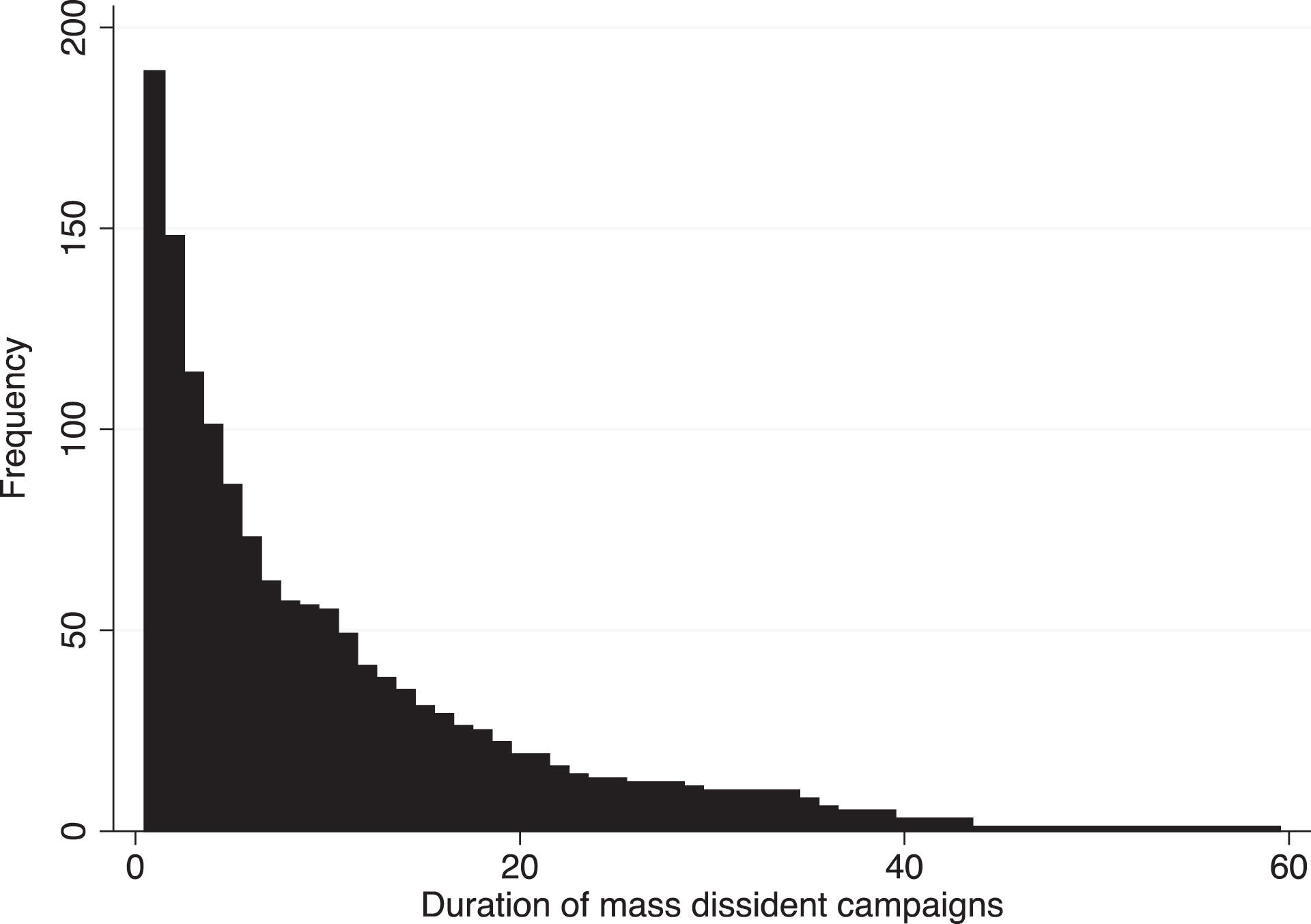
Organizations that use mass dissident tactics with relatively low participation might decide to initiate terrorism because it requires fewer dissidents and it credibly signals their willingness to endure the struggle (Biddle & Friedman, 2008; Bueno de Mesquita, 2013; Record, 2007). Lower participation is also a potential confounder for the effect of prolonged use of mass dissent if loss of followers’ commitment itself, rather than leaders’ expectation of it, affects the likelihood of terrorism onset. Therefore, I control for Size of mass dissent participation from NAVCO 2.0 (Chenoweth & Lewis, 2013a: 9).
A third obvious potential confounder is State repression. I extract repression from NAVCO 2.0 (Chenoweth & Lewis, 2013b). Groups that use mass dissent tactics openly confront the coercive apparatuses of states on the ground. Extreme physical repression against violent and nonviolent mass dissent raises the risk of death, injuries, or imprisonment for participants. To decrease the risk of being targeted by repression, leaders of dissident groups may decide to go underground and to further decrease the costs of direct retaliation associated with targeting state police and the military, participant organizations may initiate terrorism. High repression might push leaders to develop expectations about followers’ loss of commitment and therefore motivate them to initiate terrorist tactics to ensure organizational survival. Finally, high repression might motivate tactical disagreement among organizations and motivate competition among groups.
Democracies are held by some to provide a favorable environment for the development of terrorism (Eubank & Weinberg, 1994; Li, 2005; Schmid, 1992). Democracies may also be better equipped to absorb challenging extra-institutional political demands into regular political procedures, thereby reducing the duration of mass dissent. I thus control for Democracy in the previous year via a dichotomous item for countries with values of 6 or above on the Polity2 score from the Polity IV Project (Marshall, Gurr & Jaggers, 2014).
Widespread poverty may create grievances and a large pool of potential recruits for dissident activities. Low income tends to make large-scale conventional armed conflict more feasible (Collier, 2000), thereby increasing the duration of and participation in conflicts. Such grievances may also affect the resort to terrorism (Crenshaw, 1981). I thus control for a country’s GDP per capita (logged) using data from Gleditsch (2002).
For states with a large population, effective security measures are difficult to implement. This, in turn, makes the state vulnerable to terrorism. Large population size might be correlated with higher ethnic and ideological diversity. If this is reflected in the composition of mass dissident campaigns it might make mass dissident campaigns more likely to fragment. Therefore, I also include a measure of Total population (logged) from Gleditsch (2002). Countries with a larger population experience more domestic terrorism (Savun & Phillips, 2009).
Finally, rebel groups with political goals that address greater constituencies are likely to use less terrorism because of the risk of alienating potential followers and to minimize public backlash. Political goals that are connected to claims of ethnically homogeneous groups, such as territorial secession and greater autonomy, might foster consensus about the value of public goods, facilitating the operation of selective incentives to ensure their provision while promoting in-group cooperation through social sanctions (Seymour, Bakke & Gallagher, 2016). Consequently, mass dissident campaigns with ‘territorial secession’ and ‘greater autonomy’ as political goals might be less prone to fragmentation than mass dissident campaigns with ‘significant institutional reform’, ‘regime change’, and ‘anti-occupation’ as political goals. Therefore, I included campaigns’ political goals to check that the nature of the goals of dissident campaigns does not drive the effect of fragmentation. I extracted information on campaigns’ political goals from NAVCO 2.0 (Chenoweth & Lewis, 2013a). 4
Empirical analysis
I estimate logistic regression models on terrorism onset or the first new year in which terrorism occurs during mass dissident campaigns. I include a cubic polynomial approximation using a variable on the years since the last terrorist attack to correct for time dependence, since terrorist campaigns are more likely to recur when there is a recent history of terrorism (Carter & Signorino, 2010). Finally, I cluster standard errors by country, since the variance may differ systematically across states.
Determinants of terrorist campaigns onset
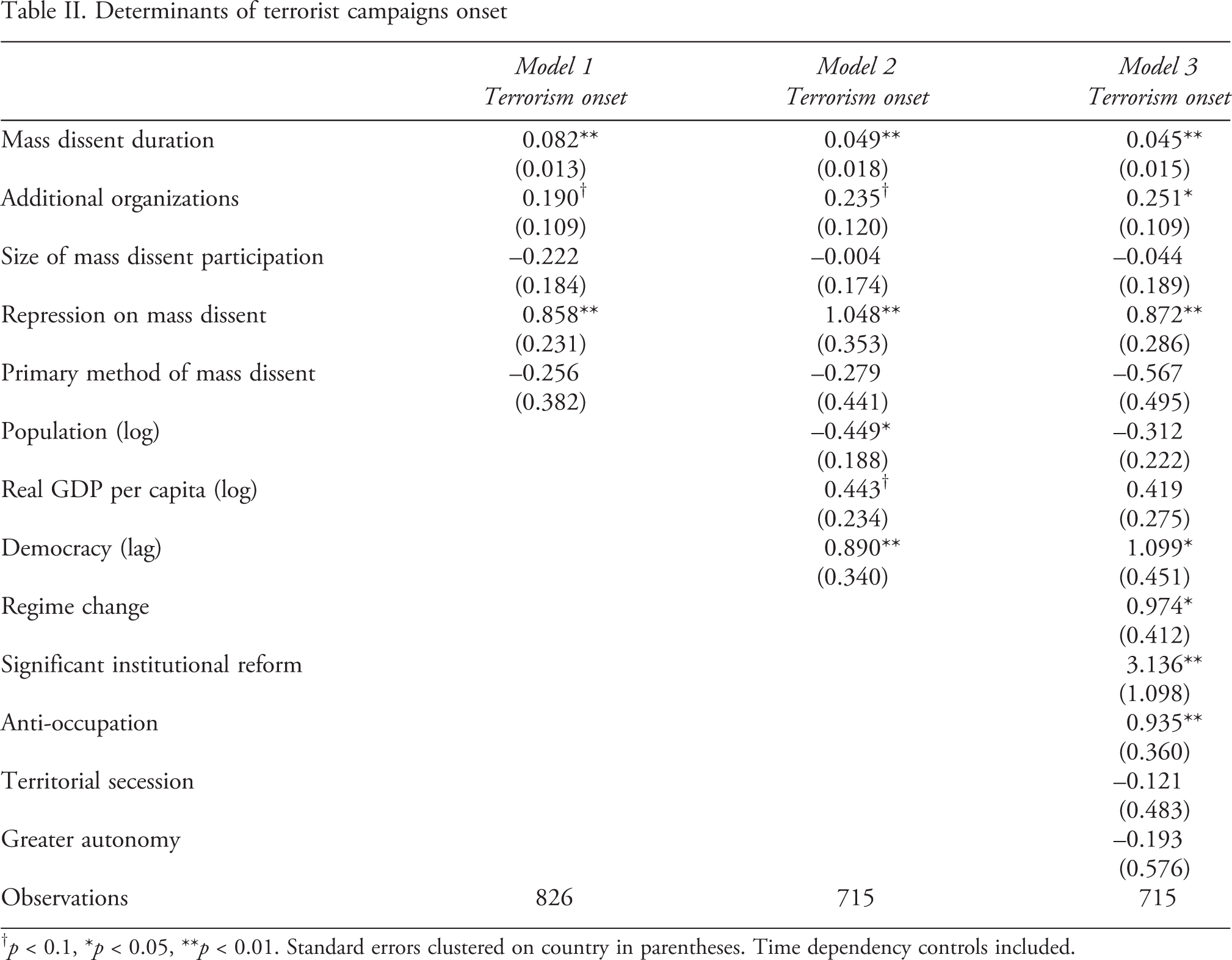
† p < 0.1, *p < 0.05, **p < 0.01. Standard errors clustered on country in parentheses. Time dependency controls included.
To verify that the values of Size of mass dissent participation do not influence the coefficients of the main explanatory variables, I consider various alternative participation measures. The findings remain virtually identical to those presented in Table II when these alternative measures are included (Online appendix, Tables VII–X). There is no evidence of a curvilinear relationship of Mass dissent duration and Additional organizations with the likelihood of Terrorism onset, and there is no evidence that the inclusion of Repression on mass dissent is driving the findings for the core independent variables (Online appendix, Tables XI–XIII). Additionally, the effect of Additional organizations lagged by one year is not robust, which suggests that current increasing fragmentation rather than increasing fragmentation in the past positively affects terrorism onset (Online appendix, Table XIV). The findings for the main explanatory variables remain consistent also when using Polity2 score (t–1) from the Polity IV Project (Marshall, Gurr & Jaggers, 2014) as an alternative measure for democracy (Online appendix, Table XV).
Figure 3 displays how the predicted probability of terrorism onset increases for every additional year of mass dissent, holding other covariates at their means. This is consistent with the expectation that terrorism onset is more likely as leaders expect followers’ loss of commitment with protracted use of mass dissent. The 95% confidence intervals get larger as very few mass dissident campaigns persist over 26 years and the number of observations decreases.
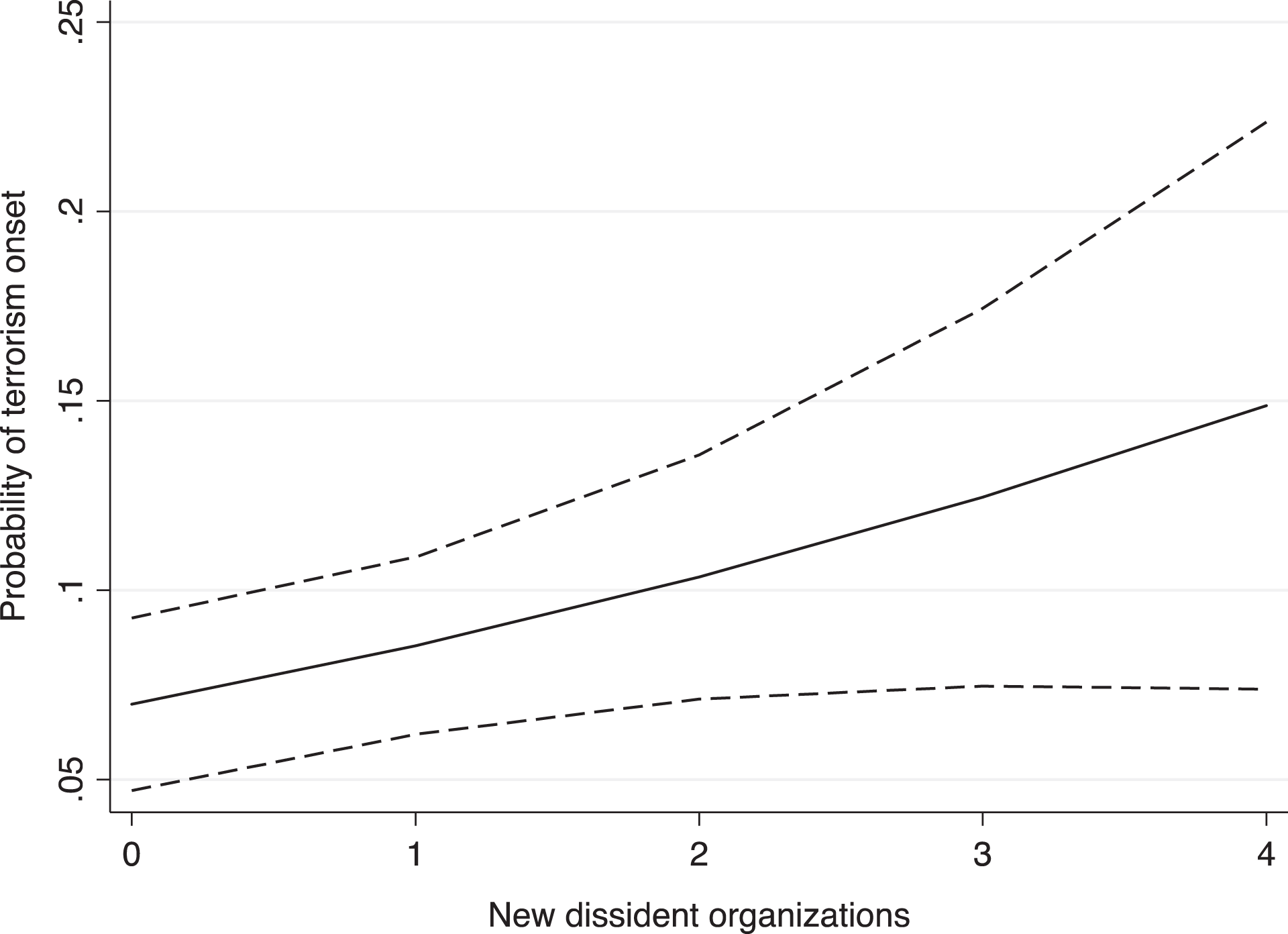
Figure 4 shows how the predicted probability of terrorism onset increases with any additional organization, holding other covariates at their means. Also in this case, the 95% confidence intervals get larger as very few mass dissident campaigns experience the emergence of more than three new additional organizations in one year.
As expected, Table II suggests that democracies provide a favorable environment for the use of terrorism. This finding remains consistent when using the lagged
Predicted probability of terrorist campaigns onsets by duration (Table II, Model 3) Predicted probability of terrorist campaigns onsets by number of additional dissident organizations (Table II, Model 3)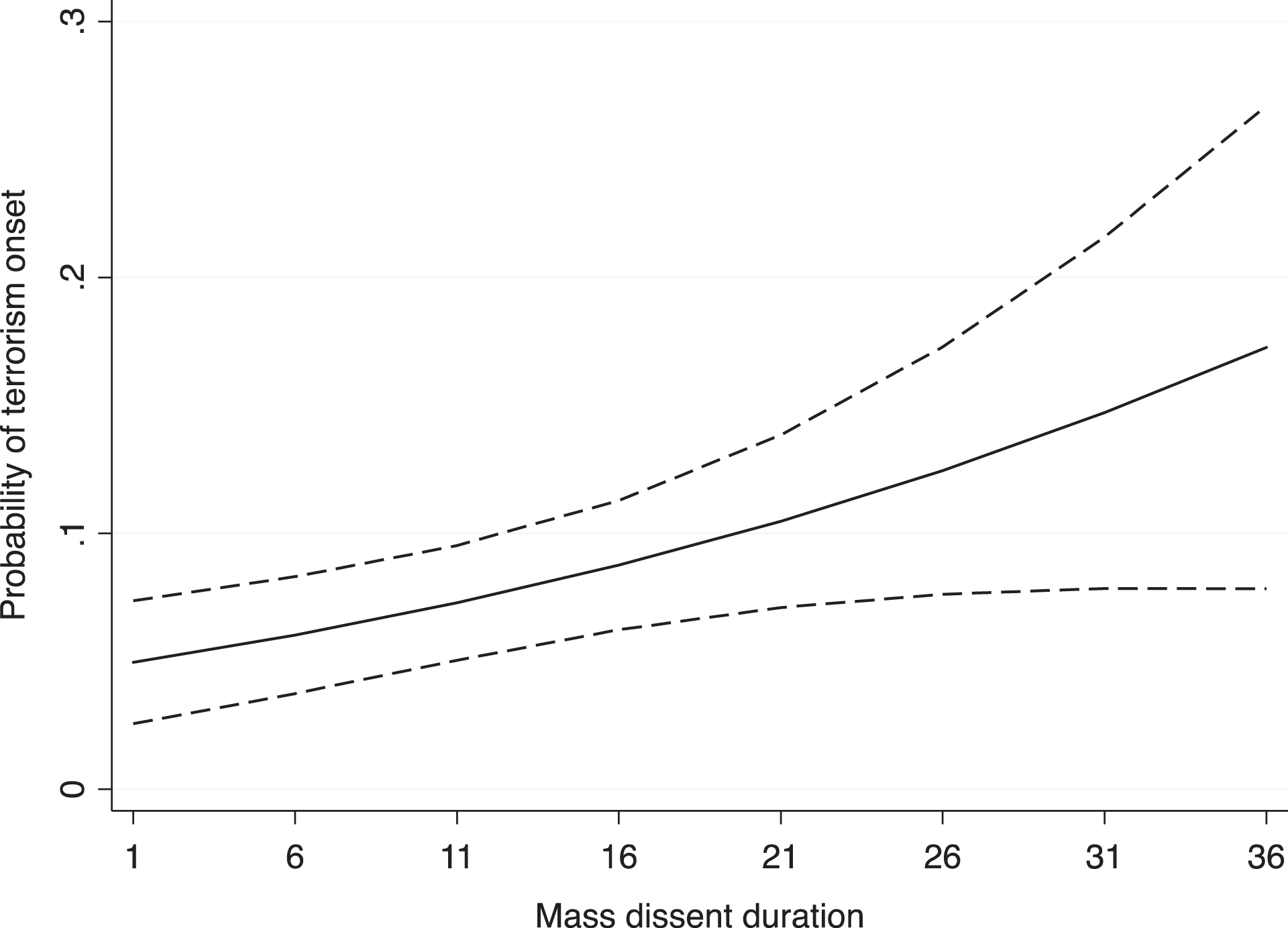
Most importantly, Primary method of mass dissent is not significant across all models. 5 The results show that the intercept of nonviolent mass dissent does not differ significantly from the intercept of civil war. I estimated nested models for all models in Table II with interaction terms between Primary method of mass dissent and significant core explanatory variables (Online appendix, Tables XVI–XVII).
In these specifications, the coefficient of each parameter shows the effect for conventional civil wars, while the coefficient of the interaction terms between Primary method of mass dissent and the other parameter is the effect of the parameter tested on mass civil resistance. I then test whether the effect of each parameter for mass civil resistance differs from the effect of the same parameter for civil wars. No significant statistical difference exists for the effect of Mass dissent duration on the likelihood of Terrorism onset across violent and nonviolent methods (Online appendix, Figures 1 –3). Furthermore, no significant statistical difference exists for the effect of Additional organizations on the likelihood of Terrorism onset across mass civil resistance and civil war (Online appendix, Figures 4–6). These findings remain robust when I use lagged regular Polity2 score (Online appendix, Table XVIII, Tests 7–8).
Since the estimates are uncertain due to variation in the data and mode uncertainty, I simulate 10,000 draws based on the estimates of all nested models of Tables XVI–XVII (Online appendix). The distribution of the results for both independent variables across large-scale conventional civil wars and mass civil resistance is virtually identical (Online appendix, Figures 7–12). The effects of the main explanatory variables also do not differ when allowing the slopes of all other covariates to differ across groups, that is, splitting the sample into violent and nonviolent campaigns across all models in Table II (Tests 9–14). The findings also remain consistent when re-estimating the core models excluding from the sample self-coded terrorist data (Online appendix, Table XIX, Figures 13–14). Finally, I can also reject the hypothesis of non-difference between the effects of the main independent variables (Online appendix, Test 15).
In summary, the effects of the covariates of interest do not change depending on control variables, a vast series of model specification, Monte Carlo simulation, and data restriction. I find robust evidence that longer mass dissent and additional organizations increase the likelihood of terrorism onset. Additionally, the findings show that these effects are robust for no statistical difference across civil war or mass civil resistance. In other words, the onset of terrorist campaigns appears to be a consistent strategic decision across organizations participating in different mass contentious activities.
Conclusion
The fact that terrorism can emerge from both violent and nonviolent mass movements calls for explanations grounded in the constraints on mass dissident activities that motivate participant groups to choose indirect illegal violence against civilians and other targets, rather than continuing their involvement in mass dissident campaigns. The empirical analysis in this article allows us to draw conclusions on the conflict dynamics that are more likely to affect dissident organizations’ choice to initiate terrorism versus continuing mass dissent. The empirical findings provide strong and robust support for my claims that terrorist campaigns are initiated (1) as a means to maintain followers’ commitment, as leaders expect increasing frustration and decreasing commitment with mass tactics the longer mass dissident campaigns last; and (2) as a means to outbid other organizations and efficiently exploit organizational recourses in situations in which fragmentation increases the competition within a mass dissident campaign.
The results are also consistent with my claim that the choice to begin terrorist campaigns is due to the similar dynamics that impose internal and external organizational pressure for organizations in mass violent and nonviolent campaigns. I show robust indications of significant non-difference in the effects of longer mass dissent and increasing fragmentation on terrorism onset across different primary methods of mass contention. In summary, it emerges that dissident groups for which the legal expression of opposition is blocked prefer the initiation of terrorist campaigns to the continuation of mass dissent tactics when these more direct methods are perceived as ineffective to secure organizational survival and gain prominence within the campaign.
This article suggests a number of relevant extensions and topics for future investigations. For example, more could be done to investigate the role that the nature of the groups and the ideology and goals of dissident campaigns play with respect to the likelihood of terrorism onset. Systematic work on the effect of ideology and goals on terrorist tactics has so far been limited to contexts of civil war and terrorism intensity. Future research may also focus on the emergence of more spontaneous and less organized types of dissident activities, such as riots and mobs, and on whether and under which conditions mass dissident campaigns with tactical variation are more or less likely to succeed. In general, the findings highlight the utility of empirically integrating the study of different types of contentious political behaviors for a more comprehensive and systematic understanding of the dynamics that motivate dissident organizations’ tactical choices. Although mass dissent and terrorism are by no means the only choices available to dissidents, an integrated approach to their study provides a starting point for understanding the choice of specific tactics with respect to other strategic alternatives.
Footnotes
Replication data

Acknowledgments
The author would like to thank the journal’s editor and the anonymous reviewers for their comments and suggestions. I am also grateful for input and support from Kristian Skrede Gleditsch, Tobias Böhmelt, Victor Asal, Andrea Ruggeri, and David Batho.
Funding
I acknowledge the support of the Economic and Social Research Council (1511095) .
Notes
References
Supplementary Material
Please find the following supplemental material available below.
For Open Access articles published under a Creative Commons License, all supplemental material carries the same license as the article it is associated with.
For non-Open Access articles published, all supplemental material carries a non-exclusive license, and permission requests for re-use of supplemental material or any part of supplemental material shall be sent directly to the copyright owner as specified in the copyright notice associated with the article.
