




Abstract
About 700 Dutchmen joined the Republican forces in the Spanish Civil War (1936–39) to fight Franco specifically and fascism generally. After 1945, both surviving veterans and those writing their histories agreed that after their return, they continued their fight against fascism in Nazi-occupied Holland. This article presents a microhistory of the trajectory of three Dutchmen, and finds the links between Spain and resistance in these three cases neither obvious nor very strong. In doing so, this article highlights not only the wide varieties of anti-fascist experiences, but also emphasizes the twists in turns in how these were subsequently refashioned.
Introduction
The 5th of December is Saint Nicholas Day. The titular saint, celebrated for his caritas and his care for children, is one of the inspirations for the mythical figure of Father Christmas or Santa Claus. In the Netherlands, the eve of Saint Nicolas Day is traditionally spent at home exchanging gifts with family and friends while drinking hot coco, eating speculaas (spicy shortcrust biscuits) and singing traditional Sinterklaas songs. These tell the tale of Saint Nicolas’s yearly travels from his Spanish estates to the Netherlands, where he rewards well-behaved children with gifts while his manservant Black Pete punishes the naughty. The 5th of December 1938, however, saw the arrival from Spain not of a saintly figure bearing gifts, but of about two hundred dishevelled Dutchmen, who had fought in the International Brigades on behalf of Spain’s Republican government against a military uprising supported by Nazi Germany and Fascist Italy. The weary travellers were expressly forbidden by their police minders from singing any battle hymns or even the Internationale. In protest, they opted for a traditional Saint Nicolas song, whose lyrics were somehow oddly appropriate: ‘The steamer is coming / from Spain to our lands / Delivering Saint Nicolas / He’s waving his hands.’ 1
Dutch police and security services awaiting the arrival of the sealed train from Spain on the platforms of Roosendaal Station, just across from the border with Belgium, failed to see the humour in the situation. Instead, their minds must have wandered to what these “Reds” were planning to do now that they had returned from fighting in Spain. Would they form an underground revolutionary army? Find another conflict somewhere to further the cause of Communism? Or had they had enough of war and violence, perhaps even of revolutionary politics? For now, police chiefs and intelligence officers erred on the side of caution and kept a close watch on both the former Brigades and their family members and friends who had come to welcome them home. 2
So what did happen to these International Brigades coming home? 3 Rémi Skoutelsky, the author of the definitive work on French Brigades, who returned home around the same time their Dutch cobelligerents did, suggests that with ‘one or two exceptions’ French veterans of the Spanish Civil War did continue fighting Fascism. This is exemplified by their important role in the French resistance to the German occupation (1940–44). In fact, their Spanish experiences were crucial to its eventual success, argues Skoutelsky, as they were able to transfer their know-how and combat experiences to other resistance movement members. 4 At first glance, the same seems to be true of the Dutch International Brigades, of which there were about 700–800 (many either returned before the 200 did on Saint Nicolas Day 1938, or had died in Spain). Interviews conducted with twenty-or-so survivors in the late 1970s and early 1980s by members of the Youth Wing of the Dutch Communist Party reveal that nearly all of them joined resistance movements or cells during the wartime German occupation of the Netherlands, which lasted from May 1940 until May 1945. 5 Other sources, such as post-war interviews with former International Brigades in newspapers and on television, seem to confirm the image of an essentially unbroken line of anti-fascist resistance stretching from 1936, when the Spanish Civil War broke out, until VE Day 1945. Hagiographic accounts written on the basis of these sources hail the Brigades as the very first members of ‘The Resistance’ (tellingly, in Dutch the word is used in the singular and capitalized). 6 The argument presented in this article is that such an unbroken line of anti-fascist Resistance does not exist and is, in fact, a post-war retrospective construct.
As an antidote both to analyses written solely on the basis of interviews conducted by communists long after the war without regard to their biases and omissions, and to generalizing statements about International Brigades’ shared experiences moving through the Spanish cauldron into the second Great War, this article takes a microhistorical approach. It probes the trajectories of three Dutchmen’s very different Spanish Civil War experiences, interrogates both post-1945 interviews and pre-Second World War egodocuments, and thereby highlights both the wide varieties of these experiences and the ways they were subsequently understood and framed. This, in turn, will also help us understand how and why the myth of an unbroken line of resistance came about, and how it is connected to efforts to restore Dutch citizenship to those International Brigades who had lost on account of their military service for the Spanish Republic.
Finally, a word of warning. In no way does this article suggest that the three International Brigades, who will be mostly unknown even to Dutch readers, are representative of the (Dutch) Brigades as a whole, or exemplify three different types thereof. Rather, this article focuses on their experiences because they have left us the sources allowing us to do so from more than one institutional perspective. Ego documents, state surveillance files, communist party archives, and memoirs all help us ponder encounters, experiences, and transformations from multiple vantage points, and explore silences, gaps, and ex post facto justifications.
Jef Last
In the Summer of 1936, a group of European writers, poets, and intellectuals visited the Soviet Union on a guided tour designed to show off the wonders of Communism to Western left-leaning intellectuals. For Dutch novellist Jef Last, this was his fourth visit to the Soviet Union since joining the Communist Party of Holland (CPH) in 1932. 7 But despite appearances, Last was far from a committed communist. In fact, he had begun to seriously doubt the party line following his previous visit, in 1934. He confided in his diary that he felt the ideals of the Russian Revolution were being betrayed and that the Soviet Union was rapidly turning into a dictatorship. However, he continued to feel loyalty to the party, which he still considered the best defender of workers’ interests. While agonizing over his split loyalties, he chanced upon André Gide at the June 1935 First International Congress of Writers for the Defence of Culture. He fell in love with him, both romantically and intellectually, and convinced him to undertake one more trip to the Soviet Union hoping, perhaps, that his new idol might help him see what he had been missing and restore his faith in Communism. 8 Instead, both Last and Gide, tightly controlled by Party minders, returned with an even stronger sense that the Soviet Union had taken a wrong turn under Stalin. 9 Returning to Holland, Last was once again in low spirits. In his desperation, he decided to travel to Spain where he hoped to find something of the “pure” communism he had been so desperately looking for in the Soviet Union, and, perhaps, even for a chance to die for the cause. 10
Arriving in Spain on 26 September 1936, he was assigned to a Spanish militia composed mostly of workers from the slums of Puente de Vallecas, a district of Madrid. 11 He participated in the defence of the Spanish capital and, although he was nearly killed, he confessed to Gide that he never felt happier. Finally, the intellectual was truly at one with the working class, fighting for their common interest: wasn’t that what Communism should be all about? 12 Several letters he sent from the front were published in the Netherlands in communist newspapers, weeklies, and finally reprinted in a series of booklets. These contained reportages from the Madrilenian trenches, and highlighted the vital necessity of winning the war. If Spain falls, he wrote home, France would be surrounded and Britain cut off from India, giving Germany and Italy an excellent starting position in the second World War to come. Holland would not be spared, as the Nazis would invade like they had Spain, ‘and Junkers and Heinkels [would] bomb my beloved Amsterdam as mercilessly as Madrid’. 13
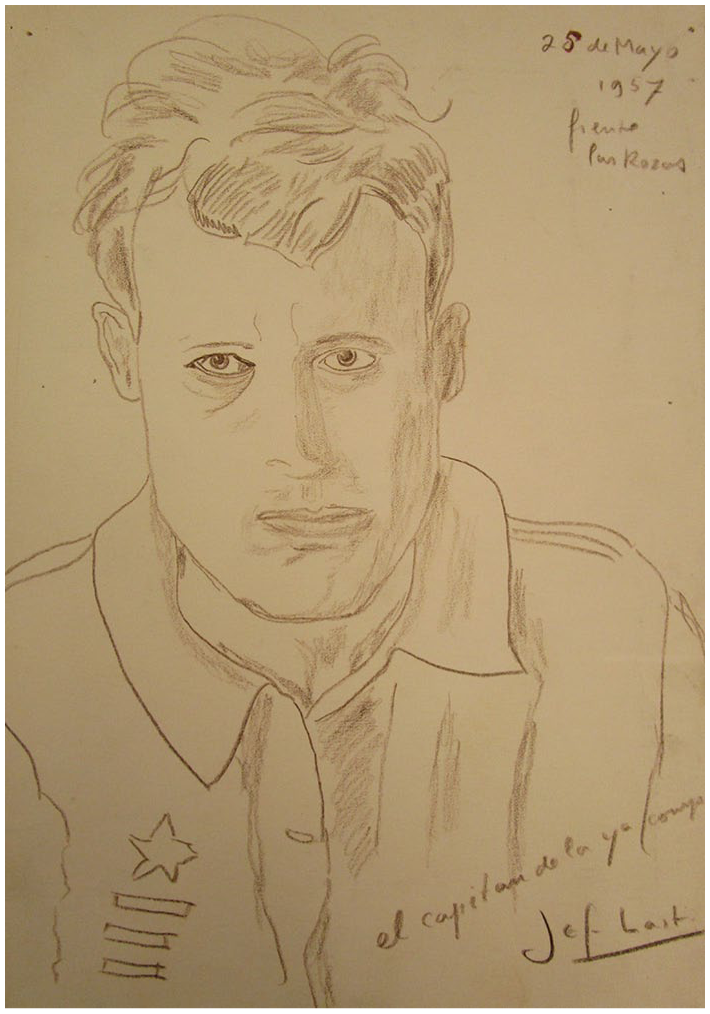
A self-portrait of Jef Last, drawn in the trenches near Las Rosas on 28 May 1937 upon Last’s promotion to captain of the 4th company of the Sargento Vazques battalion, 39th Brigade Spanish Republican Army.
Museum of Dutch Literature L00255 H4, Album by Jef Last
Last’s influential propaganda messages from the Spanish trenches, his close connections to French intellectuals, and his knack for languages (he spoke Spanish, German, French, and English) caused the Spanish government to ask him, in December 1936, to embark on a publicity tour of France, Belgium, and Holland in support of the the Republic’s fight against Fascism. 14 However, when crossing the Belgian–Dutch border on the last leg of his tour, Last was stopped by Dutch customs officials and informed that he was in violation of the 1896 Law of Citizenship, article 5, which stipulated that Dutch citizenship would be forfeit upon joining a foreign country’s armed services without prior consent of the Crown. 15 Since Last had, in his published letters, admitted serving in the Spanish Republican Army, the Dutch judiciary revoked his citizenship. 16 He was allowed to enter the Netherlands, but, as a stateless person, his activities were curtailed. He was, for example, not allowed to actively engage in politics of any kind and was, in fact, almost arrested when he was scheduled to make an appearance at a meeting of the Dutch Chapter of the Comité International d’aide au people Espagnol. 17 To make matters worse, Last was also questioned by his fellow Communist Party members about his continuing friendship with André Gide, who, in November 1936, had published a highly critical essay on his experiences in the Soviet Union. 18
Last quickly left Holland, leaving his legal and party-political troubles behind. Back in the trenches, Last managed quickly to rise in the ranks of his militia, now incorporated into the regular Spanish army, but his association with Gide continued to arouse suspicion. 19 He was put under intense pressure to publicly disavow Gide when the Frenchman published a second, even more critical, travelogue in June 1937. 20 Last refused out of loyalty to his friend; but he also could not bring himself to disavow Communism, if only because he recognized the importance of communism, both in Spain and elsewhere, and of the Soviet Union in supporting the Spanish Republic’s fight against Fascism. 21 Instead, he offered to publish an article in the CPH newspaper arguing that Gide had failed to sufficiently take the revolutionary importance of the existence of the Soviet Union as a workers’ state in progress into account. In the finished article, however, he also admonished his fellow party members to learn from Gide’s criticisms rather than simply dismissing them as ‘Trotskyite’ ramblings. 22
This rather half-hearted critique resulted in Last’s transfer from his Spanish unit to the International Brigade where, his old commander told him, Comintern officials ‘could keep an eye on you’. 23 Last was trouble, but he was also too valuable an asset to simply side-line. Even the CPH leadership found a new use for Last. Following the reorganization of the International Brigades in Summer 1937, it was decided that a new Dutch unit would be created to serve as a propaganda vehicle for Dutch efforts on behalf of Spain, and for Communism generally. 24 Last was enlisted to help with retraining the Dutchmen already in Spain and with providing copy for a Dutch-language front newspaper to be distributed to all Dutch-speaking members of the International Brigades. 25 It seems that, finally, Last and communism had found a modus vivendi. Last, who had been devastated by the order to leave his beloved Spanish company, even regained some of his former high spirits, especially once news reached him that Stalin was considering sending mass military aid to the Republic, which, he hoped, would finally turn the tide in its favour. 26 In another sign of renewed confidence, Last was, in November 1937, was once again asked to depart on a propaganda tour. Although public speaking in Holland was out of the question, Last’s still-valid Dutch passport (which the Dutch authorities had not yet had a chance to rescind) would enable him to speak in France, Belgium, Denmark, Norway, and Sweden, and finally in Czechoslovakia. 27
On 1 March 1938, while touring Scandinavia – where he delivered lectures and contributed op-ed pieces on Spain in social-democratic and communist newspapers 28 – Last suddenly decided to quit the CPH. He would later claim that his decision was the result of his long-standing doubts regarding the development of international communism under Stalin and, particularly, the fact that at the Battle of Teruel the Republican armies had been dealt a crippling blow, which he felt could have been avoided if they had been adequately supplied with Soviet weaponry. 29 However, letters Last sent to Gide at the time of his fateful decision suggest that his decision was instead motivated by what he described as a ‘very adventurous’ and ‘dangerous’ new mission he was about to embark on. Edo Fimmen, the Dutch chair of the International Transport Workers’ Federation, had asked him to spearhead a mission to Antwerp and Scandinavia in order to re-establish contact between the ITWF and German sailors’ organizations. Fimmen, whom Last had met in Madrid in 1937, hoped to establish anti-fascist cells within the Kriegsmarine and the German merchant marine. Last, who spoke fluent German and was an engaging public speaker, would try to contact these sailors on their ships’ stopovers at Antwerp and Narvik. Since the ITWF was a socialist organization and Fimmen an avowed anti-communist, it does not seem unreasonable to assume that he demanded that Last, before taking up this new task, renounce communism. 30
The CPH responded by enlisting Last’s friend Nico Rost to perform the ritual character assassination that, a year earlier, Last himself had refused to inflict on André Gide. Rost’s vitriolic philippic suggested that the apostate Last had deserted from the Spanish army, and that Last was both a Trotskyite, a crypto-Nazi, a stooge of the capitalist ruling class (explaining his quick release from captivity), and a dangerous ‘pederast’, whose marriage was nothing but a sham. 31 When news of the Munich Agreement broke around the same time, Last sunk, once again, into a deep depression. Worse, his mission came to naught as German sailors proved to be less receptive to his propagandizing than Edo Fimmen had hoped. 32
Last returned to the Netherlands when the Second World War broke out in August 1939. His wife had left him; she was aware of and fine with his bisexuality, but could not bear the continued harassment she and their two children suffered at the hands of their former communists. Alone, Last lived in squalor in an Amsterdam apartment. His worst fears appeared to come true when on 10 May 1940 Germany invaded the Netherlands – although it was Rotterdam, not Amsterdam, that suffered the brunt of the aerial bombardments Last had prophesized in 1937. He attempted to enlist in the navy and in the Civil Defence Forces, but was turned away because only Dutch citizens could join up. When, after five days, the Dutch government capitulated, Last fully expected to be arrested as a known anti-fascist activist and decided to go into hiding in the Frisian countryside. There, he took stock of the situation. In stark contrast to the Spanish, the Dutch seemed unwilling to put up a fight against fascism. He wrote despondingly in mid-1941, ‘Everything I have worked twenty years for, everything I fought for, everything was lost, my best friends, my Spanish comrades … lost or captured, everything was lost.’ Fascism simply seemed unstoppable, and perhaps his only viable option was to make the best of the situation, he concluded. But the German invasion of the Soviet Union and British successes in North Africa reignited his hopes for an Allied victory and, with it, the end of Fascism. Reconnecting with several left-wing authors, he joined an underground movement, which sought inspiration with socialism and humanism. Last was mostly responsible for the editorial line of its journal, De Vonk (‘The Spark’), which was equally opposed to Communism as it was to Fascism and Nazism. Interestingly, as editor he refused to vilify all Germans, as many other resistance publications did, out of respect for the many German nationals who had fought Fascism in Spain. He also used his Spanish experiences in underground lectures to left-wing youth organizations, whom he told that as captain of a Spanish company, it had been his sad job to send the best and brightest of the nation to impossibly dangerous jobs, and that he now relied on the best and brightest of his own nation to carry on the fight that had begun in Spain. 33 He did not take an active part in armed resistance (perhaps because his communist past was too recent for the socialist-humanist ringleaders?) until the end of the war, when he helped organized armed resistance cells in the North-eastern town of Ommen. ‘Much more fun than editing!’ he would write to Gide after the war, ‘a bit like in Spain, and beautiful like the movies’. 34
Last’s movie seemed to have a happy end. After the war, he remarried his ex-wife and his citizenship was restored in 1947; something we will return to later. He continued to write and even, briefly, became a television personality. Last also continued to care deeply for Spain and to hate communism, although he would join calls by the Communist Party to restore the citizenship of all veterans of the Spanish Civil War. Last’s cinematic life also shows us the deep impact that the Civil War made on even those who ended up disillusioned, either with Communism or even with anti-fascism in general. Many of those have disappeared from our records except as footnotes in police and judiciary files. But Last’s life shows that these silences could hide atypical stories of resistance, of accommodation, or of an earnest desire to leave it all behind.
Siep Adema
Siep Adema never doubted the communist party line. When he was interviewed in 1993, just before his death, he continued to defend Stalin and the worst excesses of communism, including the Molotov–Ribbentrop Pact and the building of the Berlin Wall. He also continued to harbour a deep hatred of the apostate Jef Last, who had betrayed communism.
But Adema was not just an apparatchik. His younger life had been marred by extreme poverty and abuse while, in his twenties, he felt trapped in an unhappy marriage, which nevertheless produced six children. He was simply too poor, he would explain later, to afford contraceptives. Adema’s decision to go to Spain was, in many respects, quite like Jef Last’s, in that his reasons were at once personal and political. Adema went to Spain to seek release from his abusive father, his dead-end jobs, and his unfulfilling marriage. Adema’s communism, moreover, was not based on a belief in its theoretical maxims but in its perceived ability to be a force for change for those who needed it most. From 1930 onwards, Adema had been active in the Dutch section of the International Red Aid, helping German political refugees. These eyewitnesses to the horrors of the Nazi concentration camps compelled him to organize, and participate in, street fights with members of the Dutch National-Socialist Movement. Adema had wanted to go to Spain as soon as the Spanish Civil War had broken out. But the CPH leadership stopped him from going; his work for the International Red Aid, where he helped organized the underground railroad bringing German refugees into Holland, was deemed too important. But Adema insisted, and in March 1937 he was finally allowed to travel to Spain. 35
Adema’s route into Spain was typical of many Dutchmen. Being unemployed, Adema could not afford a passport. However, the Dutch government also issued cheaper identity cards that were valid for travel to Belgium and, crucially, for travel to Paris to visit the International Exposition held from May to November 1937. To entice even more visitors to the Exposition, trains from Amsterdam to Paris offered a special discount rate. The identity card and discounted travel made it easier for Dutch would-be volunteers for Spain to reach Paris, not only the site of the Exposition but also a hub of international communist activity. Like many other volunteers, Adema did not travel alone. At Amsterdam Central Station, he joined a party of volunteers organized by the Dutch section of the International Red Aid His group was told to report to the headquarters of the Confédération Générale du Travail. From there, they travelled by bus to Perpignan, and crossed the Franco–Spanish border via the Pyrenees under cover of night. Arriving in Spain early in the morning, the group made its way to Figueras and were taken from there by train to Valencia and then finally to Albacete. Adema knew that by joining the International Brigades he was forfeiting his Dutch citizenship, but he later would later claim that he just didn’t care. 36
Adema’s travel plans might have been typical for many of his countrymen, but his military service was not. The majority of Dutchmen had no military record or experience to speak of, but Adema had served in both the army and the navy – although he was dismissed from both for insubordination. In Albacete, he received two weeks’ worth of additional training and was then dispatched as a machine gunner to the Hans Beimler Battalion of XI International Brigade. His machine-gun squad, which included another Dutchman, Arie van Poelgeest, was then transferred to the Edgar André Battalion of XI Brigade and then to the Thälman Battalion of XII Brigade, seeing heavy action at Brunete. There, Van Poelgeest was shot in the jaw. Seeing the horrific wound, Adema ‘lost his mind’, as he put it later. Wandering across the lines, ignoring enemy and friendly fire alike, Adema seems to have been in a fugue state triggered by acute post-traumatic stress. But he managed to recover and eventually rejoined his unit alongside Van Poelgeest, who, amazingly, had survived his head wound. During the failed Republican offensive at Zaragoza in August 1937, Adema was hit by explosive bullets that permanently damaged the nerves in his right arm, leaving him with a life-long disability. Adema was offered repatriation but he refused; there was nothing for him in the Netherlands. 37
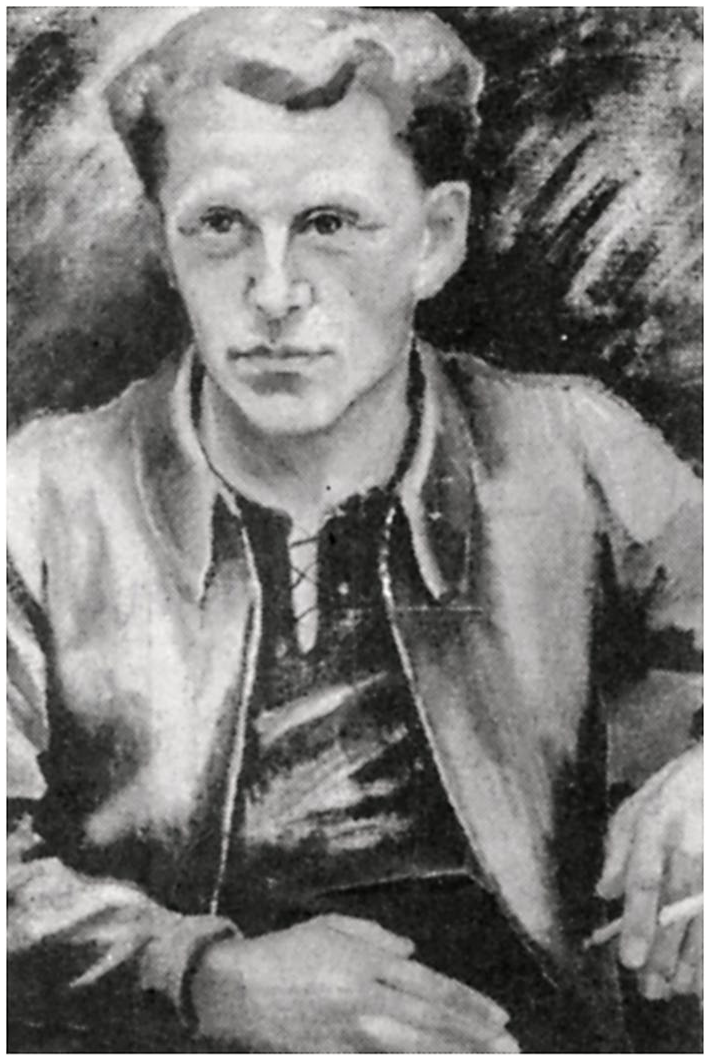
A portrait of Siep Adema by Anneke van der Feer, painted in Paris while Adema was recuperating from the bullet wounds to his right arm.
The Netherlands Institute for Art History (RKD), no 0001480333
Even disabled, Adema’s extensive military experience and the fact that he was a card-carrying communist made him a useful asset to the CPH. At Albacete base, Adema was instrumental in training new recruits for the Dutch unit that was being formed there from Autumn 1937 onwards. 38 He also met Last; they both wrote copy for the Dutch-language International Brigades front newspaper. But the two did not mingle, since they, as Adema put it later, ‘walked in different circles’. Adema remained in Spain in an advisory capacity, even becoming as assistant to the political commissar of the new Dutch company, the ‘Seven Provinces’ (a name that was meant to evoke both the Dutch Republic of the seventeenth century and a 1933 mutiny on a ship by that name, that had become a left-wing cause célèbre). When, in October 1938, the order came for the International Brigades to leave Spain, Adema was suddenly faced with the prospect of returning to the Netherlands and the loss of his citizenship. Although the survivors of the Dutch company were repatriated by train – arriving in the Netherlands on the eve of St Nicholas Day – Adema decided to try and sneak back into the country by himself to keep from being denaturalized; evidently, the loss of his citizenship mattered more to him than he later cared to admit. Captured by Dutch border guards on the lookout for stragglers, Adema at first denied having been in Spain, but a search of his possessions yielded several photos of himself dressed in a Spanish uniform. This evidence of his foreign service proved irrefutable, and Adema, too, was stripped of his Dutch nationality. 39
Originally, the Dutch government had planned to do much worse and simply throw all International Brigades in jail. But these plans were scrapped following pressure by other European countries, notably France, who feared that Dutch Brigades would rather roam the continent causing all sorts of mayhem than risk imprisonment at home. 40 But even though the Spanish Civil War veterans escaped jail time, the loss of citizenship itself came with severe, and serious, penalties. Stateless ‘aliens’ were required to report twice a week for a lengthy check-in at a local police station, which, in addition to being stigmatizing, made keeping a regular job a practical impossibility. To make matters worse, they had significantly reduced access to welfare programmes, and could not engage in political activities. Adema, like most other communist veterans of the International Brigades, was therefore officially dismissed from the party, but retained a close link to the CPH in secret. In fact, former Brigades were tasked with forming an underground cell, ready to engage in acts of sabotage and terrorism in case of a Nazi invasion. Since members were paid by the Party, which was usually their only source of income, the cell also served as a powerful vehicle for keeping veterans within the CPH framework, even though they might have been disappointed by the German–Soviet Nonaggression Pact concluded in August 1939. 41
This remained true even when Germany invaded the Netherlands in May 1940. Under orders from Moscow, the party urged its members not to take an active part in this ‘imperialist war’ between the so-called democracies and the Nazis and that the CPH should consider itself bound not to act against the Nonaggression Pact. 42 Although superficially Adema kept towing the party line, there is every indication that he had a lot of trouble keeping his emotions in check. Forbidden from fighting fascists again, he busied himself with distributing the now-illegal communist newspaper and collecting money for the underground party organization (which still including his own cell, which for now remained dormant). However, in February 1941, a communist-organized strike, carefully framed as being against the terms of occupation rather than the occupant, spiralled into a mass protest of some 300,000 participants against both the Germans and their Dutch collaborationists. With the line between obedience to the Party and desire for revenge now sufficiently blurred, Adema gleefully joined a street gang that hunted and beat up Dutch fascists. 43 In response, the German occupational forces abandoned much of its prior restraint in dealing with the CPH and moved to arrest leading communists. It quickly emerged that all Dutch security services files relating to Spanish Civil War veterans had fallen into the hands of the German occupying forces, who had since May 1940 been hard at work updating them with information on their secret wartime activities. Adema, too, was arrested in April 1941, and during his interrogation was presented with his security file laid by Sicherheitspolizei. When Germany invaded the Soviet Union, a second wave of arrests decimated the underground CPH apparatus; most Spanish Civil War veterans were detained as well, and subsequently sent to concentration and extermination camps. 44
Adema spent the majority of the war in the Groß-Rosen camp in Lower Silesia. Like many members of resistance movements, Adema was classified as a ‘Nacht und Nebel’-prisoner, named after a 7 December 1941 order from Adolph Hitler that political prisoners were to be taken away ‘in night and fog’ (e.g. in secret) to be slowly killed without their dependents knowing their fate. Adema was to suffer this horrible fate; he was condemned to slave labour in the granite mines until his death. However, he managed to survive until the Red Army’s advance caused the camp to be evacuated in early 1945. He was then marched alongside the other remaining prisoners to Buchenwald, near Weimar. When he was set down, at the end of his tether, to have his head shaven before being assigned to a work detail, his barber, a Spaniard, recognized that Adema would likely not survive another week. Quickly identifying him as a former International Brigade, he put in a word for Adema with leading communists of the so-called Buchenwald Resistance, which had infiltrated the camp’s administration. They, in turn, managed to include him on a list of French prisoners to be exchanged with Germans via Switzerland in April 1945. From Switzerland, he made his own way back to the Netherlands, where he arrived just after the unconditional surrender of the last remaining German forces there in May 1945. 45
Adema would suffer the ill effects of his treatment in German camps for the rest of his life, which, together with his experiences at Buchenwald, deepened his practical and emotional dependence on the Communist Party. He remained stateless for decades after 1945, meaning that he was unable to hold down a job and that he continued to rely on the Communist Party to support him. His fellow communists venerated him as a hero of the resistance, because of his time spent in German concentration camps and his ‘Nacht und Nebel’-status which he shared with other anti-German activists and political prisoners. Ironically, it was Adema’s service during the Spanish Civil War that put him on the German watchlist, not the unsanctioned brawl that served as the catalyst for his arrest. 46 Adema’s trajectory into and out of the Spanish Civil War also highlights the importance of communism not only as a political creed, but also a sociocultural sphere and even a financial safety net: he, and many others like him, were bound up in it and could not simply leave, even in the face of something difficult to swallow like the Molotov–Ribbentrob Pact.
Herman Scheerboom
Superficially Herman Scheerboom and Siep Adema’s life stories share many similarities up until the last year of the Spanish Civil War. Both were life-long communists, experienced devastating poverty during the early 1930s and left for Spain in 1937. Scheerboom arrived after the Dutch government, hoping to end recruitment for the Spanish Civil War, had put an end to the discounted tickets that had enabled Adema to travel to Spain on the cheap. Scheerboom therefore hitchhiked to Paris before being secretly transported over the Franco–Spanish border. A member of XI Brigade before joining the Dutch company ‘Seven Provinces’ in late 1937, Scheerboom probably met both Adema and Last at Albacete Base, although we cannot be sure. Scheerboom saw action at Teruel, where he was shot in the head but, miraculously, survived. Recovering quickly, he joined his company for the battle of the Ebro, which would end in a disastrous defeat for the Spanish Republic. 47
During the battle, Scheerboom and 24 other Dutchmen were captured and taken to the San Pedro de Cardeña concentration camp outside of Burgos, now the de facto capital of the growing Spanish territory under the control of the military rebellion headed by Francisco Franco. They remained in captivity even after the end of the Civil War and Franco’s final victory on 1 April 1939. The Dutch government refused to negotiate their release; the fact that they were POWs proved, after all, that they had served in a foreign military unit and had thus forfeited their Dutch citizenship. Franco’s government, however, decided on 19 October 1939 to release four Dutchmen (for reasons unknown), but the other 21, including Scheerboom, were transferred to a work detail in Belchite. Occasionally, the CPH managed to ship them food and letters from home. 48 But when Germany invaded the Netherlands, the remaining International Brigades had no one left to support them. Conditions in the work camps, first at Belchite and then at Palencia, were hard, and one of the Dutchmen died as a result. In December 1941, the survivors were transferred, together with most of the other remaining Brigades, to the Miranda de Ebro concentration camp. 49
The transfer to Miranda de Ebro brought the International Brigades back on the radar of the Dutch government (now in exile in London). Camp Miranda not only housed veterans of the Spanish Civil War, but also Allied military personnel and civilians who had hoped to escape German-occupied Europe via Spain, which had remained neutral. A number of Dutchmen were amongst them, and the Dutch government-in-exile feared that the arrival of ‘militant communists’ would endanger the morale or the chances of release these ‘interned Dutchmen of high calibre’. 50 Scheerboom and his fellow ex-Dutchmen presented a threat, but also, curiously, an opportunity. The Dutch government-in-exile hoped to create a new Dutch brigade, based in Britain, which would allow it to participate in Allied military operations. In particular, having a Dutch unit involved in the eventual liberation of Europe – particularly of the Netherlands – was seen as of overriding political importance. But the Dutch government in London lacked manpower, as its army had disintegrated following the German invasion of May 1940. After fruitlessly searching for recruits amongst the Dutch expatriate communities in South Africa, the United States, and Canada, the commander of the new Brigade, general-major A.C. Ruijter van Steveninck, was at his wit’s end and, in his desperation, argued that perhaps the former Brigades might be interested in continuing their fight ‘against Nazism and Fascism as part of the Dutch armed forces-in-exile’. 51
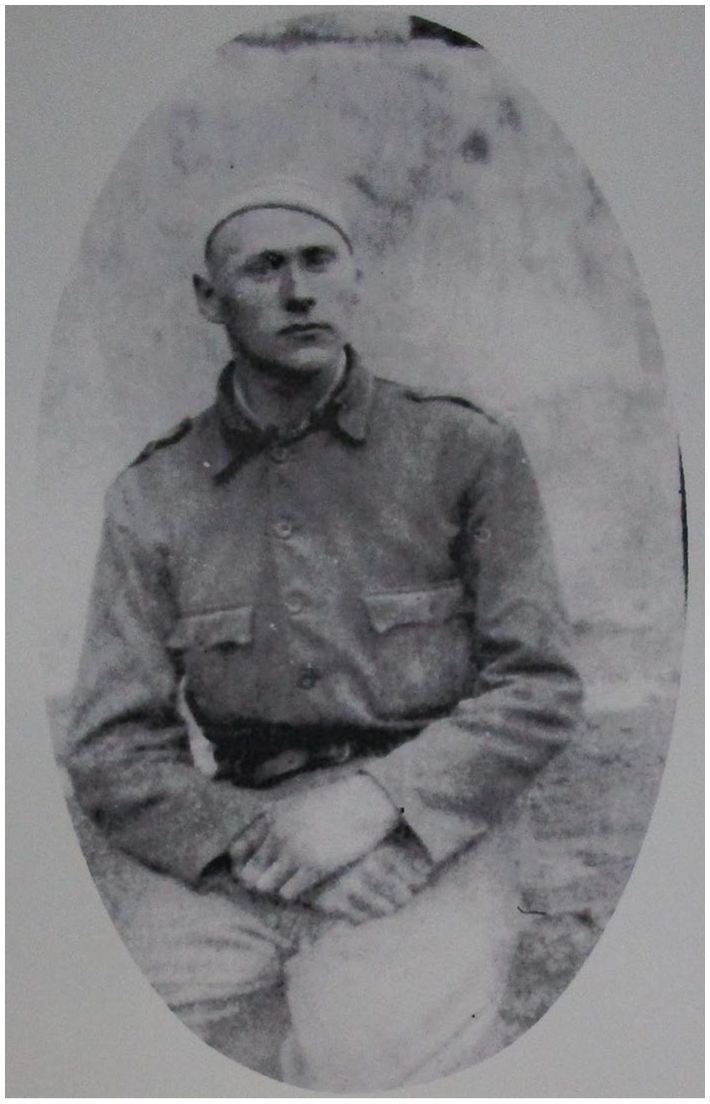
Herman Scheerboom working as part of ‘Battellon de Trabajadores 75’ in Belchite on 23 February 1941, still wearing bandages to cover his headwound.
IISG ARCH02806/147
In order to kill two birds with one stone, the Dutch Council of Ministers in London decided to negotiate with the Spanish government for the release of the Dutch Brigades; military necessity, at least for the moment, trumped the doubts many of the ministers had about the former International Brigades’ political reliability. A first contingent of 11 former International Brigades, including Scheerboom, were released to Lisbon in Summer 1942, and from there they travelled first to Curaçao and on to Canada before heading back to Britain – a roundabout route chosen so that the Spanish government had plausible deniability in case the Germans enquired why men previously held in Spanish camps were now engaged in combat against Axis forces. After lengthy negotiations, a second contingent of Dutch Brigades left Miranda in June 1943, followed by a third in February 1944. 52
In Britain, the former Dutchmen were directed to the headquarters of what was now the Princess Irene Brigade in Wolverhampton. There, Scheerboom and the others were told they could sign up to the Brigade as ‘foreign volunteers’. Most of them refused, sensing an opportunity to bargain their military service for a return of their citizenship – and out of an earnest desire to aid in the liberation of the Netherlands as Dutchmen, rather than as ‘mercenaries’. The stand-off lasted for several months until the Dutch government, still pressed for men with military experience, finally relented and promised those who enlisted the return of their citizenship after the war. Herman Scheerboom was amongst those who signed up. Joining the Princess Irene Brigade, now part of the 21st British Army Group, he fought in France, Belgium, and the Netherlands. 53
The restoration of Scheerboom’s citizenship opened the door for other Spanish Civil Veterans who had acted heroically during the Second World War to apply for a restoration of their citizenship. Laws were drafted which allowed for a blanket amnesty for those who had lost their citizenship as a result of their service in the armed forces of a foreign country without the prior consent of the Crown, and Parliament seemed on the verge of approving them. However, that quickly changed in early 1948, when CPH leader Paul de Groot expressed his support for the Soviet-backed communist coup d’état in Czechoslovakia, hinting that if war were to break out over the violent regime change he would back the invading Soviet forces rather than those of his own country and its new Western allies. This evaporated much of the widespread goodwill the Communist Party had accrued in the years following the German occupation, and suggested to the political mainstream that communists were not true Dutchmen but foreign agents of Moscow. 54 As a result, the amnesty law was amended to include much stricter background checks; only those who were considered politically reliable could apply for the restoration of their citizenship. Tellingly, Jef Last’s application was immediately approved, but Siep Adema’s were repeatedly denied. Many of the surviving communist Brigades naturally felt betrayed by the Dutch government going back on its earlier promises. Their anger turned to indignation when parliament decided that many of those who had served in the Waffen SS during the war were deemed fit to reapply for citizenship. The decision to apply the amnesty law to former Waffen SS men was taken out of fear that the Dutch social security system could not deal with even the limited access afforded to tens of thousands stateless applicants. Communist Spanish Civil War veterans, by contrast, comprised only a tiny group, which had been further decimated by the Second World War, but who were, in the early Cold War, considered much more dangerous than Dutchmen who had joined the Waffen SS to fight Stalin. 55
Incensed, the CPH started a political campaign to restore full citizenship to veterans of the Spanish Civil War. It highlighted the veterans’ anti-fascist activities and introduced the notion that they were, in essence if not formally, the very first members of the Dutch resistance movement. Many former Brigades and their supporters co-opted this narrative – which, wisely, did not stress the political allegiance of many of the surviving stateless veterans. 56 It took a German court case for the campaign to gain traction. In 1955, a West German judge determined that the German government could not only be held liable for material damage caused by Wehrmacht forces during the war, but also for immaterial damage, such as the physical and mental traumas endured by those in the Nazi concentration camps. On behalf of Dutch victims, the Dutch government thereafter concluded an agreement with its West German counterpart for a one-time payment of a massive 125 million Deutschmark to be distributed to concentration camp survivors. In 1963, a Central Settlement Bureau for German Damage Claims began assessing applications for claims and supplementary benefits. Only Dutch citizens could apply, which once again highlighted the plight of the stateless former International Brigades, who by now were aging and often in financial distress. A cross-party initiative, headed by the Protestant politician Ch.W.I. Wttewaall van Stoetwegen, finally managed to get parliament to drop the explicit discrimination of communists in processing demands for restoration of citizenship; between 1963 and 1967 the last surviving Dutch International Brigades finally saw their Dutch nationality restored. 57
Conclusion
Jef Last, Siep Adema, and Herman Scheerboom fought in the Spanish Civil War and later went on to continue fighting fascism and Nazism during the Second World War. But they took very different routes getting there and participated in very different forms of resistance for very different reasons. For Last, resisting the Nazis did not come easy as the Spanish Civil War had left him with a crippling lack of faith in the forces of anti-fascism in general, and communism in particular. Crucially, Last’s resistance was framed as being in opposition to both Nazism and Communism. For Siep Adema, real resistance was impossible. Communist Party directives forbade him, and many other Communist International Brigades, from directly engaging the Germans in 1940–41. Before the Comintern loosened these restrictions in the wake of the German invasion of the Soviet Union, he had been put on a watchlist of Spanish Civil War veterans, caught by the Sicherheitspolizei and condemned to death by slave labour; he “resisted” by simply surviving. Herman Scheerboom, captured in 1938 by Franco’s forces, only returned to the battlefield because the Dutch government saw a sudden need for him and others like him; their desperation gave Scheerboom a chance he shrewdly exploited to trade his services for freedom from captivity and the restoration of his political rights. Only after the war were they all branded resistance fighters, their service and/or sacrifice recognized or rather reconfigured as part of the new narratives that developed after the end of the occupation: that of united resistance, either by the Dutch as one people against Nazi oppression, or by Communists against Fascism.
Last, Adema, and Scheerboom recognized the utility of these frames. This was because they did share one crucial experience: their service in Spain cost them their citizenship. It was restored to them at different times. Scheerboom was first, Last followed in 1947, his very public break with Communism probably fast-tracking the process. Adema was last; it took until 1964 for his citizenship to be restored, thus allowing him to apply for German funds intended for victims of Nazi persecution. His final vindication was the result of a narrative propagated by, inter alia, the Communist Party and many of the more prominent veterans of Spain, even Last, that they were amongst the very first to fight Fascism, sparking the flame that would become the Resistance in which all Dutchmen, regardless of political affiliation, fought the Germans as one. This narrative served a political purpose all veterans of the Spanish Civil War could rally behind; it gained traction with many others in the 1960s, due to a thawing of the Cold War and a new appreciation of the horrors of the Holocaust and Nazism in general. In doing so, it created an ex post facto narrative of an unbroken line of anti-fascist resistance and melded all Dutch Spanish Civil War veterans together into one imaginary group. It stands to reason that these narratives also have played a key role in the reimagining of Spanish Civil War volunteers and their role as harbingers of and key players in resistance and partisan movements in other countries as well. That is another reason why the examples of Last, Adema, and Scheerboom are so instructive. Rather than represent archetypes of Spanish Civil War veterans, their experiences highlight a diverse range of experiences which, after the war, tended to become lost as homogenizing narratives replaced them. 58
Finally, having engaged in illegal combat in a conflict in which their home state had declared its official neutrality, these Spanish Civil War veterans from the Netherlands stand in a long tradition, which stretches, essentially, up until the present day. At the moment of writing, the Islamic State – who counted, in 2016, about 4,000 European ‘foreign fighters’ amongst its ranks – is nearly defeated. European security services, much like the Dutch policemen who anxiously awaited the sealed train on Saint Nicolas Day 1938, are keeping a close watch on those who have survived. Will they continue the fight elsewhere? Or will they come home? And if so, what will they do? 59 Answers to these questions depend, as can be seen in the case of these Spanish Civil War veterans, on a number of different factors. First of all, the role of the home state is key. The Netherlands deprived Spanish Civil War veterans of their citizenship, but did allow them to return home. As this article showed, this decision had tremendous consequences for the veterans’ post-conflict trajectories. Second, a follow-up conflict – such as the Second World War – must be seen as ideologically congruent before a foreign fighter decides to continue his (or her) violent activism. The argument presented here, based on evidence from the Spanish Civil War, suggests that this is not automatically, or immediately, the case.
Footnotes
Acknowledgements
The author would like to thank the editorial board of this journal, in particular Prof. Kathryn Barbier and the guest editor of this special issue, Dr Nir Arielli, as well as the two anonymous peer reviewers for their helpful comments on earlier versions of this article.
Funding
The author(s) received no financial support for the research, authorship, and/or publication of this article.

1
Accounts from De Telegraaf 6-12-1938 Ochtendblad, ‘Vrijwilligers uit Spanje weer “thuis”. Kapitein “Piet” hout orde er onder’ and 6-12-1938 Ochtendblad, ‘Nederl. vrijwilligers uit Spanje terug’; Het Volksdagblad 6-12-1938, ‘Geestdriftig en ontroerend welkom aan de oud-strijders uit Spanje’.
2
For the Dutch official mood, see Dutch National Archives, The Hague (DNA) 2.05.03/1682, folder ‘Spaansche burgeroorlog’: Dept. of Justice to Public Prosecutor Den Bosch, 10-11-1938; NA 2.05.03/1681: Foreign Affairs Dept. to Francisco Schlosser, 17-11-1938; NA 2.05.03/1681: Foreign Affairs Dept. to Justice Dept., 4-10-1938. For an in-depth eyewitness account of Dutch security services’ reactions to the impending return of the Interbrigadirs, see M. de Meijer, De geheime dienst in Nederland 1912–1947 (n.p., 1968), pp. 240–4 and comments by the Justice Minister: Minutes of the Upper House of Dutch Parliament (HEK), 1938–39, kamerstuknummer 2 IV ondernummer 2, ‘Rijksbegrooting voor het dienstjaar 1939. (Justitie)’, p. 9.
3
The term International Brigades was used by contemporaries to denote both the military unit(s) designed to house non-Spanish volunteers within the Spanish Republican or Popular Army, and individual members of these unit(s). See e.g. Hans Maaßen, ed., Brigada Internacional ist unser Ehrenname … Erlebnisse ehemaliger deutscher Spanienkämpfer (Berlin, 1974).
4
Rémi Skoutelsky, L’espoir guidait leur pas. Les voluntaires français dans les Brigades internationales 1936–1939 (Paris, 1998), pp. 314, 344; Jacques Delperrie de Bayac, Les Brigades internationales (Paris, 1968), pp. 387–8.
5
6
See e.g. Pim Griffioen et al., En gij… wat deed gij voor Spanje? Nederlanders en de Spaanse burgeroorlog 1936–1939 (Amsterdam, 1992), p. 61; Koen Vossen, ‘Nederland en de Spaanse Burgeroorlog’, in Een Nederlandse blik op de Spaanse Burgeroorlog / Una mirada holandesa sobre la Guerra Civila Española, ed. Hub. Hermans et al. (Utrecht, 2006), pp. 20–33, here 32–3. See also Dick van Galen Last, ‘The Netherlands’, in Bob Moore, ed., Resistance in Western Europe (Oxford and New York, 2000), pp. 189–221. Naturally, the Spanish Civil War was as politicized a topic in the Netherlands as it was in other countries. See for an overview of these debates: Eric Hobsbawm, Age of Extremes: The Short Twentieth Century 1914–1991 (London, 1994), esp. p. 160; Ruth MacKay, ‘History on the Line. The Good Fight and Good History: The Spanish Civil War’, History Workshop Journal 70 (2010), pp. 199–206; Richard Baxell, ‘Myths of the International Brigades’, Bulletin of Spanish Studies 91:1–2 (2014), pp. 11–24; Helen Graham, ‘Spain Betrayed? The New Historical McCarthyism’, Science & Society 68:3 (2004), pp. 364–9; Tony Judt, ‘Rehearsal for Evil’, The New Republic 225:11 (2001), pp. 29–35; Robert Stradling, History and Legend. Writing the International Brigades (Cardiff, n.d.), pp. xii–ix.
7
The CPH had a distinctly ‘German-sounding’ name and was probably originally an all-too literal translation of the German ‘Kommunistische Partei Hollands’, German being the lingua franca of the Comintern. In December 1935, the party changed its name to ‘Communist Party of the Netherlands’, thereby de-emphasizing its ‘international’ roots in order to heighten the appeal of a Dutch communist-led Popular Front. See Ger Verrips, Dwars, duivels en dromend. De geschiedenis van de CPN 1938–1991 (Amsterdam, 1995), pp. 22–3; Jan Willem Stutje, De man die de weg wees. Leven en werk van Paul de Groot 1899–1986 (Amsterdam, 2000), pp. 125–6. For reasons of simplicity, the Dutch CP both before and after its change of name is referred to by the acronym CPH in this article.
8
Museum of Dutch Literature, The Hague (DNA) L00255-1259, folder ‘Seksualiteit’: Autobiographical notes, s.d. 6–7; L 00255-1260, ‘Dagboek van een veroordeelde’ [‘Diary of a Condemnmed Man’], pp. 49–52.
9
Jef Last, De persoonlijkheid van André Gide (Amsterdam, 1969), p. 13. He was not the only one; see Lisa A. Kirschenbaum, International Communism and the Spanish Civil War. Solidarity and Suspicion (New York, 2015), p. 135.
10
Correspondence André Gide-Jef Last 1934–1950, ed. C.J. Greshoff (Lyon, 1985), pp. 4–5, 31. As to Last’s preparedness to die: Museum of Dutch Literature (MDL) L00255 B 1: Jef Last to Ida ter Haar, 23-11-1936.
11
Jef Last, Vingers van de linkerhand (Bussum, 1947), pp. 82–3.
12
Last, Vingers van de linkerhand, pp. 32, 79.
13
The Russian State Archive of Socio-Political History, Moscow (RGASPI), 545/6/409: Jef Last to Ida Last, 7-8-1937. Last’s reportages were published as Brieven uit Spanje (Amsterdam, 1936); In de loopgraven voor Madrid. 2e serie brieven van het Spaansche front (Amsterdam, 1937) and Over de Hollanders in Spanje (Amsterdam, 1937).
14
MDL L00255-1257, folder ‘Spanje’: Jef Last to Ida Last-Ter Haar, 16-12-1936.
15
12 December 1892, Official Dutch Bulletin of Acts and Decrees no. 268.
16
17
DNA 2.09.22/16805: Mayor of Haarlem to King’s Commissioner of North Holland Province 3-8-1937. For reports of the meeting, see De Tribune 6 and 7-1-1937.
18
André Gide, Retour de l’U.R.S.S. suivi de Retouches a mon Retour de l’U.R.S.S. (Paris, 1950), pp. 1–106, esp. p. 61: ‘Et je doute qu’en aucun autre pays aujourd’hui, fût-ce dans l’Allemagne de Hitler, l’esprit soit moins libre, plus courbé, plus craintif (terrorisé), plus vassalisé.’ On the circumstances of his return to Spain, see Jef Last to André Gide, 29-12-1936 in Greshoff, Correspondence, pp. 37–9.
19
Jef Last, ‘Een Antwoord van Jef Last op de Brochure van Nico Rost’, Liga Signaal, 16-6-1938; MDL L 00255-1257, folder ‘Spanje’: Jef Last to Ida ter Haar, 17-5-1937; NDL L 00255-1260, folder ‘Documentatie Spanje (1)’, ‘Een spook gaat rond door de wereld’ [‘A Ghost Travels the World’, an early account of Last’s eventual break with communism], s.d.; MDL L 00255-1257, folder ‘Spanje’, Jef Last to Ida ter Haar, 30-4-1937; L 00255-1260, folder ‘Documentatie Spanje (2)’, ‘De Vierde Compagnie’ [‘The Fourth Company’, an account of Last’s service in the Spanish army], s.d.; Last, De Spaanse Tragedie, 2nd ed. (Amsterdam, 1964), pp. 100–1.
20
MDL L 00255-1257, folder ‘Spanje’: Jef Last to Ida ter Haar, 17-5-1937.
21
Greshoff, Correspondence, pp. 40–2.
22
Printed as ‘Een verklaring van Jef Last. De fouten van André Gide’, Het Volksdagblad 7-10-1937.
23
Last, Spaanse Tragedie, pp. 102–3.
24
RGASPI 545/6/399: Zuidema to EKKI, undated [November 1937]; RGASPI 545/6/399: Zuidema to EKKI, undated [December 1937]. For the reorganization more generally, see ‘An Account by M. Fred on work in Spain’, 14 December 1937, in Spain Betrayed the Soviet Union in the Spanish Civil War, ed. Ronald Radosh, Mary R. Habeck, and Grigory Sevostianov (New Haven and London, 2001), pp. 295–368, and for an example of ‘national’ units set up for propagandistic reasons, see Gerben Zaagsma, Jewish Volunteers, the International Brigades and the Spanish Civil War (London and New York: Bloomsbury Academic, 2017), pp. 36–57.
25
A somewhat random collection of copies can be found in RGASPI 545/2, 426.
26
MDL L 00255-1257, folder ‘Spanje’: Jef Last to Ida ter Haar, 17-5-1937.
27
MDL L 00255-1257, folder ‘Spanje’: Jef Last to Ida ter Haar, undated and 6-11-1937.
28
See for a collection of articles L 00255 H 4: ‘Mijn tekenen begon in Spanje’, n.d. [‘I Started Drawing in Spain’, a collection of Last’s drawings and clips of his articles].
29
Last mentions the date of his exit from the CPH in MDL L00255 H 4: Jef Last to Netherlands National News Agency (ANP), 2-6-1938. For his stated reasons for leaving, see Jef Last, Een antwoord op het geval Jef Last (Amsterdam: ‘De Ploeger’, s.d. [1938]).
30
Greshoff, Correspondence, 50; MDL L00255-1257, folder ‘Spanje’: Jef Last to Ida ter Haar, 17-5-1937 and 23-6-1937.
31
Nico Rost, Het geval Jef Last. Over fascisme en trotzkisme (Amsterdam, n.d. [1938]).
32
Greshoff, Correspondence, pp. 51–69. The quotation in the original French reads, ‘C’était plus amusant qu la rédaction, un peu comme en Espagne en beau comme une filme.’
33
L 00255-1260, folder ‘Dagboek van een veroordeelde’, pp. 77–93.
34
Greshoff, Correspondence, pp. 108–9.
35
International Institute for Social History, Amsterdam (IISH) ARCH02806/33: Interview Siep Adema, 25-5-1984.
36
Ettie Huizing, Wie het geweten heeft: het levensverhaal van Siep Adema (Nijmegen, 1994), pp. 61–2.
37
IISH ARCH02806/33: Interview Siep Adema, 25-5-1984 and 3-7-1984.
38
For more on this unit, see Samuël Kruizinga, ‘Struggling to Fit In. The Dutch in a Transnational Army, 1936–1939’, Journal of Modern European History 16:2 (2018), pp. 183–202.
39
RGASPI 545/6/399: ‘Zuidema’ to EKKI, undated [November and December 1937]. Adema’s role in training Dutch International Brigades is mentioned in Gerard Vanter, Nederlanders onder commando van Hollander Piet in Spanje (Amsterdam, 1939), pp. 62–5.
40
Other countries, including Switzerland and Belgium, did jail former International Brigades. See Nic Ulmi and Peter Huber, Les Combattants suisses en Espagne républicaine (1936–1939) (Lausanne, 2001), pp. 168–71, 184, 231–2; Catherine Fussinger, ‘L’attitude des autorités vaudoises à la lumière des dossiers de la police de Sûreté’, in Mauro Cerutti, Sébastien Guex, and Peter Huber, eds, La Suisse et l’Espagne de la République à Franco (1936–1946) (Lausanne, 2001), pp. 153–89; Rudi Van Doorslaer, ‘De vervolging van de Belgische vrijwilligers in de Spaanse burgeroorlog, 1936–1939. Omtrent de rol gespeeld door de BWP en de autonomie van de rechterlijke macht’, in BEG-CHTP 15 (2005), pp. 125–46.
41
IISH ARCH02806/33: Interview Siep Adema, 25-5-1984.
42
ARCH00347/1734: EKKI, Direktiven an K.P. Holland, s.d. and Telegram 2-9-1940. Cf. Hansje Galesloot and Susan Legêne, Partij in het verzet. De CPN in de tweede wereldoorlog (Amsterdam, 1986), pp. 22–4.
43
Rudi Harthoorn, Vuile Oorlog in Den Haag. Bestrijding van het communistisch verzet tijdens de Duitse bezetting (Utrecht, 2013), pp. 248–9.
44
NIOD Institute for War, Holocaust and Genocide Studies, Amsterdam (NIOD), Gen. Komm. für das Sicherheitswesen, 77, inv. nr. 1110: Report SS-Hauptsturmführer Munt to Reichssicherheitshaubtambt, 12-1-1944. Cf. Bas von Benda-Beckmann, De Velser Affaire. Een omstreden oorlogsgeschiedenis (Amsterdam, 2013), pp. 104–5.
45
IISH ARCH02806/33: Interview Siep Adema, 25-5-1984. See for the activities of the Büchenwald Resistance e.g. Philipp Neumann-Thein, Parteidisziplin und Eigenwilligkeit. Das internationale Komitee Buchenwald-Dora und Kommandos (Göttingen, 2014).
46
Huizing, Wie het geweten heeft, pp. 129–30.
47
Irene Schaap and Nico Hylkema, Silencio (Deinum, 2011), with enclosed DVD containing a videotaped interview with Herman Scheerboom, s.d. [2009].
48
DNA 2.13.71/207: Justice Dept. to War Dept., 29-4-1943, with enclosed interrogation of Johannes Hubertus Roselle, 31-3-1943; DNA 2.13.71/207: Interrogation Hendrikus Johannes Leusink, 16-4-1943. Aid received from communist front organizations is mentioned in DNA 2.09.06/2788: J. Osterloh to Dutch Envoy in Madrid, 14-1-1941. See also Jaap-Jan Flinterman, ‘De CPN en de solidariteitsbeweging met de Spaanse republiek in Nederland (1936–1939)’, in Cahiers over de geschiedenis van de CPN 10 (1985), pp. 9–54.
49
DNA 2.05.80/3552: Report by A. Thomas, ‘Activiteiten van de Nederlandsche vertegenwoordiger in Spanje t.a.v. de bevrijding der Nederlandsche leden van de Internationale Brigade’, 10-9-1943. Cf. Matilde Eiroa and Concha Pallarés, ‘Uncertain Fates: Allied Soldiers at the Miranda De Ebro Concentration Camp’, The Historian 76:1 (2014), pp. 26–49.
50
DNA 2.05.80/3552: Dutch Envoy in Madrid to Foreign Affairs Dept., 16-4-1943; DNA 2.05.80/3552: BuZa aan Justitie, 22-4-1943; NA 2.05.80/3552: Domestic Affairs Dept. to Foreign Affairs Dept., 9-10-1943.
51
NA 2.13.71/114: Commander Princess Irene Brigade to Dept. of War, 27-1-1942.
52
NA 2.13.71/124: Dutch Governor of Curaçao, ‘Rapporten van Nederlanders aangekomen op Curaçao 22 Augustus 1942 per s.s. “CABO DE HORNOS”’, n.d. and Colonial Dept. to War Dept., 21-9-1942.
53
Schaap and Hylkema, Silencio, enclosed DVD.
54
See e.g. ‘De oud-Spanje-strijders’, De Tijd: godsdienstig-staatkundig dagblad, 9-10-1946.
55
Ismee Tames, Doorn in het vlees. Foute Nederlanders in de jaren vijftig en zestig (Amsterdam, 2013), pp. 88–107.
56
See e.g. Het vrije volk, 15-4-1969, ‘“Spanjestrijders krijgen nationaliteit terug”. Lijdensweg nadert einde’.
57
Hans Dankaart et al., De oorlog begon in Spanje. Nederlanders in de Spaanse Burgeroorlog 1936–1939 (Amsterdam, 1986), pp. 161–2.
58
Cf. Michael Uhl, Mythos Spanien. Das Erbe der Internationalen Brigaden in der DDR (Bonn, 2004); Carl-Gustaf Scott, ‘The Swedish Left’s Memory of the International Brigades and the Creation of an Anti-Fascist Postwar Identity’, European History Quarterly 39:2 (2009), pp. 217–40.
59
See Nir Arielli, From Byron to Bin Laden. A History of Foreign War Volunteers (Cambridge, MA, 2018), pp. 2–10; Andrea de Guttry, Francesca Capone, and Christophe Paulussen, ‘Introduction’, in idem, eds, Foreign Fighters under International Law and Beyond (The Hague, 2016), pp. 1–5; Edwin Bakker and Roel de Bont, ‘Belgian and Dutch Jihadist Foreign Fighters (2012–2015): Characteristics, Motivations, and Roles in the War in Syria and Iraq’, Small Wars & Insurgencies 27:5 (2016), pp. 837–57.