




Abstract
Despite the ubiquity of ingredient quantity information in the marketplace, prior literature has yet to examine whether ingredient quantity shapes consumer choice. This research presents and tests a novel framework that charts when, why, and how this pervasive ingredient quantity information influences consumers’ food decisions. The findings from two preregistered pilot studies, seven preregistered experiments, and ten supplementary experiments in the Web Appendix indicate that consumers are often more interested in food products framed as containing few (vs. many) ingredients, even when the same ingredient list is displayed across products. This preference stems from the perception that fewer ingredients indicate less processing, especially when a product’s processing history is unavailable. As a result, a product with fewer ingredients is perceived as more natural and is thus preferred. Further, the studies also show that although consumers commonly pursue the goal to consume natural products, when other consumption goals (e.g., the goal to seek indulgent or unique products) rise in importance, a product framed as containing more ingredients can become more preferred. This work uncovers how ingredient quantity information biases consumers’ perceptions and daily food product decisions, and it provides easily implementable guidance for marketers seeking to increase consumers’ purchase likelihood.
Information highlighting the number of ingredients in products, especially foods, pervades the marketplace. For example, Starbucks’s Evolution Fresh smoothies feature 11 ingredients on their packaging (Lingle 2018), the That's It brand prominently highlights that its bars contain two ingredients (That's It 2022), and the Tenbucha beverage company spotlights that its product contains 12 ingredients (Tenbucha [@ksisters.sg] 2021; see Web Appendix A for more examples). Some brands also market their products by explicitly describing them as containing many ingredients. For example, Nissin highlights on the front of its packages that its product has “lots of ingredients” (Nissin [@nissinfoodssingapore] 2024), Yes Bar promotes its product on social media as containing “so many ingredients” (Yes Bar [@theyesbar] 2020), and Chateau de Vignee describes its dishes as being composed of “a large number of ingredients” (Chateau de Vignee 2025). By contrast, other brands advertise that their products contain few ingredients. For example, Siggi's highlights on the front of its packages that its yogurt has “fewer ingredients” (Siggi's [@siggisdairy] 2020), Moon Angel Sweets promotes its chocolate on social media as containing “just a few ingredients” (Moon Angel Sweets 2024), and Great Ciao describes its products as containing “a small number of ingredients” (Great Ciao 2025; see also Web Appendix A for more examples). Despite the frequent presence of information about products’ ingredient quantity in the marketplace, the extant literature provides no clear insight into whether and how perceptions of ingredient quantity alter consumers’ decisions.
Across two preregistered pilot studies, seven preregistered experiments, and ten additional experiments reported in the Web Appendix, we examine when, why, and how ingredient quantity information affects consumers’ purchase decisions. We chart a novel theoretical framework that first introduces a lay belief about naturalness: Consumers believe that foods with fewer ingredients have undergone less processing and are therefore more natural. Because consumers regularly prefer natural foods (Roman, Sánchez-Siles, and Siegrist 2017; Rozin et al. 2004), consumers are often more likely to choose a product if it is described as containing fewer ingredients. We find that this is true even when the identical products are simply framed as containing a small or large number of ingredients. However, consumers are not always more likely to choose a product described as having fewer ingredients because they also believe that products with many ingredients have certain advantages. Specifically, we find that consumers believe that foods with many ingredients are more unique, more indulgent, and more likely to contain a wider variety of vitamins. Therefore, while consumers typically prefer products framed as containing fewer ingredients due to their perceived naturalness, this preference diminishes or reverses when other benefits rise in importance.
This work fills several gaps in the literature and offers actionable insights for practitioners. First, this research contributes to the literature on the psychology and marketing of food by uncovering perceived ingredient quantity as an unstudied and influential determinant of product preferences. Second, it contributes to the literature on naturalness and consumer preferences by documenting one important cue that consumers use to infer processing and naturalness in the marketplace: the overall number of ingredients in a product. Last, this work further contributes to both the literatures on naturalness and the psychology of food by finding that the effect of ingredient quantity on preferences is dynamic and context dependent: It charts an array of previously undocumented ingredient quantity lay beliefs (including perceived disadvantages, such that they are perceived as less unique, less indulgent, and containing a smaller variety of different vitamins). In so doing, it provides practitioners with novel and easily implementable insights about how to leverage messaging about ingredient quantity to increase consumer interest.
Conceptual Framework
Preferences for Natural Products
Consumers regularly value and seek natural products, particularly in the food domain (Abouab and Gomez 2015; Hagen 2021; Labbe, Pineau, and Martin 2013; Marozzo et al. 2020; Roman, Sánchez-Siles, and Siegrist 2017; Rozin et al. 2004, 2012; Scekic and Krishna 2021; Szocs, Williamson, and Mills 2022; Ye, Morrin, and Kampfer 2020). In fact, 87% of consumers report being willing to pay more for a product if they think it is more natural (Consumer Reports 2015). Consumers view natural products as morally superior (which makes them intrinsically appealing; Rozin et al. 2004) as well as safer and healthier (Hagen 2021; Scott, Rozin, and Small 2020). As a result, they regularly prefer natural products.
Consumers perceive a product's content and its degree of processing as two distinct determinants of that product's naturalness (e.g., Roman, Sánchez-Siles, and Siegrist 2017; Rozin, Fischler, and Shields-Argelès 2012). While a product's content and level of processing can be correlated (e.g., additional content can be a symptom of additional processing), prior research documents the theoretical and practical distinctions between them and finds that both product content and processing separately shape perceived naturalness (Rozin 2005, 2006; Scott and Rozin 2017). First, product content influences naturalness perceptions. For example, holding processing constant (by providing a very detailed step-by-step account of two products’ processing histories), different content (e.g., a smaller vs. larger amount of fat added through the identical processing procedure) affects naturalness perceptions (Scott and Rozin 2017, Study 5). Some types of content seem especially destructive to naturalness. For instance, additives—substances, either of natural or synthetic origin, that are added to products to serve a preservative, sensory, or other function (Emerton and Choi 2008)—substantially reduce perceived naturalness (Rozin, Fischler, and Shields-Argelès 2012). Second, consumers view products with more processing as less natural, even when the products have the same content (Hagen 2021; Roman, Sánchez-Siles, and Siegrist 2017; Rozin 2005; Scott and Rozin 2017; Szocs, Williamson, and Mills 2022). For example, tomato paste is perceived as more natural than tomato paste in which sugar has been added and then removed, even though both have the same content (Rozin 2006). Thus, content and processing independently shape consumers’ judgments of products’ naturalness.
However, consumers’ access to information about a product's content and processing differs. Content is legally required to be listed on product packaging (in the ingredient statement) in most countries, but there are no requirements to display the extent to which and steps through which a product has been processed. Thus, consumers have less information related to product processing (i.e., how the original components were transformed into the final product). Given this limited information about processing, we theorize that consumers may use ingredient quantity as a cue to assess the extent to which a product has been processed.
The prior literature on naturalness has not yet examined the effects of perceived ingredient quantity on consumer judgments and decisions. Instead, it has focused on the consequences of highlighting a particular product modification—for example, whether a product has been pasteurized, was genetically modified, or had an ingredient added or removed (Evans, de Challemaison, and Cox 2010; Rozin 2005, 2006; Scott and Rozin 2017). In those studies, participants typically rated the naturalness of foods with a specific change spotlighted (italicized for clarity). For example, “orange juice with a natural calcium supplement,” “0% fat (skim) milk—pasteurized whole milk from which all of the fat is removed,” and “cordial with preservatives” (Evans, de Challemaison, and Cox 2010; Rozin 2005). A posttest of these stimuli (110 unique stimuli from the most related prior literature; Evans, de Challemaison, and Cox 2010; Rozin 2005, 2006; Scott and Rozin 2017) confirmed that these stimuli predominantly tested the psychological effects of spotlighting a changed element (e.g., a foreign additive, a removal, or another feature) rather than the psychological effects of total ingredient quantity (Web Appendix B). 1 Thus, while the extant literature has shown that spotlighting a particular ingredient alters perceived naturalness, it remains untested whether the holistic perception of total ingredient quantity (e.g., framing identical ingredients as few vs. many) shapes consumer perceptions and preferences. Notably, this open question is critical for both theoretical and practical reasons, including the fact that many companies highlight their products’ total ingredient quantity but do not spotlight one particular changed ingredient (see Web Appendix A for examples). Our work answers this critical question by investigating the psychological impact of total ingredient quantity framing, a cue that consumers frequently encounter in real-world product marketing.
Ingredient Quantity, Processing, and Naturalness
When an attribute (like processing) cannot be directly observed, consumers often use other attributes to make inferences about the unobservable one (e.g., Luchs et al. 2010; Min, Liu, and Anderson 2025; Woolley, Kupor, and Liu 2023). Drawing on this literature, in the frequent instances in which consumers do not see exactly how raw materials were transformed into a final product, we propose that they rely on another more readily available signal—ingredient quantity—to infer the extent to which a product has been processed. Specifically, we propose that consumers hold a lay belief that products containing few (vs. many) ingredients have undergone less processing and are thus more natural.
As with many lay beliefs (e.g., Luchs et al. 2010; Min, Liu, and Anderson 2025; Woolley, Kupor, and Liu 2023), this lay belief may have emerged because these variables are sometimes correlated—additional content can be a symptom of additional processing. For instance, blending honey into a strawberry-only juice or stirring chia seeds into plain yogurt each introduces an additional processing step. However, ingredient quantity does not always correspond to objective processing. For example, peanuts can be put into a food processor to make peanut butter. Both the peanuts and peanut butter are composed of a single ingredient (i.e., peanuts), but the peanut butter has undergone more processing. Similarly, orange juice made by squeezing oranges is more processed than oranges. Prior literature provides additional evidence that a larger ingredient quantity does not necessarily correspond with objectively more processing, as it has investigated contexts in which products with fewer components have undergone more processing than those with more components (e.g., Rozin 2006; Scott and Rozin 2017).
Moreover, messaging and front-of-package claims can vary for an otherwise identical product. Without altering a product at all, marketers can modify consumers’ perceptions of a product's ingredient quantity. For example, they can prominently describe the same product's ingredient quantity as small (e.g., “a few ingredients”) or large (e.g., “a lot of ingredients”; see Web Appendix A for examples of brands that use these strategies). Marketers can also highlight that a product's ingredient quantity is larger or smaller than a reference product (e.g., Chipotle highlights that its use of 51 total ingredients in its entire menu of items is in “stark contrast to most other fast food chains where a single menu item can contain 40 or more ingredients”; Chipotle 2017). Thus, even for the same products, consumers might overapply a heuristic that products with fewer ingredients are less processed.
Beyond Naturalness: Multiple Ingredient Quantity Lay Beliefs and Their Opposing Consequences on Product Preferences
We further propose that the predicted naturalness lay belief is not the only lay belief that consumers hold about products’ ingredient quantity. We identify three additional lay beliefs that consumers hold about ingredient quantity and develop a theoretical framework charting how they alter consumers’ product preferences depending on their consumption goals.
Lay belief about ingredient quantity and uniqueness
Consumers often value naturalness across many food domains (e.g., Baig et al. 2019; Marckhgott and Kamleitner 2019). However, there are also contexts in which other consumer goals rise in importance, like the goal to seek unique products (e.g., Campbell 1987). We predict that the influence of ingredient quantity information on preferences shifts when a goal to consume a unique product heightens. The perceived uniqueness of a product is the degree to which consumers infer that a product is distinct from other items in the same product category (Franke and Schreier 2008). To the extent that there are fewer distinct combinations of few (vs. many) ingredients, we predict that consumers have a lay belief that products with few (vs. many) ingredients are less likely to be unique. Importantly, we further theorize that consumers overapply this lay belief even when the same ingredients are merely described as small versus large in quantity. As a result, we predict that the goal to consume unique products moderates the preference for products perceived as containing fewer ingredients such that when consumers have the goal to consume unique products, the effect of the perceived number of ingredients on product preferences will be attenuated or reversed.
Lay belief about ingredient quantity and indulgence
Second, we predict that the influence of ingredient quantity information on preferences shifts when an indulgence goal rises in importance. We predict that the goal to indulge moderates the preference for few ingredients because consumers hold a lay belief that products with few ingredients are less indulgent. This theorizing draws on prior research showing that tasting more complex flavors and a perceived greater variety of flavors heightens hedonic experiences and enjoyment (Galak, Redden, and Kruger 2009; Latour, Latour, and Feinstein 2011; Redden 2008). To the extent that more ingredients may be more likely to be perceived as enabling complex and layered flavors, we propose that consumers have a lay belief that products containing many (vs. few) ingredients are more likely to be indulgent. As a result, we further predict that the goal to indulge moderates the preference for products perceived as containing fewer ingredients such that when consumers have the goal to consume indulgent products, the effect of the perceived number of ingredients on product preference is attenuated or reversed.
Lay belief about ingredient quantity and vitamin variety
Third, our theoretical framework predicts that the influence of ingredient quantity information on preferences shifts when a goal to consume a variety of essential vitamins rises in importance. Consumers are often advised to meet daily requirements for different essential vitamins (National Institutes of Health 2025). To the extent that products with a more diverse set of ingredients may have a greater variety of essential vitamins (Krebs-Smith et al. 1987; Tucker 2001), we theorize that this association fuels a lay belief that products with few (vs. many) ingredients contain a smaller (vs. larger) number of different essential vitamins. As a result, we predict that the goal to consume a greater variety of essential vitamins moderates consumers’ typical preference for products perceived as containing fewer ingredients, such that when consumers have the goal to consume products with a greater variety of vitamins, the effect of the number of ingredients on product preference is attenuated or reversed.
In sum, we propose an overarching theoretical framework that maps multiple lay beliefs that consumers hold about products’ ingredient quantity. This framework charts how these lay beliefs shift the influence of ingredient quantity information on product preferences when consumers’ common goal to consume natural products is superseded by other consumption goals. In so doing, we identify the conditions under which consumers prefer products that they perceive as containing few ingredients as well as the conditions in which they do not. Testing each of these proposed moderators provides important theoretical insight and arms marketers with practical strategies that they can leverage to optimally position their products in the marketplace.
Research Overview
We test our theorizing in two preregistered pilot studies and seven preregistered experiments (along with ten supplementary experiments in the Web Appendix), examining a wide range of food products (see Table 1 for an overview). Pilot Studies 1a and 1b and Experiment 1 provide converging evidence that framing a product's identical ingredients as small (vs. large) in quantity is linked with increased consumer preferences for it. Experiments 2a‒3 examine the mechanism underlying this effect by leveraging both mediation and moderation: Consumers are more likely to purchase identical products framed as containing few ingredients because they infer that these products have undergone less processing and are thus more natural. Experiments 4a‒4c show that when other consumption goals rise in importance, such as the goal to find a unique product (Experiment 4a), an indulgent product (Experiment 4b), or a product containing a variety of vitamins (Experiment 4c), the preference for products framed as containing few ingredients is attenuated or reversed. Notably, throughout the studies, we use a framing approach wherein the focal products contain an identical quantity of ingredients, but this quantity is framed as few or many.
Study Overview.

All studies are preregistered, and all materials, data, and code are publicly available on ResearchBox (https://researchbox.org/2206).
Pilot Study 1a
Pilot Studies 1a and 1b examined whether framing a product as containing few ingredients is linked to increased consumer interest in a field setting. First, in Pilot Study 1a, we partnered with a real granola brand, “Banner Road Bakery,” to create and launch two Facebook advertisements. Both advertisements listed the same ingredients in Banner Road Bakery's granola. In the treatment condition, we also added a sentence framing this list as containing few ingredients. Despite the fact that both advertisements featured the same list of ingredients, we predicted that the treatment manipulation (i.e., highlighting that the ingredient quantity is small) would be linked with heightened consumer interest in the product. Notably, this manipulation is ecologically valid; many companies use similar framing techniques (e.g., Lärabar features the words “Just 5 ingredients” on its packaging; Lärabar 2022; see Web Appendix A for additional examples).
Method
We conducted a pilot field study comparing the effectiveness of two advertisements using Facebook's split testing platform, which offers an “A/B test” function. We further specified that Facebook should serve the advertisements to adults 18 years or older who live in the United States and speak English. We set the A/B test variable to creative with the campaign objective of traffic (clicks to the company's website). We designate this as a pilot study because the A/B split test function does not guarantee true random assignment (Braun et al. 2024; Braun and Schwartz 2025).
As preregistered (https://aspredicted.org/577_6XS), the sample size was determined by a daily budget limit of $50 for three days (resulting in a total reach of 17,040 Facebook users). We launched two advertisements: few ingredients framing and control (Figure 1). Both advertisements featured the complete list of the granola's ingredients. In the few ingredients framing advertisement, the sentence “Just 7 things!” was added before the list to frame the same product with identical ingredients as containing seemingly fewer ingredients. A posttest confirmed that this manipulation lowered perceptions of the granola's ingredient quantity (Web Appendix C).

Facebook Advertisements in the Few Ingredients Framing (Left) and Control (Right) Conditions (Pilot Study 1a).
Results
As preregistered, we examined the number of unique link clicks (i.e., the total number of unique users who clicked on the advertisement) out of the campaign's total reach (i.e., the total number of unique users exposed to the advertisement). As predicted, consumers were more likely to click on the advertisement in the few ingredients framing condition (1.73%; 145 unique link clicks out of the total reach of 8,385) than in the control condition (1.20%; 104 unique link clicks out of the total reach of 8,655; χ2(1) = 7.87, p = .005, ɸ = .02).
Pilot Study 1b
Pilot Study 1a provided field evidence that advertising a product as containing few ingredients is linked with increased consumer interest in that product. This study is ecologically valid, as companies regularly face the choice of whether to add a claim about their products’ ingredient quantity to their advertisements and packaging. However, one limitation of Pilot Study 1a is that the treatment condition differed from the control in two ways: It framed the ingredients as small in quantity and placed greater emphasis on ingredient quantity overall. Therefore, we conducted an additional pilot field study in which all conditions equally emphasized ingredient quantity, but framed it as either small or large. This study compared two advertisements promoting the same product with the same ingredients, with an additional message stating that these identical ingredients are few (vs. many) in number. We predicted that even when both advertisements emphasized ingredient quantity, the click-through rate would continue to be higher when these identical ingredients were described as small (vs. large) in quantity. We also tested the generalizability of the current phenomenon by partnering with a different company (a bakery called “The Protein Bakery”) and promoting a different food product (protein brownies).
Method
As in Pilot Study 1a, we launched a pilot field study on Facebook. All specifications were the same as in Pilot Study 1a except for an increase in the advertising campaign's budget to ensure that the current phenomenon replicates robustly with a larger sample size. As preregistered (https://aspredicted.org/FMF_P75), the sample size was determined by our daily budget limit of $100 over three days. This resulted in a total reach of 81,099 Facebook users.
We launched two advertisements that employed two different framing approaches: few ingredients framing and many ingredients framing (Figure 2). In the few (many) ingredients framing condition, the advertisement's headline read “Our brownies have just a few (so many) ingredients!” Both advertisements included an identical and complete list of ingredients under the headline as well as a picture of the promoted brownie.

Facebook Advertisements in the Few Ingredients Framing (Left) and Many Ingredients Framing (Right) Conditions (Pilot Study 1b).
Results and Discussion
As in Pilot Study 1a (and as preregistered), we examined the number of unique link clicks out of the total reach. As predicted, consumers were more likely to click on the advertisement in the few ingredients framing condition (3.48%; 1,395 unique link clicks out of the total reach of 40,096) than in the many ingredients framing condition (3.07%; 1,257 unique link clicks out of the total reach of 41,003; χ2(1) = 10.83, p < .001, ɸ = .01). In other words, Pilot Study 1b found that advertisements that frame products as containing few ingredients are linked with greater consumer engagement in the field than advertisements that frame products as containing many ingredients. Notably, this phenomenon occurred even though all of the advertisements imparted the same complete list of product ingredients: Simply framing the identical ingredients as small or large in quantity was associated with significant shifts in consumers’ real behavior in the field.
Importantly, Facebook's A/B test function has strengths and limitations. In terms of limitations, it employs user targeting optimization to determine which users view which ads. This “black box” divergent delivery process can therefore introduce systematic and unobservable differences between conditions, undermining randomization and causal inference. Thus, Pilot Studies 1a and 1b do not provide conclusive insight into whether ingredient quantity framing causally shifts consumer behavior (e.g., Boegershausen et al. 2025; Braun et al. 2024). However, in terms of strengths, in addition to providing initial externally valid, correlational evidence, the studies provide a further practically important insight: Marketers invest billions of dollars launching advertisements on Facebook (and on other online platforms) in hopes of capturing click-throughs (Munro 2025), and Pilot Studies 1a and 1b evaluate what matters most for these marketers in practice—whether few ingredients framing enhances ad performance when deployed in concert with user targeting optimization (Braun and Schwartz 2025). Next, we conducted a controlled real-choice experiment to investigate whether framing a product as containing few ingredients increases consumer preferences for that product.
Experiment 1
Experiment 1 tested whether framing an identical product as containing few ingredients versus many ingredients causally shifts consumers’ choices of that product.
Method
Four hundred seventy-one undergraduates at a West Coast university completed this lab experiment across five lab days. As preregistered (https://aspredicted.org/MKM_B52), we removed participants who had participated in a small pretest with similar stimuli (n = 21) or had allergies to the stimulus products (n = 26), leaving a final sample of 424 participants (42.2% female, 56.8% male, .9% nonbinary; Mage = 20.74 years).
All participants viewed two advertisements for two snack bars and chose one of them as a gift for their participation. All participants viewed the same control advertisement for a snack bar without ingredient information (Option 1). This advertisement highlighted that the bar was a “Delicious Chewy Granola Bar with 8 g of whole grain” (Figure 3). All participants also viewed a second advertisement for a different snack bar (Option 2). This second advertisement included a complete list of the snack bar's ingredients, and between conditions we varied the framing of these identical ingredients. In the few (many) ingredients framing condition, the advertisement noted that these ingredients were “JUST A FEW (SO MANY) ingredients.” A posttest confirmed that this manipulation altered perceived ingredient quantity (Web Appendix D). Next, participants made a real choice between the two snack bars and received the one they chose.
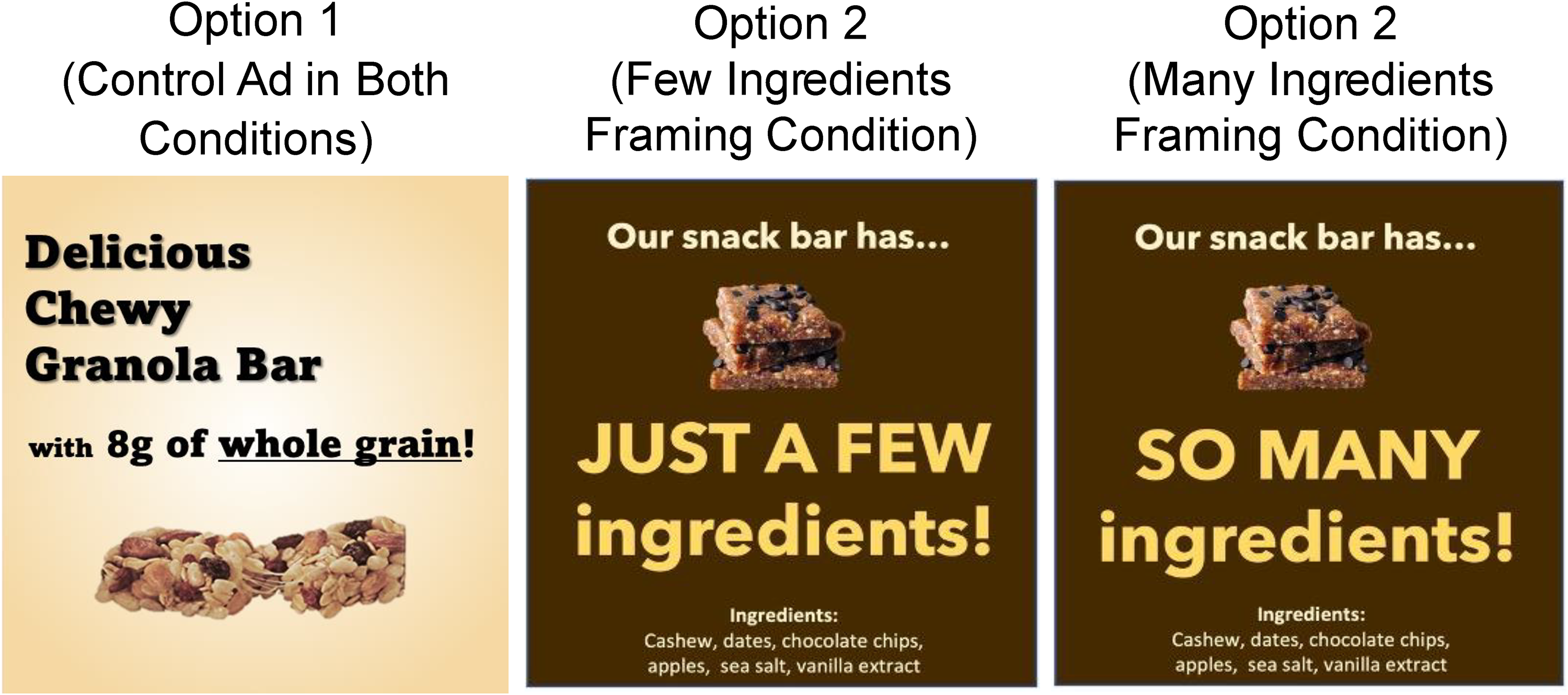
Advertisements (Experiment 1).
Results and Discussion
As predicted, participants who saw the few ingredients framing advertisement (that framed Option 2 as containing few ingredients) were more likely to choose Option 2 (58.22%) than those who saw the many ingredients framing advertisement (that framed Option 2 as containing many ingredients; 47.87%; χ2(1) = 4.15, p = .04, ɸ = .10). In other words, framing an identical product as containing a small number of ingredients increased consumers’ consequential selection of that product. Experiment 1 thus provides causal evidence that even when a product's actual ingredients are displayed and held constant, subjective perceptions of that product's ingredient quantity affect consumers’ real product choices.
The Web Appendix details several additional experiments further testing the generalizability of the current phenomenon. Web Appendix E includes an additional test of this effect on real decisions: Consumers are more likely to seek information about where to purchase a product that is framed as containing few (vs. many) ingredients.
These results raise an important question: Why does ingredient quantity framing influence consumer preferences? We assert that a key driver of this effect is inferences about naturalness (see Experiments 2a‒4c). However, another possibility is that these effects are primarily driven by differences in perceived portion size (perhaps more ingredients imply a larger portion size) or inferences about hidden ingredients (perhaps more ingredients signal the presence of undisclosed ingredients). In a supplementary experiment in Web Appendix F, we conducted a close conceptual replication of Experiment 1 that found evidence inconsistent with each of these alternatives. First, this experiment specified the portion size as well as the fact that the ingredient list was independently verified to be comprehensive. Participants were required to pass comprehension checks about both the portion size and the veracity of the ingredient list before continuing with the experiment. We replicated the effect of ingredient quantity framing on preferences, which is inconsistent with a portion size inference mechanism or a hidden ingredients inference mechanism. We also found that self-reported cognitive load did not vary between conditions, inconsistent with a cognitive load mechanism.
Another experiment (Web Appendix G) found evidence inconsistent with the possibility that the current effects occur because consumers perceive that the content (i.e., the individual ingredients) in products with few (vs. many) ingredients is more natural. This experiment compared two products: a product with few (four) ingredients that contained one relatively artificial ingredient (vanilla flavoring) and a product with many (six) natural ingredients without this artificial ingredient. As expected, the presence of this artificial ingredient in the few-ingredient product led consumers to perceive the individual ingredients in the product with few (vs. many) ingredients as less natural on average. As predicted by our theoretical framework, even in this context consumers still perceived the product with few (vs. many) ingredients as more natural overall.
In sum, five studies provide correlational evidence (Pilot Studies 1a and 1b) and causal evidence (Experiment 1, Web Appendices E and F) consistent with our theorizing that framing a product as containing few ingredients (vs. many ingredients or not highlighting ingredient quantity) shapes consumers’ real and hypothetical product decisions. Next, we examine the mechanism underpinning this bias.
Experiment 2a
We theorize that the effect of ingredient quantity framing occurs because consumers infer that products framed as containing few (vs. many) ingredients have undergone less processing and are thus more natural. Experiment 2a tested this theorizing with a serial mediation model and used a new product category to further test generalizability (i.e., juice).
Method
As preregistered (https://aspredicted.org/Q2J_Z5J), we recruited 200 CloudResearch participants and excluded those who failed an attention check (n = 21), leaving a final sample of 179 participants (57.5% female, 41.3% male, 1.1% other; Mage = 41.89 years). All participants viewed an advertisement for a juice created by the brand “Pressed.” Across conditions, the advertisement included an identical and complete list of the juice's ingredients (i.e., orange, lemon, carrot, apple, mango, grapefruit, elderberry, and beet). Between conditions, we manipulated the perceived quantity of these ingredients by altering the advertisement's headline. Participants in the few (many) ingredients framing condition saw the headline “Our juice has just a few (so many) ingredients!”
Next, participants indicated their purchase likelihood (“How likely are you to buy juice from ‘Pressed’?”; 1 = “Very unlikely,” and 7 = “Very likely”) and their naturalness perceptions (“To what extent do you think the juice from ‘Pressed’ is natural?”; 1 = “Not at all natural,” and 7 = “Very natural”). They then reported their perceptions of how much processing the product had undergone, computed by averaging three items adapted from Berry, Burton, and Howlett (2017) and Hässig et al. (2023). They were asked, “To what extent do you agree with the following statements?”: “This juice is heavily processed,” “There is only minimal processing involved in making this juice” (reverse-coded), and “Making this juice requires a lot of human processing” (1 = “Not at all,” and 7 = “Very much”; items randomized, α = .77). Purchase likelihood, naturalness perceptions, and processing perceptions were measured in a randomized order.
Results and Discussion
Conceptually replicating the prior experiments, framing the same product as containing few (vs. many) ingredients increased consumers’ likelihood of purchasing it (MFew = 4.83, SD = 1.46; MMany = 4.15, SD = 1.77; t(163.14) = 2.78, p = .006, d = .42), fostered the perception that it had undergone less processing (MFew = 2.87, SD = 1.24; MMany = 4.15, SD = 1.32; t(172.64) = −6.70, p < .001, d = −1.01), and increased its perceived naturalness (MFew = 5.67, SD = 1.15; MMany = 4.82, SD = 1.69; t(145.79) = 3.88, p < .001, d = .59).
Next, we conducted a serial mediation analysis in which the independent variable was framed ingredient quantity, the first mediator was the perceived extent of processing, the second mediator was perceived naturalness, and the dependent variable was purchase likelihood (PROCESS Model 6; Hayes 2017). The analysis found that framing the same product as containing few (vs. many) ingredients fostered the perception that the product had undergone less processing, which in turn increased its perceived naturalness and thus increased purchase likelihood (serial indirect effect = .35, SE = .10, 95% CI: [.17, .58]; see Figure 4 for the mediation figure).
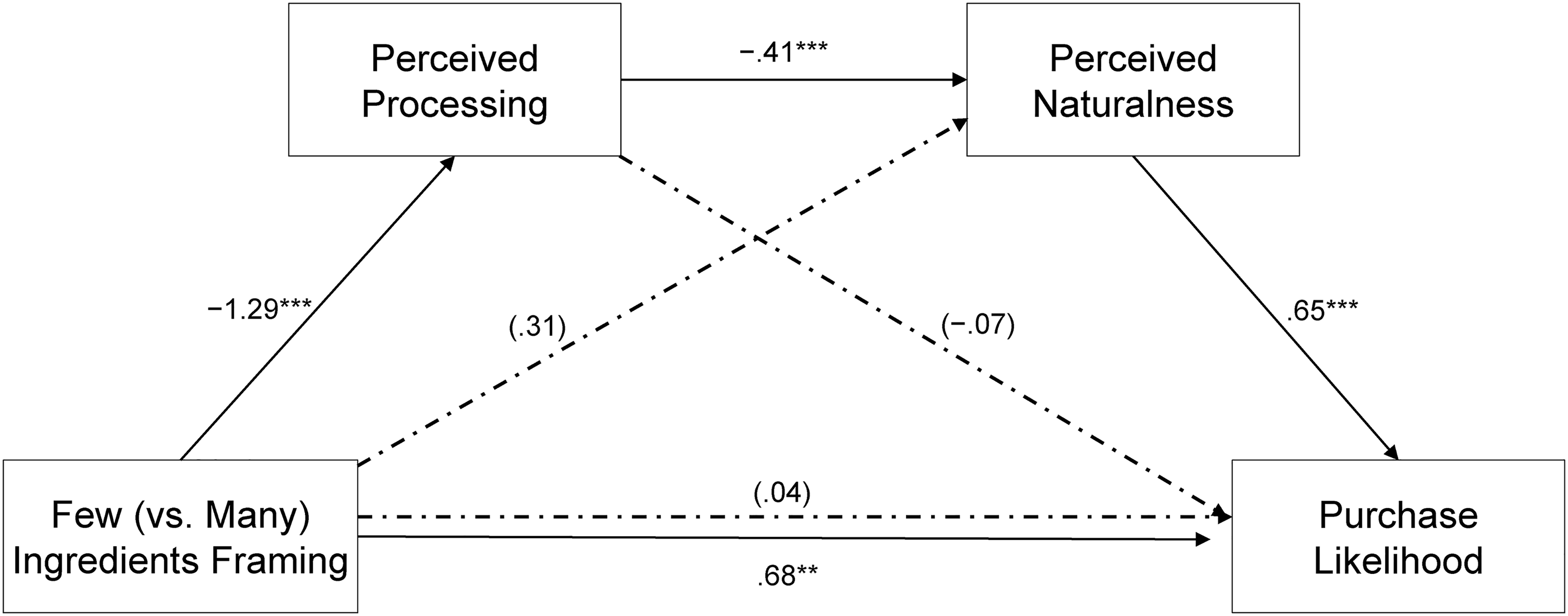
Serial Mediation (Experiment 2a).
In sum, framing the same product with the same ingredients as containing few (vs. many) ingredients fostered the perception that the product had undergone less processing and was thus more natural, which in turn increased participants’ likelihood of purchasing it. Three additional experiments in Web Appendices H1‒H3 further provide robust evidence that perceived naturalness mediates the effect of ingredient quantity framing on purchase likelihood.
Experiment 2b
Experiments 2b‒4c tested theoretically and practically important moderators of consumers’ preference for products framed as containing few ingredients. Experiment 2b leveraged moderation to further test our proposed processing mechanism. Specifically, if products framed as containing few (vs. many) ingredients are preferred because they are indeed perceived as less processed and consequently more natural, then equating the perceived processing of products framed as containing few versus many ingredients should eliminate this preference. Experiment 2b tested this theorizing by providing explicit information about processing to some consumers and examining whether it moderated the effect of ingredient quantity framing on consumer preferences.
Method
In this preregistered experiment (https://aspredicted.org/7CC_H6W), we recruited 1,600 participants from Prolific; 1,601 participants completed this experiment (57.5% female, 40.2% male, 2.3% other/prefer not to answer; Mage = 38.27 years). The participants were randomly assigned to one condition in a 2 (framed ingredient quantity: few ingredients framing vs. many ingredients framing) × 2 (processing information: baseline vs. present) between-subjects design.
All participants learned about a juice created by the brand “Pressed” and viewed the identical, comprehensive list of its ingredients (i.e., orange, lemon, carrot, apple, mango, grapefruit, elderberry, and beet). Between conditions, we manipulated the perceived quantity of these ingredients. In the few (many) ingredients framing condition, participants read that these identical ingredients are a “small (large) number of ingredients.” We also manipulated the presence of processing information. In the processing information present condition, participants read the following information: “In a study on available bottled juice on the market, Consumer Reports has found that Pressed Juice is the least processed based on rigorous and unbiased evaluations. In other words, the content in Pressed Juice undergoes less processing than all other juice brands.” By contrast, participants in the baseline condition did not read this additional information.
Next, participants indicated their purchase likelihood (“How likely would you be to purchase Pressed Juice over juice made by a different brand?”; 1 = “Much less likely to purchase Pressed Juice,” and 7 = “Much more likely to purchase Pressed Juice”). They then indicated their naturalness perceptions (“Do you think that Pressed Juice is less or more natural than the juices made by other brands?”; 1 = “Much less natural,” and 7 = “Much more natural”).
Results and Discussion
A 2 (framed ingredient quantity: few ingredients framing vs. many ingredients framing) × 2 (processing information: baseline vs. present) ANOVA on purchase likelihood yielded a main effect of the framed ingredient quantity condition (F(1, 1,597) = 31.75, p < .001, η2 = .02; see Figure 5) and the processing information condition (F(1, 1,597) = 193.88, p < .001, η2 = .11). Most importantly, it also revealed the predicted interaction (F(1, 1,597) = 25.59, p < .001, η2 = .02). Specifically, in the baseline condition, framing a product with the same quantity of ingredients as containing few ingredients increased participants’ likelihood of purchasing it (MFew = 5.06, SD = 1.34; MMany = 4.34, SD = 1.49; F(1, 1,597) = 59.91, p < .001). This effect was eliminated in the processing information present condition (MFew = 5.64, SD = 1.19; MMany = 5.59, SD = 1.22; F(1, 1,597) = .33, p = .57).
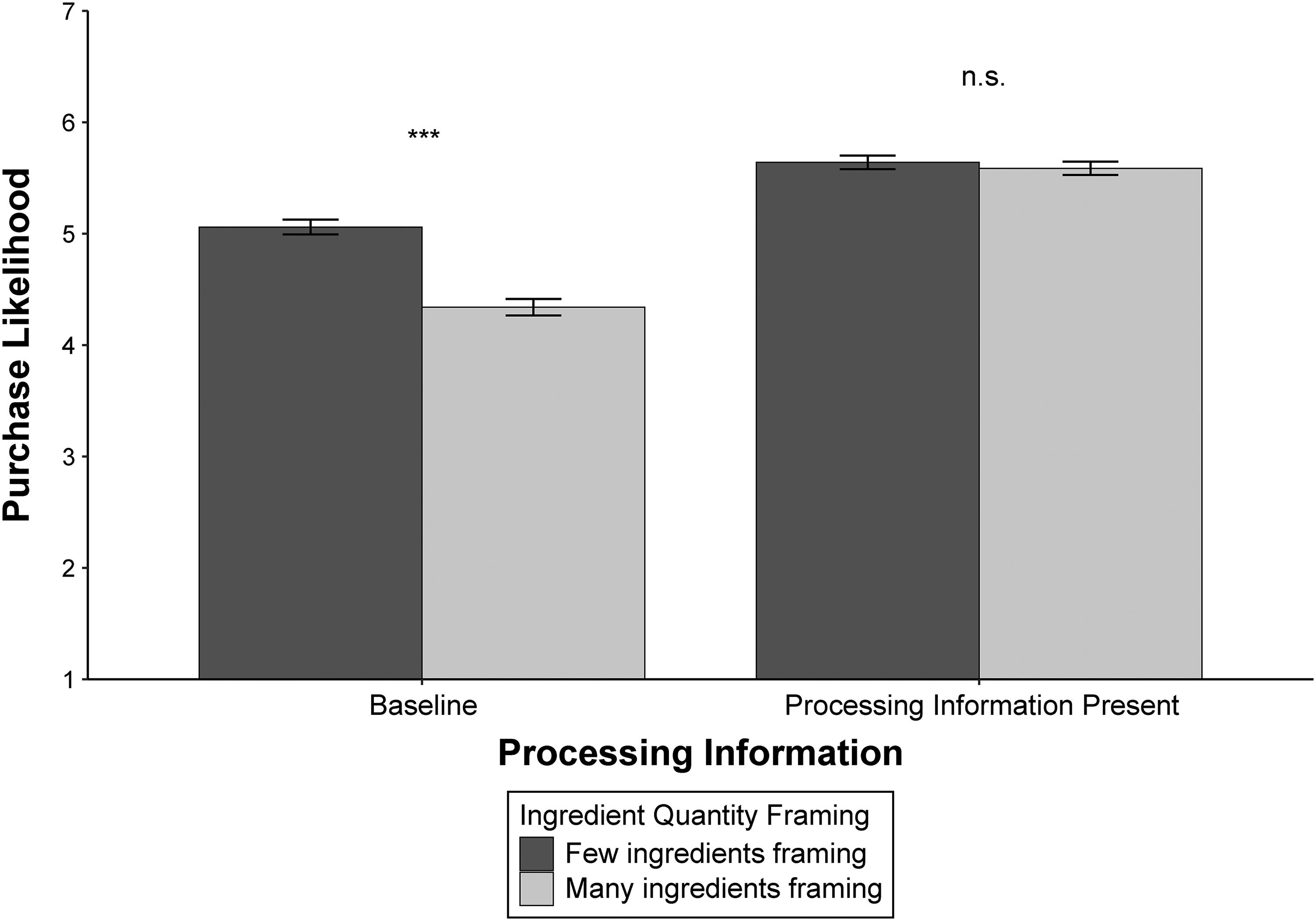
Interaction Between the Ingredient Quantity Framing Condition and the Processing Information Condition on Purchase Likelihood (Experiment 2b).
The same 2 × 2 ANOVA on naturalness perceptions revealed a main effect of the framed ingredient quantity condition (F(1, 1,597) = 1.50, p < .001, η2 = .03) and the processing information condition (F(1, 1,597) = 108.95, p < .001, η2 = .06). Most importantly, it also revealed the predicted interaction (F(1, 1,597) = 24.52, p < .001, η2 = .02). Specifically, framing the same quantity of ingredients as few (vs. many) ingredients increased perceptions of the product's naturalness in the baseline condition (MFew = 5.65, SD = 1.18; MMany = 4.90, SD = 1.45; F(1, 1,597) = 75.89, p < .001), and this effect was significantly attenuated in the processing information present condition (MFew = 5.98, SD = 1.11; MMany = 5.84, SD = 1.08; F(1, 1,597) = 2.86, p = .09).
Next, we tested the proposed process via a moderated mediation model. As previously detailed, we predict that the effect of ingredient quantity framing on perceived naturalness (i.e., the a-path) is moderated when consumers encounter explicit information about the product’s processing level. Specifically, we theorize that in the baseline condition, framing a product as containing few (vs. many) ingredients enhances its perceived naturalness—and in turn increases purchase likelihood—because consumers infer that fewer ingredients signal minimal processing. However, when consumers are explicitly told that both versions of the product are similarly minimally processed, this naturalness inference should no longer hold. In this processing information present condition, we expect participants to perceive the products as similarly natural regardless of framed ingredient quantity, thereby eliminating the effect of framing on naturalness perceptions and purchase likelihood. In other words, we expect the a-path (i.e., the effect of framed ingredient quantity on naturalness) to be weaker when processing information is provided, which should attenuate the entire indirect effect of ingredient quantity framing on purchase likelihood via naturalness.
To test this theorizing, we used the preregistered a-path moderated mediation model (PROCESS Model 7; Hayes 2017; i.e., a first-stage moderated mediation model) in which we entered the ingredient quantity framing condition as the independent variable, naturalness perceptions as the mediator, the presence of processing information as the moderator of the model's a-path, and purchase likelihood as the dependent variable. This analysis revealed significant moderated mediation (index of moderated mediation = −.40, SE = .08, 95% CI: [−.56, −.24]): Perceived naturalness mediated the effect of ingredient quantity framing on purchase likelihood in the baseline condition (conditional indirect effect = .49, SE = .07, 95% CI: [.36, .62]), and this indirect effect was significantly attenuated in the processing information present condition (conditional indirect effect = .10, SE = .05, 95% CI: [−.002, .20]; see the Web Appendix for the moderated mediation figure).
Experiment 3
Experiment 3 leveraged an additional moderation design to provide further evidence for the proposed mechanism. This experiment focused on an individual difference: consumers’ preference for natural products. Our theoretical framework predicts that if consumers prefer products framed as containing few (vs. many) ingredients because the products are perceived as more natural, then the preference for products framed as containing few ingredients should be greater among consumers who more greatly prefer natural products. This experiment also extended the generalizability of the current phenomenon by testing a different product category (nut butter) and a different manipulation of perceived ingredient quantity. It manipulated perceptions of the same product's ingredient quantity by providing information about the number of ingredients in a competitor's product.
Method
We recruited 600 participants from CloudResearch; 599 participants completed this experiment. As preregistered (https://aspredicted.org/PH6_1MN), we excluded those who failed an attention check (n = 12), leaving a final sample of 587 participants (45.3% female, 53.5% male, 1.2% other; Mage = 43.10 years).
In all conditions, participants viewed two nut butter products made by two different brands, and one of these nut butters had four ingredients. The number of ingredients in the other nut butter differed between conditions. This additional nut butter in the few (vs. many) ingredients framing condition contained nine (vs. one) ingredients, making the focal four-ingredient nut butter appear to contain relatively few (vs. many) ingredients in comparison. Participants first indicated their likelihood of purchasing the four-ingredient nut butter (“How likely are you to buy the nut butter with 4 ingredients?”; 1 = “Very unlikely,” and 7 = “Very likely”). They then indicated their perceptions of the focal nut butter's naturalness (“To what extent do you think that the nut butter with 4 ingredients is natural?”; 1 = “Not at all natural,” and 7 = “Very natural”). 2
Participants also completed a four-item index assessing their preference for naturalness (adapted from Brunner, Van der Horst, and Siegrist 2010; Siegrist et al. 2008; α = .86): “I cherish naturalness in all things,” “I don’t believe that natural foods are better than conventional foods” (reverse-coded), “I feel better when I eat natural foods,” and “I purchase or consume natural foods whenever possible.” Participants indicated their agreement with each item on seven-point scales (1 = “Not at all,” and 7 = “Very much”), and we averaged them to compute their preference for naturalness score. We also randomized whether participants completed this four-item scale at the start or end of the experiment.
Results and Discussion
As predicted, framing the four-ingredient nut butter as containing few (vs. many) ingredients increased participants’ likelihood of purchasing it (MFew = 5.57, SD = 1.28; MMany = 3.34, SD = 1.34; t(569.9) = 19.33, p < .001, d = 1.59) and heightened its perceived naturalness (MFew = 5.32, SD = 1.07; MMany = 3.65, SD = 1.32; t(562.5) = 16.79, p < .001, d = 1.38). The effect of ingredient quantity framing on purchase likelihood was moderated by individual differences in the preference for naturalness. Specifically, an interaction emerged between condition and individual differences in the preference for naturalness on purchase likelihood (B = −.85, SE = .08, t(583) = −10.52, p < .001). A Johnson–Neyman analysis (Spiller et al. 2013) revealed that participants with a preference for naturalness above 2.96 (which included 92.8% of the participants) were more likely to purchase the product framed as containing few (vs. many) ingredients (see the Web Appendix for the Johnson–Neyman graph). Those who scored below 1.83 were significantly more likely to purchase the product framed as containing many (vs. few) ingredients. 3
Additionally, we tested the theorized psychological process using a moderated mediation model. As previously detailed, we theorize that consumers are more likely to purchase products (framed as) containing few ingredients because they are perceived as more natural. However, this greater purchase likelihood should depend on how much consumers value naturalness. We predict that consumers perceive products (framed as) containing few ingredients as more natural, but the degree to which this inference about naturalness increases purchase likelihood should depend on whether the consumer in general desires natural products. In other words, we expect individual differences in the preference for natural products to moderate the b-path (the effect of naturalness inferences on purchase likelihood).
We tested this theorizing in a (non-preregistered) b-path moderated mediation analysis (PROCESS Model 14; Hayes 2017; i.e., a second-stage moderated mediation model). The analysis revealed a significant index of moderated mediation such that the indirect effect of perceived naturalness varied depending on individual differences in consumers’ preference for natural products (index of moderated mediation = .26, SE = .06, 95% CI: [.15, .38]). Specifically, the indirect effect on purchase likelihood via naturalness was larger for participants whose trait preference for naturalness was one standard deviation above the mean (i.e., at 6.4 out of 7, conditional indirect effect = 1.19, SE = .11, 95% CI: [.99, 1.39]) and smaller for those whose trait preference for naturalness was one standard deviation below the mean (i.e., at 3.8 out of 7, conditional indirect effect = .51, SE = .13, 95% CI: [.24, .75]; see the Web Appendix for the moderated mediation figure and the results of a supplementary non-preregistered robustness check using PROCESS Model 15).
Experiment 3 finds further evidence that the preference for products (framed as) containing few ingredients stems from the inference that these products are more natural. Additional empirics replicate its findings in an incentive-compatible context (Web Appendix I).
Experiment 4a
Consumers often prefer natural products (Rozin et al. 2004, 2012). As a result, the prior empirics found that consumers generally prefer few-ingredient products because they hold a lay belief that these products are more natural. In Experiments 4a‒4c, we contrasted these baseline preferences with those formed in contexts where other specific consumption goals rise in importance. In Experiment 4a, we first tested our framework's prediction that the influence of perceived ingredient quantity on preferences shifts when a uniqueness goal rises in importance. As detailed in the introduction, we predict that consumers hold a lay belief that products with few (vs. many) ingredients are less unique (see also Web Appendix J). We further propose that this lay belief even colors the perceived uniqueness of products containing the same quantity of ingredients that are simply framed as having few (vs. many) ingredients.
Although our empirics find that consumers at baseline prefer products framed as containing few (vs. many) ingredients (because they have a lay belief that products containing few ingredients are more natural), we expect a uniqueness goal will moderate this effect. Because consumers have a lay belief that products with many (vs. few) ingredients are more unique, having a goal to find a unique product should moderate (i.e., attenuate or reverse) the preference for products framed as containing few ingredients. By testing this prediction, Experiment 4a examined an additional theoretically and practically important moderator of ingredient quantity preferences.
Method
In this preregistered experiment (https://aspredicted.org/9q7v-py7t.pdf), we recruited 1,000 participants from CloudResearch; 1,014 participants completed this study (63.5% female, 34.7% male, 1.4% other, .3% prefer not to answer; Mage = 37.99 years). The participants were randomly assigned to one condition in a 2 (framed ingredient quantity: few ingredients framing vs. many ingredients framing) × 2 (purchase goal: baseline vs. uniqueness goal) between-subjects design.
All participants imagined that they were considering serving an appetizer with six ingredients at an event. Between conditions, we manipulated whether participants perceived these six ingredients as a small versus large quantity of ingredients. In the few (many) ingredients framing condition, the appetizer's six ingredients were described as “only a few” ingredients and “a small number” of ingredients (vs. “so many” ingredients and “a large number” of ingredients). We also manipulated participants’ purchase goal. In the uniqueness goal condition, participants read “You want to serve the guests an appetizer that is unique and one-of-a-kind.” Participants in the baseline condition did not read this additional information.
Next, all participants completed three measures. First, they indicated their likelihood of choosing the appetizer (i.e., purchase likelihood; “How likely would you be to choose this appetizer for the guests?”; 1 = “Very unlikely,” and 7 = “Very likely”). They next indicated their naturalness perceptions (“To what extent do you think that this appetizer is natural?”; 1 = “Not natural at all,” and 7 = “Very natural”) and their uniqueness perceptions (“To what extent do you think that this appetizer is unique?”; 1 = “Not unique at all,” and 7 = “Very unique”). The order of the latter two measures was randomized.
Results and Discussion
A 2 (framed ingredient quantity: few ingredients framing vs. many ingredients framing) × 2 (purchase goal: baseline vs. uniqueness goal) ANOVA on participants’ likelihood of choosing the appetizer found no significant main effect of the framed ingredient quantity condition (F(1, 1,010) = 1.26, p = .26, η2 = .001) and a significant main effect of the purchase goal condition (F(1, 1,010) = 5.49, p < .001, η2 = .07; see Figure 6). Most importantly, the predicted interaction emerged (F(1, 1,010) = 37.02, p < .001, η2 = .04). Specifically, in the baseline condition, participants were more likely to choose the appetizer when it was framed as containing few (vs. many) ingredients (MFew = 5.53, SD = 1.14; MMany = 4.89, SD = 1.37; F(1, 1,010) = 25.33, p < .001). This effect significantly reversed in the uniqueness goal condition: Framing the appetizer as containing few (vs. many) ingredients decreased participants’ likelihood of choosing it (MFew = 4.20, SD = 1.65; MMany = 4.66, SD = 1.53; F(1, 1,010) = 12.76, p < .001).

Interaction Between the Ingredient Quantity Framing Condition and the Uniqueness Goal Condition on Purchase Likelihood (Experiment 4a).
The same 2 × 2 ANOVA on naturalness perceptions found no significant main effect of the purchase goal condition (F(1, 1,010) = .15, p = .70, η2 = .0001) and a marginal interaction (F(1, 1,010) = 3.42, p = .06, η2 = .003). Most importantly, it yielded the predicted main effect of the ingredient quantity framing condition (F(1, 1,010) = 68.70, p < .001, η2 = .06): Framing the appetizer as having few (vs. many) ingredients increased its perceived naturalness in the baseline condition (MFew = 5.25, SD = 1.33; MMany = 4.37, SD = 1.48; F(1, 1,010) = 51.43, p < .001) and the uniqueness goal condition (MFew = 5.06, SD = 1.26; MMany = 4.50, SD = 1.44; F(1, 1,010) = 20.66, p < .001). These results provide further evidence for the naturalness lay belief: Products framed as containing few (vs. many) ingredients are perceived as more natural.
The same 2 × 2 ANOVA on uniqueness perceptions found no significant main effect of the purchase goal condition (F(1, 1,010) = .93, p = .33, η2 = .001) or interaction (F(1, 1,010) = .10, p = .75, η2 = .0001), but most importantly, it yielded the predicted main effect of the ingredient quantity framing condition (F(1, 1,010) = 73.57, p < .001, η2 = .07): Framing the appetizer as containing many (vs. few) ingredients increased perceptions of its uniqueness in both the baseline condition (MFew = 4.54, SD = 1.35; MMany = 5.26, SD = 1.29; F(1, 1,010) = 34.05, p < .001) and the uniqueness goal condition (MFew = 4.59, SD = 1.58; MMany = 5.38, SD = 1.37; F(1, 1,010) = 39.44, p < .001). These results provide evidence for the proposed uniqueness lay belief: Products framed as containing many (vs. few) ingredients are perceived as more unique.
Next, we tested the theorized psychological process using a moderated mediation model. We entered the framed ingredient quantity condition as the independent variable, naturalness and uniqueness perceptions as parallel mediators, the purchase goal condition as the moderator of the model's b-paths, and purchase likelihood as the dependent variable (PROCESS Model 14; Hayes 2017). This model includes two possible indirect effects: a naturalness indirect effect (i.e., framed ingredient quantity alters naturalness perceptions and thus purchase likelihood) and a uniqueness indirect effect (i.e., framed ingredient quantity alters uniqueness perceptions and thus purchase likelihood). Most importantly, the model tests a critical prediction: The presence of a uniqueness goal increases the size of the uniqueness indirect effect. That is, viewing a product as unique should matter more for purchase likelihood if the goal to purchase a unique product rises in importance (i.e., uniqueness b-path moderation). This is what we find. Specifically, the goal manipulation moderated the uniqueness indirect effect (index of moderated mediation = −.32, SE = .06, 95% CI: [−.45, −.21]): The effect of framed ingredient quantity on purchase likelihood through uniqueness perceptions was larger in the uniqueness goal condition (conditional indirect effect = −.45, SE = .06, 95% CI: [−.58, −.33]) than in the baseline condition (conditional indirect effect = −.13, SE = .04, 95% CI: [−.20, −.06]).
This model also tests whether the goal manipulation moderates the naturalness indirect effect—a question to which our theoretical framework is agnostic. If the importance of the naturalness goal decreases as the importance of the uniqueness goal increases, the manipulation would moderate the indirect effect. Alternatively, if goal importance is non-zero-sum and the importance of the naturalness goal remains stable when the importance of the uniqueness goal rises, the manipulation may not moderate this indirect effect. In the current experiment, the goal manipulation moderated the naturalness indirect effect (index of moderated mediation = −.09, SE = .05, 95% CI: [−.19, −.01]) such that the effect of framed ingredient quantity on purchase likelihood through naturalness perceptions was larger in the baseline condition (conditional indirect effect = .21, SE = .04, 95% CI: [.13, .29]) than in the uniqueness goal condition (conditional indirect effect = .11, SE = .03, 95% CI: [.05, .18]; see the Web Appendix for the moderated mediation figure).
Experiment 4b
Experiment 4b conducted an additional test of our theoretical framework. Specifically, we tested the framework's prediction that the influence of perceived ingredient quantity on preferences shifts when an indulgence goal rises in importance. As detailed in the introduction, we predict that consumers hold a lay belief that products with many (vs. few) ingredients are more indulgent. Thus, although our prior empirics find that the lay belief that products with few (vs. many) ingredients are more natural fuels consumers’ baseline preference for products framed as containing few (vs. many) ingredients, we theorize that an indulgence goal moderates this effect (by attenuating or reversing it).
Method
In this preregistered experiment (https://aspredicted.org/X9T_T7H), we recruited 1,000 participants from Prolific; 1,001 participants completed this study (52.3% female, 45.7% male, 2.0% other/prefer not to answer; Mage = 37.08 years). The participants were randomly assigned to one condition in a 2 (framed ingredient quantity: few ingredients framing vs. many ingredients framing) × 2 (purchase goal: baseline vs. indulgence goal) between-subjects design. All participants learned about a snack bar that contained nine ingredients, and those in the few (many) ingredients framing condition read that nine ingredients is “a small (large) number of ingredients” for a snack bar. We also manipulated participants’ goal. In the indulgence goal condition, participants read “Imagine you are trying to get an indulgent snack bar. Your goal is to maximize your pleasure by finding something decadent and satisfying.” Those in the baseline condition did not read this additional goal information (i.e., they simply read the first sentence without the mention of the indulgence goal [“Imagine you are trying to get a snack bar”]).
Next, all participants completed three items. First, they indicated their purchase likelihood (“How likely would you be to purchase the above snack bar?”; 1 = “Not likely at all,” and 7 = “Very likely”). They next indicated their naturalness perceptions (“To what extent do you think that the above snack bar is natural?”; 1 = “Not at all natural,” and 7 = “Very natural”) and indulgence perceptions (“To what extent do you think that the above snack bar is indulgent?”; 1 = “Not at all indulgent,” and 7 = “Very indulgent”). The order of the latter two measures was randomized.
Results and Discussion
A 2 (framed ingredient quantity: few ingredients framing vs. many ingredients framing) × 2 (purchase goal: baseline vs. indulgence goal) ANOVA on purchase likelihood revealed no significant main effect of the purchase goal condition (F(1, 997) = .95, p = .33, η2 = .001) and a significant main effect of the framed ingredient quantity condition (F(1, 997) = 17.55, p < .001, η2 = .02). Most importantly, the predicted interaction emerged (F(1, 997) = 64.05, p < .001, η2 = .06; see Figure 7).
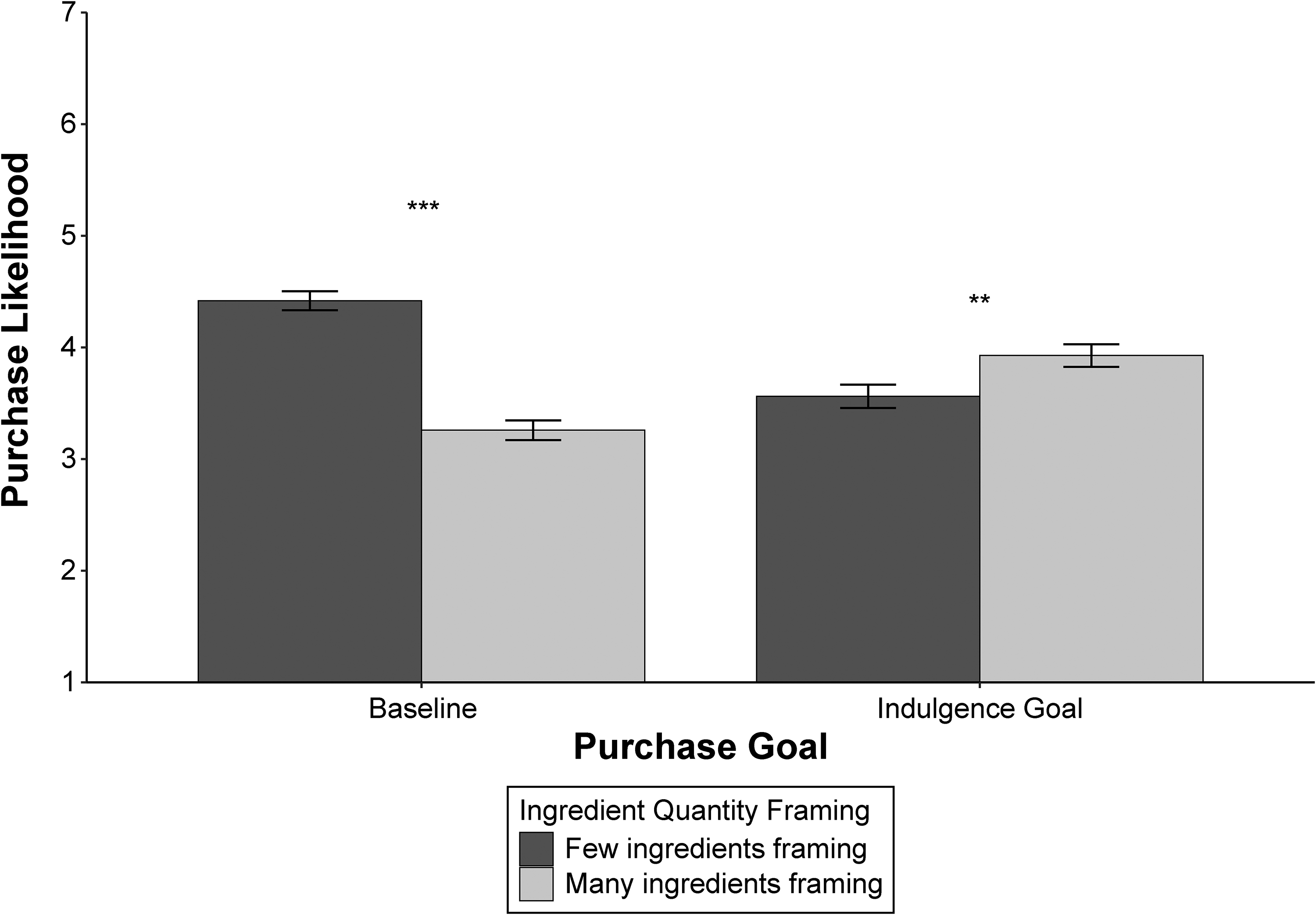
Interaction Between the Ingredient Quantity Framing Condition and the Indulgence Goal Condition on Purchase Likelihood (Experiment 4b).
Specifically, in the baseline condition, framing a product with the same quantity of ingredients as containing few (vs. many) ingredients increased participants’ likelihood of purchasing it (MFew = 4.42, SD = 1.36; MMany = 3.26, SD = 1.39; F(1, 997) = 74.25, p < .001). This effect reversed in the indulgence goal condition: Framing the product as containing few (vs. many) ingredients decreased participants’ likelihood of purchasing it (MFew = 3.56, SD = 1.66; MMany = 3.93, SD = 1.60; F(1, 997) = 7.34, p = .007).
The same 2 × 2 ANOVA on naturalness perceptions found no main effect of the purchase goal condition (F(1, 997) = .33, p = .57, η2 = .0003) or interaction (F(1, 997) = .58, p = .45, η2 = .001). Most importantly, it yielded the predicted main effect of the ingredient quantity framing condition (F(1, 997) = 556.45, p < .001, η2 = .36): Framing the same quantity of ingredients as few (vs. many) ingredients increased perceptions of the product's naturalness in both the baseline condition (MFew = 5.04, SD = 1.20; MMany = 3.12, SD = 1.43; F(1, 997) = 61.44, p < .001) and the indulgence goal condition (MFew = 5.16, SD = 1.25; MMany = 3.10, SD = 1.56; F(1, 997) = 95.62, p < .001). These results provide converging evidence for the proposed naturalness lay belief: Products framed as containing few (vs. many) ingredients are perceived as more natural.
The same 2 × 2 ANOVA on indulgence perceptions found no main effect of the purchase goal condition (F(1, 997) = .94, p = .33, η2 = .001) or interaction (F(1, 997) = .02, p = .89, η2 < .001). Most importantly, it yielded the predicted main effect of the ingredient quantity framing condition (F(1, 997) = 81.90, p < .001, η2 = .08): Framing the same quantity of ingredients as few (vs. many) ingredients fostered the perception that the product was more indulgent in both the baseline condition (MFew = 3.57, SD = 1.32; MMany = 4.41, SD = 1.48; F(1, 997) = 39.87, p < .001) and the indulgence goal condition (MFew = 3.47, SD = 1.56; MMany = 4.33, SD = 1.56; F(1, 997) = 42.08, p < .001). These results provide evidence for the proposed indulgence lay belief: Products framed as containing many (vs. few) ingredients are perceived as more indulgent.
Next, as in Experiment 4a, we tested the theorized psychological process using a moderated mediation model. We entered the framed ingredient quantity condition as the independent variable, naturalness and indulgence perceptions as parallel mediators, the purchase goal condition as the moderator of the model's b-paths, and purchase likelihood as the dependent variable (PROCESS Model 14, Hayes 2017). This analysis enabled us to test our theoretical framework's core prediction: The presence of an indulgence goal increases the size of the indulgence indirect effect. That is, viewing a product as indulgent should more strongly influence purchase likelihood when an indulgence goal rises in importance (i.e., moderation of the b-path by the indulgence goal).
This is indeed what we find. Specifically, this analysis revealed a significant index of moderated mediation for the indulgence indirect effect (index of moderated mediation = −.50, SE = .07, 95% CI: [−.65, −.36]). Indulgence perceptions mediated purchase likelihood in the indulgence goal condition (conditional indirect effect = −.67, SE = .08, 95% CI: [−.83, −.52]), and this indirect effect was significantly attenuated in the baseline condition (conditional indirect effect = −.17, SE = .04, 95% CI: [−.25, −.10]). A significant index of moderated mediation also emerged for the naturalness indirect effect (index of moderated mediation = −.64, SE = .10, 95% CI: [−.83, −.45]) such that naturalness perceptions mediated the effect of the framed ingredient quantity condition on purchase likelihood in the baseline condition (conditional indirect effect = .90, SE = .09, 95% CI: [.72, 1.09]). Additionally, this indirect effect was significantly attenuated in the indulgence goal condition (conditional indirect effect = .26, SE = .08, 95% CI: [.12, .41]; see the Web Appendix for the moderated mediation figure).
Experiment 4c
Experiment 4c conducted an additional test of our theoretical framework. Specifically, the framework further predicts that the influence of perceived ingredient quantity on preferences shifts when the goal to consume a variety of vitamins rises in importance. As detailed in the introduction, we theorize that consumers hold a lay belief that products with many (vs. few) ingredients contain a larger (vs. smaller) number of different essential vitamins, and that this lay belief even colors the perceived variety of different vitamins in products with the same ingredients that are simply framed as containing few (vs. many) ingredients. As a result, we further predict that when the goal to consume a variety of vitamins rises in importance, the preference for products framed as containing few ingredients is moderated (i.e., attenuated or reversed).
Method
In this preregistered experiment (https://aspredicted.org/t678-9nfr.pdf), we recruited 1,000 participants from Prolific; 1,001 participants completed this study (61.4% female, 36.7% male, 1.9% other/prefer not to answer; Mage = 38.72 years). The participants were randomly assigned to one condition in a 2 (framed ingredient quantity: few ingredients framing vs. many ingredients framing) × 2 (purchase goal: baseline vs. vitamin variety goal) between-subjects design.
All participants learned about the same smoothie that exclusively contained strawberries, oranges, blueberries, milk, honey, and bananas. Between conditions, we varied the framing of these identical ingredients. In the few (many) ingredients framing condition, participants read that these ingredients amounted to “only a few ingredients” (“so many ingredients”) and “a small number of ingredients” (“a large number of ingredients”). We also manipulated whether participants were prompted to seek a smoothie containing a variety of essential vitamins by leveraging an intervention that can be easily applied in digital marketplaces: a pop-up message. Specifically, in the vitamin variety goal condition, participants were shown a pop-up message that highlighted the importance of obtaining all 13 essential vitamins. Those in the baseline condition were not shown this pop-up message.
Next, all participants indicated their purchase likelihood (“How likely would you be to buy this smoothie?”; 1 = “Not likely at all,” and 7 = “Very likely”). They then indicated their perceptions of the smoothie's naturalness (“To what extent do you think that this smoothie is natural?”; 1 = “Not natural at all,” and 7 = “Very natural”) and its likelihood of containing all essential vitamins (“To what extent do you think that this smoothie has all 13 essential vitamins?”; 1 = “Not at all likely,” and 7 = “Very likely”). The order of the latter two items was randomized.
Results and Discussion
A 2 (framed ingredient quantity: few ingredients framing vs. many ingredients framing) × 2 (purchase goal: baseline vs. vitamin variety goal) ANOVA on purchase likelihood found no main effect of the purchase goal condition (F(1, 997) = .55, p = .46, η2 = .001) and a main effect of the framed ingredient quantity condition (F(1, 997) = 33.05, p < .001, η2 = .03), but most importantly, the predicted interaction emerged (F(1, 997) = 30.34, p < .001, η2 = .03; see Figure 8). Specifically, as in the prior experiments, framing the same product in the baseline condition as containing few (vs. many) ingredients increased participants’ likelihood of purchasing it (MFew = 5.60, SD = 1.26; MMany = 4.50, SD = 1.64; F(1, 997) = 63.44, p < .001). By contrast, this did not occur in the vitamin variety goal condition: Framing the same product as containing few (vs. many) ingredients did not significantly increase participants’ likelihood of purchasing it (MFew = 4.99, SD = 1.49; MMany = 4.97, SD = 1.77; F(1, 997) = .02, p = .88).

Interaction Between the Ingredient Quantity Framing Condition and the Vitamin Variety Goal Condition on Purchase Likelihood (Experiment 4c).
The same 2 × 2 ANOVA on perceived naturalness found no main effect of the purchase goal condition (F(1, 997) = 1.23, p = .27, η2 = .001) and no interaction (F(1, 997) = .62, p = .43, η2 = .001). Most importantly, it revealed the predicted main effect of the framed ingredient quantity condition (F(1, 997) = 73.56, p < .001, η2 = .07): Framing the same product as containing few (vs. many) ingredients increased perceptions of the product's naturalness in both the baseline condition (MFew = 5.84, SD = 1.17; MMany = 5.06, SD = 1.37; F(1, 997) = 44.21, p < .001) and the vitamin variety goal condition (MFew = 5.69, SD = 1.20; MMany = 5.03, SD = 1.52; F(1, 997) = 30.14, p < .001). These results provide further evidence for the naturalness lay belief: Products framed as containing few (vs. many) ingredients are perceived as more natural.
The same 2 × 2 ANOVA on perceived vitamin variety found a significant main effect of the purchase goal condition (F(1, 997) = 7.57, p = .006, η2 = .008) and a marginal interaction (F(1, 997) = 3.05, p = .08, η2 = .003). Most importantly, the predicted main effect of the framed ingredient quantity condition emerged (F(1, 997) = 34.29, p < .001, η2 = .03): Framing the same product as containing many (vs. few) ingredients increased perceptions of the product's vitamin variety in both the baseline condition (MFew = 4.41, SD = 1.29; MMany = 4.80, SD = 1.47; F(1, 997) = 8.65, p = .003) and the vitamin variety goal condition (MFew = 4.51, SD = 1.66; MMany = 5.22, SD = 1.47; F(1, 997) = 28.98, p < .001). These results thus provide evidence for the proposed vitamin variety lay belief: Products framed as containing many (vs. few) ingredients are perceived as more likely to contain all essential vitamins.
Next, as in Experiments 4a and 4b, we tested the theorized process using a moderated mediation model. We entered the framed ingredient quantity condition as the independent variable, naturalness and vitamin variety perceptions as parallel mediators, the purchase goal condition as the moderator of the model's b-paths, and purchase likelihood as the dependent variable (PROCESS Model 14; Hayes 2017). This analysis enabled us to test our theoretical framework's core prediction: The presence of a vitamin variety goal increases the size of the vitamin variety indirect effect. That is, viewing a product as containing a larger variety of different vitamins should more strongly influence purchase likelihood when the goal to purchase a product containing a large variety of different vitamins rises in importance (i.e., moderation of the b-path by the vitamin variety goal).
This is indeed what we find. Specifically, this analysis revealed a significant index of moderated mediation for the vitamin variety indirect effect (index of moderated mediation = −.17, SE = .05, 95% CI: [−.28, −.09]). Vitamin variety perceptions mediated purchase likelihood in the vitamin variety goal condition (conditional indirect effect = −.22, SE = .05, 95% CI: [−.32, −.13]), and this indirect effect was significantly attenuated in the baseline condition (conditional indirect effect = −.05, SE = .03, 95% CI: [−.11, .01]). A significant index of moderated mediation also emerged for the naturalness indirect effect (index of moderated mediation = −.13, SE = .06, 95% CI: [−.25, −.02]) such that naturalness perceptions mediated the effect of the framed ingredient quantity condition on purchase likelihood in the baseline condition (conditional indirect effect = .27, SE = .05, 95% CI: [.17, .37]), and this indirect effect was significantly attenuated in the vitamin variety goal condition (conditional indirect effect = .14, SE = .04, 95% CI: [.06, .22]; see the Web Appendix for the moderated mediation figure). 4
In sum, although consumers commonly pursue the goal to consume natural products (e.g., Li and Gal 2023; Rozin et al. 2004; Scott, Rozin, and Small 2020), there are also instances in which other goals rise in importance (e.g., Campbell 1987). Because the goal to consume natural products fuels the preference for products framed as containing few ingredients, this preference no longer emerges when different consumption goals favoring many-ingredient products rise in importance, such as the goal to consume unique products (Experiment 4a), the goal to indulge (Experiment 4b), and the goal to consume a variety of essential vitamins (Experiment 4c).
General Discussion
Ingredient quantity claims pervade the marketplace. This research is the first to demonstrate that advertising the exact same products as containing few (vs. many) ingredients systematically alters consumers’ product preferences. First, we find that consumers hold a lay belief that products with few ingredients are more natural. Because consumers typically prefer natural products, we find that framing the exact same products as containing few (vs. many) ingredients often increases consumers’ preference for them. In Pilot Studies 1a and 1b, we first show this effect of ingredient quantity framing on consumers’ consequential decisions. Two pilot field studies with different real products and companies (Pilot Studies 1a and 1b) show that advertising identical products as having few ingredients (vs. many ingredients or not highlighting ingredient quantity at all) is associated with increased consumer interest and engagement. Similarly, in a controlled lab experiment with real product choices (Experiment 1), describing the same product as containing few (vs. many) ingredients increased selection of that product. We find that this effect emerges because consumers infer that products (framed as) containing few (vs. many) ingredients have undergone less processing and are therefore more natural (Experiments 2a and 2b). As a result, this preference for products framed as containing few (vs. many) ingredients declines when consumers have a lower trait preference for natural products (Experiment 3).
We also document three additional novel lay beliefs that consumers hold about ingredient quantity: Consumers hold a lay belief that products with many (vs. few) ingredients are more unique, more indulgent, and contain a larger variety of essential vitamins (Experiments 4a‒4c). As a result, their robust preference for the exact same products framed as containing few (vs. many) ingredients declines when these other consumption goals rise in importance (Experiments 4a‒4c). Each of these moderators provides important theoretical insight and arms marketers with practical strategies that they can leverage to optimally position their products in the marketplace.
Theoretical Contributions
The psychology of naturalness
Our research offers several theoretical contributions. First, our work advances the literature on naturalness by revealing a novel cue that alters naturalness perceptions and therefore product preferences: ingredient quantity. As previously detailed, prior literature has not studied this cue. Instead, the most related prior literature (see Web Appendix B) has focused on presenting participants with scenarios that explicitly describe product modifications or spotlight a particular product attribute (such as pasteurization, genetic engineering, or the addition or removal of an ingredient) and found that doing so reduces rated naturalness (Web Appendix B). By contrast, our research makes the novel contribution of identifying the role that a distinct and unstudied construct—perceived ingredient quantity—plays in shaping naturalness perceptions and preferences. We find that holistic perceptions of total ingredient quantity affect naturalness perceptions such that even when ingredient content remains constant, simply framing the same product ingredients as small (large) in quantity increases (reduces) naturalness perceptions.
Second, we examine how consumers form processing perceptions, one important determinant of naturalness, when information about exactly how a product was processed is unavailable. Providing insight into this unanswered question is critical because brands rarely display the history of how raw materials become a packaged product. In the frequent cases where a product's processing history is difficult to observe, our work finds an unstudied, readily observable cue that consumers use to infer processing and therefore naturalness: ingredient quantity.
In addition, we contribute to the burgeoning literature investigating factors that attenuate consumers’ strong baseline preference for natural products. Prior work finds that this preference attenuates when consumers desire to cure (vs. prevent) an ailment (Scott, Rozin, and Small 2020) or treat psychological (vs. physical) conditions (Li and Gal 2023). We contribute to this literature by uncovering several additional consumption contexts in which consumers end up preferring products that they perceive as less natural because of competing goals that favor higher ingredient quantity (e.g., the goal for a more unique product, as detailed next).
Charting consumers’ multiple ingredient quantity lay beliefs and their opposing impact on preferences
Our work is the first to build a theoretical framework mapping how perceived ingredient quantity affects consumer behavior across different consumption contexts. We document multiple novel lay beliefs that consumers hold about ingredient quantity, including that products with few ingredients are more natural (Experiments 2a‒4c) but less unique (Experiment 4a), less indulgent (Experiment 4b), and contain a smaller variety of vitamins (Experiment 4c). This overarching framework, encompassing four ingredient quantity lay beliefs, highlights the dynamic role that perceived ingredient quantity plays in consumers’ decision-making, underscoring the importance of this research. This framework also identifies when consumers prefer products framed as containing few versus many ingredients. Products framed as containing few ingredients are often preferred in the food domain because consumers highly value naturalness in this domain at baseline. However, there are predictable times when consumers prefer products framed as containing many ingredients, such as when they want to indulge or want something unique. This conceptual framework is thus generative: It predicts when framing identical products as containing few versus many ingredients is beneficial, yielding important managerial implications, as detailed in the next section.
Managerial Implications
The managerial benefits of framing products as containing few ingredients
Our findings demonstrate that ingredient quantity framing can be a powerful, actionable tool for marketers seeking to enhance consumers’ interest in their food products. For example, for the exact same product and ingredient list, Pilot Studies 1a and 1b find that merely describing the product as containing few ingredients is linked with increased consumer interest. In Pilot Study 1a, simply adding the phrase “Just 7 things” was associated with a 44.17% increase in click-through rates. Similarly, Pilot Study 1b found that adding the phrase “Our brownies have just a few ingredients!” (vs. “Our brownies have so many ingredients!”) was associated with a 13.36% increase in click-through rates. Although Facebook's A/B test function employs user targeting optimization and thus does not ensure randomization between conditions, these studies provide key insight: Marketers, who are often tasked with launching advertisements on platforms with user targeting optimization, can use few ingredients framing to potentially enhance their advertisements’ performance in these contexts (Braun and Schwartz 2025). Additionally, numerous controlled experiments find causal evidence that few ingredients framing increases consumers’ perceptions of product naturalness as well as their preferences across diverse products and contexts. Thus, in the many cases in which consumers encounter marketing content outside of platforms that leverage user targeting optimization, we find that ingredient quantity framing also shifts consumers’ behavior.
Importantly, we do not necessarily recommend that companies reduce the actual quantity of ingredients in their products. Changing the product makeup may also change the quality or taste in a way that negatively impacts consumer preference. Rather, our empirics suggest that when firms create products with few ingredients, they may profit by highlighting this fact in their advertising and packaging. Moreover, merely framing a product's identical ingredients as small in quantity can increase consumers’ preferences. Companies can leverage numerous strategies to do so, including directly describing their products as containing few ingredients (e.g., Pilot Studies 1a and 1b, Experiments 1–2b, and Experiments 4a‒4c) or employing comparative messaging that contrasts their products’ ingredient count against competing products with more ingredients (Experiment 3).
The conditions under which framing products as containing few ingredients most heightens demand
Our finding that perceptions of naturalness underpin the preference for products framed as containing few ingredients also sheds light on when framing products in this way will most increase consumer preferences. Specifically, framing products as containing few ingredients is most effective in contexts in which naturalness is valued. Natural products, especially foods, are typically preferred when all else is held constant (Rozin et al. 2004; Scott, Rozin, and Small 2020). However, there is variability in the strength of this preference across consumers (e.g., Roman, Sánchez-Siles, and Siegrist 2017; see also Experiment 3). Marketers can leverage these insights to potentially increase sales, especially among consumer segments in which the preference for naturalness is strong (e.g., for sociodemographic variables associated with consumers’ naturalness preferences, see Roman, Sánchez-Siles, and Siegrist [2017]).
Our results also suggest several strategies for companies that may be disadvantaged by their products’ large ingredient quantity. For example, companies that produce products with many ingredients may increase sales if they nudge consumers to prioritize other consumption goals, such as the consumption of unique or indulgent products (Experiments 4a‒4b). In addition, Experiment 4c suggests that marketers of products containing many ingredients may increase consumer interest if they nudge consumers to seek products with a greater variety of vitamins (e.g., potentially by launching advertisements highlighting the importance of doing so).
Robustness and Generalizability
This research examines the impact of ingredient quantity framing on consumer behavior through multiple methodological approaches. We find robust evidence through experiments that manipulate ingredient quantity framing while keeping the actual list of ingredients constant (Experiments 1–2b, Experiment 4c, Web Appendices E, F, H1‒H3, and K). We also find these effects across many different products, including smoothies, snack bars, nut butters, brownies, juices, and granola bars. Of note, we replicate our effect even for hedonic products, such as “decadent brownies” (Web Appendix K). This suggests that many consumers still value naturalness when consuming hedonic products (which aligns with prior findings, e.g., Baig et al. 2019). We also investigate our theorizing in both the field and the lab, across different populations (e.g., Facebook users, university students, and online participants), and on different consequential decisions (e.g., product choices and ad clicks). Together, these findings show that ingredient quantity framing significantly alters a wide range of consumer preferences and decisions.
In addition to demonstrating the robustness and generalizability of our effects, our empirics show that these effect sizes can vary. Our theorizing and prior research suggest conditions under which these effects might be larger or smaller. Recent work highlights that design may be a particularly important determinant of effect sizes (Holzmeister et al. 2024; Landy et al. 2020). Our findings offer initial insight into design factors that might shift the current effect sizes. First, Experiment 1's choice measure yielded a smaller effect than other experiments’ rating-based measures, consistent with prior research indicating that binary outcomes often produce smaller effect sizes (e.g., Landy et al. 2020; Nuzzo 2019). Additionally, Experiment 3's comparative design yielded a larger effect size. This finding aligns with joint evaluability theory (e.g., Hsee and Leclerc 1998), which finds that numerical differences are more evaluable and thus more influential when viewed in a joint evaluation mode. We encourage future research to further test the variables that may influence the effect size of the current phenomenon.
Limitations and Future Research Directions
Choice environment and product category factors that may moderate the current phenomenon
While two pilot studies and seven experiments, along with ten additional experiments reported in the Web Appendix, together provide converging evidence supporting our theoretical framework, there are likely boundary conditions for this proposed effect. For example, a product with an objectively large number of ingredients may be difficult to credibly frame as having “few,” and such attempts could even backfire if consumers view the claim as misleading. The threshold at which framing becomes implausible is likely to vary across product categories. For example, it may be lower for products that consumers typically expect to contain few ingredients (e.g., apple juice) and higher for products expected to have more ingredients (e.g., fruit punch). We encourage future research to investigate the potential adverse consequences that may result if consumers perceive ingredient quantity framing as deceptive (e.g., when a firm labels a product as containing few ingredients but consumers view it as containing many). Understanding the repercussions of such implausible framing—including its effects on brand trust, perceived authenticity, and long-term consumer relationships—is of critical managerial importance.
Future research could also explore the functional form of the relationship between objective ingredient quantity and naturalness. While most of our empirics cannot directly address this question—because we hold the objective ingredient quantity constant and manipulate perceptions through framing—we conducted one experiment (Web Appendix L) to explore this question. When evaluating juices with one to five ingredients, we found that each additional ingredient reduced naturalness. This finding suggests that, at least for this product category and range of ingredients, increasing objective ingredient quantity leads to a monotonic decrease in perceived naturalness.
We also encourage future research to investigate additional interventions to shift ingredient quantity perceptions, such as categorizing ingredients. This possibility builds on prior literature on chunking, which can be achieved by grouping stimuli into one “chunk” (Miller 1956). Just as the letters FBICIANSF could be perceived as nine separate letters or as three chunks (e.g., the acronyms FBI, CIA, NSF), grouping many ingredients into categories might encourage consumers to process them as fewer informational chunks, reducing perceived ingredient quantity and thus increasing consumer preferences. Future research could examine how different choice environments may influence consumers’ perceptions of ingredient quantity and thus their purchase decisions.
Producer characteristics that may moderate the current phenomenon
Our research establishes ingredient quantity as a distinct antecedent of naturalness perceptions, separate from other factors such as producer size (Scekic and Krishna 2021) and visual elements (e.g., packaging presence, shine, and color; Labbe, Pineau, and Martin 2013; Marckhgott and Kamleitner 2019; Marozzo et al. 2020; Szocs, Williamson, and Mills 2022). We hold each of these factors constant and find that merely altering products’ perceived ingredient quantity, without taking any other marketing action, shapes consumer judgments of products’ naturalness. Future research could investigate whether these naturalness cues interact when manipulated together.
Other consumer goals that may moderate the current phenomenon
Future research could explore other possible product types and goals that may moderate the preference for products framed as containing few ingredients. Perhaps consumers prefer products framed as containing many ingredients when their primary goal is to increase nutritional intake, such as when running a marathon (i.e., food as fuel; Cornil, Gomez, and Vasiljevic 2020). Moreover, because the preference for naturalness attenuates for curatives (vs. preventatives; Scott, Rozin, and Small 2020), perhaps consumers’ preference for products framed as containing few ingredients attenuates when their primary goal is to cure (vs. prevent) an ailment. Future research could explore these possibilities.
Relative effects of few ingredients framing versus many ingredients framing
Our empirics suggest that the current effects may be primarily driven by few ingredients framing. In Experiment 1, participants were significantly more likely to choose an option framed as containing few ingredients (58.22%) over a neutral option (i.e., an option without ingredient quantity information; p = .02), but no significant preference emerged when they chose between an option framed as containing many ingredients (47.87%) versus the neutral option (p = .54). This pattern suggests that the current effects are primarily driven by few ingredients framing increasing preferences. Future research might examine the relative contributions of each frame and test when each has greater impact across categories and ingredient ranges.
Conclusion
Consumers often prefer natural products (e.g., Roman, Sánchez-Siles, and Siegrist 2017; Rozin et al. 2004). The perceived amount of processing involved in a product's creation is foundational to consumers’ determination of its naturalness (Rozin 2005, 2006). Because the amount of processing involved in a product's creation is an attribute that often cannot be directly observed in the marketplace, we find that consumers frequently rely on a pervasive and salient (but imperfect) cue to make inferences about this missing attribute: ingredient quantity. Consumers perceive products framed as containing few ingredients as less processed and therefore more natural, which often increases their purchase likelihood. However, we also document the systematic conditions in which the opposite occurs—when consumers prefer products framed as containing many ingredients, such as when they seek indulgence or uniqueness. This work provides novel insights into the consequences of product labeling, the antecedents of naturalness judgments, and how ingredient quantity shapes consumer behavior. In so doing, it provides actionable and easily implementable insights for marketers.
Supplemental Material
sj-pdf-1-mrj-10.1177_00222437261432622 - Supplemental material for Less Is More (Natural): The Effect of Ingredient Quantity Framing on Consumer Preferences
Supplemental material, sj-pdf-1-mrj-10.1177_00222437261432622 for Less Is More (Natural): The Effect of Ingredient Quantity Framing on Consumer Preferences by Michelle Yoosun Kim, Rachel Gershon, Sydney E. Scott, Daniella Kupor, Tianqi Chen and Remi Trudel in Journal of Marketing Research
Footnotes
Acknowledgments
The authors thank the Journal Club at Washington University in St. Louis for valuable feedback. They also thank Olivia Butler for research assistance.
Coeditor
Rebecca Hamilton
Associate Editor
Dipayan Biswas
Declaration of Conflicting Interests
The authors declared no potential conflicts of interest with respect to the research, authorship, and/or publication of this article.
Funding
The authors received no financial support for the research, authorship, and/or publication of this article.

Data Availability
Notes
References
Supplementary Material
Please find the following supplemental material available below.
For Open Access articles published under a Creative Commons License, all supplemental material carries the same license as the article it is associated with.
For non-Open Access articles published, all supplemental material carries a non-exclusive license, and permission requests for re-use of supplemental material or any part of supplemental material shall be sent directly to the copyright owner as specified in the copyright notice associated with the article.
