




Abstract
Some firms pursue open design activities—that is, they freely share innovation-related knowledge with the outside world instead of keeping it secret or protected via patents. Through a series of lab and field studies, this research examines consumer beliefs and reactions to firms’ open design activities and documents a positive open design effect: presenting a product as open design (vs. not) increases its attractiveness to consumers. This effect emerges because consumers view firms that freely share innovation-related knowledge as providing benefits to society. Consistent with this societal benefits account, the effect is found to be stronger when (1) moral (vs. selfish) firm motives are made salient and (2) many (vs. few) other firms have already utilized the shared knowledge. Moreover, the evidence suggests that the effect is anchored in the notion that open design activities involve outflows of firm-internal (vs. inflows of firm-external) knowledge. By showing that consumers judge the way firms undertake innovation as more (vs. less) beneficial for society, this research extends the literatures on open design, open innovation, corporate social responsibility, and marketplace morality.
To maximize the prospective return on innovation, firms typically keep their innovation-related knowledge secret (i.e., through trade secrets) or protected (i.e., via patents; Andries and Faems 2013; Harhoff, Henkel, and Von Hippel 2003). Indeed, according to the knowledge-based theory of the firm, maintaining control of knowledge is one of the most crucial elements of competitive advantage firms can possess (Grant 1996). Against this backdrop, it is surprising that several firms across industries freely reveal innovation-related knowledge to the outside world. For example, with reference to open source software wherein the software's source code is freely shared (Lerner and Tirole 2002), the outdoor gear company Hummingbird Hammocks states on its website that its newest hammock's designs and materials are open source. 1 The company has put considerable effort into developing innovative materials and product designs, and yet they invite “anyone and everyone to view, modify, redistribute and use” their innovation-related knowledge—for free. Similarly, the brand Open Funk has uploaded the design specifications for its re:Mix kitchen mixer to GitHub for others to use. 2 Moreover, after years of internal research and development, IKEA recently committed to a patent pledge with respect to its new furniture tip-over safety innovation, referred to as Anchor and Unlock. As noted by Carl Ervér, patent manager at IKEA, the company’s hope is that “others will adopt Anchor and Unlock for their products as well” (IKEA 2023). Finally, Allbirds, a sustainability-focused shoe and apparel company, freely shares its sugarcane-based material technology (SweetFoam) that allows for carbon-negative production of shoe soles (Marquis 2021).
While these companies use different terms to describe their behavior (ranging from “pledging patents,” “free-revealing” of technological know-how, and making innovation-related knowledge “open source”), one of the underlying principles is consistent: Firms “consciously select internally developed knowledge and make it accessible to outside actors, often for free and without contractual requirements” (Alexy, George, and Salter 2013, p. 271; see also Harhoff, Henkel, and Von Hippel 2003). In this research, we refer to “open design” to capture what lies at the core of our theorizing: the notion of free-revealing of innovation-related knowledge. 3 We consider open design activities at the product or technology level; that is, while firms may pursue an open design strategy for one particular product or technology, they might opt for different strategies (i.e., secrecy or protection via trade secrets or patents) for other products or technologies. Moreover, we argue that a firm's open design activities might influence consumer perceptions and beliefs about the focal firm in a broader sense. Accordingly, we analyze consumer reactions to firms that engage in open design activities.
Why would firms consider freely sharing innovation-related knowledge with the outside world? On the one hand, they might do so out of strategic self-interest due to potential “indirect benefits” that might ensue (see Dahlander and Gann 2010, p. 703). For example, with its open design Anchor and Unlock technology, IKEA might aspire to set industry standards and, in return, receive better rates from suppliers. On the other hand, there could be moral motives underlying the firm's related decision-making, such as IKEA simply wanting to make the world a little better—in this case, safer—by allowing others to benefit from its innovation (i.e., with an aim to reduce the aggregate number of furniture tip-over accidents). While different reasons might coexist and matter, particularly in the case of for-profit firms (the focus of our research), we set out to study consumer beliefs and congruous reactions to firms’ open design activities. That is, will consumers react differently to a product upon learning that it is an open design, ceteris paribus? In other words, is there a promotion potential in the marketplace for firms that choose to freely reveal innovation-related knowledge? If so, what mechanism would underlie such effects, and what boundary conditions might limit them? Through a series of field and lab studies, we address these heretofore overlooked research questions, shedding the first causal light on the open design phenomenon from a consumer perspective.
In short, we document a positive open design effect: Presenting a product as open design (vs. not) increases its attractiveness to consumers. We further theorize and find that the focal effect can be explained, to a significant extent, by a societal benefits account: Consumers value open design products because they view firms that freely reveal innovation-related knowledge as providing benefits to society. Consistent with our societal benefits account, the effect is found to be stronger (weaker) when (1) moral (selfish) firm motives underlying the open design decision are made salient, and (2) many (few) other firms have already utilized the shared knowledge.
This research makes several contributions. First, we demonstrate that, from a consumer perspective, the way firms undertake innovation can be seen as more (vs. less) beneficial for society, with important downstream consequences. Put differently, a firm's innovation activities per se (vs. the outcome thereof, i.e., the new products) can have significant effects on consumers. Freely revealing innovation-related knowledge to the outside world is seen as providing societal benefits, which helps explain the positive open design effect documented in this research. Second, we contribute to the emerging literature on open innovation (Dahlander and Gann 2010), which heretofore has only studied consumer reactions to one specific type of openness: the “outside-in” knowledge flow (i.e., integrating firm-external knowledge into the firm's new product development efforts). For example, Nishikawa et al. (2017) find that customers are more likely to purchase a given product upon learning that it has been crowdsourced (i.e., ideated by customers). In contrast, our research offers the first systematic and causal evidence that the second major knowledge flow type, “inside-out” (i.e., [freely] sharing firm-internally-developed knowledge with the outside world), also matters to consumers. Third, we also contribute to the related literatures on corporate social responsibility (Chernev and Blair 2015, 2021; Luo and Bhattacharya 2006) and marketplace morality (Campbell and Winterich 2018; Philipp-Muller, Teeny, and Petty 2022), which have often treated “doing good” as a separate undertaking from any activity focused on developing a firm's products (Brown and Dacin 1997). Specifically, we study consumers’ societal benefits beliefs as a function of a firm's innovation activities—an area where the need to do good is arguably less salient than in more classic prosocial settings, such as charitable giving (e.g., Chernev and Blair 2015).
Theoretical Background and Related Literature
The notion of open design can be embedded in the broader literature on open innovation, which describes “a distributed innovation process based on purposively managed knowledge flows across organizational boundaries” (Chesbrough and Bogers 2014, p. 12). Open innovation, from a given firm perspective, pertains to knowledge flowing outside-in (i.e., inflows of firm-external knowledge) and inside-out (i.e., outflows of firm-internal knowledge; Dahlander and Gann 2010).
Outside-in open innovation refers to finding innovation success—or the stimulation thereof—outside the firm's boundaries (Franke, Poetz, and Schreier 2014; Lilien et al. 2002). For example, Nishikawa, Schreier, and Ogawa (2013) demonstrate how harnessing the creative potential among users via crowdsourcing might improve a firm's bottom line. Within the context of the Japanese consumer goods brand Muji, they find that new products based on crowdsourced ideas outperformed their firm-internally-developed counterparts by a wide margin in terms of sales revenue and profitability. Moreover, marketing research has examined how firms’ outside-in open innovation activities affect consumer perceptions and preferences (e.g., Dahl, Fuchs, and Schreier 2015; Maier et al. 2024; Nishikawa et al. 2017). For example, marketing crowdsourced new products as such at the point of sale incrementally increased the underlying products’ sales by up to 20%, because “consumers perceive customer-ideated products to be based on ideas that address their needs more effectively” (Nishikawa et al. 2017, p. 525).
In contrast, inside-out open innovation aims at making firm-internally-developed, innovation-related knowledge available to the outside world (Dahlander and Gann 2010). This often manifests as selling or licensing technologies to other companies that are interested in leveraging the underlying know-how for their own innovation efforts (Chesbrough 2003). As indicated in the introduction, a special case of inside-out open innovation is open design (Raasch, Herstatt, and Balka 2009). Indeed, there are situations where for-profit firms freely share innovation-related knowledge that has been previously developed within the boundaries of a given firm (Raasch, Herstatt, and Balka 2009). For example, in the nineteenth century, firms in the iron industry freely shared their knowledge regarding new plant designs with competitors; Allen (1983) emphasized that this practice was a crucial factor for technological advancement. Another historical example of free revealing is Volvo. In 1959, Nils Bohlin, a Volvo engineer, invented the V-type three-point safety belt. Remarkably, despite having received a patent for this invention, Volvo decided to make the underlying technology and related knowledge freely available to the entire automotive industry (Bell 2019).
Critically, and in stark contrast to research on outside-in open innovation, we know little about whether consumers react differently to a firm's product upon learning that it is open design. Specifically, we identified only two academic papers focusing on consumer reactions to such products. First, in the agricultural domain, a qualitative investigation revealed that consumers hold positive attitudes toward open source seed licenses (Kliem and Wolter 2022). Second, by focusing on tomato seeds, Kliem and Sagebiel (2023) explored consumer preferences for open source (vs. private) varieties. While these findings suggest that the notion of open source resonates with consumers, it is unclear whether the effect is due to the collaborative nature of the underlying product development or to the free-revealing aspect thereof (i.e., open design as presented here).
Consumer Reactions to Open Design Products
The Open Design Effect
In this section, we develop our prediction that presenting a product as open design (vs. not) may increase its attractiveness to consumers (the “open design effect”). Specifically, based on consumer inference literature, the predicted positive open design effect is built on the notion that consumers might view firms that freely reveal innovation-related knowledge as providing benefits to society.
The consumer inference literature suggests that consumers often base their judgments and decisions on limited information (Kardes, Posavac, and Cronley 2004). Consumers often use the information available about a specific product (e.g., price) or brand (e.g., corporate social responsibility activities) to draw their overall conclusion (e.g., overall product evaluation). For example, according to the price–quality inference, consumers assume that price and quality are highly correlated, believing that a higher-priced product is higher in quality (e.g., Huber and McCann 1982). Similarly, consumers also draw inferences about a given product based on the focal firm's behavior. For example, findings from Chernev and Blair (2015) show that consumers believe that products from firms engaged in prosocial activities will perform better. Moreover, findings from Schreier, Fuchs, and Dahl (2012) show that consumers infer user-driven firms (i.e., firms that sell products designed by users) to have stronger innovation abilities. Consistent with these findings, we propose that consumers infer firms that freely share innovation-related knowledge with the outside world to provide more benefits to society.
Consider IKEA's Anchor and Unlock technology from the introduction. One could argue that IKEA provides benefits to society even without making its technology freely available—after all, IKEA's technology makes the world safer by reducing the likelihood of its furniture tipping over and causing injuries. Nevertheless, it is reasonable to conjecture that consumers will perceive the company as being of even greater benefit to society if it freely shares its technology with the outside world. Assuming the technology is viable, it would be to everyone's advantage if more firms and users were to use and benefit from it. Correspondingly, it is likely that consumers will more assuredly see the company Allbirds as providing benefits to society when it makes its SweetFoam technology (allowing for carbon-negative production of shoe soles) accessible to competitors. Although Allbirds might produce a large quantity of shoes, the aggregate global impact is minimal if we consider all the other shoes being produced in a less sustainable way (i.e., releasing a large amount of carbon). Note that in these two examples the specific dimensions along which societal benefits might accrue are comparatively salient (IKEA: safety, Allbirds: sustainability). However, we argue that this is not a necessary precondition to see the positive open design effect emerge. As long as the underlying technology's salient benefit dimension is not negative (e.g., a technology that produces more potent narcotics), consumers might associate firms that freely share innovation-related knowledge with the outside world as potentially providing broader societal benefits.
Knowledge is central to economic prosperity and societal well-being. For example, using longitudinal data across 138 countries, Pérez-Trujillo and Lacalle-Calderón (2020) demonstrate that improved access to innovation and knowledge fosters economic growth. Sharing knowledge facilitates learning and helps us understand, analyze, solve problems, and innovate (Ayoubi and Thurm 2023). As highlighted by Allen (1983), the sharing of knowledge contributes to technological advances. Similar learning effects from knowledge spillovers have been reported in the management literature both within and across firms (e.g., Haas and Hansen 2007; Yang, Phelps, and Steensma 2010). In the context of scientific equipment, Pearce (2012) argues that free revealing of knowledge—in tandem with 3D printing technologies—can sharply reduce research and education costs. Congruously, by analyzing 200 patents pledged across different technological fields over more than 20 years, De Rassenfosse and Palangkaraya (2023) find that patent pledges spur technological progress.
Against this backdrop, it is reasonable to argue that consumers might associate knowledge sharing with societal benefits. In fact, policy makers and the popular press frequently discuss the value of free and accessible knowledge, which “benefits us all” because it allows us “to build on the work of others, creating new ideas and discoveries” (Open Universal Science 2023). A recent study by Karabegovic et al. (2024) indeed shows that individuals see free knowledge sharing as a prosocial act, eliciting feelings of gratitude. Moreover, they found their study participants to be more grateful for information shared “at a greater cost to the sender, that was sent intentionally, and gratuitously” (Karabegovic et al. 2024, p. 252). We consider these criteria to be highly descriptive of firms’ open design practices studied herein.
In addition, consumers may infer firms’ sharing of output from potentially costly and time-consuming R&D processes as beneficial for society because it facilitates democratization in the marketplace, whereby actors with fewer resources can effectively build on others’ work and prosper (Pearce 2012). Recent consumer research suggests that consumers perceive brands that facilitate inclusivity and equality in the marketplace as providing societal value (Patrick and Hollenbeck 2021). Therefore, consumers might see firms that freely reveal their knowledge as actors providing benefits for society because they reduce inequality in the marketplace. From this perspective, consumers might perceive sharing innovation-related knowledge as “the right thing to do,” not unlike what Wilcox, Laporte, and Ward (2024) recently found in the context of traditional production: Consumers believe that firms using traditional methods benefit society by preserving culture, and are thereby worthy of support. Hence, we reason that even in cases of more neutral or benign technologies, such as the product design details of a hammock (Hummingbird Hammock) or kitchen mixer (Open Funk's re:Mix), consumers might associate firms that freely reveal their knowledge as providing positive effects for society at large.
Perceptions of increased societal benefits, in turn, help explain why presenting a product as open design (vs. not) might increase its attractiveness to consumers. A growing body of literature suggests that firms might be “doing well by doing good” (Chernev and Blair 2015, p. 1412; for an overview, see Sen, Du, and Bhattacharya [2016]). Specifically, research demonstrates that consumers often prefer products from firms they view as providing benefits for society. For example, Acar et al. (2021) find that consumers prefer products from brands that they believe help reduce inequality in the marketplace, and are willing to pay more for those products. From the previous example, Wilcox, Laporte, and Ward (2024) find that the societal benefits of traditional production (i.e., culture preservation) also increase a given product's attractiveness to consumers. Finally, Chernev and Blair (2021) demonstrate that firms using environmentally friendly technologies to produce a given product may positively affect consumers’ product evaluations by emphasizing the societal benefits of sustainability. We predict:
Conditional Boundaries
In this section, we discuss conditional boundaries of the open design effect. Based on our societal benefits account, we argue that the following two factors shape the open design effect: (1) a given firm's underlying motive in making knowledge freely available, and (2) the magnitude of the actual societal impact.
The firm's underlying motive
We reason that the possibility of achieving broad societal benefits plays an important role for firms that are considering freely revealing innovation-related knowledge to the outside world. In addition to prosocial considerations and moral motives, firms might also engage in open design approaches out of pure strategic self-interest (e.g., hoping to achieve a better market position or establish a positive reputation). While these different reasons for engaging in open design might coexist, consumers might hold different attributions regarding a given firm's motivation. We predict that the open design effect will be less (vs. more) pronounced in cases where the underlying motive is perceived as selfish (vs. moral).
Research on moral judgment highlights the importance of the motives underlying a given prosocial action. As noted by Carlson et al. (2022, p. 468), “the mere possibility of self-interested motives can taint otherwise helpful acts.” For example, Carlson and Zaki (2018) demonstrate that people judge selfishly motivated prosocial actions even more harshly than nonprosocial actions. Importantly, consumers judge brands similarly. Yoon, Gürhan-Canli, and Schwarz (2006) demonstrate that a firm's corporate social responsibility activities can result in negative consumer reactions when consumers view the focal firm's underlying motives as insincere or selfish.
4
Likewise, Chernev and Blair (2015) show that prosocial acts (e.g., charitable giving) make a given firm's products more attractive to consumers—however, only to the extent that those acts are seen as motivated by benevolence. In the case of a different motivational undertone (e.g., the behavior is more strongly associated with self-interest), the positive effect is attenuated. While we conjecture that open design activities might be seen by many consumers as a prosocial act, particularly where little information on intent is provided (see Haidt 2001), highlighting a potentially self-interested motivation is likely to undermine consumers’ societal benefit perceptions of a given firm. Similarly, if the underlying firm's image is dominated by a selfish, profit-seeking orientation, consumers might view a firm's open design decision as selfishly motivated as well. Indeed, research by Bhattacharjee, Dana, and Baron (2017) shows that consumers perceive firms with a strong profit orientation as harmful to society. It follows that, for firms such as this, presenting their products as open design might not generate more positive consumer responses. Formally:
The magnitude of societal impact
We argue that in many situations consumers will consider the potential magnitude of the impact a given firm's open design approach can have in facilitating societal benefits. As indicated in the popular press, free knowledge “can help to promote innovation and progress” (Open Universal Science 2023, emphasis added); whether this potential will be realized is often difficult to define. If there is an indication of actual benefits, consumers will likely appreciate firms whose open design activities have a stronger (vs. weaker) societal impact. As indicated by Touré-Tillery and Fishbach (2017, p. 860), “making an impact is a powerful motivator of prosocial behavior.” Jin and He (2018) find that consumers are more likely to buy a firm's products when the firm's prosocial activities (e.g., donating to charity) are seen as more effectual in helping the charity's cause. Similarly, consumers react more positively to firms that make larger (vs. smaller) donations (Dahl and Lavack 1995). Finally, in the context of knowledge sharing, research shows that individuals are more grateful for shared knowledge that potentially provides more (vs. less) benefits (Karabegovic et al. 2024).
The societal impact of a firm that freely reveals innovation-related knowledge can be small or large. We argue that consumers may interpret the number of firms that have used the focal open technology in their products as a proxy measure for societal impact. For example, consumers might assume that IKEA has had a stronger societal impact, because many (vs. fewer) firms have incorporated IKEA technology into their products. In the case of Allbirds’ SweetFoam technology, a significant number of firms have utilized its innovation allowing for carbon-negative production of shoe soles. According to a Forbes article, Allbirds “has provided information and help over 100 companies” (Marquis 2021). While consumers may interpret this number as an indication that the firm has had a strong societal impact, they might feel differently upon learning that no other firm has actually made use of Allbirds’ technology yet. Accordingly, we propose that consumers perceive the firm as more beneficial to society in situations where other firms or users have already benefited from their free revealing of innovation-related knowledge. Thus:
Alternative Explanations
In this section, we discuss two alternative explanations for the open design effect that might be derived from the related literature. First and foremost, presenting a product as open design (vs. not) might affect consumers’ product evaluations. At first sight, one could argue in favor of a negative effect on product evaluations because making innovation-related knowledge freely available might signal that the knowledge is not worthy of protection (why would a firm share valuable information for free?) (Piezunka and Dahlander 2015). Conversely, consumers might attribute higher quality to open design products. Like academic experts, consumers might conflate the inside-out with outside-in forms of open innovation (and the free-revealing vs. collaborative development aspect of open source software). As indicated, outside-in open innovation might yield superior, high-quality products (e.g., Lilien et al. 2002; Nishikawa, Schreier, and Ogawa 2013), and consumers have been found to perceive a crowdsourced product to be of higher quality when it is described as such (e.g., Nishikawa et al. 2017). Moreover, the literature on corporate social responsibility has identified a halo effect from societal benefits beliefs on product quality perceptions, such that consumers perceive products from firms that provide benefits for society (e.g., through charitable giving or cultural preservation) to also be of higher quality (Chernev and Blair 2015; Wilcox, Laporte, and Ward 2024).
Second, consumers may react more positively to open design products because they perceive firms that engage in open design activities as less profit driven. In fact, for-profit companies typically aim to sell their innovation-related knowledge and, hence, sharply restrict access to said knowledge (Von Hippel and Von Krogh 2003). Accordingly, one could argue that consumers will perceive a firm that freely shares its innovation-related knowledge as less profit-driven. It follows that consumers might react more positively to the focal open design product (Bhattacharjee, Dana, and Baron 2017). While none of these alternative explanations seems better positioned than societal benefits beliefs in accounting for the various conditional boundaries hypothesized, they can potentially help explain the main open design effect postulated in H1. Accordingly, we will address them in our empirical investigation. 5
Overview of Studies
We test our hypotheses across six studies (and three supplementary studies reported in the Web Appendix; see Table 1 for an overview). We start by testing the positive open design effect in terms of click-through rates (CTRs) and new product alert subscriptions on social media (Study 1), and consumers’ actual willingness to pay (WTP) (Study 2). We then proceed by examining our societal benefits account through measured mediation (Study 3). Next, based on the societal benefits account, we test several moderating variables and boundary conditions (Studies 4 through 6). With the exception of Study 1, we calculated sample sizes a priori based on pilot studies and preregistered our predictions and analyses plan for all studies (the preregistration links are provided in the individual study descriptions). 6
Overview of Studies.
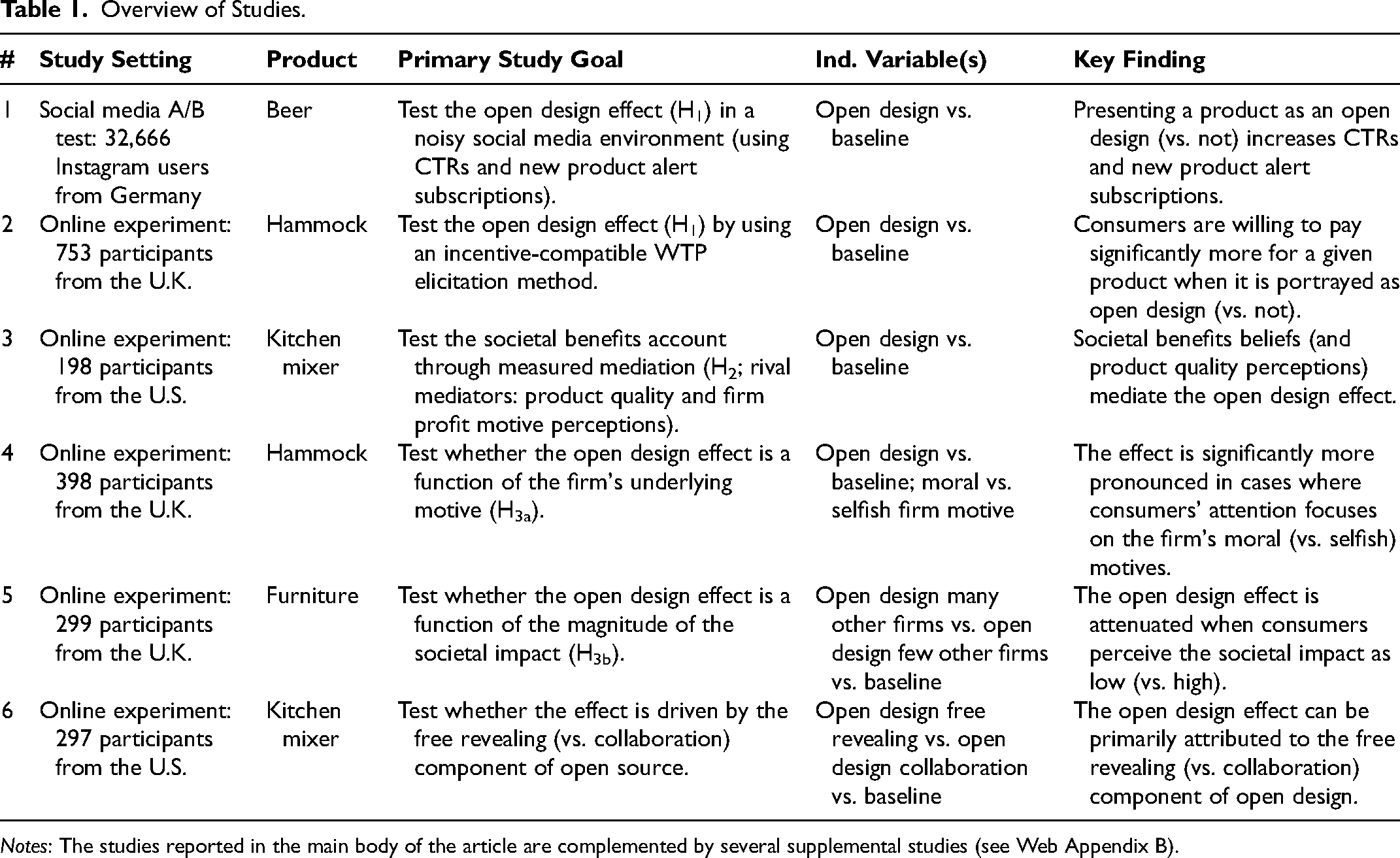
Notes: The studies reported in the main body of the article are complemented by several supplemental studies (see Web Appendix B).
Study 1: An A/B Test on Instagram
Study 1 is a social media A/B test on Instagram. We test whether portraying a given product as open design is related to more positive consumer reactions (H1) in a noisy social media environment. We use actual CTRs and new product alert subscriptions as our dependent variables.
Method
We performed an A/B test on Instagram in cooperation with the company Wirbier, a relatively new German brewery that pursues an open design strategy. Besides selling beer, Wirbier freely shares its beer recipes on its website. Instagram is a social networking platform owned by Meta; Meta allows advertisers to choose where to run their ads (e.g., Meta, Instagram, Messenger). 7 We used a photo of the Wirbier logo and employed two versions of text (both versions were in German because the brand ran the campaigns in Germany).
In the treatment condition, the text (“Wirbier! The Franconian open source brewery”) revealed the company's open design approach. By contrast, the text in the baseline condition did not contain any open design information. We manipulated the social media post descriptions accordingly (see Web Appendix A1 for details). We restricted the ads to Instagram feed posts. Instagram's advertising platform further allows advertisers to target users based on demographics. In close coordination with Wirbier, we chose three restricting characteristics for our target group. We targeted (1) nonengagers (i.e., users who were unfamiliar with Wirbier prior to the campaign), (2) users aged 20–60 years, and (3) users living in Germany. These restrictions corresponded with the targeting variables typically used by the underlying brand for social media campaigns. We designed an advertising campaign on Instagram with A/B testing with a single-factor between-participant design (open design vs. control).We followed recent best practice exemplars in the marketing literature (e.g., Hydock, Paharia, and Blair 2020) and set up the campaigns using automatic bidding, in which Meta would determine the optimal bid per 1,000 impressions (each condition had a budget of $150).
The campaigns were optimized for unique link clicks. Unique link clicks describe the total number of unique individuals who click on a link provided in an ad. Together with the number of unique individuals who saw the ad in the first place (i.e., reach), we can calculate the share of unique consumers reached who clicked on the link (i.e., CTR). Moreover, we also used the share of unique consumers reached who subscribed to the company's new product alert by leaving their email address (i.e., new product alert subscription rate) as the second dependent variable. We set up two landing pages that gave users who clicked on the advertisement the opportunity to subscribe to the company's new product alert by leaving their email address. Thus, the rows of the data file correspond to the individuals reached by the campaigns (see Web Appendix A1 for exact Instagram statistics).
The columns capture the independent and dependent variables. In particular, the variables were coded as follows: open design = 1, control = 0; dependent variable: action observed = 1, action not observed = 0. Accordingly, the likelihood of observing the dependent variable action as a function of our manipulation could be predicted. As mentioned previously, this allowed us to calculate the share of unique consumers reached who clicked on the link (i.e., CTR), and who subscribed to the company's new product alert. Across the two conditions, the ads reached 32,666 individuals, of whom 398 clicked on the ad (1.21%). This CTR is within the normal range for Instagram advertisements, thus confirming that the ads generated comparable interest to other ads on Instagram and were successfully targeted.
Findings
We tested our predictions using logistic regression analyses. We tested for main effects by using the study factor as the independent variable. First, and consistent with our theorizing, we found a significant and positive effect of the open design manipulation on CTR: The open design condition yielded significantly higher CTRs (1.34%) than the baseline condition (1.07%; β = .22, SE = .10, Wald χ2 = 4.65, p = .031). Our findings also showed a significant and positive effect of the open design manipulation on our second dependent variable: new product alert subscription rates. The open design condition received significantly higher new product alert subscription rates (.11%) than the baseline condition (.03%; β = 1.36, SE = .55, Wald χ2 = 6.11, p = .013).
Discussion
Based on a social media field study conducted on Instagram, Study 1 provides initial evidence consistent with the primary prediction that consumers will react more positively to a given product when it is presented as open design (H1). In particular, the findings show that communicating the open design information (vs. not) to consumers is related to higher CTRs and new product alert subscription rates. One limitation of Study 1 is that the open design descriptions included references to the beer recipe (e.g., “we share all recipes with you”). Thus, one might argue that the observed effects are partially attributable to consumers’ interest in the beer recipe. While this reasoning is not completely unrelated to our societal benefits account (pursuing open design implies offering the outside world the opportunity to learn more about the products), we address this limitation in subsequent studies. For example, in Study 2 we employ consumers’ actual WTP as dependent variable (i.e., consumers can learn about the open design product without having to pay for it in advance). A second limitation of Study 1 is the correlational nature of the field evidence presented (Boegershausen et al. 2025). Hence, in the subsequent studies we utilize more controlled settings to allow for causal inferences.
Study 2: Consumers’ WTP for Open Design Products
Study 2 tests the positive open design effect (H1) by using an incentive-compatible WTP elicitation method. We use a two-cell (open design vs. baseline) between-participants design (product category: hammock). The study was preregistered at https://aspredicted.org/mpnk-y958.pdf (for exact stimuli material, see Web Appendix A2).
Method
Design, procedures, and sample
We opened the survey to 750 U.K. consumers from Prolific. Prolific returned 753 complete respondents (Mage = 39.64 years; 378 women, 375 men). Participants were informed at the outset about the incentive-compatible nature of the experiment, as well as the purpose of the study, which was to ascertain their interest in a hammock. Participants were then randomly assigned to one of two experimental conditions (open design vs. baseline). In both conditions, participants viewed a screenshot of a shopping website homepage featuring three products, including the focal product (a hammock). In the open design condition, we implemented our manipulation with a statement about open design in the text above the product (for details, see Web Appendix A2). In the baseline condition, there was no respective open design information present. To maximize external validity, we used the open design information from an actual shopping website (hummingbirdhammocks.com) that sells open design products (including the hammock shown to our study participants). As in a real shopping experience, participants were directed to the next page and presented with more information about the hammock (the open design information in the treatment condition remained on this next page). Participants were shown three pictures of the hammock, together with product-related information. Both conditions included the actual product rating for the hammock (4.4 out of 5 stars, based on 29 reviews), with an exemplary customer review. In summary, our stimuli closely resembled the website's design and content, with the goal of providing high levels of ecological validity.
Measures
The dependent variable was participants’ WTP for the hammock, elicited immediately after product exposure. We employed a variant of the Becker, DeGroot, and Marschak (1964) procedure—an incentive-compatible value elicitation method, and a valid and reliable indicator of one's true WTP (e.g., Wertenbroch and Skiera 2002). Specifically, we used a two-stage measure: participants were first asked whether they had any interest in bidding on the product, and if so, to make their binding bid using a slider scale in US$.1increments (US$.1–US$70; participants who had no interest in the product were transferred to the next survey question and their WTP coded as zero). At the beginning of the study, participants were informed that their decisions would be binding if they were one of three US$70 lottery winners. They were also informed that if they had the winning bid, and it was greater than or equal to a randomly drawn price, they would receive the product at that random price as well as any remaining money (i.e., US$70 minus price). However, if the bid was smaller than the random price, they would not receive the hammock but would collect the full lottery amount instead (US$70). Next, on a separate page, all participants were asked an attention check question: “Based on the information provided, please indicate the extent to which you think the following statement is true. This product is open-source” (0 = “no,” 1 = “yes,” and 2 = “I don’t know”). Most participants answered this question correctly (83.8%; consistent with our preregistration, we retained all cases for further analyses). Finally, we captured participants’ age and gender.
Findings
As predicted, an analysis of variance (ANOVA) with WTP as dependent variable and open design (vs. baseline) as the independent variable provided strong support for the predicted positive open design effect (H1). Participants were willing to pay about 28% more when the product was described as open design, compared with when no open design information was present (Mopen design = 20.65, Mbaseline = 16.15; F(1, 751) = 9.56, p = .002, η2 = .013). Moreover, we reran the ANOVA for the subsample of participants who decided to make a bid (N = 437); results again were supportive of H1 (Mopen design = 33.32, SD = 16.95; Mbaseline = 29.80, SD = 16.02; F(1, 435) = 4.93, p = .027, η2 = .011).
Two additional analyses (not preregistered) show further support for the robustness of these findings. First, we conducted a negative binomial regression analysis to account for a large number of zero values in our dependent variable (i.e., 42% of participants made a bid of zero), which returned substantively identical results and firm support for a positive open design effect (Wald χ2 = 12.7, b = .30, SE = .08, p < .001). Second, we used the likelihood of making a bid (i.e., whether participants had any interest at all in making a bid) as the dependent variable. Results of a logistic regression analysis show that consumers were more likely to bid for the hammock when it was described as an open design product, compared with when no such information was present (62% vs. 54%; Wald χ2 = 4.7, b = .32, SE = .14, p = .03).
Discussion
Using an incentive-compatible WTP elicitation method, Study 2 shows that consumers are willing to pay significantly more for the same product when it is described as open design, thus supporting H1. Both Studies 1 and 2 are characterized by high levels of ecological validity and include consequential, behavioral dependent variables. However, one could argue that giving consumers any additional information about a firm's innovation approach (e.g., protecting an innovation by filing a patent) could lead to more favorable consumer responses. To address this possibility, we ran an online follow-up study (S1) that contrasted the open design effect against two control conditions (non–open design baseline vs. innovation protected via patent). We used participants’ purchase intentions as the dependent variable. Findings were again supportive of H1: Participants are more likely to purchase a given product when it is portrayed as open design, compared with when no additional information is provided or when it is described as protected by a patent (the difference between the two control conditions is not significant; see Web Appendix B1). Thus, a “more information” account per se is unlikely to underlie the effects identified in this research.
Study 3: Societal Benefits Beliefs Mediate the Open Design Effect
In Study 3, we test our proposed societal benefits account directly through measured mediation (H2). We also examine the alternative explanations (i.e., product quality perceptions and perceived profit motives of the firm). We use a two-cell (open design vs. baseline) between-participants design (product category: kitchen mixer). The study was preregistered at https://aspredicted.org/2s6j-f7xm.pdf (for exact stimuli material, see Web Appendix A3).
Method
Design, procedures, and sample
We opened the survey for 200 U.S. consumers from Prolific. Prolific returned 198 complete respondents (Mage = 37.86 years; 94 women, 102 men, 2 nonbinary). All participants read a short news article about the company Brand A and its new kitchen mixer. Participants in the open design condition also read that “Brand A freely shares the technology and design of its kitchen mixer with the outside world.” In the baseline condition, there was no respective open design information present. Below the text, both conditions included some pictures and product information about the kitchen mixer.
Measures
We first measured participants’ purchase intentions using a three-item scale: (e.g., “How likely are you to purchase this product?”; 1 = “not very likely,” and 7 = “very likely”; α = .94). Next, we measured our mediator with a four-item scale (e.g., “The company is good for society”; 1 = “strongly disagree,” and 7 = “strongly agree”; α = .95; based on Wilcox, Laporte, and Ward [2024]). In addition, we measured perceived product quality by three items (e.g., “In my opinion, I think the company's products are …” 1 = “high quality,” and 7 = “low quality”; α = .90), and perceived profit motives of the firm by two items (e.g., “I think the company is profit-driven”; 1 = “strongly disagree,” and 7 = “strongly agree”; r = .87; see Web Appendix A3 for full scales). 8
Findings
Purchase intentions
In support of H1, findings from an independent sample t-test revealed that participants in the open design condition reported significantly higher purchase intentions (M = 4.21, SD = 1.73) compared with participants in the baseline condition (M = 2.95, SD = 1.71; t(196) = 5.153, p < .001).
Societal benefits beliefs
In line with H2, we found that participants reported significantly higher societal benefits beliefs in the open design condition (M = 5.31, SD = 1.09) compared with the baseline condition (M = 4.01, SD = 1.08; t(196) = 8.430, p < .001).
Alternative explanations
First, participants also reported significantly higher product quality perceptions in the open design condition (M = 4.54, SD = 1.32) compared with the baseline condition (M = 3.87, SD = 1.40; t(196) = 3.431, p < .001). Second, participants perceived the firm to be significantly less profit-oriented in the open design condition (M = 4.49, SD = 1.62) compared with the baseline condition (M = 5.38, SD = 1.48; t(196) = −4.008, p < .001).
Mediating effects
As preregistered, we employed bootstrapping procedures (Hayes 2017; Model 4 in PROCESS, 5,000 bootstrap samples; 0 = baseline, 1 = open design) and included purchase intention as dependent variable, the experimental treatment as independent variable, and societal benefits beliefs as well as product quality and firm profit motive perceptions as rival mediators. In support of H2, the multivariate mediation analysis showed significant indirect effects of the experimental treatment through societal benefits beliefs (b = .90, SE = .20, 95% CI: [.52, 1.30]); moreover, the analysis revealed a significant indirect effect via perceived product quality (b = .23, SE = .09, 95% CI: [.08, .44]), but no significant indirect effect via firm profit motives (b = −.01, SE = .06, 95% CI: [−.13, .12]).
Discussion
Through measured mediation, Study 3 provides support for our societal benefits account, thus confirming H2. Second, our findings show that perceived product quality helps further explain the open design effect. In addition, the evidence suggests that the effect cannot be explained by different perceptions of the firm's profit motives.
Study 4: The Open Design Effect as a Function of the Firm's Underlying Motive
In Study 4, we aim to test whether the open design effect is a function of the firm's underlying motive (H3a). Anchored in our societal benefits account, we predict that the positive open design effect will be more pronounced when consumers believe a company's open design decision is motivated by moral reasons rather than selfish ones. We use a 2 (firm motive salience: moral vs. selfish) × 2 (open design vs. baseline) between-participant design experiment (product category: hammock). The study was preregistered at https://aspredicted.org/6y4h-5xbq.pdf (for exact stimuli material, see Web Appendix A4).
Method
Design, procedures, and sample
We opened the survey for 400 U.K. consumers from Prolific and received 398 complete responses (Mage = 42.41 years; 201 women, 195 men, 1 nonbinary, 1 prefer not to say). In this study, we manipulated firm motives by focusing respondents’ attention on firm behaviors framed as either morally or selfishly motivated. Participants in the moral (selfish) firm motive condition read: “Firms are often morally (selfishly) motivated. As such, firms may decide to strategically engage in different behaviors with the goal of benefiting society (themselves). Even firm behavior that seems selfish (selfless) at first sight may actually be morally (selfishly) motivated.” Moreover, we informed participants that “consumers often fail to correctly recognize such moral (selfish) firm behavior because they do not consider the fact that firms may be motivated to benefit society (themselves),” and asked them to “reflect on why it is important for consumers to think more carefully about how a given firm's behavior might actually benefit society (the firm itself).” In both conditions, we asked participants to briefly elaborate on their thinking in an open-ended text box.
Subsequently, we introduced participants to a purportedly unrelated study. In this study, we employed a direct comparison design (see Acar et al. 2021) and told participants that the study's aim was to examine their interest in two products from two different companies (Brand A vs. Brand B). First, we encouraged all participants to envisage being interested in buying a hammock and coming across two products from different brands. Next, we presented both brands side by side to ensure that participants could effectively compare the two products’ key attributes. Critically, we manipulated between participants whether the hammock from Brand A or Brand B featured open design technology. Accordingly, half of the participants read that the hammock from Brand A was an open design product (no such information was provided for the hammock from Brand B); in contrast, the other half of the participants read that the hammock from Brand B was an open design product (no such information was provided for the hammock from Brand A).
Measures
We measured participants’ purchase intentions by using the following three-item scale: (1) “I would be likely to purchase this product,” (2) “I would be willing to purchase this product,” and (3) “I would be inclined to purchase this product” (1 = “more true for hammock A [from Brand A],” and 7 = “more true for hammock B [from Brand B])”; α = .94). Finally, all participants indicated their age and gender.
Findings
As predicted, and consistent with H3a, a 2 × 2 ANOVA on purchase intent revealed a significant interaction effect (F(3, 394) = 20.488, p < .001, η2 = .049; see Figure 1) as well as a positive open design main effect (p < .001), but no firm motive main effect (p = .918). While follow-up contrasts even revealed a positive and significant open design effect in the selfish firm motive condition (MBrand B = open design = 4.48, SD = 1.66; MBrand B = baseline = 3.75, SD = 1.67; t(394) = 3.225, p = .001), the effect is significantly stronger in the moral firm motive condition (MBrand B = open design = 5.22, SD = 1.43; MBrand B = baseline = 3.04, SD = 1.66; t(394) = 9.627, p < .001). Moreover, as predicted, participants demonstrated significantly stronger purchase intention for Brand B's open design hammock in the moral firm motive condition (M = 5.22, SD = 1.43), compared with the selfish firm motive condition (M = 4.48, SD = 1.66; t(394) = 3.281, p < .001).
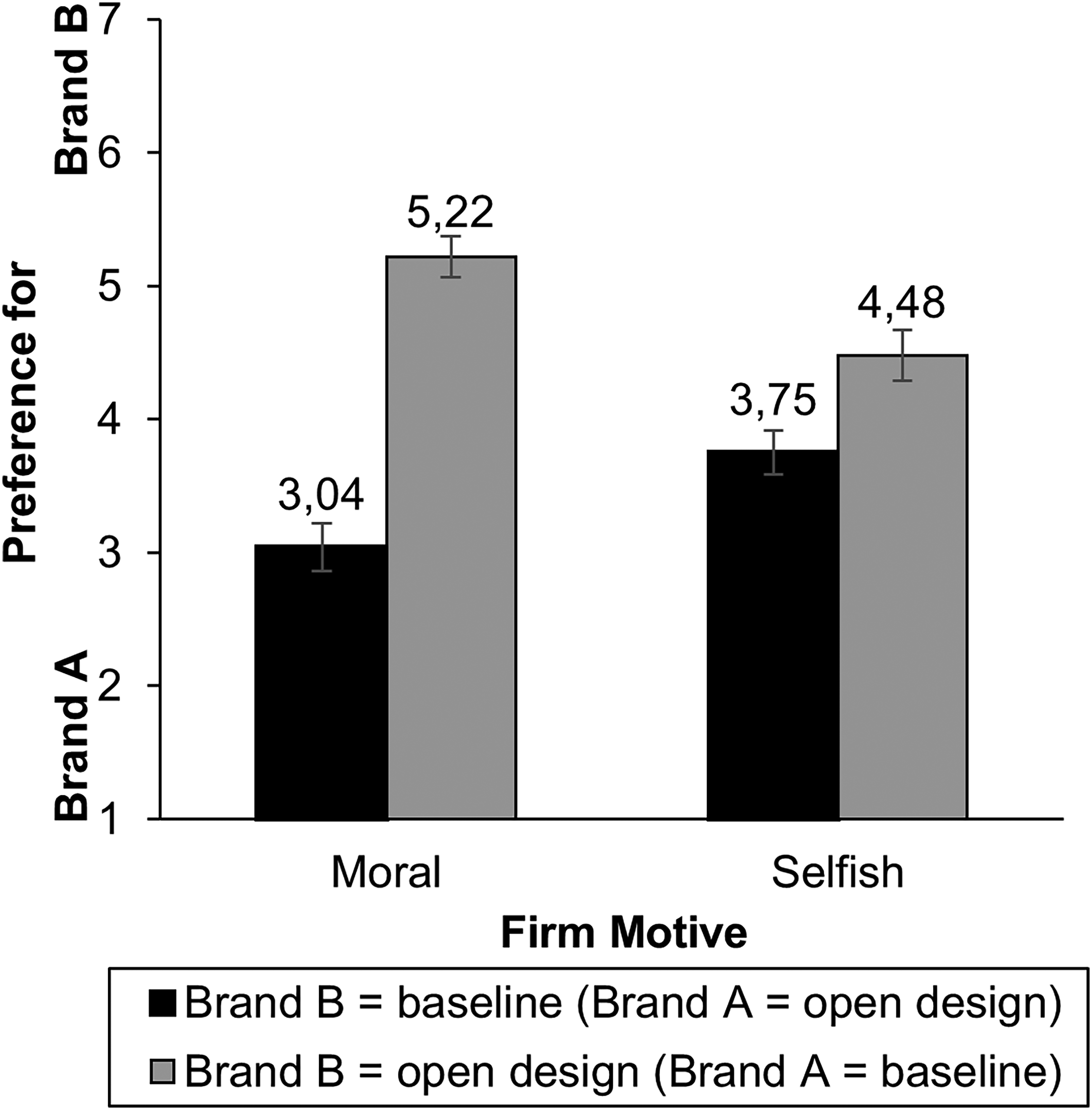
The Open Design Effect as a Function of the Firm's Underlying Motive (Study 4).
Discussion
Study 4 provides evidence that the open design effect is a function of the firm's underlying motive to make its knowledge freely available, thus confirming H3a. That is, the positive open design effect on consumers’ purchase intentions is significantly more pronounced in cases where consumer attention is focused on firms’ moral (vs. selfish) motives. While these findings are consistent with our societal benefits account, it is noteworthy that the open design effect even emerged in the selfish firm motive condition. Perhaps (some) participants associated open design with societal benefits, respectively, regardless of the preceding selfish firm motive manipulation. Moreover, it is possible that quality inferences have contributed to the open design effect in the selfish firm motive condition.
Study 5: The Open Design Effect as a Function of the Magnitude of Societal Impact
The primary aim of Study 5 is to examine whether the open design effect is a function of the magnitude of the societal impact (H3b). We predict that the open design effect will be attenuated when consumers perceive the societal impact of the open design technology as low (vs. high). We do not make any predictions as to whether the open design effect still emerges (or disappears completely) in a low societal impact condition. We test our hypothesis in a situation wherein the underlying open design technology has not yet been utilized by any other firm (vs. has already been utilized by many other firms). We utilize a three-cell (open design many other firms condition vs. open design no other firm condition vs. baseline condition) between-participant design experiment (product category: furniture). The study was preregistered at https://aspredicted.org/bjmz-hgjq.pdf (for exact stimuli material, see Web Appendix A5).
Method
Design, procedures, and sample
We opened the survey for 300 U.K. consumers from Prolific and received 299 complete responses (Mage = 42.38 years; 148 women, 147 men, 4 nonbinary). Stimulated by actual media content featuring the furniture brand IKEA (IKEA 2023), all participants first read a short news article about the company Brand A and one of its inventions: “Brand A is a company that designs and sells furniture and home accessories. Based on Brand A's goal that no one should get harmed by storage furniture tipping over, their research and development have led to a series of inventions in the field of clothing storage furniture stability. Amongst others, Brand A has developed a new tip-over safety innovation, called Anchor and Unlock. Anchor and Unlock is an innovative stability feature to help reduce the risk of furniture tip-overs.” Participants in the two open design conditions also read that “Brand A decided to freely share their Anchor and Unlock stability technology with the whole furniture industry so that other companies can start incorporating it into their furniture products as well.” In the many other firms condition, participants also read that “so far, more than 100 companies have already benefited from Brand A's Anchor and Unlock stability technology and integrated this novel safety system into their products.” In contrast, in the no other firm condition, participants read that “so far, no company has integrated this novel safety system into their products.” In the baseline condition, no respective open design information was present. Below the text, all three conditions included some standard pictures displaying the purpose and function of the underlying technology.
Measures
After participants read the newspaper article, we asked them to answer two reading check questions: (1) “In which year was the company founded? 1943 / 2010 / 2020 / Not mentioned” and (2) “What's the name of Brand A's tip-over safety innovation? Anchor and Unlock / Safety First / Safe and Secure / Not mentioned.” All participants answered these two questions correctly. In the two open design conditions, we also asked the following reading check question: “How many other companies in the furniture industry have already benefited from Brand A's innovation? No company / Only one company / More than 100 companies / Not mentioned.” Eight participants answered this question incorrectly (consistent with our preregistration, we kept those cases for further analyses). Afterward, we measured participants’ purchase intentions (α = .94), societal benefits beliefs (α = .94), and product quality perceptions (α = .87) using the same measurement scales as in Study 3. 9
Findings
Purchase intentions
An ANOVA on purchase intent suggested significant differences between conditions (F(2, 296) = 6.808, p = .001, η2 = .044). As predicted, planned contrast comparisons between the two open design conditions revealed that participants demonstrate significantly higher purchase intentions in the many other firms condition (M = 5.46, SD = 1.27) compared with the no other firm condition (M = 4.92, SD = 1.44; t(296) = 2.82, p = .005). In addition, and as predicted, the many other firms condition also yielded significantly higher purchase intentions compared with the baseline condition (M = 4.80, SD = 1.39; t(296) = 3.47, p < .001). The difference between the no other firm condition and the baseline condition was not significant (p > .51).
Societal benefits beliefs
An ANOVA on societal benefits beliefs suggested significant differences between conditions (F(2, 296) = 27.313, p < .001, η2 = .156). Planned contrast comparisons revealed that participants reported significantly higher societal benefits beliefs in the many other firms condition (M = 5.96, SD = .95) compared with the no other firm condition (M = 5.19, SD = 1.17; t(296) = 5.10, p < .001) as well as the baseline condition (M = 4.88, SD = 1.06; t(296) = 7.19, p < .001). Moreover, participants reported slightly higher societal benefits beliefs in the no other firm condition than in the baseline condition (p = .04).
Product quality perceptions
An ANOVA on product quality perceptions suggested significant differences between conditions (F(2, 296) = 10.678, p < .001, η2 = .067). Planned contrast comparisons revealed that participants reported significantly higher product quality perceptions in the many other firms condition (M = 5.68, SD = 1.11) compared with the no other firm condition (M = 5.13, SD = 1.13; t(296) = 3.42, p < .001) as well as the baseline condition (M = 4.97, SD = 1.17; t(296) = 4.41, p < .001). There was no significant difference between the no other firm condition and the baseline condition (p = .32).
Mediating effects
To test for mediation, we employed bootstrapping procedures (Model 4 in PROCESS, 5,000 bootstrap samples). We used purchase intentions as the dependent variable, the experimental treatment as the independent variable, and societal benefits beliefs as well as perceived product quality and perceived firm innovativeness as rival mediators (as preregistered, we excluded rival mediators that showed different patterns of effects than the dependent variable). The mediation analysis showed significant indirect effects of our experimental treatment through societal benefits beliefs (baseline vs. high impact: b = .66, SE = .11, 95% CI: [.45, .88]; low impact vs. high impact: b = .47, SE = .11, 95% CI: [.26, .69]; there was also a significant indirect effect between the baseline and low impact condition: b = .19, SE = .09, 95% CI: [.01, .38]). Moreover, the analysis also revealed a significant indirect effect through perceived product quality (baseline vs. high impact: b = .14, SE = .06, 95% CI: [.05, .27]; low impact vs. high impact: b = .11, SE = .05, 95% CI: [.03, .22]; there was no significant indirect effect between the baseline and low impact condition: b = .03, SE = .04, 95% CI: [−.03, .11]). Moreover, there were no indirect effects via perceived firm innovativeness (see Web Appendix A5).
Discussion
Supporting H3b, Study 5 shows that the open design effect is a function of the magnitude of the societal impact. Specifically, our findings show that the focal effect is attenuated when only a few (vs. many) other firms have already built on the firm's open design technology. Moreover, in line with Study 3, the findings provide evidence for our societal benefits account and show that perceived product quality further explains the open design effect. Finally, Study 5 shows that the open design effect also emerges by only describing the focal firm's behavior of freely sharing innovation-related knowledge (i.e., we did not use the term “open source” in our stimuli).
Study 6: Disentangling Free Revealing from Collaboration
In Study 6, we aim to understand whether the open design effect is indeed driven by the notion of free revealing, as theorized (i.e., inside-out knowledge flow), or alternatively, by the association of its potentially collaborative nature (i.e., outside-in knowledge flow). As such, we aim to reinforce our core idea that consumers particularly value the free revealing of knowledge. Moreover, we reassess our proposed societal benefits account through measured mediation (H2), and measure perceived product quality as a potential rival mechanism. To test our predictions, we use a three-cell (open design free revealing vs. open design collaboration vs. baseline) between-participant design experiment (product category: kitchen mixer). Based on our theorizing, we predict that consumers’ societal benefits beliefs will be significantly higher upon learning about the free revealing nature of open design (vs. the collaborative nature of open design vs. baseline). Moreover, while our theorizing allows us to predict that consumers will be significantly more likely to purchase the given product if they learn about the free revealing nature of open design (vs. baseline), it does not allow us to make any predictions about consumers’ purchase intentions in the collaborative nature of open design condition because, among others, product quality perceptions may also be a factor. The study was preregistered at https://aspredicted.org/v8hf-k236.pdf (for exact stimuli material, see Web Appendix A6).
Method
Design, procedures, and sample
We opened the survey for 300 U.S. consumers from Prolific. Prolific returned 297 complete respondents (Mage = 38.95 years; 140 women, 148 men, 3 nonbinary, 6 prefer not to say). All participants read a short news article about the company Brand A and its new kitchen mixer. Participants in the free revealing (collaboration) open design condition also read that “Brand A freely shares (has collaboratively developed) the technology and design of its kitchen mixer with the outside world. As such, other companies and consumers can use and build upon (could have contributed to and co-created) Brand A's technology and designs.” In the baseline condition, no respective open design information was present. Below the text, all three conditions included some pictures and product information about the kitchen mixer.
Measures
We measured participants’ purchase intentions by using the same three items as in Study 5 (α = .96). Next, we measured societal benefits beliefs (α = .95) and perceived product quality (α = .92) with the same measurement scales as in Study 3. Finally, all participants indicated their age and gender.
Findings
Purchase intentions
An ANOVA on purchase intent suggested significant differences between conditions (F(2, 294) = 50.788, p < .001, η2 = .257). As predicted, planned contrast comparisons between the two open design conditions revealed that participants demonstrate significantly higher purchase intentions in the free revealing condition (M = 4.82, SD = 1.45) compared with the collaboration condition (M = 4.36, SD = 1.59; t(294) = 2.110, p = .036). In addition, and as predicted, the free revealing condition also yielded significantly higher purchase intentions compared with the baseline condition (M = 2.74, SD = 1.56; t(294) = 9.590, p < .001). There was also a significant difference between the collaboration condition and the baseline condition (t(294) = 7.450, p < .001).
Societal benefits beliefs
An ANOVA on our mediator (societal benefits beliefs) suggested significant differences between conditions (F(2, 294) = 62.469, p < .001, η2 = .298). As predicted, planned contrast comparisons revealed that participants reported significantly higher societal benefits beliefs in the free revealing condition (M = 5.47, SD = 1.08) compared with the collaboration condition (M = 5.10, SD = 1.01; t(294) = 2.383, p = .018) and the baseline condition (M = 3.86, SD = 1.11; t(294) = 10.649, p < .001). There was also a significant difference between the collaboration condition and the baseline condition (t(294) = 8.233, p < .001).
Product quality perceptions
Next, we performed ANOVAs on perceived product quality (F(2, 294) = 21.802, p < .001, η2 = .129). Planned contrast comparisons revealed that participants reported significantly higher product quality perceptions in the free revealing condition (M = 4.90, SD = 1.34) compared with the baseline condition (M = 3.79, SD = 1.51; t(294) = 5.643, p < .001). Similarly, participants reported significantly higher product quality perceptions in the collaboration condition (M = 4.93, SD = 1.31) compared with the baseline condition (t(294) = 5.778, p < .001). However, there was no significant difference between the free revealing condition and the collaboration condition (p = .881).
Mediating effects
As preregistered, we employed bootstrapping procedures (Hayes 2017; Model 4 in PROCESS, 5,000 bootstrap samples) and included purchase intentions as dependent variable, the experimental treatment as independent variable (multicategorial), and societal benefits beliefs and perceived product quality as rival mediators. In support of our theorizing (H2), the mediation analysis showed significant indirect effects of the experimental treatment through societal benefits beliefs (baseline vs. free revealing: b = 1.16, SE = .15, 95% CI: [.88, 1.46]; collaboration vs. free revealing: b = .26, SE = .11, 95% CI: [.05, .49]; baseline vs. collaboration: b = .89, SE = .13, 95% CI: [.66, 1.14]). Moreover, the analysis revealed a significant indirect effect via perceived product quality between the baseline and free revealing condition (b = .33, SE = .10, 95% CI: [.16, .54]), as well as the baseline and collaboration condition (b = .34, SE = .10, 95% CI: [.17, .55]). However, there was no significant indirect effect via perceived product quality between the collaboration and free revealing condition (b = −.01, SE = .06, 95% CI: [−.12, .10]).
Discussion
Study 6 extends the previous findings in several important ways. First, through measured mediation, we provide further evidence for our societal benefits account, thus confirming H2. Second, in line with Studies 3 and 5, our findings show that perceived product quality further explains the open design effect (discussed next). Third, we show that the open design effect can be attributed to free revealing (vs. the collaborative innovation effort known from open innovation and open source software). While our findings show that consumers perceive both components to provide benefits for society (compared with the baseline condition), they also demonstrate that consumers perceive free revealing of knowledge as significantly more beneficial to society than collaboration. Importantly, our findings further illustrate that consumers do not ascertain any differences between the two open design conditions with respect to product quality. Thus, any differences between our two open design conditions seem to be primarily attributed to our societal benefits account. 10
General Discussion
Theoretical Contributions and Practical Implications
Our study yields several key insights that build our theoretical and practical contributions. First, we uncover an open design effect: that is, presenting a product as open design (vs. not) increases its attractiveness to consumers. Prior research suggests that freely revealing knowledge can be promising from a (strategic) innovation perspective under certain conditions (Alexy, George, and Salter 2013; Nagle 2018) and may subsequently drive innovation by reducing costs and making knowledge more accessible (Pearce 2012). Our findings show that freely revealing knowledge also holds valuable marketing potential. Notably, the open design effect emerges across several dependent variables, including CTRs and new product alert subscriptions, incentive-compatible WTP, product preference, and purchase intent measures. Thus, firms that choose to freely reveal innovation-related knowledge to the outside world might miss a heretofore overlooked economic opportunity by failing to clearly communicate said behavior to their customers across various stages in the purchase funnel. For example, findings from Study 1 showed that highlighting the firm's open design activities in a social media advertisement led to a 24% increase in CTRs. Furthermore, participants in Study 2 were willing to pay approximately 28% more when the product was described as open design. Accordingly, firms could use labels alluding to the notion of open design on their product packaging and websites with an aim to increase initial consumer interest as well as WTP.
Second, we provide empirical support for our societal benefits account: consumers see firms that freely reveal innovation-related knowledge as beneficial to society, and subsequently respond more positively to their products. As such, our findings contribute to the related literatures on corporate social responsibility (Chernev and Blair 2015, 2021; Luo and Bhattacharya 2006) and marketplace morality (Campbell and Winterich 2018; Philipp-Muller, Teeny, and Petty 2022). On a high level, our findings build on previous corporate social responsibility research by showing that firms can do well by doing good (Luo and Bhattacharya 2006; Sen and Bhattacharya 2001). On a more nuanced level, we extend prior research that shows that consumers may perceive the use of sustainable technologies per se as an activity that benefits society (Chernev and Blair 2021); in contrast, we document that how a firm uses its innovation-related knowledge matters as well (i.e., whether the firm engages in free revealing). In fact, within experiments, we kept the underlying technology (including its innovation-related attributes) constant, and instead varied only whether the open design information was present. However, across experiments we used different types of technologies (i.e., technologies that are obviously beneficial to society, as well as more neutral technologies with societal benefits that are seemingly less salient). Our findings show that the open design effect emerges for both types of technologies, thus further highlighting its robustness.
In addition, while Chernev and Blair (2015, 2021) stopped at documenting a halo effect on product performance perceptions, we demonstrate the positive open design effect by using a variety of downstream measures including incentive-compatible WTP and purchase intent. One thought-provoking implication of our findings, considering technical and legal factors, is that firms should consider actively integrating their open design activities into subsequent corporate social responsibility communications as well as their ESG (environmental, social, and governance) reports, while taking our identified boundary conditions into account. In other words, firms should no longer view their innovation and corporate social responsibility activities as two separate entities.
In line with our societal benefits account, we further demonstrate that the open design effect is attenuated in cases where consumers view (1) the firm's underlying motive as selfish (vs. moral) and (2) the magnitude of the societal impact as low (vs. high). In addition to bolstering our theorizing, these findings provide actionable implications for companies. Firms should be aware that consumers’ perceptions of their underlying motives matter. Specifically, our findings inform firms how to effectively communicate their open design activities to consumers. While strategic reasons might also be relevant, highlighting the potential societal benefits of engaging in open design should be at the center of the firm's communication efforts. Moreover, when possible, firms could also benefit from making the magnitude of the societal impact tangible to end consumers. IKEA, for example, explicitly states that its Anchor and Unlock technology is intended to “support people to live a safer life at home” (i.e., stressing the positive valence of the societal impact; IKEA 2023), and Allbirds highlights that its open design technology has already been used by more than 100 other companies (i.e., stressing the magnitude of the positive societal impact).
Third, our findings demonstrate that the open design effect is mostly attributable to the free revealing of knowledge (vs. the collaborative innovation effort associated with open innovation and open source software). Accordingly, our research adds to the current discussion in the marketing literature that seeks to understand how a firm's open innovation activities influence consumers (Dahl, Fuchs, and Schreier 2015; Maier et al. 2024; Nishikawa et al. 2017). Prior research has heretofore focused exclusively on how consumers perceive firms’ outside-in open innovation activities. For example, research shows that consumers react more positively to crowdsourced new products (i.e., products ideated by users vs. company designers) because they value ideas and knowledge stemming from likeminded users (Dahl, Fuchs, and Schreier 2015; Schreier, Fuchs, and Dahl 2012). Our findings suggest that following an outside-in open innovation approach (i.e., collaborating with the outside world)—without specifying who contributes the ideas—does not create the same value for consumers as following an inside-out open innovation approach (i.e., freely revealing knowledge to the outside world; see also Supplementary Study S2, Web Appendix B2). Relatedly, our findings also contribute to the marketing literature on open source software (e.g., Kumar, Gordon, and Srinivasan 2011), which thus far provides little insight regarding how consumers perceive and react to firms that freely reveal innovation-related knowledge. Moreover, while previous literature in this area has primarily focused on the collaborative aspect of open source and/or has not explicitly distinguished between the free revealing and collaboration component of open source (Mallapragada, Grewal, and Lilien 2012; Pitt et al. 2006), we demonstrate how each of these two components shapes consumer perceptions and responses.
Finally, while our studies have ruled out several alternative explanations, 11 our findings uncover a second mediating factor: positive product quality perceptions. This finding is interesting, because one could argue that making innovation-related knowledge freely available signals that (1) the knowledge is not worthy of protection (why should a firm share valuable information for free?), and/or (2) the underlying technology or product is not fully developed, and the company is seeking external feedback to improve it (Piezunka and Dahlander 2015). Instead, our findings suggest that consumers perceive open design products to be of higher quality. These findings align with previous literature documenting a halo effect such that consumers infer higher quality for products from firms whose actions may benefit society (Chernev and Blair 2015; Wilcox, Laporte, and Ward 2024). However, follow-up explorations of our own data did not support a full serial mediation narrative (open source → societal benefit beliefs → perceived product quality → purchase intentions). Instead, and in line with our theorizing, we find that societal benefits beliefs continue to have a direct effect on our outcome variables, even after controlling for an indirect effect via product quality perceptions (see Web Appendix C).
Future Research Directions
What are some interesting directions for further research? First, while we tested several conditional boundaries, other moderators could impact the focal effect. Although we tested the open design effect across different technologies, there might be additional technology-related contingency factors. For example, what happens when a firm's open design is associated with societal harm, rather than benefits? In fact, there might be situations wherein a neutral technology is applied in potentially dangerous or harmful situations. For example, open design 3D printing technology can be used to produce medical devices (positive valence) or weapons (negative valence). In the latter case, the original firm's intention to use open design approaches might have been well-meaning (and consumers might perceive the firm's intention as such). However, a negative application of the open technology might undermine societal benefits beliefs and thus attenuate the open design effect (a study that is consistent with this line of reasoning is available from the authors upon request).
Second, most of the technologies used in this research can be experienced directly by consumers as part of the final product (e.g., IKEA's Anchor and Unlock technology); however, some products involve technologies that do not directly affect consumers. For example, Unilever recently announced that it freely shares several of its patents for the development of more energy-efficient freezer cabinets (Unilever 2023). Will consumers react differently when the open design technology in question can be directly experienced versus not? Relatedly, do consumers react differently upon learning that the open design technology is of higher (vs. lower) strategic importance for the focal firm? And will the positive open design effect spill over to the firm's other products—even ones that do not feature open design technology? Based on our theorizing (consumers associate the underlying firm with effecting societal benefits), this does not seem far-fetched, particularly if the open design information is communicated in some form (e.g., as firm-level attribute information). However, more research is needed to claim (or refute) this with more certainty. Relatedly, some firms have adopted an open design approach on a company level (i.e., they pursue open design in all their innovation efforts). Does the scope of a firm's open design engagement matter?
Third, we did not investigate consumer-related moderators. For example, future research could examine how consumers’ political ideology influences their reactions to open design products. Based on our societal benefits account, and the notion that open design products may promote societal equality (Pearce 2012), the open design effect should be stronger for liberals (vs. conservatives) because liberals tend to react more positively to firms that benefit society by promoting equality (and reducing hierarchy) in the marketplace (Kim, Park, and Dubois 2018). To gain initial insight into this idea, we used Google Trends data from 2018 to 2023 and measured the search volume for “open source” across U.S. states. Findings show that the search volume for “open source” is higher in liberal (vs. conservative) U.S. states (p < .001), suggesting that the open design effect may indeed be more pronounced among liberal (vs. conservative) consumers. However, future research is needed to better understand this initial pattern of effects.
Moreover, it would be interesting to study whether firms could benefit from communicating more specifically about the application of their open design technology (e.g., in which products, industries, and countries it can and/or is being used), and who exactly may benefit (e.g., low-income countries, smaller companies). While our findings indicate that the magnitude of the societal impact matters, they do not elucidate whether the open design effect is also a function of who specifically is the beneficiary. For example, do consumers perceive a firm's open design activities as even more beneficial to society upon learning that the underlying technology may help small businesses or underdog brands that would otherwise be unable to afford such technology? Relatedly, does the locus of impact shape the effect differently for different consumers? For example, while conservatives may react positively to a U.S. company that freely shares its innovation-related knowledge with other U.S. companies, they might react less positively toward a U.S. company freely sharing valuable, innovation-related knowledge with non-U.S. firms (i.e., they may view this as detrimental to “their” society). However, liberals may more generally construe a firm's open design activities to benefit society, hence suggesting a positive main effect. This theorizing is speculative though, and calls for more systematic research.
Finally, future research could investigate whether the open design effect holds in conspicuous consumption contexts, that is, where consumers’ self-related benefits (e.g., signaling status or expressing uniqueness) might be more important than supporting societal benefits. Specifically, can luxury brands benefit from advertising their products as open design, or might this backfire? Interestingly, the luxury brand Gucci has recently begun to impart some of its knowledge (including product research, design, and sourcing decisions) on an open design platform (Kering 2023). How will consumers react to such practices in the context of luxury fashion? Relatedly, does the open design effect also hold for consumers with a strong desire for exclusivity? Marketing research has shown that the desire for exclusivity is an important driver when it comes to consumer product preferences and choices (e.g., Amaldoss and Jain 2005). In fact, consumers with a high desire for exclusivity tend to prefer products that are limited in supply, difficult to imitate, or that few other consumers can afford (Amaldoss and Jain 2005). In contrast to such scarce and exclusive products, open design products might be perceived as highly accessible and inclusive, resulting in a perceived loss of exclusivity. Our initial investigation of this topic (see Web Appendix B3) suggests that the open design effect is indeed attenuated for consumers with a high desire for exclusivity. Future research could investigate this relationship in more detail and explore additional situations wherein engaging in open design activities may backfire among consumers.
Supplemental Material
sj-pdf-1-mrj-10.1177_00222437251373034 - Supplemental material for The Open Design Effect
Supplemental material, sj-pdf-1-mrj-10.1177_00222437251373034 for The Open Design Effect by Lukas Maier, Martin Schreier and Darren W. Dahl in Journal of Marketing Research
Footnotes
Coeditor
Rebecca Hamilton
Associate Editor
Rebecca Slotegraaf
Declaration of Conflicting Interests
The author(s) declared no potential conflicts of interest with respect to the research, authorship, and/or publication of this article.
Funding
The author(s) disclosed receipt of the following financial support for the research, authorship, and/or publication of this article: This work was generously supported by the Dr. Theo and Friedl Schöller Research Center (Friedrich-Alexander-Universität Erlangen-Nürnberg) and WULABS and WU Revision Funds (Vienna University of Economics and Business).

Notes
References
Supplementary Material
Please find the following supplemental material available below.
For Open Access articles published under a Creative Commons License, all supplemental material carries the same license as the article it is associated with.
For non-Open Access articles published, all supplemental material carries a non-exclusive license, and permission requests for re-use of supplemental material or any part of supplemental material shall be sent directly to the copyright owner as specified in the copyright notice associated with the article.
