




Abstract
In their early life-cycle stages, business-to-business (B2B) high-tech start-ups face severe challenges in establishing customer relationships. To generate business growth, they must convey the value of unfamiliar, innovative, and complex offerings to customers, using the limited resources at their disposal. Prior research has not examined the roles of mass-media marketing and personal sales communications in this challenging endeavor, despite principal differences between these activities in start-up contexts. To help B2B high-tech start-ups allocate financial resources to mass-media marketing and personal sales communications across early and later stages of their organizational life cycle, this article presents a longitudinal survey study involving founders of B2B high-tech start-ups. The findings indicate that start-ups that spend a larger share of their budget on personal sales (i.e., higher personal sales expense ratio) exhibit stronger performance in earlier stages of their life cycle but weaker performance in later stages; however, still in later stages, these expenditures enhance certain performance metrics. Conversely, start-ups that spend a larger share of their budget on mass-media marketing (i.e., higher mass-media marketing expense ratio) show stronger performance in later stages but weaker performance in earlier stages. High-tech start-ups can leverage these findings to improve their budget allocation and ensure persistent growth.
Keywords
Business-to-business (B2B) high-tech start-ups are prominent in diverse industries, including aerospace, advanced electronics, pharmaceuticals, medical devices, and software engineering. They are globally pervasive: In 2020, 61% of successful start-ups offered B2B solutions (Statista 2020). In recent years, there has been a 47% surge of such high-tech start-ups in the U.S. economy (Wu and Atkinson 2017). In the European Union, investments in B2B start-ups grew an astonishing 211% between 2015 and 2020 (Dörner et al. 2021). In addition, B2B high-tech start-ups drive economic development, create jobs, and foster innovation: 85% of U.S. entrepreneurs create new jobs, and 36% offer new technologies or innovative products/services (Global Entrepreneurship Monitor 2018).
Despite their clear economic importance, B2B high-tech start-ups have difficulties establishing themselves in their markets. By their very nature, they face critical challenges in building customer relationships, in that they are unknown to potential customers and offer complex products and business models that require extensive explanation (Konya-Baumbach et al. 2019; Slater and Mohr 2006). They frequently suffer from a liability of newness (Xiong and Bharadwaj 2011), as they lack a firm reputation, customer trust, and industry experience (Rao, Chandy, and Prabhu 2008; Read et al. 2009). However, these factors are indispensable to effectively build relationships in B2B high-tech settings.
Market communication activities are a central part of a start-up's broader marketing ecosystem, aligning with the American Marketing Association's definition of marketing as “the activity, set of institutions, and processes for creating, communicating, delivering, and exchanging offerings” (American Marketing Association n.d., emphasis added). These activities can help start-ups overcome challenges in building customer relationships. However, founders often underestimate their importance and lack the knowledge to employ different communication strategies effectively. Research has only begun to explore the specific roles of market communication activities in start-ups; yet, these early studies tend to aggregate start-ups’ communications designed for and targeting the mass media (which we refer to as “mass-media marketing”) and interpersonal communication (which we refer to as “personal sales”), without distinguishing their potentially unique effects and conceptual mechanisms (Table 1). With limited resources at their disposal, start-up managers need to know in which of the two areas they should allocate their expenditures.
Literature on Mass-Media Marketing Communications and Personal Sales Communications by Start-Ups.
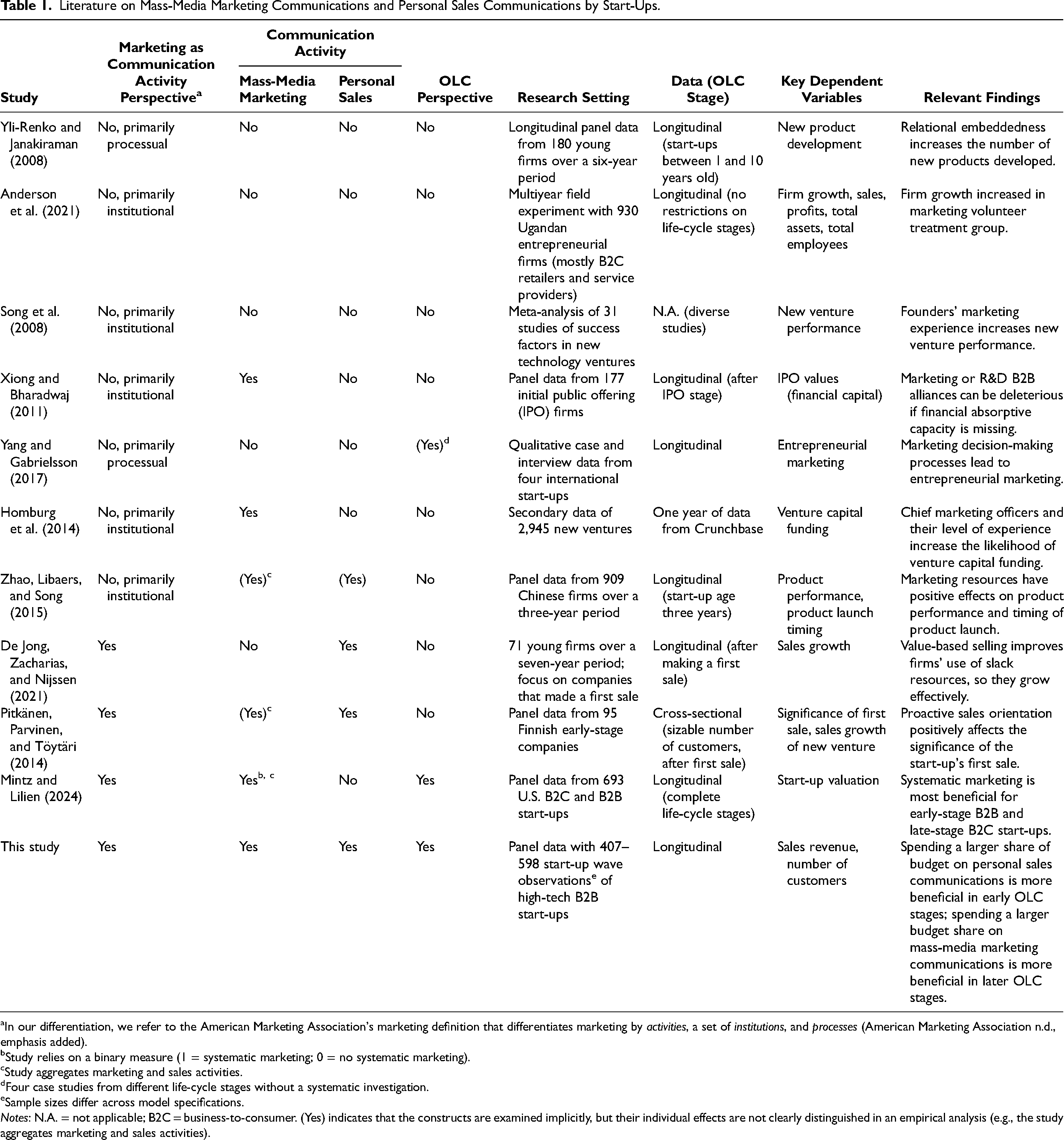
In our differentiation, we refer to the American Marketing Association's marketing definition that differentiates marketing by activities, a set of institutions, and processes (American Marketing Association n.d., emphasis added).
Study relies on a binary measure (1 = systematic marketing; 0 = no systematic marketing).
Study aggregates marketing and sales activities.
Four case studies from different life-cycle stages without a systematic investigation.
Sample sizes differ across model specifications.
Notes: N.A. = not applicable; B2C = business-to-consumer. (Yes) indicates that the constructs are examined implicitly, but their individual effects are not clearly distinguished in an empirical analysis (e.g., the study aggregates marketing and sales activities).
Seeing these practical as well as conceptual reasons, we differentiate between the influence of a B2B high-tech start-up's mass-media marketing expense ratio (i.e., the share of budget spent on mass-media marketing communications) and personal sales expense ratio (i.e., the share of budget spent on personal sales communications) on its performance. We then explore the distinct effects of these expense ratios across the stages of a start-up's organizational life cycle (OLC). Drawing on qualitative interviews and a preliminary survey with 81 founders, we define mass-media marketing communications in the B2B high-tech start-up context as all activities initiated by start-ups to establish relationships with investors and customers through indirect, nonpersonal channels such as online content, advertising, and social media marketing (Lee, Sridhar, and Palmatier 2017). For brevity, we abbreviate “mass-media marketing communications” as “mass-media marketing.” We define personal sales communications in the same context as all activities of founders and employees to establish close, direct relationships with customers and investors through personal meetings (e.g., a founder who personally initiates communication with a customer at a trade fair). In our preliminary survey, 77% of the founders indicated the importance at each stage of a start-up's development to differentiate expenses for mass-media marketing and personal sales. Noting the differences in these communication activities, we ask: What are the differential effects of increasing the personal sales expense ratio or mass-media marketing expense ratio on start-up performance in B2B high-tech contexts?
We also investigate whether and how the effects of mass-media marketing and personal sales expense ratios vary throughout the OLCs of B2B high-tech start-ups. Start-ups pass through multiple development stages, each with unique challenges. Initially, they face the liability of newness, but once they have acquired their first customers, they can leverage this success in later stages (Fisher, Kotha, and Lahiri 2016). Recent research indicates that systematic marketing activities might offer greater value in early stages than in later stages (Mintz and Lilien 2024). However, these emerging insights require more profound examination because most pertinent research focuses only on data sets at specific OLC stages or, critically, does not differentiate communication activities (Table 1). Thus, we ask: What are the differing effects of mass-media marketing and personal sales expense ratios during earlier and later stages of start-ups’ OLC?
Our conceptual model includes a start-up's personal sales expense ratio and mass-media marketing expense ratio as independent variables and the start-up's stage in the OLC as the key contingency. We test the model with different performance-based dependent variables (sales revenue and number of customers) and various operationalizations of a start-up's OLC stage. To address a research gap, in that empirical examinations refer only to late-stage start-ups (for an exception, see Mintz and Lilien [2024]), citing the lack of archival data for younger firms, we compile a primary panel data set during four waves over 20 months, producing up to 598 start-up wave observations. The data come from founders or top-level executives and corresponding interviewers. We employ panel regression models (accounting for unobserved heterogeneity among start-ups) and address potential selection biases and endogeneity concerns.
The results show that mass-media marketing and personal sales expense ratios influence different performance criteria of B2B high-tech start-ups, and these effects vary depending on the current OLC stage. A higher sales expense ratio more strongly increases start-ups’ performance in earlier OLC stages, when close relationships are important, but less in later stages. By contrast, a higher mass-media marketing expense ratio primarily increases start-ups’ performance in later OLC stages, when start-ups seek rapid growth, but hardly in earlier stages. Various robustness checks confirm these findings.
We offer several implications for marketing research and practice. Although prior research indicates positive effects of marketing resources for start-up success (e.g., DeKinder and Kohli 2008), literature on specific sales resources in start-ups is nascent (Matthews, Chalmers, and Fraser 2018). By differentiating the effects of spending a larger share of the budget on personal sales or mass-media marketing, we provide actionable recommendations for resource-constrained start-ups. Early in their development, start-ups should spend a higher share of their budget on personal sales communications to build close customer relationships. When ready to accelerate growth and expand their market reach, they should allocate more budget to mass-media marketing to boost performance in later stages. However, if a start-up aims to cultivate fewer but deeper customer relationships, continued expenses in personal sales can remain beneficial even at a more advanced stage.
Differential Effects of Expenses on Mass-Media Marketing and Personal Sales Communications
Mass-Media Marketing and Personal Sales Communications in B2B High-Tech Start-Ups
B2B high-tech start-ups provide technologically sophisticated products and services, mostly innovations (e.g., artificial intelligence [AI] solutions, cybersecurity systems, blockchain), as a core part of their often solution-based business models (Fisher, Kotha, and Lahiri 2016). Their offerings tend to be characterized by high complexity, requiring explanations to customers, and uncertainty on customers’ part (e.g., Yli-Renko and Janakiraman 2008). For instance, AI start-ups often need access to sensitive company data to train their models, but B2B decision-makers may hesitate to share it due to unfamiliarity and trust issues. This creates unique challenges for B2B high-tech start-ups in establishing credibility and initiating first customer relationships, highlighting the critical role of both personal selling and mass-media marketing. In this section, we therefore differentiate mass-media marketing and personal sales in B2B high-tech start-ups based on the insights gathered from in-depth interviews with senior managers and founders, a preliminary quantitative founder survey, and prior research that distinguishes these essential activities in established firms.
Preliminary interviews
To inform our distinct conceptualization of start-ups’ mass-media marketing and personal sales activities, we conducted in-depth interviews with 15 experienced senior managers and founders of B2B high-tech start-ups (7 h, 35 min total length; see Web Appendix A for details). We applied theoretical sampling to gather insights from a broad range of young and mature B2B start-ups across high-tech industries. Our semistructured interview guide and iterative research design allowed for follow-up questions, details, and examples; we also discussed the preliminary findings with founders (e.g., Tuli, Kohli, and Bharadwaj 2007). We present the original quotes verbatim. Please note that the practitioners used “marketing” and “sales” synonymously with mass-media marketing and personal sales, respectively.
Differentiating mass-media marketing and personal sales
The interviewees differentiate between communication activities designed for the mass media, such as online marketing measures, social media marketing, and advertising (which practitioners commonly refer to as “marketing” in a narrower sense), and interpersonal communication activities, such as personal and direct interactions with customers or investors. Most of the interviewees (12 of 15) agreed that in B2B high-tech start-ups such (mass-media) marketing and (personal) sales communications are clearly distinct. For example, a key mass-media marketing activity for start-ups is establishing an appealing online presence and creating attention for the firm (as mentioned by 13 respondents). According to the founder of a professional service start-up, “[Mass-media] marketing takes time, but at some point, it becomes easier. The press becomes aware, and suddenly you are getting published in [national newspapers]. You put that on your website and build up a name” (#2). For high-tech start-ups entering untapped niche markets or creating new product categories, mass-media marketing may be vital to raise awareness that their solution exists.
Respondents suggested personal representation at trade fairs as a key personal sales activity because, in B2B high-tech contexts, trade fairs are important for connecting with customers and achieving financial success. A cybersecurity start-up founder noted, “In [personal] sales, we attend trade fairs, where we proactively approach people. We give technical sales presentations because the whole topic of cybersecurity is quite special. It gives us the opportunity to stand out from competition” (#6). Such personal interaction is often needed to reduce customer uncertainty, for instance, when offerings require access to sensitive company data or substantial customer process changes, as is typical in data-driven high-tech solutions.
This distinction also aligns with research conducted in more mature firms (e.g., Homburg et al. 2017; Krohmer, Homburg, and Workman 2002). For example, Lee, Sridhar, and Palmatier (2017) differentiate the effects of expenses on personal selling activities and expenses on advertising activities on mature firms’ profitability. Both our main study sample (see typical activities in Table 2) and the initial survey of 81 B2B high-tech founders confirm the preliminary expert assessments. In the survey, founders who engage in these activities largely agreed that networking (65%), direct acquisitions (74%), product presentations (78%), and interpersonal social media interactions (79%) are personal sales activities. Conversely, they associated search engine optimization (SEO; 62%), websites (56%), social media advertising (70%), content creation (78%), and information materials (85%) with mass-media marketing.
Mass-Media Marketing and Personal Sales in B2B High-Tech Start-Ups.
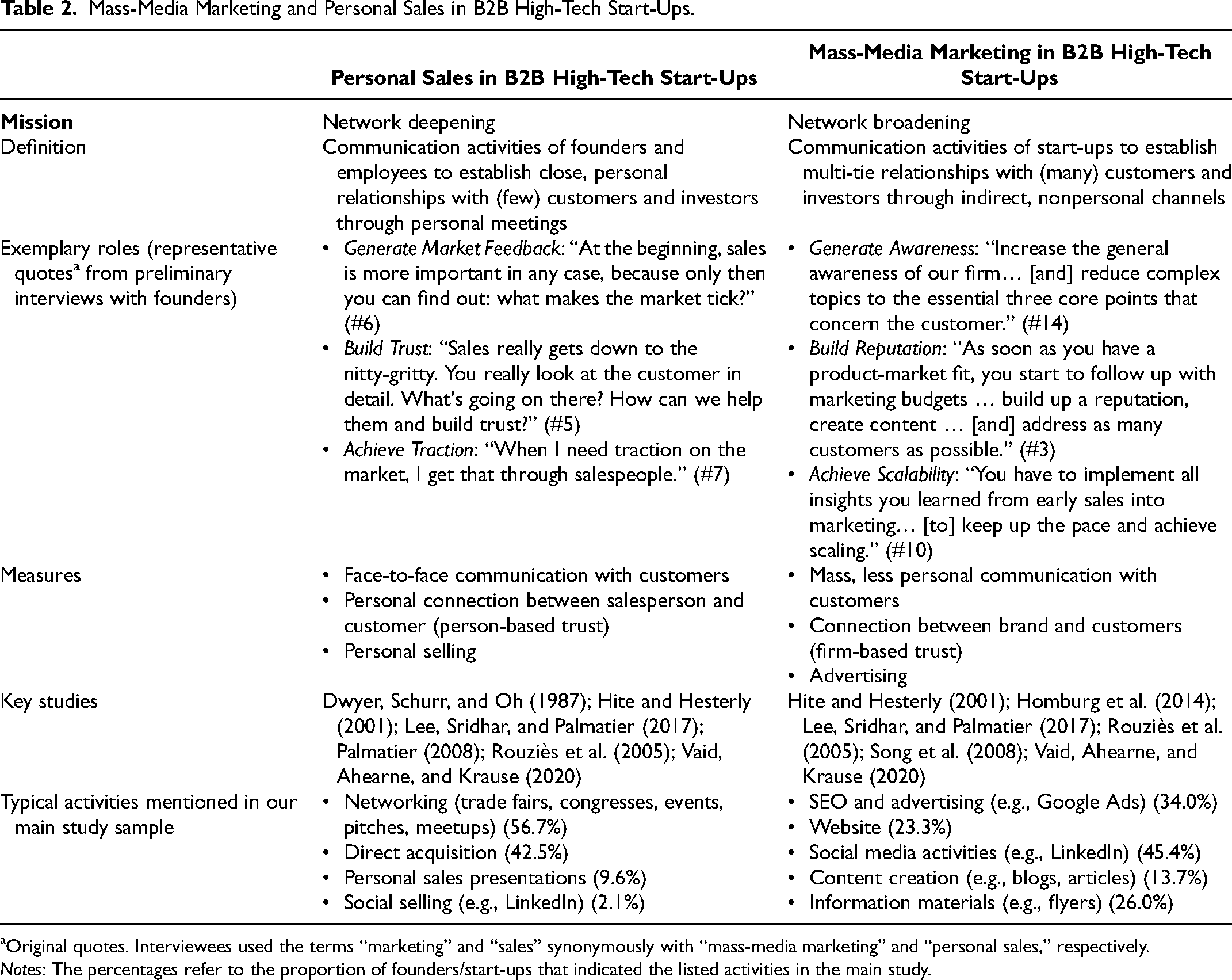
Original quotes. Interviewees used the terms “marketing” and “sales” synonymously with “mass-media marketing” and “personal sales,” respectively.
Notes: The percentages refer to the proportion of founders/start-ups that indicated the listed activities in the main study.
Conceptually, mass-media marketing and personal sales communications in B2B high-tech start-ups differ primarily in their approach to relationship-building (Table 2). In this context, mass-media marketing can create relationships with many customers, through different ties, with relatively little closeness. They enable reach and responsiveness to a broad customer base; according to the founder of a cybersecurity start-up, “It is simply about generating the highest possible number of leads via external channels” (#1). Conversely, personal sales activities require more time and effort as well as direct, personal involvement. Various founders (N = 7) noted that explaining and customizing complex offerings for business customers require high-touch interaction and can result in prolonged, resource-intense sales cycles. As one industrial service start-up founder explained, “Our technology requires a lot of explanation. We have to work individually with each customer in sales, which is a very long process until a customer is ready to buy from us. But when they do, they are tied to us. Yet a great deal of explanation and trust building is necessary beforehand” (#5). Thus, for start-ups, personal sales activities enable closer, more personal relationships, with relatively fewer customers per sales employee.
Effects of Mass-Media Marketing and Personal Sales Expense Ratios on B2B High-Tech Start-Ups’ Performance
We next discuss the differential impact of allocating a higher budget share to mass-media or personal sales activities on a start-up's performance. Start-up performance is not unidimensional; it has various dimensions, such as sales revenue or the number of acquired customers (Fisher, Kotha, and Lahiri 2016)—both goals that managers mentioned in our interviews as key challenges. We consider how both categories of activities might affect these key metrics.
Mass-media marketing communications
Prior research on the role of marketing in start-ups concurs that expenses on marketing activities should be conducive to start-up performance (Mintz and Lilien 2024). Mass-media marketing can effectively promote high-tech start-ups’ development and establish initial relationships through multiple less personal ties with a broad range of customers and other stakeholders. The founders who participated in our in-depth interviews agreed that in complex B2B settings, communicating a consistent, easy-to-understand message is crucial for generating awareness and attracting customers. Online, content, and social media marketing, along with advertising, all increase such contacts, helping firms reduce information asymmetries and signal their reliability and legitimacy (Lee, Sridhar, and Palmatier 2017). A software start-up founder explained, “I have to somehow break this complex thing down to a clear message. … Our goal is to generate a consistent customer experience and be perceived as attractive and professional by customers, business partners, investors, and even our customers’ customers” (#7).
Because, by definition, high-tech start-ups are unknown and inscrutable to potential customers (Rao, Chandy, and Prabhu 2008; Read et al. 2009), signaling legitimacy is a crucial prerequisite for building relationships with them (Song et al. 2008). The senior manager of a mature professional service start-up noted, “When you are fresh on the market, you have to start from scratch everywhere. You lack credibility when you approach customers who want to see use cases and success stories” (#4). Although customers often express uncertainty about start-ups’ products and prospects, mass-media marketing activities can alleviate this uncertainty and contribute to the start-ups’ performance by communicating relevant information.
Personal sales communications
Relationship marketing research unequivocally asserts the relevance of personal selling and personal attention in efforts to build close, profitable customer relationships (Palmatier, Scheer, and Steenkamp 2007; Schmitz et al. 2020). Personal sales communications can promote high-tech start-ups’ development by laying a foundation for building and expanding personal relationships with customers. For example, to induce first-time customers to purchase innovative, complex offerings, high-tech start-ups can thus engage in face-to-face interactions and personal selling, which allow them to provide extensive explanations (Konya-Baumbach et al. 2019; Slater and Mohr 2006). Complex offerings likely create additional customer uncertainty, which can be alleviated through direct, personal collaborations (Ulaga and Kohli 2018). Close sales-based collaborations can help start-ups better understand customer needs and concerns (De Jong, Zacharias, and Nijssen 2021; Tuli, Kohli, and Bharadwaj 2007), especially in B2B contexts where multiple actors are involved. To overcome individual reservations and foster close customer relationships, salespeople must devote focused personal attention to each decision-maker (Fang, Palmatier, and Grewal 2011).
Potential for negative outcomes
Despite the potential benefits of mass-media marketing and personal sales, allocating a higher share of start-ups’ budgets to these different activities may be less intuitive than expected. Research on entrepreneurship suggests the possibility of harmful effects (Bergmann and Brush 2001). Most start-ups operate with extreme resource scarcity, needing to trade off expenses on various resources (Homburg et al. 2014). Misallocated financial resources represent serious risks, as “you always have a limited amount of money, and you have to think about where you’re going to invest your money. … Burning your [mass-media] marketing and [personal] sales budget can really hurt your start-up” (#7). Spending a larger share of the budget on mass-media marketing or personal sales might divert financial resources from other vital areas, such as product development (Ernst, Hoyer, and Rübsaamen 2010). Thus, we ask:
Effects of Mass-Media Marketing and Personal Sales Expense Ratios Across the OLC
Integrating OLC Theory and Customer Relationship Management
High-tech start-ups face diverse challenges in building and retaining customer relationships across their OLCs. Existing OLC models describe firms’ development across time and stages, across which business risks and opportunities vary, such that unique challenges arise for customer relationships (Fisher, Kotha, and Lahiri 2016). Although different life-cycle models depict slightly varying stages, they converge on two basic stages: (1) early development, in which start-ups create and test initial products and business models with limited market activities, and (2) later growth, in which they scale up and penetrate the market.
In the earliest development phases, start-ups must arouse prospects’ interest, create close links with initial customers, and closely collaborate with them in product development, testing, and product implementation (Coviello and Joseph 2012). A software start-up founder outlined these needs: “First, I have to generate traction somehow, that's important. Only if I generate traction and have first customers [can I] further develop my product” (#7). Learning early from customer feedback also supports start-ups’ growth, according to a cybersecurity founder: “In the beginning, we analyzed: Why didn’t the customer want it? … It's always time-consuming to spend many resources on a customer you haven’t won. But that helps a lot with the next customers” (#6).
In later development phases, start-ups must grow their customer bases and explore and expand business opportunities with existing customers (i.e., upsell or cross-sell) (Dwyer, Schurr, and Oh 1987). As the chief strategy officer of a software-as-a-service (SaaS) start-up noted, “The next important step was to show that it [the solution] does not only apply to one or two customers who we knew closely but that we can actually win over new customers. That our business is truly scalable and addresses a larger problem” (#14).
We operationalize a start-up's OLC progression according to the venture's age in terms of the time elapsed since its founding. Time assumes an essential role in OLC models (e.g., Hanks et al. 1994), as well as in research on early firm survivability (e.g., Le Mens, Hannan, and Pólos 2011). According to these models, over time, organizations progress through distinct stages, such as initial conception and growth (Fisher, Kotha, and Lahiri 2016; Kazanjian and Drazin 1989). The specific challenges, goals, and events that characterize each stage (e.g., Hite and Hesterly 2001) include establishing a business plan, first commercial success, and specific growth targets. Earlier developmental phases are characterized by the liability of newness, with younger firms most likely to fail (Hannan and Freeman 1984). As previously noted, start-ups can build legitimacy to reduce the liability of newness, but building trust from stakeholders takes time (Nahapiet and Ghoshal 1998; Winkler, Rieger, and Engelen 2020).
Although prior research frequently uses venture age to reflect start-ups’ OLC progression (e.g., Fisher, Kotha, and Lahiri 2016; Hanks et al. 1994), this indicator has limitations: High initial resources (e.g., equity capital) may help start-ups progress more quickly than their ages would suggest (Brüderl and Schüssler 1990). Moreover, organizational change (e.g., change in the founder team) may alter start-ups’ developmental courses independently of their age (e.g., reset the liability of newness; Singh, House, and Tucker 1986). We account for such factors in our model. We also cross-validate our results with alternative measures for the start-up's OLC progression: venture size (indicating limited resources, or the liability of smallness; Freeman, Carroll, and Hannan 1983), venture popularity (alternatively indicating liability of newness), and an index measure (combining markers for liabilities of smallness and newness).
Effects of Mass-Media Marketing and Personal Sales Expense Ratios in Earlier OLC Stages
Because of their vulnerability in early development stages, start-ups desperately need resources from initial reference customers. Such customers provide essential references that enable start-ups to begin building legitimacy through favorable word of mouth, which improves their chances of future customer acquisition. Moreover, such partners can be highly instrumental in new product development, which usually demands particular effort and collaboration in complex B2B settings. For example, early customers might share essential insights into their “needs, market trends, competitors’ offerings, and complementary technologies” (Yli-Renko and Janakiraman 2008, p. 145). Therefore, to progress, start-ups first need to build relationships with their very first customers (Fisher, Kotha, and Lahiri 2016).
According to the literature on customer relationship management, firms should build close relationships at the interpersonal level rather than through impersonal customer touchpoints, especially in high-tech B2B settings (Palmatier, Scheer, and Steenkamp 2007), in which firms seek mutual understanding through intensive, time-consuming exploration processes (Zhang et al. 2016). Because any “exploratory relationship is very fragile” (Dwyer, Schurr, and Oh 1987, p. 16), start-ups should actively work to build mutual understanding, credibility, and legitimacy, based on appropriate information shared through high-quality interactions and deep relationships (Jap and Ganesan 2000).
Personal sales communications
Because of their liability of newness, start-ups cannot cite their extensive experience or strong firm reputations to reassure customers they are reliable (Fisher, Kotha, and Lahiri 2016). Instead, they must evoke customer trust in founders (Fang et al. 2008). To generate such person-based trust, personal sales interactions, rather than impersonal mass-media communications, are essential; they generate individual connections and establish initial relational bonds (Gruber 2004). An early-stage property technology start-up interviewee emphasized, “We need to approach customers directly. [Mass-media] marketing is … less important because at this stage, we need to contact companies very actively, arrange appointments, and enter into personal discussions” (#3). Spending a larger share of the budget on personal sales activities such as trade fair appearances and personal visits serves this purpose.
Mass-media marketing communications
Allocating operating budget to mass-media marketing may be pivotal for performance in the early stages because such activities create numerous compelling touchpoints and identify relevant customers to participate in early collaboration and product development efforts (Homburg et al. 2014). Social media activities can be particularly potent: By providing engaging content, such as representations of the start-up, its ideas, and products, start-ups can inspire customers and investors to start business relationships and signal firm legitimacy. Yet the founders we interviewed also noted a risk of spending on mass-media activities too early if products are not “market ready” or firms are not capable of handling a mass of customers. According to a property technology start-up founder, “One mistake that many start-ups make is that they burn money too early with [mass-media] marketing before they have found the famous product-market fit. Product-market fit is the magic word: I finally have a product that I feel resonates with a broad mass of people” (#3).
In summary, we conceive arguments for the benefits of spending a larger share of the budget on mass-media marketing and personal sales in the early start-up stages. However, we note that prior research in complex B2B settings strongly emphasizes the need for interpersonal relationships that facilitate B2B firm performance (e.g., Alavi et al. 2021; Panagopoulos, Rapp, and Ogilvie 2017). This argument suggests that B2B high-tech startups should focus expenses on personal sales activities in order to build relationships with customers and ensure their performance in earlier OLC stages. Thus, we ask:
Effects of Mass-Media Marketing and Personal Sales Expense Ratios in Later OLC Stages
In later OLC stages, start-ups have market-ready offerings and seek market growth. To realize such rapid market growth, their focus shifts from developing new products to commercializing and selling existing ones to broader bases of different customers (e.g., Jap and Ganesan 2000).
Mass-media marketing communications
Spending a larger share of the budget on mass-media marketing can be essential, as an industrial service start-up founder noted: “The bigger you get and the better you are positioned, the more important marketing becomes to tap into customer segments that you didn’t have on your radar before” (#5). A SaaS start-up founder added, “At some point, it probably tips over from personal level to mass marketing” (#8).
Prior research has identified the particular effectiveness of mass-media marketing in targeting mass customer segments (e.g., Rust and Huang 2014). Mass-media marketing expenses can help start-ups grow by extending ties to existing customers and capturing new customers’ attention. Mass-media marketing communications in the growth stage can help build broader sets of relational ties with customers (Palmatier 2008). Whereas personal sales activities can promote cross-selling or upselling for the most promising customers, large-scale mass-media campaigns inform entire customer bases of new business opportunities, products, or special offers. They also increase the density of start-ups’ contacts with their growing customer bases, fortify these relationships, and stabilize their continuous growth (Palmatier 2008). Such activities (e.g., advertising) also attract attention from broader, previously unknown customer bases, providing a continuous stream of new potential customers (Zhao, Song, and Storm 2013). Online marketing activities might be particularly effective because in these channels, customer references and referrals exert strong impacts and achieve wide reach (Mintz and Lilien 2024), especially in B2B high-tech contexts. Thus, a higher mass-media marketing expense ratio should be beneficial to start-ups’ performance later when they attempt to achieve market growth.
Personal sales communications
Personal sales activities can strengthen customer relationships, enhancing information sharing and understanding of customer needs (Tuli, Kohli, and Bharadwaj 2007), which especially benefits start-ups that are new to the market (De Jong, Zacharias, and Nijssen 2021). However, allocating a larger share of the budget from other essential activities, like mass-media marketing or operations, to personal sales may be risky in later stages: Start-ups need to produce and distribute their products at volume and in a cost-efficient manner requiring substantial resources for scalable operations and broader-reach market communication (Kazanjian 1988). Critically, overreliance on a few personal ties can limit market learning and “curtail opportunities to develop new and diverse products for other customers or new markets” (Yli-Renko and Janakiraman 2008, p. 134). For firms aiming for rapid customer growth, a high personal sales expense ratio may not be effective and could even impede progress at this stage. Accordingly, we ask:
Empirical Analysis
Data Collection and Sample
Because archival data on start-ups are sparse and often focus “on (the atypically) successful later-stage start-up firms” (Mintz and Lilien 2024, p. 221), we composed a unique dataset combining primary panel data with archival data sources (i.e., Amadeus, Crunchbase, and Google Trends). In our longitudinal, multiple-data-source study, we conducted telephone surveys with founders at B2B high-tech start-ups across development stages and business models. In a multistep procedure, we identified the relevant population of B2B high-tech start-ups in the target country (Germany). We extensively reviewed reliable sources (e.g., governmental and academic initiatives and organizations promoting start-ups), resulting in a comprehensive longlist of relevant start-ups. Web Appendix B shows how we developed and validated our final sampling frame. We prescreened potential respondents to ensure they meet our definition of start-ups, requiring them to have been in operation for a maximum of ten years (e.g., Winkler, Rieger, and Engelen 2020) and to have pursued a commercial, profit-oriented purpose, targeting B2B markets. We randomly selected start-ups across high-tech industries, generating 1,079 contacts.
Professional telephone interviewers with start-up business experience conducted the surveys with (co)founders or top-level executives. The interviewers first underwent extensive training to ensure quality and consistency, comparability across interviewer ratings, and appropriate data handling (Web Appendix B). Each interview began with a structured survey, which used established measurement scales and closed-ended quantitative questions. The interviewers then engaged in semistructured, in-depth discussions with respondents about their start-ups’ business model, communication activities commonly referred to as marketing or sales, and developmental course. All interviews were recorded and transcribed. After each interview, in another structured survey, interviewers rated each start-up's development according to respondent discussions (an independent rater rerated 20% of the interviews to evaluate reliability; Ø kappa: .77). The surveys spanned four waves, over 20 months, from September 2018 to April 2020. Key respondents were the same across all waves. We obtained 909 start-up-wave observations, but for the panel models, sample sizes varied between the dependent variables, sales revenue (N = 407), and number of customers (N = 598) because of item nonresponses, which we address in our analytical strategy.
The diversity of our sample reduces potential selectivity concerns, often present in entrepreneurship research (e.g., Korteweg and Sorensen 2010), because it encompasses start-ups that are in earlier and later OLC stages, more and less successful, and from various B2B high-tech industries. Table 3 depicts our sample composition (Panel A) and provides illustrative examples of B2B high-tech start-ups included in our sample (Panel B). All start-ups offer a vast range of technologically sophisticated products and services (e.g., cybersecurity applications, innovative microbiological tests, ecological seed coating, blockchain-based vehicle diagnostics), have highly innovative business models, and operate in a variety of high-tech industries (IT/software engineering, SaaS, Industry 4.0). On average, during the first survey wave, the firms in our final sample operated for 3.2 years and employed 16.1 employees. Notably, start-ups in our sample are rather young, but high-tech start-ups tend to progress faster than mid- and low-tech start-ups (Almus and Nerlinger 1999). The 81 high-tech founders surveyed in our prestudy confirmed this assumption: Start-ups in their industry are, on average, 1.4 years old in the early conception stage and 3.9 years old in the later growth stage. On seven-point scales (1 = “strongly disagree,” and 7 = “strongly agree”), the interviewers rated them as innovative (5.23), complex (4.40), and advantageous relative to existing products (5.48).
Sample Characteristics and Illustrative Examples of Start-Ups in the Sample.
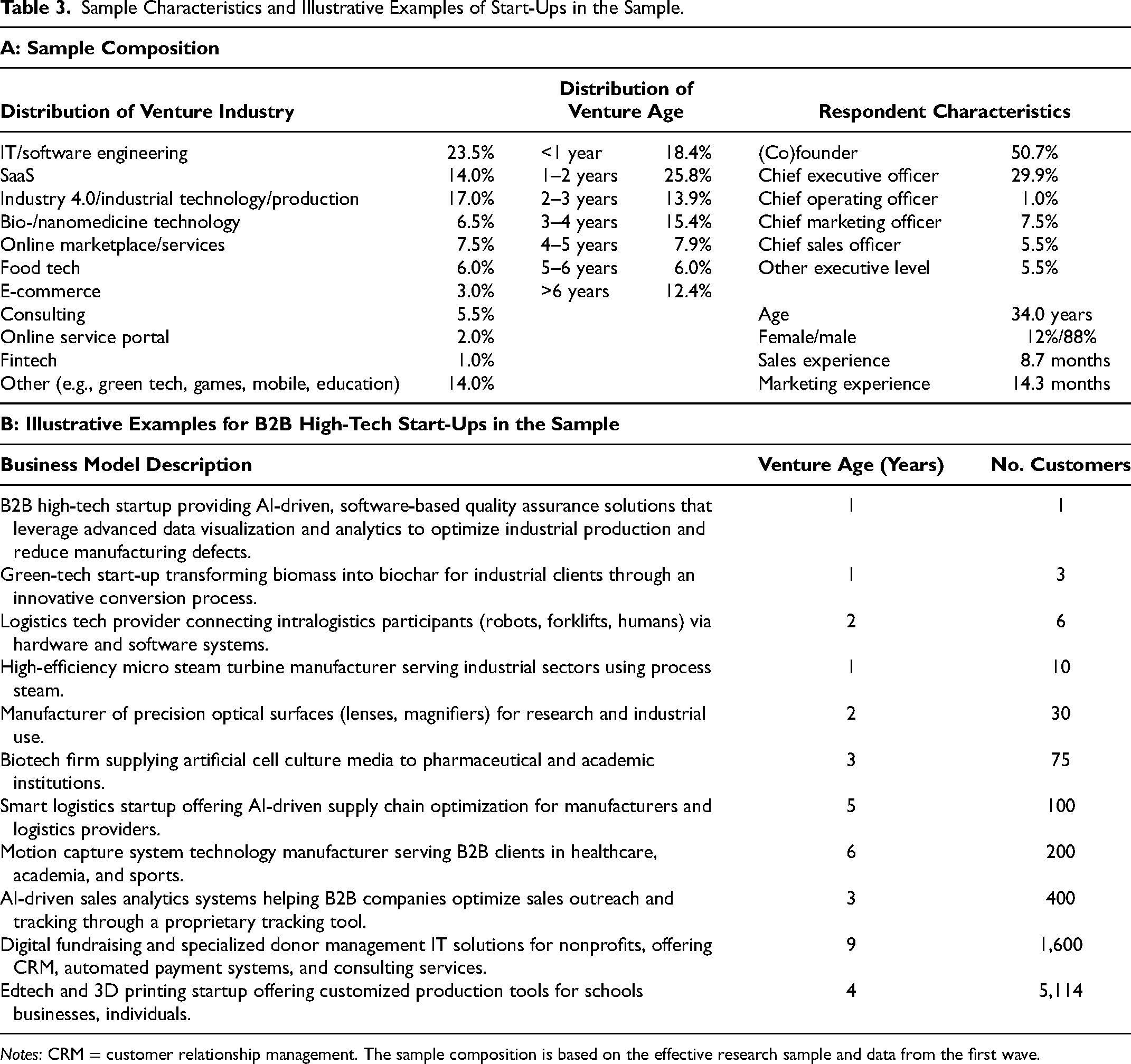
Notes: CRM = customer relationship management. The sample composition is based on the effective research sample and data from the first wave.
Measures
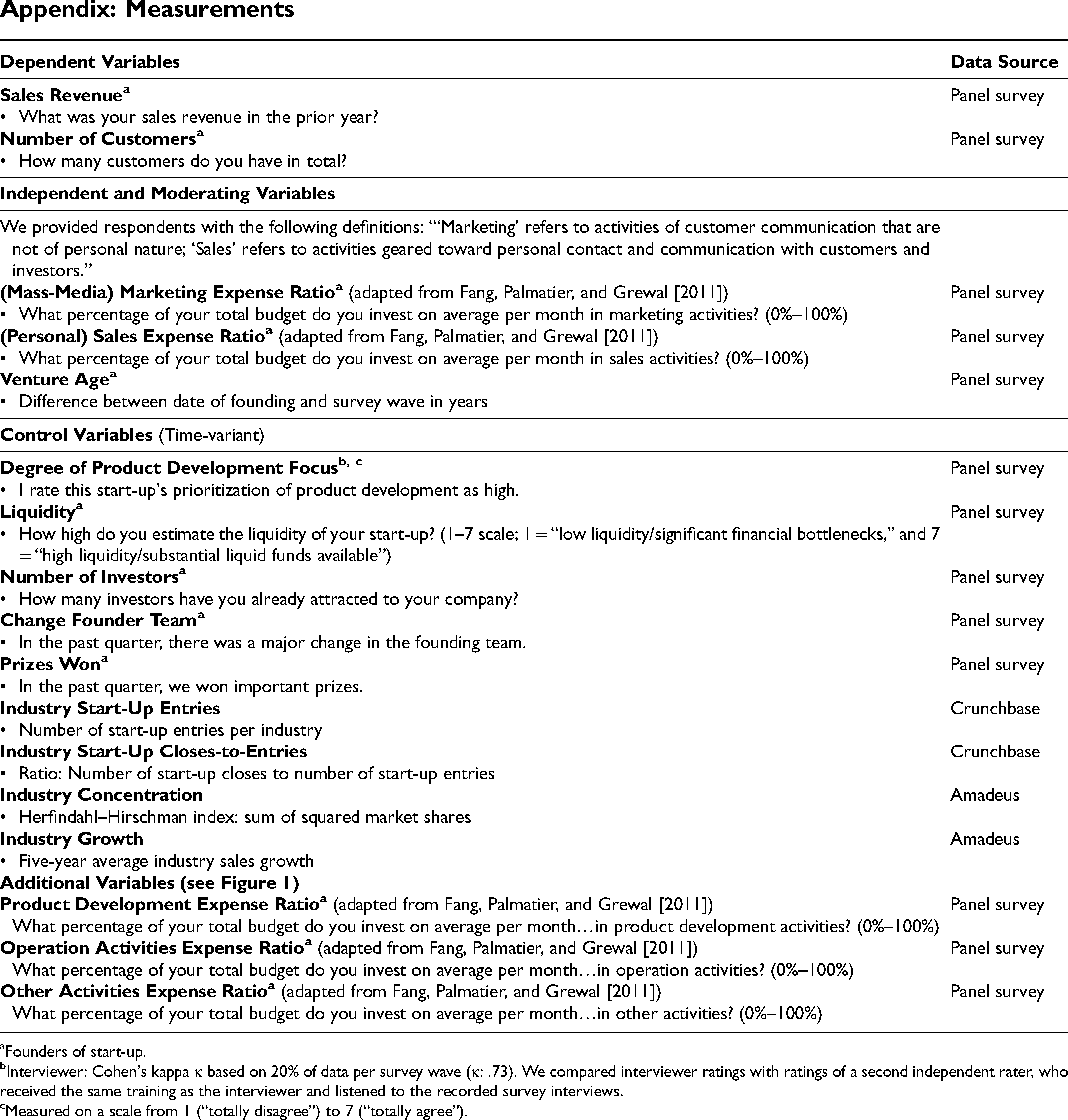
We gathered measurement items from prior literature; we report all measures and items from the main analyses in the Appendix, then provide the measures of the instrumental variables in Web Appendix C. We used quasi-objective data for our focal models (Homburg et al. 2012) and multi-item scales for instrumental variables unless the constructs were quasi-objective.
Dependent variables
We measured start-up performance via sales revenue (M = 617,485.20, Mdn = 180,000, SD = 2,396,498) and number of customers (M = 715.13, Mdn = 30, SD = 2,574.08). 1 With these measures, we accounted for the multidimensional challenges that start-ups face simultaneously (Anderson et al. 2021; Xiong and Bharadwaj 2011).
Independent variable
We relied on a quasi-objective measurement of the mass-media marketing and personal sales expense ratios. On a 100-point constant sum scale (Homburg et al. 2017), we asked respondents to indicate how they would allocate their financial budgets across marketing, sales, product development, operations, and other activities. Figure 1 illustrates how the start-ups in our sample distribute their budgets. As expected, the start-ups focus primarily on product development. However, they also allocate, on average, 15%–20% of their budgets to mass-media marketing and personal sales. Furthermore, the three start-ups we illustrate in detail exemplify that budget allocation varies considerably among start-ups.
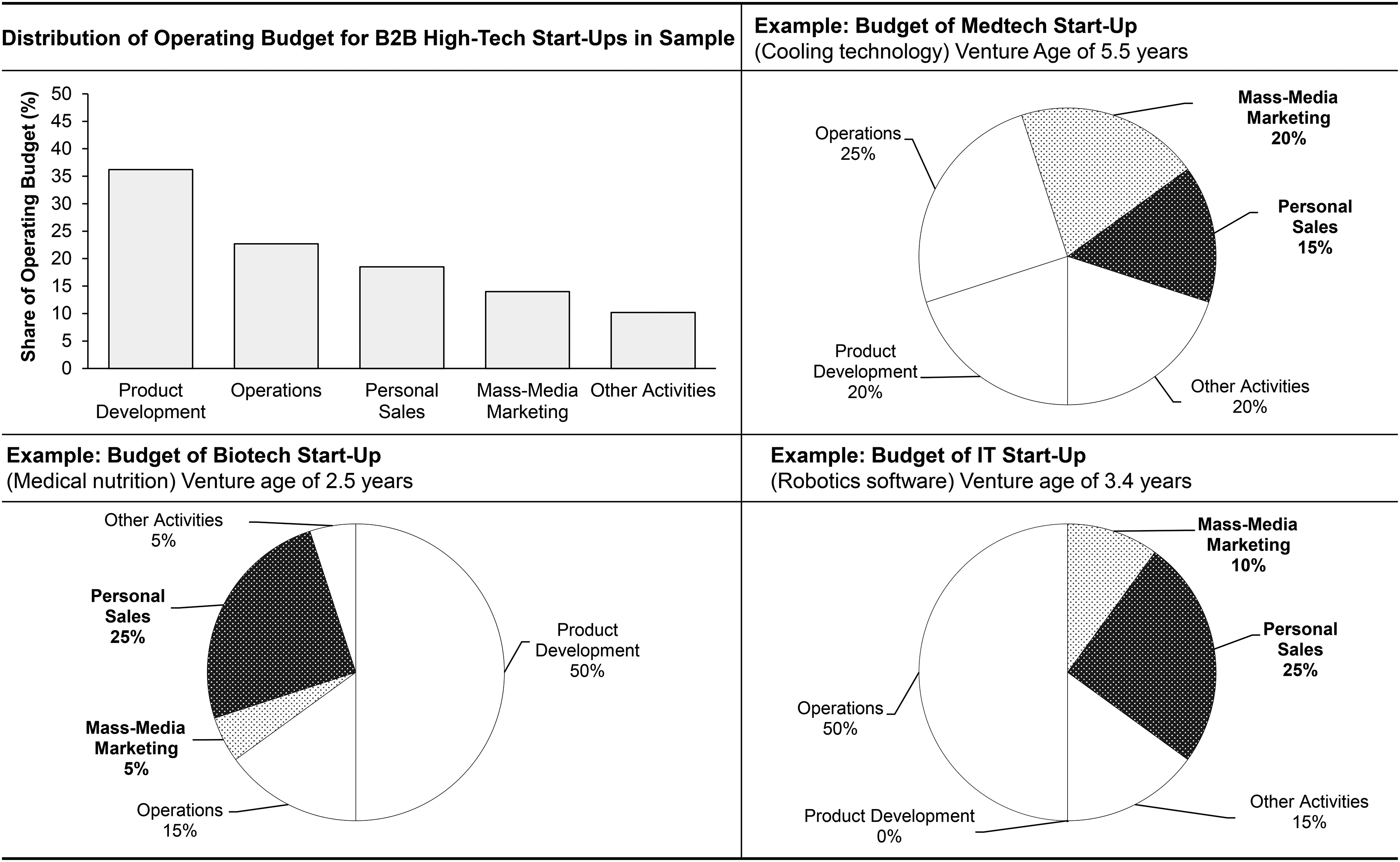
Operating Budget of Start-Ups in the Research Sample.
Web Appendix D provides descriptive information on the relationship between expense ratios and start-ups’ specific mass-media marketing and personal sales communication activities. For example, according to a median split, start-ups with a high (vs. low) mass-media marketing expense ratio are significantly more likely to employ online marketing (e.g., SEO, email marketing) (δ = 14.9%, p = .0002) or social media marketing (δ = 11.1%, p = .007). Start-ups with a high (vs. low) personal sales expense ratio are more likely to engage in personal networking (e.g., on trade-fairs) (δ = 8.5%, p = .046) and direct acquisition (δ = 9.5%, p = .027).
Moderating variable
We used venture age as the main indicator of a start-up's OLC progression and liability of newness (Freeman, Carroll, and Hannan 1983). We measured it according to the difference between the founding date and the survey wave date in years.
Control variables
Through a literature review, we identified relevant start-up internal (i.e., human capital, organizational legitimacy, and product development capability) and external (i.e., industry attractiveness) control variables. We controlled for change in the founder team, as it reflects changes in the start-up's human capital. Because financial and reputational assets can signal legitimacy, we controlled for financial liquidity, the number of investors 2 (e.g., Kaplan and Strömberg 2004), and whether the start-up had won an important prize. Start-ups with more available funds can spend more; those who have won important prizes can overcome the liability of newness, thereby lowering their mass-media marketing and personal sales expense ratios. While spending on product development may enhance performance, an excessive product orientation may decrease the willingness to allocate funds to mass-media marketing and personal sales communications. Thus, we controlled for a start-up's product development focus, measured as the extent to which it prioritizes product-related decisions and actions.
Moreover, we captured general industry attractiveness and industry attractiveness from a start-up's perspective, accounting for the number of start-ups and the closes-to-entries ratio per industry, using data from Crunchbase. Although the entry of many start-ups into an industry may signal general market potential, the fierce competition might also make it more challenging for start-ups to grow. High closes-to-entries ratios may signal that start-ups are finding it difficult to compete with more established companies. Moreover, by following research on more mature firms, we captured industry demand growth (i.e., five-year industry sales revenue growth) and industry concentration (Herfindahl–Hirschman index) with secondary data from the Amadeus database. Start-ups may thrive in growing industries, but dominant companies that characterize concentrated industries may also limit their performance.
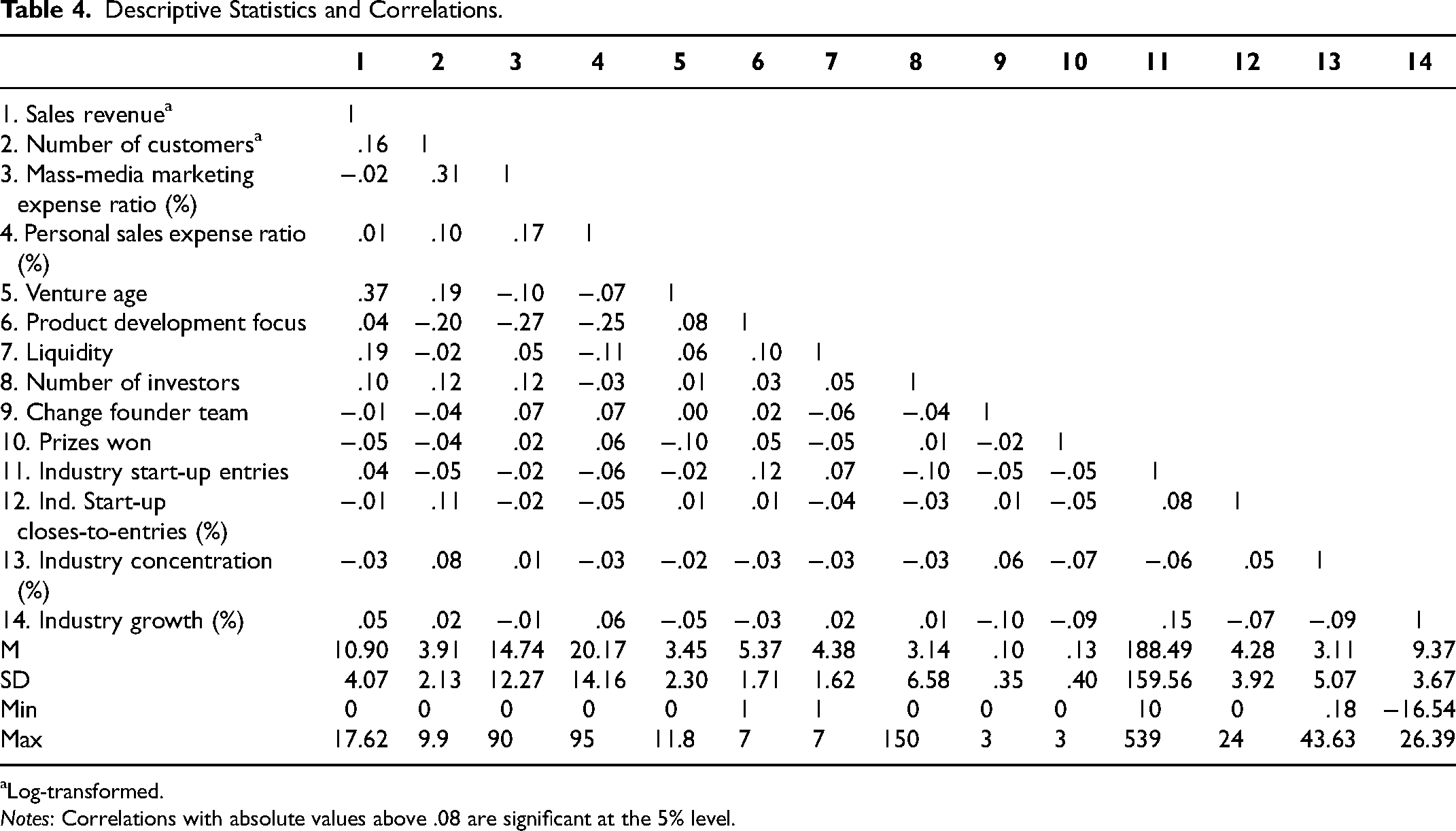
Finally, we added start-up and wave dummies to account for potential unobserved heterogeneity across different start-ups and common economy-wide developments, respectively. Start-up dummies, for example, account for important variables, such as founder characteristics (e.g., gender, personality), founding team size, initial resource composition, or industry time-invariant effects. Table 4 summarizes our data.
Descriptive Statistics and Correlations.
Log-transformed.
Notes: Correlations with absolute values above .08 are significant at the 5% level.
Measurement Validity
Key informant bias
To reduce key informant concerns, we preselected only senior-position respondents (e.g., founders, top-level executives), who should be qualified to answer strategic questions. According to their LinkedIn data, on average, respondents had 8.7 years of work experience, 3.6 years of industry experience, 1.2 years of marketing experience, and .72 years of sales experience. Moreover, key informant bias is unlikely because most of our variables relate to each start-up's current situation and internal information, with a low level of abstraction. Key informants tend to evaluate such variables accurately (Homburg et al. 2012).
Common method variance (CMV)
The threat of CMV was low. First, we investigated the effects of mass-media and personal sales expense ratios moderated by venture age; prior analytical and simulation studies show that CMV cannot create but can only deflate such interactive effects. Second, we separated the items used to measure the independent and dependent variables in the survey and avoided common scale properties (i.e., open-ended scales for the dependent variables and constant-sum scales [percentages] for mass-media and personal sales expense ratios). Third, evaluating the variables requires a low level of abstraction, which reduces CMV. Finally, start-up dummies and our instrumental variable strategy reduce CMV threats (Vomberg and Klarmann 2021).
Model Specification
We first considered a model that links start-up performance to mass-media marketing and personal sales expense ratios over time: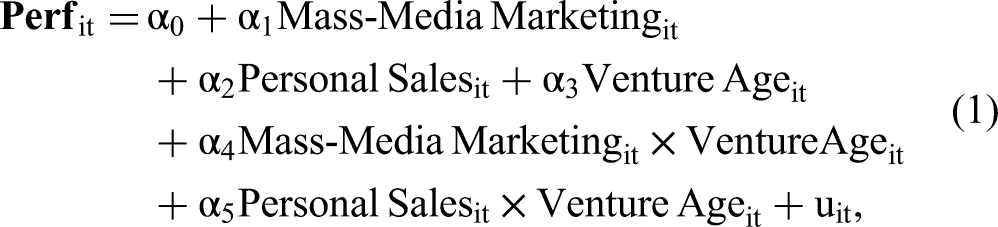
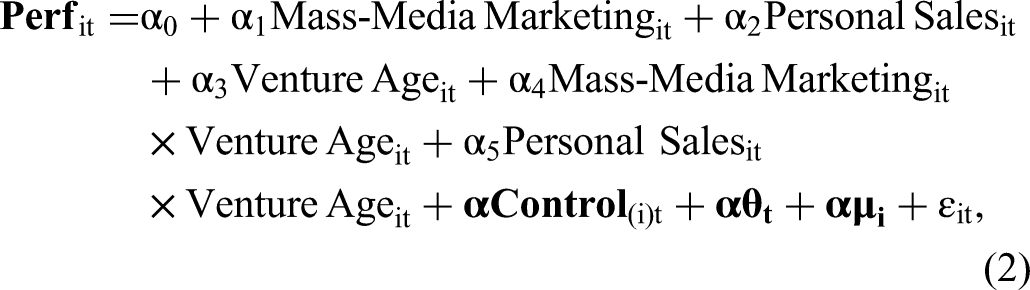
Addressing Potential Selection Bias
We find no evidence challenging our sample's representativeness. However, selection biases in panel data can also stem from two other sources: panel attrition and item nonresponse (Elwert and Winship 2014), which reduce the number of cases available for analysis. Using Heckman's (1979) two-step model, we reduce the threat of panel attrition bias; we estimate the probability of panel attrition in the next wave (attrition: 1 = “attrition in the next wave”) with a probit model (Equation 3) that includes all variables from Equation 2 (first-stage estimation results are in Web Appendix E, Table W6). We then included the calculated inverse Mills ratio (IMR) in the main analysis. For identification, we used interviewer-assessed respondent discomfort (discomfort; Web Appendix C), which satisfied both relevance and exclusion criteria—likely affecting the probability of remaining in the sample but not start-up performance.
According to the literature on panel attrition, respondent burden in the prior wave affects next-wave participation. Respondent discomfort is an important source of respondent burden (e.g., Bradburn 1978; Kleinert, Christoph, and Ruland 2021). Less comfortable respondents are less likely to return (relevance criterion), which we corroborate empirically (p = .001). Although experiences during the prior survey may explain next-period attrition, such experiences should not influence start-ups’ sales revenues or numbers of customers (exclusion criterion). Thus,
We further addressed potential bias resulting from item nonresponse regarding sales revenue. Item nonresponse frequently occurs in survey-based research and can depend on organizational or survey-related factors (Vomberg and Klarmann 2021). In contrast with established, formalized firms, start-ups may struggle to obtain and provide relevant sales revenue data, and managers likely regard information about their sales revenues as sensitive. We again followed Heckman's (1979) two-step approach. In the first stage (Equation 4), we regressed item nonresponse (nonresponse: 1 = “no information on sales revenue available”) on the variables from Equation 2 (Web Appendix E, Table W7). We leveraged three respondent-related instrumental variables according to interviewers’ assessments of respondents’ confidence levels in their start-ups, fatigue during the survey, and how structured they appeared (Web Appendix C). The more confident respondents are in their start-ups, the more likely they are to report (even nonfavorable) performance variables. Moreover, more structured respondents are likely better prepared and more likely to collect information about the variables in advance. Respondent fatigue may decrease the willingness to answer. A joint chi-square test documents the strength of these instruments (p = .004), confirming the relevance criterion. Because all instruments focus on respondents in specific interviewer situations, they are theoretically unrelated to the dependent variable, satisfying the exclusion restriction. Therefore,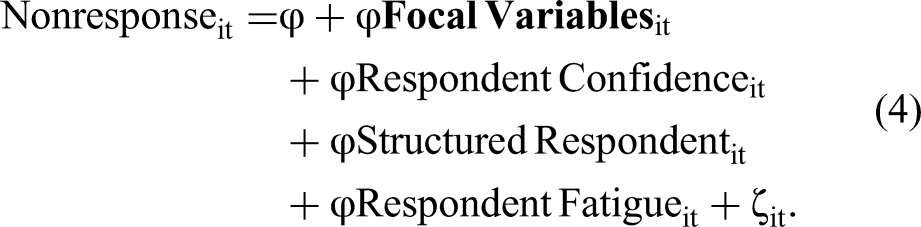
Addressing Potential Endogeneity of Mass-Media Marketing and Personal Sales Expenses
Control function approach
Although we account for time-varying control variables and wave and start-up dummies, an omitted variable bias could still pose endogeneity concerns. For example, a founder's expectation of performance levels from mass-media marketing and personal sales communication outcomes could determine a start-up's resource allocation decisions, thereby introducing a correlation with our model's error term. To address these concerns, we relied on a two-step control function approach (Petrin and Train 2010). We included residuals from the first stage (Equation 5) in the second stage (Equation 7) to correct for potential endogeneity. To obtain the residuals, we regressed the potentially endogenous variables (mass-media marketing and personal sales expense ratios) on the variables from our main model (Equation 2) and instrumental variables (Equation 5). The first-stage regression (without subscripts) is as follows:
Relevance criterion
Following prior marketing research (e.g., Germann, Ebbes, and Grewal 2015), we used weighted measures of peer firms (start-ups in the same one-digit Standard Industrial Classification [SIC]) as our sources of instrumental variables. Regarding criteria for instrumental variables, we argue that industry characteristics are key determinants of a start-up's expenditure decisions (relevance criterion). According to the theory of institutional isomorphism (DiMaggio and Powell 1983), start-ups mimic industry standards and norms to gain legitimacy among customers and investors to overcome the liability of newness (Homburg et al. 2014). Thus, industry-aggregated measures of mass-media marketing and personal sales expense ratios likely influence a start-up's expenditure decisions. If a start-up's peers engage frequently in mass-media marketing activities, the start-up is also likely to spend more on such activities to gain legitimacy.
The first-stage auxiliary regression models demonstrate that peer-weighted industry mass-media and personal sales expense ratios are positively and significantly related to mass-media marketing (Web Appendix G, Table W11; bPW_Mass-Media Marketing = .47, p = .004) and personal sales (Table W12; bPW_Personal Sales = .49, p = .008) expense ratios, respectively. Moreover, in both regression models, the Sanderson–Windmeijer F-statistics are highly significant (ps < .01). Both tests confirm the relevance of our selected instrumental variables.
We also assessed the possibility of weak instrumental variables. Weak instrumental variables are mainly problematic when many instruments are used (Rossi 2014), which does not apply in our case. For models with two potentially endogenous variables, the critical values for a 10% and 15% relative size bias are 7.03 and 4.58, respectively (Stock and Yogo 2002). The magnitude of the Sanderson–Windmeijer statistics (Web Appendix G, Table W11: F = 10.55; Table W12: F = 11.52) we observed is in line with previous studies (e.g., Manacorda and Tesei 2020) and shows that the chosen instruments reject the null hypothesis of weak instruments.
Exclusion criterion
The proposed instrument (i.e., the peer-weighted mass-media marketing and personal sales expense ratios) must not correlate with any omitted variables that are part of the error term to meet the exclusion criterion (Wooldridge 2002). As we have discussed, the founders’ individual performance expectations of mass-media marketing and personal sales communications may constitute a relevant omitted variable. However, there are both substantive and empirical reasons against such a correlation between peer-based instruments and individual founders’ performance expectations.
First, founders’ performance expectations often stem from tacit entrepreneurial knowledge—the implicit, experiential insights entrepreneurs develop over time that are difficult to codify or communicate (Wuytens et al. 2022). As such, these expectations are typically difficult to articulate and externally validate. Since they are neither disclosed nor reliably inferred by outsiders, it is unlikely that peer firms are aware of a start-up's internal performance expectations—or that these expectations systematically influence their own expense decisions. This supports the validity of the exclusion restriction.
Second, even if peers somehow had access to this implicit knowledge, it should be unlikely that they would be able to coordinate their behavior in such a way that they could systematically mimic the performance expectations of a given start-up (see Germann, Ebbes, and Grewal [2015] for a comparable argument). Such coordination would be necessary for a correlation between the peer-weighted instruments and the omitted variable to emerge. To illustrate: On average, we include 22 peer start-ups per focal start-up across all waves and industries. Coordinated responses by 22 independent start-ups to the internal expectations of a single start-up should be highly implausible. Furthermore, these same start-ups would then need to repeat this coordination process for every other start-up in their industry. Prior research has also shown that coordination among peer firms to jointly monitor and emulate specific strategies of a particular firm is generally uncommon (Han, Mittal, and Zhang 2017).
Granularity criterion for peer instruments
In addition to the general requirements for instrumental variables (relevance and exclusion), peer instruments should exhibit sufficient variance, also called the instrument's “granularity” (Lim, Tuli, and Grewal 2020). The peer instruments must vary sufficiently at the start-up level, not just at the peer-group level.
Most researchers define peer groups on the basis of a single characteristic (e.g., the company's or the start-up's main industry or sector). Without further adjustments, this procedure would result in completely overlapping peer groups. If start-ups i and j are in the same group, their peers match, and without further adjustments, the two start-ups would receive the same instruments (lack of granularity). Shi, Grewal, and Sridhar (2021) show that such instruments cannot identify peer influence. Completely overlapping peer groups result in linear dependence between the endogenous and exogenous peer variables. To break down such linear dependence and thus increase granularity, researchers traditionally exclude the focal company from calculating the average value. However, the exclusion of a single start-up does not sufficiently increase the instrument variance (Lim, Tuli, and Grewal 2020). Thus, in addition to excluding the focal start-up, we use weighted relative values of the expense ratios, resulting in partially overlapping groups. Even if start-ups i and j operate in the same industry, their peer instruments differ on the start-up level, given different weighting factors, thereby attenuating granularity concerns. Our approach follows that of Lim, Tuli, and Grewal (2020) and is similar in spirit to other approaches addressing granularity (e.g., Shi, Grewal, and Sridhar 2021). We define the peer-weighted instrumental variables (PWIV) as
We detail the operationalization of our weighted instruments and illustrative examples of their measurement in Web Appendix F. We identify peer start-ups as those operating in the same one-digit SIC sector. We chose the one-digit level to allow for permeability across more fine-grained industry boundaries when start-ups evolve. Within each sector, we position the focal start-up relative to its peers using the classic multidimensional scaling method (MDS). We use product- (e.g., product complexity), financial- (e.g., liquidity), and OLC- (e.g., venture age) related metrics to determine the similarities between start-ups, reflecting characteristics typically discussed in the start-up OLC literature (e.g., Kazanjian 1988; Kazanjian and Drazin 1989). Research shows that similar peers can exert a significant influence on the focal start-up (Hasan and Koning 2017; Hsu 2007). In abbreviated form, we determine the weights (Web Appendix F) based on the results from the MDS. Reassuringly, we find substantial variation in the peer-weighted mass-media marketing (M = 14.78, SD = 3.39, Min = 2.64, Max = 36.12) and personal sales expense ratios (M = 19.67, SD = 4.26, Min = 6.13, Max = 41.09) across SIC sectors (see also Web Appendix H).
Equation 7 represents our final model. We include the different IMRs (IMR vector, Equations 3 and 4) and the effects of the two residual error terms (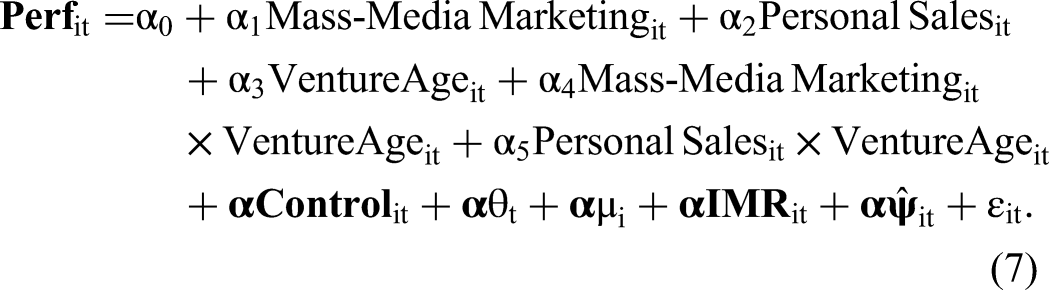
Results
Model estimation
We employed the conditional mixed process routine (command CMP) in Stata (Roodman 2011), which falls in the maximum likelihood class of estimators. It allowed us to include different dependent variables and enabled a flexible error structure with cross-correlations among equations. We log-transformed the dependent variables. We mean-centered the predictor and moderator variables (e.g., Lim, Tuli, and Grewal 2020) to enhance the interpretability of the interactive effects. The variance inflation factors for all variables are less than 10, so multicollinearity is unlikely to be a concern; observed t-values and sample size further attenuate potential multicollinearity concerns (Mason and Perreault 1991).
We employed bootstrap to obtain standard errors that also account for the additional variation that arises from our use of estimates (i.e., IMRs from Equations 3 and 4 and
Main results
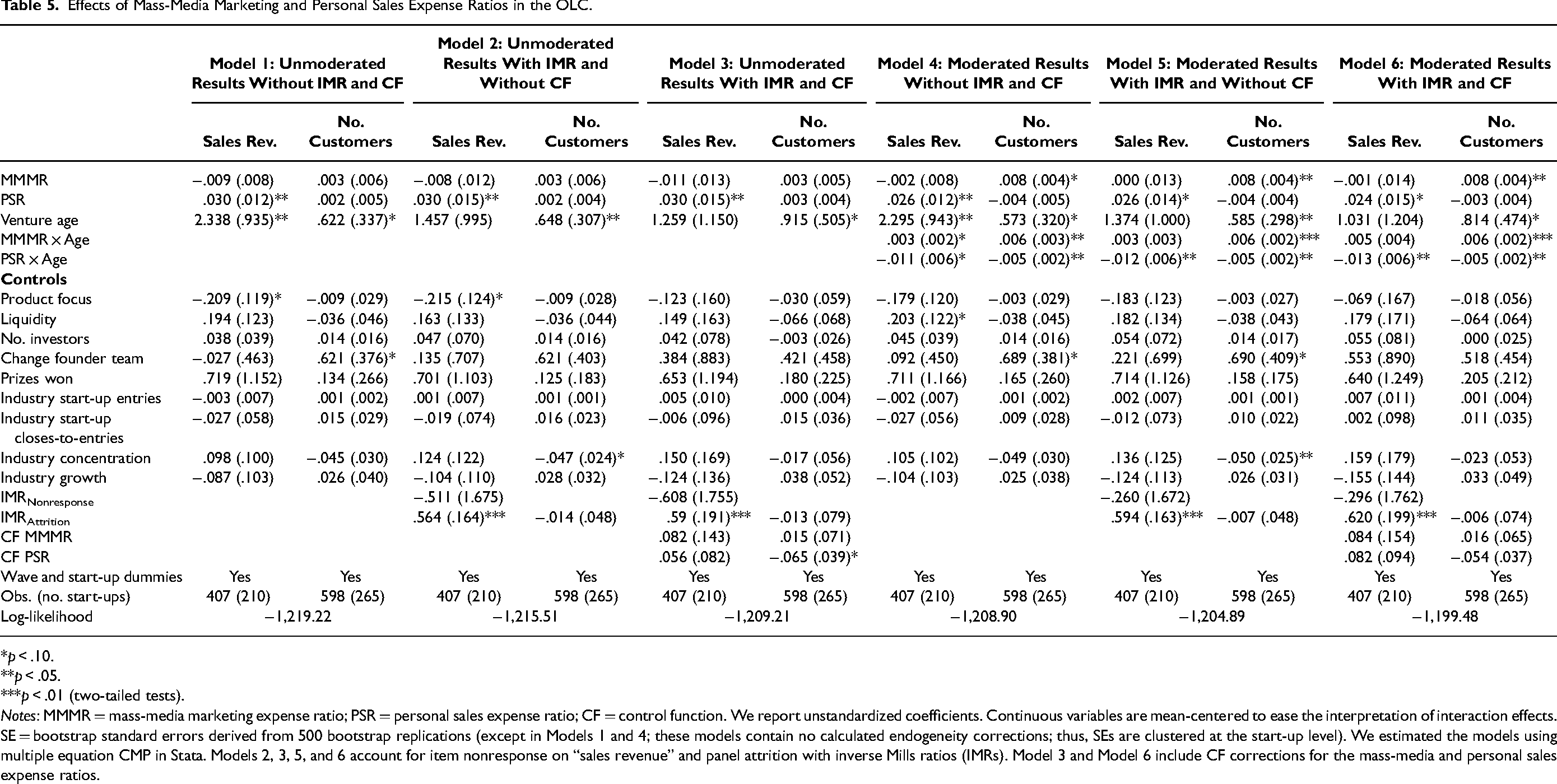
Table 5 presents the main results. We first report the unmoderated results addressing RQ1 (Models 1–3) and then discuss the moderated results to address RQ2 and RQ3 (Models 4–6). To provide a transparent view of our findings (Germann, Ebbes, and Grewal 2015), we report results without endogeneity corrections (Models 1 and 4), with IMRs (Models 2 and 5), and with control function corrections (Models 3 and 6). Overall, our results remain robust across different model-identifying assumptions.
Effects of Mass-Media Marketing and Personal Sales Expense Ratios in the OLC.
*p < .10. **p < .05. ***p < .01 (two-tailed tests).
Notes: MMMR = mass-media marketing expense ratio; PSR = personal sales expense ratio; CF = control function. We report unstandardized coefficients. Continuous variables are mean-centered to ease the interpretation of interaction effects. SE = bootstrap standard errors derived from 500 bootstrap replications (except in Models 1 and 4; these models contain no calculated endogeneity corrections; thus, SEs are clustered at the start-up level). We estimated the models using multiple equation CMP in Stata. Models 2, 3, 5, and 6 account for item nonresponse on “sales revenue” and panel attrition with inverse Mills ratios (IMRs). Model 3 and Model 6 include CF corrections for the mass-media and personal sales expense ratios.
We focus on the fully specified models (Models 3 and 6). The IMRs for panel attrition are significant for sales revenue and indicate positive selection effects (Model 3: bAttrition = .590; p = .002). Start-ups that continue to respond in the panel systematically exhibit higher sales revenues than those that no longer respond. Thus, start-ups with higher revenues are disproportionately represented in the sample. Except for the marginally significant correction term of the personal sales expense ratio in Model 3 (bCF PSR = −.065, p = .095), none of the remaining correction terms from the control function approach are significant in Models 3 and 6. Moreover, Models 3 and 6 demonstrate that incorporating these terms does not alter the substantive results.
Regarding the unmoderated effects, Model 3 shows that the personal sales expense ratio is positively related to sales revenues (bPersonal sales = .030, p = .044). All other unmoderated effects of the mass-media marketing and personal sales expense ratios are not significant. Model 3 does not show significant effects of the control variables, which is comparable to prior investigators (Homburg et al. 2014; Mintz and Lilien 2024), who only observed a few significant control variables. Existing research suggests that founders’ human capital may be a particularly important control variable (e.g., Honoré 2022); we account for this by modeling (significant) startup fixed effects. Moreover, our conservative identification approach using fixed effects, control function corrections, and bootstrapping leads to large standard errors (Germann, Ebbes, and Grewal 2015; Hahn and Liao 2021; Petersen 2008). In line with this, we observe a few significant control variables in Model 2, which become nonsignificant in Model 3.
The interactive effects (RQ2 and RQ3) show that for the dependent variables, all but one effect of the mass-media marketing and personal sales expense ratios depend on the venture's age (Model 6). For the number of customers (bMass media × Venture age = .006, p = .009), the performance-enhancing effects of the mass-media marketing expense ratio grow stronger over a start-up's OLC. However, the beneficial effects of the personal sales expense ratio become weaker over time for sales revenue (bPersonal sales × Venture age = –.013, p = .038) and number of customers (bPersonal sales × Venture age = −.005, p = .037). The interaction between mass-media expenses and venture age on sales revenue is in the expected direction (bMass media × Venture age = .005; p = .202) but is only significant in Model 4. Overall, the effects of the mass-media marketing and personal sales expense ratios depend strongly on the OLC phase.
Floodlight analysis
We conducted floodlight analyses to examine the simple effects of the mass-media marketing and personal sales expense ratios on venture age (Figure 2). At the median value of venture age (50th percentile), sales revenues increase more strongly with the personal sales expense ratio than with the mass-media marketing ratio. The effect reverses for the number of customers, a pattern that aligns with our theoretical discussion: A larger customer base results from the network-broadening potential of mass-media activities. However, the network-deepening aspect of personal sales activities explains the stronger effect on sales revenue; it leads to closer customer relationships and allows cross-selling.
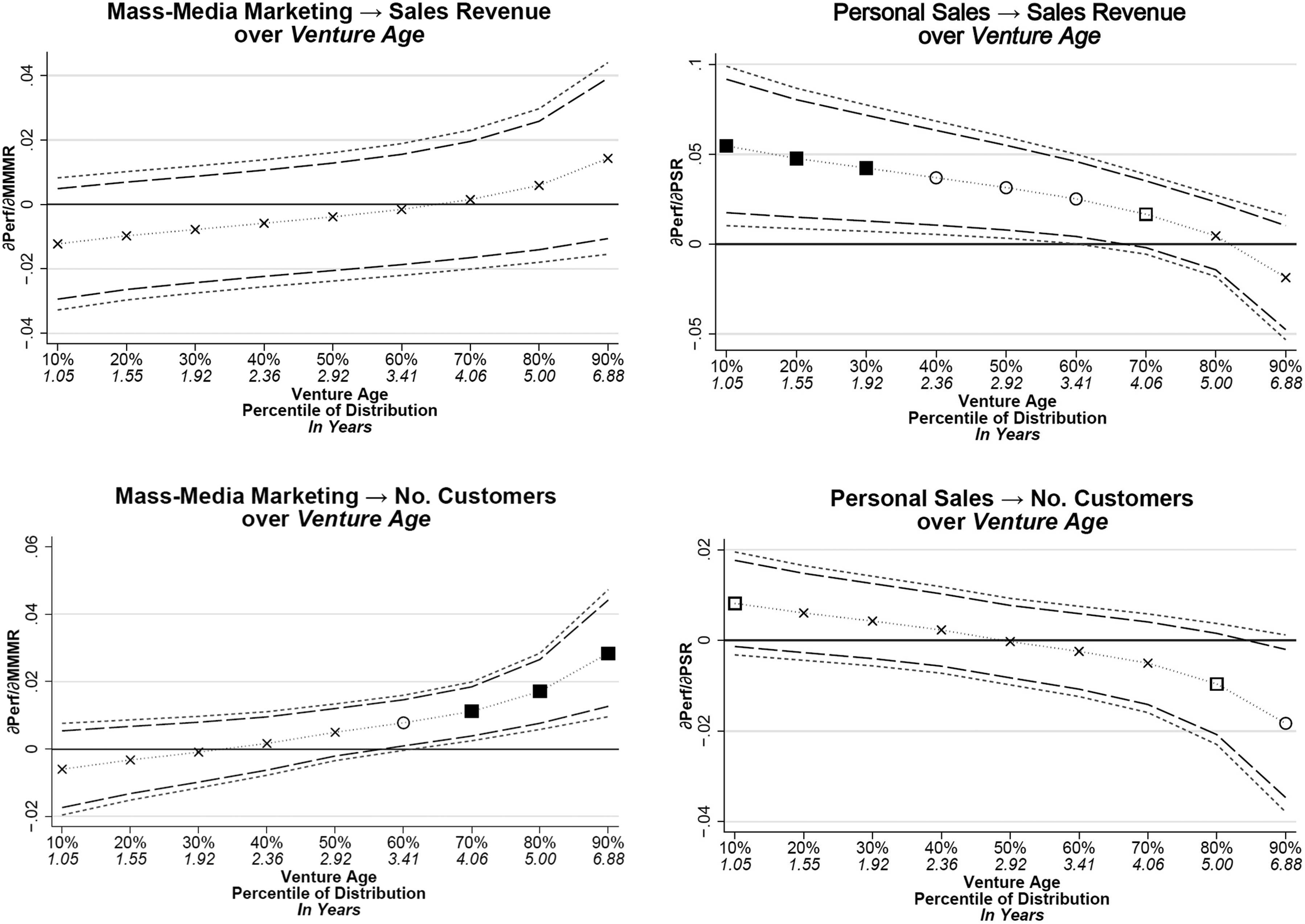
Floodlight Analysis of Moderating Effects.
The relative effects of the expense ratios depend largely on the OLC. Both types of expense ratios can have positive and negative performance effects (yet the negative effects are mostly nonsignificant). For personal sales, we first observe positive effects on sales revenue and the number of customers in earlier stages and then observe negative effects. This pattern reverses for mass-media marketing: Positive effects on the number of customers emerge only in later OLC stages, affirming the need to distinguish between mass-media marketing and personal sales expenses when predicting their performance effects.
Robustness Checks
As we detail next, important robustness checks consistently confirm our main findings. Overall, the effects of the mass-media marketing and personal sales expense ratios depend on the OLC.
OLC-stage measurement
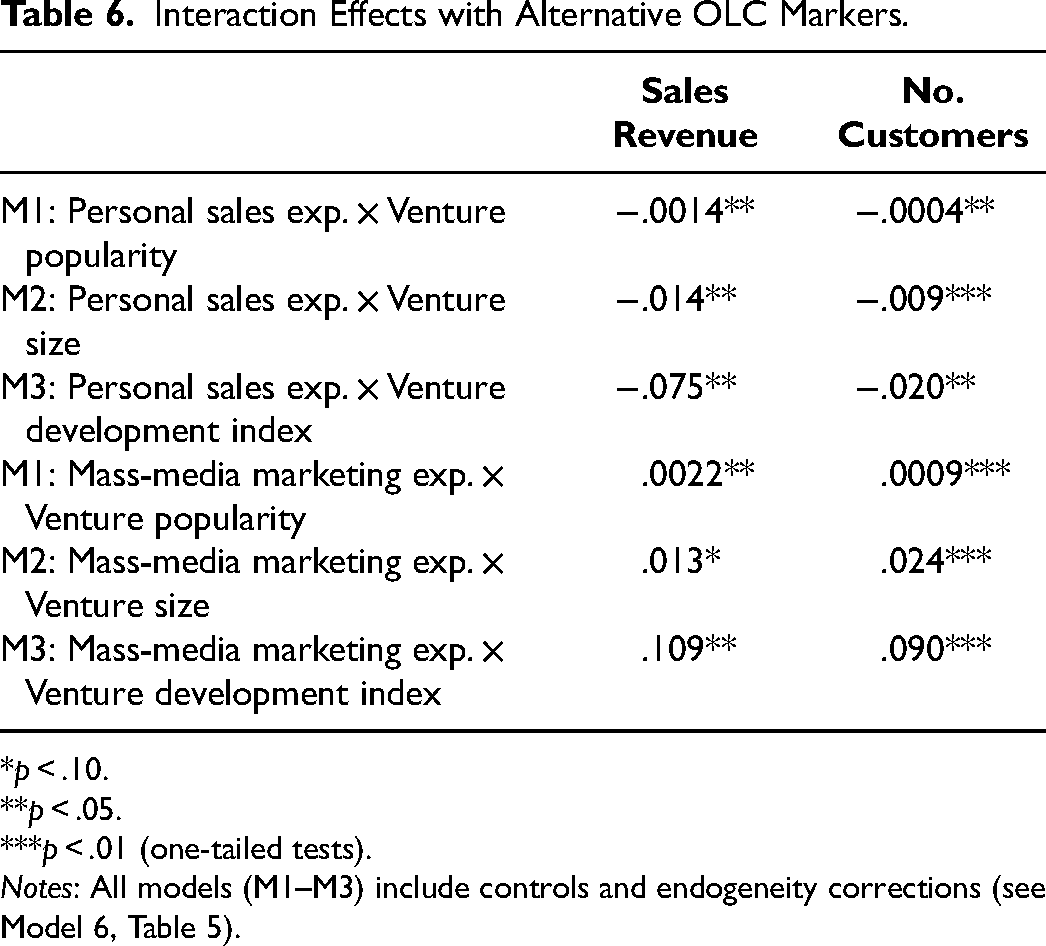
In Web Appendix I, we report the analyses with alternative OLC-stage markers. In addition to venture age (main analysis), we rely on venture popularity (e.g., Hite and Hesterly 2001; we employ Google Trends data), venture size (e.g., Winkler, Rieger, and Engelen 2020), and a venture development index. These alternative measures widely replicate the pattern of our results (see Table 6 for an overview). Here, we even observe significant positive interactive effects between the mass-media marketing expense ratio and the OLC measures for sales revenues. Because the measures explore different facets of the OLC but provide largely consistent results, they strongly support the validity of our findings.
Interaction Effects with Alternative OLC Markers.
*p < .10. **p < .05. ***p < .01 (one-tailed tests).
Notes: All models (M1–M3) include controls and endogeneity corrections (see Model 6, Table 5).
Peer-weighted instruments
Further, we alternatively use a distance measure to weigh the peer instruments, as geographically closer start-ups influence each other more than more distant ones (Raz and Gloor 2007). The robustness check replicates our results (Web Appendix J).
Discussion
Theoretical Implications
Building and maintaining customer relationships is vital to firms’ stability and prosperity (e.g., Palmatier, Scheer, and Steenkamp 2007). High-tech start-ups have great difficulties explaining their value to customers, who may not understand the benefits offered by the start-ups’ innovative products. The two instruments crucial to meeting this challenge—mass-media marketing and personal sales communications—both serve to build successful customer relationships (e.g., Rouziès et al. 2005). To extend the literature on entrepreneurship and marketing, we disentangle the impact of spending a larger share of the budget on mass-media marketing and personal sales activities on start-ups’ performance. Our panel regressions, which are robust for various specifications and operationalizations, show that while a higher mass-media marketing expense ratio tends to increase start-up performance in later OLC stages, a higher personal sales expense ratio particularly promotes start-up performance in earlier stages.
Prior research on entrepreneurial marketing agrees that marketing activities can help boost start-ups’ success (e.g., DeKinder and Kohli 2008). However, the empirical literature has not clearly distinguished expenses on personal sales versus mass-media marketing activities. Other fields unrelated to start-ups (e.g., marketing organization, marketing innovation) prominently note the organizational differences between the marketing and sales function in general (e.g., Ernst, Hoyer, and Rübsaamen 2010). In line with this seminal research, our results underline the distinct effects of mass-media marketing and personal sales expense ratios for B2B high-tech start-ups’ success, pointing to the critical need to disentangle these market activities.
With regard to expenses on personal sales activities, we build on prior research that implies their relevance in high-complexity contexts (Alavi et al. 2021), customer relationships (e.g., Tuli, Bharadwaj, and Kohli 2010), and start-ups (e.g., De Jong, Zacharias, and Nijssen 2021). We offer unique empirical evidence that spending a larger share of a B2B high-tech start-up's limited budget on personal sales activities can have a decisive impact on its development, but most significantly in the early stages and less in the later stages. Similarly, we extend entrepreneurial studies emphasizing the importance of (mass-media) marketing communication activities (e.g., Anderson et al. 2021; Song et al. 2008) and customer relationship management research emphasizing the importance of multiple ties in dynamic environments (Tuli, Bharadwaj, and Kohli 2010). Our findings demonstrate that both mass-media marketing and personal sales are crucial for B2B high-tech start-ups as they progress through their OLC. We also show that the effectiveness of these activities varies across different OLC stages, highlighting the need for start-ups to align their budgets with their respective OLC stages. However, we do not determine which specific mass-media marketing and personal sales activities are most effective in which OLC stages—this remains an avenue for future research.
Unlike previous research, we go beyond the beneficial effects of expenses on personal sales and mass-media marketing activities and identify potential negative effects on different facets of start-up performance. We observe a tendency toward lower performance among start-ups that allocate a higher share of their budget to mass-media marketing communications at an (overly) early stage—although this effect is statistically insignificant. Similarly, start-ups expending a higher share of their budget on personal sales communications in later stages also tend to perform less well. These findings are novel, as while prior research has uncovered the positive effects of general marketing activities in start-ups, it has not differentiated expenses on mass-media marketing and personal sales communications and uncovered ambivalent effects. Although we did not fully anticipate this effect pattern, we arrive at some post hoc rationalizations for these potential negative effects. Previous entrepreneurial research indicated the particular danger for start-ups to misallocate budgets (e.g., Lee and Kim 2024), as a start-up's growth may shift out of balance, resulting in opportunity costs. For instance, because start-ups face resource scarcity, particularly in their early stages (Kazanjian 1988), excessive financial expenses on mass-media marketing communications in these phases may subtract financial resources from areas vital to start-up performance. In our preliminary interviews, founders noted that if products are not adequately prepared for the market or firms lack the capacity to handle a large customer base, such higher expenses on mass-media marketing communications may backfire. Future research should explore, in more detail, the conceptual mechanisms underlying such potentially adverse effects for start-ups.
Limitations and Further Research
The limitations of our study offer opportunities for further research. First, since we focus only on the first stages of start-ups and do not examine their progression into mature firms, our findings cannot speak to how mass-media marketing and personal sales affect performance in advanced life-cycle stages. Without early-stage resource constraints, expenses on mass-media marketing activities could become even more vital to reaching the mainstream market and developing into established firms (Yli-Renko and Janakiraman 2008). Further research could explore the role of start-ups’ mass-media marketing and personal sales communications in more advanced stages of development, at the transition between start-up and mature firm.
Relatedly, we collected our data during relatively stable periods. However, various factors, such as economic crises (e.g., financial crises), security catastrophes (e.g., terrorist attacks), weather catastrophes (e.g., floods), policy reforms (e.g., data protection regulations), and public health emergencies (e.g., the COVID-19 pandemic), can rapidly alter the start-up ecosystem. These changes can significantly impact end-customer behavior, potentially delaying purchases or increasing price sensitivity, making customer acquisition more challenging for B2B high-tech start-ups (Hartmann et al. 2024). Yet, these changes may also present opportunities for start-ups, as established companies may become more receptive to agile solutions enabled by start-ups’ offerings (Kalaignanam et al. 2021). Therefore, we urge future research to investigate the strategies and dynamics of B2B high-tech start-ups during such extraordinary circumstances.
Last, because far less data exist on start-ups in external databases than on mature companies, studying them is difficult. We used a self-collected longitudinal survey data set; however, surveys can lead to systematic biases (Vomberg and Klarmann 2021), such as key informant bias. Although our survey design and analytical strategy safeguard against many potential biases, we call for replications of our study with secondary data when such data becomes available. Investigators could match primary survey with secondary archival data. In addition, we focus on key performance metrics suggested by start-up research (i.e., sales revenues, number of customers). Thus, future research could incorporate cost-related performance metrics to test the effect of marketing and sales expenses on start-ups’ profitability.
Managerial Implications
Start-ups must spend their budget carefully, as over 90% of start-ups fail (Startup Genome, 2019), largely due to ineffective mass-media marketing and personal sales efforts (CB Insights 2019). For more than 77% of the start-ups in our preliminary survey, setting proper individual expenses on mass-media marketing and personal sales activities at different stages of start-ups’ life cycles is critical to their survival. In addition, our interviews showed that many start-ups lack awareness of the importance of marketing communications, particularly activities of mass-media marketing and personal sales. To enhance start-up managers’ awareness and understanding of the performance impacts of their mass-media marketing and personal sales expenses, we illustrate the economic importance of our findings in Table 7. This quantification can also support external communication with investors. In the start-up context, evaluations of the effectiveness of strategic decisions can be difficult due to the lack of established success metrics (Mintz and Lilien 2024). Table 7 can help start-up managers in their communication with external investors.
Marginal Effects of Mass-media Marketing and Personal Sales Expense Ratios on Start-Up Performance Across the OLC.
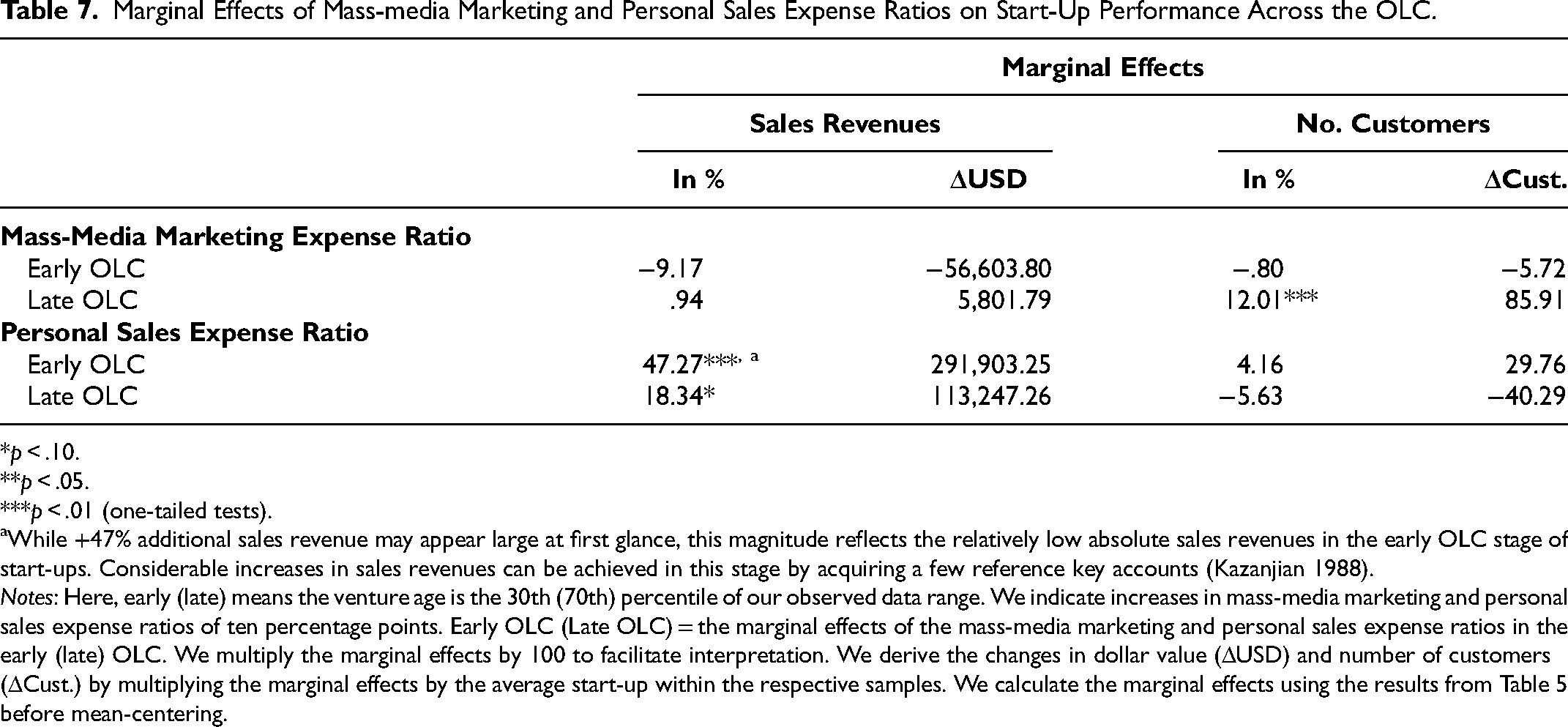
*p < .10. **p < .05. ***p < .01 (one-tailed tests).
While +47% additional sales revenue may appear large at first glance, this magnitude reflects the relatively low absolute sales revenues in the early OLC stage of start-ups. Considerable increases in sales revenues can be achieved in this stage by acquiring a few reference key accounts (Kazanjian 1988).
Notes: Here, early (late) means the venture age is the 30th (70th) percentile of our observed data range. We indicate increases in mass-media marketing and personal sales expense ratios of ten percentage points. Early OLC (Late OLC) = the marginal effects of the mass-media marketing and personal sales expense ratios in the early (late) OLC. We multiply the marginal effects by 100 to facilitate interpretation. We derive the changes in dollar value (ΔUSD) and number of customers (ΔCust.) by multiplying the marginal effects by the average start-up within the respective samples. We calculate the marginal effects using the results from Table 5 before mean-centering.
First, our findings imply that a higher personal sales expense ratio accelerates high-tech start-up development because personal sales communications can establish deep personal relationships with customers. Personal communication activities are especially important at the beginning of high-tech start-ups’ OLCs. Despite their scarce resources at this stage, start-ups should spend part of their budget on personal sales communications to develop initial, close networks with customers. By increasing the personal sales expense ratio by 10 percentage points in earlier stages (Table 7), start-ups can substantially increase their sales revenue (US$291,903.25). The increase in the number of customers is 29.76, but this is not significant.
Second, to achieve market growth and expand their customer base, start-ups should spend a higher proportion of their budget on mass-media marketing activities in later stages. Increasing the mass-media marketing expense ratio by 10 percentage points corresponds to acquiring an additional 85.91 customers (Table 7), demonstrating the effectiveness of expenses on mass-media marketing activities in broadening a start-up's customer base.
However, we also caution managers against spending excessive shares of their restricted budget on mass-media marketing or personal sales activities, as this may leave insufficient financial resources for other vital activities, such as product development. When investing in mass-media marketing and personal sales activities, managers should carefully consider their start-ups’ OLC stages and the full spectrum of potential expenditures their firms face. Notably, we do observe that in later OLC stages, a higher personal sales expense ratio is associated (although not significantly) with a reduction in the number of customers (−40.29). Our interviews suggest that personal sales primarily deepen relationships with selected customers, which may explain why an increased personal sales expense ratio relates to a narrower customer base.
Start-ups must evaluate the strategic significance of this effect with nuance. The number of customers acquired is an important growth target. However, we also observe a positive effect on sales revenue during this stage (US$113,247.26), indicating that a higher personal sales expense ratio may allow start-ups to serve fewer but more valuable customers. Given that start-ups must simultaneously pursue multiple growth objectives, our findings do not imply that they should avoid personal sales expenses in later OLC stages. Instead, they should balance customer breadth with revenue goals to align with their strategic priorities.
Supplemental Material
sj-pdf-1-mrj-10.1177_00222437251367766 - Supplemental material for The Different Effects of Mass-Media Marketing and Personal Sales Budgets Across the Life Cycle of B2B High-Tech Start-Ups
Supplemental material, sj-pdf-1-mrj-10.1177_00222437251367766 for The Different Effects of Mass-Media Marketing and Personal Sales Budgets Across the Life Cycle of B2B High-Tech Start-Ups by Arnd Vomberg, Maximilian Friess, Sascha Alavi, Verena Maag and Jan Wieseke in Journal of Marketing Research
Footnotes
|
|
|
|
What was your sales revenue in the prior year? |
Panel survey |
|
How many customers do you have in total? |
Panel survey |
|
|
|
| We provided respondents with the following definitions: “‘Marketing’ refers to activities of customer communication that are not of personal nature; ‘Sales’ refers to activities geared toward personal contact and communication with customers and investors.” | |
What percentage of your total budget do you invest on average per month in marketing activities? (0%–100%) |
Panel survey |
What percentage of your total budget do you invest on average per month in sales activities? (0%–100%) |
Panel survey |
|
Difference between date of founding and survey wave in years |
Panel survey |
|
I rate this start-up's prioritization of product development as high. |
Panel survey |
|
How high do you estimate the liquidity of your start-up? (1–7 scale; 1 = “low liquidity/significant financial bottlenecks,” and 7 = “high liquidity/substantial liquid funds available”) |
Panel survey |
|
How many investors have you already attracted to your company? |
Panel survey |
|
In the past quarter, there was a major change in the founding team. |
Panel survey |
|
In the past quarter, we won important prizes. |
Panel survey |
|
Number of start-up entries per industry |
Crunchbase |
|
Ratio: Number of start-up closes to number of start-up entries |
Crunchbase |
|
Herfindahl–Hirschman index: sum of squared market shares |
Amadeus |
|
Five-year average industry sales growth |
Amadeus |
|
|
|
| Panel survey | |
| Panel survey | |
| Panel survey |
Founders of start-up.
Interviewer: Cohen's kappa κ based on 20% of data per survey wave (κ: .73). We compared interviewer ratings with ratings of a second independent rater, who received the same training as the interviewer and listened to the recorded survey interviews.
Measured on a scale from 1 (“totally disagree”) to 7 (“totally agree”).
Acknowledgments
The authors want to thank Tammo Bijmolt, Daniel Blaseg, Peter Ebbes, and Simone Wies for their valuable feedback on earlier versions of this article. They also appreciate the valuable input from conference and seminar participants.
Coeditor
Kapil Tuli
Associate Editor
Girish Mallapragada
Declaration of Conflicting Interests
The author(s) declared no potential conflicts of interest with respect to the research, authorship, and/or publication of this article.
Funding
The author(s) received no financial support for the research, authorship, and/or publication of this article.

Notes
References
Supplementary Material
Please find the following supplemental material available below.
For Open Access articles published under a Creative Commons License, all supplemental material carries the same license as the article it is associated with.
For non-Open Access articles published, all supplemental material carries a non-exclusive license, and permission requests for re-use of supplemental material or any part of supplemental material shall be sent directly to the copyright owner as specified in the copyright notice associated with the article.
