




Abstract
The authors present a model of product returns and assortment decisions in the context of online–offline retail competition. In equilibrium, the online store optimally offers easy-to-fit products to reduce costly returns. The competing brick-and-mortar retailer (BMR) faces a subtle trade-off between generating higher sales and attracting more foot traffic, and thus it might use its limited store size to stock harder-to-fit products. The authors’ model provides a rationale for the prevalence of relatively lower-quality products sold online and the steady growth of specialty stores within the changing footprint of traditional retailing. The model is extended to include possibilities such as a physical store opening an online channel to compete with the online store. The authors apply this framework to investigate the possibility and consequences of retailers collaborating to handle returns. Specifically, a recent “buy online and return in store” (BORS) return policy allows consumers to return online purchases directly to a competing BMR. In the short run, BORS increases the BMR's foot traffic and the volume of returns. In the long run, BORS expands the online retailer's assortment and increases the BMR's foot traffic. BORS can be sustained in the long run if the BMR is small or if the cost-saving effect is large.
Keywords
Online retailing offers an almost limitless product assortment that is directly accessible in the comfort of consumers’ homes. Online sales rose from 6.4% of total retail sales in 2011 to 20% in 2021. However, this growth in e-commerce has also been accompanied by an explosion in consumer returns. For example, in 2021, consumers returned products worth more than U.S. $700 billion—over 16% of total retail sales (Repko 2021). Online retailers (ORs) face 20%–40% return rates, compared with only 5% for brick-and-mortar retailers (BMRs) (Reagan 2019). This difference in return rates is mostly driven by the inability to physically inspect products when purchasing online, which results in more instances of mismatch between the product and customer requirements. This mismatch is especially significant for products with fewer “digital attributes” (Bell, Choi, and Lodish 2012). Consider the example of a shirt: An OR can only provide images and size information, while a BMR has an actual fitting room that allows consumers to check the exact fit, texture, and feel.
Industry surveys have indicated that 62% of shoppers avoid shopping online because of the inability to inspect products (Skrovan 2017). To overcome this issue, ORs have instituted generous return policies. However, consumers often complain about the hassles of online returns: repackaging, printing out shipping labels, traveling to a physical location (e.g., the post office), and waiting to receive a refund for the return (Selyukh 2018). In addition, consumers worry about return packages being lost in the mail. Meanwhile, the return process at a physical store is significantly easier because customers can drop off returns at a customer service desk and instantly receive a refund.
Thus, while some predict the impending demise of physical stores (Economist 2017), others have called such doomsday scenarios “premature” (Dennis 2018). Retail data show that the profits of physical specialty stores have steadily grown at an average rate of 2.8% per year (Daly 2021). This is consistent with managerial work suggesting that specialization could be an effective shield against online retail platforms (Reinartz, Wiegand, and Imschloss 2019). However, existing theoretical models are silent on how digitization impacts traditional retailers’ store positioning vis-à-vis online retailing.
Since ORs and BMRs appeal to different aspects of consumer shopping experiences, their assortment choices are critical (Chernev 2012; McKinsey 2019). ORs strategically select their assortment to manage consumer returns, while BMRs carefully allocate their limited shelf space. Retailers heavily invest in marketing intelligence and information technology to optimize their product assortments. However, current retail competition models in marketing often abstract away from product assortment and tend to focus on pricing (e.g., Shulman, Coughlan, and Savaskan 2011). This abstraction from assortment is quite surprising, given that both managerial and empirical works have demonstrated its importance. For example, the average consumer picks up 13 products on each visit to Walmart (Reuter 2023b) and 7 products on each visit to Target (Reuter 2023a), and Amazon and other ORs often persuade consumers to add more items to their carts before checkout. Indeed, empirical research shows that product assortment is more critical than retail price for determining consumer shopping destination (Briesch, Chintagunta, and Fox 2009), and a reduction in assortment lowers consumers’ shopping frequency as well as quantity (Borle et al. 2005). Furthermore, from a welfare perspective, a recent empirical study also shows that 45% of the welfare gains of online–offline competition come from a reduction in consumer transportation costs, 54% come from an increase in assortment, and less than 1% comes from price competition (Huang and Bronnenberg 2023). All this evidence underscores the need to systematically investigate consumer returns and product assortment in online–offline retail competition.
Our article seeks to fill this gap by modeling four crucial aspects of online–offline competition: (1) the OR faces costly consumer returns, (2) the BMR faces limited store shelf capacity, (3) retailers strategically select their product variety and use assortment as a competitive instrument, and (4) consumers face a trade-off in their shopping destination choice—shopping online saves travel costs, but the physical store has a showroom aspect that saves potential return hassles. In extensions, we further enrich the model by bringing in other trade-offs, such as the hassle costs of shopping within a store, the delay associated with receiving online shipments, and a BMR with its own online retail channel.
Research Questions
The purpose of our research is multifold. First, we study how a BMR should adjust its store positioning in response to the rapid rise of e-commerce. Second, we seek to understand how showrooming and consumer returns affect product assortments of BMRs and ORs. Third, our main application of this theoretical framework examines the effects of an important new development in the consumer returns infrastructure: Some ORs have started to partner with their (competing) BMRs to allow customers to buy online and return in store (abbreviated as BORS; see Thomas 2021 for an example). We examine the short-run and long-run impact of BORS on consumers’ shopping strategy and retailers’ profits and positioning.
Summary of Findings
Our analysis of online–offline competition indicates that the BMR's showroom and the product return costs of online shopping have an important bearing on retailers’ assortment choices. Specifically, the OR should stock products with an ex ante high fit probability to reduce costly returns. On the contrary, the BMR may want to stock products with an ex ante low fit probability: Although the sales volume is lower, the BMR's showroom becomes more valuable, attracting more foot traffic. This result reinforces the managerial view that specialization may shield BMRs from intense online competition. Applying our framework to BORS, we find that BORS collaboration alters consumers’ shopping strategies because of the reduced expected return costs associated with returning in store. But beyond this short-run effect, BORS fundamentally reshapes the retailers’ equilibrium assortment choices in the long run: The OR expands its assortment to stock more goods with a lower fit, while the BMR no longer has the incentive to specialize within the overlapping assortment region. Overall, BORS may increase the market's product variety and benefit both retailers.
The rest of the article proceeds as follows. In the next section, we review the related literature and highlight our contributions relative to the selected studies that are close to our context. In the following sections, we set up the baseline theoretical apparatus of assortment-based competition, analyze the model of online–offline competition, and consider the possibility and consequences of BORS collaboration. We then present four extensions of our model: (1) price competition with heterogeneous operation costs, (2) private label substitute products, (3) the online channel of a BMR, and (4) a more general formulation of consumer demand. Finally, we conclude the article with a brief discussion of the implications and the limitations of our research. All proofs are collected in the Appendix and Web Appendix.
Related Literature
We discuss four streams of related literature and highlight our main contributions.
Online–Offline Competition
Early works in this literature study how online channels affect retailers’ pricing. Lal and Sarvary (1999) model the cost of a physical shopping trip and digital and nondigital product attributes. However, they abstract away from product assortment decisions and do not consider the asymmetric online–offline competition. Kuksov and Liao (2018) focus on a critical ingredient of online–offline competition: “showrooming.” They show that showrooming may increase retailer profit when manufacturer–retailer contracts are endogenous. Jing (2018) considers online–offline competition with showrooming and “webrooming.” Jing assumes that the OR and BMR sell ex ante identical single goods and finds that showrooming could hurt the OR. In addition, a host of issues have been studied within online retailing: the design of online marketing channels (Dukes and Liu 2016), advertising efficacy (Goldfarb and Tucker 2011; Mayzlin and Shin 2011), and the impact of online word of mouth (Godes and Mayzlin 2004) and reviews and blogs (Mayzlin and Yoganarasimhan 2012). To summarize, these articles study the emergence of ORs and do not consider our primary motivation: the competitive role of assortment decisions when a BMR (OR) has a disadvantage (advantage) in shopping costs and an advantage (disadvantage) in showrooming.
Much of the theoretical literature on online–offline competition focuses on retailers’ pricing strategies. However, empirical works show that product assortment carries a greater weight in the determination of consumer shopping destination (Briesch, Chintagunta, and Fox 2009), shopping frequency and quantity (Borle et al. 2005), and consumer surplus (Huang and Bronnenberg 2023). Recently, Bar-Isaac and Shelegia (2023) consider competition between “deep” and “shallow” retailers (i.e., retailers who exogenously stock two products or one product). Bondi and Cabral (2023) consider online–offline competition, where retailers can stock from two exogenous product categories, each with multiple ex ante identical substitutes. A major difference in our article is that we consider the unobservability of product characteristics online and costly consumer returns.
Multiproduct Retailing
Early works in this area have studied how competition impacts product variety, with simplifying restrictions of a single product category (Kök and Xu 2011) or two available products (Dukes, Geylani, and Srinivasan 2009). We extend this literature by analyzing how competition and return policies affect multiproduct retailers’ assortment choices. In addition, the operations literature has studied the newsvendor problem regarding the timing of ordering and optimal stocking (Arrow, Harris, and Marschak 1951; Holmes 2001; Kök, Fisher, and Vaidyanathan 2015); we abstract away from these issues to focus on assortment composition. Rhodes (2015) shows that a single multiproduct retailer can build a low-price image by stocking many products and advertising a low price for one product. Rhodes, Watanabe, and Zhou (2021) consider a single retailer and a mass of producers. Their strategic supply chain participants lead to a tension of selling to more consumers versus obtaining more profit from each consumer. We use their technique to solve our BMR's assortment optimization, but our setup differs from their article in three main ways: (1) we have two competing retailers that both strategically choose their assortments; (2) we do not have strategic producers, and this abstracts away from the core tension identified in their Propositions 1 and 2; and (3) our model has a product fit component, and its unobservability online endogenously creates consumer returns. In contrast to Rhodes, Watanabe, and Zhou, we identify a new trade-off of the BMR when its competitor (the OR) lacks showroom capability: The BMR can stock harder-to-fit products and use its showroom to attract foot traffic, but this sacrifices its per-consumer profit. Finally, and more broadly, our work relates to the literature on product variety (Bronnenberg 2015, 2024; Dixit and Stiglitz 1977; Li and Zhang 2024; Spence 1976). Our work differs from these articles in two ways. First, they examine ex ante symmetric retailers in a competitive equilibrium (with zero profits) or monopolistic competition (with free market entry), while we study imperfect competition in which two asymmetric retailers (one OR and one BMR) compete on assortment choices. Second, we assume ex ante heterogeneous fit probabilities to study consumer returns.
Product Returns
A large literature discusses different aspects of product returns. A generous return policy may signal higher product quality (e.g., Moorthy and Srinivasan 1995; Shieh 1996) and increase the credibility of sales talk (Inderst and Ottaviani 2013). However, competition could lead to a higher stocking fee (Shulman, Coughlan, and Savaskan 2011). If consumers’ prepurchase search is costly, a firm may opt for no returns, offer free returns, or charge return fees (Jerath and Ren 2025). From a social viewpoint, consumer returns may be inefficient when there is double marginalization (Shulman, Coughlan, and Savaskan 2010) or when consumers do not fully internalize the benefits of prepurchase sequential search (Janssen and Williams 2024). While these articles provide valuable insights on consumer returns, they abstract away from product assortment decisions or simply consider two horizontally differentiated products. However, assortment choices affect product returns, and returns are costly (Selyukh 2018); thus, retailers should strategically select a product assortment that accounts for consumer preferences and return costs. Our article fills this crucial gap.
Online–Offline Channel Collaborations
Finally, recent work has looked at the coordination and collaboration of online and offline channels. Ofek, Katona, and Sarvary (2011) derive conditions under which two retailers with horizontally differentiated products should invest in online channels and adopt a “bricks-and-clicks” format. Kireyev, Kumar, and Ofek (2017) study the practice of “self-matching,” whereby a physical retailer matches the price offered in its online channel. They show that horizontally differentiated retailers could benefit from such a practice, as it could soften price competition. Gao and Su (2017) study a “buy online and pick up in store” (BOPS) policy within the context of a monopoly newsvendor with a single product that could be sold via online and offline channels. They show that stockouts and cross-selling potentials determine whether a firm offers BOPS. Using data from a U.S. retailer, Gallino and Moreno (2014) find that BOPS increases sales in physical stores at the cost of online sales. Note that both self-matching and BOPS are practices that a retailer establishes within its own marketing channels. We also analyze BOPS with costly product returns as an extension in the subsection “The BMR’s Online Branch.”
Our main application studies an emerging policy wherein consumers can return purchases from an online seller at a competing physical store—the policy we call BORS. Nageswaran, Hwang, and Cho (2025) also study BORS in a model where consumers have unit demand and products are ex ante homogeneous. They show that the efficacy of BORS depends on the (exogenous) product overlap between the two types of sellers, and sellers with lower assortment overlap are more likely to enter into such partnerships. In comparison, we study consumers with multiunit demand and focus on how BORS shifts ORs’ and BMRs’ (endogenous) assortment choices and, thereby, the ensuing product overlap.
Summary of Contribution
Our article brings together important elements within the online–offline competition, enabling us to provide better substantive insights. We explicitly model the trade-offs a consumer faces in these two channels: Shopping online saves travel costs, but the physical store has a showroom, which saves potential return hassles. Product categories vary not only in easiness to fit but also in quality. Combining these elements enables us to analyze online–offline competition with product assortment as a competitive instrument, the BMR's investment to become omnichannel, the prospect of BORS, and the short-run and long-run consequences of BORS.
Model Setup
Products
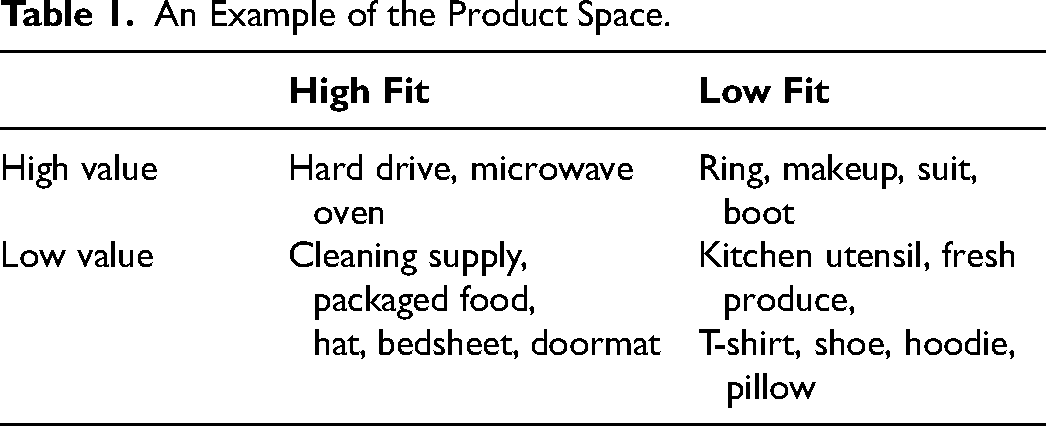
The marketplace consists of product categories that differ in a number of dimensions. We focus on two orthogonal dimensions—fit and value—which are of particular relevance for studying online–offline competition. Product fit measures the ex ante easiness to match a consumer. For example, the fit of portable hard drives is generally easier to infer than the fit of keyboards. Product value captures a consumer's willingness to pay (conditional on a match). For example, a dress shirt has a higher value than a T-shirt. These two dimensions parsimoniously capture a wide range of products that could differ among multiple attributes. Table 1 provides more examples of the product space.
An Example of the Product Space.
There is a continuum of heterogeneous product categories, with the total count normalized to one. Each category has a fit parameter
The demand D(v, p) is assumed to be increasing in v and decreasing in p. For each (v, θ), we assume there exists a unique profit-maximizing price
Retailers
There are two profit-maximizing retailers. One retailer is the BMR (e.g., Kohl's), and the other is the OR (e.g., Amazon). The BMR has limited shelf space and can display at most a fraction of
Each retailer chooses its own product assortment. Denote
Consumers
There is a unit mass of consumers. Each consumer has a potential demand for all products that fit. Consumers need to pay a (small) marginal cost s > 0 to search for a product (v, θ) at retailer
We make two simplifying assumptions about consumers’ return hassle cost r: (1) We assume the hassle cost of returning is not too small, so if a consumer gains nonnegative expected utility from buying a product online, the OR also obtains nonnegative expected profit from selling the product to the consumer. 5 (2) Consumers return all online purchases that do not fit. For this to be optimal, it suffices to assume that the hassle cost of returning is not too large. 6
Consumers must visit a retailer to search for the products it carries. To visit the BMR, a consumer needs to incur a travel cost
The travel cost t is likely to be a function of the distance from consumers’ homes to the BMR and the availability and accessibility of various transportation methods. Travel costs are consumers’ private information, and retailers observe only their population aggregate statistics G(t) (e.g., learning through marketing research). We assume
In aggregate, a consumer's expected utility can be summarized as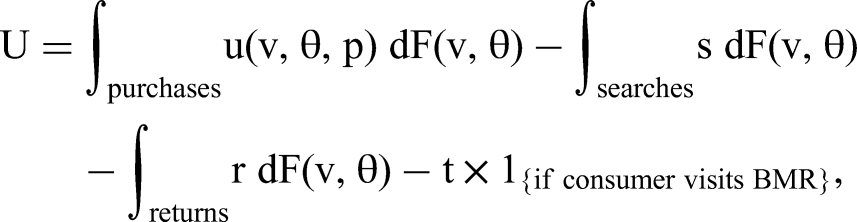
To simplify notations, we denote
Timing
First, the BMR and the OR choose their product assortments,
This timing sequence reflects the fact that retailers’ product assortment determines their brand positioning and is a relatively long-term strategy. In contrast, prices fluctuate more frequently than assorted stockkeeping units (SKUs), so pricing is a relatively short-run strategy. We assume that consumers see the product assortments of each retailer but not the prices of each product. 8 This assumption captures the idea that consumers learn about retailers’ assortment and general brand positioning over time, but they do not directly observe the daily fluctuating prices before arriving at stores.
Online–Offline Competition
Before analyzing the case of online–offline competition, we examine a benchmark with a single BMR. This corresponds to the not-so-distant past without ORs.
Benchmark: Only BMR Present
Suppose consumers can only choose between visiting the BMR or opting for the outside option. Notice that, in the main model with online–offline competition, consumers who do not visit the BMR still have the option to visit the OR. Hence, in this benchmark, we assign consumers an outside option of u0 > 0 to facilitate a better comparison with the main model.
We solve the game using backward induction. Since consumers do not directly observe prices, the smallest subgame consists of the last two stages, where the BMR sets its prices and consumers choose their shopping strategy.
Suppose there is only a BMR in the market. In the unique perfect Bayesian equilibrium of the last two stages, the BMR sets price 
In the first stage of the game, the BMR chooses its product assortment. Its profit maximization can be expressed as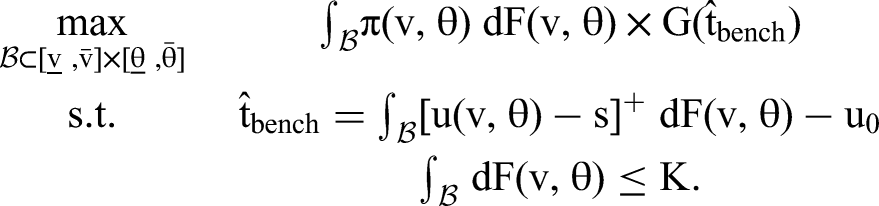
Let
Proposition 1 implies that the capacity-constrained BMR prefers to stock products with high v and θ (see Panel A of Figure 1 for a graphical illustration of Proposition 1). The intuition is simple. Products with high v yield higher profit for each unit of sales, and products with high θ have a higher chance of being sold. In the remainder of this section, we analyze the main model and show that the seemingly simple intuition of Proposition 1 breaks down in online–offline competition.
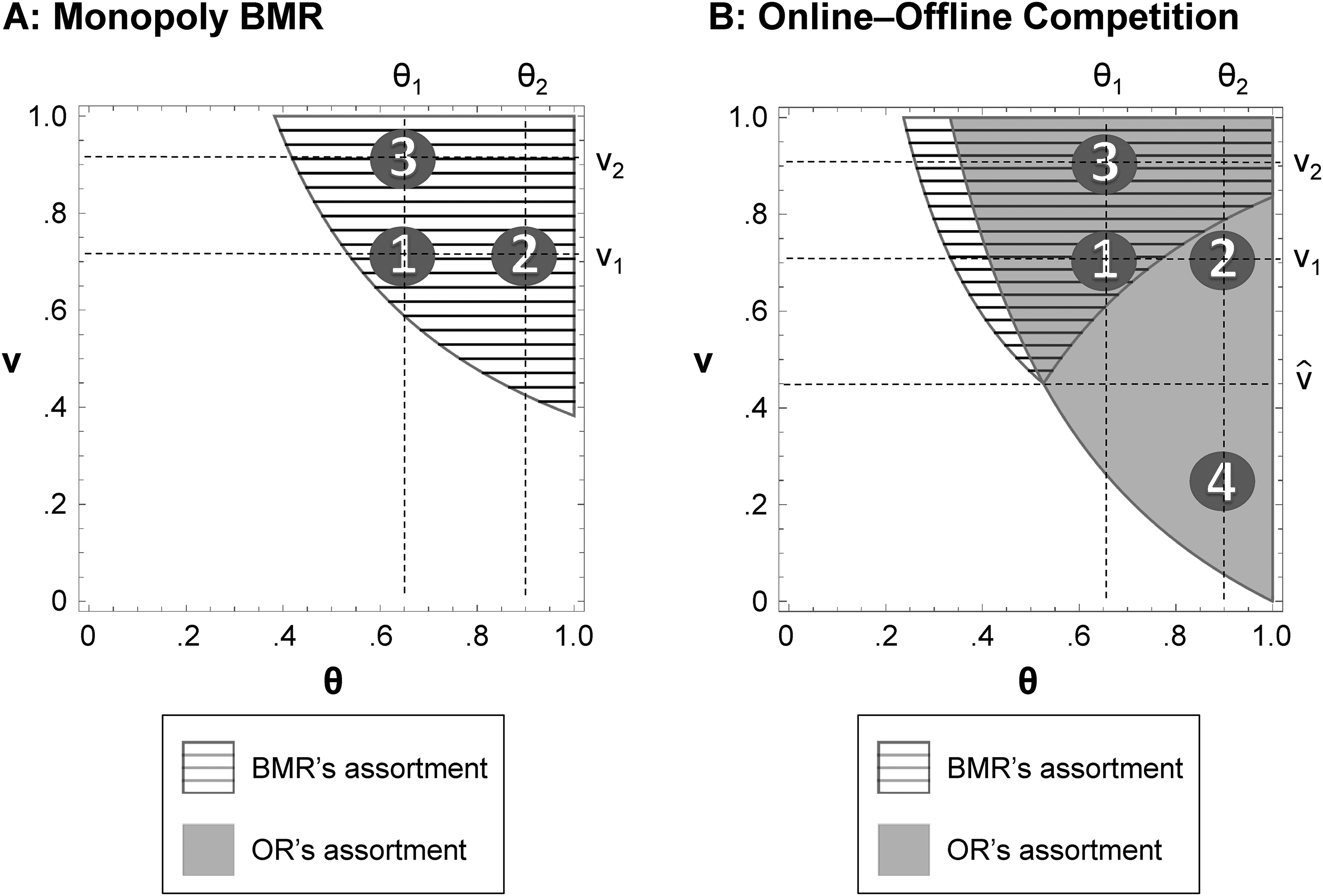
Optimal Product Assortment with Online–Offline Competition.
Consumers’ Shopping Strategies and Retailers’ Pricing Strategy
Next, we move away from the benchmark and consider our main model, where both the BMR and the OR are present and compete for consumers. Since consumers cannot directly observe prices, the smallest proper subgame comprises the last two stages, where retailers set prices and consumers choose shopping strategies. In this subgame, we consider a perfect Bayesian equilibrium in which consumers choose shopping strategies to maximize expected utility, taking as given their travel costs and price beliefs; retailers set prices to maximize their profits, taking as given consumers’ shopping strategies; and price beliefs are correct on the equilibrium path.
As in Diamond (1987), we derive an equilibrium in which the two retailers set symmetric prices
Case 1
Suppose a consumer only visits the OR. Recall that 
Case 2
Suppose a consumer plans to visit both retailers. For the BMR’s exclusive products 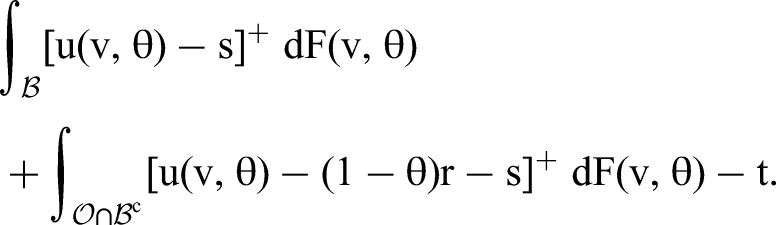
In the last two stages, there exists a perfect Bayesian equilibrium in which both retailers set price Consumers with Consumer with 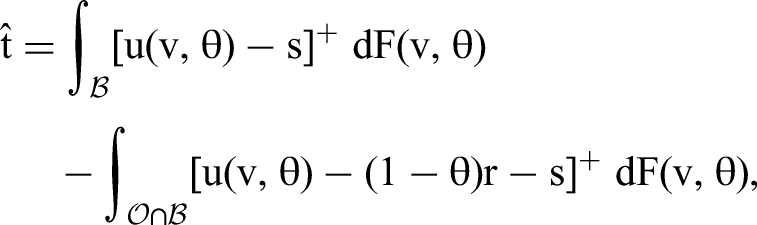
In Lemma 2, consumers’ optimal shopping strategy is intuitive: Those with low travel costs visit the BMR, and others only shop online. Retailers face the Diamond paradox because of consumers’ search cost, s > 0, and this leads to a unique symmetric pure strategy pricing. Note that the resulting equilibrium price is not one where firms are making zero profits. In fact, it is an intuitive outcome where products with a higher v are priced higher across all the channels. In the “Price Competition with Heterogeneous Costs” subsection, we study an extension in which searching within each retailer is costless, that is, s = 0. This leads to another more complicated asymmetric equilibrium with mixed strategy pricing.
Equilibrium Product Assortment
Now, we analyze the first stage of the game, in which the two retailers choose their product assortments.
First, consider the OR's assortment optimization given 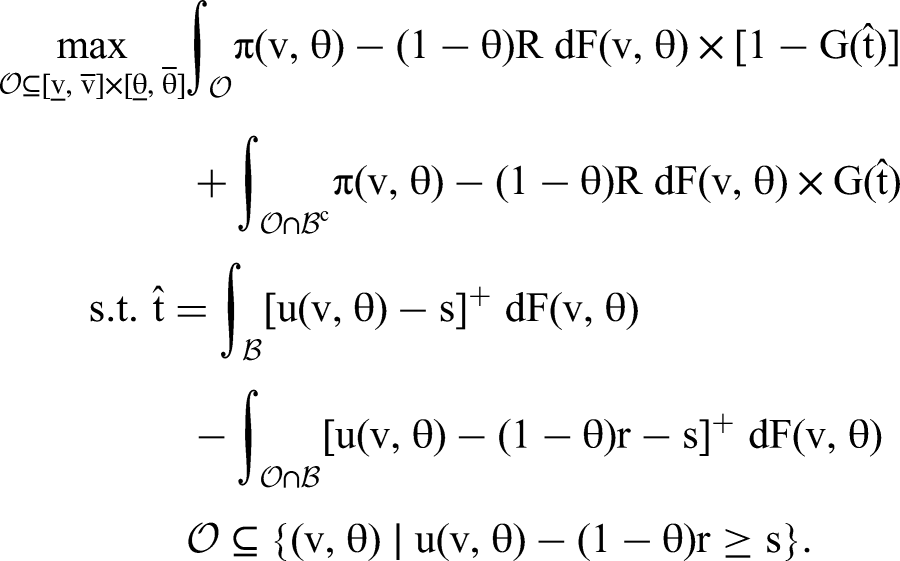
Next, consider the BMR's assortment optimization given 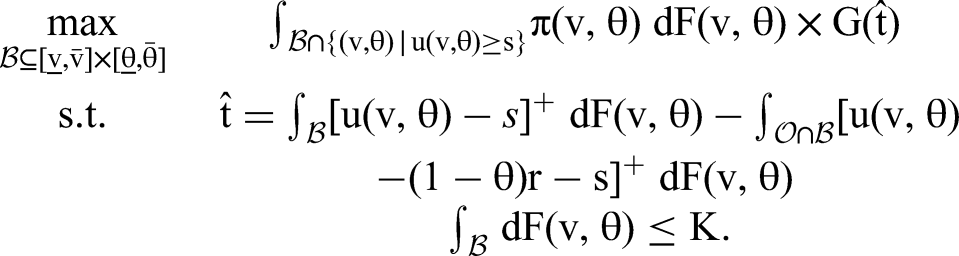
In equilibrium, the OR stocks 
The intuition behind Equation 1 involves a subtle analysis of marginal cost and benefit.
First, by the envelope theorem, λ2 is the shadow value of store shelves: If the BMR can increase store capacity from K to K + ε, its profit increases by λ2ε. Hence, the opportunity cost of stocking a product (v, θ) (and taking up an additional unit of store shelf) is λ2.
Second, the marginal benefit of stocking a product (v, θ) can be decomposed into two components:
The direct benefit of stocking (v, θ) is the BMR's profit from directly selling (v, θ) to consumers. A total of The indirect benefit of stocking (v, θ) is the BMR's benefit from attracting more consumers to its store. This is the BMR's profit from attracting each additional consumer multiplied by the total increase in foot traffic. By the envelope theorem, the BMR's marginal benefit of increasing
Finally, Equation 1 states that the BMR should stock a product (v, θ) if the marginal benefit (sum of the direct and indirect benefits) exceeds the marginal cost (opportunity cost).
Consequences of Online–Offline Competition
Recall that in the benchmark of a single BMR, the BMR prefers to sell products with high v and high θ (see Panel A of Figure 1). However, this rather intuitive result does not always extend to online–offline competition.
With online–offline competition,
For products available online, the BMR prefers products with high value. However, the BMR prefers products with low fit if its store shelf capacity is small and consumers’ return hassle is large. Formally, for any v2 > v1 and any θ2 > θ1, if For products not available online, the BMR prefers products with high value and high fit. Formally, for any v2 > v1 and any
Surprisingly, the first part of Proposition 3 shows that the BMR may choose to “waste” its limited store shelf on products with ex ante low fit probability (low θ). The intuition involves a subtle trade-off between sales volume and store foot traffic. If both retailers sell (v, θ), then a consumer obtains an expected surplus of u(v, θ) − s regardless of where the product is purchased. But inspecting the product at the BMR before purchasing can additionally save an expected return hassle cost of (1 − θ)r. Since the return probability 1 − θ decreases in θ, showrooming is more valuable for products with low θ. Thus, the BMR may want to leverage its showrooming capability and sell harder-to-fit products to attract more foot traffic. In the language of marginal cost and benefit analysis, for a product
The second part of Proposition 3 shows that the BMR does not prefer low θ products in the nonoverlapping assortment region. So, the BMR does not sell low θ products to differentiate from the OR. Therefore, the only purpose of specialization is to better utilize showrooming.
We predict that the prevalence of online retailing may eventually push some traditional retailers to transform into specialty stores. This prediction is supported by the steady growth of specialty stores in the downfall of traditional BMR (Daly 2021), and also reinforces the managerial view that specialization may effectively shield against the power of OR platforms (Reinartz, Wiegand, and Imschloss 2019).
With online–offline competition,
The OR prefers products with high value and high fit. Formally, if When s is small, some low-value products are sold exclusively online. Formally, there exists a cutoff
In contrast to the BMR's specialization in low θ products, the OR prefers products with high θ. But Proposition 4 shows that some low-value products are sold exclusively online. The intuition is that the OR can sell low-value products as long as consumers do not return them too often. However, the BMR cannot “afford” to sell these products because its physical store's capacity constraint K implies a forbiddingly high opportunity cost.
Figure 1 illustrates the two results of this subsection. In this figure, ➀
Numerical Example
Suppose v ≡ 1 and the product space is θ ∼ U[0, 1]. Consumers’ demand function is given by D(v,p) = max{1 − p, 0}, and the travel cost to BMR
By Lemma 2, all products are priced at 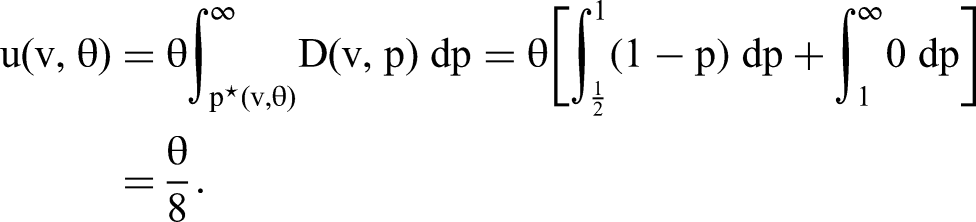



Online–Offline Collaboration: Buy Online and Return in Store
On the one hand, the OR's inability to provide showrooming leads to costly returns and restricts the OR to only carry products with low return rates. On the other hand, the BMR's physical capacity constraint makes its store less attractive and lowers foot traffic. To overcome these disadvantages, some ORs and BMRs have reached agreements allowing shoppers to buy online and return at a competitor's physical store (i.e., BORS). For example, Amazon recently reached an agreement with Kohl's, allowing products purchased from Amazon to be returned to any Kohl's physical store (Thomas 2021). Similarly, some convenience stores in Japan offer consumers the option to return online purchases to their physical stores.
The recent emergence of BORS suggests that ORs and BMRs can mutually benefit in the short run (before retailers’ assortments change). However, the long-run (after retailers strategically adjust assortments) consequences of such agreements are unclear. In this section, we apply our framework to analyze how BORS agreements affect consumer shopping strategy and retailers’ long-run assortment choices, as well as the conditions for BORS to be sustained in the long run.
BORS Setup and Model Analysis
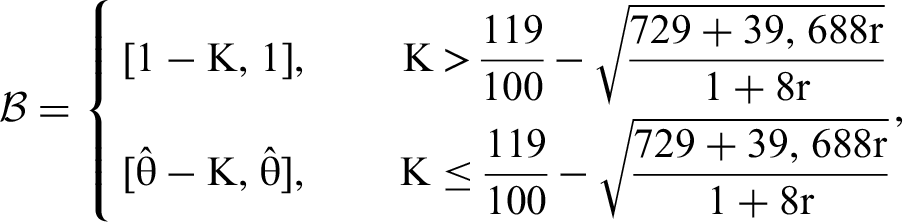
If retailers collaborate to offer BORS, we assume that consumers can return online purchases through conventional shipping (and incur the hassle cost r) or pay the travel cost t to visit the BMR and drop off the returns without hassle. If a product is returned via the BMR, the OR incurs handling cost
Similar to the case of online–offline competition, we use backward induction and start the analysis from the last two stages, where retailers set prices and consumers form their shopping strategy. In the perfect Bayesian equilibrium, both retailers optimally charge 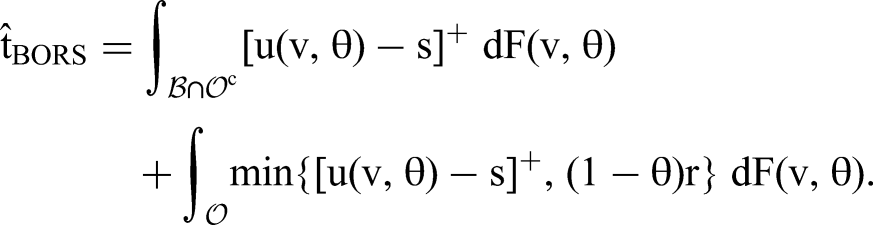
Equipped with the consumer shopping strategy, we derive the retailers’ optimal assortment decisions (see Lemma 5 in Appendix C): In equilibrium, the OR's assortment expands to 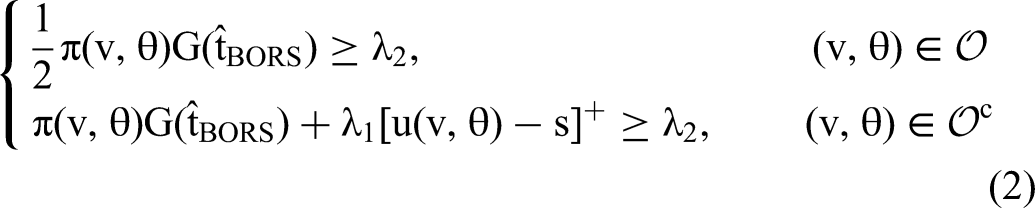
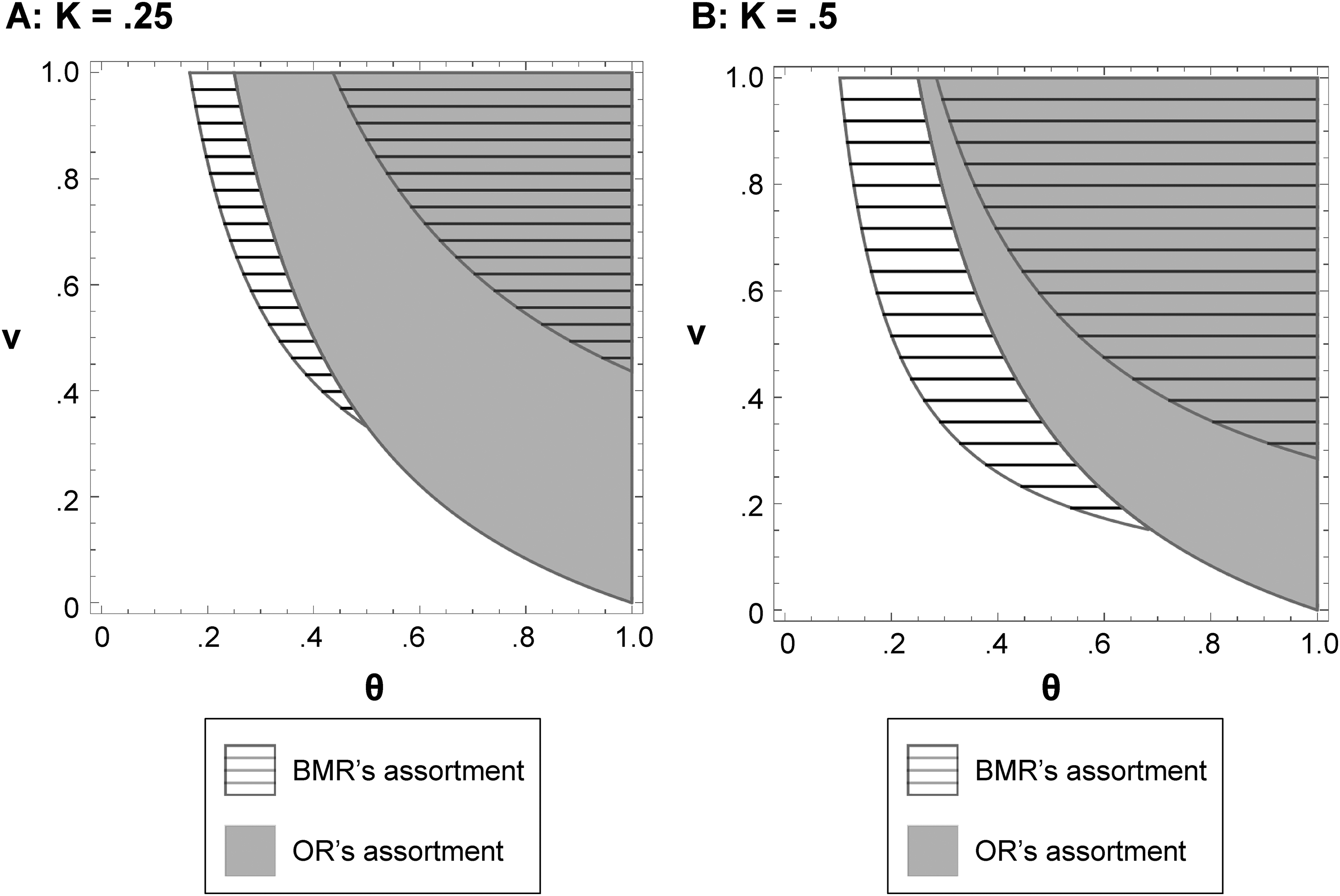
Optimal Product Assortment in the Presence of a BORS Agreement.
The Impact and Prospect of a BORS Agreement
In the short run (fixing product assortments as in the equilibrium without BORS), consumers gain an additional incentive to visit the BMR to return online purchases in store. Thus, the BMR's foot traffic increases. This prediction is consistent with Kohl's store traffic data after starting its BORS partnership with Amazon (see Figure 3).
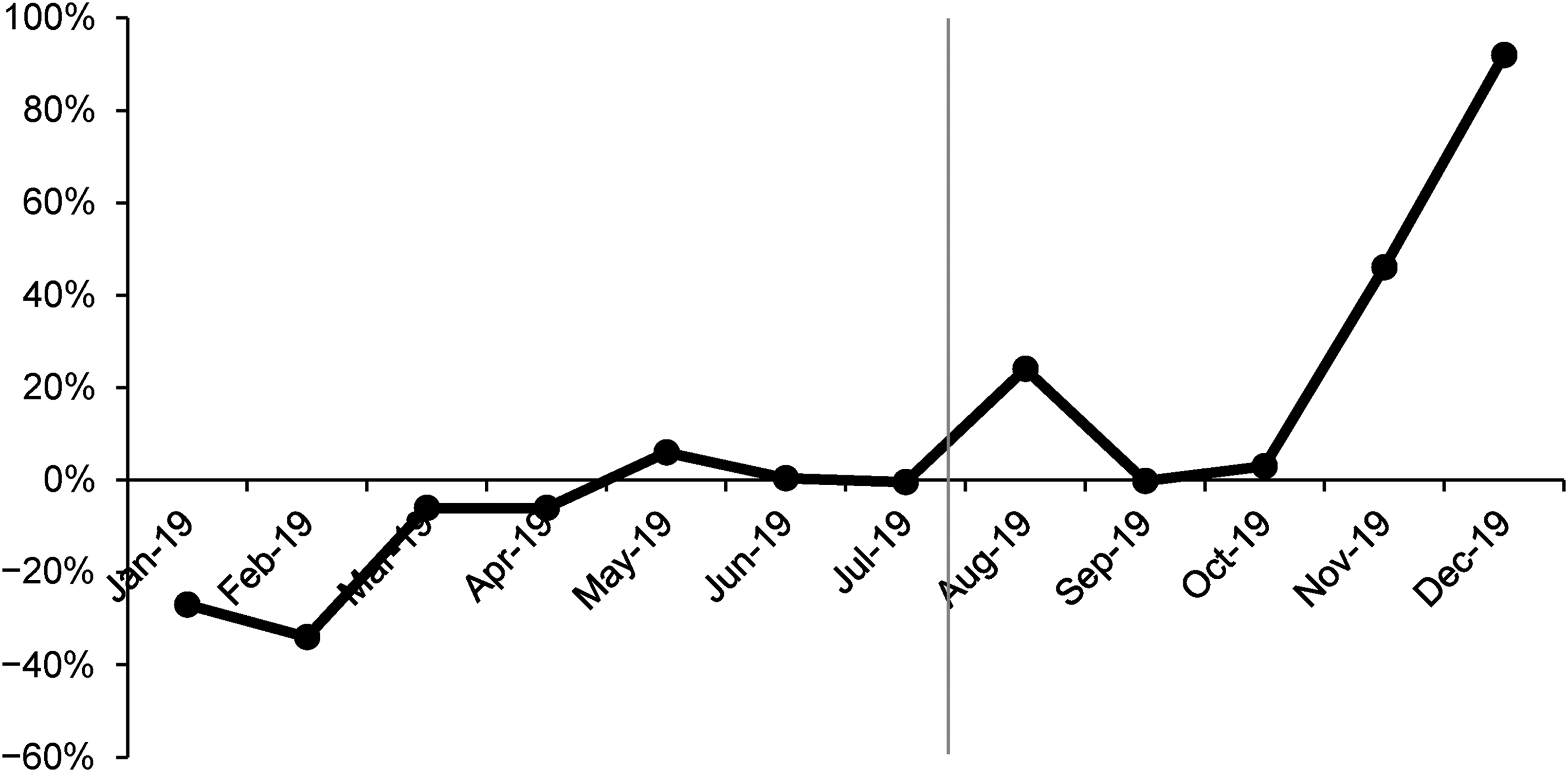
Kohl's Store Foot Traffic Before and After Collaboration with Amazon.
Suppose the two retailers collaborate to offer BORS. In the short run (before retailers’ assortments change), the BMR's foot traffic increases. The volume of consumer returns also increases.
In the long run (after product assortments shift to the new equilibrium), the OR's assortment expands because handling returns is less costly. Since consumers who visit the BMR return via the hassle-free BORS, the consumer attraction effect of providing showrooming (i.e., the indirect effect of stocking a product) disappears. Thus, the BMR no longer has any incentive to carry low θ products in the overlapping assortment region, and it instead turns to stock high θ products in
Suppose the two retailers collaborate to offer BORS. In the long run (after retailers’ product assortments change), the OR's product assortment expands, and the BMR no longer specializes in the overlapping assortment region (i.e., within
Finally, we consider retailers’ long-run profits and lay out the conditions under which a BORS agreement will likely be reached between the two retailers. For the OR, BORS reduces return costs and allows the OR to sell products with lower θ. However, the BMR shifts to stock high θ products in the overlapping region, taking a cut of the most profitable market segment. If the cost-saving effect of BORS is large, then the benefit of BORS is large; If the BMR's store size is small, then the loss of BORS is small. When either of these two conditions holds, the OR benefits from BORS. For the BMR, BORS can attract more foot traffic at the cost of creating a stronger OR competitor. When either of the previous two conditions holds, the profit-enhancing effect of increasing foot traffic dominates. Thus, both parties prefer to have BORS.
The two retailers would agree on BORS collaboration if
The cost-saving effect of BORS (i.e., The BMR's store size (i.e., K) is small.
We observe some anecdotal evidence for the latter condition, where ORs often collaborate with nondominant BMRs: Amazon purchases can be returned to the smaller department stores Kohl's and Staples, but not Target; Amazon Japan purchases can be returned with Yu-Pack service, which is available at smaller convenience stores Lawson and Ministop but not at larger ones such as 7-Eleven and FamilyMart; Taobao courier stations are often located in mom-and-pop stores instead of in larger supermarkets.
Numerical Example (Continued)
Next, we continue the example from the previous “Numerical Example” subsection. Suppose the two retailers offer a BORS, and the OR's cost of handling returns drops to 
Recall that in this example, we can express retailers’ product assortments using intervals (of θ). In the long run, the OR's assortment expands to
Extensions
This section extends our model to incorporate several realistic features of online–offline competition. First, we study price competition with heterogeneous retailer operation costs. Second, we allow for private label substitutes and investigate the implications. Third, we model a BMR's expansion into omnichannel retailing. Finally, we model consumers’ heterogeneous consideration sets to relax the assumption of consumers demanding all products that fit. Our discussion here is concise, and the technical details are relegated to the Web Appendix.
Price Competition with Heterogeneous Costs
In the main model, we assumed that retailers have zero marginal cost and consumers must pay positive search costs to learn prices. These assumptions lead to a simple pricing equilibrium as in Diamond (1987). This setup helps us focus attention on product assortment instead of pricing and improve tractability and exposition. Our focus is consistent with the empirical evidence of Huang and Bronnenberg (2023), which suggests that over 99% of the welfare gains of online–offline competition accrue from assortment increases and transportation cost reductions, and only 1% comes from price competition.
To demonstrate the robustness of our previous findings, in this extension, we adjust our model setup to allow for price competition. We assume that consumers’ search cost is negligible, s = 0. We also consider a more realistic setting of retailers having positive and heterogeneous operating costs. Specifically, we allow the BMR to have a marginal cost of selling, cBMR, and the OR to have a marginal cost of selling, c1, and a marginal cost of processing returns, c2. Here, c2 includes shipping, handling, and the salvage value of returned products. We also assume that the OR has a fixed cost of shipping to or from consumers ξ. The fixed cost of handling returns is still captured by R. In summary, if the BMR sells D(v, p) units of (v, θ) to a consumer, it incurs a total cost of D(v, p)cBMR; if the OR sells D(v, p) units of (v, θ) to a consumer, it incurs a total cost of D(v, p)c1 + ξ + [D(v, p)c2 + ξ + R] × 1{if returned}. Let
We briefly summarize the findings here and relegate details to Web Appendix C. In equilibrium, consumers still use a cutoff shopping strategy (Lemma A1 in Web Appendix C)—those with
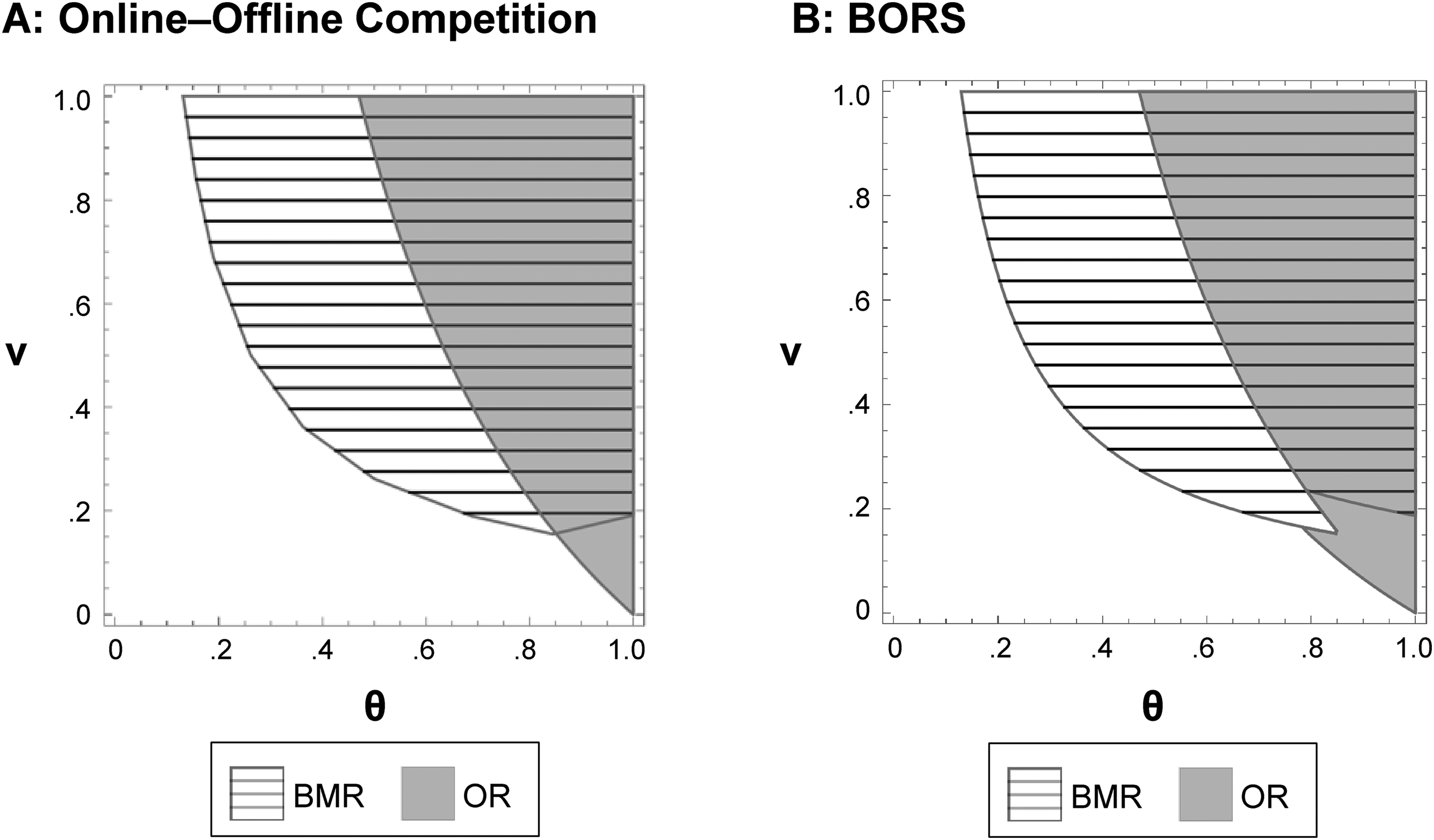
Extension: Price Competition with Heterogeneous Costs.
Price competition does not provide additional insights regarding product assortment. With online–offline competition, the OR still sells all products with high θ. In
Private Label Substitutes
In the main model, we assume that each product category has only one brand that can be stocked by both retailers. However, BMRs such as Kohl's carry many private labels like FLX and Lauren Conrad that are not available online. A consumer who did not find a fit online may visit the BMR to try private label substitutes. To capture this aspect, we extend our model to allow the BMR to offer private label substitutes. Here, we briefly describe the model setup and results. Details can be found in Web Appendix D.
We still assume that each product category has one third-party brand that can be stocked by both retailers. In addition, the BMR can choose to carry a private label substitute in each category, which also takes up one unit of the BMR's shelf space. Private labels may be “inferior” substitutes (e.g., Begley and McOuat 2020; Richardson, Dick, and Jain 1994). We capture this with a demand ρD(v,p) if the private label fits, and 0 demand if it does not, where
In the equilibrium with online–offline competition, the BMR stocks private labels only when its store size is large enough. The BMR's private label assortment is a subset of its third-party product assortment,
In the equilibrium with BORS, we find that
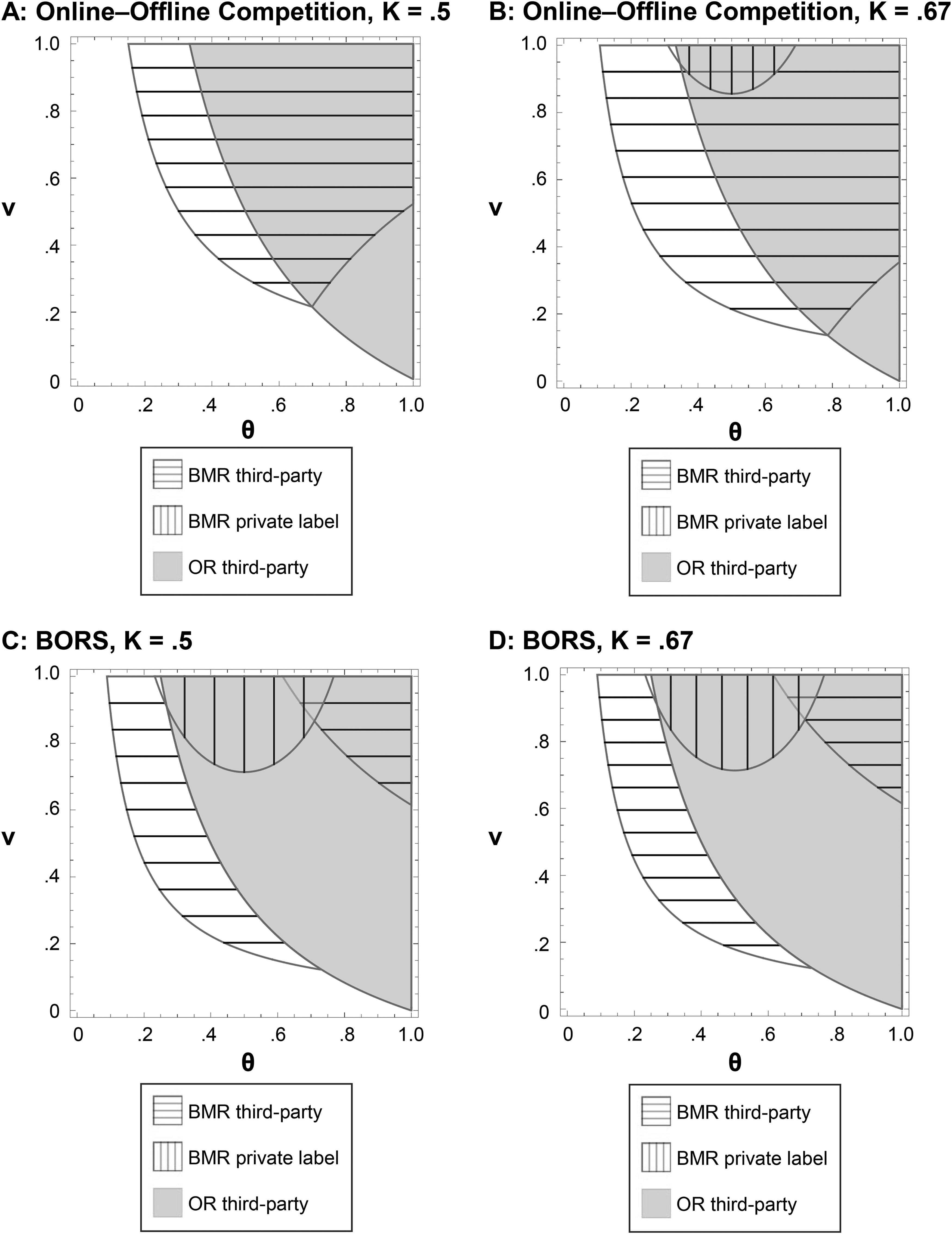
Extension: Equilibrium Assortment with Private Label Substitutes.
The BMR's Online Branch
In recent years, some BMRs have started ramping up their online operations. For example, consumers can often order an item online via Target's website and pick it up at a local physical store. To model a BMR's online branch (which we abbreviate as BO), we generalize the main model and bring in more features to incorporate the trade-offs that consumers might face when choosing among the BMR, the OR, and/or the BO. We characterize three additional shopping costs consumers face: (1) shipping delays and shipping fees associated with shopping online, (2) the cost to shop in store (e.g., waiting time in a checkout lane, infection risk in a pandemic), and (3) the hassle of returning products to a physical BMR.
If there is a BO, consumers get an additional option: “buy online and pick up in store”. Suppose that the BMR sets the same price and product assortment across its two channels. 13 Consumers’ payoffs are modeled as in Table 2. We assume that the BMR first decides whether to open a BO at a fixed cost Γ > 0, and then the game proceeds via the same timeline as in the main model. We focus on the BMR's incentive to open an online store when product assortment is used as a competitive instrument.
The Trade-Offs Consumers Face in the Presence of a BO.
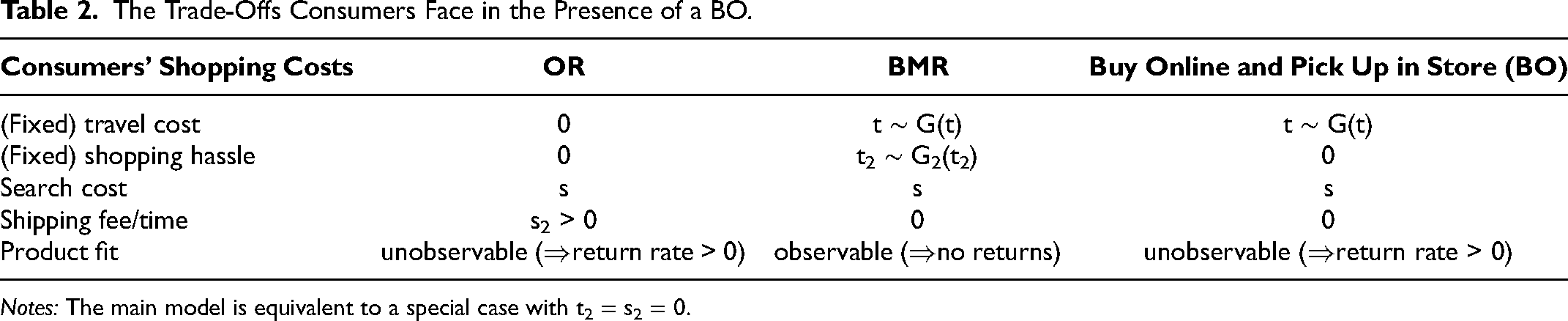
Notes: The main model is equivalent to a special case with t2 = s2 = 0.
First, we consider online–offline competition without BORS. As shown in Figure 6, the BMR faces a trade-off when deciding whether to open a BO. On the one hand, it gains new consumers (i.e., those with t + t2 ≥ C1 and t < C2) who shop in the BO. On the other hand, it incurs a fixed cost, and also some of its old consumers (i.e., those with t + t2 < C1 and t2 > C1 − C2) shift their shopping from the BMR to the BO, creating additional costly returns for the BMR. We show that the BMR should open a BO when the cost is not prohibitively high and a significant portion of consumers view in-store shopping as a big hassle. The OR is less willing to collaborate with a BMR with an established BO.
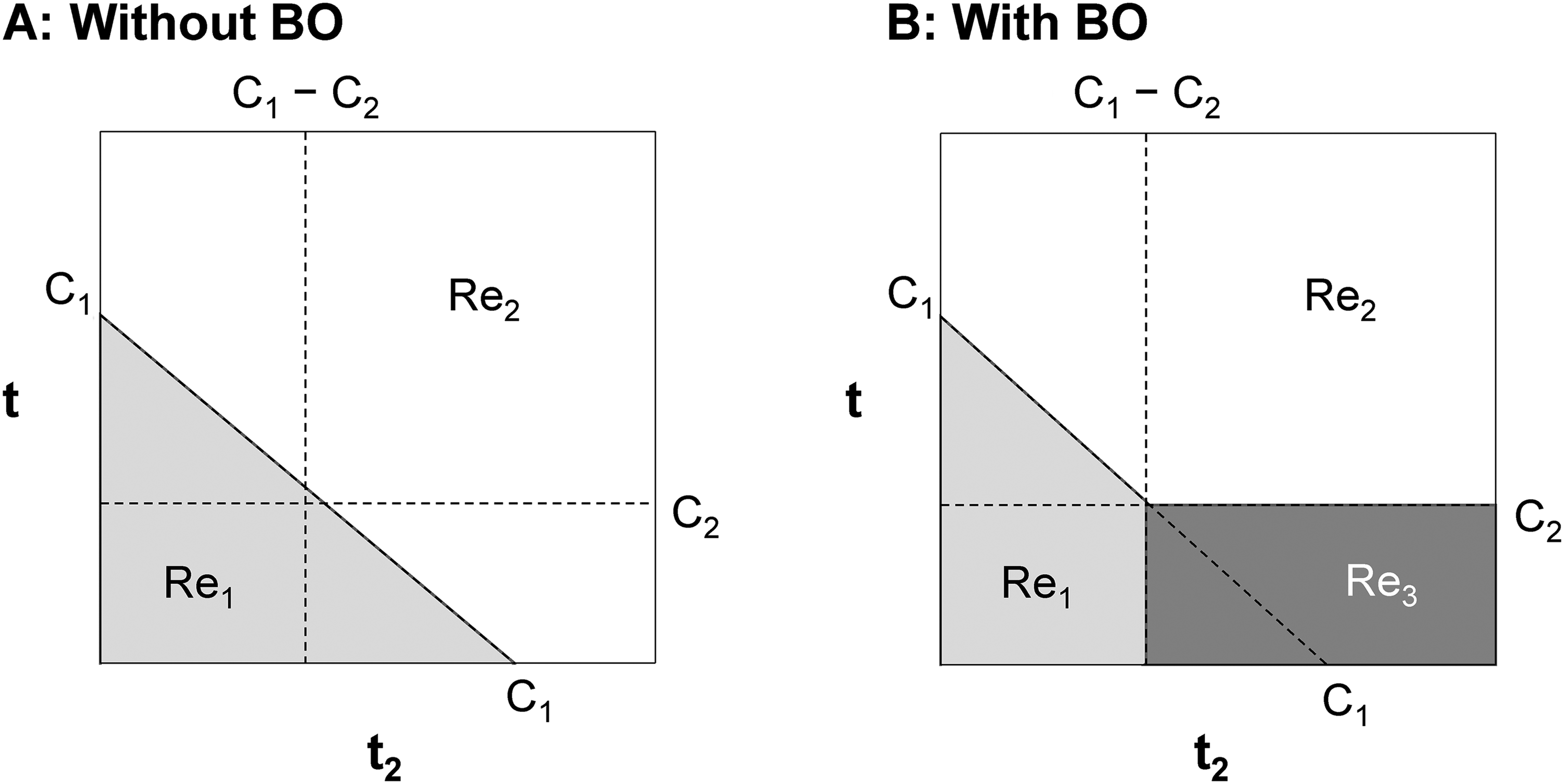
Extension: Consumers’ Shopping Strategy With and Without a BO.
Demand Heterogeneity and Consumers’ Consideration Sets
In the main model, consumers demand all products that provide a fit. This is a simplifying assumption that can be relaxed without affecting any of our results. To show this, we briefly introduce an extension with heterogeneity in individual consumers’ “consideration sets” (e.g., Hauser and Wernerfelt 1990). All of our results remain qualitatively robust under this setup. Further details and formal results can be found in Web Appendix F.
A consumer's consideration set
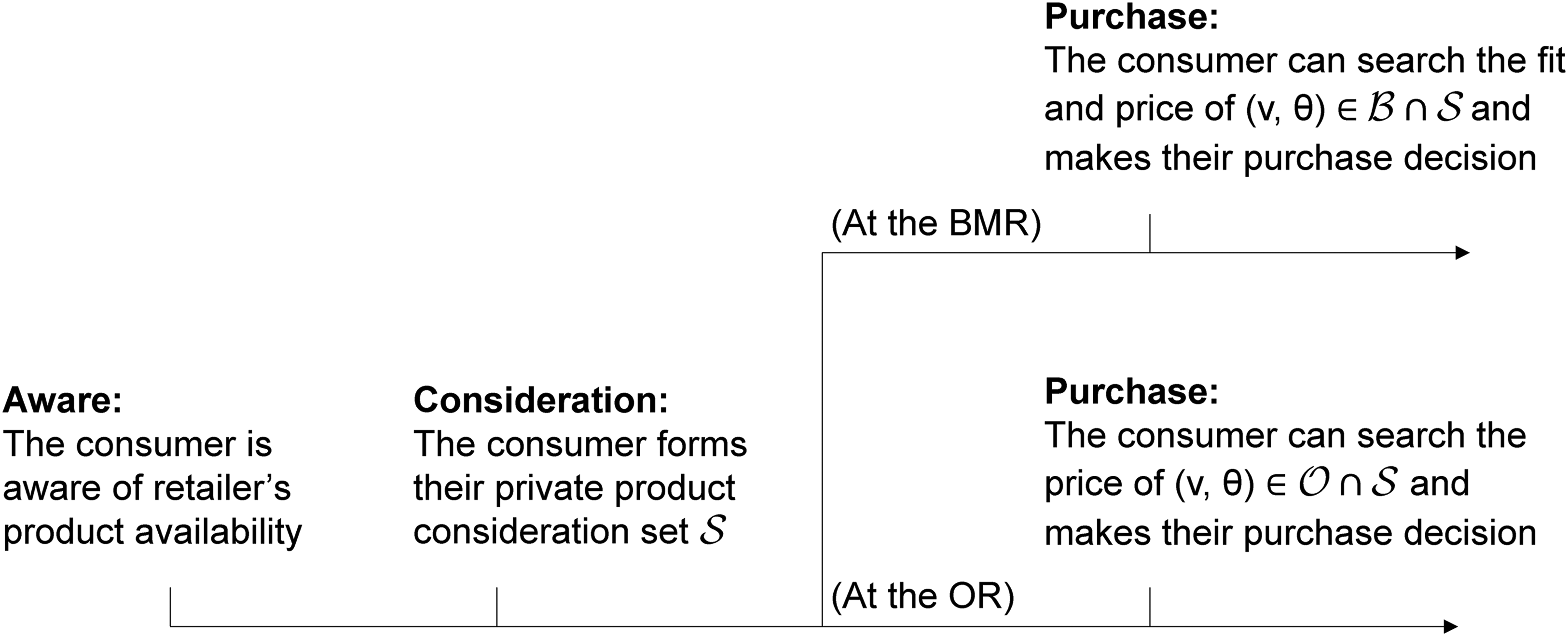
Extension: The Consumer Decision Journey.
Under this setup, the only difference from the main model is that when retailers or consumers calculate expected payoff, integrations have an additional term that captures the distribution of consumers’ consideration sets. Web Appendix F reproduces all results of the main model using our new assumption. In Web Appendix F, we also show how to further generalize the model to allow for n different consumer groups with heterogeneous consideration set distributions.
Conclusion
In this article, we investigate online–offline competition with product assortment as a competitive instrument. We find that the OR sells high-value and easy-to-fit products to minimize costly returns and maximize profit. More interestingly, the BMR might use its limited store size to stock products that have a lower fit probability. This counterintuitive result arises because of a subtle trade-off between generating higher sales and attracting more foot traffic. The results support analysts’ view of using specialization as a shield against online platforms and shed light on the steady growth of specialty stores in the downfall of traditional BMRs. These results are robust to a number of extensions, including heterogeneous cost structures for the BMR and OR, the existence of private label substitutes, the BMR operating an online channel, and consumers with heterogeneous consideration sets.
Our model provides new insights into the nascent BORS policy. In the short run, BORS alters consumers’ shopping strategies and increases returns. In the long run, BORS further changes retailers’ store positioning. The OR expands its assortment, while the BMR loses the incentive to specialize in the overlapping assortment region. If the BMR has a small store size, it sustains higher foot traffic, and BORS benefits both retailers. This provides a rationale as to why some ORs (e.g., Amazon and Amazon Japan) partner with smaller BMRs instead of larger ones.
To the best of our knowledge, our research represents the first attempt to jointly model online and offline competition, consumer returns, and strategic product assortment decisions as a competitive instrument. However, we leave some questions open. First, including manufacturers within our setup and analyzing how they strategically affect assortment decisions may be an interesting extension of our work. Second, one can further study how online–offline competition and BORS agreements impact the logistics and reverse logistics in the supply chain. Third, consumer reviews and virtual showrooms may alleviate the OR's return issue and change retailers’ assortments. Finally, we consider independent product categories (as well as private label substitutes), but our framework abstracts away from product complementarity. 15 These could be promising avenues for future research.
Supplemental Material
sj-pdf-1-mrj-10.1177_00222437251314370 - Supplemental material for Product Returns and Assortment Decisions: A Strategic Analysis of Online and Offline Competition
Supplemental material, sj-pdf-1-mrj-10.1177_00222437251314370 for Product Returns and Assortment Decisions: A Strategic Analysis of Online and Offline Competition by Yue Li, Raghunath Singh Rao and Paola Mallucci in Journal of Marketing Research
Footnotes
Appendix A: Proofs for the Benchmark of a Monopoly BMR
The proof of Lemma 1 is provided in Web Appendix A1 to comply with the page limit. Before proving Proposition 1, we characterize the optimal assortment of the BMR. Recall that
The proof follows the same steps as in the proof of Proposition 2 (see Appendix B). To comply with the page limit, we provide this proof in Web Appendix A1.
Next, we prove Proposition 1.
Appendix B: Proofs for the Online–Offline Competition Model
Step 1: We take as given the retailers’ equilibrium prices
First, observe that traveling to the OR is costless. Thus, only visiting the BMR is strictly suboptimal, as long as
Second, if a consumer plans to visit both the BMR and the OR, then the optimal strategy is to search products
We can calculate the expected utility of visiting the BMR first and visiting the OR second. The consumer obtains expected utility
Third, we calculate the expected utility of only visiting the OR. In this case, the consumer optimally searches online for the products that give an expected utility no less than the search cost (i.e., products that satisfy u(v, θ) − (1 − θ)r ≥ s). The consumer purchases all of these products and obtains expected utility
Finally, direct calculation shows that if
Step 2: Next, we take as given consumer beliefs and consumers’ optimal shopping strategies, and we show that setting price
First, consider a product (v, θ) with u(v, θ) − (1 − θ)r ≥ s. Given consumers’ price beliefs and shopping strategy, a
Second, consider a product (v, θ) with u(v, θ) − (1 − θ)r < s. If consumers anticipate
Therefore, given consumers’ equilibrium beliefs and shopping strategies, both retailers set prices
Combining the two steps, we obtain the desired perfect Bayesian equilibrium. □
Step 1: We show that the OR optimally chooses
Step 2: Next, we derive the BMR’s optimal product assortment.
Since consumers do not search products {(v, θ) | u(v, θ) < s} in the BMR, the BMR should only carry products with {(v, θ) | u(v, θ) ≥ s}. Due to the holdup problem, this is true in any equilibrium (see Web Appendix A3). The BMR’s profit maximization problem is as follows.
We next show that a solution to the preceding optimization problem exists. For this existence proof, let the notation Πq(v, θ) be the BMR’s profit when it chooses a stocking function q(v, θ). Letting
By assumption,
Thus, we can write a Lagrangian for the BMR’s optimization problem:
By Proposition 2, we have
Let
To prove the second statement, suppose that
Next, we show the second claim. By Proposition 2, the BMR’s assortment is given by
However, by Proposition 2,
Appendix C: Proofs for the Model with BORS Collaboration
For consumers with
The proof is similar to Proposition 2 and is included in Web Appendix A2 to comply with the page limit.
For the remainder of this section, we introduce some new notations. Let
Without BORS, consumers who visit both the BMR and the OR (
By Lemma 5, if the BMR stocks
If
Next, we analyze the BMR’s long-run store traffic changes. Without a BORS agreement, consumers visit the BMR if
Without a BORS agreement, the BMR’s total profit is bounded above by
Notice that
Acknowledgments
The author(s) thank conference and seminar participants at the 2021 Marketing Science Conference, 2022 Marketing Dynamics Conference, University of North Carolina at Chapel Hill Kenan-Flagler Business School, NEOMA Business School, and Wuhan University School of Economics and Management for valuable suggestions. They also thank the JMR review team, who helped significantly improve the article. All errors remain the authors’ responsibility.
Author Contributions
Paola Mallucci contributed to the article only during her time as a faculty member at the University of Wisconsin–Madison.
Coeditor
Raghuram Iyengar
Associate Editor
Kinshuk Jerath
Declaration of Conflicting Interests
The author(s) declared no potential conflicts of interest with respect to the research, authorship, and/or publication of this article.
Funding
The author(s) disclosed receipt of the following financial support for the research, authorship, and/or publication of this article: Yue Li acknowledges financial support from TaiShan Scholars (grant tsqn202306081), Natural Science Foundation of Shandong (grants ZR2023MG006 and ZR2024QG164), National Social Science Foundation of China (grant 23AJY006), National Natural Science Foundation of China (grant 72192842), and Social Science Foundation of Shandong University (grant 23RWZD13).

Notes
References
Supplementary Material
Please find the following supplemental material available below.
For Open Access articles published under a Creative Commons License, all supplemental material carries the same license as the article it is associated with.
For non-Open Access articles published, all supplemental material carries a non-exclusive license, and permission requests for re-use of supplemental material or any part of supplemental material shall be sent directly to the copyright owner as specified in the copyright notice associated with the article.
