




Abstract
Ensuring equal access to entrepreneurship and startup funding for both female and male entrepreneurs is crucial for societal perceptions of justice and long-term prosperity. Previous research presents contrasting findings, with some studies indicating a male advantage and others suggesting a female advantage. This research reconciles these inconsistencies by identifying the decision frame as a moderator. Specifically, in crowdfunding contexts, a consumer decision frame leads to stronger reliance on communal evaluation norms, resulting in favoring female entrepreneurs who are perceived as more disadvantaged. Conversely, an investor decision frame leads to stronger reliance on exchange evaluation norms, resulting in favoring male entrepreneurs who are perceived as more determined/passionate. Based on this, the authors propose that the strategic use of an entrepreneur's profile, activating a specific evaluation norm, and showing crowdfunding dependence attenuate the differential support for female versus male entrepreneurs, resulting in equal support for both. Results from six studies using a multimethod design provide converging support for this framework. This research is the first to differentiate between and directly compare consumer and investor decision frames, advancing the related literature and offering valuable guidelines for entrepreneurs, funding platforms, and public policy makers.
Keywords
Crowdfunding, defined as the efforts by entrepreneurs to fund their startups by drawing on relatively small contributions from a large number of individuals via the internet without standard financial intermediaries (Mollick 2014), has become an increasingly prominent source of funding for many entrepreneurs (Acar et al. 2021). In 2023 alone, over six million startups were funded with more than $117 billion through crowdfunding (Polaris Market Research 2024). The success of crowdfunding, and entrepreneurship in general, not only plays a crucial role in driving cultural, social, and economic progress but also contributes to the long-term prosperity of countries (Patel, Doh, and Bagchi 2021).
Compared with traditional funding sources such as venture capitalists, banks, government agencies, and other financial institutions, crowdfunding is viewed as democratizing entrepreneurship by giving regular individuals the power to decide what should be funded (Gafni et al. 2021; Mollick and Nanda 2016). Due to the nature of crowdfunding, entrepreneurs or creators behind proposed projects must promote their ideas to a large number of potential individual funders on platforms such as Kickstarter and Indiegogo. This targeted promotion presents a unique opportunity for marketing to contribute to the success of crowdfunding (Fan, Gao, and Steinhart 2020).
In this research, we differentiate between two important target markets of crowdfunding: consumers who support crowdfunding projects through the purchase and consumption of proposed products or services, and investors who allocate some of their money to crowdfunding projects for future returns. This distinction corresponds with the two major types of crowdfunding projects on the market: consumption-based and investment-based (Gorbatai and Nelson 2015; Herve et al. 2019). We introduce the concept of the decision frame, which refers to the cognitive context or perspective within which a decision is made. Specifically, in the context of crowdfunding, an individual could adopt a consumer decision frame, thinking and behaving like a consumer whose objective is to buy the proposed product for consumption. Conversely, in an investor decision frame, an individual thinks and behaves like an investor whose objective is to invest in a proposed idea for future capital returns.
Building on the concept of the decision frame, this research examines how crowdfunding projects can better position themselves through the disclosure of entrepreneur characteristics (e.g., the gender of the creator) or project descriptions to achieve better funding outcomes. Specifically, we propose that under a consumer decision frame, people tend to show stronger support for projects created by female entrepreneurs, who are perceived as disadvantaged and in need of help. In contrast, under an investor decision frame, people tend to favor projects by male entrepreneurs, who are perceived as more determined and passionate, thus having a higher chance of success. Furthermore, we identify that the strategic use of an entrepreneur's profile (e.g., describing a male entrepreneur as disadvantaged or a female entrepreneur as determined and passionate), activating a specific evaluation norm (norms guiding people's evaluation of others; Aggarwal 2004; e.g., prompting consumers to follow an exchange norm or asking investors to follow a communal norm), and disclosing a history of crowdfunding dependence (e.g., a heavy or extensive reliance on crowdfunding) act as boundary conditions that mitigate the proposed effects.
This research represents a pioneering effort in distinguishing and simultaneously studying the effects of a consumer versus an investor decision frame, which may have broader implications beyond the crowdfunding context. Furthermore, through this endeavor, we help reconcile the seemingly contradictory findings in the literature regarding the effect of entrepreneur gender. For instance, some researchers indicate that male entrepreneurs’ projects are more likely to be funded (Becker-Blease and Sohl 2007; Buttner and Rosen 1989; Marlow and Patton 2005), whereas others suggest the opposite, arguing for a female advantage (Greenberg and Mollick 2017; Johnson, Stevenson, and Letwin 2018; Mollick 2014). Our research finds that whether people support female or male entrepreneurs’ projects depends on the specific decision frame being activated. Additionally, this research contributes to the literature on gender and marketing by demonstrating that the gender of the entrepreneur or creator behind a business can have significant implications for funding access and market performance.
This research also provides valuable insights for entrepreneurs marketing their projects to potential investors and consumers. Entrepreneurs should customize their communication strategies for these two key groups of stakeholders. For instance, when marketing a startup to investors for funding access, they might choose a male partner to represent the startup, emphasize the determination and passion of a female entrepreneur, or encourage investors to adopt a communal evaluation norm. Conversely, when marketing a startup to consumers for sales purposes, they might choose a female partner to represent the startup, highlight the disadvantaged background of a male entrepreneur, or encourage consumers to adopt an exchange evaluation norm. Next, we review the related literature and develop our hypotheses.
Theoretical Development
The Effect of Entrepreneur Gender
For entrepreneurs starting a new business, a crucial task is to communicate their business ideas and themselves to potential stakeholders for funding access. Prior research has shown that the gender of the entrepreneur or the leading entrepreneur within a partnership can play a pivotal role. However, the effect of entrepreneur gender on the support received remains inconclusive. On one hand, some research has shown that a male entrepreneur's project is more likely to be funded compared with that of a female entrepreneur, all else being equal (Marlow and Patton 2005). For instance, related research has indicated that bankers not only are more likely to release startup loans to male (vs. female) entrepreneurs but also charge lower interest rates and require less collateral (Buttner and Rosen 1989). Brush et al. (2014) analyze the funds received by 6,500 startups and find that only 3% of the funds were secured by female entrepreneurs. Becker-Blease and Sohl (2007) find that to receive funding from potential investors, female entrepreneurs tend to surrender a greater proportion of their ownership of the startup compared with male entrepreneurs.
On the other hand, another stream of research shows the opposite, demonstrating that female entrepreneurs experience greater success in obtaining funds than their male counterparts. For instance, after analyzing funding outcomes from two prominent crowdfunding platforms, Gafni et al. (2021) conclude that female entrepreneurs tend to enjoy significantly higher success rates than their male counterparts. Similarly, Gorbatai and Nelson (2015) find that female entrepreneurs are more likely to use positive, vivid, and inclusive language in describing their projects, resulting in more favorable support. Allison et al. (2015) find that supporting less-privileged female entrepreneurs makes funders feel better about themselves, illustrating a warm-glow effect. Greenberg and Mollick (2017) argue that female entrepreneurs tend to receive more support when there are more female funders. Last, Johnson, Stevenson, and Letwin (2018) find that people tend to perceive female entrepreneurs as more trustworthy, leading to stronger support.
How can we reconcile these conflicting findings regarding the effect of entrepreneur gender? So far, the literature has been silent on this discrepancy. In this research, we seek an overarching theoretical perspective and more nuanced process explanations to not only unite the prior literature but also provide a more comprehensive understanding of the effect of entrepreneur gender. We begin by examining people's perceptions of entrepreneurs.
Perceptions of Female Versus Male Entrepreneurs
According to the work of Paharia et al. (2011), people tend to perceive and assess others, especially entrepreneurs, on two dimensions. The first is disadvantage, which refers to people's awareness and assessment of the relative hardships, barriers, and systemic inequalities facing an entrepreneur. When a person perceives an entrepreneur as more disadvantaged and in greater need of help, they tend to show stronger support for that entrepreneur (Shane and Cable 2002). This is because helping the disadvantaged not only increases the marginal value of the support provided (Ahlstrom and Bruton 2006) but also enhances the funder's positive self-view (Allison et al. 2015). Compared with male entrepreneurs, female entrepreneurs tend to be perceived as more disadvantaged. For instance, in both venture capital (13% of entrepreneurs were female; Raman 2022) and crowdfunding (34% of entrepreneurs were female; Gafni et al. 2021), female entrepreneurs are still the minority relative to their male counterparts. Consequently, female entrepreneurs are often described as having a more difficult time starting a business and facing more obstacles along the way (Morgan 2020). Furthermore, female entrepreneurs tend to have more difficulties accessing funder social networks or convincing others they can lead a startup, partly due to the societal stereotype of associating men rather than women with entrepreneurship (Maes, Leroy, and Sels 2014).
The second dimension is perceived determination/passion, which is the recognition and evaluation of an entrepreneur's enduring commitment, enthusiasm, and resilience toward achieving their entrepreneurial goals, especially in the face of challenges (Paharia et al. 2011). People tend to perceive those who are more passionate and determined about their goals as more likely to succeed, resulting in stronger support (Petty and Gruber 2011). Prior research has shown that people tend to perceive male (vs. female) entrepreneurs as more determined in pursuing their entrepreneurial endeavors (Balachandra et al. 2019). It is important to note that these findings are based on people's subjective perceptions with little factual basis (Robb and Watson 2012). For example, due to implicit gender biases, women are viewed as less focused on career advancement (Rudman and Phelan 2010). These biases lead some to believe that women would be distracted by familial obligations, dedicating less time and effort to professional settings (Balachandra et al. 2019; Eagly and Wood 2011). Furthermore, women in leadership positions are often perceived to focus on fostering internal relationships rather than being determined to lead their organizations to further success (Eagly and Karau 2002).
Following the previous theorizing, one might show stronger support for female entrepreneurs because they are perceived as more disadvantaged and in need of help, or one might show stronger support for male entrepreneurs because they are perceived as more determined to achieve success regardless of the costs. The question becomes the following: When, or under what circumstances, will perceived disadvantage (vs. determination/passion) dominate an individual's perception and decision-making process? To answer this question, we examine the contextual factor of the decision frame.
Decision Frame: Consumer Versus Investor
In this research, we define decision frame as the cognitive context or perspective within which a decision is made. Specifically, we differentiate between two types of decision frames. In a consumer decision frame, people take the perspective of a consumer making a purchase decision for consumption purposes. In contrast, in an investor decision frame, people take the perspective of an investor making an investment decision for potential future returns. Many decisions, such as buying a house, jewelry, or collectibles, could be viewed through either of these decision frames. For example, one can buy jewelry to wear as a consumer or to save and store as an investor. The decision frame is an especially useful concept in the crowdfunding context, where people can support a crowdfunding project either by directly investing money in the project for a potential future return or by buying the products in the project (Johnson, Stevenson, and Letwin 2018). Accordingly, prior research has differentiated between two types of crowdfunding: consumption-based (consumer decision frame) and investment-based (investor decision frame) (Greenberg and Mollick 2017; Herve et al. 2019).
Under a consumer decision frame, consumers buy a product from a crowdfunding project not only for utilitarian purposes but often because they view their purchase as support for the entrepreneur who needs their help (Johnson, Stevenson, and Letwin 2018; Zvilichovsky, Danziger, and Steinhart 2018). In fact, consumers may see their consumption as a form of communal relationship between themselves and the entrepreneur (Fan, Gao, and Steinhart 2020; Herd, Mallapragada, and Narayan 2022). Supporting this idea, researchers have shown that consumers buy from a crowdfunding startup for personal reasons (Dai and Zhang 2019) and tend to emphasize the entrepreneur's personal characteristics (Li et al. 2017).
Accordingly, we argue that consumers, or those using a consumer decision frame, tend to rely more on a communal norm in evaluating the crowdfunding project. A communal norm means that people tend to set aside their self-interest and prioritize showing kindness, empathy, and concern for others (Aggarwal 2004). Furthermore, people following a communal norm have been found to offer more help to those in need (Winterich and Zhang 2014). Combining this with the previous theorizing that female entrepreneurs are perceived as more disadvantaged and in need of help, we propose that under a consumer decision frame, individuals tend to show stronger support for female entrepreneurs than for male entrepreneurs.
In contrast, we argue that investors, or those using an investor decision frame, are more likely to rely on an exchange norm when evaluating crowdfunding projects. An exchange norm indicates that people tend to set aside their personal feelings or others’ needs and judge whether future returns justify the investment (Aggarwal and Zhang 2006). Prior research has shown that investors tend to rely on rational thinking rather than personal feelings in making investment decisions (Becker-Blease and Sohl 2007; Fay and Williams 1993). In the crowdfunding context, Gupta et al. (2009) find that investors do not view an investment as a relationship but rather as a mutually beneficial exchange, where the entrepreneur receives funds to develop a startup and the investor gets a return on their investment. As a result, people following an exchange norm seek cues that the project or entrepreneur is likely to succeed or generate positive capital returns for them (Brooks et al. 2014; Kanze et al. 2018). Combining this with the theorizing that people tend to perceive male entrepreneurs as more determined and passionate, and thus more likely to succeed, we propose that under an investor decision frame, people are more likely to support male entrepreneurs than female entrepreneurs. Summarizing our theorizing, we hypothesize:
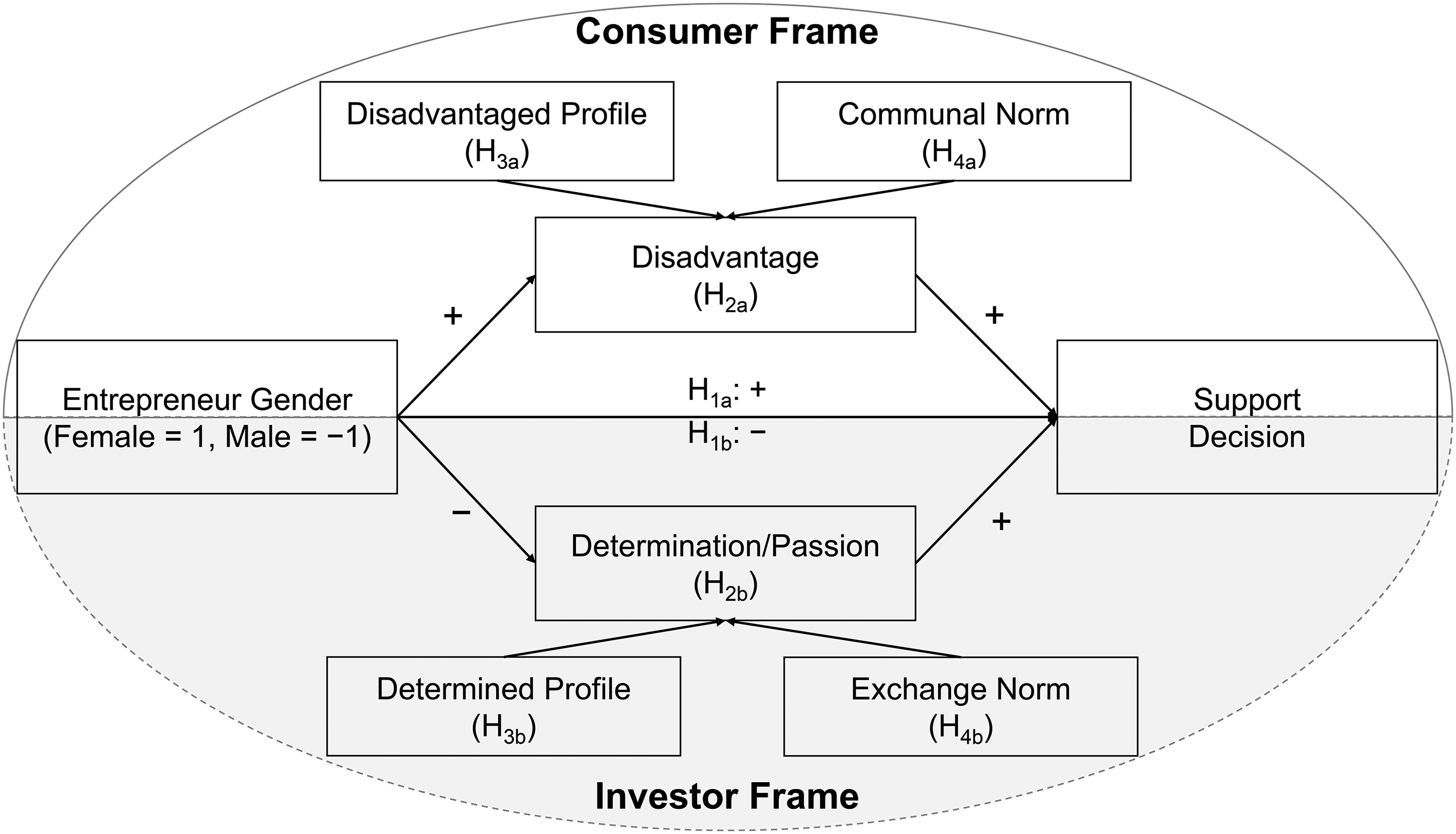
Our full conceptual model is shown in Figure 1. We next develop the rest of our theory.
Boundary Conditions
Entrepreneur profile
Following the logic of the mediating roles of disadvantage and determination/passion, we should be able to eliminate the effect of entrepreneur gender among consumers by making both female and male entrepreneurs appear similarly disadvantaged. Conversely, we should be able to eliminate the effect of entrepreneur gender among investors by making both female and male entrepreneurs appear similarly determined and passionate. In other words, if we can change people's perceptions of the entrepreneur, we can boost support for female entrepreneurs among investors and for male entrepreneurs among consumers. Following the human–brand literature (Paharia et al. 2011), we achieve this by altering the profile of the entrepreneur. Specifically, when we profile both female and male entrepreneurs as similarly disadvantaged and in desperate need of help, consumers should provide similar support to both entrepreneurs’ projects, thus attenuating the effect under a consumer decision frame. Conversely, when we profile both female and male entrepreneurs as similarly determined and passionate, willing to achieve success at all costs, investors should provide similar support to both entrepreneurs, thus attenuating the effect under an investor decision frame. Formally, we hypothesize:
Overall Theoretical Framework.
Evaluation norm
According to our theory, evaluation norms, or the norms guiding people's evaluation of others or other entities (Aggarwal 2004), play important roles in our proposed framework. Specifically, a communal norm drives consumers to rely on their perception of female entrepreneurs as disadvantaged when making decisions, whereas an exchange norm drives investors to rely on their perception of male entrepreneurs as determined and passionate when making decisions. Following this logic, if we instruct both consumers and investors to evaluate a crowdfunding project following a communal norm, both should care about the perceived disadvantage of female entrepreneurs, resulting in similar support intentions for female over male entrepreneurs. Conversely, if we instruct both consumers and investors to evaluate a project using an exchange norm, both should care more about the perceived determination and passion of male entrepreneurs, resulting in similar support intentions for male over female entrepreneurs. Formally, we hypothesize:
Next, we report six studies. Study 1 tests the interactive effect of entrepreneur gender and decision frame. Study 2 replicates the findings using an incentive-compatible design. Study 3 examines the parallel mediating roles of perceived disadvantage and determination/passion while ruling out several alternative accounts. Study 4 tests the moderating role of entrepreneur profile. Study 5 tests the moderating role of evaluation norm. Last, Study 6 uses a dataset from Kickstarter to enhance the external validity of the findings.
Study 1: The Effects of Entrepreneur Gender and Decision Frame
Method
This study has three goals. First, we test the interactive effect of the decision frame (consumer vs. investor) and entrepreneur gender on people's support intention, in the form of either product purchase or monetary investment. Second, we include two investing conditions, one in a noncrowdfunding context and another in a crowdfunding context. We expect similar effect patterns over these two investing conditions following our theory. Third, besides female and male entrepreneur conditions, we include a gender-unknown entrepreneur condition, so we can examine which entrepreneur gender (female, male, or both) drives the effect we proposed.
Thus, the study is a 3 (decision frame: consumer vs. investor-noncrowdfunding vs. investor-crowdfunding) × 3 (entrepreneur gender: female vs. male vs. unknown) between-subjects design. Participants were 990 U.S. consumers (Mage = 43.33 years, SD = 14.40; 50% female, 49% male, 1% other gender identity) from Prolific. Following our preregistration (https://aspredicted.org/wt5uh.pdf), 1 64 participants were excluded due to failing the attention check. Thus, our final sample size is 926 (Mage = 43.55 years, SD = 14.32; 50% female, 49% male, 1% other gender identity).
We randomly assigned participants to one of the experimental conditions. First, we manipulated the decision frame by asking them to envision themselves as a consumer of a crowdfunding project, an investor of a crowdfunding project, or an investor of a venture capital project. Specifically, we informed participants that they were going to decide whether to purchase a product proposed by a crowdfunding project (consumer), to invest in a product proposed by a crowdfunding project (investor-crowdfunding), or to invest in a product proposed by a venture capital project (investor-noncrowdfunding) after reviewing it (Web Appendix A).
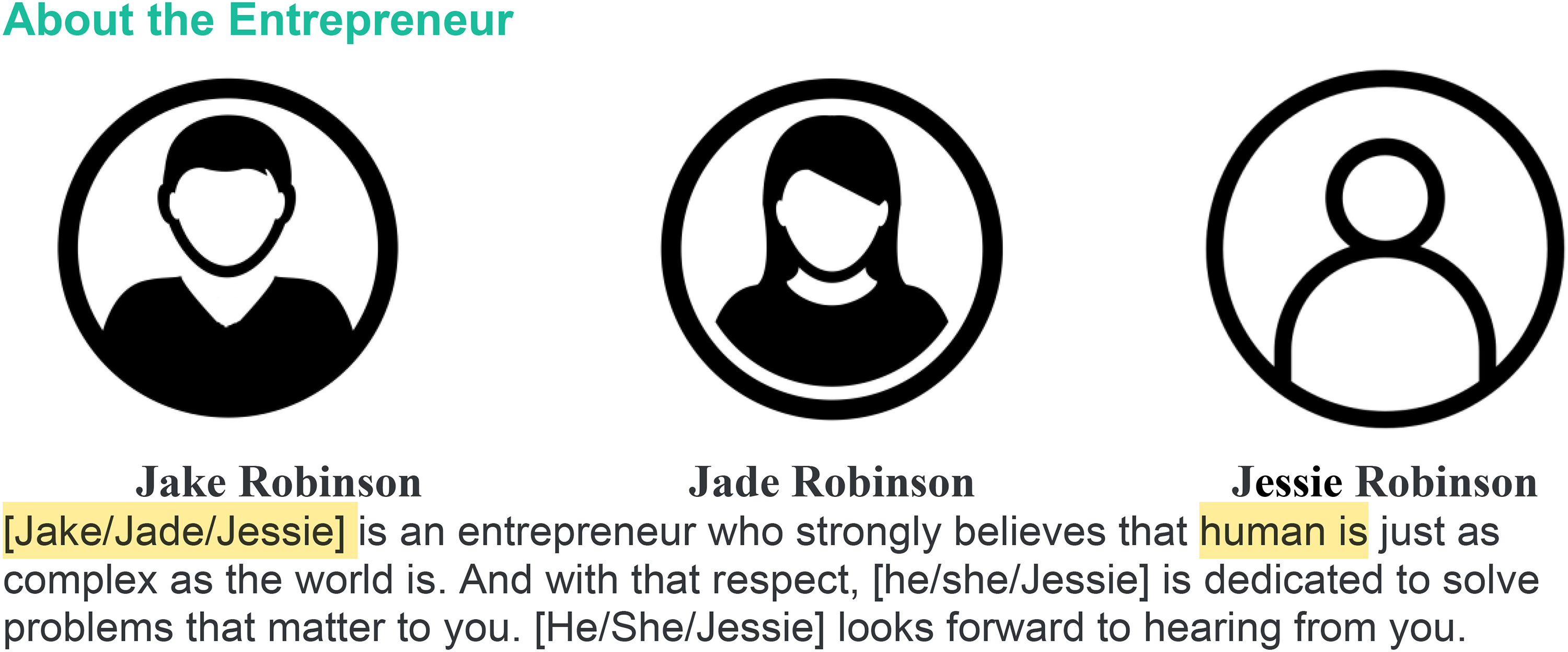
Next, all participants viewed the same project description about a phone stand with only one difference: the gender of the entrepreneur who created the project. Specifically, in the “About the Entrepreneur” section, participants viewed a profile photo of a female (vs. male vs. gender unknown) entrepreneur, named Jade (vs. Jake vs. Jessie) Robinson (Figure 2). Following the profile photo and name, participants read a brief introduction of the entrepreneur. We developed these stimuli based on typical project descriptions from Kickstarter.
Manipulation of Entrepreneur Gender in Study 1.
Given that the participants under different decision frames were asked to make distinct support decisions, we captured their support intention for the proposed project with similar five-item scales across the decision frame conditions. In the consumer frame condition, support intention was measured with a five-item purchase likelihood scale (e.g., “I am likely to purchase this product if I see it on a crowdfunding platform,” “I probably would pre-order the product from the crowdfunding platform”; α = .95). In the two investor frame conditions, support intention was measured with a similarly worded five-item investment likelihood scale (e.g., “I am likely to invest in this project if I come across it on a crowdfunding platform” and “I am considering backing this project early by investing in it through the crowdfunding platform”; α = .93; Web Appendix A). In other words, although we used one single dependent variable of support intention (α = .94) in the analyses, it was measured differently across conditions. Last, we collected demographics and measured participants’ experiences with both crowdfunding and investing.
Results
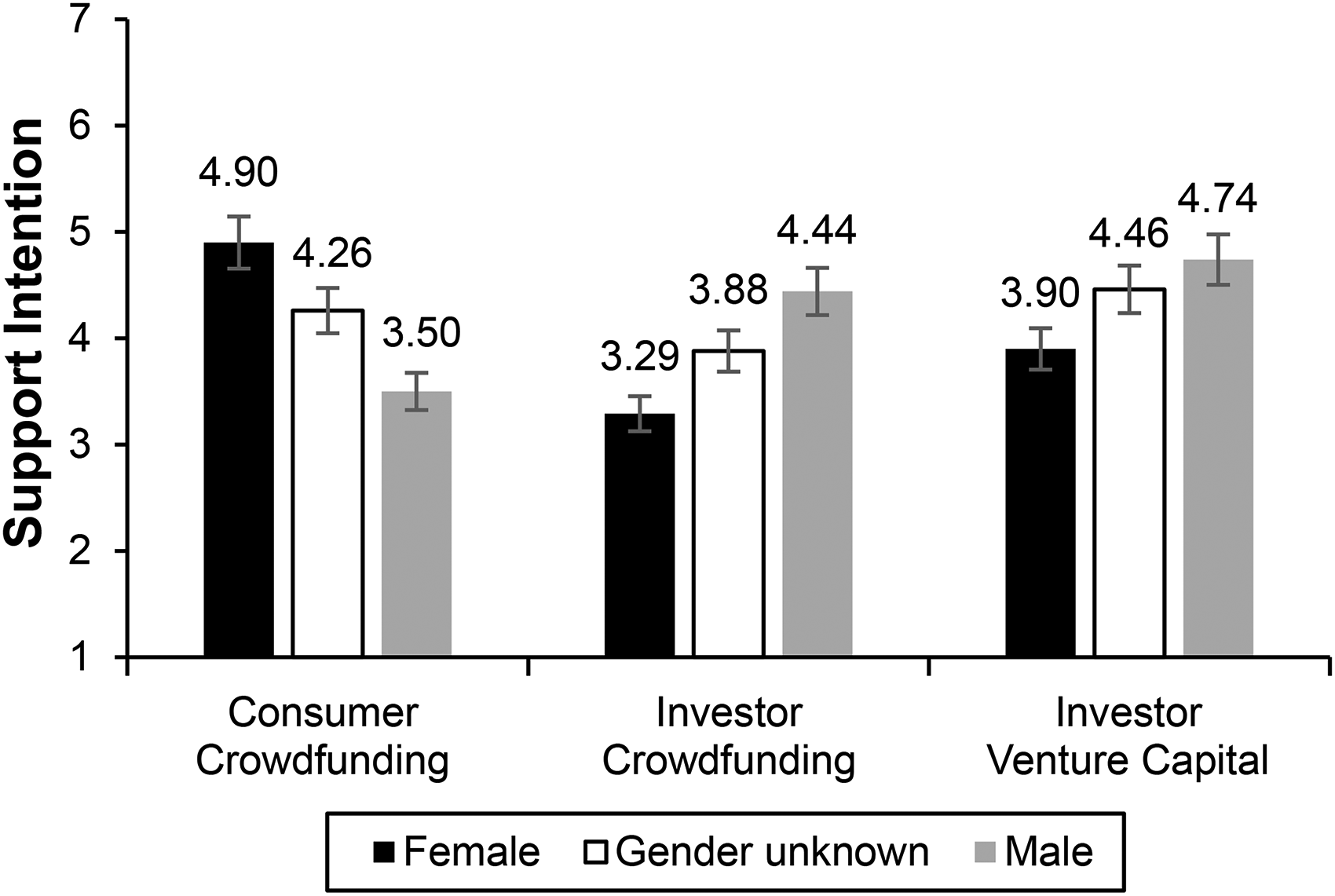
To test the interactive effect of decision frame and entrepreneur gender, we conducted a full-factorial ANOVA on support intention with decision frame, entrepreneur gender, and their interaction as the predictors. The results indicate that the main effect of the decision frame was significant (F(2, 917) = 7.62, p < .001; η2 = .017), whereas the main effect of entrepreneur gender was not significant (F(2, 917) = 1.33, p = .266; η2 = .003). Importantly, their interaction was significant (F(4, 917) = 19.40, p < .001; η2 = .085). To further examine the interaction effect, we conducted a series of follow-up contrasts (Figure 3).
The Effects of Decision Frame and Entrepreneur Gender on Support Intention (Study 1).
Under the consumer decision frame, participants showed significantly higher support intention for the female entrepreneur (M = 4.90, SD = 1.68), compared with either the male entrepreneur (M = 3.50, SD = 1.66; F(1, 917) = 39.74, p < .001; η2 = .098) or the gender-unknown entrepreneur (M = 4.26, SD = 1.58; F(1, 917) = 8.10, p = .005; η2 = .037). These results directly support H1a: When a consumer decision frame is salient, consumers are more likely to support female over male (or gender-unknown) entrepreneurs through their purchase decisions. In addition, participants showed lower support intention for the male entrepreneur compared with the gender-unknown entrepreneur (Mmale = 3.50, SD = 1.66 vs. Munknown = 4.26, SD = 1.58; F(1, 917) = 11.60, p < .001; η2 = .052). These results indicate that in a consumer decision frame, participants are less likely to support male entrepreneurs, not only compared with female entrepreneurs, but also compared with gender-unknown entrepreneurs. In other words, male entrepreneurs in a consumer decision frame may have better results by not disclosing their gender.
In contrast, under the crowdfunding investor decision frame, participants showed significantly higher support intention for the male entrepreneur (M = 4.44, SD = 1.78) compared with the female entrepreneur (M = 3.29, SD = 1.64; F(1, 917) = 26.22, p < .001; η2 = .101) or the gender-unknown entrepreneur (M = 3.88, SD = 1.38; F(1, 917) = 5.93, p = .015; η2 = .030). These results directly support H1b: Under an investor decision frame, investors are more likely to support male over female (or gender-unknown) entrepreneurs through their investment decisions. In addition, participants showed lower support intention for the female entrepreneur than for the gender-unknown entrepreneur (Mfemale = 3.29, SD = 1.64 vs. Munknown = 3.88, SD = 1.38; F(1, 917) = 6.91, p = .009; η2 = .037). These results indicate that in an investor decision frame, participants are less likely to support female entrepreneurs, not only compared with male entrepreneurs, but also compared with gender-unknown entrepreneurs. In other words, female entrepreneurs may be better off not disclosing their gender when seeking investments in a crowdfunding context.
Last, in the venture capital investor condition, participants’ intentions to support the three entrepreneur genders were similar to those in the crowdfunding investor condition. Specifically, participants showed significantly higher support intention for the male entrepreneur (M = 4.74, SD = 1.62) than for the female entrepreneur (M = 3.90, SD = 1.81; F(1, 917) = 13.20, p < .001; η2 = .056), directly supporting H1b. However, participants showed similar support intention for the male entrepreneur (M = 4.74, SD = 1.62) compared with the gender-unknown entrepreneur (M = 4.46, SD = 1.37; F(1, 917) = 1.41, p = .236; η2 = .009). In addition, participants showed lower support intention for the female entrepreneur compared with the gender-unknown entrepreneur (Mfemale = 3.90, SD = 1.81 vs. Munknown = 4.46, SD = 1.37; F(1, 917) = 6.34, p = .012; η2 = .028). These results indicate that in an investor decision frame, investors are less likely to support female entrepreneurs, not only compared with male entrepreneurs, but also compared with gender-unknown entrepreneurs.
Discussion
The results from this study provide direct support for H1, showing how decision frame and entrepreneur gender jointly shape support intention for a proposed project. Under a consumer decision frame, people are more likely to support female (vs. male) entrepreneurs by purchasing the proposed products; in contrast, under an investor decision frame, people are more likely to support male (vs. female) entrepreneurs by investing in the proposed project. Importantly, by including a gender-unknown control condition, we show that the effect of entrepreneur gender is driven by both female and male entrepreneurs. In addition, the results indicate that an investor decision frame, in the context of either crowdfunding or venture capital, tends to exhibit similar effects. Importantly, the results still hold after the inclusion of covariates (e.g., participant gender, experiences with crowdfunding, experiences with investing). We report the results of these additional analyses in Web Appendix A, as well as the results of comparing the effect of the decision frame under different entrepreneur gender conditions. In the next study, we replicate the findings of Study 1 with an incentive-compatible design to boost external validity.
Study 2: Evidence from an Incentive-Compatible Design
Method
This study was a 2 (decision frame: consumer vs. investor) between-subjects design. Participants were 200 U.S. residents recruited from Prolific, age 20 to 76 (Mage = 43.58 years, SD = 14.02; 48% female, 50.50% male, 1.50% other). Following our preregistration (https://aspredicted.org/zq272.pdf), seven participants who failed our attention check were excluded, resulting in a final sample size of 193 (Mage = 43.34 years, SD = 13.86; 46.63% female, 51.81% male, 1.55% other).
We randomly assigned participants into one of the two experimental conditions. First, we manipulated the decision frame similarly to Study 1, with two differences. First, we asked participants to review and compare two different crowdfunding projects for this study. In the consumer (investor) condition, we asked them to indicate which project they would buy from (invest in). Second, to increase the stakes and make participants take the decision task more seriously, we adopted an incentive-compatible design. Specifically, we informed participants that if their purchase or investment preference aligned with the actual performance of the project in the real marketplace, they would earn an extra $1 bonus (Web Appendix B). In practice, after the study was completed, we randomly selected half of the participants to receive the bonus.
Next, participants viewed two proposed phone stand projects, adapted from two real crowdfunding projects on Kickstarter. We presented both projects with one video, six pictures, and a few highlighted benefits (Web Appendix B). We also counterbalanced the presentation order of the two projects. In a pretest, we confirmed that participants tended to show similar evaluation, perceived viability, perceived creativity, and anticipated success for these two projects when the gender of the entrepreneur was not disclosed (Web Appendix B). Thus, if we observe any differences in support intention between the two projects, it should be due to our decision frame and entrepreneur gender manipulations.
In the main study, we manipulated entrepreneur gender (Jade vs. Jake) using the same method from Study 1, which was embodied in the “About the Entrepreneur” section of the project description. To clarify, each participant viewed two different phone stand projects, one by a female entrepreneur and the other by a male entrepreneur. We also counterbalanced the order of which phone stand project was Project A (vs. B) as well as which entrepreneur created Project A (vs. B) across the experiment.
After reviewing the two projects, we asked participants to indicate which project they intended to support. In the consumer condition, support intention was measured with purchase likelihood (e.g., “I intend to purchase the product from”; 1 = “Project A,” and 6 = “Project B”; α = .98). In the investor condition, support intention was measured with investment likelihood (e.g., “I intend to invest in the product proposed by”; 1 = “Project A,” and 6 = “Project B”; α = .98). We averaged the corresponding items to form one support index (α = .98), with values higher (lower) than the scale midpoint of 3.5 indicating relatively stronger support for the female (male) entrepreneur. Last, we collected demographics and participants’ experiences with crowdfunding as well as the difficulties of imagining themselves as a consumer and investor.
Results
To test H1, we conducted a one-way ANOVA of the support index with decision frame as the predictor. The results were significant (Mconsumer = 3.87, SD = 1.83 vs. Minvestor = 3.08, SD = 1.99; F(1, 191) = 8.11, p = .005; η2 = .041). Furthermore, compared with the scale midpoint of 3.5, consumers showed stronger support for the female entrepreneur (M = 3.87, SD = 1.83 vs. scale midpoint 3.5; t(94) = 1.95, p = .054), whereas investors showed stronger support for the male entrepreneur (M = 3.08, SD = 1.99 vs. scale midpoint 3.5; t(97) = −2.08, p = .040). The results further support H1 that a consumer (investor) decision frame leads to stronger support for female (male) entrepreneurs. Furthermore, after including covariates such as participant gender (F < 1), experiences with crowdfunding (F < 1), difficulty of imagining the self as a consumer (F < 1), and difficulty of imagining themselves an investor (F(1, 186) = 1.20, p = .275), the effect of the decision frame remained significant as predicted (F(1, 186) = 8.29, p = .005; η2 = .041).
Discussion
The incentive-compatible design used in this study increases the stakes of the decision for participants and enhances the external validity of the findings. Furthermore, because participants were asked to evaluate and compare two similar crowdfunding projects, we not only establish a stronger causal effect of entrepreneur gender, but also do so in a more realistic marketing context, as people usually have to compare multiple projects before making either a consumption decision or an investment decision. In the next study, we test the underlying mechanisms of disadvantage and determination/passion.
Study 3: Mediating Evidence
Method
This study was a 2 (decision frame: consumer vs. investor) × 2 (entrepreneur gender: female vs. male) between-subjects design. We recruited 440 participants from Prolific, age 18 to 85 (Mage = 40.61 years, SD = 13.14; 49.66% female, 48.97% male, 1.38% other). Following our preregistration (https://aspredicted.org/rg5qx.pdf), we excluded seven participants who failed the attention check, resulting in a final sample size of 433 (Mage = 40.61 years, SD = 13.15; 50% female, 48.60% male, 1.40% other).
We randomly assigned participants to one of the four experimental conditions. They first completed the decision frame manipulation used in Study 1, by envisioning themselves as either a consumer making a purchase decision or an investor making an investment decision (Web Appendix C). Next, they viewed a crowdfunding project (a phone stand) created by either a female entrepreneur or a male entrepreneur (Web Appendix C). Afterward, we measured their support intention (α = .97; consumer support: α = .97; investor support: α = .96) using the same scales from Study 1.
Next, we measured perceived disadvantage of the entrepreneur with a nine-item scale (e.g., “The entrepreneur started from a disadvantaged position compared to other entrepreneurs,” “There are more obstacles in the way of the entrepreneur's succeeding,” and “The entrepreneur had to struggle more than other entrepreneurs to get to where s/he is in her/his life”; Paharia et al. 2011; α = .92). We also measured perceived determination/passion of the entrepreneur with another nine-item scale (e.g., “The entrepreneur stays determined even when s/he loses,” “The entrepreneur shows more resilience than others in the face of adversity,” “Compared to others s/he is more passionate about her/his goals”; Paharia et al. 2011; α = .94). We averaged the corresponding scores to form a disadvantage index and a determination/passion index. We also included two measures of alternative accounts: perceived quality (four items: the product from the project would be “reliable,” “high quality,” “durable,” and “dependable”; α = .92) and trustworthiness (five items from Johnson, Stevenson, and Letwin 2018; e.g., “The entrepreneur would be very concerned about my welfare,” “My needs and desires would be very important to the entrepreneur”; α = .90). We counterbalanced the order of the four measurements. Last, we collected demographics and measured participants’ experiences with crowdfunding as well as the difficulties of imagining themselves as a consumer and investor.
Results
Support intention
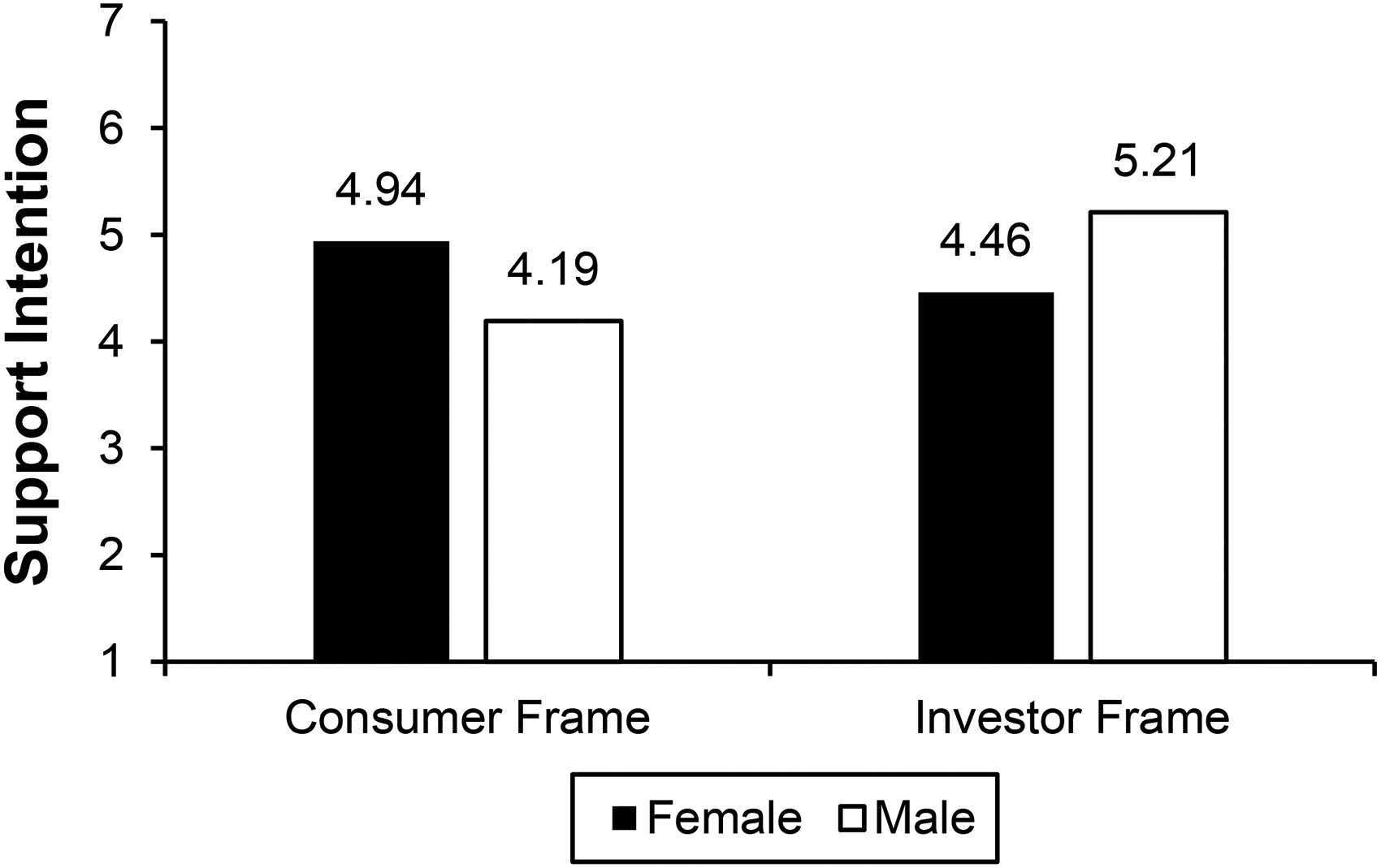
To test H1, we conducted a full-factorial ANOVA of the support index with decision frame, entrepreneur gender, and their interaction as independent variables. The results indicate that neither the main effect of the decision frame (F(1, 429) = 2.43, p = .120; η2 = .005) nor entrepreneur gender (F < 1; η2 = .000) was significant. However, their interaction was significant (F(1, 429) = 19.05, p < .001; η2 = .042). Follow-up contrasts indicated that under a consumer decision frame, participants showed stronger support for the female entrepreneur (M = 4.94, SD = 1.82) than for the male entrepreneur (M = 4.19, SD = 2.11; F(1, 429) = 9.22, p = .003; η2 = .035). In contrast, under an investor decision frame, participants showed stronger support for the male entrepreneur (M = 5.21, SD = 1.44) than for the female entrepreneur (M = 4.46, SD = 1.75; F(1, 429) = 9.84, p = .002; η2 = .052). The results further support H1 (Figure 4).
The Effects of Decision Frame and Entrepreneur Gender on Support Intention (Study 3).
Mediation analysis
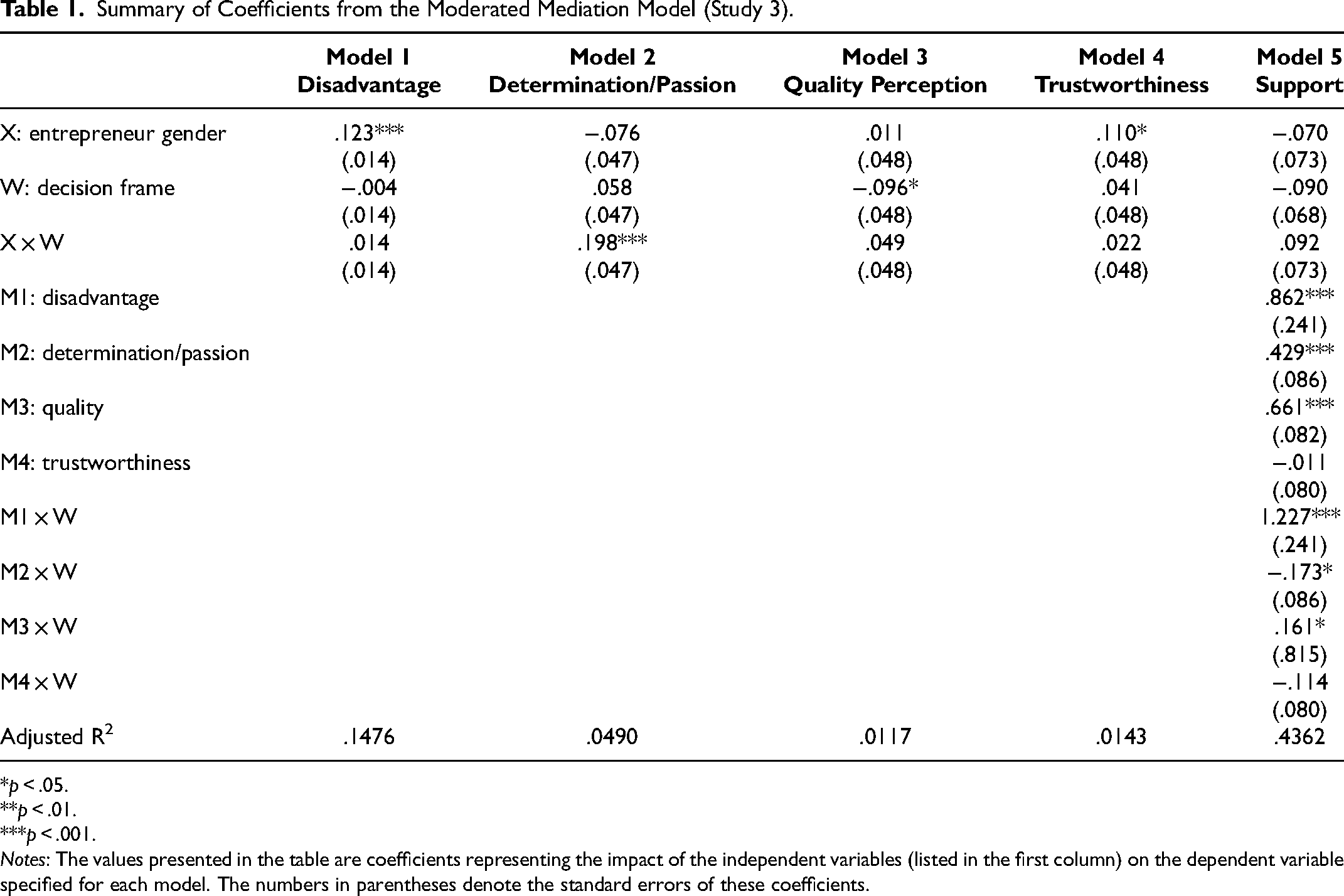
To test the mediating roles of disadvantage and determination/passion, we conducted a mediation analysis with the PROCESS Model 59 (Hayes 2018). Specifically, we defined entrepreneur gender as the independent variable (1 = female, −1 = male), and support intention as the dependent variable. We included disadvantage, determination/ passion, quality perception, and trustworthiness as the parallel mediators (mean centered). We also defined decision frame (1 = consumer, −1 = investor) as the moderator that moderates all the paths. We summarize the coefficients from the mediation models in Table 1.
Summary of Coefficients from the Moderated Mediation Model (Study 3).
*p < .05.
**p < .01.
***p < .001.
Notes: The values presented in the table are coefficients representing the impact of the independent variables (listed in the first column) on the dependent variable specified for each model. The numbers in parentheses denote the standard errors of these coefficients.
First, the moderated mediation effect through perceived disadvantage was significant (index = .3264, BootSE = .0881, 95% CI: [.1681, .5126]). Specifically, under the consumer decision frame, the indirect effect of entrepreneur gender on support through disadvantage was positive and significant (index = .2867, BootSE = .0771, 95% CI: [.1521, .4542]). That is, consumers perceived the female entrepreneur (M = 4.31, SD = 1.33) as more disadvantaged than the male entrepreneur (M = 3.26, SD = 1.25; F(1, 210) = 34.85, p < .001; η2 = .142). Furthermore, the effect of perceived disadvantage on support intention was positive and significant (β = 2.09, SE = .32, t(210) = 6.47, p < .001; η2 = .172). In contrast, under the investor decision frame, the indirect effect through disadvantage was not significant (index = −.0396, BootSE = .0421, 95% CI: [−.1232, .0465]). Specifically, although the investors also rated the female entrepreneur (M = 4.23, SD = .98) as more disadvantaged than the male entrepreneur (M = 3.41, SD = .96; F(1, 219) = 40.52, p < .001; η2 = .156), the disadvantage perception did not significantly impact support intention for the investors (β = −.36, SE = .35, t(219) = −1.05, p = .293; η2 = .012). These results indicate that under a consumer decision frame, it is perceived disadvantage that drives consumers to support female over male entrepreneurs (Figure 5).
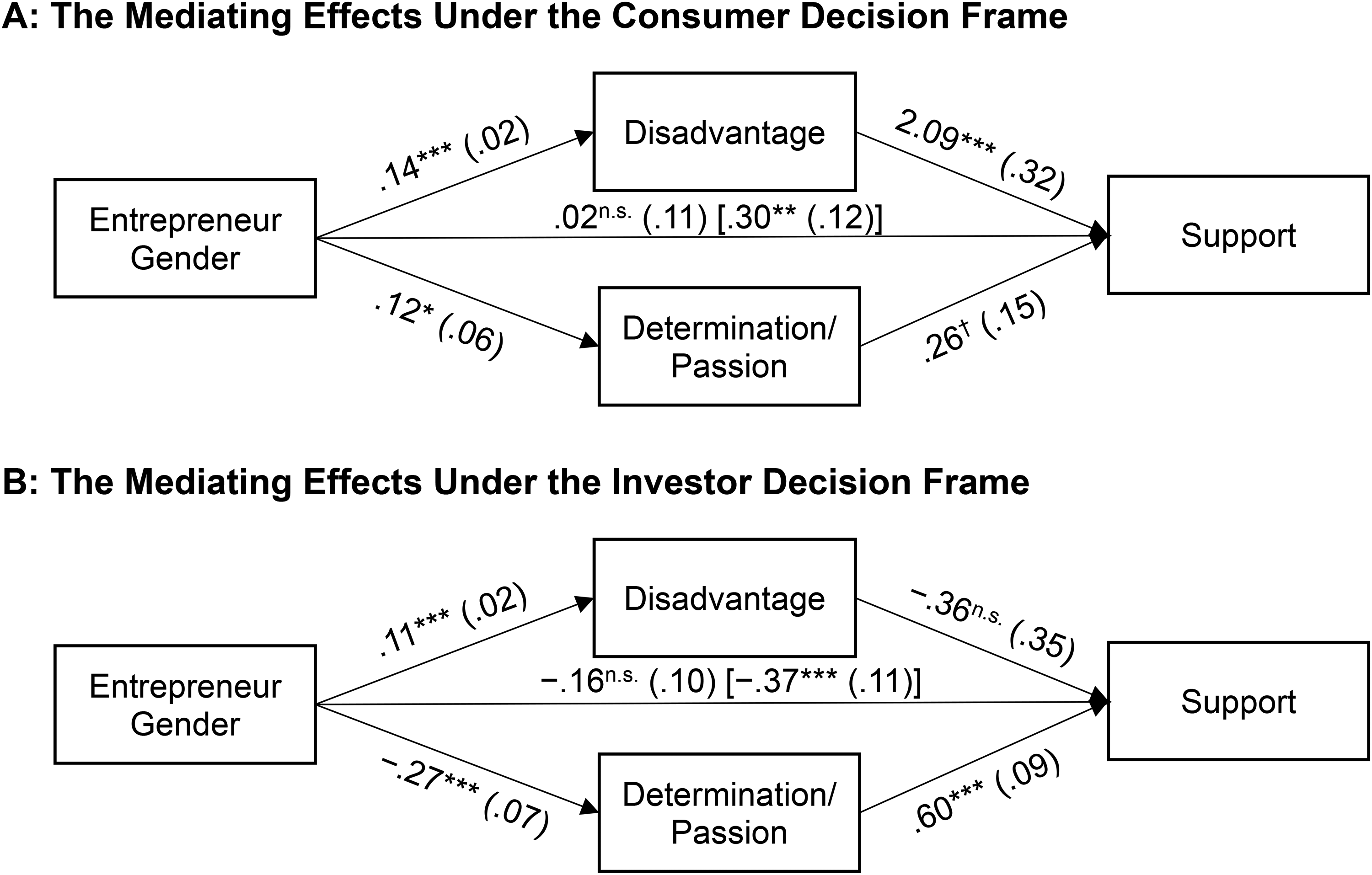
The Conditional Mediating Effects (Study 3).
Furthermore, the moderated mediation effect through perceived determination/passion was also significant (index = .1960, BootSE = .0532, 95% CI: [.0917, .3214]). Under the consumer frame, the indirect effect of entrepreneur gender on support through determination/passion was not significant (index = .0310, BootSE = .0268, 95% CI: [−.0125, .0913]). Specifically, consumers tended to perceive the female entrepreneur (M = 4.92, SD = .93) as slightly more determined/passionate than the male entrepreneur (M = 4.65, SD = 1.09), and the effect was marginally significant F(1, 210) = 3.24, p = .073; η2 = .017). In addition, the effect of perceived determination/passion on consumer support intention was positive and marginally significant (β = .26, SE = .15, t(210) = 1.68, p = .095; η2 = .027). In contrast, under the investor frame, the indirect effect through determination/passion was negative and significant (index = −.1650, BootSE = .0532, 95% CI: [−.2788, −.0721]). Specifically, the investors believed that the female entrepreneur (M = 4.34, SD = 1.47) was less determined/passionate than the male entrepreneur (M = 4.96, SD = .91; F(1, 219) = 14.60, p < .001; η2 = .060). Furthermore, the determination/passion perception showed a positive and significant effect on support intention for the investors (β = .60, SE = .09, t(219) = −6.60, p < .001; η2 = .226). These results indicate that under an investor frame, perceived determination/passion drives investors’ support for male over female entrepreneurs (Figure 5).
Last, neither the moderated mediation effect through perceived quality (index = .0689, BootSE = .0693, 95% CI: [−.0631, .2087]) nor trustworthiness (index = −.0257, BootSE = .0257, 95% CI: [−.0860, .0163]) was significant. Thus, these two alternative accounts are unlikely to explain the effects of the decision frame and entrepreneur gender on support intention.
Discussion
Besides replicating the findings from our previous studies regarding the significant interaction effect of decision frame and entrepreneur gender, this study directly tests the underlying mechanisms of disadvantage and determination/passion. The results are consistent with our predictions (H2a and H2b). Specifically, under a consumer frame, consumers tend to perceive female entrepreneurs as more disadvantaged, leading to stronger support for female entrepreneurs’ projects. In contrast, under an investor frame, investors tend to perceive male entrepreneurs as more determined and passionate, resulting in stronger support for male entrepreneurs’ projects. Importantly, in Web Appendix C (subsection WA-C6), we checked the robustness of the findings with covariates such as participant gender, experience with crowdfunding, and difficulty of the decision frame task. In the next study, we test the moderating roles of entrepreneur profile (H3).
Study 4: The Moderating Role of Entrepreneur Profile
Method
This study was a 2 (decision frame: consumer vs. investor) × 3 (entrepreneur profile: control vs. disadvantage highlighted vs. determination highlighted) between-subjects design. We recruited 600 participants from Prolific, age 19 to 71 (Mage = 41.12 years, SD = 13.11; 47.41% female, 51.75% male, .83% other). This study was preregistered (https://aspredicted.org/a5x5c.pdf).
We randomly assigned participants to one of the six experimental conditions. First, we manipulated the decision frame through the same task used in Study 2, in which we asked participants to put themselves in the shoes of either a consumer or an investor. Next, we presented participants with the same two phone stand projects used in Study 2, with one of the projects randomly assigned with a female entrepreneur and the other with a male entrepreneur (Web Appendix D). In the “About the Entrepreneur” section of the project description, we manipulated the gender as well as the profile of the entrepreneur. Specifically, in the control condition, the profile highlighted the design philosophy of the entrepreneur as well as the key features of the product proposed. In the disadvantaged condition, the profile highlighted the disadvantages the entrepreneur faced, including lack of resources, more obstacles, and less privileged backgrounds. In the determined/passionate condition, the profile emphasized the entrepreneur's resilience, tenacity, and passion for the proposed product. A pretest indicated that the profile manipulation was successful (Web Appendix D).
After participants viewed the two projects as well as the corresponding entrepreneur profiles, we asked them to indicate their support intention between the two projects. In the consumer frame condition, support intention was measured with purchase likelihood (α = .99), whereas in the investor frame condition, support intention was measured with investment likelihood (α = .99). We collapsed the two measures across conditions into one support index (α = .99), with higher value indicating stronger support for the female (vs. male) entrepreneur. Last, we collected demographics and measured participants’ experiences with both crowdfunding and investing.
Results
To test the moderating role of entrepreneur profile, we conducted a full-factorial ANOVA of support intention with decision frame, profile condition, and their interaction as the predictors. The results indicate that the main effects of the decision frame (F(1, 594) = 27.66, p < .001; η2 = .043) and profile (F(2, 594) = 6.91, p = .001; η2 = .021) were significant. Importantly, their interaction effect was significant (F(2, 594) = 6.55, p = .002; η2 = .020). To further examine the interaction effect, we conducted a series of planned contrasts (Figure 6).
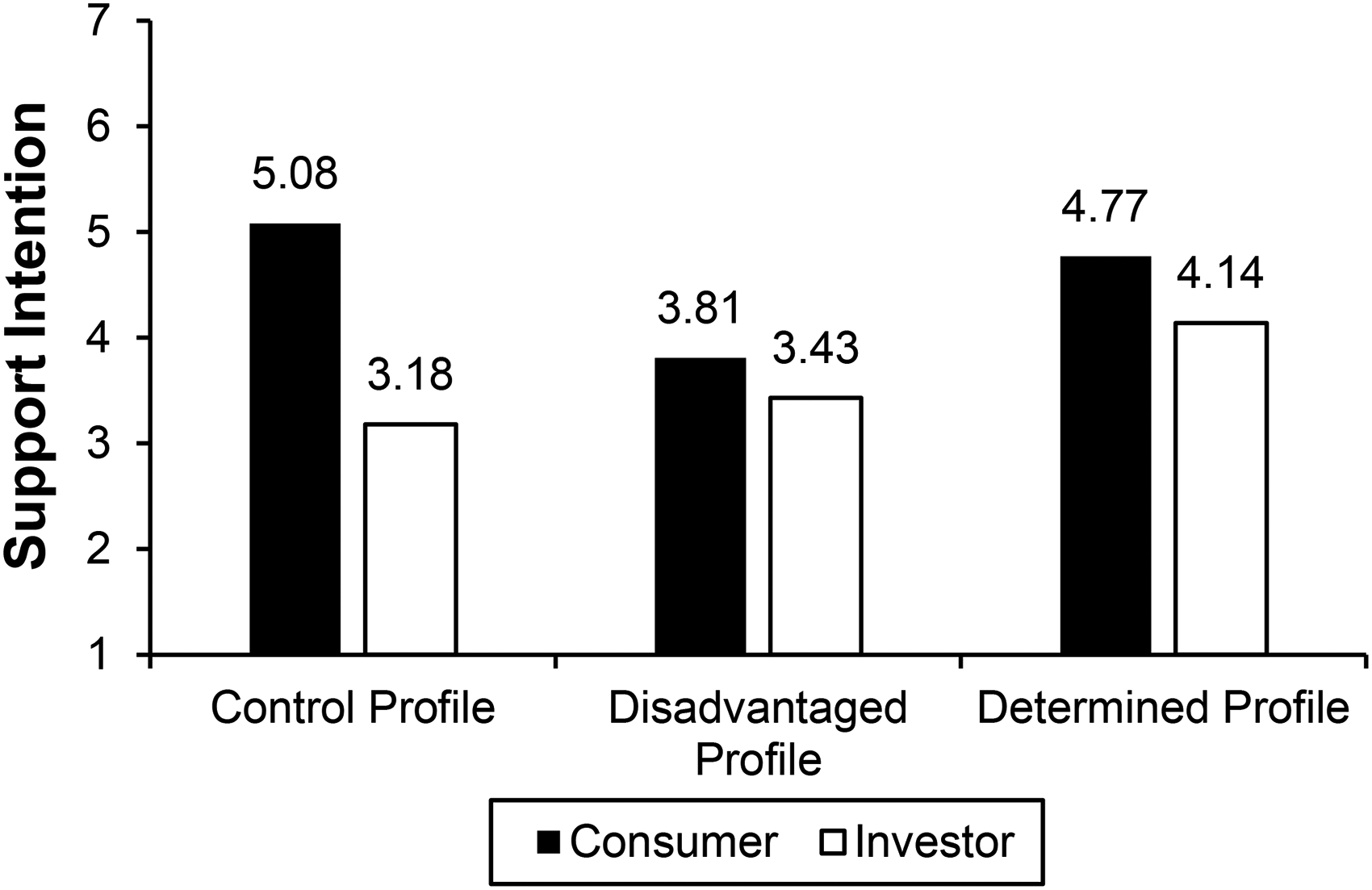
The Moderating Role of Entrepreneur Profile (Study 4).
Under the control-profile condition, the effect of the decision frame was significant (Mconsumer = 5.08, SD = 2.11 vs. Minvestor = 3.18, SD = 2.32; F(1, 594) = 35.73, p < .001; η2 = .055). Recall that for the support index, higher values (greater than the scale midpoint of 4) indicate stronger support for the female entrepreneur, whereas lower values (less than the scale midpoint of 4) indicate stronger support for the male entrepreneur. Thus, we compared the corresponding cell means with the scale midpoint of 4. The results indicate that consumers showed stronger support intention for the female entrepreneur (M = 5.08, SD = 2.11 vs. scale midpoint 4; t(102) = 5.14, p < .001), whereas investors showed stronger support for the male entrepreneur (M = 3.18, SD = 2.32 vs. scale midpoint 4; t(100) = −3.18, p < .001). The results further support H1.
In the disadvantaged-profile condition, the effect was attenuated to nonsignificant (Mconsumer = 3.81, SD = 2.18 vs. Minvestor = 3.43, SD = 2.41; F(1, 594) = 1.42, p = .234; η2 = .002). That is, regardless of the decision frame (consumer vs. investor), participants showed similar support for the female (vs. male) entrepreneur. As we theorized, a perception of the entrepreneur as disadvantaged drives support intention under the consumer decision frame. In the disadvantaged-profile condition, both female and male entrepreneurs are equally disadvantaged, so we expected consumers to become indifferent between the two disadvantaged entrepreneurs, regardless of their gender. We tested this by comparing consumers’ support intention for the female (vs. male) entrepreneur (M = 3.81, SD = 2.18) against the scale midpoint of 4 (similar support for the female and male entrepreneurs), obtaining a nonsignificant effect (t(101) = −.88, p = .391), supporting our theory.
Furthermore, the male entrepreneur was perceived as less disadvantaged in the control (vs. disadvantaged) profile condition. Thus, we expected that highlighting the disadvantage of a male entrepreneur would increase support for the male entrepreneur under the consumer decision frame. We tested this prediction by comparing support intentions under the control and disadvantaged profile conditions among those with a salient consumer decision frame. The result was significant (Mconsumer-control = 5.08, SD = 2.11 vs. Mconsumer-disadvantage = 3.81, SD = 2.18; t(594) = 4.01, p < .001; η2 = .081). As smaller values for support intention mean stronger support for the male (vs. female) entrepreneur, the result indicates that highlighting a disadvantaged profile increases consumer support for male entrepreneurs. Such a finding provides a useful way for male entrepreneurs to use a disadvantaged profile as a marketing strategy to boost consumers’ support for their projects.
In the determined/passionate condition, the effect of the decision frame was attenuated to marginal significance (Mconsumer = 4.77, SD = 2.17 vs. Minvestor = 4.14, SD = 2.34; F(1, 594) = 3.83, p = .051; η2 = .006). As we predicted, determination/passion drives support intention for investors. In the determined/passionate condition, both the female and male entrepreneurs were equally determined/passionate about their projects. Thus, we expected that for investors, their support intention for female and male entrepreneurs would be similar. To test this, we compared investors’ support intention under the determined-profile condition against the scale midpoint of 4. The result was nonsignificant (Minvestor-determined = 4.14, SD = 2.34 vs. scale midpoint 4; t(99) = .60, p = .551), consistent with our prediction.
Furthermore, our theory suggests that, by default, investors tend to view female entrepreneurs as less determined/passionate, so highlighting the determination/passion of the female entrepreneur should increase investors’ support intention for the female entrepreneurs. To test this, we compared investors’ support intention for the female (vs. male) entrepreneur under the control profile with that under the determined profile. The result was significant (Minvestor-control = 3.18, SD = 2.32 vs. Minvestor-determined = 4.14, SD = 2.41; t(594) = −3.02, p = .003; η2 = .040). Such a finding offers female entrepreneurs a unique strategy to boost support for their projects when seeking support from investors.
Discussion
This study achieves several objectives. First, it further replicates the effect of the decision frame on people's relative preference for a female versus a male entrepreneur under the control-profile condition. Second, by identifying a disadvantaged profile as a boundary condition for consumers and a determined profile as a boundary condition for investors, we show additional evidence for disadvantage and determination/passion perceptions as the mediators driving the effect of decision frame and entrepreneur gender on crowdfunding support. Third, the findings offer valuable practical insights for both female and male entrepreneurs. Specifically, in marketing their crowdfunding projects, female entrepreneurs could obtain more investment by using more determined and passionate marketing profiles, whereas male entrepreneurs could achieve more sales to consumers by using more disadvantaged marketing profiles. In Web Appendix D (subsection WA-D3), we report additional analyses to show that the effect is robust after controlling the covariates. Furthermore, we provide more comprehensive contrasts for all the means across the cells. In the next study, we further examine evaluation norms (communal vs. exchange norms) as another boundary condition (H4) for the proposed effect of the decision frame on entrepreneur gender preferences.
Study 5: The Moderating Role of Decision Norm
Method
This study was a 2 (decision frame: consumer vs. investor) × 3 (evaluation norm: control vs. communal vs. exchange) between-subjects experiment. We recruited 600 U.S. participants through Prolific, age 18 to 79 (Mage = 42.20, SD = 13.95; 51.34% female, 47.99% male, .66% other). This study was preregistered at https://aspredicted.org/er2tq.pdf.
We randomly assigned participants to one of the six experimental conditions. First, they completed the same decision frame manipulation used in Study 2, asking participants to envision themselves as either a consumer or an investor who would review two crowdfunding projects and indicate their preferences. We manipulated the evaluation norm by specifying how they should evaluate the two crowdfunding projects. In the control-norm condition, we did not specify how participants should evaluate the projects and reach their decisions. In the communal-norm condition, we emphasized that the entrepreneurs created the projects with kindness, generosity and empathy, and accordingly, participants should make decisions reflecting their own compassion, concern for communal welfare, and commitment to unity. In the exchange-norm condition, we emphasized that the entrepreneurs created the projects using professional, business-oriented, and fairness considerations. Accordingly, participants in the consumer condition were told to make decisions reflecting themselves as a wise buyer, a purchase strategist, and someone who maximizes the value for themselves, whereas in the investor condition, participants were told to make decisions reflecting themselves as a strategic investor, in pursuit of profit, and someone who maximizes the return for themselves from an investment. A pretest indicated that the manipulation was effective (Web Appendix E).
Next, participants viewed the two equally attractive crowdfunding projects, one created by a female entrepreneur and the other created by a male entrepreneur. Then, we measured their support intention with the same three-item scales from Study 4. As in the other studies, support intention was measured as purchase intention (α = .99) under the consumer decision frame, but investment intention (α = .99) under the investor decision frame. For the support intention, higher values (greater than the scale midpoint of 4) indicate stronger support for the female entrepreneur, and lower values (less than the scale midpoint of 4) indicate stronger support for the male entrepreneur. Last, we collected demographics and measured participants’ experiences with crowdfunding as well as their difficulties of imagining themselves as a consumer and investor.
Results
To test the moderating role of evaluation norms, we conducted a full-factorial ANOVA of support intention with decision frame, evaluation norm, and their interaction as the predictors. The results indicate that the main effects of the decision frame (F(1, 594) = 13.15, p < .001; η2 = .021) and evaluation norm (F(2, 594) = 7.74, p < .001; η2 = .025) were significant. Importantly, the interaction effect was marginally significant (F(2, 594) = 2.35, p = .096; η2 = .007), consistent with our prediction (H4; Figure 7).
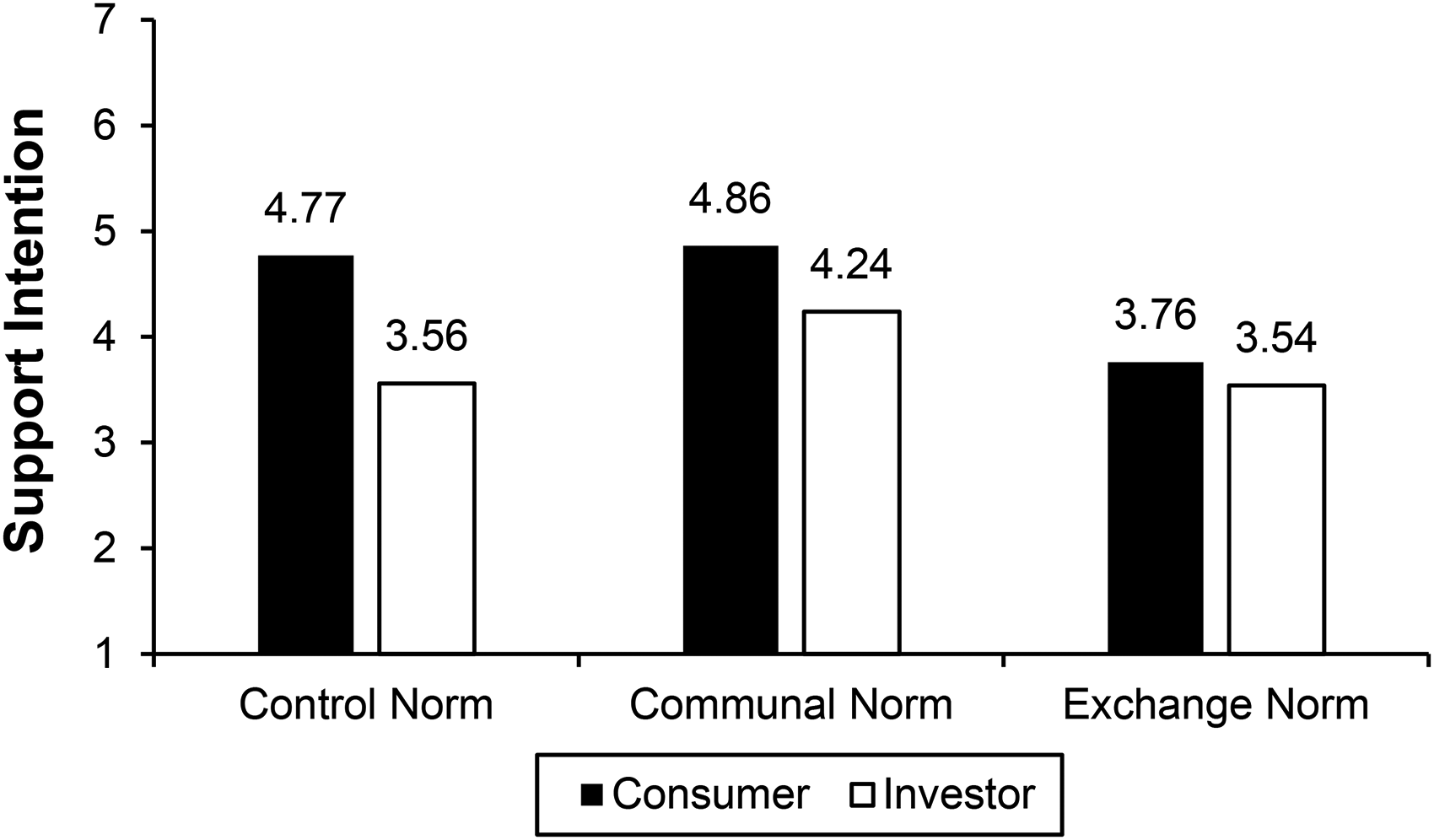
The Moderating Role of Evaluation Norm (Study 5).
Specifically, under the control-norm condition, we replicated the findings from previous studies with a significant effect of the decision frame (Mconsumer-control = 4.77, SD = 2.22 vs. Minvestor-control = 3.56, SD = 2.39; F(1, 594) = 13.99, p < .001; η2 = .023). That is, individuals were more likely to support the female (vs. male) entrepreneur's project under the consumer (vs. investor) decision frame. In addition, compared with the scale midpoint of 4 (indifference between the female and male entrepreneurs), consumers showed significantly higher support for the female entrepreneur (Mconsumer-control = 4.77, SD = 2.22 vs. scale midpoint 4; t(99) = −3.46, p < .001), whereas investors showed higher support intention for the male entrepreneur (Minvestor-control = 3.56, SD = 2.39 vs. scale midpoint 4; t(99) = 1.88, p = .063).
Under the communal-norm condition, the effect of the decision frame was attenuated to marginally significant (Mconsumer-communal = 4.86, SD = 2.25 vs. Minvestor-communal = 4.24, SD = 2.37; F(1, 594) = 3.58, p = .059; η2 = .006). As we theorized, consumers’ default evaluation norm is communal for a crowdfunding project. Thus, highlighting the communal norm should not significantly change their support for female (vs. male) entrepreneurs. To test this, we compared consumers’ support intentions under the control-norm and communal-norm conditions. The result was not significant, as expected (Mconsumer-control = 4.77, SD = 2.22 vs. Mconsumer-communal = 4.86, SD = 2.25; t(594) = −.28, p = .779; η2 = .001). In contrast, our theory predicts that investors’ default evaluation norm is exchange. Accordingly, highlighting a communal norm should boost their reliance on communal norms, resulting in relatively stronger support intentions for the female (vs. male) entrepreneur. To test this, we compared investors’ support intentions under the control-norm and communal-norm conditions. The result was significant (Minvestor-control = 3.56, SD = 2.39 vs. Minvestor-communal = 4.24, SD = 2.37; t(594) = −2.11, p = .035; η2 = .020). In other words, highlighting a communal norm boosts investors’ support for female entrepreneurs.
Under the exchange-norm condition, the effect of the decision frame was attenuated to nonsignificant (Mconsumer-exchange = 3.76, SD = 2.28 vs. Minvestor-exchange = 3.54, SD = 2.34; F(1, 594) = .45, p = .504; η2 = .001). As we expected, investors’ default evaluation norm is exchange. Thus, highlighting an exchange norm will not significantly impact their support for female (vs. male) entrepreneurs. To test this, we compared investors’ support intentions in the control-norm and exchange-norm conditions. The result was not significant, as expected (Minvestor-control = 3.56, SD = 2.39 vs. Minvestor-exchange = 3.54, SD = 2.34; t(594) = .06, p = .951; η2 = .000). On the contrary, our theory predicts that consumers’ default evaluation norm is communal. Thus, highlighting an exchange norm should boost their reliance on exchange norms, resulting in stronger support for male entrepreneurs’ projects. To test this, we compared consumers’ support intentions between the control-norm and exchange-norm conditions. The result was significant (Mconsumer-exchange = 3.76, SD = 2.28 vs. Mconsumer-control = 4.77, SD = 2.22; t(594) = −3.40, p < .001; η2 = .048). In other words, highlighting an exchange evaluation norm helps boost support for a male entrepreneur's project among those under a consumer decision frame.
Discussion
This study achieves several objectives. First, it further replicates the effect of the decision frame on individuals’ relative preference for female versus male entrepreneurs under the control-norm condition. Second, using a moderation-of-process design, we indirectly support communal and exchange norms as key underlying mechanisms driving individuals’ support for female versus male entrepreneurs’ crowdfunding projects. Third, we offer useful marketing strategies for entrepreneurs to enhance the effectiveness of their communication efforts. That is, when promoting their projects to consumers who purchase the proposed products for consumption purposes, entrepreneurs, especially male entrepreneurs, can boost success by activating a communal evaluation norm. In contrast, when promoting their projects to investors who invest in the proposed projects for future returns, female entrepreneurs could activate an exchange norm among investors to increase success. In Web Appendix E (subsection WA-E3), we find that this effect is robust even after controlling for the covariates. Furthermore, in Web Appendix E, we report more comprehensive comparisons between all the cell means.
In the next study, we further test our theory using field data from Kickstarter, a consumption-based crowdfunding platform. As a result, the data can only test the effect of entrepreneur gender on support under a consumer decision frame. Furthermore, we test crowdfunding dependence as another boundary condition. Crowdfunding usually represents a startup's first step in gathering limited funds (Greenberg and Mollick 2017). Gradually, entrepreneurs with other means tend to seek alternative funds to support the sustainable growth of their startups (Zvilichovsky, Danziger, and Steinhart 2018). Accordingly, when an entrepreneur engages in crowdfunding repeatedly, people tend to associate the entrepreneur with certain underlying struggles or facing hard barriers (Gorbatai and Nelson 2015), which signals disadvantaged backgrounds. Accordingly, we expect to replicate the positive effect of female entrepreneurs on support with the Kickstarter data when crowdfunding dependence is limited (that is, there is little signaling of disadvantage). In contrast, when the entrepreneur exhibits a heavy dependence on crowdfunding, the effect will be attenuated, with consumers showing similar support for both female and male entrepreneurs, due to the signaling of disadvantage.
Study 6: Secondary Data Evidence from Kickstarter
Method
We conducted this field study using data from Kickstarter, the largest online consumption-based crowdfunding platform. For all 15 project categories on Kickstarter (Art, Comics, Crafts, Dance, Design, Fashion, Film & Video, Food, Games, Journalism, Music, Photography, Publishing, Technology, Theater), we searched completed U.S. projects according to the proportion of their funding goal achieved: projects that raised more than 100% of their goal, those that raised between 75% and 100%, and those that raised less than 75%. This enabled us to obtain data for both successful and unsuccessful projects, yielding 71,935 projects (Table 2).
Summary Statistics for Variables Included in the Data (Across All Projects, Study 6).
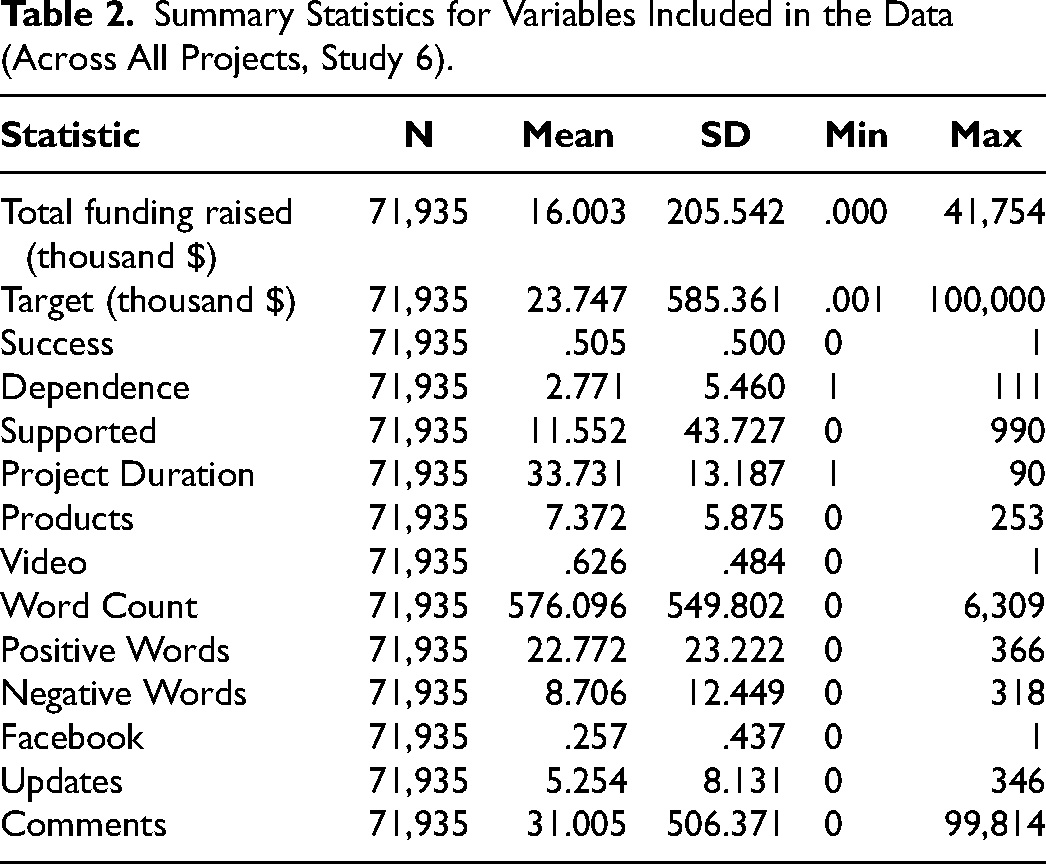
Kickstarter does not directly disclose the gender of its creators. We made inferences of the creators’ gender in the following way. First, for each project, we visited the creator's personal profile web page (“About the Creator”) and obtained the creator's name information from the page. Even though a project may involve more than one creator, only one profile can be uploaded, and the uploaded profile was used for our analysis. Usually, the uploaded profile was for the leader if there were multiple creators. Second, if the name was missing on the creator's personal web page or if we were not able to detect their gender, then we extracted the creator's name from the project web page. In both cases, we extracted the first name and used the Python package gender_guesser.detect to analyze the gender of the creator. Among the creators of all 71,935 projects, 22,884 (31.8%) were inferred to be female, 40,503 (56.3%) were inferred to be male, and 8,548 (11.9%) were unidentifiable (see Web Appendix F for details of the gender identification procedure).
Dependent variables
First, we measured support with the total amount of funds received. Given that this variable is highly skewed, we log-transformed it to obtain the variable Log Funding (log(original funding amount + 1)). We also measured support with another binary variable denoting whether the project was successfully funded or not. We named this variable Success, with 1 indicating that the funding received by the project was greater than the original funding objective and 0 indicating that the original funding goal was not met. In Kickstarter, if a project receives less funding than the original funding goal, the project is deemed unsuccessful and must refund all the money collected to the consumers who preordered its products.
Crowdfunding dependence
We measured crowdfunding dependence with the total number of projects that a creator had created on Kickstarter in the past (including the current project). A greater number of projects created indicates that the creator lacks other ways to obtain funds and heavily relies on crowdfunding for their entrepreneurship. As crowdfunding dependence is skewed, we took its logarithm to construct a new variable, Log Dependence.
To check the robustness of our findings, we included the following control variables: (1) Log Supported captures how many projects the entrepreneur has personally supported on Kickstarter; (2) Log Target measures, in monetary terms, the funding objective that a project intends to achieve; (3) Project Duration measures the length of the funding projects in days from the date the project was first available to the date the project was closed; (4) Products captures the total number of product options available for purchasing for the focal crowdfunding project; (5) Video indicates whether the project used video in the project description (1 = video used; −1 = no video used); (6) Word Count measures the total number of words used in describing the project; (7) Positive Words and Negative Words were based on sentiment analysis (Hu and Liu 2004), capturing the total numbers of positive or negative words used in describing the project; (8) the variable Facebook indicates whether the entrepreneur included their Facebook page link in the project description (1 = yes, −1 = no); (9) Updates measures the total number of times that the entrepreneur had updated the project; (10) Comments indicates the total number of comments the project had received from the consumers; and (11) Subcategory captures not only the product category of the project (e.g., music), but also the subcategory within the broad product category (e.g., classical, country, hip-hop, electronic, jazz, pop, rock, world music). By including the fixed effects of the subcategories in our analysis, we controlled for the effect of category and subcategories.
Results
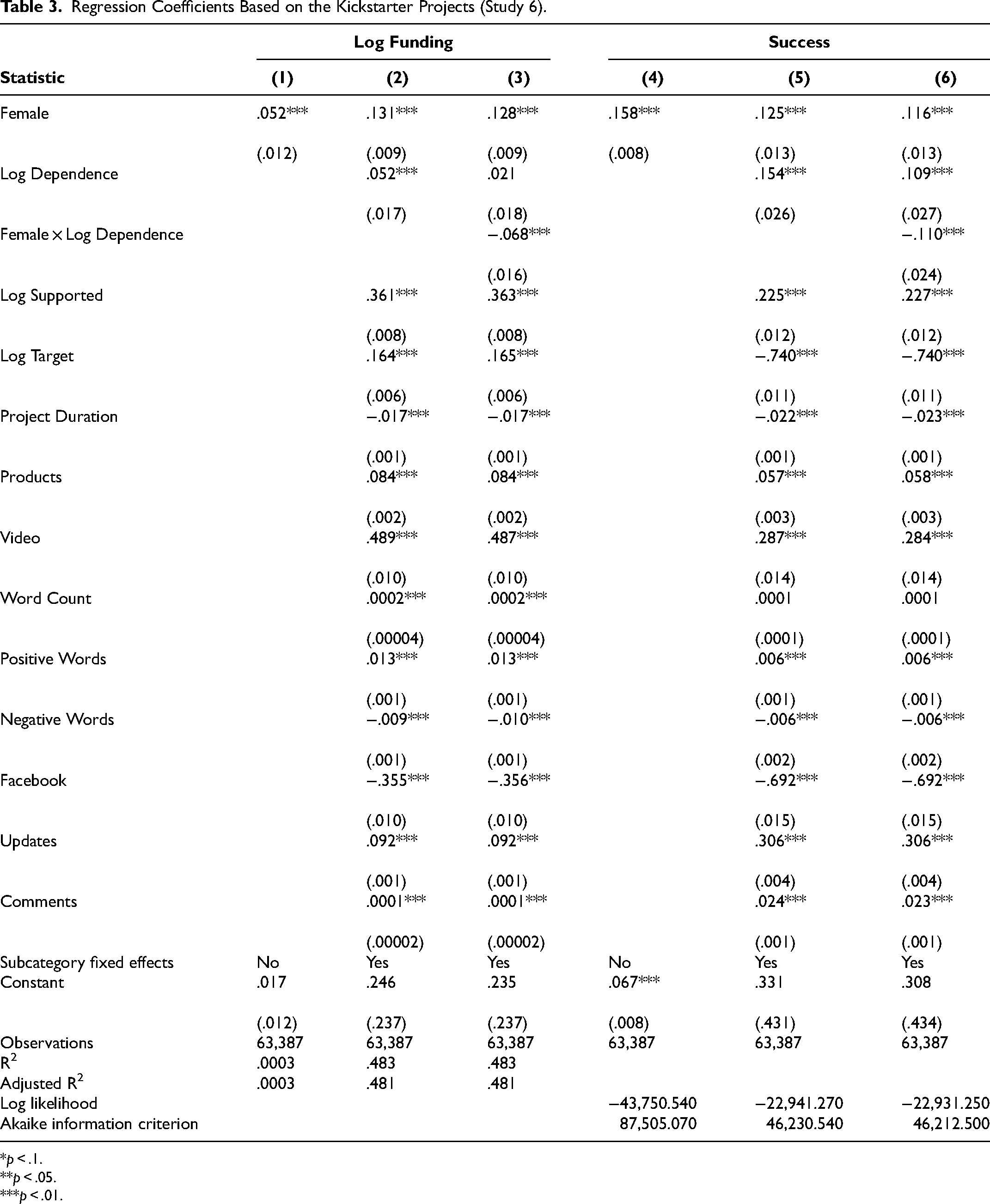
As Kickstarter is a crowdfunding site with users who are consumers (rather than investors), we expected to replicate the findings from our previous studies that female entrepreneurs receive more funding support than male entrepreneurs (H1a). To test this prediction, we conducted a regression of Log Funding on entrepreneur gender (1 = female, −1 = male). The result was positive and significant (Model 1 in Table 3), indicating that consumers are more likely to support crowdfunding projects created by female (vs. male) entrepreneurs. This effect is robust after including all the control variables (Model 2 in Table 3). We further replicated the findings with Success as the dependent variable (Model 4 and Model 5 in Table 3), indicating that the crowdfunding projects created by female (vs. male) entrepreneurs were more likely to achieve their funding objectives. These results support H1a.
Regression Coefficients Based on the Kickstarter Projects (Study 6).
*p < .1.
**p < .05.
***p < .01.
To test the moderating role of crowdfunding dependence, we conducted another regression on Log Funding with the interaction between entrepreneur gender and crowdfunding dependence as an additional predictor. Given the inclusion of an interaction term in the regression, we mean-centered all variables to make the regression coefficients more interpretable. The results indicate that the interaction effect was significant (Model 3 in Table 3). We depict the pattern of the interaction effect in Figure 8, showing that under low crowdfunding dependence, consumers tend to show stronger support for female (vs. male) entrepreneurs. However, for entrepreneurs with a history of extensive dependence on crowdfunding, consumers tend to show similar support for both female and male entrepreneurs, consistent with our theorizing.
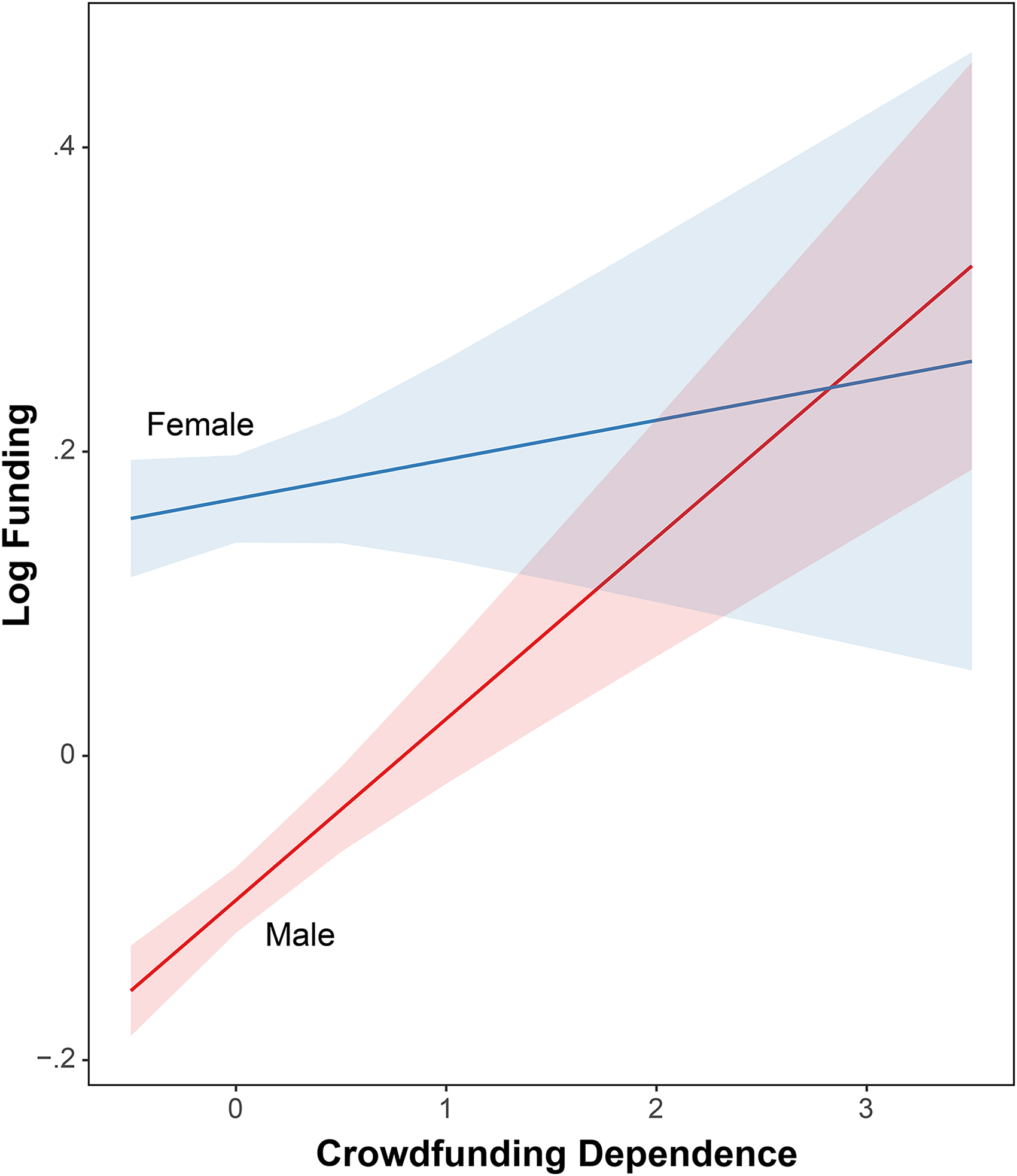
Interaction Between Crowdfunding Dependence and Entrepreneur Gender.
Discussion
Using field data from Kickstarter, this study enhances the external validity of our findings. Specifically, it replicates the main effect of entrepreneur gender on support, measured as either the amount received or the success of the project, among consumers. One limitation of this study is that given the unique nature of Kickstarter, we could only test the effect among consumers, not among investors. Furthermore, the results indicate that high levels of crowdfunding dependence can mitigate the effect of entrepreneur gender on support among consumers.
General Discussion
With the development of the sharing economy and crowdfunding, entrepreneurs can now seek funding not only from investors but also directly from individual consumers. Our research examines the differential effects of entrepreneur gender on these two groups: consumers (or those using a consumer decision frame) and investors (or those using an investor decision frame). Specifically, we find that under a consumer decision frame, individuals tend to support female entrepreneurs through their purchase behavior, whereas under an investor decision frame, individuals tend to support male entrepreneurs through their investment behavior (Studies 1 and 2). We further identify disadvantage and determination/passion perceptions as two parallel mediators of these effects (Study 3). Based on these mechanisms, we identify entrepreneur profile (Study 4) and evaluation norms (Study 5) as boundary conditions that can attenuate the effects of entrepreneur gender and decision frame. Last, using field data from Kickstarter, we test the effect of entrepreneur gender on actual support behavior among consumers and identify crowdfunding dependence as another boundary condition (Study 6). This research makes several contributions to the related literature.
Theoretical Contributions
First, this research is a pioneering effort to explicitly differentiate and study consumer versus investor decision frames simultaneously. This is an important yet understudied phenomenon in marketing. For instance, according to a recent Gallup study (2023), 61% of American adults are investors to some extent. Combining this with the fact that everyone is a consumer, it is crucial to examine what it means to be a consumer versus an investor and the subsequent consequences. In this study, we document that in a crowdfunding context, where people can support a project either as a consumer buying a product for consumption or as an investor investing for future return, the decision frame can fundamentally shape individual decision-making. In doing so, we also directly answer the call from the crowdfunding literature for more research to compare consumption- versus investment-based crowdfunding (Herve et al. 2019). This is important because most existing research has focused on either consumption-based or investment-based crowdfunding, without examining and comparing both simultaneously. Through our research, we hope to inspire future researchers not only to explore other differences between these two types of crowdfunding but also to examine other impacts of the consumer versus investor decision frame on various aspects of crowdfunding performance.
Furthermore, the study of decision frames has broader implications beyond the crowdfunding context. Many marketplace behaviors, such as buying a house, an ancient artifact, a well-known painting, or other collectibles, can be framed as either a consumption decision or an investment decision. For example, buying a house could be framed as a consumption decision, where the consumer plans to use it for residence, or as an investment decision, where the buyer expects to sell it in the future at a higher price. Therefore, we encourage future researchers to study how decision frames (consumer vs. investor) may impact other types of decision-making beyond the crowdfunding context.
Second, by introducing and studying a consumer versus an investor decision frame, our research not only reconciles the seemingly contradictory findings in the literature but also provides a more nuanced understanding of how entrepreneur gender impacts the funding outcomes of a crowdfunding project. Specifically, some prior research has suggested that male entrepreneurs’ projects are more likely to be funded (Balachandra et al. 2019; Fay and Williams 1993), whereas others have found the opposite (Gorbatai and Nelson 2015; Greenberg and Mollick 2017). We reconcile these findings by showing that under a consumer decision frame, people are more likely to support female entrepreneurs’ projects, whereas under an investor decision frame, people are more likely to support male entrepreneurs’ projects. When we use the decision frame to look back at the prior findings, we find that they largely align with our theory. Prior research indicating an advantage for male entrepreneurs was mostly conducted with investors or investment-based crowdfunding (e.g., Balachandra et al. 2019). In contrast, researchers indicating an advantage for female entrepreneurs mostly focused on consumers or consumption-based crowdfunding (e.g., Johnson, Stevenson, and Letwin 2018). Thus, this research unites the two streams and suggests that the effect of entrepreneur gender on crowdfunding success is not linear but rather dependent on the salient decision frame.
Third, this research sheds light on the underlying mechanisms behind the effect of entrepreneur gender and decision frame on support intention. Specifically, for decisions about supporting a crowdfunding project, consumers (or those under a consumer decision frame) tend to rely more on communal norms to favor the entrepreneur who needs more help, whereas investors (or those under an investor decision frame) tend to rely more on exchange norms to favor the entrepreneur who may represent a better chance of success or return. As a result, even though both consumers and investors perceive female entrepreneurs as more disadvantaged than male entrepreneurs, only consumers act on this perception and help the disadvantaged female entrepreneurs by purchasing their proposed products. Additionally, consumers tend to perceive both female and male entrepreneurs as similarly determined and passionate. However, investors tend to view female entrepreneurs as significantly less determined and passionate than their male counterparts, which helps explain why investors favor male over female entrepreneurs.
Fourth, this research further contributes to the gender literature in marketing. Prior gender research in marketing has largely focused on the effect of consumer gender (e.g., Meyers-Levy and Loken 2015; Winterich, Mittal, and Ross 2009). Other research has examined how gender perceptions of a brand, influenced by the CEO or spokesperson (Fournier and Eckhardt 2019), sex-stereotyped products (Pogacar et al. 2021), and gender-related brand names (Spielmann, Dobscha, and Lowrey 2021), may impact consumer perception and behavior. In this research, we examine the gender of the entrepreneur at the startup stage, rather than the gender of consumers or the gender perceptions of established brands. Thus, we expand the research on gender in marketing by showing that in the crowdfunding context, consumers and investors tend to view female versus male entrepreneurs differently, resulting in differential support intentions.
Practical Implications
This research also offers useful insights for entrepreneurs and crowdfunding platforms. Entrepreneurs constantly face the challenges of how to position themselves, communicate effectively with the target audience, and achieve better funding results through the marketing of themselves and their proposed projects. Our findings suggest that a team of entrepreneurs may choose to use a male name or a male representative when seeking funds from investors through traditional financial institutions (e.g., venture capitalists, bankers) or investment-based crowdfunding. In contrast, the partnership may select a female name or a female representative when promoting their projects on consumption-based crowdfunding platforms or seeking purchases from individual consumers.
Of course, in many contexts, the founder of a startup and their gender cannot be changed. In such cases, our findings suggest several solutions. First, female entrepreneurs may consider consumption-based crowdfunding their top choice, whereas male entrepreneurs may consider investment-based crowdfunding their top choice. Second, entrepreneurs can customize their profile descriptions to optimize the desired responses. That is, entrepreneurs may highlight their disadvantaged backgrounds in their profiles when targeting consumers; in contrast, they may highlight their determination and passion in their profiles when targeting investors. Third, entrepreneurs should also consider shifting potential funders’ evaluation norms to either communal norms (for female entrepreneurs) or exchange norms (for male entrepreneurs) to induce more positive support.
At a societal level, gender equality is vital. However, in many areas such as sports, arts, and academia, gender inequality is widely present (Brzezinski 2021). Accordingly, the United Nations has set achieving gender equality and empowering all women and girls as one of its priorities for the next decade as part of the Sustainable Development Goals (United Nations 2024). In the area of entrepreneurship, given the dominance of capital investing and banking, women have long been discriminated against (Buttner and Rosen 1989). Due to biased stereotypes, talented female entrepreneurs tend to encounter more barriers and difficulties in achieving their entrepreneurial dreams than their male counterparts, even though their ventures are equally successful if they get the chance to start (Robb and Watson 2012). The more striking consequence is for the future of entrepreneurship. Given the widely held stereotype, female students and girls are discouraged from pursuing entrepreneurship at a very young age (Shahin et al. 2021). We hope our research can shed some light on this issue. By showing that in a consumption-based crowdfunding context, consumers tend to appreciate the disadvantages faced by female entrepreneurs and are thus more willing to support them, we hope to encourage women to pursue entrepreneurship, especially using crowdfunding.
Given our research findings, one might expect that there would be more female entrepreneurs, at least in consumption-based crowdfunding. However, this is not the case. In our own dataset, female entrepreneurs are still a minority in crowdfunding (31.8%; Study 6). This might be due to the difficulties of breaking gender-stereotyped roles at the societal level. For instance, in political science, it has long been established that congresswomen are not only more likely to win elections but also often outperform congressmen after being elected (Anzia and Berry 2011). However, even at the time this article was written, women only accounted for 35% of the members in the U.S. House of Representatives (153 out of 435), and only 25% of the members of the U.S. Senate were female. From a broader perspective, we hope our research will become obsolete. When we achieve gender equality, our effects should disappear, as people would no longer hold the biased perceptions that women are disadvantaged and men are more determined and passionate.
Limitations and Future Research Directions
There are several limitations of our research that await future research. First, throughout the article, we rely on entrepreneurs’ first name or their profile photo to make inferences about their gender. In other words, we study consumers or investors’ deduced gender of the entrepreneur rather than the entrepreneur's own gender identity, which may differ from what their name suggests. Thus, future research may examine whether our effect could be generalized to the entrepreneur's own gender identity, beyond the female versus male dichotomy. Based on our process explanation of a disadvantaged perception, we suspect that along with women, entrepreneurs identified as transgender, or other minority gender groups, also may be perceived as disadvantaged, leading to higher support in a consumption-based crowdfunding context.
Second, in this research, we focus on entrepreneur gender as a trigger for perceptions of disadvantage and determination/passion. There are other triggers of these perceptions in the crowdfunding context. For instance, entrepreneurs with backgrounds such as new immigrants, ethnic minorities, or unusual education backgrounds tend to be discriminated against and are widely believed to be in disadvantaged positions in pursuing entrepreneurship (Morgan 2020). Following our theory, these minority entrepreneurs may also enjoy more purchase support and funding success in consumption-based crowdfunding.
Third, although we posit disadvantage perception as the mechanism by which entrepreneur gender affects the support provided by those with an activated consumer decision frame, whereas determination/passion perception is the mechanism at work for those with an activated investor decision frame, there are certainly other mechanisms for these complicated effects. Future research may explore other potential mediators, especially consumers’ thought process in reviewing a crowdfunding project, to provide a more comprehensive understanding of how entrepreneur gender impacts support decisions in different contexts.
Supplemental Material
sj-pdf-1-mrj-10.1177_00222437241286790 - Supplemental material for Crowdfunding Success for Female Versus Male Entrepreneurs Depends on Whether a Consumer Versus Investor Decision Frame Is Salient
Supplemental material, sj-pdf-1-mrj-10.1177_00222437241286790 for Crowdfunding Success for Female Versus Male Entrepreneurs Depends on Whether a Consumer Versus Investor Decision Frame Is Salient by Huachao Gao, Xin (Shane) Wang, Xi Li and June Cotte in Journal of Marketing Research
Footnotes
Acknowledgments
The authors are grateful to the JMR review team for their invaluable comments that greatly improved the article.
Author Note
This project was partly completed when Huachao Gao was Associate Professor of Marketing, Gustavson School of Business, University of Victoria, Canada.
Coeditor
Rebecca Hamilton
Associate Editor
Julie Irwin
Declaration of Conflicting Interests
The authors declared no potential conflicts of interest with respect to the research, authorship, and/or publication of this article.
Funding
The authors received no financial support for the research, authorship, and/or publication of this article.

Notes
References
Supplementary Material
Please find the following supplemental material available below.
For Open Access articles published under a Creative Commons License, all supplemental material carries the same license as the article it is associated with.
For non-Open Access articles published, all supplemental material carries a non-exclusive license, and permission requests for re-use of supplemental material or any part of supplemental material shall be sent directly to the copyright owner as specified in the copyright notice associated with the article.
