




Abstract
Monitoring technologies, which are at the heart of the industrial Internet of Things ecosystem, promise significant transactional efficiencies by making it easier to track product performance and contract compliance. These efficiencies are particularly compelling in industrial multivendor, multicomponent systems, where complex component interdependencies often cause disputes around liability in the case of product failures. Drawing on transaction cost theory, fieldwork, and a national survey of industrial original equipment manufacturers (OEMs), we estimate how product performance contracts are specified in these contexts, and how these monitoring technologies can impact ex post exchanges between OEMs and their suppliers. We find that systems architecture associated with multicomponent systems, as well as the presumed efficiencies of monitoring technologies, drive the contract designs through their potential impact on the disputes, monitoring, and contract writing costs faced by the OEM. However, we also find there are clear limits to the benefits offered by these monitoring technologies, as the greater monitoring facilitated by these technologies appears to exacerbate disputes. This counterintuitive finding comports with the view that when unforeseen interdependent failures occur, detailed data from monitoring may trigger a spate of disputes over new and unexpected information, as well as over the appropriateness of existing protocols for failure metrics and remedies.
Keywords
Commentaries extolling virtues of the emerging industrial Internet of Things (IIOT) ecosystem are quite common. Consider the following excerpts from some recent industry white papers: “[IIOT] will transform manufacturing processes to be more productive and more quickly able to meet market demands” (IIOT-World 2024, p. 3), and “[IIOT] enables the tracking of the performance of operations right down to the component level” (HiveMQ 2024, p. 3).
At the heart of the IIOT are small sensors that enable parties to remotely monitor equipment performance and compliance with agreed operating parameters. Industry reports claim these monitoring systems can improve uptime for industrial equipment by as much as 20%, promising close to $10 billion in annual savings for industrial manufacturers whose unplanned downtime is estimated to cost $50 billion yearly (Coleman, Damodaran, and Chandramouli 2017). Other reports have quantified the benefits from IIOT implementation as “a 20% reduction in mean time to repair and a 90% elimination in paperwork” (Capgemini 2019, p. 32). Not surprisingly, as more firms embrace digital transformation in their operations, specialized vendors market such monitoring solutions by pegging operational savings as the key value proposition. 1 However, there may be downsides to the massive monitoring capabilities that these types of systems engender, which are rarely discussed and almost never measured. This frames the key motivation for this article, as we explain in the following discussion.
In most industrial applications, original equipment manufacturer (OEM) equipment consists of multicomponent systems (MCSs). For example, wastewater treatment plants comprise chemical agent dispensers, aeration tanks, pumps, actuators, sensors, and so on, mostly procured from different suppliers. Key characteristics of MCSs are modularity and mixing and matching interoperable components from different vendors. The complex interdependencies of the components mean that product failures and performance dips are often difficult to resolve. Consider, for example, that a heat exchanger system is not generating enough steam pressure. Several scenarios could be driving this outcome. The pump may be malfunctioning, the heat exchanger element may be failing, or the filtration component may not by working optimally—leading to a cascading sequence of failures as sediments and minerals build up to unwarranted levels. Ascertaining the cause often requires significant investigative efforts, and even that may not necessarily result in unambiguous conclusions. Consequently, disputes often flare as business partners try to determine the cause, fix responsibilities, and assign liabilities while keeping business relations on track, which can be costly. A study conducted with British businesses estimates that the costs associated with dispute resolution between industrial buyers and sellers could amount to almost £33 billion annually (Sheffield Telegraph 2009).
Monitoring technologies like IIOT offer a way out of the preceding imbroglio. Consider the situation alluded to in the following statement by a senior engineer in a large aircraft engine design and manufacturing firm:
2
We often must determine the root cause behind our engines not performing to expectations. These could include several parameters including suboptimal thrust vector and time to start. Multiple reasons can contribute to these. For example, the fuel supply unit may not be working appropriately, the ignition unit not generating the right temperature, the engine gear box unit not operating at the right speed etc. These units are typically procured from other vendors. We engage in significant diagnostics to isolate the root cause of such performance failures. This is helped significantly by IIOT sensors that measure parameters like flow rate, temperature, and speed on the components. In the absence of the data provided by these IIOT sensors, diagnosis can often become contentious, with the vendors disputing findings and trying to shirk redesign responsibilities. In effect, these IIOT sensors help us work more collaboratively.
IIOT sensors generate detailed real-time data about how the different components are functioning, helping to quickly identify the root cause of equipment failure or performance drops, as well as detect improper usage—tasks that would be impossible or prohibitively expensive if carried out manually in many operating conditions. While these could help resolve disputes, help proactive servicing, and plan predictive maintenance schedules, the fine-grained data stream could also discover unexpected sources of interdependent failures.
Normally, failure metrics and associated remedial protocols are governed by product performance contract (PPC) clauses, which are often subsumed in procurement or long-term service agreements. Usual considerations of contracting agents’ bounded rationality and complexities of MCS interdependency mean that such “codes-in-use” are never completely specified (Heide and John 1990). Thus, it is broadly recognized that ex ante efforts at contract specifications do not obviate ex post adaptations such as disputes or monitoring contract compliance (Dahlstrom and Nygaard 1999; Kashyap, Antia, and Frazier 2012; Mooi and Ghosh 2010). Such ex post disputes and noncompliance can often be triggered by parties’ incentives to renegotiate terms for higher contracted payoffs, cheat on commitments, or even create conditions to generate and usurp noncontracted economic rents, to their partners’ disadvantage. Consequently, here, monitoring is seen as a rational response to such hazards of opportunism and thus a boost to efficiency. However, monitoring may also uncover previously unknown data. While run-of-the-mill and anticipated failures can be managed within existing contractual frameworks, unexpected interdependent failures can trigger a spate of renegotiations and disputes over existing protocols for failure metrics and remedies. Therefore, understanding how PPCs incorporate disputes and monitoring considerations is critical to understanding the impact of monitoring technologies. Unfortunately, few studies examine such trade-offs inherent in ex post monitoring and disputes.
Current literature tends to discriminate between two types of monitoring. The potential for opportunistic shirking motivates firms to monitor partner behavior—behavior monitoring (BM) (e.g., Grover and Malhotra 2003; Houston and Johnson 2000; Murry and Heide 1998). For example, BM may include partners' project completion activities, shipment accuracy, and supply price dispersion (Cannon and Homburg 2001; Dahlstrom and Nygaard 1999). Firms may also undertake output monitoring (OM) (Sadeghi et al. 2022), for example, monitoring relevant partner outputs such as personnel commitments, service response times, and advertisement expenses (Heide, Wathne, and Rokkan 2007; Hu et al. 2016; Kashyap, Antia, and Frazier 2012). However, the nature of the monitoring associated with product failures in MCSs is different.
First, in most cases, once its component is included in the MCS, the supplier has limited ability to directly impact product functionality in an ongoing basis. As a result, BM of suppliers is less significant an issue for the OEM. 3 Second, OM here is not partner specific because it necessarily involves metering product- and component-level data. Component interdependency means that supplier performance is only imperfectly captured in its component-level metrics and would require deeper analyses of trends and interlinkages to attribute to specific partners. Third, performance monitoring here requires little cooperation from exchange partners. However, it generates data that can accurately diagnose malfunctions and even provide early warning indicators of impending failures. These data can then be matched against contracted performance obligations to address disagreements and ambiguities. 4
Trying to address this type of monitoring cannot be more timely. Consider the following U.S. Department of Defense (DOD) guideline to rationalize transactions costs of procurement: “rules, regulations, and policies should be promulgated only when their benefits clearly exceed the costs of their development, implementation, administration, and enforcement” (Federal Acquisition Regulations System 2022). As the largest single buyer of industrial goods in the free world, the DOD has a big impact on the operational standards adopted by other firms in the ecosystem. Despite this renewed focus on transaction efficiency and the ubiquity of MCSs in industrial markets, MCS research in marketing has yet to study the monitoring of interconnect complexities (Ghosh, Dutta, and Stremersch 2006; Ghosh and John 2009; Ray, Bergen, and John 2016; Stremersch et al. 2003). Interconnect complexity here refers to the difficulties of precisely identifying how the interdependency of the different MCS components determine final product performance.
Interconnect complexities have also not been prominent in the studies of interfirm coordination that mostly focus on the standard governance factors of lock-in, adaptation, and performance evaluation problems (Williamson 1985, 1991). For example, in their review, Gulati, Wohlgezogen, and Zhelyazkov (2012) discuss learning and renegotiation to manage postformation coordination failures but are silent on the role of such interdependencies. This reticence could partly be because interdependent failures may not necessarily be driven by opportunism. Regardless, even as “honest” mistakes, they can generate significant disputes and renegotiations for the transacting parties (Alchian and Woodward 1988). The emergent salience of component monitoring technologies indicates that this is an important gap in the literature.
A related and growing body of research studies the hazards of misaligned contracts, examining the impact on firm- or project-level outcomes such as innovation, technology, and project completion time (Lee 2011; Leiblein, Reuer, and Dalsace 2002; MacCormack and Mishra 2015; Sampson 2004). While drawing on the inefficiencies of such misalignment, studies of the adaptation microprocesses underlying these hazards are far fewer. Mooi and Ghosh (2010) study how misalignment impacts transaction costs. Yet, because they do not disentangle the ex post costs of disputes and monitoring, transactional trade-offs germane to MCS interdependencies are not well documented. This is also a key gap in the literature. 5
To address these gaps, we first develop a theoretical framework to study how these monitoring technologies, and the monitoring they facilitate, work together with the interconnect complexities to influence the design of PPCs in OEM–vendor MCS settings. We then explore their impact on the ex post transaction costs faced by the OEM. Using data from a national survey of industrial OEMs, we find that despite their efficiency-enhancing capabilities, monitoring technologies can, in fact, lead the firm to incur monitoring penalties, thereby challenging their efficiency proposition. We find that misaligned contracts, whether under- or overspecified, are costly to the OEM, and therefore the effectiveness of monitoring technologies hinges on properly specifying performance contracts. We calibrate the relative costs of misaligned contracts and illustrate that OEMs must engage in balancing disputes and monitoring when organizing transactions with their vendors in MCS contexts. To the best of our knowledge, we are the first to highlight and empirically assess these trade-offs of monitoring technologies and explain how the interdependencies of MCSs are critical determinants of the same. Figure 1, Panel A, represents the MCS OEM channel, using the aircraft engine example, to illustrate the context of our study.
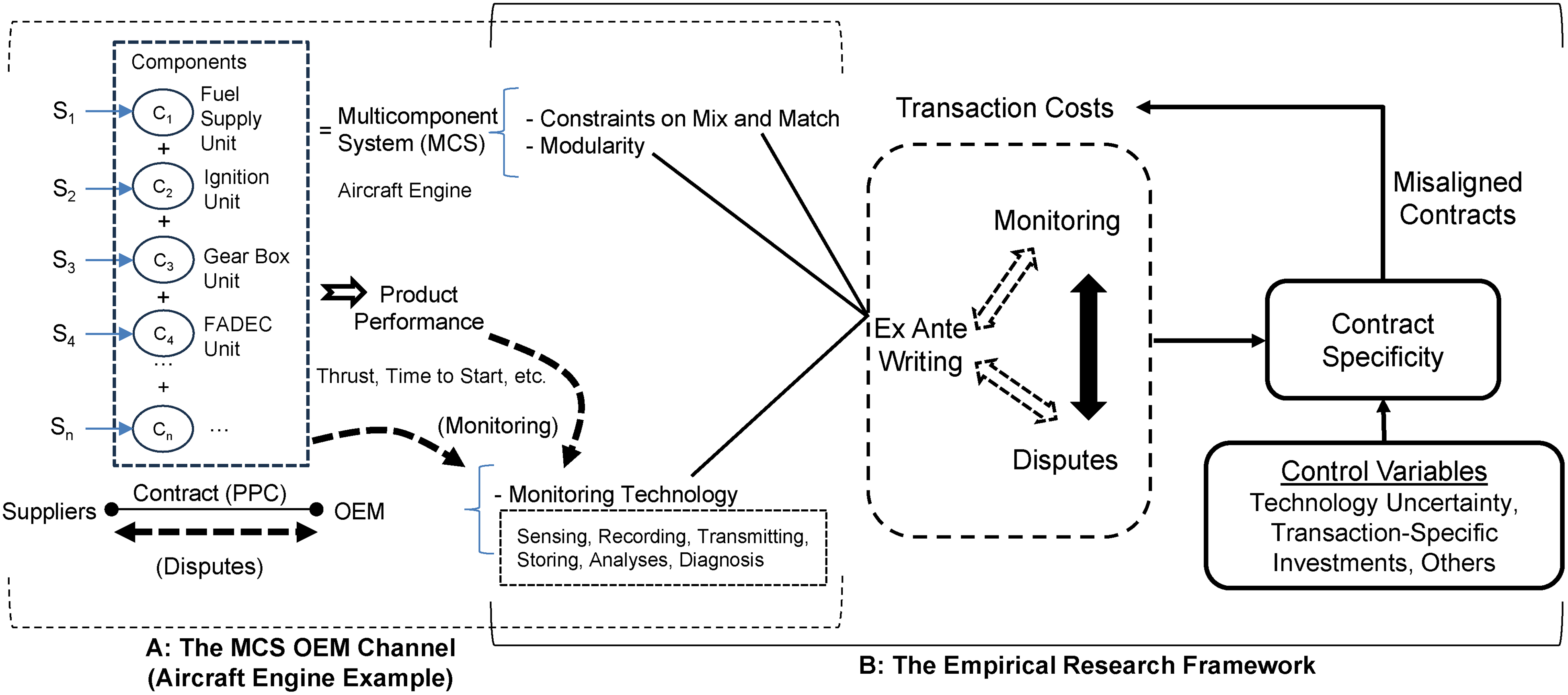
The Context of the MCS OEM Channel and the Empirical Research Framework.
Background Literature
In this section, we focus on the literature pertaining to monitoring, including previous references to some of the literature on BM and OM. For the most part, these studies frame monitoring as a buffer against opportunism and, as such, as contributing positively to business outcomes (Houston and Johnson 2000; Hu et al. 2016; Kashyap, Antia, and Frazier 2012; Kashyap and Murtha 2017; Wang, Gu, and Dong 2013). Nevertheless, there are several major theoretical boundary conditions to this conclusion.
First, it is not always clear how closely the observable partner behavior predicts output, meaning BM may ultimately become a deadweight cost with no impact on thwarting opportunism (Stump and Heide 1996). Second, triggered in part by the normalization of trust deficit, excessive BM may cause antagonistic reactance in the partner subjected to monitoring, which would lead to greater noncompliance with agreed terms (Heide, Wathne, and Rokkan 2007) or withholding of value-creating efforts (Jacobides and Croson 2001). Third, the firm’s monitoring capabilities matter (Wang, Gu, and Dong 2013). When its partners are aware that monitoring becomes too costly for the firm beyond a threshold, the firm is exposed to increasing hazards despite its monitoring. Fourth, opportunistic quality shading by business partners in a multipartner setting may be conflated with stochastic variation in outcome metrics when there are ambiguities around interdependencies. These can make monitoring moot, exacerbating myriad transactional frictions, for example, acrimonious free-riding allegations. This issue is largely unexplored in the literature. To the best of our knowledge, the work of Hu et al. (2016) is the only article that investigates monitoring in the context of interdependent suppliers. They study joint liability as a governance tool for these situations, suggesting that peer monitoring can be effective but only if the ambiguities around interdependent outcomes are resolvable. However, their study only focuses on BM of suppliers, and thus it cannot address transactional challenges associated with the type of output stochasticity alluded to in this article.
Not surprisingly, the literature is fragmented on the net impact of monitoring. While some studies find that monitoring leads to positive outcomes (Dahlstrom and Nygaard 1999; Kashyap, Antia, and Frazier 2012; Tiwana 2008), others find negative results (Heide, Kumar, and Wathne 2014; Jacobides and Croson 2001; Mooi and Wuyts 2021). Additionally, while many past studies use industrial procurement as the context (e.g., Cannon and Homburg 2001; Grover and Malhotra 2003; Heide, Kumar, and Wathne 2014; Houston and Johnson 2000), we are the first to study PPCs, which are increasingly standard in industrial procurements. We capture these variations and our specific contributions to the monitoring literature in Table W1, in Web Appendix A. Next, we discuss our theory and empirical efforts.
Theory and Hypotheses
We build our theory on the efficient governance maxims of transaction cost economics (TCE). The key idea is that parties govern their transactions to minimize governance costs, and negotiating parties have the choice to outline product performance expectations explicitly or implicitly through mutual understanding. In the industries that we focus on, explicit contracts are more common. However, these PPCs are characterized by different levels of contract specificity, as the parties can choose from generic boilerplate contracts or more customized ones. Such customizations could identify specific performance metrics, remedial measures, and operational commitments. In theory, a multivendor, multicomponent context means that accounting for myriad technological and environmental contingencies will result in an impossibly large number of permutations and combinations to specify. Not only are these specifications costly to identify and negotiate, but they can also impose a significant monitoring and renegotiation burden on the parties. Thus, there are transaction costs, both ex ante and ex post, to such specifications, and the agent chooses the specification that minimizes the sum of these costs.
Fieldwork
To further observe the nuances of the relevant OEM–supplier interactions and inform our subsequent theorizing and empirical investigations, we conducted a series of in-depth fieldwork observations. First, we examined DOD documents for sample contracts between vendors and buyers. We then visited the manufacturing facility of a multinational steam systems solutions company and were extensively debriefed by a senior engineer in charge of business development and customer relations. Next, we visited an open-pit potash mine in Canada, accompanied by a “contract performance manager” of a large multinational gas turbine OEM, to observe their vendor interactions in situ. Last, we studied a “red-lined” version of an actual contract to observe how the contract clauses were negotiated between a supplier and a buyer for gas turbine power generators. This document (with client identities redacted) was obtained from a U.S. law firm specializing in negotiating agreements between industrial OEMs, their vendors, and customers. These offer insights into the practical complexities of managing MCS configurations, including the role of emerging IIOT technologies. We highlight some of the key takeaways here. 6
We find that highly specified performance clauses in contracts are seen as reducing ambiguity and avoiding disputes. We also find instances of PPCs that specify operating conditions, laying out the value of explicit monitoring in the event of a product failure. These concerns with performances are in keeping with broader procurement trends. 7 We learn that while emerging IIOT monitoring technologies are increasingly part of business transactions, field managers do not view them as unmitigated blessings. While they are seen as adding a lot of value to the customer interaction, they are also viewed as somewhat invasive with a potential for sparking disputes—the so-called monitoring penalty.
In the following, we lay out our theory in more detail by first explicating how the ex ante considerations of disputes and monitoring derive from the component interdependencies and impact the design of PPCs. We then explain the ex post transactional impact of monitoring technologies, specifically on monitoring and disputes.
Governance Costs
The broad outline of our theory is represented in Figure 2, and we describe the different relevant components in this section. In keeping with the literature, we specify the OEM's total governance cost G as comprising the following three costs: (1) the ex post disputation cost, D (Crocker and Reynolds 1993; Jap and Ganesan 2000; Williamson 1985); (2) the ex post contract monitoring cost, M (Celly and Frazier 1996; Grover and Malhotra 2003; Stump and Heide 1996); and (3) the ex ante contract writing cost, W (Antia and Frazier 2001; Cannon and Homburg 2001; Dahlstrom and Nygaard 1999; Heide, Wathne, and Rokkan 2007; Houston and Johnson 2000; Kashyap, Antia, and Frazier 2012). The efficiency criterion of TCE theory proposes that parties would choose the level of PPC specificity, CS, to minimize these costs (CSi* in Figure 2). Thus, in explaining these choices, we will also be able to explain the trade-offs germane to our study. The observed level of CS is a joint outcome. Thus, in developing our hypotheses, we consider the OEM as the principal and the suppliers as agents who can accept, reject, or modify the OEM's contract offer (Ghosh, Dutta, and Stremersch 2006; Kashyap, Antia, and Frazier 2012; Stremersch et al. 2003). This enables us to pose our hypotheses from the OEM’s point of view as we illustrate the trade-offs. We draw on the principles of comparative statics to justify how the optimal CS will shift (CS1* to CS2* in Figure 2) with changes in exogenous factors that affect governance costs. We also draw on extant empirical work to further justify the predictions.
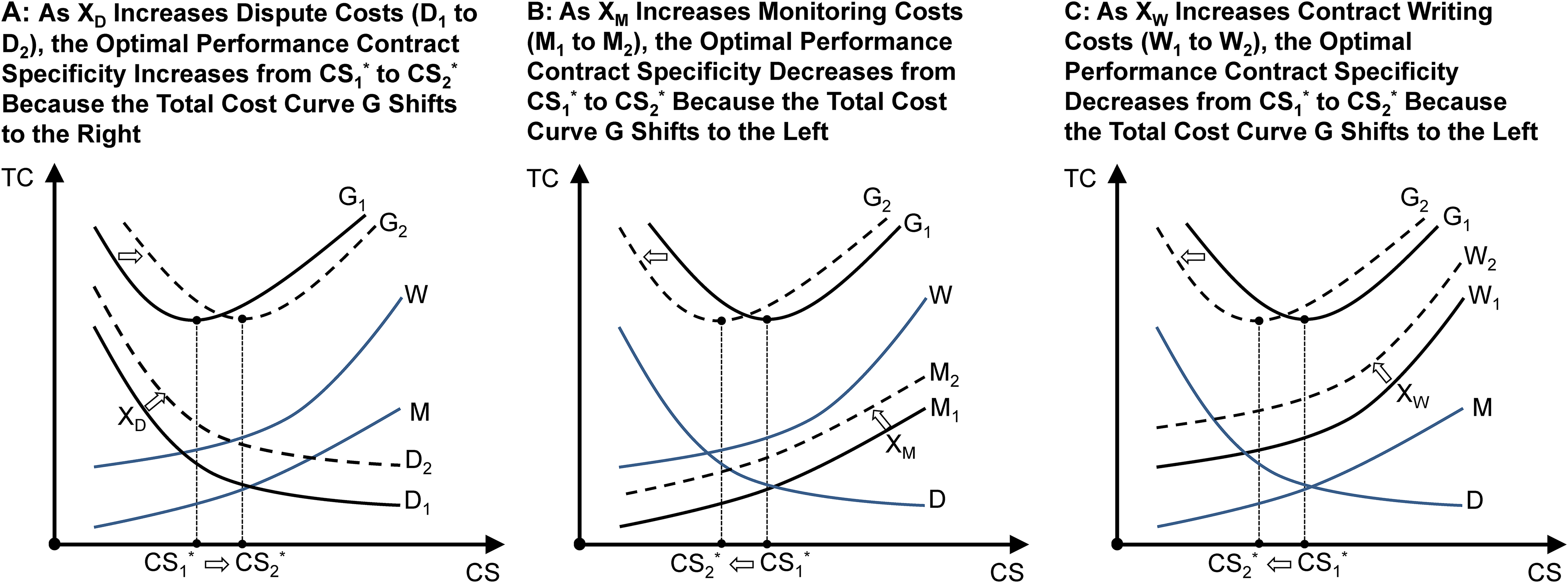
Schematic Illustrating How Considerations of Factors That Impact Dispute, Monitoring, and Writing Costs Influence the Chosen Product Performance Contract Specificity.
Characterizing ex post dispute costs
Product failures in multivendor MCS contexts almost always involve ambiguity about whether subpar performance of a supplier component triggered the failure. This ambiguity often leads opportunistic partners exposed to liabilities to contest findings, question the reasonableness of performance metrics, or even renege on or renegotiate existing agreements. At the risk of losing relationship-specific investments (which are not redeployable), these impose ex post dispute costs, D, on the parties. Contractual provisions that specify more operational contingencies reduce the potential for disputes (Mooi and Ghosh 2010). Greater specificity also discourages partner opportunism by more sharply outlining expected performance parameters, further reducing potential for disputes (Wuyts and Geyskens 2005). Indeed, firms are shown to gravitate to more stringently specified contracts when reducing disputes is a key consideration (Crocker and Reynolds 1993). These follow the prediction of TCE where contracts are safeguards to reduce ex post adaptation costs (Williamson 1985). Based on these, we characterize ∂D/∂CS < 0 (downward-sloping curve D in Figure 2). 8
Characterizing ex post monitoring costs
Greater contract completeness can reduce partner opportunism and thus the need for monitoring (Dahlstrom and Nygaard 1999; Kashyap, Antia, and Frazier 2012). However, in most cases the complex interdependencies of MCSs rule out any easy determination of cause of failure in the absence of data about system performance trends. Consequently, as more specific terms are inserted into the contract to reduce disputes, more technical performance and usage-related specifications also accompany them. These create a need for relevant data footprints to measure performance and usage parameters to curb ex post supplier opportunism (Heide, Wathne, and Rokkan 2007; Wang, Gu, and Dong 2013), without which the greater specificity would not be enforceable. In turn, this imposes a greater need for monitoring, raising the monitoring costs, M. Therefore, ∂M/∂CS > 0 (upward-sloping curve M in Figure 2). 9
Characterizing ex ante contract writing costs
Contract writing costs, W, are derived from multiple sources—incomplete information as well as environmental, technological, and market uncertainties, compounded by bounded rationality of agents (Williamson 1985). As a result, writing meaningfully specified contracts can be costly (Anderson and Dekker 2005; Crocker and Reynolds 1993; Mooi and Ghosh 2010). For MCSs, numerous possible interdependent permutations make specifying meaningful clauses onerous. Specifying mutually agreeable contingent plans of action is also difficult given uncertainties in component technologies and the attendant interdependencies. Therefore, ∂W/∂CS > 0 (upward-sloping curve W in Figure 2). 10
Trade-offs in transactional efficiencies
Lower specificity of contracts economizes on contract writing and monitoring but at the cost of higher disputes, while higher specificity reduces disputes but at the cost of higher contract writing and monitoring. Other trade-offs can be more nuanced, operating through correlated exogenous factors. We focus on the roles of three key technology-related variables—modularity, unconstrained interbrand mix and match, and deployment of monitoring technology. We illustrate how modularity and unconstrained mix and match may impose contrasting incentives due to their different impacts on disputes and monitoring. Thus, their net effect on contracts depends on which effect dominates. Figure 1, Panel B, outlines the empirical framework that we discuss in the following section.
Modularity and Unconstrained Interbrand Mix and Match
Modularity
We define modularity as the degree to which the MCS components are technologically separable and have standardized interfaces. This is similar to the definitions used in previous literature (Ghosh, Dutta, and Stremersch 2006; Harmancioglu, Wuyts, and Ozturan 2021; Sanchez 1999; Stremersch et al. 2003; Wilson, Weiss, and John 1990). There are two key implications of modularity for our context. First, standardized interfaces imply interoperability and allow component substitution without design changes in other components. Without this, OEMs may have to ask suppliers to design to specifications, or design customized interfaces, introducing more interdependent complexity for the MCS performance. Second, the separability and standardized interfaces facilitate component-level diagnostics, which would be more difficult otherwise.
Unconstrained interbrand mix and match
An important characteristic of MCS markets is the degree to which components from different suppliers can be mixed and matched by the OEM without constraints. The constraints on mixing components is a function of industry interoperability standards and supplier agreements. However, interoperability is not sufficient for mix and match. The OEM must “mix” different suppliers’ components when its suppliers are “single line” (i.e., they specialize in only one component). When a supplier is “full line,” that is, it carries all components, the OEM can source all components from the single supplier or “mix and match” some of its components with others’. Most suppliers are “short line,” that is, without the whole range of components, and the OEM must mix and match some of its components with others’. Mix and match can drive market growth by plugging gaps in customer preferences (Matutes and Regibeau 1988; Venkatesh and Kamakura 2003). Strategically deployed, it could also help the OEM manage its dependence on suppliers. However, suppliers could restrict unconstrained mix and match with different arrangements spanning contracts, distribution, prices, and warranties (Ray, Bergen, and John 2016).
(Non)equivalence between modularity and unconstrained mix and match
While much of our definition of modularity is consistent with that of the literature, we deviate from previous studies in some important ways. In many studies, modularity is the same as interoperable systems architecture and is studied through the lens of mix and match (a behavioral outcome of interoperability). For example, researchers have studied modularity through the impact of mix and match on product variety, competition (Katz and Shapiro 1994; Matutes and Regibeau 1988, 1992), and governance (Harmancioglu, Wuyts, and Ozturan 2021). However, many of these studies make a strong assumption that mix and match is a necessary outcome of modularity. Thus, the dominant driver in these studies is that the very potential for mixing and matching distorts market structures and strategic incentives. Yet, once we relax the assumption, the actual degree of mix and match observed in the market could be seen both as a choice and as resulting from different contractual or other restrictions independent of the technology architecture. A series of studies examine such choices—both of buyers (Stremersch et al. 2003) and of sellers (Ghosh, Dutta, and Stremersch 2006)—while Ray, Bergen, and John (2016) study restrictions on mix and match. Our research is more in the spirit of these latter lines of work, with an important difference. Ray, Bergen, and John (2016) study how such restrictions were endogenous to system properties. In the complex MCS industrial supply chains that we study, most contracting occurs in the context of established practices and standards, supplier-imposed restrictions being one. Accordingly, we consider them exogenous.
While modularity offers a convenient way to classify systems architecture, the complexity of many industrial systems precludes easy modular/nonmodular binaries. The aircraft engine example in Figure 1 is a case in point. There may be different levels of modularity across the supplier components (e.g., fuel supply, ignition, gear box, full authority digital engine control [FADEC] units). The gear box unit, in many cases, may be modular with standardized interfaces. In contrast, the FADEC unit must meet unique design requirement specifications (DRSs) and hence is not modular in the traditional sense. Even when a vendor unit (e.g., the fuel supply unit) may conform to some industry standards of modularity, the OEM may still design software interfaces to meet its unique performance needs, which may compromise the deemed modularity characterization. Further, many of these vendor units are subsystems themselves, with components that can be sourced from third parties even if the unit itself is subject to DRSs. For example, spark plugs in a DRS ignition unit may be modular in the traditional sense of interoperability, and the OEM may source third-party spark plugs without any supplier restrictions. These contextual considerations challenge the usual equivalence assumed between modularity and mix and match in our contexts, 11 and therefore we use both to motivate our hypotheses.
Unconstrained mix and match and disputes
Not surprisingly, many suppliers attempt to protect their revenue stream by imposing direct and indirect constraints on the OEM's mix and match activity. These constraints can come in various forms, including contractual restrictions and warranty denials. While these constraints might restrict the OEM from implementing its component choices, they also impact potential disputes. As more different suppliers’ components are mixed and matched, the OEM faces an increasing array of performance-related disputes in the event of a performance failure. This is due not only to the multiplicity of suppliers but also to a broader spectrum of possible interconnect failures, as each supplier refuses to stand behind the interconnect performance of another supplier's component. Increased ex post hazards have been shown to lead to more detailed contracts (Crocker and Reynolds 1993). Thus, facing the uncertainty of a potentially higher cost of disputes associated with higher levels of interbrand mixing and matching, the OEM would have a secular incentive to increase the degree of specificity of its PPCs (Wuyts and Geyskens 2005).
Unconstrained mix and match and monitoring
In contrast, the high levels of ambiguity in the sources of interconnect failures that accompany mixing and matching call for greater monitoring to help in failure diagnostics. Yet, the ambiguity also compounds the difficulty of identifying contingent conditions to appropriately specify the contract for monitoring purposes. As a result, a highly specified contract will likely include unnecessary clauses that would only add to the monitoring requirement. Thus, the OEM will be better off with lesser specificity as it seeks to reduce redundant monitoring.
Modularity and disputes
A higher degree of modularity can decrease dispute costs D by making it easier for the OEM to isolate the causes and sources of the product failure. Correspondingly, lower modularity will make it more difficult and increase dispute costs. As in Crocker and Reynolds (1993), the OEM with higher modularity of its MCS will thus opt for a lower specificity of its PPCs, compared with OEMs with lower modularity, which would prefer higher specificity to offset the potential higher cost of disputes.
Modularity and monitoring
In contrast, the separability of modular systems can make it easier to monitor by segmenting and “modularizing” observations of individual component performances, reducing the monitoring costs (Ghosh, Dutta, and Stremersch 2006; Stremersch et al. 2003; Wilson, Weiss, and John 1990). Correspondingly, a lower degree of modularity would impose higher monitoring costs. As in Heide, Wathne, and Rokkan (2007), the OEM with higher modularity of its MCS will thus opt for a higher specificity of its PPCs, compared with OEMs with lower modularity, who would prefer lower specificity to offset the potential higher cost of monitoring. This presents a hypothesis competing with H2a:
Interaction of modularity and unconstrained mix and match
From a dispute-driven perspective, as argued in Crocker and Reynolds (1993), the OEM's incentive is to increase the degree of specificity of its PPCs to offset the potentially higher cost of disputes, as is likely with greater mix and match. In contrast, when mix and match happens with modular systems, the separability of the modular components makes it easier to diagnose failures, leading to lower dispute costs (a negative interaction). Therefore,
Conversely, from a monitoring-driven perspective, OEM incentives associated with mix and match and modularity are not absolute, as these can also affect monitoring costs, presenting a tension in the OEM decision (Grover and Malhotra 2003). In its monitoring-centric role argued previously, greater mix and match inflates monitoring costs, motivating the OEM to choose a lower degree of PPC specificity. However, higher modularity introduces greater monitoring efficiencies (Ghosh, Dutta, and Stremersch 2006; Stremersch et al. 2003; Wilson, Weiss, and John 1990), thereby reducing the OEM incentives to lower the PPC specificity. Thus, the OEM's incentive to reduce the degree of specificity of its PPCs to offset the potential higher cost of monitoring higher levels of interbrand mixing and matching will be lower for higher levels of MCS modularity (a positive interaction)—a hypothesis competing with H3a.
Monitoring Technology and Monitoring
Monitoring technologies help the OEM to measure both engineering performance parameters (temperature, pressure, cycle times, etc.) and usage (service intervals and, in some cases, even the chemical composition of additives). Emerging IIOT technologies now bring significant performance and usage monitoring capabilities within the reach of traditional OEM channels. These strategic investments involve installing sensors and actuators on different components of a system. Some afford real-time data streams over the internet, while others depend on periodic local data dumps. By bypassing the need for extensive physical metering, this approach reduces monitoring costs.
Thus, effective deployment of these technologies involve sensing, recording, transmitting, and storing data, followed by analyses and diagnosis, which are often automated (see Figure 1, Panel A). The greater the extent to which the OEM deployed such technology, the lower the expected monitoring costs (Gulati, Wohlgezogen, and Zhelyazkov 2012). With monitoring efficiency as an objective (Cannon and Homburg 2001; Grover and Malhotra 2003; Houston and Johnson 2000; Stump and Heide 1996), firms will choose lower levels of PPC specificity. Thus, compared with OEMs with higher levels of monitoring technology, OEMs with lower levels of monitoring technology will be more motivated to choose lower levels of PPC specificity to economize on monitoring costs. Conversely, OEMs with greater levels of monitoring technology will choose higher levels of PPC specificity.
Monitoring benefits
In agent-based studies, the coordination benefits of monitoring have been shown to be derived from several factors such as contract compliance (Kashyap, Antia, and Frazier 2012; Kashyap and Murtha 2017), reduced hazards of opportunism (Heide, Wathne, and Rokkan 2007; Hu et al. 2016), and learning and adaptation (Gulati, Wohlgezogen, and Zhelyazkov 2012). In our MCS monitoring context, monitoring technology enables creating accurate logs for diagnosing performance deterioration, potentially reducing disputes between the OEM and its component suppliers. Note that one of the key characteristics of monitoring technology is that it enhances the firm's ability to monitor, not necessarily to trigger more monitoring. Monitoring technology generates data, but the data must be attended to. Thus, only the actual level of monitoring will compensate disputes.
Monitoring penalty
A peculiar characteristic of monitoring technology is that the very effort to monitor and meter functional performance and usage could uncover information, such as data trends, incidents, and potential sources of failures, that were not anticipated by either the OEM or its suppliers. This is especially true for MCSs, where interdependencies between different suppliers’ components can interact with myriad situational influences and produce unexpected outcomes. These could lead to more disputes as the OEM and its suppliers try to make sense of the discoveries, with the probability of this happening increasing with greater deployment of the technology. This runs up against the cost savings notions of monitoring technology, imposing a trade-off—monitoring technology reduces monitoring costs while potentially aggravating dispute costs. As previously noted, the dispute-aggravating penalty will only occur when there is actually more monitoring, not merely from the ability to monitor per se. Indeed, while much of the literature highlights the potential coordination benefits of monitoring (Gulati, Wohlgezogen, and Zhelyazkov 2012; Houston and Johnson 2000; Kashyap, Antia, and Frazier 2012; Kashyap and Murtha 2017; Wang, Gu, and Dong 2013), there is evidence that excessive monitoring can deplete efficiency by creating agent incentives to shirk and censor their efforts (Heide, Wathne, and Rokkan 2007; Jacobides and Croson 2001; Murry and Heide 1998). While similar in spirit, our context of MCS monitoring differs from the monitoring of agents studied in the literature. This sets up a hypothesis competing with H5a.
Data and Method
Survey Design and Data Collection
The primary data for our empirical tests come from a 2015 online key informant survey of industrial OEMs in the United States and Canada, which procure, assemble, and then sell MCSs to their customers. The key informants are senior managers who are knowledgeable on the OEM's procurement and marketing practices. We received 263 responses out of 476 surveys (a net 55% response). After rejecting incomplete and ineligible surveys, we had 200 usable responses. 12 The respondents were asked to identify one specific MCS of their company and anchor responses on this focal MCS. Our unit of analysis is the OEM–supplier PPC. The functional domains of the respondents included engineering, supply chain, procurement, contract performance, logistics, and inventory management. Most held senior executive roles, such as managers, vice presidents, directors, and presidents.
Controlling for Unobserved Firm Effects via a Pseudo Panel
To control for variation that can be attributed to unobserved OEM-level factors, we collect two separate data points from each OEM (Ray, Bergen, and John 2016). These correspond to two key component suppliers—one with whom the OEM had to discuss a major performance failure and another with whom the OEM had to discuss only a minor one in the past year.
Variable Measures
Many of our variables are dyadic transactional constructs, indexed ij, corresponding to OEM i and Supplier j; others are at the OEM level, indexed i only. While many of the variables are borrowed or adapted from prior published work, we created new scales for some. We discuss them briefly here, with more details in Web Appendix B.
PPC specificity
PPC specificity (CSij) is the extent to which OEM–supplier contractual provisions for product design, performance, disputes resolution, and so on are specified ex ante along with the product procurement terms. 13 Our measure of this variable draws inspiration from similar constructs in Anderson and Dekker (2005), Crocker and Reynolds (1993), Ghosh and John (2005), and Mooi and Ghosh (2010). It is measured with a five-item, seven-point scale (1 = “Not Specified at All,” and 7 = “Very Specified”).
Transaction costs
The respondents estimated the number of labor-days spent in each of the disputes, monitoring, and contract-drafting activities (represented by Dij, Mij, Wij). Because some respondents may not accurately recall these numbers, we gave them the option to skip the questions and directed those who did not respond or responded “zero” for those questions to a categorical scale: “one day or less,” “2–4 days,” and so on, up to “more than 90 days.” We confirm consistency between “zero” in the objective response and “one day or less” in the categorical measures.
Extent of monitoring technology
The extent of monitoring technology (MTi) is the extent to which the OEM had the ability to sense, acquire, transmit, and analyze data pertaining to the performance and general health of the MCS and its associated components. It is measured with an eight-item, seven-point scale (1 = “Strongly Disagree,” and 7 = “Strongly Agree”) and was developed based on our fieldwork.
Unconstrained mix and match
Unconstrained mix and match (MXMij) indexes the freedom of the OEM i in mixing and matching supplier j's components with others’ of its choice. The freedom is constrained by supplier-imposed restrictions. We measure this with a one-item, seven-point scale (1 = “Many,” and 7 = “None”). However, across the two suppliers that the OEM responds to, we have 43.5% and 52% responses reporting that there are no constraints (scale point 7). The distribution is not only skewed but also appears to have another peak around the middle of the scale (scale point 4, 17.5% and 12.5%). Faced with this single-item scale with such a skewed distribution, we dichotomize it between 0, representing no constraints at all (scale point 7), and 1, as constrained (scale points 1–6).
Irwin and McClelland (2003) caution against dichotomizing continuous measures. However, they acknowledge that this generally dampens significance in regressions, thereby potentially increasing the power of a test. Further, they report that the negative impact of dichotomization (1) is high for median splits, which is not the approach we use, and (2) is exacerbated when there are several dichotomized variables in a multiple regression, which is not true in our models. They also report that the negative impact is smaller when the variable’s distribution is multimodal, which is approximately true in our case. Their analyses also do not address unique concerns with single-item scales, which constrain usual reliability checks of multi-item scales. We reason that respondents are likely to more reliably report no constraints to mix and match (7) than to discriminate among specific degrees of mix and match (1–6) in their firms. It is for these reasons that we adopt the dichotomous scale, which results in an almost evenly balanced (between 0 and 1) measure of mix and match. 14 See Web Appendix F for the distribution of the MXM variables.
Other variables
We adapt the following three variables from the existing literature: (1) OEM's transaction-specific investments (OEMTSIij), measured with a six-item, seven-point (1 = “Strongly Disagree,” and 7 = “Strongly Agree”) scale adapted from Ghosh and John (2009); (2) technological uncertainty (TECUNCi), measured with a three-item, seven-point (1 = “Strongly Disagree,” and 7 = “Strongly Agree”) scale (reversed), also adapted from Ghosh and John (2009); and (3) modularity (MODi), measured with a three-item, seven-point scale adapted from Ghosh, Dutta, and Stremersch (2006).
In addition to the previously listed focal variables, we use several others as controls and instruments. We introduce them as we describe our empirical model and results, and list them in Table 1. To save space, all other variable details are available in Web Appendix B.
List of Variables for Empirical Estimation.
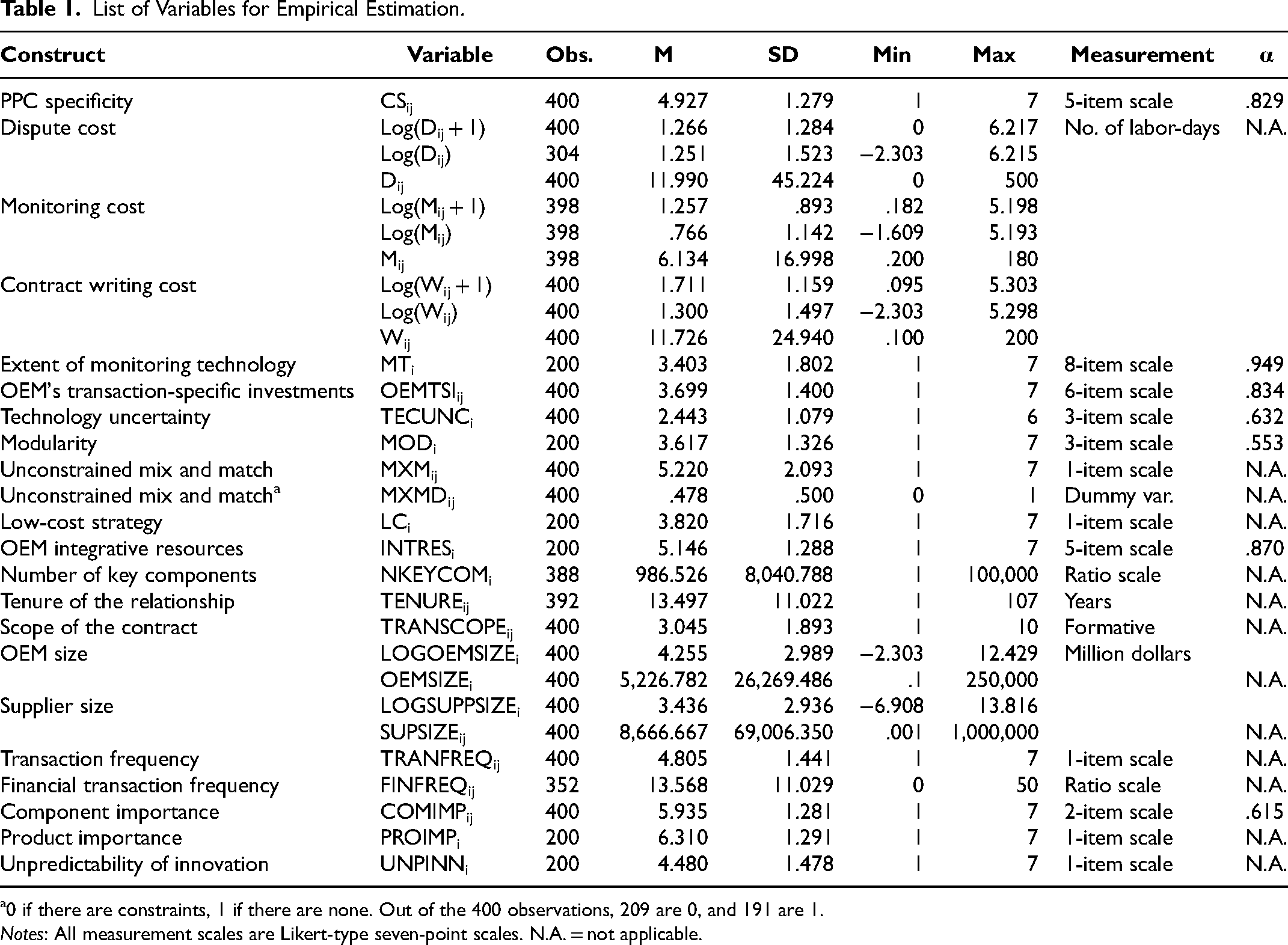
0 if there are constraints, 1 if there are none. Out of the 400 observations, 209 are 0, and 191 are 1.
Notes: All measurement scales are Likert-type seven-point scales. N.A. = not applicable.
Sample Characteristics
Over 75% of the OEMs were from six two-digit Standard Industrial Classification code manufacturing industries. 15 The mean reported annual revenue of the OEMs is $5.2 billion, the median being $43.5 million. The mean annual revenue of the suppliers is $323 million, and the average duration of OEM–supplier relationships is 13 years. Almost 90% of the suppliers were identified as supplying only one of the two key components identified by the respondents. The average component was reported to have cost the OEM about 18% of the market price of the final MCS.
Data Quality
We check data integrity in several ways. First, we cross-validate the annual company revenues reported by the respondents with other sources like company reports and websites. The numbers were consistent, enhancing confidence in the responses. Second, we check respondent expertise with two self-reported measures of their involvement with, and knowledge of, component suppliers. The central tendencies are high for both (means 5.7 and 5.8 and median 6 for both, on a scale of 1 = “Very Low,” and 7 = “Very High”). Only 16 out of 200 respondents reported involvement below 3, while only 8 out of 200 reported knowledge below 3. The high average expertise reported is consistent with respondent characteristics, 84% of whom held managerial or higher positions in their companies across relevant functions in supply chain and procurement. Thus, we elected to keep the entire sample to preserve degrees of freedom. Last, we insert a couple of attention check queries at random points in the survey, asking respondents to check a specific number, and discarding the incorrect responses. More details are available in Web Appendix B.
Common Method Bias
It is difficult to completely rule out common method bias in surveys. However, we can mitigate it through survey design and perform ex post tests to check for its severity. One ex post test we perform is the marker variable test (Podsakoff et al. 2003), which needs a variable that has no conceptual correlation with other composite variables. We use customer heterogeneity, which does not appear to be related to the technology or contracting hazards. We then add a common latent factor constrained to have same loading on all items in the measurement model. The estimated loading on the marker variable is .079; that is, .0792 or only .6% of the variance is explained by the common latent factor. Based on this and the results of two other ex post tests (see Web Appendix C), we conclude no major concern with common method bias.
Measurement
As a check for reliability, all our Cronbach's αs are high and range from .63 to .95, with the exception of the three-item modularity measure (MODi; α = .55). Unidimensionality, convergent and discriminant validities are established using the procedure suggested by Fornell and Larcker (1981) (see Web Appendix B for more details). Table 2 is the correlations matrix of the variables.
Variable Correlations.
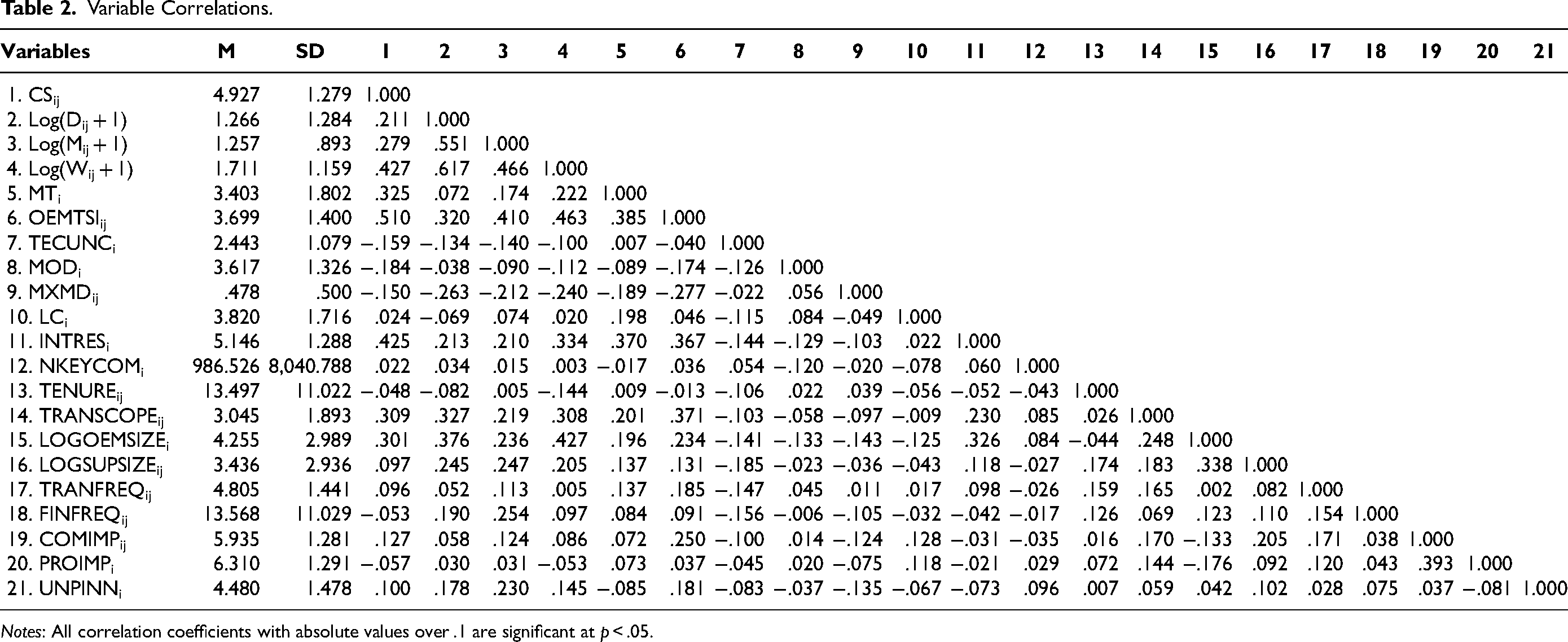
Notes: All correlation coefficients with absolute values over .1 are significant at p < .05.
Analyses and Results
The empirical model estimations are done in two parts. First, we test the hypotheses concerning how ex ante considerations of monitoring and disputes (and contract writing costs) are incorporated into contract design (H1–H4). We then test how monitoring impacts disputes (H5).
Impact of Monitoring and Dispute Considerations on Contract Specification
To estimate the impacts, we regress PPC specificity, CSij, on the variables in Equation 1.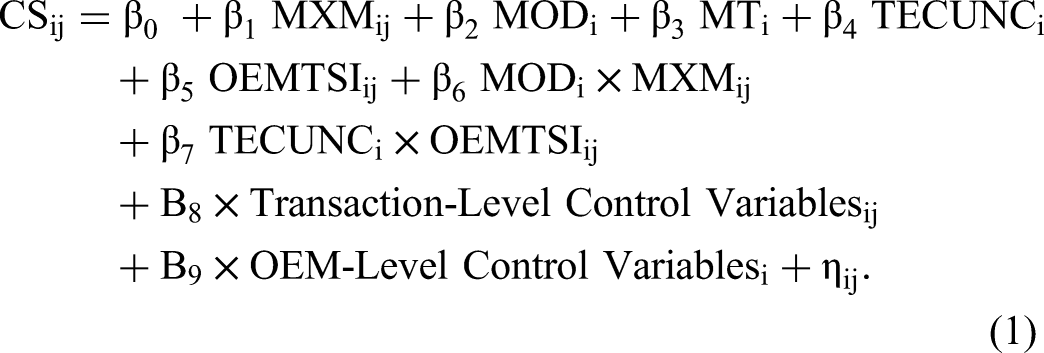
Control variables
We control for some variations across OEMs and transaction characteristics. Factors that result in a need for greater diligence in drafting contracts increase W (indicated by XW in Figure 2, Panel C), creating an efficiency-driven need to offset the higher W with lower levels of PPC specificity, CS. We do not pose explicit hypotheses here but indicate technological uncertainty and the OEM's transaction-specific assets as two key factors that we control for. Technological uncertainty (TECUNC) from the pace of technological changes increases W because parties have to protect against the hazards of obsolescence and lost competitiveness to maintain the productive value of their investments (Crocker and Reynolds 1993; Ghosh and John 2009). Similarly, transaction-specific investments made by the OEM (OEMTSI) increase W because the increased vulnerability to vendor opportunism creates an incentive to incur the costs of drafting a PPC with a higher degree of specificity as a safeguard.
Relationships have also been argued to be important factors in determining OEM–supplier arrangements (Cannon and Homburg 2001; Ghosh and John 2005). To account for this, we include three different variables (TENUREij, TRANSCOPEij, and FINFREQij) that control for the length of the OEM–supplier relationship, the number of different contractual commitments made by the supplier, and the frequencies of financial transactions between the OEM and the supplier. To control for the importance of the business relationship, we use the variable COMIMPij, which captures the extent to which supplier j's component is important for OEM i.
LOGOEMSIZEi (log of annual revenue) captures unexplained OEM-level variation that can be attributed to OEM size. NKEYCOMi (the number of system components) and PROIMPi (the importance of the system for the OEM's bottom line) capture variation attributable to the OEM's product. All other OEM-level unobserved variation is captured by δi.
While power sits uneasily within the efficiency paradigm of TCE, several authors nevertheless have argued that power plays an important role in determining how business relations are organized (Ghosh and John 2009; Mooi and Ghosh 2010). 16 Therefore, we include LOGSUPPSIZEij (log of annual revenue) as a transaction-level variable pertaining to the size of suppliers as a scale variable. We also include its interaction with OEM size (LOGOEMSIZEi) to further capture any possible variation due to power imbalance. To the extent that specific contracts can be seen as an exercise of OEM power over suppliers, one would expect that as suppler size increases, the level of contract specificity would decrease.
Endogeneity
One of the challenges of the previous model specification is potential endogeneity of MTi. Industrial OEM–supplier relations are invariably embedded in myriad ongoing agreements and arrangements that build up over time and determine the relational value-enhancing investments parties make. Because the monitoring technologies are investments in building capabilities for managing channel and customer relations, the deployment of these technologies may be seen to be driven by some of the same (unobserved) factors that drive OEM–supplier agreements, or even as a consequence of existing OEM–supplier agreements. Thus, MTi is potentially correlated with the error term εij, and ordinary least squares estimates could be inconsistent. 17 We undertake two separate analyses to address this endogeneity. We use a two-stage least squares (2SLS) instrumental variable (IV) regression approach and then use an instrument-free Gaussian copula estimation.
Instrumental variables
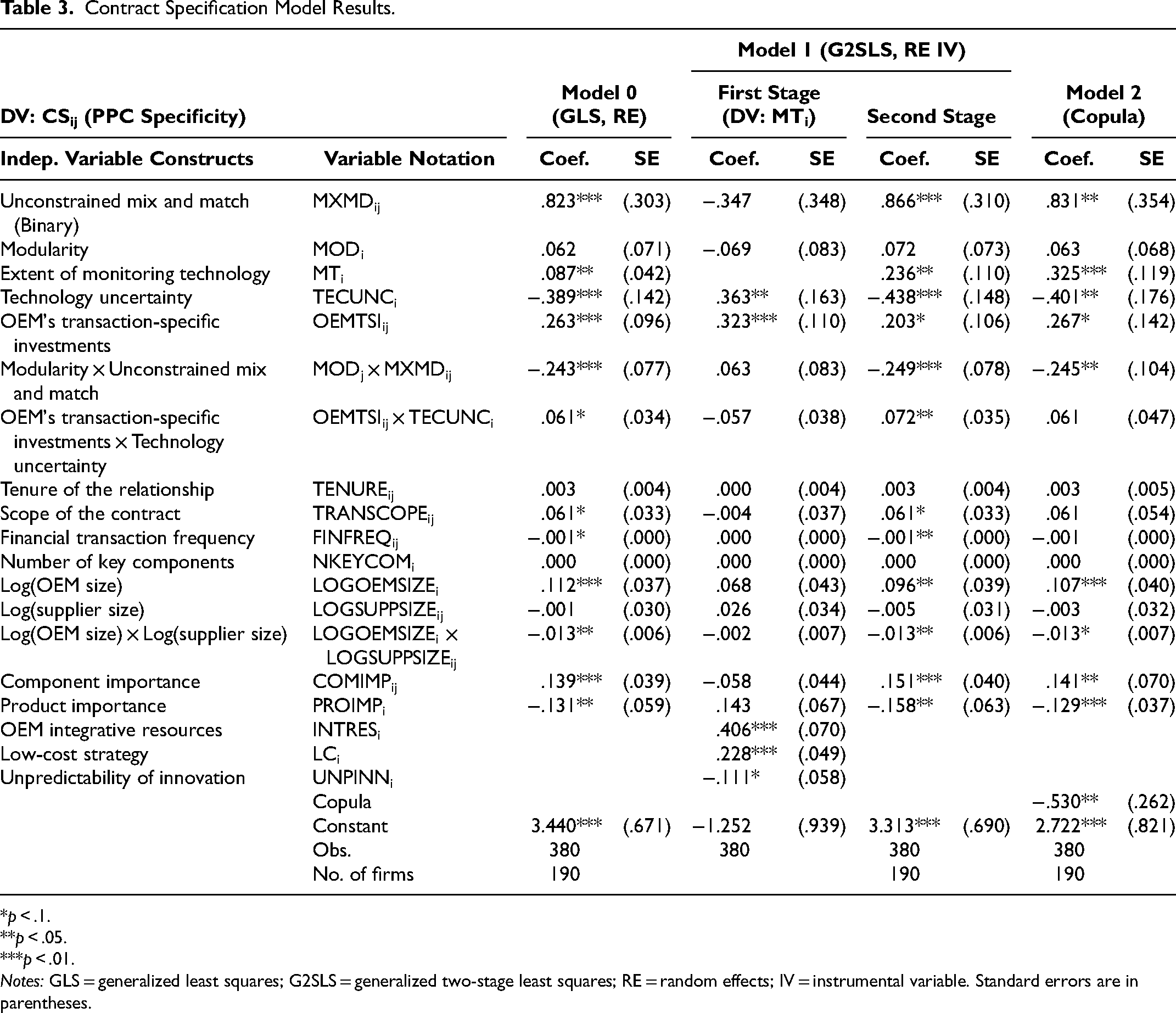
We use three instruments—pertaining to firm capabilities, strategic focus, and the external technology environment—in a generalized two-stage least squares (G2SLS) model (see Table 3 for the results). We argue that these instruments satisfy both the relevance and exogeneity criteria because while they directly impact MTi, they have no direct impact on the OEM–supplier contracts and are thus uncorrelated with the error term. The first instrument, the OEM's integrative resources (INTRESi), enables the OEM to integrate different processes to generate greater productive value. This should facilitate deployment of MTi, and the positive coefficient (.406, p < .01) in the first-stage results is consistent (see Table 3). However, INTRESi is independent of suppliers and has no bearing on how well the supplier components function. Therefore, it should have no direct impact on the OEM–supplier contracts regulating product failures. The second instrument, LCi, is the extent to which the OEM has a low-cost strategy (Ghosh and John 2009), which should positively impact the firm's efficiency-driven investments such as MTi (Ghosh and John 2005). We do observe a positive coefficient (.228, p < .01) in the first-stage results. However, such low-cost orientation does not impute product quality, especially that of supplier components, and so it should not impact product performance-related contracts. The third instrument, unpredictability of technology innovation in the OEM's technology environment, UNPINNi, is expected to negatively impact its investments in MTi. Investments in such technologies are sticky, and if protocols change suddenly, the OEM could forfeit these sunk costs. Consistent with this, we find a negative effect of UNPINNi (−.111, p < .1) in the first-stage results. However, future changes in technology would not directly impact current product performance-related contracts. The Sargan–Hansen postestimation test statistic for overidentification restrictions is not significant (χ2(2) = 4.391, p = .111), suggesting the validity of the instruments. 18
Contract Specification Model Results.
*p < .1. **p < .05. ***p < .01.
Notes: GLS = generalized least squares; G2SLS = generalized two-stage least squares; RE = random effects; IV = instrumental variable. Standard errors are in parentheses.
Instrument-free Gaussian copula
As explained in Park and Gupta (2012), the Gaussian copula method is an instrument-free semiparametric approach that constructs a joint distribution of the endogenous regressor(s) and the structural error term and then estimates the coefficients using maximum likelihood. To implement this, we first calculate the cumulative density of the endogenous variable, MTi. Next, we calculate the inverse cumulative standard normal distribution and use it as an additional regressor in the estimation of CSij. Finally, we use a bootstrap method with 200 iterations to estimate standard errors and confidence intervals. With the structural error term εij assumed to be normally distributed, a key identifying condition for the estimated model is that the distribution of the endogenous regressor (MTi) is nonnormal (Papies, Ebbes, and van Heerde 2017). We use the Shapiro and Wilk (1965) test and fail to reject normality for the errors (Z = −.352, p = .637) but reject normality for MTi (Z = 4.963, p = .000).
Results of the impact of monitoring and disputes on contract specificity
Table 3 presents the estimation results. Model 0 is the base regression, Model 1 is the G2SLS, and Model 2 is the Gaussian copula estimation. Note that the key results are consistent across all three models. We consider significant coefficients in Models 1 and 2 as robust evidence of an effect. 19
The coefficients of MXMij are significantly positive for both Models 1 and 2 (β = .866 and .831). This supports H1a over H1b, indicating that unconstrained mixing and matching engenders a greater likelihood of disputes, which is offset by more specified contracts.
The coefficient for MODi is not significant (H2a,b), and thus it is unclear whether the residual impact of modularity on contracts emphasizes lower dispute costs over lower monitoring costs or vice versa. However, the interaction term MODi × MXMij is significantly negative (β = −.249 and −.245). This suggests that the dispute driving role of modularity (H3a) dominates its monitoring driving role (H3b)—higher modularity dampens the potential for disputes associated with greater mix and match, relaxing the need for greater safeguards with specified contracts.
We find strong support for H4, with MTi significantly positive (β = .236 and .325). Evidently, the lower monitoring costs expected of monitoring technology ease concerns about the cost of drafting and monitoring greater safeguards with highly specified contracts.
Of the control variables, TECUNCi is significantly negative (β = −.438 and −.401), suggesting that parties economize on contract writing costs by drafting less-specified contracts when facing high levels of technological uncertainty. OEMTSIij is significantly positive (β = .203 and .207), which indicates that firms bear the ex ante costs of drafting highly specified contracts to offset the opportunism hazards of high transaction-specific investments. The interaction term TECUNCi × OEMTSIij is positive and significant for Model 1 (β = .072), suggesting that the hold-up problems of specific investments mute the economizing incentives posed by higher uncertainty.
OEM size (LOGOEMSIZEi) is significantly positive (β = .096 and .107), which indicates that larger OEMs realize greater economies in drafting specified contracts. The negative sign for the interaction term LOGOEMSIZEi × LOGSUPPSIZEij (β = −.013 and −.013) suggests that supplier size restrains OEMs’ abilities to impose highly specified contracts, consistent with a power balance explanation. In an indication of OEMs’ desire for greater safeguards when the opportunity costs are high, COMIMPij (importance of the component to an OEM's bottom line) is positive (β = .151 and .141). Interestingly, PROIMPi (importance of the system for an OEM's profit) is negative (β = −.158 and −.129), hinting at OEMs’ desire to retain flexibility for ex post adjustments with their suppliers. No other control variables are significant in both models.
Ex Post Impact of Monitoring Technologies and Monitoring
To test the hypothesized monitoring benefits (H5a) or monitoring penalty (H5b), we must estimate how both monitoring technologies and monitoring impact disputes. We face two related problems in using the measures of transaction costs for this: the distributions of these costs are highly skewed, and there are a large number of “zero” answers in the reported transaction costs. A natural log transformation would partially address the first problem, but because log of zero is undefined, we would lose a large number of observations with zeros and hence any information contained in those responses. 20 To address this, we shift all measures of transaction costs by one and use a Log(TC + 1) transformation for our analyses. This retains the degrees of freedom without compromising estimation of the direction of the marginal effects of interest.
We implement this test with a series of regressions. First, we regress dispute costs Log(Dij + 1) on monitoring technology MTi as in Equation 2. We then regress monitoring costs Log(Mij + 1) on MTi in Equation 3 and Log(Dij + 1) on Log(Mij + 1) in Equation 4. Last, we regress Log(Dij + 1) on both MTi and Log(Mij + 1) in Equation 5. For each regression, we use a dummy variable to control for the suppliers (SupplierDj = 1 for suppliers with only a minor product failure and 0 for suppliers with a major product failure). The models are specified following this paragraph, with the regression error modeled as ʋkij = δki + εkij, where δki is a random effect to capture unobserved OEM-level variation and εkij is distributed normally with mean zero. As earlier, index i refers to the OEM and j to the supplier. The tests for hypotheses H5a and H5b require at least the following: H5a: β41 < 0 (monitoring benefits), and H5b: β41 > 0 (monitoring penalty). In addition, β11, β21, β31, and β32 help us estimate whether monitoring technology, MTi, has a direct and/or indirect impact on disputes through its impact on monitoring, as discussed in the next subsection.



Results of hypothesis tests for monitoring penalty/benefits
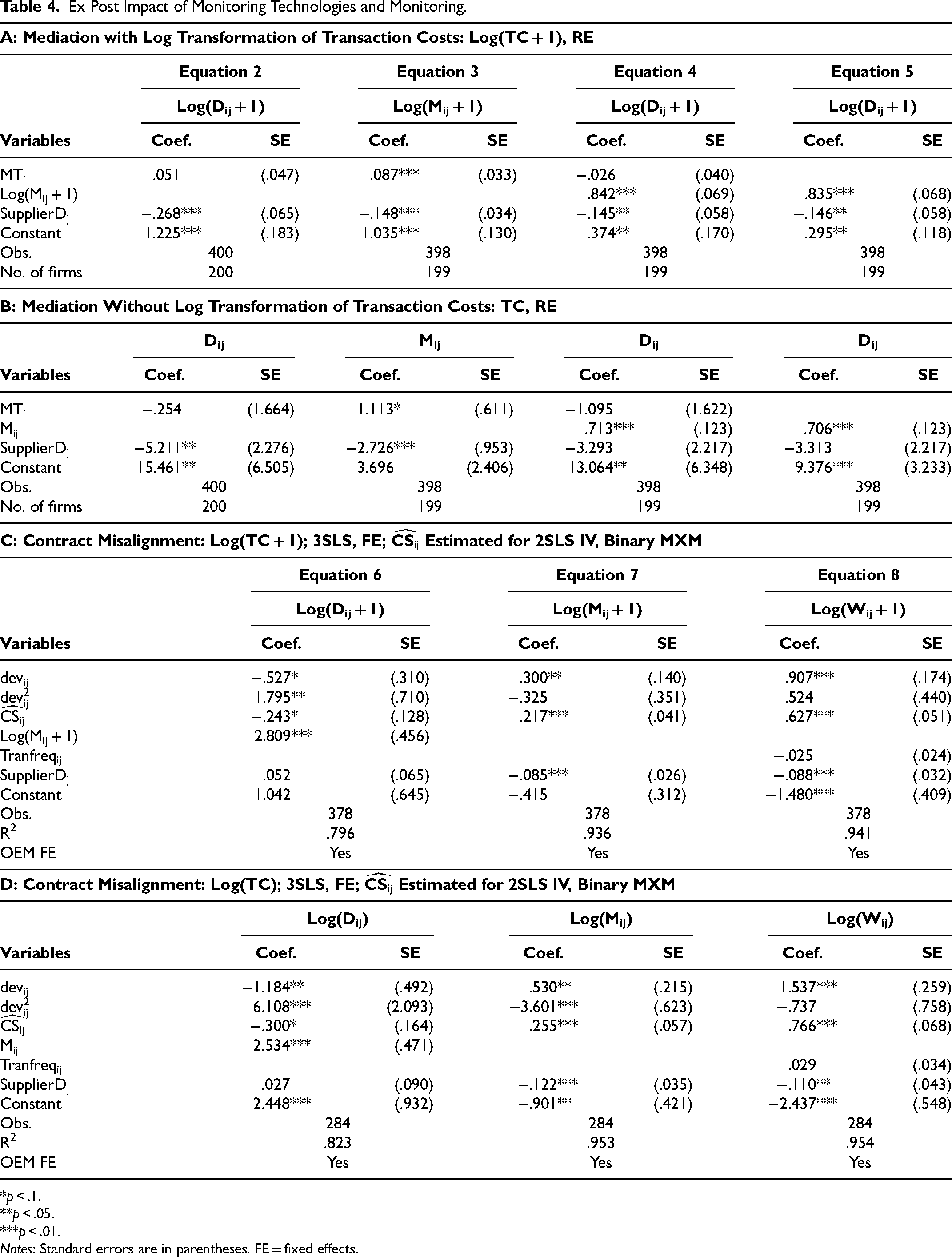
Table 4, Panel A, reports the estimated coefficients for Equations 2–5. The significantly positive β21 (.087, p < .01) in Equation 3 (MTi) shows that monitoring technology is associated with more monitoring, consistent with expectations that the technology enables the firm to monitor areas that were previously difficult to monitor. That said, this seems to come at some cost, as the significantly positive β41 (.835, p < .01) in Equation 5 (Log(Mij + 1)) means that greater monitoring is associated with aggravated disputes, which is in line with the monitoring penalty hypothesis H5b.
Ex Post Impact of Monitoring Technologies and Monitoring.
*p < .1.
**p < .05.
***p < .01.
Notes: Standard errors are in parentheses. FE = fixed effects.
To check for any mediating role of monitoring, we turn to the coefficients in Equations 2 and 4. β11 (MTi) is not significant in Equation 2. However, in Equation 4 with both MTi and Log(Mij + 1) included in the regression, β32 (Log(Mij + 1)) is positive (.842, p < .01), consistent with the monitoring penalty hypothesis. Further, while not significant, we observe that the coefficient of MTi decreases from .051 in Equation 2 to −.026 in Equation 4. These findings indicate that the impact of MTi on disputes may be fully mediated by monitoring costs.
We confirm this mediation with Sobel–Goodman tests (p < .001). We also reconfirm it with a bootstrapping analysis with 1,000 iterations to generate the standard error of the indirect effect, finding similar significant results. The details of these tests are available in Web Appendix D. The SupplierDj coefficients are negative, indicating that transactions costs are higher for suppliers with whom the OEM has experienced a major product failure, as is to be expected. To check further, we run Equations 2–5 without the log transformation and find similar results (see Table 4, Panel B). Thus, the Sobel–Goodman tests and bootstrapping results reconfirm full mediation.
Misaligned contracts
Notwithstanding the presumed efficiency of CS* (the optimal PPC specificity), the observed specificity of the realized contracts, CS, could be misaligned. These misalignments may be due to several factors—bounded rationality of agents as per TCE (Williamson 1985, 1991), lack of relevant information as per agency theory (Sadeghi et al. 2022), or even just pure mistakes, as argued in Alchian and Woodward (1988). Operationally, contracts can be either overspecified (ΔS* = CS − CS* > 0) or underspecified (ΔS* = CS − CS* < 0). TCE's efficiency logic would suggest that for any misspecification, the net effect would manifest in higher (total) governance costs, which is composed of the three transaction cost components (Williamson 1991). Thus, will the monitoring penalty effect survive even when we account for the impact of such misalignments on the different transaction costs? We use the following approach to examine this.
To estimate contract misalignment, devij, we calculate the predicted specificity 


Table 4, Panel C, only presents the results for the case where
We are also interested in the results for devij, which is the degree of overspecification. Recall our characterization of the dispute, monitoring, and writing costs in the theory section. In particular, with ∂D/∂CS < 0, underspecified contracts should incur higher dispute costs compared with overspecified ones (Crocker and Reynolds 1993; Mooi and Ghosh 2010; Wuyts and Geyskens 2005). The significantly negative β11 (−.527, p < .1) in Equation 6 vindicates this. Similarly, with ∂M/∂CS > 0, overspecified contracts should incur higher monitoring costs compared with underspecified ones (Dahlstrom and Nygaard 1999; Kashyap, Antia, and Frazier 2012). The significantly positive β21 (.300, p < .05) in Equation 7 matches this characterization. Last, with ∂W/∂CS > 0, overspecified contracts should also incur higher contract writing costs compared with underspecified ones (Anderson and Dekker 2005; Crocker and Reynolds 1993; Mooi and Ghosh 2010). We observe this in the significantly positive β31 (.907, p < .001) in Equation 8. The coefficients for
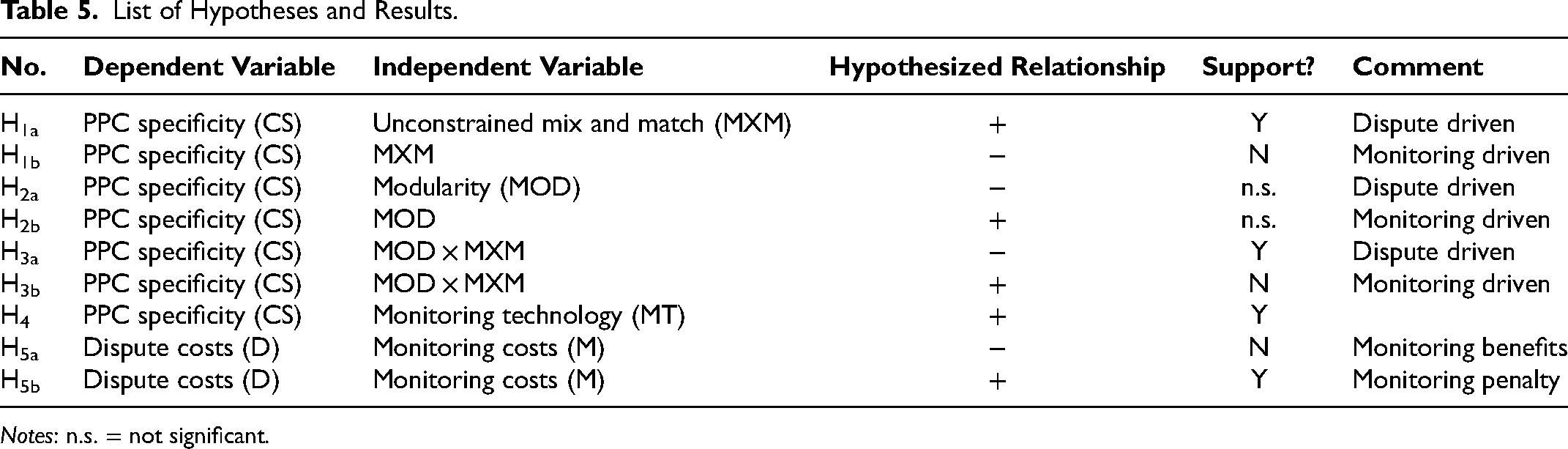
Table 4, Panel D, presents the results using the Log(TC) transformation, which automatically drops the observations with zero transaction costs. All the key results are consistent. Thus, overall, we find strong empirical support for the characterization of the transaction costs that drive our theory. Table 5 summarizes the hypotheses and the results.
List of Hypotheses and Results.
Notes: n.s. = not significant.
Discussions
Key Results and Their Research Contributions
In this subsection, we highlight and discuss four key results and their research contributions. First, despite their value addition, component monitoring technologies harbor unforeseen transactional hazards. Second, despite the presumed efficiencies of monitoring technologies, misaligned PPCs can deplete such efficiency. Third, MCS interdependencies can thwart the intended efficiency gains of monitoring. Last, in some MCS contexts the locus of transaction hazards may not necessarily reside only in opportunism.
Component monitoring technologies as a double-edged sword
Component monitoring technologies at the heart of the IIOT ecosystem come with a promise of realizing greater productive value from the installations (Coleman, Damodaran, and Chandramouli 2017). Improved vendor relations are a key part. Driving this is detailed data generation at scale, enabling the firm to monitor across a broader spectrum of transaction-relevant outcomes. Greater contract “completion” (i.e., more precisely specified performance contracts) becomes feasible with the promise of data and easier monitoring afforded by the technology. A key efficiency premise is that, in disputes, data from these technologies enable bilateral resolution instead of costly third-party/legal mediation. Yet, these technologies are nontrivial investments requiring greater understanding.
We find that these monitoring technologies are indeed associated with greater ex post monitoring and thus may support higher levels of coordination. However, our results also show that these technologies may not offer unmitigated benefits. We find that greater monitoring is associated with greater disputes, consistent with the idea that overzealous deployment of such technologies is inefficient. Existing codes-in-use (i.e., the provisions of the contracts) address anticipated failures, but unexpected interdependent failures offer new data points that can trigger a spate of renegotiations and disputes over existing protocols for failure metrics and remedies. This trade-off is one of the most important takeaways from our research.
In essence, while monitoring technologies facilitate expanding the set of clauses toward contract “completion,” accounting for the potentially infinite possibilities is impossible. Thus, on the one hand, there is the evident promise of more efficiency in terms of lower transaction costs, while on the other hand, there is the prospect of these advantages being easily traded away if parties exclusively rely on the codes-in-use for coordination and compliance.
Several articles have studied the downsides of monitoring (Heide, Wathne, and Rokkan 2007; Jacobides and Croson 2001; Mooi and Wuyts 2021; Stump and Heide 1996). We show that these downsides can be structural, unrelated to the behavioral backlash of the monitored agent studied in those articles. Relatedly, we illustrate how the capability to monitor per se matters for transaction outcomes. In doing so, we build on related work (Wang, Gu, and Dong 2013) and show how such capabilities may ease monitoring but can also incur transactional penalties in disputes. These are significant results in the context of the monitoring capabilities that are emerging as the digital transformation of our industrial ecosystems gathers pace.
Misaligned PPCs deplete efficiency in spite of monitoring technologies
While much of the focus in multivendor coordination is on monitoring, our results offer a sobering reflection not only on the limits of monitoring but also on how monitoring technologies are only a part of the whole system of governance. As firms invest in these capabilities, misaligned contracts reduce their value proposition. Underspecification of contracts is associated with higher disputes, and overspecification is associated with increased monitoring and contract writing costs. To calibrate the potential impact of misspecifications on the OEMs’ transaction costs, we use the estimates in Table 4, Panel D, using only the nonzero transaction costs to estimate the coefficients.
Relative magnitudes of the trade-offs can be inferred from the significant coefficients of devij and
The results add to the literature on misspecified contracts. Sampson (2004) study the impact of misspecification on innovation outcomes, and Leiblein, Reuer, and Dalsace (2002) examine its impact on technology performance. However, few studies attempt to examine the microprocesses of the adaptations themselves (cf. Mooi and Ghosh 2010). By disentangling monitoring and disputes, we fill this gap. Our use of the same metrics to measure transaction costs helps calibrate the relative trade-offs between monitoring and disputes in more tractable terms.
Our results also contribute to a growing marketing literature on how firms balance seeking value from strategic investments with transaction efficiency. Several articles focus on ex post adaptations for creating and claiming value (Antia and Frazier 2001; Cannon and Homburg 2001; Heide, Wathne, and Rokkan 2007; Houston and Johnson 2000; Kashyap, Antia, and Frazier 2012), and a related stream studies firm strategy and capabilities (Elhelaly and Ray 2024; Ghosh and John 2005, 2009). We show how the productive value of strategic investments such as monitoring technologies hinges on the trade-offs in ex post monitoring and disputes.
Specifying contracts when MCS interdependencies thwart efficiency gains of monitoring
While the usual considerations of technology uncertainty and assets specificity drive greater specification to offset opportunism, the two key characteristics to emerge in our multivendor, multicomponent context are modularity and unconstrained mixing and matching components from different vendors. The resulting interconnect complexity appears to favor greater specifications, triggered by the firm's concerns that disputes around product failures and performance dips would be difficult to resolve without appropriate codes-in-use. In this, our context of PPC is unique given that much of the literature focuses on broader procurement contracting (Cannon and Homburg 2001; Grover and Malhotra 2003; Heide, Kumar, and Wathne 2014; Houston and Johnson 2000). Beyond the novelty of a new context, PPCs enable us to study how product architecture impacts monitoring. In making contracts endogenous to monitoring technology, we unpack the tightrope balance mentioned previously and contribute to an understudied area of the literature (Mooi and Gilliland 2013). Monitoring technologies that could compensate for potential disputes also enable firms to specify their contracts to a greater extent. At the same time, the easier monitoring encourages firms to monitor more, thereby setting conditions for monitoring penalties in the form of increased disputes.
Our findings help fill some key empirical gaps. The monitoring of suppliers, where their interdependency flows from the architecture of products, is a setting in which many industrial exchanges occur but whose transaction hazards are understudied. The limited work in this area focuses on peer monitoring, where interdependent outcomes are easy to identify (Hu et al. 2016). Gulati, Wohlgezogen, and Zhelyazkov (2012) discuss coordination hazards but are silent on the role of product-derived interdependencies. We show how ambiguity surrounding such interdependent outcomes can invite unforeseen transactional penalties.
“Honest” mistakes and “pure” friction in ex post adaptations
Our results address a gap in the literature that provides little guidance on some interfirm adaptations salient in many MCS contexts. Ray, Bergen, and John (2016) study how system asymmetry impacts channel coordination. Another stream of research (Harmancioglu, Wuyts, and Ozturan 2021; Tiwana 2008) studies system modularity as moderating the impact of governance mechanisms on firm outcomes. In each of these, the focus is on agent opportunism. In our case, with a focus on product performance, the coordination problems that we study are different. We explicitly account for “honest” mistakes, where these hazards are not necessarily opportunism driven but rather are in the nature of “pure” friction, alluded to by Alchian and Woodward (1988). Thus, we build on a large interfirm governance literature in TCE that mostly focuses on the standard governance factors of lock-in, adaptation, and measurement hazards (Williamson 1985, 1991).
Managerial Implications
Advanced component monitoring technologies are part of the emerging IIOT ecosystem and the digital transformation of our industries. They offer unprecedented capabilities in the form of product monitoring efficiencies to smoothen supply chain coordination. The benefits derive from the generation of detailed data that can be used to track product performance, monitor product usage, and resolve disputes. Our results offer several lessons for managers.
Recognize the potential for a “monitoring penalty.” Hazards of opportunistic rent usurpation are contributors to disputes and are often pegged to an inability to monitor economic leakages due to high monitoring costs. Monitoring technologies facilitate easier monitoring, ostensibly as a check on the hazards. However, greater monitoring can also uncover unknown information that can aggravate disputes as the parties recalibrate their hazards and negotiate safeguards. These costs could eventually outstrip the efficiencies associated with the technology. Recognize the limitations of the codes-in-use. While the capabilities of monitoring technologies enable greater degrees of contract “completion,” contracts are inevitably incomplete. Thus, while monitoring technologies often come with the seductive promise of “smart contracting” (Arruñada 2020), there are clear limits to the extent that such automatic execution can work. Develop capabilities for “off-code” resolution of disputes. Greater monitoring will likely identify unanticipated failures and points of contention, which cannot be resolved by existing provisions. The opportunity costs are high, with the marginal impact of underspecification being about 11 times that of the benefits of overspecification. Therefore, parties must draw on off-code processes, such as industry norms, to address disputes. To this end, it seems quite appropriate that industry leaders like General Electric appoint dedicated contract performance managers as relationship stewards for key accounts across several of its business units in aviation, power, oil, energy, and so on.
24
Leverage the capabilities of monitoring technologies to create and claim value. Monitoring technologies are significant investments, whose productive value resides in greater cooperation with other vendors in the supply chain. As a result, they are vulnerable to hold-up problems, and it is important to be mindful of safeguards. Indeed, these technologies appear more likely to be deployed when suppliers also make transaction-specific investments in their relationship with the OEM, easing hold-up concerns. Further, greater contract specification could also be a safeguard, especially when technological uncertainties dominate. However, new business models leveraging the capabilities to create and claim value are also warranted. A case in point is Bosch Rexroth's “condition monitoring” systems and the associated menu of maintenance service contracts.
25
Bosch offers service on a graded scale, from reactive to proactive service engagements. Where it installs monitoring equipment, it matches the greater monitoring abilities to more comprehensive predictive maintenance schedules, thereby folding the potentially high bilateral transaction costs into more internal administrative processes.
Limitations and Future Research
To conclude, we offer an efficiency framework to explain the role of monitoring and new monitoring technologies in MCS industries, illustrating these in the context of PPCs. Our results highlight both benefits and challenges of the massive data generation and processing capabilities underlying the emerging IIOT monitoring ecosystem. Yet, many questions remain unaddressed. Do these technologies trigger better product performance? IIOT systems vary, for example, their intrusiveness, their use purpose, and ownership of the data streams. Does such heterogeneity impact the outcomes? We do not address these in our article but hope our results will encourage others to do so. This will require significant efforts, not all of them theoretical. The empirical challenges of researching industrial contexts largely derive from the granularity with which the research questions study efficiency and value addition in business relationships. Because these relationships are key to firms’ competitive advantage, firms are generally unwilling to share relevant data. Thus, we call for increased instances of effective industry–academia collaborations and hope future researchers will have access to more diverse data sources. The discipline will be stronger for it.
Supplemental Material
sj-pdf-1-mrj-10.1177_00222437241282308 - Supplemental material for Monitoring Technologies in Industrial Systems
Supplemental material, sj-pdf-1-mrj-10.1177_00222437241282308 for Monitoring Technologies in Industrial Systems by Saeed Shekari and Sourav Ray in Journal of Marketing Research
Footnotes
Acknowledgments
The authors would like to thank the JMR review team for their insightful and constructive critiques on previous versions of the article. They also gratefully acknowledge the encouragement from the coeditor, Kapil Tuli, as well as from the past editor in chief, Sachin Gupta. The research would not have been possible without the very generous involvement and help from the authors’ industry collaborators including the Supply Chain Management Association of Canada. Participants of numerous conferences and marketing department workshops, including those of the Institute for the Study of Business Markets, Industry Studies Association, Product Development and Management Association, American Marketing Association, Empirical and Theoretical Symposium for Canadian Marketing Strategy, University of Guelph, and McMaster University, have influenced the article through their comments and suggestions.
Coeditor
Kapil Tuli
Associate Editor
Jan Heide
Declaration of Conflicting Interests
The author(s) declared no potential conflicts of interest with respect to the research, authorship, and/or publication of this article.
Funding
The author(s) disclosed receipt of the following financial support for the research, authorship, and/or publication of this article: The authors thank the Social Sciences and Humanities Research Council of Canada for facilitating this work through a research grant to Sourav Ray.

Notes
References
Supplementary Material
Please find the following supplemental material available below.
For Open Access articles published under a Creative Commons License, all supplemental material carries the same license as the article it is associated with.
For non-Open Access articles published, all supplemental material carries a non-exclusive license, and permission requests for re-use of supplemental material or any part of supplemental material shall be sent directly to the copyright owner as specified in the copyright notice associated with the article.
