




Abstract
This research investigates how shopping on a weekday or a weekend moderates the impact of music on supermarket sales. Contrary to the intuitive beliefs of interviewed store managers, a meta-analysis, two field studies, and a controlled experimental study indicate that playing pleasant music (vs. no music) in supermarkets on weekdays enhances sales, an effect not found on weekends. Theorizing and interviews with shoppers suggest a potential reason for this week-part difference: Shoppers are more mentally depleted on weekdays (vs. weekends). A final study demonstrates and tests mental depletion as the driving factor for how shoppers are affected by music during different week parts. When consumers are depleted (e.g., on weekdays) music increases affect, which mediates the impact of music on sales. The results of the studies further indicate that week part plays a significant role in determining the impact of in-store music on sales. This article concludes with a discussion of the substantive and theoretical importance of incorporating the impact of week parts to predict in-store marketing effectiveness.
Seven-day calendars segregate weekdays from weekends, and these week parts establish common, learned routines for most people. From early childhood, people learn that their routines on weekdays differ from those on weekends. For example, in conventional weekday schedules, children attend school and parents work; on weekends, families and friends tend to engage in various other activities. Furthermore, consumers shop differently on weekdays and weekends, requiring retailers to make systematic changes in their operational features, such as opening and closing times, merchandise availability, stock quantities, and staffing levels.
Yet few studies explicitly address differences between weekdays and weekends regarding their potential effects on consumer shopping behaviors (Table 1). Using IRI shopping data, Kahn and Schmittlein (1989) determine that shoppers develop loyalties to specific days and that Saturday is the most popular shopping day. East et al. (1994) find that 87% of Saturday shoppers do their shopping then because they are not working on that weekend day. According to Davis and Berger (1988/1989), maximum sales occur on Fridays and Saturdays. Researchers also have investigated the characteristics of grocery shoppers who buy specific products on particular days of the week (Namin and Dehdashti 2019), as well as the impact of week parts on choices to shop in person or online (Chintagunta, Chu, and Cebollada 2012). Arguably, the week part represents a trip-specific factor that predicts certain behaviors (e.g., cherry-picking; Fox and Hoch 2005). To move beyond these demonstrations that differences between weekday and weekend shopping exist, we seek to understand why consumers’ shopping behaviors vary by week part and when grocery retailers can use music to encourage certain behaviors.
Week-Part Literature Summary.

Music offers an important atmospheric element that retailers can leverage to influence shopping behavior. But choosing when to play music, or not, represents a difficult choice for retailers, due to the complicated choice process it demands. In turn, the uses of music as an in-store marketing element are heterogeneous, varying among different retailers and sometimes even within the same retail chain. For example, fewer than half of all Target stores played music in 2019. Marks & Spencer experimented with in-store music but discontinued it following customer complaints about the repetitiveness of the playlist (Meyersohn 2019). According to Aldi, music is inconsistent with its brand, so it purposefully chooses not to play music in stores (Rossen 2020). Yet Kroger relies on music to establish its grocery store atmosphere (Berthiaume 2021). These distinct, varied approaches may reflect the outcomes of prior implementations of in-store music; we aim to offer a theoretical explanation and thus help predict when and why in-store music may be more or less effective.
We propose that the week part determines the influence of music. Although prior research has included the day of the week as a control variable, reflecting its relevance in relation to the effect of music on behavior (e.g., Knöferle et al. 2012; Morrison et al. 2011), we know of no research that examines whether music affects shopping behaviors differently across various parts of the week. Music is a sensory cue that is easy for retailers to manipulate and has a strong influence on affective feelings (e.g., Darke, Chattopadhyay, and Ashworth 2006; Gorn, Goldberg, and Basu 1993), which in turn can influence consumer behavior (Bruner 1990).
We also posit that the presence or absence of music is relevant to consumer shopping because it relates to the mental resources that consumers have available when making decisions, which may be driven by the activities they undertake and when they undertake them. For most people, more work- and school-related activities take place during weekdays, whereas weekends involve more socializing and leisure-related activities (Zhong, Hunt, and Lu 2008). Consequently, consumers are likely more mentally depleted on weekdays, which results in more intuitive processing (Pocheptsova et al. 2009). Intuitive processing in turn is informed by feelings, including those elicited by atmospheric elements, such as pleasant music. As we explicate subsequently, we thus anticipate that the music played in retail grocery stores positively affects shopping behaviors during weekdays, but not on weekends.
We first develop our conceptual model by drawing from literature regarding the role of the week part (weekday vs. weekend) on depletion, supported with insights gained from interviews with supermarket industry executives. Then we discuss the role of music and how it influences affect and store sales, as well as how the week part might moderate music → affect → sales relationships, due to depletion. Thereafter, we present a meta-analysis, four experimental studies (including two field studies), and interview data obtained from customers to provide empirical support for our prediction that the week part moderates the impact of music on sales.
Specifically, the meta-analysis (Study 1) reveals that music effect sizes collected on weekdays have stronger positive effects on shopping behaviors than data collected during both weekdays and weekends; music effects collected solely on weekends have a reverse effect on shopping behaviors. Study 2a, a field study in a grocery store, tests the impact of music (vs. no music) on sales as a function of the week part. Study 2b replicates these results with shoppers in a grocery store who complete an online study. Study 3, another field study in a grocery store, then replicates the impact of pleasant music (vs. no music) on sales as a function of week part while demonstrating that affect mediates this impact. We include an additional field experiment and an online experiment in the Web Appendix. Interviews with shoppers regarding how they perceive shopping on weekdays and weekends provide support for our theorizing that shoppers are more depleted on weekdays. Finally, Study 4 manipulates the week part to demonstrate that people are more depleted on weekdays. It shows that when people are more depleted, music generates positive affect, and that affect mediates the impact of music on sales. In the weekend condition (e.g., low depletion), music does not influence affect.
In turn, this article makes several contributions. First, we show that there are differences in how consumers respond to in-store marketing on weekdays versus weekends. Specifically, we empirically demonstrate, with field and controlled experimental studies, that grocery stores can initiate a substantial lift in sales on weekdays by playing music (vs. not playing music). However, music has no impact on weekend sales. Second, we establish the significant financial implications (sales, return on investment) associated with playing music (an easily implemented in-store atmospheric element) in grocery stores on weekdays.
Background
In this section, we explain our conceptual framework, as depicted in Figure 1. We first develop arguments for how the week part influences consumer depletion levels. We supplement the theoretical support for this claim in prior literature with interviews with supermarket industry executives. Both sources indicate that consumers are more depleted on weekdays than on weekends. We then argue that music, an in-store atmospheric element that is easily controlled by store management, determines affect in customers and can influence their shopping. Finally, we conceptualize how week parts, due to varying levels of depletion between weekdays and weekends, might moderate the effect of music.

Conceptual Framework.
Week Parts Influence Consumer Depletion
According to an analysis of web traffic market shares on U.S.-based websites in 18 industries, on weekdays, consumers seek to take care of essentials and serious issues (e.g., business, investments, medical issues, education), whereas on weekends, they display more leisure-related behaviors (e.g., food, drinks, entertainment; Bussière 2011). Standard schedules feature more work on weekdays and more leisure on weekends (Khare and Inman 2009; Rybczynski 1991; Zhong, Hunt, and Lu 2008), so consumers generally have less discretionary time available on weekdays (Yamamoto and Kitamura 1999). Weekday activities also tend to be stressors (Ragsdale et al. 2011) and require consumers to devote resources to complete them (e.g., effort, attention, energy; Meijman and Mulder 1998). To meet the demands imposed by such work during the week, consumers use up their psychological and physical resources (Meijman and Mulder 1998; Rook and Zijlstra 2006; Sonnentag and Fritz 2007), and this resource depletion often results in feelings of fatigue (Sonnentag and Zijlstra 2006). Similarly, panel data pertaining to more than 300,000 U.S. participants show that people report higher levels of stress on weekdays and more negative affect (Helliwell and Wang 2015; Stone, Schneider, and Harter 2012), which increases mental depletion (Muraven and Baumeister 2000).
Weekends provide consumers with greater autonomy regarding how to spend their time and evoke feelings of closeness and relatedness with others (Reis et al. 2000; Ryan, Bernstein, and Brown 2010; Sheldon, Ryan, and Reis 1996). Autonomy and relatedness both can enhance energy and vitality (Ryan, Bernstein, and Brown 2010), so people are more energetic and less depleted on weekends. Notably, weekends often are described as the time to replenish psychological and physical resources depleted by effortful work-related demands. For example, in a survey-based study, Ragsdale et al. (2011) find that the recovery experiences people engage in during weekends lower their need for recovery and psychological strain the following Monday.
Semistructured Interviews That Further Establish the Importance of Week Parts
Even if academic literature provides evidence that consumers feel and behave differently on weekdays versus weekends, we were curious about whether managers were aware of such differences and took them into account in their marketing efforts. Therefore, we conducted ten semistructured interviews with supermarket industry executives (owners or store managers) regarding in-store marketing efforts during different parts of the week. Table 2 contains a list of the themes identified. With a purposive sampling approach, we reached out to industry partners that could provide a substantive account of week-part effects in grocery settings. The store owners were from the same chain of independent grocery retailers we used for the field studies that we report subsequently. The interviews took 21 minutes on average (range: 12–33 minutes) and were conducted on video conferencing software. The interviewer has significant retail industry experience. The interviews followed a fluid approach, involving questions about (1) perceived differences in shopping behaviors between weekdays and weekends, (2) whether and how the retailers adapted their store operations and marketing to the various parts of the week, and (3) insights regarding in-store music. One of the researchers conducted all the interviews; the interview data were transcribed to facilitate thematic analyses.
Key Quotes from Interviews with Store Managers.
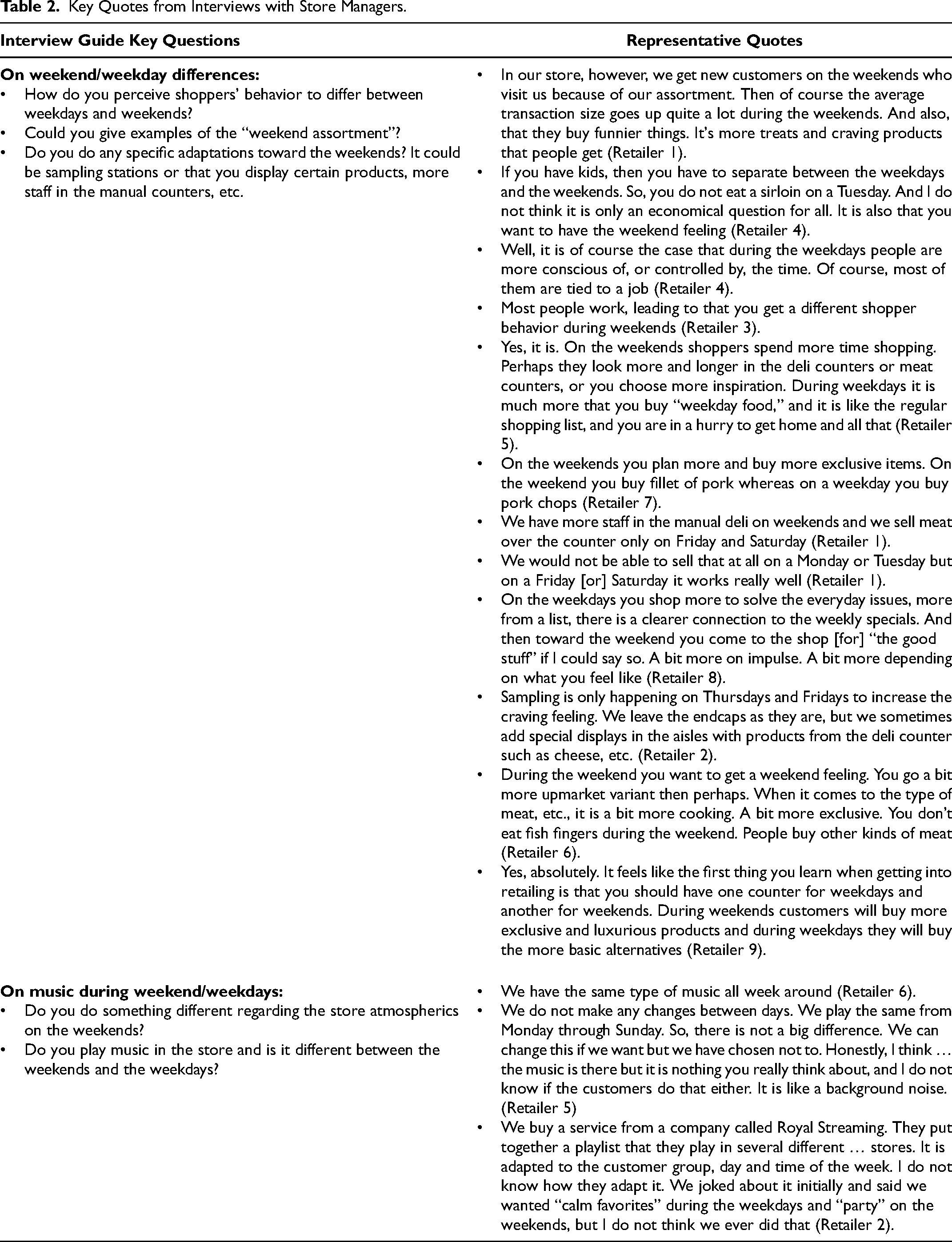
A key theme emerged from the interviews to explain differences between weekdays and weekends and their consequences for shopping behaviors: Weekday shoppers are more stressed due to a lack of time. Several managers pointed out that most shoppers work during weekdays, which affects their behavior: “During the weekdays people are more conscious of, or controlled by, the time. Of course, most of them are tied to a job” (Retailer 4). The interview participants described shoppers who work on weekdays as functionally oriented when they shop, such that “during weekdays it is much more that you buy ‘weekday food,’ and it is like the regular shopping list, and you are in a hurry to get home” (Retailer 5). During these shopping trips, shoppers buy “everyday items,” often products that are part of simpler dishes that are quick and easy to prepare: “On the weekdays you shop more to solve the everyday issues, more from a list, there is a clearer connection to the weekly specials. And then toward the weekend you come to the shop for ‘the good stuff’ if I could say so. A bit more on impulse” (Retailer 8). Overall, our managerial interviews support academic findings that consumer behavior differs on weekdays versus weekends, because consumers are more depleted (i.e., pressed for time and stressed) on weekdays.
Citing the differences in shopper behavior during weekdays versus weekends, all ten store managers reported that they adapted their store operations and marketing efforts to meet shoppers’ preferences and needs. 1 The stores typically have more staff working during the weekends, as well as sampling stations closer to the weekend. Most of the managers felt that they did not adapt their stores enough and had no clear idea whether music should be adapted during different parts of the week or not. If retailers had a more precise understanding of how the week part affects consumer behavior, they could better design their in-store marketing and atmospheric elements, including music, to resonate with customer preferences and effectively influence consumer behaviors.
Furthermore, our interviews indicate that many retailers do not play music or do not have a consistent strategy. As Retailer 5 said, “We do not make any changes between days. We play the same from Monday through Sunday. So, there is not a big difference. We can change this if we want but we have chosen not to. Honestly, I think … the music is there but it is nothing you really think about, and I do not know if the customers do that either. It is like a background noise.” Another retailer did not play music, due to a belief that shoppers do not like to have music playing while they shop. Thus, the general impression of store managers is that in-store music is unlikely to influence sales significantly, and even if it does, they do not expect a difference as a function of week parts. Therefore, it is important to study whether retailers should play music on both weekdays and weekends and whether music influences shopping, through affect.
Music Influences Affect and Then Shopping
Music is an effective way to evoke affective feelings (Darke, Chattopadhyay, and Ashworth 2006; Gorn, Goldberg, and Basu 1993) and shift consumer behaviors (Bruner 1990). It is well known that music can affect shopping behaviors (e.g., Biswas, Lund, and Szocs [2019] find that music influences healthy food purchases; Milliman [1982] finds that music influences shopping), as well as determine moods and affective feelings (Cohen and Andrade 2004). The valence of these moods and affective feelings then strongly influences judgments and behaviors (Cohen, Pham, and Andrade 2008; Schwarz and Clore 2007).
People's decisions often are influenced by their affective feelings (Pham 1998; Schwarz and Clore 2007), due to the affect heuristic (Slovic et al. 2004), which predicts that “even when objective information about the target is held constant, targets are evaluated more favorably and chosen more frequently when they are perceived to elicit pleasant feelings than when they are perceived to elicit unpleasant feelings” (Pham and Avnet 2009, p. 268). When Gorn, Goldberg, and Basu (1993) asked students to evaluate stereo speakers while listening to music that induced either good or bad moods in the listeners, they found that participants’ moods biased their evaluations, such that they provided more favorable reviews if the music evoked a good mood for them. In addition to favorable evaluations, people in a good mood tend to alter their purchase behavior (Baker et al. 2002), display more approach behaviors (Mehrabian and Russell 1974), spend more time in-store, and increase their incremental spending (Donovan et al. 1994).
Week Part (Due to Depletion) Moderates the Effect of Music
As we have discussed, the week part influences depletion. Depleted resources influence consumers’ thinking and decision making (e.g., Pocheptsova et al. 2009). Because cognitive resources are limited when they become depleted, people tend to rely on more intuitive and automatic processing that generates responses unconsciously (Baumeister et al. 1998; Muraven and Baumeister 2000), as opposed to deliberative processing that involves careful and effortful consideration of information (Kahneman and Frederick 2002). When a consumer's resources are depleted, it also increases context effects that arise from automatic processing and decreases the effects that stem from deliberative processing (Pocheptsova et al. 2009). For example, a person in a depleted state is more likely to put off decisions. This choice deferral uses automatic processing, whereas making a choice would require more effortful trade-off evaluations (Pocheptsova et al. 2009, study 5). Previous research also provides evidence that depleted shoppers are more susceptible to affective product features (Bruyneel et al. 2006).
In this research, we extend this reasoning and suggest that when consumers are depleted, they are more likely to be influenced by the feelings elicited from the music played in the store, due to the affect that music evokes in people. This affect heuristic (Slovic et al. 2004) also should influence their shopping. People tend to feel more negative affect on weekdays than on weekends, and they generally report more positive affect on weekends than on weekdays (Helliwell and Wang 2015; Stone, Schneider, and Harter 2012). Therefore, reliance on the affect heuristic should be less for weekend shoppers because they are less depleted and less reliant on automated processing. Less depleted shoppers are also likely happier (and more relaxed) as a baseline. Even though the patterns may be related to a traditional Monday–Friday workweek, these societal structures are ingrained patterns even for those who do not work those hours; even retirees report more positive affect on weekends than weekdays (albeit with a smaller effect size; Stone, Schneider, and Harter 2012). Therefore, we expect affective cues are important when shoppers are depleted but not when they are not depleted.
The impact of this music-induced affect heuristic might vary between the two week parts, which is our main prediction. When consumers shop on weekdays, they likely experience a depleted state (Meijman and Mulder 1998; Rook and Zijlstra 2006; Sonnentag and Fritz 2007) and seek a shopping experience that helps them quickly and easily meet their objectives. Furthermore, because weekday shoppers should be more depleted, they may attend to environmental cues only selectively (Lee and Schumann 2004), which should generate simple inferences to determine their attitudes (Fiske and Neuberg 1990; Meyers-Levy and Malaviya 1999). These shoppers are likely to use the affect created by pleasant music (Cohen, Pham, and Andrade 2008) as an input in their decisions, resulting in greater purchasing (Donovan et al. 1994; Mehrabian and Russell 1974). Such a response to environmental stimuli that influence affect, and in turn influence purchase behaviors (or intentions), is consistent with Mehrabian and Russell's (1974) framework, as tested by Baker, Levy, and Grewal (1992).
In contrast, when consumers shop on weekends, they are less likely to be in a depleted state, because on average, they have more time available and are engaged with fewer depleting activities. Consequently, they already should be in a more positive affective state (relative to weekdays). Thus, the role of the music cues is less influential when consumers are engaged in greater processing (i.e., greater motivation and/or ability to process). In a nondepleted state, consumers might be less likely to use music as a cue to soothe their mental tiredness and poorer affective state. Thus, we predict that their purchasing behavior on weekends is similar regardless of the presence or absence of environmental stimuli such as music. Formally, we hypothesize:
We test this theorizing in five main studies (and two studies in the Web Appendix). In Study 1, we conduct a meta-analysis of previous research on the presence of in-store music and assess how the effects of music on sales differ during weekdays versus weekends. Study 2a is a field study that tests H1. Study 2b replicates the results of Study 2a in a more controlled setting. Study 3 is another field study to test both H1 and H2. Interviews with customers support our theorizing that there are differences in depletion levels between weekday and weekend shopping. Although Study 3 tests the music × week part interaction and the affect mediation, we do not test the full model, including depletion, until Study 4. In Study 4, we formally and experimentally manipulate the week part and measure the level of depletion resulting from different parts of the week in a controlled setting. This study validates our assertion that depletion is responsible for the varying effectiveness of pleasant music, as a function of the week part.
Study 1: Synthesizing Current and Previous Research Using a Meta-Analysis
To understand whether the presence of music can have differential effects, according to the week part, we conducted a meta-analysis of studies examining the effect of in-store music (presence vs. absence) on shopping behaviors (or behavioral intentions). We first examined the effects of music during different parts of the week for various types of brick-and-mortar retail store environments. We then assessed the role of week part in supermarket settings (which also is where we conduct our field studies).
In line with standard meta-analysis review procedures (Grewal, Puccinelli, and Monroe 2018), we examined references, leading journals, and publications listed on the websites of authors working in this domain. We also reviewed a meta-analysis by Roschk, Loureiro, and Breitsohl (2017) and conceptual review articles (Oakes and North 2008; Spence et al. 2014) to locate empirical studies that might be candidates for inclusion. Significant literature has focused on in-store music from various angles, but because our meta-analysis pertains to the effects of in-store music on shopping intentions and behaviors as a function of different parts of the week, we exclude articles that do not feature intention or behavioral measures, those that lack a control condition (e.g., no music), and those for which we could not obtain sufficient statistics. We list the excluded studies in Web Appendix A.
The coding of the selected articles spans multiple dimensions. First, we determined the week part when the data were collected (weekday, weekend, both). Second, we identified the type of retailer (e.g., supermarket, restaurant, department store). Third, for each study, multiple coders established the type of dependent variable (intention or behavior), whether music was present/absent, whether the study manipulated the tempo (yes/no) or genre/mood (yes/no) of the music, store type (brick-and-mortar or other), and where the study was conducted (field/lab). Web Appendix B lists all studies included in the meta-analysis. In total, we found ten studies that fulfilled all these requirements. Five effect sizes come from data collected during weekdays only, four effect sizes come from data collected during both weekdays and weekends, and one effect size comes from data collected on weekends only.
We sought to calculate effect sizes for between-subject design studies in which music was operationalized as present or absent. For each study, we calculated the effect size using pertinent statistics (e.g., F-value, t-value, r) associated with the effect of the music collected on weekdays or weekends. The data set of previous research contained ten effect sizes with 2,047 participants for all retail formats, out of which five effect sizes came from studies conducted in supermarket/grocery settings. We used the Pearson r correlation as an effect size indicator; it represents the strength of the association between the presence of music and shopping intentions/behaviors. A positive r indicates that music enhances shopping; a negative r offers evidence that music results in reduced shopping outcomes. We then converted the effect sizes (r) into Fisher's Z (Rosenthal 1991) to test the main effect of music, as well as the role of the various moderators, with fixed and random effects models. Finally, we checked whether the effect sizes were homogeneous (Borenstein et al. 2009).
In line with our theorizing about the role of week parts, we compared effects between weekdays and weekends across store environments, using all ten studies that report when the data collection took place. We find a positive overall effect for a fixed and random effects model (fixed η = .07, Z = 2.98, p = .003; random η = .17, Z = 2.78, p = .005). The fail-safe N test indicates that the number of missing studies that would make the overall effect insignificant (α = .05) is 62 studies (Rosenthal 1979). The Q test for heterogeneity between groups reveals a significant difference in the variance of effect sizes (Q(9) = 46.56, p < .001), indicating the moderating effect of part of the week. Thus, there is a significant difference in music effect sizes, possibly depending on when the data were collected. When we assess the effects as a function of when during the week the data were collected, we find the strongest positive effect of music during weekdays (fixed and random η = .25, Z = 6.06, p < .001). Effect sizes from studies collected during both weekdays and weekends were smaller but still significantly positive (fixed and random η = .17, Z = 3.33, p = .001). We find a negative effect size for the study conducted during weekends (fixed η = −.07, Z = 2.17, p = .030). When analyzing the effect sizes within groups, there is no longer heterogeneity within the groups (weekdays: Q(4) = .41, p = .982; full weeks: Q(3) = 2.59, p = .458; no study variation on weekends). Thus, week parts explain a significant amount of variation in the variance between studies (see Table 3, Model A).
Meta-Analysis Results.

Notes: Heterogeneity in the fixed effects analysis. Number of degrees of freedom for Q is N – 1.
When assessing the effect of music in the five articles that specifically examine supermarket settings, we obtain similar results (Table 3, Model B). Even though the overall effect of music is not significant (fixed η =.00, Z = .00, p > .999; random η = .14, Z = 1.33, p = .185), we find heterogeneity among the effect sizes, indicating the presence of a moderating factor (Q(4) = 24.97, p < .001). When we look at the effects as a function of week parts, we find a significant positive effect of music during weekdays (fixed and random η = .27, Z = 4.49, p < .001), and the effect sizes are no longer heterogeneous (Q(2) = .09, p = .954). The effect size obtained in studies conducted during both weekdays and weekends is not significantly different from zero (fixed η = −.02, Z = .14, p = .891). The effect of music in studies with data collected on weekends remains significantly negative (fixed η = −.07, Z = 2.17, p = .030).
By considering the role of the week part, we aim to understand how it may moderate the impact of in-store music described in prior research. We also assess several alternative moderators that may explain differences in previous results, such as the type of music manipulated (e.g., presence, volume, tempo) and the type of dependent variable (actual behaviors vs. intentions), using a meta-regression (Table 4). The effect sizes do not differ substantively across these moderators. Therefore, we affirm that the week part functions as a key moderator of when music influences shopping intentions and behaviors. These results also indicate that the impacts of different moderators identified by Roschk, Loureiro, and Breitsohl (2017), such as the sampling frame (akin to lab vs. field context), may be less important when controlling for the week part. The meta-analysis thus provides initial indications that the week part has an important influence on the effectiveness of in-store music. To test our predictions causally, we run experimental studies in real-world supermarkets and more controlled settings.
Meta-Regression Results.
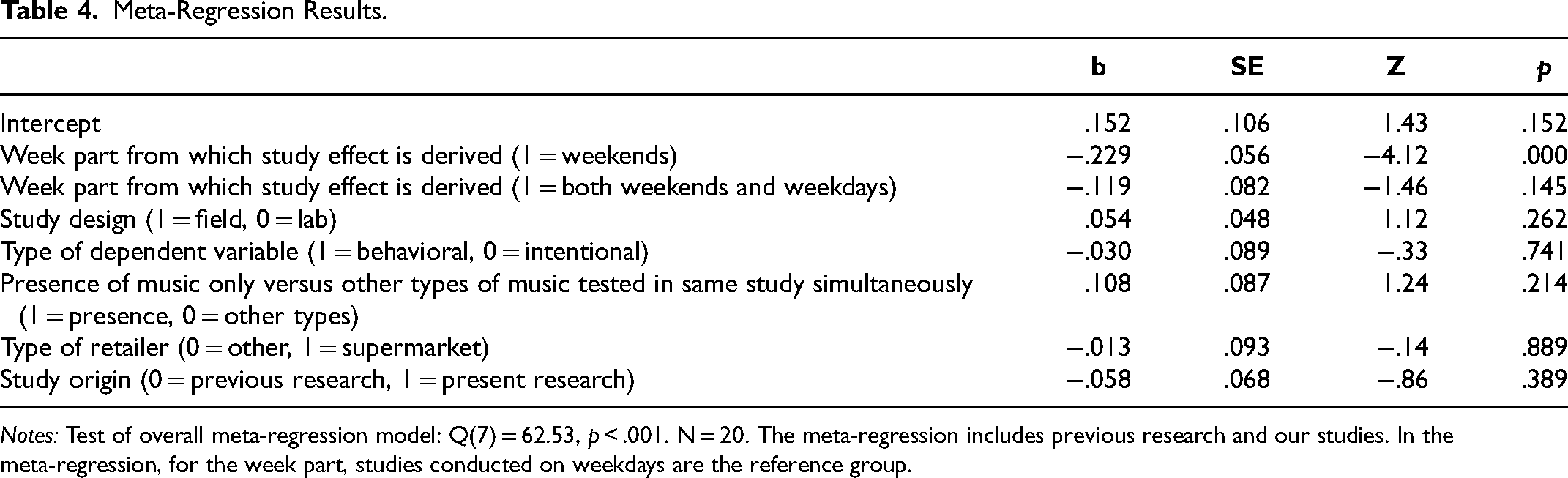
Notes: Test of overall meta-regression model: Q(7) = 62.53, p < .001. N = 20. The meta-regression includes previous research and our studies. In the meta-regression, for the week part, studies conducted on weekdays are the reference group.
Study 2a: Field Experimental Test of Week Part and Music Effects
Method
The field study, conducted over three weeks in grocery stores, uses a 2 (week part: weekday vs. weekend) × 3 (music: foreground, background, absent) between-subjects design. Week-part sales data were collected on weekdays (Monday–Thursday) and weekends (Friday–Sunday). For most working people, the subjective experience of the weekend begins sometime on Friday (Ryan, Bernstein, and Brown 2010). Consumer behaviors on Friday tend to be like those on weekends (Khare and Inman 2009; Stone, Schneider, and Harter 2012), so previous research includes Friday as a weekend day (Jacobe and Jones 2009; Kim and Park 1997). According to the store managers and historical sales data, consumer purchases in the study stores are similar on Fridays and other weekend days.
Three supermarkets, belonging to the same retail chain in an urban area of a large European city, collaborated with us for this field study, which cost approximately $45,000 to implement and took four months of planning. The stores’ professional-quality speakers had been installed by a professional sound agency, with expertise regarding the physics of sound and the appropriate use of speakers and sound absorbents, so the volume and quality of sound were consistent throughout each store and across all three stores.
The stores were open 7:00 a.m. to 11:00 p.m., and music played the entire time they were open in the music-present conditions. To generalize the findings, two music playlists were developed, in cooperation with a professional sound design agency that specializes in music for public spaces. The background music had no vocals; it is most easily described as elevator music, with songs in major modes. As it played, it was less likely for consumers to recognize distinct songs. In contrast, the foreground music includes songs that were popular at the time of the study and included vocals, likely to be recognized as individual songs. In both conditions, the music could be heard clearly over any noise from refrigerators or ventilation, without being overwhelming. Each playlist lasted for more than eight hours, to avoid repetitiveness for customers or employees. Each music condition (foreground, background, absent) ran for one week in each of the three stores, so we collected three weeks of data. Our dependent variable is total aggregated store sales per day, and we obtained 63 observations (7 days × 3 weeks × 3 stores), which represent approximately 150,000 shopping trips (information provided by the store chain). Sales were collected in the local currency and converted to U.S. dollars.
Results
We conducted an analysis of covariance (ANCOVA), with week part and type of music as independent variables and total store sales per day as the dependent variable. We created two dummy variables to represent the three stores, then included them as covariates to control for store differences. We also controlled for the number of shoppers (total number of receipts issued each day) per store within the store format (i.e., supermarkets, hypermarkets) each day, to control for any seasonality effects. The store covariates are significant (Store 1: F(1, 54) = 16.24, p < .001; Store 2: F(1, 54) = 177.56, p < .001), but the number of shoppers visiting the retailer per day is not (p = .388). The main effect of music type is not significant (p = .839), but we find a main effect of week part (Mweekday = $44,466.27, Mweekend = $53,150.07; F(1, 54) = 33.68, p < .001, η = .62) and, in line with H1, a significant interaction (F(2, 54) = 3.50, p = .037, η = .34).
Planned contrasts reveal that during weekdays, sales are higher with music; the joint effect of the foreground and background music conditions versus the no music condition is positive (Mnomusic = $41,458.62, Mmusic = $45,970.10; F(1, 54) = 4.57, p = .037, η = .28). For the specific music conditions, sales are marginally higher with either foreground or background music, compared with no music (Mnomusic = $41,458.62, Mforeground = $46,065.49; F(1, 54) = 3.60, p = .063, η = .25; Mbackground = $45,874.72; F(1, 54) = 3.31, p = .074, η = .24, see the Appendix). We find no difference between the foreground and background music conditions (p = .937).
In the weekend condition, the joint effect of the two music conditions versus the no music condition is insignificant, albeit directionally negative (Mnomusic = $55,618.89, Mmusic = $51,915.66; F(1, 54) = 2.38, p = .129). For the specific music conditions, we find a marginally significant negative difference between foreground music and no music but no significant difference between background music and no music (Mnomusic = $55,618.89, Mforeground = $50,837.88; F(1, 54) = 2.98, p = .090, η = .23; Mbackground = $52,993.44, p = .348). Again, we find no difference in sales between the two music-present conditions (p = .440).
Discussion
In support of H1, Study 2a demonstrates a week part by music interaction. On weekdays, music results in enhanced sales, whether the music is in the foreground or background. On weekends, music does not affect sales or perhaps even has a directionally negative effect, compared with no music. For retail managers deciding whether and when to play music, the results consistently highlight that on weekdays, it is beneficial to play music, because it prompts a bump in sales (11% for either type of music). The results in the weekend condition are less clear because there is no statistical difference across music conditions.
Study 2b: Controlled Experimental Test
With Study 2b, we test H1 in a more controlled setting. Because Study 2a provides consistent results across foreground and background music, we prioritize the comparison of the presence or absence of music, using background music for the present condition.
Method
In this 2 (week part: weekday vs. weekend) × 2 (music: present vs. absent) between-subjects experiment, we intercepted 136 shoppers in a grocery store and asked them to participate in a study of grocery shopping. A scratch-off ticket worth 10 Swedish krona (SEK) was offered as an incentive. Those who agreed moved to a secluded area of the grocery store, set up as a test lab, where they completed an online study on a tablet. These data were collected on a Wednesday and Thursday (weekdays) and a Saturday and Sunday (weekends). We worked closely with the grocery store to arrange this design and capture responses from actual shoppers while also controlling the experiment precisely. Accordingly, we instructed the participants to put on noise-canceling headphones that we provided; the volume was fixed to ensure that it remained the same for all participants. In the music condition, participants heard background music while reading the scenario and making their selections. Those in the no music condition did not hear anything.
Although they already were in an actual grocery store, the scenario description also noted, “You are in a grocery store to buy groceries. The store has a very functional format.” Next, participants watched a 20-second video of a shopping cart being pushed down an aisle, which reinforced the format of the store. All participants read, “This grocery store atmosphere is clean and efficient. Displays are functional and show the products in a very effective fashion. The lighting is efficient. The floors are clean. The service personnel are efficient.”
Participants then saw 24 products (e.g., snacks, cereals, beverages, canned food, candy, cold cuts). Each product featured a picture, size information, and the price, as displayed in Web Appendix C. The shoppers were instructed: “Please select items you would like to purchase.” After making their selections, participants saw a receipt on the next page, showing the total cost of the products selected. Finally, participants completed manipulation checks and provided demographic information. Sales were collected in the local currency and converted to U.S. dollars. We also collected shoppers’ ages and gender as covariates. Age may determine the effects of in-store music (Yalch and Spangenberg 1990) and people's ability to hear well (Gates and Mills 2005), and different age groups tend to shop distinctly on different days of the week (Goodman 2008). In addition, men are more likely than women to shop on weekends (Goodman 2008). We include these covariates in all models but also report results without covariates in Web Appendix D.
Results
An ANCOVA reveals that age has a significant effect on sales (F(1, 130) = 7.14, p = .009), whereas gender has no such effect (p = .263). Neither main effect is significant (week part p = .488; music p = .251), but we find a marginally significant interaction effect between the week part and music (F(1, 130) = 3.34, p = .070, η = .16; left-hand part of Figure 2). Consistent with our expectations, on weekdays, music results in higher sales (Mmusic = $14.06, Mnomusic = $10.09; F(1, 130) = 4.24, η = .18, p = .042), whereas on weekends, music does not affect sales (Mmusic = $10.71, Mnomusic = $11.60; p = .630).

Results of Studies 2b and 3.
Discussion
Study 2b provides support for H1 in a controlled lab setting and demonstrates a week part by music interaction. On weekdays, music results in enhanced sales. On weekends, music has no impact. This study benefits from the control provided by a lab study, yet it also features actual shoppers in a grocery store who completed the online study during shopping trips.
As an exploratory analysis (Web Appendix E), we also examined whether the effect of music during weekdays is stronger later in the day, to consider the possibility that people may become more depleted throughout the day. Using a moderated moderation approach, we find that the effect of music on sales on weekdays is significantly moderated by time of the day, such that it is greater later in the day. No time-of-day moderation effect arises on weekends; music does not affect sales at any point during weekends. Thus, it seems that traditional workweek patterns could exert influences according to not only week parts but also different times of the day.
Study 3: Testing the Affect Mechanism in a Field Study
Having established the main effects in a field experiment and a controlled experiment, in Study 3, we run another field study to assess sales at the individual customer level (rather than the aggregate daily sales level as in Study 2a). We also examine the potential mediation of perceived affect on the impact of music on sales. We do not test the complete model (including the role of depletion) until Study 4.
Method
This field study relies on a 2 (week part: weekday vs. weekend) × 2 (music: present vs. absent) between-subjects design. Data were collected from shoppers in one of the supermarkets from Study 2a on weekdays (Monday, Tuesday) and weekends (Saturday, Sunday). To manipulate the presence/absence of music, we used the store's sound system. The background music, as described in Study 2a, played on Monday and Saturday in Week 1 and Tuesday and Sunday in Week 2. The music-absent condition took place on Tuesday and Sunday in Week 1 and then Monday and Saturday in Week 2. Thus, we could control for day-specific differences. As described in Study 2a, the store had professional-quality speakers, ensuring consistent sound volume and quality throughout the store. We also used the same background music playlist, developed in cooperation with a professional sound design agency. During the data collection period, from 9:00 a.m. to 7:00 p.m., music either played the entire time or did not play.
We intercepted 466 shoppers as they entered the store and asked if they would be willing to participate in a research study in exchange for a scratch-off ticket worth 10 SEK. If they agreed, they were asked some questions for an unrelated study at the store entrance, and then they completed the items for this study as they exited. To obtain data on their spending in the store, we requested their store receipt and then had them complete a short paper-based survey, which took about 2 minutes. Finally, we gave them the scratch-off ticket.
The sales amount on the receipt was collected in the local currency and later converted to U.S. dollars. The survey asked participants to indicate their level of agreement with three measures designed to capture their affect while shopping: “excited,” “happy,” and “satisfied.” We selected them from a larger set of items measuring positive affect by Babin and Attaway (2000). All items were measured on seven-point scales (1 = “do not agree at all,” and 7 = “completely agree”; α = .78). We asked these questions in the local language and then translated the responses to English for our analysis. We also collected demographic information. Of the 466 initial participants, 45 failed to complete the full survey, either by not filling in all questions or not providing their receipt, and 14 participants did not buy anything. After excluding these participants, we retained a sample of 407 shoppers (for demographic details, see the Appendix).
As in Study 2b, we consider other potential differences in shopping behavior by controlling for age and gender. Shopping during the music condition days may be random, but inherent differences might inform who visits the grocery store on a weekday versus a weekend. Thus, we also tested for any differences in age or gender among participants who completed the study on a weekend or weekday. The average participants were slightly older during the Monday and Tuesday data collections, compared with the Saturday and Sunday collections (Mweekday = 53.26, Mweekend = 49.17; t(405) = 2.39, p = .017), but there was no gender difference (χ2(1) = 2.00, p = .157). In addition to the results with the full sample, we conduct a propensity score analysis, using the week part (weekday/weekend) as a treatment indicator and age and gender as covariates, to reduce potential self-selection bias. The directions of all analyses and all key contrasts replicate the findings with the full sample, so customer characteristic differences do not appear to influence our results. The analyses for the full sample and the propensity score matched sample are in Web Appendix F.
Results
Sales
We conducted an ANCOVA with purchases as the dependent variable, music and week part as independent variables, and age and gender as covariates. The results indicate that age has a marginal impact on sales (F(1, 401) = 3.13, p = .078) but gender does not (p = .592). We find a main effect of the week part (Mweekend = $25.80, Mweekday = $19.13; F(1, 401) = 7.93, p = .005, η = .14) but no main effect of music (Mmusic = $24.01, Mnomusic = $20.92; p = .190). In support of H1, we note a significant interaction between music and the week part (F(1, 401) = 5.00, p = .026, η = .11; right-hand part of Figure 2). Consistent with our expectations, in the weekday condition, music results in greater sales (Mmusic = $23.31, Mnomusic = $14.96; F(1, 401) = 6.68, p = .010, η = .13). In the weekend condition, it does not influence sales (Mmusic = $24.70, Mnomusic = $26.89; p = .524).
Affect as a PROCESS mechanism
To test for the mediating impact of perceived affect on sales, we ran PROCESS Model 7, 2 with music as the independent variable, week part as the moderator, and sales as the dependent variable. We again control for age and gender as covariates. These findings indicate significant moderated mediation (index = −2.31, 95% CI: [−4.75, −.56]). We drew 10,000 bootstrap samples for all mediation models. In the weekday condition, music increases affect (Mmusic = 4.31, Mnomusic = 3.96; p = .048), which in turn increases sales (conditional indirect effect = .83, 90% CI: [.09, 1.86]). Although the direct effect of music on sales is not significant in the weekend condition (in line with H1), its indirect effect through affect is significant. That is, music negatively influences affect (Mmusic = 3.96, Mnomusic = 4.57; p < .001), and this negative effect leads to lower sales (conditional indirect effect = −1.48, 95% CI: [−3.15, −.32]). The full statistical details, including all regression coefficients, are in Web Appendix G.
Discussion
Music effects moderated by week part
Study 3 again affirms that on weekdays, sales are higher with music, but on weekends, music has no direct impact (but can indirectly reduce sales). In support of H2, we find that in the weekday condition, music generates affect, which mediates the impact of that music on sales. In the weekend situation, music (vs. no music) negatively influences sales by reducing affect. Thus, in addition to confirming the findings of the main effect studies (Studies 2a and 2b), we identify affect as a key mediator of the effects of music during different parts of the week. In two follow-up studies (field and lab), we also test the mediating role of affect in the weekday situation, when music enhances sales. Both follow-up studies confirm that on weekdays, music enhances sales, relative to no music, and affect mediates its impact (see Web Appendix H for the online experiment and Web Appendix I for the field experiment). Thus, Study 3 and two follow-up studies consistently demonstrate that on a weekday, affect mediates the impact of music on sales.
Customer interviews to examine the role of depletion
We have theorized that the difference between weekday and weekend shoppers stems from their depletion levels (Meijman and Mulder 1998; Rook and Zijlstra 2006; Sonnentag and Fritz 2007). To provide empirical support for this assertion, we hired a professional marketing research firm to conduct 122 open-ended, semistructured customer interviews (55 on a Tuesday and 67 on a Sunday). 3 The results indicate that consumers shop differently on weekdays and weekends. For example, one customer said that “on weekdays [shopping] is quicker, more focused and more standardized, but on weekends it is more exploratory” (Customer 10). Most shoppers who work on weekdays describe weekday shopping as more stressful than weekend shopping and indicate that they are more mentally tired, as in the following quotes: “I am more tired on a weekday as I have work and small children” (Customer 41) and “on weekdays, I am more stressed and usually just grab something on the way home” (Customer 68).
Conversely, and in line with previous research, shoppers seem happier and better rested on weekends: “Generally I am happier on the weekends” (Customer 80) and “on weekdays when I work, I am a bit tired after, and on weekends I am more well rested” (Customer 8). For shoppers who do not work, the role of week part seems less important: “As I’m retired, it doesn’t matter” (Customer 88). Additional representative quotes are in Web Appendix J. We also coded the interviews for how mentally depleted the customer described feeling on weekdays versus weekends and used one-sample binomial tests to show statistically that the proportion of people who feel depleted on weekdays (44.3%) is higher than that on weekends (6.6%) (p < .001).
Study 4: Testing the Complete Model
To provide direct evidence that the varying level of depletion on weekdays versus weekends drives the results of Studies 1–3, Study 4 manipulates the week part and measures mental depletion and its impact on affect and sales.
Method
We ran this study using a 2 (week part: weekday vs. weekend) × 2 (music: present vs. absent) between-subjects design with U.S. participants from Prolific Academic on Tuesday through Thursday. In this study, we explicitly manipulated the week part and measured depletion to provide a test of our framework. Furthermore, week part is easier for managers to operationalize than is the level of depletion of individual customers.
Participants were instructed to put on headphones and then verify the content of a short sound clip and a CAPTCHA anti-bot verification task to qualify for inclusion. The 608 participants who passed the sound check and anti-bot verification task were randomly assigned to one of four treatment conditions. However, eight participants did not complete the study, resulting in 600 participants for analysis. We also included an attention check (“please select ‘two’”) in the final part of the study, which all participants passed.
Because our aim is to assess directly whether different parts of the week lead to different levels of depletion, and whether music may mitigate the negative affective outcomes of that depletion, we divide the study into two parts. In the first part, we created an operationalization of week parts by telling participants, “We are interested in how people spend their time during different parts of the week (weekends vs. weekdays). We would like to ask you a series of questions regarding how you typically spend your time during regular weekdays [weekend days] (e.g., a Tuesday [Saturday]) relative to weekends [weekdays]. Please carefully think about how you generally spend your time during weekdays [weekends]. What activities do you generally do and how do you feel?” Participants then selected three activities from a pretested list of ten typical weekday activities and ten typical weekend activities, presented in random order, as well as one “other (describe)” alternative. The activity pretest is in Web Appendix K. On the next page, the three chosen activities appeared in a list, and we asked questions regarding the activities (“When you do or experience these weekday [weekend] activities, how do they make you feel?”). Specifically, we measured depletion using four items, including two items adapted from an established scale by Twenge, Muraven, and Tice (2004): “mentally tired,” “mentally worn out,” “stressed,” and “anxious” (α = .96; Likert scale, 1 = “Do not agree at all,” and 7 = “Completely agree”). We also measured consumer affect on a similar Likert-type scale, using the items from Study 3 (“happy,” “satisfied,” and “excited”; α = .94). We measured depletion prior to the music manipulation because music arguably could influence depletion.
Then, in the second stage, participants had to “imagine that it is a weekday [weekend] (e.g., a Tuesday [Saturday]), just like the day you just thought of.” Therefore, each participant envisions a weekday or weekend in both stages of the study. The three activities they had chosen previously appeared in a list again. We then asked them to “imagine that you are going grocery shopping on a weekday [weekend] (e.g., a Tuesday [Saturday]).” They watched a short video of a shopping cart being pushed through a grocery store. In the music-present condition, the playlist of background music from Study 2a automatically started playing in the background for the remainder of the study; in the music-absent condition, no sound played. Consistent with Studies 2b and 3, participants then saw 24 products and had to make selections. Web Appendix L contains excerpts of the instructions for parts 1 and 2.
After completing the shopping task, they again responded to the affect items (“happy,” “excited,” and “satisfied”; α = .91) and questions about their deliberative processing (“I was very unsure which products to buy,” “Once I found some nice products, I deliberated a long time about whether I should buy them or not,” and “I took a long time deciding which products to actually choose”; α = .80; adapted from Büttner, Florack, and Göritz 2013) to rule out a week-part effect through deliberation. 4 Finally, they provided their age and gender (male, female, or other/don’t want to define; see the Appendix). The participants did not differ in age (F(3, 596) = .69, p = .558) or gender (χ2(6) = 2.73, p = .842) across the four study cells, so the randomization was successful.
Results
Manipulation check
We find a significant difference between the weekday and weekend conditions regarding perceived levels of depletion (Mweekday = 4.41, Mweekend = 2.55; t(598) = 13.56, p < .001) and initial affect (Mweekday = 3.72, Mweekend = 5.42; t(598) = 14.39, p < .001), indicating that the weekend manipulation was successful. At the end of the study, 98.8% of the sample also correctly identified whether music was playing by answering the question “Did you hear music during the study?”; thus, the music manipulation worked as intended as well.
Sales
To assess the overall effects, we conducted a two-way ANCOVA with week part and music as the independent variables and sales as the dependent variable. As in Studies 2a, 2b, and 3, we controlled for age (F(1, 594) = .30, p = .585) and gender (F(1, 594) = 2.46, p = .117). The ANCOVA shows a main effect of music on sales (Mmusic = $23.19, Mnomusic = $21.13; F(1, 594) = 4.47, p = .035, η = .09) but no significant main effect of the week part (Mweekday= $21.88, Mweekend = $22.44; F(1, 594) = .34, p = .562). We find a two-way interaction effect between the week part and music on sales (F(1, 594) = 4.17, p = .042, η = .08), in line with H1. Consistent with our theorizing and previous findings, the planned contrasts show that in the weekday condition, music enhances sales (Mmusic = $23.90, Mnomusic = $19.85; F(1, 594) = 8.69, p = .003, η = .12), whereas in the weekend condition, it has no effect on sales (Mmusic = $22.48, Mnomusic = $22.41; F(1, 594) = .00, p = .961).
Depletion and affect as process mechanisms
To test the full conceptual model, we use a customized model in the PROCESS macro (Model 91), in which we modeled music as the independent variable, affect as the mediator, and sales as the dependent variable, along with depletion as a moderator between the effects of music and the weekend. Then we modeled the effect of the week part on depletion (i.e., week part, through depletion, moderates the effect of music on affect, which ultimately influences sales). The model is depicted in Figure 3. 5 We control for age and gender effects in all stages of the mediation model, and we include a direct effect of both music and weekend on sales. It is worth noting that PROCESS Model 91, while statistically identical, is a serial mediation model with a moderator between the first and second mediator, which differs somewhat from our conceptual model. It treats the week part as an independent variable and music as a moderator. Therefore, PROCESS automatically estimates only the conditional indirect effects between week parts, not between music conditions, which represents the contrast of interest for this study. To obtain the conditional indirect effects of music at different levels of depletion on weekdays and weekends, we saved the 10,000 bootstrap samples generated and calculated conditional indirect effects manually, using the relevant coefficients in the bootstrap sample and the mean values for depletion during weekdays and weekends. The full statistical details are in Table 5.

Mediation Model in Study 4.
Model Estimates for Moderated Mediation Analysis in Study 4.

Notes: Notation refers to coefficient estimates, which are labeled “a,” “d,” and “b” to refer to the regression in which they are included; they are all unstandardized regression coefficients.
The results indicate a significant effect of week part on depletion, such that participants are less depleted on weekends (a1 = −1.87, p < .001). There is also a significant interaction between depletion and music that influences affect positively (d3 = .13, p = .032). When depletion is higher, such as on weekdays, music has a stronger positive impact on affect. Subsequently, we also find that higher affect leads to higher sales (b1 = 2.51, p < .001).
We calculated the index of moderated mediation in the serial model to determine whether the serial mediation is moderated. The index does not span 0, indicating that the effect of music, through affect, on sales is moderated by the depletion resulting from different parts of the week (index of moderated mediation = −.62, 95% CI: [−1.30, −.01]). We assessed the conditional indirect effects of music on weekdays and weekends by specifying the mean depletion during those periods (Mweekday = 4.41, Mweekend = 2.55). Specifically, the conditional indirect effect of music on weekdays is significantly positive (weekday indirect effect = .79, 95% CI: [.12, 1.57]), but there is no significant effect on weekends (weekend indirect effect = .17, 95% CI: [−.48, .87]), in support of H2. Again, the full statistics are in Table 5.
Discussion
Study 4 provides direct evidence that depletion moderates the impact of music on sales, supporting our theorizing that the difference in shopping behaviors between weekdays and weekends is due to depletion. In the depletion condition, music increases sales; in the no depletion condition, it does not influence sales, just as in Studies 1–3, across weekdays (when shoppers are feeling depleted) and weekends (when they are not feeling depleted). Consistent with H2, we also find that when people are depleted (e.g., on weekdays), music generates positive affect, which mediates the impact of music on sales. In the no depletion condition, music (vs. no music) does not determine affect.
General Discussion
Shopping behavior differs on weekdays and weekends (see Table 1), and sales tend to be higher on weekends than on weekdays (Davis and Berger 1988/1989); Saturday is the most popular shopping day (Kahn and Schmittlein 1989). However, we lack clear understanding of why consumers’ shopping behavior might depend on the week part and what grocery retailers can do to encourage more sales during different week parts. Consumers experience different depletion levels on weekdays versus weekends, and we have demonstrated that the pleasant affect created by music in a grocery store enhances sales on weekdays, but not on weekends.
An initial meta-analysis of research into the effects of music confirms that during weekdays, music enhances shopping intentions and behaviors, but not during weekends. When we combine previous research with our studies in a meta-analysis, we find similar results (see Table 3, Model D). These meta-analytic results demonstrate that the music effect is robust across a host of studies, including study design, type of dependent variable, music category, type of retailer, and research type (Table 4).
In the Appendix, we summarize the results of all our experimental studies. In Study 2a, a field study in a grocery store, we test three music conditions (foreground, background, none) and provide support for H1: On weekdays, music enhances sales, compared with no music. On weekends, the presence or absence of background music does not determine sales, and the presence of foreground music even reduces them. Conducted online but in a field setting, Study 2b gathers input from actual shoppers in a grocery store who completed an online study that manipulated the presence or absence of background music. The results affirm that on weekdays, music enhances sales, but on weekends, it does not affect sales. Study 3, another field study, includes receipt data and gathers affect measures. Once more, the results reveal that on weekdays, sales are higher with music versus no music. On weekends, music has no impact. The results also establish mediation by affect, because on weekdays, music creates affect that influences sales.
Additional field and lab studies provide follow-up tests of the week-part influences, as well as further tests of the mediating impact of perceived affect (Web Appendixes H and I). In interviews, shoppers affirm that their depletion levels vary across week parts. Study 4 replicates these findings; by measuring depletion, we show that week-part differences affect depletion levels, and depletion then moderates the impact of music on sales, such that when consumers are depleted (e.g., on weekdays), sales are higher with music versus no music, because the music enhances consumers’ affective state. However, when consumers are not depleted (e.g., on weekends), sales are not affected by music. Across the meta-analysis and all studies, we find that the presence of music enhances sales on weekdays, but not on weekends.
Contributions
This research offers several contributions to theory and practice.
Week part as a moderator of in-store marketing effectiveness
As this research indicates, consumer shopping behaviors differ on weekdays versus weekends, with important implications for how consumers respond to atmospheric cues such as music. We thus offer insights into the importance of considering the week part as a determinant of consumer behavior. On weekdays, consumers are more depleted than on weekends, which influences how they process information; specifically, they are more influenced by affect heuristics. Both our interviews and the results of Study 4 demonstrate that depletion is greater on weekdays.
Previous research considers how the week part influences sales as an independent variable (Namin and Dehdashti 2019), not a moderator. By understanding how the week part moderates the impact of music on sales, the current research enriches understanding of the importance of the week part for predicting consumer behavior in grocery retail settings. Although we specifically examine how week parts moderate the effects of music, our findings likely are relevant for predicting its moderating influence on other in-store environmental cues too.
We also extend the affect heuristic (Pham and Avnet 2009) to the domain of in-store music. Building on research that indicates that the impact of the affect heuristic is moderated by different processing styles (Pham and Avnet 2009), we theorize and demonstrate that on weekdays, the affect generated from music results in higher sales.
Effective use of in-store music
From a managerial perspective, this research offers ideas for how retailers can enhance sales on weekdays, which typically attract fewer sales than on weekends (Goodman 2016). In the present research, we provide direct evidence for music as an in-store marketing element, such that we offer insights for music in particular, in response to managers’ uncertainty regarding how music should be used in the store during different parts of the week (Table 2). The sales lift achieved by playing music on a weekday can be substantial; according to the field study in Study 2a, on weekdays, the presence of music provides an 11% lift in sales. The relative affordability of sound systems suggests high returns on the investments required to install these systems. That is, in our field studies, the sound system cost about $15,000 per store. Each store sells approximately $10 million per year, and around 40% of those sales occur Monday–Thursday, so an 11% lift implies that a store would recoup its investment in less than one quarter, based on gross profits, and in less than a year, based on net profits. These results highlight the practical viability of using music appropriately in retail environments.
Prioritizing in-store marketing during different parts of the week
If depletion is already relatively low, such as on weekends, music does not have a substantial impact on sales; less depleted weekend shoppers rely less on affective environmental cues. The results of Study 4 also imply that shoppers who are more depleted may be less happy, whereas less depleted shoppers already are in a positive affective state, so the affective boost from music may not be necessary. From these findings, the managerial implications are clear: There are fewer benefits to be had from playing music when people are not depleted, and it even may lead to detrimental effects (Table 3, Model D). Grocery retailers therefore should play music and offer affective cues on weekdays, but they should prioritize other marketing elements on weekends. We speculate that more active, involvement-inducing marketing efforts, such as tastings or customer interactions with sales associates, could be suitable avenues to pursue. Additional research in this domain may be fruitful (see Table 6).
Implications and Research Directions.

Our retail manager interviews indicate that they already consider week parts in terms of staffing and merchandise levels, to deal with varying volumes of store traffic. We recommend that they include a strategic synchronization of in-store elements, such as music, on weekdays versus weekends, to align with consumers’ shopping objectives and prompt the highest sales. Such options had not been considered by the store managers we interviewed. We discuss these and some other key implications and research directions in Table 6.
Further Research
Other temporal aspects
In the exploratory analysis, reported in Web Appendix E, we find preliminary evidence that the time of day might provide additional insights regarding when, during the course of weekdays, the affective in-store marketing cues are more or less effective. Intuitively, shoppers likely are more depleted later in the day on weekdays, after a full day of work. Further research could test time-of-day effects. For example, experimental designs might require shoppers to perform a series of mentally depleting, work-like tasks first, then make shopping decisions. Our studies were conducted in nations where the typical workweek is Monday–Friday and the weekend is Saturday–Sunday. Continued research might try to replicate these results in a country (e.g., Israel) in which these days differ (e.g., workweek is Sunday–Thursday, and weekend is Friday–Saturday). In the metropolitan areas where we conducted our studies, shoppers are typically employed, but in other areas, most shoppers may be retirees or people on holiday. We suggest this area as a topic for ongoing research.
Manipulated depletion effects
In Study 4, we operationalized depletion with a measure and demonstrated that the week part influenced depletion. Another test of the moderating impact of depletion on the effect of music could be to manipulate depletion directly. Toward this end, we ran an unreported study and manipulated depletion using a Stroop (1935) test; the results of that study support our conjecture that the effects of music are more pronounced when people are depleted. It would be beneficial for further research to examine the role of other potential depletion manipulations that might be more externally valid.
Alternative operationalizations of music
In our studies, we predominately focus on background music. Music is characterized by different facets, such as genre, tempo, valence, and congruity. Retailers and manufacturers could benefit from further exploration of whether these and other facets are similarly moderated by the week part (and/or levels of depletion).
Contextual effects
We call for more research into the impact of music in various contextual settings, including nongrocery ones, to build on our research. Our research partner is a grocery retailer, and by collaborating with it to gain real-world data, we establish the impact of music during different week parts in a natural setting. Ideally, we would run other field studies with different types of retailers, such as experiential fashion retailers. Depletion and affect explain why music works better during weekdays than weekends in utilitarian grocery settings, but other competing mechanisms may arise in other types of retail environments. Our manager interviews implied that different types of products sell better during different parts of the week (e.g., people buy more hedonic products on weekends). In some exploratory analyses for Studies 3 and 4, we examined the levels of hedonicity and impulsivity of the products selected, using a rating of categories from previous literature, but they show no notable differences. Still, these effects may arise in additional field studies or simulation studies with wider product selection options. These areas are ripe for further investigation.
Methodological opportunities
From a methodological standpoint, most of our studies take place in the field. However, Study 4 relies on an online sample from Prolific Academic, and one of our pretests relies on Amazon Mechanical Turk participants, which creates potential limitations related to computer compatibility issues, sound volume, and background noise. It is challenging to confirm that any simulation represents reality too. Continued research, perhaps using other types of simulated shopping trips and alternative measures for shopping behaviors, might expand our understanding, at both the overall receipt level and the category level.
Other types of in-store marketing stimuli
We purposefully limited our focus to when and why week parts moderate the impact of music on sales; continued research could adopt our theoretical framework and apply it to other in-store stimuli. The interviews with both shoppers and managers further support the argument that people behave differently during different parts of the week. Thus, studies might investigate the effectiveness of other modality cues (e.g., smell, touch, taste), in accordance with our study framework. We expect they operate in a similar fashion, such that sensory aspects that trigger affective responses should prompt higher sales on weekdays but not on weekends.
Supplemental Material
sj-pdf-1-mrj-10.1177_00222437221150930 - Supplemental material for Understanding How Music Influences Shopping on Weekdays and Weekends
Supplemental material, sj-pdf-1-mrj-10.1177_00222437221150930 for Understanding How Music Influences Shopping on Weekdays and Weekends by Carl-Philip Ahlbom, Anne L. Roggeveen, Dhruv Grewal and Jens Nordfält in Journal of Marketing Research
Footnotes
Appendix: Study Details
Acknowledgments
The authors acknowledge help with transcribing the interviews from Elma Nordfält.
Associate Editor
Nailya Ordabayeva
Author Note
Data for Studies 1–3 were collected by the first author and the fourth author. Data for Study 4 were collected by the first author. The first author handled the data analysis.
Declaration of Conflicting Interests
The author(s) declared no potential conflicts of interest with respect to the research, authorship, and/or publication of this article.
Funding
The first author was supported by funding from The Swedish Retail and Wholesale Council.

1
For example, managers displayed more expensive and exclusive items such as meats and fish during the weekends and displayed ready-made meals such as lunch boxes on weekdays. These lunch box meals both fit the needs of time-pressured weekday shoppers and reduced waste from the more exclusive items that had not been sold over the weekend, in that they could be included in the lunch box. Some managers even said that certain products would only move on weekdays or weekends: “We would not be able to sell that at all on a Monday or Tuesday but on a Friday [or] Saturday it works really well” (Retailer 1). Some store managers also explained that they would change the fruit and vegetable displays to highlight more exotic items during the weekend but display more basic items, such as apples and bananas, on weekdays.
2
Because we expect the interaction between music and the week part to be mediated by affect (H2), we use Model 7, which does not hypothesize any moderation on the remaining direct effect after accounting for the moderation of the indirect effect paths. As a check, we also ran the analysis using PROCESS Model 8, which includes moderation of the remaining direct effects. As expected, the indirect effect of music through affect on sales is still significantly moderated by weekdays (index = −1.88, 95% CI: [−4.08, −.19]), with a positive indirect effect in the weekday condition (indirect effect = .67, 90% CI: [.04, 1.57]) and a negative indirect effect in the weekend condition (indirect effect: −1.20, 95% CI: [−2.70, −.11]). The interaction between music and the week part is marginally significant (b = −8.66, p = .071).
3
The customer interviews took place in one of the stores of the same grocery chain as in the field studies and manager surveys. The interviews were a bit more structured, as we were conscious of the shoppers’ limited time, so the average interview took 2 minutes (range: 1–6 minutes). Customers were intercepted in the store by a research assistant and asked to participate in a research study. As an incentive, shoppers received a lottery ticket worth 30 SEK for their participation. As in the prestudy with managers, shoppers were asked questions regarding (1) perceived differences in shopper behavior between weekdays and weekends, (2) whether and, if so, how the store was adapted to the various parts of the week, and (3) the perceived effect of music and whether it potentially could have a different effect depending on when it was played. All interviews were recorded, and we then used the same approach as in the manager interview prestudy (i.e., all interviews were transcribed, and then iteratively relevant themes were identified).
4
There is no significant interaction effect between the week part and music on deliberative processing (F(1, 596) = .88, p = .348). There is no main effect of the week part (F(1, 596) = .33, p = .566). There is a positive main effect of music (Mnomusic = 2.62, Mmusic = 2.95; F(1, 596) = 8.77, p = .003, η = .12).
5
We also estimated a Bayesian structural equation model with 1,000,000 Markov chain Monte Carlo iterations (potential scale reduction = 1.001), in which we treated affect and depletion as latent variables to account for measurement errors. The results replicate the effects of the bootstrapped PROCESS-like model, such that the indirect effect of music through affect on sales is a function of depletion and weekday (standardized index of moderated mediation = −.06, 95% credible interval: [−.12, −.01]).
References
Supplementary Material
Please find the following supplemental material available below.
For Open Access articles published under a Creative Commons License, all supplemental material carries the same license as the article it is associated with.
For non-Open Access articles published, all supplemental material carries a non-exclusive license, and permission requests for re-use of supplemental material or any part of supplemental material shall be sent directly to the copyright owner as specified in the copyright notice associated with the article.
