




Abstract
Ad blockers allow users to browse websites without viewing ads. Online news publishers that rely on advertising income tend to perceive users’ adoption of ad blockers purely as a threat to revenue. Yet, this perception ignores the possibility that avoiding ads—which users presumably dislike—may affect users’ online news consumption behavior in positive ways. Using 3.1 million visits from 79,856 registered users on a news website, this research finds that ad blocker adoption has robust positive effects on the quantity and variety of articles users consume. Specifically, ad blocker adoption increases the number of articles that users read by 21.0%–43.2%, and it increases the number of content categories that users consume by 13.4%–29.1%. These effects are stronger for less-experienced users of the website. The increase in news consumption stems from increases in repeat visits to the news website, rather than in the number of page impressions per visit. These postadoption visits tend to start from direct navigation to the news website, rather than from referral sources. The authors discuss how news publishers could benefit from these findings, including exploring revenue models that consider users’ desire to avoid ads.
Ad blockers are software programs, usually browser extensions, that internet users can download to prevent ads from being displayed on the websites they visit. Ad blockers are popular among consumers, with recent reports suggesting that almost 50% of internet users between the ages of 16 and 64 have used an ad blocker within a given month (Dean 2021). For publishers and advertisers, however, who gain revenue from displaying ads to users, ad-blocking software constitutes an obvious concern. Indeed, representatives of the advertising industry have described ad blockers as plain “robbery” and an “existential threat to the industry” (IAB 2015). Likewise, publishers have (unsuccessfully) sued providers of ad blockers for anticompetitive conduct, copyright infringement, and other unethical business practices (Toulas 2019).
The industry pushback against ad blockers exposes two potentially problematic assumptions underlying the advertising revenue model that are rarely explicitly discussed in articles on this model (Lambrecht et al. 2014). The first assumption is that users are willing to “pay” the publisher for its content by enduring exposure to ads. Clearly, the popularity of ad blockers calls the validity of this assumption into question (Sołtysik-Piorunkiewicz, Strzelecki, and Abramek 2019). The second assumption is that this mode of “payment” is beneficial overall for the publisher, in that it does not substantially impair users’ consumption of the publisher’s content. This assumption also lacks firm support, as little is known about how ad blocking influences users’ content consumption online. The current study addresses this question.
More specifically, this article provides publishers with a nuanced and potentially more positive view of ad blockers by taking an in-depth look at how adopting an ad blocker affects users’ consumption of the publisher’s content. We suggest that, given that users generally dislike ads (Despotakis, Ravi, and Srinivasan 2021), ad blocker adoption may lead users to consume content differently than they do in the presence of ads. Such a change could be positive from the publisher’s perspective. For example, by enabling users to avoid ads that they find annoying or distracting, ad blockers could encourage users to consume and engage with more of the publisher’s content.
To explore these ideas, we exploit a unique individual-level panel data set from a reputable news website, containing the data of 3.1 million visits of 79,856 registered users. Our data set provides information about users’ news reading behavior, their usage of ad blockers, and the timing of their adoption (or abandonment) of ad blockers. We use this data set to empirically examine how ad blocker adoption affects users’ news consumption, which we measure along two dimensions: quantity and variety. Our analysis incorporates numerous robustness checks, including multiple alternative definitions of treatment. We further explore potential mechanisms for the effects of ad blocker adoption on news consumption by investigating users’ behavior within and across visits. We evaluate the heterogeneity of these effects across different subsets of users (e.g., users with a different number of browsers and different levels of experience with the news website).
Overall, our findings contribute toward a better understanding of the effects of ad blockers on users’ behavior, and they reveal how ad blockers can benefit publishers. Accordingly, they may assist publishers in identifying alternative revenue models, beyond the advertising model, that might be more suitable for the news consumption context.
Literature Review
Our study draws from and contributes to three main streams of literature.
First, we contribute to the understanding of how ad blocking affects different stakeholders in the online advertising market. A recent review paper identified ad blockers as one of four primary sources of market inefficiency in digital advertising that warrant further research (Gordon et al. 2020).
In general, research on ad avoidance precedes the emergence of internet ad blockers, and it encompasses various media consumption contexts. For example, studies have documented ad skipping among television viewers (Danaher 1995) and evaluated its impact on consumer shopping behavior (Bronnenberg, Dubé, and Mela 2010). Studies have also explored how to optimize the pricing and scheduling of TV advertising to compensate for losses due to ad skipping (Wilbur, Xu, and Kempe 2013).
Among the studies that address internet ad blocking, most take an analytical approach (Aseri et al. 2020; Chen and Liu 2022; Despotakis, Ravi, and Srinivasan 2021; Gritckevich, Katona, and Sarvary 2021), whereas only a few rely on empirical evidence. Empirical studies include the work of Shiller, Waldfogel, and Ryan (2018), who used aggregate website-level data to show that an increase in ad blocker adoption reduced traffic on a large set of websites over the course of three years. The authors attributed this effect to a decrease in the websites’ investment in content. Another study (Todri 2022) used consumer-level data to show that ad blocking decreases online purchasing and reduces consumer search across information channels.
Our study contributes to the literature on ad avoidance in general, and internet ad blocking in particular, by using a real-world, individual-level data set to investigate how ad blocker adoption affects news consumption. Our findings are likely to be of practical value, given the vast popularity of advertising revenue models in the online news industry, coupled with this industry’s increasing reliance on subscription revenue models (Accenture 2021).
In focusing on news consumption, our research contributes to a second, growing stream of literature that explores the challenges faced by the news industry in the digital world. This stream of literature has analyzed how demand for news is influenced by various features of digital environments. Examples of such features include social media platforms (Scharkow et al. 2020), news aggregators (Calzada and Gil 2020), other online referral channels (Roos, Mela, and Shachar 2020), and digital subscription models (e.g., paywalls and subscription fees; Aral and Dhillon 2021). We contribute to this literature by analyzing how users’ news consumption is affected by their adoption of ad blockers, a relatively new technology that has received little attention in the context of online news. Notably, studies that examine advertising in conjunction with news consumption have tended to assume that exposure to advertising does not affect users’ engagement with the news content itself (Aribarg and Schwartz 2019; Pattabhiramaiah, Sriram, and Sridhar 2018). Our study challenges this assumption, enabling us to question whether the vast popularity of advertising revenue models in the news industry (Accenture 2021) is justified.
In comparing adoption versus nonadoption of ad blockers, we effectively compare different levels of exposure to advertising. This comparison enables us to contribute to a third stream of literature, the broad literature on the effects of advertising on consumer behavior. Although these effects have been studied extensively in marketing and economics, studies have tended to focus on the advertiser’s perspective, measuring the extent to which ads are successful in eliciting desired outcomes. Examples of focal outcome measures include recall and recognition of ads (Aribarg and Schwartz 2019), click-through (Dinner, Van Heerde, and Neslin 2013), sales (Danaher and Dagger 2013), and brand awareness (Bruce, Becker, and Reinartz 2020). These measures have been used, for example, to compare advertising effectiveness across different media channels (Danaher et al. 2020) and to explore the potential negative marginal returns of repetitive advertising exposure (Chae, Bruno, and Feinberg 2019).
Fewer studies have explored how ads affect publishers and, specifically, users’ engagement with those publishers. Among the empirical studies examining these facets, most have focused on nondigital markets (e.g., traditional TV, magazines, and telephone directories). These studies have documented both positive and negative effects of ads on media consumption (Kaiser and Song 2009; Wilbur, Xu, and Kempe 2013). Studies on digital advertising, in turn, have primarily taken place in highly controlled lab settings, which provide high internal validity but may be of limited external validity. These studies have mostly revealed that exposure to advertising has adverse effects on website usage (Goldstein et al. 2014). A notable exception is Shiller, Waldfogel, and Ryan (2018), who used aggregate website-level data to document that ad blocking has adverse effects on the publishers’ content quality and, as a result, their website usage, implying a positive effect of advertising on website usage. Still, real-world evidence for such effects on the level of individual users is lacking.
Empirical Setting, Data Set, and Variable Construction
We rely on a proprietary data set from a reputable European news publisher that prefers to remain anonymous. In addition to a printed newspaper, this news publisher runs an online news website that publishes daily news, focusing on politics and business while reporting on various other topics. The news website ranks among the top ten in its country in weekly usage. This news publisher has long been regarded as a national “newspaper of record” in the industry. Its reputation in its linguistic area is comparable to the reputations of the New York Times, the Financial Times, or the Guardian. During our observation period, the news website offered all content free of charge. Users were required to register with the website (by entering an email address in a designated field) to access archival content and newsletters but were not required to pay for this content. Approximately 20% of visits to the website came from registered users.
Our data set was composed of pseudonymized clickstream data with unique identifiers for all registered users who visited the news website from the second week of June 2015 (Week 1) to the last week of September 2015 (Week 16). Our focus on registered users enabled us to track each user individually over time, providing a unique panel setting. The clickstream data for each registered user included a complete record of that user’s browsing behavior on the news website throughout the data collection period. Recorded information included, for example, the time stamp of each of the user’s visits to the site, the pages viewed, and whether the user used an ad blocker. We further combined the clickstream data with self-reported user demographics from the publisher’s customer relationship management database. In total, we analyzed data for 79,856 unique users with 3.1 million visits.
Ad Blocker Adoption Decisions and Trends in Ad Blocker Usage
Before we analyze how ad blocker adoption affected news consumption on the website, it is essential to acknowledge how ad blockers might have affected users’ browsing experience. In most cases, an ad blocker automatically removes all ads on the webpage the user visits—except on websites for which the user has allowed ads to be displayed. As it is common for publishers to allocate relatively large amounts of space for ads, blocking the ads on a website can make a noticeable difference in the website’s display (see, e.g., Figure 1), which may influence the user experience. On average, the website features five display ads on its home page and three display ads on each article page. In addition, the website did not run native advertising during the observation period of our study. We report additional information on the type of ads on this news website in Web Appendix A.

Comparison of a news website without and with an ad blocker.
Our identification strategy, elaborated in what follows, hinges on individual users’ decisions to adopt (or abandon) ad blockers. A key assumption underlying this strategy is that the decision to adopt an ad blocker is not driven by content consumption on the news website. This assumption seems justifiable for several reasons. First, a user adopts an ad blocker on an entire browser, and thus does not target removal of ads for a specific website. Second, surveys suggest that a user’s decision to adopt an ad blocker is motivated by ad annoyance, page loading speed, and privacy concerns (Sołtysik-Piorunkiewicz, Strzelecki, and Abramek 2019). These factors are likely to relate to a user’s preference regarding ads, rather than to a specific experience on a single website. We provide further support for these assumptions in a robustness analysis (Web Appendix B), which suggests that nothing specific about a user’s news consumption influences the user’s decision to adopt an ad blocker.
Construction of Independent Variables: Ad Blocker Adoption
Our data set includes, for each user, the number of page impressions with blocked ads. We use this information to derive an indicator of ad blocker usage. Specifically, a positive number of page impressions with blocked ads indicates that an ad blocker is being used, whereas zero blocked page impressions indicate no usage of an ad blocker. According to this definition, 19,088 of the 79,856 website users used an ad blocker during the observation period, and 60,768 website users did not. Thus, 24% of website users in our data set used an ad blocker. This percentage is comparable to the ad blocker adoption rates across European countries during that period, which ranged from 20% to 38% (Newman et al. 2016).
The basic premise of our main analysis is to compare the postadoption behavior of ad blocker adopters (treatment group) with their preadoption behavior, as well as with the behavior of nonadopters (control group). In this analysis, treatment is broadly defined as adoption of an ad blocker during the observation period. However, this basic definition of treatment is inadequate, because of the structure of our data set. Specifically, whereas our data set contains records of news consumption from the first week of the observation period (Week 1), it only documents ad blocker usage from Week 10 onward. This situation creates a potential left-censoring problem. For example, a user with ad blocker usage in Week 10 cannot be reliably identified as having adopted in that week, as the user might have used the ad blocker in Week 9 or earlier.
Following an approach to address a similar problem in the context of adopting Spotify (Datta, Knox, and Bronnenberg 2018), we designate a two-week cutoff period for defining our group of ad blocker adopters. Specifically, we define a user as having adopted an ad blocker in Week t (e.g., Week 12) if the user had zero ad blocker usage in the two weeks preceding Week t (e.g., Weeks 10 and 11) and then had nonzero ad blocker usage from Week t onward. Accordingly, the treatment group for our main analysis comprises users who adopted an ad blocker in Weeks 12–16. The control group, in turn, comprises users who had no ad blocker usage throughout Weeks 10–16. This analysis does not include users who did not visit the website during the cutoff weeks. 1 Web Appendix C shows the robustness of the cutoff threshold.
According to this construction, our treatment group comprises 6,366 users, and our control group consists of 38,270 users (see the top part of Figure 2 for an illustration of our construction of the treatment and control groups). For robustness, we carry out two additional analyses using alternative definitions of treatment and control groups. Our second analysis compares early adopters of an ad blocker (treatment group) to late adopters (control group). In constructing these groups, we define adoption using the two-week cutoff approach described previously. We define an early adopter as a user who adopted an ad blocker in Week 12 (N = 1,124; see Figure 2) and a late adopter as a user who adopted an ad blocker in Week 14 (N = 1,167). This approach enables us to control for bias related to users’ individual tendencies to adopt an ad blocker, because users in both the treatment and control groups adopted an ad blocker and only differ in the time at which they did so.

Construction of treatment groups and control groups.
Our third analysis focuses on the 9,055 users in our data set who already used ad blockers during Weeks 10 and 11. These users are censored users for whom we cannot identify the timing of ad blocker adoption, according to the two-week cutoff definition specified previously. We can, however, leverage the fact that some of these users abandoned an ad blocker during the observation period, meaning that they switched from nonzero ad blocker usage to zero usage.
A user might abandon an ad blocker for a variety of reasons. In particular, some popular publishers use aggressive anti-ad-blocking measures, such as asking users to fully disable ad blockers to access their websites’ content, as opposed to merely requesting that users allow a specific website to display ads (Lomas 2015; Nithyanand et al. 2016). Neither the website’s publisher nor its competitors did so during the observation period. Accordingly, we can explore the effects of users’ abandonment of ad blockers without concern that this abandonment was directly instigated by the news site.
In this analysis, we classify the censored adopters into the treatment group if they changed from nonzero to zero ad blocker usage during Week 12 or later. In other words, the users in this treatment group (N = 2,882; see Figure 2) did not see ads in Weeks 10 and 11 but started to see ads during Week 12 or later. The control group (N = 6,173) consists of users in this censored sample who had nonzero ad blocker usage throughout Weeks 10–16. The bottom part of Figure 2 depicts the construction of these treatment and control groups.
Construction of Dependent Variables
Our analysis considers numerous measures of news consumption and user behavior. Table 1 summarizes these measures. We report all measures and the corresponding analyses at the user-week level.
Description of News Consumption and Users’ Behavior on the News Website.

Notes: All variables are computed at the week level for 79,856 users.
We focus on two primary variables of interest. The first is article views, representing a count of the number of news articles that a user of the website clicks on. This measure captures the quantity of news consumption. The second is breadth, a count of the number of unique news categories of article views; this measure captures the variety of news consumption.
We further explore mechanisms that might underlie the effects of ad blocker adoption on our main variables of interest. To this end, we measure variables corresponding to users’ behavior within and across visits, where a visit is defined as an entry to the news website that ends with the user clicking away from the website or remaining inactive for 30 minutes. Within-visit measures include, for example, the number of article views per visit and time spent on the website per visit. Across-visit measures include, for example, the total number of visits, as well as information about the referral sources of these visits (e.g., direct navigation vs. referral from external websites such as social media platforms or search engines). The complete list of within- and cross-visit variables is provided in Table 1.
We base our mechanism analysis on the premise that adopting an ad blocker affects users’ behavior through two main channels. The first is a cognitive mechanism, wherein the absence (as opposed to presence) of ads resulting from ad blocker adoption enhances the user’s cognitive resources to process website content. We suggest that a cognitive mechanism is likely to manifest in short-term, within-visit effects, such as an adoption-induced increase in the number of article views per visit. The second potential mechanism is a learning mechanism. The experience of using an ad blocker helps users learn how well their preferences match the website, which can increase their desire to return to the website. Accordingly, a learning mechanism is expected to manifest in an adoption-induced increase in repeat visits or in a heightened tendency to navigate directly to the website, as opposed to being referred through other channels.
To better understand the main effects observed and their robustness, we measure several additional variables. First, we count the number of article views separately for each news category (e.g., political news and economic news). We report all news categories of the website in Panel B of Table 1. In addition, we count the number of page views on the home page. The page views corresponding to news articles and to the home page account for more than 90% of the page views during our observation period. The remaining page views correspond, for example, to account-related pages and the weather forecast. We report the results for these additional variables in Web Appendix C.
Descriptive Statistics and Preliminary Analysis
Recall that our primary analysis focuses on two groups of users: ad blocker adopters (treatment group) and nonadopters (control group), as defined previously. Table 2 reports the group means of our main dependent variables: article views and breadth. It also presents a before-and-after difference within each of the two groups, and a difference-in-differences (DiD) comparison between groups.
Before-and-After Analysis of Ad Blocker Adopters and Nonadopters.

We start with the before-and-after analysis. For users in the treatment group (ad blocker adopters), all news consumption measures increase after the week they adopted ad blockers. However, these measures decrease for the control group (nonadopters) in the same week, leading to a positive value when computing a simple DiD estimator (e.g., 2.126 for article views and .733 for breadth; see the last column of Table 2 for Week 12 adopters). These results provide preliminary evidence of the positive effect of ad blocker adoption on news consumption in terms of quantity and variety. However, self-selection into ad blocker adoption could confound the DiD reported in Table 2.
In the next section, we describe our approach to remove any potential confounders that might arise from self-selection. To identify the causal effect of ad blocker adoption on news consumption, we combine matching with DiD and establish robustness by repeating the analysis with the alternative treatment and control definitions elaborated previously.
Identification Strategy
Selection bias into treatment groups can come from both observable and unobservable confounders. In our analysis, we first nonparametrically control for observable confounders using coarsened exact matching (CEM). Then, to remove any time-invariant unobserved confounders, we use DiD with individual-level fixed effects. As for time-varying confounders, we use a placebo treatment test to show that they do not bias our results. In what follows, we describe the identification strategy for our primary analysis, in which ad blocker adoption at Week 12 and onward (as elaborated previously) serves as a treatment. We use the same identification strategy in our two robustness analyses, in which, respectively, early adoption and abandonment of an ad blocker serve as treatment.
Recall that our sample covers 16 weeks, running from June 8, 2015, to September 27, 2015. Our treatment period starts from Week 12. We use the first 11 weeks, that is, the entire pretreatment period, for matching. For our estimation, we use Weeks 7 to 11 as the pretreatment period. The remaining weeks, Weeks 12 to 16, are used as the posttreatment period. We also use Weeks 1 to 11 as a pretreatment period in an additional robustness check, reported in Web Appendix C, which confirms the robustness of our results.
Coarsened Exact Matching
To remove observable confounders, we use matching to refine our treatment and control groups. The statistical treatment effects literature commonly combines matching methods with DiD (Heckman et al. 1998). We chose CEM for its advantages over other matching methods (such as propensity score matching; see King and Nielsen 2019) in terms of balancing the covariates (Iacus, King, and Porro 2012) when the number of covariates is not large. We also use propensity score matching as a robustness check. The results remain similar (Web Appendix D details CEM and the robustness check).
We match the treatment and control groups based on the following covariates. 2 First, we include three controls for demographics—age, gender, and income—as prior empirical studies show that these demographic variables are important determinants of news consumption (Fan 2013; Roos, Mela, and Shachar 2020) and ad blocker usage (Sołtysik-Piorunkiewicz, Strzelecki, and Abramek 2019). Second, we match users on pretreatment browsing behavior, namely, article views, breadth, and number of visits. Third, we include indicators of each user’s first and last weeks of observed activity, to ensure that matched users are active throughout the same observation window and to reduce bias related to users’ visit behavior or active time. Finally, we include the two variables that stay significant when we model users’ ad blocker adoption process (reported in Table W2 of Web Appendix B): most frequently used browser and mobile page views in the pretreatment period.
Table 3 presents a comparison between the treatment group (ad blocker adopters) and the control group (nonadopters) regarding the observed characteristics we use for matching. The table shows information separately for the matched and the unmatched samples. Before analyzing the matched samples, we carried out a logistic regression on the full, unmatched sample to examine how user demographics impact the probability of adopting an ad blocker (Web Appendix E). We found that the odds of being an ad blocker adopter in the male group are 1.332 times greater than the odds of being an ad blocker adopter in the female group. Moreover, the odds of being an ad blocker adopter in the high-income (e.g., Income Index 2) group are .631 times greater than the odds of being an ad blocker adopter in the low-income (e.g., Income Index 1) group. The right part of Table 3 confirms that, after matching, the treatment group and the control group are balanced in all matching covariates.
Comparison of Nonadopters and Adopters Before and After CEM.

Figure 3 further validates our matching process. Specifically, it depicts the distributions of the “propensity scores” before and after CEM. The propensity score is defined as the distance metric obtained by running a logistic regression with ad blocker adoption as the dependent variable and all matching variables as independent variables. Figure 3 shows that CEM balanced the treatment and control groups by creating a similar empirical distribution of the matching variables, thereby increasing the common support (overlap) between the two groups. Figure 3 also shows that CEM removes the sample’s most likely and least likely ad blocker adopters. Thus, in effect, we mimic an experimental setting in which users in the treatment and control group are equally likely to adopt an ad blocker but decide at random whether to adopt it or not.

Distribution of propensity score in matched and raw samples.
The use of CEM removes the differences in all observed covariates, and thus any remaining selection bias can only come from unobservable confounders, which we discuss next.
Difference-in-Differences
Having produced our matched treatment and control samples, we subsequently apply DiD with individual-level fixed effects. This approach eliminates all variation in news consumption caused by time-invariant unobserved heterogeneity between individuals (e.g., differences in education or preference toward news or ads). In addition, DiD removes any bias due to time trends that are common to both groups (e.g., resulting from seasonality or news shocks) by taking the difference once again across groups.
Specifically, we estimate the following DiD model:
Our identification strategy builds on the changes in news consumption after treatment (in our primary analysis, adopting an ad blocker). Crucial for this identification is that all confounders are either controlled for or quasi-random; that is, any unobserved time-varying confounders follow parallel trends in the pretreatment periods. In Web Appendix F, we use placebo treatments to formally test this identification condition. The results show that this identification assumption holds for all dependent variables.
Results
Main Effects on Quantity and Variety of News Consumption
Recall that our analyses focus on two main measures of interest: (1) the number of article views, indicating the quantity of news consumption; and (2) breadth (the number of news categories to which viewed articles correspond), reflecting the variety of news consumption. Table 4 reports the results for these measures, for our primary analysis and for our two robustness analyses with alternative treatment and control group designs. The dependent variables are the natural logarithms of news consumption measures (with 1 added to avoid zero values). Thus, a simple transformation of
Treatment Effect on Article Views and Breadth.

*p < .05.
**p < .01.
***p < .001.
Notes: In this table, β1 represents the one-week effect and β2 represents the five-week effect. Each column refers to a separate regression of the following model:
Our primary analysis used ad blocker adopters as a treatment group and ad blocker nonadopters as a control group. We find a significant and consistent positive effect of ad blocker adoption on news consumption quantity and variety. Regarding quantity (see Table 4), ad blocker adoption increases the number of article views by 21.0% (calculated as (exp(.155) – 1) × 1.250) at the median (4), 3 over the five weeks after adoption. The increase is larger during the weeks of and immediately following treatment: 43.2% at the median. Regarding the variety of news consumption, ad blocker adoption increases breadth by 13.4% at the median (3) over five weeks, with a one-week increase of 29.1% at the median.
Our second analysis compared early adopters (treatment group) who adopted an ad blocker in Week 12 with late adopters (control group) who adopted in Week 14. The results of this analysis were consistent with those of our primary analysis. In our second analysis,
In line with our expectations, we find a positive and significant effect during Week 12 and Week 13, and we do not find any significant effect over five weeks. Specifically, early adopters increased their news consumption quantity by 47.5% and their consumption variety by 30.6% (both at the median) during Weeks 12 and 13. These estimates are numerically similar to those of our previous analysis, because they are within the standard error obtained in that analysis.
In our third and last complementary analysis, the treatment group comprised users who used ad blockers during Weeks 10 and 11 and subsequently abandoned them. The control group comprised users who used ad blockers throughout Weeks 10–16. The results of this analysis lend further robustness to our findings. Specifically, we find that users who abandoned ad blockers decreased their quantity of news consumption by 25.7% and the variety of their news consumption by 16.8% (both at the median within 1 week of abandonment). These results align with the results of the previous two analyses in terms of sign, but not in terms of significance level. One reason is that the CEM matching process drops many observations. Indeed, in Web Appendix H (Table W20), we present a robustness check without matching, in which we find that ad blocker abandoners significantly decrease their news consumption over five weeks.
Taken together, the findings of these three analyses support the positive effect of ad blocker adoption on both the quantity and the variety of news consumption. For clarity of presentation, in all subsequent subsections, we only report the results of our primary analysis, with ad blocker adopters as the treatment group and nonadopters as the control group. The results obtained with our alternative treatment definitions (early adoption of ad blockers or ad blocker abandonment) remain substantively the same; we report them in Web Appendix H.
Within-Visit Effects: Exploring a Cognitive Mechanism
Previous studies have shown that ads have a cognitive impact on consumers, regardless of whether consumers pay attention to them (Vakratsas and Ambler 1999). The reason is that the human brain processes information both consciously and subconsciously (Kahneman 1973). Such cognitive effects may explain the increases we observe in news consumption after adoption of an ad blocker (e.g., Table 4). In particular, by reducing users’ exposure to ads, ad blockers may free up cognitive resources that enable users to read more articles. If this explanation holds, then we should expect to observe postadoption increases in news consumption within individual visits. This expectation is grounded in the fact that the working memory is a key cognitive system for processing information, and this system functions in the short term (Baddeley 1992). Given that a visit is, by definition, a short-term period of engagement with the site, we expect changes in the availability of working memory to manifest in behavioral changes on the visit level.
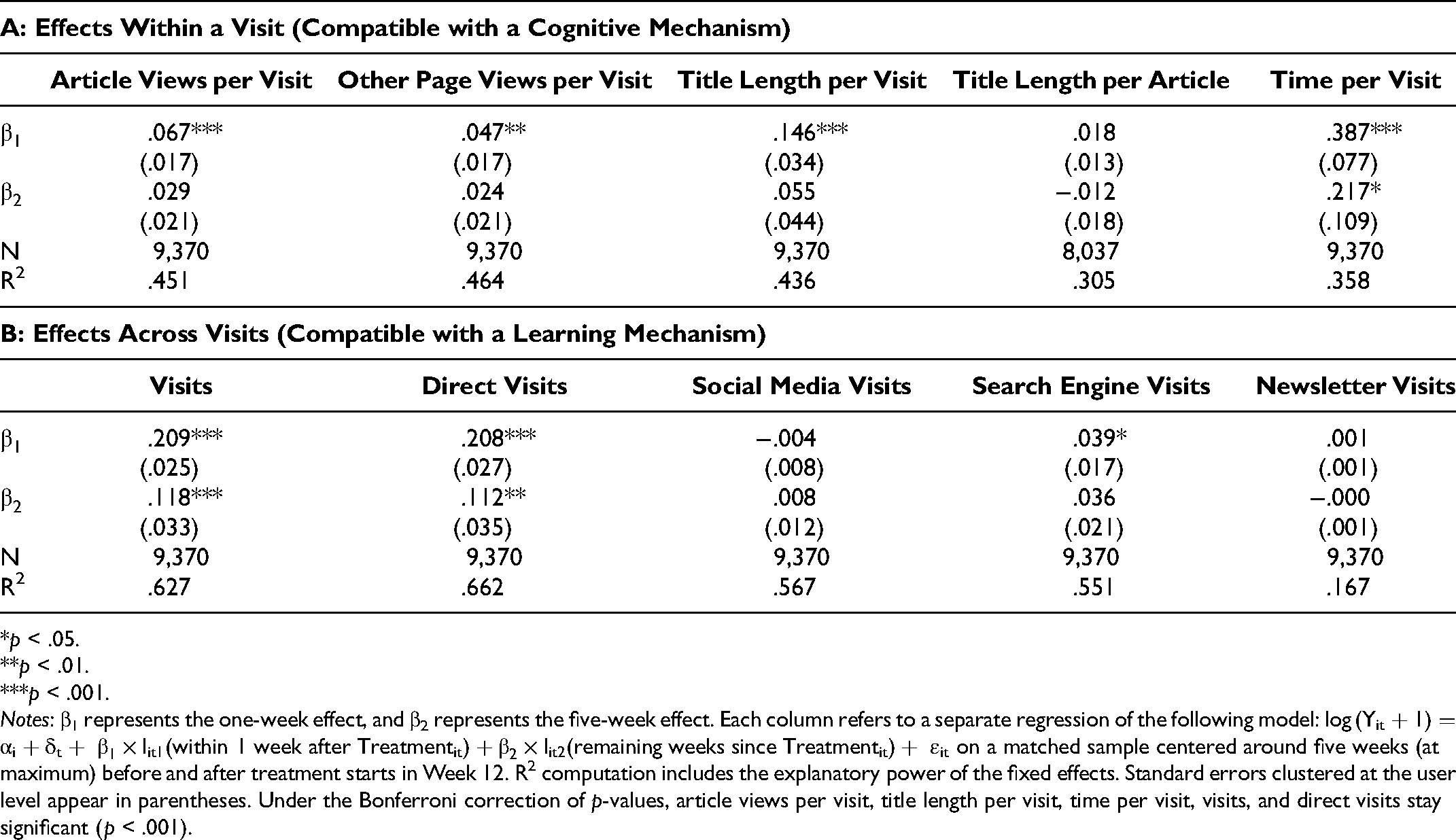
Panel A of Table 5 shows that, following ad blocker adoption, the number of article views per visit increased by only 13.9% (at the median within one week), much less than the one-week increase of 43.2% of total article views (as reported in Table 4). The median number of other page views (e.g., home page views) per visit also only increased by 7.7%. These findings suggest that the increases we observed in news consumption are not attributable, to a substantial degree, to postadoption increases in the availability of cognitive resources.
Treatment Effects on Within- and Across-Visit Measurements.
*p < .05.
**p < .01.
***p < .001.
Notes: β1 represents the one-week effect, and β2 represents the five-week effect. Each column refers to a separate regression of the following model:
To further explore how ad blocker adoption might have influenced the availability of users’ cognitive resources, we considered several additional within-visit measures of news consumption. First, we examined the possibility that ad blocker adoption enabled users to read longer or more complex articles. To this end, we scraped the titles (headlines) of all the articles that users clicked on and analyzed the length of these titles (by measuring the number of words). We assume that, for users, the titles serve as indicators of the expected length and complexity of the respective news articles. We find that the total title length across all news articles read in each visit increased by 18.6% (at the median within one week), whereas the title length per news article did not increase significantly.
In addition, we checked the effect of ad blocker adoption on time spent on the website per visit, which is an engagement metric commonly known in the industry as dwell time. We find that the median time spent per visit increased by 47.4% over one week and by 24.3% over five weeks after ad blocker adoption. This result suggests that ad blocker adoption might have enabled users to devote more attention to the articles they read, even though they did not read more news articles within each visit.
Effects Across Visits: Exploring a Learning Mechanism
The results in the previous subsection provide preliminary evidence that ad blocker adoption elicited cognitive effects among users. Yet, these effects explain only a small part of the increase in news consumption quantity after ad blocker adoption. Accordingly, an increase in the number of visits to the website must be the primary driver of the increase in the number of articles read. Indeed, we find that ad blocker adoption results in both a one-week increase and a five-week increase in website visits (see the “Visits” column in Panel B of Table 5). These effect sizes are comparable to the sizes of the effects of the treatment on article views (Table 4), which further supports the robustness of our main result.
Learning, the process of acquiring knowledge and experience about a product, provides an intuitive explanation for the increasing number of visits (Johnson, Bellman, and Lohse 2003). In particular, the usage of ad blockers may have affected users’ experience of the site (e.g., by enhancing their enjoyment), thereby encouraging them to visit it more frequently.
Hoch and Deighton (1989) suggest that learning involves actively seeking experience with a product. To explore whether users engaged in an active information-seeking process, we separately analyzed visits to the news website according to the referral sources from which the visits originated. Specifically, users could visit the news website directly (e.g., by using a bookmark or typing the URL in the navigation bar) or through an alternative referral source, such as a social media website (e.g., Facebook), a search engine (primarily Google), or an email newsletter from the newspaper publisher. As shown in Table 5, we find that the postadoption increase in article views is driven by an increase in users’ tendency to visit the news website directly, indicating an active seeking process. Notably, our observation of an active information-seeking process can also explain the observed increase in the variety of news consumption. Users might have actively sought to experience more aspects of the news website, leading them to explore additional news categories.
The results of our within-visit and across-visit analyses enable us to conjecture regarding the mechanisms underlying the observed effects of ad blocker adoption on the quantity and variety of news consumption. Specifically, these effects are more consistent with consumer learning processes than with enhanced availability of cognitive resources due to reduction of ad exposure. We emphasize, however, that because of the nature of our data, our evidence regarding the underlying mechanism is only suggestive. For instance, it is challenging to use observational data to distinguish learning processes from other positive state-dependent phenomena such as habit formation. Users who enjoy the website experience when using an ad blocker can also develop habits associated with the website. Such habits might last even longer than our observation period and represent an actual long-term effect, particularly given the inherently recurring nature of news consumption (DeFleur and Ball-Rokeach 1989). Conclusively isolating the mechanism (or mechanisms) underlying the behavioral effects we have observed is beyond the scope of this paper and constitutes an intriguing avenue for future research.
Heterogeneous Treatment Effects Across Users with Different Characteristics
To obtain a more detailed understanding of the effects observed, we reran our analyses (Equation 1) while distinguishing among users according to specific characteristics of interest. Specifically, we focused on the number of browsers used to access the website and the frequency of website usage before treatment. Table 6 presents the results.
Heterogeneous Treatment Effects Across Users with Different Characteristics.

*p < .05.
**p < .01.
***p < .001.
Notes: Each column refers to a separate regression of the following model:
Single- versus multiple-browser usage
In 2015, very few browsers blocked advertising by default. Instead, users had to install ad blockers in their browsers, and, when using multiple browsers (on a single device or across multiple devices), a user had to install an ad blocker on each browser. In addition, not all browsers enabled an ad blocking feature; for example, ad blocking was not feasible in the Apple mobile browser before September 2015, when iOS 9 launched.
In the analyses described previously, we identified ad blocker adopters according to whether they exhibited any ad blocker usage, meaning that we considered every user who blocked at least one ad. However, ad blocker usage does not necessarily imply a total absence of exposure to ads. In particular, an individual who uses multiple browsers might block ads on one browser yet view them on another. Accordingly, we might expect the effect of ad blocker adoption to be weaker among users of multiple browsers than among users who use a single (ad-blocking) browser. Our data set enables us to explore this idea, as it reveals which browser each user used to access the website.
We reran our analyses, distinguishing between users who used multiple browsers (N = 717) and those who did not (N = 605). As shown in Panel A of Table 6, we found that ad blocker adoption had a larger effect on news consumption (in terms of both quantity and variety) for single-browser users than for multiple-browser users.
We further used these data to explore whether, among users of multiple browsers, ad blocker adoption led to substitution effects across browsers. Specifically, it is possible that users of multiple browsers might have diminished their news consumption on non-ad-blocking browsers and instead consumed more news on ad-blocking browsers. To examine this possibility, we leveraged the fact that ad blocking was not possible on older versions of Apple’s mobile browser Safari (versions iOS 8 and older). In the presence of substitution effects, we would expect users who adopted ad blockers (on other browsers) to subsequently decrease their news consumption on older versions of Safari.
We reran the regression in Equation 1 with the dependent variables being article views and breadth on mobile Safari iOS 8 or below. The results are shown in the last two columns of Panel A in Table 6. In the presence of substitution effects (as defined previously), we would expect ad blocker adoption to have statistically significant negative effects on our dependent variables. Instead, the coefficients of interest are positive for both article views and breadth on non-ad-blocking browsers (mobile Safari iOS 8 or below). These effects are much smaller in economic magnitude than the effects identified in our main analysis. Nevertheless, these findings are inconsistent with substitution effects. Rather, they suggest that the positive effects of ad blocker adoption on news consumption carry over to non-ad-blocking browsers. That is, after adopting an ad blocker on one browser, multiple-browser users increase their news consumption not only on that browser but also on non-ad-blocking browsers.
Usage frequency
We examined whether the effects of ad blocker adoption on the quantity and variety of news consumption differ across users with different levels of prior experience with the website. Previous studies have found that heavy users of a particular platform are more likely than light users to engage in information- and variety-seeking behavior on that platform (Assael 2005; Gu et al. 2021). However, it is also more difficult for heavy users to increase their time on the platform even further. We reran the regression in Equation 1 separately for light users and for heavy users, defined, respectively, as users whose frequency of visiting the website was below or above the median in the pretreatment period. As shown in Panel B of Table 6, for light users, the effects of ad blocker adoption on the quantity and variety of news consumption were significant within one week and five weeks after treatment. For heavy users, however, the effects were only significant within one week after treatment. These results are consistent with a potential learning mechanism: Users who have less prior experience with the website are more strongly affected. Note that all users in our analysis had registered with the website, suggesting some level of commitment and perhaps a tendency for heavier usage compared with nonregistered users.
Summary and Conclusion
We used data from 3.1 million pseudonymized visits from 79,856 users on a news website to show that ad blocker adoption increases both the quantity (number of article views) by 21.0% to 43.2% and the variety (number of news categories) by 13.4% to 29.1% at the median, indicating that users read one to two more news articles per week and one more news category in total after adopting ad blockers. These increases are even stronger for less-experienced users of the website. Subsequent analyses revealed that the postadoption increase in the quantity of news consumption was driven by users visiting the news site more frequently, rather than by an increase in the number of articles read per visit. Furthermore, ad blocker adopters do not substitute their news consumption on browsers without an ad blocker. Instead, ad blocker adopters increase their news consumption on browsers without an ad blocker, though in much smaller magnitude.
A key contribution of this study is in providing empirical evidence regarding the relationship between ad blocker adoption and news consumption. Yet, our findings also offer broader practical insight.
First, the enhanced engagement of ad blocker users could translate into subscription revenues, which news publishers increasingly rely on. Indeed, publishers acknowledge that ad blocker users are more willing than nonusers to pay for certain kinds of subscriptions (Yeon 2020). This idea is further supported by subsequent aggregate data that we obtained from the news website, covering several years after our observation period and not included in our previous empirical analysis. The publisher introduced a paywall after our observation period. The paywall offered different subscription plans but still showed ads to all users independent of their subscription status. A year and a half after the introduction of the paywall, the subscription rate of ad blocker users was 30.13% higher than the subscription rate of nonusers of ad blockers. The potential of ad blocker users to contribute to subscription revenue is further supported by our finding that ad blocker adoption had a stronger effect on the news consumption of lighter users. This result suggests that ad blockers can “convert” light users into heavy users—who, in turn, are more likely to subscribe than light users (Anderson et al. 2020).
Publishers might also be able to enhance their revenue by focusing on the differences between ad blocker adopters and nonadopters, in terms of demographic characteristics and other traits. Our demographic analysis of the adoption decision (see Web Appendix E) showed that female and high-income users were less likely to adopt ad blockers compared with male and low-income users. Thus, the users who remained exposed to advertising on the website had a more valuable demographic profile compared with ad blocker adopters (Lambrecht and Tucker 2019). Publishers might exploit such differences, coupled with the fact that individuals who do not adopt ad blockers are likely to be more willing than adopters to endure exposure to ads. For example, a publisher could focus on selling subscriptions to ad blocker users and increase ad intensity for nonusers of ad blockers. In doing so, it might achieve higher returns in revenue (Despotakis, Ravi, and Srinivasan 2021).
Another implication of our findings is that news providers who rely on online subscription models should reconsider the current practice of displaying ads even to users who pay for subscriptions. Most subscription-based news websites offer two versions: a free version and a paid version. The free version comes with some restrictions; for example, nonpaying users can access only a subset of the content of the paid version or only a limited number of articles, whereas paying users have unlimited access. However, it is common to expose both sets of users to advertising (Lindsay 2018), despite the fact that users claim that ads interrupt the web browsing experience, slow it down, and intrude on their privacy (Sołtysik-Piorunkiewicz, Strzelecki, and Abramek 2019). Offering a paid but ad-free version of a news website could provide a subscription incentive for loyal users who wish to support the site but do not wish to endure exposure to ads (Appel et al. 2020; Westcott et al. 2019).
One limitation of our study is the short observation period, especially compared with the work of Shiller, Waldfogel, and Ryan (2018), whose data covered three years. Their study found that ad blocker usage was associated with a decrease in publishers’ traffic. Yet, we suggest that the length of the observation period is unlikely to explain the contrast between those results and our own findings regarding the positive effects of ad blocker adoption on content (news) consumption. As noted previously, we managed to obtain longer-term aggregate-level data from the news publisher, which tracked the development of the size of the online audience. These data reveal that the number of unique users per month—a key advertising-relevant metric that publishers communicate to advertisers—increased by 173% from 2015 to 2020. Various factors could have contributed to this increase in audience size. For example, the publisher introduced a paywall after our observation window; introduced new journalistic products, especially for younger target groups; and started to target readers in other countries within the same linguistic area.
Another limitation of our study is that our observations were local to a single news website, and we could not observe news consumption across multiple news publishers. Accordingly, our results may not generalize to all online news platforms, given that the impact of ad blocker adoption may differ across websites with different amounts of advertising and that user switching between news websites might introduce a substitution effect. Specifically, after adopting an ad blocker, a user might gravitate more to news websites that display more ads (which the user no longer needs to endure) and diminish news consumption on websites with fewer ads. We examine the direction of potential substitution effects across news websites, if they existed. In Web Appendix A, we show that if there was a bias from users switching news websites, then we are likely to have erred on the conservative side. Future research could investigate the effects of ad blocker adoption on aggregate news consumption across websites and how competition between websites plays out.
Footnotes
Acknowledgments
The authors thank the JMR review team for extremely valuable guidance throughout the review process. The authors also thank the anonymous news publisher for providing the data for this research project; participants of the 2019 European Marketing Academy Conference, 2019 Statistical Challenges in Electronic Commerce Research, 2019 Journal of the Academy of Marketing Science Thought Leaders’ Conference on Innovating in the Digital Economy, 2019 Marketing Science Conference, 2019 ZEW Conference on the Economics of Information and Communication Technologies, 2019 American Marketing Association Consumer Behavior Special Interest Group Conference, 2019 China Marketing International Conference, 20th Workshop on Information Systems and Economics, 2020 Annual Conference of German Academic Association for Business Research, 2020 Annual Conference of German Economic Association, 2020 Interactive Marketing Research Conference, 2020 Conference on Artificial Intelligence, Machine Learning, and Business Analytics, and 2021 American Marketing Association Summer Academic Conference; and seminar participants at Goethe University Frankfurt, Ludwig Maximilian University Munich, Queensland University of Technology, National Central University, National Tsing Hua University, Adblock Plus/Eyeo, Tel Aviv University, Hebrew University of Jerusalem, European Quant Marketing Seminar, George Mason University, Notre Dame University, Georgetown University, Santa Clara University, and Shanghai University of Finance and Economics for helpful comments. All remaining errors are our own.
Associate Editor
Catherine Tucker
Declaration of Conflicting Interests
The author(s) declared no potential conflicts of interest with respect to the research, authorship, and/or publication of this article.

Funding
The author(s) disclosed receipt of the following financial support for the research, authorship, and/or publication of this article: Klaus M. Miller acknowledges funding of the Hi!Paris Research Center for the Study of Artificial Intelligence in Business and Society.
Notes
References
Supplementary Material
Please find the following supplemental material available below.
For Open Access articles published under a Creative Commons License, all supplemental material carries the same license as the article it is associated with.
For non-Open Access articles published, all supplemental material carries a non-exclusive license, and permission requests for re-use of supplemental material or any part of supplemental material shall be sent directly to the copyright owner as specified in the copyright notice associated with the article.
