




Abstract
Consumers’ price evaluations are influenced by the left-digit bias, wherein consumers judge the difference between $4.00 and $2.99 to be larger than that between $4.01 and $3.00, even though the numeric differences are identical. This research examines when and why consumers are more likely to fall prey to the left-digit bias. The authors propose that the left-digit bias is stronger in stimulus-based price evaluations, wherein people see the focal price and the reference price side by side, and weaker in memory-based price evaluations, wherein people have to retrieve at least one price from memory. This is because in stimulus-based price evaluations, people tend to rely on perceptual representations of prices without rounding them. In memory-based price evaluations, they rely more on conceptual representations, which makes them more likely to round the prices. Results from six studies—five experiments and a scanner panel study—support the hypothesis that the left-digit bias is stronger in stimulus-based evaluations. These results inform managers about when to use left-digit pricing and characterize fundamental differences between stimulus-based and memory-based evaluations.
The practice of pricing products a few cents below round amounts has been prevalent for almost a century. Retailers set prices at, for instance, $2.99 instead of $3.00, expecting to benefit from consumers’ tendency to anchor their price magnitude judgments on left-most digits (Manning and Sprott 2009; Thomas and Morwitz 2005). This tendency, commonly referred to as the left-digit bias, has been shown to affect price evaluations (Thomas and Morwitz 2005), shape willingness to pay (Lacetera, Pope, and Sydnor 2012), and drive demand (Bhattacharya, Holden, and Jacobsen 2012; Manning and Sprott 2009; Stiving and Winer 1997), both in laboratory experiments and in real-world settings with nontrivial economic consequences. For example, buyers in the used car market pay disproportionately higher prices for cars whose mileage falls just below 10,000-mile thresholds (Lacetera, Pope, and Sydnor 2012), stock traders are more likely to buy stocks priced one penny below whole-dollar amounts (Bhattacharya, Holden, and Jacobsen 2012), and students are more likely to retake the SATs when their scores fall below multiples of 100 (Goodman, Gurantz, and Smith 2020). Further attesting to the importance of the left-digit bias, the Israeli government recently made retailers display only prices that are multiples of 10 agorot to ensure that consumers are not misled by left-digit pricing (Davidovich-Weisberg 2013).
In the present research, we examine when the left-digit bias is more likely to affect consumer judgments and decisions. Identifying the conditions that facilitate the left-digit bias is practically relevant, as it can help managers decide when to use left-digit pricing. Moreover, this question is theoretically important; studying when the left-digit bias occurs can help us understand the cognitive mechanisms that underlie price evaluations.
Building on the behavioral pricing literature (Adaval 2013; Adaval and Monroe 2002; Bagchi and Davis 2016; Cheng and Monroe 2013; Monga and Bagchi 2012; Monroe and Lee 1999; Rao 2013; Thomas and Morwitz 2009) and the cognitive psychology literature (Dehaene 1992; Dehaene and Cohen 1991; Zhou et al. 2008), we suggest that the left-digit bias is more likely to emerge in stimulus-based price evaluations, wherein people process the focal prices and the reference prices side by side, than in memory-based evaluations, wherein they retrieve at least one price from memory. This happens because in stimulus-based evaluations people rely more on perceptual representations of prices and evaluate them digit-by-digit without rounding. In contrast, in memory-based evaluations, they rely more on conceptual representations of underlying price magnitudes. As a result, they become more likely to round fractional prices to the nearest whole-dollar amounts (e.g., $2.99 to $3.00), rendering the left-digit bias less likely. Consistent with our theorizing, six studies—five experiments and a scanner panel data study—demonstrate that the left-digit bias is stronger in stimulus-based than in memory-based price evaluations.
The present set of studies contributes to the consumer behavior literature in at least two ways. First, this article outlines a framework predicting when retailers are more likely to benefit from a left-digit pricing strategy. Retailers price products a few cents below the round price (e.g., $2.98 instead of $3.00) 1 in the hope that the loss in revenues from lowering the prices will be compensated by the increase in sales because of the left-digit bias. Our results suggest that such left-digit pricing strategy is more likely to succeed when consumers make stimulus-based price evaluations. As such, left-digit pricing is more likely to boost sales when retailers facilitate stimulus-based evaluations by providing reference prices on their price tags (e.g., was $4.00, now $2.99); or when they target light users of a category who do not have readily accessible memory-based reference prices and are thus prone to rely on stimulus-based price evaluations.
Second, although the present work focuses on price evaluations, it contributes to the broader debate on how stimulus- and memory-based evaluations affect judgment accuracy (Raghubir and Krishna 1996; Rottenstreich, Sood, and Brenner 2007; Schley, Lembregts, and Peters 2017). Some researchers have argued that by reducing effortful retrieval from memory, stimulus-based evaluations tend to produce more accurate judgments (Rottenstreich, Sood, and Brenner 2007). Yet, others have found that stimulus-based evaluations can reduce judgment accuracy by increasing the salience of irrelevant information (e.g., Raghubir and Krishna 1996; Schley, Lembregts, and Peters 2017). We propose that stimulus-based evaluations will accentuate judgment biases that are driven by perceptual features of the stimuli. In contrast, memory-based judgments, which rely on conceptual representations, should reduce such biases. By highlighting how stimulus-based evaluations increase biases induced by perceptual features, the present research offers a richer understanding of how evaluation modes affect everyday judgments.
Conceptual Framework
Our main hypothesis is that the left-digit bias is more likely in stimulus-based than in memory-based price evaluations. To understand the basis for this prediction, it is critical to distinguish between perceptual and conceptual representations of multidigit prices. 2
Perceptual and Conceptual Representation of Price
Cognitive and social psychologists have characterized the differences between perceptual and conceptual routes of stimulus processing in a variety of domains (Jacoby 1983; Lee 2002; Lee and Labroo 2004; Miceli et al. 2014). Words can be encoded and stored perceptually as letter strings, whereby the reader must rely on a visual analysis of the word to identify it; or they can be processed conceptually, in terms of their meaning (Jacoby 1983; Lee and Labroo 2004). For example, the word ROBIN can be encoded and stored as a five-letter stimulus with three consonants, R, B, N, and two vowels, O and I, or in terms of its meaning as a songbird with a reddish-orange breast. A similar dichotomy is observed in visual stimulus processing whereby image recall and evaluation are influenced by perceptual (e.g., shape of a circle with six lines) and conceptual image features (e.g., association with a steering wheel) (Miceli et al. 2014; Schwartz and Yovel 2016); and in processing of more complex stimuli such as brand extensions that can be evaluated on the basis of either their perceptual fit (e.g., extension with a similarly sounding name) or their conceptual fit (e.g., extension into a semantically similar category) (Zhang and Sood 2002).
Following the same logic, cognitive psychologists interested in numerical cognition and consumer psychologists studying pricing have argued that multidigit numbers and prices can be represented in terms of their perceptual or conceptual attributes (e.g., Dehaene 1992; Monroe and Lee 1999; Thomas and Morwitz 2005). Perceptually, a multidigit price is represented as a sequence of digits (e.g., 2.99 as two nine nine) and conceptually as the underlying magnitude (≈3). As such, perceptual price representations are akin to pin-codes, digit sequences with a precise structure. Conceptual representations, by contrast, are rough representations of underlying magnitude that can be approximated to the nearest accessible round numbers.
We propose that the left-digit bias in price evaluations will be stronger when consumers rely on precise perceptual representations of price and weaker when they rely on approximate conceptual representations. Consider an evaluation of the difference between $4.00 and $2.99. Focusing on the precise perceptual representations, consumers would begin by comparing the left digits 4 and 2, instead of comparing the rounded magnitudes of 4 and 3, resulting in the left-digit bias. In contrast, when focusing on conceptual representations of price, people should be more prone to round $2.99 to $3.00, as 3 is very similar to $2.99 in terms of underlying magnitude. As rounding up becomes more likely, the left-digit bias should diminish.
Stimulus-Based and Memory-Based Evaluations
We argue that memory-based evaluations make people less likely to rely on the precise perceptual representations of price (e.g., $2.99) and more likely to rely on its approximate conceptual representations (≈3). We base this prediction on convergent evidence from several domains: object recognition studies comparing the roles of perceptual and conceptual features in stimulus- and memory-based tasks; Stroop interference studies conducted in stimulus- and memory-based settings; and, finally, price recall studies examining the accessibility of precise and approximate price representations in memory-based tasks. We discuss the evidence from these domains next.
Visual object recognition studies comparing stimulus-based and memory-based judgments show that in memory-based judgments people are more likely to rely on conceptual features than on perceptual ones (Lee 2002; Melkman, Tversky, and Baratz 1981). An early categorization study by Melkman, Tversky, and Baratz (1981) demonstrated that young children grouped objects in terms of their perceptual features, such as color and form, during stimulus-based encoding. Yet, while retrieving the information from memory, they benefited more from conceptual cues than from perceptual ones (e.g., “Can you remember any clothing objects?” vs. “Can you remember any red objects?”). That is, whereas perceptual features dominated the stimulus-based task, conceptual features dominated the memory-based one. Similar insights were obtained in the brand-choice context (Lee 2002). Perceptual processing of a brand name increased brand choice in stimulus-based tasks, whereas conceptual processing increased brand choice in memory-based tasks, again supporting the notion that reliance on perceptual representations is lower in memory-based judgments than in stimulus-based ones.
Further, Stroop interference studies suggest that memory-based processing reduces interference from task-irrelevant attributes of stimuli. When people have to focus on a given stimulus attribute (e.g., the ink color of a color word) while ignoring another one (e.g., what the color word says), they take longer to name the color when stimulus attributes are in conflict (e.g., blue ink color for the word “red”). Importantly, this effect is stronger in stimulus-based tasks, where color words are present on the screen, than in memory-based tasks, where people have to retrieve the stimuli from memory (La Heij, Heiden, and Plooij 2001; Roelofs 2011). Similar to letters interfering with color judgments in the Stroop task, individual digits can interfere with price-magnitude judgments. As such, we expect that the interference from digit-by-digit perceptual representations of price will be reduced in memory-based price evaluations.
Last, and more directly pertinent to our theorizing, evidence from studies on price and number processing also supports our thesis that memory-based judgments rely less on perceptual features and more on conceptual representation of magnitude. Several studies have shown that even a few seconds after being exposed to a price, many consumers cannot retrieve it digit-by-digit (Dickson and Sawyer 1990; Le Boutillier, Le Boutillier, and Neslin 1994), suggesting that perceptual price representations fade rapidly in memory. However, conceptual price representations are more intact: Vanhuele and Drèze (2002) find that while few consumers (2.1%) can correctly recall exact prices of previously seen products, many consumers (37.2%) can correctly indicate whether a given price is “a special price.” Put differently, whereas people cannot retrieve the precise representations of prices, they can retrieve their underlying magnitudes. Similarly, Kyung and Thomas (2016) show that after the initial encoding, prices are stored as approximate magnitudes, rather than digit-by-digit, in consumers’ memory. In fact, they report a paradoxical result that trying to retrieve precise perceptual representations of price (e.g., whether a product’s price was $2.99 or $2.95) disrupts memory for approximate price magnitudes (e.g., whether it was higher or lower than $3), and, consequently, reduces the accuracy of memory-based price evaluations.
Evaluation Mode and the Left-Digit Effect
Drawing on the aforementioned streams of literature, we posit that depending on how people evaluate product prices—using stimulus-based or memory-based evaluations—their propensity to rely on perceptual and conceptual price representations will vary. Stimulus-based price evaluations will prompt the reliance on precise perceptual representations, whereas memory-based evaluations will prompt the reliance on approximate conceptual representations of price. The more people rely on precise perceptual representations, the less likely they are to round fractional prices and the more likely they are to fall prey to the left-digit bias. Formally,
To assess the robustness of the proposed hypothesis, we consider the effect of left digits not only on subjective magnitude judgments but also on the response times for such judgments. Whereas subjective magnitude judgments rely on self-reports from participants, response times are more autonomous and more indicative of nonconscious cognitive mechanisms underlying numeric judgments (Dehaene 1992; Zhou et al. 2008). Thus, as convergent evidence for the effect of evaluation mode on the left-digit bias, we propose that left digits will affect response times more in stimulus-based than in memory-based evaluations.
Consider two price pairs: “$4.00 and $2.99” and “$4.00 and $3.01.” In stimulus-based evaluations, people will compare the perceptual representations of prices digit-by-digit, without rounding the numbers. In the first pair, comparing $4.00 and $2.99 digit-by-digit will produce a biased initial judgment (i.e., 4 − 2 = 2). This initial judgment will then have to be corrected to produce a correct, unbiased evaluation. In the second pair, digit-by-digit evaluation without rounding will produce an initial response (i.e., 4 − 3 = 1) that will not require further correction. Thus, in stimulus-based evaluations, participants should take more time to compare numbers whose left digits lead to biased evaluations than to compare numbers whose left digits do not bias evaluations.
By contrast, in memory-based evaluations, instead of comparing the perceptual representations of prices, people will focus on the underlying approximate magnitudes (≈4 and ≈3) and round the numbers. That is, they will compare both “$4.00 and $2.99” and “$4.00 and $3.01” as 4 and 3, spending similar amounts of time evaluating both pairs. Thus, in memory-based evaluations, the response times should be similar for numbers whose left digits bias evaluations and for numbers whose left digits do not. Formally, we hypothesize as follows:
Managerial Implications
Having explained how evaluation mode—stimulus-based or memory-based—affects the left-digit bias, we next turn to when shoppers are likely to rely on stimulus-based and memory-based evaluations of prices. Reference price research shows that consumers tend to evaluate a given price by comparing it with some reference. Such reference can be a stimulus-based reference price at the point of purchase (“How does this price compare with the competing brand’s price?”) or a memory-based reference price retrieved from memory (“How does this price compare with the price I paid last week?”) (Mazumdar, Raj, and Sinha 2005; Winer 1986). Importantly, whether consumers will rely on stimulus-based or memory-based reference prices depends on the shopping context as well as on consumer characteristics.
When retailers provide a salient stimulus-based reference price on the price tag (e.g., today’s price $2.99, was $4.00), consumers should be more likely to rely on stimulus-based price evaluations. That is, they will compare the offer price with the reference price available on the price tag. In doing so, they are likely to rely on perceptual price representations and compare prices without rounding. In contrast, when stimulus-based reference prices are not provided, consumers have to rely on memory-based reference prices to evaluate the offer price. Because memory-based reference prices are usually stored as approximate conceptual representations (Kyung and Thomas 2016; Vanhuele and Drèze 2002), digit-by-digit comparison of the focal and the reference prices is less likely. Thus, consumers should become more likely to round the focal price, and the left-digit bias should diminish. In summary, we postulate that providing salient stimulus-based reference prices can increase the left-digit bias in price evaluations. Formally,
Moreover, reliance on stimulus- or memory-based reference prices can vary with consumer characteristics. Light users of a category, those shopping less frequently and spending less in a given category, are likely to have less-developed price knowledge and to be less confident in it. As a result, they should be more likely to compare prices with other displayed shelf prices, as opposed to prices retrieved from memory. In contrast, heavy users of a category, those shopping more frequently and spending more in a given category, develop better price knowledge through repeated exposure to and evaluation of prices (Rajendran and Tellis 1994; Thomas and Menon 2007). Thus, they should rely less on stimulus-based reference prices and more on memory-based ones. Given this difference in the propensity to rely on stimulus-based reference prices across heavy and light users, we hypothesize as follows:
Overview of Studies
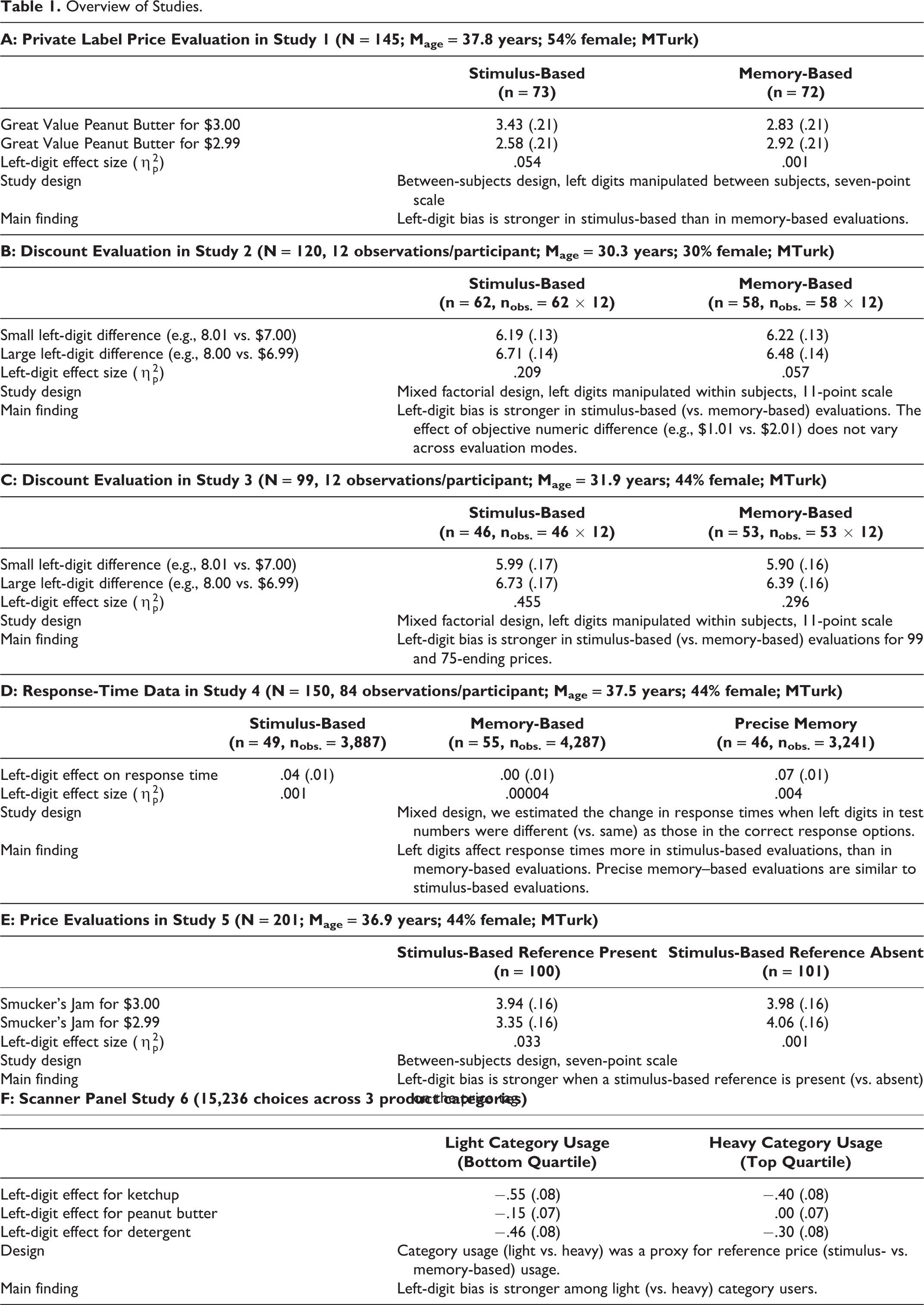
Table 1 features an overview of our studies and main findings. Studies 1–3 provide evidence for our primary hypothesis that the left-digit bias is stronger in stimulus-based than in memory-based price evaluations. These studies also rule out several alternative accounts. Study 4 examines the underlying process using response-time data. Studies 5 and 6 demonstrate the managerial implications of our findings. With the exception of the response-time Study 4, the experimental studies reported in the article did not exclude any observations. 3
Overview of Studies.
Study 1: Stimulus- and Memory-Based Price Evaluations
Study 1 tested whether the left-digit bias will be stronger in stimulus-based than in memory-based evaluations in a grocery store price-evaluation scenario.
Method
Participants and procedure
One hundred forty-five Amazon Mechanical Turk (MTurk) panelists (Mage = 37.8 years; 54% female) took part in this study. The study employed a 2 (left-digit difference: small vs. large) × 2 (evaluation mode: stimulus-based vs. memory-based) between-subjects design.
Participants read that “a large retail chain that is planning to open a store wants to know consumers’ opinions about store brands versus premium brands.” They read that they would “see pairs of brands from 5 different product categories” and “evaluate the price of the store brand (Great Value) relative to the price of the premium brand.” Of the five categories, the first four were fillers and were identical across all experimental conditions. Filler categories were used to make the task similar to a typical grocery shopping experience where people make multiple price evaluations. In each category, the premium-brand product was priced higher than the store-brand product (see Web Appendix A). The fifth category had the test stimuli—a premium brand and a store brand of peanut butter.
Left-digit difference was manipulated in the test stimuli such that the difference between the left digits of the premium brand and the store brand was smaller in the small-left-digit-difference condition ($4.01 vs. $3.00) and larger in the large-left-digit-difference condition ($4.00 vs. $2.99). Note that the actual price differences were identical in the two conditions ($1.01). Participants had to evaluate the magnitude of the store-brand price on a seven-point scale anchored on “very low” (1) on the left and “very high” (7) on the right.
Evaluation mode was manipulated such that participants in the stimulus-based condition saw the premium- and store-brand products simultaneously on the computer screen, with the seven-point price evaluation scale placed at the bottom of the screen. In contrast, participants in the memory-based condition saw each of the two products appear on the screen one by one, the premium brand before the store brand, with each product price followed by an asterisk (see Web Appendix B). The asterisk was used to clear participants’ visuospatial sketchpads and make it more difficult for them to retain precise perceptual representations in memory (Baddeley and Hitch 1974).
Results
A two-way analysis of variance (ANOVA) revealed a significant interaction between left-digit difference and evaluation mode (F(1, 141) = 4.84, p = .029). Simple contrasts revealed that, in the stimulus-based condition, when the difference between the left digits of the premium- and the store-brand prices was small (“$4.01 vs. $3.00”), the price of the store brand was evaluated as higher, compared with when the difference between the left digits of the premium- and the store-brand prices was large ($4.00 vs. $2.99; M$4.01 vs. $3.00 = 3.43 vs. M$4.00 vs. $2.99 = 2.58; F(1, 141) = 8.08, p = .005). This effect was not significant in the memory-based condition (M$4.01 vs. $3.00 = 2.83 vs. M$4.00 vs. $2.99 = 2.92; F(1, 141) = .08, p = .782). For a full summary of model results for this and the remaining price evaluation-studies, see Table 2.
Price-Evaluation Studies: Summary of Model Results.*

Notes: The effects that were hypothesized or tested to rule out alternative accounts are marked in boldface.
Discussion
Study 1 shows that the left-digit bias in price evaluations varies across stimulus-based and memory-based tasks. The left-digit bias was significant in stimulus-based evaluations, where participants were expected to rely more on precise perceptual representations of numbers. The bias was reduced in memory-based evaluations, where participants were expected to rely more on approximate conceptual representations.
An alternative explanation for the observed results could be that memory-based evaluation attenuated the left-digit bias because this evaluation reduced participants’ confidence and increased scale-midpoint responding. The next study was designed to rule out this alternative explanation and to replicate our result in a different context.
Study 2: Memory and Stimulus-Based Discount Evaluations
The first goal of Study 2 was to conceptually replicate the results of Study 1 in a different context. Whereas Study 1 used a store-brand price-evaluation scenario, Study 2 used a discount evaluation scenario where people assessed differences between regular and sale prices.
The second goal of Study 2 was to rule out lower confidence in memory-based evaluations as an alternative explanation for Study 1’s results. One could argue that memory-based evaluations reduce participants’ confidence in their numeric evaluations, making them more prone to rate all numeric magnitudes toward the midpoint of the response scale. To illustrate, whereas a confident participant in the stimulus-based condition would rate $3.99 and $4.00 as 5 and 7, respectively, on an 11-point scale, a less confident participant in the memory-based condition would rate them both as 6. This propensity for scale-midpoint responding in memory-based evaluations could, in turn, reduce the difference between small- and large-left-digit-difference conditions and attenuate the left-digit bias.
To rule out the scale-midpoint-responding account in Study 2, in addition to the two focal factors used in Study 1, we introduced a third factor—the magnitude of numeric difference between the prices. Participants saw 12 pairs of regular and sale prices (6 with small left-digit difference; 6 with large left-digit difference) and rated the differences between regular and sale prices in each pair. Numeric differences varied between $1.01 ($8.01 vs. $7.00, $8.00 vs. $6.99) and $6.01 ($8.01 vs. $2.00, $8.00 vs. $1.99). If scale-midpoint responding was reducing the left-digit bias in memory-based evaluations, we would expect not only a weaker effect of left-digit difference but also a weaker effect of numeric difference in this evaluation mode, with all ratings becoming closer to the scale midpoint. For instance, while a confident participant in the stimulus-based condition would rate the differences between “$8.01 vs. $5.00” and between “$8.01 vs. $4.00” as 5 and 7, respectively, on an 11-point scale, a less confident participant in the memory-based condition would rate them both as 6. Thus, the effect of numeric difference on evaluations would diminish in the memory-based condition. In contrast, if the left-digit bias diminishes because participants in the memory-based condition rely on approximate conceptual representations and round the prices more, the memory-based condition should mitigate the left-digit bias but not the effect of numeric difference.
Method
Participants and procedure
One hundred twenty MTurk panelists (Mage = 30.3 years; 30% female) took part in this study, with each participant rating 12 price pairs (Table 3 presents the stimuli for Studies 2 and 3). The study employed a 2 (left-digit difference: small vs. large) × 2 (evaluation mode: stimulus-based vs. memory-based) × 6 (numeric difference: 6 levels) mixed factorial design, with evaluation mode as a between-subjects factor and left-digit difference and numeric difference as within-subject factors. Thus, this study had a total of 1,440 observations (120 × 2 × 6 = 1,440).
Stimuli Used in Studies 2 and 3.

Participants read that they would complete a “discount evaluation” study where they would see pairs of regular and sale prices. They were asked to evaluate how small or large each difference between regular and sale prices (i.e., the discount) was on an 11-point scale (1 = “small,” and 11 = “large”). As in Study 1, participants in the stimulus-based condition saw the regular and the sale prices simultaneously, the regular price above the sale price, with the price-difference evaluation scale placed at the bottom of the screen. Participants in the memory-based condition saw the prices one by one, the regular price before the sale price, with each price followed by an asterisk. The evaluation scale appeared on a separate screen.
Results
To test the effect of evaluation mode on the left-digit bias, we conducted a 2 × 2 × 6 mixed factorial ANOVA on price-difference evaluations. The analysis revealed a marginally significant interaction between left-digit difference and evaluation mode (F(1, 118) = 3.86, p = .052). Simple contrasts indicated that the left-digit bias was stronger in stimulus-based evaluations (Msmall LDD = 6.19 vs. Mlarge LDD = 6.71; F(1, 118) = 31.14, p < .001) than in memory-based evaluations (Msmall LDD = 6.22 vs. Mlarge LDD = 6.48; F(1, 118) = 7.09, p = .009; Figure 1, Panel A). Consistent with our predictions, the left-digit bias affected discount perceptions more in stimulus-based (vs. memory-based) evaluations.
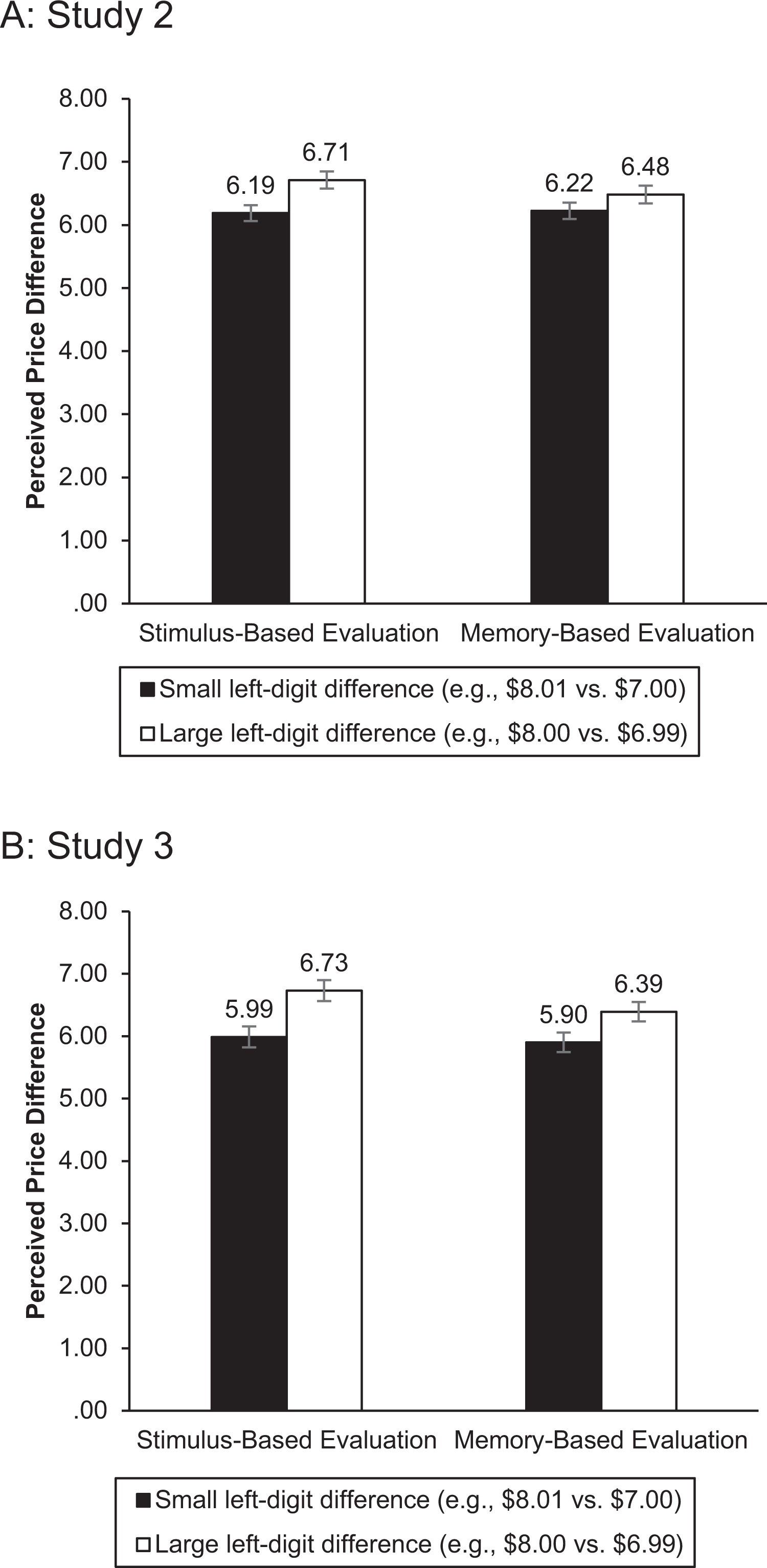
Studies 2 and 3: The left-digit bias is stronger under stimulus-based evaluation.
Scale-midpoint responding account
As mentioned previously, the alternative account posits that, being less confident in memory-based judgments, people could be more prone to give scale-midpoint ratings to all price pairs. If the scale-midpoint-response account were true, we would expect price-difference evaluations to be less sensitive to numeric differences in the memory-based condition. This was not the case. The analysis revealed a main effect of numeric difference (F(2.77, 336.27) = 353.62, p < .001) but no interaction between numeric difference and evaluation mode (F < 1). That is, numeric difference had an equally strong effect on price-difference evaluations in the stimulus-based and memory-based conditions, counter to the scale-midpoint-response account. Web Appendix C presents the means for price-difference evaluations in stimulus-based and memory-based conditions across all 12 price pairs.
Discussion
Study 2 demonstrates that the left-digit bias affects discount evaluations in a stimulus-based task, but this effect is weaker in a memory-based task. Importantly, memory-based evaluations did not change participants’ sensitivity to the numeric differences between prices. Thus, this study rules out the alternative account that the mitigation of the left-digit bias in the memory-based condition is due to scale-midpoint responding caused by lower confidence.
Study 3: Ruling Out “99 = Sale Sign” Account
Studies 1 and 2 showed that people were more affected by prices’ left digits in stimulus-based than in memory-based price evaluations. In both studies, low-left-digit prices had “99” endings ($2.99 in Study 1; $1.99–$6.99 in Study 2) and high-left-digit prices had “00” endings ($3.00 in Study 1; $2.00–$7.00 in Study 2). An alternative explanation for findings from Studies 1 and 2 is that the more cognitively taxing memory-based evaluations made people less likely to infer that 99-ending prices were promotional prices. Indeed, Rottenstreich, Sood, and Brenner (2007) found that people are less likely to make inferences from price information (e.g., infer quality from price) in memory-based evaluations. In the same way that consumers use higher prices as a signal of superior quality, they may use 99-endings as a signal of promotions or deals (Schindler 2006). If memory-based evaluation makes people less likely to consider 99-endings as a signal of promotions or deals, it can produce results similar to those of Studies 1 and 2. In Study 3, to rule out this alternative account, we tested the effect of evaluation mode on the left-digit bias using 99- and 75-ending prices. If memory-based evaluation makes people less likely to consider 99-endings as a signal of promotions or deals, it should reduce the left-digit bias for 99- but not for 75-ending prices. In contrast, if memory-based evaluation makes people rely on approximate conceptual price representations, it should reduce the left-digit bias for both 99- and 75-ending prices.
Method
Participants and procedure
Ninety-nine MTurk panelists (Mage = 31.9 years; 44% female) took part in this study, with each participant rating 12 price pairs. The study employed a 2 (left-digit difference: small vs. large) × 2 (evaluation mode: stimulus-based vs. memory-based) × 3 (numeric difference: 3 levels) × 2 (right digits: 99 vs. 75) mixed factorial design. Evaluation mode was a between-subjects factor. Left-digit difference, numeric difference, and right digits were within-subject factors. Study 3 had a total of 1,188 observations (99 × 2 × 3 × 2 = 1,188).
The procedure in this study was identical to that applied in Study 2. Participants saw 12 price pairs and evaluated differences between regular and sale prices on an 11-point scale. In addition to manipulating evaluation mode (stimulus-based vs. memory-based), left-digit difference (small vs. large), and numeric difference (small [≈1], medium [≈3], and large [≈5]), we manipulated prices’ right digits. Specifically, for half of the prices, the right digits were equal to 01 (small-left-digit-difference pairs) or 99 (large-left-digit-difference pairs); for the other half of the prices, the right digits were equal to 25 (small-left-digit-difference pairs) or 75 (large-left-digit-difference pairs). Table 3 presents the stimuli used in Study 3.
Results
A 2 × 2 × 3 × 2 mixed factorial ANOVA on price difference evaluations revealed a significant interaction between left-digit difference and evaluation mode (F(1, 97) = 5.00, p = .028). Simple contrasts showed that the left-digit bias was stronger in stimulus-based evaluations (Msmall LDD = 5.99 vs. Mlarge LDD = 6.73; F(1, 97) = 80.99, p < .001) than in memory-based evaluations (Msmall LDD = 5.90 vs. Mlarge LDD = 6.39; F(1, 97) = 40.70, p < .001; Figure 1, Panel B). The three-way interaction between left-digit difference, evaluation mode, and right digits was not significant (F < 1). Thus, counter to the “99 = sale sign” account, memory-based evaluation reduced the left-digit bias for 99-ending numbers as well as for 75-ending numbers. Moreover, as in Study 2, the interaction between evaluation mode and numeric difference was not significant (F(2, 96) = 1.00, p = .37), ruling out the possibility that memory-based evaluation mitigated the left-digit bias due to scale-midpoint responding. For an additional discussion of Study 3’s results that are not directly pertinent to our hypotheses, see Web Appendix D.
Discussion
Study 3 demonstrates that memory-based processing reduced the left-digit bias for both 99- and 75-ending prices. In doing so, the study rules out the “99 = sale sign” account of the observed results. In summary, Studies 1–3 showed that the left-digit bias was reduced in memory-based evaluation, an effect attributed to reliance on approximate conceptual representations in memory-based conditions, in support of H1a. Study 4 tests the proposed process directly.
Study 4: Response Time in Number-Magnitude Judgments
The study had three objectives. First, the study tested H1b by examining the effect of left digits on response times across stimulus-based and memory-based number evaluations. Participants were shown several fractional numbers such as 6.99 and 6.09, one at a time on the computer screen (“test numbers” hereinafter). They had to choose which of the four round numbers—5.00, 6.00, 7.00, 8.00—was the closest in magnitude to the test number. Some of the test numbers had lower left digits than the correct responses.
Consider two fractional numbers 6.99 and 6.09. Participants in the stimulus-based condition, relying on precise perceptual representations, would evaluate both these numbers starting with the left digit, 6. As a result, when evaluating 6.99, the initial response would be to select 6 as the closest number. Yet, upon realizing that 7.00 is the closest to 6.99, participants would have to correct their initial response. In contrast, for 6.09 no such correction would be needed. As a result, it should take people longer to produce the correct response for 6.99 than to produce the correct response for 6.09. More generally, we expected that participants in the stimulus-based condition would take longer to make magnitude judgments for test numbers with left digits different from those of the correct response option (e.g., 6.99), than for test numbers with left digits that were the same as those of the correct response option (e.g., 6.09).
In contrast, participants in the memory-based condition, relying on approximate conceptual number representations, should be less affected by the left digits. They would instinctively round 6.99 to 7.00 when evaluating its magnitude. Thus, it should take them similar amounts of time to judge that 6.99 is the closest to 7.00 and that 6.09 is the closest to 6.00.
Second, this study allowed us to rule out a plausible alternative account that memory-based evaluation reduces the left-digit bias because of more deliberative processing. It could be argued that participants in the memory-based condition are more deliberative and that it is this increased deliberation that reduces the left-digit bias in their judgments. To rule out this possibility, we tried to ensure similar amounts of deliberation in magnitude judgments across stimulus-based and memory-based conditions using a speed-and-accuracy bonus.
Third, the study was designed to provide direct evidence for the proposed mechanism. Our conceptualization posits that the difference in the left-digit effect across stimulus-based and memory-based evaluations is driven by the propensity to use rounded numbers, as opposed to precise numbers, in memory-based evaluations. Following this logic, if we instruct participants in the memory-based condition to retain the precise numbers in their memory, their evaluations should become similar to stimulus-based evaluations. To test this, in the current study we introduced an additional memory-based condition (the precise memory–based condition) that required participants to recall precise numbers after making number-magnitude judgments.
Method
One hundred fifty MTurk panelists (Mage = 37.5 years; 44% female) took part in this study. The study employed a 2 (left-digit: same vs. different) × 3 (evaluation mode: stimulus-based vs. memory-based vs. precise memory–based) mixed design. Left digits were manipulated within subjects, and evaluation mode was manipulated between subjects.
The effect of left digits on response times was assessed in a magnitude judgment task. Participants read that they would see a set of test numbers one by one and would have to choose which of the four numbers—5.00, 6.00, 7.00, 8.00—was the closest in magnitude to the test number as fast as possible. Participants made magnitude judgments by tapping one of four keys, d, f, j, or k, that represented the four responses (d = 5.00, f = 6.00, j = 7.00, k = 8.00) on their keyboard. For 36 test numbers, the left digit was different from that in the correct response option (hereinafter “different-left-digit” numbers). For the remaining numbers, the left digit was the same as that in the correct response option (hereinafter “same-left-digit” numbers; for the full stimuli set, see Web Appendix E). The numbers were presented in random order.
To ensure similar amounts of deliberation across experimental conditions, we introduced a speed-and-accuracy bonus. Before the main task, participants read that if they were correct on over 90% of the trials and completed the magnitude judgment task in under 90 seconds, they would get a bonus. Then they completed ten practice trials and received feedback after each trial.
Evaluation mode was manipulated between subjects. Participants in the stimulus-based condition saw test numbers in the center of the screen above the response options, one number at a time. After tapping one of the response keys, they automatically moved to the next screen with a different test number. For example, if they saw “6.99” in the center of the screen, they would tap “j” to indicate that “6.99” is closest to “7.00” in magnitude. Their response times on each trial were recorded as the time to the first keystroke (i.e., time to produce a response). Web Appendix F presents a schematic overview of the study procedure.
Participants in the memory-based condition also saw test numbers in the center of the screen, one by one. However, they produced their responses on a separate screen, without having the test numbers present in front of them. To proceed from the number-presentation page to the response page, participants had to tap the “d” key on their keyboards. On the response page they had to tap one of the four response keys (d, f, j, k). For example, if participants saw “6.99” on the presentation screen, they would tap “d” to proceed to the response page and tap “j” on the response page to indicate that “6.99” is closest to “7.00” in magnitude. 4 The participants’ response times in the memory-based condition were computed as the time to the first keystroke on the presentation page plus the time to the first keystroke on the response page.
Finally, participants in the precise memory–based condition saw test numbers in the center of the screen, one by one, followed by two response pages. They proceeded from the presentation page to the response pages by tapping the “d” key on their keyboards. On the first response page, they would tap one of the four response keys (d, f, j, k) to indicate which number was closest in magnitude to the number they saw on the presentation page. On the second response page, they had to recall the exact number they had seen on the presentation page. For example, if participants had seen “6.99” on the presentation page, they would tap “d” to proceed to the first response page with options “5.00 6.00 7.00 8.00.” There they would have to tap “j” to indicate that “6.99” is closest to “7.00” in magnitude. Next, they would automatically proceed to the second response page with options “6.69 6.79 6.89 6.99.” There they would tap “k” to indicate that the number they had seen earlier was “6.99.” Participants’ response times in the precise memory–based condition were computed as the time to the first keystroke on the presentation page plus the time to the first keystroke on the first response page only. Because participants in this condition had to retain the precise test numbers in memory during magnitude judgments, we expected them to be slower than those in the other two conditions.
Results
Before analyzing the data, we filtered out incorrect response trials (8.40%), log-transformed the data and trimmed it at three standard deviations from the respective means in the three evaluation-mode conditions (1.00%). The final data set comprised 11,415 observations. For data on participant handedness, bonuses, and error rates, see Web Appendix G.
Pairwise t-tests on participants’ average response times on same-left-digit and different-left-digit trials indicated that the left-digit effect was significant in the stimulus-based condition (Msame left digit = .04 vs. Mdiff. left digit = .08; t = 3.02, p = .004). Participants took more time to respond to numbers that had different left digits from the correct response. Importantly, the effect was not significant in the memory-based condition (Msame left digit = .03 vs. Mdiff. left digit = .03; t = −.12, p = .908). The effect was again significant in the precise memory–based condition (Msame left digit = .53 vs. Mdiff. left digit = .61; t = 6.79, p < .001).
Next, we analyzed the data using a mixed linear model accounting for repeated responses from participants. Log-transformed response times for a given participant on a given trial served as the dependent variable. Left digits (0 = same, 1 = different), memory-based evaluation dummy (1 = memory-based, 0 = otherwise), precise memory–based evaluation dummy (1 = precise memory–based, 0 = otherwise), and the two interactions between left-digit and evaluation-mode dummies were the independent variables.
The simple effect of different left digits was significant (b = .04, SE = .01, p < .001). Thus, in the stimulus-based condition, when the left digits in the test number and the correct response option were different (vs. same), participants took longer to select the correct response. The predicted two-way interaction between left digits and the memory-based evaluation dummy was significant and negative (b = −.03, SE = .01, p = .024), suggesting that memory-based processing reduced the left-digit bias. The interaction between left digits and the precise memory–based evaluation dummy was also significant but positive (b = .03, SE = .02, p = .028), suggesting that retaining the precise digits in memory exacerbated the left-digit bias.
Deliberation
We also examined average response times across the three evaluation-mode conditions to probe the increased-deliberation account. Running counter to the increased-deliberation account, the response times were similar across stimulus-based and memory-based evaluations (Mstimulus-based = .05 vs. Mmemory-based = .03; p = .821). Furthermore, as we expected, retaining the precise digits in memory increased response times in precise memory–based evaluations (Mstimulus-based = .05 vs. Mprecise memory–based = .55; p < .001).
Discussion
Using an incentive-compatible procedure, Study 4 demonstrates that the left-digit bias influences response times in stimulus-based judgments but not in memory-based judgments, in line with H1b. The results also provide process evidence. We proposed that the left-digit bias diminishes in memory-based evaluations because these evaluations reduce the reliance on precise perceptual representations of numbers. In line with this account, when memory-based evaluations required increased focus on precise number representations, these evaluations no longer reduced the left-digit bias.
Finally, the study rules out increased deliberation as the driver of our results. Contrary to the increased-deliberation account, memory-based evaluation reduced the effect of left digits without increasing participants’ response times. Moreover, in the precise memory–based condition, where participants were taking longer to produce their responses, the effect of left digits emerged again. Thus, it is unlikely that memory-based evaluation reduces the left-digit effect due to increased deliberation.
Study 5: Price Tags with Stimulus-Based Reference Prices
Studies 1–4 demonstrated that the left-digit bias manifests in stimulus-based evaluations but does not manifest, or is considerably weakened, in memory-based evaluations. In Study 5 we aimed to test a critical managerial implication of this finding.
Retail store managers can influence whether consumers evaluate a given price using stimulus-based or memory-based evaluations. For example, they can facilitate stimulus-based evaluations by providing a salient reference price on the price tag. Our theory suggests that price tags featuring reference prices will boost the effectiveness of left-digit pricing compared with tags not featuring stimulus-based reference prices (H2a). Study 5 tests this prediction.
Method
The study adopted a 2 (left digit of offer price: low vs. high) × 2 (evaluation mode: stimulus-based reference present vs. absent) between-subjects design.
In the main task, participants rated a price of a focal product—Smucker’s plum jam—on a 1 (“very low”) to 7 (“very high”) scale. The product was priced at $2.99 for half of the participants and at $3.00 for the other half of the participants. For participants in the stimulus-based reference present condition, the regular price of the product was added to the price tag. The reference price was absent for the remaining participants (see Figure 2).

Study 5: Stimuli used across experimental conditions.
Results
Two hundred one MTurk panelists completed the study (Mage = 36.9 years; 44% female). A two-way ANOVA revealed a significant interaction between left digits and evaluation mode (F(1,197) = 4.33, p = .039). Simple contrasts showed that the left-digit bias affected price evaluations when a stimulus-based reference price was present (M$3.00 = 3.94 vs. M$2.99 = 3.35; F(1, 197) = 6.70, p = .010) but not when the stimulus-based reference price was absent (M$3.00 = 3.98 vs. M$2.99 = 4.06; F(1, 197) = .123, p = .727).
Discussion
In support of H2a, Study 5 shows that the left-digit bias is facilitated in settings where the retailer provides a stimulus-based reference, compared with settings where consumers have to retrieve a reference price from memory to evaluate the offer price. Thus, the study indicates that managers can significantly increase the effectiveness of left-digit pricing by providing salient reference prices on product price tags.
Study 6: Scanner Panel Study
Study 6 tested another managerial implication of our theory: specifically, it examined whether the left-digit effect varies across heavy versus light product-category users (H2b) using scanner panel data. Compared with light users, heavy category users, who buy frequently and spend more in a category, are likely to have better price knowledge (Rajendran and Tellis 1994; Thomas and Menon 2007). As a result, they should be more likely to rely on memory-based reference prices and be less susceptible to the left-digit bias. In contrast, light users are unlikely to have readily accessible memory-based reference prices, so they are more likely to make stimulus-based price evaluations in the store. In addition, in this study we tested the external validity of our theory using shoppers’ actual purchases.
Data
The data for the study came from 11 stores of a major Northeastern U.S. supermarket chain. The scanner panel data set covered all transactions made by 2,000 randomly selected households in three categories—peanut butter, ketchup, and liquid dish detergent—in 2007. During this period, there were 16 product items (stock keeping units [SKUs]) in the ketchup category, with a price range of $.99 to $4.69; 34 SKUs in the peanut butter category, with a price range of $1.57 to $6.29; and 38 SKUs in the dish detergent category, with a price range of $.98 to $4.25.
For our empirical analysis, we used households that had made at least four purchases in 2007 to have adequate observations for constructing a category-usage variable. We used the first 26 weeks of data in 2007 to operationalize consumers’ category usage, and the subsequent 26 weeks of data for model estimation. The final estimation sample consisted of 4,326 choices made by 1,727 consumers in the ketchup category, 4,862 choices made by 1,592 consumers in the dish detergent category, and 6,048 choices made by 1,590 consumers in the peanut butter category. For summary statistics, see Web Appendix H.
Models
Given our focus on studying the effects of price left digits on product choice probabilities, we used a SKU-level logit choice model. To capture the left-digit bias, we modeled the shift in linear price response from changes in dollar digits (e.g., Wedel and Leeflang 1998). We specified the utility of SKU j for consumer i at occasion t as

and consumer i’s probability of choosing SKU j among n SKUs in a purchase occasion t as

Marketing-mix variables used in this model specification included the unit price (price per ounce) of SKUs and a promotion dummy (1 = price discount present, 0 = otherwise). We also accounted for inertia in consumers’ choices by allowing the last purchased item to influence item utility in the current choice occasion
To capture the left-digit bias, we included the left (dollar) digit of the price of a SKU (e.g., $2 for prices from $2 to $2.99) in the utility specification. The coefficient of the left-digit variable captured the shift in the linear response of utilities to price when there was a change in the left digit of the price. The coefficient was expected to be negative.
We tested the moderating effect of category usage on the left-digit bias by including an interaction between the left digit of prices and category usage. We defined category usage of a household as its total category spending in the first 26 weeks of the study period (Bowman and Narayandas 2001; Neslin, Henderson, and Quelch 1985). As category usage is a consumer-level variable, only its interaction term could be included in the logit model. We expected that heavy category users would be less susceptible to the left-digit bias; thus, the interaction term coefficient was expected to be positive.
We also ran an additional model to test and rule out the possibility that the moderating effect of category usage on the left-digit effect was driven by underlying differences in price sensitivity or loyalty across light and heavy category users rather than by their differential reliance on stimulus-based and memory-based reference prices. To control for heavy and light users’ differences in price sensitivity, we added an interaction term between unit-price and category-usage variables in our model specification.
To control for loyalty differences, we computed a loyalty variable and included its interactions with left digits and unit price. The loyalty variable was computed at the household level on the first 26 weeks of data as the Herfindahl index for SKU shares in household purchases (Klapper, Ebling, and Temme 2005). Higher values of the Herfindahl index indicated higher loyalty of a household during the first 26 weeks of shopping. All models were estimated in SAS using the MDC procedure.
Results
The parameter estimates for our main models and the robustness-check models with interaction effects are presented in Table 4, columns 2–4 and 5–7, respectively. As predicted, the coefficient of the left-digit variable was negative and significant in all three categories, in support of the left-digit bias. Furthermore, the interaction between the left-digit variable and category usage was positive and significant across all categories. Thus, the left-digit bias was weaker among heavy users of each category.
Study 6: Moderating Role of Category Usage in Left-Digit Bias.

*p < .10.
**p < .05.
***p < .01.
a Estimates of SKU intercepts are not shown and are available from the authors on request.
Figure 3 illustrates the left-digit bias for light and heavy category users across the three categories. For this illustration, we defined light (heavy) category users as the bottom (top) quartile of consumers in terms of their category usage. The figure shows the predicted changes in utilities in the three studied categories when the price of a SKU is reduced from $3.01 to $2.00 (i.e., small left-digit difference) and from $3.00 to $1.99 (large left-digit difference, same numerical difference) for light and heavy category users. For all three categories, holding the actual price difference constant, large left-digit differences increased utilities more than did small left-digit differences. This effect was mitigated for heavy users.
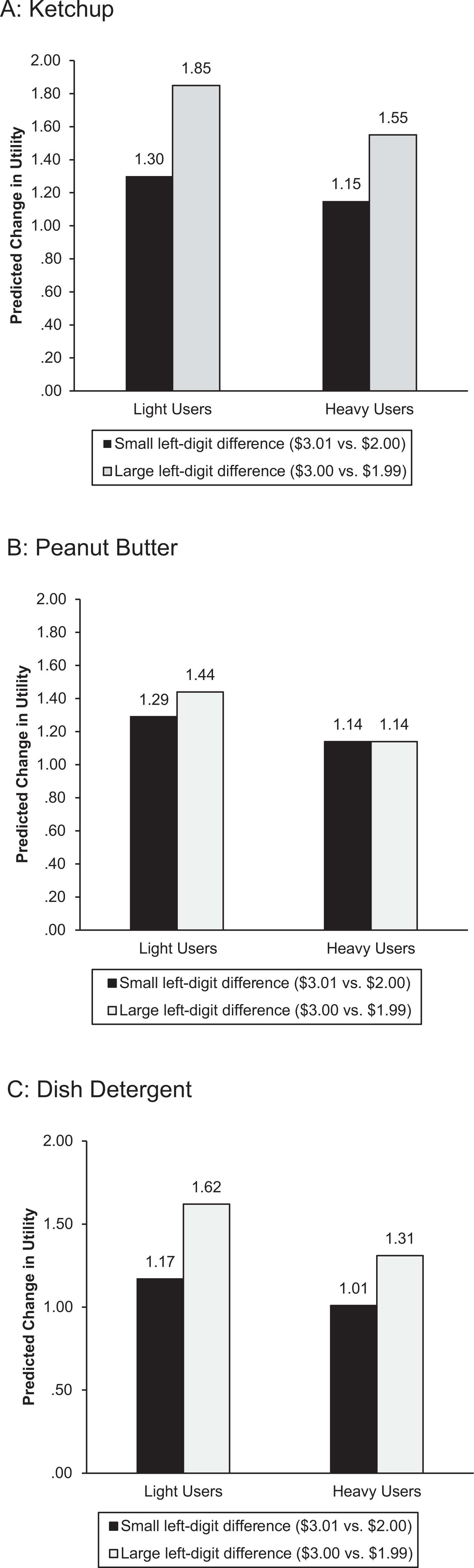
Study 6: Left-digit bias is stronger for light category users.
Robustness check
After allowing for differences in price sensitivity and loyalty among heavy and light category users, our results remained unchanged: the left-digit effect was present in all three categories and was mitigated for heavy category users (Table 3, columns 5–7).
Posttest
A separate posttest validated our assumption that heavy category users are more prone to rely on memory-based reference prices than light category users are. Panelists from MTurk (n = 201; Mage = 38.7 years; 43% female) indicated whether they relied more on stimulus-based or memory-based reference prices across ten different products. The responses were given on a seven-point bipolar scale (1 = “by comparing it to prices of competing products in the store” [stimulus-based], and 7 = “by comparing it to past prices of the same product” [memory-based]; anchor order was reversed for half of the participants). Participants then reported their category usage by reporting their purchase frequency (“How frequently do you buy these products?”; 1 = “not at all frequently,” and 7 = “very frequently”) and perceived category spending (“How much do you spend on each of these product categories per month?”; 1 = “very much,” and 7 = “very little”).
A repeated-measures linear regression revealed a significant positive effect of shopping frequency on propensity to rely on memory-based reference prices (b = .16, SE = .05, p = .001). Similarly, there was a significant positive effect of perceived category spending on propensity to rely on memory-based reference prices (b = .12, SE = .05, p = .009). Consistent with our assumptions, heavy category users were more prone to rely on memory-based price evaluations.
Discussion
Our analysis showed that light category users—who rely more on stimulus-based reference prices as shown in our survey—were more susceptible to the left-digit bias than were heavy category users—who rely more on memory-based reference prices, in support of H2b.
While the scanner panel-data study demonstrates that the left-digit bias manifests in real-world shopping behavior, it is not without limitations. First, the scanner panel data do not allow us to directly observe which reference prices—stimulus- or memory-based—were used in consumer decisions. However, prior research and our posttest validate the assumption that heavy category users are more prone to use memory-based reference prices. Second, the data do not allow us to demonstrate causally that increased reliance on memory-based reference prices is the only reason left-digit pricing is less effective among heavy users. To address this limitation, we account for potential confounding factors (e.g., price sensitivity, loyalty) in our analysis. Importantly, this study, together with the preceding experimental results, points to the external validity of our findings and provides critical insights for managers employing a left-digit-pricing strategy: the results suggest that left-digit pricing is more likely to boost sales among light buyers rather than the heavy buyers of a category.
General Discussion
Six studies demonstrate that evaluation mode (stimulus-based vs. memory-based), a factor linked to perceptual/conceptual price representations, affects the strength of the left-digit bias. When people rely on stimulus-based evaluations, which entail greater focus on precise perceptual representations of price, the left-digit bias is stronger. When people rely on memory-based evaluations, which entail greater focus on conceptual price representations and greater propensity to round up prices, the left-digit bias is reduced. Study 1 showed that the left-digit bias was stronger in stimulus-based evaluations than in memory-based evaluations in the context of store-brand price evaluations. Studies 2 and 3 replicated this effect in the context of discount evaluations. In addition, they ruled out scale-midpoint responding and “99 = sale sign” inference-making as alternative explanations of the observed results. Study 4 provided process evidence for the evaluation-mode effects. Finally, Studies 5 and 6 demonstrated the managerial implications of our theorizing: Study 5 showed how price-tag design affects left-digit pricing effectiveness, and Study 6 demonstrated how observable consumer characteristics, such as category usage, can predict shoppers’ susceptibility to the left-digit bias.
To compare the magnitude of the left-digit bias in stimulus-based and memory-based evaluations across all five price evaluation studies (Studies 1–3 and 5, and Study 5 replication reported in Web Appendix I), we conducted a single-paper meta-analysis. The analysis estimates the simple effect of left digits under stimulus-based evaluation at .56 (95% confidence interval [CI]: [.43, .70]) (McShane and Böckenholt 2017). In contrast, the simple effect of left digits under memory-based evaluation was estimated at .21 (95% CI: [.09. .33]). In terms of standardized effect sizes, these results translate into a medium-to-strong effect of left digits under stimulus-based evaluation (d = .56) and a weak effect of left digits under memory-based evaluation (d = .19). The interaction between left digits and evaluation mode was estimated as significant at .36 (95% CI: [.17, .54]) and falls between a small and medium effect size (d = .33).
Theoretical Implications
Memory-based evaluations
First, our findings contribute to the literature on evaluation-mode effects. Associated with lower cognitive effort, stimulus-based evaluations have been shown to produce more accurate judgments in some contexts (Rottenstreich, Sood, and Brenner 2007). Yet they have also been shown to produce less accurate judgments in other contexts (Raghubir and Krishna 1996; Schley, Lembregts, and Peters 2017). Our conceptualization of memory- and stimulus-based evaluations allows us to reconcile these seemingly inconsistent findings: we propose that stimulus-based evaluations enhance biases that are driven by the high salience of perceptual features of stimuli or by the low salience of conceptual features of stimuli. For instance, because the salient perceptual cue of direct distance between route endpoints biases distance estimates, these estimates become more accurate when people perform memory-based evaluations and rely less on perceptual representations (Raghubir and Krishna 1996). Similarly, the low salience of underlying magnitudes makes people judge the difference between 36 and 60 months to be larger than that between 3 and 5 years. However, this tendency diminishes in memory-based judgments whereby the focus on the underlying magnitudes increases (Schley, Lembregts, and Peters 2017).
Left-digit bias strength and mechanisms
Second, this article identifies conditions facilitating the left-digit bias. Research offers substantial evidence in support of the left-digit bias (Bhattacharya, Holden, and Jacobsen 2012; Lacetera, Pope, and Sydnor 2012; Schindler and Kibarian 1996; Thomas and Morwitz 2005). However, the magnitude of the effect varies substantially across published studies (Kalyanam and Shively 1998; Stiving and Winer 1997). For instance, Stiving and Winer (1997) provide support for the left-digit bias in the tuna category but not in the yogurt category. From both academic and practical standpoints, it is important to identify the conditions and psychological processes facilitating and attenuating the left-digit bias. Our work bridges this gap: we provide a framework of price evaluations and propose that when consumers focus on the precise perceptual representations of prices instead of rounding them, the left-digit bias is enhanced.
Judgments versus response times
Finally, this research makes a nontrivial methodological contribution to the numerical cognition literature. To the best of our knowledge, psychologists studying the mechanisms underlying number evaluations have been using response latencies from number categorization tasks (e.g., odd/even, high/low number) to infer whether people process numbers digit-by-digit or whether they process them holistically, by quickly grasping their overall magnitudes (e.g., Dehaene 1992; Zhou et al. 2008). Because the choice of digit-by-digit processing is largely unconscious, evaluation strategy self-reports were not considered useful in testing theories of multidigit number evaluations. Our research suggests that, in addition to response-time data, the left-digit bias in magnitude judgments can be used to test whether numerical cognition is digital or holistic, with the strength of the bias serving as a signal of increased digit-by-digit number processing.
Practical Implications
Our data suggest that left-digit, or just-below pricing (e.g., $1.99 vs. $2.00), will not be uniformly effective across different shopping contexts and consumer types. For example, we find that the left-digit pricing strategy is substantially more effective when consumers are provided salient reference prices on price tags and are thus encouraged to perform stimulus-based price evaluations. We also find that the left-digit price effectiveness varies across different consumers. Given their increased propensity to rely on stimulus-based price evaluations, light category users are more affected by prices’ left digits and therefore more sensitive to left-digit pricing. Thus, depending on the extent to which they cater to light category users, managers can adjust their pricing strategies. More generally, contexts and consumer characteristics facilitating stimulus-based evaluations should increase the effectiveness of left-digit pricing. This means, for example, that left-digit pricing will be more effective during promotions wherein people see the compared prices on the same tag and become more likely to rely on stimulus-based evaluations.
In conclusion, this article shows that the left-digit bias is stronger in stimulus-based price evaluations. From a practical standpoint, our findings have important implications for managers deciding whether and when to use left-digit pricing. From a theoretical standpoint, our results offer insight into the mechanisms underlying the left-digit bias and, more generally, into the fundamental differences between stimulus-based and memory-based evaluations.
Supplemental Material
Supplemental Material, WEB_APPENDICES_pdf - The Left-Digit Bias: When and Why Are Consumers Penny Wise and Pound Foolish?
Supplemental Material, WEB_APPENDICES_pdf for The Left-Digit Bias: When and Why Are Consumers Penny Wise and Pound Foolish? by Tatiana Sokolova, Satheesh Seenivasan and Manoj Thomas in Journal of Marketing Research
Footnotes
Acknowledgments
The authors gratefully acknowledge the comments of the JMR review team. The authors also thank Timothy Heath, Tina Lowrey, Rik Pieters, and Marc Vanhuele for their helpful comments on the previous versions of the manuscript. This paper is based on the first author’s doctoral dissertation and inspired by the third author’s first published paper.
Associate Editor
Vikas Mittal
Declaration of Conflicting Interests
The author(s) declared no potential conflicts of interest with respect to the research, authorship, and/or publication of this article.
Funding
The author(s) disclosed receipt of the following financial support for the research, authorship, and/or publication of this article: The first author acknowledges the financial support of HEC Foundation.

Notes
References
Supplementary Material
Please find the following supplemental material available below.
For Open Access articles published under a Creative Commons License, all supplemental material carries the same license as the article it is associated with.
For non-Open Access articles published, all supplemental material carries a non-exclusive license, and permission requests for re-use of supplemental material or any part of supplemental material shall be sent directly to the copyright owner as specified in the copyright notice associated with the article.
