



Abstract
Contemporary trends in the buying behavior of increasingly technology-empowered business customers are triggering disruptive shifts in B2B selling and sales management, which have recently been the subject of extensive research. So far, however, there has been no comprehensive investigation into how foundational elements of B2B selling, encompassing its purpose, the salesperson's role, and core selling activities, are being impacted by rapidly evolving B2B buying behaviors. This research probes this issue, drawing on the theories-in-use of B2B executives and salespeople struggling to meet today's B2B selling challenges. The authors find that a novel selling paradigm, which they call holistic selling (HS), is emerging. The article details how HS differs from the existing paradigms of personal selling, relational selling, and digital selling regarding the foundational elements of B2B selling. Under HS, the key role of the salesperson evolves from order getting or long-term relationship building, as in existing paradigms, to orchestrating all buyer–seller touchpoints to boost buyers along buyer-led purchase journeys. The authors provide propositions for the effect of HS versus other paradigms on buying effectiveness at different purchase journey stages, along with key boundary conditions of this effect. The article closes with implications for reorienting B2B sales organizations and future research directions.
Keywords
Business-to-business (B2B) sales are expected to reach $12.5 trillion in 2027 in the United States alone, of which non-e-commerce sales comprise 76% (Miglani and Cicman 2022). In this huge economic sector, a profound trend, namely, digitalization of the B2B buying process, has considerably accelerated during and after the COVID-19 pandemic years (Mantrala and Albers 2022). This trend, recently augmented by advances in AI technologies, has enhanced organizational buyers’ ability to research alternative suppliers and products to meet their needs independent of suppliers’ selling efforts. In turn, buyers’ enhanced information and knowledge power has led them to drastically limit, postpone, and modify the nature of their direct contacts with salespeople (Adamson 2022b). Thus, buyer–seller interactions along B2B purchase journeys have drastically changed from being seller-driven to buyer-led progressions (Grewal et al. 2015). Buyers are also increasingly shifting from in-person interactions to synchronous or asynchronous virtual or remote interactions using various technologies. Remote B2B buyer–seller contacts spiked when COVID-19 appeared, 1 but even after the abatement of the pandemic, they continue and appear irreversible, with digital channels expected to account for 80% of B2B buyer–seller interactions by 2025 (Gartner 2020b). At the same time, B2B buyers formalized their purchasing protocol: Buying centers grew larger, evolved into broader buying ecosystems, and have become more complex to navigate (Bonney, Beeler, and Chaker 2022; Ehret, Johnston, and Ritter 2024).
Disruptions in B2B selling processes due to these momentous shifts in B2B buyer behavior are most evident in “new task”
2
purchase situations (Grewal et al. 2015), where buying journeys have become increasingly nonlinear and looping. Not surprisingly, B2B sales organizations are urgently adapting their selling function (Guilherme et al. 2022). Many have undertaken digital transformation of their sales operations and further adopted hybrid sales structures in response to the omnichannel interaction preferences of today's B2B buyers (e.g., Andersen et al. 2024; Donchak, McClatchy, and Stanley 2022). However, it appears that the foundational elements of B2B selling, encompassing its purpose, the salesperson's role, and core selling activities, are changing dramatically in response to shifting buyer behavior. These changes point to the emergence of a novel B2B selling paradigm
3
that has yet to be comprehensively investigated and explained. The need for greater understanding of the emerging paradigm and its implications for sales management is pressing to guide the rethinking of B2B sales practice to effectively adapt to the contemporary B2B buyer. To meet this research need, we apply the discovery-oriented theories-in-use approach (Zeithaml et al. 2020) to elicit and probe the understanding of B2B professionals, including sales executives, salespeople, and buyers, with respect to the following three research questions:
How are the foundational elements of B2B selling evolving in today's B2B buying environment? What are the differences between the emerging and the existing B2B selling paradigms in foundational elements and sales force management? What are the implications of the emerging B2B selling paradigm for future B2B sales practice, theory, and research?
Our study of these questions is inspired by a collaboration with a Fortune 500 global B2B marketer grappling with how to reorient and adapt its various divisional sales forces in the new era of B2B buying. Consistent with earlier theories-in-use research (e.g., Homburg, Theel, and Hohenberg 2020; Noble, Sinha, and Kumar 2002), we compiled our evidence from 42 in-depth interviews of B2B executives, two virtual focus group discussions involving active B2B salespeople, and an extensive review and analysis of the relevant B2B practitioner literature. The overall conclusion from our data analyses is that a novel B2B selling paradigm for new task purchases, which we call holistic selling (HS), is, in fact, emerging, defined as follows: Holistic selling is the orchestration of all buyer–seller touchpoints across the prepurchase, purchase, and postpurchase stages of a buyer-led purchase journey aimed at boosting
4
buyers.
As evident, the core role of the salesperson under HS is orchestration, which concerns arranging effective communications at all buyer–seller touchpoints. 5 Notably, this new B2B salesperson's role is different from those in selling paradigms that have evolved earlier, namely, traditional personal selling (PS), relational selling (RS), and digital selling (DS). More specifically, the primary purpose of orchestration is fostering the buyer's decision-making competence and thereby enabling them to improve their decision-making along the buyer-led purchase journey, rather than order getting under PS, digital conversions under DS, or long-term partnering under RS. We subsequently discuss in depth the corresponding differences in the salesperson's role and selling activities under HS versus PS, RS, and DS.
The rest of this article is organized as follows: In the next section, we review the academic literature bearing on the major changes and trends in B2B purchasing and selling and indicate how our work contributes to this research stream. We then describe our research approach, its components, and its phases, followed by a discussion of the major insights from our study. Based on our interviews with sales executives and salespeople, subsequently validated and augmented by interviews with B2B buyers, we introduce the paradigm of HS, breaking down the dimensions and enablers of orchestration, and distinguishing HS from PS, RS, and DS not only conceptually but also with respect to key managerial implications. After translating these differences into specific activities under the respective paradigms, we offer a set of propositions for how HS impacts buying effectiveness 6 across the buyer-led purchase journey relative to existing selling paradigms, and moderators of this effect. We close with theoretical and managerial implications and future research directions.
Background Literature
In recent years, much research attention has been devoted to how digitalization of B2B buying behavior is impacting sellers. Table 1 summarizes selected articles from the previous literature along three aspects: changes in (1) the sales function (i.e., design of sales operations and activities), (2) the role of the salesperson (i.e., responsibilities and activities of salespeople), and (3) the overarching selling paradigm.
Overview of Relevant Academic Literature on the Transformation of the Sales Function and the Role of B2B Salespeople.
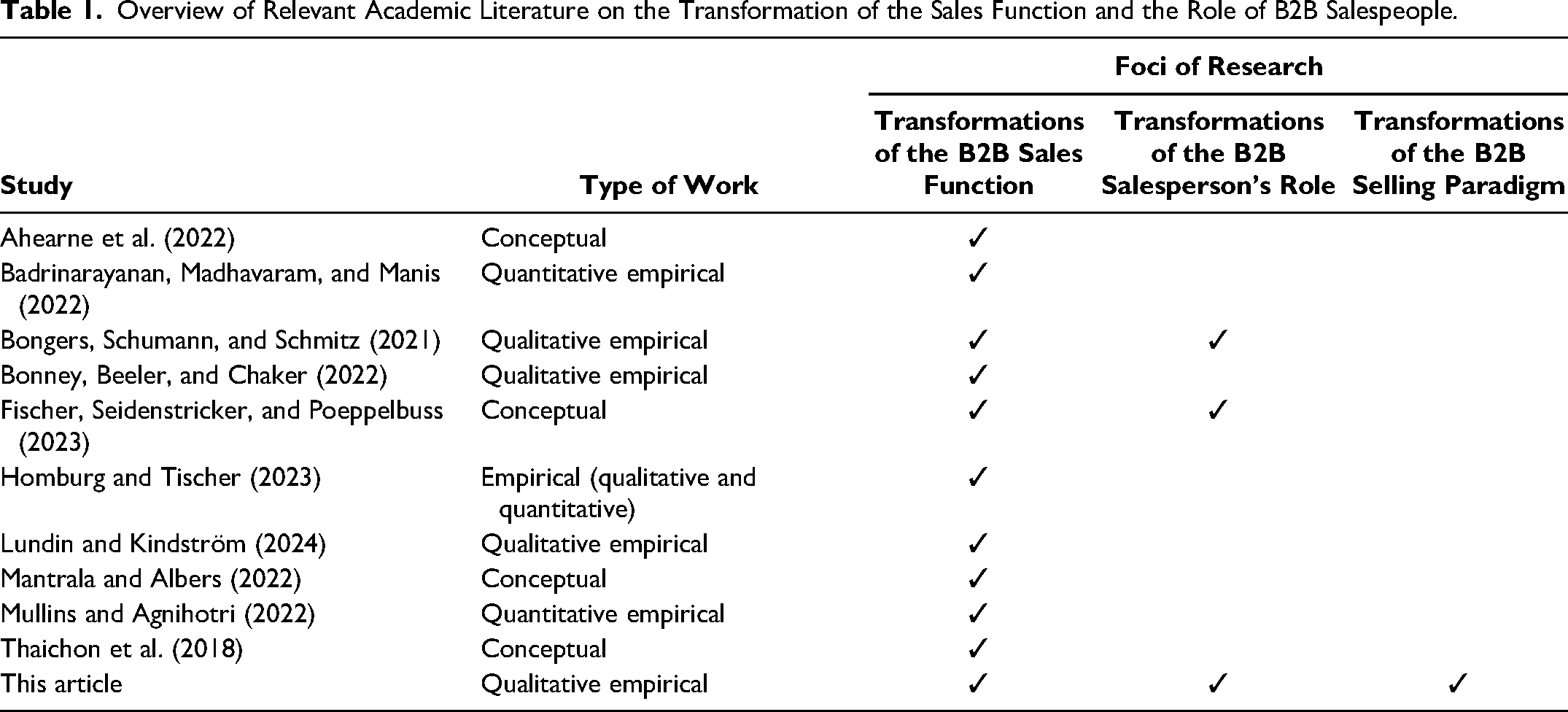
The majority of articles have focused on changes in the sales function. Mantrala and Albers (2022) examine the influence of the internet on B2B buying behavior and conclude that, as the purchase process is becoming more technology-aided, the selling process is becoming more buyer-driven. Ahearne et al. (2022) discuss how buyer–seller interactions are being impacted by the reversal in product and market information asymmetry between them—formerly in favor of the seller, currently favoring the buyer in the B2B buying process. Relatedly, Bonney, Beeler, and Chaker (2022) conclude that longer decision cycles, declining importance of interpersonal ties with B2B salespeople, and more complex buying center setups characterize buyer behavior in the postpandemic era. Focusing on technological developments from the seller's perspective, Badrinarayanan, Madhavaram, and Manis (2022) propose the concept of a firm's technology-enabled sales capability, identify its antecedents, and demonstrate its positive performance effects. Mullins and Agnihotri (2022) explore how to effectively manage the shift to DS (i.e., using digital assets to create customer value and achieve one's sales goals) at the individual salesperson level. Further, Ahearne et al. (2022) elaborate on how technological solutions offer opportunities to redesign the sales function in terms of options for interaction with customers through technology-mediated and multiformat communication.
Other articles in Table 1 have focused on the multichannel nature of B2B selling and its implications for the sales function. For example, Thaichon et al. (2018) conceptualize hybrid sales structures as the interplay of field sales force, inside sales force, and the online channel. Although these sales channels interact with each other, they are each targeted at different customer types. Considering the B2B customer journey as one coherent entity, Homburg and Tischer (2023) conceptualize the buying journey management capability of B2B sales organizations as the ability to create, implement, and monitor value at each touchpoint. Similarly, Lundin and Kindström (2024) explore suppliers’ capabilities in managing digitalized touchpoints in B2B customer journeys. However, these articles’ conceptualizations are at an organizational level.
While the previously mentioned articles underscore the changes in the B2B sales function triggered through buyer-induced shifts, they do not probe their implications for the role of the individual B2B salesperson. In contrast, Bongers, Schumann, and Schmitz (2021) provide initial insights into how salespeople can prevent channel conflicts in multichannel B2B environments. Synthesizing findings from extant literature, Fischer, Seidenstricker, and Poeppelbuss (2023) suggest the following set of five responsibilities for B2B salespeople given the digitization of the sales function: user coordination, ecosystem management, value facilitation, social selling, and collaboration. However, they offer no empirical support.
To conclude, the recent literature has mostly focused on transformations of the B2B sales function, rather than the core role of the salesperson. Certainly, there has not yet been a systematic appraisal of managers’ understanding of whether and how the underlying B2B selling paradigm as a whole is transforming. In short, our research questions still await comprehensive, conceptual, and data-driven treatment.
Research Method
Research Process
In this research, we rely on 42 in-depth interviews with B2B executives, two focus groups with 13 B2B salespeople, and contributions from the practitioner literature addressing recent changes in B2B sales and selling. As shown in Figure 1, in collecting these data, we followed a five-phase process, which encompasses both the sales and the buyer perspectives. In the first phase, we developed an understanding of changes currently occurring in B2B selling by speaking to nine senior executives from our collaborating firm. Following theoretical sampling guidelines (Corbin and Strauss 2015), we selected interview partners with in-depth knowledge and diverse corporate responsibilities. Thus, our sample of interviewees includes senior B2B executives in charge of sales, sales training, inside sales, marketing, e-commerce, customer relationship management (CRM), and information technology (IT). This allowed us to gain a purposefully broad view of developments in B2B selling. In these interviews, we elicited the executives’ perceptions of changes in B2B buying processes and the challenges and questions they posed in their domains of business. The second phase involved in-depth interviews of 16 senior international sales executives recruited through university and personal networks working in different industries and country markets (i.e., United States, Germany, India, South Korea). The conversations with these executives provided us with deep insights into their perceptions of contemporary changes in B2B selling and their causes that helped us discern that fundamental shifts in the selling paradigm, especially for new task purchases, were underway.
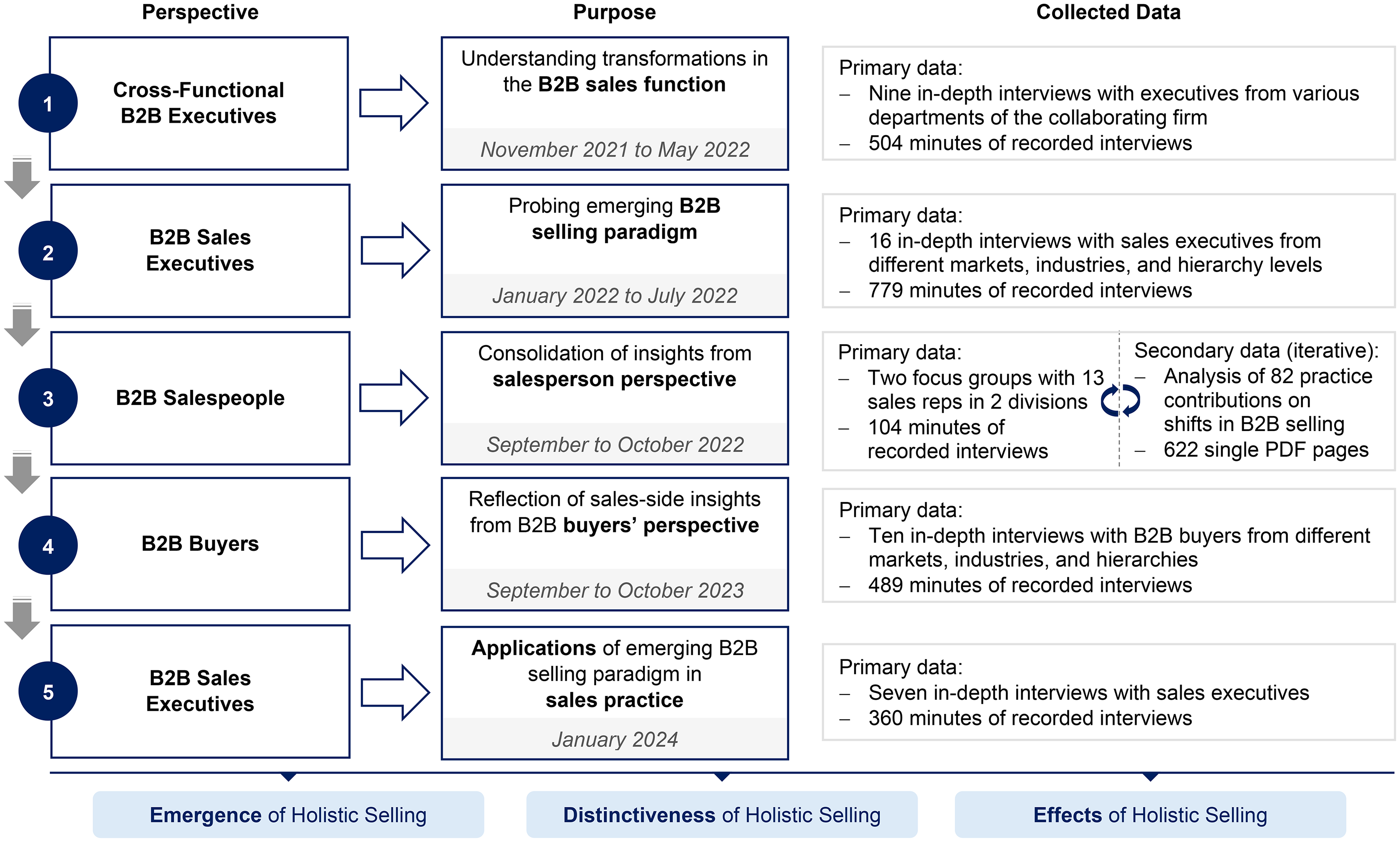
Perspectives, Purpose, and Collected Data of Our Research Process.
In our third research phase, we conducted two virtual focus groups, one with six and the other with seven sales representatives, selected from two business divisions (health care and industrial services) of the cooperating firm that vary greatly in terms of their selling tasks. Here, our goal was to validate and augment findings from the previous research phases with the perspectives of salespeople. Further, we supplemented our primary data with secondary information. Specifically, we comprehensively compiled and analyzed articles from the practitioner literature, almost all of which were published after 2020. Next, the fourth phase focused on the B2B buyer's perspective and comprised ten in-depth interviews with senior B2B buyers from various markets and industries. In these interviews, we probed whether and to what extent seller-side perceptions of the shift in salesperson roles and the selling paradigm were shared by buyers. As we discuss subsequently, these buyer interviews not only validated but also augmented our view of the new role of B2B salespeople. Finally, the fifth phase comprised seven in-depth interviews with sales executives at suppliers identified by buyers as particularly visionary. These interviews provided us with insights into how the HS paradigm is manifesting in B2B practice. Web Appendix A contains summaries of all our research samples.
Data Collection
In collecting our primary data, we closely followed the theories-in-use guidelines of Zeithaml et al. (2020). Specifically, we utilized semistructured interview procedures for both our in-depth and focus group interviews to ensure consistency across the conversations. The in-depth interviews and focus group sessions were conducted and recorded via videoconferencing by the primary research team and professionally transcribed. To supplement our primary database, we reviewed relevant items from the practice literature. Web Appendices A through F provide details regarding our data collection procedure.
Data Analysis
In line with the theories-in-use nature of our research, we follow the general inductive approach by Thomas (2006). The data for the qualitative analyses were evaluated through a line-by-line multilevel coding process in line with grounded theory (Corbin and Strauss 1990). In doing so, we closely followed the procedure proposed by Gioia, Corley, and Hamilton (2013). Web Appendix A provides details on our data analysis, while Web Appendix G shows how we meet the criteria for rigorous theories-in-use research.
Findings
Our discussions with B2B sales executives and industry experts soon revealed that B2B selling is undergoing fundamental transformations that will shape it in the long term. These transformations are essentially due to the changes in behaviors and expectations of today's B2B buyers, who are becoming more judicious in their interactions with suppliers.
Specifically, buyers are increasingly automating and autonomously completing the early stages of their purchasing processes to release more time for strategic discussions with selected sellers on issues that drive their business forward. This is evident from the following quote from a chief purchasing officer in the machinery industry: We are trying to automate the operational part of buying to the maximum. We do this to have more time in our sales contacts [with suppliers] for strategic issues and bringing new products into our machines. So, we are trying to automate this buying journey to the maximum, to digitalize it. If we look at the sales cycle from the past, the salesperson would own everything from start to end. And that is not the case anymore. It's no longer the classic buying and selling. Instead, you have to pick up more stakeholders. You have to be on hand to advise the customer. Customers need to take many steps themselves. You have to help customers demonstrate success internally …. It's not just about the technical component. It's about more, and a bigger picture. Holistic selling is the orchestration of all buyer–seller touchpoints across the prepurchase, purchase, and postpurchase stages of a buyer-led purchase journey aimed at boosting buyers. If they [salespeople] come up with creative ideas and present me with solutions that prompt me to say: “This will enhance our business. That improves our processes. This leads to a more economical or more efficient collaboration with the supplier,” then I would be happy if I had more contact [with salespeople]. … Only if the added value of the provider's solutions is clear then I would want more interaction. Otherwise, I have no interest in continuing [the business relationship].
Fourth, the core salesperson role in HS, as defined previously, is orchestration, that is, arranging effective communications 7 at all buyer–seller touchpoints. Next, we detail four distinct dimensions of this novel role of the salesperson discovered in our interviews with B2B sales executives that we further validated from the buyer's perspective. The associated results of our qualitative analysis, including the code hierarchies, can be found in Web Appendix H.
Orchestration Dimension 1: Dual Agency for Supplier and Buyer
The first dimension of orchestration reflects an emerging dual agency of the salesperson, defined as the concurrent representation of the supplier and the buyer along the purchase journey and in associated cross-organizational relations within the sales ecosystem.
8
In today's B2B environment, marked by blurring organizational boundaries in multistakeholder ecosystems and technology-empowered buyers who have taken the driver's seat, salespeople are required to coordinate cross-organizational initiatives and reconcile cross-organizational concerns. To achieve this, sales reps must accompany customers along the purchase journey, recognizing that they are equally responsible for the success of the buyer and their own organization, thereby fostering effective buyer–seller communications (Lawrence et al. 2021). A vice president from the machinery and systems sector notes: As a salesperson, I’m not just a salesperson, I’m an account owner …. I’m responsible for this account. And if I am responsible for this account, then I am also responsible for the orchestration, that I don’t just take orders, but also take care afterwards, in the case of bearings, for example, whether they are manufactured. Will they be shipped? Is the customer satisfied? Does he need help with the assembly? It's the same with condition monitoring. Is the customer happy with the system? Does the customer need another introduction to the software or a customization? My understanding of the role of an orchestrator is that it entails being the account owner. I always call him [i.e., the salesperson] the lawyer for our company at the supplier. The nicest thing is always when the managing director jokingly says that we should pay his salary because he is so committed to us. I always demand from good salespeople that they implement our requirements optimally at the supplier and take care of it.
Orchestration Dimension 2: Networking of Customized Intelligence
Given the growing numbers of actors involved in B2B sales and the need to manage extended sales ecosystems (Fischer, Seidenstricker, and Poeppelbuss 2023; Gomes et al. 2022), higher knowledge levels on a broader range of topics than ever before are required of salespeople. A head of governance supply chain management purchasing of a technology firm notes: Due to the CSRD [i.e., Corporate Sustainability Reporting Directive] obligations, I must provide information on the CO2 content of the products supplied. I am required to provide information on the human rights situation in the supply chains at these suppliers and must be able to provide information on certain substances of concern …. Thus, a supplier's sales department must be able to provide targeted information on many topics on which it was not able to provide information in the past. He [the salesperson] then networks, for example, with colleagues from the sustainability area, innovation area, his IT department, the digitization area, and brings us together in a conversation. This networking role … is becoming increasingly important. … He has to know people in his company—if he cannot do it himself—who can provide information about these subject areas. Then he has to bring me together with these people. You act like a spider in the web and coordinate the various activities in the background of the company. This increases efficiency, speed, and sustainability of communication.
Orchestration Dimension 3: Interlocking Touchpoints Along the Buying Journey
The third dimension of orchestration deals with interlocking buyer–seller touchpoints, defined as the alignment of the sequence and interplay of all buyer–seller touchpoints along the buyer-led purchase journey with the interaction needs of the buyer. The observed shift away from transactions and strictly linear processes to networked and intertwined paths of individual buying and usage center members echoes present-day changes in B2B customer behavior (Steward et al. 2019). In line with the concept of customer journey design (Purmonen, Jaakkola, and Terho 2023), the third dimension of orchestration covers two interconnected notions facilitating effective communications. First, salespeople are required to match the format and purpose of interactions. This means that, under HS, sales reps must constantly adapt channels, format, and timing of interactions to the decision-making needs of the individual buying center members. For instance, in the buyer-led purchase journey, buyers in the prepurchase stage may primarily rely on digital touchpoints, while postponing in-person interactions to later journey stages for deeper discussions and negotiations, as described by a vice president from the machinery sector: Customers do a lot of research before they even get in touch with suppliers. They already have a pretty clear idea of what they want to buy and what the supplier has to offer. They primarily rely on social media and the supplier's website [when searching for information]. … Customers then contact us [sales staff] directly and tell us that there is this and that product and that they want to do this and that with it. Next, they ask for a personal contact with whom they can negotiate contracts for a specific range of services. This means that our online presence, our content marketing on social media, and our website are very important and today are an essential building block for interacting with customers and initiating personal conversations about business opportunities. Keeping the sales rep up to date on initiatives, special promotions, and activities so that he can pick up on and build on these. … He [the sales rep] also gets part of the sales tools that are linked to these initiatives so that he can really complement the digital presence at the stage of the buying journey where he can actually engage, and the customer wants to see him. If we talk about new suppliers, it's the ability to use multiple channels simultaneously to reach customers—be it LinkedIn, other social media or traditional … means. As we are in the midst of a transformation, I believe it is interesting for sales departments to be able to leverage diverse channels in such a way that every customer feels addressed and no customer feels excluded from the outset.
Orchestration Dimension 4: Seamless Handling of Customer Interactions
The fourth dimension of orchestration concerns the need to seamlessly handle customer interactions, defined as the delivery of consistent customer experiences across and seamless transitions between all personal and nonpersonal buyer–seller touchpoints in the buyer-led purchase journey. As such, the dimension takes into account that today's B2B salespeople are tasked with omnichannel customer experience design. With the number of potential customer touchpoints increasing (Harrison et al. 2021), sales reps, in their role as orchestrators, are called on to deliver integrated experiences to ensure effective buyer–seller communications throughout the purchase journey. On the one hand, sales reps must serve as the acknowledged buyer's primary point of contact and conduit to the seller. All interactions originate with and converge back to the salesperson as the central node in the buying journey, whether personally involved or not. Functioning as this “one face to the customer” is essentially demanded by the buyers, as a chief purchasing officer from the mechanical engineering industry emphasizes: One face to the customer, who calls in his colleagues from the relevant departments as required and depending on where we are in the journey. When we are at the beginning, when it comes to finding ideas for a particular problem, he [the salesperson] brings in development support, but he is always there from A to Z. We attach great importance to this. What we don’t really have is the seamless user experience across all the different tools and platforms. From a customer perspective, they do not really want to have a different user experience across the channels. Most of the customers are using more than just one channel, so they are expecting to have a seamless integration into their processes.
Enablers of Orchestration and Effectiveness Elements
Having provided insights into the concept of orchestration and its four dimensions (see Web Appendix I for an illustrative operationalization of these dimensions), our research shows that orchestration is driven by four factors, which we refer to as “enablers.” Each of these factors comprises individual characteristics, which we call “effectiveness elements,” depicted in Figure 2 and further illustrated by quotes in Web Appendix J.
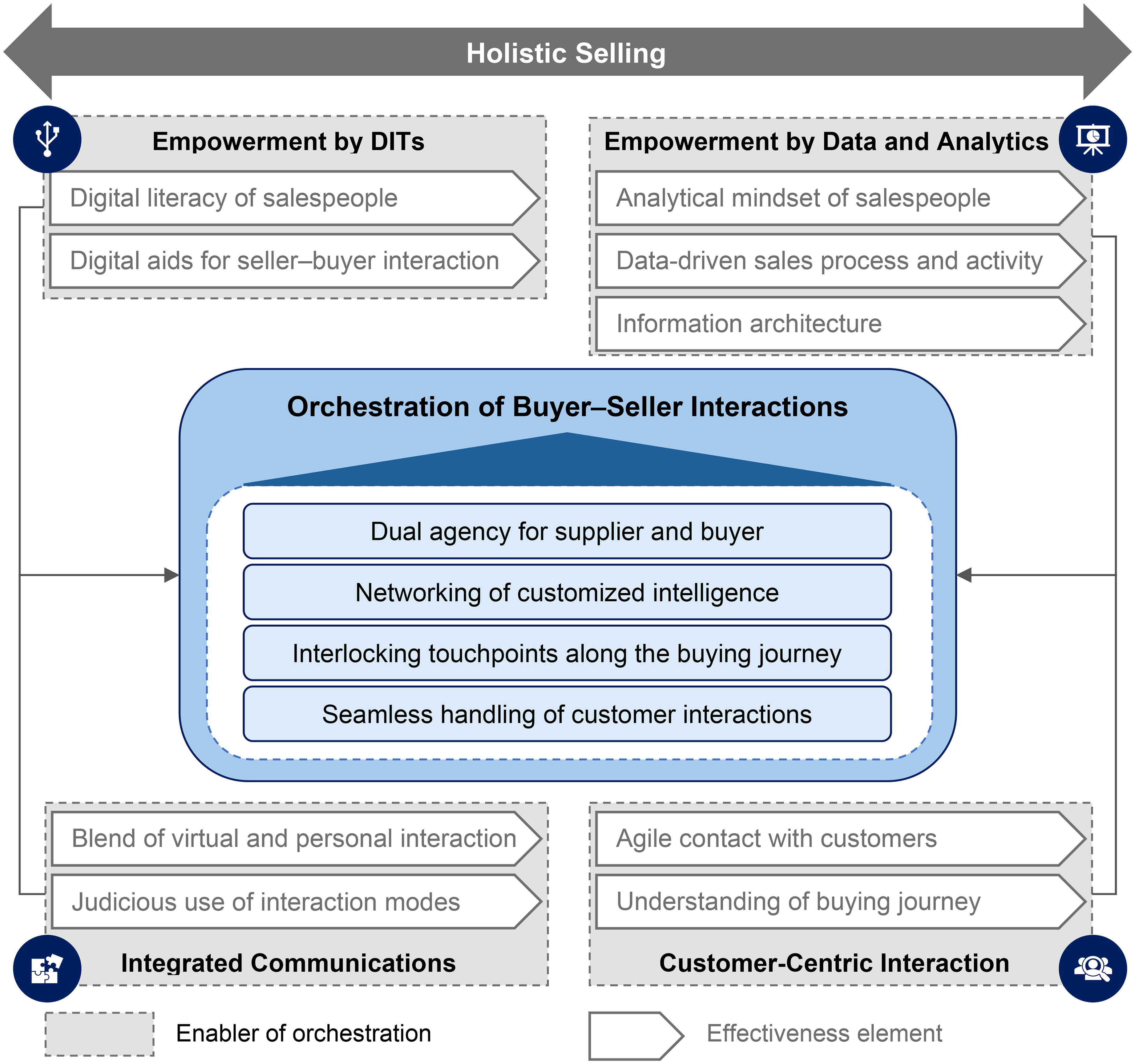
Conceptualization of HS.
Empowerment by digital information technologies
According to Grewal et al. (2015, p. 201), digital information technologies (DITs) refer to the “integration of telecommunications …, computer systems …, and data that enable firms to access, store, transmit, and manipulate information pertinent to their daily business operations.” Under HS, DITs support salespeople's interaction with customers. On the one hand, technological solutions such as chatbots or product recommendation systems backed by AI function as autonomous touchpoints with which customers interact independently of sales staff (Rusthollkarhu et al. 2022). On the other hand, technological capabilities are impacting direct interactions between salespeople and customers, complementing human capabilities to enhance the overarching quality of buyer–seller interactions along the purchase journey (Paschen, Wilson, and Ferreira 2020). As a result, digital literacy is becoming an essential requirement for individual B2B salespeople's success.
Empowerment by data and analytics
As customers increasingly engage with suppliers digitally, large amounts of structured and unstructured data are being acquired, stored, and processed to inform both the sales process as a whole and the salesperson's selling activities (Hallikainen, Savimäki, and Laukkanen 2020). Data-related responsibilities and the resulting changes in the job profile for salespeople are the norm today, with evidence already showing that data-driven decisions, which are facilitated by information architectures, yield better results than relying on intuition in the selling process (Habel, Alavi, and Heinitz 2024). To implement all this effectively, well-thought-out information architectures that integrate all information flows and thereby facilitate the intra- and interorganizational exchange of information are essential.
Integrated communications
HS embraces an admixture of personal and digital buyer–seller interactions. This blend has sometimes been referred to as hybrid selling at the salesperson level (Donchak, McClatchy, and Stanley 2022). Consequently, it is now vital for B2B salespeople to judge which mode of interaction (i.e., personal vs. digital) along the buyer-led purchase journey enhances the customer's experience the most, ensuring continued customer engagement.
Customer-centric interaction
As Mantrala and Albers (2022) have noted, the internet has effectively transformed buyers’ purchase journeys into buyer-led processes. To remain responsive, salespeople need to engineer their interactions with customers in an “outside-in” manner, focusing on developing an in-depth understanding of the buying journey and providing buyers with the flexibility and agility they demand in their supplier interactions at all times.
Distinguishing HS from Existing B2B Selling Paradigms
In this section, based on our interviewees’ responses, we discuss key differences between HS and existing B2B selling paradigms of PS, RS, and DS. The latter includes inside and virtual selling, which came to the fore during the COVID-19 pandemic (Gartner 2020a). Table 2 summarizes these differences, including substantially different sales management implications under HS, which are discussed in detail subsequently.
Comparison of B2B Selling Paradigms.
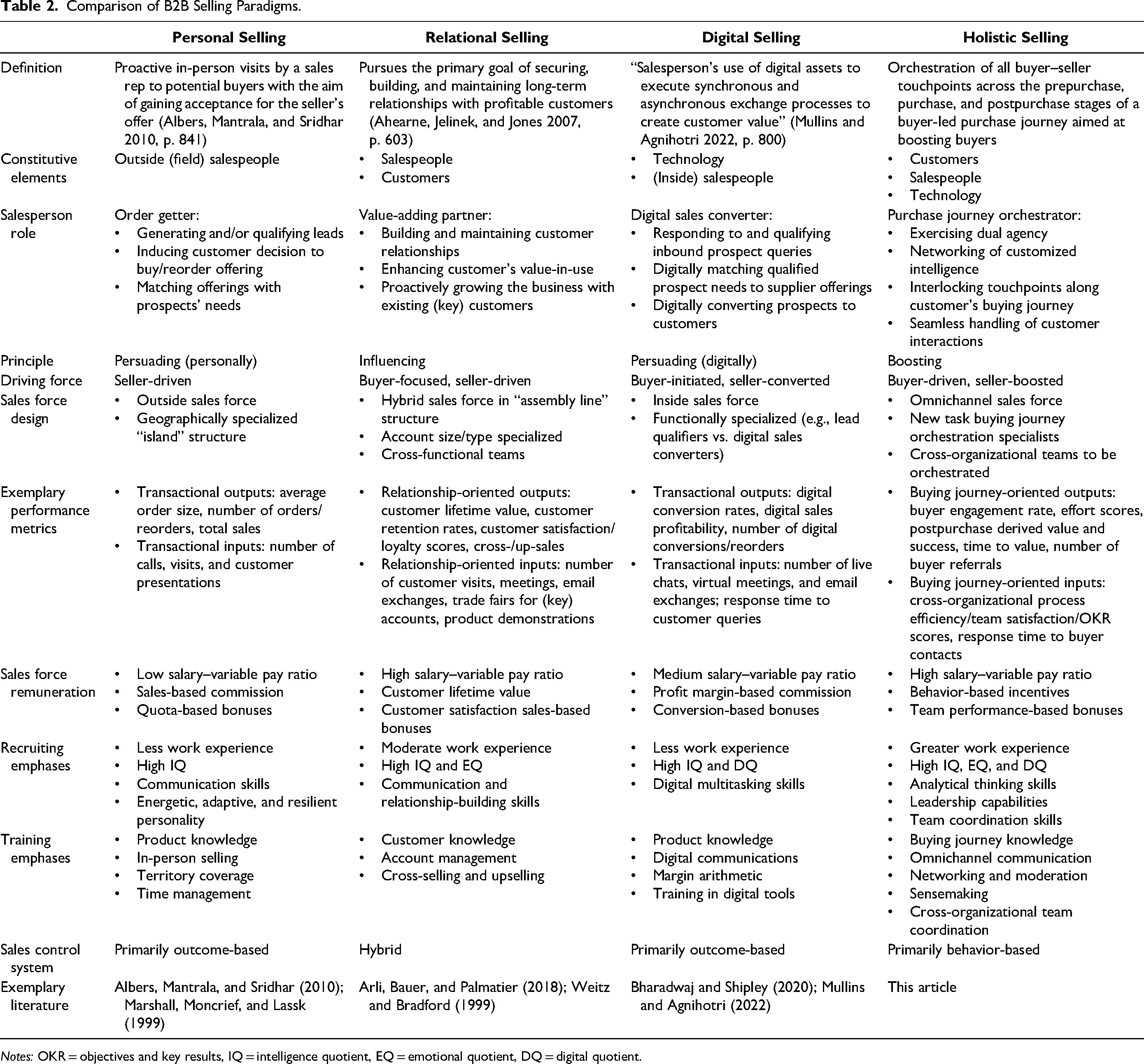
Notes: OKR = objectives and key results, IQ = intelligence quotient, EQ = emotional quotient, DQ = digital quotient.
We first focus on the purpose of each paradigm from the seller's perspective. In PS, the purpose is to match the customer's needs with the supplier's offering, primarily through in-person visits by field sales representatives, drawing on persuasion to make the buyer decide in favor of the seller's immediate offering (Albers, Mantrala, and Sridhar 2010; Weitz 1981). In contrast, the purpose of RS is to establish long-term relationships with profitable key customers to increase customer lifetime value for the supplier (Arli, Bauer, and Palmatier 2018; Jolson 1997; Kramer, Krafft, and Storbacka 2024; Morgan and Hunt 1994). RS is characterized more by the exercise of influence based on commitment and trust to achieve mutually beneficial goals for the seller and buyer. In DS, the seller's purpose is usually to “convert” online visitors to buy at the seller's website, relying on digital persuasion, that is, guiding the potential buyer down the digital sales funnel to achieve buyer conversion (Bharadwaj and Shipley 2020; Mullins and Agnihotri 2022). In contrast to all three of these existing selling paradigms, however, HS does not seek to persuade customers to buy, convert exploratory website visits to transactions, or build long-term customer relationships. Rather, HS focuses on boosting buyers’ decision-making competence along the buyer-led purchase journey. This is achieved by deft orchestration by the salesperson, which ensures effective communications at all buyer–seller touchpoints.
Building on these fundamental distinctions, further differences between the individual selling paradigms become apparent. First, in terms of the driving force, it is evident that PS, RS, and DS are fundamentally seller-driven paradigms, with RS being the most “buyer-oriented” and DS heavily “buyer-initiated” at the outset of the purchase journey. Ultimately, however, all three paradigms primarily focus on value gains for the supplier. In contrast, HS explicitly recognizes that technologically empowered and well-informed buyers, not sellers, are driving the purchase journey. The purpose of the holistic salesperson, once approached by the buyer, is to boost the buyer's interests and thereby become an invaluable companion on their path to purchase, remaining integral to the customer's buying process. Second, this has crucial implications for the salesperson's role. While salespeople are at the forefront as proactive order getters under PS, operate as value-adding long-term partners for key customers under RS, and drive customer conversions through digital technologies under DS, they assume the role of orchestrators under HS. Here, salespeople in the buyer-led purchase journey ensure that the customer's interests are protected, that buyers are given access to cross-organizational knowledge resources, and that interactions along the purchase journey conform to the buyer's preferences in terms of the sequence and interplay of touchpoints as well as overall customer experience. This shift in the role of the salesperson not only has profound implications for sales management but also drives HS implementation along the purchase journey, as shown in Table 3. Specifically, salespeople under HS aim, from the outset of their engagement by buyers, to help the latter navigate the purchase journey via sensemaking and networking of customized intelligence. Once the new task purchase decision is made, salespeople continue to boost buyers’ decision-making competences in product-service system codevelopment and achieving customer success. Web Appendix K contains further details on sales reps’ and buyers’ behavior along the purchase journey under HS.
Comparison of the B2B Selling Paradigms Along the Purchase Journey.
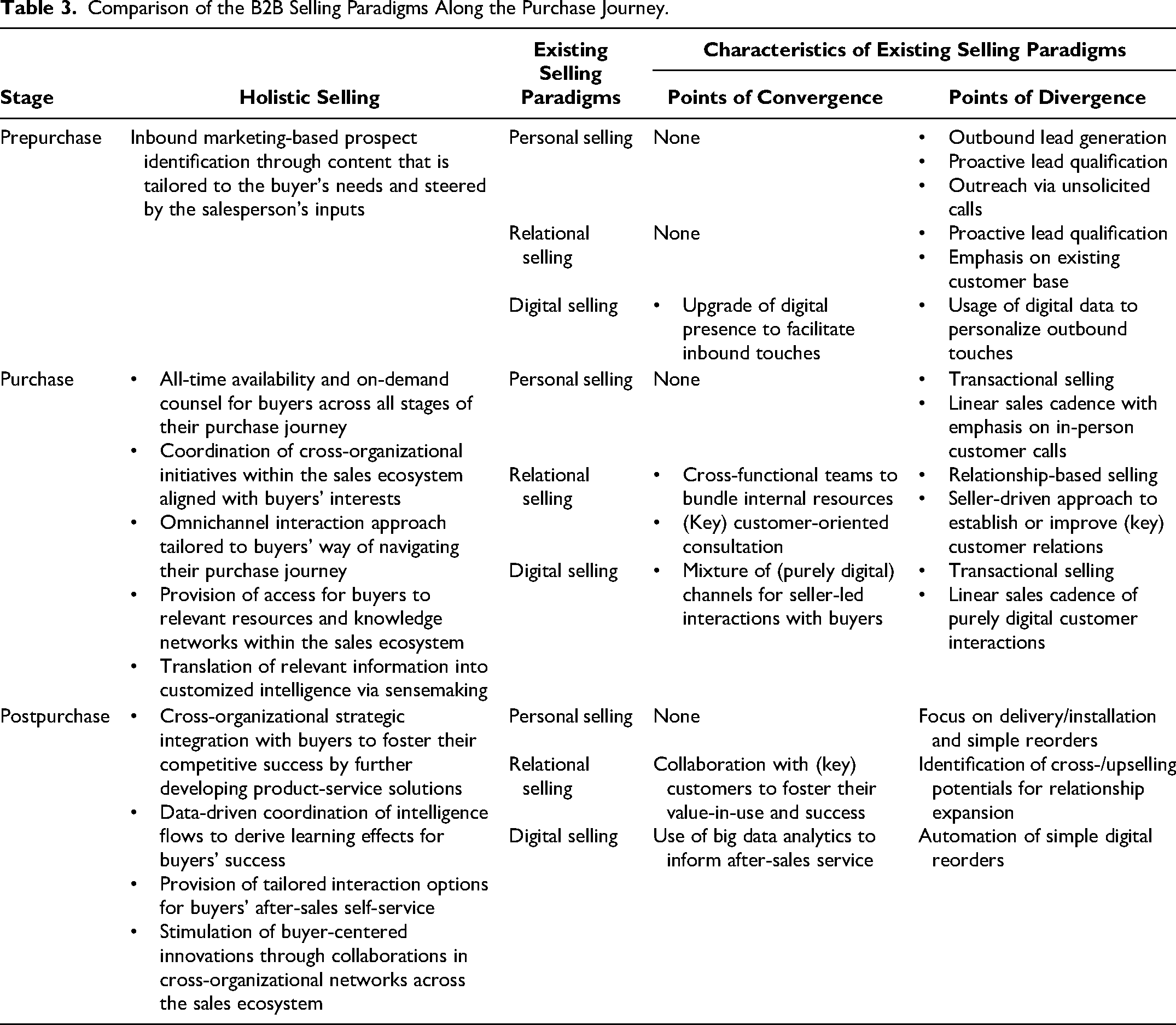
Distinctions Between B2B Selling Paradigm Activities
In the previous sections, we have summarized the profound differences between PS, RS, DS, and the emerging paradigm of HS. In this section, we map these differences into specific activities carried out by salespeople within the respective selling paradigms.
PS activities
The systematic identification of selling activities began with the study by Moncrief (1986) that generated 121 activities. Subsequently, Marshall, Moncrief, and Lassk (1999) added 49 new, mostly technology-driven selling activities. More recently, Moncrief, Marshall, and Lassk (2006) identified 12 PS factors underlying the previously identified activities. In this article, we group these 12 factors into five categories (the factors derived by Moncrief, Marshall, and Lassk are shown in parentheses):
PS 1: account/product service (i.e., delivery and product support), PS 2: administrative and organizational tasks (i.e., educational activities, office, training/recruiting), PS 3: direct interaction with customers/prospects (i.e., entertaining, prospecting, and RS), PS 4: sales support activities (i.e., channel support, promotional activities, and computer-related), and PS 5: travel.
RS activities
In the work of Moncrief, Marshall, and Lassk (2006), RS is linked to consultative selling approaches. Under the RS paradigm, the primary goal is to establish long-term partnerships to ensure business success (Jolson 1997). Consistent with Weitz and Bradford (1999), three key sets of activities for salespeople under RS are as follows:
RS 1: building and maintaining customer relationships, RS 2: managing intra- and interfirm conflict, and RS 3: organizing and managing sales teams.
These activities are reiterated in the more recent review by Arli, Bauer, and Palmatier (2018), who present salespeople under RS as business relationship managers in seller-driven processes steering relationships through relational mediators (i.e., commitment, trust, relationship satisfaction, and relationship quality), in line with Palmatier et al. (2006).
DS activities
DS activities have not yet been formally articulated in research, beyond some initial definitions (e.g., Bharadwaj and Shipley 2020; Mullins and Agnihotri 2022). Hence, to detail DS activities further, we content-analyzed recent practitioner and trade press reports, searching for the keywords “virtual selling” and “virtual sales” to identify articles published between 2020 and 2022 (see Web Appendix L for complete listing). In doing so, we identified four DS activity categories aimed at closing deals digitally:
DS 1: derive insights from digital data, DS 2: enhance digital presence, DS 3: handle digital tools, and DS 4: engage with customers/prospects remotely.
HS activities
Given the previously delineated PS, RS, and DS activity categories, what activities does HS emphasize that justify viewing it as an emerging selling paradigm? To identify the core activities of salespeople under HS, we drew on an extensive content analysis of 662 individual PDF pages (following the guidelines presented in the data analysis section and the procedures in Web Appendices A and F) comprising 82 recent articles from the practitioner literature (listed in Web Appendix L). In compiling these, we restricted ourselves to contributions from consultancies, market research companies, and the business press (e.g., Forbes Councils and Harvard Business Review) that were almost all published between 2020 and 2024. The selections were based on the sources’ track records and publicly available rankings. In identifying the specific articles, we conducted a topic-based keyword search focused on the keywords “future of B2B sales/selling” and “post-pandemic B2B sales/selling.” All 82 articles identified indicate activities to be implemented by B2B salespeople operating within this new reality. From these insights, we derived the following five overarching categories of HS activities and within-activity category tasks shown in Table 4, which we validated in multiple closing interviews with senior B2B sales executives:
HS 1: execute a customer-centric approach in a customer-led selling process, HS 2: extend human capacities through technological solutions, HS 3: shape customer experiences and accompany their buying journey, HS 4: steer cross-organizational integration along the buying journey, and HS 5: use (digital) data to improve decision-making and buyer engagement.
Holistic Selling Activity Categories, Illustrative Quotes, and Individual Tasks.
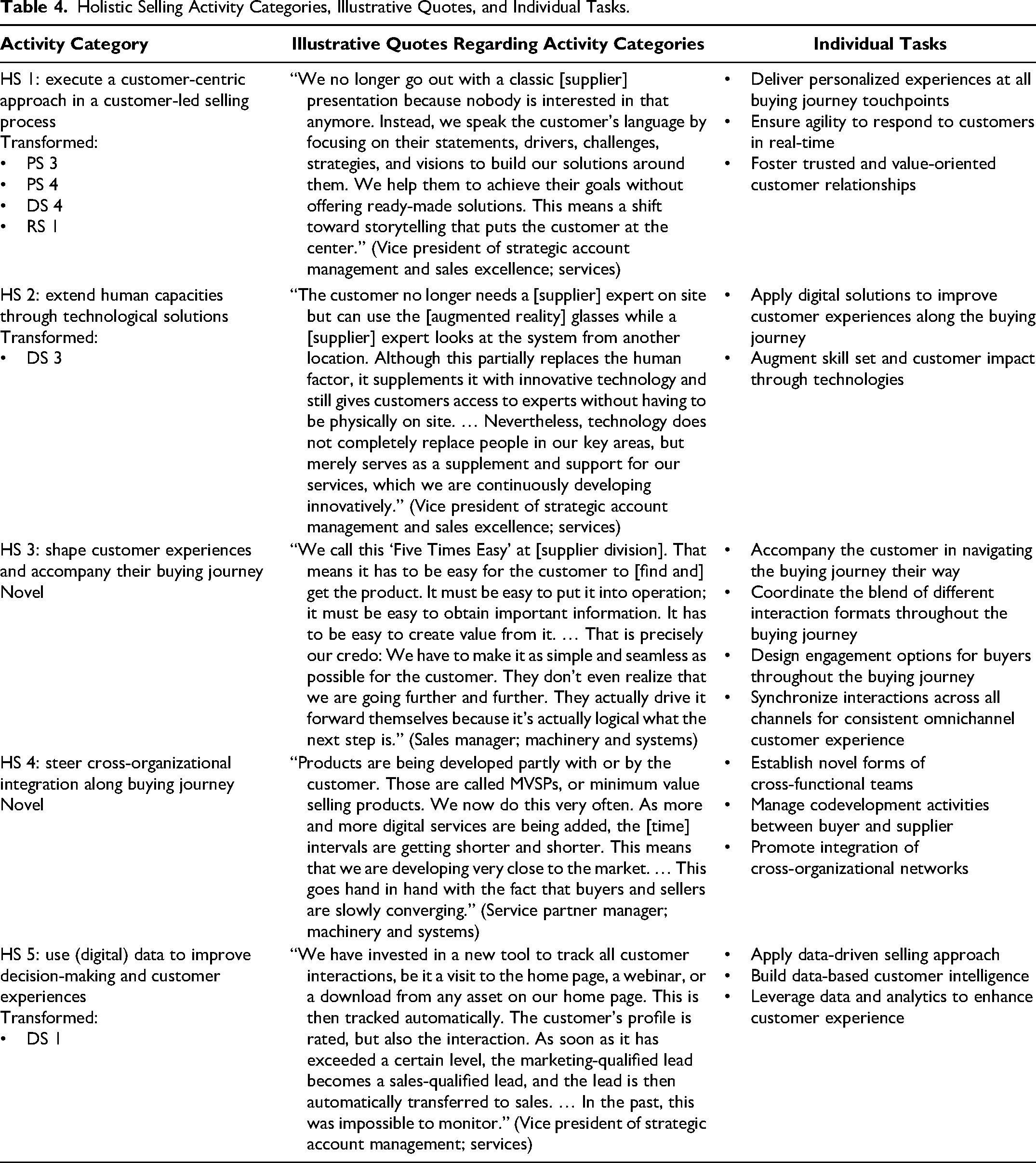
All five HS activity categories enable salespeople to effectively fulfill their role as orchestrators aimed at boosting the buyer's decision-making competence along the purchase journey. Next, we explore the distinctiveness of the five HS activity categories. In doing so, we distinguish between HS activity categories that are transformed, novel, and persisting relative to those listed under PS, RS, and DS. Figure 3 illustrates the activities of salespeople in the context of HS, which we further exemplify in a sketch of a typical “day in the life of a holistic salesperson” in Web Appendix M.
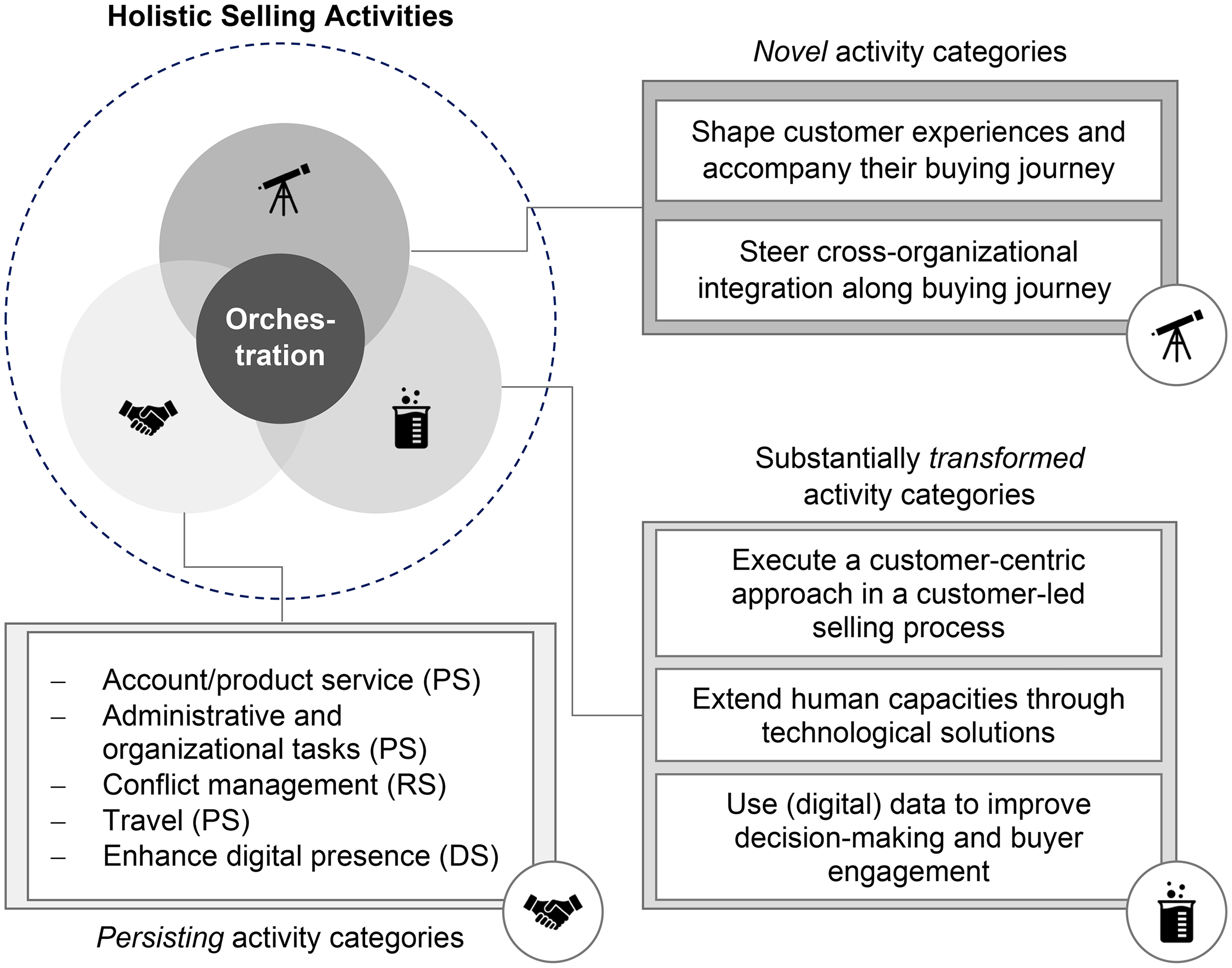
HS Activities at the Individual Salesperson Level.
First, drawing on our insights, we consider three HS activity categories to be “transformed” versions of earlier selling paradigm activities. HS 1 activities require salespeople to execute a customer-centric approach in a customer-led selling process. In performing this, salespeople draw on both the elements of personal (PS 3) and remote interaction with customers/prospects (DS 4), combined with marshaling channel sales support (PS 4), while cultivating buyer–seller ties (RS 1). However, today's buyer-led buying journeys need to be viewed from the customer's perspective (outside-in) as opposed to the seller's perspective (inside-out). This entails that the activity spectrum of salespeople under HS is extended to include the personalization of customer experiences at all touchpoints and being agile in responding to customer queries in real time. HS 2 activities focus on extending human capacities through technological solutions. Thus, these build on the handling of digital tools (DS 3). However, in contrast to enabling customer interactions in purely digital environments under DS, HS revolves around the fusion of human and technological capabilities. Specifically, digital technologies are deployed to improve the customer experience and assist salespeople in their orchestration endeavors by augmenting their skills and impact in on-demand client encounters. For example, applications based on generative AI provide salespeople with direct recommendations for their synchronous (e.g., real-time prompts in virtual calls) or asynchronous (e.g., sentiment-based suggestions for the wording of their next email) interactions with buyers (Sinha, Shastri, and Lorimer 2023). Last, HS 5 focuses on salespeople's activities to use (digital) data to improve decision-making and buyer engagement, building on the notion of digital data analytics (DS 1). In contrast to the latter, however, the data analytics–oriented activities within HS are not limited to customer segmentation and targeting strategies but rather comprise an end-to-end data-driven selling approach. Under HS, salespeople leverage data to support the entire buying journey at the individual customer level. Further, sales reps develop customer intelligence by pooling data sources and establishing company-wide information flows to enrich customer experiences and facilitate the buyer's progression through their buying journey.
Next, some HS activities are novel, not present in existing paradigms. HS 3 activities are aimed at enabling salespeople to shape customer experiences and accompany their buying journey. Within the HS paradigm, salespeople achieve this by designing and providing opportunities for buyers to stay engaged along the buying journey, complementing different customer interaction formats, and synchronizing interactions across all channels to ensure consistent customer experiences.
HS 4 activities aim to steer cross-organizational integration along the buying journey by establishing networks between the supplier, the buyer, and other actors in the sales ecosystem to facilitate resource exchanges and codevelopment initiatives. Thus, holistic salespeople are required to coordinate cross-organizational teams spanning sales ecosystems, and not just internal teams as in RS (Steward et al. 2010). To facilitate this, suppliers should, for example, consider the establishment of “win rooms” as agile and cross-functional team structures (Guilherme et al. 2022).
Finally, some activities from existing selling paradigms persist in their present form under HS to support orchestration but are not at the forefront of this emerging paradigm. Specifically, salespeople under HS must routinely take care of account/product service (PS 1), administrative and organizational tasks (PS 2), and conflict management (RS 2). In addition, travel (PS 5) as and when needed and the enhancement of digital presence (DS 2) remain part of the HS orchestrator activities.
Theories-in-Use-Inspired Propositions on HS
In this section, we present two frameworks derived from our theories-in-use research and drawn from our aforementioned findings (Zeithaml et al. 2020). Both frameworks focus on the proposed novel outcome variable of buying effectiveness, which we define, analogously to the definition of selling effectiveness by Zoltners, Sinha, and Zoltners (2001), as the buyer's perceived quality of their decisions along the purchase journey, drawing on the seller's inputs. Whereas the first framework examines the effect of HS relative to existing B2B selling paradigms on buying effectiveness in the different buying journey stages (Panel A of Figure 4), the second framework delineates the boundary conditions of HS, illustrating the influence of selected contingency factors (Panel B of Figure 4).
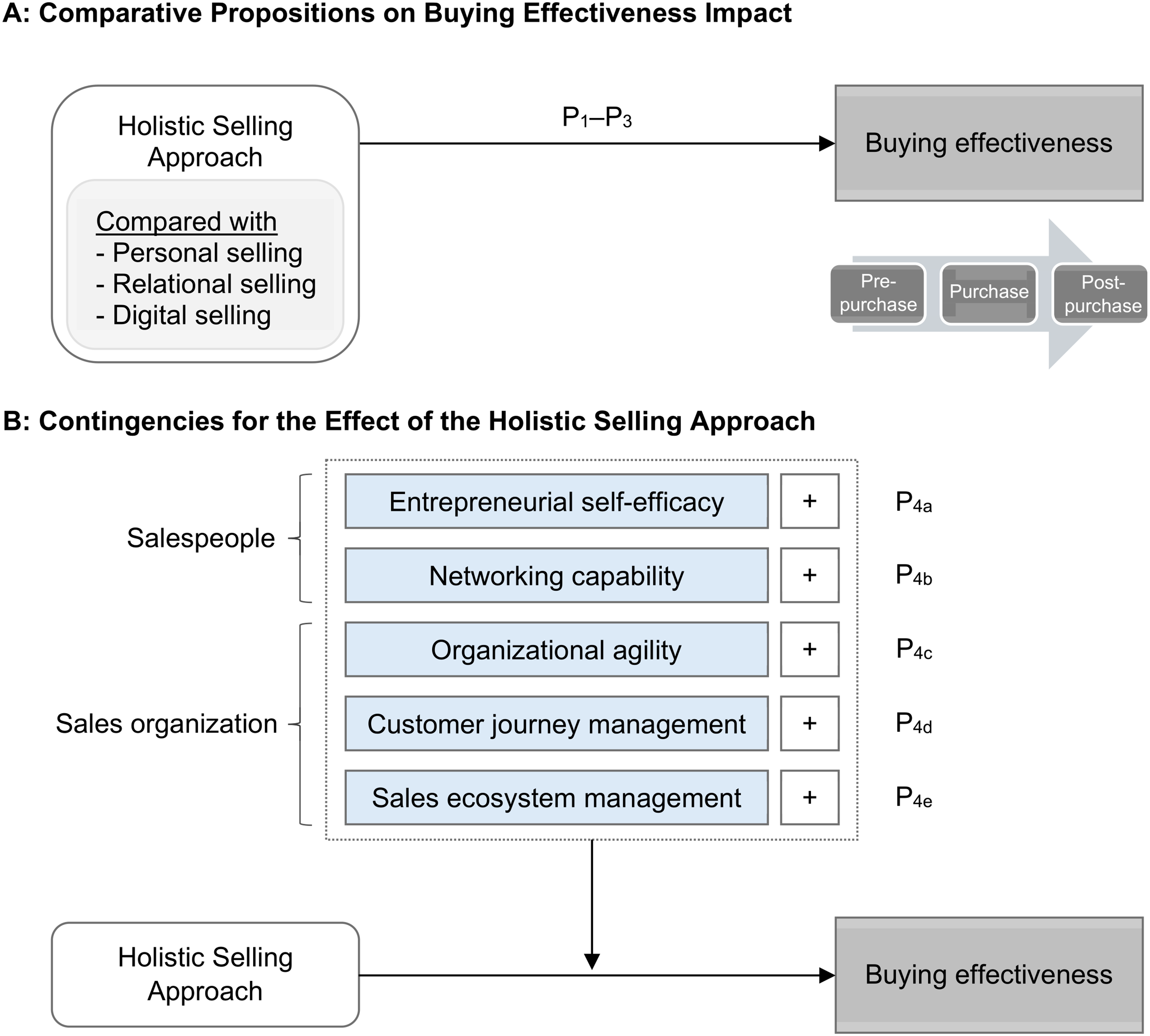
Conceptualizations of the Impact of HS on Buying Effectiveness.
Propositions Comparing the Selling Paradigms’ Impact on Buying Effectiveness
Salespeople influence buying effectiveness by providing inputs to buyers that affect their perceived decision quality. Within the different purchase journey stages, buyers are faced with key decisions that can be shaped by the seller if consulted. With regard to the prepurchase phase, buyers are concerned with developing their consideration set of potential suppliers and associated offerings relevant to their problems. In the purchase phase, buyers aim to select the supplier or combination of suppliers that offers the optimal solution and support. Ultimately, in the postpurchase phase, buyers focus on the question of how the purchased solution can be implemented and further enhanced to deliver maximum value to their business. To derive propositions on the effect of HS and the existing selling paradigms on buying effectiveness, we subsequently scrutinize the paradigms’ specific purpose and associated salesperson role (see Table 5 for further details). 9
Impact of the Different Selling Paradigms on Buying Effectiveness in Buyer-Led New Task Purchases.
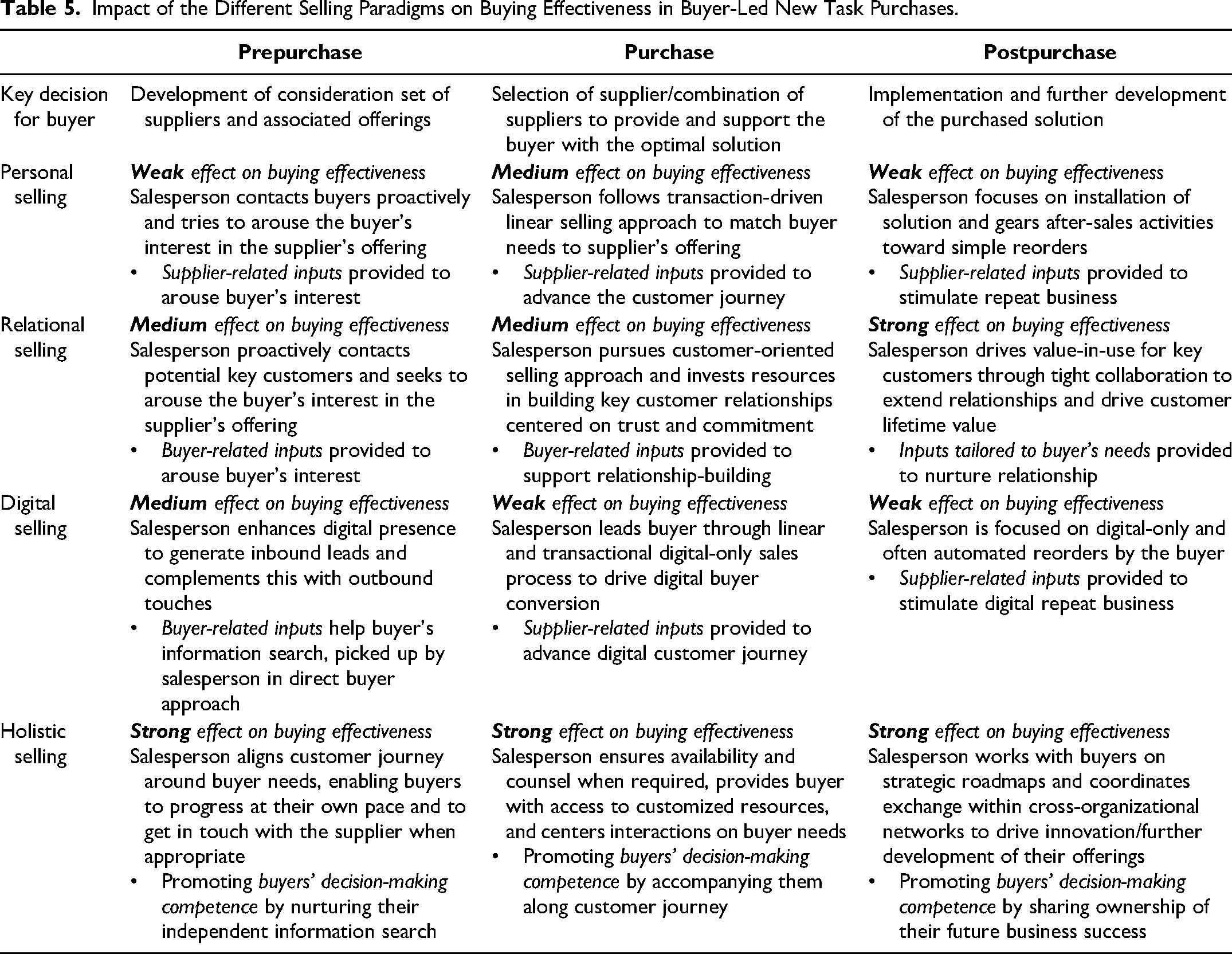
Starting with HS, the purpose of this emerging paradigm is to boost buyers’ decision-making competences along the purchase journey. Under HS, sales reps achieve this by serving as orchestrators along four distinct dimensions. Each of these dimensions is geared toward providing buyers with inputs that facilitate their decision-making competence. By assuming dual agency for suppliers and buyers alike, salespeople provide buyers with empowerment, ensuring that their interests are safeguarded and that cross-organizational initiatives are targeted at their success (Lawrence et al. 2021). Salespeople further act as networkers of customized intelligence. In line with social capital theory (Burt 1997), networks of relationships mobilize resources via interactions along structural, relational, and cognitive dimensions (Adler and Kwon 2002). Under HS, salespeople provide buyers with customized knowledge by coordinating and integrating resources from cross-organizational networks. By ensuring that touchpoints along the purchase journey are interlocked and the format and purpose of interactions match customers’ needs, following media synchronicity theory (Dennis, Fuller, and Valacich 2008), HS enhances buyers’ autonomy in navigating their purchase journey. Finally, adhering to the principles of integrated marketing communications (Batra and Keller 2016), the seamless handling of customer interactions by sales reps, who act as the one face to the customer and ensure consistent customer experiences at all journey touchpoints, provides clarity for buyers. Since holistic salespeople foster buyers’ decision-making competence throughout their entire new task purchase journey, we propose:
P1: HS positively affects buying effectiveness across all stages of the buyer-led purchase journey.
In contrast, the purpose of both PS and DS is to match buyer needs with supplier offerings and thereby drive buyer conversion. Salespeople within these paradigms accomplish this by providing buyers with inputs that are designed to advance their purchase of the seller's offering. Thus, these essentially seller-driven paradigms are not focused on improving buyers’ decision-making competence, leading us to propose:
P2: Compared with both PS and DS, HS exerts stronger positive effects on buying effectiveness across all stages of the buyer-led purchase journey.
Although RS adopts a more customer-centric perspective than PS and DS, the purpose of the paradigm is to extract value from key customers by building and expanding business relationships. However, once the business relationship is established, salespeople gear their inputs toward the customer's success and strive to further develop customer solutions. Whereas this serves an entirely different purpose compared with HS, it nevertheless results in comparable benefits for the buyer. Thus, we propose:
P3: Compared with RS, HS exerts stronger positive effects on buying effectiveness in the prepurchase and purchase stage, whereas it yields similarly strong effects in the postpurchase stage of the new task purchase journey.
Boundary Conditions for the Effect of HS on Buying Effectiveness
Having discussed the impact of HS on buying effectiveness relative to the existing B2B selling paradigms across the distinct buying journey stages, we next turn to key boundary conditions of the emerging selling paradigm's overarching effect, which emerged from our theories-in-use research. In doing so, we refer to how HS affects the buyer's decision-making competence by providing inputs originating from the four orchestration dimensions. The first two boundary conditions, entrepreneurial self-efficacy and networking capability, are salespeople-related factors; the remaining three are related to the sales organization. Web Appendix N contains a glossary of terms for all the framework constructs.
Entrepreneurial self-efficacy
Entrepreneurial self-efficacy refers to the belief that one is capable of performing tasks and roles aimed at entrepreneurial outcomes (Chen, Greene, and Crick 1998). Through entrepreneurial actions, salespeople respond to, and create, change within the organization (Hébert and Link 1989). Entrepreneurially minded salespeople are open to new ways of solving problems and thus devise creative ideas for sales activities and customer interactions (Wang and Netemeyer 2004). This notion is underscored by a strategic procurement manager from the transportation industry: The salesperson should quickly understand what we want and offer it accordingly. He should also show us how to address the requirements we have defined even more effectively. In other words, he points out opportunities for improvement, quickly understands our specific problems, and offers us tailor-made solutions that meet our requirements. In the best case, even such solutions go one step further than what we as the customer had previously in mind. Not in terms of quality, but perhaps an even smarter solution. P4a: The positive effect of HS on buying effectiveness is amplified as the entrepreneurial self-efficacy of the salesperson increases.
Networking capability
Salespeople's networking capability is defined as the ability to establish networks and stay connected with key players in the workplace (Ferris et al. 2005). The ability to build social networks within one's own organization has been shown to exert positive effects on sales performance (Bolander et al. 2015). HS goes one step further in that this capability extends to networking with actors in the customer organization and across the entire ecosystem. Here, salespeople, acting as orchestrators, build intelligence networks and match actors from buying and supplying organizations to interact with each other. This pivotal role of networking capability is highlighted in the following quote from a service partner manager in the machinery and systems industry: It is management. … It is still the people relationship. When I look at our high performers, they know who needs to talk to whom. When do they have to bring whom in? They are facilitators. That means they sometimes only act in the background. But it's about creating the right connections. This requires a lot of soft skills and not necessarily hard skills. P4b: The positive effect of HS on buying effectiveness is amplified as the networking capability of the salesperson increases.
Organizational agility
The agility of an organization reflects its ability to perceive and respond to unexpected changes in external environments (Cheng, Zhong, and Cao 2020). Market changes are seen as key opportunities for strategic moves, which require rapid adaptation of internal business processes to respond effectively to such changes (Kalaignanam et al. 2021). With regard to HS, organizational agility is of utmost relevance, as described by a service partner manager in the machinery and systems industry: The holistic seller is fast, wants to do something, and has the customer who wants to do something. But our organization, because it is a large organization, often slows down the process. That's often the case. … If I were looking for a new colleague, I would always promote [Division] as an internal startup from [Company]. We do a lot of things slightly differently. We sometimes make side cuts to speed things up. P4c: The positive effect of HS on buying effectiveness is amplified as the selling organization's organizational agility increases.
Customer journey management capability
Customer journey management aims to design and manage customer journeys from the B2B buyer's perspective (Lundin and Kindström 2024). Thus, the value anchoring of customer touchpoints vis-à-vis the individual members of the buying center is vital (Homburg and Tischer 2023). A managing director of marketing and sales from the construction software industry emphasizes this profound transition from an inside-out to an outside-in perspective to improve the B2B buyer's customer journey experiences: One of the first things I did was to introduce the customer perspective and change the view from the company perspective to the customer angle. … The idea here was: Where does the customer stand at each stage in the buying journey and what information and support do they need at this particular point to move forward in their buying cycle? P4d: The positive effect of HS on buying effectiveness is amplified as the selling organization's customer journey management capability increases.
Sales ecosystem management capability
Contemporary B2B selling extends beyond the traditional buyer–seller dyad, with the concept of sales ecosystems coming to the fore (Hartmann, Wieland, and Vargo 2018). Within sales ecosystems, the collaborative efforts of all ecosystem actors involved must be orchestrated to develop coherent customer solutions that yield mutual benefits (Hewett et al. 2022; Singh et al. 2019). Accordingly, sales ecosystem management encompasses planning, organizing, and performing activities to design and manage an ecosystem for distributed value creation (Gomes et al. 2022). This line of thought is supported by a CEO from the IT services industry: We [the supplier] would have this technical expertise. We would be able to identify our requirements very well, pass on the specifications to various vendors and ask them for the best prices. Cisco offers its switches, Check Point offers its firewalls, and Microsoft offers its software. … The responsibility for system integration and making sure everything works together—that's the responsibility we take. P4e: The positive effect of HS on buying effectiveness is amplified as the selling organization's sales ecosystem management capability increases.
Theoretical Implications
Our research builds on the notion that today's dynamics between buyers and sellers in B2B new task purchase contexts are undergoing fundamental shifts. Contrary to the assumption of information and power asymmetries favoring sellers, we find that today's technology-empowered buyers are in the driver's seat and seek to navigate their purchase journey autonomously. Specifically, the informants in our research observe that B2B buyers are less interested in building and expanding relationships. Instead, they engage with sellers who promote their agency, enabling them to make better decisions along their purchase journey and achieve greater business success. In light of this pivotal change, the emerging HS paradigm calls for novel and extended theoretical perspectives, different from earlier theories that have driven much of the extant B2B selling research, such as power dependencies (Frazier 1983; Kumar, Scheer, and Steenkamp 1995), commitment and trust (Morgan and Hunt 1994), or relational exchanges (Heide and John 1992). Initial thoughts on such new theoretical perspectives are summarized next.
First, salespeople's new core role as orchestrators under HS aims at boosting B2B buyers (Hertwig and Grüne-Yanoff 2017), that is, promoting buyers’ competences, strengthening their agency, and providing valuable inputs for their decision-making along the buyer-led purchase journey. This is different from influencing or nudging buyers toward mostly seller-preferred outcomes, as in extant selling paradigms (e.g., Kelman 1961; McFarland, Challagalla, and Shervani 2006; Plouffe et al. 2016). As a case in point, and in line with the notion of dynamic capabilities (Teece, Pisano, and Shuen 1997; Winter 2003), the idea that organizations adapt their resource base to match the requirements of changing environments has been applied to explain how sales units and sales management can enhance business success (e.g., Badrinarayanan, Madhavaram, and Manis 2022; Menguc, Auh, and Uslu 2013). However, going forward, one wide-ranging theoretical implication of HS is that, in new task purchase contexts, B2B sales organizations will succeed by building the buyer's rather than the seller's dynamic capabilities. This is what changing from an inside-out to an outside-in mindset entails in buyer-led purchase journeys.
Second, one related theoretical implication from our research is the necessity for an extended perspective on the resource-based view of the firm (Wernerfelt 1984). Rather than restricting one's perspective to the sales organization or the supplier–buyer interface (Jap 2001), we see that the entire sales ecosystem, including the interrelationships between involved ecosystem actors, should be conceived as a resource in itself to cultivate buyer agency and competences. Under HS, salespeople orchestrate the collaboration, the flow of knowledge, and the development of capabilities between different actors to equip buyers to make more informed, autonomous, and effective decisions along their purchase journey.
Third, our conceptualization of the orchestration dimensions under HS is inspired by theoretical perspectives that are relatively new in the B2B selling literature and need further development to better fit today's reality. Thus, we integrate agency and role theory in unison with Lawrence et al. (2021) to conceptualize salespeople's dual agency for supplier and buyer. We build on social capital theory to support salespeople's ecosystem-wide networking of customized intelligence (Adler and Kwon 2002). Our perspective on “interlocking touchpoints along the buying journey” aligns with multiformat communication theory and the design of customer journeys (Moffett, Folse, and Palmatier 2021). Finally, the seamless handling of customer interactions builds on customer experience design, particularly the concept of omnichannel customer experience (Rahman et al. 2022).
Fourth, we develop stand-alone theory with our theories-in-use-inspired propositional frameworks to link our conceptualization of HS and orchestration more directly to relevant performance effects. More specifically, we uncover that the emerging HS paradigm will likely be superior to PS, RS, and DS in strengthening buying effectiveness along the buyer-led new task purchase journey. Also, we identify contingency factors at both the salesperson and sales organization levels that further reinforce this effect. Looking forward, we see the pressing need for new organic theories that explain the mechanics and effects of HS in today's B2B selling environment from different perspectives.
Managerial Implications
This research uncovers that HS, a novel paradigm for B2B selling, is emerging in practice and has several significant implications for salespeople, sales organizations, and sales management.
First, sellers must make fundamental changes in their perspectives on B2B new task purchase cycles and adapt to buyer-led purchase journeys. Specifically, suppliers can no longer plan on advancing the buyer through the purchase cycle, linearly from stage to stage, on their terms. Rather, they must be agile, responsive, and prepared, whenever, through whatever channel, and on whatever topic called on by the buyer, to boost the buyer's decision-making competence along the purchase journey. By concentrating on buying effectiveness instead of focusing on driving customer conversion or nurturing long-term relationships with profitable key customers, sellers increase the likelihood that the contemporary buyer will continue to engage with them throughout their purchase journey.
Second, to achieve the novel purpose of boosting the buyer's decision-making competence, the B2B salesperson's role is transforming to become an orchestrator along the buyer-led purchase journey. This role calls for salespeople to be customers’ sought-after companion along the purchase journey, advocate for their interests in cross-organizational collaborations, provide them with access to relevant knowledge sources within the sales ecosystem as networkers, align the sequence and interplay of touchpoints along the buyer-led purchase journey with buyers’ preferences, and improve buyers’ omnichannel experiences. Sales managers can empower salespeople in realigning their roles and activities by ensuring that the orchestration enablers (i.e., empowerment by DITs, empowerment by data and analytics, integrated communications, and customer-centric interaction) are in place.
Third, our propositional frameworks highlight that holistic salespeople positively influence buying effectiveness through their actions along the four orchestration dimensions. Hence, suppliers should not only develop systematic and reliable ways to collect data on customers’ buying effectiveness to assess salespeople's performance but also pay close attention to fostering the sales force–related factors (i.e., entrepreneurial self-efficacy and networking capability) and the sales organizational factors (i.e., organizational agility, customer journey management capability, and sales ecosystem management capability) that enhance the positive impacts of HS on buying effectiveness.
Fourth and finally, the previously described emergence of HS necessitates substantial transformations in sales force structure and sales management practices, as summarized in Table 2. In particular, we expect shifts to more buying journey–oriented sales forces and to increasingly behavior-based control and incentive systems, which rely more heavily on activity-based as well as buyer input-based performance goals. Ultimately, in terms of recruiting and training, we anticipate that team coordination, leadership, sensemaking, and omnichannel communication abilities, among other factors, will take precedence over product knowledge and PS skills.
Future Research
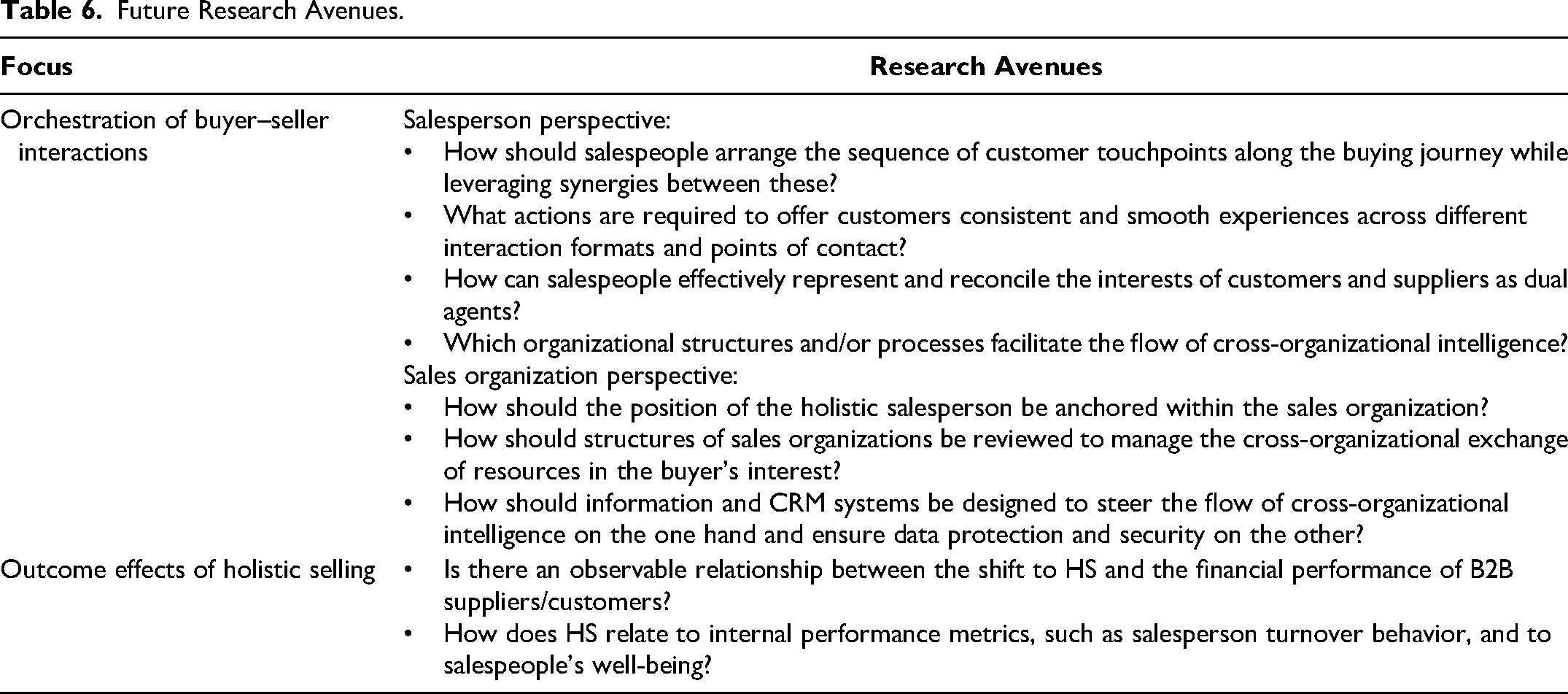
In addition to empirical testing of the propositions from our two conceptual frameworks, there are many questions about the effective implementation of HS, as summarized in Table 6, which need to be studied.
Future Research Avenues.
Orchestration of Buyer–Seller Interactions: Salesperson Perspective
In a B2B sales landscape where customers represent the driving force in the buying journey and salespeople serve as facilitators along the way, future research should investigate the effective orchestration of buyer–seller interactions at the salesperson level. For example, how should sales reps assess whether and how the format of customer interaction is aligned with the task to be completed? How can the sequence of various touchpoints along the buying journey be determined to exploit valuable dependencies from one touchpoint to another? How can salespeople succeed in harmonizing customer communications at all touchpoints to enable seamless transitions between these? How should salespeople effectively represent the interests of both the supplier and the customer as dual agents, increasing the benefits of value cocreation for both parties at the same time? And, finally, what actions should salespeople undertake to leverage network-embedded resources for both the supplier and the buyer?
Orchestration of Buyer–Seller Interactions: Sales Organization Perspective
At the organizational level, future research should address the question of how the position of holistic salespeople should be anchored in the sales organization to effectively assume their hub function in facilitating the buyer's purchase journey with the help of other relevant departments and functions. Complementary to this, how should sales organizations be structured to enable holistic salespeople to orchestrate buyer interactions in real time? For example, how should agile, cross-functional structures with direct, cross-organizational connections to other actors in the sales ecosystem be established, promoting smooth and buyer-centric exchanges of supplementary resources within the sales ecosystem? Another viable focus for future research would be the setup in terms of CRM systems or DITs required for effective orchestration. Thus, how should seamless interfaces to the systems of the buyers as well as to other relevant enterprises in the sales ecosystem be created, should exchange systems be centralized or rather handled decentrally, and how should challenges of data protection and data security be addressed?
Outcome Effects of HS
Although we expect HS to positively impact specifically buying and thereby indirectly impact supplier firms, our propositions remain at a conceptual level. We therefore call for future research to investigate the relationship between the implementation of HS and the financial performance of B2B selling firms and to empirically examine the impact of HS on different performance variables relating to the value of this selling paradigm for suppliers and customers. Furthermore, pivotal internal metrics such as salesperson turnover or job satisfaction should also be considered, and the impact of HS on the overall well-being of salespeople should be investigated, to explore the value that HS provides more comprehensively.
Conclusion
We have concluded that a new paradigm, HS, is emerging in response to disruptive changes on the buyer's side. At the heart of this paradigm lies the differentiating shift in the salesperson's role to orchestrating buyer–seller touchpoints, necessitating not only the updated set of selling activities presented but also profound rethinking along several key dimensions of sales management. Further, we have developed two frameworks that capture the differential effects of HS on buying effectiveness along the purchase journey while also encompassing critical contextual factors. All these insights were validated in interviews with B2B executives, active B2B salespeople, and B2B buyers.
Supplemental Material
sj-pdf-1-jmx-10.1177_00222429251338820 - Supplemental material for Holistic Selling: An Emerging Paradigm in B2B Markets
Supplemental material, sj-pdf-1-jmx-10.1177_00222429251338820 for Holistic Selling: An Emerging Paradigm in B2B Markets by Tim Kalwey, Manfred Krafft, Yeji Lim and Murali K. Mantrala in Journal of Marketing
Footnotes
Acknowledgments
The authors sincerely thank the contact people at the partner company for their supportive collaboration; the scholars at various academic conferences (e.g., 2022 Theory + Practice in Marketing Conference, 2022 ISBM Academic Conference, 2023 AMA Winter Academic Conference, and 2024 Enhancing Sales Force Productivity Conference) and colleagues from Auckland, Kansas, and Münster for their constructive feedback; and Sebastian Hohenberg, Ajay K. Kohli, Andreas Mann, Werner Reinartz, Prabhakant Sinha, and Kapil R. Tuli for their invaluable personal input. Finally, the authors gratefully acknowledge the helpful and constructive comments and feedback provided by the JM review team.
Author Contributions
The names of the authors are listed alphabetically. All authors contributed equally.
Coeditor
Vanitha Swaminathan
Associate Editor
Alok Kumar
Declaration of Conflicting Interests
The author(s) declared no potential conflicts of interest with respect to the research, authorship, and/or publication of this article.
Funding
The author(s) received no financial support for the research, authorship, and/or publication of this article.

Notes
References
Supplementary Material
Please find the following supplemental material available below.
For Open Access articles published under a Creative Commons License, all supplemental material carries the same license as the article it is associated with.
For non-Open Access articles published, all supplemental material carries a non-exclusive license, and permission requests for re-use of supplemental material or any part of supplemental material shall be sent directly to the copyright owner as specified in the copyright notice associated with the article.
