




Abstract
In sectors across the experience economy—from live sports to festivals, nightlife entertainment, private members’ clubs, and invite-only events—firms compete by staging social atmospheres. When firms successfully stage social atmospheres, they benefit from enhanced customer experiences, loyalty, and place attachment. However, social atmospheres often fail when firms struggle to bring together the “optimal” mix of customers. Yet marketing research offers limited insight into how firms can attract and select heterogeneous customers who fit together productively to create meaningful shared experiences of place. Accordingly, this article draws on aesthetic work literature to conceptualize social atmosphere curation—the process through which firms manage customer heterogeneity to achieve social fit as a means to stage social atmospheres. Through an ethnographic study of Berlin's iconic electronic music club scene, this article reveals a three-stage social atmosphere curation model, comprising curation mechanisms of cultivation, selection, and mystification. This research advances marketing scholarship's understanding of social atmospheres, customer heterogeneity, and marketplace inclusion and exclusion. By outlining the managerial tasks associated with each curation mechanism, this research provides actionable guidance for managers across various service contexts on how to curate the right crowd to deliberately stage social atmospheres.
Keywords
Firms in the experience economy compete by staging social atmospheres that unite diverse groups of customers and make them feel and think as one (Hill, Canniford, and Eckhardt 2022). Customers are attracted to live sports, nightclubs, festivals, and private members’ clubs because of the emotional togetherness these social atmospheres provide. However, social atmospheres often fall flat or fail (Rokka et al. 2023). For instance, the once-exclusive social atmosphere of high-end private members’ clubs, such as Soho House in New York and London, has faded as memberships have expanded, leading to poor customer experiences and financial strain (Gogarty 2024; Shackle 2024). Similarly, because of their rising popularity, countercultural festivals and underground nightclubs, such as Burning Man or Berlin's Berghain, are accused of becoming “boring tourist traps” (Scally 2023), with atmospheres that have shifted “beyond recognition” (Willis 2023). Whether a festival, nightclub, or private members’ club, social atmospheres fail when firms struggle to bring together the “optimal” mix of customers who complement each other to create shared experiences of place.
In this article, we investigate this managerial problem as we seek to explain how firms can achieve social fit among customers to stage social atmospheres. Social atmospheres are meaningful shared experiences of place that emerge and intensify when customers synchronize their emotions and behaviors (Cayla and Auriacombe 2024; Hill, Canniford, and Eckhardt 2022). However, prior research shows that heterogeneous customer motivations, abilities, and behavioral expectations can make this synchronization difficult, causing group tensions, threatening belonging, and detracting from the social atmosphere (Higgins and Hamilton 2019; Parmentier and Fischer 2015; Thomas, Price, and Schau 2013). Although studies acknowledge the crucial role customer heterogeneity plays in the success or failure of social atmospheres (Hill, Canniford, and Eckhardt 2022), the question of how firms can manage this heterogeneity to achieve social fit among customers remains poorly understood.
One way firms can achieve social fit is by attracting and selecting the “right” customers, whether through promoting a unique ethos at live sports events and music festivals (Flinn and Frew 2014; Kozinets 2002) or by choosing customers who seem to fit together, when demand outstrips supply. Common customer selection methods include brief conversations at nightclub entrances, extensive membership applications for private members’ clubs, or exclusive invitations to events like gallery openings, film premieres, charity galas, or book launches (Holmqvist, Wirtz, and Fritze 2022; Rivera 2010). However, prior studies provide limited theoretical insight into how firms can attract and select customers for social fit, the evaluative criteria used to both include customers who fit together and exclude those who don’t, and how these inclusion and exclusion mechanisms contribute to the success or failure of social atmospheres. Thus, this article answers the research question: How can firms achieve social fit among heterogeneous customers to stage social atmospheres?
To address this question, we studied Berlin's iconic electronic music club scene—an ideologically based consumption community with high entry barriers designed to create inclusive safe spaces for marginalized customers (Thomas, Price, and Schau 2013). Recognized as a role model for nightlife industries worldwide and added to UNESCO's cultural heritage list (Brown 2024), Berlin's music clubs are places for these communities to come together in an atmosphere of shared hedonism and “effervescent excitement” (Goulding et al. 2009, p. 759). Behind these shared experiences lies the careful curatorship of customers (Garcia-Mispireta 2023) involving the clubs’ staff, whom we refer to as “curators.” Curators comprise both frontline and backstage staff—including club owners, event organizers, DJs, selectors, and security—who attract and select an “optimal” mix of local clubgoers and “techno tourists.” These curators shape a club's identity, handpick a diverse yet complementary crowd, and mystify customer selection to reinforce exclusivity, all contributing to the cocreation of the social atmosphere. Thus, we adopt a firm-level perspective, drawing on a rich data set combining ethnographic methods, including 38 in-depth interviews with various curators and clubgoers, field notes from nonparticipant observations of curators “working the door,” and archival data about Berlin's club scene.
To analyze the data, we draw on insights from theories of aesthetic work (Böhme 2003; Mears 2011). Aesthetic work literature explains how firms stage social atmospheres by curating the “right” groups of customers—attracting and selecting those who “fit, or belong together, beyond physical appearance” (Pounders, Babin, and Close 2015, p. 679). This theoretical lens enables us to conceptualize “social fit,” or the extent to which groups of customers feel, think, and act “in ways that are aligned with the thoughts and behavioral expectations of members of a social group” (Mobasseri, Goldberg, and Srivastava 2019, p. 305). Our analysis reveals a three-stage social atmosphere curation model, comprising curation mechanisms of cultivation, selection, and mystification. Cultivation shapes social fit expectations, selection involves decisions to include or exclude customers based on social fit, and mystification conceals and glorifies selection criteria and reinforces myths of exclusivity. Together, these mechanisms explain how firms manage customer heterogeneity to achieve social fit as a means to stage social atmospheres. That these curation mechanisms are derived from the Berlin music club scene—which is unique not only for its rigorous selection but also for the myths surrounding its clubs and door policies—does not mean our insights lack transferability. On the contrary, as with previous research on “extreme” contexts (Arnould, Price, and Moisio 2006; Cayla and Auriacombe 2024), our model isolates three generalizable mechanisms that explain how firms stage social atmospheres and discusses when elements of our model are most suitable for achieving social fit across sectors in the experience economy.
Our research makes three contributions: First, by introducing this social atmosphere curation model, we extend previous work on how firms create social atmospheres (Hill, Canniford, and Eckhardt 2022; Joy et al. 2023). We show that firms stage social atmospheres by optimizing customer heterogeneity and achieving social fit, rather than relying on the design of servicescape elements alone (Bitner 1992; Tombs and McColl-Kennedy 2003). Second, we reveal the curation mechanisms firms use to manage customer heterogeneity, thus extending customer-focused research on the easing of heterogeneity-related tensions in consumption communities across customer cohorts (Thomas, Price, and Schau 2013). Third, we demystify the evaluative criteria firms use to stage inclusive atmospheres for marginalized customers. By showing how inclusion and exclusion are interdependent, we advance previous work on customer rejection (Dion and Borraz 2017) and challenge notions that inclusion should be “operationalized as opposition to exclusion” (Arsel, Crockett, and Scott 2022, p. 920) or that exclusion must be “designed out” to create inclusive places (Fisk et al. 2018). Together, our insights into the curation of customer cohorts offer actionable guidance for firms on how to stage social atmospheres that entice customers to visit, stay, and return.
Theoretical Foundations
Social Atmospheres and Customer Heterogeneity
Defined as “qualities of place created when a shared focus aligns consumers’ emotions and behavior, resulting in lively expressions of collective effervescence” (Hill, Canniford, and Eckhardt 2022, p. 121), social atmospheres are key to firms competing in sectors in the experience economy. Previous research explains how firms stage atmospheres through the design of servicescape elements, such as lighting, materials, and sound (Bitner 1992; Spangenberg, Crowley, and Henderson 1996; see Table W1 in the Web Appendix). For example, luxury retail stores create sophisticated atmospheres through an absence of music and by limiting merchandise on display (Dion and Borraz 2017).
Social atmospheres, however, require customer participation, reaching an emotional peak when customers synchronize their emotions and behaviors (Hill, Canniford, and Eckhardt 2022). This research goes beyond showing that customer and staff interactions shape how a place feels (Tombs and McColl-Kennedy 2003) by explaining that social atmospheres require customers to be physically copresent, share a focus of attention, and synchronize their behaviors and emotions (Collins 2004). It is through shared movements, vocalizations, gestures, and emotional responses that customers become rhythmically entrained (Cayla and Auriacombe 2024) and social atmospheres emerge and intensify.
The complexity of these emotions and behaviors varies across contexts. For example, at Club Med, customers follow easy-to-learn dance routines as part of nighttime entertainment rituals (Cayla and Auriacombe 2024). In contrast, the carnivalesque social atmosphere of live sports events requires customers to forget public decorum and embrace strangers after a goal, as well as learn chants and songs (Hill, Canniford, and Eckhardt 2022; Holt 1995). On dance floors where music subcultures meet, social atmospheres climax as dancers lose themselves through vigorous and rhythmic movements, and community-specific gestures of intimacy among strangers foster a warm and caring social atmosphere (Goulding et al. 2009).
Since social atmospheres depend on synchronized emotions and behaviors, they are threatened by customer heterogeneity (Hill, Canniford, and Eckhardt 2022). Indeed, customer heterogeneity is a double-edged sword: While heterogeneous customer cohorts can enrich shared experiences and provide customers with access to social and economic resources (Thomas, Price, and Schau 2013), other studies show how customer heterogeneity is an obstacle to social atmospheres. Specifically, customer heterogeneity can cause group tensions, undermine belonging, and disrupt the continuity of shared behaviors over time (Higgins and Hamilton 2019; Parmentier and Fischer 2015). For instance, when festivals, music clubs, and private members’ clubs expand their customer base to pursue revenue growth, core customers can lose their sense of belonging, and social atmospheres suffer (Hill, Canniford, and Eckhardt 2022). Customer heterogeneity is a particular challenge for firms whose social atmospheres cater to marginalized communities—such as underground nightclubs, alternative music festivals, or invite-only events. Their social atmospheres rely on the performance of rituals that maintain a shared identity across events and customer cohorts, and are thus threatened by the presence of “outsiders” (Kates 2002; Ostberg 2007; Thomas, Epp, and Price 2020).
The challenge for firms, then, is to bring together heterogeneous customer groups whose differences complement each other productively. However, despite these insights, it remains unclear how firms can “optimize” customer heterogeneity to achieve social fit among customers to stage desired social atmospheres. Clues as to how this may be done can be found in studies suggesting that firms can erect barriers to participation to deter and exclude customers who “don’t belong” while attracting and including those who do (Dion and Borraz 2017; Rivera 2010). To explore this, we turn to ideas of marketplace inclusion and exclusion.
Marketplace Inclusion and Exclusion
Marketplace inclusion “involves access to and fair treatment within the market” (Saatcioglu and Ozanne 2013, p. 32). Inclusion is “usually operationalized as opposition to exclusion” (Arsel, Crockett, and Scott 2022, p. 920). Accordingly, extant research on marketplace inclusion emphasizes the importance of dismantling various forms of marketplace exclusion—those “barriers to participation in marketplace relationships and activities, available to the majority of people in a society” (Burgess et al. 2017, p. 491). Marketplaces are not a level playing field, and scholars have studied how markets exclude and discriminate against certain customer groups (Saren, Parsons, and Goulding 2019). This is particularly true for marginalized customers, those stigmatized “due to a particular identity marker [e.g., age, gender, sexual orientation, preferences] that situates them as ‘othered’ in the marketplace” (Hansman and Drenten 2024, p. 84). This stigmatization bars marginalized customers from accessing the same opportunities and resources available to others (Burgess et al. 2017).
Most research on marketplace inclusion and exclusion examines why and how marginalized customers are excluded by the market or explores its consequences. For example, studies on marketplace discrimination show that marginalized customers often do not receive “equal treatment for equal dollars” (Williams and Henderson 2012, p. 174) due to factors such as gender, age, body type, sexual orientation, disability, race, ethnicity, social class, social status, religion, and cultural identity (Arsel, Crockett, and Scott 2022). Similarly, research on customer rejection and segmentation reveals how firms exclude marginalized customers. For instance, luxury brands exclude “low-status” customers not only through location decisions and exorbitant pricing but also through intimidating servicescape design and dismissive staff (Dion and Borraz 2017; Ward and Dahl 2014). In turn, live sports events, festivals, and private members’ clubs use promotional materials and segmentation practices to promote an exclusionary ethos that deters unwanted customers (Burgess et al. 2017; Flinn and Frew 2014; Gogarty 2024; Kozinets 2002). Nightclubs and retail stores, on the other hand, have been accused of racial profiling, barring marginalized customers or treating them unfairly due to their race or ethnicity (Thaddeus-Johns 2019). Accordingly, studies explain how marginalized customers cope with exclusion and the strategies they use to achieve inclusion (Bone, Christensen, and Williams 2014; Scaraboto and Fischer 2013).
However, far less attention has been paid to the inclusion of marginalized customers in places that temporarily override social marginalization and alleviate historical injustices (Saatcioglu and Ozanne 2013). Research thus fails to explain how firms can deliberately stage such protected places to create inclusive social atmospheres and whether and when these efforts may require and justify the exclusion of nonmarginalized customers—those who typically enjoy full market participation without facing barriers of stigmatization. Previous research stresses the interdependence of marketplace inclusion and exclusion (Miller and Stovall 2019). Still, the trade-offs between inclusion and exclusion are poorly understood (Dobscha et al. 2024), as is their impact on the success or failure of social atmospheres. Next, we introduce concepts from theories of aesthetic work to address these limitations.
Curation Work for Social Fit
We draw on aesthetic work literature to explain the mechanisms of inclusion and exclusion that firms use to manage customer heterogeneity and achieve social fit among customers to stage social atmospheres. Theories of aesthetic work capture “the totality of activities which aim to give an appearance to things and people … to generate an atmosphere in ensembles” (Böhme 2003, p. 72). In marketing research, aesthetic work has been used to explain how firms stage atmospheres through the design of material and social servicescape elements. This includes emphasizing “sensual interaction of people … participating in the atmosphere” (Biehl-Missal and Saren 2012, p. 173). Atmospheres are therefore dynamic configurations of architecture and customer interactions “as they are co-created by the people in the space, their reactions to others and also to their own emotional dispositions” (Biehl and vom Lehn 2021, p. 28). Accordingly, recent studies applying an aesthetic work lens stress the importance of “filtering” mechanisms that bring together customers most likely to engage in these interactions (Biehl and vom Lehn 2021; Garcia-Mispireta 2023). These filtering mechanisms entail inclusion and exclusion activities, a form of work performed by a specific type of market actor: curators.
Curators attract and select groups of people who belong together. Historically linked with art and museum collections, over time the role of curators has expanded to other fields such as fashion, where curators select and evaluate people (Jansson and Hracs 2018). Curation work is performed, for example, when fashion bookers “filter through” models to group those with complementary attributes for client introductions (Mears 2011), or when doormen at exclusive nightclubs admit customers “on the basis of perceived ‘fit’ with the club's mission, elite image, and clientele” (Rivera 2010, p. 234). Curators thus act as gatekeepers, restricting access to resources and bestowing status on those selected (Bessy and Chauvin 2013).
Beyond this gatekeeping function, curators’ influence stems from their claim to expertise (Rivera 2010). This expertise may be held by individuals, but more often it is shared by various frontline and backstage staff working together (Bessy and Chauvin 2013; Mears 2014). Hence, curation work is typically performed collectively at the firm level. For instance, backstage staff such as headhunter teams attract and select candidates who not only are competent but also fit socially with themselves, the employer, and other candidates (Rivera 2012; Vonk 2023). In other cases, frontline staff (e.g., selectors, security) and backstage staff (e.g., club owners, event organizers) work together to curate the “right” crowd for a particular event when planning and executing dance music parties (Garcia-Mispireta 2023).
Aesthetic work literature further explains how curators bring together people who “fit, or belong together, beyond physical appearance” (Pounders, Babin, and Close 2015, p. 679, emphasis added). Since such a fit transcends mere beauty and looks, we conceptualize it as “social fit,” defined as the extent to which groups of customers feel, think, and act “in ways that are aligned with the thoughts and behavioral expectations of members of a social group” (Mobasseri, Goldberg, and Srivastava 2019, p. 305). In this way, social fit is the basis on which curators assess degrees of complementarity between individuals’ beliefs and values, and degrees of compliance with the group's normative, behavioral, and emotional expectations.
Thus, when curators evaluate social fit, what customers wear, their personal style, and self-presentation are only one indicator of social fit (Goffman 1959). However, to fit in and demonstrate insider status to curators, customers must also express subcultural capital in objectified and embodied forms (Bourdieu 1986; Kates 2002; Mears 2014). For example, in the context of music-based consumption communities, subcultural capital is objectified through adherence to stylized dress codes and embodied through effortless displays of knowledge related to subcultural norms, rules, and rituals (Ostberg 2007; Thornton 1995).
Beyond “fitting in,” aesthetic work literature further explains how curators value heterogeneity when assessing social fit. Scholars explain that by evaluating people's sense of uniqueness, social fit emphasizes two contradictory points: People should both fit in with others and at the same time express individuality and uniqueness (Mears 2014; Vonk 2023). For instance, fashion models’ success depends on them embodying a “contradictory twin imperative for sameness and difference, to simultaneously fit in and stand out” (Mears 2011, p. 119). In this way, the concept of social fit helps explain how standing out is valued to the extent that it embodies the “right kind” of individuality (Rivera 2012; Vonk 2023) and does not threaten cultural compatibility within the group. Social fit thus provides an appropriate conceptual lens to explain how heterogeneous customers can nevertheless fit in.
Moreover, studies of aesthetic work shed light on the less visible skills that enable people to fit together. Across service sectors, staff must “develop and showcase particular forms of embodied as well as affective skills” (Mears 2014, p. 1331). For instance, fashion models’ unfair reputation of being lifeless “cardboard cutouts” overlooks the cognitive, emotional, social, and motivational skills that enable them to work with other models, clients, photographers, dressers, and makeup artists (Mears 2011). In this way, researchers explain how social fit requires “readiness,” or “the abilities and motivation embedded in a human actor that form his or her intrinsic potential to collaborate with multiple actors” (Danatzis, Karpen, and Kleinaltenkamp 2022, p. 261). Thus, social fit not only is about assured displays of fitting in while also being unique but also depends on softer, embodied skills.
Finally, aesthetic work literature explains that since curators decide who belongs together, they also, by definition, specify who does not (Mears 2011, 2014). Curators, therefore, combat suspicions of discrimination given the close relationship between physical appearance, style of dress, and legally protected categories such as religion, race, sex, age, and ability (Vonk 2023). In light of this, studies show how curators mask the evaluative criteria they use when attracting and selecting customers who fit (Rivera 2012). We draw on these insights to explain how firms achieve social fit to manage social atmospheres.
In sum, aesthetic work is a promising approach to understanding the staging of social atmospheres. It moves beyond the design of servicescape elements by explaining how staff engage in curation work to manage heterogeneity and achieve social fit among customers. However, the inclusion and exclusion mechanisms that curators use to achieve social fit remain unclear, leaving managers in the dark about how to stage desired social atmospheres. To this end, we conducted an ethnographic study of Berlin's electronic music scene.
Research Methods
Empirical Context: Berlin's Electronic Music Club Scene
Berlin is to electronic music what Nashville is to country music: a global hub for the production and performance of underground electronic dance music. Berlin's music clubs are places of escape, experimentation, and communion, forming subcultural “safe spaces” for communities to come together based on their marginalized musical or sexual tastes (Garcia-Mispireta 2023; Thornton 1995). Unlike mainstream nightclubs, its music clubs do not have bottle service or a VIP section, nor do they attract the wealthy and conventionally beautiful. Instead, its clubs are labyrinths, shabby, and dark, the ideal servicescape for the performance of the city's signature sound—minimal, hypnotic techno that unites dancers on the floor through a shared “obligatory rhythm” (Goulding et al. 2009, p. 768). Its dance floors are famous; they are places of social contact and intimacy, where clubgoers “feel that they fit in, that they are integral to the group. The experience is not one of conformity, but of spontaneous affinity” (Thornton 1995, p. 111). Over the course of a night, the combination of close bodily proximity, intense dancing, and gestures of care results in clubgoers becoming emotionally and behaviorally entrained with one another. Given this reputation, it is therefore of little surprise that Germany's capital city has become the home of electronic music for international techno tourists (Drevenstedt 2020). Its clubs promise “dancefloor heterogeneity,” where the social mixing of heterogeneous clubgoers exemplifies electronic dance music's ideology of progressive cosmopolitanism (Garcia-Mispireta 2023, p. 185).
The principal virtue of investigating Berlin's music club scene is that it enables us to explore how firms achieve social fit among diverse customers to stage social atmospheres. Clubs do not rely on traditional exclusion methods such as the price of entry, nor do they rely on their servicescapes to put off potential clubgoers. Infamous are selectors, staff responsible for customer selection at the door. Alongside security staff, they handpick customers for admission from queues in excess of hundreds of people based on their interactions with them. Their expertise lies in filtering out those who don’t belong, and including those who fit in.
That Berlin's music clubs are notoriously difficult to enter has not diminished but enhanced their reputation. Club owners, event organizers, DJs, and regular clubgoers mythologize the strict and elusive door policies and their role in creating curated, protected “safe spaces” for marginalized customers. As a result, clubs such as Berghain, Sisyphos, KitKatClub, Renate, Watergate, ://about blank, and Tresor became sites for secular pilgrimages (Rief 2010), where self-identified eccentric outsiders, who differentiate themselves from the cultural mainstream, queue for hours, fully aware that the selector may refuse them admission (Arsel and Thompson 2011; Garcia-Mispireta 2023). In 2019, Berlin's 280 clubs generated €168 million in revenue. The popularity of this sector has a positive spillover effect for the city, resulting in €1.48 billion ($1.65 billion) in tourism overall (Damm and Drevenstedt 2019, pp. 27–35). In 2024, the club scene was added to UNESCO's cultural heritage list, and it is seen as a role model for other nightlife industries worldwide (Brown 2024).
Data Collection and Analysis
Between 2018 and 2022, we investigated how Berlin's music clubs achieve social fit, using ethnographic research methods. In this way, our study continues in the tradition of research methods investigating how social atmosphere is created (Hill, Canniford, and Eckhardt 2022; Joy et al. 2023). Our fieldwork aimed to capture how Berlin's clubs create their dance floor heterogeneity (Garcia-Mispireta 2023). We started our fieldwork with a focus on how selectors made their customer selection decisions at the door. However, immersion in this scene revealed how clubs do not only rely on selection to achieve social fit. Four years of fieldwork resulted in a rich dataset comprising 38 in-depth interviews with staff in various roles and clubgoers, field notes from nonparticipant observations, and archival sources.
Archival research
Our data sources include video documentaries and written accounts of the Berlin club culture's origins and evolution. Sources include documentaries, such as Berlin Bouncer (Dietl 2019), that profile selectors and chronicle the history of Berlin's music clubs. We also collected newspaper articles and trade industry reports on the cultural and economic impact of Berlin's club scene (Damm and Drevenstedt 2019). This enabled us to understand the economic and cultural impact of the scene, as well as its controversies.
Interviews
Authors one, three, and four interviewed ten selectors and three event organizers from the Berlin music club scene between February and July 2022 in person or using videoconferencing software. The sampling criteria for interviewees were that they were involved in the staging of clubs’ social atmospheres. We recruited participants through personal networks and snowball sampling and prepared semistructured interview guides for each type of participant (see Web Appendices A and B). The questions focused on their role, the desired atmosphere of their events, the management of the customer cohorts on any given night, and the customer selection process. Interviewees disclosed unanticipated topics not mentioned in the interview guide (Arsel 2017). Initially, we assumed customer selection was the primary method by which clubs manage social fit. However, during data collection, we discovered that clubs also filter customers before they arrive and after the event ends. We also interviewed two DJs and five experts in the scene to contextualize and triangulate the data.
Additionally, research assistants conducted 18 interviews with clubgoers while enrolled in a postgraduate marketing research course under the supervision of the fourth author, between July 2018 and July 2019. Though studies provide rich empirical insight into the experience of clubbing (Goulding et al. 2009), our interviews focused on how clubgoers signal that they fit in with the club's vision for the night. Clubgoers were asked about their experiences in the Berlin club scene—from preparing for the night, standing in line, and being accepted or rejected to partying and reflecting on their feelings and memories afterward.
In total, our interviews lasted 1,342 minutes, with each averaging 35 minutes. The interviews were conducted in German and professionally translated into English. Table W2 in the Web Appendix provides informant details, and we use pseudonyms to ensure anonymity.
Nonparticipant observation
We used nonparticipant observation to capture interactions between curators and customers (Arnould and Wallendorf 1994). Collecting data on these interactions was vital as customer selection can happen rapidly, often based on less than a minute of interaction or “mere glimpses” (Rivera 2010, p. 238) of customer behavior. Authors one and two shadowed a selector at a renowned music club for a single night in July 2022 between 10 p.m. and 7 a.m. We chose this club due to its reputation as one of the most difficult to enter and its extended queues. We observed an estimated 500 selection decisions. Though access was difficult to obtain, author four built trusting relationships with club owners and selectors. Observations of customer selection provided firsthand accounts of staff and guest behavior, and opportunities for informal interviews with selectors and other staff about their decisions. We audio recorded these observations and generated written jottings (Emerson, Fretz, and Shaw 2011). We focused on clubgoers’ interactions—both verbal and nonverbal—with each other and staff, and our conversations with selectors, security, and bar staff. Given that staff use handheld communication devices, we used a digital voice recorder to record. In total, 69 minutes of audio recordings and 30 jottings resulted in 8,364 words of field notes, written up in thematic episodes of interaction between curators and clubgoers (Emerson, Fretz, and Shaw 2011).
Data analysis
To analyze the data, we held coding workshops. To identify patterns that explain how Berlin music clubs achieve social fit, we began with open coding of all data sources, followed by axial coding to detect similarities and differences among the categories (Strauss and Corbin 1998). This process revealed how clubs employ different methods to ensure the “right” mix of clubgoers is admitted each night. At this stage, customer selection emerged as a key focus. We coded the cues curators look for, the questions asked, and reasons for acceptance and rejection in field notes and interviews. The aesthetic work literature enabled us to conceptualize the criteria used in customer selection. We then paid attention to our interview data with clubgoers, DJs, event organizers, club owners, and Berlin music club scene experts, as well as promotional materials and other archival data. This enabled us to identify other filtering mechanisms curators use to attract and deter clubgoers and to achieve social fit. By iterating between data and theory in our analysis, we derived three mechanisms (see Web Appendix Table W3) that capture social atmosphere curation: (1) cultivation, (2) selection, and (3) mystification. To verify our interpretations, the resulting model of social atmosphere curation was member-checked (Thompson, Locander, and Pollio 1989).
Social Atmosphere Curation
Our findings explain social atmosphere curation, the process through which firms manage customer heterogeneity to achieve social fit as a means to stage social atmospheres. Differences among customers pose a challenge for firms staging social atmospheres. Social atmosphere curation serves as a filtering process that curates the “optimal” mix of customers who complement each other to create meaningful shared experiences of place. This filtering process entails three curation mechanisms: (1) cultivation, (2) selection, and (3) mystification.
First, heterogeneous customers are filtered through “cultivation,” referring to work done by curators to (a) converge and (b) reinforce social fit expectations. Cultivation curates social fit by attracting complementary customers through self-selection while removing those who do not align with social fit expectations. Second, heterogeneous customers are filtered through “selection,” referring to customer (a) exclusion and (b) inclusion decisions based on curators’ assessment of social fit. Selection curates social fit by excluding customers with disqualifying attributes and by including those who demonstrate (i) readiness, (ii) fit with the desired atmosphere, and (iii) unique contribution to the customer cohort. Third, heterogeneous customers are filtered through “mystification,” referring to work done by curators to (a) conceal and (b) glorify the access to and value of curated cohorts. Mystification curates social fit by deterring customers through withholding access to selection criteria and attracting complementary customers by legitimizing selection and fostering myths of exclusivity. While Figure 1 presents these mechanisms sequentially, they operate iteratively across customer cohorts over time. The resulting social fit is key for the synchronization of emotions and behaviors that create and intensify social atmospheres, often enhanced by servicescape design. Arrows indicate how included and excluded customers may compose any future curated customer cohort, showing how social atmosphere curation is an ongoing process.
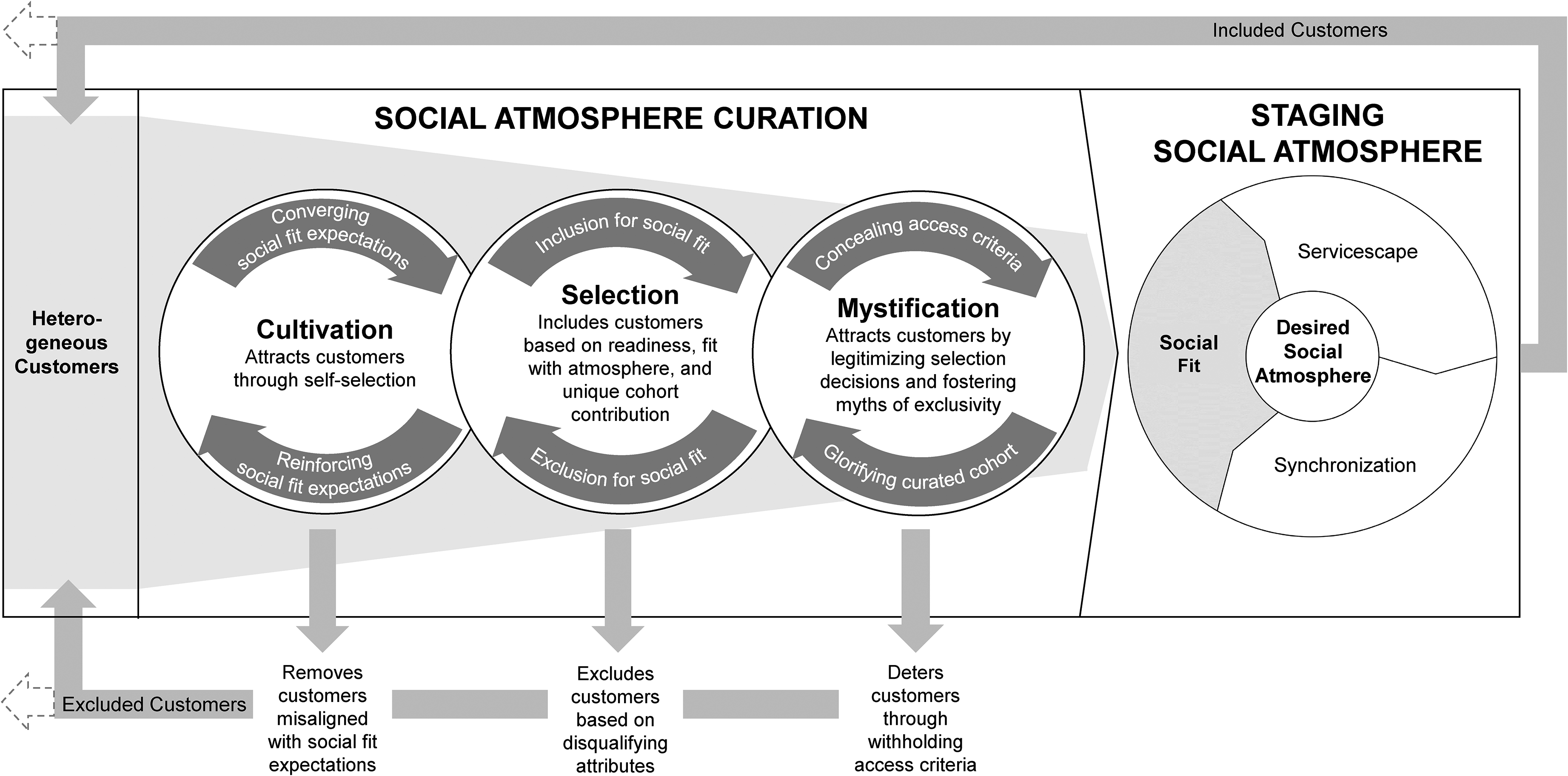
Social Atmosphere Curation.
Cultivation: Converging and Reinforcing Social Fit Expectations
Converging
Converging refers to curation work that aligns social fit expectations internally among staff and externally with customers. Curators talk of the “concept,” the vision they have for the desired atmosphere, and the customers who “fit in” this vision. Backstage staff, such as club owners, event organizers, and DJs, communicate their “idea” of the night and the target customers they wish to bring together to frontline staff, like selectors and security staff. Sebastian, an event organizer, for instance, explains how “at every event, I do briefings with the door and with the selection,” which Paul, a selector, describes as important to “get all staff on the same page.” These briefings essentially constitute “backstage learning” (Wägar 2007), where frontline staff learn through interactions with backstage staff to build shared knowledge about the target group. Daniel, a DJ, explains this when he recounts how “door staff are very clearly instructed about which audience is allowed in, and when more tourists are allowed in, or when they are not.” These target groups vary based on marginalized sexual or musical tastes. For events at Berghain's Lab.oratory, for example, the target customers are principally gay men who embrace sexual freedom and exploration, often as part of leather and fetish subcultures. In contrast, for other popular clubs such as Sisyphos, their target customers have an affinity for deep techno and house music and a commitment to bohemian eccentricity. Either way, achieving social fit requires all frontline and backstage staff to know the vision for the night and know which customers belong inside (Mears 2014; Rivera 2010).
Curators also align social fit expectations externally to customers through targeted promotional materials created and distributed by backstage staff such as club owners, event organizers, and promoters. Given Berlin's popularity for global techno tourism, curators are only too aware of the risk of excessively long queues and unmanageable levels of customer heterogeneity (Thomas, Price, and Schau 2013). It is therefore important for curators to not only attract subculturally complementary groups of customers but also deter those who do not fit in (Mears 2014). Price is one method typically used to deter customers in other sectors. But given the sector's history of low admission prices, promotional materials take on added importance. Martin, an event organizer, explains: “The door begins, so to speak, before the door. It starts with the marketing of the events of the club.” If a club gets promotional materials right, “the fewer problems you have at the door … because self-selection takes place beforehand,” says Matthias, a scene expert. Beyond carefully chosen event names, curators use subcultural codes and imagery, and, at times, explicit dress codes, to attract the “right” crowd (see Figure W1 in the Web Appendix). They also display posters in select locations, use word of mouth among regulars, post cryptic social media posts, and use listings on Resident Advisor, an online magazine for electronic music. While converging aligns social fit expectations internally and externally, curators also use a more hands-on approach to achieve social fit.
Reinforcing
Reinforcing refers to curation work that valorizes and enforces customer behaviors aligned with social fit expectations. Curators set customers’ behavioral expectations at the door. For instance, field notes reveal how club owners and event organizers reinforce social fit expectations with instructional posters displayed at the entrance queue: There are seven posters in total. These posters explicitly signal what behaviors are and are not allowed, or expected, in the club. This includes a zero-tolerance policy to sexual harassment as well as racist, homophobic, or transphobic behavior. … Other posters such as the “bystander chain reaction test” use comic-style images … to educate customers about how they should intervene when witnessing sexual violence. One rule is no cameras allowed. Besides a note reading “NO PHOTOS” chalked above the entrance, the security team expresses it several times during the night. Once guests are accepted, the selector and the burly security supervisor make an effort to welcome people. This could not be more different from the treatment guests received just seconds ago. Their aloofness is replaced by warmth and friendliness. … Marion gives the broadest of smiles to guests as she removes the barrier for them to enter: “Welcome,” “Have fun,” or “You’re going to have a great night!” The guests are relieved. The all-male security team—who come across as unwelcoming at the best of times—also change their demeanor. When conducting a body search with a man who still looks apprehensive and nervous, they lighten the mood by making jokes and engaging in small talk. The head of security, built like a bodybuilder … is the most welcoming, giving a huge, welcoming slap and squeeze on the shoulder.
Achieving social fit requires curators to remove those who violate the community's behavioral expectations. The word “curator,” from the Latin curare, meaning “to care” (Hope and Turner 2015), reflects their role in protecting clubs as a subcultural “safe space” for marginalized customers. Curators describe how atmospheres fail when customers disrupt the synchronization of emotions and behaviors. Robert, a selector, explains why removing misbehaving clubgoers is key: “No matter how long the disturbance was, the person can’t give time back to us. … No one has the right to take it away from us. And the one who dares is then asked to leave.” Achieving social fit requires the threat of exclusion, ensuring customers express intimacy and care to create inclusive social atmospheres.
Accordingly, reinforcing requires curators to monitor customer behavior inside. Selector Phillip, for instance, explains how security, selectors, and bar staff collectively “have an eye on what's going on in the club. … There are … situations where the bar says, ‘That guest was unfriendly, he has to leave.’” Here, Phillip stresses how curators work together to achieve social fit. The following field notes detail how frontline staff collaborate to protect women inside the club, traditionally places where they feel vulnerable (Thornton 1995): At 2:30 a.m., security staff throw out a male guest for filming female guests. Bar staff have caught him holding his camera below his knees and appearing to film their bottoms. Security approaches him: “What the hell, man! Stop filming!” The perpetrator apologizes. Yet security is furious, pushing him toward the exit.
Thus far, we show how cultivation shapes social fit expectations among staff and customers. Cultivation curates social fit by attracting complementary diverse customers through self-selection and removing those who do not align with social fit expectations. Next, we show how social fit among customers is further achieved through customer selection.
Selection: Exclusion and Inclusion for Social Fit
Selection refers to customer inclusion and exclusion decisions based on curators’ assessment of social fit. Frontline staff, such as selectors and security, typically enact these selection decisions. Our data describe how selection achieves “optimal” heterogeneity levels by admitting diverse customers who still fit together. By detailing how selection achieves social fit, we reveal the evaluative criteria used to include or exclude customers. Our analysis shows how customer exclusion decisions are based on curators’ identification of disqualifying attributes of social nonfit. We then explain how customers are included based on curators’ assessment of social fit using three criteria: (1) readiness; (2) fit to the desired social atmosphere based on their subcultural capital; and (3) unique contribution to the customer cohort, as determined by underrepresented identity markers and distinct appearances. We also describe the expertise curators use and give insight into how these skills are acquired.
Exclusion
Exclusion refers to curation work that identifies and excludes customers with disqualifying attributes signaling nonbelonging. Queues heighten clubgoers’ anticipation of pleasure and enable curators to identify customers who may undermine the cohesion of the customer cohort (Thomas, Epp, and Price 2020). Paul, a selector, explains that behaviors such as excessive alcohol consumption, aggression, and antisocial conduct are red flags: Are they loud? Do they show they have a temper? Are they carrying alcoholic drinks with them? Are they being obnoxious and loud to others? Do they leave bottles lying around? Are they smoking and flicking their cigarette butt out?
Less obvious reasons for exclusion are the size of the group queuing. Phillip, a selector, explains how they “have to be careful with letting larger groups enter. … Being part of a group already makes people less likely to connect with others, with strangers, to become part of something bigger.” This is also recognized by regular clubgoers, such as Felix, who describes how the “size of the group is always hotly debated, whether it's lining up alone, in pairs, or at most a group of three or four … [to] have a higher chance of getting in.”
Curators also treat unironically worn “mainstream” styles of dress as markers of outsider status, and therefore grounds for refusal. Clothing indicates social aspiration and position (Arsel and Thompson 2011). For curators, men in suits or gilets, or women with handbags and high heels, signal an affinity with mainstream society. While these may be signs of social fit in typical nightclub scenes (Mears 2020), this is not the case in Berlin. As Robert, a selector, explains, mainstream customers who do not “fit in visually” often lack the embodied subcultural capital (Thornton 1995) to engage in the intense dancing and gestures of intimacy and care needed for clubgoers to feel emotionally in sync with one another: 99.9% of the time, the suit guy isn’t on the dance floor and isn’t dancing wildly. He's standing or sitting somewhere, playing it cool, spending his money, and watching. That's why … I never let any suit guys in—they don’t bring anything to the evening.
Inclusion: Customer readiness
As much as selectors identify disqualifying attributes to exclude customers who do not fit in, they use three inclusion criteria in their curation work to evaluate customers’ social fit. The first of these evaluative criteria is customers’ readiness to contribute to the desired social atmosphere. Selectors infer customers’ readiness by assessing their motivational and interactional capacity to immerse themselves in crowds (Danatzis, Karpen, and Kleinaltenkamp 2022). Similar to how fashion models develop skills to perform in complex, fast-paced environments (Mears 2011), selectors assess whether customers can “lose themselves” and find intimacy among strangers. Paul, a selector, explains: We distinguish whether they are active participants or passive observers. An active participant is one who comes to be a part of everything. And a passive observer … would not be able to actively participate properly at all if he is inside. … If you have too many passive observers, the active participants can no longer let themselves go. Later … when there are few people trying to enter, Marion [the selector] … describes how she uses open-ended questions when she is uncertain about whether somebody is going to contribute: … “The questions are there to get people to show something about themselves … to show me they want to be there for the right reasons,” she explains.
Questions like “Why are you here?” or “What are you looking for?” prompt genuine responses, as customers cannot prepare answers they think selectors want to hear. Responses like “I’m here to meet people and enjoy the music” or “We’re here to have a good time with others” are cues that selectors find favorable, while answering with “It's all about our group tonight” or “I heard this place is super trendy” suggest less desirable motivations, namely unwillingness to mix with other guests or seeking status over sharing experiences with others. Beyond assessing motivational readiness, selectors and security work together to evaluate customers’ interactional readiness—the capacity to develop relationships with other customers and staff (Danatzis, Karpen, and Kleinaltenkamp 2022). Initiating conversation with strangers and staff is key to a warm, intimate social atmosphere. To this end, selectors and security staff adopt exaggerated personas that require clubgoers to adapt how they behave to both. Security staff intimidate to reveal if clubgoers are deferential to staff (Dion and Borraz 2017), after which selectors assess whether clubgoers can confidently engage in conversation: The selector and security team take on contrasting roles. While the selector is open in her body language, smiles … security takes on the role of the “bad cop.” His role is to intimidate. His tight black T-shirt makes his bulging arms and muscular chest stand out. … He strides up and down the queue. At times, he stops to lean over the rope to take a closer look at guests. Guests don’t know whether to engage with him or carry on talking. … Many fall silent. … The selector engages in her usual friendly small talk with two potential guests. … The security moves behind the selector, standing behind her left shoulder, and stares into the eyes of those guests to whom she is talking. … He then returns to patrol the queue, where he continues to stare down those closest to the front. The queue grows quiet as he inspects them, with some guests avoiding his gaze by looking at the floor or turning away, rarely daring to meet his eyes.
Selectors and security staff rely on their mastery of body language and verbal communication skills to assess customers’ readiness. Selector Robert, for example, stresses the importance of advanced communication skills in this role: “Communication is very important to us. You should be able to talk to people … and you need to perform, to really show them your authority.” This aligns with studies showing that the mastery of language and communication enables staff to control service interactions (Dion and Borraz 2017).
Selectors develop these skills through formal training, often provided by specialist Berlin-based event management organizations, such as Vorfreude. Vorfreude offered training for selectors and security, where role-play exercises were used to develop their communication skills (Vorfreude 2024). Moreover, selectors and security learn to develop their body language and communication skills by observing more experienced colleagues (Maciel and Wallendorf 2017). For instance, trainee selectors watch seasoned selectors use open-ended questions to assess customer readiness, stepping in during breaks to gain experience. Through mimicking these interactions and honing their questioning techniques, new selectors engage in situated learning (Lave and Wenger 1991). As Phillip explains, assessing customer readiness is “based on accumulated experience,” comparing it to the experience of professional athletes who “react correctly because they’ve trained so hard.” In this way, assessing customer readiness becomes an intuitive skill developed over time through formal training and experience.
Inclusion: Fit to social atmosphere
The second way selectors assess social fit is by evaluating customers’ fit to the desired social atmosphere, based on an assessment of subcultural capital (Kates 2002; Thornton 1995). Clubgoers are assessed on their subcultural knowledge and whether they adhere to localized modes of dress and their knowledge of the Berlin electronic music club scene. When explaining the importance of subcultural capital for fitting in with the social atmosphere, selectors cite the importance of “people to fit in visually together” and for there to be a level of “cultural compatibility” based on shared sexual or musical tastes.
Selectors agree that clubgoers’ style of dress is a key indicator of subcultural capital. While the definition of appropriate dress varies across clubs, selectors generally favor a techno-hipster aesthetic (Garcia-Mispireta 2023), which might include black clothing, leather harnesses, skimpy leotards, or mesh tops. Clubgoers are aware of how their style of dress can signal insider status. As Johanna explains, “I think about my outfit a few days in advance.” Similarly, Alexander says, “You have to think beforehand, what do I wear to get in? To look like I fit the part?” Thus, clubgoers recognize that personal style and self-presentation are potent visual indicators of social fit (Goffman 1959; Mears 2014).
Beyond style of dress, selectors assess clubgoers’ knowledge of Berlin's music scene. A common question asked by selectors is “Who is playing tonight?” While this may seem simple, the length of the lineup—often including 15 or more DJs over a weekend—makes it challenging. Enthusiasm for lesser-known DJs conveys insider status. In one instance, a clubgoer approached the selector and, before being asked any questions, proudly announced, “I’m here for DJ [name redacted],” while revealing a tattoo dedicated to the artist. Similarly, when asked “Where have you been tonight?,” naming a hip underground bar reflects being “in the know” and confidently demonstrates embodied subcultural capital (Ostberg 2007).
As curators with expertise and influence (Bessy and Chauvin 2013), selectors rely on their subcultural capital to evaluate customers’ social fit. Selectors are considered “masters of the scene” (Thornton 1995, p. 203), whose expertise has been developed through long-term socialization in Berlin's electronic music club scene. Unlike the skills needed to assess readiness, subcultural expertise cannot be developed through formal training. Selectors, like bookers of fashion models, are often immersed in their scene from a young age (Mears 2011). Phillip, a selector, explains how his expertise stems from firsthand involvement in adjacent cultural sectors such as fashion, music, and the broader cultural industries (Bourdieu 1986): You have to have an eye, and you develop an eye when you are involved with certain things yourself. Fashion, culture, local music, you have to be connected to these, otherwise you can’t judge what goes with what, and who fits with who. You have to know where you are and what you are to judge what kind of crowd belongs here. So, you have to be part of the whole thing yourself to be able to judge.
Inclusion: Unique contribution to the customer cohort
The final criterion selectors use to assess social fit is customers’ unique contribution to the customer cohort (Mears 2014; Vonk 2023). This evaluative criterion does not assess clubgoers’ readiness or insider status, but their potential to create the “dancefloor heterogeneity” (Garcia-Mispireta 2023, p. 185) for which Berlin's clubs are renowned. In this way, a customer's uniqueness is never preestablished; it is contingent on the current and anticipated makeup of the customer cohort inside the club. It is for this reason that even the most regular clubgoers who “fit in” are sometimes rejected.
Selectors use “surface-level” (Khan and Kalra 2022, p. 179) demographic markers of identity—age, gender, ethnicity, or sexual orientation—to evaluate a customer's unique contribution to the cohort. Selectors regularly cite “doing the rounds,” where they leave their post to “take in the atmosphere inside,” to observe the cohort and identify underrepresented groups. Based on these observations, selectors adjust their selection decisions accordingly. As Phillip explains, “after my rounds, I then know I must … make sure that I have more people of color, or more girls, or whoever … is not currently represented inside.” Field notes also captured selectors discussing the need for more “queer groups” after admitting a group of seemingly straight men. By adjusting the demographic composition of the cohort, selectors help create a curated “microcosm of cosmopolitanism” (Garcia-Mispireta 2023, p. 184).
In addition to demographic markers of identity, selectors also infer an individual's uniqueness based on “distinct body looks” (Rief 2010, p. 184; Vonk 2023), an intensified aestheticization of appropriate styles of dress and performance. Unlike unsuitable clothing items such as office wear that act as disqualifying attributes, or a style of dress that signals insider status, selectors evaluate distinct body looks favorably because they enhance the club's social atmosphere. For clubs like Berghain, flamboyant fetish wear helps clubgoers embody the “right kind” of individuality (Rivera 2012; Vonk 2023). For bohemian clubs such as Sisyphos, an intensification of a “playful glamour” style of dress is a reliable sign customers have the “attitude and charisma,” as Marion, a selector, puts it, to enhance the atmosphere. This suggests selectors do not select customers for simply fitting in, but for their unique looks that signal “individuality, comfort, and confidence” (Vonk 2023, p. 14), underlining their unique contribution to the customer cohort. As Hans, a selector, puts it, “sometimes it is just a kind of positive energy that comes up the stairs [that says] ‘I’m an asset to your club.’”
Selectors’ evaluations therefore require constant attention to the customer cohort's composition. To do this, selectors develop sensory expertise, becoming emotionally synchronized and attuned with the social atmosphere and cohort inside. For instance, Phillip, a selector, describes the need to go inside and “have a look. What have I actually built here? What is the atmosphere like?” This sensory knowledge is not codified; it cannot be learned by transferring discursive knowledge through training. Instead, it requires selectors to “feel and know how people are feeling inside, and know what the crowd needs,” as Marion, another selector, says. When the atmosphere “fails,” selectors handpick clubgoers out of the queue who they feel will electrify the mood, as Phillip explains: “I go out and walk through the queue and then get what I think needs to be in the club very quickly. ‘You, you, you, you. Come to the front!’” Attuning to the atmosphere inside cannot be trained as assessing clubgoers’ readiness can. Instead, it is situated knowledge “perceived through the senses, judged through the senses” (Strati 2007, p. 62), learned and developed through practice.
Mystification: Concealing and Glorifying Social Fit
Mystification refers to work done by curators to conceal and glorify the access to and value of curated cohorts. Mystification curates social fit by deterring customers by withholding access to selection criteria and attracting complementary customers by legitimizing selection and fostering myths of exclusivity. Both frontline and backstage staff enact mystification work.
Concealing
Concealing refers to curation work that obscures selection criteria to prevent questioning of social fit and sustain the mystery of access. Our data show that curators use various techniques to avoid explaining their selection decisions to those they turn away. One notable example is Sven Marquardt, arguably the most infamous selector, whose inscrutable approach has helped make Berghain one of the world's most notorious nightclubs (Rogers 2014). Clubgoers often report queuing for hours, only to be met by Marquardt, who rejects them with nothing more than a shake of his head and a simple “no,” before moving on to assess other guests. Research shows how sales staff use intimidation to make people feel worthy of exclusion (Dion and Borraz 2017). With sunglasses hiding his eyes, the combination of face tattoos and dual-lip piercings makes Marquardt look intimidating, such that rejected customers do not dare to strike up a conversation. By refusing to enter a conversation with rejected clubgoers, selectors do not risk divulging the criteria used to assess social fit.
Other selectors are more approachable. As Robert says, “we’re not there to step on people's souls.” When curators do engage in conversation, they can appear to offer helpful advice on how to gain entry next time. However, this advice is typically generic and does not offer real insight into how customers can signal social fit, as seen in the following field notes: The selector has the gift of letting people down gently. … When she decides not to let people in, she communicates clearly and assertively, while smiling. … She starts with an apologetic, “Sorry, it won’t work for you tonight.” … To those, however, who do protest, she provides a reason for why they got rejected. For example, a man in his thirties, wearing a turban, is trying to get in by himself. She rejects him and he asks why. She provides a rationale for her decision as well as suggestions on how to increase his chances next time: “Sorry, I can’t tell what you are like. By yourself, you don’t look very comfortable. Next time, come in a small group and you might feel more relaxed. This would be a lot easier for me to get a feel for who you are.”
Concealing also mitigates the risk of curators being accused of discrimination. Since social fit is evaluated based on appearance and subcultural capital, these criteria can intersect with legally protected categories like race, gender, or sexual orientation (Vonk 2023). While social atmosphere curation may create diverse dance floors, selectors still face accusations of discrimination (Thaddeus-Johns 2019). Although selectors such as Paul claim they “do not differentiate on the basis of gender, sexual orientation, or background,” concealing selection criteria enables them to obscure exclusion decisions based on race or sexuality. Backstage staff, like club owners or event organizers also help conceal selection criteria by publishing “entry guidelines” on their website that are not only generic but also strategically crafted to preempt accusations of bias or discrimination. For instance, the Sisyphos club (2024) states: There is no age-related discrimination, and there are no exclusion criteria based on gender or gender identity, sexual orientation & identity, religion, disability, ethnicity, or nationality. … Our door staff base their decisions solely on the current situation.
Glorifying
Glorifying refers to curation work that perpetuates narratives that legitimize customer selection decisions and foster myths of exclusivity. Selectors, as the first and last point of contact for clubgoers, play a symbolic role in granting access to a temporary escape from reality and returning guests to normal life in the early morning (Goulding et al. 2009). In these departure interactions, selectors validate their expertise in social atmosphere curation by “blurring the boundaries of commercial exchange” (Pomies and Arsel 2023, p. 83). Narratives are woven into these exchanges, subtly affirming the selectors’ role in creating customers’ experiences, as these field notes show: “Hey! I told you you’d have a great time!” said one selector to a clubgoer leaving the venue, covered in sweat and with bulging pupils. Some selectors are more explicit, as Phillip stresses: “When people leave—even if it was just a so-so evening—we say goodbye nicely and then add a twist: ‘Ah no, it was a great night! … I told you I know how to put on a good party!’” Through glorifying, curators legitimize exclusion decisions by highlighting how social fit enables social atmospheres to emerge.
Curators affect the symbolic value of a service (Bessy and Chauvin 2013). Selectors’ decisions are also glorified by clubgoers for ensuring enhanced customer experiences, even if this means they will sometimes be rejected. Clubgoers describe how selectors’ presence and decision-making add to the “myth” of Berlin's club scene, heightening their desire to enter because, if accepted, they know they will have a superior experience. As Alexander explains: It's good that people are selected because a lot of people don’t necessarily fit in. … You have to protect privacy, and because there can be sexual interactions, safety is important. The selectors are good at selecting people who fit together. If everyone got in, then this special thing would be lost, the myth, and the rules would be broken.
Summary
Overall, our social atmosphere curation model explains how firms achieve social fit among heterogeneous customers to stage a desired social atmosphere. Our three curation mechanisms—cultivation, selection, and mystification—are interdependent and work in tandem. While cultivation fosters self-selection and removes customers who do not align with social fit expectations, selection excludes customers based on disqualifying attributes and includes those who show readiness, fit with the desired atmosphere, and unique cohort contribution. Mystification further drives this curation process by legitimizing customer selection and fostering myths of exclusivity. Together, these mechanisms act as a three-stage filtering process that iteratively curates the “optimal” mix of customers. The resulting social fit is key for synchronizing customer emotions and behaviors that allow social atmospheres to emerge and intensify, which can be enhanced by servicescape design. Whether for a festival, a nightclub, or a live sport, invite-only, or religious event, our model thus details how firms across the experience economy can manage customer heterogeneity and achieve social fit to stage social atmospheres. Next, we discuss three theoretical contributions of our study, before outlining key managerial tasks associated with each curation mechanism to help managers assess when to apply them to achieve social fit across sectors. Finally, we consider boundary conditions, legal and ethical implications, and opportunities for future research.
Discussion
Theoretical Contributions
Staging social atmospheres through social fit
First, we contribute to marketing research on social atmospheres by detailing how firms can stage them through social atmosphere curation. Extant service research explains how atmosphere may be produced through the design of servicescape elements, such as lighting, materials, and sound (Bitner 1992; Spangenberg, Crowley, and Henderson 1996). More recent studies explore the impact of social surroundings, revealing how other customers and employees influence collective experiences (Joy et al. 2023; Tombs and McColl-Kennedy 2003). However, many of these studies view atmospheric effects as a secondary, unintended outcome. Yet in sectors across the experience economy—from festivals to nightclubs and live sports—creating social atmospheres is key, and our study is the first to provide evidence of the intentional social curatorship process.
Moreover, we introduce social fit as a key ingredient in staging social atmospheres. Recent work adopts a customer-focused approach, theorizing that social atmospheres emerge when customers synchronize their emotions and behaviors (Cayla and Auriacombe 2024; Hill, Canniford, and Eckhardt 2022). In contrast, our firm-focused approach reveals how social fit among customers is fundamental in enabling this synchronization. Since social fit “aligns … thoughts and behavioral expectations” (Mobasseri, Goldberg, and Srivastava 2019, p. 305), it enables customers to coordinate expressions of intimacy and synchronize their dancing. Achieving social fit therefore enables firms to stage social atmospheres by making the rhythmic entrainment (Cayla and Auriacombe 2024) between customers more likely.
In addition, our study advances research on aesthetic work by showing how firms curate social fit. Mears’s (2011, 2014) studies on fashion and aesthetics of fashion retailers provide the theoretical foundations of social fit, and her work enables us to theorize how social fit comprises both sameness and difference among customers. Owing to her empirical focus, however, Mears has little to say about how social fit is curated in the delivery of shared customer experiences. Accordingly, our work extends Mears's (2011, 2014) by identifying mechanisms through which firms curate social fit. In this sense, our study illustrates how firms exert close control over “the recruitment, control, and discipline” (Mears 2014, p. 1335) of customers’ looks, behaviors, and emotions that transpire in the experience economy.
Managing customer heterogeneity
Second, we contribute to marketing research on consumption communities by revealing how firms manage customer heterogeneity by attracting and selecting customer groups with complementary levels of heterogeneity. Prior work explains that customer heterogeneity can be a double-edged sword: It can threaten social atmospheres by generating group tension, undermining collective belonging, and disrupting community continuity (Hill, Canniford, and Eckhardt 2022). Conversely, it can enhance social atmospheres by offering resources that enrich shared experiences and foster shared identity and goals across customer cohorts over time (Thomas, Price, and Schau 2013).
By identifying three curation mechanisms—cultivation, selection, and mystification—that firms use to achieve social fit, we explain how firms can “optimize” customer heterogeneity to stage social atmospheres. Social atmosphere curation optimizes heterogeneity by creating customer cohorts whose heterogeneity is limited to a narrow range of acceptable, surface-level differences (Khan and Kalra 2022). Thus, customer cohorts are sufficiently diverse to the extent that they enrich shared emotional experiences, but their complementarity is ensured through the filtering mechanisms of cultivation, selection, and mystification.
Notably, our research shows that achieving social fit through social atmosphere curation is a collaborative and dynamic process. While prior research often assumes curation work is performed by staff with advanced skills, such as recruiters (Rivera 2012), we show that curation work involves a range of frontline and backstage staff who collectively manage customer heterogeneity. Notably, this work requires iterative alignment to maintain its effectiveness. For example, while selectors make inclusion or exclusion decisions, they adjust these based on the quality of the emerging atmosphere. The effectiveness of selection also relies on the work of other curators like event organizers, bar staff, and security, whose cultivation efforts reinforce social fit expectations. Their cultivation work shapes the event's ethos, fostering self-selection among the “right” customer groups and ensuring adherence to emotional and behavioral expectations across events. Meanwhile, club owners, DJs, and clubgoers engage in mystification work, legitimizing customer selection decisions and enhancing the event's desirability, which facilitates future cultivation and selection work across customer cohorts. Thus, our work complements previous research on frame alignment practices, which customers use to reconcile differences and manage heterogeneity-related tensions in consumption communities (Thomas, Price, and Schau 2013).
Interdependence of marketplace inclusion and exclusion
Third, our findings call for a shift in how marketing scholarship understands the relationship between marketplace inclusion and exclusion. Prior research primarily focuses on how marginalized customers are rejected in retail settings (Dion and Borraz 2017; Ward and Dahl 2014) or excluded from consumption settings (Bone, Christensen, and Williams 2014). These studies show how marginalized customers often struggle to secure fair treatment and face barriers to participation in markets that are accessible to the majority of marketplace participants (Burgess et al. 2017).
In contrast, we focus on how firms can intentionally include marginalized customers to create a protected space that temporarily overrides social marginalization. By demystifying the evaluative criteria firms use to include marginalized customers—such as readiness, fit to social atmosphere, and unique cohort contribution—our findings show how firms can stage inclusive social atmospheres. However, we also demonstrate that the inclusion of marginalized customers may require the exclusion of nonmarginalized customers—those who typically enjoy full market participation without facing barriers of stigmatization (Burgess et al. 2017)—if they are perceived as a threat to the experience of the marginalized. Our findings detail how this exclusion is based on disqualifying attributes indicating social nonfit. By showing how excluding nonmarginalized customers enables the inclusion of marginalized customers, we respond to recent calls for “further theoretical development … and more critical analyses regarding the tradeoffs between inclusion and exclusion in the marketplace” (Dobscha et al. 2024, p. 4). Our work therefore challenges traditional notions that inclusion should be “operationalized as opposition to exclusion” (Arsel, Crockett, and Scott 2022, p. 920) or that exclusion must be “designed out” to create inclusive places (Fisk et al. 2018).
Managerial Implications
Our findings offer valuable insights for managers, outlining how firms can stage social atmospheres using our social atmosphere curation model. All three curation mechanisms of our model are crucial for achieving social fit. In this section, we explain how breakdowns in any of these mechanisms can compromise social fit and cause social atmospheres to fail. To help managers avoid such failures, we provide a decision flowchart that outlines the managerial tasks associated with each mechanism and the applicability of our proposed selection criteria (see Figure W2 and Table W4 in the Web Appendix). This guidance outlines the transferability of our model to contexts where social atmospheres are central to the firm's offering—from private members’ clubs to music festivals, religious gatherings, and invite-only events.
Managing cultivation
Our findings highlight how curators engage in cultivation work to shape social fit expectations both internally and externally, reinforcing behavioral models for customers to align with (Dion and Borraz 2017). Thus, the first managerial cultivation task is to establish a shared internal understanding of the social atmosphere the firm seeks to stage. Cultivation is a team effort, and managers must ensure that all staff involved in the curation process—whether event organizers, security staff, selectors in nightclubs, or clergy, volunteers, and community outreach coordinators at religious events (Higgins and Hamilton 2019)—share the same vision of the event. Failure to shape such social fit expectations internally can result in poor team performance, threatening social atmospheres. For example, unclear communication between venue management and security at an alternative music venue recently resulted in male guests being interrogated and harassed by security staff (Snapes 2024). Here, confusion among staff regarding target customers led to the intended social atmosphere being compromised, the venue apologizing, and critical press coverage emerging.
The second managerial cultivation task is to assess whether external communications effectively create the desired social fit expectations for potential customers, fostering self-selection. If social fit expectations are not carefully shaped externally, the wrong crowd may be attracted, undermining customer self-selection and causing negative downstream effects on selection and mystification. This can prevent firms from educating customers about cultural meanings and behavioral expectations, impeding the development of future customer cohorts (Thomas, Epp, and Price 2020) by precluding those customer-led preparation activities vital for social atmospheres (Hill, Canniford, and Eckhardt 2022). Popular festivals such as Burning Man in the United States, Glastonbury in the United Kingdom, or Fusion in Germany, for example, promote a unique ethos through marketing communications (Flinn and Frew 2014; Kozinets 2002) to educate customers about behavioral expectations, fostering self-selection and attracting complementary customers to achieve social fit. However, firms must target distinct yet complementary customer groups to avoid excessive homogenization, which can dilute the positive outcomes of feeling emotionally in tune with a diverse customer cohort (Hill, Canniford, and Eckhardt 2022). This is often seen when music festivals such as Coachella or private members’ clubs such as Soho House expand their customer base, leading to accusations of becoming mainstream (Gogarty 2024) or when popular nightclubs turn into “boring tourist traps” (Scally 2023). Whether a festival, a nightclub, or a private members’ club, firms must therefore balance their communications to welcome suitable newcomers without alienating seasoned customers.
The third managerial cultivation task is to reinforce behaviors that achieve social fit among customers. Our findings show how curators provide behavioral models for customers to follow. While staff can curb misbehavior through rule enforcement (Danatzis and Möller-Herm 2023), providing positive behavioral models reinforces social norms (Dion and Borraz 2017). Failure to engage in this reinforcement work can lead to customer misbehavior, potentially ruining the social atmosphere, as evidenced by recent reports of abusive audience behavior at live music shows across the United States and United Kingdom, causing interruptions and canceled performances. In response, live venues have implemented stricter policies, with staff reinstating expected customer behaviors before live performances (Thorp 2023).
Managing selection
Our findings reveal four evaluative criteria curators use to make selection decisions for achieving social fit. Exclusion is based on the assessment of a set of disqualifying attributes, while inclusion depends on assessing customers’ (1) readiness, (2) fit to the social atmosphere, and (3) unique contribution to the customer cohort. While these criteria outline how managers make customer selection decisions, this section helps firms determine when each criterion is best suited to achieve social fit. Along with a decision flowchart that outlines the four managerial selection tasks, we also provide a table showcasing their transferability across contexts (see Figure W2 and Table W4 in the Web Appendix).
The first managerial selection task is to assess whether demand exceeds supply for a specific event. Venues such as nightclubs, music festivals, and live sports have limited capacity. Conversely, luxury stores, high-end restaurants, and private members’ clubs limit access to foster an atmosphere of exclusivity (Dion and Borraz 2017). In both cases, managers must identify and assess a set of disqualifying attributes signaling social nonfit, such as “mainstream” clothing in nightclubs or nonadherence to etiquette in high-end restaurants. Notably, the way exclusion decisions are communicated varies. For example, managers may reject customers explicitly through admission letters to private members’ clubs or at nightclub doors or implicitly by raising prices for ticketed events or making customers feel unwelcome in luxury stores (Dion and Borraz 2017; Ward and Dahl 2014). Failure to screen for such attributes can lead to excessive heterogeneity, causing group tensions, leading audiences to dissipate, and damaging the brand's image (Higgins and Hamilton 2019; Parmentier and Fischer 2015). In turn, if demand does not exceed supply, as it is often the case for invite-only events, for example, managers should omit exclusion and focus on inclusion criteria instead.
The second managerial selection task is to assess the complexity of crowd behavior. Research shows how participation in common movements, vocalizations, and emotional responses is key for the synchronization required for social atmospheres to emerge and intensify (Cayla and Auriacombe 2024; Hill, Canniford, and Eckhardt 2022). Yet the complexity of these behaviors varies, and with it, the readiness required for customers to participate (Danatzis, Karpen, and Kleinaltenkamp 2022). Compare, for instance, a rock concert with a high-end private members’ club. While behaviors at rock music concerts—such as singing along and dancing—are usually of low complexity and require low readiness, behaviors in private members’ clubs like London's Annabel's or Garrick are more complex. Navigating these elite clubs requires high readiness, including the ability to communicate across hierarchies, express emotions appropriately, and adhere to “highly codified [codes of conduct] with procedures and subcommittees and diktats on attire” (Lo Dico 2024). Hence, the more complex the cohort's crowd behavior, the greater the need for managers to assess readiness, be it through short conversations at nightclub doors or extensive membership applications at private clubs. Failure to assess readiness can threaten the synchronization of emotions and behaviors among customers, hindering the emergence of social atmospheres.
The third managerial selection task is to assess how embedded an event is in subcultural rules, norms, and rituals (Ostberg 2007). Much like Berlin music clubs, some religious or invite-only events can serve as subcultural safe spaces where people share marginalized beliefs and practices, while mainstream nightclubs or live sports attract a more heterogeneous crowd. The more an event is rooted in subcultures, the more important it is for managers to assess customers’ fit to the desired atmosphere based on subcultural capital. This assessment involves both objectified and embodied expressions of belonging and insider status, such as dress code and community-specific knowledge (Kates 2002; Rivera 2012). While failure to assess readiness disrupts the cohort's immediate interaction dynamics, ineffective assessment of customers’ fit to social atmosphere leads to a growing cultural divide over time (Thomas, Epp, and Price 2020). This alienates seasoned customers and erodes the event's subcultural identity (Hill, Canniford, and Eckhardt 2022). Once countercultural festivals and underdog sports clubs like Burning Man or 1. FC Union Berlin share these concerns, worrying that their “festival has changed beyond recognition” (Willis 2023) or that their soccer club may struggle to “maintain their identity” (Holden 2022).
Finally, the fourth managerial selection task is to assess how much unique contributions are valued at an event. For example, social atmospheres at invite-only events thrive when managers carefully select a diverse yet complementary group of customers who enhance access to social and economic resources for attendees (Thomas, Price, and Schau 2013). Unlike luxury stores, festivals, or religious gatherings, which prioritize a sense of belonging, managers at invite-only events—such as exhibition openings, film premiers, galas, or book launches—should evaluate attendees based on underrepresented demographic identity markers, expertise, and social networks (Bessy and Chauvin 2013). For example, applying to speak at a TED conference involves an extensive process where applicants must share their story and “reflect on who [they] are and what makes [them] tick” while explaining “what makes [them] exceptional,” as the organizers seek members who can contribute strongly to the TED community (TED 2024). Ineffective screening for unique contributions, in turn, weakens the potential resources and rewards available for attendees (Rivera 2010).
Managing mystification
Our findings reveal how curators engage in mystification work to conceal and glorify the access to and value of curated cohorts to achieve social fit. The first managerial mystification task is to establish clear guidelines on what curators can and should disclose. Much like how Berlin music clubs deliberately conceal their selection criteria to legitimize rejection decisions and mitigate allegations of discrimination, high-end private members’ clubs and invite-only events similarly keep the process of joining or securing an invitation opaque. The management of this concealment varies: Some firms may articulate vague and elusive acceptance criteria, such as the community fit required for prospective TED speakers (TED 2024), while others, like The Other Club, a high-end private members’ dining club in London, enforce policies that obscure both the selection criteria and the identities of the selectors, with a rule stating: “The names of the executive committee shall be wrapped in impenetrable mystery” (Lo Dico 2024). Failure to maintain this concealment increases the likelihood of managers having to justify rejection decisions to complainants, whether online or in court, as evidenced by lawsuits against nightclubs and social clubs (Waters 2023). Additionally, disclosing evaluative criteria risks alienating seasoned customers by revealing the requirements to gain access, potentially threatening the status and subcultural identity of the event's social atmosphere (Dion and Borraz 2017; Ostberg 2007).
The second managerial mystification task is to glorify and reinforce myths about the value of curated customer cohorts. Beyond advising curators to champion the outcomes of customer selection, managers should promote myths of exclusivity, framing the event as a curated, protected safe space. Brands often cultivate myths to create an aura of authenticity (Beverland 2005) through storytelling or by fostering brand ambassadors or an evangelizing community. These myths glorify exclusion decisions and legitimize them, while also helping maintain an apparent commitment to nonfinancial ideals. Failure to promote such myths may lead customers to question the sincerity and necessity of the selection process and the value of achieving social fit. In contrast, when done well, glorifying the selection process elevates the perceived quality of the curated experience (Bessy and Chauvin 2013).
Conclusion, Boundary Conditions, and Future Research
Our study explains how firms stage social atmospheres through a three-stage social atmosphere curation model that brings together the “right” crowd based on social fit. Since our theorization is based on an extreme and persuasive case (Arnould, Price, and Moisio 2006), we acknowledge several boundary conditions that also open future research opportunities.
First, our model and its three curation mechanisms—cultivation, selection, and mystification—are applicable to contexts where the social atmosphere is central to a firm's offering—including private members’ clubs, live sports events, religious and music festivals, nightlife entertainment, and invite-only events. Given that sectors have competing strategic priorities, future research should explore how social atmosphere curation might differ in contexts where social atmospheres are important but not central to firm success. For instance, elite universities benefit from creating an exclusive social atmosphere where cultivation, selection, and mystification foster self-selection and enhance student experiences, yet managing social atmospheres is secondary to delivering quality education. Thus, the applicability and relative importance of our curation mechanisms may vary, warranting further exploration of how social atmosphere curation unfolds in these different settings.
Second, our inclusion and exclusion criteria for selecting customers are particularly relevant when (1) demand exceeds supply, (2) crowd behaviors and emotions are complex, (3) an event is rooted in subcultural identities, and (4) diversity is valued. As detailed previously, the applicability of these criteria varies across contexts. When none of them apply, social atmosphere curation relies on cultivation and mystification, with less emphasis on customer selection. For example, unlike many Berlin music clubs, ticketed sex-positive events such as Joyride in London rely primarily on cultivation, particularly by providing behavioral models for customers to achieve social fit. While tickets are available to anyone, event organizers provide detailed “community guidelines” on their website—including instructions on dress and etiquette, strictly enforced by “welfare teams” (Joyride 2024). Future research could consequently explore the relative effectiveness of the three curation mechanisms.
Third, we introduce social fit as a key ingredient in the staging of social atmospheres, as it enables the synchronization of customer emotions and behaviors. While social fit is a necessary condition for this synchronization—without which social atmospheres are unlikely to emerge—service research stresses how this synchronization can be enhanced through the design of servicescape elements, such as music, layout, or scent (Bitner 1992). For example, Berlin music clubs are often housed in disused factory buildings, whose labyrinthine layout encourages exploration and experimentation, while the clubs’ techno fosters synchronization on the dance floor. However, the interaction between social fit, synchronization, and servicescape design remains unclear, presenting exciting opportunities for future research.
Finally, our model of social atmosphere curation raises important legal and ethical considerations. Legally, excluding customers as is done in Berlin music clubs is neither permissible nor advisable in many service settings. Even where it is legal, ethical concerns remain, as customer selection can be misused to systematically discriminate, especially against marginalized customers. However, in contexts such as ours, customer selection is geared toward including marginalized customers, which may require the exclusion of nonmarginalized customers to curate protected spaces for marginalized groups. Excluding nonmarginalized customers may therefore be considered legitimate when those rejected occupy dominant societal positions or pose a threat to marginalized customers. However, exclusion decisions based on disqualifying attributes always risk discrimination, especially when these are linked to physical appearance, which is hard to separate from legally protected categories like religion, race, sex, age, and ability. Future research should explore to what extent our selection criteria might perpetuate discrimination against marginalized customers or act as a tool “to create fairness in the marketplace” (Baker, Gentry, and Rittenburg 2005, p. 134).
Supplemental Material
sj-pdf-1-jmx-10.1177_00222429251328277 - Supplemental material for Curating the Crowd: How Firms Manage Social Fit to Stage Social Atmospheres
Supplemental material, sj-pdf-1-jmx-10.1177_00222429251328277 for Curating the Crowd: How Firms Manage Social Fit to Stage Social Atmospheres by Ilias Danatzis, Tim Hill, Ingo O. Karpen and Michael Kleinaltenkamp in Journal of Marketing
Footnotes
Acknowledgments
The authors would like to thank Ricarda Forstner, Kevin Haug, Marie-Theres Klüpfel, and Juliane Reetz for their time and talent in conducting interviews for this study. The authors would also like to thank Giana Eckhardt and Andreas Chatzidakis as well as colleagues at the University of Adelaide, University of Bath, Freie Universität Berlin, and King's College London for helpful comments during the article development process.
Authors Contributions
All authors contributed equally and are listed in alphabetical order.
Coeditor
Vanitha Swaminathan
Associate Editor
Amber Epp
Declaration of Conflicting Interests
The author(s) declared no potential conflicts of interest with respect to the research, authorship, and/or publication of this article.
Funding
The author(s) received no financial support for the research, authorship, and/or publication of this article.

References
Supplementary Material
Please find the following supplemental material available below.
For Open Access articles published under a Creative Commons License, all supplemental material carries the same license as the article it is associated with.
For non-Open Access articles published, all supplemental material carries a non-exclusive license, and permission requests for re-use of supplemental material or any part of supplemental material shall be sent directly to the copyright owner as specified in the copyright notice associated with the article.
