




Abstract
The authors aim to stimulate discussion on how innovation research within marketing can use a better world (BW) perspective to help innovation become a driver of positive change in the world. This “Challenging the Boundaries of Marketing” series article is intended to provide purposeful research opportunities for scholars seeking to bridge innovation research with the BW movement. The authors frame the discussion with four areas of innovation research in marketing that are particularly relevant to BW objectives. They discuss how the innovation process may be disrupted by potentially relinquishing customer centricity and embracing the constraints imposed by BW objectives. They explore how firms should organize for BW innovation, in terms of both who should be involved in the process internally and externally and how the workforce and firm should be structured to support BW innovation. The authors then consider consumer response to innovation from a BW perspective, examining drivers of adoption behavior regarding BW innovations and how these innovations should be marketed; they also explore postadoption behavior and how to help consumers resist adoption in certain contexts. Finally, they discuss how markets for BW innovation may be created and sustained, and how external constituencies (i.e., government, lawmakers, and academic communities) could shape these markets.
“Innovation, the process of bringing new products and services to market” (Hauser, Tellis, and Griffin 2006, p. 687), is considered fundamental to the economic growth and success of society. Indeed, the purpose of innovation is to devise new ideas and technologies that increase our productivity and generate greater output and value (Abramovitz 1956). In a marketing context, innovation has addressed the strategic challenge of growth by creating value for the organization and its various stakeholders. This is accomplished through a variety of means, such as bringing new products to market, improving sales and customer relationships, reducing costs, and boosting market position. In short, innovation helps firms remain competitive and meet their profit goals. A significant body of academic work in marketing (e.g., Hauser, Tellis, and Griffin 2006; Lee et al. 2020) validates the role of innovation in facilitating effective marketing strategy and execution. However, could marketing scholars be doing more in the innovation space? In a world where major challenges—including environmental crises, social justice concerns, and health emergencies—are increasingly paramount, is there an opportunity for marketing academics to make a more significant contribution to innovation practices that seek to directly address issues fundamental to the human condition?
One promising approach toward answering these questions lies in the adoption of a better world (BW) research lens, inspired by the Journal of Marketing’s “Better Marketing for a Better World” (Chandy et al. 2021). Here, research efforts explicitly seek to understand how marketing practices and outcomes affect society in a broader sense, and how they can contribute to a better world or, at the very least, how related harm can be monitored and minimized. Reinforcing this notion, Chandy et al. (2021) conclude that a gap “remains between what is studied in our field and what is possible” (p. 1), given that the world is facing more significant challenges than ever before. Importantly, they highlight that a firm's efforts can be good for the firm and/or the world, whereas a myopic focus on firm profitability could produce outcomes that are good for the firm, but detrimental to society at large.
With this conjecture as background, we contend that innovation as a marketing function is fundamental to business's ability to meet the societal challenges specific to achieving a better world, and thereby provides an excellent context for marketing research to make both theoretical and substantive contributions in meeting significant global challenges—a research direction that marketing innovation scholars have not yet fully embraced. 1 In a sense, the great challenge lies in putting BW goals at the center of innovation research in marketing—an opportunity to facilitate real change in a world that needs better innovation outcomes for all stakeholders. We present a constructive proposal to seize this opportunity by identifying innovation research ideas that seek to advance and motivate this imperative.
In this work, we define BW innovation as innovation with goals that extend beyond traditional profit-seeking to include societal and environmental benefits. We contend that a BW perspective provides both opportunities and constraints for innovation that may ultimately affect all aspects of the innovation process. We frame our discussion utilizing the key aspects of innovation development suggested in past research (e.g., Hauser, Tellis, and Griffin 2006; Lee et al. 2020). First, we assess how BW considerations are likely to impact the innovation process—specifically questioning the traditional emphasis on customer centricity in favor of a broader view of the product journey, as we explore ways to leverage various innovation constraints with a BW perspective. Next, we define the challenges of organizing innovation to better achieve BW goals, in terms of both who should be involved in the innovation process and how innovation teams should be organized and engaged in BW work. Third, we examine how utilizing a BW lens impacts consumer adoption and acceptance of innovation. Additionally, we consider how helping consumers resist adoption might be desirable in some contexts, and we look to better understand BW implications over the full consumption life of the adopted product. Fourth, success in BW innovation requires effective marketplaces. Thus, creating and sustaining markets (through direct government intervention, adopting novel approaches to intellectual property [IP], or other actions) is often needed. These marketplaces also include the marketplace of ideas, in which academia has an important role to play.
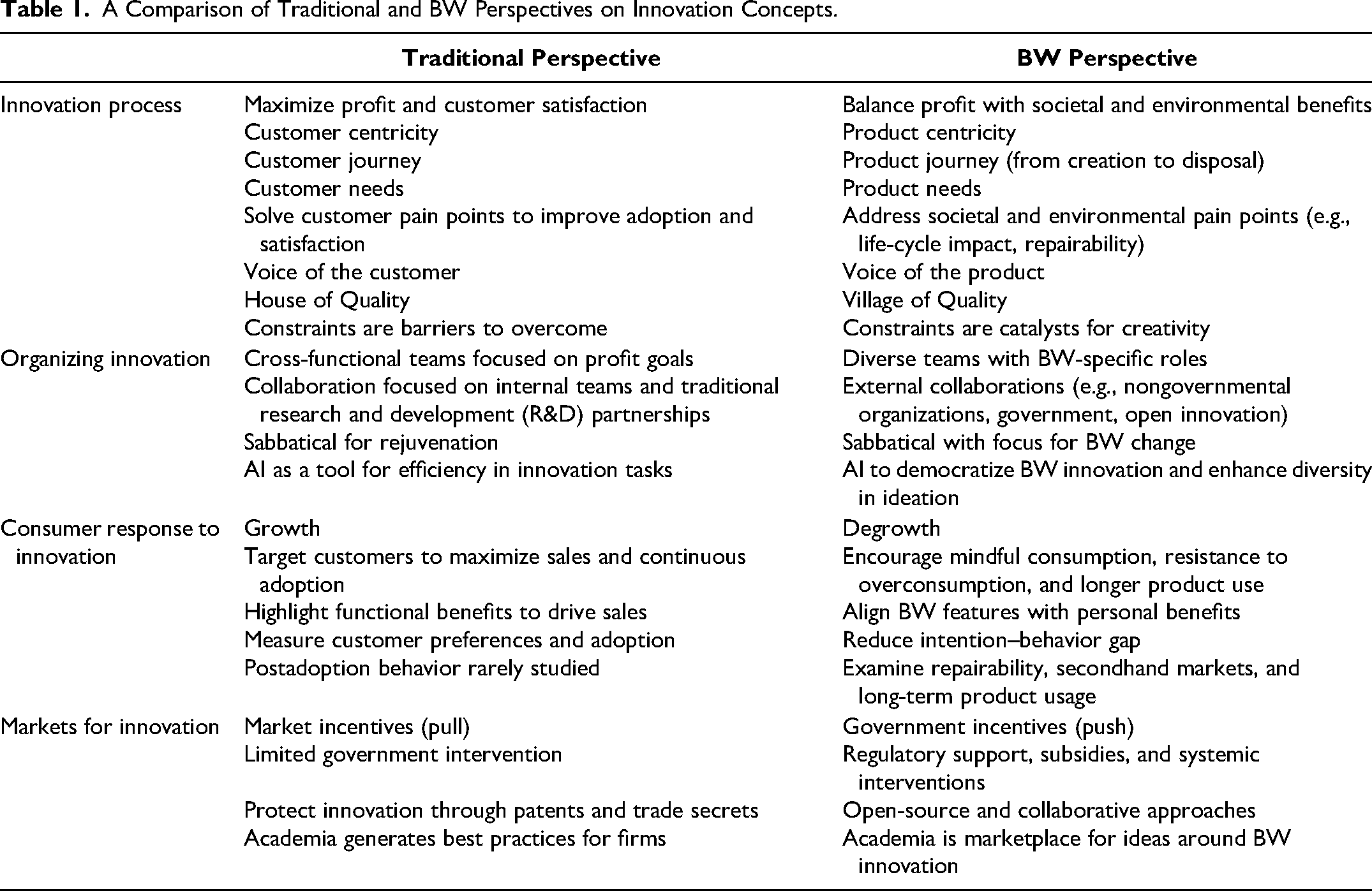
Taking these considerations together, we hope to stimulate a thorough discussion on how innovation research within marketing can use a BW perspective to more holistically understand and inform how innovation practices can better align to improve the world around us. Figure 1 illustrates the framework guiding our research, and Table 1 summarizes select concepts contrasting traditional and BW innovation perspectives. Through this exploration, we hope to provide purposeful and impactful research opportunities for marketing scholars interested in bridging innovation research to meet the BW challenges facing us today.
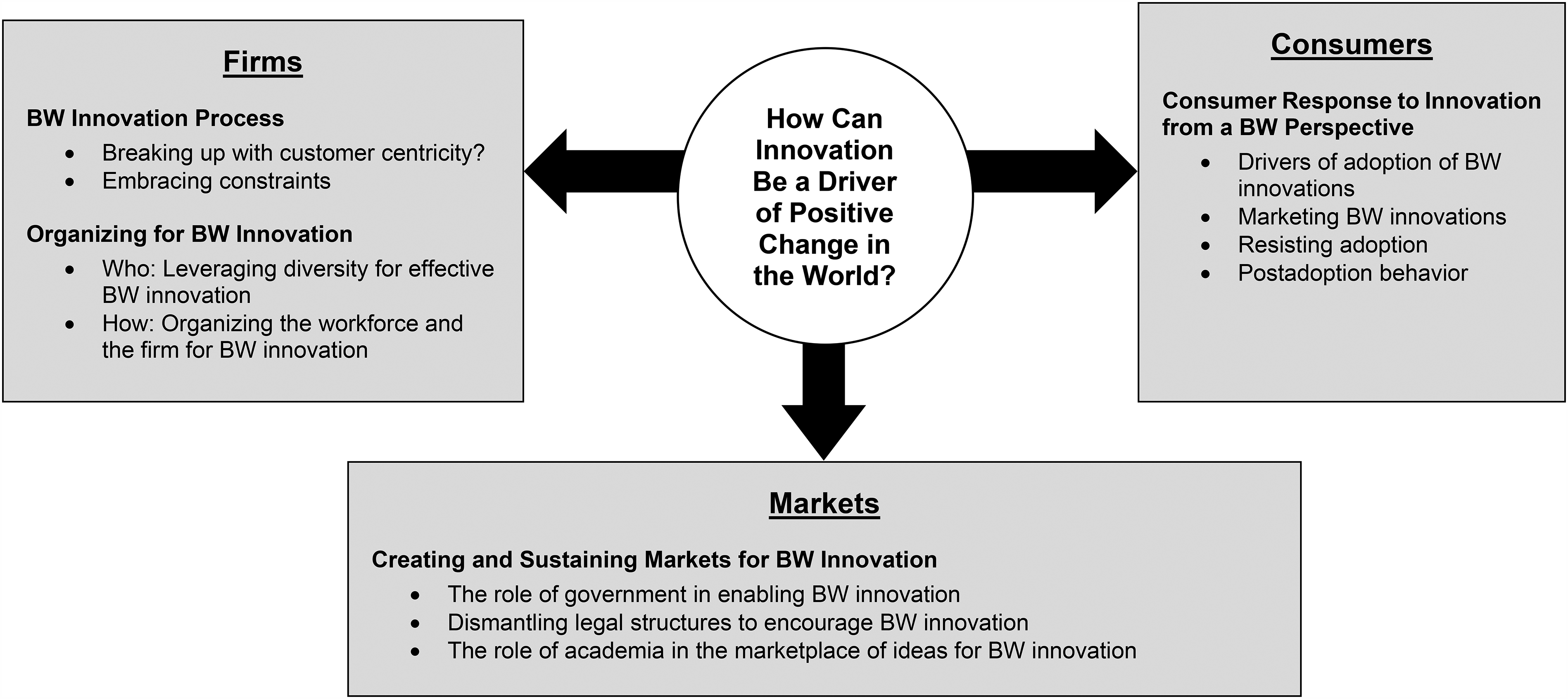
A Framework for BW Innovation Research.
A Comparison of Traditional and BW Perspectives on Innovation Concepts.
Disrupting Innovation Processes for a Better World
In this section we explore how the innovation process itself needs to adapt in response to a strategic shift toward BW innovation. The marketing literature has typically considered the innovation process to be focused on the objective of maximizing profit by pleasing one key stakeholder (the customer). In contrast, BW innovations look to maximize profit under a set of constraints that emerge from multiple stakeholders and/or objectives. Thus, a BW-focused innovation process should deviate from the traditional innovation process in three fundamental ways. First, it challenges one of the core tenets of marketing, customer centricity, in that pleasing the customer becomes only one of several objectives. Second and relatedly, measuring customer needs and preferences for BW innovation raises unique challenges. Third, a BW-focused innovation process forces the innovator to embrace and address added constraints throughout the process, while remaining profitable. We organize this section according to these three fundamental shifts with regard to the traditional view of innovation.
Breaking Up with Customer Centricity?
Marketing, the quintessential customer-focused business function, typically preaches customer-centric innovation. Innovators are taught that the best path toward identifying market opportunities is through mapping out the customer journey, identifying pain points, and innovating against those pain points (Rosenbaum, Otalora, and Ramírez 2017). However, such an approach could be inefficient and/or harmful from a BW perspective. For example, what if customer-centric innovation leads to new products that are not easily repaired, recycled, or reused (i.e., with shorter lifespans)? Indeed, alleviating customer pain points may not always align with BW objectives, which often require effort on the part of the consumer (e.g., recycling used products, adopting better health behaviors, reflecting on biases and prejudice in their consumption).
How then should marketers identify promising innovation opportunities that align with BW objectives? Perhaps, in addition to the customer journey, innovators should consider the product journey as a catalyst for BW opportunity identification. From purchase to disposal, what are the various stages in a product's life where BW “pain points” exist (e.g., points wherein the product is likely to become harmful to the consumer or environment and turn into a BW liability)? How can we innovate to address these product pain points? To address this question, a promising innovation framework may be to develop products that “grow” with their customers, as advocated by Govindarajan, Eapen, and Finkenstadt (2024). Instead of innovating to solve the needs and problems of customers, what if the focus was on solving the needs of the product to meet BW considerations (e.g., minimize environmental impact, enhance social justice, enhance societal health)? Or perhaps we could shift from focusing on individual users as the “customer” to viewing society as the “customer,” one whose more holistic needs and problems might be addressed through innovation?
To what extent would this constitute a paradigm shift within the marketing field (which holds customer centricity as a central tenet), or would it merely invite marketing scholars to utilize our customer-centric innovation toolkit with a different target in mind (i.e., the product, the environment, or society as a whole rather than the consumer)? How would marketers go about integrating the “voice of the product” into the innovation process in addition to (or perhaps even instead of) the “voice of the customer”? While the overall approach may be fundamentally similar (i.e., elicit, structure, and prioritize needs), a clear explanation of “product needs” and how they differ from “customer needs,” specific to a BW context, is warranted. For example, would the need for repair qualify as a valid product need? What would be the implications of this need for product design? For instance, would it lead to the design of physical products that are more modular in nature?
Measuring Customer Needs and Preferences for BW Innovation
A key topic in customer-centric innovation research is the ability to measure customer needs and preferences in order to design effective products, and to quantify the market potential of new product ideas, concepts, prototypes, and so forth. However, in the context of products and services developed with a BW focus, obtaining reliable and actionable data from customers is likely to be challenging. For example, the well-known intention–behavior gap (Sheeran and Webb 2016) suggests that consumers tend to overstate their preferences and willingness to pay in some instances. This intention–behavior gap has been well documented in the context of privacy (Johnson, Shriver, and Du 2020), as well as BW-related topics such as sustainability (Vermeir and Verbeke 2006). More research is needed to explore the intention–behavior gap in other domains relevant to BW, such as societal health challenges, inclusive product design, and social justice more generally. For instance, do current social expectations and the intention–behavior gap in other domains relevant to BW, such as societal health challenges, mean consumers will indicate a preference for inclusive design, but default to more traditional options, behaviorally? Is it possible to develop market research tools that help mitigate or reduce the intention–behavior gap for BW innovations? Based on the psychological distance literature (Trope, Liberman, and Wakslak 2007), reducing the various components of psychological distance (temporal, physical, social, probability) between the innovation and the consumer should reduce the gap. But how can this be achieved? While incentive alignment is an obvious potential solution, it is unlikely to sufficiently motivate consumers to respond to a survey exactly as they would in real life (Yang, Toubia, and de Jong 2018). Perhaps incentive alignment could be combined with virtual reality (Wienrich, Döllinger, and Hein 2021), augmented reality (Tan, Chandukala, and Reddy 2022), or information acceleration (Urban et al. 1997) to close the gap.
The intention–behavior gap is not the only phenomenon that poses a challenge to effective customer measurement in the BW innovation context. Customer centricity could also hinder the pursuit of BW objectives based on whose feedback is solicited and how. Market research and testing in innovation have historically been myopic in their customer sampling approaches. Perez's (2019) seminal book entitled Invisible Women: Data Bias in a World Designed for Men notes a definitive bias whereby “product designers use a ‘one-size-fits-all’ approach to everything from pianos to cell phones to voice recognition software, when in fact this approach is designed to fit men” (p. i). More broadly, the reliance on what is known as WEIRD samples (Henrich, Heine, and Norenzayan 2010)—white, educated, industrialized, rich, democratic—in research and testing predisposes innovation to primarily Western culture and ideals. Perhaps a stronger reliance on observational and ethnographic research methods across differing sampling frames, throughout the innovation process, could alleviate such biased outcomes. For example, could customer service call logs or products equipped with sensors serve as observational input? Such questions might open the door for new Internet of Things applications. However, it is likely that biased observer and analyzer effects would also be problematic in a BW innovation context. For example, if a member of a minority group is interviewed about a new product, does it matter who conducts and analyzes the interview? More research is needed to better identify how bias is created (and eliminated) in innovation research and testing with respect to BW outcomes. In particular, ensuring diversity and representation among the sample of consumers providing feedback would probably not be sufficient to debias market research; attention should also be directed toward the way market research instruments are developed, and how the data are analyzed and translated into insight.
Embracing Constraints
BW innovations need to satisfy multiple stakeholders and objectives, which naturally places significant constraints on the task of developing successful innovations. While constraints may be initially perceived as limiting (and it is tempting to conclude that the presence of constraints will hurt innovation), there is in fact a significant literature on the effect of constraints on creativity (e.g., Moreau and Dahl 2005), which suggests that the types of constraints imposed by BW objectives (e.g., materials used in production, government policy requirements) might give rise to products that are more creative and innovative. This is also the premise behind jugaad innovation, the art of overcoming harsh constraints by improvising an effective solution using limited resources (Radjou, Prabhu, and Ahuja 2012).
Indeed, a BW focus might promote a systematic and systemic view of idea generation, wherein new products are viewed as components within complex, constrained systems that consider a broader set of issues than those found in traditional new product development. This perspective may lead us to reexamine the task unification template developed by Boyd and Goldenberg (2013), a systematic innovation tool that looks to assign a new task to an existing resource. The focal template could be used to identify and develop BW-centered ideas that turn constraints into opportunities by exploring novel ways to better leverage resources available within a product's surrounding ecosystem. This approach requires us to consider not only which features could be added to a product, but also which ones could be removed, replaced, repurposed, and so forth. An example of this shift in focus is captured in the development of hybrid and electric vehicles, which harvest the energy dissipated during braking to charge the car's battery. A testable hypothesis would be that innovation ideas generated from a BW-focused task unification template give rise to more sustainable or health-focused product designs, compared with innovation ideas that are unguided or generated by other ideation templates.
Embracing constraints is necessary not only at the idea generation stage of the innovation process, but also at the design stage. If we see BW considerations as generating additional design constraints for innovators, what innovation tools could we use to deal with the increased complexity inherent in said constraints? Once again, it may be helpful to scan the innovation literature for classic tools that might serve as inspiration. One such example is the House of Quality framework (Hauser and Clausing 1988), which brings information from various product functions together to help innovation teams find optimal design solutions that satisfy multiple, complex constraints. A typical House of Quality effort quantifies how each product feature maps onto a set of customer needs, while capturing potentially complex interactions between design features (e.g., increasing battery life negatively impacts battery size).
This constrained optimization mindset seems well suited to the development of BW innovations, but may require augmentation to capture the more complex interactions across products and stakeholders that characterize BW innovations. First, customer needs should be complemented with societal and environmental needs, and design features should be optimized against these multiple objectives. Second, each product's design feature may interact with the needs of multiple stakeholders and the design features of other products. For example, a newly designed electric car may reduce gas consumption, which in turn reduces pollution at the point of consumption, which ultimately benefits electric car owners and their communities. But these cars require electricity, the production of which will have an environmental impact on other communities (perhaps marginalized ones). Electric cars also require the production of batteries, which again calls for materials mined in other communities, which could trigger geopolitical considerations. Further, an electrical vehicle's tires wear out 30% faster than those of combustible engine cars (Dreibelbis 2023), providing a new environmental challenge for BW innovation to address. That is, rather than optimizing the design of a particular product in isolation, innovators need to think more holistically about design where horizontal (i.e., how product design complements and impacts the environment surrounding its development) and longitudinal (i.e., the downstream implications of said design over time) considerations are paramount in creating a better world.
In doing so, innovators may potentially transition from a House of Quality to a “Village of Quality,” with interconnected houses each representing a different product in the ecosystem. Future research could formalize and test this conceptualization; initially, it may seem like a straightforward extension of the House of Quality, but several important questions arise when thinking more carefully about implementation. For example, should a Village of Quality be composed of Houses of Quality that each represent one stakeholder (e.g., customer, product, environment, society) or of houses that each represent one product in the ecosystem? How should houses be linked together (e.g., should we capture how the features of each product address the needs of each stakeholder?)? How do the needs of each stakeholder relate to the needs of other stakeholders? Should separate design teams create their own respective Houses of Quality to be connected to each other later, or should a holistic perspective be followed throughout the process?
Organizing Innovation for a Better World
BW objectives may be achieved not only by thinking carefully about the structure of the innovation process and the tools used therein, but also by pondering the organization of innovation within the firm. Two key organizational challenges in innovation lie in defining who to involve in the innovation process (the “who”) and how to effectively organize the firm and its workforce for BW innovation (the “how”). We approach the question of “Who innovates?” by examining how diversity within an organization, strategic use of cross-functionality, leveraging of external entities, and the adoption of artificial intelligence can each offer opportunities for BW innovation research. We then focus on research questions concerning “How?” to organize the workforce, build culture, and define ownership structures for BW outcomes.
Who Innovates?
Diversity and BW innovation
Historically, a wide range of diversity factors (including demographics, experience, and cultural and ethnic background) have been studied in the context of an organization's innovation efforts (Hewlett, Marshall, and Sherbin 2013). Such research has typically focused on the impact of diversity on overall innovation performance (e.g., whether diverse teams tend to generate more and better innovation ideas). For example, research indicates that diverse and inclusive innovation teams are more motivated to “work smarter” as they push team members to recognize differences, handle unexpected viewpoints, and put more effort into reaching consensus on better decisions (Philips 2014). Interestingly, very little research has focused on how diversity in the innovation process specifically impacts BW innovation outcomes. One exception is research focused on gender diversity, which suggests a direct relationship between female leadership and BW innovation (Bazel-Shoham et al. 2023). For example, firms with C-level female leaders exhibit higher corporate social responsibility performance (McGuinness, Vieito, and Wang 2017); the conceptual linkages here include findings that women “think greener” than men (Umaerus, Nordin, and Lidestav 2019).
Given these initial gender-specific findings, the potential impact of a broader view of diversity in a BW innovation context holds research promise. Specifically, which forms of diversity are fundamental to BW innovation, and how should we think about diversity per se? How does diversity in age, socioeconomic background, and experience influence BW-centered innovation? Does diverse input during the innovation process give rise to output that appeals to more diverse groups of customers and/or that helps firms achieve other BW objectives through innovation? One opportunity lies in understanding the impact of a diverse innovation team on the types of products and services created by the firm, such as whether and how diverse innovation teams tend to develop products that appeal to customer segments focused on BW goals (or not). For example, are teams with members from less affluent backgrounds more likely to define innovations with societal benefits, or provide unique insights that are pertinent to BW innovation goals? One testable tenet is that diverse teams are needed to create products for diverse markets. Conversely, will products created by such diverse teams somehow “miss the mark” in appealing to a more mainstream customer audience? And what about more contemporary diversity approaches, including sexual orientation, Indigeneity, and disability? As one example, it has been argued that entrepreneurship is fundamental to Indigeneity (Foley and O’Connor 2013), and Indigenous innovation practices that focus on collective well-being—such as Buen Vivir (living well; Jimenez et al. 2022)—provide an interesting juxtaposition to Western innovation models that focus on a fundamental need for “growth.” With this identification in mind, what is the interplay between specific forms of diversity and a firm's BW innovation direction?
More broadly, what type and level of diversity best facilitates creativity related to BW innovation, and where in the innovation process is diversity best applied? A final promising area for research in this regard includes the nature of causality between BW-driven organizations and diversity; that is, do BW-driven firms attract more diverse and broad-minded team members, or do such team members assemble serendipitously and then motivate the organization toward a BW path? Further, recruiting and retaining a diverse set of skilled people might be easier for BW firms, thereby increasing the firm's capacity to innovate and thrive.
Cross-functionality and BW innovation
The marketing literature has established the importance of cross-functionality in facilitating innovation success (Troy, Hirunyawipada, and Paswan 2008). Further, previous work has shown how reward structures (Sarin and Mahajan 2001), organizational context (Blindenbach-Driessen 2015), and the pursuit of either radical or incremental innovation (Brettel et al. 2011) are important considerations when defining whether and how an organization should strive for cross-functional innovation. Traditionally, cross-functionality was viewed as the intersection of marketing and R&D, but research has demonstrated the value of expanding the breadth of the design team to include sales, manufacturing, and other organizational functions (e.g., Brettel et al. 2011). Herein lies the opportunity for research with a BW innovation lens: How would the addition of a chief sustainability officer or chief health officer, along with members of their respective units, impact a cross-functional innovation team? More specifically, how would including individuals focused on BW outcomes on these innovation teams affect the innovation process and resultant outcomes?
Classic work (e.g., Hutt 1995) on cross-functional relationships that identifies turf barriers, interpretive barriers, and communication barriers provides one avenue for investigation. With the addition of BW-focused team members, how would a potential loss of power and control from other business disciplines (in the innovation process) best be managed? Would the addition of BW constraints and requirements communicated by BW team members provide the motivation for better innovation, or simply become a source of cross-functional friction? Further, interpretation and communication challenges that often manifest in cross-functional teams would likely be amplified with the addition of BW team members. How can both common problem interpretation and effective shared language be cultivated with such diversity in the team?
Interestingly, a key identified benefit of cross-functional teams is the depth and breadth of additional market knowledge imparted to the innovation process. However, as De Luca and Atuahene-Gima (2007) note, the effectiveness of knowledge integration mechanisms within the firm (i.e., processes such as documentation, information-sharing meetings, analysis of successful and failed projects, project reviews, and external expert briefings) is a key moderator that dictates whether additional knowledge can be effectively leveraged. Given the significant knowledge breadth inherent in BW initiatives, what type of integration system would best facilitate knowledge transfer in the BW innovation context? More generally, BW initiatives require organizations to see the big picture; in that sense, job rotation programs are an avenue where learning, motivation, performance, and innovation are cultivated (Mlekus and Maier 2021). What are the best ways to design programs that cultivate a BW mindset in those who are at the center of innovation creation?
Leveraging external entities for BW innovation
External stakeholders (and customers in particular) have long added an important voice to the innovation process (Jeppesen and Molin 2003). Open innovation techniques like crowdsourcing (Nishikawa et al. 2017) enable firms to include heterogeneous and more representative viewpoints within the innovation process, providing a real opportunity to facilitate BW outcomes. Given this, opportunities for future research lie in identifying and testing how the benefits of the customer's voice can be magnified and realized within the firm, particularly in BW innovation applications.
Foremost, questions regarding the interplay between open innovation and BW goals pertain to which customers should be solicited for participation. First, are customers who participate in open techniques like crowdsourcing representative of the marketplace? One view is that they are not: They tend to be younger, more educated, and come from groups that are not historically marginalized. Thus, how can firms encourage marginalized customers to participate in open innovation initiatives (e.g., how can they deepen trust with the crowd?)? What are the ramifications for achieving BW innovation goals here? Second, is it more effective to crowdsource ideas from loyal customers when BW innovation goals are paramount, or is it better to employ a more broadly defined crowdsourcing process? Loyal customers are more likely to understand and agree with the firm's values and contribute accordingly (thereby helping meet BW goals), but they may also fixate on the firm's current products and therefore be less likely to contribute novel viewpoints and disruptive ideas that could help the firm “move the needle” on BW-related metrics.
Research could also test whether crowdsourcing platforms featuring anonymous participation (e.g., closed platforms) reduce biases in the innovation process and lead to better BW outcomes. Anonymity may reduce fear of evaluation (Diehl and Stroebe 1987), freeing participants to express ideas that reflect minority views or take the firm outside its comfort zone, consistent with BW objectives. Alternately, anonymity gives participants license to contribute toxic or socially unacceptable views that conflict with BW goals. Relatedly, a broader question is whether it is the customers’ job to actively help pursue BW innovation, and if they can be trusted to do so effectively. Given that the self-interested actions of customers have in part contributed to the very problems and issues that have made BW goals necessary and salient today (e.g., trend consciousness in clothing leading to excess consumption), can we expect these same customers to solve said problems? Hence, researchers could explore whether these crowdsourcing practices might have the unintended consequence of hindering BW innovation goals.
Another important avenue in facilitating BW innovation is the effective use of alliances and joint ventures with other organizations—already a recognized and utilized strategic approach to solving societal problems. As one example, the SDG Actions Platform (United Nations 2025) is a concerted effort to bring governments and a broad range of stakeholders together to achieve the United Nations’ Sustainable Development Goals. In another example, the World Economic Forum fosters centers like the Centre for Health and Healthcare (World Economic Forum 2025), where business can better innovate through partnership with government and nonprofits. While joint ventures to achieve innovative BW outcomes have noble intentions, research is needed to identify the critical factors in optimizing innovation success. Financial asymmetries and power imbalances between contributing organizations have been noted as stumbling blocks in BW joint ventures (Taylor et al. 2023)—how do these challenges apply to innovation efforts? Further, do organizations need to share the same beliefs and goals to realize success? What is the ideal joint venture partner—do such ventures require closely aligned organizations working in the same space or can perceived “enemies” (e.g., oil companies and Greenpeace) find BW innovation success?
Artificial intelligence and BW innovation
One could argue that the question of “who” to involve in the innovation process does not stop at the human level. Given that recent large language models (LLMs) have outperformed university professors and other individuals with advanced degrees on IQ tests (Campello de Souza, Andrade Neto, and Roazzi 2023), it is not surprising to see scholars and practitioners actively considering the use of generative AI across innovation process activities, or that initial findings have confirmed the ability of generative AI to outperform humans on various innovation tasks. For example, Girotra et al. (2023) and Lee and Chung (2024) find that new product ideas generated by GPT-4 are judged as more creative than ideas generated by humans (conversely, see Nave, Meincke, and Terwiesch [2024] for research showing how GPT-4 produces less diverse ideas in aggregate).
At first glance, generative AI has the potential to democratize innovation by giving individual entrepreneurs and smaller firms access to knowledge and tools traditionally reserved for larger organizations. Generative AI holds the potential to create diverse “silicon innovation teams,” whereby even the smallest firms could bring new voices into their innovation processes via generative AI. Opportunities for research abound in assessing whether AI can effectively bridge the resource gap such that small players could outperform larger entities. This has significant implications for nonprofits and smaller social innovation firms that often do not have enough resources to support their innovation activities. How can smaller players best leverage AI for their BW goals and initiatives?
It is important to note the potential downsides of using generative AI to meet BW innovation goals. Foremost, there is a risk of bias and prejudice when innovation processes are partially outsourced to machines, and when innovation ideas stem from generative AI. Indeed, tools such as these are trained on corpuses of text (or images, or other forms of data) that may contain biases and stereotypes, such as specific needs or products that are more likely to be associated with certain genders (Bolukbasi et al. 2016), or certain negative traits associated with a particular ethnic or religious group (Abid, Farooqi, and Zou 2021). For example, Santurkar et al. (2023) find that LLMs such as GPT often reflect the opinions of younger, left-leaning individuals, particularly regarding BW-related topics such as climate change and discrimination. How do biases of this type carry over into the output from AI tools for innovation? To what extent does AI-enabled innovation reinforce preexisting biases? Conversely, future research may find opportunity in developing AI-enabled tools to detect and eliminate such biases (see Ascarza and Israeli [2022] for an attempt to eliminate bias in AI-based personalization).
The discussion of generative AI as a diverse voice in the innovation process further raises the issue of whether (and how) generative AI may be endowed with moral “guardrails” to ensure an output consistent with BW objectives. Scherrer et al. (2023) develop a method for eliciting the moral beliefs embedded in LLMs, and find circumstances wherein these preferences appear brittle and/or suspicious. However, this poses a fundamental question: Which moral values and views should be promoted and embedded within BW-mindful AI tools? For example, is there universal consensus regarding what is best for the world? Awad et al.’s (2018) data, collected in the context of AI embedded in self-driving cars, suggest there are cultural and individual differences between moral values, and so too in perceptions of what constitutes a “better world.” If there is heterogeneity in moral values, then whose values should be considered the gold standard? Should moral values be elicited from consumers (and if so, which ones), managers, academics, and/or policy makers?
How to Innovate?
Organizing, engaging, and hiring for BW innovation
Traditional models concerning how to best organize and engage the workforce are changing—often with BW implications. As an example, the adoption of remote and hybrid work engagement in the workforce, across a significant number of industries, is likely to have a significant impact on BW objectives. It has the potential to improve the well-being and health of employees by enabling them to better balance work with their personal lives and to save time and money on commuting, as well as providing environmental benefits from reduced travel. But remote work also has potential BW implications more specific to innovation. In particular, remote work offers the ability to engage with more diverse innovation teams, and potentially mitigates biases and individual dominance that can occur in traditional, in-person innovation approaches (e.g., brainstorming exercises). This may result in a workforce better equipped to achieve BW objectives.
Interestingly, in contrast to this view, there have been concerns that remote and hybrid work are negatively impacting innovation. For example, the CEO of OpenAI, Sam Altman, declared in 2023 that “one of the tech industry's worst mistakes in a long time was thinking that everybody could go full remote forever, and startups didn’t need to be together in person and, you know, there was going to be no loss of creativity” (Cawley 2023). This sentiment is backed by academic work (Brucks and Levav 2022), which finds that groups are better at idea generation in person versus online. In a similar vein, in-person collaboration has also been shown to boost research innovation: Lin, Frey, and Wu (2023) analyze 20 million research articles and 4 million patent applications, finding that remote collaborations are less likely to make breakthrough discoveries relative to their on-site counterparts. Given these opposing views and findings, more research is needed to assess the relative magnitude of the consequences (both positive and negative) of remote and hybrid work models on BW innovation efforts. For example, is remote BW innovation work particularly effective when it allows a company to engage a truly diverse and/or global team with broader perspectives? Do the more balanced interpersonal dynamics of a remote team better allow goals beyond profit to emerge from individual voices? Does remote work permit team members to spend more time in their communities, better acquainting them with local needs? Alternatively, can the grand challenges typically associated with BW innovation be better solved with intense, in-person interactions as opposed to more sporadically timed digital connections?
Another research opportunity in workforce organization concerns defining the most effective hiring strategies for BW innovation. For example, should recruiting paradigms focus on the classic archetype of a successful innovation team member centered on “T-shaped skills” (i.e., deep in one functional area with empathy for many others), or do recruiting methods need to consider new approaches? Should BW innovation recruiting processes rely on direct experience and background in BW initiatives, or instead weight strong passion for BW causes in their formulation? In general, we need more insight into how organizations’ hiring processes can facilitate and/or limit better BW innovation outcomes.
Creating a culture of BW innovation
Firms do not easily pivot from a traditional, profit-first innovation focus to one that emphasizes BW goals. Changes are presumably needed in organizational training, incentives, and other cultural factors. Foremost, recalibrating individual managers to prioritize and pursue BW goals in their innovation work is key. This is likely challenging due to the heterogeneity in the extent to which individual managers are drawn to BW ideals. One possible approach here is the facilitation of a corporate sabbatical program where managers can have firsthand exposure and training in a BW activity or organization. For example, marketing managers could apply their innovation skills in a sabbatical with an environmental group, a public health agency serving impoverished geographic regions, or in a startup social enterprise. Research could validate whether direct immersion and exposure to a BW initiative will have postsabbatical benefits in shifting both the individual and the team culture accordingly. More broadly, research could investigate whether organizational BW goals can simply be “assigned” to a manager to positive effect; if not, and given that self-determination is fundamental here, how can an organization achieve success through managing BW goal alignment across individuals and teams? Can workforces with fundamentally different BW mindsets coexist and succeed in needed innovation? A deeper understanding of the individual innovator mindset is needed, particularly of the interplay between personal BW values and professional goals.
A second potential driver of effective BW innovation culture is the incentive structures defined by the firm—are they aligned with BW goals? One challenge here may be the difficulty in assigning quantifiable metrics for some desired BW outcomes. For example, measuring innovation's ability to extend product life cycles and documenting the degree to which new products are ethically sourced have been demonstrably difficult to measure. Indeed, the extensive use of subcontractors and micronetworks for production in many developing nations is shown to be a challenge for such measurements (Gaddi and Mastrolonardo 2024). Further, recent research on ESG (environmental, social, and governance) goal incentives has found that some objectives (e.g., environmental) could be easily linked to desired CEO performance, while others (e.g., social, governance) could not be achieved (Nasta, Magnanelli, and Ciaburri 2024). Some questions must be resolved, such as these: Do BW incentives require a fundamentally different (i.e., longer) time horizon than is standard within most of today's organizations? Does performance relative to BW goals require a broader set of outside inputs than is customary today, such as the use of environmental scoring systems, evaluation from various advocacy groups, and so on?
Ownership models for BW innovation
Traditionally, most Western firms’ innovation efforts are motivated by shareholder or owner expectations regarding performance and returns. This reality often translates into a relatively short-term perspective, as well as the trade-offs, constraints, and sacrifices necessary to meet these expectations. For example, Wies and Moorman (2015) demonstrate that going public can reduce firms’ subsequent risk-seeking in innovation. Despite the increased volume of innovations, they find that firms that go public bring fewer breakthrough innovations to market thereafter. What then are the related implications for effective BW innovation? Indeed, BW innovation may need a longer-term innovation time frame, which is unlikely to meet the normative financial return expectations of firm shareholders. Ergo, are there better organizational or ownership models available for BW-focused firms (i.e., ownership structures that facilitate and augment BW innovation efforts)? One such example was profiled in a New York Times article (Gelles 2022), which examined the divestment of the Patagonia clothing company by its founder—thereby creating a nonprofit trust and ensuring company independence, with less emphasis on short-term financial goals and a long-term focus on BW outcomes. What are the consequences of this, and other ownership structures, in facilitating BW innovation success?
Consumer Response to Innovation from a BW Perspective
In this section, we explore consumer response to innovation from a BW perspective. We first discuss the unique drivers that motivate the adoption of BW innovations, and strategies for promoting the adoption of said innovations. Next, we explore whether encouraging consumers to resist adoption is a viable approach in meeting BW goals. Finally, we argue that BW objectives require looking beyond initial adoption, and suggest research directions in postadoption behavior.
Drivers of Adoption of BW Innovations
As summarized by Gatignon and Robertson (1985), traditional innovation research has studied which (perceived) innovation characteristics affect product diffusion, which consumers are early adopters of innovations and more effective in influencing others to follow suit, and what type of marketing activities affect the diffusion process more favorably (e.g., adapting the marketing program to different consumer segments at different stages of the diffusion process). Do certain consumer characteristics predict early adoption of BW innovations? In cases where a BW innovation also excels within more conventional realms (e.g., product quality, price), existing research may be applied almost directly. However, in cases where compromises (i.e., trade-offs) are made, the consumer decision-making process is less obvious, calling for more nuanced research. For example, despite a potentially positive attitude toward BW goals, a consumer might still opt for a fashion item that is low in price but bad for the environment, a food item that is tasty but unhealthy, or a product that is effectively tailored to personal preferences but not inclusive to other, potentially disadvantaged consumer segments. Dalsace and Challagalla (2024) propose three different consumer segments that might matter in this space: the Greens (true believers), the Blues (agnostics), and the Grays (disbelievers). While the Greens might be willing to pay more for BW innovations (and to compromise on performance and quality), the Blues may opt for BW innovative products only when everything else is constant (i.e., no trade-offs involved). The Grays, in contrast, may be nonreceptive to BW innovations no matter what.
Although the logic of these segments is appealing, they have not been empirically validated, and we currently know little about segment behaviors, how stable segment membership is across domains and time, and how segments interact with one another. For example, does the need for BW products reach a satiation point for Greens, implying that BW innovations compete with each other across categories? Relatedly, how do early adopters affect subsequent diffusion of BW innovations across these segments? While targeting the Greens early on seems intuitive, this might create backfiring effects for later diffusion processes should the Blues want to distance themselves from the Green lifestyle and activist mindset. Indeed, a unique feature of BW innovations is, ostensibly, that they speak to polarized consumer segments. On the extreme end are those who identify themselves as the Last Generation, who fight against climate change with attention-catching stunts such as gluing themselves to roadways to block traffic (De la Garza 2023). On the opposite end of the spectrum are those who publicly deny the reality of climate change in the first place (i.e., the new climate deniers; Ramirez 2024). Those in the middle (the Blues, as per our discussion) might not want to be associated with any of these groups. Addressing the related diffusion dynamics and identifying effective strategies to spur both early adoption and rapid diffusion appears critical from a BW perspective, given the need for broad consumer involvement in meeting BW challenges.
Marketing BW Innovations
With an aim to encourage adoption, how should marketers promote BW innovations? At first glance, the answer seems obvious: They should simply highlight the product's BW features. However, the approach taken in communicating these features (and how to best position BW innovations) is often nuanced, and offers specific research opportunities worth pursuing.
Communicating BW features
We currently know little about how to best communicate BW features to the customer. 2 To visualize, would customers’ point-of-sale decision-making process change if they were cognizant of a given innovation's impact on BW objectives? And what type of communication would work best in this regard? For example, Oatly AB, a global food company that produces dairy product alternatives, recently introduced its own climate labels (which are prominently printed on the products’ packaging) to the U.S. market (Hirji 2023). Specifically, Oatly AB decided to conspicuously disclose exact, verified figures regarding the carbon footprint of its products. A series of interesting research questions emerge: First, will a BW innovation communication of this type affect adoption? If so, what is the magnitude of the effect and what type of consumer is likely to react most favorably? On the one hand, it could be argued that customers with a particularly positive BW attitude (the Greens) might react more strongly to climate footprint labels. On the other hand, the information contained in such labels might not be especially novel, and thus offer limited value to this segment (e.g., the Greens might already know that oat milk is superior to dairy milk in terms of carbon footprint). Therefore, perhaps consumers who are only moderately supportive and informed on BW topics are the right target group (the Blues). For this target segment, however, we conjecture that the communication must be simple if it is to exert any effect on behavior (e.g., what does a “climate footprint” of “1.8 kg CO2e/kg” mean?).
Relatedly, effects on consumer behavior may be delayed such that information needs to be processed and internalized first (learning stage) before a behavioral action and change can be observed. If this holds true, a typical field study that examines sales directly after the communication effort is introduced into the market might underestimate the true effect. Instead, the communication could first create awareness of the topic and help introduce a novel attribute for consideration, which over time might gain importance within the consumer's decision-making process. Studying these dynamics in tandem with moderators defined by the type of communication, the nature of the BW innovation, and target customer might be a valuable next step in this line of research.
Alternative ways to position BW innovations
Our previous discussion assumes that BW features are conceptually unrelated to traditional innovation features (e.g., enhanced performance). This assumption merits further investigation from the customer's point of view. For example, the customer might infer trade-offs between BW features and product performance and price, respectively, which have important implications for the way in which BW innovations are positioned in the market. Indeed, when marketing its eco-friendly laundry detergent capsules, Tide shied away from touting the environmental benefits of the new product, choosing instead to base the campaign on cost efficiency (“Don’t pay for water, pay for clean”; Procter & Gamble 2024). The underlying reason for this positioning was probably a concern that consumers might perceive sustainable products to underperform (Luchs et al. 2010). Indeed, recent research reveals that the main motivation behind many BW product choices is often not directly tied to the BW objective itself (e.g., Wei, Krefeld-Schwalb, and Gabel 2024). Consequently, a fundamentally different way to set about positioning BW innovations might be to actively align the BW aspect of the innovation with a benefit dimension that is concrete, immediate, and centered on the prospective customer (e.g., focusing on links to their self-identity). How can this be accomplished?
Similarly, instead of pushing toward prescriptive normative BW behavior (e.g., “We have to do something to save the planet”), which might be unconvincing for those not yet committed to BW outcomes, it might be more promising to position BW consumption as fashionable, cool, or otherwise admirable. In line with this reasoning, recent research in the context of carbon offsetting suggests that simply making the focal action more fun to perform may effect a positive behavioral change on the part of the consumer (Maier, Schreier, and Dahl 2024). Building on this initial work, research that tests which of these self-oriented benefit dimensions (e.g., high status, fashionable, cool, fun) work best in which specific BW innovation context would be important. For example, while a high-status frame might appeal to some customers, it could backfire for others (because they are unlikely at present to consider a BW innovation a vertical marker of differentiation). In turn, inducing a BW action with something fun (e.g., some sort of gamification) might distract from status-related goals and potentially resonate better with certain consumer populations. This line of reasoning also suggests that BW innovations that aim to enhance traditional innovation features might be most appealing to customers because there are no related self–other trade-offs. For example, Dalsace and Challagalla (2024) describe a cattle company that created a livestock care program with the goal to produce better quality meat and meet BW objectives while doing so. Future research could examine whether (and to what extent) such BW innovations fare better in the market compared with other types of BW innovations (e.g., those with a BW feature independent of product performance). Relatedly, would a product performance enhancement linked to a BW initiative fare better in the marketplace than a performance gain linked to some other initiative?
Finally, it is possible that emphasizing BW benefits actually produces a positive halo effect (because the company is seen as a moral agent), thus strengthening (rather than weakening) product performance beliefs (Chernev and Blair 2021). What might explain the positive (vs. negative) spillover effects on consumer perceptions of innovation that some BW activities yield? It is conceivable that a firm's innovation brand equity in general, and BW commitment in particular, is critical in this space (i.e., firms with a strong reputation for innovation and a long-term commitment to a better world might enjoy positive spillover effects). What marketing actions supporting BW innovation would amplify (attenuate) related favorable (backfiring) downstream consumption effects?
Resisting Adoption
Nudging consumers to adopt only BW-focused new products (e.g., food products with health benefits, services with lower carbon footprints) might not be sufficient to overcome all of society's BW challenges. Accordingly, proponents of the so-called degrowth movement argue that we must produce and consume less (Hickel et al. 2022). Thus, the macroeconomic mantra that economic growth unequivocally benefits society is challenged such that many BW objectives are considered attainable only by downscaling consumption and production. Against this backdrop, we pose the question: How can we help consumers resist adopting innovations, new product releases, and so on? In a world where marketing is omnipresent, this seems like a considerable challenge. Indeed, the marketing literature is mostly silent regarding this question, which is hardly surprising given the widespread “sell more, do well” motto. 3
How then can anticonsumption goals be framed such that they create positive utility (and not merely a sacrifice) for the individual consumer, thus helping them resist adopting new products that are counter to BW objectives? Offering potential elucidation here, a qualitative study by Lee and Ahn (2016) presents four identifiers of anticonsumption values: (1) high control over consumption, (2) macro-level sources of concern, (3) low material desire, and (4) intrinsic sources of happiness. How can these values be used to develop interventions for consumers who are receptive to anticonsumption, and which value works best for what type of consumer? Another starting point can be found in recent research on consumer minimalism (Wilson and Bellezza 2022), which is reflected in the tendency (among others) to prefer fewer possessions, as well as mindfully curated consumption. Wilson and Bellezza (2022) report that their Minimalist Consumer Scale is positively correlated with green consumer values, negatively correlated with materialism, predictive of choosing quality over quantity, and related to one's willingness to forgo receiving free products. Could additional research that provides understanding of the sources and antecedents of consumer minimalism be leveraged and applied to BW objectives? Finally, the SHIFT framework proposed by White, Habib, and Hardisty (2019) provides more general avenues to facilitate BW consumption—how can this framework be shifted to directly apply to BW innovation adoption behaviors?
Postadoption Behavior
To date, marketing research on consumer response to innovation typically stops at adoption (including studying how adopters may further influence others to adopt; e.g., Bollinger et al. 2022). However, to achieve BW objectives, it is critical to understand what happens after adoption from the two interrelated perspectives of the product and the consumer.
The product as unit of analysis
From a BW perspective, it is preferable to adopt new products that can be used for a long period of time. Against this backdrop, it is surprising how little is known about what types of innovation attributes are associated with longer usage. One interesting initial study in this respect is by Buechel and Townsend (2018), who find that consumers predict a faster decrease in liking of product designs with high (vs. low) arousal potential (i.e., intense colors or intense patterns), but they also find that consumer predictions are often misguided. Specifically, they report that product designs with high arousal potential actually increase in liking over time, whereas product designs with low arousal potential show a downward trend in likability. These findings point to the importance of the product itself as a catalyst for BW behaviors, and delineate where consumer predictions of product usage are inaccurate. What other product characteristics are key to motivating better BW behaviors? Further, how can consumer biases and beliefs with respect to product attributes be better managed and defined with a BW lens?
Another overlooked pain point in the product journey is when a product breaks down and becomes unusable and/or loses some of its utility. One potential way to address this outcome is to better understand how to design innovations that are more repairable, as well as how to convince consumers to opt for innovations that are more (vs. less) repairable at the point of sale. Relatedly, is a product actually being (successfully) repaired as needed? Surprisingly, research on these types of product repair questions is scarce (for a recent ethnographic study on consumer repair, see Godfrey, Price, and Lusch [2022]).
Beyond repair, BW objectives might also be realized by extending a product's life cycle by identifying “new” purposes for “old” products. Indeed, early research on innovative use (e.g., Price and Ridgway 1983) shows that certain consumer segments are motivated to seek creative new uses for products that can no longer perform their original function. Workarounds and reapplications are direct manifestations of consumer innovation in the marketplace (Von Hippel 2005). For example, users of IKEA products have posted more than 5,000 “hacks” on the global repository Ikeahackers.net. Recent innovation research in this space has studied the occurrence of so-called “exaptations”—the emergence of novel functionalities of existing products (Chan and Lim 2023). Future research should look to understand how these ideas can be applied to all customer segments (e.g., Blue or Gray consumers) and across different product classes (e.g., status goods, tech products). Further, beyond BW goals focused on environment and climate stewardship, how can we leverage the momentum around reusability toward specific BW objectives centered in health and social justice as well?
Finally, what effect does the nature of a given innovation have on its downstream appeal to the secondhand market—an area that has seen increased attention recently, with potentially positive BW implications (i.e., extending a product's usage by passing it on to other users)? Interestingly, recent research (e.g., Fuchs and Schreier 2023) finds that the product utility enjoyed by the original customer might be detrimental to potential customers in the secondhand market. Specifically, findings suggest that aesthetic uniqueness (a feature highly valued by the original customer) negatively impacts secondhand market customers’ willingness to pay, given that the aesthetic utility is unlikely to meet said customers’ taste preferences. Given this, what innovation features are likely to be “eternal,” that is, valued by any given owner over the course of time? Further, how does the awareness and communication of BW objectives best motivate secondary market consumers? How can issues of contagion (e.g., Morales, Dahl, and Argo 2018), wear, and cultural trends best be managed in the application of BW sustainability and health care objectives in this context?
The individual customer and BW goals
A different approach to studying postadoption behavior's impact on BW goals centers on following the customer, not the product. For example, whereas a high-quality product innovation might offer greater consumption longevity, it is unclear whether owning such a product actually reduces the customer's overall consumption behavior. Sun, Bellezza, and Paharia (2021) find that luxury handbags are positively related to sustainability via durability, which suggests that the focal customer needs fewer handbags over time. This prediction, however, calls for systematic empirical research, given that “needs” might not be the same as “wants” (i.e., do owners of luxury handbags actually own more handbags on average?). In parallel, the so-called “rebound effect” (Jevons paradox) describes an ironic phenomenon wherein technological advances change consumption behavior such that potential resource savings are more than offset by increased consumption (Binswanger 2001; Freire-Gonzales and Puig-Ventosa 2015). For example, if a consumer adopts a carbon-friendly product, such as a pair of MTBR (made-to-be-remade) Adidas sneakers with an “end-of-life solution” (once returned, used sneakers are remade into new ones; Adidas 2022), how would that affect the time between the two purchases and, in consequence, the number of shoes purchased during that period? As another example, do consumers that adopt innovative health products with BW health benefits (e.g., the adoption of Ozempic for weight loss) adopt or increase other unhealthy consumption behaviors thereafter (e.g., increased alcohol consumption; subsequent licensing or backfiring effects; Blanken, Van de Ven, and Zeelenberg 2015)? Indeed, what happens to the customer's other behaviors?
In contrast, adopting a BW innovation might spur further BW actions and practices. In fact, a single BW action could positively affect one's self-perception, and this now salient BW identity (in tandem with a consistency motif) might positively affect the consumer's subsequent decision-making. In support of this idea, Gneezy et al. (2012) find that a more (vs. less) costly prosocial action triggered more consistent subsequent behavior. Which customer segments are more amenable to this type of consistency, and is it possible to identify dynamic effects within a given customer (with respect to better motivating consistency over time)? Further, could such effects exist across different forms of BW objectives (e.g., adopting BW innovation in health care then leads to consistent consumption behavior in sustainability)?
Creating and Sustaining Markets for BW Innovation
For BW innovation to succeed, it needs a market in which to thrive. While market viability is ultimately determined by consumer demand, it must first be initiated by managerial (or public) action and intent. In this section, we explore a variety of outside influences (i.e., market forces external to the firm) that can guide managers toward better BW innovation. Specifically, we discuss the role government can play in enabling BW innovation, highlight how disrupting legal precedent through open-source innovation may advance innovation markets, and opine on the role of academia in sustaining a different type of marketplace: the marketplace of ideas.
The Role of Government in Enabling BW Innovation
How can BW innovation markets be stimulated and supported through government mandates and policy intervention? What is more effective in encouraging individual firms to adopt BW innovation pursuits: regulation and penalties/fines (i.e., sticks), or deregulation and subsidies/tax credits (i.e., carrots)? And what are the related effects on aggregate BW outcomes? While behavioral researchers have long believed that society's most pressing problems can be addressed cheaply and effectively at the individual level (e.g., via nudging; Thaler and Sunstein 2008), more recent thinking propagates framing policy problems in systemic (vs. individual) terms (Chater and Loewenstein 2023). However, as demonstrated by Seiler, Tuchman, and Yao (2021), any system-level intervention needs careful theoretical and empirical assessment. To illustrate, in the context of the debut of a regional tax on sweetened beverages (soda taxes), these authors show that while the regional tax sharply reduced demand for the taxed products in the corresponding area, half of this positive effect was offset by cross-shopping outside the region (with no significant substitution for bottled water).
Incentives may also be targeted toward the consumers themselves. Should policy makers target certain consumer segments, and if so, which segment, in which situation, and for what reason? Liu (2022) recently asked which consumer group should be subsidized for purchasing electric vehicles, taking into account direct network effects (i.e., social influence from others) and indirect network effects (i.e., charging station availability). Findings suggest that when socioeconomically disadvantaged consumers are charged less (e.g., $15,000) than advantaged groups, firm profits and consumer equity all improve.
Research is needed to define which policy lever or levers produce the most effective BW outcomes, and which contextual variables are critical to understand as moderating influences on policy efforts. A provocative thesis in this space is to consider forcing firms—and when it comes to innovation adoption, consumers—to act. That is, instead of giving actors a libertarian choice to behave a certain way (in line with BW goals or not), perhaps in some situations it is better to force behavioral change, at least temporarily. Consider the research reported by Larcom, Rauch, and Willems (2017) showing that a two-day strike on the London Underground, which caused many (but not all) Tube stations to remain closed, forced commuters to experiment with new routes and ultimately brought about lasting changes in behavior. Thus, “forced experimentation”—where consumers or firms are given no choice but to innovate—is an interesting direction with respect to the study of BW innovation processes and outcomes. Relatedly, how can policy makers nudge consumers and firms to voluntarily impose on themselves interventions that force them out of their own comfort zone? What types of policy interventions are more likely to be adopted and, conditional on adoption, more effective? For example, whereas forcing individual consumers to use a garbage can that is 50% smaller than baseline may sharply reduce actual food waste, it is unlikely that many consumers would voluntarily engage in this type of experiment in the first place. Resolving tensions such as these, theoretically and empirically, constitutes a promising avenue for future research.
Another major research question can be found in a less invasive policy action: mere reporting. The United Nations’ Sustainable Development Goals have helped set global BW policy and goals. Similarly, at the national level the U.S. Securities and Exchange Commission (SEC) adopted rules in 2024 requiring public companies to disclose climate change-related information in their SEC filings. 4 Research by Hartzmark and Sussman (2019) on the U.S. mutual fund market reveals that investors value sustainable and socially responsible endeavors, if they are cognizant of the focal attribute: Categorizing a fund as “low sustainability” (“high sustainability”) produced net outflows (inflows) in the range of several billion U.S. dollars. The authors argue that this effect is due to investors’ belief that the sustainability attribute is predictive of future performance (a belief that seems groundless, given their finding that high-sustainability funds did not outperform low-sustainability funds). Does the mere reporting of BW-related metrics also fuel BW innovation? If so, under what conditions and through which mechanisms?
Reporting regulations—even without any ex post evaluation, assessment, or publication—might create positive effects due to increased awareness and attention to the focal metric, compared with the status quo of no reporting. Support for this thesis can be found in the health psychology literature. For example, Boghrati et al. (2024) demonstrate the positive effects of tracking daily emotions on subsequent mental health (emotional and subjective well-being). However, does the positive outcome here, defined at the individual level, translate to more complex organizational reporting? To answer this question, Moorman, Ferraro, and Huber (2012) study how firms responded to the introduction of the Nutrition Labeling and Education Act in 1994. Their findings are sobering: On average, the legislation was associated with a decrease in brand nutritional quality for regulated products. At the same time, the authors observe positive effects when firm risk or firm power was low, for example, when a firm changed an existing product (vs. introducing a new one) or held a low (vs. high) market share in the category. These findings suggest that to achieve positive outcomes by means of simple reporting, a BW regulation must provide firms with an opportunity to innovate in relatively low-risk situations. Future research should carry out a more nuanced exploration of how regulations can be shaped to maximize compliance and intended benefits in the BW context. Furthermore, it would be valuable to understand how this positive reporting effect (if it does exist) can be amplified. For example, does it matter whether the reported data are available to the public (vs. merely reported to a government body)? Does adding competitive elements to the reporting (e.g., benchmarking with competitors; European Commission 2023) help or hinder average firm behavior and aggregate outcome variables? Finally, how can gamification interventions, particularly with a focus on end consumers, be used to further amplify potential reporting effects?
Finally, research could explore how policy makers can contribute to the development of BW innovation by fostering cooperation among different organizations—or, at the very least, by not hindering interfirm collaboration. For example, antitrust laws have been shown to work in opposition to innovation goals (Petty 2002). Among government policy directives, the National Cooperative Research Act of 1984 was intended to avert antitrust concerns and stimulate firms to cultivate effective innovation. Thus, proactive government policy may actually break down barriers to more collaborative and effective innovation, which could be particularly instrumental in solving BW problems in the aggregate. Future research should investigate which governmental policies are uniquely warranted to spur BW (vs. more conventional) innovation; for example, antitrust hurdles could conceivably be further lowered for BW innovation efforts, given that the societal benefits might outweigh the risks of harmful monopolistic practices.
Dismantling Legal Structures to Encourage BW Innovation
Another approach to the creation of BW innovation markets is through the disruption of traditional legal structures, such as the treatment of IP. A central tenet of innovation strategy has long involved restricting the economic exploitation of innovations (e.g., products, technologies, processes) by others. From this perspective, innovation is seen as IP—a competitive advantage in the marketplace—that has to be protected (i.e., with patents, trade secrets, or other methods).
One disruptive alternative to protecting IP (and innovation more generally) is an open-source approach wherein the key technical elements of an innovation are made freely available to the public for general use and improvement (e.g., Alexy, George, and Salter 2013). 5 Since BW goals at a societal level cannot realistically be achieved by a single firm, it is conceivable that open-source innovation could facilitate a flourishing BW market, thereby realizing underlying BW objectives. In an illustrative example, Pearce (2012) describes how material scientists are advancing a BW society by building research equipment with free, open-source hardware. In addition, several startups—and established for-profit firms including Adobe, Google, IBM, Sony, and Procter & Gamble—have recently joined the rapidly evolving open-source movement. One notable structure supporting this effort is the Eco-Patent Commons, which allows companies to make patents with environmental benefits freely available to other companies and individuals (Maier, Schreier, and Dahl 2024). Against this backdrop, we ask whether policy makers should more broadly encourage the adoption of open-source approaches in the context of BW innovation and, if so, which system-level intervention has the greatest potential to effect a change in firms’ IP protection behavior.
While some argue that open-source efforts may lead to more rapid and effective innovation because more parties are jointly working on and improving innovation outcomes (Niezen, Eslambolchilar, and Thimbleby 2016), one could also paint a more pessimistic picture. In short, IP protection via patents (or related tools such as trade secrets) provides incentives for firms to invest time and money into R&D; without such incentives, firms might shy away from innovating in the first place (Grabowski, DiMasi, and Long 2015). The ironic consequence of this alternative line of reasoning is that the aggregate technological progress due to open-source approaches in a given market might be slower, not faster.
From a for-profit firm perspective, we need nuanced research on how open-source philosophies may produce superior BW outcomes while still maintaining strong traditional business performance. For example, Allbirds (a sustainability-focused shoe and apparel company) open-sourced its sugarcane-based material technology (SweetFoam), which allows for carbon-negative production. Showcasing the BW potential, Allbirds has already provided free information and assistance to over 100 companies seeking to integrate this material into their products (Marquis 2021); however, Allbirds cannot give everything to everyone for free. As described by one of the cofounders, Joey Zwillinger, the challenge is to navigate between “competing vigorously for market share” and “collaborating effectively for the planet” (Marquis 2021). Research opportunities also exist in exploring how end consumers themselves react to open-source innovation ideals. Early work by Maier, Schreier, and Dahl (2024) suggests that consumers are more likely to buy open-source (vs. IP-protected) products for the societal benefits they may entail. Overall, there is both an opportunity and need for research that defines how benefits can outweigh the costs in freely revealing BW innovation efforts.
The Role of Academia in the Marketplace of Ideas for BW Innovation
In this final subsection we consider the role of academics in creating and sustaining markets for BW innovations. Academics specialize in ideas; therefore, we focus on how they can have a hand in facilitating an active marketplace of ideas around BW innovation (Moorman et al. 2022). We apply this objective to the three areas that typically describe academia: research, teaching, and service. Note that our focus here shifts somewhat from attempting to propose testable research questions to a more meta-level discussion of how marketing scholars may think about the development and dissemination of ideas in the BW innovation space. While these questions may seem difficult to answer with a classic empirical toolkit, they can be approached through a theoretical, sometimes philosophical lens.
Research is the primary way in which scholars contribute to the marketplace of ideas. Interestingly, while markets for products and IP are regulated with relatively clear boundaries through both legal and market forces, the market of ideas wherein academics operate tends to be freer and more open. Indeed, academic freedom is fundamental to academia and the tenure system in which research is conducted. However, an interesting question lies in whether (and how) the marketplace of research ideas should be regulated (or self-regulated) in a BW context. BW topics are typically both politically and emotionally charged by nature, and researchers working in these areas often have strong opinions on the type of impact they wish to have on firms and consumers. To illustrate, suppose a researcher found empirical evidence that certain groups of consumers placed a premium on innovations that hurt the environment. Should such a study be published in a marketing journal because it expands our understanding of consumer behavior, or should it be positioned sensitively (or even censored) for fear that it might encourage destructive behavior by firms and/or consumers? Nature Human Behaviour (2022) argues that science should respect the dignity of all humans (even those not actively involved in a given research effort); should one likewise argue that science should heed the (direct and indirect) impact it may have on the environment and elements of social justice, as defined by BW principles? On the one hand, academic spheres are often viewed as a “safe haven” for the progressive thought that drives positive social change. On the other hand, it could be argued that academic communities tend to embrace certain values (moral, political, ethical), and are less open to views that oppose the “dominant narrative.” Thus, one might ask whether it is appropriate for academics to become activists pushing certain agendas related to BW innovation, or if they should focus instead on the pursuit of knowledge, irrespective of whether said knowledge conforms with any specific values or moral intent.
One possible approach is to encourage external parties to incentivize BW innovation research, akin to how other innovation topics have been incentivized (e.g., AI, industry 3.0). Incentives can come in the form of specialized calls by prestigious funding institutions (e.g., by the European Commission), highly paid scholarships (e.g., PhD scholarships, sabbaticals), best paper awards (e.g., Financial Times, RRBM [Responsible Research in Business and Management]), or structured positions dedicated to a given topic (e.g., chair of BW innovation in marketing). Will these incentives work in such a way that more high-quality research on BW innovation emerges? While the answer seems obvious, we reason that more careful thinking and empirical testing are needed to better understand the mechanisms and effects on individual research behavior and aggregate outcomes. For example, Gallus and Frey (2016) point to the value-destructive elements of these types of awards and incentives, such as unintended motivational effects or social comparison costs.
A second major channel in which academia might influence the market of ideas around BW innovation is, of course, teaching. As we create useful knowledge focused on creating a better world, we should also seek to effectively disseminate that knowledge in the classroom. Several courses have emerged on topics such as sustainable marketing, social innovation, and marketing for social good. These are welcome additions to our curriculum; however, there are concerns that such courses are “preaching to the choir”—in other words, targeting the subset of students who are already attuned to BW issues, while leaving the remaining student body relatively unaffected and uninformed. If future innovation managers are to embrace BW objectives and realize them in the marketplace, such topics should not only be inherent in specialized option courses, but rather woven throughout business school curricula in their entirety. One incentive with the potential to achieve this goal is the inclusion of BW innovation in school and program rankings. For example, “Engagement and Societal Impact” is one of the nine standards relevant for AACSB accreditation. Similarly, MBA or master’s program rankings could more strongly build on BW innovation-related deliverables. If BW innovation topics need to be taught in core courses for a given program to rank highly, they are likely to be included. As noted, however, this is a philosophical question concerning how much external (re)enforcement is desired in curricular design, and what the hidden costs of such interventions are.
Developing a BW innovation curriculum might present exciting possibilities to combine teaching with research opportunities. As an analogy, consider recent research on entrepreneurship, wherein Camuffo et al. (2019) test the effects of a training program for startups. Compared with the control group startups, the entrepreneur training treatment groups were subsequently observed to perform better and pivot further to a different idea when necessary. In a large-scale follow-up study involving several hundred startups, Camuffo et al. (2024) replicate the effectiveness of their training program. In a similar vein, it would be interesting to explore how a BW training program might help firms develop and market innovations that are good for both the firm and the world. Moreover, research could analyze what type of training is most effective for which type of student. For example, is it more beneficial to teach BW topics to students interested in marketing and innovation (e.g., students in MBA or Master of Science in Marketing programs), or to teach marketing and innovation to students interested in BW topics (e.g., students in sustainability programs)? Similarly, startups focusing on BW topics may benefit more from classic marketing training, while entrepreneurs in comparatively classic domains may benefit more from acquiring BW innovation skills. Despite their different vantage points and training focus, both segments could develop into enterprises pursuing successful BW innovations, thereby achieving market growth as well as meeting BW objectives.
Beyond research and teaching, academics may have an impact through their service to the community and their engagement with stakeholders outside of academia. One possibility is to leverage the growing trend of business academics accepting embedded positions within organizations (e.g., Amazon, Federal Reserve Board, Unilever, Massachusetts General Hospital) during sabbatical leaves and as postdocs before starting full-time tenure-track positions. In these embedded positions, researchers bring value to their host organization by introducing new methodologies, challenging organizational norms, and offering different perspectives regarding the issues and challenges faced. In return, these scholars are exposed to the latest trends and current thinking in industry, and might gain access to valuable data. In the BW innovation context, an outside perspective is likely to be especially beneficial given that BW goals require significant shifts from the status quo. Early evidence for benefits in this respect have been identified in the health sector, where the advantages of a “researcher-in-residence” model have been identified and discussed (e.g., Cheetham et al. 2018).
Conclusion
Research on innovation within marketing to date has mostly sought to advance knowledge from the perspective of helping firms thrive. While informing firms how to generate profits by means of innovation is a laudable goal, it might be shortsighted from a BW perspective. What if profits and BW outcomes are not well aligned? Against this backdrop, we have used a BW lens to argue that, as a field, we can do more to encourage utilizing innovation as a key driver of positive change in the world. We have discussed research opportunities for scholars who seek to bridge innovation research with BW goals and objectives. Thus, we argue that a significant opportunity exists for a renaissance in innovation research within marketing. Adopting a BW innovation perspective could yield disruptive insights and implications, which might not only help achieve BW goals directly but also enable marketing to exert more substantive impact in the world more generally.
Supplemental Material
sj-pdf-1-jmx-10.1177_00222429251322774 - Supplemental material for Better Innovation for a Better World
Supplemental material, sj-pdf-1-jmx-10.1177_00222429251322774 for Better Innovation for a Better World by Darren W. Dahl, Charles H. Noble, Martin Schreier and Olivier Toubia in Journal of Marketing
Footnotes
Author Contributions
The order of authorship is alphabetical, and all authors contributed equally.
Coeditor
Christine Moorman
Associate Editor
Christine Moorman
Declaration of Conflicting Interests
The author(s) declared no potential conflicts of interest with respect to the research, authorship, and/or publication of this article.
Funding
The author(s) received no financial support for the research, authorship, and/or publication of this article.

Notes
References
Supplementary Material
Please find the following supplemental material available below.
For Open Access articles published under a Creative Commons License, all supplemental material carries the same license as the article it is associated with.
For non-Open Access articles published, all supplemental material carries a non-exclusive license, and permission requests for re-use of supplemental material or any part of supplemental material shall be sent directly to the copyright owner as specified in the copyright notice associated with the article.
