



Abstract
How do managers time the launch of new technologies? Without actionable frameworks to ensure consumers and other stakeholders are ready, innovation releases remain a risky endeavor. Previous work on legitimacy has focused on stages following a product launch. However, launch timing involves shared expectations of when actions should occur prior to launch. This conceptual article evaluates the alignment between firm and stakeholder expectations regarding launch timing. It proposes that the market timing of new technology launches is structured by two dimensions: firm-led coordination and stakeholders’ willingness to change. Combining these dimensions, the authors map four types of market timing situations managers can encounter: antagonistic, synergistic, flexible, and inflexible timing. Temporal legitimacy is achieved when a firm and its key stakeholders share timing norms about the ideal moments when activities should occur in a market process. The authors conceptualize proto-markets as prefacing the well-known market legitimacy stages. This article concludes with a detailed managerial decision tree on how to create the optimal technology product launch moment and avenues of future research on market timing beyond technology launches.
Keywords
The augmented reality experience that Google Glass offered was not comparable with anything. … Back then as a web developer, I was interested to see how website interactions will transform when people move onto using smart glasses and other types of wearable tech, but sadly Google explorer programme stopped its operations. … Google Glass in my view was simply a great product that came into the scene in the wrong time. Majority of people were not yet ready for such a great piece of wearable tech. (Homayoun 2018) Why did Meta smart glasses succeed where Google Glass failed over a decade earlier? … By making sure the smart glasses were stylish before even beginning production, Meta could ensure that wider adoption was possible by everyday people. … Meta smart glasses … fill a much more specific purpose. … The features build on the already established functionality. … Maybe the world just wasn't ready for the Google Glass. … Perhaps if it was announced today people would be a lot more open to the idea. … People are more used to everything being recorded. (Tech Oasis 2024)
According to the Global Innovation Index (2023) report, technological adoption and investment in innovation by nation-states and corporations have remained strong, with worldwide R&D expenditure growing at a rate of 5.2% and international patent filings reaching a record-shattering 278 million in 2021. However, several scholars have noted the difficulties in developing markets for new technologies (e.g., Debenedetti et al. 2021; Hoffman 1999). Design conventions in technology, for example, can be stumbling blocks to new product acceptance (Hargadon and Douglas 2001). Misguided or insufficient communications with key stakeholders about the technology can also hamper a product launch (Johnson, Gatz, and Hicks 1997). Knowledge of, access to, and intent to use the technology constitute further important barriers to gaining a market foothold (Yeatts et al. 2017).
However, while innovators work hard to create associations with established product categories for their offerings to become comprehensible and recognizable (Rao, Chandy, and Prabhu 2008) and/or use widely accepted social myths to promote their innovations (Suddaby, Bitektine, and Haack 2017), managerial guidance is scarce on the role of timing in establishing new technologies’ market legitimacy, or making a market entity (product, practice, or industry) “socially, culturally, and politically acceptable” leading up to a product launch (Humphreys 2010a, p. 3). For example, while noting that professionals engage in temporal institutional work—“how they construct, navigate, and capitalize on timing norms [shared expectations of when actions should occur] in their attempts to change institutions”—Granqvist and Gustafsson (2016, p. 1009) call for a more refined understanding of legitimacy's temporal foundations.
In this conceptual article, we develop the idea that the market timing of new technology launches is structured by two dimensions (see Figure 1). The opening quote by Tech Oasis exemplifies these two key aspects of market timing. The comment that “today people would be a lot more open to the idea” indicates the important managerial practice of understanding the degree to which consumers and other stakeholders (e.g., influencers, activists, journalists, and regulators) are willing to change their opinions about when an action should occur, which is our first dimension. The second dimension is exemplified by the comment “making sure the smart glasses were stylish,” which relates to firm-led coordination, or managerial efforts to influence timing norms, in establishing the optimal launch moment.
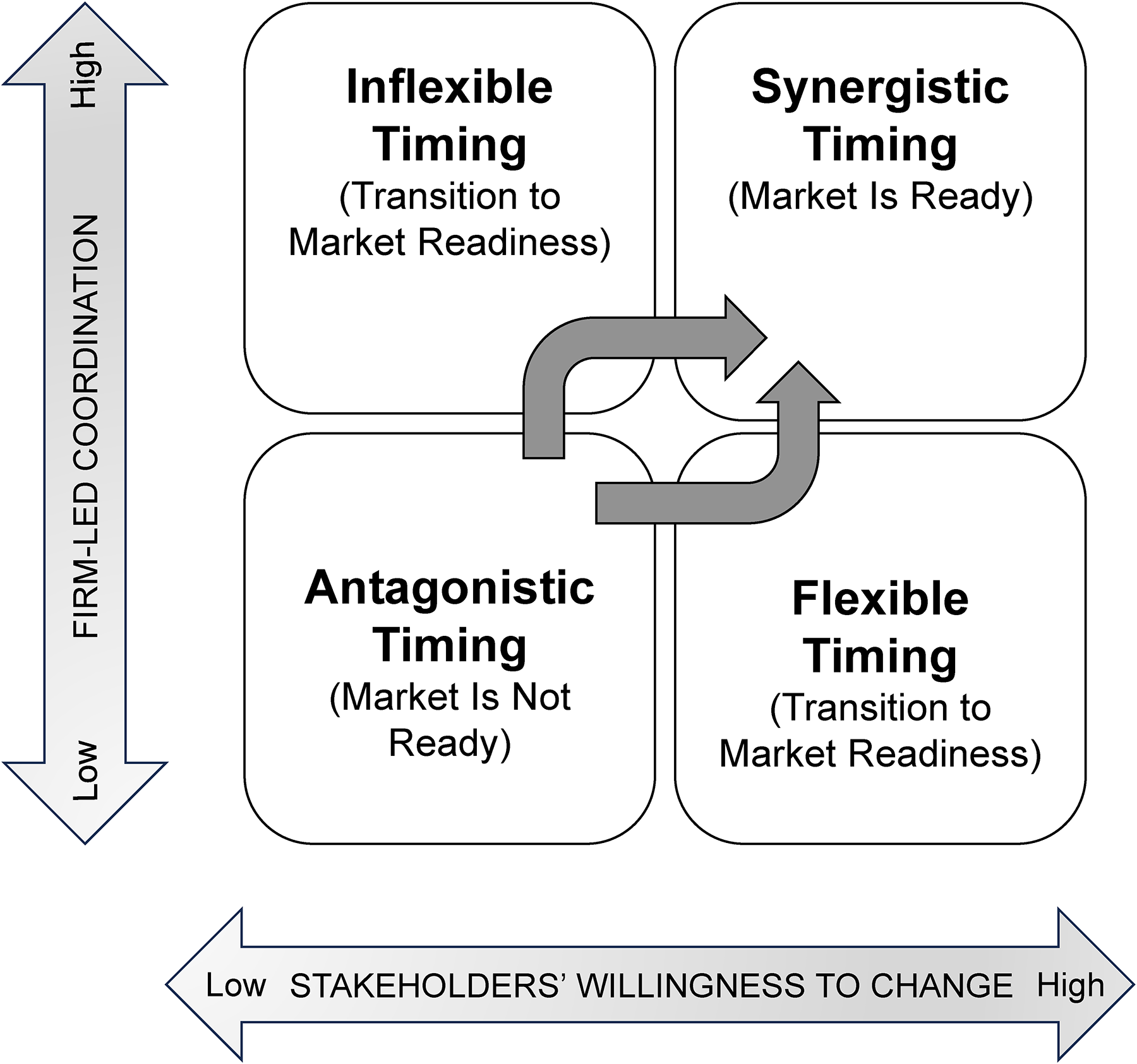
Market Timing Situations.
By combining the two dimensions, we identify four market timing situations managers can encounter: antagonistic, synergistic, flexible, and inflexible timing (see Figure 1). On the one hand, antagonistic timing is a delegitimate launch moment that involves low firm-led coordination and low stakeholder willingness to change. Synergistic timing, on the other hand, entails high firm-led coordination and high stakeholder willingness to change, resulting in a legitimate launch moment. Flexible and inflexible timing are both situations of transition to market readiness led either by stakeholders or by the firm. Flexible timing consists of low firm-led coordination but high stakeholder willingness to change. Here, consumers and other stakeholders initiate the legitimacy of a launch moment by being open to a product's prospective utility (uses, benefits, and functions) right away, despite it being in the early stage of development. Last, inflexible timing occurs when there is high firm-led coordination but low stakeholder willingness to change. Hence, this situation triggers concentrated efforts from the firm to legitimize a launch moment by establishing strict boundaries in the marketplace that limit the new product's scope in an effort to build stakeholder trust. Ultimately, market readiness to adopt an innovation when firm-led efforts and stakeholder attitudes align leads to temporal legitimacy, which we define as shared timing norms about what constitutes good and bad moments for specific activities to occur in a market process.
Our model illustrates managerial approaches to prepare a market for a successful tech product launch by transitioning from antagonistic to synergistic timing. In 2013, Google Glass faced antagonistic timing, as the firm had not adequately engaged privacy regulations, the immature social media market was not yet ready for the product's advanced functions, and the social norms related to technology-mediated human interaction led to doppelgänger brand images (Thompson, Rindfleisch, and Arsel 2006), such as “glasshole” (Honan 2013). Transitioning this market's stakeholders to synergistic timing took a decade, with Meta smart glasses now “fill[ing] a much more specific purpose … build[ing] on the already established functionality” (Tech Oasis 2024). In other words, the AR eyewear market has achieved temporal legitimacy, as firms and stakeholders now agree that the right moment has arrived. Timing is not merely a residue of other elements important to a product launch or a mere windfall of making technology that consumers expect through recognizable design conventions. Rather, market timing is independent of these elements, yet still actionable.
We provide a managerial toolkit to achieve the temporal legitimacy of a tech product launch. This framework strategically engages the pragmatic, regulative, normative, relational, and cultural-cognitive legitimacy pillars to identify the optimal launch moment (Scott 1995; Suchman 1995; Tost 2011). Accordingly, our market timing model reveals two main avenues to transition the market to product launch readiness—namely, a firm-led approach and a stakeholder-led approach—as illustrated by the two arrows in Figure 1. While prior market legitimacy research has mapped various timelines that stakeholders progress through, we show that managers can actively reflect and act on time in a way that makes it a source of opportunity and credibility for a firm and its products (Bourdieu 1990).
We next present the methodology of our systematic literature search and document the role of time in extant market legitimacy research. We demonstrate that timelines have been favored methodologically at the expense of efforts to optimize timing. Then, we unpack our conceptual model of the four market timing situations managers can encounter by drawing from prior research and Google technology launch cases, specifically Google Glass and Google’s consumer-oriented artificial intelligence (AI) products. We conclude by discussing the theoretical contributions of market timing to research on launching new technologies and market legitimacy more broadly.
Specifically, our work suggests that managers can rebirth phoenix-like markets when the timing is right by revisiting previously failed technologies. Further, we conceptualize proto-markets as prefacing the well-known market legitimacy stages (Humphreys 2010a) with our identified market timing situations. We then unpack a step-by-step managerial decision tree to create the optimal technological product launch moment. Finally, we propose promising avenues for research on market timing.
Methodology
To explore the role of timing in market legitimacy for new technology product launches, we pursued a systematic literature review. The aim was to compile a bibliography containing the various scholarly manifestations of the concept of legitimacy in the field of marketing. A systematic literature review enables researchers to engage theoretically with extant operationalizations of a concept and is particularly useful in “provid[ing] an integrated, synthesized overview of the current state of knowledge” (Palmatier, Houston, and Hulland 2018, p. 2). Stall-Meadows and Hyle (2010) argue that this method allows for objectivity and generalizability in a literature synthesis without covering up the nuances of real-life contexts. Systematic literature reviews are therefore useful in deriving new insights and future research directions on substantive topics (MacInnis 2011), such as the role of timing in market legitimacy in our case.
Search Process
We began by searching the scientific database Business Source Complete for academic articles using the key terms “legitimacy” and “marketing” appearing in publication titles, abstracts, keywords, and full text (Hulland and Houston 2020; Palmatier et al. 2006). We limited our search to full-text, peer-reviewed, academic journal articles in the English language. This search was as comprehensive as possible from the inception of articles featuring these two keywords in the database from 1956 to February 2024. However, like Peñaloza et al. (2023), we found that the results missed articles in journals on this topic with which we were familiar. Furthermore, we agree with Peñaloza et al.’s (2023) observation that the search parameters in any database do not consider journal rankings.
To overcome these limitations, we followed Peñaloza et al.’s (2023) systematic literature review process. Specifically, we manually identified articles on market legitimacy in the 20 marketing journals ranked 4*, 4, and 3 in the 2021 Academic Journal Guide furnished by the Chartered Association of Business Schools. This process entailed first searching each of the 20 journals’ home pages from their inception until February 2024 for research articles using the keywords “legitimacy” AND “markets” AND “process” AND “institutions.” Next, we manually searched for these four keywords in each identified article to see if they were substantially mentioned in the full text, excluding one-off or passing mentions. This step narrowed the original 946 articles to 172 articles (see Figure 2). A complete list of the 172 articles is available in Web Appendix A.
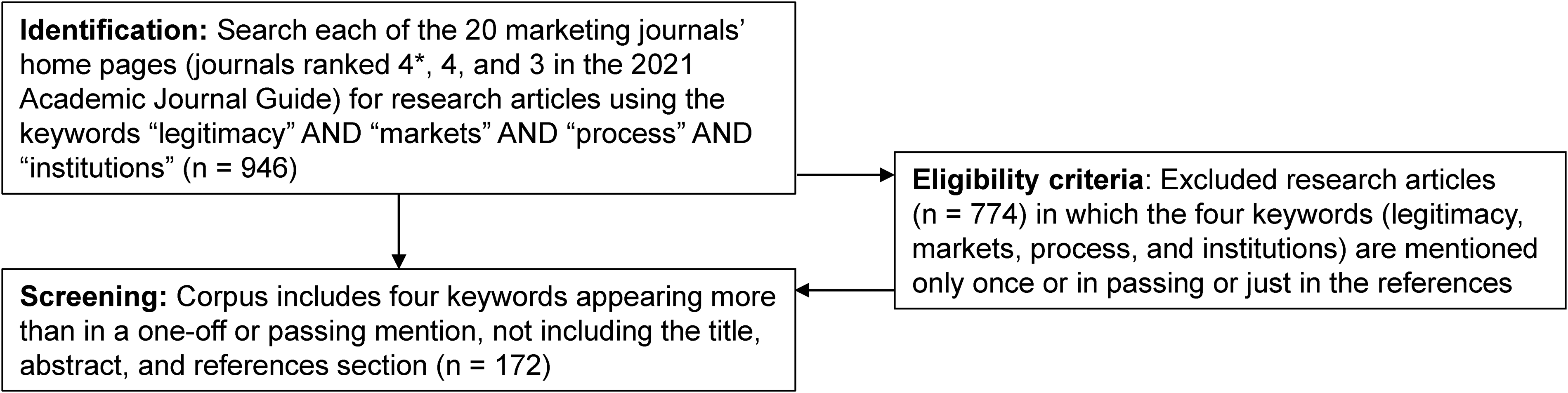
Systematic Literature Review Process.
Coding and Analysis
Table W1 in Web Appendix B provides a summary of all the codes used at each stage of our analysis (Saldana 2021). We began by recording bibliographic data (title, author, publication year, and journal) and the context of study for each of the 172 articles in an Excel spreadsheet. More specifically, we searched the abstracts and keywords for the market and/or consumer phenomenon under investigation for each study (e.g., casino gambling industry, Botox cosmetic market). This step showed that a substantial number of articles (45) focused on technology products and/or firms (e.g., AI, biotechnology; see Web Appendix B, Table W2).
Next, to synthesize extant research and translate the full corpus of findings into a higher level of abstraction, we employed a two-stage analysis of the 172 articles. For the deductive analysis based on our theoretical work (Saldana 2021), we first searched for the following list of time-related codes in the methods sections, figures, and tables of each article: timing, timeline, periods, phases, longitudinal, historical, and any mentions of years (e.g., 2000, 1980–1989). This step enabled us to code the different types of market legitimacy timelines documented in prior work. Table W3 in Web Appendix B shows how we coded the market legitimacy timelines of all 4* articles identified. Then we recorded the key market legitimacy implications of each study, paying particular attention to articles on technology products. For example, Rao, Chandy, and Prabhu (2008, p. 71) “show that new [biotech] ventures can overcome the liability of newness by adopting strategies that give them legitimacy in the eyes of stakeholders.” Column 2 of Table W4 in Web Appendix B contains examples of this coding for all 4* and 4 articles.
We next engaged in within-code inductive analysis (Saldana 2021), which for systematic literature reviews entails identifying novel, important, and understudied tensions, elements of paradox, and/or linkages (especially counterintuitive ones) to broader theory that can inspire future research (MacInnis 2011; Robinson, Veresiu, and Rosario 2022). Researchers therefore typically bring in theory from other areas to facilitate this type of analysis. Hence, we first established two critical dimensions regarding the timing of tech product launches: firm-led coordination of the timing of an action and stakeholders’ willingness to change their views about the right or wrong moment for an action to occur (Bourdieu 1990; Ricoeur 2014). We then coded for manifestations of these dimensions in our corpus. Specifically, we manually searched in the findings and general discussion sections of each article for the following list of codes: timing, time, over time, long-term, temporal, and process. At the same time, we paid particular attention to which stakeholders (e.g., firm, consumers, regulators, policy makers, media) were mentioned in the text featuring any of these codes. For example, Giesler (2012, pp. 64–65) alludes to high firm-led coordination when firms adopt his four-step brand image revitalization process and high stakeholder (particularly consumer) willingness to change, stating that “the more consumers adopt a given innovation brand image, the more culturally dominant it will become in time.” Table W4 in Web Appendix B provides more concrete examples of how we coded 4* and 4 articles on technology for both market timing dimensions.
Timelines of Market Legitimation Processes
Legitimacy is an anchor point of institutional theory (Powell and DiMaggio 2012; Scott 2013; Suchman 1995) and has long been a focal interest in marketing research (see Web Appendices A and B). Humphreys (2010a) investigates this social process to unpack how new markets are created and sustained in complex social, institutional, and political environments. More specifically, the legitimacy or delegitimacy of market entities (e.g., market, industry, brand, consumer segment, consumption practice) can be managed through five institutional pillars: pragmatic, regulative, normative, relational, and cultural-cognitive (e.g., Huff, Humphreys, and Wilner 2021; Humphreys 2010a, 2010b; Valor, Lloveras, and Papaoikonomou 2021). Each pillar serves a key function that either supports or opposes the market entity over time and deals with utility, legislative standards, shared values, exchanges that shape collective identity, and taken-for-granted knowledge, respectively. Legitimate markets emerge as the five pillars converge, but the processes through which these pillars are attained are often complex. While the processual nature of market legitimacy means that “time is of the essence” (Scott 2013, p. 65), temporal dynamics have so far been addressed only methodologically by mapping market legitimation processes across various timelines of events through which stakeholders progress.
Scott (2013, p. 4) observes that while neoclassical institutional theory builds on “timeless and placeless” assumptions, institutionalists such as Powell and DiMaggio (2012) and Scott himself credit Bourdieu (1990) with inspiring a heightened effort to explore temporal dynamics in the form of change. Accordingly, Scott (2013, p. 4) focuses on conditions that cause institutional “features to vary over time,” which require a “diachronic” rather than a “structural” analysis. Early approaches to theorizing the temporal patterns of legitimacy identify either an episodic or a continual chronology (Suchman 1995) that appears after a product launch. A continual legitimation process is not necessarily more complicated than an episodic one; it “boils down to … developing a defensive stockpile of supportive beliefs, attitudes, and accounts” that endure (Suchman 1995, p. 595). Identifying regular, irregular, and multilevel chronological stages of legitimacy following a product launch (see Table 1 and Web Appendix B, Table W3), market research has extended the two temporal patterns of legitimacy initially proposed by Suchman (1995). We elaborate on these temporal patterns next.
Timelines of Market Legitimation Processes.
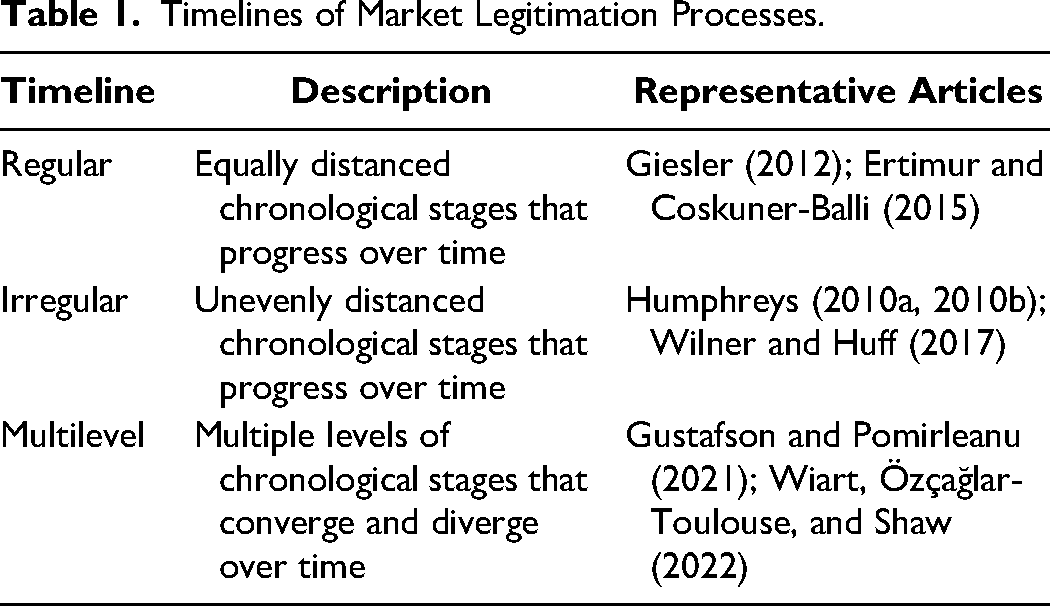
In exploring how doppelgänger brand images influence a market legitimation process, Giesler (2012) shows that the meanings of a new cosmetic self-enhancement technology evolve “over the course of contestations” between positive brand images promoted by the firm and negative brand images promoted by other stakeholders. His intertemporal analysis “link[s] these interpretations to different phases of a historical [market legitimation] process” (pp. 57–58). Specifically, Giesler identifies a regular temporal pattern by dividing the Botox market's legitimation process into strict two-year gaps: 2002–2004, 2004–2006, 2006–2008, and 2008–2010. Ertimur and Coskuner-Balli's (2015) approach to market legitimacy similarly employs a highly structured timeline. The authors examine the legitimation of the U.S. yoga market “over time” through precise decadal stages of 1980–1989, 1990–1999, and 2000–2009, without explaining why they split their timeline in this manner. However, not all market legitimation processes exhibit such equally distanced temporal stages.
Humphreys (2010a) identifies three sequential stages with different time spans for the casino gambling market's legitimation process: 1980–1988, 1989–1999, and 2000–2007. While Giesler's (2012) strict two-year stages are governed by the internal logic of opposing product meanings, the temporal pattern of the casino market's legitimation process is shaped by external conditions, as the “time frames were chosen because their endpoints correspond to important regulatory actions” imposed on the market (Humphreys 2010a, p. 5). Importantly, a focus on chronological stages through “shifts in regulatory, normative, and cultural-cognitive structures” enables managers to “identify the stage of market development” and then select the appropriate framing strategy (Humphreys 2010a, p. 15). Wilner and Huff (2017, p. 247) similarly identify an irregular timeline when exploring “changes in an existing product category over time” by tracing product design transformations that caused greater market interest. Thus, the temporal pattern they identify in the legitimation of sex toys appears in irregular intervals: 1989–1997, 1998–2007, and 2008–2014. Uneven chronological stages caused by external regulatory impact or design decisions help address the temporal dynamics of market legitimacy. However, scholarship has also gone one step further by tying multiple, distinct levels of analysis to a timeline.
A key development in market legitimacy studies is the integration of “multiple levels” of analysis within the classic “temporal configurations” of market legitimation (Gustafson and Pomirleanu 2021, p. 25). This complex market legitimacy dynamic nonetheless adheres to fixed reference points on a timeline. Similarly, Wiart, Özçağlar-Toulouse, and Shaw (2022) show how the legitimation process of meat markets progresses through multidimensional discursive convergences called nodal points. While these nodes are “temporary points of identification” (Wiart, Özçağlar-Toulouse, and Shaw 2022, p. 393) that gradually evolve, emerge, and tangle with other nodes only to fade and be replaced with no clear chronological demarcation, they are nonetheless embedded in a fixed timeline, which serves as an antecedent condition. Wiart, Özçağlar-Toulouse, and Shaw therefore repeatedly insist that “discursive constructions change over time” (p. 395) and are “(re)articulated and (re)created over time” (p. 398).
Across regular, irregular, and multilevel chronological stages in a market legitimation process, the key idea remains that “effects follow causes in temporal succession” (Scott 2013, p. 65), as the researcher's aim is to determine and map “the effect of these variables on industry legitimation” over time (Humphreys 2010a, p. 3). Thus, while prior research frames objective institutional processes as rigid timelines, we respond to Reinecke and Ansari's (2015, pp. 642–43) call for legitimacy research to “transcend clock-based linearity and cultivate heterogeneity in organizational temporal commons.” In other words, according to Reinecke and Ansari, firms and stakeholders can have different perspectives, norms, and experiences of time in a market process. Moreover, extant market legitimization processes start after a product launch and thus provide few managerial tools and frameworks with which managers can prepare the prospective new market before the product is offered (Debenedetti et al. 2021; Humphreys 2010a).
Bourdieu (1990, p. 98) argues that reducing social and institutional changes to a strictly causal process or a mere “order of succession” that is “constructed in time” ironically leads to a “detemporalizing” perspective, as it does not account for individuals’ ability to think about, relate to, and influence time when initiating or responding to legitimization processes. Therefore, understanding timing in the period before the product launch and getting the market ready to initiate a market legitimation process become important managerial practices, as “the same act [pursued by a stakeholder] … can have completely different meanings at different times, coming as it may at the right or wrong moment, opportunely or inopportunely” (Bourdieu 1990, p. 105). Consequently, before launch and the establishment of a new market, managers can formulate “strategies that consist in playing with the time, or … the tempo, of the action” to their benefit, thus making time “an instrument of power” (Bourdieu 1990, p. 106) that, we argue, managers can strategically use. Building on Bourdieu's ideas, we propose that managers can influence the timing of a product launch before initiating a market legitimation process through the same five established institutional pillars. Importantly, we view market timing as a necessary precursor to starting a market legitimation process. We next unpack the dimensions of this managerially strategic effort in the case of new technology launches.
Timing Market Launches
Humphreys (2010a, p. 14) highlights how market legitimacy is “steered by social actors in important ways” through various legitimacy pillars. We extend this insight by demonstrating that optimally timing the launch of products leading up to a market legitimation process is a crucial managerial steering capability. As Figure 1 illustrates, two dimensions structure market timing as a managerial practice. The first is firm-led coordination to align an innovation with relevant stakeholders’ timing norms. Research on market legitimacy in the context of new technologies alludes to this dimension in several ways (see Web Appendix B, Table W4). For example, Sheng, Zhou, and Li (2011) find that business and political ties affect a firm's legitimacy and thus performance differently owing to different time horizons between these two stakeholder groups. Specifically, they demonstrate that Chinese high-tech firms “work together to coordinate exchanges” (p. 3) to foster long-term cooperation and obtain network legitimacy. Furthermore, Varadarajan et al. (2022) show that innovation firms that are rated poorly on environmental, social, and governance performance dimensions for the greater good fail to initiate actions to close this legitimacy gap. That is, it is not enough for marketing managers to consider “the type of content that is effective”; they must also assess “the time when the content must be presented” (Varadarajan et al. 2022, p. 493) to gain greater legitimacy in the eyes of relevant stakeholders.
The second dimension of our model addresses the extent to which relevant stakeholders are willing to change their views about timing norms. Prior work on technology market legitimacy also alludes to this dimension (see Web Appendix B, Table W4). Rao, Chandy, and Prabhu (2008) argue that markets are not blank slates when firms initiate product launches. Although firms choose “the date of product introduction,” managers should be aware that “the market is already aware of the legitimacy variables … and has incorporated these into the valuation of the firm” (Rao, Chandy, and Prabhu 2008, p. 73). This finding establishes consumer and other stakeholder responses as a key element of timing, as “the date of product introduction” causes a specific “market reaction” that “practically incorporates all the gains associated with [the] actual introduction” (Rao, Chandy, and Prabhu 2008, p. 73). Returning to the idea of time horizons, Sheng, Zhou, and Li (2011) show that in China, firms’ political ties have a limited time horizon, with government officials engaging in opportunistic behavior, which showcases their low willingness to change. For example, government officials who want to maximize their short-term interests, such as getting a promotion, will issue direct commands to firms (Sheng, Zhou, and Li 2011).
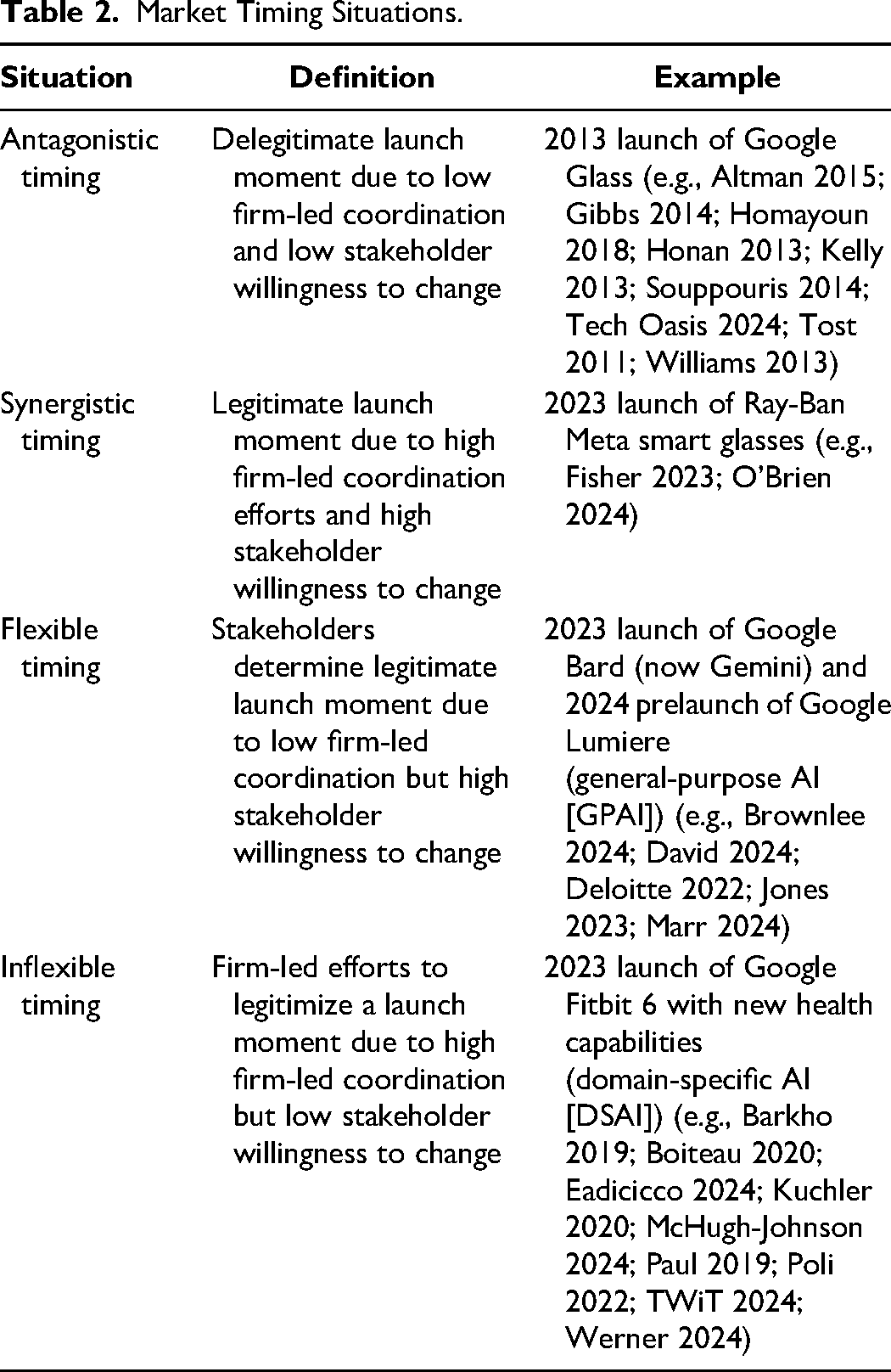
The synergy of firm-led coordination and stakeholder willingness to change to adopt an innovation leads to temporal legitimacy, or the “simultaneous” appearance of timing norms that form “a community of time” within a market (Ricoeur 2014, p. 113). Successful market timing is therefore based on a mutual understanding of when things should happen in a market process (Ricoeur 2014). The following section unpacks the four quadrants of market timing (see Figure 1) using exemplary new tech product launches from Google in comparison with its competitors (see Table 2). In analyzing these cases, we pay particular attention to the role of the pragmatic, regulative, normative, relational, and cultural-cognitive pillars of legitimacy within our classification of market timing situations.
Market Timing Situations.
Antagonistic Versus Synergistic Market Timing
Product launches in the AR eyewear market provide illustrative cases for understanding the difference between antagonistic and synergistic market timing. In 2013, when Google Glass was soft launched in the United States to qualified “Glass Explorers,” Google had not properly assessed the timing of this launch in relation to the five legitimacy pillars, nor were consumers and other stakeholders willing to change, thereby making 2013 a delegitimate launch moment. Market readiness did not arguably manifest until 2023, when Meta capitalized on this legitimate launch moment with Ray-Ban Meta smart glasses.
Pragmatic legitimacy involves managers identifying the right moment when stakeholders engage in self-interested, utilitarian calculations about a product's tangible, practical benefits (Hakala, Niemi, and Kohtamäki 2017; Huff, Humphreys, and Wilner 2021). In other words, managers need to anticipate when consumers’ and other key stakeholders’ cost–benefit appraisal judgments will play out to the firm's advantage (Debenedetti et al. 2021; Suchman 1995). Before launching Google Glass, “it wasn't clear to the customer what problem it solved or why they needed it” (Altman 2015). This left consumers and other stakeholders with little motivation to adopt the product into their existing practices. Moreover, the firm did not coordinate with other platforms before launch. As a result, Google Glass was launched in an antagonistic timing situation (see Figure 1).
Conversely, as a firm-led initiative, Ray-Ban Meta smart glasses were designed to interface with Instagram at the outset through the portrait orientation of the two-megapixel camera to record reels and stories. Unlike Google Glass, this function makes the Ray-Ban Meta smart glasses “an excellent tool” (Fisher 2023). Thus, a key challenge in 2013 was the limited use of video-based social media platforms, without which the smart eyewear was more of an oddity than a tool. Pragmatic legitimacy can thus change over time as the infrastructural environment evolves. While Instagram now has more than 2 billion users, in 2013 there were only 90 million users (Dixon 2023). The number of Instagram accounts, especially the estimated 64 million Instagram influencer accounts (Andrii 2023), represents a potential market segment of consumers motivated to change their content creation practices with a new tool to stand out.
Legislation, contracts, performance standards, criminal law, and formal oversight all set regulative standards for optimal timing. However, laws typically lag technological advances by many years, thus creating tensions with new technologies and their associated practices (Koselleck 2004). Google Glass was immediately embroiled in privacy concerns due to its video recording capacity. At the time, the Electronic Communications Privacy Act (1986) addressed issues of government surveillance of citizens rather than reconnaissance among private individuals in public spaces. The key challenge concerned reasonable expectations related to public filming by individuals (Lam 2018).
In 2013, many consumers and other stakeholders were simply unwilling to accommodate Google Glass over privacy concerns. The device was, for example, proactively banned in many shops (Kelly 2013). Furthermore, a “Stop the Cyborgs” campaign was launched against Google Glass, stressing issues of knowledge, consent, and security, as well as threatened lawsuits for punitive damages related to privacy breaches (Williams 2013). By 2020, however, cameras became ubiquitous and unavoidable in public spaces, leading to a transformed legal environment regarding video surveillance and privacy concerns. This updated legal environment made the core functionality of AR eyewear much less problematic (Brown 2023).
Stakeholders also adhere to an internalized normative system of time-related expectations, or timing norms, that they incorporate into their personality structure (Scott 1995). Timing norms are motivated by individuals’ moral convictions about the right and wrong sequencing of events. Consequently, social sanctions were added to Google Glass through the term “glasshole,” capturing the prying, obnoxious presence of an unwanted camera in public (Honan 2013). This mocking moniker led to the social ostracization of first adopters (Gibbs 2014). While Google exhibited low firm-led coordination to battle this pervasive doppelgänger brand image (Giesler 2012), Ray-Ban Meta smart glasses included an indicator light that switches on when recording. This new device “detects if you’ve covered the [light] in order to be a creep” (Fisher 2023).
Belonging, social status, and collective identity from the relational legitimacy pillar (Gustafson and Pomirleanu 2021; Valor, Lloveras, and Papaoikonomou 2021) equally relate to timing issues. Rushing interactions, being tardy, or mistiming a social encounter can have negative effects on relational legitimacy. While Google Glass's imposition in face-to-face interactions was perceived as compromising one's social status and collective sense of identity (Tost 2011), the mobile phone has become a far larger challenge to human interactions. Since 2015, Americans have reported substantial “interaction and relationship dissatisfaction” from the time spent on their phones, which was 203 minutes per day as of 2018 (Humphreys and Hardeman 2021, p. 104). Ray-Ban designed its Meta smart glasses to affirm authentic social relations by “captur[ing] those moments that ordinarily you can't capture by having your phone out” in ways that were not relevant in 2013 (O’Brien 2024). In particular, parents’ photo ops with children have become a “big friction point” (O’Brien 2024). In response, Ray-Ban Meta smart glasses allow consumers to discard their phones in a social interaction and simply be present, while still capturing the moment for future enjoyment (O’Brien 2024). These developments illustrate greater consumer willingness to adopt the new technology a decade after Google Glass’s failed launch.
Finally, regarding the cultural-cognitive legitimacy pillar, stakeholders complained that “what Google have done thus far, I wouldn't be seen dead wearing. It looks pretty stupid” (Souppouris 2014). Consequently, managers failed to understand what frames of reference consumers and other stakeholders employed to make sense of the product and when to use it. In 2013, no cultural-cognitive cues were in place for Google Glass, largely because of its poor design. By contrast, Ray-Ban crafted its Meta smart glasses as “a design statement,” with the firm recognizing that style provides important cues for legitimate use (O’Brien 2024). Sunglasses are worn in many activities or situations in which the user wants to convey “first-person perspective of an experience,” such as sports or poolside (Fisher 2023). A product's design should therefore be the firm's response to a deficiency of cultural-cognitive legitimacy by providing prompts on how consumers make sense of the product and benefit from incorporating it in their practices, as indicative of synergistic timing.
The changing antecedent circumstances for launching AR eyewear between 2013 and 2023 illustrate the difference between good and bad launch moments and, thus, how timing is a major part of a market launch strategy. The launches of Google Glass versus Ray-Ban Meta smart glasses illustrate how bringing a technology to the market can have different meanings to firms and stakeholders at different times (Bourdieu 1990) and that, rather than rushing an innovation to the market, waiting can be an “instrument of power” (Bourdieu 1990, p. 106) for tech firms and entrepreneurs. Google trusted its technology to be powerful enough in itself to capture the market in 2013; however, this launch tactic did not give consumers and other stakeholders time to reflect on and evaluate the nature of the offer.
Given the magnitude of transformation brought about by Google Glass, haste, speed, briskness, and impetuosity became delegitimizing factors leading to a lack of credibility for the product, as the market had not yet transitioned into launch readiness. Conversely, patience establishes credibility for a product, firm, or industry by recognizing the need for collective oversight, consultation, and approval across all legitimacy pillars. A new technology market launch is therefore a “social game,” in which market timing is an issue of “style” and courtesy in the firm's engagement with external stakeholders (Bourdieu 1990, p. 105). Offering time signals care, respect, and attention (Bourdieu 1990). Just as proposing marriage on a first date can compromise the legitimacy of a suitor, Google Glass committed the faux pas of not granting time for the public to get to know the product or feel safe and comfortable around its functionality. There is nothing wrong per se with offering AR eyewear to the market, but good timing involves recognizing the propriety of how events are sequenced leading up to a product launch.
A decade later, the market was finally ready for the launch of Ray-Ban Meta smart glasses, as the institutional foundation had matured to support the value and utility provided by the device. Indeed, AR glasses now even work to enable underlying institutional and social processes, such as facilitating social media content creation. However, while the move from antagonistic to synergistic market timing happened through the largely unmanaged maturation of this particular market, managers should have strategies in place to steer and even accelerate the transition from antagonistic to synergistic market timing. To illustrate managerial approaches in the transitional phase leading up to the optimal launch moment, namely flexible versus inflexible timing, we next turn to Google's launch efforts in consumer-facing AI (Puntoni et al. 2021).
Transitioning to Market Readiness
While AI has been broached in business-to-business contexts as a source of legitimacy and power for firms (Keegan, Canhoto, and Yen 2022) and as a social good that builds legitimacy (Bai, Orzes, and Sarkis 2022; Varadarajan 2017), knowledge is lacking on “how the cultural cognitive, normative, or regulatory legitimacy of AI changes over time” (Puntoni et al. 2021, p. 135). This technology is so new that it is in a state of transition, as consumer habits are still being established (Puntoni et al. 2021). Thus, tech firms and their stakeholders have not reached consensus that the current launch moment is univocally right for all AI functions. For example, the general-purpose AI (GPAI) Google Bard (now renamed Gemini) was released “before it was ready” to ensure “slow cooking” of the technology (Jones 2023) and does not yet include its full image-generating capacity. We next address flexible and inflexible timing situations in the transition from antagonistic to synergistic timing using the product launch cases of GPAI, such as Google's Gemini, Google Lumiere, and OpenAI's Sora, which create general content, and domain-specific AI (DSAI), such as Google's Fitbit health assistant, which creates highly personalized content.
Flexible Timing
In a flexible timing situation, consumers and other stakeholders are adaptive and thus interested in a technology's potential future benefits. Engaging the pragmatic legitimacy pillar by sharing failures becomes paramount to buy time and benchmark future consumer value. In the GPAI product of text-prompted video generation, Google's Lumiere, yet to be included in Google Gemini, provides an ideal example of how a tech firm can connect with stakeholders and generate excitement for the innovation's future benefits. This is done by delaying the actual launch, while drip-feeding “sizzle reel[s]” or early, imperfect examples to prospective consumers and other stakeholders (David 2024). A key aim of Google's slow release of AI video generating and editing tools is to prepare stakeholders for the technology's transition from “uncanny valley to near realistic” over the next few years (David 2024). Perhaps prompted by the backlash against the camera function in Google Glass, Google has not yet opened the technology to public testing but instead is waiting to incorporate it into its Gemini GPAI, given “a risk of misuse for creating fake or harmful content with [its] technology” (David 2024).
Stakeholders’ initial, emotional reactions to the potential of an imperfect early product prompt reflexivity on the meanings of the technology and its future uses (Bourdieu 1990). This situation occurs when individuals think that they “lag behind” the trajectory of innovative technological development (Grenfell 2014, p. 132). The “gap” between current “attitudes and practices” and “new opportunities” that may occur initiates stakeholders’ imaginative incorporation of the new product into their practices, habits, and routines, which helps them articulate the “desirability” of the product (Grenfell 2014, p. 135). We call the stages of transitioning through a flexible timing situation (i.e., astonishment, rejection, interpretation, incorporation, and acceptance) the hierarchy of market readiness. More specifically, Bourdieu (1990) stresses a “time signature” of this process, whereby the individual becomes “adjusted” to the “probable future,” which signals transition into market readiness (Grenfell 2014, p. 135). This effect is so potent that other technology firms in the text-to-video GPAI market are pursuing the same strategy but at an amplified rate.
The infamous and disturbing “Will Smith Eating Spaghetti” video created by OpenAI's Sora (Edwards 2023) garnered notoriety in 2023 for its astoundingly poor quality, but also for its potential. While, at that time, there were “fears of world-ending doom, and job disruption [brought about by AI], the clouds have briefly parted,” given the laughable attempt at generating quality video from GPAI technology (Edwards 2023). GPAI product imperfections therefore become a part of the “social game” that tech firms should play to better engage with external stakeholders to identify the right moment to launch, as releasing a product with imperfections not only offers more time but also signals care, respect, and attention to stakeholders’ responses (Bourdieu 1990, p. 105). Entertaining but imperfect and grotesque videos provide an opportunity to consider “the enormous potential” and come to terms with the “ethical concerns” of GPAI, while hinting at future user incorporation and market readiness, as it can “continue to inspire innovation and creativity across industries” (Lopez 2024).
Although the text-to-video GPAI market has not yet reached synergistic timing, it is on a clear trajectory toward market readiness. The pragmatic justification strategy in a flexible market timing situation can be summarized by a famous tech influencer's rationale from a YouTube video review that has garnered 8.6 million views: “why would anyone making something pay for footage of a house in the cliffs [at the cost of a drone and a production team] when they can generate one for free or for a small subscription price?” (Brownlee 2024). Reacting to Google's Lumiere, a professional video editor also noted that “you can clearly tell it's not entirely real,” but that it was “impressive” enough that “it's going to take my job, isn't it?” (David 2024). However, exhibiting failure extends time for stakeholders to assess the utilitarian value of the product over time and reduces the sense of danger, thereby hastening the arrival of the optimal launch moment.
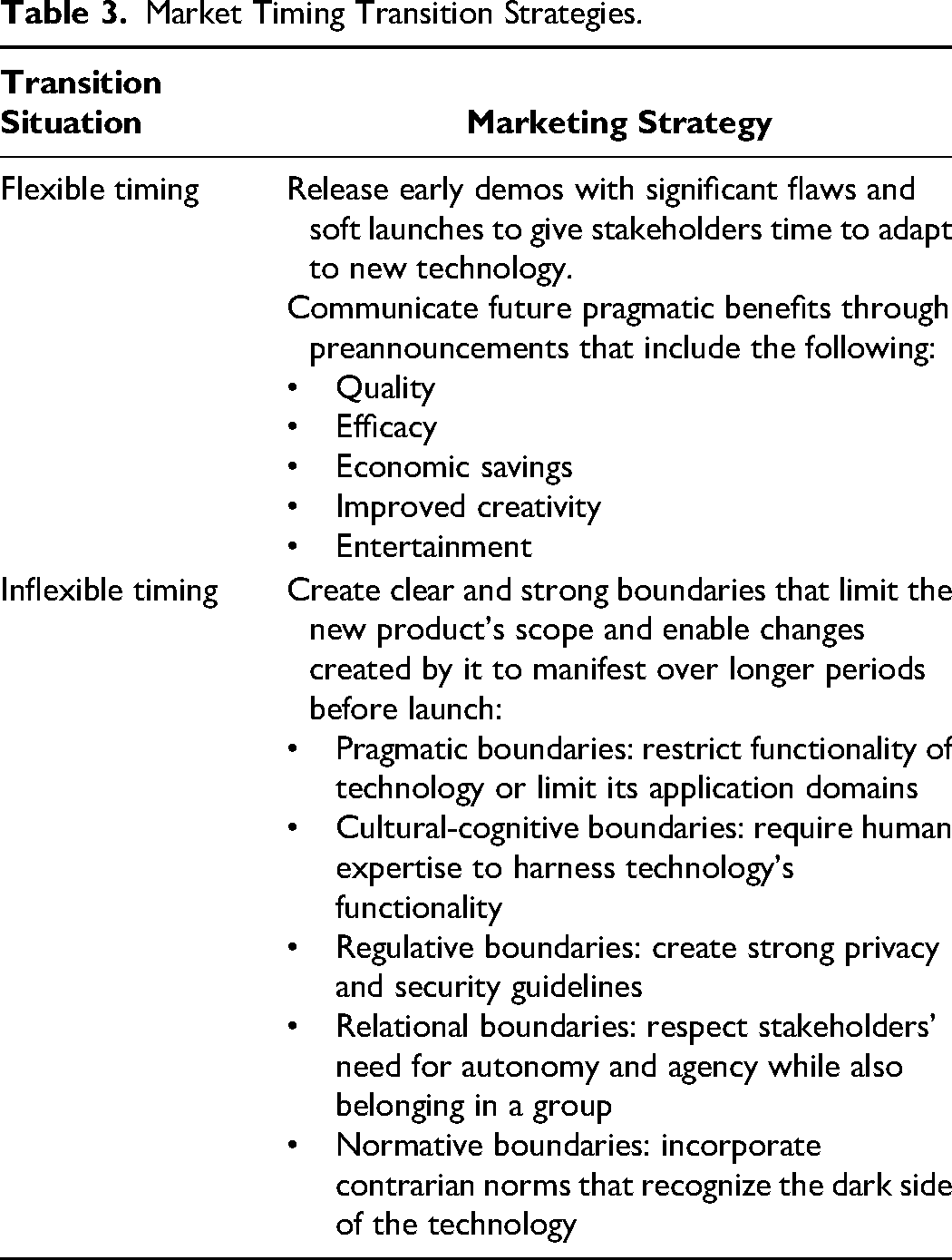
Stressing that GPAI “has the potential to enhance human creativity across the whole spectrum of arts, sports, and entertainment,” Marr (2024) highlights the plethora of benefits and utility that text-to-video GPAI such as Google Lumiere may bring, despite the product's lack of technological readiness. Importantly, these are forms of utilitarian benefits that may enhance users’ status through further exchanges and promote their interests, as Lumiere is “laser focused on what consumers need” (Deloitte 2022). Table 3 provides a summary of marketing strategies managers can implement to gain pragmatic legitimacy in flexible and inflexible timing situations. DSAI is in an inflexible timing situation that requires different marketing strategies for transitioning the market to readiness, as this technology has the potential for heightened individual risk and, thus, perceived safety concerns.
Market Timing Transition Strategies.
Inflexible Timing
Health-based DSAI, such as Google's Fitbit, similarly needs to generate pragmatic legitimacy leading up to a market launch. This technology combines copious amounts of personal biometric data, such as sleep patterns, training results, heart monitoring, and hydration, with increasingly sophisticated digital analyses as one of the main practical benefits. Google now provides an interactive DSAI chatbot that “help[s] you better understand the nuances of those readings” and extends training advice on how to improve performance (Eadicicco 2023). Ultimately Google's vision is to launch a DSAI Google Assistant for personal health that combines health records with smartphone data, genomes, wearables (e.g., AR glasses), glucose monitors, and “ambient sensors: bedside devices, under-mattress sensors, sensors integrated into toilet seats” to preempt strokes, heart attacks, and other health conditions while optimizing life quality (Kuchler 2020; see also Puntoni et al. 2021).
However, engaging pragmatic legitimacy is not enough in an inflexible timing situation; instead, this marketing strategy may be too much. The ultra-personalization of DSAI technology through such intense firm-led coordination and customization of the offering creates new market launch timing challenges due to the immediate risks it poses to consumers (Puntoni et al. 2021). In an inflexible timing situation, stakeholders exhibit more caution and even rejection of a new DSAI (TWiT 2024). The personal risk from Google's Fitbit AI means there is often no amount of benefit that can outweigh the perceived dangers in an inflexible timing situation, leading customers to state that they “tossed my Fitbit into the trash today” (Paul 2019) or to “boycott” and “rebel” against Google (Barkho 2019). Bourdieu (1990, p. 74) stresses that innovations become terrifying and are perceived as having unlimited power if they are not “bound up with a system” of social relations and sanctions. By using the five legitimacy pillars to provide “boundaries that define” the social functions of the technology in greater detail (see Table 3) and situate the technology in a system of strong mutual commitments, managers can provide a “social structuring of time” (Bourdieu 1990, p. 193) that allows stakeholders to accept a particular moment as viable for launch.
Rather than expanding the pragmatic potential of the product, managers can move the inflexible timing situation into a synergistic one by restricting the functionality of the technology (Werner 2024) and/or limiting its application domains. To this end, Google stresses that its “Personal Health Large Language Model isn't meant to make a medical diagnosis or treat any conditions. Rather, the goal behind the model is to make it easier to understand and navigate Fitbit data” for exercise (Eadicicco 2024). Managers can also create cultural-cognitive legitimacy boundaries by having human expertise bound the technical functionality. For example, Google highlights “the clinical team supporting strategy, research and product development for Fitbit” (McHugh-Johnson 2024). This latter approach focuses on how the technology is reined in and subject to human intervention at all stages of knowledge production.
Drawing on regulative legitimacy to establish boundaries for the technology through strong privacy and security guidelines is another important tactic to move stakeholders from outright rejection to a moment when launch is viable. For example, in Google's policies, issues such as local device storage versus cloud storage, third-party sharing, permanent data deletion, transparency options, and location tracking deactivation all constitute key firm-led measures to establish trust by creating clear legal boundaries (Poli 2022). Because regulations differ substantially in different geographic contexts, transparency about jurisdiction provides managers another key trust-building mechanism in an inflexible timing situation. The European Union's General Data Protection Regulation, for example, has strong consumer and antitrust protections that work in favor of consumers (Paul 2019).
Another key challenge in transitioning to full market readiness for health-based DSAI such as Google Fitbit stems from relational delegitimization (Valor, Lloveras, and Papaoikonomou 2021). To build relational legitimacy boundaries, managers must signal firm-led recognition of consumers and other stakeholders’ concerns and diligence regarding the product's functionality to help stakeholders derive a collective sense of identity and belonging (Valor, Lloveras, and Papaoikonomou 2021). Because total control of users’ personal data creates power imbalances that can compromise brand community participation, inflexible timing situations require firms to show that they are acting “in a humble way” (Kuchler 2020). Doing so signals firm-led relational reflexivity, conveys awareness of consumers and other stakeholders, and explicitly respects their needs for autonomy and agency. Finally, the Google Fitbit DPAI engages explicitly with and even incorporates contrarian norms that question the benefits of excessive self-tracking, recognizing that there is a “dark side” to the technology that must be moderated (Boiteau 2020).
While Google's text-to-video GPAI has low levels of individual user risk exposure and thereby elicits higher levels of stakeholder willingness to change, Google Fitbit must take “a very long perspective” (Kuchler 2020) on transitioning to market readiness to mitigate low stakeholder adaptability before fully launching the DPAI's new functions and services. Consequently, in an inflexible timing situation, managers need to create clear boundaries that limit the new product's scope and allow the changes created by it to manifest over longer periods before launch. Table 3 provides a summary of marketing strategies in both flexible and inflexible timing situations.
Discussion
Our framework offers new perspectives on how managers can time the market launch of new technologies. We find that the intertemporal analysis of market legitimacy research (Humphreys 2010a, 2010b) is a misnomer, as it focuses only on stages within a strict chronological process rather than also analyzing the dynamic relationship between the different norms of time held by technology firms and their key stakeholders. Linear modeling of stages does not capture the full scope of time to make products, practices, or markets widely acceptable within a particular context (Humphreys 2010a). To this end, we show how firms can activate the five pillars of legitimacy to transition from bad to optimal market timing, thereby establishing launch readiness in a market. In the next sections, we first discuss our study's contributions to the literature on launching new technologies and market legitimacy more broadly. We then introduce clear and actionable strategic management decisions firms can take in terms of market timing to achieve temporal legitimacy and thus establish an optimal launch moment. Finally, we unpack avenues of future research on market timing.
Theoretical Contributions
Research on market creation for innovations tends to view technology as inevitable linear progress, in which the main managerial concerns are the degree to which older technologies can coexist with new ones in particular niches (Chandrasekaran, Tellis, and James 2022), as well as how cutting-edge technologies have one shot to overcome the liability of newness in the face of safe and known technological practices (Stinchcombe 1965). However, the failed case of Google Glass implies that this one-directional approach to “successive” technology with a market launch as a one-off opportunity (Chandrasekaran, Tellis, and James 2022) may be too simplistic. Technologies can appear and disappear only to reappear again later successfully. Social media (McMillan 2013), electric cars (Standage 2021), smartwatches (Karella 2020), and smart glasses (Tech Oasis 2024) have all been plagued by timing issues during their initial launch only to successfully reemerge at the opportune moment. The power of market timing therefore suggests that beyond “technological leapfrogging, cannibalization, and coexistence” (Chandrasekaran, Tellis, and James 2022), managers can rebirth “phoenix” markets when the time is right by revisiting what was previously a technological dead end. A phoenix market therefore occurs when an innovation fails in its initial launch and is then successfully relaunched at a later, more opportune moment to arise from its own ashes.
The idea that technology evolves in linear progression, offering more opportunities to the new than the old, has also shaped market legitimacy research. This idea has inspired managerial framing strategies that begin univocally with an “innovation” that is “not yet clearly defined” with “several contradictory meanings … available” (Humphreys 2010a, p. 15). This perspective conceives of innovation as such a powerful entity that “modern product markets are no longer as constrained by time or place,” since racing to create the next new thing has become the key driver of contemporary markets (Rosa et al. 1999, p. 64). As this research stream takes a retrospective and historical approach to market legitimacy, a surprising shortcoming is its focus on the diffusion and validation of new markets (Humphreys 2010a) or the stability and contestation in mature markets (Debenedetti et al. 2021) following a product launch. It has paid less theoretical and managerial attention to the market dynamics leading up to a product launch or identifying the ideal moment for a launch.
Legitimacy research assumes that firms and entrepreneurs “face preexisting institutionalized practices” that require the “tearing down of old logics and the construction of new ones” (Maguire, Hardy, and Lawrence 2004, p. 673) or that new markets being created “cannot build on a long history” because the rules of the market are “still under construction” (Debenedetti et al. 2021, p. 340). Thus, studies providing models of market legitimation dynamics visualize this process as beginning at zero at the intersection of the x- and y-axes, suggesting a blank slate (e.g., Debenedetti et al. 2021). However, phoenix technologies, such as wearable AR glasses, smartwatches, electric cars, and social media, were all initial failures that later succeeded. Hence, it should be remembered that Google Glass’s launch, even as it failed, paved the way for future successes in this market by creating growing awareness of future possibilities for firm learning and consumer learning alike. Google Glass, for example, transformed consumers’ “normal process of imaginative anticipation of, or speculation about, the future” (Campbell 1987, p. 138) by making AR credible in everyday contexts and not just a sci-fi gimmick. In this sense, a later successful firm's synergistic timing, such as that of the Ray-Ban Meta smart glasses, may in circuitous ways depend on prior firms’ failed market timing. In this process, the decomposing remains of failed legitimation efforts may become important touchpoints in prospective timing strategies by reworking key dimensions of a failure that must be solved by the new offer.
Rather than simply tearing down old logics and starting from scratch, market timing dynamics suggest stages of proto-market legitimacy before launch, when the market may be more receptive than at other times (see Figure 3). A proto-market is the time before the launch happens, when marketers may influence the institutional environment in preparation for launch. If market legitimacy is a plant that grows, then timing issues in proto-market legitimacy constitute the metaphorical presence of a viable growth medium. In this imagery, market timing strategies before launch become the gardening that establishes the flower beds and a suitable environment for the plant to thrive. The proto-market, in which timing synergy happens, is therefore where the roots of the postlaunch market legitimization process can take hold. Market timing thus involves identifying the best possible moment for launch.
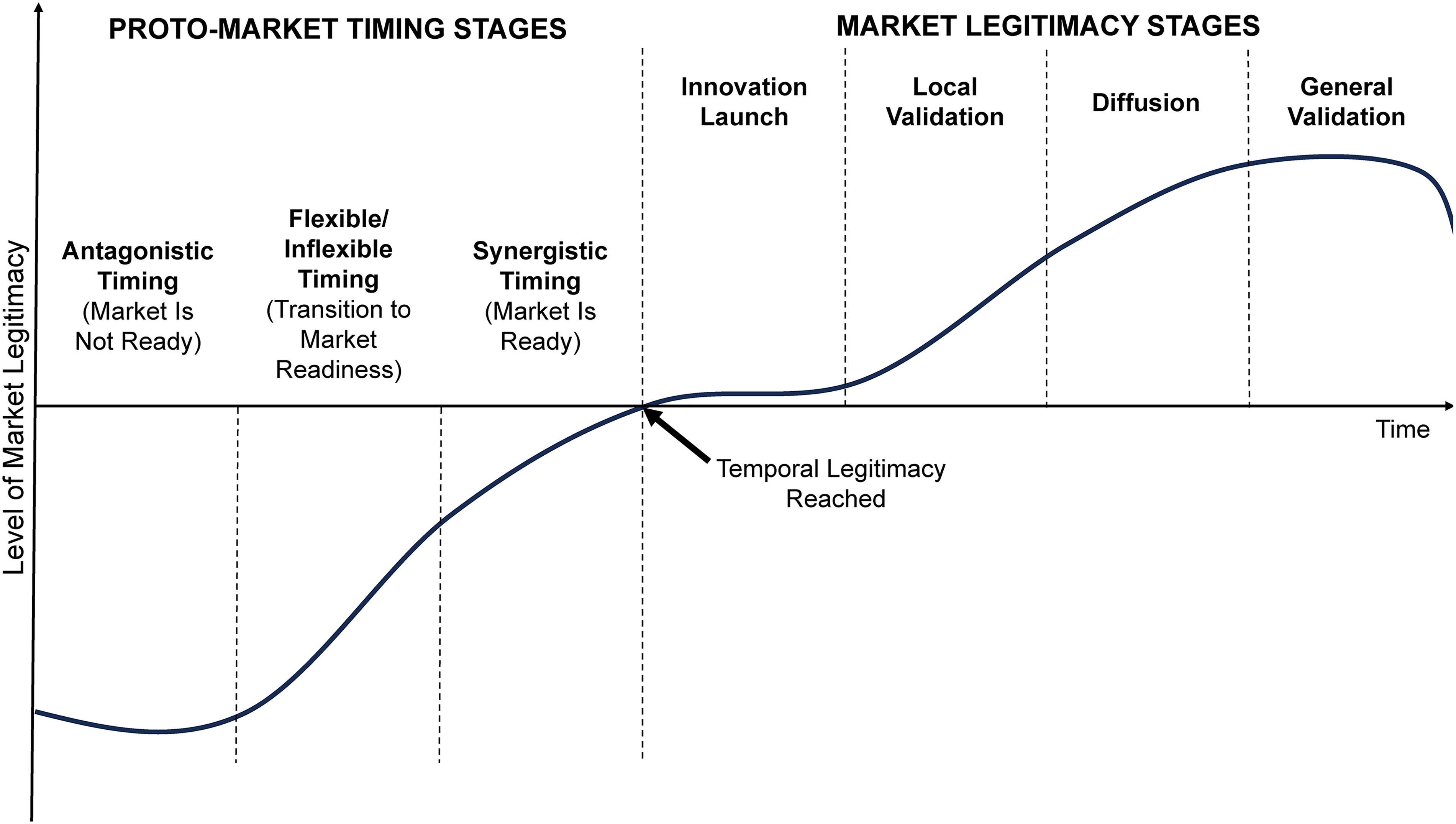
Market Timing Before Market Legitimation Process.
In Figure 3, we illustrate the proto-market by prefacing the well-known market legitimacy stages (Humphreys 2010a) with antecedent managerial stages of a market timing process leading from antagonistic timing, using a flexible or inflexible timing transition, to synergistic timing. Thus, the beginning of the traditional legitimation process is not a nil, blank slate but a moment in time when the prerequisite materials are in place for the new product to take hold. Our research therefore suggests that market timing is a key antecedent for market legitimacy.
Temporal legitimacy assures managers well in advance that resources are present to enable stakeholders to create associations with more established entities, meanings, rules, identities, and usages (Huff, Humphreys, and Wilner 2021; Rao, Chandy, and Prabhu 2008). Such legitimacy is achieved by managing technological, commercial, organizational, and societal uncertainties in the years leading up to the launch (Ramani, Thutupalli, and Urias 2017). Managerial engagement with timing also means verifying that the market will be resilient to the approaching transformation before the launch even happens (Hargadon and Douglas 2001). Strategies in an inflexible timing situation that provide boundaries, for example, add social and managerial control over time and a slower rate of change to the oncoming market, while marketing strategies in a flexible timing situation enable consumers to become adjusted to the probable future more swiftly by developing a normative framework about benefits before the final launch.
Managerial Implications
Finding the optimal moment to launch a new technology means calibrating firm-led activities with relevant stakeholder attitudes in the transition from antagonistic to synergistic timing (see Figure 3). Managers should be aware that individuals’ timing norms may differ by technology type, as evidenced by Google's various product launches occurring in different market timing situations: Google Glass was launched in antagonistic timing, Google Gemini and its extension Google Lumiere are facing flexible timing, and Google Fitbit 6 was launched in an inflexible timing situation (see Table 2). Figure 4 displays a decision tree designed for managers to help reach the optimal market timing for their new tech launch. It illustrates the options available at key strategic points leading up to a possible launch moment. By adhering to this decision tree, managers can take well-informed actions in determining when and how to bring their innovation to market, as well as when and why they should wait.
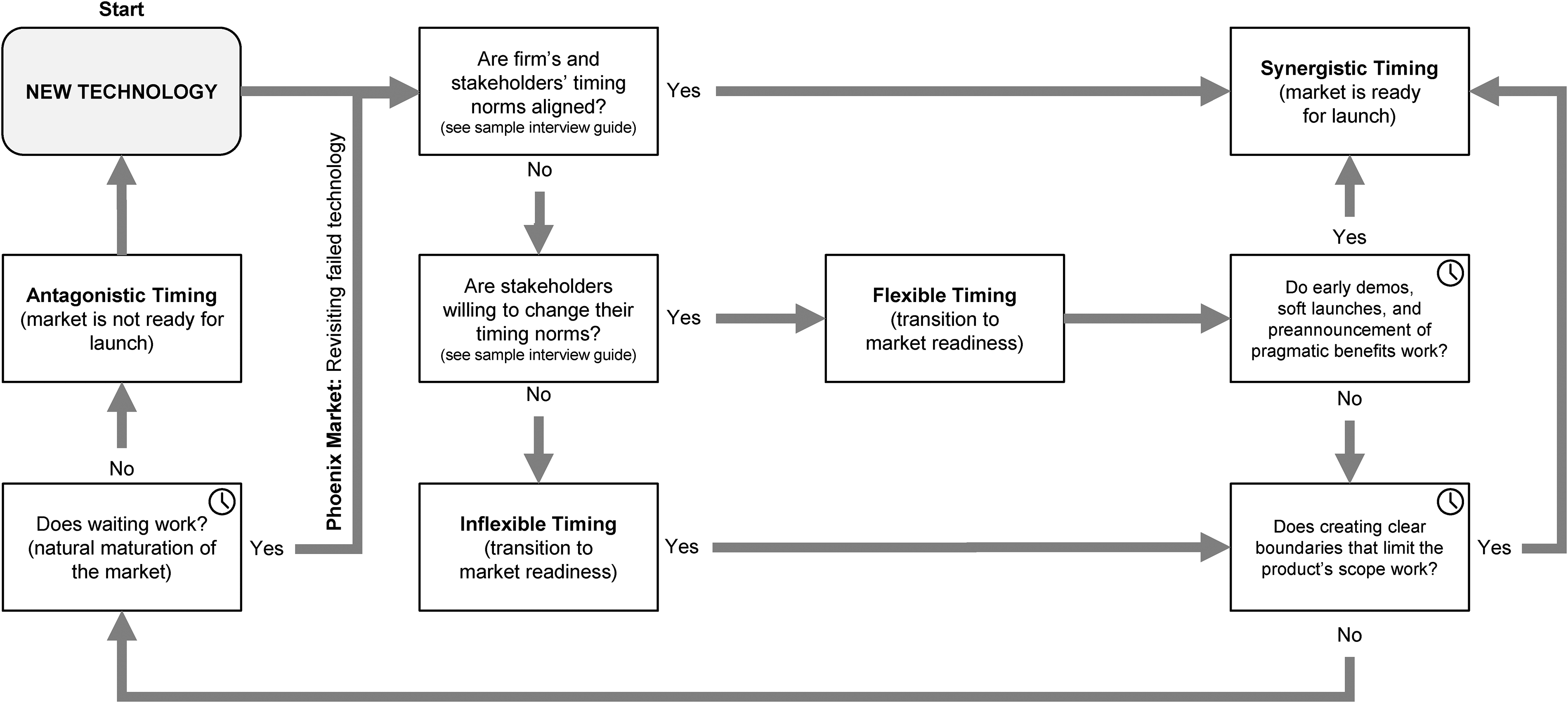
Market Timing Decision Tree for Managers.
Before setting a product launch date, managers should first determine whether their firm's and relevant stakeholder groups’ (e.g., consumers, influencers, activists, journalists, and regulators) timing norms are aligned (see Figure 4). They should conduct market research at this initial stage in the form of a questionnaire or brief interviews to determine what everyone thinks are optimal moments when market activities should take place (i.e., timing norms). Based on our market timing model (Figure 1), Web Appendix C provides a detailed interview guide to help managers gauge whether their firms’ employees and their stakeholders’ timing norms are aligned. Questions 1–5 are more general questions about technological innovations and market timing, whereas Questions 6–12 are specific timing questions on whether the new technology's functions relate to the five pillars of legitimacy (pragmatic, regulative, normative, relational, and cultural-cognitive). These proposed questions should be completed both internally by employees from key departments (e.g., C-suite, R&D, marketing, distribution, finance) and externally by relevant stakeholders (e.g., consumers, influencers, activists, journalists, and regulators). If this market research reveals that timing norms for the product are indeed aligned (answers do not significantly vary), managers are in a situation of synergistic market timing. This means that the market is ready to embrace the new product, and a launch date can be set immediately.
If the market research reveals that stakeholders’ timing norms are not aligned for the product (answers significantly vary), the next question managers should ask is whether these stakeholders are willing to change. Web Appendix C provides a second list of six questions to gauge stakeholders’ willingness to change their timing norms. These questions should only be posed to external stakeholders. If stakeholders are indeed willing to change, managers are in a flexible timing situation. However, managers facing this situation should not assume that stakeholders know when they are ready. Rather, managers should communicate the new product's future utility and functions (pragmatic benefits) through preannouncements, early demos, and soft releases to include segmented consumers and other relevant stakeholders in establishing an ideal launch moment together (see Table 3 for specific marketing strategies). One of the main managerial strategies in a flexible timing situation is to publicize imperfections for products with low user risk exposure (e.g., GPAI). This strategy helps move stakeholders through a hierarchy of market readiness that starts with astonishment and then is followed by rejection, interpretation, incorporation, and, finally, readiness (Bourdieu 1990). Hence, this strategy is particularly suited for firms in a market-driving situation, where they are trying to influence consumers and other stakeholders (Humphreys and Carpenter 2018). As Figure 4 illustrates with a clock symbol, this step involves a longer stretch of time to transition the market from flexible to synergistic timing.
If the market research reveals that stakeholders are not willing to change, managers are facing an inflexible timing situation. Here, the managerial task is to build stakeholder trust. Managers should therefore shift their attention to creating strong boundary conditions for their innovation's functions. Specifically, managers can engage the five established legitimacy pillars to limit the new product's scope and allow changes created by it to manifest over longer periods before launch (see Table 3 for specific marketing strategies). Importantly, managers can use respondents’ answers from Questions 6–11 to understand how employees and stakeholders think the technology's functions should be better controlled or limited. Again, the clock symbol for this managerial action box in Figure 4 signals that transitioning from inflexible to synergistic timing, and thus market readiness to launch, takes time.
If these strategies do not work to transition a market to launch readiness, we recommend that managers wait for the natural maturation of the market and then restart the decision tree (see Figure 4, where the clock symbol for this managerial action box now means waiting). Thus, patience becomes an important and powerful managerial tool that contributes to more favorable decision-making outcomes (Haque, Liu, and TitiAmayah 2017) and possibly a phoenix market. Patience is itself a temporal construct that refers to a willingness to give time for something to happen and thus highlights managers’ respect for others (Bourdieu 1990). If waiting for the market to naturally mature is not an option, managers have reached a situation of antagonistic market timing, which means any launch moment is bound to fail. In this situation, the market is simply not ready for the innovation. To avoid a failed launch, managers must change something about their product's functions and restart the decision tree. Ultimately, while getting the market timing right with an innovation is not easy, understanding the concept of timing and the dynamics involved as they have been presented herein will help ensure the success of a technological product launch before starting a traditional market legitimation process (Humphreys 2010a).
Future Research Avenues
While this article provides a theoretical and managerial basis for optimally timing technological product launches before a market legitimation process (see Figure 3), this topic can inspire future studies in a range of adjacent research streams. To gain a deeper understanding of market timing, we propose several questions for future research (see Table 4) that will help develop this area further.
Areas of Future Research with Suggested Research Questions.
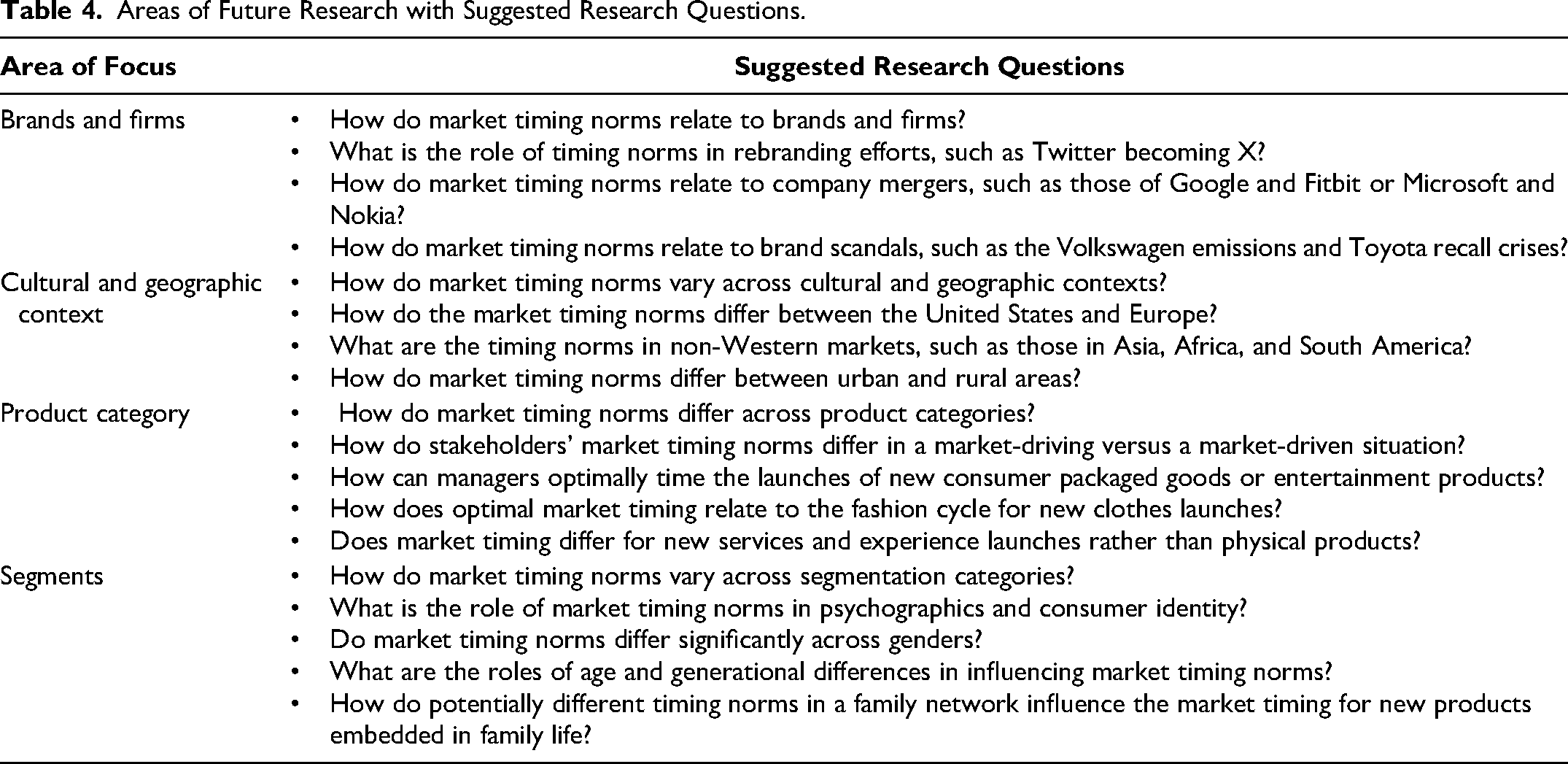
Intuitively, timing plays a key role for managerial and strategic decisions about brand-level changes, as well as company mergers and acquisitions. Drawing on our model, we encourage researchers to establish optimal market timing for rebranding efforts at both the product (Keller, Geyskens, and Dekimpe 2020) and corporate (Bolhuis, De Jong, and Van den Bosch 2018) levels. Twitter's crisis following Elon Musk's takeover, for example, created market legitimacy issues with employees, advertisers, investors, content creators, and consumers. These stakeholders had different timing norms, with many calling the rebrand (to X) “abrupt” and an “overnight” erasure of one of social media's most recognizable brands that potentially killed billions in brand value (Hart 2023). Consequently, developing a toolkit for brand management regarding the market timing of rebrands is of utmost importance.
Furthermore, research on the market timing of cobranding (Washburn, Till, and Priluck 2000) and merger (Homburg and Bucerius 2005) strategies is necessary. Did Google purchase Fitbit and announce this merger at the right moment? Mergers, similar to new tech product launches, are risky and can happen too early or too late, as in the case of Microsoft's failed Nokia acquisition (Warren 2016). Brand scandals and reputation crises (Dutta and Pullig 2011), such as the Volkswagen violation of the Clean Air Act (Jung and Sharon 2019), equally involve market timing issues during the response phase. Understanding the period of penance for a brand, the timing of apologies, and the initiation of other subsequent managerial initiatives to regain brand legitimacy (Kates 2004) requires further investigation building on our market timing model.
Prior work has investigated the market legitimacy of international companies with subsidiaries in multiple countries (e.g., Sheng, Zhou, and Li 2011). To complement these studies, future research could address differences in timing norms across various cultural and geographic contexts. Comparative studies in the West, such as between North America and Europe, could offer new theoretical contributions and managerial implications to this research stream. More important, future research should investigate timing norms in non-Western contexts, such as in Asia, Africa, and South America, with a particular view on the role of local infrastructure, institutional makeup, and trajectory of modernization. Cross-cultural issues of time provide substantial challenges and pitfalls for managers (Graham 1981). Geographic differences within countries may also be fruitful when identifying different timing norms. For example, stakeholders living in urban versus rural areas may have radically different sensibilities about right and wrong moments for market actions to occur.
We strongly encourage researchers to test the robustness of our market timing model beyond the new technology product category. For example, researchers can investigate how stakeholders’ market timing norms differ in a market-driving versus a market-driven situation (Humphreys and Carpenter 2018). While Narayanan, Manchanda, and Chintagunta (2005) investigate the timing of marketing communication for various new product categories in the postlaunch stages, no study to date focuses on prelaunch market timing. Future research could therefore explore how managers can optimally time the launches of new consumer packaged goods or entertainment products. Furthermore, how does optimal market timing relate to the fashion cycle (Sproles 1981) for new clothes launches? Does market timing differ for new services and experience launches versus physical products?
Finally, future research should investigate different consumer segments’ (Yankelovich and Meer 2006) timing norms and their impact on product launches and market legitimation processes. Future studies could focus on how managers can engage with complex consumer segments that have a diverse set of timing norms among themselves. For example, how do potentially different timing norms in a family network influence the market timing for new products embedded in family life (Epp, Schau, and Price 2014)?
Conclusion
Managers are not temporal dupes locked into a rigid market legitimation process but can target the right time for their technology products’ launches through systematic preparation and by strategically identifying the optimal moment when consumers and other stakeholders are ready for their innovation. Yet time can be a difficult theme to address. As a fundamental medium for all human activities and experiences, time is so obvious as to render one blind to its relevance. Simultaneously, any attempt to articulate the meaning and phenomenon of time is at risk of leaping into extreme abstraction beyond any immediate application. In this article, however, we show that the market timing of a tech product launch is an important antecedent for a market legitimation process. Although we provide concrete and actionable managerial tools that enable managers to influence individuals’ timing norms, we close with ethical reflexivity. There is no more powerful ideological tool than influencing people's understanding of and engagement with time, given its irreversibility. Researchers and managers should therefore always consider whether the application of these powerful temporal tools is for the greater good.
Supplemental Material
sj-pdf-1-jmx-10.1177_00222429241280405 - Supplemental material for Timing Legitimacy: Identifying the Optimal Moment to Launch Technology in the Market
Supplemental material, sj-pdf-1-jmx-10.1177_00222429241280405 for Timing Legitimacy: Identifying the Optimal Moment to Launch Technology in the Market by Thomas Derek Robinson and Ela Veresiu in Journal of Marketing
Footnotes
Acknowledgments
The authors sincerely thank Giana Eckhardt, Eileen Fischer, Colleen Harmeling, and members of the Bayes Business School and King's College London marketing departments and the London CCT Seminar Series for their valuable feedback.
Coeditor
Cait Lamberton
Associate Editor
Ashlee Humphreys
Declaration of Conflicting Interests
The authors declared no potential conflicts of interest with respect to the research, authorship, and/or publication of this article.
Funding
The authors received no financial support for the research, authorship, and/or publication of this article.

References
Supplementary Material
Please find the following supplemental material available below.
For Open Access articles published under a Creative Commons License, all supplemental material carries the same license as the article it is associated with.
For non-Open Access articles published, all supplemental material carries a non-exclusive license, and permission requests for re-use of supplemental material or any part of supplemental material shall be sent directly to the copyright owner as specified in the copyright notice associated with the article.
