



Abstract
Existing literature has concluded that employees who regularly interact with customers often find this central aspect of their work emotionally draining. But what if some customer interactions could emotionally regenerate service employees? This ethnographic research demonstrates that several factors influence emotional energy in service interactions, including staff copresence with customers, mutual focus, shared mood, and barriers to outsiders. In addition, service employees’ experience of autonomy and status in interactions plays an important role in influencing their emotional energy. Based on these insights, this study advances a framework for service organizations to manage a crucial asset: the emotional energy of frontline service employees.
Keywords
How could interacting with customers possibly become a source of emotional energy for frontline service employees? After all, the picture that emerges from the service frontlines appears decidedly bleak. At a time when service employees are expected to satisfy clients by any means, customers have become entitled, demanding, and occasionally aggressive (Rouquet and Suquet 2021). Tesco has equipped its retail staff with body cameras to combat the rise in physical assaults, and Uber has developed technology to monitor drunk customers (Bhatnagar et al. 2024). The accumulation of negative interactions with customers means that stress and burnout among frontline service workers now reach stratospheric levels (Yang, Zhou, and Huang 2024). Customer interactions and their consequences occupy the epicenter of the service crisis.
Our study offers a striking contrast to this dispiriting picture of frontline service interactions. Rather than being drained by customers, the frontline service employees featured in this article describe being invigorated by customer interactions. Even more surprisingly, some employees refer to these encounters with clients as the best part of their job. While existing research consistently portrays customer interactions as stressful (Chan and Wan 2012; Hennig-Thurau et al. 2006), the service employees in our findings describe moments of intense emotional regeneration. The goal of this research is to better theorize these contradictory findings.
To resolve these contradictions, we use insights from interaction ritual theory. An important contribution of interaction ritual theory is the framework it offers for analyzing why some interactions fill us with emotional energy whereas other interactions drain us of emotional energy. Emotional energy is the feeling of “confidence, elation, strength, enthusiasm, and initiative in taking action” (Collins 2004, p. 49). Interaction ritual theory has been applied to a wide variety of contexts, ranging from the dynamics of team creativity (Metiu and Rothbard 2013) to the emotional energy of the hiring process (Rivera 2015) or the collective effervescence of boisterous soccer stadiums (Hill, Canniford, and Eckhardt 2022). A limitation of such previous research on emotional energy, however, is that it focuses only on the horizontal dynamics of solidarity rituals (Hill, Canniford, and Eckhardt 2022; Lepisto 2022; Wellman, Corcoran, and Stockly-Meyerdirk 2014). Solidarity rituals, such as religious ceremonies or fan gatherings, are bonding exercises that convey a sense of belonging and create mutual support among participants. In this sense, solidarity rituals bring us closer to Durkheim's model of rituals as collective gatherings that generate effervescence (Durkheim 1912).
In contrast to solidarity rituals, however, some interaction rituals reflect and reinforce power inequalities (Dion and Borraz 2017; Üstüner and Thompson 2012). We call these interaction rituals power rituals. Service jobs such as hair styling (Hill and Bradley 2010; Üstüner and Thompson 2012), call center work (Taylor and Bain 1999), and hospitality (Sherman 2003) are permeated by a power asymmetry, as service workers in such contexts are generally command takers rather than command givers. This power asymmetry means that the focus of attention in interactions tends to be on the status and emotional well-being of consumers, rather than on those of frontline employees (Sherman 2003). With all attention and favors directed at consumers in this asymmetrical structure, it seems unlikely that frontline service employees could ever be regenerated through customer interactions. However, our results provide striking evidence to the contrary and lead us to pose the following research question: Under what circumstances do customer interactions fill frontline service employees with emotional energy?
Our findings are based on ethnographic fieldwork conducted at the iconic vacation resort company, Club Med. This context proved particularly fruitful for developing new theory because the emotional energy of both customers and employees was extreme and thus “transparently observable” (Lepisto 2022, p. 1331). Club Med is a high-energy environment, one in which customers and frontline service workers can easily be found dancing or partying together. However, it would be a mistake to think that Club Med is too particular a setting to provide useful insights for other service organizations. On the contrary, as with previous research mobilizing extreme contexts (Arnould and Price 1993), our research helps theorize the emotional energy of service interactions in ways that extend far beyond Club Med's exuberant parties.
More specifically, our research contributes to existing scholarship in two primary ways. First, we extend existing service scholarship by detailing the conditions under which customer interactions regenerate frontline service employees. When compared with past research on the emotions of frontline employees (Chan and Wan 2012; Hennig-Thurau et al. 2006), our research provides a more detailed and managerially actionable framework for designing uplifting service environments.
Second, we extend research on emotional energy by detailing the dynamics of emotional energy in a service context. While extensive research exists on the emotional energy of solidarity rituals (Hill, Canniford, and Eckhardt 2022; Krishnan et al. 2021; Lepisto 2022; Metiu and Rothbard 2013), our study offers an opportunity to understand how service functions as a power ritual, and, especially, how status and autonomy affect the emotional energy of service interactions.
Theoretical Foundations
Customer Interactions and the Emotions of Service Employees
This study focuses on the emotional impact of customer interactions on frontline service employees. Given the vast literature on emotions (see Bericat [2016] for a review), we limit our attention to studies that have specifically examined the emotional impact of customer interactions on frontline employees in terms of (1) emotional regulation, and (2) emotional contagion.
Emotional regulation
Emotional regulation refers to the strategies and techniques that individuals employ to manage and control their emotions during interactions. In studies adopting this theoretical lens, customer interactions are depicted as situations of intense emotional regulation in which organizational members must manage their emotions (Brotheridge and Grandey 2002; Grandey 2000). Previous literature has documented how this emotional labor depletes regulatory resources, leading to stress and exhaustion (Brotheridge and Grandey 2002).
Despite these insights, emotional regulation theory remains limited regarding the pleasures of interacting with customers. Although pioneering work on emotional labor evokes flight attendants enjoying their “work with people” (Hochschild 1983, p. 107), the literature on emotional regulation does not elaborate on these gratifying aspects of service. Therefore, we turn to research on emotional contagion for help in theorizing the pleasures of service interactions.
Emotional contagion
The concept of emotional contagion refers to the transfer of emotions from one person to another during social interactions. Research on emotional contagion shows that the emotions of service workers and customers converge during interactions because spontaneous, automatic, mental processes lead them to imitate each other (Hennig-Thurau et al. 2006). Thus, customers’ emotions impact the emotional state of service employees, with observable effects on their work. In one simulation, for example, rude customers reduced service employees’ friendliness and accuracy when compared with polite customers (Wegge, Vogt, and Wecking 2007).
However, existing research on emotional contagion neglects the collective dynamics and physical aspects of emotional contagion, both of which are highly relevant to service work. Previous studies on emotional contagion in services have relied on dyadic research designs that examine how emotions are transmitted from one person to another (Hennig-Thurau et al. 2006; Pugh 2001) without considering how emotions are collectively experienced in larger groups. This dyadic focus is problematic because emotional contagion takes a different form in groups and crowds, leading to the formation of collective identities and collective actions (Goodwin, Jasper, and Polletta 2001; Hill, Canniford, and Eckhardt 2022). When it comes to service environments, where interactions are not always dyadic, it is necessary to examine the collective dynamics of emotional contagion to understand frontline employees’ emotional energy.
Moreover, existing studies of emotional contagion in service settings have focused exclusively on facial displays as indicators of emotional impact (Hennig-Thurau et al. 2006; Pugh 2001). However, emotional contagion involves a much wider range of bodily expressions and gestures (Collins 2004; Durkheim 1912; Hill, Canniford, and Eckhardt 2022). While organizational scholars have integrated bodily cues and verbal tones into the study of emotional contagion (Barsade 2002), this more physical operationalization of emotional contagion has yet to be explored in marketing scholarship.
Both of these dimensions of emotional contagion—collective and physical—are crucial to understanding the emotional dynamics of service settings. Consider, for instance, the collective dynamics of retail work (Bozkurt 2015) or the importance of physicality to the experience of hospitality (Ocejo 2017). Recent scholarship argues that “even though emotional contagion is frequently discussed as a pivotal process underpinning service delivery, empirical evidence has been relatively scarce” (Groth et al. 2019, p. 97). We would add that research on emotional contagion needs to consider the collective and intensely physical dimensions of this process. We introduce interaction ritual theory as a framework to address these limitations.
Interaction Ritual Theory and Emotional Energy
Emotional energy
Emotional energy is the positive feeling of being invigorated, as if one's entire being is electrically charged with a sense of vitality. Crucially, in interaction ritual theory, emotional energy is “socially derived” (Collins 2004, p. 39). As opposed to accounts that evoke the possibility of generating emotional energy on one's own (Baker 2019), interaction ritual theory focuses on the emotional energy emerging from what Collins calls interaction rituals.
An interaction ritual is a social encounter involving at least two parties. Such rituals can range from banal, everyday conversations to more formalized, infrequent, public ceremonies. The emotional energy produced in these rituals fills people with confidence and courage for social interactions. Like “moths to a light” we are drawn to interactions that fill us with emotional energy (Rivera 2015, p. 1344). Positive experiences of emotional energy thus lead us to seek and repeat energy-giving experiences, forming what Collins (2004) calls “interaction ritual chains”: chains of interconnected events spread over time, with different levels and qualities of emotional energy.
For marketing scholarship, the value of interaction ritual theory lies in its ability to explain the emotional energy that arises from market interactions, including interactions between service employees and customers. More specifically, emotional energy is generated when certain conditions are met, namely, (1) physical copresence, (2) mutual attention, (3) shared mood, and (4) barriers to outsiders. First, emotional energy accrues when people gather in the same place and can hear and see each other. Second, emotional energy increases when people focus on the same thing and become aware of each other's attention to the common object. Third, emotional energy is enhanced when people develop a shared mood through rhythmic entrainment (Collins 2004), a process of alignment in which the coordinated actions of people participating in the same interaction ritual result in the synchronization of their behavior and emotions. Finally, the presence of a barrier to outsiders amplifies emotional energy by facilitating the distinction between ritual insiders and outsiders, thus fostering a sense of unity and strengthening the shared identity of participants.
Solidarity rituals versus power rituals
To date, interaction ritual theory has been used to explain a range of phenomena, including sports fandom (Hill, Canniford, and Eckhardt 2022), religious gatherings (Wellman, Corcoran, and Stockly-Meyerdirk 2014), and social movements (Goodwin, Jasper, and Polletta 2001). In addition, organizational theorists have used emotional energy to explain extraordinary creativity (Harvey 2014), effective group dynamics (Krishnan et al. 2021), the energizing power of small talk (Methot et al. 2021), and work meaningfulness (Lepisto 2022). However, a limitation of these studies is that they tend to focus on what Collins (2004) calls solidarity rituals, that is, interaction rituals whose main purpose is to facilitate and strengthen group belonging. Examples of solidarity rituals include exercise classes (Lepisto 2022), mass demonstrations (Collins 2013), and fan gatherings (Hill, Canniford, and Eckhardt 2022). Solidarity rituals help galvanize participants, forge new ties, and create symbols of group membership.
The dynamics of power rituals differ from those of solidarity rituals. To picture a power ritual, think, for instance, of an officer giving orders in battle, a sports coach leading a team of athletes, or a leader directing workers. These interaction rituals are structured by hierarchy and status, so that some actors have the power to issue commands while others follow them. Collins (2004) argues that such an imbalance in power affects emotions. Those who receive orders are more likely to experience negative emotions that drain them of energy. Consistent with these predictions, a study of entrepreneurship in Russia shows that confronting government officials triggered feelings of shame, anger, and frustration because entrepreneurs felt powerless when trying to fight bureaucracy (Doern and Goss 2014).
We approach service encounters as power rituals in which frontline service employees are more likely to be order receivers and thus to experience negative emotions. While power dynamics vary across service contexts, frontline service employees are generally in a position of subservience, with the obligation to obey orders from customers. To analyze the emotional energy of servicescapes, it is key to give consideration to these power asymmetries—namely, the lack of autonomy and status to which frontline employees are usually subjected in a climate of customer sovereignty (Rouquet and Suquet 2021)—and to how power asymmetries affect the emotional energy of frontline employees. If we want to understand the emotional energy of service interactions, we need to look at the autonomy and status of service employees.
Autonomy and emotional energy
We define autonomy as the ability to “exercise willpower and judgment in one's work” (Steger 2019, p. 216), that is, the degree of control and discretion frontline employees have over their work tasks, decisions, and interactions with clients. Service employees are often left with little sense of agency in their interactions with clients. Indeed, whether it is serving customers at McDonald's (Leidner 1993) or Disney (Van Maanen 1991), frontline employees often experience little discretion over work tasks, but are forced to put on a brave face and smile in front of customers. This power asymmetry is often frustrating for service employees, especially when dealing with misbehaving or disrespectful customers. Yet, aside from questions of emotional labor, marketing scholarship has neglected the emotional impact of this power asymmetry on service workers. In contrast, in this article, we examine how the autonomy that service employees hold in this power ritual impacts their emotional energy.
While the concept of autonomy is studied by organizational scholars, service scholars focus more on “empowerment” to capture the discretion that frontline employees can exercise in offering nonroutine, personalized services to their clients (Bowen and Lawler 1995). However, empowerment studies generally overlook how frontline employees approach their own, individual empowerment, preferring instead to measure how empowerment improves organizational performance (Sirianni et al. 2013). This focus is problematic, especially since past research indicates that perceived autonomy positively influences the emotions of service workers. In a study of nurses, for instance, the imposition of stricter employee control played an important role in amplifying the effects of emotional labor (Aiken and Sloane 1997).
Thus, in this study, we focus on how the experience of autonomy affects the emotional energy of frontline employees. In doing so, we draw on research demonstrating that autonomy makes work more meaningful and enjoyable (Wrzesniewski, Dutton, and Debebe 2003). We also build on Collins’s (2004) insights that command recipients (such as service workers) are likely to experience their limited autonomy relative to the command giver's greater autonomy as energy-draining. We use these insights to consider the role that autonomy plays in energizing frontline employees.
Status and emotional energy
Status is “a set of learned and shared rules for organizing social relations” (Ridgeway 2019, p. 14), including interactions between service employees and clients. For instance, status beliefs mean that doctors and athletes are likely to receive high respect and attention wherever they go (Maoret, Marchesini, and Ertug 2023). Conversely, service workers in lower-status occupations, such as hairdressers or restaurant servers, are less likely to receive the same level of deference (Paules 1991).
While status is an entrenched cultural schema, however, it is also dynamic (Maoret, Marchesini, and Ertug 2023). For example, although the hairdressing profession does not enjoy the same prestige as the medical profession, hairdressers have the opportunity to become confidants of their clients, as clients often candidly share details about their lives with hairdressers (Hill and Bradley 2010; Price and Arnould 1999). Hairdressers can elevate their status by building close relationships with clients or by demonstrating their unique skills (Auriacombe and Cova 2017; Üstüner and Thompson 2012). As we will show, these contextual dynamics are key to influencing emotional energy.
To summarize, interaction ritual theory addresses past research limitations in three primary ways. First, while existing service scholarship offers limited advice on how to create uplifting service interactions, interaction ritual theory gives insights into the emotional regeneration that such interactions can provide. Second, while emotional contagion research has focused on emotional energy in facial displays and dyadic interactions, interaction ritual theory examines how emotional energy translates through the mobilization of the entire body and points to collective gatherings as key ways to generate high emotional energy. Finally, since it considers the impact of both autonomy and status on emotional energy, interaction ritual theory lends itself particularly well to studying service interactions as power rituals.
Ethnographic Methods
Research Context
Our study of emotional energy is based on ethnographic fieldwork in a unique service context: the hospitality organization Club Med. Created in the 1950s as an “antidote to civilization,” Club Méditerranée—which the company promptly shortened to Club Med—was designed for urban consumers to decamp into a utopian world of hedonism and informality (De Raedt 2010). Club Med resorts are situated in secluded areas that are difficult to access and are only open to customers who have paid for their vacation in advance. Club Med has consistently referred to its resorts as “villages,” purposely created to offer a contrasting experience to the hustle and bustle of urban life.
Although Club Med resorts are now positioned in the luxury segment, they retain traces of their original, egalitarian ethos. Hence, service staff are referred to as Gentils Organisateurs (“friendly organizers”), or GOs. They are encouraged to interact with customers in conversations, at meals, and at parties. Such customer interactions are frequent at Club Med, because both GOs and clients reside on-site. The clients, also known as GMs (Gentils Membres, or “friendly members”), rarely venture outside the resorts, because these destinations offer all-inclusive packages comprising sports activities, meals, and entertainment. Consequently, GOs engage with customers from the moment they leave their rooms until their return, resulting in a constant stream of interactions.
The time that Club Med service employees spend with clients exceeds their regular working hours, with a substantial portion of their interactions remaining uncompensated. While the most visible GOs are sports instructors, workers from all services (food and beverage, reception, housekeeping, and childcare, as well as back-office employees) are GOs and participate in what Club Med staff and management call “life of the village” activities. These activities include departures and arrivals, in which GOs greet customers; mealtimes, in which GOs are encouraged to socialize with customers; and live shows performed by GOs, also outside regular working hours. The diversity and frequency of these interactions make Club Med a uniquely fertile terrain for studying the role of emotional energy in service settings.
Participant Observation
Observing emotional energy is a key part of our research design. As part of an ongoing agreement, the authors conducted ethnographic studies on questions of interest for Club Med, always in relation to customer and/or worker experience. We were given unrestricted access to observe and interact with service employees at Club Med, with the agreement that we would share our findings with senior management.
We had two objectives in terms of our observations: (1) to immerse ourselves in the Club Med experience; and (2) to analyze interactions between service workers and customers. First, we experienced the life of the resort as GMs. We played sports, watched shows, and ate meals with clients and workers. Our membership role as clients allowed us to better understand the Club Med environment. It also offered a privileged vantage point from which to study service interactions. Second, we used an observation protocol to record encounters between GOs and customers in different situations. We paid attention to how people moved, stood, and spoke. We conducted these observations in nine different resorts encompassing a range of countries (France, Italy, China, Morocco), location types (mountain, countryside, seaside), seasons (winter, summer), levels of comfort (three or four “tridents”), and customer nationalities.
Interviews
Due to the hectic nature of resort work, it was difficult to conduct longer interviews with GOs currently working in the field. Therefore, our interviews focused on former GOs who now hold new positions at Club Med corporate headquarters in Europe and Asia. This decision explains the relatively high proportion of long-term employees in our sample. Our final sample included informants with work experience at Club Med ranging from 9 months to 38 years (see the Web Appendix for a description of our informants).
After obtaining informed consent, we began our interviews with questions about each GO's background before they worked at Club Med. The following questions focused on interactions between clients and staff (e.g., “How would you describe your relationship with GMs at Club Med? What are some of your best memories? What are some of your less positive memories?”). In the final part of our interviews, we discussed work-life balance issues and how these aspects changed for employees after they left a GO position (if applicable). Interviews were conducted in French or in English, lasted between 45 and 90 minutes, and were audio-recorded, transcribed, and translated when necessary. We also anonymized the data collected to protect the research participants’ identities.
Data Analysis
We analyzed the data in two main phases. The first phase focused on identifying the pains and pleasures of interacting with customers. We developed codes to capture the emotions and meanings of customer interactions from the GO's perspective. In reviewing our interview transcripts, we were surprised that the interactions GOs described having with clients did not lead to the kind of emotional exhaustion described in previous research. When we examined our ethnographic field notes, we found that we frequently referred to “electricity” and “energy.” At this stage, we realized that interaction ritual theory could help us analyze our data.
In the second phase, we used interaction ritual theory to refine our coding scheme. Specifically, we found that autonomy and status played a critical role in generating employees’ emotional energy, in ways that could extend previous research on emotional energy (e.g., Hill, Canniford, and Eckhardt 2022). Thus, we included new codes for autonomy and status to analyze our data. At the end of this process, we devised a framework to explain how service interactions generate emotional energy.
Regarding the trustworthiness of our analysis, we followed Wallendorf and Belk's (1989) guidelines to improve the credibility of our interpretations. More specifically, we triangulated our interpretations across sources, methods, and researchers. In terms of sources, our sample includes a wide variety of GOs who have worked in different positions, including some who no longer work at Club Med. When it came to methods, our analysis involved going back and forth between our observations of employees’ emotional energy and the GOs’ own accounts when they talked about their career. Regarding triangulation across researchers, our analysis of the data involved both authors developing independent interpretations of the data before collaboratively developing an interpretation that was plausible to each member of the team. Finally, to further enhance the reliability of our interpretations, we organized two meetings with Club Med managers in which we shared our research findings. These meetings strengthened our conviction that our theoretical framework can provide answers to a significant puzzle. Specifically, Club Med managers had difficulty comprehending the level of energy GOs invested in their roles. We see our analysis as an opportunity to unravel this mystery and, more broadly, to advance our understanding of emotional energy in service settings.
Findings
Our findings examine the ebbs and flows of emotional energy in service work. First, we describe how emotional energy emerges in service interactions. Frontline service employees find emotional regeneration in two contexts. The first is in large, effervescent gatherings. In these gatherings, employees experience high levels of emotional energy. In smaller, more intimate gatherings with customers, the dynamics are different. Such gatherings generate less intense emotional energy but still give workers vitality. Second, we examine the power asymmetries of frontline service work, as reflected in the autonomy and status of service workers. We found that status and autonomy hold important roles in generating emotional energy in service situations.
Finally, we show how emotional energy carries over from one interaction to the next. This dynamic interplay is integral to our narrative, as it underscores the interconnectivity of emotional experiences in service settings. We describe service interactions as moments carrying different energy, from the hot energy of effervescent gatherings to the milder energy of intimate gatherings.
Emotional Energy in Service Interactions
We start with a riddle: frontline employees evoking the joy of interacting with customers all day, in contrast to existing scholarship pointing to the negative impacts of customer interactions. At Club Med, we met some GOs who were willing to change jobs at the resort just to participate in shows, parties, and events with customers. Mathilde, a GO, wanted to switch from her bar position to the front desk so she could perform in the Club's evening shows: What I missed as a barmaid was the “life of the village” (“vie de village”), so meals, apéritif, coffee, I was stuck behind the bar. And the shows. Because the shows for me are the best moments. For me, this is what Club Med is about. It is not so much the regular work that I enjoyed. What I enjoyed was talking with customers. It was going on stage to dance the Crazy Signs [simple and easy-to-follow group choreographies], being in the shows, wearing a badge and joining in the games. (interview with Mathilde, former GO, reception)
The pleasures of the parties that Mathilde evokes in this interview might seem unsurprising. After all, fun and games make work more bearable. However, in contrast to other work environments, the shows and parties that frontline employees at Club Med attend are not part of their paid work hours and extend the time GOs spend with clients beyond their assigned work schedule. At Club Med, putting on shows for clients or dancing with clients are activities that Club Med GOs engage in above and beyond their regular work hours. Service workers like Mathilde spend their regular work hours interacting with customers, but still want more of these interactions at the end of the day. Thus, our findings contradict the predictions of emotional regulation theory (Chan and Wan 2012; Hennig-Thurau et al. 2006).
To explain this mystery, we must abandon the preconceptions of emotion regulation theory and observe the emotional experience of being a GO. Our findings demonstrate that interactions with customers can refuel service employees with emotional energy, rather than draining them. Next, we describe two types of client interactions that we found to be energizing: (1) large, effervescent gatherings, which produce high levels of emotional energy; and (2) smaller, more intimate gatherings, which produce less intense emotional energy.
Effervescent gatherings
Effervescent gatherings are moments of heightened enthusiasm and shared engagement in which actors align their movements and emotions. A contribution of our research is to show how these large gatherings energize frontline employees, not just customers. Take, for instance, the iconic Club Med ritual called Crazy Signs. Performed every evening after the show, Crazy Signs are easy-to-follow choreographies led by a group of GOs, danced—and often also sung—to international pop hits. Figure 1 shows a picture of this ritual: GOs on stage raising their arms while energetically performing, commanding the attention of the GMs before them. The image captures a moment of dynamic interaction and shared mutual focus.
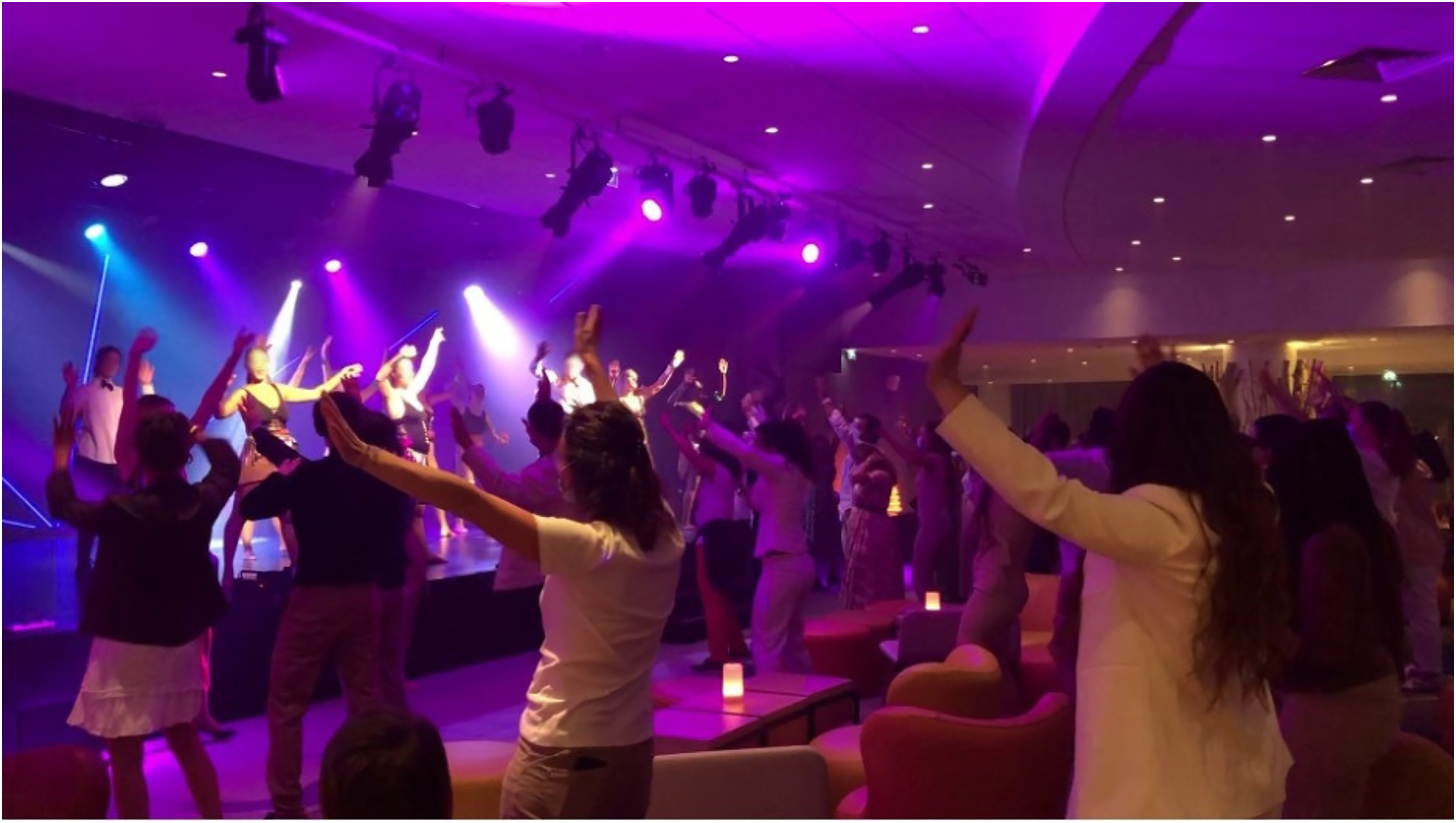
The “Crazy Signs” Ritual.
As the following field notes describe, the ensuing process of rhythmic entrainment creates high levels of emotional energy, thereby creating a vibrant atmosphere (Rokka et al. 2023): As I return to the bar after dinner, I am struck by the intensity of the ambience: the music is loud and exciting, and the room has been transformed by large, black curtains that reduce the space to the central area. Everything is black except for the graffiti on the curtains, the fluorescent “45” T-shirts worn by many, and the fluorescent makeup offered by a GO at the entrance to the bar. I have the impression that everyone is joining in the party. The music alternates between Madisons [a line dance], Crazy Signs, or other choreography of the same style, i.e., danced all together. The intensity of the music and the movement of the bodies—everything participates in creating the atmosphere tonight. The central space is very dense, surrounded by high drapes, but also limited by two stages situated opposite each other. Two GOs are dancing on one stage, guiding the participants through several Madisons and Crazy Signs. Two other GOs are on the stage opposite, they follow the Crazy Signs, then sometimes they take over the lead, and guide the dancers. I feel an incredible energy here. People also feel that energy. No one seems to want to stop. I see two elderly ladies who, until now, were seated; they are caught up in the mood and start dancing. A little later I see Jean Pierre (a GM I met earlier), who is also dancing by himself, and the Flemish gentleman too. He is dressed in the same walking shorts and T-shirt and has his backpack. Never mind, he dances too, he is in the movement. (field note, 2018)
In the parlance of interaction ritual theory, the event this field note describes was a particularly successful interaction ritual that produced high levels of emotional energy. Evidence of this success includes the fact that, whereas the Crazy Signs ritual generally lasts for 20 minutes, the Crazy Signs depicted in this note lasted much longer. In addition, the emotional energy was palpable, so the second author was “struck by the intensity of the ambience.”
Intense emotional energy of this kind comes from the presence of four key ingredients: (1) physical copresence, (2) mutual focus of attention, (3) shared mood, and (4) barriers to outsiders. First, because of the spatial arrangement of the resort, the bodies in the ritual described previously are very close to each other. This arrangement allows people to “observe each other's signals and bodily expressions” so that “human nervous systems become attuned” (Collins 2004, p. 64). Second, moving bodies in coordination leads to a mutual focus of attention. As the GMs’ bodies perform the same movements, replicating those of the GOs leading them, they gradually become aware that they are focusing their attention on the same object: the GOs on stage. Third, participants converge toward a shared mood so that the observer has the impression that “everyone is joining in the party.” As GMs and GOs experience the emotional high of rhythmic entrainment, their enthusiasm becomes contagious. Finally, the resort context creates a barrier between insiders and outsiders, thereby amplifying the emotional energy.
The originality of our findings lies in detailing how effervescent gatherings can revitalize frontline employees, as the following field note illustrates: I observe the spectators attending the show: all faces are turned toward the stage; I do not see anyone play with their cell phone. The room is dark with a very colorful, psychedelic screen, and the choreography is lively and seems precise and well done. Several times, the audience applauds with energy, and few loud “bravos!” can be heard. The scenes of the show follow one after the other. Many GOs on stage. Faces are expressive. I recognize a few: Gilles (in charge of animating Club life) plays one of the main characters, and the choreographer, in the main role. She is definitely a dancer. I also recognize Annabelle and Jennifer (two GOs I met earlier). And even José (another GO). No one exudes more energy than him! They all seem focused, committed. The show is a little too long for my taste, but I observe that no GM leaves the room, and at every opportunity, the applause is hearty, and for the finale, it is a standing ovation! The applause is not over yet; Gilles sprints across the room to arrive first at the bar and launch the party. All of this while sporting a big smile; but how does he do it?! (field note, 2018)
Here again, we see the behavioral and emotional entrainment that Collins calls rhythmic entrainment and witness its impact on participants’ emotional energy. Through their bodily movements, participants within each group entrain each other and gradually align, not just physically but emotionally (“all faces are turned toward the stage”; “faces are expressive”; “they all seem focused, committed”). Customers respond to workers’ performance on stage by clapping and cheering, leading both groups to converge emotionally, with the workers on stage demonstrating high levels of emotional energy through their performance and customers doing the same by rising to their feet and offering a standing ovation.
How does any of this relate to service and serving? After all, very few service workers end up singing and dancing with their clients. However, we contend that service interactions in collective settings, marked by the physical presence of both employees and customers, are frequent—consider busy bars, restaurants, hotel receptions, or shops—but that such collective dynamics are not given due recognition. Moreover, the model described previously does not just explain collective service interactions. Smaller interactions involving fewer participants, including dyadic interactions like the intimate conversations in hairdressing salons (Price and Arnould 1999), also create emotional energy. Attention to this process is important, given the prevalence of dyadic interactions in service settings.
Intimate bubbles
Beyond effervescent gatherings, emotional energy arises in “intimate bubbles”: smaller interactions between GOs and GMs that occur when sharing drinks and meals or during serendipitous conversations throughout the resort. Although emotional energy is more subdued in these interactions, they help us show how GOs spend their day navigating different types of interactions with varying degrees of emotional energy. Working as a GO, indeed, is experienced as a series of moments with different levels of energy.
The emotional energy of intimate bubbles resembles the energy arising from successful conversations in everyday life. When conversational exchanges are successful, they produce emotional energy. Hence, Ondine expresses the pleasure she gets from interacting with GMs: I loved all that and that's the reason that I work at Club Med. This customer side. If you do not like it, you must work in a regular hotel. […] And we benefit a lot from the GM. Because yes indeed there is always the odd meal, once a month, when nothing happens, but apart from that, all the other meals, you live unique moments. Because we meet people, different people, who have so much to give, and who are all very funny, and sometimes, when you get on well, you will spend the whole week with the same people. So it is very very enriching. In fact, for us, GOs, it's super enriching to meet all these people. (interview with Ondine, former GO now working in headquarters)
However, the Club Med setting means that GOs and GMs can find common experiences to connect over, such as attending the previous night's show or participating in the same sports activities. In turn, these experiences become what Collins calls “dramatic material”: a shared ground that allows participants to develop mutual focus. With a common focus in play, GOs and GMs take turns sharing stories, and this turn-taking becomes a type of rhythmic entertainment that allows GMs and GOs to synchronize their behavior and emotions. When Ondine evokes people who are “very funny” and with whom she developed strong bonds, we see the consequences of this rhythmic entrainment: a bubbly gaiety that resembles the emotional energy of effervescent gatherings. Ondine and other GOs are drawn to this emotional energy, thereby explaining why she chooses to “spend the whole week” with the same customers.
Thus far, we have shown how Collins’ model of emotional energy production extends to service employees who gain emotional energy from collective gatherings and more intimate conversations. Moving beyond this model, we need to better understand how a power ritual can be revitalizing. We thus turn to examining the status and autonomy of GOs in their interactions with customers.
Service as a Power Ritual
Service organizations can create interaction rituals that either elevate the status of frontline service employees or reinforce their sense of autonomy, both of which heighten emotional energy. At Club Med, GOs can temporarily experience status elevation, especially in events like shows where they become the focus of all attention. Likewise, interaction rituals in which GOs feel autonomous are more likely to become energizing moments.
Status and emotional energy
At one level, status refers to a culturally normative schema (Ridgeway and Correll 2006). At Club Med, GOs who work as tennis or sailing instructors have a higher status position than reception or food and beverage staff. These status differences mean different opportunities (or lack thereof) to generate emotional energy from interactions with customers, since employees with higher status are more likely to receive respect and attention from customers. Status operates as an “evaluative hierarchy in which one person is more respected, deferred to and influential than others” (Ridgeway and Correll 2006, p. 432). GOs start their day with different status positions that influence energy opportunities.
However, our research highlights the dynamic nature of status in service interactions, either through the neutralization of status differences between customers and frontline employees, or through the temporary elevation of frontline employees’ status. At Club Med, the “life of the village” gatherings play a central role in this temporary neutralization or elevation of status. These gatherings can provoke “status shocks,” that is, events in which “third-party audiences exogenously bestow privilege to some actors over others” (Maoret, Marchesini, and Ertug 2023, p. 926).
Take the shows as an example of this type of status shock. Mathilde, whom we mentioned previously, decided to switch from working as a barmaid to being a receptionist because this change enabled her to perform in shows. When GOs perform on stage, they become what Collins calls “energy stars”: Much like charismatic pastors and magnetic organizational leaders, they derive their energy from being the center of attention for others. This phenomenon is reflected in the following field note: 9:30 pm, around the bar, during the “Decades” show. One scene attracts my attention: a GO dressed as Michael Jackson is about to perform “Billie Jean.” In contrast to the other skits, “Michael Jackson” is alone on stage. Is it the resort manager's speech? The light or the music? Whereas until now GOs and GMs around the bar were mildly distracted in paying attention to the show, now I can feel that the attention of all is focused on “Michael Jackson” … who turns out to be Paul, the shy lifeguard! I can hardly believe my eyes: He totally occupies the stage and seems completely at ease. I had thought that Paul was a rather timid and introverted young man …; I am amazed. His body posture, head high, proud torso, afraid of nothing, defying all. He dances very well, and I am under the impression that the scene lasts longer than the other ones. Was this planned? Is it him who makes things last longer? The audience asking for more? He finishes the show with a standing ovation. I am so surprised; I can hardly recognize Paul. I have a conversation with Paul later that same evening. Paul tells me, “I love going on stage, I adore it! During dinner, just before leaving the table, as I got up, I just screamed ‘Billie Jean’ [high-pitched voice], and Steven [in charge of entertainment] said: ‘This evening, you will do Billie Jean.’ I had never done it before, but this evening, it was my best time ever at Club Med. Going on stage is nothing but pleasure.” (field note, 2018)
In this interaction ritual, a GO becomes the center of the crowd's attention. While the audience has not been particularly attentive up to this point, its focus changes when Paul takes the stage. Through his posture and movements, Paul's body radiates so much energy that he seems transformed. As he draws everyone's attention, his energy is transferred to the entire assembly, which responds with a standing ovation. Experiencing this position of energy star or leader proves to be an extremely pleasant experience, “nothing but pleasure.” Even if Paul may have spent the day fighting the dullness of the lifeguard's routine, in the evening, he finds a context in which he becomes the focus of attention.
Becoming energy leaders is what GOs experience in large collective effervescent gatherings, particularly the shows. In all these collective rituals, GOs and GMs are in asymmetrical positions. GOs perform standing on a brightly lit stage, while customers are seated in the dark. GOs occupy the center of attention, whereas customers are more at the periphery. Thus, GOs experience an elevated status and higher levels of emotional energy, which they then use to further energize the participants.
Small gatherings are contexts in which status dynamics can create emotional energy as well, but only under certain conditions. At Club Med, we find that when GOs and customers interact in small gatherings on a more equal footing, this neutralization of status creates an environment conducive to increasing emotional energy. When GOs converse with GMs at the bar or dine with them at the restaurant, they are not order receivers and do not serve GMs. It is the bar staff who are on duty and who serve the drinks, while during the meals, GOs and GMs both help themselves to the buffets. These elements of service design reflect and reinforce Club Med's egalitarian ethos. In turn, this egalitarian ethos, and the status leveling it entails, is key to the production of emotional energy. Consider the following field note: Conversation with Bert (South African student, first year at Club Med, 3rd village, barman). We first met during the GO/GM tennis challenge (games where teams of GMs and teams of GOs play against each other). We meet again at the bar, at 19 h, that same day: “Barman is ok but sometimes it can get boring. Sometimes you can spend hours with practically nobody. So, then it really gets boring. Otherwise, I love the socializing at Club Med. At first, I didn’t get Club Med: how is it different from a hotel? Why would people want to come? I think Club Med is amazing. Once there was a South African GM who was with his family; he looked as if he couldn’t even afford Club Med. Super relaxed clothing. We got on very well and shared a lot of time together. In the end it turned out that he was the CEO of an international super-successful business. And he said: ‘When you come to Cape Town, tell me; you can stay with us. And if you need a job, it's yours. Just call me.’ Amazing.” (field note, 2020)
When Bert told this story, he beamed with pleasure. In addition, the language he used to describe his experience reflects intense emotions (e.g., “love,” “amazing”). Where does his emotional energy come from? Status leveling is key here to energizing Bert. To start with, the GM does not treat Bert as an order receiver, but rather as an equal conversation partner. Finding a common ground is also made easier by the fact that they are both South African. The energy that Bert draws from successfully conversing with this client is amplified by the difference between his expectation of being an order receiver (an expectation that Bert probably had when he entered Club Med, since this was his first season) and the experience of interacting with a powerful businessman as an equal. Such incongruity between expectations and experience increases the intensity of the emotions aroused, so that status leveling both facilitates and heightens emotional energy.
If status dynamics are contextual, though, this means they are also precarious. If we see status as a game (Üstüner and Thompson 2012), achieving status leveling or status elevation requires players who agree to play the same game. In the context of Club Med, it only takes a single dissatisfied customer complaining about their room for service to revert to a more asymmetric power ritual. Before looking into these more negative cases though, we attend to the key role autonomy plays in energizing frontline employees.
Autonomy and emotional energy
In their regular service positions (rather than during “life of the village” activities), GOs are subjected to two important constraints: first, they must perform tasks assigned by management, and second, their implicit role, when performing these tasks, is to satisfy customers. For instance, a tennis instructor must respect a schedule, follow a training methodology, and satisfy customers who want to improve their tennis skills. The autonomy of GOs is thus curtailed, on the one hand, by managers who define the tasks to be executed, and on the other hand, by customers, whose expectations and desires are to be fulfilled.
What our findings reveal, however, is the importance that the “life of the village” moments hold because they allow GOs to experience high levels of autonomy. Most of the GOs we met do not see “life of the village” activities as an obligation assigned by management. Instead, they frame these gatherings as something they do “out of choice,” as the following field note illustrates: I come across Pia at the reception. I congratulate her for the previous evening's show. She tells me: “I love being on stage. I used to do dance classes when I was a child. I have been working at Club Med for nine years, and since I joined, I have always participated in the shows. It is a moment when we are all together, it's great for the team and it breaks our routine.” “Do you not get nervous going on stage?” “Oh no! And anyway, we are not obliged to participate. We do so out of choice.” (field note, 2018)
What appears to be key in this process of regenerating emotional energy is the ability for GOs to create their own moments and spaces of autonomy—having meals with customers, for instance. While in their regular work GOs may be forced to converse with clients with whom they have not chosen to speak, what stands out in the context of the “life of the village” interactions is how service employees deliberately select the customers with whom they will interact more closely: The key moment is the arrival of the client. It's great because when you take a client to their room, it's a first step to reach out to the client later etc. It's very simple. Therefore, each accompanied client is a potential client to interact with later in the week. So, you have to be careful who you welcome and take to their room [laughs]. You must choose your customers according to your preferences. We all have different profiles. We welcome 500 to 1,000 clients per week, so we are really experienced. When clients get off the bus, we can tell which ones will be fun; which clients will want to let loose; which clients will be a little annoying. We can get it right about 80% of the time. (interview with Lise, former GO, now working in headquarters)
Service as an Interaction Ritual Chain
If we return to our research question—under what circumstances do customer interactions fill frontline employees with emotional energy?—we must also consider the interdependence between service interactions over time, not just interactions in isolation. For example, a conflictual service encounter becomes an input for the next service encounter and makes it more difficult for a service employee to achieve maximum emotional energy. Each service interaction creates a unique emotional signature that affects subsequent interactions.
In this section, we thus consider (1) the process by which emotional energy spills over from one interaction to the next in emotional energy spirals, and (2) instances in which this positive process breaks down with the accumulation of failed rituals. Service may be a thrilling ride with its peaks and valleys, but without the push of emotional energy, service employees can stall.
Emotional energy spirals
Successful interaction rituals, such as shows, parties, or great conversations with customers, provide bursts of emotional energy that carry service workers from one interaction to the next in ascending emotional energy spirals. Hence, in the following field note, we see the influence of the show that occurred the day before on an employee's emotional energy: [23 h, in front of the reception]. As we are walking across the reception, heading to our bedrooms for the night, we come across Joseph [a GO met a couple of days before], by chance. He turns toward us with a broad smile on his face: “So, what did you think of the show yesterday [in which Joseph had taken part]?” We tell him we had a great time—which was true—and the smile on his face becomes even broader. He goes on: “Just now I’m joining the rehearsal and I’m super happy to go. I don’t know what may have changed compared to last week, but I’m super happy to be part of it.” As he talks, Joseph starts walking toward the theater to join the rehearsal. I think to myself how brave Joseph is, because I for one would not appreciate abruptly switching from a casual conversation with friends, to suddenly start a rehearsal! I think I would not like that at all. I am genuinely impressed by the courage of these GOs. (field note, 2017)
Frontline employees’ emotional energy spirals upward as they move through a sequence of successful interaction rituals, combining effervescent gatherings with more intimate bubbles. Hence, Joseph's energy in this conversation is intensified by the success of the previous night's show. Even the simple fact of remembering this performance plays a crucial role in fueling him with energy. As a consequence, and rather counterintuitively, the more that frontline employees engage in successful interaction rituals, the more they are energized. It is the energy accumulated through the sequence of successful interaction rituals over time that protects GOs from exhaustion, which they only experience at the end of the season, when they stop their work as GOs and no longer experience the high of energizing interaction rituals.
While they experience such energy-intensifying spirals from successful interactions, GOs simultaneously face energy-draining interactions, especially when facing GMs who occupy their role as customers. While the “life of the village” activities allow GOs and GMs to interact on a more equal footing, in their regular service position GOs are more likely to face the draining qualities of service as a power ritual. In the following quote, we see a GO devising tactics to maintain energy despite these challenges: At reception [compared to the mini club], it was more difficult [to approach customers during aperitifs or meals] because, well, a small percentage of people come to reception, generally because there's a problem. So either we manage to resolve the problem easily, and at that moment, when we find them outside the service, it's easy because we are … we are a facilitator. … Or we cannot resolve it easily, and then, when we came across them outside the reception, I, personally, did not go toward these people, because I knew that the … the conversation was not necessarily going to turn toward something pleasant, and that perhaps they had resentment, or I was the person who had failed to resolve their problem, who had ruined their vacation. They had associated their problem with me (laughs). So I avoided these situations. (interview with Alexandre, former GO now working in headquarters)
Alexandre's experience illustrates three important points regarding service as an interaction ritual chain: (1) frontline employees are energy seekers. (2) interaction ritual chains are fragile, and (3) frontline employees’ experiential trajectories are determined by their role. First, we see how Alexandre, like other frontline employees, seeks energizing interactions and avoids interactions that are likely to be draining. Hence, he decides to avoid customers who previously complained about their room. Second, this interaction ritual chain is a fragile assemblage of positive moments. A rude customer at reception can quickly end any emotional high, leading GOs like Alexandre to avoid customer interactions. Finally, GOs’ regular service positions shape a distinctive experiential trajectory. A receptionist like Alexandre needs status-leveling interactions such as lunches or parties even more than GOs with higher status (e.g., sports instructors) because his regular job confronts him with interactions in which the figure of the sovereign customer as order giver surfaces more frequently.
Failed interaction rituals
The energy of interaction ritual chains fizzles because of failed rituals. Too many bad encounters with demanding customers or too many dull lunches lead to an accumulation of failed rituals that drain frontline employees of emotional energy and turn service interactions into emotional labor. GOs will then drag themselves unwillingly to the next lunch or even disappear in their room to avoid interacting with customers. We see three factors explaining why interaction rituals turn into failed rituals: (1) lack of customer socialization and participation, (2) lack of perceived autonomy, and (3) the individual career journeys of frontline employees.
The production of emotional energy depends on the socialization and participation of actors in interaction rituals (Hill, Canniford, and Eckhardt 2022). For instance, synchronized dances such as Crazy Signs are most effective when clients and service employees are all familiar with the steps. Ensuring this familiarity among guests is a challenge, however, as the company expands and seeks to attract new customers. While regulars often know Club Med rituals such as Crazy Signs, new customers, if not properly socialized, can struggle to participate. In our field notes, we see many instances where customers were either unwilling or unable to participate and appeared too uncomfortable to join: Back at the bar, there are a few people, maybe a dozen, seated in front of the bar or in the armchairs. […] The DJ launches a song that I love, “I Follow You, Deep Sea Baby.” Guy (the entertainment manager) shouts into the microphone: – We’re not tired, we’re not tired! Come on, come dance! However, the participants are already on their way elsewhere, seeming not to hear him. I feel it's going to be challenging tonight. Despite the very successful show that just happened, and hearing Deep Sea full blast? […] Four elderly GMs (two couples, above 60, regulars of Club Med) seated next to me, remark: – There is no energy, it's not picking up, just feels like the end of the party vibe. (field note, 2019)
Perceived lack of autonomy for service employees also plays a critical role in creating failed rituals. The best illustration for this is the meals GOs share with customers, which can be energizing but can also turn into energy-sapping episodes. Although meals with customers are not framed by Club Med management as an obligation, in staff meetings, village managers emphasize the importance of GOs having meals with customers in order to differentiate Club Med from other hotels. This emphasis can result in the interaction ritual being perceived as an obligation rather than a voluntary act, since it is imposed by managers to satisfy customers. This sense of obligation is reflected in the following quote from former GO Chloé: The less positive side [of life of the village activities], it's sometimes, especially in the morning, it happened to me in the evening also, being tired, and not actually wanting to go to lunch, that's it, and to go and talk with people. Not [having] the inner strength to do it. There were times when I didn't want to go, [but] I went anyway and sometimes … for example, if I didn’t want to go … I settled with families who did not speak the same language, because I knew that I was going to be there and I was going to be able to eat, but they weren’t going to talk to me, or they weren’t going to ask me questions. They were going to leave me alone. It was my way of bending the rules. And other times, if I didn’t feel like it, I didn’t go and therefore I didn’t eat. Several times I have not eaten in the evening or not eaten in the morning, because I preferred to stay in my room quietly. (interview with Chloé, former GO)
The time it takes to reach this point varies widely, from a couple of months to several years, but in the end, many service employees report experiencing a feeling of saturation from customer interactions. A long succession of high-energy interactions can also cause service employees to hit an energy wall. Hence, Alexandre describes how after ten years he experienced a loss of desire for customer interactions: I always loved going on stage, I always loved rehearsing. […] I did it with pleasure for many years. And one day, not overnight, but almost, I didn’t want to do it anymore. I had had my dose and … […] And the same [happened for the more intimate interactions], … like the shows, I was also reaching a point of … I was starting to be fed up with … customer contact. […] I think I got to a point where I was a little bit full too, with too much human contact. (Alexandre, former GO, now working in headquarters)
Alexandre expresses a feeling of saturation with human interactions. This saturation is not triggered by a failed interaction ritual, since he emphasizes the pleasure of parties with customers. Yet despite the pleasurable aspects, Alexandre has reached a point of saturation. For Alexandre, Club Med rituals have now become “forced rituals” (Collins 2004, p. 53). Especially in today's context of high employee turnover, understanding and managing these tensions should become a managerial imperative.
Discussion
Our research question was the following: Under what circumstances do customer interactions fill frontline service employees with emotional energy? We summarize our findings subsequently by depicting how frontline employees may experience emotional energy in an interaction ritual chain. We distinguish three types of interactions: (1) failed rituals, (2) intimate bubbles, and (3) effervescent gatherings (see Figure 2).
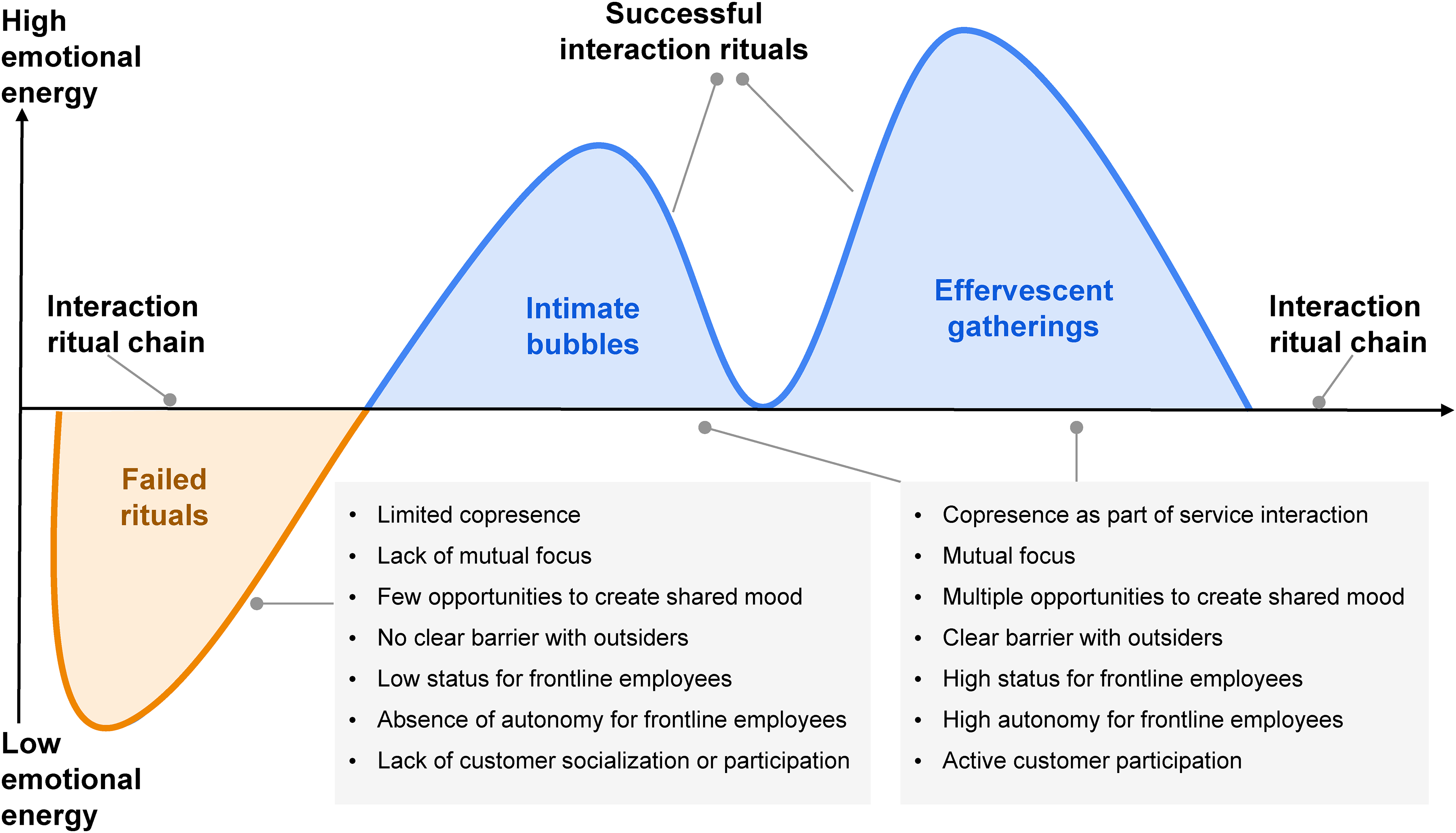
Emotional Energy of Service Interaction Rituals.
First, when frontline service employees experience interactions characterized by limited copresence, lack of mutual focus, few opportunities to create a shared mood, no clear barrier to outsiders, and low autonomy or status, they are likely to be drained of emotional energy. Second, the emotional energy of intimate bubbles comes from the neutralization of status asymmetries and the presence of autonomy in service interactions. Put more simply, it is because frontline employees and customers can interact on more equal footing that they manage to find common ground and to create rhythmic entrainment. Finally, effervescent gatherings generate high levels of emotional energy in frontline employees. Consider, for instance, research on outdoor guides (Riehle, Wieser, and Hemetsberger 2023), river rafting instructors (Arnould and Price 1993), and jazz musicians (Becker 1951). In these studies, we find strong evidence of emotional energy. Our study details how this energy is created and how it affects frontline employees. These findings contribute to marketing scholarship in two main ways: (1) by theorizing the emotional regeneration of frontline employees in customer interactions; and (2) by highlighting the distinctiveness of service as a power ritual, especially the roles played by autonomy and status.
Regenerative Potential of Customer Interactions
We contribute to research on service emotions (Chan and Wan 2012; Hennig-Thurau et al. 2006) by detailing how service interactions can revitalize service employees. Our findings extend previous work that portrays service workers’ interactions with the public as depleting their cognitive and emotional resources (Chan and Wan 2012; Hennig-Thurau et al. 2006). Instead, we provide a framework that explains how customer interactions can either reenergize service employees or drain them of emotional energy. As previously mentioned, a major limit of emotional regulation theory is that it cannot properly theorize the pleasures of interacting with customers. As Wouters (1989, p. 112) argues, “Hochschild's concentration on the costs of emotional labor distorted her empirical results.” In contrast, our theoretical framework recognizes both the potential for emotional labor (through the concept of forced ritual) and the possibility for emotional regeneration in service interactions.
In addition, we offer a more collective and embodied perspective on emotional contagion in service contexts. To begin with the collective dimension, our research shows how the emotional contagion produced by rhythmic entrainment creates intense emotions that go beyond simply the pleasant feeling of seeing a customer smile (Pugh 2001). On the physical side, our research demonstrates the importance of the body in carrying emotional energy, and of bodily synchronization in amplifying emotional energy. Although emotional contagion can occur through facial expressions (Hennig-Thurau et al. 2006), emotional contagion arising from rhythmic entrainment is more powerful and energizing for service employees.
These moments of intense physicality and the emotional energy they generate are a common but underresearched feature of servicescapes. Though not focusing on emotional energy, previous research describes the hustle and bustle of the vacation season as sending retail employees’ bodies into a frenzy of movement. During this time, employees feel more energized by their work despite the stress of serving customers (Bozkurt 2015). We can also see this phenomenon in the way fast-food employees invoke their love of intense moments where you “run everywhere” and “forget yourself” (Pinto, Cartron, and Burnod 2000, p. 150). Our research helps us better understand the power of these collective and embodied episodes of emotional contagion.
Finally, our findings on emotional energy shed new light on the ways in which service interactions are embedded in chains of interaction rituals. Service scholarship has begun to examine these connections between service interactions and the emotions they provoke. Recent research has shown that negative interactions can have spillover effects (Yue, Wang, and Groth 2022). We extend these findings by demonstrating the positive spillover effects of high-energy interactions. We also stress that these positive effects rest on a fragile equilibrium. Asymmetrical power dynamics can easily interrupt the flow of emotional energy.
Service as a Power Ritual
Our second contribution is to extend existing scholarship on emotional energy, which has up to this point focused on solidarity rituals (Hill, Canniford, and Eckhardt 2022; Krishnan et al. 2021). In contrast, we highlight service as a power ritual and emphasize two crucial dimensions: status and autonomy.
In terms of status, our research demonstrates that status elevation and status neutralization are important ways in which service employees gain emotional energy. Yet, many service contexts are structured around elevating the customer's status; indeed, we live in the “velvet rope economy” of VIP treatment and luxury service (Schwartz 2021). However, such status elevation produces a particular distribution of roles, wherein the customer is a powerful order giver and the frontline service employee is a more powerless order receiver. Research shows that this elevation of the sovereign customer comes at a cost: the emotional well-being of service employees (Bhatnagar et al. 2024).
A revealing finding from our research, however, is that elevating the status of service employees, or neutralizing, at least temporarily, the status of the sovereign customer, can energize service employees. Status elevation works by drawing customers’ attention toward service employees. Status neutralization functions by enabling participants in an interaction to break free from the roles of customer and provider, thereby facilitating rhythmic entrainment and emotional energy.
However, the precariousness of these status dynamics cannot be ignored. A disgruntled customer can quickly transform pleasant encounters into painful ones. Thus, we add boundary conditions to the regenerative power of temporary status changes (Hill and Bradley 2010). If the status positions of customers and frontline service workers can be temporarily modified, these status modifications can quickly disappear, to be replaced by the harsher realities of customer sovereignty.
We also show that a lack of perceived autonomy for service employees can transform interaction rituals into forced rituals. Forced rituals happen “when individuals are forced to put on a show of participating wholeheartedly in interaction rituals” (Collins 2004, p. 53). From this perspective, emotional labor becomes especially negative when frontline employees see it as being imposed on them, and when they feel no sense of agency over the expression of their own feelings. In contrast, when service employees feel more autonomous in carrying out their work, their interactions with customers are more likely to produce emotional energy.
Our insights into autonomy are consistent with studies describing the enchantment retail workers find in routine jobs through creativity (Endrissat, Islam, and Noppeney 2015), or the pleasures of craft practiced away from managerial surveillance (Ocejo 2017). In these studies, we see the importance of autonomy for making service interactions more appealing. We extend these studies in the current research, though, by demonstrating the crucial importance of perceived autonomy when it comes to energizing service employees.
Our findings on how frontline employees’ experiences of their own autonomy impact their emotional energy call for more attention to how frontline employees experience their autonomy in service contexts. As mentioned previously, marketing scholarship to date has tended to focus on empowerment rather than autonomy. However, empowerment is always constrained by managerial oversight and customer satisfaction. Empowerment means that employees have some discretionary power, but always with a customer-oriented goal: namely “to do whatever is necessary to satisfy [the customers]” (Bowen and Lawler 1995). Empowerment refers to the “sharing of power through the delegation of responsibility” (Spreitzer 2008, p. 55); that is, it always involves some form of control and monitoring by management.
However, when managers tightly control service interactions, these exchanges quickly become tedious emotional labor for employees. The burden of this emotional labor, in turn, forces service organizations to teach frontline employees emotion regulation skills and practices (Kidwell et al. 2011). To retain and motivate frontline employees, service organizations must instead create moments that provide then with more status and autonomy. As for marketing scholarship, the focus on empowerment prevents the field from fully understanding how service interactions can energize frontline employees, through encounters in which service employees have more agency and find opportunities to engage in the pleasures of emotional energy.
Managerial Recommendations
What can managers do to create more energized service employees? Our research points to two main avenues: (1) redesign service interactions for emotional energy, and (2) create breathing rituals (See Table 1). First, to cultivate energized service employees, managers should prioritize redesigning service interactions by promoting synchronization and mutual focus between employees and customers. Second, we introduce the notion of “breathing rituals”: interaction rituals that allow service employees to temporarily escape the power dynamics associated with serving others. By implementing these strategies, organizations can create a more energized environment that enhances employee experience.
Designing Service Interactions to Energize Service Employees.
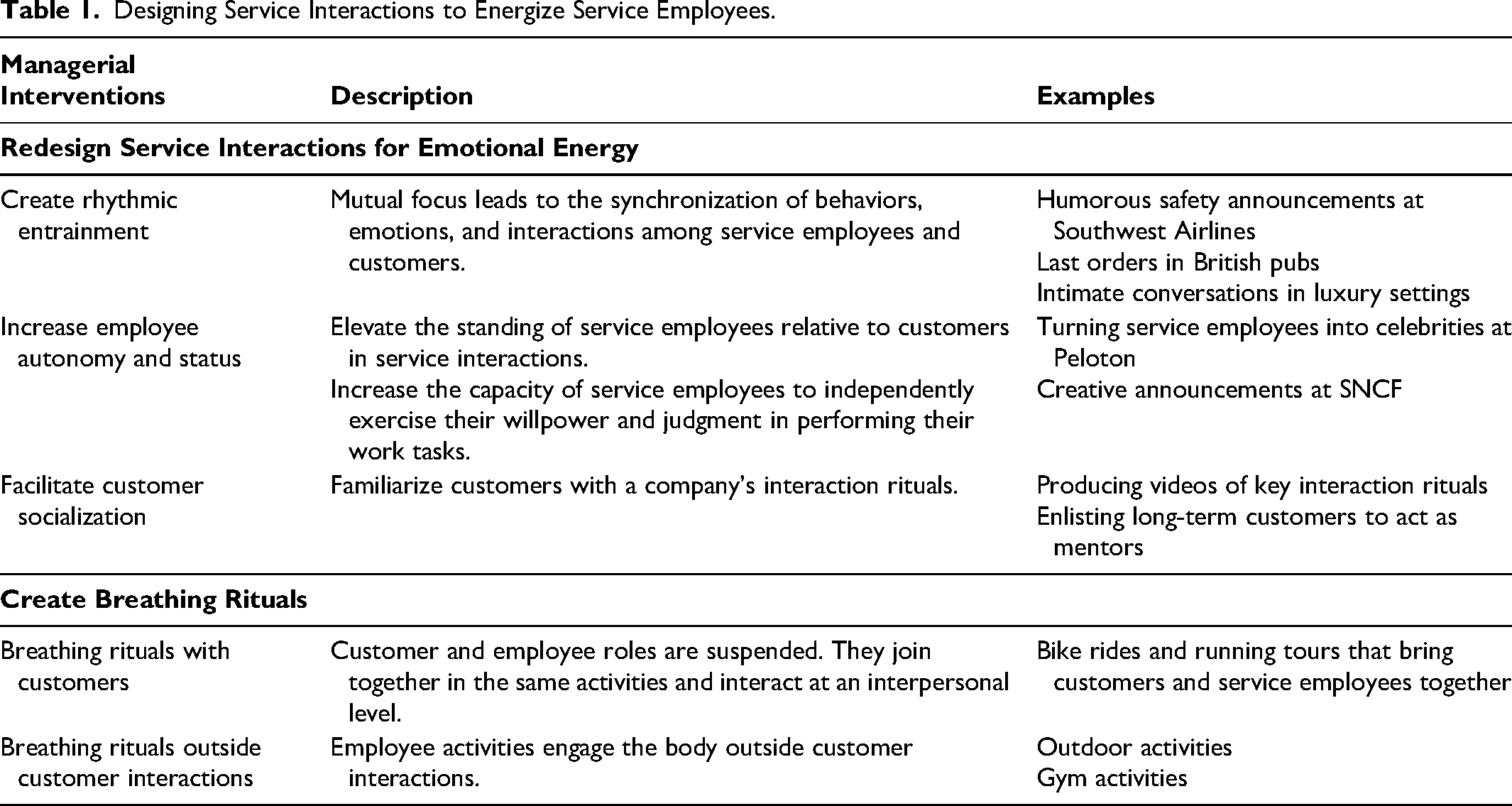
Redesign Service Interactions for Emotional Energy
Create rhythmic entrainment
Our research demonstrates the power of interaction rituals in which service employees and clients generate emotional energy through behavioral and emotional attunement, a process that Collins (2004) refers to as rhythmic entrainment. Our findings are consistent with research advising companies to create vibrant customer atmospheres by mobilizing consumers’ “focus and entrainment” (Hill, Canniford, and Eckhardt 2022, p. 127), but we emphasize how vibrant atmospheres, in particular, can energize service employees.
To energize service employees, organizations need to redesign service interactions to allow the development of a mutual focus and behavioral and emotional alignment. Consider, for instance, the famous safety announcements from Southwest Airlines. These humorous announcements by service workers foster a lighthearted atmosphere, yet this interaction ritual also becomes a moment of mutual focus for service employees and customers. Furthermore, it allows airline crews to move their bodies in a synchronous fashion, and through this synchronization—a clear instance of rhythmic entrainment—to converge toward the same lighthearted mood. The Southwest Airlines case also offers a good example of how it is possible to take an existing service interaction that does not normally generate emotional energy for service employees and turn it into one that increases employees’ emotional energy.
The call for “last orders” in British pubs is another example of powerful rhythmic entrainment. An employee initiates this ritual by ringing a bell and typically shouting “last orders” to signal to all customers that they must now place their order. In no time at all, everyone's attention is drawn to placing orders and the customers all flock to the bar. As the staff begin to serve the orders at the same intense pace, their body movements synchronize, creating a rhythmic entrainment that propels them along. The call for “last orders” illustrates how a well-designed service interaction can capture the mutual attention of a large crowd of customers and staff in a brief moment, resulting in rhythmic entrainment.
Rhythmic entrainment can also occur in more intimate gatherings. In the luxury sector, for instance, companies have developed spaces where customers and service employees can engage in intimate conversations (Welté, Cayla, and Fischer 2022). What is important in such contexts is to create the conditions for service employees and customers to find common ground. Finding this common ground is easier when service employees and customers share common experiences (Rivera 2015; Üstüner and Thompson 2012). A key insight from our research is that rhythmic entrainment does not solely happen in intensely physical interactions but also in more intimate settings.
Increase employee autonomy and status
As we have seen, status and autonomy are also important in the creation of emotional energy, and companies can do more to temporarily elevate the status of service employees and increase their autonomy. Consider Peloton, a brand that redefines home fitness through immersive workouts. In its quest to promote the utilization of its premium bikes, Peloton orchestrates live events that not only keep customers engaged with exhilarating workouts and pulsating music but also serve to elevate the status of its instructors. By actively nurturing its instructors’ social media presence, Peloton ensures that they emerge as influential figures with a substantial following. Peloton turns its instructors into energy stars.
Another example is SNCF, the French national railroad company. Since 2020, SNCF has let its employees greet passengers with creative announcements they broadcast over the train's audio system. Some employees crack jokes, while others replay the evening TV program or pretend to be politicians. One SNCF driver said he uses this opportunity to “spread positive energy” (Dubreuil 2022). While this interaction ritual does not have the physical synchronization of Club Med, it includes essential components of a successful interaction ritual, such as the creation of mutual focus (listening to employee jokes) and the synchronization that occurs when passengers respond with laughter.
Several videos with these SNCF announcements have reached millions of views on YouTube, showing how train employees can increase their status. During this ritual, they also experience a moment of autonomy and creativity, away from scripted interactions. Importantly, service organizations seeking to develop similar rituals need to apply a light touch, especially if the goal is to increase the autonomy of service employees. In the case of SNCF, rail employees have already expressed concerns that the company could make these humorous announcements mandatory. This would be a mistake on the part of management, as it is precisely the autonomy inherent in this ritual that gives it energy.
Facilitate customer socialization
Service companies must also develop better ways to onboard customers. In the case of Club Med, for example, although various videos showcasing rituals such as Crazy Signs circulate on social media, such videos are typically created by customers and are not part of the company's social media marketing strategy. The company could assume a more direct role in producing videos that feature key interaction rituals and provide explanations to customers before their stay. In addition, new customers could be introduced to these rituals by GOs, or loyal GMs, during the onboarding phase of their stay. Once managers recognize the significance of interaction ritual design for both customer experience and frontline employees, they will be able to leverage the power of emotional energy to create memorable experiences not only for customers but also for the service employees themselves.
Create Breathing Rituals
Breathing rituals with customers
The power dynamics of service interactions can be stifling. This is especially true in service contexts where the status of service workers, or their lack of autonomy, turns service interactions into emotionally depleting encounters. Receiving complaints in a call center (Taylor and Bain 1999) or serving entitled clients in a hotel (Sherman 2003) can quickly metamorphose service work into emotional labor. Occupations in which service workers have few opportunities for status leveling or autonomy are likely to be challenging and even suffocating.
Thus, we recommend the introduction of what we call “breathing rituals.” Breathing rituals are liminal moments in which power dynamics are relaxed. Breathing rituals suspend the roles of the client and employee, allowing relationships to become more interpersonal and equal. These are moments of autonomy and freedom for service employees, where employees are not order receivers but engage with customers on a more equal footing. Importantly, participation in breathing rituals must rely solely on employees’ intrinsic motivation and interest for the activity, without organizations resorting to extrinsic motivators such as rewards, incentives, or sanctions that would introduce a sense of obligation.
Some service organizations are already experimenting with breathing rituals. For example, a bicycle store near the home of one of the authors organizes weekly bike rides to which customers and service employees are invited, so they can experience the pleasure of going for a ride together. Similarly, a hotel in Prague organizes early morning runs twice a week. Guests and employees jog through the picturesque streets in Prague, led by one of the hotel's sports coaches. This early morning run is primarily for the hotel's guests, but employees are also invited to participate if they wish.
These interaction rituals act as a regenerative moment for service employees, as the power dynamics associated with serving are temporarily suspended. In such a setting, where participants are stripped of their service worker and customer roles and drawn to participate out of intrinsic interest, the development of common ground between service workers and clients is facilitated. By interacting with customers in this liminal context, service workers potentially find new sources of emotional energy.
Breathing rituals outside customer interactions
In addition to rituals in which customers and service employees can interact on an equal footing, service companies can also develop rituals for employees to breathe outside customer interactions. One study described how exercise classes can be effective in creating a sense of joy, pride, and meaning among employees (Lepisto 2022). In research on outdoor guiding, we see that management organizes fun activities such as high diving and sliding for their “socializing” and “energizing” effects (Riehle, Wieser, and Hemetsberger 2023, p. 13). By prioritizing and nurturing breathing rituals, companies can create dynamic and energizing environments, leading to an elevated experience for both employees and customers, powered by positive emotional energy.
Future Research
In this study, we developed a theory of emotional energy in service interactions. However, questions remain about how our model can be applied to the broad diversity of the service sector. Not all service environments are as collective and physical as the context we studied. In addition, service employees have varying levels of autonomy and status. For example, what about service professions such as lawyers or doctors, where collective interactions are limited, and employee status and autonomy are high? What types of interaction rituals could create rhythmic entrainment in these contexts? What would breathing rituals look like? How is emotional energy generated in banks and in public transportation? We need research on a broader range of service activities to examine the boundary conditions of our framework.
In addition, future research should investigate the reciprocal influence of emotional energy on customers and employees within servicescapes. Most previous studies have examined emotional energy from either the customer's (Hill, Canniford, and Eckhardt 2022) or employee's (Hill and Bradley 2010) perspective. However, there is a need to understand how joint interactions generate emotional energy for both parties. Future research could seek to better understand how different interaction rituals affect employees and customers differently.
Even more importantly, research must address the negative aspects of emotional energy. Emotional energy can cause employees in the service sector to work overtime and invest too much in their jobs. As the Club Med case demonstrates, there is also the thorny issue of deciding whether time spent with customers is necessarily “work time.” Especially in a context like Club Med, where employees spend extremely long hours with customers, the power of emotional energy raises several ethical issues. The question also arises concerning employees who are either unable or unwilling to participate in energizing interaction rituals. What happens to service workers who are unwilling to engage in the emotional energy game? Future research should explore the darker side of emotional energy in more detail.
Supplemental Material
sj-pdf-1-jmx-10.1177_00222429241260637 - Supplemental material for Emotional Energy: When Customer Interactions Energize Service Employees
Supplemental material, sj-pdf-1-jmx-10.1177_00222429241260637 for Emotional Energy: When Customer Interactions Energize Service Employees by Julien Cayla and Brigitte Auriacombe in Journal of Marketing
Footnotes
Acknowledgments
The authors would like to express their gratitude to Timothy Hill, Eileen Fischer, Jean Clarke, Linda Price, Dwayne Gremler, Per Skålén, Bernard Forgues, Chahrazad Abdallah, Rachel Kyne, and Kushagra Bhatnagar for their generous feedback on earlier drafts of this article. The authors would also like to thank the JM review team for their detailed and constructive feedback throughout the review process. Special thanks go to Joonas Rokka for contributing to an earlier iteration of this project. The authors also want to thank all the employees of Club Med who made this project possible. Their emotional energy continues to inspire the authors.
Coeditor
Cait Lamberton
Associate Editor
Amber Marie Epp
Declaration of Conflicting Interests
The author(s) declared no potential conflicts of interest with respect to the research, authorship, and/or publication of this article.
Funding
The author(s) disclosed receipt of the following financial support for the research, authorship, and/or publication of this article: This work was partly supported by a grant from Nanyang Technological University (grant number M4081807).
References
Supplementary Material
Please find the following supplemental material available below.
For Open Access articles published under a Creative Commons License, all supplemental material carries the same license as the article it is associated with.
For non-Open Access articles published, all supplemental material carries a non-exclusive license, and permission requests for re-use of supplemental material or any part of supplemental material shall be sent directly to the copyright owner as specified in the copyright notice associated with the article.
