



Abstract
This article analyzes the nature and temporal change of conceptual contributions in marketing scholarship with two complementary studies. First, based on a computer-aided text analysis of 5,922 articles published in the four major marketing journals between 1990 and 2021, the authors analyze how conceptual contributions have changed over time using the MacInnis (2011) framework. Results indicate that over the past three decades, theorizing efforts have strongly favored “envisioning” and “explicating” at the expense of “relating” and “debating,” with this imbalance increasing over time. Second, the authors draw on 48 in-depth interviews with editors, department heads, and authors to validate these patterns and uncover the underlying mechanisms. The findings indicate that a prevalent thought style has developed in the field—defined by the research ideals of novelty, clarity, and quantification—that shapes the collective view of how marketing scholars, in their roles as authors, reviewers, and mentors, can make a valuable contribution to marketing scholarship. This thought style favors envisioning and explicating contributions and disfavors relating and debating contributions. Jointly, the two studies point to several rebalancing options that can reinvigorate relating and debating contributions while preserving the current strengths of the marketing field.
Keywords
Theories are the bedrock of scientific progress. By systematizing relationships between concepts (Bagozzi 1984), theories enable two of science's major functions: explanation and prediction (Rudner 1966). Despite this importance, scholars have noted that research in marketing often fails to make meaningful theoretical advancements. This has been a long-standing challenge for the field (Jaworski 2011; Lehmann, McAlister, and Staelin 2011; Wells 1993; Yadav 2010; Zaltman 1997) that has recently been revived in the Journal of Marketing (Eisend 2015; MacInnis et al. 2020; Moorman et al. 2019a; Zeithaml et al. 2020). These latest analyses have examined the lack of theoretical advancements from various angles, including the fragmentation of knowledge (Eisend 2015), the lack of practical impact (Kohli and Haenlein 2021), the tendency for excessive complexity (Lehmann, McAlister, and Staelin 2011), and the missed opportunity for homegrown theories (Zeithaml et al. 2020). While helpful, these studies share limitations that may prevent them from fully diagnosing the problem.
First, a critical discussion of marketing theory typically occurs in editorials (e.g., Moorman et al. 2019a; Stewart and Zinkhan 2006) or conceptual articles (e.g., Jaworski 2011; MacInnis et al. 2020; Zeithaml et al. 2020), which limits the evidence offered to make this case. As for the few empirical articles (e.g., Yadav 2010), their insights draw on indirect measures, such as using the publication patterns of conceptual articles as a proxy for the evolution of theory engagement. Second, these studies tend to focus on the choices of individual actors, for example, by noting that marketing scholars often study topics of marginal importance or by arguing that reviewers put too much emphasis on methodological rigor (e.g., Kohli and Haenlein 2021; Lehmann, McAlister, and Staelin 2011; Zeithaml et al. 2020). While important, this view fails to recognize that knowledge emerges through collective discourse among scholars that is shaped by shared beliefs and norms (Feldman and Orlikowski 2011).
In our research, we address these issues and conduct two studies designed to provide more substantial evidence of changes to theory in marketing and a better understanding of the mechanisms underlying these changes. Study 1 traces how scholars have engaged with marketing theory over a 32-year period. To this end, we relied on a framework devised by MacInnis (2011) and analyzed four conceptual contributions marketing scholars can make with their research: envisioning, explicating, relating, and debating. To examine the prevalence of these contributions, we developed customized dictionaries and analyzed 5,922 articles published in the Journal of Marketing, the Journal of Marketing Research, the Journal of Consumer Research, and Marketing Science between 1990 and 2021. This analysis revealed distinct patterns reflecting a change in the type of conceptual advancements: over these 32 years, theorizing efforts have strongly favored envisioning and explicating at the expense of relating and debating, with this imbalance increasing over time.
Study 2 validates these patterns and links them to the social structures defining marketing scholarship. Drawing on the sociology of science (see Fleck 1979; Kuhn 1962), we postulated that marketing scholars’ beliefs of how knowledge should advance (i.e., the field's thought style) affect their decisions when producing, judging, and disseminating knowledge. To substantiate the presence of this thought style, we conducted 48 in-depth interviews with current or former editors of the four journals, the heads of the most productive marketing departments in the world, and the authors of relating and debating articles. These interviews indicate that the field follows a thought style characterized by three scholarly ideals—a quest for novelty, a quest for clarity, and a quest for quantification—that guide the decisions that marketing scholars make in their roles as authors, reviewers, and mentors.
Our research offers important implications for the marketing field. First, our documentation of the temporal development of marketing scholarship over a 32-year period indicates that the field does not suffer from an overall lack of theorizing efforts. Instead, our analysis suggests that the field has shifted toward certain types of contributions and that this shift has influenced the general development of marketing knowledge. Second, our findings reveal that the tendency to focus on some types of contributions over others affects citation impact. Those articles that typically spark the most citations (i.e., relating articles) are the ones that have experienced the steepest decline, suggesting that marketing scholars may be missing an opportunity to achieve higher impact with their work. Third, by placing these findings within the broader social structure of marketing scholarship, we link this imbalance to a deep-rooted and implicit thought style that shapes the field's view on what contributions to theory should ideally look like. Fourth, we derive several rebalancing options the field can employ to enhance future theory development. Our emphasis on the field's thought style complements existing studies discussing how the field needs to change to produce more relevant and timely knowledge (e.g., Lehmann, McAlister, and Staelin 2011; MacInnis et al. 2020; Yadav 2010; Zeithaml et al. 2020).
Theory Development and Conceptual Contributions
Theories can be defined as “systematically related sets of statements, including some law-like generalizations, that are empirically testable” (Hunt 1983, p. 10). An evolutionary view of theory development holds that theories evolve through social discourse among scholars, within and across scientific fields (Bergkvist and Eisend 2021; MacInnis 2011). Through creating and testing theories, scholars gradually build new knowledge. Put differently, “scientific progress proceeds through an iterative process with conceptual ideas spurring empirical observation, which in turn give rise to more conceptual ideas” (MacInnis 2004, p. 1).
Crucial to the evolutionary view of theory development is the notion of conceptual thinking, defined as “the process of understanding a situation or problem abstractly by identifying patterns or connections and key underlying properties” (MacInnis 2011, p. 140). Simply put, conceptual thinking allows scholars to generate new knowledge. In the marketing domain, MacInnis (2011) proposed an influential framework that discusses the role of conceptualization and identifies four different types of contributions (see Table 1). These types differ not only in terms of their conceptual goals, but also in terms of the skills required for crafting them.
Types of Contributions and Their Defining Characteristics (Adapted from MacInnis 2011).
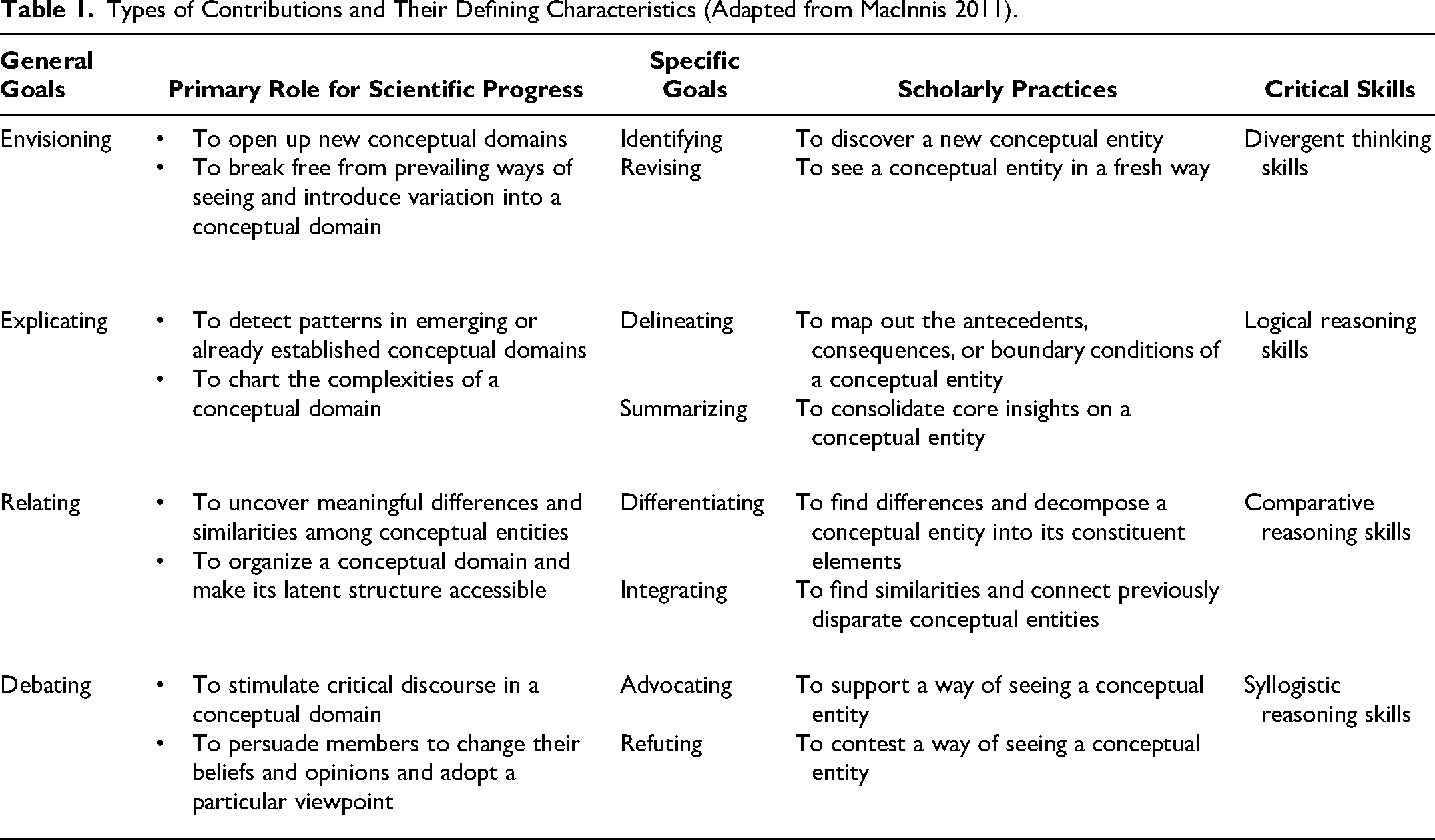
Envisioning contributions open up new theoretical domains, either (1) by identifying a new conceptual entity (e.g., a new concept, proposition, or theory) or (2) by revising an existing one. Identifying reveals the previously unseen, unknown, or unobservable and directs attention to overlooked but important conceptual entities. Revising, in contrast, provides alternatives to existing beliefs and enables the field to rethink established conceptual entities and their taken-for-granted assumptions. Fueled by divergent reasoning (i.e., a creative, free-flowing, and nonlinear thought process), envisioning helps members break free from prevailing ways of seeing and conceive of reality in a fresh way (MacInnis 2011).
Explicating contributions detect patterns in emerging or established conceptual domains, either (1) by delineating different facets of an entity or (2) by summarizing empirical regularities. Delineating maps out the nature of a conceptual entity by shedding light on its antecedents, consequences, or boundary conditions. Thus, it helps scope and potentially expand a conceptual domain. Summarizing, in turn, takes stock of what is already known and distills empirical regularities, thereby helping consolidate a conceptual domain. Both forms of explicating rely on logical reasoning skills, that is, the “ability to relate what is known in a linear, rational, internally consistent, and compelling manner” (MacInnis 2011, p. 148).
Relating contributions offer a comparative perspective on a domain, either (1) by differentiating one or more conceptual entities or (2) by integrating a conceptual entity into a broader body of knowledge. Differentiating decomposes a conceptual entity into its constituent elements and highlights differences among elements that were previously considered similar. Integrating, in turn, connects conceptual entities so far seen as different by identifying similarities and links with the aim of forming a new whole. Thus, relating plays a vital role in organizing a conceptual domain and making its latent structure accessible to members of a field (MacInnis 2011). To achieve these ends, relating relies on comparative reasoning skills to uncover meaningful differences and similarities among conceptual entities.
Debating contributions stimulate critical discourse, either (1) by advocating a specific viewpoint or (2) by refuting such a viewpoint. Advocating builds confidence in a particular stance on a conceptual controversy by providing supporting arguments and evidence. Refuting, in contrast, undermines such confidence by challenging supporting arguments and presenting counterarguments. As both advocating and refuting aim to persuade readers to adopt a particular viewpoint, debating contributions are normative in nature (MacInnis 2011). Debating requires syllogistic reasoning skills, that is, a form of deductive reasoning in which a conclusion is inferred based on two or more premises that are believed to be true (Halpern 2013).
Interplay and Balance Among Contribution Types
Although the four types pursue different goals, they are also interrelated at different levels of analysis. First, at the level of the individual article, scholars typically aim to make a specific contribution through their work: Some articles introduce new conceptual entities (envisioning), whereas others seek to deepen (explicating), organize (relating), or challenge (debating) existing knowledge. That said, any single article usually contains all four types of contributions, albeit to different extents. Thus, articles can be described through a unique contribution profile, that is, through their specific combinations and proportions of contribution types. To signal that profile to their readers, scholars will use corresponding language (see, for example, some of the terms used to illustrate the different goals in Table 1).
Second, at the level of a conceptual domain, the four types affect each other as knowledge gradually progresses. MacInnis (2011) discusses an evolutionary perspective, arguing that these types of “contributions reflect the evolution of conceptual ideas … from their early identification to more complete perspectives on them. [They thus] capture the development of knowledge and ultimately reflect the engine of scientific progress” (p. 152). From this perspective, envisioning contributions introduce new ideas to the field, followed by efforts to delineate these ideas (explicating) and integrate them into the current body of knowledge (relating). Finally, contributions that question apparently agreed-on ideas (debating) may stimulate a new evolutionary cycle.
At the same time, other sequences of the four contribution types are also possible. For instance, a dialectic perspective emphasizes the importance of contradiction and conflict (Putnam, Fairhurst, and Banghart 2016). Using this perspective, debating rather than envisioning may initiate knowledge development processes. Debating may help crystallize opposing viewpoints, thereby triggering subsequent envisioning, explicating, or relating efforts to reconcile the opposing views in a synthesis. In a related vein, a life cycle perspective holds that domains develop along the stages of emergence, conceptualization, competition, and consensus (Bergkvist and Eisend 2021; Van De Ven and Poole 1995). Multiple contribution types can shape each development stage, with relating and envisioning adding to debating contributions in the final stage of consensus building.
Regardless of any particular sequence, each contribution type plays a vital role in knowledge development. Hence, to make substantial conceptual advances, academic fields need to balance the four contributions. As MacInnis (2011, p. 152) argues, “to the extent that our field emphasizes one type of thinking over another, knowledge in the field may be stunted,” making “attentiveness to the underrepresentation of certain types of conceptualizations and their bases … important.” Yadav (2014) succinctly summarizes that “in a dynamic, social science discipline such as marketing, ‘envisioning’ and ‘debating’ articles can play a very important role in reinvigorating knowledge development” (p. 4). While more additive contribution types, such as explicating, fulfill essential roles, marketing scholars have recently suggested that the field's apparent overreliance on those types might be detrimental to the relevance of the generated insights (Kohli and Haenlein 2021; MacInnis et al. 2020; Zeithaml et al. 2020).
Thought Collectives and Thought Styles
We adopt a sociology of science perspective to understand why certain types of contributions are valued more than others in a scientific field. The work of Fleck (1979, first published in 1935), which both preceded and, in some ways, generalized the more popular work of Kuhn (Kuhn 1976; Mößner 2011), is particularly instructive for our purposes. According to Fleck, how scholars perceive, think, and act in science is deeply influenced by the thought collectives they are part of and the associated thought styles they have adopted (Fleck 1979).
A thought collective is a “community of persons mutually exchanging ideas or maintaining intellectual interaction” (Fleck 1979, p. 39). Thought collectives are ubiquitous in science, art, business, politics, and other areas of social life (Sady 2021). As thought collectives mature, they develop structures, supporting institutions, and shared convictions.
More developed collectives contain a smaller inner circle of specialists (i.e., the esoteric circle) and a larger outer circle of general experts and interested laypersons (i.e., the exoteric circle) (Fleck 1979). In fields like marketing, the inner circle is composed of researchers who advance scholarship in their roles as authors, reviewers, and mentors. The outer circle may include practitioners, consumer advocates, and other individuals interested in marketing science but not directly contributing. Each circle relies on the other, with the inner circle advancing specialist knowledge and the outer circle providing validation and inspiration. Typically, scholars belong to more than one thought collective and are part of the inner circle of their scientific collective and of the inner or outer circles of other collectives (Sady 2021).
As thought collectives mature, they develop thought styles. A thought style is a set of convictions, often taken for granted, that members share within a collective (Schnelle 1981). These ideals pertain to “the common features in the problems of interest to a thought collective, the judgment which a thought collective considers evident, and by the methods which it applies as a means of cognition” (Fleck 1979, p. 99). A thought style shapes the conceptual, methodological, and linguistic qualities considered acceptable for scientific investigation within a collective and the type of ideas worthy of examination (Fleck 1979). Put differently, a thought style may define what is studied in a thought collective, how it is studied, and how it is validated, evaluated, and communicated (Mößner 2011).
A thought style's guiding capacity will materialize across the different roles that scholars have in the collective. A thought style shapes how scholars select research problems and methods in their role as authors, how they evaluate the work of others in their role as reviewers, and how they guide the development of new scholars in their role as mentors. In the latter function, a thought style is “transmitted from one generation to another, by initiation, training, education or other devices whose aim is introduction into the collective” (Fleck 1986, p. 99).
While useful as a means to make sense of a field, a thought style also constrains members’ intellectual openness and may lead them to discount or even ignore problems, methods, and findings deemed inconsistent with the thought style. In this process, the idea is shaped such that it conforms with the thought style, removing many of the original idiosyncrasies (Mößner 2011). Fleck (1979, p. 64) considers the thought style “a definite constraint on thought, and even more; it is the entirety of intellectual preparedness or readiness for one particular way of seeing and acting and no other.” In a recent analysis of consumer research, MacInnis et al. (2020, p. 2) comes to a somewhat similar conclusion, noting that the “implicit boundaries regarding our choices about engaging in consumer research, while well-entrenched and familiar, blind us to new ways of contributing to knowledge.”
When examined through the lens of Fleck, the socially contingent nature of conceptual contributions becomes apparent. What is considered a valuable contribution is likely to depend on the prevalent thought style of a field. Hence, if one is to identify the mechanisms that shape the development of different contribution types in marketing scholarship, the field's thought style needs to take center stage. In Study 1, we use a text analysis of published articles to identify the patterns of contributions in the field of marketing, as described in the MacInnis (2011) framework. In Study 2, we validate these patterns and link them to features of the marketing field's thought style through a set of in-depth interviews with thought leaders in the field.
Study 1: Temporal Patterns in Conceptual Contributions
The aim of Study 1 was to trace the development of conceptual contributions in the marketing field through computer-aided text analysis. To do so, we defined a set of words that would indicate an article's conceptual contribution. Although the language used for describing conceptual domains might change (Kuhn 1987, 1991), we argue that the operators that researchers use for describing how they contribute are likely to remain stable. For instance, introducing a novel concept, delineating a novel relationship, or differentiating two conceptual domains are all ways of contributing that stay unaffected by possible changes in the lexicon of specific theories. Thus, our approach consists of defining dictionaries with time-unspecific operators uniquely associated with different contribution types.
Sample
We began by compiling a data set of articles from the Journal of Marketing, the Journal of Marketing Research, the Journal of Consumer Research, and Marketing Science between 1990 and 2021. We used the EBSCO Business Source Premier database to download the PDF files of those articles categorized as “Article” or as “Review” (i.e., review articles and surveys of previous publications), excluding other categories such as “Book Review,” “Biographical Item,” “Software Review,” “Editorial Material,” “Notes,” and “Letters.” This procedure led to a data set of 5,922 articles comprising 57,374,094 words of text (see Table 2). We used optical character recognition software to convert the PDF documents into text format. Reference lists were deleted from each article, as these would introduce unnecessary noise.
Distribution of Articles in Sample.

Algorithm and Dictionary Development
We employed a rigorous five-step process to develop and validate our algorithm and the associated dictionaries used for the computer-aided analysis of the 5,922 articles.
Step 1: Definition of target words
We defined a set of “target words” specified as terms denoting theory and elements of it. To do this, we reviewed previous literature on the constitutive elements of theories (Dubin 1978; Van de Ven 2007; Whetten 1989), including words such as “concept,” “hypothesis,” and “proposition.” We used this initial word list to find synonyms and semantically related words, drawing on the online database of WordNet (Fellbaum 2005; “WordNet Search - 3.1” n.d.). This led to the addition of words such as “prediction” and “explanation.” In total, this procedure yielded a set of 28 words, including “theory” (see Appendix A for a complete list).
Step 2: Definition of verbs
A search algorithm then scanned the 5,922 articles of our data set for these target words. Whenever the algorithm detected a target word in the text, it recorded every verb used in a three-sentence window, including the sentence containing the target word as well as the preceding and succeeding sentences. In this manner, we created a list of verbs that indicate which concrete operators marketing scholars use when engaging with theory in their work. Put differently, these verbs reflect what scholars do when referring to theory. Verbs that appeared outside of these three-sentence frames were not considered, thus reducing the risk of recording verbs that are not used in conjunction with theory. After manual identification and removal of duplicates and erroneously included words, the preliminary list consisted of 1,302 verbs. The first author manually evaluated each of these verbs according to two criteria to ascertain whether they were relevant operators for our context. First, the verb needed to reflect an operator that was predominantly used in relation to theoretical entities. Second, the verb could be assigned unambiguously to one of the four contribution types. This process led to a list of 67 infinitives, distributed relatively equally across the four types.
Step 3: Validation of verbs
To validate the dictionaries and the categorizations, we implemented two tests. First, the other three authors independently assigned a contribution type to each of the 67 verbs. As measures of interrater reliability, we calculated Cohen/Conger's kappa and Fleiss’ kappa. This process yielded values of .88 in both cases, indicating highly similar assessments among the four raters. The team of authors discussed the seven cases in which the ratings diverged. For five verbs, differences in categorization could be resolved; two verbs were eliminated. This led to a list of 65 verbs categorized into four dictionaries, one per contribution type (see Appendix B).
Second, we recruited 27 marketing professors to assess the degree to which they agreed with our categorization. Each professor had published at least one article in one of the four journals (average: 3.4 articles). Participants were presented with the categorization of each verb and asked to indicate their agreement with this categorization on a five-point Likert scale (1 = “Do not agree at all,” and 5 = “Do fully agree”). On average, the level of agreement for all verbs ranged between 3.93 and 4.96, indicating high agreement with the categorization of verbs.
Step 4: Word counts
We lemmatized each verb and added its noun form, if applicable. Based on this list, we ran a search algorithm across the data set of 5,922 articles. Similar to the exploratory procedure in Step 2, the algorithm scanned the texts for the target words (e.g., concept, theory, explanation). Once the algorithm detected a target word, it counted the number of words per contribution category from our list of verbs (and nouns) in a three-sentence window. To reduce the risk of false positives (e.g., the noun “differentiation” might be frequently used in an article on brand differentiation without denoting a relating contribution), we additionally analyzed the title and keywords of the articles. If any of the words of our list was present in the title or the keywords, this specific word was not counted in the article.
For each article, the algorithm noted the number of words corresponding to each of the contribution types. This procedure assumed that all articles make an envisioning, explicating, relating, and debating contribution, albeit to different degrees, and that each article can be described by a specific profile that delineates the extent to which it focuses on a particular contribution. To account for the articles’ length, for each article, we divided the number of words corresponding to each contribution type by the total number of words in the article. For better readability, we then multiplied these values by 1,000. As we are interested in temporal changes within the profiles, we calculated relative values for each contribution type. First, we summed the absolute word counts across all contribution types to obtain the overall number of contribution words included in the article. Second, we divided each contribution type's word count by this overall number to generate type-specific proportions that characterize each article's contribution profile. These relative values provided a basis for the subsequent analyses.
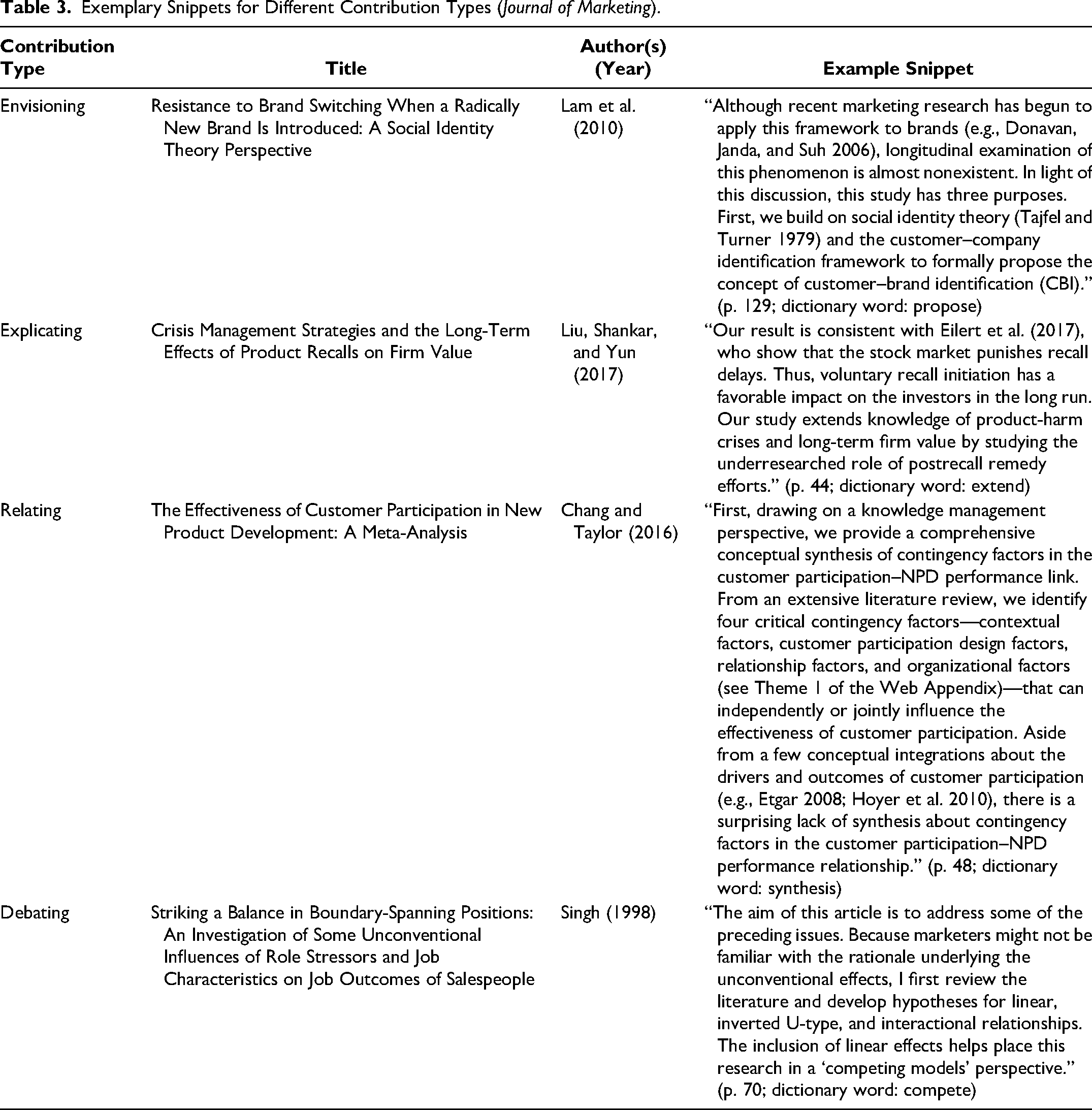
For purposes of illustration, Table 3 presents exemplary articles from the Journal of Marketing that are particularly strong on each contribution as well as exemplary snippets of the three-sentence windows (Web Appendix A offers more details, including examples from the other three journals). In addition, Table 4 shows how we used our algorithm's results to identify exemplary articles for each contribution type across three popular research domains: customer orientation, brand extensions, and brand relationships.
Exemplary Snippets for Different Contribution Types (Journal of Marketing).
Exemplary Articles per Contribution Type Across Different Research Domains.
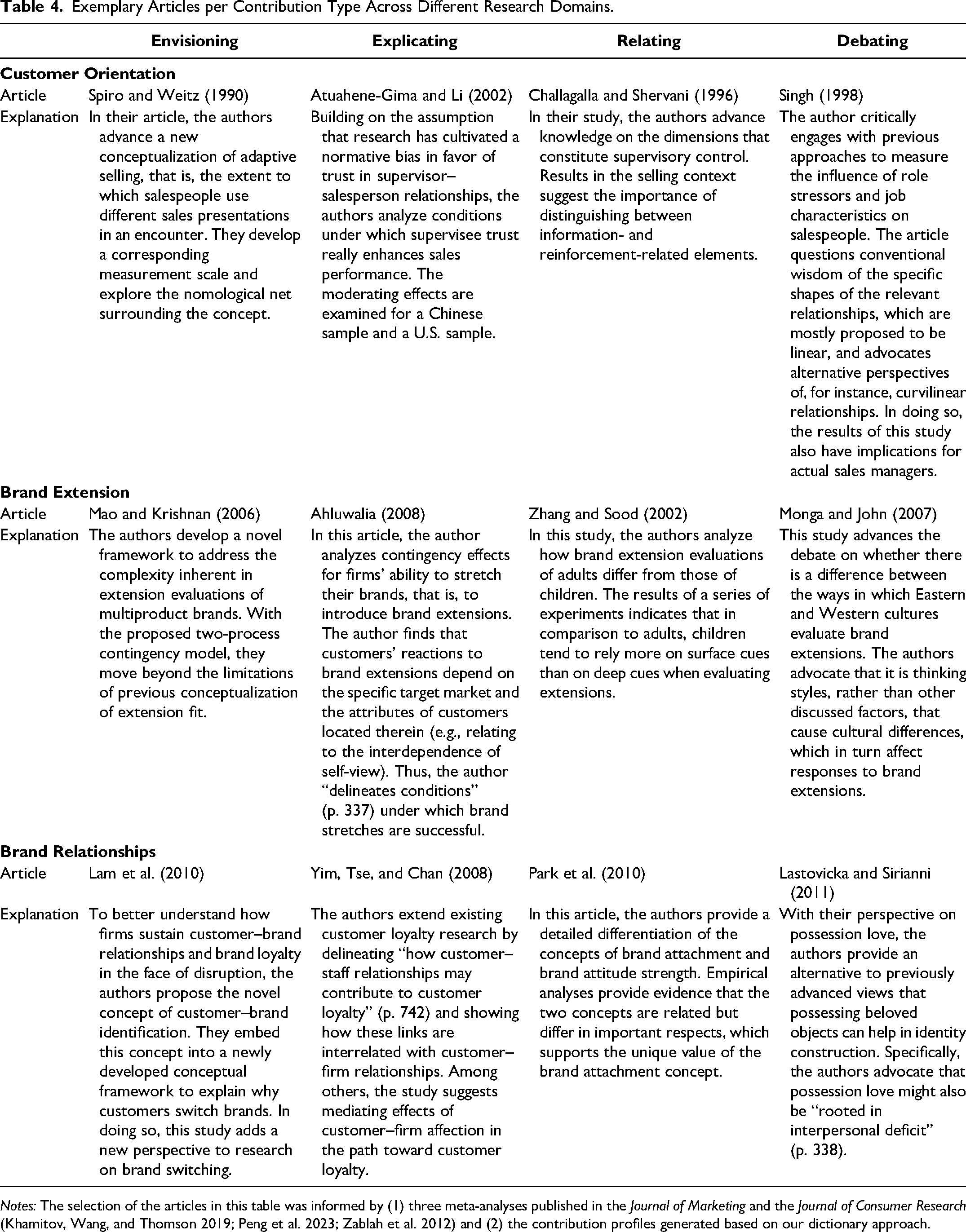
Notes: The selection of the articles in this table was informed by (1) three meta-analyses published in the Journal of Marketing and the Journal of Consumer Research (Khamitov, Wang, and Thomson 2019; Peng et al. 2023; Zablah et al. 2012) and (2) the contribution profiles generated based on our dictionary approach.
Step 5: Validation process
To validate the performance of the algorithm and the dictionaries, we followed a two-step process. First, we manually coded 600 randomly selected articles based on the articles’ entire text corpus. Corresponding to more than 10% of our overall sample (n = 5,922), this subsample scope is in line with recommendations in the literature (Humphreys and Wang 2018). The coding was conducted by two of the authors, who examined each article individually and, based on this assessment, assigned the two strongest contribution types to the article. As the vast majority of the articles emphasize one or two contribution types, assigning the third and fourth strongest type would not have been useful.
Second, we randomly selected 60 of these 600 articles and manually coded each of the 2,481 snippets the algorithm had identified. Specifically, two of the authors rated the extent to which the detected dictionary word in each of the snippets was used as intended (i.e., describing a conceptual contribution) on a five-point Likert scale (1 = “Weak fit to intended use,” and 5 = “Strong fit to intended use”). After excluding snippets that received a low rating on this scale, we ascertained the two strongest contributions for each article based on the sums of valid snippets.
Given that human coding is considered the gold standard in text analysis (Grimmer and Stewart 2013), we used the two forms of human coding as a benchmark. That is, we compared these codings to the algorithm's results, with the two strongest contribution types corresponding to the two types with the highest relative values. We calculated precision, recall, and F1 scores as performance indicators for each contribution type (e.g., Ebrahimi, Nunamaker, and Chen 2020). We did not account for specific sequences, that is, whether contribution type A or B showed higher values, as the differences between the first and the second strongest contribution type were often marginal. Table 5 (Columns 1 and 2) shows a comparison between the two forms of human coding and our algorithm. Given scores generated in comparable studies (Ebrahimi, Nunamaker, and Chen 2020; Velichety, Ram, and Bockstedt 2019), the indicators show high performance, with all mean values above 80%.
Algorithm Performance Indicators (Mean Values).

To examine how our dictionary-based approach performed compared with a machine-learning approach, we relied on the subset of 600 articles and implemented a classifier. We used a naive Bayes classifier, a classifier that has gained popularity due to its simplicity and performance in natural language contexts (Ko 2017). To train the classifier, we used 70% of the 600 articles and, based on this training set, predicted the two strongest contribution types for the remaining 30%. We created six different classification models, including models that relied on the articles’ full texts and abstracts, and included unchanged words or words in lemmatized or stemmed forms. 1 Next, we compared the results of the various classification specifications with the benchmark values derived from the manual coding of the 600 articles. The results in Table 4 (Column 3) list the highest average performance measures. Given these values, we conclude that none of the classification specifications led to a better performance than our algorithm.
Analysis Plan
To examine the development of marketing scholarship over the 32 years from 1990 to 2021, our analysis followed three steps. First, we wanted to understand how prevalent each of the four contribution types are and how their relative proportions developed over time. Second, to comprehend how each of the types affects knowledge development in marketing, we analyzed each type's citation impact. Third, we conducted a number of robustness checks to ascertain that our results are not contingent on the specific words contained in the dictionaries.
Results
Prevalence and development of conceptual contributions
To examine the prevalence of each contribution, we compared the absolute levels of the different types. Across the entire period (i.e., 1990 to 2021), explicating exhibited the highest absolute level (M = 1.975, SD = 1.373), followed by envisioning (M = 1.369, SD = 1.078). The absolute levels of relating (M = 1.202, SD = 1.152) and debating (M = .421, SD = .671) were considerably lower. A series of paired Wilcoxon signed rank sum tests revealed that the differences between all means were statistically significant (p < .001). This finding, however, is not unexpected (see Kuhn 1962). It stands to reason that more effort is devoted to describing and delineating a new concept than to integrating or questioning it.
To analyze the development of contributions over time, we focused on the relative levels of the different types. That is, to document conceptual shifts in marketing scholarship, we needed to examine whether the field's focus on specific contributions relative to, and possibly at the expense of, other contributions has changed over the 32-year period. The absolute levels, however, may tell us little about such overarching shifts since changes in absolute levels may simply reflect more general shifts in how marketing scholars engage with theory (for example, when the words used to describe conceptual contributions increase or decrease jointly for all types).
Figure 1 exhibits the mean value of each contribution type's proportion within the relative contribution profile per year. As this figure shows, envisioning and explicating have become increasingly prevalent within the overall contribution profile of articles. These temporal patterns were supported by additional regression analyses indicating significant and positive time trends for envisioning (b = .0018; p < .001) and explicating (b = .0021; p < .001). With average proportions of 30.94% and 43.72% in 2021 (vs. 23.55% and 39.25% in 1990), envisioning and explicating, respectively, have become the dominant contribution types in marketing articles. In contrast, we detected a decline in relating and debating contributions within the contribution profiles of articles. This decline was more pronounced for relating (b = −.0028; p < .001) than for debating (b = −.0011; p < .001). These two types also represented recessive contributions: in 2021, the average proportions of relating and debating contributions were 19.06% and 6.28%, respectively (vs. 28.18% and 9.02% in 1990).

Temporal Patterns Within Articles’ Contribution Profiles Between 1990 and 2021.
The preceding results point to an increasing imbalance in marketing scholarship that is fueled by a growing focus on envisioning and explicating. To substantiate this conclusion, we conducted two supplementary analyses. First, we examined whether articles, instead of engaging in broader conceptual discussions, exhibit an increasing focus on specific contributions. To this end, we calculated a Herfindahl–Hirschman index for all articles based on their relative contribution proportions. Regressing this index on a time variable revealed a positive coefficient (b = .0006; p < .001), suggesting that contribution profiles become more concentrated over time.
Second, we analyzed whether the decline of relating and debating is associated with a corresponding rise in envisioning and explicating. To this end, we calculated two regression models whereby we regressed the absolute levels of relating (debating) on the absolute levels of the other contribution types, a time variable, and their respective interaction terms. (Note that we had to rely on the absolute levels for these analyses since the relative levels are dependent on each other.) For relating, we find a negative and significant interaction term of the time variable and explicating (b = −.003; p < .05), indicating that the co-occurrence of relating and explicating declines over time. For debating, we find negative interaction terms of the time variable for both envisioning (b = −.004; p < .001) and explicating (b = −.002; p < .01). These findings suggest that the co-occurrence of debating and both envisioning and explicating declines over time (see Web Appendix B for full results). Overall, both supplementary analyses provide support for the notion that marketing scholarship is becoming increasingly imbalanced.
Impact analysis
To assess the implications of the identified temporal patterns, we examined each contribution type's association with the number of received citations. Again, we relied on the relative levels of the four contribution types. As elaborated previously, we assumed that all articles feature all four contributions, albeit to different extents, and were interested in examining how the focus on one contribution type relative to the other types affect an article's citation impact (note, however, that we controlled for the absolute levels). We retrieved each article's citation count from the Web of Science and used the total citation count as a dependent variable. We employed a negative binomial regression model to analyze the association with the four contribution types. A significant test for the dispersion parameter supported this choice relative to a Poisson model. Since total citation counts are highly dependent on article age, we included the publication year as an exposure variable.
In addition, we controlled for the following variables. First, we included the absolute number of words associated with each contribution type to ascertain whether these types exhibit a relationship with citation count beyond their relative weights within the contribution profiles. Second, we added the number of authors to account for changes in the size of author teams. Third, the variable article type (regular article vs. review article) controlled for potential changes in the number of published review articles. Fourth, we accounted for the articles’ length. Fifth, we considered journal dummies to control for journal-specific effects. Finally, we included the publication year as a dummy variable to control for potential year-based effects. For better interpretability, we standardized all continuous independent variables.
For the analysis, we used the incidence rate ratio (IRR), a relative difference measure that compares the incidence rates of specific events (in our context, the citation impact for different contribution types) (UCLA Statistical Consulting Group 2021). Debating contributions were defined as the reference category. Thus, the calculated IRRs need to be interpreted as indicating citation rates in comparison to debating contributions. An IRR above 1 indicates an increase in the citation rate, whereas an IRR below 1 indicates a decrease. Among the four contribution types, relating contributions were most strongly associated with increases in citation rates (IRR = 1.221; p = .001). That is, if an article increases its relating contribution by one standard deviation, its citation rate will increase by a factor of 1.221. This finding is particularly interesting since relating contributions exhibited the strongest decline within the overall contribution profiles of articles (see Table 6 for the full results).
Impact of Contribution Types on Citations.

Notes: n = 5,883; Wald χ2(43) = 4,305.33, p < .000. Debating, review articles, and Marketing Science were used as reference categories. Publication year was used as an exposure variable. We report robust standard errors.
In a follow-up analysis, we examined whether the scope of an article's contribution profile (i.e., the extent to which an article focuses on a single contribution vs. multiple contributions) is related to its citation impact. To this end, we again used the Herfindahl–Hirschman indices as a measure of conceptual concentration for each article. This analysis showed a negative impact for conceptual concentration (IRR = .471; p = .001). That is, the more an article focuses on one particular type of contribution (at the expense of other types), the lower its citation impact. Hence, articles that engage in broader conceptual discussions of their ideas and findings tend to be cited more often. These findings are also noteworthy as our temporal patterns indicate that, overall, the field is moving toward greater conceptual concentration, with envisioning and explicating contributions increasingly crowding out relating and debating efforts (see Web Appendix C for a complete reporting of this analysis and further impact analyses).
Robustness checks
To ensure that our findings are not contingent on specific words, we conducted several checks. First, we reran the analyses 65 times, with one verb (and the noun form) excluded from our dictionary in each run. We calculated the contribution profile for every article across these 65 replications and subtracted this value from the respective value of our full model. As the additional runs include fewer words than the full model (64 instead of 65), fewer hits were found in the texts. However, the differences between the full model and the reduced models did not differ between the contribution types (F(3, 2,883,528) = 1.00, p = .394).
We then analyzed whether the individual words differed in their effect on the relative contribution type measure. These analyses showed that certain words exert a stronger effect on the articles’ contribution profiles than others, likely reflecting differences in linguistic frequencies. However, we replicated all the time trends for all contribution types, irrespective of whether individual words were included or not (see Web Appendix D for a full reporting of these analyses and additional robustness checks).
Discussion of Study 1
Study 1 revealed distinct temporal patterns for different contributions in marketing scholarship across a sample of 5,922 articles spanning 32 years. Over time, envisioning and explicating contributions take increasing prevalence within articles’ contribution profiles. These increases come at the cost of declining emphases on relating and debating. However, although relating contributions have declined substantially, they have the highest impact on citations, indicating their essential role in knowledge development. This trend points to a theory production mechanism in which scholars neither sufficiently compare new conceptual ideas to the existing state of knowledge (i.e., relating) nor judge their potential usefulness (i.e., debating).
These findings are important for at least two reasons. First, they shine a new light on previous analyses of the development of marketing scholarship. For instance, Eisend (2015) pointed to a potential fragmentation of the field, as evidenced by decreasing effect sizes over time. Arguably, this fragmentation can be attributed to a lack of relating and debating contributions that typically facilitate a focus on bigger, unifying themes rather than idiosyncratic findings that may not withstand the test of time. Our results may also speak to the oft noted lack of relevance of marketing research for the managerial sphere (Jedidi et al. 2021; Kohli and Haenlein 2021; Stremersch, Winer, and Camacho 2021). Practical marketing problems are often complex, multifaceted, and fuzzy. Successfully addressing such problems requires the skill to assess the relative merit of different viewpoints and/or integrate them, activities that are typical of relating and debating. In sum, many of the frequently discussed challenges of the field may relate to the kinds of contributions it does or does not pursue.
Second, the results of Study 1 point to the larger social structures that drive the development of contributions. New conceptual entities do not emerge in a vacuum but evolve through the continuous circulation of ideas among marketing scholars. The temporal patterns may represent tangible manifestations of this process and can inform our understanding of the implicit thought style that has produced these patterns (Fleck 1979). By documenting what the field has chosen to study across 32 years, we provide a starting point for understanding what the field considers a worthwhile contribution.
Study 2: Underlying Mechanisms Within the Marketing Thought Collective
Approach, Data, and Analysis
In Study 2, we aimed to validate the patterns revealed in Study 1 and understand the processes and mechanisms underlying these patterns. Given this twofold objective, members of the inner circle of the marketing thought collective are well positioned to serve as key informants. We employed theoretical sampling to recruit scholars who could provide valuable but diverse insights into the field's thought style and its influence on the development of conceptual contributions. We ended the sampling when theoretical saturation was reached, that is, when every further interview provided limited additional insights.
First, we interviewed 22 authors who, according to our analysis, had published articles that were strong in relating or debating (hereafter referred to as “authors”). Scholars who are strong in crafting these contribution types may provide valuable insights as to why these types have declined. Second, we interviewed 15 current and former editors and coeditors of the four journals (hereafter referred to as “editors”). Editors are key gatekeepers in knowledge production, as they define and implement a journal's aims, including overseeing the review process. Third, we interviewed the heads of 11 of the globally most productive marketing departments, according to the University of Texas at Dallas ranking (hereinafter referred to as “heads”), as these scholars can opine on the structural mechanisms encouraging or discouraging specific contribution types (see Web Appendices E–G for more details on our sampling procedure).
In total, we undertook 48 interviews (see Web Appendix F). All interviews were conducted by the second author between April 2022 and March 2023. On average, interviews lasted 40 minutes, yielding 433 pages of single-spaced transcripts. The interviews followed a semi-structured process, with the interviewer relying on a predetermined set of questions; however, the conversation was free-flowing, and participants were allowed to broach further issues (see Web Appendix H for the interview guide). Except for two telephone interviews, all interviews took place via Zoom. Following guidelines for rigorous qualitative research (Gioia 2021; Gioia, Corley, and Hamilton 2013), the author who had conducted the interviews and another author analyzed the transcripts and notes in a two-step procedure. First, we employed open coding to move from raw data to around 1,000 first-order (informant-centric) codes. Next, we used axial and selective coding procedures to move toward second-order (theory-centric) codes. Figure 2 shows our conceptual model, and Web Appendices I and J contain details on our aggregation procedure, our data structure, and illustrative quotations.

Theoretical Model.
Validating the Temporal Patterns of Conceptual Contributions in Marketing Scholarship
One aim of Study 2 was to validate the patterns identified in Study 1 with key members of the marketing thought collective. Informants expressed strong agreement with our findings, with many stating that our analysis mirrored their subjective experience of the development of the field. For instance, one author stated, “I find it very interesting that you guys have shown this, but it also … makes a ton of sense to me as well. I mean, it's surprising at one level and not at another” (A12). 2 Informants also argued that these patterns hindered the field in building broader theories and in addressing complex practical marketing problems.
When pressed to account for these patterns, participants pointed to three factors. First, marketing scholars increasingly choose to study topics related to envisioning and explicating, while disregarding topics addressing relating and debating, and, collectively, these choices are reflected in the field's publication patterns. Second, review processes often change the conceptual thrust of a paper, with reviewers pushing authors to expound the envisioning- and explicating-related aspects of their work while holding other aspects in relatively low regard. Third, PhD programs typically focus on envisioning and explicating skills, as a result of which the students graduating from these programs produce contributions aligned with these skills.
On the one hand, these factors provide a straightforward explanation for Study 1's results, pointing to three dominant mechanisms through which thought collectives produce conceptual advances (i.e., by creating, evaluating, and passing on knowledge). On the other hand, this perspective cannot explain why knowledge in marketing has developed in this particular way. In this regard, informants noted that our findings need to be interpreted in light of a more general intellectual lens, with one author noting, “One way all of this can be explained is differences in the sociology of disciplines. The culture or … what kind of practices are institutionalized in disciplines and what practices are almost nonexistent” (A19). From this perspective, the findings from Study 1 can be understood as tangible reflections of the field's implicit thought style. In the following, we first explore this thought style. We then analyze how the thought style affects scholars’ decision making across their different roles in the knowledge creation process.
Exploring the Dominant Thought Style of Marketing Scholarship
As discussed previously, a thought collective will develop a prevalent thought style over time (Fleck 1979). These convictions may take the form of stylized ideals that the collective holds about the correct process of scientific discovery. The results of our interviews suggested that the thought style of marketing is characterized by three of those ideals: a quest for novelty, a quest for clarity, and a quest for quantification.
Quest for novelty
Our informants indicated that the field puts a premium on novelty when judging the value of a conceptual contribution. That is, to be considered a sufficiently powerful contribution, a piece of research will need to be seen as focusing on a novel conceptual entity, and this focus will often be realized through tactically reframing the entity being studied. One author noted, “I repeatedly had colleagues tell my students and [me] that we should not present a new test of an overarching theory as a test of the overarching theory because it would impair the perceived novelty of what we’re doing. And we should give it a new name, right? … It's the next new thing and you need to hype it up as much as possible” (A4). Similarly, one head referred to this focus on novelty as “theory's version of the bright, shiny object” (H2).
However, interviewees noted that the field was skeptical of work that focused on extending existing theories and building a cumulative base of knowledge. This skepticism was considered to be especially prevalent for theories that were imported from other disciplines such as economics and psychology. Very often, such work was thought to lack originality and not make a large enough contribution to warrant publication in the field's premier journals. While concerns regarding the transfer of theories to marketing were considered valid, interviewees observed that these concerns extended more generally to work that seeks to create new theories or build on existing ones. As one editor stated, “If we come up with a new theory and give it to the discipline, then the reaction is ‘This is old wine in a new bottle.’ You know, they kill it. If you borrow from another discipline and bring it here, then they say it's applied and it's not a new theory. … The zone of comfort is small” (E13).
The interviews also yielded insights as to why the field may have moved toward a focus on novelty. Informants remarked that recent years had seen the rise of new phenomena that have transformed the practice of marketing, such as the emergence of new forms of value creation, the rise of digital ecosystems, and the diffusion of revolutionary consumer technologies. In such a dynamic environment, building on existing theories may seem relatively futile, considering that these theories may be rendered superfluous by the emergence of new phenomena. As one author noted, “If you look at where the world is today, we are in this kind of new era of engagement. … Academia was behind, which is kind of natural, but I think there's a lot to catch up on” (A1). Hence, over time, the field may have shifted to a thought style in which emerging conceptual entities are not appraised in terms of what is already known about them but in terms of what is (or at least seems to be) unique about them.
Quest for clarity
Informants also felt that the field assessed the value of new ideas in terms of their conceptual clarity and had little tolerance for ideas that were not perfectly spelled out or that were conceptually messy. This tendency may be detrimental to the progress of knowledge. As one editor noted, “Anything that is new is not polished by definition, because you’re cutting your way through the jungle. … You’re making lots of mistakes. But without that, without trying to break through and create a path, nothing ever happens. What the field likes is asphalt highways. Well, where you can put the asphalt highway? You can put it where everything is already cleared” (E2). Thus, the field seems to follow a thought style that holds the clarity of a new idea in higher regard than its scope.
This preference for clarity can extend toward single-mindedness. Conceptual advances often require diverse theoretical perspectives, especially now that many business problems cross disciplinary boundaries. However, the field is often unreceptive to such approaches, as noted by one editor: “The single big idea will send you into the jungle and then you start writing from there. What I really feel the field is missing is someone else in the same jungle coming in from a different direction. And I wish they were talking to each other” (E15).
A third facet of this quest for clarity is a low tolerance for results that fail to provide support for, or even contradict, existing findings. One author noted that whereas disciplines advance through a validation principle and a falsification principle, marketing was biased in favor of the validation principle, and findings that aligned with existing knowledge had a better chance of being published. Another author noted that the field's inability to consider conflicting findings a chance for critical debate stymied progress. Referring to Hegel's dialectical method of argument, this author observed: “If you’re more into explicating …, there is less room in a way for synthesis, contraposing [a] thesis and antithesis.” Instead, empirical studies that tackle an existing thesis are often positioned to “shoot down the original thesis. But I think if you follow the Hegelian philosophy as a framework, you say there's a thesis, there's an antithesis, they both have value and they both have demonstrability, and we learn from that opposition” (A14).
Again, the emergence of this ideal may have been spurred by the more general development of the field. Informants observed that the field may have reached a stage of maturity where many of the essential concepts have been mapped out and where the field has fragmented into different subfields. This maturity, in turn, may foster a thought style focused on conceptual clarity. That is, when the field was beginning to chart its intellectual boundaries, it may have been more willing to accept a certain level of messiness in the interest of a greater conceptual scope. However, after reaching a critical level of maturity, scholars may have felt that the field affords a proper conceptual basis for studying new phenomena. One author noted, “I think that the technical demands for getting work published are greater than before. And maybe as a consequence, we have come to demand more precision. I think we have become less tolerant of messiness. … I think it was different 20 years ago” (A20).
Quest for quantification
A third ideal shaping the prevalent thought style is a focus on empirical analysis and the quantification of the conceptual entity being studied. Whereas our informants considered marketing's methodological competence to be one of the core strengths of the field, they also noted that this focus may shape how marketing scholars generally think about creating new knowledge. On a more operational level, a thought style focused on quantification will lead to an emphasis on methodological sophistication at the cost of conceptual relevance, a problem that has been noted in previous analyses (e.g., Kohli and Haenlein 2021; Lehmann, McAlister, and Staelin 2011). One head argued that the field viewed articles that did not feature data as failures, stating, “If you publish an article like that, quite a few people might say, ‘Well, that's not research.’ … I think a lot of thought pieces are viewed as ‘You just sat around and, you know, twiddled your thumbs’” (H1).
On a more substantial level, a focus on quantification may also affect how scholars approach the process of scientific discovery. Informants felt that the field has increasingly relied on a reasoning style based on quantification. In the process of developing an idea, empirical arguments were felt to trump conceptual ones, even to the extent that conceptual arguments need to be accompanied by empirical support to be accepted. Referring to the growing quantification of science, one author noted: “When you put something in an equation, it is definitive. When you describe it in words, it is still a work in progress” (A19).
Finally, the ideal of quantification may affect not only how a problem is studied but whether it is studied. Informants indicated that the field was attracted to those problems that can be answered readily and unambiguously through empirical, quantitative analysis. However, this tendency may unintentionally change the logic of scientific inquiry. Informants noted that many times, problems seem to be constructed around the data, as illustrated in this poignant statement by an editor: “I’ve got a cool data set. Let me create a problem that can be answered with this data set” (E2). In such cases, the research process will be triggered by the availability of a data set, and the idiosyncratic properties of the data set will determine the question being studied, irrespective of whether that question is important.
Again, our interviews suggested that the rise of this ideal may be linked to developments external to the field. Recent years have witnessed an explosion of quantitative methods and of data, both in the digital domain (e.g., data that can be gathered from the internet) and the behavioral domain (e.g., data that can be obtained from platforms such as Amazon Mechanical Turk). This development may have fostered a thought style focused on quantification; that is, scholars may tend to adopt a data-driven approach in their intellectual endeavors because such an approach has been made possible through technological advances. An important manifestation of this change concerns the relative weight given to quantitative arguments over conceptual ones. One head recalled: “Back then, you had this one shot [at running a study] and if it didn’t work, then you published the paper saying, ‘Here's the theory, but we didn’t find support for it.’ Right now, you have to keep running the same study until it works perfectly” (H3). As this statement suggests, the increase in the available data and methods may have resulted in a shift of the thought style from developing and presenting a conceptual idea to testing and confirming it.
How the Thought Style Shapes the Marketing Field's Views on Conceptual Contributions
The three ideals discussed in the preceding sections are central components of marketing research's thought style. These ideals strongly influence the field's conceptual contributions by shaping what marketing scholars consider valuable research. As our findings indicate, envisioning and explicating contributions align much better with the three ideals and the broader thought style they are embedded in than relating and debating contributions.
First, a quest for novelty is likely to favor efforts at envisioning but disfavor efforts at relating. By introducing new ideas that have not yet been apprehended, envisioning directly aligns with the particular notion of novelty the field has come to embrace. Conversely, while relating also creates new conceptual ideas, it does so in reference to existing knowledge and is therefore at odds with the field's understanding of novelty. One author noted, “By relating [your findings] too much to other research, you’re penalized by doing so because reviewers then are engaged in an idea of ‘What is your contribution of this work?’” (A11).
Second, a quest for clarity favors efforts at explicating but disfavors efforts at debating. As explicating contributions focus on questions with relatively clear boundaries, they will typically succeed in providing relatively clear answers to these questions. Conversely, debating involves taking a new, and possibly contentious, view on existing knowledge, thereby questioning the very notion of conceptual clarity. Hence, to the extent that the field values clarity, it may have little appreciation for debating contributions. One author observed, “A trend … [is] to view the scientific process as a zero-sum game, so that attempting to make a theoretical advance or a theoretical claim is somehow viewed as a threat to previous claims” (A9).
Third, a quest for quantification favors efforts at explicating but disfavors efforts at relating and debating. Again, because explicating focuses on relatively well-defined problems, it lends itself to a form of scientific discovery and validation that draws on quantified arguments. As one author observed, “With small problems, you can unambiguously establish causality. With big problems, you cannot, because too many things are involved” (A18). Conversely, relating and debating often draw on nonquantified (i.e., conceptual) arguments and are therefore at odds with the field's dominant view on how knowledge is to advance.
How the Thought Style Affects the Decisions of Marketing Scholars Across Different Roles
While the preceding arguments point to a general alignment between the field's thought style and particular types of contributions, the interviews also showed that the thought style affects marketing scholars’ more specific decisions across their different roles in the knowledge creation process, namely in their roles as authors, reviewers, and mentors. These decisions favor envisioning and explicating contributions but disfavor relating and debating contributions. These effects are discussed next.
The rise of envisioning and explicating
In their role as authors, scholars need to choose a topic of inquiry (i.e., what to study) as well as a path of inquiry (i.e., how to study it). Fleck argues that these choices are deeply influenced by the field's thought style: “Problems we choose to solve do not come from a neutral reservoir of problems which existed prior to the development of sciences, but we choose those which are born on the ground of a thought style imposed on us” (Sady 2021).
As elaborated previously, there is a better alignment between the field's thought style and envisioning and explicating contributions. A quest for novelty is better served by envisioning, whereas a quest for clarity and a quest for quantification better align with explicating. In support of this argument, informants remarked that scholars often choose to study trendy topics that can easily be positioned as novel and for which data are readily available. However, as noted by an editor, these topics may not be the most pressing ones for the field: “Problem selection is very artificial. It's not driven by its importance. It's driven by other factors like ease of getting data, you know, ability to find a certain effect” (E14). Importantly, the tendency to focus on topics that are, or at least seem, novel and can be quantified easily may lead to a self-validating cycle in which new topics will seem to be relevant simply because they are studied by many people.
In their role as reviewers, scholars need to evaluate the work of their peers. While the review process is, in principle, an open intellectual discourse, our findings suggest that scholars often base their assessments of other people's work on the field's thought style. First, for reasons of intellectual consistency and self-validation, scholars tend to hold the efforts of other scholars to the same standards as their own. Second, from a more procedural perspective, relying on the standards engendered by the thought style makes the review process easier, as this involves evaluating an article along familiar dimensions. As an editor noted, “One of the problems is, when you’re reviewing you have limited time. What are you going to do? You’re going to evaluate based on the stuff you already know” (E2).
Assuming that scholars assess the work of other scholars based on the field's thought style, review processes may tilt papers toward contributions aligned with this style. Our informants identified several examples of this effect. One author noted that a paper's theoretical framework is typically heavily discussed in the review process, with reviewers often suggesting that authors adopt a different framework than the one originally presented. A different framework, however, might not fit the storyline of the paper to the same extent, thus causing authors to position the paper more strongly along the novelty of the effect (A7). Similarly, mirroring a quest for quantification, reviewers often ask authors to respond to more conceptual concerns with quantitative arguments. As one head noted, “There's an expectation on the part of authors and reviewers that there will be something to justify [an argument]” (H3). In this manner, review processes may push papers to espouse a stronger focus on envisioning and explicating than the authors may have originally intended.
It is important to note that the author role and the reviewer role are inextricably linked, because most scholars will be both authors and reviewers. Due to their experience as reviewers, authors will likely have a good idea of the concerns that reviewers will typically bring up and will ex ante align their intellectual efforts with these likely concerns, a process that one editor called the “anticipated review process” (E5). This process, too, may encourage envisioning and explicating contributions. As authors understand that papers that align with the prevalent thought style are easier to defend in an uncertain review process, they may tend to focus on these kinds of contributions in the first place.
In their role as mentors, scholars pass on knowledge to new members of the marketing field, a role that is formalized in PhD programs. Here, informants observed that many PhD programs had undergone vast changes in the past years, with a growing focus on the teaching of methodological skills at the expense of more conceptual skills. This changing focus was felt to have a strong effect on the contributions produced by new members. For instance, informants noted that the rise in explicating contributions may also be attributed to the fact that these contributions are easier to create. However, the (perceived) difficulty of conceiving and implementing a research project is directly contingent on the skills one has developed as a scholar. Hence, if PhD programs mostly convey skills conducive to explicating, younger scholars may find other types of contributions proportionately more challenging.
The decline of relating and debating
While the preceding sections have identified factors that encourage envisioning and explicating, our findings also point to factors that undermine relating and debating. Regarding the author role, scholars may fear that relating and debating do not align with the field's thought style. Thus, the quest for novelty clashes with the idea of advancing knowledge through building on existing theories (i.e., relating). Indeed, positioning a topic as novel may require detaching it from existing knowledge, thus portraying the topic as more unique than it is. As one head noted, “People pretend that what they’re doing is new when, in fact, it actually has antecedents, roots, … precursors that might have had different names” (H9). Furthermore, the quest for clarity conflicts with both relating and debating, as these contributions seek to build new knowledge in reference to existing knowledge.
The interviews also pointed to more complex patterns between the thought style and the production of relating and debating contributions. Informants noted that the field's growing interest in meta-analyses and replication studies may reflect a renewed interest in relating (in the case of meta-analyses) and debating (in the case of replication studies). Yet, this interest may also be attributed to the fact that meta-analyses and replication studies present quantified forms of relating and debating, thereby satisfying the thought style's ideal for quantification. One head stated, “I think what our field has fallen back on is meta-analyses instead of conceptual papers. … There's an empirical component to [meta-analyses] which is hard to argue with. … That's why you’re seeing more meta-analyses published in the last ten years” (H3).
Regarding the reviewer role, our findings suggested that review processes may push papers away from relating and debating because of a lack of standards for assessing these contributions. One editor noted, “Our review process is very strongly oriented toward … logical, hypothetical, deductive-type research. … And when you try to do something that falls outside that fairly narrow construal, then you’re judged by standards that are not appropriate to the type of work that you’re doing” (E10). Hence, papers focused on relating and debating are very vulnerable in the review process, with one head noting that this vulnerability “is so extreme that the chance of coming out of it [the review process] unscathed is actually quite low” (H6).
Similar to some of the effects described previously, this effect may partially result from the interdependencies between the role of an author and that of a reviewer. Because scholars do not focus on relating and debating in their own work, they may not only lack the skills for assessing these aspects in someone else's research; they may also fail to encourage authors whose work they are reviewing to engage in relating and debating, leading to what one author called a “terrible cycle” (A6). As a result, review processes may also compromise those sections of a manuscript reserved for conceptual debates, namely the general discussion (GD). As noted by an author, “The GD is a missed opportunity to actually build scientific insights, to build knowledge. … Through the review process, the GD sometimes becomes a place where you have to continue to explicate rather than relate and debate” (A3).
Regarding the mentor role, informants noted that many PhD programs no longer included courses focused on theoretical and conceptual skills. One head stated, “Being in the field a long time, I realized it was important that PhD students be exposed to thinking very broadly about what it means to empirically validate something, what are theories. … I haven’t seen anything like that debate go on in marketing in probably 20 years. It's almost like we’re done with that” (H1). As a result, authors, especially younger ones, may lack the skills to craft contributions that fall outside the field's thought style, namely relating or debating contributions that typically require strong conceptual skills. As one editor noted, “I think people less and less know how to write an article like this, frankly. … If you do just empirical, empirical, empirical, and suddenly you’re supposed to write a conceptual article—not easy” (E5).
Discussion of Study 2
Drawing on a sample of 48 in-depth interviews, Study 2 developed a conceptual model that helps explain the patterns revealed in Study 1. The first layer of this model identifies the field's thought style and three research ideals—a quest for novelty, clarity, and quantification—that it takes for granted. The second layer of the model links this thought style to the decisions marketing scholars make across different professional roles. Finally, the third layer elaborates how these decisions favor envisioning and explicating contributions but disfavor relating and debating contributions. In sum, Study 2 clarifies that the temporal patterns revealed in Study 1 are explicit manifestations of the field's more implicit view of what does and does not constitute a valuable contribution to marketing scholarship.
General Discussion
With this research, we make three contributions to the literature on theory development in marketing. First, Study 1 shows that the nature of the conceptual contributions produced by marketing scholars changed significantly over the 32 years from 1990 to 2021, with an increasing emphasis on envisioning and explicating and a decreasing emphasis on relating and debating. These developments may hinder the long-term progress of knowledge. A lack of relating may lead to an accumulation of isolated findings, causing the field to miss broader, connecting themes; a lack of debating may prevent theory pruning, the process of challenging and removing conceptual entities that do not withstand the test of time. In both cases, the field's ability to provide answers to timely and relevant marketing challenges may be significantly stunted.
Second, Study 1 also reveals that the different contribution types are associated with different citation impacts, with relating contributions generating the largest number of citations. Given that relating contributions showed the sharpest decline over the 32 years, this finding is particularly surprising. A lack of relating may not only preclude more sizeable conceptual advances at the level of the field; it may also undermine the potential impact of any individual publication. Put differently: if marketing scholars want to achieve a higher impact with their work, they need to make more effort to relate it to the existing knowledge. This conclusion is also supported by Study 1's finding that articles engaging in broader conceptual discussions (i.e., those with a lower focus on single contributions) generate more citations.
Third, Study 2 uncovers some of the underlying mechanisms driving these trends, finding that the patterns revealed in Study 1 can be attributed to the field's thought style. Apart from illuminating marketing's thought style, Study 2 also contributes by charting the effects of this style across different academic roles. That is, the temporal patterns documented in Study 1 are not only the result of the decisions that scholars make in their roles as authors, but also the result of their decisions as reviewers and mentors. While all of these decisions may align perfectly with the roles’ guiding norms, collectively they may undermine the progress of the field, as evidenced by an increasingly imbalanced pattern of contributions.
In light of these findings, changing the balance of conceptual contributions may require alterations to the thought style of the field. Our intention is not to call into question the value of the thought style as a whole. Many of the field's strengths—such as its empirical sophistication and its ability to tackle new phenomena—can be attributed to its thought style. At the same time, if the field does not adjust its thought style, it may not only miss out on a broader intellectual discourse but also fail to address contemporary marketing challenges adequately.
At first sight, changing the thought style may seem daunting, as it is deeply ingrained in the practices of the field. However, thought styles continuously evolve through social interactions and the associated circulation of ideas (Zittel 2012). When examined through this lens, shaping the thought style can be viewed as shaping the social interaction patterns of a thought collective (Fleck 1979). Figure 3 captures two dimensions along which these patterns can vary: who the partners (the inner or outer circle) are and whether the focus is on the marketing or other thought collectives, such as related fields. Using these dimensions, rebalancing the social interactions of the field may unfold in four ways.

Rebalancing Options for the Marketing Field.
Rebalancing Social Interactions Within Marketing's Inner Circle
Reinvigorating relating and debating contributions will require changing social interactions across all three roles discussed in our analysis. Regarding the author role, journals will need to emphasize editorial policies that encourage authors to focus on relating and debating. Such policies can relate to the level of individual articles (e.g., emphasizing relating and debating) or the level of the journal. As an example, the Journal of Marketing's “Challenging the Boundaries” series is a promising mechanism to stimulate relating and debating (Moorman et al. 2019b). Neighboring fields can provide further inspiration. Organization Studies, for example, publishes so-called Agora articles, short essay-style pieces that take up big ideas to spark further theorizing. The Journal of Management Studies formalizes debating through its point-counterpoint sections in which several articles discuss controversial topics from different perspectives. Introducing and perpetuating such formats will help establish relating and debating contributions.
Regarding the reviewer role, editorial policies will need to ensure that reviewing practices align with the contribution an article aims to make. This will require editors to define explicitly reviewing criteria for contributions focused on relating and debating (Yadav 2010). More generally, editorial policies should create safe spaces for contributions that fall outside of the thought style. In doing so, journals would also address a concern often voiced in the interviews. That is, informants noted that authors may feel that relating and debating contributions have too high a risk of being rejected and may thus stay clear of such contributions. By decreasing the (perceived) risk associated with relating and debating, editorial policies would increase the likelihood that authors actually work on and submit such contributions.
Finally, regarding the mentor role, PhD programs will need to emphasize conveying conceptual thinking skills more strongly (MacInnis 2011; MacInnis et al. 2020; Zaltman 2016), including a broader understanding of the process of scientific discovery. As one author noted, “At the very least, [there are] two kinds of causality. That is, statistical causality or … logical causality. But … most people do not know much about logic” (A18). In addition, a crucial part of the mentoring process is guiding young scholars on their first research projects (Yadav 2020). At this point, new members of the field begin to form their notion of what it means to create knowledge, and here, their mentors must emphasize the value of relating and debating.
Rebalancing Social Interactions Beyond Marketing's Inner Circle
Changing the thought style will also require changing the interactions beyond the inner circle. First, vertical interactions—between the members of a field's inner and outer circles—should be designed to integrate practitioners, consumer activists, and policy makers more comprehensively into theory development (Moorman et al. 2022). While several fertile forums have already been established (e.g., the Theory + Practice in Marketing conference), members of the outer circle may take more substantial roles as coauthors, reviewers, or mentors of junior scholars. Such efforts could help fuel relating and debating contributions by allowing scholars to understand better the complexity of practical marketing challenges. As one author noted, “Business problems in the real world, people don’t see it as a one-sided optimization problem. But we make it into it … because we think we are true scientists in a way that we are not” (A14).
Second, horizontal interactions—with the inner circles of other thought collectives—allow for the cross-collective conceptualization of both established and emerging marketing phenomena. These interactions, which may take the form of joint special issues, workshops, or funding schemes, need to go beyond applying conceptual entities from other fields to marketing phenomena. Instead, they need to be truly integrative and connect conceptual entities from both thought collectives, fostering theory blending instead of theory borrowing (Moorman et al. 2022; Okhuysen and Bonardi 2011; Shaw et al. 2018).
Third, lateral interactions—with the outer circles of other thought collectives—can promote debating by bringing so-called proto-ideas to the marketing field. Initially, proto-ideas take the form of broad metaphors or analogies without substantial scientific grounding (Brorson 2000; Fleck 1979). Even though proto-ideas tend to be vague when they first enter a thought collective, they can inspire fundamental debates that help augment or even rethink existing conceptual entities (Fleck 1979; Sady 2021). For instance, Hahn and Knight (2021) use proto-ideas on the ontological foundations of quantum mechanics to redirect existing conceptualizations of organizational paradoxes. While such proto-ideas may spur conceptual advances, their inherent messiness will require the field to resist what one head called the “desire to look for problems where somebody can put the proverbial bow on the problem” (H6).
Taken together, these rebalancing options have the potential to reinvigorate relating and debating. Such interrelated changes in social interactions, thought styles, and contribution types do not need to come at the expense of the field's traditional strengths. Quite to the contrary, combining these strengths with a greater ability to connect different knowledge domains and a greater appreciation of critical debate may help us tackle problems that are messier but more reflective of the complexity of contemporary marketing challenges.
Limitations and Future Research
This study has some limitations that call for future research. First, our textual analysis only covered marketing scholarship published after 1990 and drew on only four journals. While this limitation can be attributed to the complexity of text analysis, it confines the conclusions we can draw from the data. Arguably, in 1990 (i.e., the start of our observation period), marketing had already reached maturity as an academic field, thus raising the question of whether looking at the formative stages of the field would have led us to observe different or similar contribution patterns. Likewise, it is unclear whether the patterns we found at the field's core (as reflected in the four major journals) generalize to the field's periphery (as reflected in domain-specific journals).
Second, our analysis identified different temporal patterns for different contribution types, but did not address specific evolutionary paths. As discussed previously, knowledge in marketing does not necessarily develop in a linear fashion (i.e., starting with envisioning and ending with debating). Against this background, it would be important to examine whether and how different trajectories of contributions affect knowledge development. This avenue would require going beyond the theory-neutral approach adopted in this research and analyzing how conceptual domains or theories (e.g., brand equity, relationship marketing) evolve over time through different contribution patterns (Bergkvist and Eisend 2021).
Third, although we took great care to validate our dictionaries, we acknowledge that the use of particular words in an article may not always correspond to the actual contribution. Authors might have chosen specific words to create the impression of making a certain contribution, while the reality does not support this. At the same time, it seems unlikely that articles using a language disconnected from their factual contribution would pass the highly competitive review processes. In this regard, future research should not be bound to the dictionaries developed in this study. Instead, such studies should reassess the validity of our dictionaries or devise detection approaches tailored to their specific data sets.
Finally, while our analysis of the field's thought style draws on a broad and rigorous qualitative analysis, future research should extend our findings. For example, it may be interesting to examine whether the three ideals identified in this research are unique to marketing or whether they also apply to other scientific fields. Arguably, a quest for quantification may reflect a broader shift toward an increasingly quantified view of science fueled by sweeping technological developments. However, a quest for novelty may be more specific to marketing and may reflect the field's desire to achieve a unique standing vis-à-vis base disciplines such as psychology and economics (Zeithaml et al. 2020).
Although many aspects remain unexplored, our research intends to provide a novel view on the issue of theory in marketing and to support more balanced theory development processes in the future, both on the level of individual contributions and in the field as a whole.
Supplemental Material
sj-pdf-1-jmx-10.1177_00222429231196122 - Supplemental material for Conceptual Contributions in Marketing Scholarship: Patterns, Mechanisms, and Rebalancing Options
Supplemental material, sj-pdf-1-jmx-10.1177_00222429231196122 for Conceptual Contributions in Marketing Scholarship: Patterns, Mechanisms, and Rebalancing Options by Bastian Kindermann, Daniel Wentzel, David Antons and Torsten-Oliver Salge in Journal of Marketing
Footnotes
Appendix A: Target Words
abstraction, assumption, boundary, causal, concept, conjecture, construct, discipline, domain, explanation, framework, hypothesis, knowledge, laws, linkage, logic, model, perspective, prediction, principle, proposition, rationale, reasoning, relation, relationship, science, theory, view
Appendix B: Dictionary Verbs per Contribution
Acknowledgments
The authors thank the JM review team for their continued support and guidance during the review process, Heribert Meffert for supporting the first author’s visiting scholarship at the Georgia Institute of Technology, Eduard Grünwald for programming assistance, and all the marketing professors for generously providing their insights for the interview study.
Associate Editor
Ashlee Humphreys
Declaration of Conflicting Interests
The authors declared no potential conflicts of interest with respect to the research, authorship, and/or publication of this article.
Funding
The authors received no financial support for the research, authorship, and/or publication of this article.

Notes
References
Supplementary Material
Please find the following supplemental material available below.
For Open Access articles published under a Creative Commons License, all supplemental material carries the same license as the article it is associated with.
For non-Open Access articles published, all supplemental material carries a non-exclusive license, and permission requests for re-use of supplemental material or any part of supplemental material shall be sent directly to the copyright owner as specified in the copyright notice associated with the article.
