




Abstract
Technologies are becoming increasingly autonomous, able to complete tasks on behalf of consumers without human intervention. For example, robot vacuums clean the floor while cooking machines implement recipes on their own. These autonomous products free consumers from daily chores that they used to perform manually. The current research suggests that some consumers derive meaning from completing such manual tasks, and that this meaning of manual labor acts as a barrier to the adoption of autonomous products. A series of field and experimental studies shows that consumers who score high (vs. low) on the meaning of manual labor construct tend to evaluate autonomous products less favorably and adopt them less frequently. However, making alternative sources of meaning in life salient can serve as a remedy to increase autonomous product adoption among these consumers. One such strategy is to emphasize that the time gained through the use of autonomous products can be spent on meaningful activities, thus offsetting the detrimental effects of meaning of manual labor on autonomous product adoption. The findings suggest effective interventions for firms that offer autonomous products while stressing the need to provide meaningful experiences to consumers.
Keywords
Autonomous products have entered our everyday lives. From cleaning the floor to mowing the lawn, consumers are increasingly able to delegate manual tasks to this novel type of technology. Autonomous products operate independent of human oversight—they allow consumers to free themselves from mundane chores and promise unprecedented levels of efficiency and convenience. At the same time, anecdotal evidence suggests that the completion of chores such as cleaning and mowing can also be associated with satisfaction and positive feelings. Do consumers account for these feelings, and, if so, do they impact the adoption of autonomous products?
Industry reports indicate that in some domains consumers are still hesitant to adopt autonomous products, despite their functional benefits. For example, 68% of Americans are afraid of autonomous driving technology (Moye 2023), and consumers fear that they will lose control to smart home devices (Zimmermann et al. 2023). Research in marketing and related disciplines has demonstrated that consumers are ambivalent about autonomous products and perceive them as beneficial but risky (Rijsdijk and Hultink 2003, 2009). Consumers value the comfort-enhancing aspects and the increased efficiency of autonomous products, but they resent their intrusiveness and privacy invasion (André et al. 2018; Mani and Chouk 2017; Whillans et al. 2020). High levels of product autonomy can lead to consumer disempowerment and reduced feelings of control (André et al. 2018; Wertenbroch et al. 2020). Autonomous products can also challenge identity-based consumption, as they limit consumers’ ability to attribute the outcomes of consumption to themselves (Leung, Paolacci, and Puntoni 2018).
Important to the current investigation is the finding that completing a cumbersome task—for example, a chore such as vacuuming—is positively associated with meaning in life (Baumeister et al. 2013; Pew Research Center 2021). The perceived effort expended on such a task likely drives consumption decisions and can sometimes increase product valuations (Garcia-Rada et al. 2022; Inzlicht, Shenhav, and Olivola 2018; Norton, Mochon, and Ariely 2012). It is thus likely that meaning in life also plays a role when evaluating new technologies that take over cumbersome, manual tasks.
We consider meaning in life to be a higher-order need and introduce the novel construct “meaning of manual labor” (MML) as one way through which consumers may derive meaning in life (Heintzelman and King 2014). Consumers likely vary in the extent to which they derive meaning from manual tasks (i.e., how meaningful manual labor is to them). For those high in MML, using autonomous products takes away a source of meaning in their lives, making them less likely to adopt these products. However, meaning in life is derived from many sources, and those who derive meaning from manual tasks also derive meaning from other activities, such as spending time with friends and family or advancing their career (Pew Research Center 2021; Zhang et al. 2019). If other effective ways of deriving meaning are salient when evaluating autonomous products, then MML should be less likely to serve as a barrier to adoption. In other words, meaning in life will be viewed more generally than through the lens of meaning derived from manual tasks when alternative sources of meaning are made salient, and this is likely to reduce resistance to adopting autonomous products.
A series of field and experimental studies shows that high (vs. low) MML causes consumers to lower valuations and reduce adoption of autonomous products. We provide evidence for this effect by measuring and manipulating MML and by testing several autonomous product domains. We also show that increasing the salience of alternative sources of meaning in life offsets the effect, thus pinning down the mechanism and providing valuable interventions that firms can use to overcome the meaning-based barrier to adoption. The findings contribute to our understanding of the adoption of new technologies (De Bellis and Johar 2020; Leung, Paolacci, and Puntoni 2018) and how consumption can affect meaning and well-being (Mead and Williams 2023; Wang, Sun, and Kramer 2021).
Theoretical Background
Autonomous Products
Automated consumer products, such as home appliances and automobiles, have a long history dating back to the early twentieth century and the Second Industrial Revolution (Frey 2020). It is only now, however, that products are being equipped with higher levels of autonomy and intelligence (Hoffman and Novak 2018; Schmitt 2019). In fact, an increasing number of scholars argue that we are moving from the age of automation to the age of autonomy, in which products complete tasks without any human intervention based on artificial intelligence (Bächle 2023; Beer, Fisk, and Rogers 2014; De Bellis and Johar 2020; Hoffman et al. 2022; McClean 2021).
An automated product is designed to accomplish a specific set of largely deterministic steps narrowly focused on one specific task, requiring some level of human intervention to complete the task (Hancock 2017; McClean 2021). By contrast, an autonomous product “is self-sufficient and requires no human intervention; it can learn and adjust to dynamic environments and evolve as the environment around it changes” (McClean 2021, p. 1; see also Beer, Fisk, and Rogers 2014; Hancock 2017; Schweitzer and Van den Hende 2016). Take, for example, the case of cooking. Conventional kitchen appliances, such as Whirlpool's basic KitchenAid stand mixer, perform one specific task (i.e., blend added ingredients). Human intervention is needed to complete the entire task of preparing a dish. By contrast, novel forms of cooking machines, such as Vorwerk's Thermomix TM6, can complete the entire task without any human intervention—they not only blend ingredients but also specify which ingredients to add, cook them, and prepare the whole dish. In other words, the focus of autonomous products “is less on how humans complete mundane tasks faster and more on completely freeing humans from performing manual or process-oriented tasks” (Shani 2018, p. 1; for an illustration from industry, see Caterpillar Inc. [2022]). Automated products tend to augment consumers’ skills, whereas autonomous products replace consumers altogether (Frey 2020).
In this research, we focus on those autonomous products that take over manual tasks (De Bellis and Johar 2020; Shani 2018). Whereas many automated products allow consumers to perform some manual labor themselves during task completion, autonomous products do not require any human manual labor. Examples of manual tasks being replaced by autonomous products include cleaning the floor (delegated to a robotic vacuum cleaner), mowing the lawn (robotic lawn mower), and cooking a meal (cooking machine). These autonomous products free consumers from daily chores; they perform manual tasks that require time and effort, allowing consumers to take part in other, arguably more meaningful activities (André et al. 2018; Carmon et al. 2019; Leung, Paolacci, and Puntoni 2018; Whillans et al. 2020). The current investigation contrasts products with higher (e.g., robotic vacuum cleaner) versus lower (e.g., conventional vacuum cleaner) levels of autonomy; the lower-autonomy products may be viewed as automated, but not fully autonomous, products.
Research in marketing and innovation management suggests that consumers perceive autonomous products as riskier and more complex than automated and manual products, but also as offering a relative advantage (Rijsdijk and Hultink 2003). Because no human input is needed, consumers see autonomous products as comfort-enhancing devices that increase the efficiency and effectiveness of task fulfillment while potentially improving well-being (André et al. 2018; Rijsdijk and Hultink 2009; Whillans et al. 2020). At the same time, autonomous products can trigger feelings of technology dependence, reducing consumers’ intentions to adopt such products (Mani and Chouk 2017; Schweitzer and Van den Hende 2016). Autonomous products can also undermine consumers’ sense of autonomy, with negative effects on consumer well-being and, especially for those with a high desire for control, on the adoption of such new technologies (André et al. 2018; Faraji-Rad, Melumad, and Johar 2017; Hoffman and Novak 2018). Similar effects have been shown in health care, with consumers resisting artificial intelligence technology that autonomously makes medical decisions (Longoni, Bonezzi, and Morewedge 2019).
Leung, Paolacci, and Puntoni (2018) have shown that automation is less desirable when identity motives drive consumption. Consumers who strongly identify with an activity (e.g., cooking) attribute consumption outcomes (e.g., a delicious meal) internally to their own actions. These consumers resist autonomous products because the technology may hamper the internal attribution of identity-relevant consumption outcomes (Leung, Paolacci, and Puntoni 2018). Consumers thus seem to struggle with delegating identity-relevant tasks to technology. In the following sections, we argue that a more fundamental barrier to consumer adoption of autonomous products is the meaning consumers derive from manual tasks. Before introducing our novel construct, we discuss the related concept of meaning in life.
Meaning in Life
Research on meaning in life goes back to the 1960s, when Viktor Frankl argued that humans are characterized by a “will to meaning”—an innate drive to find meaning and significance in their lives (Frankl 1963; Steger et al. 2006). The human experience of meaning is widely viewed as a central human motive, with eudaimonia (meaning) and hedonia (happiness) being two different approaches to well-being (Deci and Ryan 2008; Heintzelman and King 2014). Meaning in life has been defined in terms of a three-dimensional model that includes coherence (a sense of comprehensibility and one's life making sense), purpose (a sense of core goals and direction in life), and significance (a sense of life's inherent value and having a life worth living; Heintzelman and King 2014; Martela and Steger 2016; Waytz, Hershfield, and Tamir 2015). The three facets of meaning in life correspond to three different domains of human experience: coherent understanding (cognitive), worthwhile pursuing (motivational), and valued living (evaluative; Martela and Steger 2016). Besides examining general meaning in life, research has started exploring meaning salience, a state variable defined as the daily awareness of meaning in the moment (Hooker et al. 2020; Hooker, Masters, and Park 2018). Meaning salience provides a link between the “somewhat abstract and distal concept of meaning in life” and the actual influence that meaning has on daily choices and behaviors (Hooker, Masters, and Park 2018, p. 16).
Whereas meaning in life has received considerable interest in the positive psychology literature, it has also found its way into consumer psychology and marketing. For example, conceptual research has connected meaning in life with time, discussing how spending and construing time can enhance meaning (Rudd, Catapano, and Aaker 2019). Empirical studies have shown how the search for meaning can increase the preference for less expensive options (i.e., by causing people to consider how they could otherwise use their money) and that specific types of consumption (i.e., ritualistic consumption) can increase meaning in life, which in turn reduces loneliness (Mead and Williams 2023; Wang, Sun, and Kramer 2021). A series of studies by the Pew Research Center (2018, 2021) has shown that people derive meaning from various sources in their lives. One dominant finding across the globe is that most meaning in life is derived from spending time with one's family, followed by a plethora of other sources such as career, money, spirituality, friends, and hobbies.
Meaning of Manual Labor
We argue that manual labor is another important source of meaning in life. As early as 1844, Karl Marx famously reasoned that mechanization deprives workers of the meaning of their work, which is echoed by more recent research arguing that technological advances have made consumption less meaningful (Frey 2020; Puntoni 2018; Van Osselaer et al. 2020). Importantly, research has shown that everyday tasks can have value and add meaning to people's lives. Baumeister et al. (2013) demonstrated that certain types of experiences such as cleaning, cooking, and maintaining one's house may not make one happy, but they nevertheless add meaning to one's life (see also Pew Research Center 2018). Thus, even daily chores may result in perceived meaning in life, just as negative experiences, derived from diverse sources such as arguing or personal losses, can add meaning to life (Vohs, Aaker, and Catapano 2019).
To explore the role of meaning in adoption of autonomous products, we ran a preliminary qualitative study on the acceptance of autonomous home appliances. We conducted 30 semistructured, two-hour interviews with informants in Asia, Europe, and North America. Findings revealed that everyday manual tasks, such as cooking or producing objects, provide some consumers with meaning. For example, an informant from Sweden said, “We need to be hand-creative, using something like pottery as an example where you pay a premium for a hand-created product. … It feels more authentic. We want more purpose in the world, otherwise there would be no point.” In turn, depriving consumers from fulfilling their need to perform tasks manually may result in a lack of appreciation and meaning of the outcome, as highlighted by a Chinese informant: “If simple household tasks are being performed by machines and everything goes so smoothly, then you won’t appreciate anything. You won’t appreciate what you have.” The qualitative study further indicated that completing manual tasks is a form of counterrumination and an effective way to escape heavy thoughts by focusing the mind on a manual task. Thus, ironically, autonomous products that are meant to disburden the consumer by taking over manual tasks may end up being a burden by preventing consumers from generating meaning in life through working on a manual task and investing effort to accomplish something.
Inspired by these qualitative study findings and prior work on meaning derived from specific personal events (Waytz, Hershfield, and Tamir 2015), we focus our investigation on meaning of manual labor (MML), defined as the extent to which consumers derive meaning from performing tasks with their hands. MML is derived exclusively from manual tasks and is one aspect of general meaning in life. Just as individuals vary in the extent to which they derive meaning from specific personal events, they are also likely to vary in the extent to which they derive meaning from doing manual tasks. In other words, some people may derive meaning from sources such as learning new hobbies, whereas others may derive meaning from performing tasks with their hands.
We argue that MML acts as a barrier to the adoption of autonomous products because adopting such products would take away an important source of meaning in life for consumers high in MML. Thus, MML should not inhibit the adoption of innovative products generally if these products do not substitute a manual task. The proposed effect of MML is independent of the documented effect of identity relevance, which refers to any category label with which consumers self-associate (Leung, Paolacci, and Puntoni 2018; Reed et al. 2012). Whereas identity relevance relates to narrowly defined tasks that are key to one's identity, MML is a broader construct focusing on any task that involves manual labor. High MML should impede autonomous product adoption irrespective of whether the substituted task is identity relevant or not.
According to our conceptualization, consumers who derive value from manual labor are reluctant to delegate manual tasks to autonomous products because they regard their own manual effort as a significant part of their lives. When considering the adoption of autonomous products, the fact that they substitute for manual labor is likely to be salient for all consumers. For example, companies emphasize that there is “no need for manual operation” and “no more manual work for you” to promote their robotic vacuum cleaners and lawn mowers (see Web Appendix A). However, only consumers high in MML view such product positioning as stripping away an important source of meaning. We thus hypothesize that consumers who derive more (vs. less) meaning from completing manual tasks (1) are likely to evaluate autonomous products less favorably and (2) are less likely to adopt them.
How can this resistance to autonomous products be overcome? By definition, manual labor is an important source of meaning for those high in MML. However, even for high-MML consumers, there are other (likely more important) sources of meaning in life. If these consumers consider different aspects of their lives that give them meaning at the time of making product decisions, then meaning derived from manual tasks should not impede adoption of autonomous products. This is because MML will no longer be considered a key aspect of the higher-order meaning in their lives. Such a demonstration would help pin down our proposed underlying meaning mechanism in addition to providing an intervention that could help overcome a key barrier to autonomous product adoption.
Making Alternative Sources of Meaning Salient
People derive meaning in life from various sources, such as their family and career (Pew Research Center 2018, 2021), and research in psychology has found that these sources can compensate for each other in providing meaning in life. For example, individuals who encountered a threat to one source of meaning (i.e., belongingness) attempted to reaffirm their meaning in life through another source (i.e., autonomy), thus shifting among sources of meaning (Zhang et al. 2019). These findings are in line with the “meaning maintenance model,” which posits that when people's sense of meaning is threatened, they reaffirm alternative representations to regain meaning (a process termed fluid compensation; Heine, Proulx, and Vohs 2006). Notably, people can reaffirm meaning in domains that are different from the domain in which the threat occurred. In a similar vein, research has demonstrated that finding meaning in some domains can “satisfy” people's search for general meaning (Steger and Dik 2009).
As we have discussed, the need to derive meaning in life from any one source should be reduced when the possibility of deriving it from other sources is highlighted. Thus, making alternative sources of meaning in life salient is likely to reduce consumers’ need to derive meaning from manual tasks. For consumers high in MML, making alternative sources of meaning salient at the time of the adoption decision should therefore counteract the negative effect of MML on autonomous product adoption.
One way to make alternative sources of meaning salient lies in the very nature of autonomous products. On the one hand, autonomous products take over tasks from consumers, typically leading to a reduction in manual labor and, thus, in people’s ability to derive meaning from manual tasks. On the other hand, by taking over manual tasks, autonomous products provide consumers with the opportunity to spend time on other tasks and activities (De Bellis and Johar 2020; Leung, Paolacci, and Puntoni 2018; Rijsdijk and Hultink 2003). In fact, a key value proposition for many of these technologies is that they free up time (Carmon et al. 2019), such as iRobot claiming that its robotic vacuum cleaner Roomba saves owners as much as 110 hours of cleaning a year. Some companies go even a step further by suggesting what consumers could do with their freed-up time. For example, German home appliance company Vorwerk promotes its cooking machine Thermomix with “more family time” and “Thermomix does the work so you can make time for what matters most.” Instead of promoting the quality of task completion (i.e., cooking a delicious meal), the company emphasizes that consumers can spend time on other, arguably more meaningful activities. This practice is supported by research showing that time is a precious commodity (Rudd, Catapano, and Aaker 2019) and that time savings are related to various beneficial effects. For example, Whillans et al. (2017) found that consumers were happier when they spent money on a time-saving purchase, such as paying for housecleaning, than when they spent money on a material purchase, such as buying new clothes. Based on these findings, we propose that highlighting that the time gained by employing autonomous products can be used for meaningful activities—that is, making meaningful time gain salient—can be a potential remedy that switches off the negative effects of MML on autonomous product adoption. We thus hypothesize that the effect of MML on autonomous product adoption is offset if alternative sources of meaning are made salient.
Overview of Studies
We present four main studies that test our theorizing. Study 1 takes the form of a large, representative survey examining to what extent MML is related to the adoption of autonomous products and specific attitudes toward them. This study also includes a field investigation that compares MML scores between autonomous product users and the general population. Study 2 examines the causal effect of MML on autonomous product adoption in a tightly controlled setting; it manipulates MML and product autonomy while testing alternative explanations such as general adoption barriers to new technologies (e.g., conservatism, risk aversion). Study 3 examines the conceptual differences between MML and identity relevance while testing the robustness of the effect (i.e., whether the effect generalizes to automated products that do not completely eliminate manual labor). Study 4 explores an individual-specific intervention that provides meaning to consumers based on the time-saving nature of autonomous products, thereby pinning down the meaning mechanism and overcoming the barrier to adoption for high-MML consumers.
To increase the ecological value of the research (Van Heerde et al. 2021), we test our theorizing across different samples (from actual product owners and nationally representative samples to online panels) and different autonomous products that complete manual tasks (e.g., autonomous vacuum cleaners, lawn mowers, cooking machines). We also employ different study designs (field studies, large-scale correlational surveys, and web-based experiments) and types of variables (self-reported and consequential measures of product valuation, adoption, and choice). Web Appendix B provides additional information on the samples, including exclusion criteria.
Study 1: Representative Survey on Meaning of Manual Labor as Adoption Barrier
The goal of Study 1 was to explore the effect of MML on consumers’ adoption of and attitude toward autonomous products using a large, representative survey. Our study was conducted in collaboration with two firms that provide autonomous products (one in the domain of cooking and cleaning devices; one in the domain of energy and home devices) as part of a larger investigation on the consumer perception and use of autonomous products.
Method
We recruited 1,004 Swiss consumers (Mage = 48.1 years; 51.7% female, 48.3% male) through a local market research company, with the sample being representative of the Swiss population according to gender, age (>15 years), region (Swiss cantons), and language (French, German, and Italian). The survey consisted of four parts related to autonomous products: use and attitude, advantages and disadvantages, perceptions and wishes, and personal information and demographics.
In the first part, we included a question about general attitude toward autonomous products (“How would you describe your general attitude toward these products?”; 1 = “very negative,” and 7 = “very positive”). In the second part, we asked participants to rate ten proposed advantages and ten proposed disadvantages of autonomous products on seven-point Likert scales (1 = “strongly disagree,” and 7 = “strongly agree”; see Table 1, Panels A and B). In the third part, we included questions regarding consumers’ expected time gain when using autonomous products (e.g., “By using autonomous products, will there be more or less time for other activities?”; 1 = “much less time,” and 7 = “much more time”). In the fourth part, we included abbreviated scales of MML (one item: “I find the completion of manual tasks such as cooking and cleaning meaningful”) and technology savviness (three items: “Technology fascinates me,” “I am very good with computer technology,” and “When a new technology comes to market, I tend to buy it and try it out before others”; α = .80), both measured on seven-point “disagree”–“agree” Likert scales.
Study 1: Disadvantages and Advantages of Autonomous Products and Their Correlation with MML.
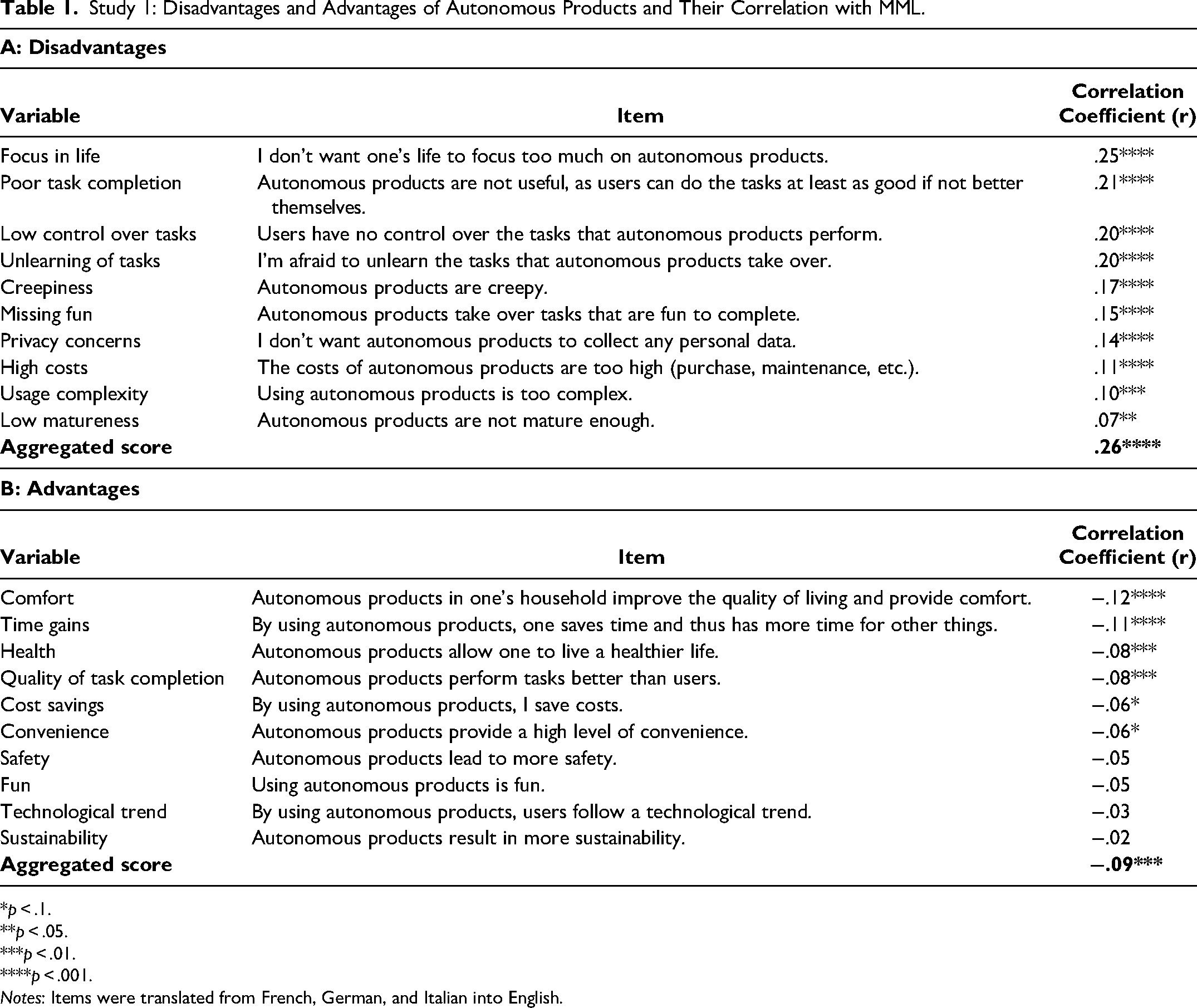
*p < .1. **p < .05. ***p < .01. ****p < .001.
Notes: Items were translated from French, German, and Italian into English.
At the end of the survey, participants had the opportunity to take part in a lottery and stated their preferences for eight products (1 = “not at all preferred,” and 7 = “very much preferred”). The products consisted of an autonomous and a conventional version across four product domains (i.e., cleaning, cooking, lighting, and speakers), which allowed us to compute an aggregated score for consumers’ autonomous product preference (preference for autonomous products minus preference for conventional products; M = .12, SD = 1.26, Min = −5.25, Max = 5.50). Importantly, this variable was consequential—participants were informed that we would randomly draw three participants who would win one of their most preferred products. Once the study was completed, we contacted the three winners and sent them the respective product. To ensure data privacy, participants had to agree that we could receive their email address from the market research company if they won the prize (88.3% of participants agreed).
Results
Preliminary analyses
We first explored the nature of the meaning consumers derive from completing manual tasks. MML tended to correlate negatively with education level (r(1,002) = −.06, p = .051), and female consumers tended to exhibit lower MML than male consumers (Mfemale = 4.64, Mmale = 4.81; t(1,002) = 1.94, p = .053, d = .122). We did not find any significant differences in MML with respect to age, household income, children (yes/no), and technology savviness (ps > .21).
Preference for autonomous products
Autonomous product preference was measured as part of the lottery (see the “Method” section). A linear regression model showed that higher MML scores were associated with lower preference for autonomous products (b = −.09, SE = .03, t = 3.11, p = .002, η2 = .010). This effect was robust even after incorporating various sociodemographic variables (i.e., consumers’ language, technology savviness, age, sex, and household income; b = −.08, SE = .03, t = 3.01, p = .003,
Attitude toward autonomous products
MML was also negatively associated with consumers’ general attitude toward autonomous products (b = −.09, SE = .03, t = 3.58, p < .001, η2 = .013), even after controlling for consumers’ language, technology savviness, age, sex, and household income (b = −.08, SE = .02, t = 3.54, p < .001,
Time gain
We also explored consumers’ perceptions of time gain through autonomous products: 4.3% of consumers expected that they would lose time, 27.8% expected that they would neither gain nor lose time, and 67.9% expected that they would gain time. Of those who expected a time gain, we asked what they would use their freed-up time for (closed-ended questions; multiple answers possible): 73.6% indicated leisure, 63.5% relaxation, 55.1% family, 45.5% friends, 21.0% watching TV, and 17.0% work. These results suggest that when time gain is made salient, most consumers expect that they would use the freed-up time for leisure-related activities.
Discussion
Study 1's findings based on a large, representative survey support our assertion that MML is negatively associated with the adoption of autonomous products. Consumers who score high on MML are less likely to prefer autonomous over conventional products, an effect that proved robust when accounting for various consumer demographics. Consistent with this effect, consumers high in MML had a more negative attitude toward autonomous products; they were also more prone to believe in the disadvantages of autonomous products (e.g., too much focus on technology in life) relative to their advantages (e.g., comfort). When asked, most participants reported that autonomous products would lead to time gains and that they would use the gained time for leisure-related activities. This finding provides support to the plausibility of the intervention on meaningful time gain tested in Study 4.
In a follow-up to Study 1, we assessed MML among owners of an autonomous product and compared their scores with the general population. If our theorizing on MML as an adoption barrier is correct, we should see lower scores for owners given that they have adopted the product. To do so, we compared over 8,000 customers of a cooking machine with the Study 1 sample, which was representative of the same population. Results confirmed that owners had lower levels of MML than the average population (Mowners = 4.29, Mpopulation = 4.69; t(919) = 6.77, p < .001, d = .285), providing additional correlational evidence for the notion that MML is associated with reduced adoption of autonomous products. Web Appendix C reports the full study including additional analyses.
Study 2: Manipulation of Meaning of Manual Labor
Study 2 aimed to provide causal evidence for the effect of MML by manipulating the construct and sought to rule out alternative explanations. Specifically, we assessed general adoption barriers to new technologies such as risk aversion to innovative products in general and conservatism among those high in MML. We wanted to pin down the role of MML by showing that it lowers valuation and adoption of autonomous products, but not other types of innovative products that are not autonomous (and hence do not strip away MML).
Note that we do not expect MML to have significant effects for nonautonomous products. While one could argue that those high in MML should be more favorable toward products that enable them to indulge in manual labor, nonautonomous products are still the default in the market. Thus, they are likely not viewed solely through the lens of whether they enable manual labor or not. Given multiple potential influences on valuations of nonautonomous products, we do not explicitly set up predictions in this regard.
Pretest
To pretest the MML manipulation, we recruited 195 North American participants (Mage = 42.7 years; 55.4% female, 43.6% male, 1.0% prefer not to answer) from Amazon Mechanical Turk (MTurk) via CloudResearch. Participants were randomly assigned to three conditions (MML: high vs. low vs. control). Specifically, they were asked to “recall a manual task that was (was not) meaningful to you in the past” and to “describe the task in your own words” (see Web Appendix D). In the control condition, participants were asked to “recall a manual task that you completed in the past.” The manipulation is based on prior research asking people to recall specifically meaningful events (Dwyer, Dunn, and Hershfield 2017; Routledge et al. 2011). Participants were then asked to complete the measure of MML described in the main study (α = .91). Results showed that the manipulation worked as intended to manipulate MML (Mhigh = 5.84, Mlow = 4.42, Mcontrol = 5.47; F(2, 203) = 26.55, p < .001, η2 = .217; all contrasts were significant [ps < .05]). We also measured potential confounds that might correlate with MML, such as need for autonomy (Deci and Ryan 2000; α = .80) and self-accomplishment (Gander, Proyer, and Ruch 2017; α = .87). As desired, the manipulation of MML did not affect any of these variables (ps > .33).
Method
Participants and design
We analyzed data from 728 North American participants (Mage = 42.5 years; 54.5% female, 44.9% male, .5% prefer not to answer; out of 853 recruited participants, see Web Appendix B) from MTurk. We employed a 2 (MML: high vs. low) × 4 (product autonomy: high vs. medium vs. low vs. low and innovative) × 2 (product domain: cleaning vs. lawn mowing) between-subjects design. The last factor was included to test the generalizability of the effect across product domains.
Procedure
Participants were introduced to the “recall task” of the pretest and were randomly assigned to the high- (n = 367) versus low- (n = 361) MML condition. In an ostensibly unrelated part of the study, they were introduced to “market research about household appliances.” In line with prior research (e.g., Leung, Paolacci, and Puntoni 2018), participants were asked to imagine a scenario that focused on either cleaning or lawn mowing. For example, the cleaning scenario read, “It is the weekend and the floor of your apartment needs cleaning. You have a device at home that supports you in cleaning the apartment floor.” Subsequently, they were randomly assigned to the high (n = 168), medium (n = 179), low (n = 191), or low but innovative (n = 190) product autonomy condition. Participants in all conditions were presented with the same product image, the only difference being the product description. Specifically, participants read that the product was “fully autonomous; you don’t have to mow/clean manually at all,” “partially autonomous; you have to mow/clean one part manually,” “not autonomous; it allows you to mow/clean manually,” or “not autonomous; it allows you to mow/clean manually” but the product would be “highly innovative” (for the visual implementation, see Web Appendix D). In the final part of the study, participants responded to measures of product valuation, adoption likelihood, autonomy of the product, and innovativeness of the product. We further assessed participants’ MML and how much previous experience they had with autonomous products in the domain of cleaning/lawn mowing. We also included a measure of conservatism. Finally, we asked participants to provide demographic information and to complete an attention check and final questions (including a hypothesis-guessing question).
Measures
We measured product valuation with the four-item measure of Faraji-Rad, Melumad, and Johar (2017) on seven-point scales (α = .97; see Web Appendix F). We measured adoption likelihood with one item on a slider (“How likely are you to adopt the product?”; “Likelihood of adoption [%]: 0 to 100”). As manipulation checks, we measured perceived product autonomy and perceived product innovativeness with one item each (“Please rate how autonomous and innovative the product was. An autonomous product works completely without human intervention. An innovative product is advanced and original. The product was…”; 1 = “not at all autonomous,” and 7 = “highly autonomous”; 1 = “not at all innovative,” and 7 = “highly innovative”).
Our measure of MML was inspired by research on meaning derived from specific personal events (Waytz, Hershfield, and Tamir 2015). We adjusted Waytz, Hershfield, and Tamir’s (2015) measure to reflect meaning derived from manual tasks (1 = “not at all,” and 7 = “very much”). The measure is based on the three-dimensional model of meaning (Heintzelman and King 2014; Martela and Steger 2016), with two items apiece tapping into each facet of meaning: purpose (“To what extent do manual tasks achieve a purposeful goal?,” “To what extent are manual tasks full of purpose?”); significance (“To what extent do manual tasks make you feel significant?,” “To what extent are manual tasks important rather than trivial?”); and coherence (“To what extent do manual tasks give you a sense of coherence?,” “To what extent do manual tasks make sense?”). As these items constituted a highly reliable composite (α = .90), we averaged them to produce a measure of MML.
We gauged participants’ previous experience with the autonomous product with one item (“Please indicate how much experience you have with an autonomous vacuum cleaner [lawn mower]”; 1 = “no experience at all,” and 7 = “a lot of experience”). We measured social and economic conservatism with a 12-item scale (Everett 2013; αsocial = .85, αeconomic = .74). Web Appendix G provides additional measures and results.
Results
Preliminary analyses
In line with the pretest, the high- (vs. low-) MML condition exhibited higher MML (Mhigh = 5.75, Mlow = 4.59; t(726) = 13.48, p < .001, d = 1.00), indicating that the manipulation of MML was effective. The manipulation had no effect on participants’ social and economic conservatism (ps > .71). As expected, the manipulation of product autonomy resulted in significant differences in terms of perceived product autonomy (Mhigh = 6.42, Mmedium = 5.42, Mlow = 2.83, Mlow_innovative = 2.76; F(3, 724) = 210.1, p < .001, η2 = .465; all contrasts were significant [ps < .001] except the one between the low and the low and innovative conditions [p = .734]). We also found that the manipulation of product autonomy affected perceived product innovativeness (Mhigh = 6.08, Mmedium = 5.48, Mlow = 4.24, Mlow_innovative = 4.71; F(3, 724) = 43.44, p < .001, η2 = .153; all contrasts were significant [ps < .002]). As product domain (cleaning vs. lawn mowing) did not interact with the other independent variables, we collapsed the data across product domains for the subsequent analyses.
Main analyses
An analysis of variance with MML and product autonomy as factors and product valuation as the dependent variable revealed an interaction of the two factors (F(3, 720) = 4.52, p = .004,

Study 2: The Causal Effect of MML and Product Autonomy on Product Valuation and Product Adoption Likelihood.
Discussion
This study provides evidence for the causal influence of MML on autonomous product adoption. Consistent with our reasoning, MML affects valuation and adoption only of products that reduce the source of that meaning, namely fully autonomous products that take over manual tasks. The finding that MML acts as a barrier to adoption of autonomous products, but not of merely innovative products, helps pin down the underlying mechanism whereby use of autonomous products strips away meaning. Finally, we did not hypothesize a reversal of the effect for nonautonomous products that are innovative. We speculate that this occurred because the innovative label enabled those high in MML to discern that the product would enable them to derive meaning from its use. The next study focuses on a key conceptual point: the distinction between MML and identity relevance.
Study 3: Meaning of Manual Labor and Identity Relevance
A pretest showed that MML and identity relevance of manual tasks are moderately correlated (r = .48); however, the two constructs are distinct from each other, as indicated by discriminant validity analysis (see Web Appendix E, which also addresses further related constructs such as need for autonomy). The key objective of Study 3 was to distinguish the effects of MML on autonomous product adoption from those of identity relevance (Leung, Paolacci, and Puntoni 2018). Whereas Study 2 assessed two activities that are arguably less identity relevant (vacuuming and lawn mowing), this study contrasted two activities that were expected to vary in terms of their identity relevance (doing the dishes and cooking).
A second objective was to replicate findings from Study 2 that our effects do not hold for merely automated products that do not complete the entire chore themselves. Given that automated products (e.g., conventional kitchen appliances) typically require consumers to perform some manual labor (e.g., adding ingredients, preparing the dish), we do not expect to see a negative effect of MML on the valuation of automated products.
Method
Participants and design
We analyzed data from 405 North American participants (Mage = 43.4 years; 51.1% female, 47.4% male, 1.0% other, .5% prefer not to answer; out of 454 recruited participants, see Web Appendix B) from MTurk. We employed a 2 (MML: high vs. low) × 2 (technology type: autonomous vs. automated) × 2 (task identity relevance: more vs. less) mixed design, with the first two factors being manipulated between-subjects and the third within-subjects.
Procedure
Participants were first asked to rate the identity relevance of several household chores. We then manipulated MML with Study 2's recall task and randomly assigned participants to the high- (n = 207) or low- (n = 198) MML condition. In the second part of the study, they were randomly assigned to the autonomous (n = 202) or automated (n = 203) condition, in which participants were presented with a short description of an autonomous or automated technology in the domain of cooking (more identity relevant) and doing the dishes (less identity relevant) in a random order.
The description of the autonomous cooking machine read, “The device is not only able to blend and mix ingredients, but can also choose the ingredients, cook them, and prepare the whole dish. Thus, you don’t have to do anything manually anymore. The cooking is taken care of completely.” The description of the automated cooking machine read, “The device is able to blend and mix ingredients. However, you have to choose the ingredients, cook them, and prepare the whole dish. Thus, you still have to do parts manually. The cooking is not taken care of completely.” The description of the autonomous dishwasher was based on novel forms of dishwashers (Voysey, Thuruthel, and Iida 2021) and read, “The device is not only able to clean and dry the dishes, but can also clear the table, prewash the dishes, and stow away the dishes. Thus, you don’t have to do anything manually anymore. The dishes are taken care of completely.” The description of the automated dishwasher read, “The device is able to clean and dry the dishes. However, you have to clear the table, prewash the dishes, and stow away the dishes. Thus, you still have to do parts manually. The dishes are not taken care of completely.”
Note that the automated product in this study can be viewed as analogous to the medium autonomy condition in Study 2. Also note that in contrast to Study 2, we did not show an image of the product in this study to reduce potential confounds. In all conditions, participants evaluated the product directly after processing the product description. In the last part of the study, participants completed manipulation checks of MML and type of technology, measures of identity relevance of and expertise with manual tasks, along with an attention check, final questions, and demographics.
Measures
We measured identity relevance of five household chores, namely vacuuming, lawn mowing, cooking, doing the dishes, and doing the washing (“Please rate the identity relevance of the following activities. To what extent do these activities define who you are?”; 1 = “very low relevance,” and 7 = “very high relevance”). For the technology manipulation check, we presented participants with a short definition of autonomous and automated products (based on McClean [2021]) and asked them to rate the two products on a continuum (“To what extent was the cooking machine/dishwasher automated vs. autonomous?”; semantic differential from 1 = “automated” to 7 = “autonomous”). We measured identity relevance of manual tasks (e.g., “I identify myself with manual tasks”; α = .93) and expertise with manual tasks (e.g., “I am good at manual tasks”; α = .95) with three items each on seven-point scales (adapted from Leung, Paolacci, and Puntoni [2018]). Finally, we measured product valuation (α = .97) and the MML manipulation check (α = .89) as in Study 2.
Results
Preliminary analyses
We first analyzed the identity relevance of the five household chores. As expected, cooking was rated as the most identity-relevant activity (M = 3.95), followed by doing the dishes (M = 3.04), doing the washing (M = 3.02), vacuuming (M = 2.85), and lawn mowing (M = 2.25). A paired t-test confirmed that cooking and doing the dishes (the two domains used in this study) differed in terms of identity relevance (t(404) = 9.20, p < .001, d = .428). This analysis also confirms that the two product domains in Study 2 (vacuuming and lawn mowing) were of low identity relevance. Note that identity relevance of manual tasks correlated moderately with the more specific items of identity relevance of household chores (.33 < rs < .45).
In terms of manipulation checks, participants in the high- (vs. low-) MML condition exhibited higher MML scores (Mhigh = 5.64, Mlow = 4.40; t(403) = 10.89, p < .001, d = 1.08), indicating that the manipulation of MML was successful. We also found that the manipulation of technology type was successful for both more (Mautonomous = 5.27, Mautomated = 2.35; t(403) = 15.76, p < .001, d = 1.57) and less (Mautonomous = 4.83, Mautomated = 2.48; t(403) = 11.51, p < .001, d = 1.14) identity-relevant tasks.
Main analyses
We ran a mixed analysis of variance on product valuation with MML (1 = high, −1 = low) and technology type (1 = autonomous, −1 = automated) as between-subjects factors and identity relevance (1 = more, −1 = less) as a within-subjects factor. Results showed a significant interaction of MML and technology type (F(1, 401) = 4.16, p = .042, η2 = .008), as well as significant main effects of technology type (F(1, 401) = 16.20, p < .001, η2 = .029) and identity relevance (F(1, 401) = 69.33, p < .001, η2 = .044; all other effects are nonsignificant [ps > .22], including the two- and three-way interactions with identity relevance). The main effect of identity relevance is in line with Leung, Paolacci, and Puntoni (2018) such that automation is not desirable when identity motives are likely drivers of consumption.
Following up on the significant interaction, high (vs. low) MML decreased valuation for autonomous products (Mhigh = 4.49, Mlow = 4.99; F(1, 806) = 7.06, p = .008) but not for automated products (Mhigh = 4.16, Mlow = 3.98; F(1, 806) = .39, p = .533). Consistent effects emerged when considering identity relevance: High (vs. low) MML decreased autonomous product valuation for more (F(1, 806) = 3.49, p = .062) and less (F(1, 806) = 3.88, p = .049) identity-relevant tasks, but did not affect automated product valuation for more (F(1, 806) = .36, p = .547) and less (F(1, 806) = 2.25, p = .134) identity-relevant tasks (see Figure 2). Controlling for the measured identity relevance of manual tasks produced consistent results, including a significant interaction of MML and technology type. In short, we found that the MML manipulation affected valuations only for autonomous products and for tasks high and low in identity relevance.
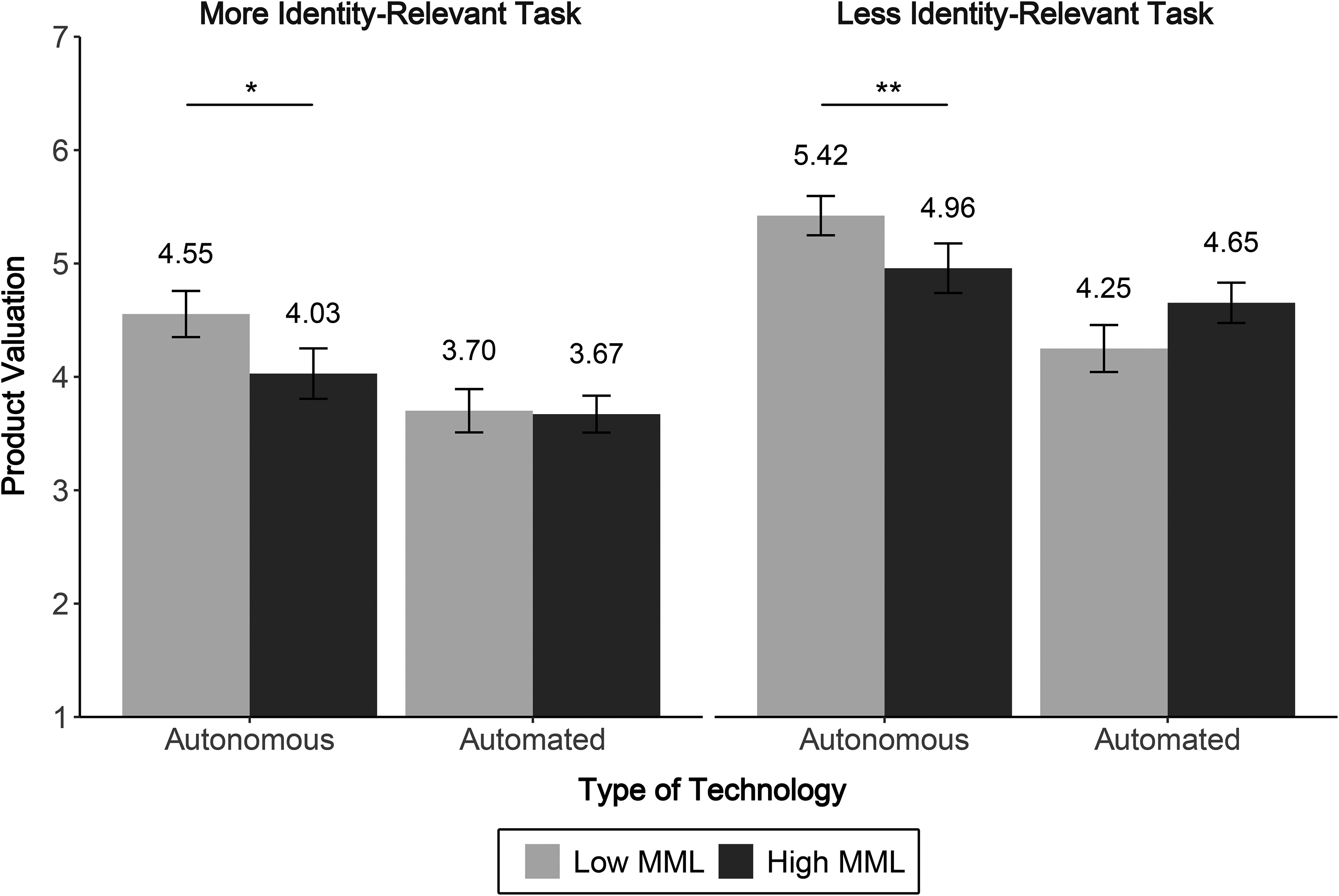
Study 3: The Causal Effect of MML and Type of Technology on Product Valuation for Tasks That Are More (Cooking) and Less (Doing the Dishes) Identity-Relevant.
Discussion
This study replicated the previously established effect that MML acts as a barrier to the adoption of autonomous products. It also showed that the effect does not generalize to automated products (e.g., conventional kitchen appliances) that still need some human input. This is in line with the results of Study 2, in which high MML did not reduce valuations of products with medium and low levels of autonomy. As theoretically expected, MML is particularly impactful when products fully substitute for manual labor. Importantly, this study ruled out the alternative explanation that identity relevance drives our effects (Leung, Paolacci, and Puntoni 2018). First, the effect generalizes to activities that are more (cooking) and less (doing the dishes) identity-relevant. Second, high MML lowered valuations of autonomous products even after controlling for identity relevance of manual tasks. The final study explores an intervention that may be used to drive autonomous product adoption.
Study 4: Meaningful Time Gain from Using Autonomous Products
Study 4 had two key objectives: to provide an effective intervention for firms and to offer additional evidence for the central role of MML in autonomous product adoption. Specifically, we aimed to reduce the detrimental effect of MML on autonomous product adoption (as per the previous studies) by making salient that the time gained by using autonomous products can be used for meaningful activities. The study focuses on a managerially relevant outcome—consumer choice—using a longitudinal study design.
Method
Participants and design
We analyzed data from 698 consumers (Mage = 43.93 years; 53.3% female, 46.4% male, .3% other; out of 755 recruited participants, see Web Appendix B) from MTurk who completed two separate studies over time. The study employed two factors: We measured MML along with control variables at t1 and manipulated the product description of the autonomous product (meaningful time gain vs. control) between-subjects at t2.
Procedure
In the first study, participants were asked to complete several scales. In addition to assessing MML, we included measures of identity relevance of manual tasks, expertise, and technology savviness (to control for variables that likely influence autonomous product adoption), as well as a measure of meaning in life (to assess participants’ level of general meaning and its association with MML). In the second study, which was launched approximately two weeks after the first study, participants were introduced to the cleaning scenario of Study 2 and were randomly assigned to the meaningful time gain (n = 352) or control (n = 346) condition. In both conditions, participants were presented with two types of vacuum cleaners: an autonomous and a nonautonomous version (see Web Appendix F). Whereas the description of the autonomous product in prior studies may have made MML salient because it emphasized manual labor—a practice that is frequently used (see Web Appendix A)—the autonomous product description in the current study did not refer to manual labor to provide a more conservative test of our hypotheses. Inspired by marketing practice (i.e., Vorwerk advertising its cooking machine with “more family time”), the meaningful time gain condition entailed one extra attribute in the description of the autonomous version: “Allows you to spend time on more meaningful tasks and pursuits than cleaning.” In both conditions, participants were asked to explain which of the devices they would use as part of a reflection task. Participants then responded to a simple choice question, followed by a measure of autonomous product adoption likelihood and a manipulation check. The study ended with demographic questions, an attention check, and final questions.
Measures
To provide a more sensitive measure of MML that can also be used in marketing practice, we assessed MML with a simple constant sum scale. Specifically, we asked participants to rate two dimensions—manual tasks and cognitive tasks—according to how much meaning in life they provide by assigning a value and ensuring that the sum is 100 (see Web Appendix F). We used the value for manual tasks as a measure of MML (M = 40.78, SD = 17.37, Min = 0, Max = 90). Identity relevance (α = .93), expertise (α = .95), and technology savviness (α = .80) were assessed as in the previous studies. Meaning in life was measured with two subscales gauging presence of and search for meaning with five items each (Steger et al. 2006; αpresence = .95; αsearch = .96). Finally, we measured autonomous product choice with one simple question (“Which device would you use?”; 53.3% chose the autonomous device) and autonomous product adoption likelihood as in Study 2.
Results
Preliminary analyses
To check the effectiveness of the meaningful time gain manipulation, we analyzed what participants wrote in the reflection task. Specifically, we examined whether participants used terms related to meaning and time gain with the grepl function in R. As desired, participants in the meaningful time gain condition used these terms more frequently when describing their product usage than those in the control condition (Mmeaningful = .49, Mcontrol = .40; t(696) = 2.28, p = .023, d = .172). These results were robust when controlling for the number of characters written (p = .038).
We further correlated our measure of MML with the more general measure of meaning in life (both assessed at t1) and found, as expected, that MML correlated neither with presence of meaning (r(696) = .03, p = .383) nor with search for meaning (r(696) = .00, p = .974). However, presence of and search for meaning were negatively correlated with each other (r(696) = −.32, p < .001), supporting the notion that if one experiences meaning, the quest for additional meaning is reduced.
Main analyses
A linear regression with MML (mean-centered) and product description (1 = meaningful time gain, −1 = control) as factors and autonomous product choice as the dependent variable showed a significant interaction (b = .26, SE = .11, t = 2.37, p = .018,

Study 5: The Effect of MML and Product Description (Meaningful Time Gain vs. Control) on Autonomous Product Choice.
We ran two types of analyses to explore the interaction further. A simple slope analysis showed that the effect of MML on autonomous product choice was negative and significant in the control condition (b = −.47, p = .003), but nonsignificant in the meaningful time gain condition (b = .05, p = .752). The former result replicates the effect found in previous studies that MML acts as a barrier to the adoption of autonomous products, using a simple measure of MML. A floodlight analysis (Spiller et al. 2013) produced a Johnson–Neyman point of 48.77, indicating that the effect of product description was positive and significant for any MML score above 48.77 and thus for nearly half of consumers (46.3%). Note that the effect was not significant for those scoring low on MML (the second Johnson–Neyman point was at −17.69 and thus outside of the scale). In short, highlighting that the time gained by using an autonomous product can be used meaningfully increases the likelihood of choosing the autonomous product for consumers high in MML.
Analyzing autonomous product adoption likelihood (instead of autonomous product choice) as the dependent variable produced consistent results. A linear regression with MML showed a significant interaction of MML and product description (b = .17, SE = .07, t = 2.36, p = .019,
Discussion
Study 4 demonstrates that MML reduces consumers’ choice of autonomous products using a longitudinal study design and a conservative description of the autonomous product that does not hint at manual labor. The study employed a simple measure of MML that can easily be implemented in practice, inquiring how much meaning manual versus cognitive tasks provide to consumers. The findings help shed light on the underlying mechanism by showing that a meaning-based manipulation can overcome the negative effect of MML on autonomous product adoption. The findings also suggest an effective intervention for firms offering autonomous products. To prevent the detrimental effects of high MML on autonomous product adoption, firms can highlight the meaningful time consumers gain with the use of autonomous products. We report another strategy to boost autonomous product adoption in the “General Discussion” section and Web Appendix H.
General Discussion
Autonomous products have entered our everyday lives, with unquestionable benefits such as increased efficiency and convenience. Although these functional benefits might seem compelling, this novel type of technology may deprive consumers of meaningful experiences. We presented four main studies showing that some consumers derive meaning from performing manual tasks (those high in MML) and autonomous products strip away that source of meaning. Thus, MML acts as a barrier to adoption of autonomous products. The studies demonstrate that high-MML consumers tend to resist the delegation of manual tasks to autonomous products, even if these tasks are not central to one's identity. However, there are other ways by which meaning in life can be achieved, and if these alternative sources of meaning are made salient, the reluctance to adopt autonomous products decreases.
Contributions to Marketing Theory
The current research makes two broad contributions to the marketing literature. First, we contribute to the emerging stream of research on new technologies in marketing, including recent work on automation and new technology adoption. Several studies in marketing and consumer research have documented the influential roles of artificial intelligence, algorithms, and product autonomy (Clegg et al. 2023; Huang and Rust 2021; Puntoni et al. 2021; Zimmermann et al. 2023). Research has also demonstrated that consumers tend to resist automation when identity motives are salient (Leung, Paolacci, and Puntoni 2018). We add to this stream of research by showing that the upcoming “age of autonomy” challenges a fundamental human motive, namely the quest for meaning, which is a broader concept than self-identity. We demonstrate that MML, or the meaning consumers derive from completing manual tasks, varies across consumers and acts as a barrier to the adoption of new technologies that exhibit autonomous features taking over manual tasks. We also showed that these effects do not generalize to automated products (e.g., conventional kitchen appliances, vacuum cleaners) because these products still provide consumers with the opportunity to perform some degree of manual labor.
Second, we contribute to research on meaningful consumption, meaning in life, and consumer well-being. Consumer research on materialistic versus experiential consumption has repeatedly highlighted the importance of (meaningful) experiences for consumer well-being (Gilovich, Kumar, and Jampol 2015; Van Osselaer et al. 2020). Psychological research has distinguished various forms of meaning, including meaning in life (Steger et al. 2006), need for meaning (Abeyta and Routledge 2018), and meaning from specific personal events (Waytz, Hershfield, and Tamir 2015). We add to this stream of research by introducing a novel construct—MML—demonstrating that manual labor is one important source of meaning, with implications for how new technologies are perceived and adopted. Our findings contribute to research arguing that cumbersome tasks and negative experiences can add meaning to one's life (Baumeister et al. 2013; Vohs, Aaker, and Catapano 2019).
We hypothesized and found that alternative sources of meaning (e.g., consumers’ families, jobs) increase the adoption of autonomous products because they reduce the need to derive meaning specifically from manual tasks. One could argue that consumers should always opt for more meaning, ceteris paribus. However, as autonomous products provide distinct functional benefits (e.g., increased convenience), consumers are confronted with a trade-off between functionality on the one hand and meaning on the other hand. By highlighting the meaningful time gain of autonomous products, even those high in MML (who derive more meaning from completing manual tasks) are “able” to choose the autonomous product (see Steger et al. [2006] for a related discussion on why presence of and search for meaning are relatively independent constructs). The idea that activating one source of meaning should deactivate other sources of meaning has parallels in consumer research on the self, showing that activating one aspect of the self (e.g., the math self) deactivates other aspects of the self (e.g., the creative self; Chung and Johar 2018).
Contributions to Marketing Practice
Despite the unique benefits of autonomous products, this novel type of technology seems to exhibit characteristics that can hamper its adoption. How can these findings guide practitioners? We propose that marketers of autonomous products can use these results in designing their segmentation and positioning strategies. One way to draw on our findings is by segmenting consumers into high- and low-MML groups. In fact, MML is not only a robust predictor of consumer behavior but also a relatively visible one. In contrast to other personality variables that can only be reliably measured using complex psychometric scales, the extent of consumers’ MML might be assessed simply by observing their behavioral characteristics, such as whether they tend to do the dishes by hand, whether they prefer a manual car transmission, or what type of activities and hobbies they pursue (e.g., woodworking, cookery, painting, and fishing are likely predictors of high MML). Similarly, there are many ways to track behaviors online (e.g., likes on social media for specific activities and hobbies that involve manual labor). Finally, as shown in Study 4, practitioners can use a simple question as a proxy for MML that asks consumers to rate the degree to which manual versus cognitive tasks are meaningful to them. Given the various means to segment consumers according to their MML, marketers can better target and focus their messages and efforts (e.g., promotions).
Based on the critical role of MML in the adoption of this novel technology, we designed an intervention that provides consumers with alternative sources of meaning. One strategy is to highlight a source of meaning that is directly tied to the technology—the time-saving nature of autonomous products. The findings of Study 4 showed that this intervention offsets the negative effect of MML on autonomous product choice, a highly relevant outcome for marketers. Specifically, consumers high in MML tended to choose the autonomous product over the conventional one when the former was positioned as a time-saving tool that enabled them to spend more time on meaningful things. Making meaningful time gain salient appears to boost valuations of those high in MML without negatively impacting valuations of those low in MML. Based on these findings, firms that provide autonomous products may emphasize not only the time savings that can be achieved by these products but also meaningful activities that can be undertaken instead.
Another strategy to provide alternative sources of meaning is more generic—to highlight a common source of meaning at the point of sale (e.g., by reminding consumers of the meaning they derive through their family or partner) and thus to put consumers into a state of high meaning in life. This strategy should be highly effective in overcoming consumers’ resistance to autonomous products because the experienced meaning in life should eliminate the need to derive meaning from other sources, including from manual tasks, and generally reduce consumers’ search for meaning. Results of two exploratory studies reported in Web Appendix H are in line with such a reasoning, suggesting that high meaning in life (either manipulated or measured) increases valuation and adoption likelihood of autonomous products irrespective of MML. Overall, the current research introduces two distinct strategies to boost autonomous product adoption by providing alternative sources of meaning.
Limitations and Future Research
We believe the current findings can spur research that is both intriguing and relevant. As mentioned previously, prior research has documented negative effects of autonomous products in terms of perceived loss of autonomy, disempowerment, privacy invasion, and feelings of technology dependence (André et al. 2018; Mani and Chouk 2017; Schweitzer and Van den Hende 2016). It would be interesting to examine to what extent these feelings are exacerbated for consumers high in MML, and whether our intervention of providing alternative sources of meaning can reduce these negative effects as well. Given the interest in anthropomorphizing technologies (Blut et al. 2021), another avenue to explore is whether framing autonomous products as an extension of the self through anthropomorphization can mitigate the negative effects of MML, as doing so may increase feelings of psychological ownership and boost valuations (Atasoy and Morewedge 2018; Weiss and Johar 2016).
An important issue relates to whether our findings are tied to autonomous products or whether they can be generalized to other types of products that also replace manual labor. In addition, one might find similar effects of MML when exploring the delegation of tasks to humans (instead of to technology), which is facilitated through the rise of online platforms that allow consumers to delegate various tasks to human helpers (e.g., Alfred, Angi, TaskRabbit). The underlying mechanism whereby delegating manual tasks deprives some consumers of meaning is likely to occur even in the case of delegating to human helpers. However, notable differences exist between the delegation to humans versus technology that may limit the generalizability of our findings to such a context. Importantly, whereas task delegation has been around for centuries and was limited to the wealthy, it is only now that many consumers are able to delegate many tasks due to the increased availability of autonomous products.
A related question concerns the type of tasks—manual versus nonmanual. Our mechanism specifically implicates the meaning of manual labor and cannot speak to consumer reactions to technologies that replace nonmanual tasks. Research is needed to examine whether technologies that replace cognitive tasks deprive consumers of meaning, and which type of meaning is at play. Specifically, whereas high-MML consumers are not good targets for autonomous products that emphasize labor-saving aspects, they could be targets for other types of autonomous technologies that substitute cognitive tasks. For example, autonomous shopping systems that facilitate and partly take over the decision-making process for shopping-related tasks (De Bellis and Johar 2020) may be preferred by high-MML consumers, as these systems allow them to focus more on the completion of manual tasks and activities. The same may hold for generative artificial intelligence: Consumers high in MML may be especially susceptible to chatbots such as OpenAI's ChatGPT, which heavily facilitate cognitive tasks including writing and programming.
Our research focused on one core aspect of autonomous products—their high levels of product autonomy. Future research may explore to what extent other aspects of technology such as agency and authority (Hoffman and Novak 2018; Novak and Hoffman 2019) may affect meaning. There are other factors that could influence consumer responses to autonomous products, such as consumers’ degree of self-reliance and moral attributions like laziness (e.g., “only lazy people delegate chores to machines”; Whillans et al. 2020). These potential responses suggest that the area of autonomous product adoption is ripe for future inquiry.
A final issue relates to the role of technology familiarity and whether our effects hold over time. Our findings indicate that MML does not influence the adoption of automated products, such as kitchen appliances or cruise control in cars, which replace manual tasks to a lesser extent than autonomous products. Did consumers simply get used to these technologies, causing them to find new ways to satisfy their quest for meaning? And will we still find the proposed effects for autonomous products when this novel type of technology becomes more common in the future? While we cannot answer these questions, we hope that the current investigation helps to ascertain that consumers can have meaningful experiences despite, or perhaps because of, the technological advances offered by autonomous products.
Supplemental Material
sj-pdf-1-jmx-10.1177_00222429231171841 - Supplemental material for Meaning of Manual Labor Impedes Consumer Adoption of Autonomous Products
Supplemental material, sj-pdf-1-jmx-10.1177_00222429231171841 for Meaning of Manual Labor Impedes Consumer Adoption of Autonomous Products by Emanuel de Bellis, Gita Venkataramani Johar and Nicola Poletti in Journal of Marketing
Footnotes
Acknowledgments
The authors thank Shige Oishi and the participants of the Johar Lab at Columbia University for their suggestions, and two anonymous firms and Jenny L. Zimmermann for collaborating on Study 1.
Associate Editor
Simona Botti
Declaration of Conflicting Interests
The author(s) declared no potential conflicts of interest with respect to the research, authorship, and/or publication of this article.
Funding
The author(s) thank the Swiss National Science Foundation and the Columbia Business School Research Fund for helping with funding for this research.

References
Supplementary Material
Please find the following supplemental material available below.
For Open Access articles published under a Creative Commons License, all supplemental material carries the same license as the article it is associated with.
For non-Open Access articles published, all supplemental material carries a non-exclusive license, and permission requests for re-use of supplemental material or any part of supplemental material shall be sent directly to the copyright owner as specified in the copyright notice associated with the article.
