




Abstract
This research investigates whether charities can enhance fundraising effectiveness by increasing donors’ sense of agency. This article introduces two strategies that allow donors to target individual charitable projects, either via the choice options (targeting-via-options) or via the suggested donation amounts (targeting-via-amounts). A large-scale field experiment involving more than 40,000 prospective donors manipulates the ability to control the allocation of the charity's resources and finds that enhancing donor agency boosts fundraising revenue by 42%. A causal forest analysis indicates significant donor heterogeneity, with a subset of donors being three times more responsive to the opportunity to target their gift than the average donor. Inactive donors, “clumpy” donors (who exhibit uneven donation patterns), and donors who concentrate their gifts during the popular giving periods are less responsive to interventions, whereas frequent, generous, and long-tenured donors are more responsive to them. Three experiments offer stronger internal validity regarding the manipulations and process evidence that agency—and not emotion—is responsible for the increased donation effects. An optimization analysis provides implications for how charities can leverage these insights to manage their fundraising campaigns to greater success.
Keywords
Donations are essential to charities. In the United States, they account for almost 70% of charities’ estimated $470 billion in revenues (Giving USA 2021). In line with the charitable giving literature that investigates how to boost donations (Bekkers and Wiepking 2011), we aim to improve fundraising effectiveness by increasing donors’ sense of agency. By allowing donors to choose—or target—a specific charitable project, we offer them a greater sense of control over the allocation of the charity's resources. In line with agency theory (Bandura 1989), we propose that transferring agency from the charity to the donor should stimulate giving.
The positive effects of agency have been documented in several domains. For instance, allowing taxpayers to choose how the government should distribute its spending increases tax compliance (Lamberton, De Neve, and Norton 2018); encouraging people to vote for new products increases demand for those products (Fuchs, Prandelli, and Schreier 2010); and employees with more opportunities to voice their dissatisfaction are less likely to switch jobs (Spencer 1986). However, the benefits of agency could be more complex in a fundraising context. Depending on how it is implemented, enhancing donor agency could potentially generate emotional conflicts. For instance, asking donors to choose between two needy individuals (e.g., Frida vs. Caroline) implies that they cannot help them both. In a recent study, Ein-Gar, Levontin, and Kogut (2021) found that offering choice reduces the generosity of donors. When donors allocate resources, they show a preference for distributing help because distribution (allocating help to multiple beneficiaries) feels procedurally fairer than concentration (allocating help to a single beneficiary) (Sharps and Schroeder 2019). Thus, enabling donors to target their gifts does not necessarily enhance fundraising effectiveness.
Charities can enhance donor agency in various ways. This article proposes two strategies that increase donors’ agency by allowing donors to target a specific charitable project. The first strategy (“targeting-via-options”) consists of presenting the choice options in a way that enables donors to choose the option that corresponds to the charitable project they want to target. The second strategy (“targeting-via-amounts”) consists of coupling the suggested donation amounts with the charitable projects in such a way that donors can choose to donate the amount that is linked to the charitable project they want to target.
In a series of studies, including a field experiment involving more than 40,000 prospective donors, we show that targeting-via-options and targeting-via-amounts enhance donors’ sense of agency (Studies 1a and 1b, lab studies) and consequently boost their donations (Study 2, lab study). Together, these interventions increase both the likelihood of donating and the average donation amount (Study 3, field study), offering a 42% revenue increase. Finally, we show that the response to agency is highly heterogeneous across donors, and we demonstrate how charities can design effective fundraising campaigns that account for donor heterogeneity. The conditional average treatment effects (CATEs) estimated by causal forests (Wager and Athey 2018) reveal that many donors are insensitive to the interventions. In contrast, a small subset of donors is three times more responsive to interventions than the average donor. Inactive donors, “clumpy” donors (who exhibit uneven donation patterns), and donors who concentrate their gifts during the popular giving periods are less responsive to our interventions, whereas frequent, generous, and long-tenured donors are more responsive to them.
Our findings contribute to the literature in several ways. First, we show that enhancing agency by allowing donors to target a specific charitable project can be effective. We also show that our interventions are straightforward to implement in online (via call-to-action buttons) or offline (via money transfer forms) contexts. Second, we show that a preference for distributed helping (Ein-Gar, Levontin, and Kogut 2021; Sharps and Schroeder 2019) may be less general than previously anticipated. In contexts where prospective donors can choose between charitable projects—rather than needy individuals—increasing donors’ sense of agency can boost donations. Third, we explore donors’ heterogeneous responses to our interventions. Instead of cross-cultural differences (Fuchs, De Jong, and Schreier 2020) or differences in income (Kessler, Milkman, and Zhang 2019), we find substantial heterogeneity based on past donation behavior.
We organize the remainder of the article as follows. We first review the agency literature in the charitable giving context and make predictions about the effect of our interventions. We then present Studies 1a and 1b to establish how targeting-via-options and targeting-via-amounts affect donors’ sense of agency. Study 2 shows that a sense of agency mediates the relationship between targeting-via-options and targeting-via-amounts on the one hand and donations on the other. We continue with a field experiment that explores heterogeneity in donor responses. Finally, we end with a discussion, limitations, and recommendations for further research. All codes and study materials are available on OSF. 1
Agency in Charitable Giving
Previous research has proposed various strategies to increase individuals’ motivation to donate (Bekkers and Wiepking 2011). For instance, Ariely, Bracha, and Meier (2009) distinguish intrinsic motives (e.g., pure altruism) from extrinsic and “impure” motives (e.g., donations stimulated by thank-you gifts, donations intended to increase one’s reputation). Some scholars argue that most donors do not calculate the expected benefit of their gifts but rather donate based on spontaneous affective reactions (Berman et al. 2018). For instance, identifiable victims evoke sympathy and move people to give because the victims invoke donors’ affective system (Small and Loewenstein 2003). A single identified victim generates stronger feelings of distress among donors than a single unidentified victim or a group of victims (Kogut and Ritov 2005). Other framing effects, such as in-group or reference-dependent effects, create similar sympathy biases (Sudhir, Roy, and Cherian 2016).
We propose that increasing donors’ sense of agency is another way to stimulate charitable giving (Heist and Cnaan 2018; Kessler, Milkman, and Zhang 2019). Acting with agency means intentionally trying to achieve an outcome through one's actions (Bandura 1989, 2000, 2001). Sense of agency refers to the feeling of being in control (Metcalfe and Greene 2007), controlling one's actions, and, through them, controlling the external world (Haggard 2017; Haggard and Tsakiris 2009). None of the mechanisms of human agency are more central or pervasive than beliefs in one's own efficacy (Bandura 1982). Self-efficacy refers to a fundamental belief in one's ability to produce desired results. Several meta-analyses outside the charitable giving literature indicate that motivation and performance will be high if individuals believe they can produce desired outcomes (Bandura and Locke 2003). This fundamental relationship between efficacy beliefs, motivation, and performance has been documented in areas as diverse as work-related performance, psychosocial functioning, academic achievement, health functioning, and athletic performance (Bandura and Locke 2003). In a similar vein, we propose that enhancing donors' belief that they can control the external world through their actions will motivate them to donate. While our goal is not to test different theories or to apportion the variance among various accounts, we list four explanations for the positive effect of donor agency on giving.
First, enhancing agency allows for preference matching by permitting individuals to select the charitable project they support the most. It makes economic sense to donors that the charity invests where they see fit (Berman and Small 2012). Investment decisions are more likely to match donors’ preferences, making them more responsive to a request (Arora et al. 2008).
Second, the benefits of agency extend beyond the opportunity of merely matching personal preferences with available charitable projects. Research has established an effect on choice evaluation itself. When people perceive themselves as having exercised choice, they evaluate outcomes more positively, even if the available options were equally attractive or incongruent with stated preferences (Langer 1975; Lefcourt 1973; Perlmuter and Monty 1977).
Third, agency may reduce perceived uncertainty, increasing donors’ confidence that their gifts will be spent as they indicated. Less uncertainty can make donors more generous. For instance, people donate more to a victim who has already been determined than to a victim who is not determined yet (Small and Loewenstein 2003). The identifiable victim effect could be explained in view of the uncertainty related to the fate of victims (Jenni and Loewenstein 1997; Small and Loewenstein 2003). Deaths of identified victims are usually certain to occur if action is not taken, whereas statistical deaths are probabilistic. Transferring agency to donors reduces the uncertainty regarding how their money will be spent, possibly contributing to the positive effect of agency on fundraising effectiveness.
Fourth, by enhancing agency, donors may assume that they effectively solve a specific problem when they donate a particular amount to a well-defined charitable project. For instance, Fuchs, De Jong, and Schreier (2020) claim that donors who can earmark their contribution perceive that their gift makes a greater impact, in accordance with the theory of impact philanthropy. An impact philanthropist prefers to target their contribution because targeting increases the perception that a financial gift is more effective. According to Duncan (2004, p. 2161), “Sponsoring an individual child can increase a philanthropist's perceived impact because he or she gives the first, as well as the last, dollar to the child.” Therefore, perceived impact can also contribute to the positive effect of agency on donations.
Predictions
We propose that “targeting-via-options” and “targeting-via-amounts” enhance donors’ sense of agency. This sense of agency, in turn, enhances donation likelihood (whether to donate) and amount (how much to donate). Both interventions enhance donors’ perceived control over the donation target because they enable donors to specify which charitable project to support (or not).
Figure 1 provides examples of both strategies. It is important to emphasize that, in all scenarios, donors have a basic level of autonomy: They can express whether they would like to donate and, if so, how much they would like to donate. For instance, in the upper-left example in Figure 1, donors can choose whether they would like to make a one-time donation or donate every month, and they can choose between various amounts (e.g., $50, $100, $250). In addition to that basic level of autonomy, our interventions enhance agency in two ways. First, in the upper-right example, donors can select the “U.S. United Way” radio button, the “International United Way” radio button, or the “Where help is needed most” radio button to target their donation. This is an example of targeting-via-options, as the donor selects the option corresponding to the charitable project they want to target. Second, in the lower-left example, donors learn about three projects that are associated with three different suggested donation amounts (i.e., $50 = food, $150 = blankets, $300 = face masks). Donors can target one of the projects (e.g., blankets) by selecting the amount (i.e., $150) that is linked to a particular project. This is an example of targeting-via-amounts. Finally, the lower-right cell combines the two strategies. Donors can target their donation by clicking on one of the suggested donation amount buttons, where each amount is linked to a different charitable project (i.e., £22 = radios and education materials, £58 = nutrition packages, £106 = a hygiene kit).

Strategies to Boost Donor Agency.
Next, we examine each intervention in more detail. Targeting-via-options consists of presenting choice options such that each choice option corresponds to a distinct charitable project. Suppose, for instance, a charitable request that raises funds for two mobility aids: wheelchairs and prostheses. Targeting-via-options can be done by presenting two choice options, one option with the label “wheelchair” and another with the label “prosthesis.” This approach enables donors to select the option that corresponds to the charitable project they want to support.
We predict that this choice of how their donation should be used increases donors’ sense of agency for the following reasons. Targeting-via-options allows for preference matching (Berman et al. 2018), may reduce perceived uncertainty (Small and Loewenstein 2003), and may increase perceived impact (Fuchs, De Jong, and Schreier 2020). The alternative scenario would be to present a single choice option (e.g., labeled as “donate a wheelchair or prosthesis”). In this context, donors can no longer specify how their gift should be allocated across the charitable projects. The charity could decide to fund one project only, or both projects in varying proportions (e.g., 80/20, 30/70). Importantly, we predict that targeting-via-options will only stimulate giving if every choice option is associated with a distinct charitable project. Study 1a shows that merely offering multiple choice options, but not linking them to distinct charitable projects (such as in Rifkin, Du, and Berger [2021]), does not enhance donors’ sense of agency. Targeting-via-options shares commonalities with the literature on unpacking (Tversky and Koehler 1994) and partition dependence (Fox, Bardolet, and Lieb 2005; Fox, Ratner, and Lieb 2005; Tannenbaum, Fox, and Goldstein 2013), because it effectively unpacks the “whether to donate” decision into a “which charitable project to support” decision.
The second intervention (targeting-via-amounts) consists of linking the suggested donation amounts to distinct charitable projects. Suppose, for instance, a charitable request that presents two suggested donation amounts ($10 and $15) to raise funds for two charitable projects (wheelchairs and prostheses). Targeting-via-amounts can be done by informing the donor that the charity needs $10 for the prosthesis and $15 for the wheelchair. Now, donors can specify how their donation should be used by choosing the amount that corresponds to charitable project they want to target (e.g., $10 for a prosthesis), thus increasing their sense of agency. Targeting-via-amounts allows for preference matching (Berman et al. 2018), may reduce perceived uncertainty (Small and Loewenstein 2003), and may increase perceived impact (Fuchs, De Jong, and Schreier 2020). In the alternative scenario where the suggested donation amounts ($10, $15) are mentioned but not linked to charitable projects (prosthesis, wheelchair), donating a suggested amount does not enable donors to specify how to use their gift. Importantly, we postulate that targeting-via-amounts enhances donors’ sense of agency only if the charitable projects are coupled with distinct donation amounts. In the case of identical suggested donation amounts (i.e., $10 for a prosthesis, $10 for a wheelchair), donors cannot specify how their donation should be used through the amount they donate. If a donor donates $10 in response to a request where all projects cost $10, the charity could fund one of the projects (but not necessarily the project that is favored by the donor) or both projects in varying proportions (e.g., 80/20, 30/70). Study 1b shows that merely linking an amount to a project does not significantly increase perceived control over the resource allocation process. Thus, the effect of targeting-via-amounts does not stem from providing information on how much each project costs and is therefore unrelated to providing more detailed information about charitable projects (Cryder, Loewenstein, and Scheines 2013). Targeting-via-amounts shares commonalities with the literature on mental accounting (Prelec and Loewenstein 1998; Thaler 1999) and coupling (Kamleitner and Hölzl 2009) because targeting-via-amounts creates an association between costs (i.e., the suggested donation amounts) and benefits (i.e., the charitable projects).
Heterogeneous Responses to Agency
Although we hypothesize that enhancing donor agency will generally increase fundraising effectiveness, there are reasons to expect heterogeneous responses to our interventions. First, donors with limited time or resources may prefer to delegate their giving decisions to better-informed others (Butera and Houser 2018). Second, cultural values can influence how individuals react to agency. For example, earmarking a gift is less beneficial in cultures that score lower on autonomy relative to embeddedness and lower on egalitarianism relative to hierarchy (Fuchs, De Jong, and Schreier 2020). Third, Kessler, Milkman, and Zhang (2019) highlight the role of donors’ income and social status in their response to agency. Wealth and power are associated with feelings of independence, autonomy, and a stronger orientation toward agency (Rucker, Galinsky, and Magee 2018). Fourth, generous donors may have different donation motives than less generous donors, which can trigger different reactions to agency. For instance, Karlan and Wood (2017) show that making impactful donations matters more to large donors because “pure” donation motives (such as impact) may matter more to them than “impure” donation motives (such as warm glow). Relatedly, loyalty affects not only the response to any solicitation request but also the relative performance of different appeals (Karlan, List, and Shafir 2011). Overall, more engaged donors (e.g., loyal, generous, active) should care more about the charity and be more motivated to express their choice and so be most responsive to our interventions to enhance sense of agency. Finally, donation habits may dampen responsiveness to particular charitable appeals. For instance, changing the suggested donation amounts affects infrequent and frequent donors differently (De Bruyn and Prokopec 2013). We expect that habitual donation patterns may make our interventions less effective, as these routines might decrease donors’ willingness to deviate from their typical donation pattern.
Study 1a: Targeting-via-Options
Study 1a has two goals. First, it tests the hypothesis that targeting-via-options effectively enhances donors’ sense of agency. Second, and most importantly, we aim to rule out the explanation that the increased sense of agency comes from merely choosing between different options without determining the beneficiaries (Rifkin, Du, and Berger 2021).
Method
We randomly assigned participants from Prolific (n = 304; 48% women, 52% men; median age = 24 years; all residing in countries with the euro as the official currency) to one of three experimental conditions in a between-subjects design (targeting-via-options: high, low, pseudo). In all experimental conditions, participants had to evaluate a request from a fictitious charity to provide mobility support to needy people. We mentioned the same two projects in all conditions (a prosthesis and a wheelchair; see stimuli in Web Appendix A). The high targeting-via-options condition presented two call-to-action buttons, one per project (“I would like to donate a prosthesis,” “I would like to donate a wheelchair”). The low targeting-via-options condition presented a single call-to-action button (“I would like to donate a prosthesis or a wheelchair”). The pseudo targeting-via-options condition presented two call-to-action buttons, one button associated with the two projects (“I would like to donate a prosthesis or a wheelchair”) and one button providing the opportunity to support the charity more broadly (i.e., “I would like to donate to [charity]”). This condition has the same number of choice options as the high targeting-via-options condition but should not enhance perceived control over the resource allocation process. This condition is crucial because it rules out the explanation that the effect is due to the number of choice options. Across all conditions, we randomized whether the prosthesis was mentioned first or second. We asked participants to inspect the information about the charitable request for 20 seconds and then measured their sense of agency (our dependent variable) with three items: “I feel that I can control how [charity] will use my donation to support a specific project,” “I feel that I can choose how my donation will fund a specific project,” and “I feel that I can target my donation to a specific project” (alpha = .72, 95% CI = [.65, .77]) on a five-point scale with item labels “strongly disagree” (1), “somewhat disagree” (2), “neither agree nor disagree” (3), “somewhat agree” (4), and “strongly agree” (5).
Results
Our focal prediction is that the high targeting-via-options condition increases participants’ sense of agency relative to the low and pseudo conditions. A generalized linear model with the condition as predictor yields a significant effect (F(2, 301) = 13.47, p < .001), suggesting that sense of agency differs across conditions. More specifically, the high targeting-via-options condition (M = 4.02, SD = .79) increases sense of agency relative to the low targeting-via-options condition (M = 3.43, SD = .94; t(201) = 4.82, p < .001) and relative to the pseudo targeting-via-options condition (M = 3.58, SD = .77; t(199) = 3.99, p < .001), while the low and pseudo conditions are not significantly different from each other (t(202) = 1.25, p = .21). Figure 2, Panel A, summarizes the results.

Sense of Agency Across Conditions in Studies 1a and 1b.
Discussion
This study shows that targeting-via-options increases participants’ perceived control over the resource allocation process. Relative to the low and pseudo conditions, the high targeting-via-options condition offers the greatest perceived control over how funds are allocated. Most importantly, the results rule out that merely being able to choose between two options would enhance donors’ sense of agency.
Study 1b: Targeting-via-Amounts
Study 1b has two goals. First, we test whether targeting-via-amounts (i.e., coupling different suggested amounts with distinct charitable projects) increases participants’ sense of agency. Second, we aim to rule out the explanation that the increased sense of agency comes from merely providing more detailed information about the charitable projects (Cryder, Loewenstein, and Scheines 2013). We aim to show that the positive effect of coupling amounts with charitable projects disappears when the suggested amounts are identical.
Method
We randomly assigned participants from Prolific (n = 304; 47% women, 53% men; median age = 25 years; all residing in countries with the euro as the official currency) to one of three experimental conditions in a between-subjects design (targeting-via-amounts: high, low, pseudo). In all experimental conditions, participants had to evaluate a charitable request to provide mobility support to needy people. We mentioned the same two charitable projects in all conditions (a prosthesis and a wheelchair; see stimuli in Web Appendix B). In the high targeting-via-amounts condition, we coupled each charitable project with a different suggested donation amount (“prosthesis = €10,” “wheelchair = €15”), and we randomized whether the prosthesis (or wheelchair) was associated with the low (or high) amount. In the low targeting-via-amounts condition, we displayed the same suggested donation amounts (“€10,” “€15”) at the same location on the screen to hold the salience and the prominence of the suggested amounts constant across conditions. We displayed the same charitable projects (“prosthesis,” “wheelchair”), but we did not couple the amounts with the respective charitable projects. In the pseudo targeting-via-amounts condition, we coupled the distinct charitable projects with identical suggested donation amounts, and we randomized whether these amounts were low (“prosthesis = €10,” “wheelchair = €10”) or high (“prosthesis = €15,” “wheelchair = €15”). Across all conditions, we randomized whether the prosthesis was mentioned first or second. We asked participants to inspect the information about the charitable request for 20 seconds and then measured their sense of agency (our dependent variable) with the same three items and five-point scale as Study 1a (alpha = .83, 95% CI = [.79, .87]).
Results
Our focal prediction is that the high targeting-via-amounts condition increases participants’ sense of agency relative to the low and pseudo conditions. A generalized linear model with the condition as predictor yields a significant effect (F(2, 301) = 12.15, p < .001), suggesting that sense of agency differs across conditions. More specifically, the high targeting-via-amounts condition (M = 3.76, SD = .95) increases the participants’ sense of agency relative to the low condition (M = 3.08, SD = 1.06; t(200) = 4.77, p < .001) and relative to the pseudo condition (M = 3.22, SD = 1.07; t(200) = 3.77, p < .001), while the low and pseudo conditions are not significantly different from each other (t(202) = .94, p = .35). Figure 2, Panel B, summarizes the results.
Discussion
This study shows that targeting-via-amounts (i.e., coupling different suggested donation amounts with distinct charitable projects) affects donors’ sense of agency. Participants indicate that coupling amounts with projects increases perceived control over how the funds will be used, relative to not coupling the projects with amounts or relative to coupling the charitable projects with identical amounts. This study rules out an explanation in terms of providing more detailed information (Cryder, Loewenstein, and Scheines 2013), such as the particular cost of a charitable project. The following study will test whether the enhanced sense of agency that stems from targeting-via-options and targeting-via-amounts stimulates donation behavior.
Study 2: Agency Process Evidence
Study 2 examines the mediating role of agency on the effect of targeting-via-options and targeting-via-amounts on donation behavior. It also tests whether the manipulations may trigger alternative explanations in the form of emotions such as empathy, sympathy, or compassion (Cryder, Loewenstein, and Scheines 2013; Small and Loewenstein 2003).
Method
We randomly assigned participants from Prolific (n = 401; 48% women, 52% men; median age = 25 years; all residing in countries that have the euro as the official currency) to one condition of a 2 (targeting-via-options: high vs. low) × 2 (targeting-via-amounts: high vs. low) between-subjects full-factorial design. We used the same fictitious charity and stimuli as in Studies 1a and 1b (see Web Appendix C). In particular, we presented two call-to-action buttons, one per project (“I would like to donate a prosthesis,” “I would like to donate a wheelchair”) in the high targeting-via-options condition, but only a single call-to-action button (“I would like to donate a prosthesis or a wheelchair”) in the low targeting-via-options condition. In the high targeting-via-amounts condition, we coupled the different charitable projects with distinct donation amounts, but we did not couple amounts and projects in the low targeting-via-amounts condition. As in Study 1b, we displayed the suggested amounts at the same location in both conditions. We randomized the order of the projects such that a particular project (e.g., wheelchair) could be associated with the lower (€10) versus higher (€15) donation amount (in the high targeting-via-amounts condition) or such that a particular project could be mentioned first or last (in the low targeting-via-amounts condition). After inspecting the information about the charity for 20 seconds, participants had to indicate how much they would hypothetically donate (our focal dependent variable). To avoid extreme responses, we required a numeric response between €0 and €30.
Following this, we assessed participants’ sense of agency (our mediator) by asking them to what extent they agreed with three items (“I feel that I can control to which of the two causes I would like to donate to,” “I feel that I can choose one of the two causes by donating,” and I feel that I can target my donation to one of the two causes”; alpha = .80, 95% CI = [.74, .83]), with “strongly disagree” (1) and “strongly agree” (5) as anchors. In addition, we assessed participations’ emotional response by asking to what extent they agreed with three items (“I feel sympathy for the people who will receive aid from [charity],” “I feel compassion for the people who will receive aid from [charity],” and “I feel empathy for the people who will receive aid from [charity]”; alpha = .77, 95% CI = [.73, .84]), with the same anchors as for agency. We counterbalanced the order of the agency and emotion measures. We standardized mediators and outcome (Pieters 2017).
Results
We first test the overall effect of our interventions on the donation amount using a regression with robust standard errors against heteroskedasticity (White 1980). Because the interaction between the interventions is not significant (p > .10), we focus on the main effects. Targeting-via-options (total effect = .09, p < .10) and targeting-via-amounts (total effect = .17, p < .001) increase the amount donated. We then test whether the effects are mediated by one's sense of agency and/or emotional response to the manipulation. To do so, we specified a structural equation model (lavaan R package; Rosseel 2012) because the mediators are latent multi-item constructs. Structural equation modeling is superior to conventional regression analysis when testing indirect effects because it accounts for measurement error (Pieters 2017; Preacher and Hayes 2008). We estimate the model with maximum likelihood with robust (Huber–White) standard errors (Savalei and Rosseel 2022). The global fit indices suggest a good fit between the model and the underlying data (p-value χ2 < . 001; comparative fit index = .94, Tucker–Lewis index = .90, root mean square error of approximation = .08, p-value < .01). Figure 3 reports the standardized coefficients and corresponding p-values and Web Appendix D contains detailed results per condition.

Mediation via Sense of Agency in Study 2.
The results show that the respondents’ sense of agency significantly mediates the impact of the manipulations on the amount donated (i.e., indirect effect of targeting-via-options = .09, p < .001; indirect effect of targeting-via-amounts = .04, p < .05) with 48% (p < .01) of the total effect being mediated by sense of agency. Relative to the low targeting-via-options condition, high targeting-via-options boosts sense of agency (a1 = .33, p < .001). Relative to the low targeting-via-amounts condition, high targeting-via-amounts enhances sense of agency (a2 = .13, p < .05). Importantly, greater sense of agency is associated with higher donation amounts (b1 = .27, p < .001).
We rule out a mediation via emotions (i.e., indirect effect of targeting-via-options = .01, p > .10; indirect effect of targeting-via-amounts = .00, p > .10). Neither manipulation affects emotions (a3 = .07, p > .10; a4 = .02, p > .10). Note that respondents who score higher on emotional items donate more (b2 = .16, p < .05), but this is not driven by our manipulations. Finally, the conditional direct effects of targeting-via-options and targeting-via-amounts on the amount donated are −.01 (p > .10) and .13 (p < .01), respectively.
Discussion
This study shows that targeting-via-options and targeting-via-amounts increase charitable giving via enhanced agency and rules out a process in terms of an emotional response. We conclude that enhancing the perceived ability to control how donations are allocated across charitable projects can boost donations.
Study 3: Field Experiment
Study 3 has two goals. First, we aim to enhance the ecological validity of our research by showing the effects of our interventions on actual donations in a large field experiment. Second, we aim to investigate whether the effect is heterogeneous across donors by exploring the moderating role of past donation behavior.
Method
We cooperated with an international charity that manages a database of 40,893 donors, all included in the field experiment. All donors received an identical direct mail with a detailed description of the charitable projects. We randomly assigned donors to one condition of a 2 (targeting-via-options: high vs. low) × 2 (targeting-via-amounts: high vs. low) between-subjects full-factorial design (see Web Appendix E). The charitable request described the same three charitable projects P1, P2, and P3 across all conditions 2 and presented the same three suggested donation amounts (€48, €88, and €120) across all conditions. These specific amounts correspond to the marginal cost of every charitable project, as established by the charity.
In the high targeting-via-options condition, donors received three money transfer forms included in the envelope, together with the donation request. Those money transfer forms were labeled “for project P1,” “for project P2,” and “for project P3.” In the low targeting-via-options condition, donors received a single unlabeled money transfer form. The “donation amount text box” on the money transfer form(s) was empty in all conditions. Donors could thus donate any amount. In the high targeting-via-amounts condition, we coupled each charitable project with one of the suggested donation amounts (“With 48 euros for project P1, 88 euros for project P2, or 120 euros for project P3, your help can make a difference”). In the low targeting-via-amounts condition, we mentioned the same suggested donation amounts but did not couple them with the corresponding charitable projects (“With €48, €88, or €120, your generosity makes a difference”).
Data
We obtained data on the responses to the donation requests (incidence and amount) and past donation data for all solicited donors between 1990 and 2016. To leverage the richness of these data, we calculate the following donor covariates.
Recency, frequency, monetary value, and clumpiness (RFMC)
Drawing on the RFMC framework (Zhang, Bradlow, and Small 2015), we calculate recency (number of days between the start of the experiment and the last donation), frequency (number of donations per year from 1990 up to 2016), monetary value (donation amount per year from 1990 up to 2016), and clumpiness. Following Zhang, Bradlow, and Small (2013), we measure clumpiness as an entropy-like measure based on the interdonation times, where higher values correspond to clumpier donation behavior. Clumpy donation patterns are characterized by extended periods of inactivity punctuated by short, intense donation bursts. Finally, we calculate three metrics for the frequency and monetary value time series: the average over time, the standard deviation over time, and the time trend (donor-specific regression slope). Overall, the RFMC metrics are good predictors of the individuals’ future lifetime value (Zhang, Bradlow, and Small 2015).
Tenure
We measure donor tenure as the number of days between the first donation made to the charity and the start of the experiment.
Year-over-year (YoY) range
The YoY range variable captures recurring donation patterns from one year to the next. For each donor i and each month of the year, we calculate the minimum and maximum donation amount they have made across all years. From it, we calculate the range value for each month of the year:
Share of past donations of €48, €88, or €120
We also consider whether the suggested amounts align with the donors’ habits regarding how much they tend to donate to the charity. We calculate the fraction of past donation amounts corresponding to one of the suggested amounts in the current experiment.
Share of gifts in popular months
Some seasons, such as the major holidays, are more popular than others for donations. In our data, popular months are May, November, and December. We capture the percentage of contributions made by a donor during these popular months. A value of 100% indicates that the donor made all their donations during popular months.
Number of gifts in February
Finally, we also capture whether the month during which the experiment took place (February) is a month in which a donor typically makes a gift. This variable counts the number of previous donations made in February.
Demographics
Finally, we have two binary variables: (1) whether the prospective donor is an individual or a member of an organization and (2) the donor's spoken language.
Table 1 provides an overview of the covariates per condition. We report the medians (and standard deviations in parentheses) for the continuous variables and the percentages per level for the categorical variables. We use pairwise permutation tests (Web Appendix F) to check the random assignment of donors across conditions. None of the covariates in Table 1 are significantly different between conditions. Note that 3,319 donors (equally spread across conditions) have missing values for some covariates, in which case statistics are computed on the nonmissing values.
Descriptive Statistics of Experimental Conditions in Study 3.

Notes: We report the medians (and SDs in parentheses) for the continuous variables. For the categorical variables, we report the percentages per level of the categorical variable. We tested for differences between conditions using permutation tests (10,000 permutations, Web Appendix F) with a Bonferroni correction for multiple testing, and all p-values are greater than .10.
Descriptives
We start by describing the average donation across the conditions in the field experiment. The field experiment raised a total of €89,782 in gross revenues. The condition with the highest sense of agency (i.e., high targeting-via-options and high targeting-via-amounts) generated the highest donation revenue (M = €2.57 per request sent, SE = .14; total = €26,277), relative to the baseline condition (i.e., low targeting-via-options and low targeting-via-amounts), which raised the smallest amount (M = €1.81 per request sent, SE = .11; total = €18,535). The 42% increase is in line with the range of effects in the charitable giving literature on agency. 3 The high targeting-via-options and low targeting-via-amounts condition generated M = €2.30 per request sent (SE = .13; total = €23,538) while the low targeting-via-options and high targeting-via-amounts condition generated M = €2.10 per request sent (SE = .12; total = €21,432). Web Appendix G details the specific amounts donated per condition.
Effect of Targeting-via-Options and Targeting-via-Amounts on Donations in Study 3.

*Significant at 10%, **significant at 5%, ***significant at 1%.
Notes: Estimates of the effect of targeting-via-options and targeting-via-amounts on (1) the total amount donated, (2) the likelihood of giving, and (3) the amount donated conditional on giving, with SEs in parentheses. The baseline condition is the low targeting-via-options, low targeting-via-amounts condition. Column 1 reports estimates for which the dependent variable is the total amount donated, including the zero donations. Column 2 reports estimates from a linear probability model in which the dependent variable indicates whether the individual has donated. Column 3 reports estimates when the dependent variable is the total amount donated only for the individuals who donated. For Columns 1 and 2, we use and report White (1980) robust SEs.
Model Results
Following Kessler, Milkman, and Zhang (2019), we specified three regressions to decompose the effect of targeting-via-options and targeting-via-amounts on overall fundraising effectiveness (first regression) into their effects on donation likelihood (second regression) and conditional donation amount (third regression). Table 2 reports the results. In Column 1, we regressed the amount donated (€) by all donors and nondonors (i.e., we include zeros for donors who did not donate) on both variables. We used robust standard errors (White 1980) to account for heteroskedasticity (Breusch–Pagan test p < .05).
4
For Column 2, we specified a linear probability model where the dependent variable captures whether the donor made a gift to the charity (0/1). Given the heteroskedasticity (Breusch–Pagan test p < .10), we again used robust standard errors (White 1980). Finally, for Column 3, we regressed the donation amount conditional on donating. We thus excluded the nondonors and regressed the amount donated (€) on targeting-via-options and targeting-via-amounts for the 2,110 individuals who donated. In all three cases, we also specified an interaction effect between the manipulations. The overall specification is:

Amount Donated, Probability of Giving, and Amount Donated Conditional on Giving per Condition in Study 3.
Looking at the overall effect on fundraising revenues (Table 2, Column 1), we find that both interventions positively impact donations. Targeting-via-options significantly (p < .01) increases fundraising revenues to €2.30 per request sent (i.e., €1.81 + €.49), representing a 27% increase (i.e., €.49/€1.81) compared with the low targeting-via-options condition. Targeting-via-amounts marginally (p < .10) increases total donations to €2.10 per request sent (i.e., €1.81 + €.28), which represents a 16% increase (i.e., €.28/€1.81) compared with the low targeting-via-amounts condition. The interaction effect is not significant (p > .10).
These positive effects are in part due to an increase in donation likelihood (Table 2, Column 2 and Figure 4, Panel B). Given a donation rate of 4.7% in the baseline condition, targeting-via-options increases the probability of a donation with β = .007 (p < .05), or 14% (i.e., .007/.047), while targeting-via-amounts increases donation likelihood with θ = .01 (p < .10), or 11% (i.e., .005/.047). Combined, targeting-via-options and targeting-via-amounts offer a donation rate of 5.38%.
Finally, we find somewhat weaker effects on the conditional donation amount (Table 2, Column 3 and Figure 4, Panel C). The baseline condition gives a conditional donation amount of €38.69. Conditional on a gift being made, targeting-via-options marginally (p < .10) increases the amount donated to €42.95 per request (i.e., €38.69 + €4.26), representing a 11% increase (i.e., €4.26/€38.69). Conditional on a gift being made, the effect of targeting-via-amounts is not significant (θ = 1.55, p = .53). Combined, targeting-via-options and targeting-via-amounts give a conditional donation amount of €47.78. Again, we find no interaction effect (p > .10). In summary, both interventions boost fundraising revenues and do not interact with each other. This effect is due to an increase both in the donation likelihood and (to a lesser extent) in the donation amounts, conditional on giving.
Heterogeneity in Treatment Effects
Overall, targeting-via-options and targeting-via-amounts increase donations. However, the aggregation may mask heterogeneous responses across donors (Karlan, List, and Shafir 2011; Sudhir, Fong, and Roy 2021). This section explores heterogeneity in treatment effects.
Method
We define the treatment dummy as Ti = 1 when a donor i receives the solicitation request that provides the highest agency (high targeting-via-options and high targeting-via-amounts) and Ti = 0 when donor i receives the solicitation request with the lowest agency (low targeting-via-options and low targeting-via-amounts).
5
The potential outcomes yi(0) and yi(1) capture the donation (in €) made by a donor i, respectively, when Ti = 0 or 1. In reality, we only observe one of the two counterfactuals. The treatment effect conditional on the pretreatment covariates Xi (see Table 1) is defined as
Causal forests have a key advantage over a regression model in which one would manually interact the treatment dummy with each pretreatment covariate: The algorithm retains only the most impactful interactions and allows for flexible, nonparametric relationships between covariates and the outcome of interest. It is ideal in large-scale field experiments like ours, where we observe many donor characteristics. We include all donor characteristics (Table 1) as pretreatment covariates. We trained the causal forest on half of the donors and kept the other half as a holdout sample. To avoid that results would depend on a specific data split, we generated 1,000 splits and summarized results across splits (Ascarza 2018). 6
Results
We interpret the results as proposed by Chernozhukov et al. (2020). First, we test for heterogeneity in the treatment effect. If the actual treatment effect is homogeneous, a model that allows for heterogeneous treatment effects would most likely overfit the data. We therefore need to confirm that the treatment effects are heterogeneous before interpreting the causal forest. Second, we compare treatment effects by heterogeneity quintiles identified by the causal forest. Third, we explore the relation between the predicted CATEs and the pretreatment covariates. This step allows us to profile donors according to their responsiveness to the treatment. The detailed procedure is described in Web Appendix H.
Step 1: Test for heterogeneity
We test for treatment effect heterogeneity based on the causal forest estimator using the best linear prediction test (Chernozhukov et al. 2020). This test determines whether the causal forest estimator is a good proxy for the true CATE or whether, in contrast, the causal forest predictions are uncorrelated with the true CATEs and/or the treatment effect is homogeneous. The test consists of regressing the predicted CATE on the mean-centered Xi using a doubly robust estimator (that considers the propensity scores, see Equations W3 and W4 in Web Appendix H) across all 1,000 data splits. The heterogeneity predictor loading parameter (see Equation W2) is greater than zero (.74, p < .01), thus indicating significant heterogeneity in treatment effects. In addition, its 95% confidence interval (CI = [.23, 1.23]) includes 1, suggesting that the causal forest estimator is a good proxy for the actual CATEs (i.e., it captures actual differences in the effectiveness of the treatment across donors).
Step 2: Group average treatment effects (GATEs)
We next explore how the treatment effect varies across donors. We group donors (in the holdout sample) in five quintiles based on their CATE predicted by the causal forest and estimate the GATE by quintile. The GATE is defined as

Group Average Treatment Effects by Donor Quintile in Study 3.
Step 3: Partial dependence plots
We explore the relationship between all pretreatment covariates and the predicted CATEs across 1,000 holdout samples. Figure 6 plots these relations together with error bars (±1 SEs across the 1,000 splits).

Partial Dependence Plots in Study 3.
RFMC
We discovered several meaningful variations in responsiveness based on donors’ RFMC values. To begin, donors who show a more positive response to the higher-agency requests have donated more recently, donated more often, donated higher amounts, and show a more positive trend in their donation patterns over time. This is in line with Karlan, List, and Shafir (2011), who found “warm list” donors to be more responsive to charitable appeals than “cold list” donors. Donors’ attention is likely to play a role in this process—donors need to pay sufficient attention to the charitable request to notice a greater sense of agency—but it is not the only factor. Varied giving motives can also contribute to these differences because large donors are more responsive to analytical effectiveness information (Karlan and Wood 2017) and because rich donors value agency more (Kessler, Milkman, and Zhang 2019). In addition, donors who exhibit clumpier donation patterns were less responsive to the higher-agency request than donors who spread their donations over time. Clumpy donors exhibit donation activity phases that go from “hot, then cold, then hot again” (Zhang, Bradlow, and Small 2013, p. 2534). One explanation can be that it might be challenging to activate clumpy donors when they are in a cold phase. In contrast, regular donors tend not to experience cold phases and, as such, might be more responsive to our solicitation request.
Tenure
The higher-agency request was also more effective among the long-tenured charity donors, suggesting that loyalty positively influences the responsiveness to charitable appeals (Karlan, List, and Shafir 2011). Long-tenured donors are more likely to care about the charity and be more motivated to express their choice.
YoY range
“Calendar” habits also play a role in donors’ responsiveness. Donors who donate the same amount every year in the same month (small YoY range) were less sensitive to the higher-agency request. One potential explanation could be that habits or routines might decrease donors’ willingness to deviate from their typical donation pattern. It might be harder to “move the needle” when donors have strong habits.
Share of past donations of €48, €88, or €120
Donor responsiveness to agency does not depend much on whether the suggested donation amounts (€48, €88, or €120) are amounts they have given in the past.
Share of gifts in popular months
This variable confirmed the role of habits. Donors who donate exclusively during popular months were less sensitive to the higher-agency request. The experiment occurred in February, outside a major holiday, possibly corresponding to a cold(er) phase for these donors.
Number of gifts in February
The response to our intervention was stronger for donors who tend to make more gifts in February, suggesting that these donors might be in a comparatively hot(ter) phase than the others.
Optimizing Fundraising Campaigns
Our analysis reveals that some donors respond more favorably when provided with a greater sense of agency. This section shows how a charity can leverage these insights to improve fundraising effectiveness. We consider two scenarios for illustrative purposes. In the first one, our starting point is the charity's current approach of contacting all donors, but rather than sending everyone the same request, our policy selectively assigns a higher-agency request or a lower-agency request based on the predicted CATEs. In the second scenario, our policy determines how many donors to contact with a higher-agency request to maximize the net revenues of a campaign. We use off-policy evaluation to evaluate the expected return of each policy using the experiment data (Yoganarasimhan, Barzegary, and Pani 2022).
Scenario 1: What is the Best Mix of Lower-Agency Versus Higher-Agency Requests?
In each of the 1,000 holdout samples, we rank all donors in order of decreasing predicted CATE, such that 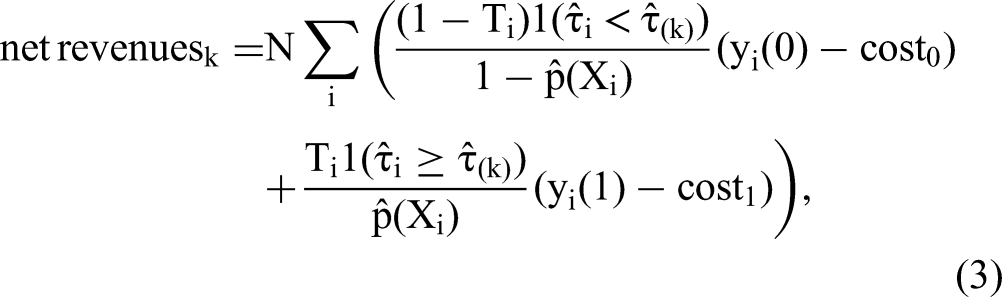
Scenario 2: How Many Donors to Contact with a Higher-Agency Request?
Similar to scenario 1, we rank donors but from highest to lowest holdout predicted donation amounts conditional on receiving a higher-agency request 
Results
For each policy, we obtain a distribution of holdout net revenues across the 1,000 holdout samples

Off-Policy Evaluation in Study 3.
In scenario 1 (Figure 7, Panel A), the horizontal axis is the percentage mix of donors receiving higher-agency versus lower-agency requests. Going from left to right shows the incremental revenues of offering more donors a higher-agency request rather than lower-agency request. When lower-agency and higher-agency requests are equally expensive (€1), the optimal mix is 100% higher-agency and 0% lower-agency requests, due to the fact that our data show no reactance to agency appeals (Figure 5). In addition, the top 20% of the donors in terms of largest CATEs are responsible for 82.3% (95% CI = [81.8%, 82.9%]) of the incremental net revenues (i.e., €12,696 out of the €15,468) generated by a fundraising campaign that sends higher-agency requests rather than lower-agency requests. Benefits of providing agency decrease when higher-agency requests are more costly than lower-agency requests. In these cases, the optimal mix is approximately 20/80, with a net holdout revenue of €11,727 (95% CI = [€11,634, €11,821]) when cost1 = €1.5 and a net holdout revenue of €10,580 (95% CI = [€10,484, €10,676]) when cost1 = €2.
In scenario 2 (Figure 7, Panel B), the horizontal axis indicates the share of donors contacted with a higher-agency request. The figure shows the results for cost1 = €1 (see Web Appendix J for €1.5 and €2). The net revenues of the “lower agency” and “higher agency” policies increase linearly because the policies ignore heterogeneity (donors ranked randomly). When contacting 100% of the donors, these policies respectively generate €8,234 (95% CI = [€8,161, €8,307]) and €15,466 (95% CI = [€15,379, €15,553]), after the campaign cost of €10,224 is deducted. This is a significant increase of €7,232 (95% CI = [€7,118, €7,346], p < .001), or 88% (for the gross revenues, the increase was 42%). The “higher agency + heterogeneity” policy ranks the most responsive donors first, such that the revenue curve is an inverted U. At its maximum (approximately half of the donors contacted), the policy offers €17,141 (95% CI = [€17,058, €17,223]) net holdout revenues. This is €1,675 (95% CI = [€1,647, €1,702], p < .001) more (i.e., 11%) than the “higher agency” policy that contacts all donors. Contacting more donors hampers the net revenues, as the resulting donations no longer compensate for the contact cost.
General Discussion
From the charity management perspective, transferring agency to donors comes with challenges because it reduces the charity's autonomy. It may lead to administrative and even humanitarian problems if donors target “sensational” emergencies (Evangelidis and Van den Bergh 2013). Given these challenges, transferring control to donors is only viable if the benefits (e.g., fundraising revenues) outweigh the costs (e.g., reduced autonomy). In this article, we investigated the impact of two strategies, targeting-via-options and targeting-via-amounts, on donations in a large field experiment. We documented their underlying mechanism and heterogeneity in donor responses.
Theory Implications
Our research has theoretical implications. First, we show that enhanced control over which charitable project to target (through targeting-via-options and/or targeting-via-amounts) increases the donation likelihood and the donation amount. Prior research indicated that when donors allocate aid to multiple needy individuals, they prefer an equitable distribution across victims (Ein-Gar, Levontin, and Kogut 2021; Sharps and Schroeder 2019). In such cases, donating entails complex emotional trade-offs between being helpful versus being fair and may undermine generosity. However, the donation decision is likely to involve a less intense emotional trade-off when donors choose between charitable projects (e.g., wheelchair vs. prosthesis) rather than victims (e.g., Frida vs. Caroline). Therefore, the preference for distributed, rather than targeted, helping might be less general than anticipated (Sharps and Schroeder 2019). Rather than reducing generosity, we find that the ability to target a gift increases donations.
Second, our research contributes to the literature that sheds light on potential moderators regarding the overall positive role of agency. Prior research illustrated moderations in terms of demographic variables such as nationality (Fuchs, De Jong, and Schreier 2020) and income (Kessler, Milkman, and Zhang 2019), whereas we explored the moderating role of past donation variables that are readily available to any charity manager. We find that giving donors a sense of agency is not beneficial when these donors are less engaged with the charity or when they have strong donation habits or routines. Presumably, enhancing agency among individuals who are not very engaged is not an effective approach to reactivate those donors; thus, other strategies may be needed to engage with less active donors.
Practical Implications
Our findings also yield practical insights for charities. First, both interventions are straightforward to implement in online (e.g., call-to-action buttons) and offline (i.e., money transfer forms) contexts. Most importantly, they increase fundraising effectiveness in the field by more than 40% and, in contrast to other mechanisms to increase fundraising effectiveness, we do not find countervailing effects on donation likelihood versus amounts. This is a critical advantage for charities, as some strategies to boost fundraising lead to self-canceling effects. For instance, suggesting a smaller donation amount typically increases donation likelihood but often decreases the average donation amount. Conversely, suggesting a larger donation amount typically increases the average donation amount but often reduces donation likelihood. Thus, some strategies, such as selecting defaults in charitable appeals, result in no net effect in fundraising revenue (Goswami and Urminsky 2016).
Second, we offer new insights into how different donor segments respond to charitable appeals. For instance, the more engaged donors, as captured by a longer tenure and/or larger, more recent, more frequent, and less clumpy gifts were particularly responsive to our interventions. Charities can improve the effectiveness of their campaigns by incorporating these insights in deciding how to approach different donor segments. Notably, a differentiated approach is most beneficial when donors react in opposing directions to agency appeals.
Limitations and Future Research
Our research comes with limitations that might inspire future research. First, future research might consider other ways to enhance donor agency. Targeting-via-options is fundamentally different from prior research, as we force donors to make a choice in the high targeting-via-options condition (i.e., the call-to-action buttons and money transfer forms were labeled with a project's name). Prior research allowed donors to not choose (e.g., by allowing donors to leave checkboxes corresponding to particular charitable projects unchecked; Kessler, Milkman, and Zhang 2019). The “checking a box” paradigm led to conflicting results. Fuchs, De Jong, and Schreier (2020) document strong effects on donation likelihood but negligible effects on donation amount, while Kessler, Milkman, and Zhang (2019) find no effect on donation likelihood but positive effects on donated amounts. Future research should explore when, why, and how different manipulations, such as drop-down lists, open entry boxes (Heist and Cnaan 2018), or tipping jars (Rifkin, Du, and Berger 2021), could trigger countervailing or additive effects on donation likelihood and amount. Decreasing agency by delegating the choice to algorithms or better-informed people (Berman and Small 2012; Butera and Houser 2018) may also be worth exploring given the heterogeneity we discovered.
Second, one could also investigate whether a charitable project's attractiveness, perceived urgency, or importance moderate agency effects. The effect of our agency interventions is inherently tied to the nature of the charitable projects. For instance, if charitable projects are unattractive, the opportunity to control resource allocations may not stimulate donations. Moreover, if more attractive projects are coupled with excessively large suggested donation amounts, enhancing donor agency may not help either.
Third, the charity determined the suggested amounts in the field study based on marginal costs. These amounts might have nudged donors to give more than they had considered. Targeting-via-amounts might decrease the revenues of a charitable campaign if the suggested donation amounts were set below what people typically donate (Shang and Croson 2009). Further research should explore how the suggested amounts could alter our findings.
Fourth, the high targeting-via-options requests in Studies 2 and 3 offered more choice options than the low targeting-via-options requests. They may have triggered an obligation to donate, as not donating would mean rejecting a request two or three times. In addition, the number of charitable projects was relatively small. Future research could explore whether the presence of more options dampens the effect of targeting-via-options by adding complexity.
Finally, the off-policy evaluation section ignored the uncertainty around the CATE predictions when ranking donors. Future research could consider whether and how to incorporate such uncertainty when prioritizing donors. For instance, should the charity prioritize donors with high but uncertain preferences for agency versus donors with low but more certain agency preferences? Methods that specifically handle the exploration/exploitation trade-offs could provide a framework for fundraising campaign designs (Schwartz, Bradlow, and Fader 2017). We hope our results will encourage charities to leverage the heterogeneous benefits of agency in their fundraising activities.
Supplemental Material
sj-pdf-1-jmx-10.1177_00222429221148969 - Supplemental material for Enhancing Donor Agency to Improve Charitable Giving: Strategies and Heterogeneity
Supplemental material, sj-pdf-1-jmx-10.1177_00222429221148969 for Enhancing Donor Agency to Improve Charitable Giving: Strategies and Heterogeneity by Emilie Esterzon, Aurélie Lemmens and Bram Van den Bergh in Journal of Marketing
Footnotes
Author Contributions
All authors contributed equally to the manuscript.
Associate Editor
Neeraj Arora
Declaration of Conflicting Interests
The author(s) declared no potential conflicts of interest with respect to the research, authorship, and/or publication of this article.
Funding
The author(s) disclosed receipt of the following financial support for the research, authorship, and/or publication of this article: This work was supported by the NWO Vidi Grant (grant number 452-12-011).

Notes
References
Supplementary Material
Please find the following supplemental material available below.
For Open Access articles published under a Creative Commons License, all supplemental material carries the same license as the article it is associated with.
For non-Open Access articles published, all supplemental material carries a non-exclusive license, and permission requests for re-use of supplemental material or any part of supplemental material shall be sent directly to the copyright owner as specified in the copyright notice associated with the article.
