



Abstract
Against a backdrop of limited research focusing on dark-side characteristics in alliances, the authors argue that Machiavellianism in an alliance influences strategies pertaining to gaining new knowledge and using power to achieve better performance effectiveness. They develop a model using theories-in-use procedures and drawing from both Machiavellian intelligence and achievement goal perspectives, which they test in a quasi-longitudinal study of 199 marketing alliances. The results suggest that Machiavellianism relates negatively to collaborative learning and positively to learning anxiety and use of power. The findings also indicate that collaborative learning enhances performance, whereas learning anxiety and use of power result in underperformance. Collaborative learning, learning anxiety, and use of power fully mediate Machiavellianism's impact on performance. Finally, Machiavellianism's relationships with collaborative learning and learning anxiety are moderated positively and negatively, respectively, by partners’ collaborative history. This evidence provides managers with a more in-depth understanding about the nature, functioning, and performance relevance of Machiavellianism in alliance partnerships.
Keywords
Alliances concurrently possess both a bright side, in which partners make collaborative decisions to achieve common goals, and a dark side, in which partners make self-serving decisions to attain self-interest goals (Luo, Rindfleisch, and Tse 2007; Moorman, Zaltman, and Deshpandé 1992). This tension can be of use to an alliance partner with Machiavellian characteristics. We define Machiavellianism in an alliance as a firm's strategy of social conduct that involves manipulating the partner for its own gain, often against its best interests (Wilson, Near, and Miller 1996). Scholars (e.g., Oliveira and Lumineau 2019) have underscored the relevance of Machiavellianism in triggering competitive processes in alliances, such as the exploitation of a partner through learning. While dark-side aspects (e.g., opportunism) and their outcomes have received attention in alliance work (Noordhoff et al. 2011), the role of Machiavellianism in alliance functioning and performance has not.
Understanding the nomological network of Machiavellianism in the alliance is impossible without resolving ambiguities with the construct itself. The Machiavellian characteristics of the managers the firm assigns to an alliance will shape the firm's Machiavellianism in the alliance (Dahling, Whitaker, and Levy 2009). Like other social psychology constructs transferred from the individual to the firm level (e.g., trust; Fang et al. 2008), Machiavellianism is partly dispositional (internal beliefs) and partly manifest (behavioral). However, it is unknown whether a firm's Machiavellianism is a fixed disposition or manifests differently across alliances. Scholars also disagree over its dimensionality (Monaghan, Bizumic, and Sellbom 2016). Dahling, Whitaker, and Levy’s (2009) study of Machiavellianism in management advances a higher-order structure with four dimensions: distrust, desire for status, amoral manipulation, and desire for control. These dimensions may or may not be relevant to Machiavellianism in alliances (Connelly, Miller, and Devers 2012; Shipilov, Li, and Greve 2011).
From a Machiavellian intelligence perspective (Orbell et al. 2004), 1 the main challenge facing firms in alliances is the possibility of gaining an advantage or losing out due to within-alliance competition. Machiavellian intelligence views others in a goal-oriented manner and as devices for pursuing the exploiter's own goals (Bereczkei 2018). Indeed, alliances offer a platform for learning that can serve the interests of the partnership, or they can foster exploitation and the use of power to prioritize one's own goals. There is reason to expect that the link between Machiavellianism and performance effectiveness is mediated by learning and power. Performance effectiveness refers to the extent to which the firm achieves its set performance objectives in the alliance partnership (Bello, Katsikeas, and Robson 2010). Although Machiavellianism orients a firm toward the possibility of success rather than failure, the self-interested performance outcomes sought might not be consistent with achieving the objectives of the alliance. The firm may share some, but not all, of these objectives with its partner and may even neglect common ones (Ariño 2003). In summary, we do not know whether learning and power are mechanisms through which Machiavellian firms can succeed.
Further, the Machiavellian intelligence perspective maintains that exploiters are more likely to succeed if, based on awareness of the social situation, they change tactics to reduce disruption (Crow 1996). This implies a certain level of pragmatism insofar as operating in a goal-oriented manner may involve defection or cooperation (Wilson, Near, and Miller 1996). The boundary condition facilitating such pragmatism is likely to be based on the firm's situational knowledge of the partner through acquaintance with them as a result of past relational exchanges (i.e., collaborative history). Prior alliance studies are silent on the matter.
Alliance scholars have stressed the criticality of taking time into account to reliably capture the effects of learning and other processes (Arslan and Ariño 2017; Palmatier et al. 2013). However, most extant research has assessed learning effects in alliances using either cross-sectional data or “panel studies that analyze secondary databases and interpret changes of coarse proxies of successful or failed learning processes” (Nippa and Reuer 2019, p. 18). The few primary source, longitudinal studies that exist have captured learning's performance relevance qualitatively within one or few alliances (Ariño and De la Torre 1998; Doz 2017).
To address these gaps, the current research examines Machiavellianism and its importance in driving learning and power mechanisms and, in turn, performance in alliances. Following theories-in-use (TiU) procedures, we develop a conceptual model and hypotheses and test them in a quasi-longitudinal study of marketing alliances. We make three primary contributions. First, we extend work on the nature and functioning of Machiavellianism (Bagozzi et al. 2013; see also Table 1) to the alliances field, which has seldom considered links between partner firms’ dark-side characteristics and learning and power (Noordhoff et al. 2011). We show that Machiavellianism is a multidimensional construct, and although it has a dispositional side, such that top executives’ internal beliefs merge to represent firm-level beliefs that affect alliance decisions (Mellewigt, Bruhs, and Keller 2017), it differs across a firm's alliance settings. Further, Machiavellian-led learning is responsive to the partner’s situational knowledge. We find that Machiavellianism in the alliance negatively affects collaborative learning and positively influences learning anxiety and use of power. Collaborative history weakens the negative link with collaborative learning and the positive link with learning anxiety. Using history to understand the situation paves the way for Machiavellian pragmatists to favor bright-side (collaborative) learning over the more intuitive dark-side (anxiety) route in the race to learn.
Key Characteristics of the Empirical Literature on Machiavellianism and the Present Study.

Unless otherwise indicated with dimensions shown, Machiavellianism is conceptualized and operationalized as an unidimensional construct.
References appear at the end of the Web Appendix.
Notes: N.A. = not applicable.
Second, we employ TiU, the Machiavellian intelligence perspective (Orbell et al. 2004), and elements of achievement goal theory (Elliot and McGregor 2001) to theorize and test the performance effects of collaborative learning, learning anxiety, and use of power. We find that a firm's collaborative learning drives its performance effectiveness, but its learning anxiety and use of power are likely to underperform. Moreover, all three mechanisms fully mediate the link between a firm's Machiavellianism and performance. In exploring the question of whether Machiavellianism is a successful strategy in alliances, we observe negative mediation. Additional analyses reveal moderating conditions that can benefit performance by neutralizing the negative mediation effects of collaborative learning and learning anxiety.
Third, our quasi-longitudinal study enables us to recognize that learning and power effects take time to unfold. We run additional analyses that provide new evidence that performance outcomes of learning are contingent on the alliance development stage (Palmatier et al. 2013). We observe an inverted U-shaped moderation of alliance development stage on the paths from collaborative learning and learning anxiety to performance. Once an alliance partnership is past its peak, opportunities fade for both learning-related mechanisms. Further, the competitive mechanism, use of power, appears to be problematic because it is resistant to the conditioning effects of both collaborative history and alliance development stage.
Literature Review
Machiavellianism and Opportunism
Within our theoretical framework, we view Machiavellianism as a dark-side characteristic underlying a firm's strategy of self-interested gain in alliances. Dark-side aspects are discussed in the alliance literature, with opportunism being foremost among them. We compare and contrast Machiavellianism and opportunism on the basis of their origins, conceptualizations, and attributes (see Table 2). Our examination reveals both similarities and differences. Machiavellianism's disciplinary origins can be traced to social psychology and political leadership (McHoskey, Worzel, and Szyarto 1998), while opportunism stems from sociology and economics (Rindfleisch and Heide 1997). These two dark-side constructs have also developed in biological work related to species’ survival behaviors. A key difference in construct delineation, which can be attributed to their disciplinary origins, is that Machiavellianism has a dispositional side that opportunism lacks. Indeed, Machiavellianism's focus on interpersonal relationships (Table 1) is linked to its origins in social psychology. Opportunism in society and in economic exchanges has historically been treated as transactional in nature, though more recent work (e.g., Wathne and Heide 2000) has added a social dimension to capture how the construct functions in interfirm relationships.
Comparing and Contrasting Machiavellianism and Opportunism.

Conceptually, while Machiavellianism is a strategy of social conduct involving manipulation for one's own gain (though the partner may gain too), opportunism centers on guileful self-interest. The two constructs have overlapping archetypal characteristics (i.e., self-interest seeking, defecting, and exploiting) and others that differ (e.g., Machiavellian dominance and expediency vs. opportunistic withholding and shirking). They also differ in their underlying aspects, as in the case of Machiavellian status seeking versus opportunistic violation. Although Machiavellianism and opportunism have separate dark-side elements, they share a family resemblance. Podsakoff, MacKenzie, and Podsakoff (2016) suggest that family-resemblance relationships entail each member having at least one attribute in common with other members, while no or few attributes are shared by all members. Table 2 shows a set of attributes on which Machiavellianism and opportunism can be compared and contrasted. 2
Machiavellianism focuses on manipulating to succeed in social situations. For opportunists, cheating is a means to an end, which has the economic goal of maximizing gains and minimizing costs. In both cases, firms may seek the benefits of acquiring idiosyncratic resources/knowledge from the partner, but separate benefits can also be pursued. For example, Machiavellian firms seek control through leadership, while opportunists seek financial gain. Although the trigger for defection is a calculation in both cases, the nature of the calculus is different: specifically, it is strategic for the Machiavellian and economic for the opportunist. Indeed, Machiavellianism is a strategy of defection that is highly cognizant of the partnership's social situation and operates in environments in which communication is not lacking (Sakalaki, Richardson, and Thépaut 2007). Pragmatic in its working mechanism, Machiavellianism can mobilize a firm's defecting or cooperating strategies (Christie and Geis 1970). In contrast, opportunism is typically an economic strategy of defection that operates in a more detached context, whereby the focus on maximizing one's own gains does not necessarily consider the other a social partner that can be manipulated in the long run. A partner that misplaces trust is likely to be exploited in the short run (Scheer 2012). The opportunistic firm can read the social aspects of the partnership and would factor moral costs into its defection decision (Wathne and Heide 2000), but it is not interested in nurturing the relationship for gain over a longer time frame.
Both Machiavellians and opportunists are fundamentally selfish and, as such, cultivate an unfair distribution of value and partner dissatisfaction. Yet in the Machiavellianism case, a partner's dissatisfaction may be caused by the sense of being manipulated rather than by low performance outcomes or relationship instability. The opportunist's exclusive focus on maximizing its own gains may result in a zero-sum game that lowers partner performance, increases governance costs, and risks relationship termination (Rindfleisch and Heide 1997).
We run two tests to demonstrate that Machiavellianism and opportunism are indeed different constructs (see Web Appendices A and B). First, exploratory factor analysis reveals that opportunism items load on a different factor from distrust in the partner, desire for status, amoral manipulation, and desire for control. Second, we test our conceptual model by replacing Machiavellianism with opportunism. The results show a (nonsignificant) different pattern of outcomes for opportunism, suggesting that Machiavellianism and opportunism have dissimilar nomological networks.
Machiavellian Intelligence in Alliances
The Machiavellian intelligence perspective raises the prospect that a firm will respond to within-alliance competition by strategizing in a goal-oriented manner to increase the chance of its own success (Bereczkei 2018; Orbell et al. 2004). Learning has received heightened attention as the domain of partner firms’ within-alliance competition and gain (Luo, Rindfleisch, and Tse 2007; Rindfleisch and Moorman 2001). The alliance learning literature (see Web Appendix C) suggests that alliances can be a competitive setting in which partners pursue learning goals to win the race to learn proprietary knowledge and obtain asymmetric rents and/or a vehicle for positive-sum collaborative learning (Inkpen and Tsang 2007). Nippa and Reuer (2019) criticize alliance studies for assuming (often unrealistically) that a partner's strategic motive is homogenous, matching whichever theory is to be tested. Machiavellian intelligence implies that the goal-oriented learning firms use may involve mixed motives (i.e., cooperation and/or competition) based on careful reading of the social situation to identify when benefits can be gained from exploiting the partner or when to refrain from this tendency (Crow 1996). However, prior work has not studied Machiavellian intelligence to deepen understanding of the expediency and appropriateness of firms’ alliance decisions.
Qualitative Field Interviews
Qualitative Procedures
Using a TiU approach, we conducted a series of in-depth interviews with marketing alliance executives to address ambiguity in our constructs and their definitions and to build a conceptual model for testing that is grounded in real-world practice (Zeithaml et al. 2020). This qualitative phase of our multimethod design enabled us to develop unique insights into the nature of Machiavellianism and goal-oriented learning in alliances and their importance for performance. In the current study, our TiU approach captures executives’ mental models of how their firm's Machiavellianism and learning work in alliances. We gleaned insights from interviews with 21 marketing alliance executives based primarily on the mosaic filling strategy in TiU (Zeithaml et al. 2020). We describe our sampling and interviewing procedures in Web Appendix D.
We designed an open-ended and semistructured discussion guide that advanced across four main areas: the role of our informants, the nature of Machiavellianism in the alliance, the nature of learning goals in an alliance, and if–then (except when) propositions involving these constructs. Web Appendix E reports the discussion guide and representative comments from the interviewees. Although we intended the guide and its use in the interviews to fill gaps in our understanding of goal-oriented learning (which emerged in our literature review), we augmented this part of our mosaic filling with a second TiU approach: openness to new ideas (Zeithaml et al. 2020). By allowing our open-ended discussions to move beyond the focus of the questions, power emerged as an alternative mechanism relevant to Machiavellianism.
Qualitative Findings
In the first area, we started the process of surfacing interviewees’ knowledge by inviting them to talk about their responsibilities. Interviewees emphasized how they represented the senior management of their firms. As one alliance director noted, “I’m a [marketing] alliance director. I set the goals for this alliance and ensure that my firm achieves them.” We also asked them to discuss whether their dispositions guided their firm in the alliance. In general, they answered affirmatively, though some interviewees offered more nuanced responses. As one marketing director stated, “My personal orientations contribute to our strategic decisions…. When the circumstances call for something different, then I hold back.” Another executive's motivations “drive the way decisions are taken for the alliance, but not all of the time,” as the firm's sentiment is an aggregation of its relevant executives’ sentiments.
In the second area, which focused exclusively on Machiavellianism, interviewees confirmed that the construct resonates strongly in the alliance context. As one chief executive officer (CEO) suggested, “For companies like mine, tie-ups are a unique vehicle that offers great opportunities to benefit from the partner and its skills. We are masters of manipulation.” We then delved into the meaning of Machiavellianism in the alliance, confirming that it involves strategic conduct designed to manipulate the alliance partner for selfish gain, in accordance with our definition. As one CEO stated, “It's a strategy-like orientation that uses deceit to impose yourself on a partner to get what you need to succeed. Whether or not they gain too, is optional.” The pragmatism of Machiavellianism that distinguishes it from opportunism comes through further in the quotations in Web Appendix E. Interviewees suggest, for example, that Machiavellianism is an “intelligent path” that makes the “effort to connect” with the partner, and the firm can “be a great alliance partner, but is prepared to change to be the opposite of this.”
The interviews reveal ample evidence of a multidimensional, higher-order conception of Machiavellianism in alliances comprising four dimensions: distrust in the alliance partner, desire for status, amoral manipulation, and desire for control. Guided by the interviews, we adapt prior definitions (Dahling, Whitaker, and Levy 2009) to the alliance context.
Distrust in the alliance partner is defined as the firm's cynical and wary outlook with respect to the partner's intentions, with a specific concern about the negative implications those intentions might have for the firm. Interviewees suggested that distrustful firms are excessively wary and believe that “if you’re vulnerable others will exploit you,” that the partner is “probably selfish,” and that it is important to be “constantly questioning their motivations” and to be on “red alert.”
Desire for status is the firm's ambition to use the alliance to bolster external indicators of its own success, such as reputation, knowledge, leadership, market dominance, and distinctive achievements. Interviewees confirmed that such a desire is manipulative and often works contrary to the interests of the partner (“It's where competition is not obvious.… Under the surface, there's room for the Machiavellian mercenary to gain some extra status.”) and distracts partners from getting on with the business of the alliance (“We gained status as soon as the alliance was announced. After that the only way to boost it is to learn.”).
Amoral manipulation is the firm's willingness to behave unethically toward the partner if the opportunity for gain presents itself or is threatened. Interviewees regularly cited preparedness to use tactics that deviate from normal moral standards, using phrases such as “deploying unscrupulous schemes,” “dupe others to succeed,” and “tactical traps often need adjustment.” The justification was sometimes the threat of losing a “zero-sum game” or that they felt the partner was insufficiently “prudent.”
Desire for control is the firm's ambition to exercise dominance over the alliance's decisions and operating procedures and to reduce the extent to which the partner has influence. In the interviews, we observed language of control, expressed bluntly (“impose yourself on the partner”) or more subtly (“urging the partner to do what is needed”). Importantly, the interviewees confirmed that the four dimensions co-occur. For example, a statement from a marketing director combined aspects of amoral manipulation and desire for control: “A bundle of devious and amoral tactics and traps used to protect against a partner, by out-maneuvering and dominating them as much as you can.”
Interviewees were convinced that their firm's Machiavellianism varied across alliance settings. For example, the managing director of a marketing alliance was adamant that “it can change. Our motives, needs, and desire to lead in the production of new skills … change, as it's often easier to chalk up another victory by deceiving rather than leading.” We draw on the literature to extend the notion that Machiavellianism differs across a firm's alliances, suggesting that it is not a fixed firm-level disposition. A firm's Machiavellianism in the alliance depends on which executives from its leadership group, alliance unit, and/or substantive areas (Robson et al. 2019) participate in the alliance. 3 Further, theory on dispositions holds that these can be manipulated and updated through work and effort (Dweck and Leggett 1988). The literature on trust suggests that while trust is a stable belief guided by disposition, its behavioral side is a function of the trustor (Bigley and Pearce 1998). Hardin (1993) finds that acquaintance with circumstances of the partnership replaces inner beliefs, and the influence of distrustful tendencies over manifest behavior declines. Other dimensions of Machiavellianism also get updated based on experiences in the partnership.
In the third area, we encouraged interviewees to discuss their firm's learning goals in the alliance. They disclosed situations underpinning the firm's need for achievement. Here, two learning-related mechanisms were relevant: collaborative learning and learning anxiety. Our interviewees implied that these aspects are likely to be used individually in a given alliance, but they can appear together. As one CEO noted, “the learning goal of our company is to combine with the partner's skills to jointly develop new markets for … products and services. We’re also worried about failing to get hold of their expertise on life-science tech.”
The follow-up question explored the precise nature of collaborative learning and learning anxiety. As a result of these conversations, we define collaborative learning as the firm's desire to harness opportunities to develop and learn new knowledge with the alliance partner. We define learning anxiety as the firm's fear of failing to access and learn all there is to learn from the alliance partner. As an alliance director noted, collaborative learning “means constant effort to beef-up new skills … side-by-side with the partner…, working hard, taking risks, and patiently investing in knowledge-creation … and learning activities.” Another alliance director described learning anxiety as “a neurotic desire to understand and soak up the way the partner produces and distributes its products and services…. You’re motivated by a fear of falling short and learning new skills badly, with or without their help.”
Our findings extend achievement goal theory's framing of learning based on approach and avoidance goals pertaining to task mastery (Elliot and McGregor 2001). A mastery approach focuses on advancing one's learning of new knowledge by working with others to complete a difficult task as well as possible. In alliances, collaborative learning captures the mastery-approach goal as it involves partners optimally combining their knowledge in a behavioral process of problem solving and effort (Dweck and Leggett 1988). To succeed and increase its competence, a firm embraces the work challenge posed by the alliance (“working hard … patiently investing”) through cooperation (“side-by-side”).
By contrast, mastery avoidance is a challenge-averse approach in which one strives to avoid task failure, resulting in a stagnation of competence. This occurs in relation to a point of reference (Elliot 1999), which, in alliances, is the partner in a race to learn. A basic requirement of alliance work is to learn from the partner. Learning anxiety represents mastery avoidance as it manifests anxiety about failing to develop a complete understanding of what the alliance partner knows. Learning anxiety is an expression of negative affect that distracts from the pursuit of task competence (Dweck and Leggett 1988), and it is self-serving and competitive (“soak up the way the partner produces…, with or without their help”).
Our exploration of how firms’ learning goals work in alliances reveals power to be a behavioral mechanism used by Machiavellian firms. An exploitative firm will engage in a competitive power play: such firms “squeeze until they [the partner] give in to our position,” and “do whatever is needed to not lose to their goals.” Because power does not emerge straightforwardly from our questions (i.e., openness to new ideas), we use the alliance literature to clarify. It is rare for two firms in an alliance to have the same set of goals, and these goals may prove incompatible (Doz 1996). A firm will press its agenda using all means at its disposal and will study how the partner responds to reduce uncertainty about goals that are not explicitly shared (Ariño and De la Torre 1998). Thus, we define use of power as a firm's use of expedients to understand the partner's situation and ensure that its own strategic agenda and priorities are put first.
In the fourth area, we sought insights into nomological ties of Machiavellianism in the alliance and learning goals, starting with their links to each other (see Figure 1). The “Hypothesis Development” section benefits from insights from the interviews.
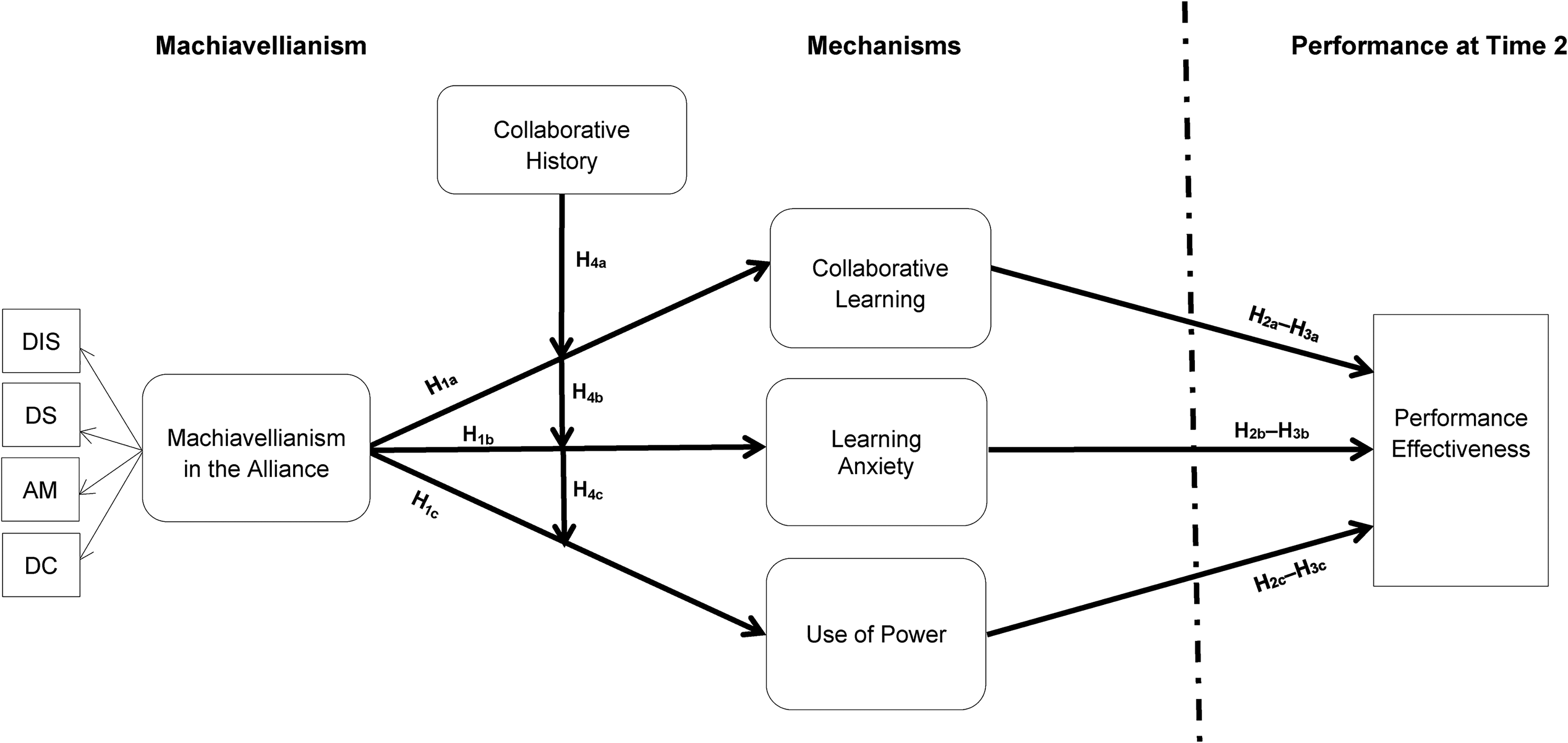
Conceptual Model.
Hypothesis Development
Effects of Machiavellianism on Learning and Power Mediating Mechanisms
Machiavellianism can affect performance through collaborative learning, learning anxiety, and use of power. Indeed, alliance arrangements often accommodate a partner's mixed motives (Luo, Rindfleisch, and Tse 2007). Machiavellian calculations in alliances aim to maximize self-interest gains by utilizing competitive and/or cooperative mechanisms, depending on the circumstances (Wilson, Near, and Miller 1996). Still, Machiavellian firms are likely to deploy competitive mechanisms (i.e., learning anxiety and use of power). For instance, interviewees asserted that Machiavellianism is fully consistent with learning anxiety, as it is “more about taking than giving.” As one CEO suggested, “Even if grasping part of what is shared by the other party is fair and bound to happen…, this isn’t quite enough for Machiavellian firms that would have the more negative, anxious type of learning goal.”
Collaborative learning requires close collaboration with the counterpart to jointly develop and learn new knowledge. With Machiavellianism, it would be difficult for the firm to sufficiently cooperate with the partner to learn how to master alliance tasks. Self-interested, Machiavellian social conduct drives the focus away from patiently combining complementary knowledge with a partner, as the Machiavellian firm desires easy gains through competing. The firm's willingness to engage in tactical exploitation of the alliance partner would inevitably lead to periods of elevated friction (Monaghan, Bizumic, and Sellbom 2016) that undermine efforts to combine knowledge.
The negative link to collaborative learning is reinforced by Machiavellianism's four dimensions. The firm's distrust and negative expectations of the partner's willingness to cooperate removes any incentive to place itself in a position of vulnerability. Such expectations weaken the appeal of striving to establish transparent routines aimed at sharing knowledge. Desire for status reduces the intention to collaborate due to concerns about status leakage, which can occur when one partner acquires knowledge exclusive to the other (Swaminathan and Moorman 2009). The potential for a negative status shift drives the firm's motivation to engage in status-protection actions (e.g., separating work routines) that block coordination efforts needed to develop and learn new knowledge with the partner. Amoral manipulation is geared toward the selfish manipulation of core knowledge when the opportunity presents itself, irrespective of the agreement to create reciprocal learning opportunities (Samaha, Palmatier, and Dant 2011). The firm's failure to make good on the agreement can deplete its motivation to engage in activities that support learning deeper knowledge with the partner. Firms with a high desire for control do not leave to chance the matter of dominance in the alliance and would be reluctant to cede control of their knowledge (Inkpen and Currall 2004). The ambition to unilaterally dominate decisions and operations is likely to impede efforts to invest in bilateral knowledge creation and learning.
Learning anxiety fuels a preoccupation with the partner's knowledge and its accessibility in the race to learn. Machiavellianism increases the firm's emphasis on developing its own abilities as well as its willingness to employ an ends-justify-the-means approach (Castille, Buckner, and Thoroughgood 2018). This may take the form of willingness to ignore social norms linked to the alliance's knowledge-creation agenda in the service of appropriating the partner's specialist knowledge before the partner becomes a threat. Indeed, it is likely that a Machiavellian firm will treat avoiding failure to learn a partner's unique skills as a standard of competitive accomplishment.
The positive link to learning anxiety is supported by the four dimensions of Machiavellianism. Distrust in the partner is likely to generate expectations of failing to learn new knowledge due to an obsessive focus on self-serving behaviors (Connelly, Miller, and Devers 2012). The Machiavellian firm will be anxious to strike first by accessing and learning new knowledge from the partner. Desire for status shapes the competitive goal of outperforming others by possessing more knowledge than them (Wu, Loch, and Ahmad 2011). The prospect of a status-based learning competition is likely to amplify the Machiavellian firm's anxieties about missing opportunities to expand its knowledge base in relation to that of the partner. Amoral manipulation captures the firm's readiness to deviate from set agreements if the situation calls for it and if there is a low chance of getting caught (Wagner, Eggert, and Lindemann 2010). In alliances, it is difficult for partners to protect themselves from knowledge disclosures. Such threatening circumstances divert the unethical firm's attention toward both the potential of losing the race to learn and the fact that the alliance provides the cover needed to pursue learning directed at not failing to acquire the partner's knowledge. Firms with a desire for control tend to view their partners as threatening, particularly if they are allowed to make decisions (Dahling, Whitaker, and Levy 2009). Retaining the upper hand requires avoiding competence stagnation in relation to the partner, which can lead to a fixation on self-preservation via information control and learning.
Use of power is triggered by suspicions that the partner may have divergent goals and a hidden agenda. A Machiavellian firm wary of within-group competition will study the partner to seek clues about its motives (Ariño and De la Torre 1998). The Machiavellian firm's pressure on the partner to impose its own goals on the alliance not only inhibits the agenda of the partnership but also forces the partner to defend its goals, which in turn surfaces them even more. Because Machiavellianism anticipates ruthless conduct in the alliance, it boosts the firm's willingness to get the job done using any means necessary (e.g., coercion).
Machiavellianism's four dimensions reinforce the positive link with the use of power. Distrust in the alliance partner leads to a cynical and wary outlook on the partner's intentions that drives the perception that the partner may have a hidden agenda. Because a distrustful firm constantly questions its partner's motives, it will incessantly press to install and protect its own agenda. Desire for status reflects the firm's ambition to use the alliance as a means of showcasing its leadership qualities and success. Use of power would be considered a way to consolidate the firm's status gains. Amoral manipulation encourages the firm to be unethical toward the partner. Squeezing the partner to test its limits requires the full use of expedients. While such expedients can be convenient and practical, they may also be immoral. An unethical firm is less likely to have qualms about using overtly aggressive tactics, including power plays that exploit a partner's weaknesses. Desire for control suggests the need to dominate alliance decisions and reduce a partner's influence, which should fuel the use of power to probe the partner's strategic priorities and impose the firm's own goals on the alliance. The potential for exploitation of a partner is the greatest when there is a power imbalance (Zheng et al. 2020). The desire for control leads a firm to try to establish such an imbalance, and the use of power exploits it. Accordingly, we posit the following:
Effects of Learning and Power Mediating Mechanisms on Performance Effectiveness
To investigate the time lag needed to reliably capture the performance outcomes of learning, we asked interviewees to expand on the time frame in which their firm achieved its learning goals in the alliance. Interviewees invariably indicated that it would take approximately a year to attain certain learning outcomes. We infer that the same time frame can reliably capture the effectiveness of power's behavioral processes. Indeed, we use the firm's effectiveness (i.e., achievement of its set objectives in the alliance) to gauge the performance effects of collaborative learning, learning anxiety, and use of power.
Collaborative learning is a mastery-approach motivation that generates the belief that new knowledge can be created and internalized through taking risks and making persistent efforts in collaborative exchanges (Elliot and McGregor 2001). In alliance research, bright-side learning that focuses on cocreation and learning new knowledge with the partner enables superior performance (Inkpen and Tsang 2007). A firm pursuing a collaborative learning agenda would view the alliance as a creator of positive learning outcomes and would understand the criticality of designing processes that facilitate and optimize the partners’ coordination efforts (Fang, Lee, and Yang 2015). Yet, to secure joint-learning benefits, the firm would need to develop standards of openness directed toward sharing and combining existing knowledge to create and learn new knowledge. Prioritizing working with the partner to maximize joint benefits to be shared—that is, a pie-expansion orientation (Jap and Anderson 2007)—is likely to encourage persistence in driving open collaboration, leading to the achievement of the firm's performance goals in the alliance.
Learning anxiety is a mastery-avoidance motivation that signifies the focal firm's short-term focus on avoiding negative learning outcomes (Elliot and McGregor 2001). In alliances, learning directed at the partner can reduce the strategic value of this partner's knowledge and the stability of the alliance itself (Inkpen and Tsang 2007). Learning anxiety is a shallow approach that diverts attention away from pie expansion and toward pie appropriation. When a firm prioritizes getting a larger share of the pie, it risks creating a competitive race to outlearn the counterpart that is both unrelated to and neglectful of core alliance tasks. The firm's fear of failing to access and learn new knowledge from the partner is a form of negative affect that precludes effective problem solving. The dark side of learning anxiety lies in its short-sightedness, which weakens the firm's own performance with regard to its set objectives—some, but not all, of which the firm might share with its partner (Ariño 2003). The obsessive ambition to access and learn is conducive to accomplishing self-interested performance goals that are incompatible with common performance objectives.
Use of power also has a dark side insofar as it leads a firm to act on suspicions that the partner has not revealed its alliance goals and has a hidden agenda that could supplant the firm's own objectives. Work on Machiavellian intelligence has advocated the use of persuasion (Orbell et al. 2004). Machiavellianism is likely to encourage a firm to use all means at its disposal to persuade a partner to accept its goals as the driving force behind the alliance's work. When a firm overtly pushes its goals, the partner is likely to compensate by surfacing and defending its own goals. The firm can then glean insights into the partner's priorities and agenda, and any incompatibilities (with its own) would become clear. In turn, a better understanding of the partner's goals helps the firm impose its own by recalculating how to use expedients (e.g., expertise) to encourage the partner to yield. Use of power can shift alliance performance goals toward the firm's self-interested objectives that are conducive to its own performance. Still, the partner will see the firm's exploitative tactics for what they are. Power plays introduce friction, resentment, and rigidity into the working relationship (Lin and Germain 1998) and undermine any sense of productive balance and fluid give-and-take, to the detriment of the collaborative work and the firm's performance in the alliance. Thus,
Although previous alliance studies have not examined the performance relevance of a firm's Machiavellianism, we expect a negative relationship. Work in other areas tends to link Machiavellianism to negative outcomes (Table 1). Machiavellianism orients the firm to the possibility of self-interested success in a manner that is not supportive of, and even deleterious to, the work and objectives of the alliance (Bagozzi et al. 2013). Still, as our TiU findings and hypotheses imply, the negative relationship is mediated. Machiavellianism aims to help a firm succeed by strategically exploiting the partner, and learning and power are the chief means of exploitation in alliances. Accordingly,
Moderating Effects of Collaborative History
We posit that collaborative history moderates the effects of Machiavellianism on the learning and power constructs. Our TiU interviews confirm the pragmatism of Machiavellianism, insofar as it can, under specific circumstances, drive cooperation. 4 One marketing director suggested that Machiavellianism was used “rarely, unless necessary, with a shoulder-to-shoulder expansive goal…. True Machiavellian firms are schemers. They find a way to hoard most of what is shared or produced.” Our review of Machiavellianism's attributes (Table 2) indicates that Machiavellian firms have social intelligence and can cooperate if there is a strategic benefit, after unfamiliar partners become understood acquaintances (Castille, Buckner, and Thoroughgood 2018). When we scrutinized if–then (except when) propositions, it became apparent that situational knowledge via shared history leads a Machiavellian firm to “to read the situation” and reorient from the dark to the bright side. For instance, a firm familiar with its partner may decide to “dial down pressure we put on them.” Collaborative history taps the number of prior alliances formed between the partners (Kale, Singh, and Perlmutter 2000).
Prior alliances with a partner provide a firm with reliable, broad-based information about their competencies and behaviors in different alliances across time. The firm would understand the partner's capabilities and how it intends to make use of these in the ongoing alliance. Such insights are important in helping partners feel confident about successfully coordinating their activities (Lioukas and Reuer 2015). Indeed, a firm with Machiavellian characteristics would be able to calculate a pathway to superior gains from a collaborative learning agenda. When the firm has knowledge of the partner and can anticipate behaviors during the execution of alliance tasks, it can better synchronize its own actions with those of the partner. The firm will rationalize attempts to overcome challenges to mastering alliance tasks and be quicker to prioritize cooperative learning opportunities. Without the confidence-boosting insights into ways of working with the partner afforded by a collaborative history, the self-interested firm is not likely to pursue collaborative learning. When collaborative history is high (vs. low), the firm's Machiavellianism can drive the process of jointly developing and learning new knowledge with its counterpart, thus flattening the negative link.
Working again with a former partner facilitates flows of core proprietary knowledge due to reduced causal ambiguity about the use of resources (Li et al. 2008). However, collaborative history also limits the risk of exploitation because it enables the firm to anticipate and detect a partner's self-interested behavior (Kale, Singh, and Perlmutter 2000). Openness and transparency in the partnership will reduce the Machiavellian fear that a race to learn with the counterpart will emerge. Further, a firm with a large number of prior alliances with a specific partner is likely to have committed extra resources to this ongoing partnership and to have seen informal commitments become institutionalized. As a result, it will be more difficult for the firm to act on its dark-side characteristics by breaking with norms and prioritizing its apprehensions. When collaborative history is low, however, there is less transparency and fewer normative blocks, which can feed Machiavellianism in the alliance via learning anxiety. As such, when collaborative history is high (vs. low), a firm's Machiavellianism is less likely to produce an anxiety-fueled desire to access and learn the partner's knowledge, thus flattening the positive link.
A firm's uncertainty about its partner's agenda in an alliance is naturally reduced through the thread of previous interactions and the deeper predictive insights that have been gleaned (Ariño and De la Torre 1998). Working with a partner across alliances creates an awareness of the patterns of development and the future trajectory of their strategic priorities. Indeed, previous collaborative processes lead partners to clarify, revise, or refocus their goals. Firms with a rich alliance history will be on the inside track of changes in their partner's circumstances and collaborative needs. Such conditions are not conducive to the Machiavellian fear of losing out to the partner's goals, and thus the firm is unlikely to overtly use power. However, in the absence of collaborative history, there are no shared experiences to temper the Machiavellian suspicions of losing out to a partner's goals. In such cases, the firm is likely to prepare for the possibility of within-group competition. Pressing the partner in the new collaboration might be viewed as a prudent step in reducing information asymmetry and conveying the firm's expectation for prioritizing its own goals. As such, when collaborative history is high (vs. low), the Machiavellian firm is less likely to use power tactics to install its own agenda in the alliance at the expense of the partner's, thus flattening the positive link. Accordingly, we offer the following hypothesis:
Method
We tested the hypotheses using a quasi-longitudinal survey of vertical marketing alliances. This approach aligns the need to tap changes in performance over time with challenges involved in gathering data on the same set of variables across years (Lynn 2009). We chose a one-year time lag for collecting the data, as our TiU fieldwork confirmed that performance outcomes can be captured reliably over this period. A one-year interval is in line with work on capturing overall changes in alliance performance (Katsikeas, Skarmeas, and Bello 2009).
The unit of analysis is an ongoing vertical marketing alliance. Such alliances are formalized collaborative arrangements between upstream and downstream partners, designed to achieve marketing-related goals such as access to and/or codevelopment of new markets, products, and allied knowledge (Fang et al. 2016). 5 We sought alliances among U.S., European, and Asian firms with different structures (i.e., equity and nonequity) in various industries to generate sufficient data for rigorous analyses and generalizability. We excluded alliances not set up to pursue marketing-related goals (e.g., those focused on production efficiency and risk). We also excluded horizontal alliances; compared with vertical ones, these present less scope for partners’ provision of complementary resources and openness in working together (Noordhoff et al. 2011; Rindfleisch and Moorman 2001). Prestudy interviews suggested that such conditions raise the likelihood of a partner's use of learning and power mechanisms across different relationship stages. We also reasoned that informants would find it easier to identify and inform on vertical alliances in successive data collection phases. We further excluded alliances involving three or more partners (most alliances are between two partners; Bello, Katsikeas, and Robson 2010) and not-for-profit firms, due in part to their idiosyncratic nature and more complex decision making.
We developed the sampling frame through a systematic search for alliance-related groups on LinkedIn. 6 We identified four active groups: Alliance Best Practice, International Strategic Alliances, Association of Strategic Alliance Professionals Community, and Partnership Marketing Alliance. We combined these groups to create a sampling frame of 19,785 alliance practitioners. This frame reduces concerns about nonsampling error, as it represents the population of interest by including professionally qualified informants and excluding foreign elements (Lessler and Kalsbeek 1992). We randomly selected 2,000 practitioners and employed a two-step validation process. We first scrutinized each potential informant's LinkedIn profile to confirm their employer (company), role (job title), experience (years in this role, prior positions, and “About Me” information), involvement in making decisions in the alliance (duties), and membership in more than one LinkedIn group (i.e., duplication). We discarded 659 practitioners from our list, as they did not hold an alliance job, had less than one year of in-role experience, were not involved in alliance decision making, and/or belonged to another LinkedIn group. Second, we approached the remaining 1,341 practitioners via a LinkedIn (InMail) message, standard email, and/or telephone call to inform them about the study, verify if they currently managed a marketing alliance, and request their participation. This process increased the accuracy of our sample.
We asked informants to take their firm's perspective (e.g., for Machiavellianism) in a marketing alliance they knew well. Those who accepted our invite were provided with a link to the online survey and a cover letter outlining the study's aims. We also sent two reminders about completing the survey and a “thank you” message. Of the 447 questionnaires received, we discarded 32 with missing data and 11 that scored poorly in an informant competency check at the end of the questionnaire. 7 The average score across our competency questions was 6.19. We achieved a time-one response rate of 30.1% (404 out of 1,341).
One year later, a second phase of data collection targeted the 404 first-phase informants. We contacted these informants via InMail, email, and/or telephone. Again, we provided them with the link to the online survey and a letter explaining the study's purpose. After two reminders, we received 211 questionnaires and removed 12 that were incomplete or did not meet our informant competency check. In total, we collected 199 completed surveys for a time-two response rate of 49.3%—a favorable response, given respondent attrition in longitudinal marketing alliances (Rindfleisch et al. 2008). Second-phase informants’ average competency score was 6.14, and the average period spent managing an ongoing alliance 3.8 years. Web Appendix F presents descriptive characteristics for the study sample.
Except for collaborative history and alliance development stage, we captured constructs with multi-item scales (1 = “strongly disagree,” and 7 = “strongly agree”) taken from the literature and adapted to our empirical context; we report items and sources in Table 3. We organized prestudy interviews with 14 alliance executives and 11 academics familiar with alliance work to assess and refine the conceptual model, construct conceptualizations, and measures. Next, we ran a pilot with 85 eligible informants. We received 27 questionnaires that were omitted from the main study. The pilot raised no issues with the instructions or the measures.
Measurement Model Results.

SL = standardized loading.
Second-order path loadings in the Machiavellianism construct are at acceptable levels for distrust in the alliance partner (SL = .95, t = 7.97), desire for status (SL = .72, t = 2.32), amoral manipulation (SL = .73, t = 5.37), and desire for control (SL = .91, t = 4.97).
Formative measure.
Categorical measure that was rendered ordinal.
eInformants were presented with a brief statement: “Marketing alliances typically evolve through a number of stages over time. Which of the following best describes your current relationship with the specific alliance partner?” Informants then selected one of four stage descriptions. Our prestudy interviews with marketing alliance executives confirmed that the descriptions depicted their alliances, and the pilot test revealed no issues.
Notes: Fit indices: chi-square = 801.64 (d.f. = 420), p = .00; CFI = .94; IFI = .94; NNFI = .93; RMSEA = .058. “My firm” refers to the focal firm that answered all the questions.
To assess potential nonresponse bias, first, we compared early and late respondents at times one and two with respect to the study constructs and other characteristics (e.g., alliance employee number, partner size, and research-and-development [R&D] investments). Second, using secondary data on employee numbers and annual sales, we compared the 199 responding firms with a group of 70 randomly selected nonresponding firms (about a third of the nonrespondents). Third, we secured responses to 10 questionnaire items from 58 randomly selected nonrespondents—half of the nonrespondent group (103 firms)—which we compared with those from our responding firms. All t-tests revealed no significant differences (p < .05) between the two groups, suggesting that nonresponse bias is not an issue of concern.
We controlled for related variables to account for additional drivers of learning, use of power, and performance. We used alliance-level (development stage, age, importance, knowledge complementarity, function, employee number, nationality, nonequity, and non–end point), partner firm–level (strategic importance, R&D investments, opportunism, size, reputation, and information exchange norms), and industry-level (type and competitiveness) controls. Web Appendix G presents the logic and measurement details for these variables.
Analysis and Results
Measure Validation
We followed conventional procedures to establish the validity and reliability of our reflective scales for every multi-item measure, except for formative desire for status. Cronbach's alpha scores for the scales tapping the study constructs were satisfactory, ranging from .85 to .95. The average variance extracted (AVE) for each construct was equal to or higher than the .50 cutoff (Fornell and Larcker 1981). Cronbach's alpha and AVE scores appear in Table 4, along with correlations among the study constructs and control variables.
Correlations, Descriptive Statistics, and Reliability Measure.

Because formative indicators tap distinct facets of desire for status, α and AVE estimates cannot be used to assess the adequacy of our formative construct.
Marker variable used for method bias procedure.
Notes: N.A. = not applicable. N = 199; correlations ≥ .18 significant at the .01 level and ≥.14 significant at the .05 level (two-tailed). Bolded numbers on the diagonal are the AVEs.
We ran a confirmatory factor analysis in EQS—deploying the elliptical reweighted least-squares estimation procedure—for the study constructs. This procedure permits unbiased estimates for both multivariate normal and nonnormal data. We report the results in Table 3. The goodness-of-fit indices suggest satisfactory fit, and first-order factor loadings are greater than .63 and significant at p < .01. The second-order path loadings in the Machiavellianism construct all exceed .71. Thus, the scales used to tap the study constructs have satisfactory convergent validity. To examine discriminant validity, we checked whether the AVE for each variable exceeded its highest shared variances with other constructs (Fornell and Larcker 1981). The results of this test raised no issues of concern (see Table 4).
To determine the validity of our formative index for desire for status, we followed established guidelines (Diamantopoulos and Winklhofer 2001). Specifically, we conducted a review of the pertinent literature first to specify the domain of content tapped by the construct and then to identify and specify a set of indicators that fully define the domain of the construct. We identified six formative items. To ensure that our six formative items constitute an inclusive index that fully defines and causes desire for status, we used a Q-sorting procedure in our prestudy interviews (Petter, Straub, and Ra 2007). We also followed statistical procedures for assessing and purifying formative indicators (Diamantopoulos and Winklhofer 2001; Jarvis, MacKenzie, and Podsakoff 2003). The resulting evidence (see Web Appendix H) suggests no concerns about the validity of our formative measure.
Because we gathered data on performance effectiveness one year later than we did for its drivers, this reduces common method bias (CMB) concerns. Still, we minimized CMB in the data by following established procedures (MacKenzie and Podsakoff 2012). Specifically, we ensured that informants possessed sufficient knowledge of the topic and guaranteed their anonymity. We opted for simple and comprehensible item wording and negatively worded some items in the questionnaire. Further, we applied the correlation-based marker variable technique to test for CMB (Lindell and Whitney 2001). We deployed a marker variable (i.e., alliance partner's attractiveness; single item from Jap and Anderson [2007]) deemed to be not linked to at least one of the study constructs (i.e., alliance development stage). To identify CMB, we noted the correlation between the marker variable and the theoretically unrelated construct. We observe (see Table 4) low shared variance between the marker variable and the unrelated construct (r = .01). We used this value to estimate a CMB-corrected matrix and a marker measurement model using the corrected matrix. Next, we ran a chi-square difference test between the marker measurement model and our initial measurement model. Because we observed no deterioration in fit (p < .05), CMB is not a serious issue in this study.
Tests of Hypotheses
We tested the hypotheses following Preacher and Hayes’s (2008) bootstrapping procedures (PROCESS Model 7; 5,000 bootstrapped samples; bias-corrected percentile confidence intervals). In using bootstrapping, we do not need to make any assumptions about the shape of the sampling distribution when conducting inferential tests (Preacher, Rucker, and Hayes 2007). We report the model estimations in Table 5.
Model Estimations.

Notes: N = 199; SEs in parentheses; 95% CIs in square brackets; number of bootstrap samples is 5,000; two-tailed tests of significance.
We find that Machiavellianism in the alliance is linked negatively to collaborative learning (b = −.40, SE = .14, p = .00) and positively to learning anxiety (b = .32, SE = .13, p = .01) and use of power (b = .49, SE = .20, p = .01), in support of H1a, H1b, and H1c. We also find that whereas collaborative learning is linked positively to performance effectiveness (b = .26, SE = .07, p = .00), learning anxiety and use of power are linked negatively (b = −.21, SE = .08, p = .01; b = −.16, SE = .05, p = .00, respectively), in support of H2a, H2b, and H2c.
In accordance with our mediation thesis, we tested whether Machiavellianism harms performance through collaborative learning, learning anxiety, and use of power. We estimated the confidence interval (CI) for the indirect effect of Machiavellianism in the alliance on performance effectiveness via collaborative learning (b = −.10, SE = .04, p = .02, 95% bootstrap CI = [−.224, −.025]), learning anxiety (b = −.07, SE = .03, p = .03, 95% bootstrap CI = [−.159, −.014]), and use of power (b = −.08, SE = .04, p = .03, 95% bootstrap CI = [−.184, −.020]). We also observe that Machiavellianism's negative direct effect on performance (b = −.31, SE = .13, p = .02) becomes nonsignificant (b = −.04, SE = .14, p = .80) when the three mediators are taken into account. These results provide evidence for full mediation (Zhao, Lynch, and Chen 2010) for collaborative learning, learning anxiety, and use of power, in support of H3a, H3b, and H3c. The results imply that Machiavellianism orients a firm toward pursuing self-interested success via learning and power mechanisms in a manner that is deleterious to core tasks and performance objectives set for the alliance.
We also find that collaborative history positively moderates paths between Machiavellianism in the alliance and collaborative learning (b = .15, SE = .06, p = .01) and learning anxiety (b = −.12, SE = .05, p = .01), but not use of power (b = −.03, SE = .09, p = .76), in support of H4a and H4b, but not H4c. Plots of the significant effects (Figure 2, Panels A and B) show that Machiavellianism's negative link to collaborative learning and positive link to learning anxiety are present when collaborative history is low (vs. high). Working repeatedly with the partner across alliances gives the firm a broad understanding of their expertise and situational knowledge that allows Machiavellian tendencies to shift from triggering learning anxiety in a perceived race to learn to driving collaborative learning.

Plots of Interaction Effects.
Additional Analyses
While our moderation thesis focuses on the social intelligence behind Machiavellian firms’ use of learning and power, we explore whether the way firms benefit from these is also a function of the alliance's situation. Our TiU fieldwork reveals that outcomes of learning and power are shaped by their differential functioning across stages. Interviewees suggested a peaking and tailing off (“beyond a certain stage of alliance development”), indicating that the alliance development stage might have an inverted U-shaped moderation effect. Following previous work (Palmatier et al. 2013), we reason that alliances evolve over four life-cycle stages: introduction, growing, early maturity, and late maturity (for descriptors, see Table 3).
Collaborative learning has the potential to maximize joint knowledge development in the alliance, but this may not materialize in early-stage alliances. Understanding the complementarities of partners’ resources and how to embrace opportunities to reflect on shared working patterns will increase as the alliance develops toward maturity (Jap and Anderson 2007). Still, the positive effect of development stage on the link between collaborative learning and performance is likely to tail-off when the novelty of partners’ resource combinations fades in late-stage alliances (Palmatier et al. 2013). Learning anxiety can lead to a fixation on achieving learning benefits from the partner, and this can be damaging to early-stage alliances because it can prevent the alliance from moving into a pie-expansion mode. As the alliance advances to maturity and both parties have built up credit with each another, the firm's anxiety about acquiring new skills from the partner is likely to be less detrimental. That said, in late-stage alliances, the neglect of core tasks resulting from learning anxiety might signal a final free-for-all and hasten the decline of a productive relationship. Use of power is particularly disruptive in early-stage alliances. Against the backdrop of a contested agenda, partners might be reluctant to take the first steps needed to move the alliance onto a productive footing. Yet, as an alliance develops toward maturity, the stability and strength of the working relationship can help accommodate the firm's use of power. In late-stage alliances, the firm's use of power will be viewed as a hostile act to secure self-serving ends (Rindfleisch and Heide 1997).
Following Preacher and Hayes’s (2008) bootstrapping procedures (PROCESS Model 1; 5,000 bootstrapped samples; bias-corrected percentile confidence intervals), we tested for the moderation effects of the square term of alliance development stage. The performance relevance of collaborative learning (b = −.17, SE = .07, p = .01) and learning anxiety (b = −.21, SE = .07, p = .00), but not use of power (b = −.02, SE = .05, p = .68), are conditional on the square term of alliance development stage. Plots of the significant effects confirm the existence of inverted U-shaped moderation (see Web Appendix I). 8
To assess if Machiavellianism and collaborative history are endogenous, we used the instrument-free Gaussian copula method (Wetzel et al. 2018). 9 The results show that these regressors are not endogenous. We also ran a moderated mediation analysis to identify if there are paths through which Machiavellianism positively affects performance. The results reveal conditions in which Machiavellianism's negative performance effects via collaborative learning and learning anxiety are neutralized. Finally, we tested country-level trust effects, a rival moderator to collaborative history, and if Machiavellianism changes over time. Web Appendix J presents these additional analyses.
Discussion
Theoretical Contributions
Our theoretical contributions are threefold. First, we extend research on the nature and functioning of Machiavellianism in alliances. Despite the realpolitik of alliances juxtaposing bright- and dark-side opportunities, scholars have overlooked Machiavellianism's relevance for learning and power (Oliveira and Lumineau 2019). Dark-side alliance work has studied how defection behaviors, such as opportunism, result from economic calculus (Noordhoff et al. 2011). Machiavellianism's novelty lies in its recognition of different social strategies depending both on beliefs that predispose a firm to act in certain ways across alliances and on a behavioral side that allows Machiavellianism to update due to experiences in a specific alliance. We extend knowledge about Machiavellianism by revealing that it is not a fixed, firm-level disposition; rather, it differs across alliance settings.
Based on the Machiavellian intelligence perspective (Bereczkei 2018), we posit that firms ready themselves for within-alliance competition using goal-oriented learning and power mechanisms. We show that Machiavellianism is linked negatively to collaborative learning and positively to learning anxiety and use of power. While Machiavellianism naturally drives learning anxiety, it can, under certain conditions, encourage collaborative learning. Our results suggest that collaborative history improves the Machiavellian firm's ability to read its partner (Bigley and Pearce 1998), which causes an adjustment from learning anxiety to collaborative learning. Firms understand that they cannot attain set performance goals via competition alone, and a planned cooperative response to a potential race to learn is needed. However, Machiavellian use of power to dominate the alliance's agenda is immune to knowledge built via collaborative history. Future work might examine what, if not historical familiarity, can coax a socially intelligent Machiavellian firm to ease its use of power.
Second, we provide new evidence that collaborative learning has a positive performance effect, as opposed to the negative effects of learning anxiety and use of power. The results uphold achievement goal theory's premise that mastery-approach and mastery-avoidance motivations have beneficial and detrimental learning consequences, respectively (Elliot 1999). The contrasting performance effects of collaborative learning and learning anxiety, which firms may hold simultaneously (r = .29), advance knowledge of the mixed strategic intents that shape firms’ alliance decision making (Nippa and Reuer 2019). The harmful effect of use of power extends the Machiavellian intelligence idea about the capacity to read and persuade a partner to accept and believe what is in the firm's interests (Orbell et al. 2004) to the study of influence strategy outcomes in alliances (Bagozzi et al. 2013).
Moreover, we find that collaborative learning, learning anxiety, and use of power fully mediate the link between a firm's Machiavellianism and performance in the alliance. The paradox of Machiavellianism is that it is a strategy a firm uses to manipulate the partner to improve its own gain, but doing so is likely to prove detrimental to its performance in the alliance. Machiavellianism harms performance by (1) weakening collaborative learning, which enhances the effectiveness of alliance work, and (2) strengthening learning anxiety and use of power, which reduce performance. Our additional analyses reveal positive moderated mediation effects that neutralize the negative mediation paths.
Third, alliance scholars (e.g., Palmatier et al. 2013) have long emphasized the need to incorporate temporal aspects when researching the performance relevance of learning and power mechanisms. Arguably, previous cross-sectional studies—which, by design, have downplayed the fact that performance outcomes of such processes need time to unfold—have contributed to the current state of inconclusive findings (e.g., Web Appendix C). Our quasi-longitudinal design provides novel insights into performance effects of collaborative learning, learning anxiety, and use of power and helps disentangle the complexities of learning–performance and power–performance linkages by taking into account relationship stage.
The study reveals that the performance relevance of collaborative learning and learning anxiety, but not use of power, is moderated by alliance development stage. There is a steepening positive conditional effect when the stage moves toward medium levels for collaborative learning and learning anxiety. This finding extends the view that cooperative information exchanges need time to produce results and shows that the firm's anxiety over failing to acquire new knowledge from the partner is less destructive when the alliance is at its productive peak. In mature or late development stages, steepening negative conditional effects imply that opportunities to attain set performance goals tail-off for learning aspects. Use of power is consistently bad for performance across the stages.
We offer explanations for our unsupported moderation effects regarding the use of power. First, the results do not support H4c, which predicted that Machiavellianism's link with use of power would be negatively moderated by collaborative history. This may be attributed to Machiavellianism's sensitivity to situational changes (see Table 2). Although a prior relationship can boost the firm's ability to read its partner, Machiavellian firms expect the partner's (hidden) goals to be subject to ongoing changes (Ariño and De la Torre 1998). Continuous use of power is needed to surface and counter the partner's revised agenda. Second, the expected U-shaped moderation effect of alliance development stage on the use of power–performance path is not validated. Use of power is detrimental even when the relationship has grown stronger and more stable. Prima facie, a firm's continued pressure, when the alliance should be achieving a productive balance underscored by shared goals, triggers partner resentment.
Managerial Implications
Alliance managers should know that Machiavellian strategizing hurts performance by (1) weakening motivations to develop and learn new knowledge with the partner, (2) strengthening motivations related to anxiety about failing to access and learn new knowledge from the partner, and (3) increasing the use of power to dominate the alliance's agenda. Machiavellian firms’ preoccupation with competitive, not cooperative, mechanisms negatively affects performance. A post hoc test reveals that high (top 25%), compared with low (bottom 25%), Machiavellianism reduces performance by 11.4%. It also lowers collaborative learning by 10.5%, although high (vs. low) collaborative learning increases performance by 17.3%. High (vs. low) Machiavellianism increases learning anxiety by 24.8% and use of power by 44.6%, which is problematic because low (vs. high) learning anxiety and use of power boost performance by 5.9% and 14.4%, respectively. The observed strength of the dark-side route through the use of power, along with the nonsignificant moderation findings for the power mechanism, mark it as a key concern for alliance management.
Machiavellian firms, pragmatic in their thinking, will support a collaborative knowledge agenda if they perceive a strategic benefit. Machiavellianism encourages a switch from learning anxiety to collaborative learning when there is situational knowledge resulting from collaborative history. In the absence of collaborative history (bottom 25%), high (top 25%), compared with low (bottom 25%), Machiavellianism reduces collaborative learning by 16.2% and increases learning anxiety by 44.4%. However, in the presence of collaborative history (top 25%), high (vs. low) Machiavellianism boosts collaborative learning by 6.7% and reduces learning anxiety by 2.3%. Managers’ ability to harness shared experiences is key for Machiavellian firms to move from an adverse dark-side to a functional bright-side learning route. Firms that have invested in building a shared history with partners can nullify the harmful performance effect of Machiavellian strategizing via collaborative learning and learning anxiety (i.e., negative mediation effects become nonsignificant).
Managers should find advantage in deploying collaborative learning at medium levels of alliance development when its performance benefits materialize. The challenges of executing collaborative learning are more acute in early-stage alliances before cooperative routines have solidified and in late-stage alliances when the freshness of partners’ resource combinations fades. Managers also need to be cognizant of learning anxiety's damaging performance effect in early-stage alliances, as it prevents the alliance from making progress on core tasks, and in late-stage alliances, as the firm risks hastening the decline of a partnership.
Understanding how to identify a Machiavellian partner would be beneficial for practitioners, as such partners are adept at creating the illusion of cooperation. Our TiU discussions surfaced manifestations of Machiavellianism's behavioral side, including a partner's hypervigilance (“it's better not to leave the stable door open”), authoritative work patterns (“determine the … goals, and lead the way to secure these in this alliance”), and calculative adaptations (“you must shift your natural orientation to do things in a way that fits the situation”). Firms may find it prudent to set up an alliance with a partner with Machiavellian characteristics, provided the partner offers a good fit of capabilities for the alliance work. The challenge facing managers is to surface this partner's Machiavellianism and suppress its deleterious effects, until they can find value in collaborative learning.
Limitations and Directions for Future Studies
Our findings should be considered in light of limitations inherent in our research design choices. Efforts to generalize should be made with caution, as the study's findings focus on alliances among U.S., European, and Asian firms. Replicating our study in other country contexts would enhance external validity. Our sample was restricted to upstream and downstream marketing alliances. Future work could test our assertions in horizontal alliances that, prima facie, have a different profile of collaborative learning, learning anxiety, and use of power.
The study's dynamic perspective involved capturing performance outcomes of collaborative learning, learning anxiety, and use of power using a one-year time lag in performance effectiveness and scrutinizing these effects across different alliance development stages. Future studies might expand our design to include additional partner data points over a longer time period. However, response attrition is an acute problem in longitudinal alliance research due to the natural instability of these arrangements and turnover among alliance executives (Rindfleisch et al. 2008). Further, our study of Machiavellianism's outcomes used the perspective of a single partner in the alliance. Despite the difficulties involved in collecting dyadic data over time, future work could adopt a two-partner approach to extrapolate conclusions for the alliance as a whole.
In addition, given the importance of a firm's absorptive capacity for learning within alliances (Xiong and Bharadwaj 2011), a natural extension of our theorization about linkages between goal-oriented learning and performance would consider the firm's ability to recognize and absorb new knowledge. Firms characterized by Machiavellianism possess a social intelligence and can cooperate with the partner if they perceive a strategic benefit for themselves. We show that collaborative history can reorient a firm's learning path from the dark to the bright side. Yet our TiU interviews also hint at a theme of self-monitoring—Machiavellian firms can restrain negative behaviors when needed—that could furnish additional moderators of the Machiavellian tendency to change mechanisms to avoid disruption. As one interviewee likewise hinted, the ability “to adapt the alliance might smoothen the effects” of competitive learning and power tactics (Chmielewski-Raimondo et al. 2022). In particular, future work should identify boundary conditions that nullify the harmful performance effect of Machiavellian strategizing via use of power.
Supplemental Material
sj-pdf-1-jmx-10.1177_00222429221100186 - Supplemental material for Machiavellianism in Alliance Partnerships
Supplemental material, sj-pdf-1-jmx-10.1177_00222429221100186 for Machiavellianism in Alliance Partnerships by Giuseppe Musarra, Matthew J. Robson and Constantine S. Katsikeas in Journal of Marketing
Footnotes
Associate Editor
Stefan Wuyts
Declaration of Conflicting Interests
The author(s) declared no potential conflicts of interest with respect to the research, authorship, and/or publication of this article.
Funding
The author(s) received no financial support for the research, authorship, and/or publication of this article.

Notes
References
Supplementary Material
Please find the following supplemental material available below.
For Open Access articles published under a Creative Commons License, all supplemental material carries the same license as the article it is associated with.
For non-Open Access articles published, all supplemental material carries a non-exclusive license, and permission requests for re-use of supplemental material or any part of supplemental material shall be sent directly to the copyright owner as specified in the copyright notice associated with the article.
