



Abstract
Why do some technology products enjoy enduring continued use, whereas others are quickly discarded? Existing marketing research explains that continued use is motivated by cost–benefit decisions over how useful and easy to use a tech product is. Yet the interconnected nature of contemporary technologies means that continued use can depend on tech products’ capacities to interact with other devices, objects, infrastructures, and people as parts of assemblages that generate useful properties. By analyzing interview and observational data of technology consumption through the lens of assemblage theory, the authors identify four continued use trajectories. These explain different paths from adoption to discontinued use by distinguishing component parts’ capacities to interact and hold assemblages together to sustain emergent properties. In each trajectory, continued use is sustained by entropy work to support a tech product's usefulness and ease of use. The authors consider implications of entropy work for theories of continued use and broader marketing scholarship, and offer recommendations to help firms manage the opportunities and risks that accompany different continued use trajectories.
Following adoption, tech products can follow a variety of continued use trajectories. Some products are immediately useful, easy to use, and provide years of continued use. Yet others are dogged by connectivity failures, battery woes, and crashing apps that force users to check connections, reset devices, apply updates, consult YouTube, seek help, or simply discard the product. Such issues make tech products harder to use, burdening consumers with work to sustain usefulness among their interconnected technologies (Business Wire 2018; Hill 2023).
Current marketing research explains that continued use is motivated by cost–benefit decisions concerning individual tech products (e.g., Setterstrom, Pearson, and Winwig 2013; Shaw, Ellis, and Ziegler 2018). However, these studies stop short of explaining how continued use is affected by the increasingly interconnected nature of contemporary tech products (e.g., Epp, Schau, and Price 2014; Hoffman and Novak 2018). Research also has yet to explain how continued use is sustained when relations between interconnected objects fall apart over time (Bryant 2014).
Accordingly, we ask: Why do some tech products enjoy enduring continued use while others follow more problematic trajectories? and How do humans and objects sustain a tech product's continued use over time? We answer these questions by theorizing continued use as emerging within technology assemblages composed of diverse components (Epp, Schau, and Price 2014; Hoffman and Novak 2015, 2018; Schneider-Kamp 2024) with varying capacities to sustain tech products’ usefulness and ease of use. This perspective enables us to reveal four continued use trajectories that trace different paths from adoption to discontinued use in which continued use is more or less successfully sustained.
Our study extends marketing scholarship in three ways. First, we show how the continued use of interconnected technologies depends on levels of entropy, the tendency for assemblages to fall apart (Bryant 2014). Second, since entropy is a persistent obstacle to continued use, we conceptualize entropy work as the actions of humans and objects to hold assemblages together to sustain continued use. Third, our considerations of entropy and entropy work contribute to broader studies of technology consumption by explaining ways in which tech products frustrate consumers. Based on these contributions, we offer managerial considerations to help firms tackle opportunities and risks raised by entropy and entropy work. Such considerations can enable firms to support continued use to raise customer satisfaction, loyalty, and intentions to adopt associated products (Shih and Venkatesh 2004).
Continued Use Theories
Continued use theories explain why consumers may or may not sustain tech product use after initial adoption. Chief among these are the technology acceptance model (Davis 1989), the unified theory of acceptance and use of technology (Venkatesh, Thong, and Xu 2012), and variations of these theories (e.g., Canhoto and Arp 2017; Setterstrom, Pearson, and Winwig 2013). In all cases, continued use is explained as a choice based on users’ contextual judgments about the ongoing costs and benefits of using a tech product (Kim 2009; Ortiz de Guinea and Markus 2009).
Such factors include a technology's potential to enable tasks, conceptualized as usefulness; how simple it is to apply to tasks, conceptualized as ease of use; how enjoyable it is to use; and its desirability (Kulviwat et al. 2007; Wood and Moreau 2006). These theories also hold that continued use is maintained by habits (Kim 2009). When users grow familiar with a tech product, habits form. Thereafter, continued use can become second nature rather than a conscious choice (Ortiz de Guinea and Markus 2009; Shaw, Ellis, and Ziegler 2018).
Notwithstanding these contributions, marketing scholarship has yet to explain how the increasingly networked nature of contemporary technologies impacts continued use. When a tech product's use requires connections to other products and infrastructures (Epp, Schau, and Price 2014; Hoffman and Novak 2018; Novak and Hoffman 2023; Setterstrom, Pearson, and Winwig 2013), we suggest that continued use may be driven by forces beyond consumers’ intentions or habits.
Consider how gaming consoles require televisions, Bluetooth, internet connections, and electricity infrastructures to function. Despite a consumer's intention to use their console, continued use is facilitated or disrupted depending on whether these products can establish and maintain their connections. To consider how the interconnected status of technologies influences continued use, we next turn to assemblage theory (DeLanda 2006).
Rethinking Continued Use with Assemblage Theory
Assemblage theory enables us to rethink continued use by offering a range of concepts that help us analyze how tech products are entangled with humans and other objects, as well as what transpires from these interconnections (Canniford and Bajde 2015). Table 1 introduces key assemblage concepts that inform our rethinking of continued use.
Assemblage Theory Concepts.
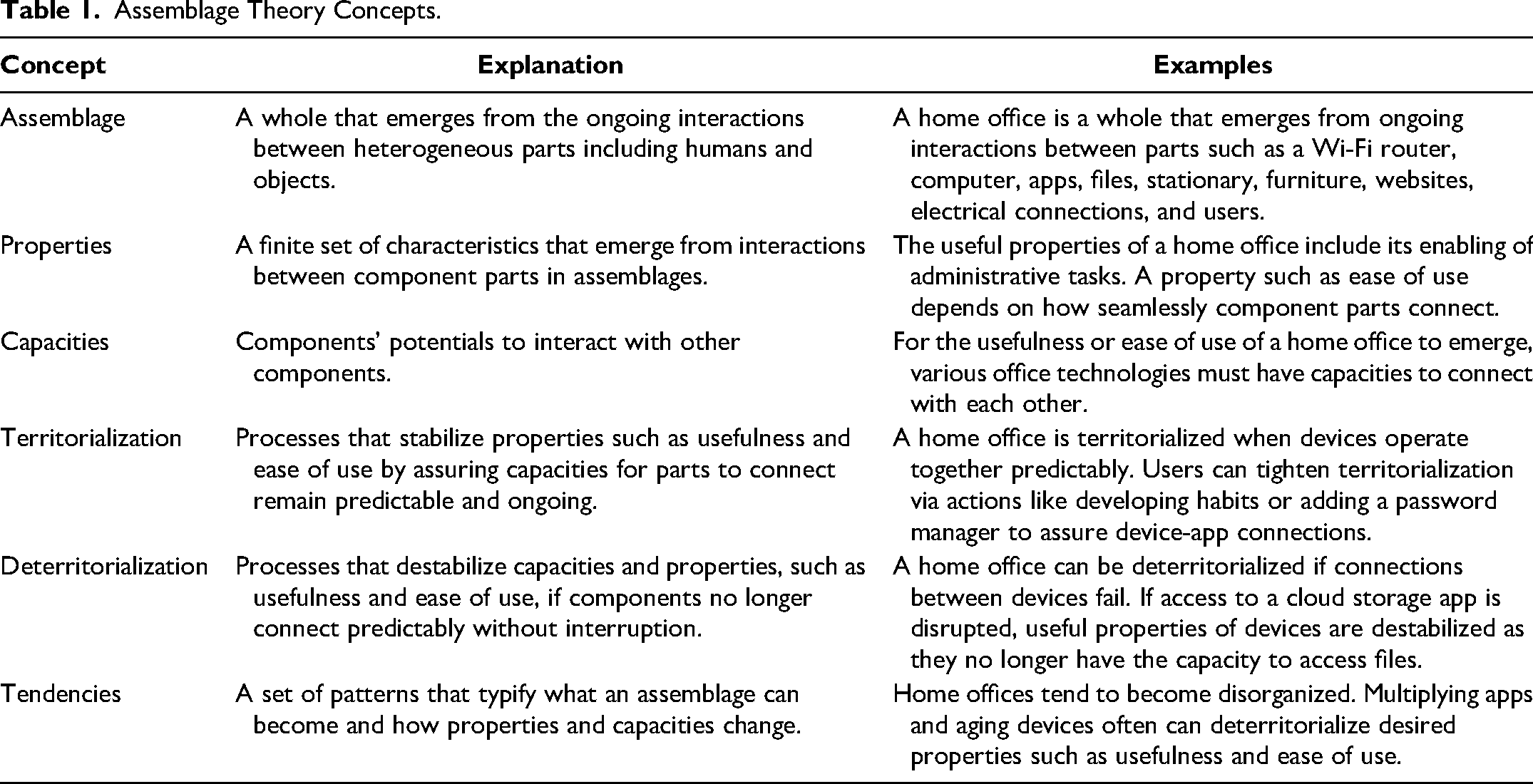
An assemblage is an ensemble of component parts whose ongoing interactions produce a whole with “properties that its components do not have” (DeLanda 2016, p. 5; Hoffman and Novak 2018). By viewing usefulness and ease of use as emergent properties of assemblages, we highlight how these drivers of continued use depend on relations between component parts and the whole they establish, rather than being inherent features of any one tech product. For properties like usefulness and ease of use to emerge, however, component parts must be able to affect or be affected by other components. DeLanda (2006) labels these potentials to interact “capacities” (Hoffman and Novak 2018). Capacities are particularly helpful for thinking about ease of use. Put simply, when technologies have the capacity to connect seamlessly and automatically, consumers will derive useful properties easily.
When parts are well-related and uses emerge unproblematically and predictably, assemblages are said to be “territorialized” (DeLanda 2016; Novak and Hoffman 2023). Think of an old-fashioned hi-fi in which connectivity between a turntable, records, an amplifier, speakers, and electricity might sustain its useful properties for decades of continued use. Yet if components like cables wear out or if the turntable loses power, then capacities to connect fail. In such cases, assemblages are deterritorialized (DeLanda 2016; Hoffman and Novak 2018; Parmentier and Fischer 2015). Deterritorialization tends to alter capacities in assemblages in ways that disrupt emergent properties like usefulness and ease of use.
Territorialization and deterritorialization may also occur when components enter and exit assemblages (DeLanda 2016). Such considerations are relevant given the highly portable and connected character of digital technologies. As smartphones and laptops are carried around, or as apps and other devices are added or removed, capacities alter, potentially disrupting existing properties or revealing new ones (DeLanda 2006). For instance, smartphones can connect with myriad other devices, revealing novel properties when components with well-matched capacities enter an assemblage (DeLanda 2016). These properties can be useful, such as when portable devices connect automatically to Wi-Fi networks on the move, or when novel uses are created through the capacities to combine programmable applets with smart technologies (Novak and Hoffman 2023).
However, altered capacities can also lead to less favorable outcomes. Bryant (2014) conceptualizes this characteristic of assemblages as entropy: a measure of the potential for unruly capacities to deterritorialize an assemblage. When entropy is low, assemblages are territorialized with expected properties intact. Our hi-fi example is a case in point. However, Bryant (2014) explains that assemblages tend to transition to higher entropy states over time. Consider how smartphones often become harder to use as apps and connections to other devices multiply over years of use (Merkel 2017). This transition can be considered a “tendency” of an assemblage. Tendencies describe a set of patterns that typify what an assemblage can become (DeLanda 2011). Technology assemblages tend toward entropy. As unruly capacities mount and deterritorialize an assemblage, its properties are also at risk.
In these instances, if useful properties falter or unwanted properties manifest, then users are confronted with work to rectify these problems. Prior studies offer clues as to how consumers work at “reterritorializing” assemblages, for instance by updating or replacing problematic devices when they become dysfunctional (Epp, Schau, and Price 2014; Godfrey, Price, and Lusch 2022; Hoffman and Novak 2018). Nevertheless, these studies stop short of explaining the potentially ongoing and diverse nature of this work, how it can vary in timing, extent, and efficacy, and how objects also perform work. Beyond the reactive quality of reterritorialization, for example, consumers may proactively anticipate and address unruly capacities by taking the time to fit protective cases, toggle settings, or clean devices to head off problems before they can occur (Cipriani 2022). Moreover, tech products themselves perform ongoing work in assemblages, implementing automated backups and running virus scans and system updates.
To extend knowledge of these possibilities, it is necessary to take a longitudinal perspective on tech product use as part of broader technology assemblages. In doing so, we view continued use as an outcome of tech assemblages impacted by entropy. Increases in entropy necessitate work to sustain usefulness and ease of use. This perspective informs how we investigate our research questions: (1) Why do some tech products enjoy enduring continued use, whereas others follow more problematic trajectories? and (2) How do humans and objects sustain a tech product's continued use over time?
Methods and Data Analysis
To address our research questions, we developed a longitudinal, qualitative research design (Canniford and Shankar 2013; Epp and Price 2010). We next explain how interviews and observational data enable us to extend prior research on continued use (e.g., Setterstrom, Pearson, and Winwig 2013; Shaw, Ellis, and Ziegler 2018) by exploring consumers’ tech assemblages and how both humans and objects sustain these in naturalistic contexts.
Study Participants
Participant recruitment began using posters on university and shopping center noticeboards as well as through personal networks. Subsequently, snowball sampling sought participants of diverse ages and tech skills. As our analysis unfolded, we observed how continued use often involved family members. Accordingly, we sampled families for interviewing procedures (Epp, Schau, and Price 2014). To include older adults who were missing in initial interviews, the first author contacted a retirement village for people over age 60. This enabled access to further home interviews and naturalistic observations of tech product uses, as well as family technology uses during relatives’ visits in person and via video chat.
Interviews
Semistructured interviews ranged from 30 to 90 minutes in participants’ homes or public locations (McCracken 1988). Participants were asked to choose tech products to discuss via interview prompts (Mick and Fournier 1998). Participants’ choices reflected common contemporary technologies (e.g., smartphones, laptops). Interviews began with grand tour questions (McCracken 1988) that elicited the contextual history of a tech product's use within tech assemblages. To strengthen our longitudinal perspective, six follow-up interviews took place. These enabled us to check in on tech products that were featured in earlier interviews and to ask updated questions as our theoretical framework emerged (Canniford and Shankar 2013). Altogether, we conducted 31 interviews with 21 individuals and 4 families, detailing a diverse set of tech products through 526 pages of single-spaced transcripts (see Table 2).
List of Participants and Tech Products Studied (Referred to by Pseudonym).

Denotes participants recruited from the retirement village.
Notes: F = female; M = male; VR = virtual reality; DSLR = digital single-lens reflex.
Participant Observation
To gather information on tech product use in naturalistic contexts, the first author carried out participant observation (Canniford and Shankar 2013). Participant observations augmented interview data. By observing participants using technologies in the home, at work, and in public places we were able to chronicle tech products’ stable or changing connections and interactions in assemblages (Epp and Price 2010). In addition, the first author volunteered in a retirement village as a “tech helper” to assist residents and their families. This enabled us to gather observations on group interactions with technologies. Weekly observations took place in residents’ homes and community spaces during 76 visits over an 18-month period. Participant observation generated 156 pages of single-spaced field notes and 122 photographs.
Data Analysis
Data were analyzed in two stages. First, interviews and observations were visually mapped to create a time line of a tech product's continued use within assemblages of humans and objects. Our data enabled us to produce 105 such visuals (see Figure 1). Each visual treats the tech assemblage it represents as our unit of analysis (Epp, Schau, and Price 2014). Second, these visuals enabled us to abstract further. Specifically, tracing components’ shifting capacities and deterritorialization potentials in assemblages showed that some tech products experienced enduring continued use, while others faced declining usefulness or ease of use, sometimes resulting in discontinued use. Our analysis also highlighted how both humans and objects respond to such declines. Together, these analyses revealed singular or successive issues that hinder continued use and the ways humans and objects sustain usefulness and ease of use.

Example Tech Product Continued Use Time Line Map.
Four Continued Use Trajectories
We explain four continued use trajectories that trace how entropy and work influence tech product uses from adoption to discontinued use. As Figure 2 shows, each trajectory begins with a tech product becoming a useful part of a tech assemblage, before requiring more or less entropy work: actions to maintain valued properties of assemblages such as usefulness and ease of use. Each trajectory ends when the tech assemblage succumbs to entropy. However, the timing, extent, and efficacy of entropy work varies across trajectories.
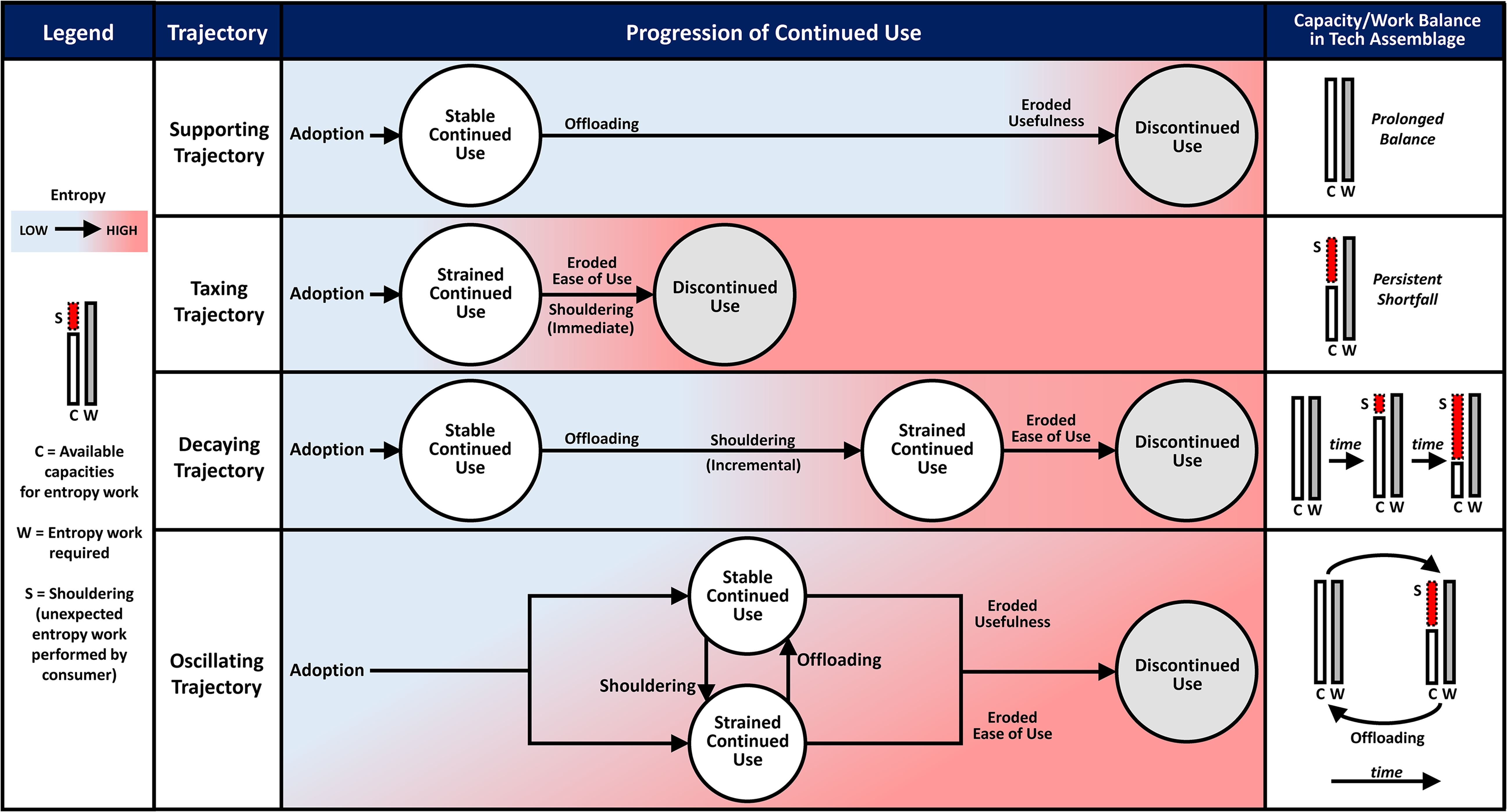
Four Continued Use Trajectories.
Supporting trajectories describe tech assemblages that persist in a low entropy state as components have capacities to perform entropy work to support a tech product's continued use. Although this trajectory can be cut short if a tech product fatally breaks down or is no longer deemed useful, it is characterized by stable continued use. These tightly territorialized assemblages retain their useful properties, and tech products embedded within them stay easy to use for long periods, imposing minimal work on consumers. However, consumers’ and objects’ capacities to perform work are not always so simple.
Taxing trajectories occur when components immediately fail to territorialize with stable properties. Due to numerous objects failing to exercise expected capacities, consumers must shoulder unexpected work to get a tech product to function, a situation we call strained continued use. In these situations, the tech assemblage persists in a high state of entropy, becoming too onerous for consumers to maintain. As a consequence, taxing trajectories often lead to what we call eroded ease of use, where tech products are quickly discarded.
Decaying trajectories, by contrast, take hold when components’ capacities to connect gradually fail, leading consumers to shoulder increasing entropy work. Although a territorialized tech assemblage in a low entropy state supports stable continued use during the earlier stages of this trajectory, entropy increases, and consumers begin to face strained continued use as ease of use is eroded. This trajectory typically ends in discontinued use when mounting deterritorializations make the tech product too hard to use.
Oscillating trajectories occur when components’ capacities are inconsistently exercised, requiring consumers to shoulder unpredictable entropy work to sustain continued use. In this trajectory, consumers shift between periods of stable and strained continued use. However, due to persistent high entropy, entropy work tends to fail, and tech assemblages are intermittently territorialized and deterritorialized. In this trajectory, continued use ends due to eroded ease of use or when tech products are replaced as they are no longer deemed useful.
Our framework suggests that tech products enjoy enduring continued use in a supporting trajectory where a consumer has minimal entropy work to enable the tech product’s consistent usefulness and ease of use. The remaining three trajectories, however, are more problematic due to the necessity to shoulder entropy work to derive useful properties. Consumers must shoulder entropy work right from the start of the trajectory (taxing), later in the trajectory (decaying), or intermittently across the trajectory (oscillating). Next, we illustrate our four continued use trajectories in more detail. Supplementary data points for each trajectory and our concepts are available in Web Appendices A and B.
The Supporting Trajectory
The supporting trajectory is an ideal situation where component parts of a tech assemblage consistently exhibit capacities to connect in ways that manifest a tech product's ease of use and usefulness. This trajectory is characterized by a territorialized tech assemblage in a low-entropy state. This means that components’ available capacities for entropy work are in balance with the work required to ensure the tech assemblage remains territorialized. As consumers only have to do minimal entropy work, continued use endures. The Lopez family's smart TV serves as an example: [Dad and I] rushed to buy this [smart] TV. … I remember it well because my friend was coming to stay over for Christmas and what we do is play Xbox and there's no other place to play but the lounge room. It [the family's rear-projection TV] broke that morning, so I had to buy the TV that day. (Elle Lopez) Whatever hardware is in [the smart TV] works well with our internet, ’cause it's very fast…it can handle streaming now. The other one you were just stuck with free TV. Whereas this one can do pretty much anything, and it has so many USB ports, so all my hard drives are attached. (Elle Lopez)
Elle also describes how the smart TV's capacities to connect as a part of a wider assemblage establish ease of use. These capacities to connect with existing devices and spaces meant that it meshed automatically and seamlessly with an existing remote control, Wi-Fi router, and their TV cabinet, demanding little to no work from Elle and her family. DeLanda (2016) explains that habits are an indication of territorialization. Indeed, the smart TV's continued use quickly became habitual, and the tech assemblage in which it had become a part was tightly territorialized (Novak and Hoffman 2023).
A territorialized tech assemblage helps sustain usefulness, ease of use, and continued use. And although entropy work can still feature in supporting trajectories, technologies will often perform this work without human intervention. When devices automatically update firmware, for instance, potentials for unruly capacities to deterritorialize a tech assemblage, such as bugs, are kept at bay. Nevertheless, if there is entropy work to be done by consumers, it is mostly limited to simple tasks such as checking settings and replacing apps, cables, or batteries (Robinson and Arnould 2020).
Although many consumers have the capacities to perform these simple and expected forms of entropy work, some require support. For example, Sadie's 21-year-old sister does not have the capacity to perform entropy work. Yet, her computer remains in a supporting trajectory thanks to family members who perform this work for her. My younger sister is not great with technology. Her response to most things is “I don’t know.” Or “Ask Dad.” As soon as she got her first computer, like 8 or 10 years old…it felt natural to just ask me. I think it's natural she keeps asking me, even though now she should know herself. (Sadie Lee)
Nevertheless, even during the lengthy periods of habitual consumption that occur in territorialized assemblages, entropy levels can rise. For instance, lifestyle changes can spell declining use for objects (Epp and Price 2010). Indeed, after a few years, Elle explains that the usefulness of the Lopez family's smart TV started to decline: I don’t play Xbox anymore. [The smart TV] is still there. No one sits in the lounge room now, so we bought a TV for guests! My parents like their TV/computer setup in their bedroom. I actually just use it for yoga now. (Elle Lopez)
The Taxing Trajectory
Taxing trajectories characterize circumstances when expected properties immediately fail to manifest. In contrast to the seamless continued use of the supporting trajectory, tech products in this trajectory lack capacities to match well with existing parts of an assemblage (DeLanda 2016; Hoffman and Novak 2018). This persistent shortfall in well-matched capacities places the assemblage in a state of higher entropy (Bryant 2014). Accordingly, consumers perform work to force coherence between devices in order to make their tech product useful. These unexpected demands for entropy work mean that consumers often quit on the tech product before it becomes part of a territorialized tech assemblage. Fred explains how issues with his digital audio workstation (DAW) began soon after purchase: I bought a DAW that you had to connect to a computer. It had software bugs and functions that didn’t really work. Akai [manufacturer] did not do too good in supporting it with software fixes. I got frustrated because I paid $600 for a creative tool, and I spent more time with technical gripes! (Fred Wilson) I got a Fitbit through work because we had a competition. I have a diabetes meter that connects via Bluetooth to my phone, that's always dropping out, and the Fitbit was a similar thing—the connection would always just be lost. … Then when it stopped charging, the little screen doesn’t turn on. (Chelsea Blair)
Here, another potentially useful object like a Fitbit does not have the capacity to connect as part of a tech assemblage, such that its usefulness and ease of use do not emerge. As such, Chelsea was forced to routinely monitor whether the Fitbit would sync with the associated app, disconnect/reconnect it to her smartphone, and troubleshoot its charger. The Fitbit and smartphone's lack of capacity to exchange data, and her charger's incapacity to power the Fitbit are further complicated by a diabetes meter. To Chelsea's surprise, this device exhibited an unruly capacity to impede the Fitbit's connection to her smartphone. As such, Chelsea's tech assemblage assumes a state of high entropy, it cannot become territorialized, and Chelsea must shoulder entropy work to address mounting problems in an effort to derive her Fitbit's usefulness and ease of use.
We label such situations strained continued use. Strained continued use motivates some consumers to offload work to enable usefulness and ease of use. Chelsea, for instance, frequently asked family to help. If offloading addresses degraded capacities such as those Chelsea laments, then the entropy of a taxing trajectory may be reduced, possibly resulting in the emergence of useful properties. However, if offloading fails, then the tech product will remain hard to use. As such, tech products following this trajectory face discontinued use. Kimberley's frustrations with a car MP3 player exhibit this possibility: This little thing, supposedly you can listen to MP3 files through your car radio—if I could get it to work! I bought it to play podcasts in the car from my phone. But there's a constant horrible crackle noise. … Like the car engine is giving out some signal through the device. I never had it work properly. My nephew couldn’t fix it either. This is typical; tech doesn’t work and we eventually give up on it. (Kimberley Fuller)
Taxing trajectories are often short-lived, as tech products never become parts of a territorialized assemblage. Chelsea jokes that her Fitbit is now in a drawer at home with other discarded devices (Bilton 2016). Likewise, when Fred realized he was spending more time working to get the DAW to function than using it to create music, he quit trying in favor of a simpler alternative: “I just bought a turntable. There's no internet, it just runs on electricity. That's as technical as it gets.” Fortunately, the turntable's capacities worked seamlessly with other components, quickly territorializing a low-entropy tech assemblage that has placed the turntable into a supporting trajectory that is likely to yield years of continued use.
The Decaying Trajectory
Some tech products become useful for a time, and enjoy habitual use, but gradually get harder to use. The decaying trajectory characterizes a shift from stable continued use to strained continued use, typified by participants describing tech products as “getting old” or “slowing down.” In this trajectory, tech assemblages gradually shift from low entropy to high entropy as components enter, exit, and wear out (Bryant 2014). As these kinds of changes accumulate, unruly capacities tend to emerge, and the potential for deterritorializations mount. Usefulness and ease of use then start to decline, forcing consumers to shoulder increasing entropy work as a product ages. For instance, Peter and Lisa Sotto describe how their smartphones are subject to increasing entropy: When you first get the phone, the battery goes well. But eventually it won’t work well anymore. The life of the battery gets shorter and shorter the more you use the phone. I have the problem of accessories. It's about how you take care of your phone. There's no more cases made for my phone anymore. I need to be extra careful now. My wife's phone is really old! It's your battery too? Yes, it's also the charger. I have problems with my smartphone's battery lifespan. … I might not always be able to charge it during work time [in addition to charging it overnight at home]. So, I’ve gotten a power bank. It's important because I’m taking trains coming home. It's to keep the family in the loop. Otherwise, you need to save your uses in case you have to make an emergency call. (Lisa Sotto)
As in many assemblages, components’ capacities to relate often go unnoticed until they fail (Hill, Canniford, and Mol 2014). As Lisa's phone's battery slowly wore out, she found herself performing more work to sustain this tech product's usefulness by adding a power bank. This device's charging capacities are vital to her, not least because her job as a hospital technician entails constant movement, and she needs to be able to contact family while commuting. Despite her anticipatory work to prevent a full-scale deterritorialization of her phone's useful properties, the power bank itself requires routine charging. This extra work was further compounded when Lisa found that she was no longer able to buy spare phone cases. Beyond shielding her smartphone from damage, its appearance enabled aesthetic capacities in her tech assemblage:
I like variety because it depends on my mood. I like to change the case to match what I’m wearing. When I wear scrubs [hospital clothing], my cases become blue because they rub off on them. I don’t like my casing looking untidy because it reflects your personality. … This case is the last surviving one—I don’t have any changes anymore. My frustration is that there's no supply of cases now [shows her case's blue blemishes]. (Lisa Sotto)
As manufacturers no longer make cases that fit her phone, Lisa deems it less useful. She also finds it harder to use as she must be careful with its protective case, preserving her phone's capacities to match her outfits, moods, and desired image (Kozinets 2008). We found similar instances of nontechnological objects affecting devices in our data (see also the Web Appendix). For instance, jeans pockets led phones to overheat or routinely fall to the ground, and walls and ceramic tiles impeded many devices’ capacities to connect via Wi-Fi. Indeed, Lisa showed us how hospital scrubs could stain her phone case. Despite her phone's degrading appearance, its capacities for calling and texting remain useful, and Lisa says she will use it until it breaks. Such hassles indicate that this phone has entered strained continued use.
For many consumers, however, entropy work can move technologies from strained continued use to discontinued use. In a decaying trajectory, a tech product that was initially useful and easy to use becomes subject to increasing capacity shortfalls that deterritorialize tech assemblages. For example, Elle describes how her laptop, which once had the capacity to mesh seamlessly with her iPhone, syncing her music collection, now demands increasing work: My old MacBook lasted for seven years. A couple of years ago I was looking at new laptops, because this old one started breaking down. I could feel it was dying. Like blanking screens and stuff, every now and then. I was like: “If I can’t turn this on anymore, I’m absolutely screwed.” Work stuff and my iTunes library were the first things I moved [onto an external hard drive]. (Elle Lopez)
The Oscillating Trajectory
Tech products in oscillating trajectories seesaw between stable and strained continued use. These oscillations occur due to tech assemblages that exhibit persistently high entropy states. Yet in contrast to the immediate work demanded in the taxing trajectory, or the slow increases in work in the decaying trajectory, the oscillating trajectory demands intermittent work. This entropy work is necessitated by components inconsistently exercising necessary capacities, such that the tech assemblage wavers between being territorialized and deterritorialized. As a result, usefulness, ease of use, and habitual use emerge and then erode, leaving users to shoulder unpredictable instances of entropy work to sustain continued use.
Arjun's laptop serves as an illustration. After purchase, it entered stable continued use, operating well with various apps and devices such that he was able to stream videos and tackle tasks for work and school. But the high entropy of the assemblage around the laptop deterritorialized its uses multiple times, demanding work to sustain continued use. In the first instance, the laptop's keyboard and touchpad failed to connect as expected: I had problems with the keyboard because it's detachable. Some keys were not working and the touchpad was not working. … So I googled stuff. I cleaned the sensors, but that didn’t solve the problem. I contacted Microsoft tech support. … Then it started working on its own—I don’t know! (Arjun Singh)
DeLanda (2016) explains that unlike properties that are limited and manifest, not all capacities of an assemblage or its components are expressed. Rather, capacities can lie dormant until a component with matching capacities is encountered (Franco, Canniford, and Phipps 2022). When this occurs, surprising properties can be revealed, and desired properties can be betrayed (Bryant 2014; Franco, Canniford, and Phipps 2022). During Arjun's initial period of stable continued use, it is likely that a variety of unruly capacities were dormant in his high-entropy tech assemblage. However, it is not clear what changed in his assemblage to disrupt the connective capacities between his laptop, keyboard, touchpad, and associated software.
Due to the complex and often nested status of assemblages (DeLanda 2016; Hoffman and Novak 2018; Huff, Humphreys, and Wilner 2021), it is often only possible to speculate on what alterations have led to the product’s unruly capacity in ways that disrupt desired properties. It could have been a new addition to the assemblage that triggered the problem. For example, our data show instances of tech products experiencing problems in humid places, such that we can speculate that moisture disrupted Arjun's device connections. Yet the culprit could also be a bug in a software update that altered the laptop's Bluetooth settings. With this level of ambiguity, the work necessary to reterritorialize this tech assemblage can be demanding, placing devices into strained continued use.
Weeks later, however, the laptop and these other components suddenly restored their capacities to connect, reterritorializing his tech assemblage with useful properties. As in a supporting trajectory, these objects performed the necessary work of making the laptop useful and easy to use again. But unlike a supporting trajectory, Arjun's tech assemblage remained in a state of high entropy. And, as such, it was not long before another unruly capacity was manifest, impeding the laptop's capacities to work with Wi-Fi, YouTube, and Netflix: I couldn’t stream! It would go on for like a minute or two, then it would start buffering. If it was for work it would have been bad, like if I was not able to access the internet at all. When this happens, whoever is facing the problem [Arjun or his roommate] unplugs the modem and plugs it back in. (Arjun Singh) It now keeps giving me RAM [random access memory] notifications. If I have YouTube, Acrobat, and Chrome—or Excel maybe—open at the same time, it will tell me, “Please save all of your data,” something is going to crash. (Arjun Singh)
This time, Arjun's laptop's RAM no longer had the capacity to run multiple apps at the same time. As before, Arjun was left guessing whether it was a software update or a heat source that had degraded his laptop's performance. In any case, Arjun began shouldering the work of backing up data and restarting apps to restore his laptop's capacities to connect with software. Some rise to the challenge of shouldering work to reterritorialize tech assemblages. This may depend on consumers’ capacities to understand how parts of an assemblage can operate as a whole (Hoffman and Novak 2015).
Arjun considered a variety of solutions such as offloading the entropy work to an automated hard drive. Unsurprisingly, he felt anxious due to the unpredictability of this work, the time demands of researching the potential causes of the problems, and fears of losing data. Moreover, the persistently high entropy that characterizes oscillating trajectories means it is never clear if solutions will successfully reterritorialize a tech assemblage, as further problems are likely to emerge. As such, the unpredictability of oscillating trajectories can test the patience of even tech-savvy consumers, eroding ease of use, placing tech products in strained continued use, and eventually motivating users to give up.
Why Tech Products Endure
Identifying four continued use trajectories enables us to explain why some tech products enjoy enduring uses, while others are more quickly discarded or replaced. These trajectories enable us to extend existing continued use theories by demonstrating that usefulness and ease of use are not inherent characteristics of particular tech products. Rather, they are properties that emerge when humans and objects have capacities to establish and sustain technology assemblages. These trajectories enable us to trace how entropy can impact the continued use of tech products over time, and how entropy work sustains continued use in technology assemblages in which problematic circumstances threaten discontinued use. With these findings in mind, we explain how our study extends continued use theories and contributes to more general marketing scholarship. Finally, we offer managerial considerations to help firms leverage the opportunities presented by our four continued use trajectories, before concluding with suggestions for future research.
An Assemblage Theory View of Continued Use
Our assemblage theory view extends theories of continued use. Such theories commonly apply the technology acceptance model (Davis 1989) and the unified theory of acceptance and use of technology (Venkatesh, Thong, and Xu 2012). These theories view continued use as driven by individual consumers’ judgments concerning the ongoing costs and benefits of using a particular tech product (e.g., Kim 2009; Ortiz de Guinea and Markus 2009; Setterstrom, Pearson, and Winwig 2013; Shaw, Ellis, and Ziegler 2018). By contrast, our study of contemporary interconnected technologies shows that continued use can be an outcome of relations in assemblages that are driven by forces beyond consumers’ intentions or habits.
By viewing usefulness and ease of use as emergent properties of tech assemblages, we explain that continued use is impacted by entropy (Bryant 2014). Tech assemblages can present lower or higher states of entropy, the latter revealing greater possibilities for unruly capacities to deterritorialize properties such as usefulness and ease of use. Entropy tends to increase over time as components wear out, as well as enter and exit assemblages, thereby raising the occurrence of unruly capacities. Accordingly, humans and objects must perform entropy work to sustain continued use.
These insights inform our framework in Figure 3 that highlights entropy-oriented mechanisms that ground our four continued use trajectories. Continued use is sustained if humans and objects have capacities to connect and territorialize a tech product among other components (Epp, Schau, and Price 2014; Hoffman and Novak 2018; Novak and Hoffman 2023). However, when components fail to exercise these capacities, or when unruly capacities emerge, the assemblage becomes prone to deterritorialization, putting usefulness and ease of use at stake. Specifically, accumulations of entropy erode ease of use since demands to sustain usefulness require consumers to shoulder increasing work.

An Assemblage Theory View of Continued Use.
If humans or objects can handle the entropy work required to reterritorialize an assemblage, or to anticipate and address unruly capacities before these thwart ease of use, then stable continued use will prevail. In this case, it is only when the useful properties of a tech product are eroded that it succumbs to discontinued use (top half of Figure 3). Consumers dealing with high levels of entropy, however, face strained continued use, particularly if the necessary work is difficult or if they cannot offload this entropy work. In either case, they are prone to quit using tech products because these have become too hard to use (bottom half of Figure 3).
As these possibilities demonstrate, entropy and the work it demands alter the usefulness and ease of use of tech products, thereby complicating continued use. This observation extends theories that explain usefulness and ease of use as deliberative evaluations made by consumers concerning individual technologies (e.g., Kim 2009; Ortiz de Guinea and Markus 2009). Further to this notion, we show that mechanisms beyond an individual product guide their ongoing evaluations.
In supporting trajectories and the earlier stages of decaying trajectories, consumers enjoy low-entropy tech assemblages where tech products are easy to use. As in prior studies (e.g., Setterstrom, Pearson, and Winwig 2013; Shaw, Ellis, and Ziegler 2018), tech products in these trajectories appear to be evaluated on their own merits with consumers continuing or discontinuing use based on how useful they deem it to be. Yet, when entropy is high, as in the taxing and oscillating trajectories, and the later stages of the decaying trajectory, it becomes clearer that tech product use is evaluated according to how tech products are able to form coherent parts of wider assemblages. In these cases, it becomes clear that consumer evaluations stem from unexpected work that is necessitated by how myriad devices and other influences fit together.
As such, our study shows that continued use is more a choice enabled or constrained by tech assemblages than driven by evaluations of individual products. In this respect, we also update how habitual consumption drives continued use. Prior studies explain that growing familiarity with a tech product's uses fosters contextual cues that prompt habitual use (Setterstrom, Pearson, and Winwig 2013; Shaw, Ellis, and Ziegler 2018). We show that habitual uses are an indication of, and enabled by, territorialized tech assemblages with low entropy. Further, where prior studies stop short of theorizing how habits can falter, we show that when assemblages fail to territorialize or are deterritorialized, habits are disrupted.
In the tightly territorialized assemblages that form in supporting trajectories, for instance, habits may endure for years. In taxing trajectories, assemblages fail to territorialize and consumers face persistent entropy work, such that habit formation is unlikely. Meanwhile, in decaying trajectories, habits form early on but as entropy rises, they are disrupted by mounting deterritorializations. Finally, oscillating trajectories show how habits can be intermittently formed and disrupted as high entropy inflicts sporadic deterritorializations that require bouts of often novel entropy work. As these four trajectories illustrate, habitual continued uses of tech products depend on how well humans and objects can establish and maintain territorialized relations within tech assemblages (DeLanda 2016).
Entropy Work in Technology Assemblages
By illustrating how continued use trajectories are influenced by entropy and the variable extents of entropy work performed by interconnected humans and objects, our study also contributes to research on technology assemblages. Prior studies show how changes in a tech assemblage's composition can alter consumers’ technology uses and experiences (Epp, Schau, and Price 2014; Huff, Humphreys, and Wilner 2021; Novak and Hoffman 2019; Parmentier and Fischer 2015). Bryant's (2014) concept of entropy enables us to extend this body of research by highlighting how such developments trend toward declining tech product uses and experiences.
Bryant (2014) explains that the tendency for entropy to rise in assemblages can make them prone to deterritorialization. We theorize that this results in emergent properties like usefulness and ease of use tending to erode over time. Entropy reminds us that assemblages and the properties they produce are often fragile, temporary achievements (Canniford and Shankar 2013; Epp, Schau, and Price 2014). For instance, many consumers learned that phones, tablets, and computers have the capacities to “crowd out” each other's internet connections during the COVID-19 pandemic, as work- and school-related uses and devices suddenly migrated into homes (Alba and Kang 2020). As this example illustrates, the emergence and exercise of unruly capacities can deterritorialize a tech assemblage, erode its properties, and demand work.
We contribute the concept of entropy work to conceptualize the actions that both humans and objects perform to sustain useful assemblage properties in the face of entropy. We have explained how the timing of entropy work varies according to when assemblages demand work and when this work is performed. In particular, the longer it takes for consumers to successfully reterritorialize the assemblage, the longer they will suffer strained continued use and the more likely they will quit using their tech product. Similarly, we show how proactive forms of entropy work can be effective in staving off potential deterritorializations before they can occur. Hence, the benefit of earlier timed and anticipatory entropy work is that consumers may enjoy prolonged periods of stable continued use.
These insights enable us to extend research that tracks how changes in assemblages can alter consumers’ experiences over time (Epp, Schau, and Price 2014; Hoffman and Novak 2015, 2018; Novak and Hoffman 2023). For instance, Novak and Hoffman (2019) explain that consumers and tech products can play “master” or “servant” roles in tech assemblages, and that these roles can shift. Our study explains that entropy can drive these shifts. For instance, decaying trajectories see consumers’ roles shifting from master to servant as rising entropy demands work. Meanwhile, oscillating trajectories feature consumer and tech product flipping between master and servant roles, due to intermittent deterritorializations. As these trajectories demonstrate, entropy and entropy work can drive different temporal patterns in consumer experiences that are generated by technology assemblages.
Our study also illustrates that the diverse quality of the work demanded in tech assemblages matters. Prior studies refer to reterritorialization processes that restore a tech assemblage's stability and properties (Hoffman and Novak 2015; Novak and Hoffman 2023). Entropy work goes beyond these instances, by including both reterritorialization and components’ actions that anticipate and address the possibilities for other components’ capacities to deterritorialize an assemblage. Such actions include humans and objects updating, optimizing, and cleaning devices and checking interconnections. The aim of this proactive work is to tackle rising entropy and prolong valued properties of assemblages such as usefulness and ease of use.
Accordingly, our study also sheds light on how entropy can make tech assemblages increasingly problematic. Lanier (2010) suggests that, once established, technology use can waver, as the technical standards to which components are built may not combine well with newer devices. Lanier terms this situation as “lock-in.” We suggest that entropy is a related effect to lock-in. For instance, the problems Fred faced with his DAW stem from the fact that this new tech product lacked the right capacities to link up seamlessly with an older computer system. Lock-in of this kind can increase entropy and require consumers to perform additional work in relation to a number of products.
The iPhone 15, for instance, is the first Apple smartphone to adhere to a European Union ruling that requires phones sold in the region to use USB-C cables (Porter 2022). Given that consumers have spent decades accruing Apple cables, continued use of the iPhone 15 and future models will require work to change cables, charging bricks, and accessories. In the short term, rises in entropy work are likely, as consumers will need to ensure that their tech assemblages remain territorialized while adopting newer iPhones. However, in the long term, mandating USB-C cables should reduce work, as users will no longer need to manage different accessory standards between brands. This insight suggests that studies of tech product compatibility (e.g., Canhoto and Arp 2017; Shih and Venkatesh 2004) may benefit from considering how tech assemblages can develop forms of “lock-in,” especially as such situations can make technology consumption frustrating, as we explain next.
Entropy and Technology Consumption
Our study offers insights that inform more general technology consumption scholarship in marketing. In recent years, marketing research has pointed out the complex, networked, and automated nature of contemporary tech products and their effects on consumers (Hoffman and Novak 2018; Novak and Hoffman 2019, 2023; Schneider-Kamp 2024). These effects include disillusionment, desires to escape the ubiquity of devices, and the feeling of being controlled by these technologies (Belk, Weijo, and Kozinets 2021; Humayun and Belk 2020; Schweitzer et al. 2019).
We suggest that these effects often emerge due to increasing entropy in assemblages, and the work consumers must shoulder to keep actual and potential threats to tech product use at bay. As our findings show, entropy can force consumers to shoulder simple but tedious work like updating, cleaning, or more frequent device charging (Robinson and Arnould 2020). However, entropy can also demand work that is beyond a consumer's skills, especially when technologies fail or use does not occur as planned (Thomas and Epp 2019). If consumers are unable to restore their tech products’ uses, they can become frustrated and overwhelmed.
Our research also has important implications for studies that explain how and why technologies frustrate consumers. Our study suggests that frustration is not only due to a technology's features (Mick and Fournier 1998), its meanings, and consumer expectations (Belk, Weijo, and Kozinets 2021; Kozinets 2008). Rather, frustrations can emerge from how a technology is related to other people and objects in assemblages (Epp, Schau, and Price 2014; Hoffman and Novak 2018). Given that entropy foregrounds how these relationships can also shift over time, frustration can become palpable as various unruly capacities emerge and demand that consumers perform unpredictable kinds and quantities of work to sustain continued use.
Considering entropy also offers insight into enabling and constraining consumer experiences in technology consumption contexts (Hoffman and Novak 2018). When entropy remains low and work is not shouldered by consumers, such as in the supporting or decaying trajectories, consumers feel enabled by their tech products due to stable continued use. For instance, the smart TVs in our data commonly enabled participants to do more kinds of tasks (e.g., streaming, gaming) due to the expanded capacities they add to assemblages, with little entropy work required.
Participants who battled tech products whose functions were getting harder to sustain instead faced constrained experiences, as high levels of entropy forced them to do elaborate entropy work to ensure the wider tech assemblage remained territorialized. Much of this work involves managing myriad devices and accessories like power banks and keyboards. However, we also found that unexpected objects like hospital scrubs, concrete walls, and ceramic tiles could similarly prompt participants to perform work to sustain continued use. As such, we also build on Hoffman and Novak (2018) by showing that even mundane objects can enable and constrain consumer experiences when they alter components’ capacities, thereby territorializing and deterritorializing assemblages.
As mundane objects are complicit in provoking tech use frustration, there is a need to broaden research focus beyond the networked nature of contemporary technologies. For instance, although recent studies have shown that smart technologies can frustrate consumers as much as benefit them (e.g., Novak and Hoffman 2019; Schweitzer et al. 2019), they stop short of accounting for nontechnological objects’ roles in generating these outcomes. By contrast, our entropy-oriented framework accounts for how nontechnological objects also sow the seeds for frustration through the unpredictable capacities they can contribute to assemblages. Our analysis shows how the capacities of assemblage components like clothing, moisture, and architectural features can deterritorialize assemblages and thwart tech products’ continued uses. Therefore, we argue that marketing scholars must remain aware of nontechnological objects when studying new and emerging technologies.
Finally, our research bears implications for studies that examine the consumption of tech products that have higher and lower levels of connectivity, such as comparisons between digital and analog technologies (Beverland, Fernandez, and Eckhardt 2024; Humayun and Belk 2020; Mardon and Belk 2018). Our framework emphasizes that tech products with limited capacities to connect, such as analog technologies, contribute fewer unruly capacities to tech assemblages. Recall our previous hi-fi example. Assemblages like these are more likely to remain in low-entropy states, meaning that embedded technologies tend to enjoy more enduring continued uses. In these cases, consumers can focus on the rewarding aspects of using their technologies (Beverland, Fernandez, and Eckhardt 2024). By contrast, highly connectable digital technologies can often burden consumers with frustrating, unexpected entropy work to ensure that they function.
Such demands stem from the myriad capacities that digital technologies contribute to tech assemblages, thereby fostering higher levels of entropy. This is because smart products are designed to connect and depend on many other devices to enable automation benefits (Novak and Hoffman 2023). Given consumers’ increasing needs to manage these manifold connections, as well as anticipate and respond to unruly capacities in assemblages, managers must be mindful that entropy and the work it demands can undermine the ease of use of digital technologies. Such insights bring us to the managerial implications of our work.
How to Manage Continued Use Trajectories
The four trajectories present different opportunities and risks to manage continued use based on a two-pronged approach (Figure 4). Managers can first consider two proactive approaches at the level of the tech product offering. These approaches intend for the tech product to last customers as long as possible (reflecting an aim to foster supporting continued use trajectories), or manage its life cycle to encourage customer upgrades (requiring management for decaying trajectories). Meanwhile, managers can also prepare to enact two reactive approaches at the individual customer level. These approaches depend on customers facing a high-entropy tech assemblage and either unexpected entropy work immediately after adoption (requiring managers to help fight a taxing trajectory) or intermittent unexpected work (requiring managers to help ameliorate an oscillating trajectory). In these reactive approaches, the aim is to shift a taxing or oscillating trajectory into a supporting or decaying trajectory by reducing entropy levels in the tech assemblage.
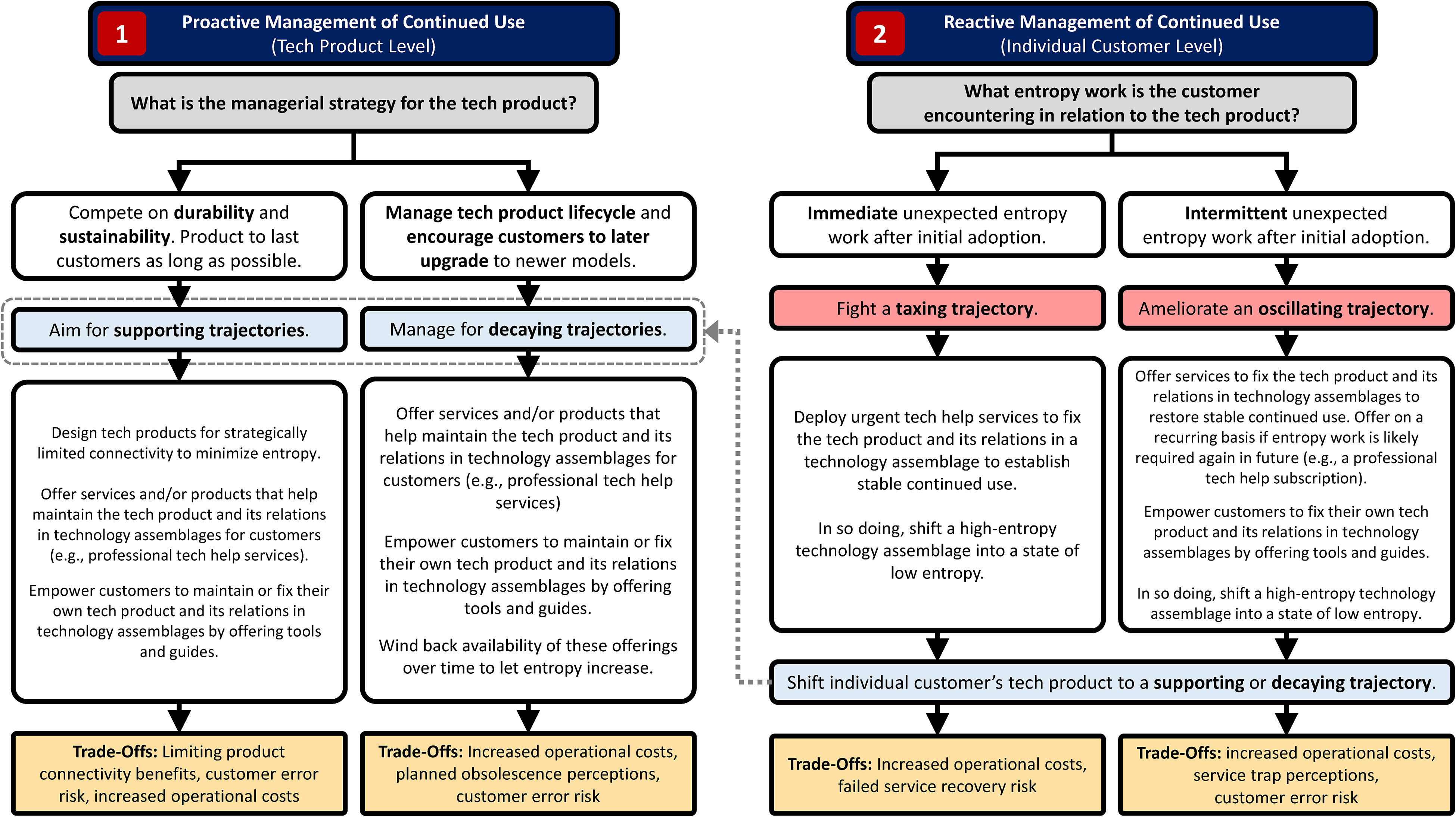
How to Manage Continued Use Trajectories.
Proactive Management of Continued Use
The supporting and decaying trajectories present managers with strategic opportunities and risks. Our data show that these trajectories often offer customers better experiences as tech assemblages in low states of entropy demand minimal entropy work to sustain useful properties. The choice of trajectory depends on the product strategy intended for the technology. Strategies premised on a tech product persisting in continued use for as long as possible suit aiming for supporting trajectories. Products designed for a limited lifespan in which customers are encouraged to upgrade later fit managing for decaying trajectories.
Aim for supporting trajectories
Brands that compete on durability and sustainability intend for products to last as long as possible, which suits an aim for supporting trajectories. Firms that aim for this trajectory should help customers hold tech assemblages together to prolong their product’s desired properties. Such aims require managers to consider product design aspects and offer customers continued resources and support (Venkatesh, Thong, and Xu 2012) that minimize the amount of work customers perform or how challenging it is to shoulder.
Managers can design products to enable low-entropy tech assemblages that give rise to supporting trajectories. Although myriad ways to connect are what drives the allure of smart technologies for consumers (Novak and Hoffman 2023), we suggest that managers can also consider limiting their connectivity where appropriate. We caution that as the possible connectivity of a tech product increases, the chances for unruly capacities to emerge and deterritorialize the product’s place in a wider tech assemblage also increases. As in our data, it may only take one such capacity to be revealed and threaten usefulness and ease of use. Sonos appears mindful of this problem, as this firm has long limited its smart speakers’ connectivity with other brands’ products to ensure that its own devices operate well together. Although critics have described this product design feature as limiting customers’ future purchasing choices, they concede that it enables Sonos customers to enjoy seamless ease of use (Burger 2023).
Beyond product design, entropy work can be reduced or made easier for customers through service offerings that anticipate unruly capacities that emerge in assemblages before these take hold and exert deterritorializing influences. iFixit is a company that offers “repair cafés” where customers can offload work to tech helpers who replace parts and optimize settings such that tech products have the capacity to work well with other devices for longer. iFixit also sells cleaning tools to manage dust and moisture, software to help with updates, and troubleshooting “fix kits” and guides. All of these offerings can ease the work that customers shoulder to keep tech assemblages territorialized by reducing the chances that customers make errors that further increase entropy and erode usefulness and ease of use.
Nevertheless, as Figure 4 suggests, the trade-off of increasing product longevity may heighten firms’ operational costs when offering tech help via in-store services, repair cafés, replacement parts, and guides to customers. Such costs can be addressed by partnering with firms that specialize in maintenance offerings. Notably, Samsung partners with iFixit to offer official guides and parts for Galaxy smartphones (Perry 2022). In doing so, Galaxy users are better able to keep their tech assemblages territorialized.
Manage for decaying trajectories
Opportunities exist to manage decaying trajectories by allowing entropy to accumulate in tech assemblages. Indeed, our study suggests that letting tech assemblages gradually shift to high-entropy states toward the end of a tech product's life cycle can make upgrades attractive. As such, firms can benefit from decaying trajectories by incentivizing upgrades to newer models (Bellezza, Ackerman, and Gino 2017). Decaying trajectories can be encouraged through service management. By gradually winding back the availability of services that enable customers to offload work, managers can allow entropy to build and increase the likelihood that a tech assemblage deterritorializes, incentivizing a new purchase.
Apple showcases this strategy in action. AppleCare enables customers to offload work to Apple technicians for two to three years after purchase. After this period, customers must rely on more costly certified technicians or third parties, or shoulder work themselves. In such cases, customers may be tempted to upgrade, prioritizing the expected ease of use of a new device over the continued use of their existing device. Nevertheless, pursuing this strategy requires careful consideration of whether consumers will tolerate rising entropy.
Indeed, a shorter decaying trajectory may offer brand enthusiasts and early adopters a welcome excuse to upgrade (Belk, Weijo, and Kozinets 2021; Bellezza, Ackerman, and Gino 2017; Muñiz and Schau 2005). Yet, offerings like AppleCare may be too short for customers who do not want to, or cannot afford to, upgrade after two to three years of use. In fact, the average Apple product is estimated to have four to five years of actual use (Dediu 2018). Given that AppleCare lasts well short of these products’ actual lifespans, customers who are left with reduced opportunities to offload entropy work may perceive these managerial actions as planned obsolescence (Muñiz and Schau 2005).
Companies that pile on entropy work to foster planned obsolescence threaten brand image by attracting negative attention from media and customers. For instance, when Apple admitted to slowing down older iPhones through software updates that coincided with the releases of new models (Kirby 2017), it ended up paying out $310 million in a class-action settlement (Collins 2022).
Currently, the entropy linked with the lifespans of parts like batteries often lies at the heart of decaying trajectories. Customers may increasingly expect companies to proactively address such commonly problematic parts to ensure that assemblages remain territorialized. Such moves are evidenced by governmental organizations and customers increasingly demanding life cycle assessments that reveal the environmental impacts of tech products (Peters 2023). Samsung and GoPro have recently turned this to their advantage by enabling batteries to be changed, prolonging the earlier stages of decaying trajectories (Fowler 2022).
Reactive Management of Continued Use
Taxing and oscillating trajectories present firms with challenges as customers encounter high-entropy tech assemblages that are yet to territorialize or are intermittently deterritorialized. These trajectories complicate continued use, as they demand unexpected entropy work. In particular, these trajectories feature strained continued use that can prime customers to quit on tech products even if they are potentially useful. Managers should help customers tackle these trajectories as they emerge. This can be achieved through offerings that can shift a customer's tech assemblage into a low-entropy state that supports stable continued use.
Fight a taxing trajectory
Firms must be prepared to fight the high-entropy assemblages that characterize taxing trajectories. Moreover, firms must succeed, or they risk further disappointing customers, damaging trust and future purchase intentions (Basso and Pizzutti 2016). For instance, soon after reports of its smartphones’ batteries overheating and exploding in 2016, Samsung initiated product recalls (Dolcourt 2017). During this time, customers faced strained continued uses due to volatile tech assemblages, not least due to fears of injury. Samsung performed the necessary work via recalls and replacements that cost some $5.3 billion. By stressing safety through recalling a product that added a dangerous capacity to customers’ tech assemblages, Samsung salvaged its brand image (Dobie 2021). As such, replacement phones without capacities to overheat so easily enabled affected customers to enjoy low-entropy assemblages and higher chances of prolonged continued use.
To fight entropy, however, managers may need to implement holistic investigations into which components are contributing unruly capacities and heightening entropy levels in an assemblage. Such potential for things to go wrong can prevent tech assemblages from territorializing. For instance, firms can visually map customers’ tech assemblages as we have done (see Figure 1) to discern which components might be contributing unruly capacities. Such maps can reveal issues that lie with a tech product itself, or with multiple other humans or objects to which it is connected in the wider assemblage.
This means that service recovery may entail work to address products that are not made by the firm in order to reduce entropy. Further, although faulty batteries have been blamed for Samsung smartphone explosions, attention to other objects that have capacities to cause overheating also required attention. In our data, cars sitting in the sun, protective cases with poor ventilation, and tight jeans pockets are all associated with overheating tech products in taxing trajectories. As these examples illustrate, fighting entropy can require dealing with myriad surprising objects that increase entropy in assemblages and complicate continued use (Bryant 2014; Franco, Canniford, and Phipps 2022).
Ameliorate an oscillating trajectory
Though difficult for customers, oscillating trajectories present opportunities for firms. In particular, value can be created by minimizing customers’ shifts between stable and strained continued use by ameliorating the high entropy of their tech assemblages. Similar to supporting and decaying trajectories, managers can ameliorate entropy by enabling customers to offload work. In best-case scenarios, offloading through repair-oriented entropy work shifts a tech assemblage from a high to low entropy state. This can result in the tech product shifting into a supporting or decaying trajectory, meaning that the customer can enjoy prolonged continued use of their tech product with little future work.
However, unique to the oscillating trajectory is that such work may not be successful and the tech assemblage might persist in a high-entropy state. Such circumstances present an opportunity for firms to establish enduring service relationships as tech product issues are likely to recur, despite customers enjoying limited periods of stable continued use. These relationships can be built on recurring tech help in anticipation of likely problems when unruly capacities are revealed in tech assemblages, rather than incidental engagements only when deterritorializations occur. This means tech helpers become integral relations that enable customers to sustain continued use, in spite of a persistently high-entropy assemblage.
Yet, firms must tread carefully when ameliorating entropy through this strategy. First, this strategy risks customers feeling “trapped” in service relationships, especially if they become dependent on a brand's technicians for entropy work (Fournier, Dobscha, and Mick 1998). For instance, although farmers have long shouldered the work of fixing their machinery, John Deere has increasingly forced its customers to consult authorized technicians for repairs. Complaints about unavoidable service fees have damaged John Deere's brand reputation.
Such concerns are only likely to increase: we note that Colorado has recently legislated to guarantee farmers the right to repair equipment, and refusal to provide repair resources will be considered a deceptive trade practice (Brodkin 2023). In light of consumer movements demanding the right to repair (Klosowski 2021), it may be appropriate for firms to empower customers’ in oscillating trajectories by reducing the difficulty of shouldering work. Ameliorating entropy requires that such offerings help customers learn how to repair their own tech products, restoring their capacities to connect in tech assemblages.
When firms offer tools and guides that help customers develop capacities to repair tech products, they can differentiate themselves from competitors. Gaming console company Valve positions repairability as a key part of its value offering through its vocal support of the right to repair movement (Gault 2022). Valve understands that gamers wear out parts like joysticks and screens over time, and that resulting issues can lead consoles into strained continued use and oscillating trajectories. Accordingly, Valve offers official replacement parts and guides that empower customers to conduct entropy work before tech product issues become frustrating. In so doing, Valve helps its customers prolong their tech products’ continued use as a way to establish itself in a highly competitive market.
Some customers may already have the required capacities to perform entropy work. Tech enthusiasts, for instance, derive pleasure and identity benefits from their interests in technology products (Bruner and Kumar 2007; Kozinets 2008). These customers might be skilled “assemblage thinkers” (Hoffman and Novak 2015) who can quickly understand how an assemblage can be reterritorialized through entropy work to keep a tech product in use for longer. From our perspective, these customers are “entropy workers” who use their skills to restore a tech product's continued use. Managers can partner with such “working consumers” (Cova and Dalli 2009) to source and implement solutions for entropy as it rises. For instance, software company Adobe hosts web communities to support and troubleshoot its suite of products (https://community.adobe.com/), and game developer Paradox Interactive provides platforms where customers can create downloadable add-ons that fix problems (Paradox Interactive 2023).
Despite these opportunities, ameliorating entropy by enabling customers to shoulder entropy work has its risks. As explained previously, customers may inadvertently deterritorialize technology assemblages when attempting entropy work. Given this risk, this focus perhaps best suits brands who target enthusiasts who are skilled enough already to perform entropy work as outlined previously.
Future Research Directions
To conclude, we consider our study's limitations and what our entropy and entropy work concepts can mean for future research into consumer and organizational marketing contexts.
First, consumers’ varying tolerances for entropy work offers marketers a new segmentation consideration. Reflecting on our participant sample, we have mainly considered consumers who do not enjoy entropy work. Yet, other kinds of orientations to entropy work likely exist among consumers. For those enthusiastic about technology (Hoffman and Novak 2018; Kozinets 2008), entropy work might be rewarding and promote agency (see Beverland, Fernandez, and Eckhardt 2024). Future research can explore how different segments may be oriented to entropy work to help managers consider what continued use trajectories are relevant to their marketing strategies. For instance, price-conscious consumers likely want their technologies to last for as long as possible. This means these consumers will be receptive to offerings that help them shoulder entropy work to avoid the costs of an upgrade. Consumers with strong sentimental attachments to their tech products may also be persistent in offloading or shouldering repairs (Godfrey, Price, and Lusch 2022; Muñiz and Schau 2005). These consumers may have greater tolerance for decaying or oscillating trajectories. Accordingly, developing typologies of consumers’ orientations to entropy work in light of various marketing strategies promises to be a fruitful area for future research.
Second, our concepts offer ways to think about emerging consumer technologies that will soon integrate advanced kinds of artificial intelligence (AI) (Hoffman et al. 2022; Puntoni et al. 2021; Schneider-Kamp 2024). Although we have studied everyday technologies with networked capabilities, AI-augmented tech products tend to be granted even more autonomy to do tasks without consumer involvement (Novak and Hoffman 2023). Complicating matters is that many AIs are “black boxes,” meaning that humans often cannot make sense of how they produce certain outcomes (Sartori and Theodorou 2022). If ordinary consumers have limited capacity to understand how AI-augmented devices like self-ordering fridges, self-driving cars, or care robots function, what chance do they have at shouldering entropy work to maintain or restore assemblages when things go wrong? Future marketing research should therefore study how consumers can navigate consumption contexts where firms and experts are the only ones with the necessary capacities to territorialize consumers’ tech assemblages through entropy work. Such studies will have implications for scholarship on the right to repair, disruptions to everyday routines, and consumers’ preferences for simpler technologies (e.g., Beverland, Fernandez, and Eckhardt 2024; Humayun and Belk 2020; Phipps and Ozanne 2017).
Third, our theorization that rising entropy is a tendency of assemblages highlights a part of DeLanda's (2011, 2016) assemblage theory that is seldom utilized by marketing researchers. Emphasizing tendencies enables researchers to illuminate and map patterns of change in an assemblage's properties and capacities (e.g., Hoffman and Novak 2018; Huff, Humphreys, and Wilner 2021). While we discern a frustrating tendency for entropy to rise in tech assemblages, other tendencies may benefit consumers. For instance, Hoffman and Novak (2015) note that smart home assemblages tend to improve in affordability and features over time. Future research should explore further tendencies of assemblages. Studies of how markets and brands change (Dolbec, Arsel, and Aboelenien 2022; Eagar, Lindridge, and Martin 2022; Parmentier and Fischer 2015), for example, can reveal different tendencies of market, brand, and consumption assemblages. In this regard, we envision that discerning tendencies can enrich future assemblage theory studies in marketing.
Finally, our research considers small-scale technology assemblages. We note, however, that many of our participants shouldered work to sustain tech products’ uses in relation to employment and wider communities. Future research should examine how entropy affects organizational contexts like schools, offices, hospitals, banks, hotels, and government and military installations, where complex technology assemblages often involve larger groups of people. Understanding entropy, and entropy work in these contexts, could inform how organizations can mitigate risks when tech assemblages deterritorialize (e.g., Smith, Conway, and Karsh 1999; Swanton 2013). For instance, the U.K. Post Office is currently mired in a scandal due to a computer system that erroneously flagged missing money in hundreds of post office branches. The unruly capacities within this tech assemblage enabled these errors such that more than 700 innocent users were prosecuted for false accounting and theft (Peachey, Race, and Sri-Pathma 2024). Studies of entropy and entropy work may also be invaluable for organizations that make tech products accessible to marginalized populations, such as those living in retirement or care facilities where residents often depend on communal devices to arrange welfare and pension payments (Franco 2020).
As these potential research directions illustrate, entropy work extends from customer-oriented assemblages, through business and public service assemblages, through to wider societal levels. Based on these potentials, we hope that this study enables scholars and practitioners to map how technology assemblages can be managed in ways that benefit stakeholders across a variety of contexts.
Supplemental Material
sj-pdf-1-jmx-10.1177_00222429241255306 - Supplemental material for Continued Use Trajectories: How Entropy Work Sustains Technology Assemblages
Supplemental material, sj-pdf-1-jmx-10.1177_00222429241255306 for Continued Use Trajectories: How Entropy Work Sustains Technology Assemblages by Paolo Franco, Robin Canniford, Marcus Phipps and Amber M. Epp in Journal of Marketing
Footnotes
Acknowledgments
This article is based on the first author's doctoral dissertation conducted at the University of Melbourne. The authors thank the JM editorial and review team for their generous comments on previous versions of this manuscript. The authors also thank colleagues at Radboud University, the University of Melbourne, KEDGE Business School, University of Wisconsin–Madison, and University of Illinois Chicago for their helpful comments during the manuscript development process. Last, the authors are grateful to the participants for their time and openness in sharing their experiences.
Coeditor
Cait Lamberton
Associate Editor
Rob V. Kozinets
Declaration of Conflicting Interests
The author(s) declared no potential conflicts of interest with respect to the research, authorship, and/or publication of this article.
Funding
The author(s) disclosed receipt of the following financial support for the research, authorship, and/or publication of this article: This research is based on the first author's doctoral dissertation, which was supported by an Australian Government Research Training Program (RTP) Scholarship.

References
Supplementary Material
Please find the following supplemental material available below.
For Open Access articles published under a Creative Commons License, all supplemental material carries the same license as the article it is associated with.
For non-Open Access articles published, all supplemental material carries a non-exclusive license, and permission requests for re-use of supplemental material or any part of supplemental material shall be sent directly to the copyright owner as specified in the copyright notice associated with the article.
